Segments - by Service Type (Corporate Events, Entertainment Events, Educational Events, Sports Events, Others), by Application (Corporate, Government, Education, Entertainment, Sports, Others), by Organization Size (Small and Medium Enterprises, Large Enterprises), by Channel (Online, Offline), by End-User (Corporate, Individuals, Government, Others)
This report is updated with the latest market data and insights as of June 2026. Base year: 2025 | Forecast period: 2026-2034
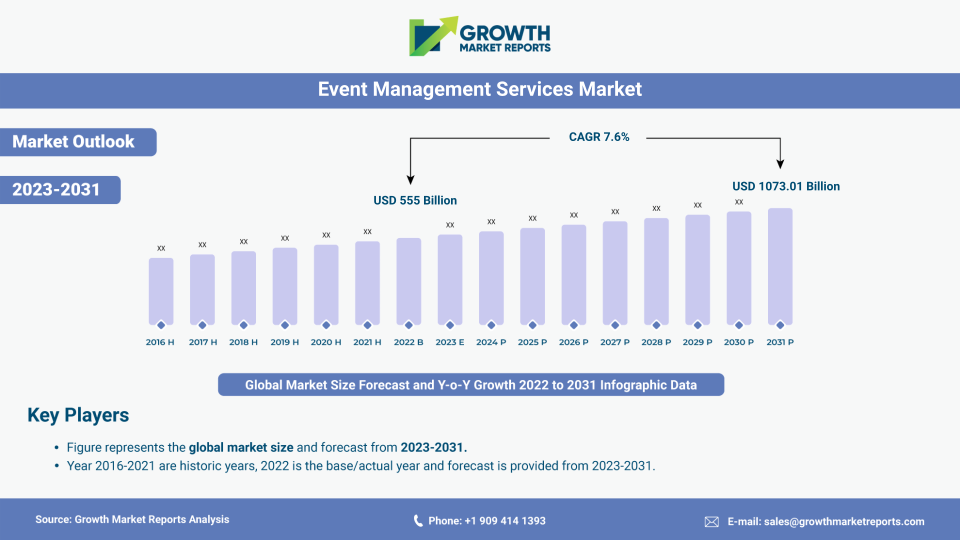
According to our latest research, the global event management services market size reached USD 1,207.4 billion in 2025, reflecting robust demand across diverse sectors. The market is projected to grow at a CAGR of 11.6% during the forecast period, reaching USD 3,098.5 billion by 2034. This significant growth is driven by the increasing adoption of digital technologies, rising demand for experiential marketing, and the expanding scope of corporate and entertainment events globally. As per our latest research, the industry's upward trajectory is underpinned by dynamic shifts in consumer preferences and the proliferation of hybrid event production formats, further fueling market expansion.
One of the primary growth factors accelerating the event management services market is the increasing emphasis on brand engagement and experiential marketing by organizations worldwide. In today's highly competitive business landscape, companies are leveraging events to foster deeper connections with their target audiences, enhance brand recall, and drive customer loyalty. The integration of advanced technologies such as artificial intelligence, augmented reality, and data analytics into event management solutions is enabling organizers to deliver personalized experiences, streamline operations, and measure event ROI more effectively. Furthermore, the sustained growth of hybrid and virtual events, which became entrenched during the pandemic era, has expanded the reach of events and introduced new revenue streams for service providers, contributing to continued market expansion well into 2025 and beyond.
Another key driver is the growing number of corporate, entertainment, and sports events across the globe. The robust return of in-person gatherings, coupled with the continued popularity of virtual and hybrid formats, is creating ample opportunities for event management companies to diversify their offerings and cater to a broader clientele. Corporate events such as product launches, conferences, and team-building activities are witnessing increased investment as organizations recognize the value of face-to-face interactions for networking and knowledge sharing. Similarly, the entertainment and sports sectors are experiencing a surge in large-scale events, concerts, and tournaments, further propelling demand for comprehensive event management solutions that encompass planning, logistics, marketing, and execution. Cycling event management, for example, has emerged as a niche but fast-growing sub-category reflecting the broader diversification of sports event formats.
The rapid digital transformation of the event management industry is also playing a pivotal role in market expansion. The widespread adoption of online registration platforms, event apps, live streaming, and virtual networking tools is enhancing attendee engagement and operational efficiency. Event organizers are leveraging data-driven insights to tailor event content, optimize resource allocation, and maximize attendee satisfaction. Additionally, the proliferation of social media and influencer marketing is amplifying event reach and impact, encouraging more individuals and organizations to invest in professional event management services. This digital shift is expected to continue shaping the industry landscape, fostering innovation and driving sustained growth over the 2026-2034 forecast period.
Event Stewarding Services play a crucial role in ensuring the smooth execution of large-scale events, particularly in the sports and entertainment sectors. These services encompass a range of responsibilities, including crowd management, security, and guest assistance, which are vital for maintaining order and enhancing the overall attendee experience. With the increasing complexity of events and the growing emphasis on safety and security, the demand for professional event stewarding services is on the rise. Companies specializing in these services are leveraging advanced technologies, such as real-time monitoring and communication systems, to enhance operational efficiency and responsiveness. As the event management industry continues to evolve through 2025 and beyond, the integration of stewarding services is becoming a key component of comprehensive event solutions, ensuring that events are not only successful but also safe and enjoyable for all participants.
From a regional perspective, North America currently dominates the event management services market, accounting for approximately 37.5% of the global share in 2025, followed by Europe at 26.8% and Asia Pacific at 23.5%. North America's leadership is attributed to the high concentration of multinational corporations, advanced technological infrastructure, and a mature event ecosystem. However, the Asia Pacific region is poised for the fastest growth, driven by rising disposable incomes, increasing urbanization, and a burgeoning middle-class population. Countries such as China, India, and Japan are witnessing a surge in corporate, entertainment, and sports events, presenting lucrative opportunities for market players. Meanwhile, Latin America and the Middle East and Africa are also emerging as promising markets, supported by government initiatives to promote event-led tourism and cultural programming.
The event management services market is segmented by service type into corporate events, entertainment events, educational events, sports events, and others. Corporate events constitute the largest segment, accounting for approximately 34.5% of the market in 2025, driven by the increasing frequency of conferences, product launches, seminars, and team-building activities. Organizations are increasingly recognizing the value of professional event management in ensuring seamless execution, enhancing attendee experience, and achieving strategic business objectives. Service providers are offering end-to-end solutions, including venue selection, logistics, catering, audiovisual support, and post-event analysis, to cater to the evolving needs of corporate clients. The demand for innovative event formats, such as hybrid and virtual meetings, is further augmenting the growth of this segment. For a deeper exploration of this category, the corporate event market offers complementary intelligence on buyer trends and competitive dynamics.
Entertainment events represent another major segment, holding approximately 24.8% of market share in 2025, and encompassing concerts, music festivals, award shows, and cultural performances. The resurgence of live entertainment, coupled with the growing popularity of experiential and immersive events, is fueling demand for specialized event management services. Organizers are leveraging cutting-edge technologies such as augmented reality, holography, and interactive installations to create memorable experiences for attendees. The entertainment segment is also witnessing increased collaboration between event management companies and artists, sponsors, and media partners to maximize event reach and monetization opportunities. As audiences seek unique and engaging experiences, service providers are continuously innovating to stay ahead of the curve.
The educational events segment, representing around 12.1% of the market in 2025, is gaining traction, driven by the rising number of academic conferences, workshops, seminars, and training programs. Educational institutions, professional associations, and training organizations are increasingly outsourcing event management to ensure smooth coordination, effective communication, and optimal participant engagement. The adoption of virtual and hybrid event formats is enabling organizers to reach a global audience, reduce costs, and enhance knowledge sharing. Service providers are offering customized solutions, including online registration, content management, live streaming, and interactive Q&A sessions, to meet the specific requirements of educational events. This segment is expected to witness steady growth as the demand for lifelong learning and professional development continues to rise.
Campus Event Management is emerging as a significant sub-category within the educational events segment, driven by the increasing number of academic and extracurricular activities organized by educational institutions. These events, ranging from conferences and workshops to cultural festivals and sports competitions, require meticulous planning and execution to achieve their objectives. Professional event management companies are collaborating with universities and colleges to offer tailored solutions that address the unique needs of campus events. This includes venue selection, logistics coordination, and the integration of digital technologies to enhance participant engagement and streamline operations. As educational institutions continue to expand their event portfolios, the demand for specialized campus event management services is expected to grow, providing new opportunities for service providers to innovate and differentiate their offerings.
Sports events form a dynamic and rapidly growing segment, representing approximately 18.2% of the global market in 2025. The proliferation of local, national, and international sporting events, coupled with increased media coverage and sponsorship investments, is driving demand for comprehensive event management solutions. Organizers are focusing on delivering seamless experiences for athletes, spectators, sponsors, and broadcasters, encompassing aspects such as ticketing, security, logistics, hospitality, and on-site management. The integration of digital technologies, such as mobile apps for real-time updates and virtual fan engagement platforms, is enhancing the overall event experience. Sports event catering has emerged as a particularly fast-growing ancillary service category, reflecting increasing expectations for premium hospitality at major competitions.
The others category, accounting for approximately 10.4% of the market in 2025, includes a diverse range of events such as trade shows, exhibitions, charity galas, and private celebrations. This segment is characterized by its versatility and adaptability, catering to the unique requirements of various clients and industries. Event management service providers are leveraging their expertise to deliver customized solutions that align with the objectives and preferences of each event. The growing trend of themed events, experiential marketing activations, and destination events is creating new opportunities for innovation and differentiation within this segment. Demand for high-end experiences, including luxury event production and bespoke activations, is particularly strong, as clients seek memorable and impactful experiences that stand apart from standard formats.
| Attributes | Details |
| Report Title | Event Management Services Market Research Report 2034 |
| By Service Type | Corporate Events, Entertainment Events, Educational Events, Sports Events, Others |
| By Application | Corporate, Government, Education, Entertainment, Sports, Others |
| By Organization Size | Small and Medium Enterprises, Large Enterprises |
| By Channel | Online, Offline |
| By End-User | Corporate, Individuals, Government, Others |
| Regions Covered | North America, Europe, APAC, Latin America, MEA |
| Base Year | 2025 |
| Historic Data | 2019-2024 |
| Forecast Period | 2026-2034 |
| Number of Pages | 294 |
| Number of Tables & Figures | 261 |
| Customization Available | Yes, the report can be customized as per your need. |
The event management services market is segmented by application into corporate, government, education, entertainment, sports, and others. The corporate application segment holds a dominant position, driven by the increasing number of business events, conferences, product launches, and networking sessions in 2025 and beyond. Organizations are investing in professional event management to enhance brand visibility, foster business relationships, and drive employee engagement. The integration of technology, such as event apps, virtual networking platforms, and data analytics, is enabling corporate clients to achieve measurable outcomes and maximize return on investment. The demand for innovative event formats, such as hybrid and experiential events, is further fueling growth in this segment.
The government application segment is witnessing steady growth, supported by the rising number of public events, official ceremonies, policy forums, and community engagement initiatives. Government agencies are increasingly partnering with event management companies to ensure efficient planning, coordination, and execution of large-scale events. The focus on transparency, inclusivity, and stakeholder engagement is driving demand for specialized event management solutions that cater to the unique requirements of government events. Service providers are leveraging their expertise in logistics, security, and protocol management to deliver successful outcomes for government clients globally in 2025.
In the education application segment, demand for event management services is being driven by the increasing number of academic conferences, seminars, workshops, and graduation ceremonies. Educational institutions are recognizing the value of professional event management in enhancing the quality of events, improving participant experience, and achieving learning objectives. The adoption of virtual and hybrid event formats is enabling organizers to reach a wider audience, reduce costs, and facilitate knowledge sharing. Service providers are offering end-to-end solutions, including online registration, content management, live streaming, and interactive sessions, to meet the specific needs of educational events.
The entertainment and sports application segments are experiencing robust growth in 2025, fueled by the resurgence of live events and the increasing popularity of experiential and immersive experiences. Organizers are leveraging advanced technologies and creative concepts to deliver memorable events that captivate audiences and drive engagement. The focus on safety, security, and crowd management is also driving demand for professional event management services in these segments. As the entertainment and sports industries continue to evolve, service providers are playing a crucial role in ensuring the success of high-profile events and maximizing stakeholder value.
The others segment includes a wide range of applications such as trade shows, exhibitions, charity events, and private celebrations. This segment is characterized by its diversity and flexibility, catering to the unique requirements of various clients and industries. Event management companies are leveraging their expertise to deliver customized solutions that align with the objectives and preferences of each event. The growing trend of themed events, experiential marketing activations, and destination events is creating new opportunities for innovation and differentiation within this segment through the forecast period to 2034.
The event management services market is segmented by organization size into small and medium enterprises (SMEs) and large enterprises. Large enterprises account for a significant share of the market in 2025, driven by their substantial budgets, complex event requirements, and focus on brand building. These organizations are increasingly outsourcing event management to professional service providers to ensure seamless execution, enhance attendee experience, and achieve strategic business objectives. The demand for innovative event formats, such as hybrid and experiential events, is particularly strong among large enterprises, as they seek to differentiate themselves in a competitive marketplace.
Small and medium enterprises (SMEs) are also emerging as a key growth segment in the event management services market. With the increasing recognition of the value of events for marketing, networking, and employee engagement, SMEs are investing in professional event management solutions to enhance the quality and impact of their events. The availability of cost-effective and scalable event management services is enabling SMEs to access the same level of expertise and resources as larger organizations. Service providers are offering tailored solutions that cater to the specific needs and budgets of SMEs, including flexible pricing models, modular service offerings, and digital tools for event planning and execution.
The adoption of digital technologies is leveling the playing field for SMEs, enabling them to compete more effectively with larger organizations in the event space. Online registration platforms, event apps, and virtual networking tools are making it easier for SMEs to organize and manage events, reach a wider audience, and deliver engaging experiences. The growing trend of hybrid and virtual events is also reducing barriers to entry for SMEs, allowing them to host events without the need for significant upfront investments in physical infrastructure. This democratization of event management capabilities is expected to drive SME segment growth at an above-average pace through 2034.
Large enterprises continue to drive innovation in the event management services market, setting new standards for event quality, attendee engagement, and ROI measurement. These organizations are leveraging advanced technologies, such as artificial intelligence, data analytics, and immersive experiences, to create impactful events that resonate with their target audiences. The focus on sustainability, inclusivity, and social responsibility is also shaping the event strategies of large enterprises, driving demand for eco-friendly and socially conscious event management solutions as stakeholder expectations evolve through the latter half of the 2020s.
Both SMEs and large enterprises are increasingly seeking integrated event management solutions that encompass planning, logistics, marketing, and post-event analysis. Service providers are responding to this demand by offering comprehensive, end-to-end solutions that streamline event management processes, enhance operational efficiency, and deliver measurable outcomes. The ability to deliver scalable, flexible, and customized solutions is becoming a key differentiator for event management companies in a highly competitive market as of 2025.
The event management services market is segmented by channel into online and offline. The online channel is witnessing rapid growth, driven by the widespread adoption of digital technologies and the increasing preference for virtual and hybrid event formats. Online event management platforms are enabling organizers to streamline event planning, registration, ticketing, marketing, and attendee engagement through a single, integrated interface. The ability to reach a global audience, reduce costs, and gather real-time data is making online channels an attractive option for both organizers and attendees in 2025.
The proliferation of event management software, mobile apps, and virtual networking tools is transforming the way events are planned, executed, and measured. Organizers are leveraging these digital solutions to automate routine tasks, personalize attendee experiences, and analyze event performance. The integration of features such as live streaming, interactive polls, virtual exhibitor booths, and AI-driven matchmaking is enhancing the value proposition of online event management channels. As a result, service providers are investing heavily in technology development and partnerships to stay ahead in the digital event management landscape through 2034.
Despite the rapid growth of online channels, the offline channel continues to play a vital role in the event management services market, particularly for in-person and experiential events. Face-to-face interactions, networking opportunities, and immersive experiences remain highly valued by attendees, making offline channels indispensable for certain types of events. Event management companies are focusing on delivering seamless, high-quality experiences through meticulous planning, logistics management, and on-site support as in-person event volumes continue to grow strongly in 2025.
The integration of online and offline channels is giving rise to hybrid event formats, which combine the best of both worlds. Hybrid events enable organizers to reach a larger audience, offer flexible participation options, and maximize event impact. Service providers are developing integrated solutions that facilitate smooth coordination between online and offline components, ensuring a cohesive and engaging experience for all participants. The ability to deliver hybrid events is becoming a key differentiator for event management companies in a rapidly evolving market, reflecting the continued investment in hybrid event production services globally.
As the event management services market continues to evolve through 2026-2034, the balance between online and offline channels will be shaped by factors such as technological advancements, changing consumer preferences, and sustainability considerations. Service providers that can offer flexible, scalable, and integrated solutions across both channels will be well-positioned to capitalize on emerging opportunities and drive sustained growth.
The event management services market is segmented by end-user into corporate, individuals, government, and others. The corporate end-user segment dominates the market in 2025, driven by the increasing number of business events, conferences, product launches, and networking sessions. Organizations are investing in professional event management to enhance brand visibility, foster business relationships, and drive employee engagement. The demand for innovative event formats, such as hybrid and experiential events, is particularly strong among corporate clients, as they seek to differentiate themselves in a competitive marketplace and maximize the return on their event investments.
The individuals end-user segment is also experiencing steady growth, fueled by the rising popularity of personal celebrations, weddings, milestone events, and private parties. Individuals are increasingly seeking professional event management services to ensure seamless planning, execution, and memorable experiences for their guests. Service providers are offering customized solutions that cater to the unique preferences, themes, and budgets of individual clients. The growing trend of destination weddings, themed parties, and experiential celebrations is creating new opportunities for innovation and differentiation within this segment, with demand for premium event concierge offerings rising sharply among high-net-worth individuals.
The government end-user segment is witnessing increased demand for event management services, driven by the rising number of public events, official ceremonies, policy forums, and community engagement initiatives in 2025. Government agencies are partnering with event management companies to ensure efficient planning, coordination, and execution of large-scale events. The focus on transparency, inclusivity, and stakeholder engagement is driving demand for specialized event management solutions that cater to the unique requirements of government events across all regions.
The others segment includes a diverse range of end-users such as non-profit organizations, educational institutions, and professional associations. This segment is characterized by its diversity and flexibility, catering to the unique requirements of various clients and industries. Event management companies are leveraging their expertise to deliver customized solutions that align with the objectives and preferences of each end-user. The growing trend of themed events, experiential marketing activations, and destination events is creating new opportunities for innovation and differentiation within this segment through the 2026-2034 forecast period.
Across all end-user segments, the demand for professional event management services is being driven by the need for seamless execution, enhanced attendee experience, and measurable outcomes. Service providers that can offer integrated, flexible, and customized solutions are well-positioned to capture a larger share of the market and drive sustained growth to 2034.
The event management services market is ripe with opportunities, particularly in the realm of digital transformation and hybrid event formats. The rapid adoption of virtual and hybrid events is enabling organizers to reach a global audience, reduce costs, and enhance attendee engagement. Service providers that can offer innovative digital solutions, such as AI-driven matchmaking, virtual exhibitor booths, and interactive content, are well-positioned to capitalize on this trend through 2034. The growing focus on data-driven decision-making is also creating opportunities for event management companies to offer advanced analytics and ROI measurement tools, enabling clients to optimize event strategies and maximize returns. Furthermore, the growing global appetite for event decor and rental services reflects broader consumer demand for visually distinctive and memorable event environments.
Another significant opportunity lies in the expansion of the event management services market in emerging economies. Rising disposable incomes, increasing urbanization, and a burgeoning middle-class population are driving demand for corporate, entertainment, and sports events in regions such as Asia Pacific, Latin America, and the Middle East and Africa. Governments in these regions are also investing in tourism promotion and cultural events, creating new opportunities for market players. Service providers that can tailor their offerings to the unique needs and preferences of clients in these markets will be well-positioned to capture a larger share of the global market over the 2026-2034 forecast period.
Despite the numerous opportunities, the event management services market faces several restraining factors. One of the primary challenges is the high level of competition and price sensitivity in the industry, which can put pressure on profit margins. Additionally, ongoing economic volatility and geopolitical uncertainties pose risks to event planning and execution. Event management companies must be agile and adaptable, leveraging technology and innovation to mitigate risks and deliver value to clients. Regulatory compliance, cybersecurity concerns, and environmental sustainability are also emerging as critical considerations for event organizers and service providers as stakeholder expectations continue to rise through 2025 and beyond.
North America remains the largest regional market for event management services, accounting for approximately 37.5% of the global market in 2025, or around USD 452.8 billion. The region's leadership is driven by a mature event ecosystem, a high concentration of multinational corporations, and advanced technological infrastructure. The United States, in particular, is a hub for large-scale corporate, entertainment, and sports events, attracting significant investments in professional event management services. The demand for innovative event formats, such as hybrid and experiential events, is particularly strong in North America, as organizations seek to enhance attendee engagement and maximize ROI across the 2026-2034 forecast period.
Europe is the second-largest market, capturing about 26.8% of the global share, or approximately USD 323.6 billion in 2025. The region's rich cultural heritage, robust tourism industry, and strong tradition of public and private events contribute to steady demand for event management services. Countries such as the United Kingdom, Germany, France, and Italy are key markets, supported by a vibrant event ecosystem and favorable regulatory environment. The focus on sustainability, inclusivity, and innovation is shaping the event management landscape in Europe, driving demand for eco-friendly and socially responsible event solutions through 2034.
The Asia Pacific region is poised for the fastest growth, projected to expand at a CAGR of 14.2% during the 2026-2034 forecast period. In 2025, the region accounted for 23.5% of the global market, or about USD 283.7 billion. Rapid urbanization, rising disposable incomes, and a burgeoning middle-class population are fueling demand for corporate, entertainment, and sports events in countries such as China, India, Japan, and Australia. Governments in the region are also investing in tourism promotion and cultural events, creating new opportunities for market players. The adoption of digital technologies and hybrid event formats is accelerating market growth, enabling organizers to reach a wider audience and deliver engaging experiences across the region.
Latin America accounts for approximately 7.2% of the global market in 2025, representing around USD 86.9 billion, with Brazil, Mexico, and Colombia as the leading markets in the region. The Middle East and Africa holds approximately 5.0% of global share, or about USD 60.4 billion in 2025, driven by ambitious government investments in mega-events, tourism infrastructure, and cultural programming, particularly in the Gulf Cooperation Council countries. Both regions are expected to outpace the global average growth rate through 2034, as rising incomes, expanding urbanization, and growing corporate activity continue to stimulate event management demand.
The event management services market is highly competitive, characterized by the presence of numerous global, regional, and local players. The competitive landscape is shaped by factors such as service quality, technological innovation, pricing strategies, and customer experience. Leading companies are investing in advanced technologies, such as artificial intelligence, data analytics, and virtual event platforms, to differentiate their offerings and enhance value for clients. The ability to deliver integrated, end-to-end solutions that encompass planning, logistics, marketing, and post-event analysis is becoming a key differentiator in the market as of 2025.
Strategic partnerships, mergers and acquisitions, and geographic expansion are common strategies employed by major players to strengthen their market position and expand their service portfolios. Companies are also focusing on sustainability, inclusivity, and social responsibility to align with evolving client expectations and regulatory requirements. The growing prevalence of hybrid and virtual events is driving investments in digital infrastructure and capabilities, enabling service providers to offer flexible and scalable solutions that cater to a diverse range of clients and event types throughout the 2026-2034 forecast period.
The market is also witnessing the emergence of niche players and startups that specialize in specific event types, applications, or technologies. These companies are leveraging their agility and innovation to capture market share and address unmet needs in the industry. The increasing demand for personalized and experiential events is creating opportunities for boutique event management firms that can deliver unique and memorable experiences for clients across corporate, entertainment, and private event categories.
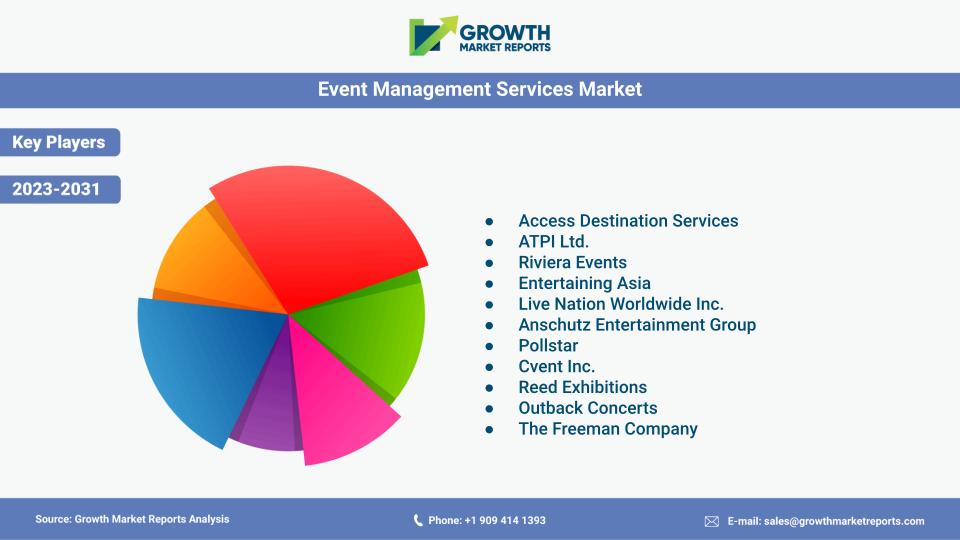
Major companies operating in the event management services market include BCD Meetings & Events, Cvent Inc., Freeman Company, Informa PLC (RX Global), Live Nation Entertainment, MCI Group, GL Events, Eventbrite Inc., George P. Johnson Experience Marketing, Jack Morton Worldwide, Maritz Global Events, ATPI Ltd., Sodexo Live!, and The Interpublic Group of Companies. These companies offer a wide range of services, including event planning, logistics, marketing, technology solutions, and on-site management. BCD Meetings & Events is recognized for its global reach and expertise in corporate event management, while Cvent Inc. leads in event technology solutions, including cloud-based planning, registration, and analytics platforms. Freeman Company is distinguished by its creative event design and production capabilities, and Informa PLC (RX Global) is a dominant player in the trade show and exhibition segment.
Live Nation Entertainment maintains its leadership in the live entertainment segment, organizing some of the world's largest concerts and music festivals, supported by its ownership of major venues and ticketing infrastructure. GL Events is prominent in the trade show and exhibition space, offering comprehensive event management solutions for clients across various industries across Europe and internationally. ATPI Ltd. specializes in sports and corporate events, while MCI Group is recognized for its expertise in association and government events. Eventbrite Inc. continues as a leading online event management and ticketing platform, catering to a wide range of event types and sizes globally.
These companies are continuously innovating and expanding their service offerings to stay ahead in a rapidly evolving market. Investments in technology, strategic partnerships, and a relentless focus on customer experience are key drivers of competitive advantage. As the event management services market continues to grow from its 2025 base toward 2034, companies that can deliver integrated, flexible, and customized solutions will be well-positioned to capture a larger share of the global market and drive sustained growth.
The Event Management Services market has been segmented on the basis of
Yes, the report can be fully customized to meet specific research requirements. Customization options include additional country-level or city-level analysis, deeper segmentation by event type or industry vertical, competitive benchmarking for specific companies, analysis of niche event categories, and tailored forecast scenarios. Please contact our research team to discuss your specific customization needs.
Hybrid and virtual events have become a permanent fixture in the event management landscape, accounting for a growing share of total event activity. They enable organizers to reach global audiences without geographic constraints, reduce per-attendee costs, and generate richer data on participant behavior and engagement. Service providers are investing heavily in hybrid event production capabilities, interactive digital features, and integrated online-offline management platforms to meet rising client demand for flexible event formats across all sectors.
Leading companies in the market include BCD Meetings & Events, Cvent Inc., Freeman Company, Informa PLC (RX Global), Live Nation Entertainment, MCI Group, GL Events, Eventbrite Inc., George P. Johnson Experience Marketing, Jack Morton Worldwide, Maritz Global Events, ATPI Ltd., Sodexo Live!, and The Interpublic Group of Companies. These firms compete on the basis of technological innovation, global reach, creative capabilities, and end-to-end service integration.
The industry faces several significant challenges, including intense competition and margin pressure from a fragmented supplier landscape, economic uncertainty that can cause corporate clients to scale back event budgets, evolving health and safety regulations, cybersecurity risks associated with online event platforms, and the logistical complexity of executing large-scale hybrid events. Environmental sustainability expectations are also increasing, requiring providers to adopt greener practices while maintaining service quality.
Digital technologies are fundamentally reshaping the industry. Artificial intelligence is enabling smarter attendee matchmaking, personalized content delivery, and predictive analytics for event planning. Virtual and hybrid event platforms are extending the geographic reach of events while reducing costs. Mobile apps, live streaming, online registration systems, and immersive technologies such as augmented reality are enhancing attendee engagement and operational efficiency. Event organizers are also leveraging social media and influencer marketing to amplify event visibility and drive attendance.
Event management services cover a broad spectrum of event types, including corporate events (conferences, product launches, seminars, team-building activities), entertainment events (concerts, music festivals, award shows), educational events (academic conferences, workshops, training programs), sports events (tournaments, marathons, league competitions), and others such as trade shows, exhibitions, charity galas, and private celebrations.
North America holds the largest regional share at approximately 37.5% of global revenue in 2025, followed by Europe at 26.8% and Asia Pacific at 23.5%. Asia Pacific is forecast to grow at the fastest pace, with a CAGR of around 14.2% through 2034, driven by urbanization, rising incomes, and expanding corporate and entertainment event activity in China, India, Japan, and Southeast Asia.
Key growth drivers include increasing corporate spending on experiential marketing, the rapid integration of artificial intelligence and data analytics into event planning, the sustained popularity of hybrid and virtual event formats, rising disposable incomes in emerging markets, and growing government investment in tourism and cultural events. The post-pandemic resurgence of large-scale in-person events is also a major catalyst.
The market is projected to grow at a compound annual growth rate (CAGR) of 11.6% over the 2026-2034 forecast period, reaching approximately USD 3,098.5 billion by 2034. This growth is underpinned by rising adoption of hybrid event formats, digital technologies, and expanding demand in emerging economies.
The global event management services market reached USD 1,207.4 billion in 2025, reflecting robust demand across corporate, entertainment, sports, and educational event categories worldwide. This figure represents the base-year valuation used in this report.