Cloud-based Financial Management Software Market Research Report 2033

Cloud-based Financial Management Software Market Research Report 2033

Segments - by Component (Software, Services), by Deployment Mode (Public Cloud, Private Cloud, Hybrid Cloud), by Organization Size (Small and Medium Enterprises, Large Enterprises), by Application (Accounting & Budgeting, Revenue & Invoice Management, Payroll Management, Asset Management, Others), by End-User (BFSI, Healthcare, Retail & E-commerce, Manufacturing, IT & Telecommunications, Government, Others)

https://growthmarketreports.com/Raksha
Author : Raksha Sharma
https://growthmarketreports.com/Vaibhav
Fact-checked by : V. Chandola
https://growthmarketreports.com/Shruti
Editor : Shruti Bhat

Upcoming | Report ID :ICT-SE-5012 | 4.0 Rating | 73 Reviews | 272 Pages | Format : Docx PDF

Report Description


Cloud-based Financial Management Software Market Outlook

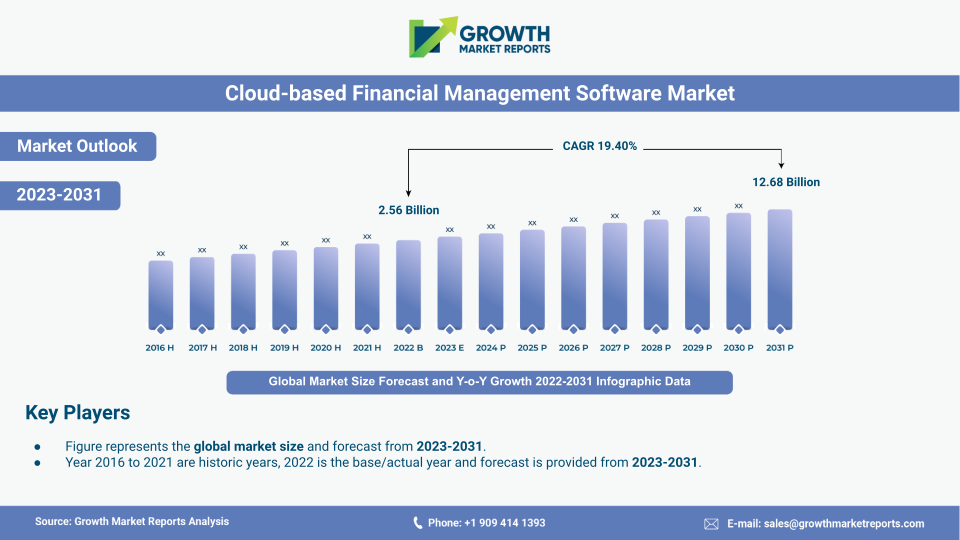
According to our latest research, the global market size for Cloud-based Financial Management Software reached USD 17.8 billion in 2024, demonstrating robust momentum driven by digital transformation initiatives across industries. The market is expected to expand at a CAGR of 11.4% from 2025 to 2033, reaching a projected value of USD 48.9 billion by 2033. This impressive growth trajectory is underpinned by increasing demand for real-time financial insights, automation of complex financial processes, and the scalability offered by cloud-based solutions. As per our latest research, organizations worldwide are rapidly adopting these platforms to modernize their finance operations and enhance decision-making capabilities.

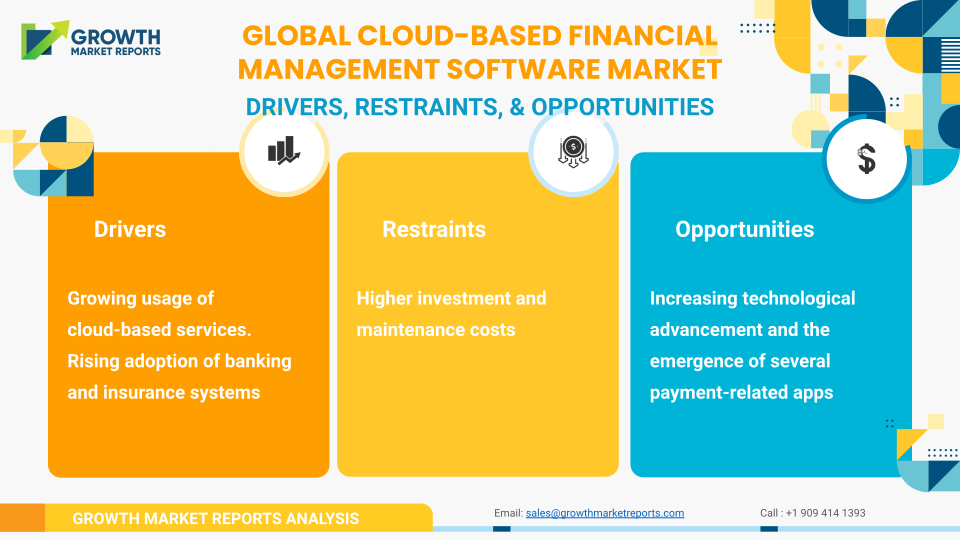
One of the primary growth factors fueling the cloud-based financial management software market is the accelerating pace of digital transformation across businesses of all sizes. Enterprises are increasingly recognizing the importance of agile, scalable, and cost-effective financial management solutions that can seamlessly integrate with existing IT infrastructure. The move away from legacy on-premises systems toward cloud-based platforms is not only reducing operational costs but also enabling organizations to access advanced analytics, artificial intelligence, and machine learning functionalities. This shift is particularly pronounced among small and medium enterprises (SMEs), who benefit from the lower upfront investments and reduced IT maintenance costs that cloud solutions offer. Additionally, the COVID-19 pandemic has further catalyzed the adoption of remote financial management tools, as businesses seek to ensure continuity and resilience in the face of ongoing disruptions.

Another significant driver for the market is the increasing regulatory scrutiny and the need for enhanced compliance in the financial sector. Cloud-based financial management software provides robust frameworks for managing complex regulatory requirements, automating tax calculations, and ensuring accurate reporting. These platforms are equipped with advanced security protocols, encryption, and audit trails, which help organizations mitigate risks related to data breaches and fraud. The ability to generate real-time reports and maintain transparency across financial operations is also crucial for organizations aiming to comply with evolving global standards such as IFRS, SOX, and GDPR. As regulatory landscapes become more intricate, the demand for cloud-based solutions that can adapt quickly to new requirements is expected to surge, further propelling market growth.

The evolving landscape of business models and the rise of globalized operations are also contributing to the expansion of the cloud-based financial management software market. Companies are increasingly operating across multiple geographies, necessitating financial management platforms that offer multi-currency, multi-language, and multi-entity capabilities. Cloud-based solutions provide the flexibility and scalability needed to manage distributed teams, diverse regulatory environments, and complex supply chains. The integration of these platforms with enterprise resource planning (ERP), customer relationship management (CRM), and business intelligence (BI) systems enables organizations to gain holistic visibility into their financial health and make data-driven strategic decisions. This interconnected ecosystem is fostering innovation and driving the adoption of cloud-based financial management software across various industry verticals.

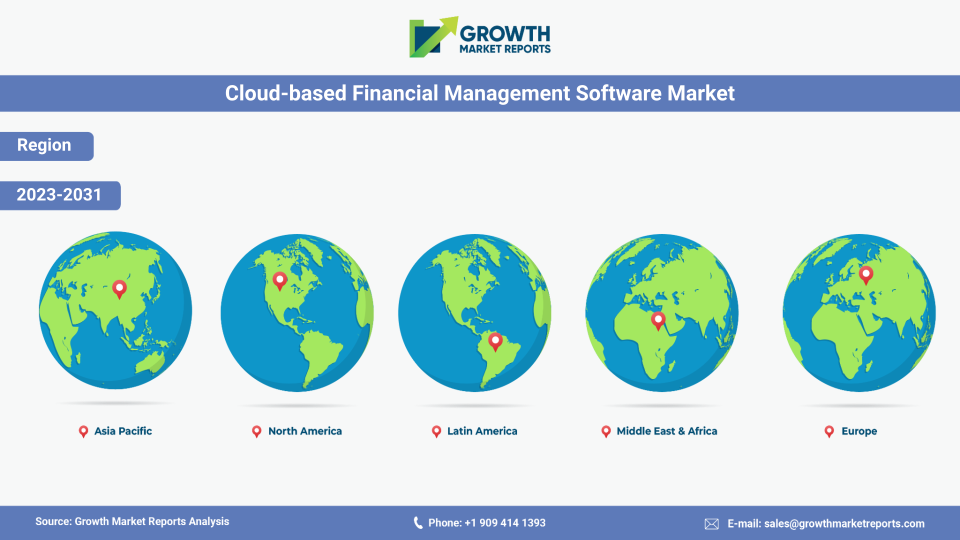
Regionally, North America continues to lead the global market, accounting for the largest share due to the early adoption of cloud technologies and the presence of major software vendors. However, the Asia Pacific region is emerging as a significant growth engine, driven by rapid digitalization, increasing investments in cloud infrastructure, and the proliferation of start-ups and SMEs. Europe is witnessing steady growth owing to stringent regulatory requirements and the growing focus on financial transparency. Meanwhile, Latin America and the Middle East & Africa are showing promising potential as organizations in these regions increasingly embrace cloud solutions to overcome legacy system limitations and enhance operational efficiency. The regional dynamics of the market are shaped by varying levels of technological maturity, regulatory frameworks, and business environments, making it essential for vendors to tailor their offerings to local needs.

Global Cloud-based Financial Management Software Industry Outlook

Component Analysis

The component segment of the cloud-based financial management software market is bifurcated into software and services, each playing a pivotal role in driving the market’s expansion. The software sub-segment encompasses comprehensive financial management platforms that integrate functionalities such as accounting, budgeting, payroll, revenue management, and asset tracking. These solutions are designed to streamline financial operations, reduce manual errors, and provide real-time data accessibility. The increasing demand for automation and advanced analytics is pushing organizations to invest in robust software platforms that can scale as their business grows. Furthermore, the integration of artificial intelligence and machine learning into these platforms is enabling predictive analytics, anomaly detection, and intelligent forecasting, which are critical for strategic financial planning.

On the other hand, the services sub-segment includes professional services such as implementation, consulting, training, and support, which are essential for the successful deployment and adoption of cloud-based financial management software. As organizations transition from traditional systems to cloud environments, they often require expert guidance to ensure seamless migration, data integrity, and optimal configuration of the software. Managed services, in particular, are gaining traction as they allow businesses to outsource the day-to-day management of their financial software, freeing up internal resources to focus on core activities. The growing complexity of cloud environments and the need for continuous updates and security patches further underscore the importance of service offerings in this market.

The interplay between software and services is crucial for delivering end-to-end value to customers. While software solutions provide the backbone for financial management, services ensure that these platforms are tailored to the unique needs of each organization and are functioning at peak efficiency. Vendors are increasingly offering bundled solutions that combine software licenses with comprehensive service packages, enabling clients to maximize their return on investment. This trend is particularly evident among large enterprises with complex financial operations, as well as SMEs seeking cost-effective solutions that minimize the need for in-house IT expertise. The ability to offer flexible, scalable, and customizable solutions is emerging as a key differentiator for vendors in the highly competitive cloud-based financial management software market.

Moreover, the rapid pace of technological innovation is driving continuous enhancements in both software and service offerings. Vendors are leveraging cloud-native architectures, microservices, and APIs to deliver highly modular and interoperable solutions that can be easily integrated with other business systems. This approach not only accelerates deployment timelines but also enables organizations to adopt a best-of-breed strategy, selecting the most suitable components for their specific requirements. The growing adoption of subscription-based pricing models is also making advanced financial management capabilities accessible to a broader range of organizations, further fueling market growth. As the market matures, the ability to deliver seamless, end-to-end solutions that combine cutting-edge software with expert services will be critical for sustained success.

Report Scope

Attributes Details
Report Title Cloud-based Financial Management Software Market Research Report 2033
By Component Software, Services
By Deployment Mode Public Cloud, Private Cloud, Hybrid Cloud
By Organization Size Small and Medium Enterprises, Large Enterprises
By Application Accounting & Budgeting, Revenue & Invoice Management, Payroll Management, Asset Management, Others
By End-User BFSI, Healthcare, Retail & E-commerce, Manufacturing, IT & Telecommunications, Government, Others
Regions Covered North America, Europe, APAC, Latin America, MEA
Base Year 2024
Historic Data 2018-2023
Forecast Period 2025-2033
Number of Pages 272
Number of Tables & Figures 320
Customization Available Yes, the report can be customized as per your need.

Deployment Mode Analysis

The deployment mode segment is categorized into public cloud, private cloud, and hybrid cloud, each offering distinct advantages and addressing specific business needs. Public cloud deployment is characterized by its cost-effectiveness, scalability, and ease of access, making it the preferred choice for small and medium enterprises (SMEs) and organizations with limited IT resources. By leveraging shared infrastructure, businesses can rapidly deploy financial management solutions without the need for significant capital investments in hardware or maintenance. Public cloud platforms also facilitate seamless updates and enhancements, ensuring that users always have access to the latest features and security patches. The widespread adoption of public cloud solutions is being driven by the growing acceptance of Software-as-a-Service (SaaS) models and the increasing availability of robust, enterprise-grade offerings from leading vendors.

Private cloud deployment, on the other hand, is favored by large enterprises and organizations operating in highly regulated industries such as banking, healthcare, and government. Private clouds provide enhanced control, customization, and security, allowing organizations to tailor their financial management environments to specific compliance requirements and operational needs. The ability to maintain dedicated infrastructure and implement stringent access controls is particularly important for organizations handling sensitive financial data and adhering to strict regulatory mandates. While private cloud solutions typically involve higher upfront costs and greater complexity, they offer unparalleled flexibility and peace of mind for organizations with advanced security and governance needs. As data privacy concerns and regulatory pressures continue to mount, the demand for private cloud deployments is expected to remain strong.

Hybrid cloud deployment represents a middle ground, combining the benefits of both public and private clouds to deliver a flexible, scalable, and resilient financial management environment. Hybrid solutions enable organizations to seamlessly integrate on-premises systems with cloud-based platforms, facilitating data sharing, workload balancing, and disaster recovery. This approach is particularly attractive for organizations undergoing digital transformation, as it allows them to gradually migrate critical financial processes to the cloud while maintaining legacy systems where necessary. Hybrid deployments also support multi-cloud strategies, enabling organizations to leverage best-in-class solutions from multiple vendors and avoid vendor lock-in. The growing complexity of financial operations and the need for business continuity are driving increased adoption of hybrid cloud models in the financial management software market.

The choice of deployment mode is influenced by a variety of factors, including organizational size, industry, regulatory environment, and strategic objectives. Vendors are responding to these diverse requirements by offering flexible deployment options and robust migration tools that simplify the transition to cloud-based financial management. The ability to provide seamless integration, strong security, and high availability across deployment models is emerging as a key competitive differentiator. As organizations continue to navigate the complexities of cloud adoption, the deployment mode segment will remain a critical area of focus for both vendors and end-users, shaping the future trajectory of the cloud-based financial management software market.

Organization Size Analysis

The organization size segment is divided into small and medium enterprises (SMEs) and large enterprises, each with distinct needs and adoption patterns. SMEs are increasingly embracing cloud-based financial management software to drive efficiency, reduce costs, and gain access to advanced functionalities that were previously out of reach due to budget constraints. The subscription-based pricing models offered by cloud vendors eliminate the need for significant upfront investments, making it easier for SMEs to adopt state-of-the-art financial management solutions. Additionally, the scalability of cloud platforms allows SMEs to start with basic modules and gradually expand their usage as their business grows. The ability to access financial data in real-time, automate routine tasks, and generate insightful reports is empowering SMEs to make informed decisions and compete more effectively in the market.

Large enterprises, on the other hand, require robust, highly customizable financial management solutions capable of handling complex, multi-entity operations across global markets. These organizations often have intricate financial structures, diverse regulatory requirements, and a high volume of transactions, necessitating advanced features such as multi-currency support, consolidation, and sophisticated analytics. Cloud-based platforms offer the flexibility and scalability needed to manage these complexities, while also enabling seamless integration with other enterprise systems such as ERP, CRM, and HRM. Large enterprises are also leveraging cloud-based financial management software to drive digital transformation initiatives, enhance collaboration among distributed teams, and improve compliance with global standards. The ability to centralize financial data and processes in a secure, cloud-based environment is delivering significant operational efficiencies and strategic advantages.

The adoption dynamics within each organization size segment are influenced by factors such as IT maturity, budget constraints, regulatory requirements, and strategic priorities. SMEs are generally more agile and open to adopting new technologies, while large enterprises may face challenges related to legacy systems, data migration, and change management. Vendors are addressing these challenges by offering tailored solutions, dedicated support, and comprehensive training programs designed to facilitate smooth transitions and maximize user adoption. The growing availability of industry-specific solutions is also enabling organizations of all sizes to address unique financial management challenges and regulatory requirements, further driving market growth.

Furthermore, the rise of remote work and distributed teams is accelerating the adoption of cloud-based financial management software across organizations of all sizes. The ability to access financial data and collaborate in real-time from anywhere is becoming a critical requirement in today’s dynamic business environment. Cloud platforms are also enabling organizations to leverage advanced technologies such as AI, machine learning, and predictive analytics, which were previously accessible only to large enterprises with significant IT resources. As the market continues to evolve, the ability to deliver scalable, flexible, and user-friendly solutions tailored to the needs of different organization sizes will be essential for vendors seeking to capture a larger share of the cloud-based financial management software market.

Application Analysis

The application segment of the cloud-based financial management software market encompasses a wide range of functionalities, including accounting & budgeting, revenue & invoice management, payroll management, asset management, and other specialized financial processes. Accounting & budgeting remains the cornerstone application, as organizations seek to streamline core financial operations, ensure accurate record-keeping, and facilitate strategic planning. Cloud-based platforms offer real-time visibility into financial performance, enabling organizations to monitor budgets, track expenses, and forecast future trends with greater accuracy. The automation of routine accounting tasks, such as journal entries and reconciliations, is reducing manual errors and freeing up finance teams to focus on higher-value activities. The integration of budgeting tools with other financial modules is also enabling organizations to align financial planning with business objectives and respond quickly to changing market conditions.

Revenue & invoice management is another critical application area, particularly for organizations with complex billing structures and high transaction volumes. Cloud-based solutions enable automated invoice generation, real-time revenue recognition, and seamless integration with payment gateways, reducing the risk of errors and improving cash flow management. The ability to track receivables, automate reminders, and generate detailed reports is helping organizations optimize their revenue cycles and enhance customer satisfaction. Advanced analytics and reporting tools are also enabling organizations to identify trends, detect anomalies, and make data-driven decisions to maximize profitability. The growing adoption of subscription-based business models and the proliferation of digital payment methods are further driving demand for cloud-based revenue & invoice management solutions.

Payroll management is a vital application, particularly for organizations with distributed workforces and complex compensation structures. Cloud-based payroll solutions automate the calculation of salaries, deductions, taxes, and benefits, ensuring compliance with local regulations and reducing administrative overhead. The ability to integrate payroll data with other HR and financial systems is enabling organizations to streamline processes, improve accuracy, and enhance employee satisfaction. Cloud platforms also facilitate self-service capabilities, allowing employees to access pay slips, update personal information, and manage benefits online. The increasing complexity of payroll regulations and the need for timely, accurate payments are driving organizations to adopt cloud-based payroll management solutions that offer flexibility, scalability, and robust security.

Asset management is an emerging application area, as organizations seek to optimize the utilization and lifecycle management of their financial and physical assets. Cloud-based asset management solutions provide real-time visibility into asset inventory, depreciation, maintenance schedules, and compliance requirements. The integration of asset management with accounting and budgeting modules is enabling organizations to make informed investment decisions, reduce costs, and improve operational efficiency. The growing adoption of Internet of Things (IoT) technologies is further enhancing asset tracking and management capabilities, enabling organizations to monitor asset performance and predict maintenance needs in real-time. As organizations continue to expand their asset portfolios and operate in increasingly complex environments, the demand for cloud-based asset management solutions is expected to rise.

End-User Analysis

The end-user segment of the cloud-based financial management software market includes BFSI, healthcare, retail & e-commerce, manufacturing, IT & telecommunications, government, and others, each with distinct requirements and adoption patterns. The BFSI sector is a major adopter of cloud-based financial management software, driven by the need for robust security, regulatory compliance, and real-time financial insights. Banks, insurance companies, and financial institutions are leveraging cloud platforms to automate core financial processes, improve risk management, and enhance customer service. The ability to integrate financial management with other banking systems is enabling BFSI organizations to streamline operations, reduce costs, and respond quickly to market changes. The increasing focus on digital banking and the proliferation of fintech solutions are further accelerating the adoption of cloud-based financial management software in the BFSI sector.

The healthcare sector is also witnessing significant adoption of cloud-based financial management software, as organizations seek to optimize revenue cycles, manage complex billing structures, and ensure compliance with healthcare regulations. Cloud platforms are enabling healthcare providers to automate billing, track reimbursements, and generate detailed financial reports, improving transparency and accountability. The integration of financial management with electronic health records (EHR) and other clinical systems is enabling healthcare organizations to align financial planning with patient care objectives and improve operational efficiency. The growing emphasis on value-based care and the need for cost containment are driving healthcare organizations to adopt cloud-based financial management solutions that offer flexibility, scalability, and robust analytics capabilities.

Retail & e-commerce companies are increasingly adopting cloud-based financial management software to manage high transaction volumes, optimize inventory, and improve cash flow management. The ability to integrate financial management with point-of-sale (POS), inventory, and customer relationship management (CRM) systems is enabling retailers to gain real-time visibility into sales, expenses, and profitability. Cloud platforms are also facilitating the adoption of omnichannel business models, enabling retailers to manage financial operations across physical stores, online platforms, and mobile channels. The growing complexity of retail operations and the need for agile, data-driven decision-making are driving the adoption of cloud-based financial management software in the retail & e-commerce sector.

Manufacturing, IT & telecommunications, and government sectors are also significant end-users of cloud-based financial management software, each with unique requirements related to compliance, scalability, and integration. Manufacturing organizations are leveraging cloud platforms to manage complex supply chains, optimize production costs, and improve financial planning. IT & telecommunications companies are adopting cloud-based solutions to manage recurring revenue streams, automate billing, and enhance financial reporting. Government agencies are increasingly utilizing cloud-based financial management software to improve transparency, streamline budgeting processes, and ensure compliance with public sector regulations. The ability to tailor cloud-based solutions to the specific needs of different industry verticals is a key factor driving market growth and vendor differentiation.

Opportunities & Threats

The cloud-based financial management software market presents a wealth of opportunities for vendors, investors, and end-users alike. One of the most promising opportunities lies in the integration of advanced technologies such as artificial intelligence, machine learning, and predictive analytics into financial management platforms. These technologies are enabling organizations to automate complex financial processes, detect anomalies, and generate actionable insights that drive strategic decision-making. The rise of open banking, digital payments, and fintech innovations is also creating new avenues for market expansion, as organizations seek to integrate financial management platforms with a broader ecosystem of digital services. The growing adoption of cloud-based solutions in emerging markets, particularly in Asia Pacific and Latin America, presents significant growth potential as organizations in these regions seek to modernize their financial operations and compete on a global scale.

Another key opportunity for market participants is the increasing demand for industry-specific solutions tailored to the unique needs of different verticals. Organizations in sectors such as healthcare, manufacturing, and government face distinct regulatory, operational, and financial challenges that require specialized functionality and compliance capabilities. Vendors that can offer customizable, modular solutions that address these industry-specific requirements are well-positioned to capture a larger share of the market. The shift toward subscription-based pricing models and the growing popularity of managed services are also creating opportunities for vendors to build long-term, recurring revenue streams and deepen customer relationships. As organizations continue to prioritize agility, scalability, and digital transformation, the demand for innovative, cloud-based financial management software is expected to remain strong.

Despite the numerous opportunities, the market also faces certain restraining factors that could impede growth. Data security and privacy concerns remain a significant challenge, particularly for organizations operating in highly regulated industries or handling sensitive financial information. The risk of data breaches, cyber-attacks, and unauthorized access is a major concern for businesses considering the migration of critical financial processes to the cloud. Additionally, the complexity of integrating cloud-based financial management software with existing legacy systems can pose significant challenges, particularly for large enterprises with intricate IT environments. The lack of skilled professionals with expertise in cloud technologies and financial management is another potential bottleneck, as organizations may struggle to implement and maintain advanced solutions. Addressing these challenges will require ongoing investment in security, training, and integration capabilities to ensure the continued growth and success of the cloud-based financial management software market.

Regional Outlook

North America remains the dominant region in the cloud-based financial management software market, accounting for approximately USD 7.2 billion of the global market size in 2024. The region’s leadership is driven by the early adoption of cloud technologies, the presence of major software vendors, and a highly mature IT infrastructure. Organizations in the United States and Canada are at the forefront of digital transformation initiatives, leveraging cloud-based financial management platforms to drive innovation, improve efficiency, and enhance compliance. The strong focus on regulatory compliance, coupled with the growing adoption of advanced analytics and artificial intelligence, is further fueling market growth in North America. The region is expected to maintain its leadership position throughout the forecast period, with a steady CAGR reflecting continued investment in cloud technologies.

The Asia Pacific region is emerging as a significant growth engine for the cloud-based financial management software market, with a market size of USD 4.1 billion in 2024 and an anticipated CAGR of 14.2% through 2033. Rapid economic development, increasing investments in cloud infrastructure, and the proliferation of start-ups and SMEs are driving the adoption of cloud-based financial management solutions across the region. Countries such as China, India, Japan, and Australia are witnessing a surge in demand for scalable, cost-effective financial management platforms that can support business expansion and regulatory compliance. The growing emphasis on digitalization, coupled with government initiatives to promote cloud adoption, is creating a favorable environment for market growth in Asia Pacific. As organizations in the region continue to modernize their financial operations, the demand for innovative, cloud-based solutions is expected to rise significantly.

Europe is also a key market for cloud-based financial management software, with a market size of USD 3.6 billion in 2024. The region’s growth is driven by stringent regulatory requirements, the increasing focus on financial transparency, and the widespread adoption of cloud technologies across industries. Organizations in countries such as the United Kingdom, Germany, France, and the Nordics are leveraging cloud-based platforms to enhance compliance, improve operational efficiency, and drive digital transformation. The growing emphasis on data privacy, coupled with the need for real-time financial insights, is fueling the adoption of cloud-based financial management solutions in Europe. Meanwhile, Latin America and the Middle East & Africa are showing promising potential, with market sizes of USD 1.8 billion and USD 1.1 billion respectively in 2024. These regions are increasingly embracing cloud solutions to overcome legacy system limitations and enhance operational efficiency, although growth rates may vary depending on local economic and regulatory conditions.

Cloud-based Financial Management Software Market Statistics

Competitor Outlook

The cloud-based financial management software market is characterized by intense competition, with a diverse mix of global technology giants, specialized software vendors, and emerging start-ups vying for market share. The competitive landscape is shaped by rapid technological innovation, evolving customer requirements, and the increasing demand for integrated, end-to-end financial management solutions. Leading vendors are investing heavily in research and development to enhance their product offerings, incorporate advanced analytics and artificial intelligence, and deliver seamless user experiences. The ability to offer flexible deployment options, robust security, and industry-specific functionality is emerging as a key differentiator in the market. Strategic partnerships, mergers and acquisitions, and the expansion of global distribution networks are also common strategies employed by vendors to strengthen their market position and drive growth.

Customer-centricity is becoming a focal point for vendors, as organizations increasingly demand tailored solutions that address their unique financial management challenges and regulatory requirements. The shift toward subscription-based pricing models and managed services is enabling vendors to build long-term, recurring revenue streams and deepen customer relationships. Vendors are also focusing on enhancing customer support, training, and onboarding processes to ensure successful adoption and maximize user satisfaction. The growing importance of data security and privacy is prompting vendors to invest in advanced security protocols, compliance certifications, and robust governance frameworks. As the market continues to evolve, the ability to deliver innovative, scalable, and secure solutions that meet the diverse needs of customers will be critical for sustained success.

Several major companies dominate the global cloud-based financial management software market, including Oracle Corporation, SAP SE, Microsoft Corporation, Workday Inc., Intuit Inc., Sage Group plc, and Infor. These industry leaders offer comprehensive financial management platforms that integrate a wide range of functionalities, from accounting and budgeting to payroll, asset management, and analytics. Oracle, for example, is renowned for its Oracle Cloud ERP platform, which provides robust financial management capabilities for organizations of all sizes. SAP SE offers SAP S/4HANA Cloud, a next-generation ERP suite that delivers real-time financial insights and advanced analytics. Microsoft Corporation’s Dynamics 365 Finance platform is widely adopted for its scalability, integration capabilities, and user-friendly interface.

Workday Inc. is a leading provider of cloud-based financial management and human capital management solutions, serving a diverse range of industries and organization sizes. Intuit Inc. is particularly strong in the SME segment, with its QuickBooks Online platform offering intuitive, cost-effective financial management tools for small businesses. Sage Group plc and Infor are also prominent players, with comprehensive cloud-based financial management solutions tailored to the needs of mid-sized and large enterprises. In addition to these global leaders, a growing number of regional and niche vendors are entering the market, offering specialized solutions for specific industries, geographies, or functional areas. The competitive landscape is expected to remain dynamic, with ongoing innovation, strategic partnerships, and the emergence of new market entrants shaping the future of the cloud-based financial management software market.

Key Players

  • Oracle Corporation
  • SAP SE
  • Workday, Inc.
  • Intuit Inc.
  • Microsoft Corporation
  • Sage Group plc
  • Infor, Inc.
  • Xero Limited
  • FinancialForce (Certinia)
  • Epicor Software Corporation
  • Unit4
  • Acumatica, Inc.
  • BlackLine, Inc.
  • Kyriba Corp.
  • Coupa Software Inc.
  • NetSuite (Oracle NetSuite)
  • Yonyou Network Technology Co., Ltd.
  • Ramco Systems
  • FreshBooks
  • Wave Financial Inc.
Cloud-based Financial Management Software Market Overview

Segments

The Cloud-based Financial Management Software market has been segmented on the basis of

Component

  • Software
  • Services

Deployment Mode

  • Public Cloud
  • Private Cloud
  • Hybrid Cloud

Organization Size

  • Small and Medium Enterprises
  • Large Enterprises

Application

  • Accounting & Budgeting
  • Revenue & Invoice Management
  • Payroll Management
  • Asset Management
  • Others

End-User

  • BFSI
  • Healthcare
  • Retail & E-commerce
  • Manufacturing
  • IT & Telecommunications
  • Government
  • Others

Competitive Landscape

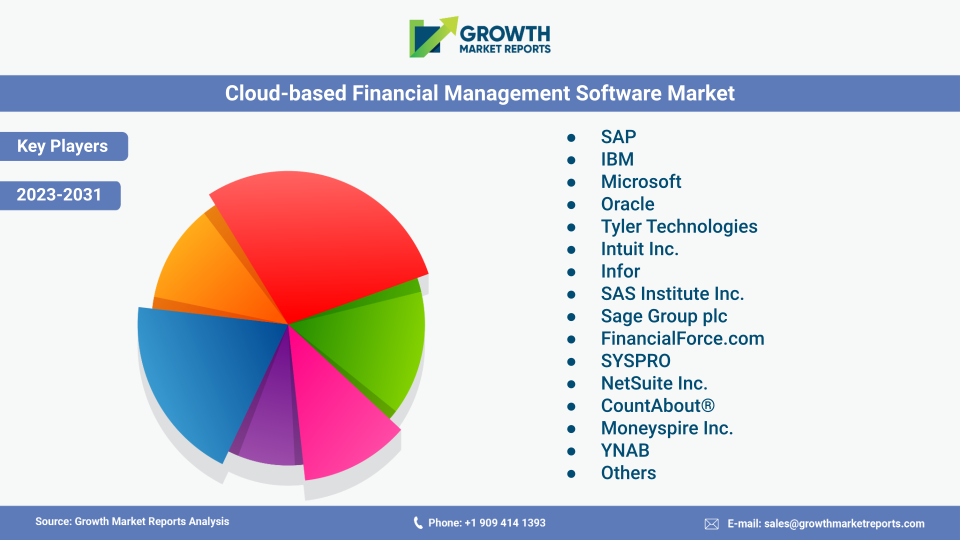
Key players competing in the global cloud-based financial management software market are SAP; IBM; Microsoft; Oracle; Tyler Technologies; Intuit Inc.; Infor; SAS Institute Inc.; Sage Group plc; FinancialForce.com; SYSPRO; NetSuite Inc.; CountAbout®; Moneyspire Inc.; YNAB; Epicor Software Corporation; FreshBooks; OneStream; and Wave Financial Inc.

These companies adopted development strategies including mergers, acquisitions, partnerships, collaboration, product launches, and production expansion to expand their consumer base worldwide. For instance,

  • On December 7, 2022, Wave launched a new financial playbook to help 7 million population of America who are part of the creator economy. The playbook is designed as a resource to help educate creators regarding business setup, cash flow, and tax strategies and to keep new businesses headed in the right direction.
  • On August 18, 2022, Sage launched Sage People Payroll in the US and UK. This innovative cloud-based HR and payroll solution offers enhanced payroll capabilities and enables small and medium-scale businesses to complete a secure and accurate payroll process in a matter of minutes.

Global Cloud-based Financial Management Software Market Key Players

Frequently Asked Questions

SMEs favor cloud-based solutions for affordability, scalability, and ease of use, often starting with basic modules and expanding as needed. Large enterprises require robust, customizable platforms for complex, multi-entity operations, advanced analytics, and global compliance.

Key challenges include data security and privacy concerns, integration complexity with legacy systems, regulatory compliance, and a shortage of skilled professionals in cloud and financial technologies.

Key players include Oracle Corporation, SAP SE, Workday Inc., Intuit Inc., Microsoft Corporation, Sage Group plc, Infor, Xero Limited, FinancialForce (Certinia), Epicor Software Corporation, and others.

North America leads the market due to early cloud adoption and mature IT infrastructure. Asia Pacific is the fastest-growing region, driven by digitalization and SME growth. Europe sees steady growth due to regulatory needs, while Latin America and MEA show promising potential.

Core applications include accounting & budgeting, revenue & invoice management, payroll management, asset management, and other specialized financial processes.

Major end-users include BFSI (banking, financial services, and insurance), healthcare, retail & e-commerce, manufacturing, IT & telecommunications, and government organizations.

Deployment modes include public cloud (cost-effective and scalable, ideal for SMEs), private cloud (enhanced security and customization for large enterprises and regulated industries), and hybrid cloud (combining public and private benefits for flexibility and integration).

Key drivers include digital transformation initiatives, demand for real-time financial insights, automation of complex processes, scalability, regulatory compliance, and the need for cost-effective solutions, especially among SMEs.

The global cloud-based financial management software market reached USD 17.8 billion in 2024 and is projected to grow at a CAGR of 11.4% from 2025 to 2033, reaching USD 48.9 billion by 2033.

Cloud-based financial management software refers to financial applications and platforms hosted on remote servers and accessed via the internet. These solutions help organizations manage accounting, budgeting, payroll, revenue, asset tracking, and other financial processes, offering real-time insights, automation, and scalability.

Table Of Content

Chapter 1 Executive Summary
Chapter 2 Assumptions and Acronyms Used
Chapter 3 Research Methodology
Chapter 4 Cloud-based Financial Management Software Market Overview
   4.1 Introduction
      4.1.1 Market Taxonomy
      4.1.2 Market Definition
      4.1.3 Macro-Economic Factors Impacting the Market Growth
   4.2 Cloud-based Financial Management Software Market Dynamics
      4.2.1 Market Drivers
      4.2.2 Market Restraints
      4.2.3 Market Opportunity
   4.3 Cloud-based Financial Management Software Market - Supply Chain Analysis
      4.3.1 List of Key Suppliers
      4.3.2 List of Key Distributors
      4.3.3 List of Key Consumers
   4.4 Key Forces Shaping the Cloud-based Financial Management Software Market
      4.4.1 Bargaining Power of Suppliers
      4.4.2 Bargaining Power of Buyers
      4.4.3 Threat of Substitution
      4.4.4 Threat of New Entrants
      4.4.5 Competitive Rivalry
   4.5 Global Cloud-based Financial Management Software Market Size & Forecast, 2023-2032
      4.5.1 Cloud-based Financial Management Software Market Size and Y-o-Y Growth
      4.5.2 Cloud-based Financial Management Software Market Absolute $ Opportunity

Chapter 5 Global Cloud-based Financial Management Software Market Analysis and Forecast By Component
   5.1 Introduction
      5.1.1 Key Market Trends & Growth Opportunities By Component
      5.1.2 Basis Point Share (BPS) Analysis By Component
      5.1.3 Absolute $ Opportunity Assessment By Component
   5.2 Cloud-based Financial Management Software Market Size Forecast By Component
      5.2.1 Software
      5.2.2 Services
   5.3 Market Attractiveness Analysis By Component

Chapter 6 Global Cloud-based Financial Management Software Market Analysis and Forecast By Deployment Mode
   6.1 Introduction
      6.1.1 Key Market Trends & Growth Opportunities By Deployment Mode
      6.1.2 Basis Point Share (BPS) Analysis By Deployment Mode
      6.1.3 Absolute $ Opportunity Assessment By Deployment Mode
   6.2 Cloud-based Financial Management Software Market Size Forecast By Deployment Mode
      6.2.1 Public Cloud
      6.2.2 Private Cloud
      6.2.3 Hybrid Cloud
   6.3 Market Attractiveness Analysis By Deployment Mode

Chapter 7 Global Cloud-based Financial Management Software Market Analysis and Forecast By Organization Size
   7.1 Introduction
      7.1.1 Key Market Trends & Growth Opportunities By Organization Size
      7.1.2 Basis Point Share (BPS) Analysis By Organization Size
      7.1.3 Absolute $ Opportunity Assessment By Organization Size
   7.2 Cloud-based Financial Management Software Market Size Forecast By Organization Size
      7.2.1 Small and Medium Enterprises
      7.2.2 Large Enterprises
   7.3 Market Attractiveness Analysis By Organization Size

Chapter 8 Global Cloud-based Financial Management Software Market Analysis and Forecast By Application
   8.1 Introduction
      8.1.1 Key Market Trends & Growth Opportunities By Application
      8.1.2 Basis Point Share (BPS) Analysis By Application
      8.1.3 Absolute $ Opportunity Assessment By Application
   8.2 Cloud-based Financial Management Software Market Size Forecast By Application
      8.2.1 Accounting & Budgeting
      8.2.2 Revenue & Invoice Management
      8.2.3 Payroll Management
      8.2.4 Asset Management
      8.2.5 Others
   8.3 Market Attractiveness Analysis By Application

Chapter 9 Global Cloud-based Financial Management Software Market Analysis and Forecast By End-User
   9.1 Introduction
      9.1.1 Key Market Trends & Growth Opportunities By End-User
      9.1.2 Basis Point Share (BPS) Analysis By End-User
      9.1.3 Absolute $ Opportunity Assessment By End-User
   9.2 Cloud-based Financial Management Software Market Size Forecast By End-User
      9.2.1 BFSI
      9.2.2 Healthcare
      9.2.3 Retail & E-commerce
      9.2.4 Manufacturing
      9.2.5 IT & Telecommunications
      9.2.6 Government
      9.2.7 Others
   9.3 Market Attractiveness Analysis By End-User

Chapter 10 Global Cloud-based Financial Management Software Market Analysis and Forecast by Region
   10.1 Introduction
      10.1.1 Key Market Trends & Growth Opportunities By Region
      10.1.2 Basis Point Share (BPS) Analysis By Region
      10.1.3 Absolute $ Opportunity Assessment By Region
   10.2 Cloud-based Financial Management Software Market Size Forecast By Region
      10.2.1 North America
      10.2.2 Europe
      10.2.3 Asia Pacific
      10.2.4 Latin America
      10.2.5 Middle East & Africa (MEA)
   10.3 Market Attractiveness Analysis By Region

Chapter 11 Coronavirus Disease (COVID-19) Impact 
   11.1 Introduction 
   11.2 Current & Future Impact Analysis 
   11.3 Economic Impact Analysis 
   11.4 Government Policies 
   11.5 Investment Scenario

Chapter 12 North America Cloud-based Financial Management Software Analysis and Forecast
   12.1 Introduction
   12.2 North America Cloud-based Financial Management Software Market Size Forecast by Country
      12.2.1 U.S.
      12.2.2 Canada
   12.3 Basis Point Share (BPS) Analysis by Country
   12.4 Absolute $ Opportunity Assessment by Country
   12.5 Market Attractiveness Analysis by Country
   12.6 North America Cloud-based Financial Management Software Market Size Forecast By Component
      12.6.1 Software
      12.6.2 Services
   12.7 Basis Point Share (BPS) Analysis By Component 
   12.8 Absolute $ Opportunity Assessment By Component 
   12.9 Market Attractiveness Analysis By Component
   12.10 North America Cloud-based Financial Management Software Market Size Forecast By Deployment Mode
      12.10.1 Public Cloud
      12.10.2 Private Cloud
      12.10.3 Hybrid Cloud
   12.11 Basis Point Share (BPS) Analysis By Deployment Mode 
   12.12 Absolute $ Opportunity Assessment By Deployment Mode 
   12.13 Market Attractiveness Analysis By Deployment Mode
   12.14 North America Cloud-based Financial Management Software Market Size Forecast By Organization Size
      12.14.1 Small and Medium Enterprises
      12.14.2 Large Enterprises
   12.15 Basis Point Share (BPS) Analysis By Organization Size 
   12.16 Absolute $ Opportunity Assessment By Organization Size 
   12.17 Market Attractiveness Analysis By Organization Size
   12.18 North America Cloud-based Financial Management Software Market Size Forecast By Application
      12.18.1 Accounting & Budgeting
      12.18.2 Revenue & Invoice Management
      12.18.3 Payroll Management
      12.18.4 Asset Management
      12.18.5 Others
   12.19 Basis Point Share (BPS) Analysis By Application 
   12.20 Absolute $ Opportunity Assessment By Application 
   12.21 Market Attractiveness Analysis By Application
   12.22 North America Cloud-based Financial Management Software Market Size Forecast By End-User
      12.22.1 BFSI
      12.22.2 Healthcare
      12.22.3 Retail & E-commerce
      12.22.4 Manufacturing
      12.22.5 IT & Telecommunications
      12.22.6 Government
      12.22.7 Others
   12.23 Basis Point Share (BPS) Analysis By End-User 
   12.24 Absolute $ Opportunity Assessment By End-User 
   12.25 Market Attractiveness Analysis By End-User

Chapter 13 Europe Cloud-based Financial Management Software Analysis and Forecast
   13.1 Introduction
   13.2 Europe Cloud-based Financial Management Software Market Size Forecast by Country
      13.2.1 Germany
      13.2.2 France
      13.2.3 Italy
      13.2.4 U.K.
      13.2.5 Spain
      13.2.6 Russia
      13.2.7 Rest of Europe
   13.3 Basis Point Share (BPS) Analysis by Country
   13.4 Absolute $ Opportunity Assessment by Country
   13.5 Market Attractiveness Analysis by Country
   13.6 Europe Cloud-based Financial Management Software Market Size Forecast By Component
      13.6.1 Software
      13.6.2 Services
   13.7 Basis Point Share (BPS) Analysis By Component 
   13.8 Absolute $ Opportunity Assessment By Component 
   13.9 Market Attractiveness Analysis By Component
   13.10 Europe Cloud-based Financial Management Software Market Size Forecast By Deployment Mode
      13.10.1 Public Cloud
      13.10.2 Private Cloud
      13.10.3 Hybrid Cloud
   13.11 Basis Point Share (BPS) Analysis By Deployment Mode 
   13.12 Absolute $ Opportunity Assessment By Deployment Mode 
   13.13 Market Attractiveness Analysis By Deployment Mode
   13.14 Europe Cloud-based Financial Management Software Market Size Forecast By Organization Size
      13.14.1 Small and Medium Enterprises
      13.14.2 Large Enterprises
   13.15 Basis Point Share (BPS) Analysis By Organization Size 
   13.16 Absolute $ Opportunity Assessment By Organization Size 
   13.17 Market Attractiveness Analysis By Organization Size
   13.18 Europe Cloud-based Financial Management Software Market Size Forecast By Application
      13.18.1 Accounting & Budgeting
      13.18.2 Revenue & Invoice Management
      13.18.3 Payroll Management
      13.18.4 Asset Management
      13.18.5 Others
   13.19 Basis Point Share (BPS) Analysis By Application 
   13.20 Absolute $ Opportunity Assessment By Application 
   13.21 Market Attractiveness Analysis By Application
   13.22 Europe Cloud-based Financial Management Software Market Size Forecast By End-User
      13.22.1 BFSI
      13.22.2 Healthcare
      13.22.3 Retail & E-commerce
      13.22.4 Manufacturing
      13.22.5 IT & Telecommunications
      13.22.6 Government
      13.22.7 Others
   13.23 Basis Point Share (BPS) Analysis By End-User 
   13.24 Absolute $ Opportunity Assessment By End-User 
   13.25 Market Attractiveness Analysis By End-User

Chapter 14 Asia Pacific Cloud-based Financial Management Software Analysis and Forecast
   14.1 Introduction
   14.2 Asia Pacific Cloud-based Financial Management Software Market Size Forecast by Country
      14.2.1 China
      14.2.2 Japan
      14.2.3 South Korea
      14.2.4 India
      14.2.5 Australia
      14.2.6 South East Asia (SEA)
      14.2.7 Rest of Asia Pacific (APAC)
   14.3 Basis Point Share (BPS) Analysis by Country
   14.4 Absolute $ Opportunity Assessment by Country
   14.5 Market Attractiveness Analysis by Country
   14.6 Asia Pacific Cloud-based Financial Management Software Market Size Forecast By Component
      14.6.1 Software
      14.6.2 Services
   14.7 Basis Point Share (BPS) Analysis By Component 
   14.8 Absolute $ Opportunity Assessment By Component 
   14.9 Market Attractiveness Analysis By Component
   14.10 Asia Pacific Cloud-based Financial Management Software Market Size Forecast By Deployment Mode
      14.10.1 Public Cloud
      14.10.2 Private Cloud
      14.10.3 Hybrid Cloud
   14.11 Basis Point Share (BPS) Analysis By Deployment Mode 
   14.12 Absolute $ Opportunity Assessment By Deployment Mode 
   14.13 Market Attractiveness Analysis By Deployment Mode
   14.14 Asia Pacific Cloud-based Financial Management Software Market Size Forecast By Organization Size
      14.14.1 Small and Medium Enterprises
      14.14.2 Large Enterprises
   14.15 Basis Point Share (BPS) Analysis By Organization Size 
   14.16 Absolute $ Opportunity Assessment By Organization Size 
   14.17 Market Attractiveness Analysis By Organization Size
   14.18 Asia Pacific Cloud-based Financial Management Software Market Size Forecast By Application
      14.18.1 Accounting & Budgeting
      14.18.2 Revenue & Invoice Management
      14.18.3 Payroll Management
      14.18.4 Asset Management
      14.18.5 Others
   14.19 Basis Point Share (BPS) Analysis By Application 
   14.20 Absolute $ Opportunity Assessment By Application 
   14.21 Market Attractiveness Analysis By Application
   14.22 Asia Pacific Cloud-based Financial Management Software Market Size Forecast By End-User
      14.22.1 BFSI
      14.22.2 Healthcare
      14.22.3 Retail & E-commerce
      14.22.4 Manufacturing
      14.22.5 IT & Telecommunications
      14.22.6 Government
      14.22.7 Others
   14.23 Basis Point Share (BPS) Analysis By End-User 
   14.24 Absolute $ Opportunity Assessment By End-User 
   14.25 Market Attractiveness Analysis By End-User

Chapter 15 Latin America Cloud-based Financial Management Software Analysis and Forecast
   15.1 Introduction
   15.2 Latin America Cloud-based Financial Management Software Market Size Forecast by Country
      15.2.1 Brazil
      15.2.2 Mexico
      15.2.3 Rest of Latin America (LATAM)
   15.3 Basis Point Share (BPS) Analysis by Country
   15.4 Absolute $ Opportunity Assessment by Country
   15.5 Market Attractiveness Analysis by Country
   15.6 Latin America Cloud-based Financial Management Software Market Size Forecast By Component
      15.6.1 Software
      15.6.2 Services
   15.7 Basis Point Share (BPS) Analysis By Component 
   15.8 Absolute $ Opportunity Assessment By Component 
   15.9 Market Attractiveness Analysis By Component
   15.10 Latin America Cloud-based Financial Management Software Market Size Forecast By Deployment Mode
      15.10.1 Public Cloud
      15.10.2 Private Cloud
      15.10.3 Hybrid Cloud
   15.11 Basis Point Share (BPS) Analysis By Deployment Mode 
   15.12 Absolute $ Opportunity Assessment By Deployment Mode 
   15.13 Market Attractiveness Analysis By Deployment Mode
   15.14 Latin America Cloud-based Financial Management Software Market Size Forecast By Organization Size
      15.14.1 Small and Medium Enterprises
      15.14.2 Large Enterprises
   15.15 Basis Point Share (BPS) Analysis By Organization Size 
   15.16 Absolute $ Opportunity Assessment By Organization Size 
   15.17 Market Attractiveness Analysis By Organization Size
   15.18 Latin America Cloud-based Financial Management Software Market Size Forecast By Application
      15.18.1 Accounting & Budgeting
      15.18.2 Revenue & Invoice Management
      15.18.3 Payroll Management
      15.18.4 Asset Management
      15.18.5 Others
   15.19 Basis Point Share (BPS) Analysis By Application 
   15.20 Absolute $ Opportunity Assessment By Application 
   15.21 Market Attractiveness Analysis By Application
   15.22 Latin America Cloud-based Financial Management Software Market Size Forecast By End-User
      15.22.1 BFSI
      15.22.2 Healthcare
      15.22.3 Retail & E-commerce
      15.22.4 Manufacturing
      15.22.5 IT & Telecommunications
      15.22.6 Government
      15.22.7 Others
   15.23 Basis Point Share (BPS) Analysis By End-User 
   15.24 Absolute $ Opportunity Assessment By End-User 
   15.25 Market Attractiveness Analysis By End-User

Chapter 16 Middle East & Africa (MEA) Cloud-based Financial Management Software Analysis and Forecast
   16.1 Introduction
   16.2 Middle East & Africa (MEA) Cloud-based Financial Management Software Market Size Forecast by Country
      16.2.1 Saudi Arabia
      16.2.2 South Africa
      16.2.3 UAE
      16.2.4 Rest of Middle East & Africa (MEA)
   16.3 Basis Point Share (BPS) Analysis by Country
   16.4 Absolute $ Opportunity Assessment by Country
   16.5 Market Attractiveness Analysis by Country
   16.6 Middle East & Africa (MEA) Cloud-based Financial Management Software Market Size Forecast By Component
      16.6.1 Software
      16.6.2 Services
   16.7 Basis Point Share (BPS) Analysis By Component 
   16.8 Absolute $ Opportunity Assessment By Component 
   16.9 Market Attractiveness Analysis By Component
   16.10 Middle East & Africa (MEA) Cloud-based Financial Management Software Market Size Forecast By Deployment Mode
      16.10.1 Public Cloud
      16.10.2 Private Cloud
      16.10.3 Hybrid Cloud
   16.11 Basis Point Share (BPS) Analysis By Deployment Mode 
   16.12 Absolute $ Opportunity Assessment By Deployment Mode 
   16.13 Market Attractiveness Analysis By Deployment Mode
   16.14 Middle East & Africa (MEA) Cloud-based Financial Management Software Market Size Forecast By Organization Size
      16.14.1 Small and Medium Enterprises
      16.14.2 Large Enterprises
   16.15 Basis Point Share (BPS) Analysis By Organization Size 
   16.16 Absolute $ Opportunity Assessment By Organization Size 
   16.17 Market Attractiveness Analysis By Organization Size
   16.18 Middle East & Africa (MEA) Cloud-based Financial Management Software Market Size Forecast By Application
      16.18.1 Accounting & Budgeting
      16.18.2 Revenue & Invoice Management
      16.18.3 Payroll Management
      16.18.4 Asset Management
      16.18.5 Others
   16.19 Basis Point Share (BPS) Analysis By Application 
   16.20 Absolute $ Opportunity Assessment By Application 
   16.21 Market Attractiveness Analysis By Application
   16.22 Middle East & Africa (MEA) Cloud-based Financial Management Software Market Size Forecast By End-User
      16.22.1 BFSI
      16.22.2 Healthcare
      16.22.3 Retail & E-commerce
      16.22.4 Manufacturing
      16.22.5 IT & Telecommunications
      16.22.6 Government
      16.22.7 Others
   16.23 Basis Point Share (BPS) Analysis By End-User 
   16.24 Absolute $ Opportunity Assessment By End-User 
   16.25 Market Attractiveness Analysis By End-User

Chapter 17 Competition Landscape 
   17.1 Cloud-based Financial Management Software Market: Competitive Dashboard
   17.2 Global Cloud-based Financial Management Software Market: Market Share Analysis, 2023
   17.3 Company Profiles (Details – Overview, Financials, Developments, Strategy) 
      17.3.1 Oracle Corporation
SAP SE
Workday, Inc.
Intuit Inc.
Microsoft Corporation
Sage Group plc
Infor, Inc.
Xero Limited
FinancialForce (Certinia)
Epicor Software Corporation
Unit4
Acumatica, Inc.
BlackLine, Inc.
Kyriba Corp.
Coupa Software Inc.
NetSuite (Oracle NetSuite)
Yonyou Network Technology Co., Ltd.
Ramco Systems
FreshBooks
Wave Financial Inc.

Methodology

Our Clients

General Mills
Deloitte
General Electric
Microsoft
Nestle SA
FedEx Logistics
The John Holland Group
Honda Motor Co. Ltd.