3D NAND Flash Memory Market Research Report 2033

3D NAND Flash Memory Market Research Report 2033

Segments - by Product Type (Triple-Level Cell (TLC), Multi-Level Cell (MLC), Single-Level Cell (SLC), Quad-Level Cell (QLC)), by Application (Consumer Electronics, Enterprise, Automotive, Industrial, Others), by End-User (BFSI, IT & Telecommunications, Healthcare, Automotive, Consumer Electronics, Others), by Structure (Floating Gate, Charge Trap)

https://growthmarketreports.com/Debadatta
Author : Debadatta Patel
https://growthmarketreports.com/Vaibhav
Fact-checked by : V. Chandola
https://growthmarketreports.com/Shruti
Editor : Shruti Bhat

Upcoming | Report ID :CG-5177 | 4.9 Rating | 28 Reviews | 289 Pages | Format : Docx PDF

Report Description


3D NAND Flash Memory Market Outlook

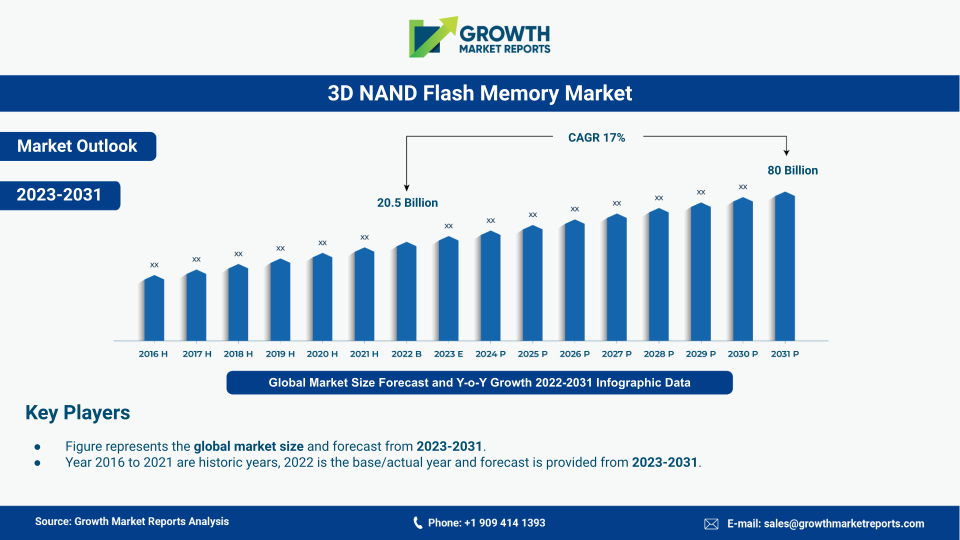
As per our latest research, the global 3D NAND Flash Memory market size reached USD 31.8 billion in 2024, reflecting robust adoption across diverse sectors. The market is experiencing a strong upward trajectory, registering a CAGR of 14.2% from 2025 to 2033. By 2033, the 3D NAND Flash Memory market is forecasted to reach USD 98.1 billion, underpinned by increasing demand for high-performance storage solutions in consumer electronics, enterprise data centers, and automotive electronics. This growth is primarily driven by the surging need for efficient, compact, and cost-effective memory technologies capable of supporting data-intensive applications and next-generation devices.

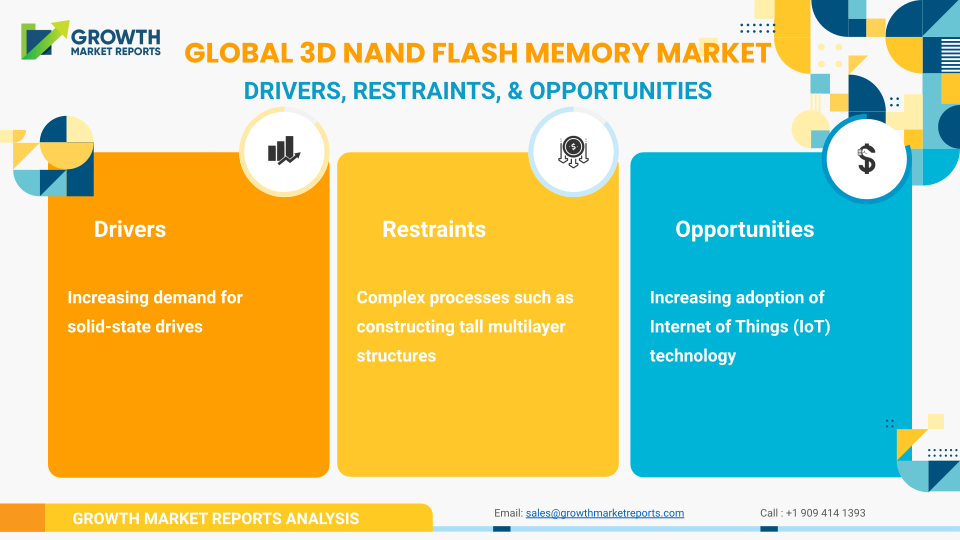
The rapid proliferation of smart devices and the exponential growth in data generation are among the primary growth factors for the 3D NAND Flash Memory market. As consumers and enterprises alike demand faster, more reliable, and higher-capacity storage, 3D NAND technology is emerging as the preferred solution. Unlike traditional planar NAND, 3D NAND Flash Memory stacks memory cells vertically, significantly increasing storage density and reducing the cost per bit. This architectural advancement enables manufacturers to deliver products with higher endurance, improved performance, and lower power consumption, which are essential attributes for modern smartphones, tablets, laptops, and IoT devices. The ongoing digital transformation across industries further amplifies the need for advanced memory technologies, driving sustained market growth.

Another significant driver for the 3D NAND Flash Memory market is the escalating adoption of cloud computing, artificial intelligence, and big data analytics. Enterprises are increasingly investing in high-capacity, high-speed storage infrastructure to efficiently manage and process vast volumes of data. 3D NAND Flash Memory's ability to deliver superior performance, reliability, and scalability makes it an ideal choice for data centers and enterprise storage solutions. Moreover, the automotive sector is witnessing a surge in demand for advanced infotainment systems, autonomous driving capabilities, and connected car technologies, all of which require robust memory solutions. The integration of 3D NAND Flash Memory in automotive electronics not only enhances system performance but also supports the evolution of next-generation vehicles.

Technological innovation and continuous R&D investments are also propelling the 3D NAND Flash Memory market forward. Leading manufacturers are focusing on increasing the number of layers in 3D NAND structures to further boost storage density and reduce costs. The transition from 64-layer to 176-layer and beyond is enabling the production of memory chips with unprecedented capacities and performance metrics. In addition, advancements in manufacturing processes, such as charge trap technology and floating gate structures, are enhancing reliability and endurance. These innovations are crucial for meeting the evolving requirements of various end-use industries, including BFSI, healthcare, and industrial automation, thereby broadening the application scope of 3D NAND Flash Memory.

NAND Flash Memory has become a cornerstone in the realm of digital storage, revolutionizing the way data is stored and accessed. Its architecture, which allows for the stacking of memory cells vertically, has significantly enhanced storage capacity while reducing the physical footprint of memory devices. This innovation is crucial in a world where the demand for faster, more efficient data storage solutions is ever-increasing. As industries continue to evolve, the role of NAND Flash Memory becomes even more pivotal, offering the speed and reliability needed for modern applications. Its influence extends across various sectors, from consumer electronics to enterprise solutions, underscoring its versatility and indispensability in the digital age.

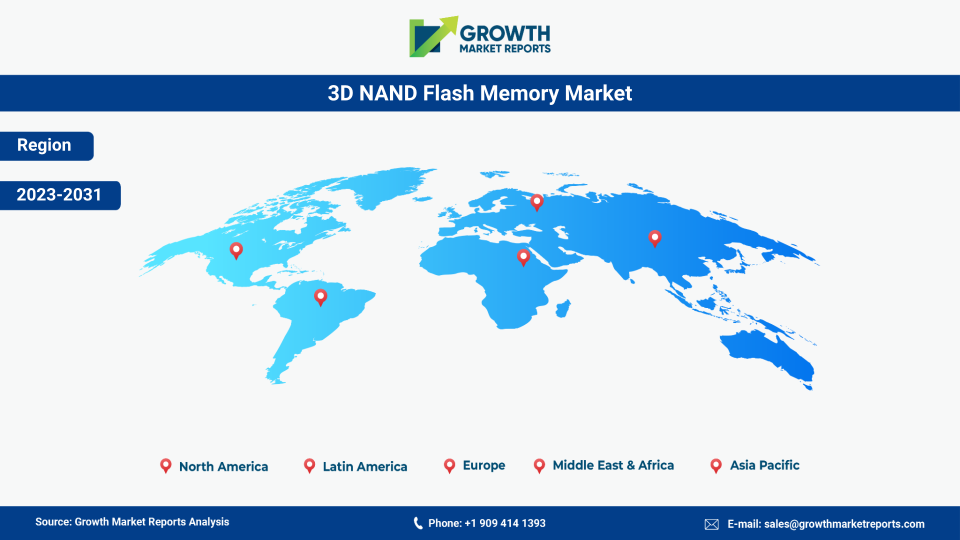
From a regional perspective, Asia Pacific continues to dominate the 3D NAND Flash Memory market, accounting for the largest revenue share in 2024. The region's leadership is attributed to the presence of major semiconductor manufacturers, robust electronics production, and high consumer demand for smart devices. North America and Europe are also witnessing significant growth, driven by strong investments in data center infrastructure and the rapid adoption of advanced automotive and healthcare technologies. Meanwhile, emerging markets in Latin America and the Middle East & Africa are gradually embracing 3D NAND solutions, supported by expanding digital ecosystems and increasing investments in technology infrastructure.

Global 3D NAND Flash Memory Industry Outlook

Product Type Analysis

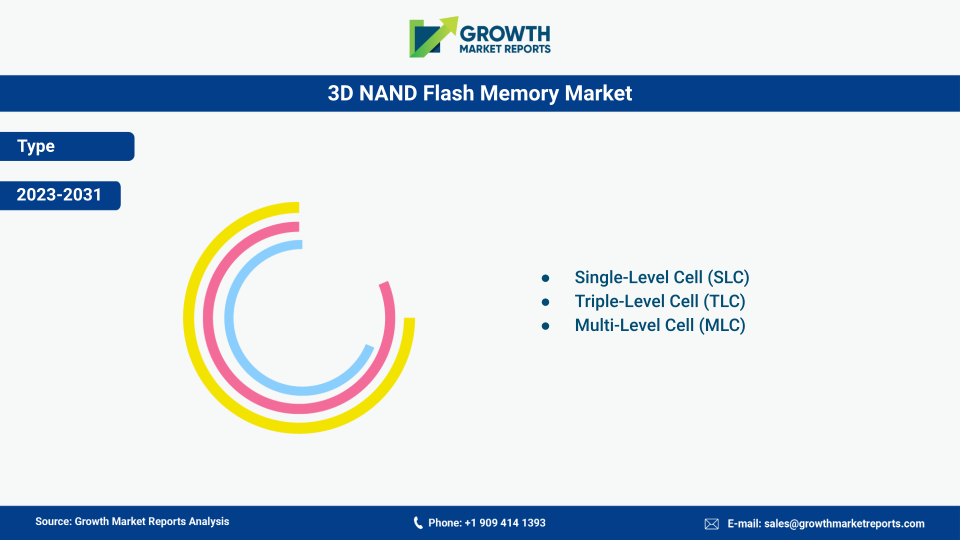
The 3D NAND Flash Memory market is segmented by product type into Triple-Level Cell (TLC), Multi-Level Cell (MLC), Single-Level Cell (SLC), and Quad-Level Cell (QLC). TLC 3D NAND dominates the market, owing to its optimal balance between storage density, performance, and cost. TLC technology stores three bits per cell, enabling higher data capacity in a smaller footprint, which is particularly advantageous for consumer electronics and enterprise SSDs. The cost-effectiveness of TLC, combined with its adequate endurance and speed for mainstream applications, has led to its widespread adoption in smartphones, laptops, and data center storage solutions.

MLC 3D NAND, which stores two bits per cell, remains popular in applications requiring enhanced reliability and endurance. While MLC offers lower storage density compared to TLC, it provides superior data integrity and longer lifespan, making it suitable for enterprise-grade storage, industrial automation, and mission-critical systems. The market for MLC is sustained by industries prioritizing data security and durability, such as BFSI and healthcare, where memory failures can have significant consequences.

SLC 3D NAND, though representing a smaller share of the market, is indispensable for applications demanding the highest performance and endurance. By storing only one bit per cell, SLC offers the fastest read/write speeds and the longest lifespan, making it ideal for cache memory, high-end enterprise storage, and specialized industrial applications. Despite its higher cost per bit, SLC continues to find use in scenarios where reliability and speed outweigh capacity requirements.

QLC 3D NAND is emerging as a key growth segment, particularly for applications where maximizing storage density and reducing costs are paramount. QLC technology stores four bits per cell, enabling unprecedented data capacities at competitive price points. While QLC's endurance and performance are lower than TLC and MLC, ongoing advancements in error correction and wear leveling are addressing these challenges. As a result, QLC is increasingly being adopted in consumer SSDs, archival storage, and read-intensive enterprise workloads, further diversifying the product landscape of the 3D NAND Flash Memory market.

Report Scope

Attributes Details
Report Title 3D NAND Flash Memory Market Research Report 2033
By Product Type Triple-Level Cell (TLC), Multi-Level Cell (MLC), Single-Level Cell (SLC), Quad-Level Cell (QLC)
By Application Consumer Electronics, Enterprise, Automotive, Industrial, Others
By End-User BFSI, IT & Telecommunications, Healthcare, Automotive, Consumer Electronics, Others
By Structure Floating Gate, Charge Trap
Regions Covered North America, Europe, APAC, Latin America, MEA
Base Year 2024
Historic Data 2018-2023
Forecast Period 2025-2033
Number of Pages 289
Number of Tables & Figures 265
Customization Available Yes, the report can be customized as per your need.

Application Analysis

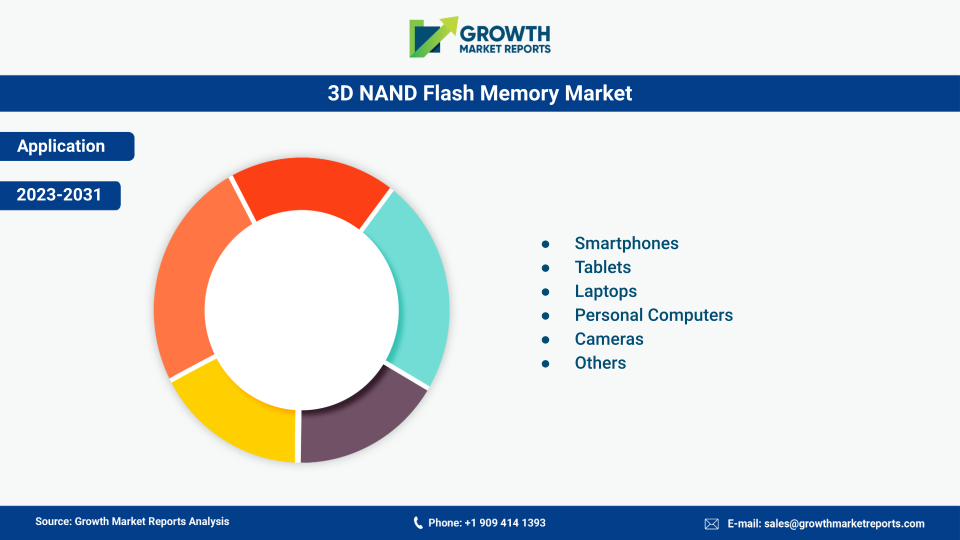
The application landscape of the 3D NAND Flash Memory market encompasses Consumer Electronics, Enterprise, Automotive, Industrial, and Others. Consumer electronics represent the largest application segment, driven by the insatiable demand for high-capacity, high-performance storage in smartphones, tablets, laptops, and wearable devices. The trend toward 5G connectivity, ultra-high-definition video recording, and data-intensive mobile applications is fueling the integration of 3D NAND Flash Memory in next-generation consumer devices. Manufacturers are leveraging 3D NAND to deliver products with enhanced speed, lower power consumption, and greater reliability, meeting the expectations of increasingly tech-savvy consumers.

The enterprise segment is another major contributor to market growth, as organizations invest heavily in robust storage infrastructure to support cloud computing, big data analytics, and virtualization. 3D NAND Flash Memory's scalability, high data throughput, and energy efficiency make it the preferred choice for data centers, enterprise SSDs, and high-performance computing environments. The proliferation of AI-driven workloads and the transition to edge computing are further amplifying the need for advanced memory solutions in enterprise applications.

In the automotive sector, 3D NAND Flash Memory is gaining traction as vehicles become more connected, autonomous, and reliant on sophisticated infotainment and navigation systems. The ability of 3D NAND to withstand harsh operating conditions, deliver rapid data access, and support over-the-air updates is critical for modern automotive electronics. As the automotive industry embraces electric vehicles and advanced driver-assistance systems, the demand for reliable and high-capacity memory solutions is expected to surge.

Industrial applications are also witnessing increased adoption of 3D NAND Flash Memory, particularly in automation, robotics, and industrial IoT devices. The need for rugged, high-endurance memory capable of operating in extreme environments is driving the deployment of 3D NAND solutions in manufacturing, energy, and transportation sectors. Furthermore, the "Others" category, which includes sectors such as aerospace, defense, and smart cities, is gradually incorporating 3D NAND technology to support advanced data storage and processing requirements.

End-User Analysis

The 3D NAND Flash Memory market serves a diverse array of end-users, including BFSI, IT & Telecommunications, Healthcare, Automotive, Consumer Electronics, and Others. The BFSI sector is increasingly leveraging 3D NAND Flash Memory to enhance data security, transaction speed, and storage efficiency in banking, financial services, and insurance operations. With the rise of digital banking, mobile payments, and real-time analytics, the need for reliable and high-capacity memory solutions in BFSI is more critical than ever.

IT & Telecommunications is another major end-user segment, driven by the explosive growth in data traffic, cloud services, and mobile connectivity. Telecom operators and IT service providers are deploying 3D NAND-based storage systems to support the rapid expansion of 5G networks, edge computing, and IoT platforms. The scalability and performance of 3D NAND Flash Memory are essential for managing the massive influx of data generated by connected devices and digital services.

In the healthcare sector, 3D NAND Flash Memory is playing a pivotal role in enabling advanced medical imaging, electronic health records, and telemedicine services. The ability to store and retrieve large volumes of patient data quickly and securely is vital for improving diagnostic accuracy and patient care. As healthcare providers embrace digital transformation and remote monitoring technologies, the demand for robust and high-performance memory solutions continues to rise.

The automotive and consumer electronics sectors are also prominent end-users, as discussed in previous sections. Additionally, the "Others" category encompasses a wide range of industries, including education, government, and public safety, all of which are increasingly adopting 3D NAND Flash Memory to support digital initiatives and data-driven decision-making. The versatility and adaptability of 3D NAND technology make it a cornerstone of modern digital infrastructure across multiple end-user segments.

Structure Analysis

The structure segment of the 3D NAND Flash Memory market is bifurcated into Floating Gate and Charge Trap architectures. Floating gate technology has been the traditional choice for NAND Flash Memory, offering proven reliability and compatibility with existing manufacturing processes. This structure stores electrical charge in a conductive floating gate, enabling precise control over memory cell states. Despite its widespread use, floating gate technology faces challenges in scaling to higher layer counts due to interference and leakage issues, prompting the exploration of alternative structures.

Charge trap technology, on the other hand, is gaining momentum as manufacturers seek to overcome the limitations of floating gate architectures. Charge trap structures use an insulating layer to trap and store charge, reducing cell-to-cell interference and enabling the stacking of more layers. This advancement is critical for achieving higher storage densities and improving the scalability of 3D NAND Flash Memory. Leading players in the market are increasingly adopting charge trap technology to produce next-generation memory chips with enhanced performance and reliability.

The transition from floating gate to charge trap architectures is being driven by the need for improved endurance, faster read/write speeds, and lower power consumption. Charge trap technology offers several advantages, including simplified manufacturing processes, reduced production costs, and improved data retention. These benefits are particularly important as the market moves toward 200-layer and higher 3D NAND structures, where traditional floating gate designs become less viable.

Despite the growing adoption of charge trap technology, floating gate structures continue to hold a significant share of the market, particularly in legacy applications and cost-sensitive segments. The coexistence of both architectures provides manufacturers with the flexibility to address diverse customer requirements and application scenarios. As the 3D NAND Flash Memory market evolves, ongoing innovation in structure design will remain a key differentiator for leading vendors.

Opportunities & Threats

The 3D NAND Flash Memory market presents substantial opportunities for growth, driven by the ongoing digital transformation across industries and the relentless demand for high-capacity storage solutions. The proliferation of data-intensive applications, such as AI, machine learning, and big data analytics, is creating new avenues for 3D NAND adoption in enterprise and cloud environments. Furthermore, the rise of edge computing and the Internet of Things (IoT) is fueling demand for compact, energy-efficient memory solutions capable of supporting real-time data processing at the network edge. Manufacturers that invest in advanced manufacturing processes, such as extreme ultraviolet (EUV) lithography and 200-layer stacking, are well-positioned to capitalize on these emerging opportunities.

Another significant opportunity lies in the automotive and industrial sectors, where the integration of 3D NAND Flash Memory can enable the development of smarter, more connected, and autonomous systems. The shift toward electric vehicles, advanced driver-assistance systems, and Industry 4.0 initiatives is driving the need for robust, high-endurance memory solutions capable of operating in harsh environments. Additionally, the expansion of 5G networks and the growing adoption of smart city technologies are expected to create new demand for 3D NAND-based storage in telecommunications, public safety, and infrastructure management. Companies that focus on developing application-specific memory solutions and forging strategic partnerships with OEMs and technology providers can unlock significant growth potential in these sectors.

However, the 3D NAND Flash Memory market is not without its challenges. One of the primary restraining factors is the intense competition among leading manufacturers, which exerts downward pressure on prices and profit margins. The cyclical nature of the semiconductor industry, characterized by fluctuations in supply and demand, can lead to periods of oversupply and price volatility. Additionally, the high capital investment required for advanced manufacturing facilities and the complexity of scaling to higher layer counts pose significant barriers to entry for new players. Intellectual property disputes and the risk of technology obsolescence further add to the competitive pressures in the market.

Regional Outlook

Asia Pacific remains the dominant region in the global 3D NAND Flash Memory market, accounting for USD 14.9 billion in revenue in 2024. The region's leadership is attributed to the presence of major semiconductor manufacturing hubs in countries such as China, South Korea, Japan, and Taiwan. These countries benefit from robust supply chains, skilled labor, and strong government support for the electronics industry. The rapid growth of consumer electronics, automotive, and industrial sectors in Asia Pacific is further driving demand for advanced memory solutions. With a projected CAGR of 15.1% through 2033, Asia Pacific is expected to maintain its leadership position, reaching a market size of USD 49.7 billion by the end of the forecast period.

North America is the second-largest market for 3D NAND Flash Memory, with revenues of USD 8.7 billion in 2024. The region's growth is driven by strong investments in data center infrastructure, enterprise IT, and advanced automotive technologies. The presence of leading technology companies, coupled with a robust innovation ecosystem, supports the rapid adoption of 3D NAND solutions in the United States and Canada. The increasing focus on AI, machine learning, and cloud computing is expected to drive further growth in the region, with North America projected to reach USD 27.4 billion by 2033.

Europe, Latin America, and the Middle East & Africa collectively contributed USD 8.2 billion to the global 3D NAND Flash Memory market in 2024. Europe is witnessing steady growth, driven by the adoption of advanced automotive, healthcare, and industrial technologies. Latin America and the Middle East & Africa are emerging markets, with increasing investments in digital infrastructure and rising demand for consumer electronics. While these regions currently represent a smaller share of the global market, their growth potential is significant as digital transformation initiatives gain momentum and technology adoption accelerates.

3D NAND Flash Memory Market Statistics

Competitor Outlook

The competitive landscape of the 3D NAND Flash Memory market is characterized by intense rivalry among a handful of global players, each striving to gain a technological edge through continuous innovation and capacity expansion. The market is highly consolidated, with the top five companies accounting for a significant share of global revenues. These companies are investing heavily in R&D to advance layer stacking technologies, improve manufacturing efficiency, and develop next-generation memory architectures. Strategic collaborations, mergers and acquisitions, and long-term supply agreements with OEMs are common strategies employed to strengthen market positions and expand customer bases.

Technological differentiation is a key focus area for leading competitors, as they race to develop higher-layer 3D NAND structures and introduce new cell architectures, such as QLC and PLC (Penta-Level Cell). Companies are also exploring novel materials and fabrication techniques to enhance performance, reduce costs, and minimize power consumption. The ability to deliver customized solutions tailored to specific applications and end-user requirements is emerging as a critical success factor in the highly competitive market environment.

Despite the dominance of established players, the 3D NAND Flash Memory market is witnessing the entry of new participants, particularly from China, as domestic manufacturers ramp up production capacities and invest in advanced technologies. While these new entrants face significant barriers in terms of technology and scale, they are gradually gaining traction through aggressive pricing strategies and government support. The increasing fragmentation of the market is expected to intensify competition and drive further innovation in the coming years.

Among the major companies operating in the 3D NAND Flash Memory market are Samsung Electronics, SK Hynix, Micron Technology, Kioxia Holdings Corporation (formerly Toshiba Memory), and Western Digital. Samsung Electronics leads the market with its advanced V-NAND technology, offering high-capacity and high-performance solutions for a wide range of applications. SK Hynix is a key player known for its innovative 3D NAND architectures and strong presence in the consumer and enterprise storage segments. Micron Technology is recognized for its focus on high-reliability memory solutions and its leadership in the development of charge trap technology. Kioxia Holdings Corporation, a pioneer in NAND Flash Memory, continues to drive innovation through strategic partnerships and capacity expansion. Western Digital, with its extensive product portfolio and global distribution network, is a major supplier of 3D NAND-based SSDs and storage solutions.

These companies are continuously investing in next-generation technologies and expanding their manufacturing capacities to meet the growing demand for 3D NAND Flash Memory. Strategic collaborations with technology partners, OEMs, and cloud service providers are enabling them to deliver integrated solutions that address the evolving needs of customers across industries. As the market continues to evolve, the ability to innovate, scale, and adapt to changing customer requirements will remain the key determinants of success in the highly competitive 3D NAND Flash Memory market.

Key Players

  • Samsung Electronics Co., Ltd.
  • SK hynix Inc.
  • Micron Technology, Inc.
  • Kioxia Holdings Corporation
  • Western Digital Corporation
  • Intel Corporation
  • Yangtze Memory Technologies Co., Ltd. (YMTC)
  • Toshiba Corporation
  • SanDisk Corporation
  • Kingston Technology Company, Inc.
  • ADATA Technology Co., Ltd.
  • Transcend Information, Inc.
  • Corsair Memory, Inc.
  • Seagate Technology Holdings plc
  • PNY Technologies, Inc.
  • Silicon Power Computer & Communications Inc.
  • TEAMGROUP Inc.
  • Patriot Memory LLC
  • Apacer Technology Inc.
  • Lexar Media, Inc.
3D NAND Flash Memory Market Overview

Segments

The 3D NAND Flash Memory market has been segmented on the basis of

Product Type

  • Triple-Level Cell (TLC)
  • Multi-Level Cell (MLC)
  • Single-Level Cell (SLC)
  • Quad-Level Cell (QLC)

Application

  • Consumer Electronics
  • Enterprise
  • Automotive
  • Industrial
  • Others

End-User

  • BFSI
  • IT & Telecommunications
  • Healthcare
  • Automotive
  • Consumer Electronics
  • Others

Structure

  • Floating Gate
  • Charge Trap

Competitive Landscape

Key players operating in the global 3D NAND flash memory market include SAMSUNG; KIOXIA Holdings Corporation; Micron Technology, Inc.; Integrated Silicon Solution Inc.; Western Digital Corporation; STMicroelectronics; Realtek Semiconductor Corp.; Semiconductor Components Industries, LLC; Infineon Technologies AG; and Advanced Micro Devices, Inc. These companies adopt strategies such as acquisitions, partnerships, collaboration, mergers, R&D investments, and product launches to boost their market share. For instance,

In 2020, KIOXIA Holdings Corporation, a leading Japan-based computer memory manufacturer, announced the launch of its 162-layered Gen 6 BiCS NAND flash memory chips, with Western Digital Corporation. The project is anticipated to increase the sales of 3D NAND in Asia Pacific.
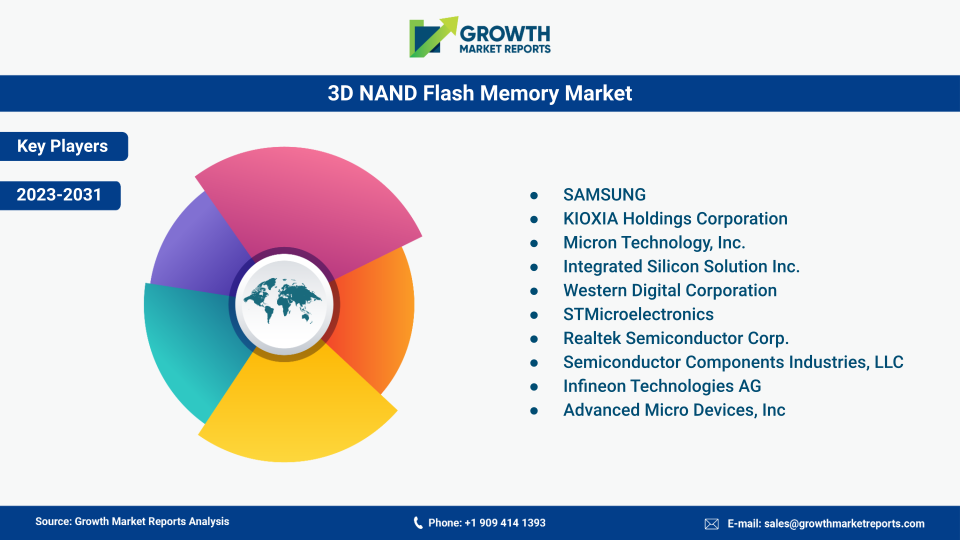

3D NAND Flash Memory Market Key Players

Frequently Asked Questions

Floating gate is the traditional structure, offering proven reliability but facing scaling limitations. Charge trap technology uses an insulating layer to trap charge, enabling more layers, higher density, and improved performance. The market is transitioning toward charge trap for next-generation memory chips.

Opportunities include growing demand from AI, big data, IoT, edge computing, automotive, and industrial sectors. Challenges involve intense competition, price volatility, high capital investment, technology scaling complexities, and intellectual property disputes.

3D NAND Flash Memory is widely used in consumer electronics (smartphones, laptops, tablets, wearables), enterprise storage (data centers, SSDs), automotive electronics (infotainment, ADAS), industrial automation, healthcare (medical imaging, EHR), and other sectors like aerospace and smart cities.

Major companies include Samsung Electronics, SK Hynix, Micron Technology, Kioxia Holdings Corporation, Western Digital, Intel, Yangtze Memory Technologies (YMTC), Toshiba, SanDisk, Kingston, ADATA, Transcend, Corsair, Seagate, PNY, Silicon Power, TEAMGROUP, Patriot Memory, Apacer, and Lexar.

Key advancements include increasing the number of stacked layers (from 64 to 176 and beyond), adoption of charge trap technology, and improvements in manufacturing processes. These innovations boost storage density, reliability, and performance while reducing costs.

Asia Pacific leads the market, driven by major semiconductor manufacturing hubs and high electronics demand. North America and Europe are also significant markets due to investments in data centers and advanced automotive and healthcare technologies. Latin America and the Middle East & Africa are emerging markets with growing adoption.

The main product types are Triple-Level Cell (TLC), Multi-Level Cell (MLC), Single-Level Cell (SLC), and Quad-Level Cell (QLC). TLC dominates due to its balance of cost, performance, and density, while MLC and SLC are preferred for reliability and endurance. QLC is emerging for high-capacity, cost-sensitive applications.

Key industries driving demand include consumer electronics, enterprise data centers, automotive electronics, industrial automation, BFSI, IT & telecommunications, and healthcare. The proliferation of smart devices, cloud computing, AI, and big data analytics are major growth factors.

The global 3D NAND Flash Memory market is expected to reach USD 98.1 billion by 2033, growing at a CAGR of 14.2% from 2025 to 2033. The market was valued at USD 31.8 billion in 2024, reflecting strong adoption across various sectors.

3D NAND Flash Memory is a type of non-volatile storage technology where memory cells are stacked vertically in multiple layers, increasing storage density and reducing cost per bit compared to traditional planar (2D) NAND. This architecture enables higher capacity, better endurance, improved performance, and lower power consumption, making it ideal for modern devices and data centers.

Table Of Content

Chapter 1 Executive Summary
Chapter 2 Assumptions and Acronyms Used
Chapter 3 Research Methodology
Chapter 4 3D NAND Flash Memory Market Overview
   4.1 Introduction
      4.1.1 Market Taxonomy
      4.1.2 Market Definition
      4.1.3 Macro-Economic Factors Impacting the Market Growth
   4.2 3D NAND Flash Memory Market Dynamics
      4.2.1 Market Drivers
      4.2.2 Market Restraints
      4.2.3 Market Opportunity
   4.3 3D NAND Flash Memory Market - Supply Chain Analysis
      4.3.1 List of Key Suppliers
      4.3.2 List of Key Distributors
      4.3.3 List of Key Consumers
   4.4 Key Forces Shaping the 3D NAND Flash Memory Market
      4.4.1 Bargaining Power of Suppliers
      4.4.2 Bargaining Power of Buyers
      4.4.3 Threat of Substitution
      4.4.4 Threat of New Entrants
      4.4.5 Competitive Rivalry
   4.5 Global 3D NAND Flash Memory Market Size & Forecast, 2023-2032
      4.5.1 3D NAND Flash Memory Market Size and Y-o-Y Growth
      4.5.2 3D NAND Flash Memory Market Absolute $ Opportunity

Chapter 5 Global 3D NAND Flash Memory Market Analysis and Forecast By Product Type
   5.1 Introduction
      5.1.1 Key Market Trends & Growth Opportunities By Product Type
      5.1.2 Basis Point Share (BPS) Analysis By Product Type
      5.1.3 Absolute $ Opportunity Assessment By Product Type
   5.2 3D NAND Flash Memory Market Size Forecast By Product Type
      5.2.1 Triple-Level Cell (TLC)
      5.2.2 Multi-Level Cell (MLC)
      5.2.3 Single-Level Cell (SLC)
      5.2.4 Quad-Level Cell (QLC)
   5.3 Market Attractiveness Analysis By Product Type

Chapter 6 Global 3D NAND Flash Memory Market Analysis and Forecast By Application
   6.1 Introduction
      6.1.1 Key Market Trends & Growth Opportunities By Application
      6.1.2 Basis Point Share (BPS) Analysis By Application
      6.1.3 Absolute $ Opportunity Assessment By Application
   6.2 3D NAND Flash Memory Market Size Forecast By Application
      6.2.1 Consumer Electronics
      6.2.2 Enterprise
      6.2.3 Automotive
      6.2.4 Industrial
      6.2.5 Others
   6.3 Market Attractiveness Analysis By Application

Chapter 7 Global 3D NAND Flash Memory Market Analysis and Forecast By End-User
   7.1 Introduction
      7.1.1 Key Market Trends & Growth Opportunities By End-User
      7.1.2 Basis Point Share (BPS) Analysis By End-User
      7.1.3 Absolute $ Opportunity Assessment By End-User
   7.2 3D NAND Flash Memory Market Size Forecast By End-User
      7.2.1 BFSI
      7.2.2 IT & Telecommunications
      7.2.3 Healthcare
      7.2.4 Automotive
      7.2.5 Consumer Electronics
      7.2.6 Others
   7.3 Market Attractiveness Analysis By End-User

Chapter 8 Global 3D NAND Flash Memory Market Analysis and Forecast By Structure
   8.1 Introduction
      8.1.1 Key Market Trends & Growth Opportunities By Structure
      8.1.2 Basis Point Share (BPS) Analysis By Structure
      8.1.3 Absolute $ Opportunity Assessment By Structure
   8.2 3D NAND Flash Memory Market Size Forecast By Structure
      8.2.1 Floating Gate
      8.2.2 Charge Trap
   8.3 Market Attractiveness Analysis By Structure

Chapter 9 Global 3D NAND Flash Memory Market Analysis and Forecast by Region
   9.1 Introduction
      9.1.1 Key Market Trends & Growth Opportunities By Region
      9.1.2 Basis Point Share (BPS) Analysis By Region
      9.1.3 Absolute $ Opportunity Assessment By Region
   9.2 3D NAND Flash Memory Market Size Forecast By Region
      9.2.1 North America
      9.2.2 Europe
      9.2.3 Asia Pacific
      9.2.4 Latin America
      9.2.5 Middle East & Africa (MEA)
   9.3 Market Attractiveness Analysis By Region

Chapter 10 Coronavirus Disease (COVID-19) Impact 
   10.1 Introduction 
   10.2 Current & Future Impact Analysis 
   10.3 Economic Impact Analysis 
   10.4 Government Policies 
   10.5 Investment Scenario

Chapter 11 North America 3D NAND Flash Memory Analysis and Forecast
   11.1 Introduction
   11.2 North America 3D NAND Flash Memory Market Size Forecast by Country
      11.2.1 U.S.
      11.2.2 Canada
   11.3 Basis Point Share (BPS) Analysis by Country
   11.4 Absolute $ Opportunity Assessment by Country
   11.5 Market Attractiveness Analysis by Country
   11.6 North America 3D NAND Flash Memory Market Size Forecast By Product Type
      11.6.1 Triple-Level Cell (TLC)
      11.6.2 Multi-Level Cell (MLC)
      11.6.3 Single-Level Cell (SLC)
      11.6.4 Quad-Level Cell (QLC)
   11.7 Basis Point Share (BPS) Analysis By Product Type 
   11.8 Absolute $ Opportunity Assessment By Product Type 
   11.9 Market Attractiveness Analysis By Product Type
   11.10 North America 3D NAND Flash Memory Market Size Forecast By Application
      11.10.1 Consumer Electronics
      11.10.2 Enterprise
      11.10.3 Automotive
      11.10.4 Industrial
      11.10.5 Others
   11.11 Basis Point Share (BPS) Analysis By Application 
   11.12 Absolute $ Opportunity Assessment By Application 
   11.13 Market Attractiveness Analysis By Application
   11.14 North America 3D NAND Flash Memory Market Size Forecast By End-User
      11.14.1 BFSI
      11.14.2 IT & Telecommunications
      11.14.3 Healthcare
      11.14.4 Automotive
      11.14.5 Consumer Electronics
      11.14.6 Others
   11.15 Basis Point Share (BPS) Analysis By End-User 
   11.16 Absolute $ Opportunity Assessment By End-User 
   11.17 Market Attractiveness Analysis By End-User
   11.18 North America 3D NAND Flash Memory Market Size Forecast By Structure
      11.18.1 Floating Gate
      11.18.2 Charge Trap
   11.19 Basis Point Share (BPS) Analysis By Structure 
   11.20 Absolute $ Opportunity Assessment By Structure 
   11.21 Market Attractiveness Analysis By Structure

Chapter 12 Europe 3D NAND Flash Memory Analysis and Forecast
   12.1 Introduction
   12.2 Europe 3D NAND Flash Memory Market Size Forecast by Country
      12.2.1 Germany
      12.2.2 France
      12.2.3 Italy
      12.2.4 U.K.
      12.2.5 Spain
      12.2.6 Russia
      12.2.7 Rest of Europe
   12.3 Basis Point Share (BPS) Analysis by Country
   12.4 Absolute $ Opportunity Assessment by Country
   12.5 Market Attractiveness Analysis by Country
   12.6 Europe 3D NAND Flash Memory Market Size Forecast By Product Type
      12.6.1 Triple-Level Cell (TLC)
      12.6.2 Multi-Level Cell (MLC)
      12.6.3 Single-Level Cell (SLC)
      12.6.4 Quad-Level Cell (QLC)
   12.7 Basis Point Share (BPS) Analysis By Product Type 
   12.8 Absolute $ Opportunity Assessment By Product Type 
   12.9 Market Attractiveness Analysis By Product Type
   12.10 Europe 3D NAND Flash Memory Market Size Forecast By Application
      12.10.1 Consumer Electronics
      12.10.2 Enterprise
      12.10.3 Automotive
      12.10.4 Industrial
      12.10.5 Others
   12.11 Basis Point Share (BPS) Analysis By Application 
   12.12 Absolute $ Opportunity Assessment By Application 
   12.13 Market Attractiveness Analysis By Application
   12.14 Europe 3D NAND Flash Memory Market Size Forecast By End-User
      12.14.1 BFSI
      12.14.2 IT & Telecommunications
      12.14.3 Healthcare
      12.14.4 Automotive
      12.14.5 Consumer Electronics
      12.14.6 Others
   12.15 Basis Point Share (BPS) Analysis By End-User 
   12.16 Absolute $ Opportunity Assessment By End-User 
   12.17 Market Attractiveness Analysis By End-User
   12.18 Europe 3D NAND Flash Memory Market Size Forecast By Structure
      12.18.1 Floating Gate
      12.18.2 Charge Trap
   12.19 Basis Point Share (BPS) Analysis By Structure 
   12.20 Absolute $ Opportunity Assessment By Structure 
   12.21 Market Attractiveness Analysis By Structure

Chapter 13 Asia Pacific 3D NAND Flash Memory Analysis and Forecast
   13.1 Introduction
   13.2 Asia Pacific 3D NAND Flash Memory Market Size Forecast by Country
      13.2.1 China
      13.2.2 Japan
      13.2.3 South Korea
      13.2.4 India
      13.2.5 Australia
      13.2.6 South East Asia (SEA)
      13.2.7 Rest of Asia Pacific (APAC)
   13.3 Basis Point Share (BPS) Analysis by Country
   13.4 Absolute $ Opportunity Assessment by Country
   13.5 Market Attractiveness Analysis by Country
   13.6 Asia Pacific 3D NAND Flash Memory Market Size Forecast By Product Type
      13.6.1 Triple-Level Cell (TLC)
      13.6.2 Multi-Level Cell (MLC)
      13.6.3 Single-Level Cell (SLC)
      13.6.4 Quad-Level Cell (QLC)
   13.7 Basis Point Share (BPS) Analysis By Product Type 
   13.8 Absolute $ Opportunity Assessment By Product Type 
   13.9 Market Attractiveness Analysis By Product Type
   13.10 Asia Pacific 3D NAND Flash Memory Market Size Forecast By Application
      13.10.1 Consumer Electronics
      13.10.2 Enterprise
      13.10.3 Automotive
      13.10.4 Industrial
      13.10.5 Others
   13.11 Basis Point Share (BPS) Analysis By Application 
   13.12 Absolute $ Opportunity Assessment By Application 
   13.13 Market Attractiveness Analysis By Application
   13.14 Asia Pacific 3D NAND Flash Memory Market Size Forecast By End-User
      13.14.1 BFSI
      13.14.2 IT & Telecommunications
      13.14.3 Healthcare
      13.14.4 Automotive
      13.14.5 Consumer Electronics
      13.14.6 Others
   13.15 Basis Point Share (BPS) Analysis By End-User 
   13.16 Absolute $ Opportunity Assessment By End-User 
   13.17 Market Attractiveness Analysis By End-User
   13.18 Asia Pacific 3D NAND Flash Memory Market Size Forecast By Structure
      13.18.1 Floating Gate
      13.18.2 Charge Trap
   13.19 Basis Point Share (BPS) Analysis By Structure 
   13.20 Absolute $ Opportunity Assessment By Structure 
   13.21 Market Attractiveness Analysis By Structure

Chapter 14 Latin America 3D NAND Flash Memory Analysis and Forecast
   14.1 Introduction
   14.2 Latin America 3D NAND Flash Memory Market Size Forecast by Country
      14.2.1 Brazil
      14.2.2 Mexico
      14.2.3 Rest of Latin America (LATAM)
   14.3 Basis Point Share (BPS) Analysis by Country
   14.4 Absolute $ Opportunity Assessment by Country
   14.5 Market Attractiveness Analysis by Country
   14.6 Latin America 3D NAND Flash Memory Market Size Forecast By Product Type
      14.6.1 Triple-Level Cell (TLC)
      14.6.2 Multi-Level Cell (MLC)
      14.6.3 Single-Level Cell (SLC)
      14.6.4 Quad-Level Cell (QLC)
   14.7 Basis Point Share (BPS) Analysis By Product Type 
   14.8 Absolute $ Opportunity Assessment By Product Type 
   14.9 Market Attractiveness Analysis By Product Type
   14.10 Latin America 3D NAND Flash Memory Market Size Forecast By Application
      14.10.1 Consumer Electronics
      14.10.2 Enterprise
      14.10.3 Automotive
      14.10.4 Industrial
      14.10.5 Others
   14.11 Basis Point Share (BPS) Analysis By Application 
   14.12 Absolute $ Opportunity Assessment By Application 
   14.13 Market Attractiveness Analysis By Application
   14.14 Latin America 3D NAND Flash Memory Market Size Forecast By End-User
      14.14.1 BFSI
      14.14.2 IT & Telecommunications
      14.14.3 Healthcare
      14.14.4 Automotive
      14.14.5 Consumer Electronics
      14.14.6 Others
   14.15 Basis Point Share (BPS) Analysis By End-User 
   14.16 Absolute $ Opportunity Assessment By End-User 
   14.17 Market Attractiveness Analysis By End-User
   14.18 Latin America 3D NAND Flash Memory Market Size Forecast By Structure
      14.18.1 Floating Gate
      14.18.2 Charge Trap
   14.19 Basis Point Share (BPS) Analysis By Structure 
   14.20 Absolute $ Opportunity Assessment By Structure 
   14.21 Market Attractiveness Analysis By Structure

Chapter 15 Middle East & Africa (MEA) 3D NAND Flash Memory Analysis and Forecast
   15.1 Introduction
   15.2 Middle East & Africa (MEA) 3D NAND Flash Memory Market Size Forecast by Country
      15.2.1 Saudi Arabia
      15.2.2 South Africa
      15.2.3 UAE
      15.2.4 Rest of Middle East & Africa (MEA)
   15.3 Basis Point Share (BPS) Analysis by Country
   15.4 Absolute $ Opportunity Assessment by Country
   15.5 Market Attractiveness Analysis by Country
   15.6 Middle East & Africa (MEA) 3D NAND Flash Memory Market Size Forecast By Product Type
      15.6.1 Triple-Level Cell (TLC)
      15.6.2 Multi-Level Cell (MLC)
      15.6.3 Single-Level Cell (SLC)
      15.6.4 Quad-Level Cell (QLC)
   15.7 Basis Point Share (BPS) Analysis By Product Type 
   15.8 Absolute $ Opportunity Assessment By Product Type 
   15.9 Market Attractiveness Analysis By Product Type
   15.10 Middle East & Africa (MEA) 3D NAND Flash Memory Market Size Forecast By Application
      15.10.1 Consumer Electronics
      15.10.2 Enterprise
      15.10.3 Automotive
      15.10.4 Industrial
      15.10.5 Others
   15.11 Basis Point Share (BPS) Analysis By Application 
   15.12 Absolute $ Opportunity Assessment By Application 
   15.13 Market Attractiveness Analysis By Application
   15.14 Middle East & Africa (MEA) 3D NAND Flash Memory Market Size Forecast By End-User
      15.14.1 BFSI
      15.14.2 IT & Telecommunications
      15.14.3 Healthcare
      15.14.4 Automotive
      15.14.5 Consumer Electronics
      15.14.6 Others
   15.15 Basis Point Share (BPS) Analysis By End-User 
   15.16 Absolute $ Opportunity Assessment By End-User 
   15.17 Market Attractiveness Analysis By End-User
   15.18 Middle East & Africa (MEA) 3D NAND Flash Memory Market Size Forecast By Structure
      15.18.1 Floating Gate
      15.18.2 Charge Trap
   15.19 Basis Point Share (BPS) Analysis By Structure 
   15.20 Absolute $ Opportunity Assessment By Structure 
   15.21 Market Attractiveness Analysis By Structure

Chapter 16 Competition Landscape 
   16.1 3D NAND Flash Memory Market: Competitive Dashboard
   16.2 Global 3D NAND Flash Memory Market: Market Share Analysis, 2023
   16.3 Company Profiles (Details – Overview, Financials, Developments, Strategy) 
      16.3.1 Samsung Electronics Co., Ltd.
SK hynix Inc.
Micron Technology, Inc.
Kioxia Holdings Corporation
Western Digital Corporation
Intel Corporation
Yangtze Memory Technologies Co., Ltd. (YMTC)
Toshiba Corporation
SanDisk Corporation
Kingston Technology Company, Inc.
ADATA Technology Co., Ltd.
Transcend Information, Inc.
Corsair Memory, Inc.
Seagate Technology Holdings plc
PNY Technologies, Inc.
Silicon Power Computer & Communications Inc.
TEAMGROUP Inc.
Patriot Memory LLC
Apacer Technology Inc.
Lexar Media, Inc.

Methodology

Our Clients

General Mills
The John Holland Group
Microsoft
Pfizer
Deloitte
sinopec
General Electric
Honda Motor Co. Ltd.