Polycarboxylate Ether Market Research Report 2033

Polycarboxylate Ether Market Research Report 2033

Segments - by Product Type (Liquid Polycarboxylate Ether, Powder Polycarboxylate Ether), by Application (Ready-Mix Concrete, Precast Concrete, High-Performance Concrete, Self-Compacting Concrete, Others), by End-Use Industry (Residential, Commercial, Infrastructure, Industrial, Others)

https://growthmarketreports.com/Raksha
Author : Raksha Sharma
https://growthmarketreports.com/Vaibhav
Fact-checked by : V. Chandola
https://growthmarketreports.com/Shruti
Editor : Shruti Bhat

Upcoming | Report ID :MC-5190 | 4.2 Rating | 7 Reviews | 277 Pages | Format : Docx PDF

Report Description


Polycarboxylate Ether Market Outlook

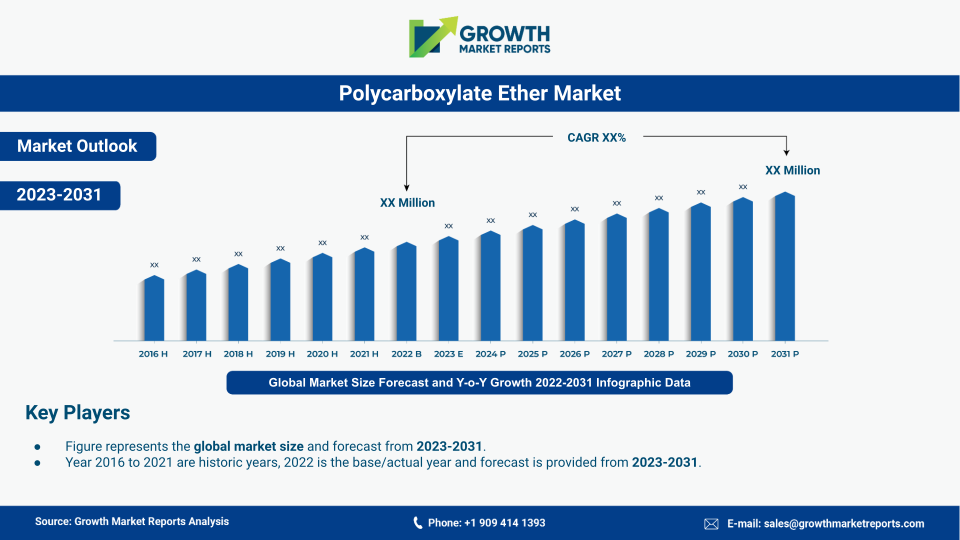
According to our latest research, the global Polycarboxylate Ether (PCE) market size was valued at USD 2.74 billion in 2024, demonstrating robust expansion across construction and infrastructure sectors worldwide. The market is expected to register a CAGR of 7.8% from 2025 to 2033, reaching a forecasted value of USD 5.41 billion by 2033. This impressive growth trajectory is primarily driven by the increasing demand for high-performance concrete admixtures, rapid urbanization, and significant investments in infrastructure development worldwide, particularly in emerging economies.

One of the primary growth factors propelling the polycarboxylate ether market is the widespread adoption of advanced concrete admixtures to enhance the performance and sustainability of construction materials. Polycarboxylate ethers have become the preferred choice for superplasticizers due to their superior water-reducing capabilities, improved workability, and ability to produce high-strength, durable concrete. As the construction industry faces mounting pressure to deliver environmentally friendly solutions, PCEs offer an attractive alternative by enabling lower cement consumption and reducing the carbon footprint of concrete production. Additionally, the global push for green buildings and sustainable infrastructure is further accelerating the adoption of PCE-based admixtures, as they contribute to LEED certifications and other sustainability benchmarks.

Another significant driver for the polycarboxylate ether market is the rapid pace of urbanization and infrastructure development in emerging economies, particularly in Asia Pacific and the Middle East. Governments and private sector players are investing heavily in transport networks, smart cities, and residential and commercial complexes, all of which demand high-quality, durable concrete. PCEs play a crucial role in meeting these requirements, as they enable the production of self-compacting, high-performance, and precast concrete with superior mechanical properties. As a result, the demand for polycarboxylate ether is surging in countries such as China, India, and the Gulf Cooperation Council (GCC) nations, where large-scale construction projects are underway to support economic growth and urban expansion.

Technological advancements in polymer chemistry and the continuous evolution of polycarboxylate ether formulations are also contributing to the market's growth. Leading manufacturers are investing in research and development to create customized PCEs that cater to specific regional requirements, climatic conditions, and application needs. Innovations such as low-viscosity PCEs, high-early strength admixtures, and eco-friendly formulations are gaining traction, as they address the evolving demands of the construction sector. Furthermore, the integration of digital technologies and automation in concrete batching plants is facilitating the precise dosing and efficient utilization of PCEs, thereby optimizing concrete performance and reducing costs for end users.

The integration of Construction Chemicals into the polycarboxylate ether market is becoming increasingly significant as the industry evolves. Construction chemicals, including admixtures like polycarboxylate ethers, play a crucial role in enhancing the performance and longevity of concrete structures. These chemicals are essential for achieving the desired properties in concrete, such as increased strength, durability, and resistance to environmental factors. As infrastructure projects become more complex and demanding, the role of construction chemicals in ensuring the quality and sustainability of these projects cannot be overstated. The synergy between polycarboxylate ethers and other construction chemicals is pivotal in meeting the industry's growing demands for high-performance materials.

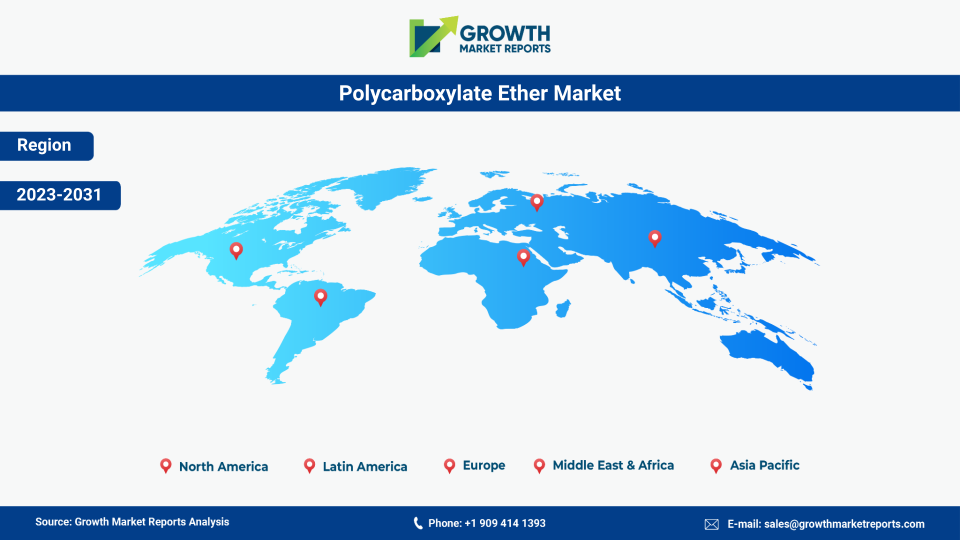
Regionally, the polycarboxylate ether market exhibits a dynamic landscape, with Asia Pacific leading in both consumption and production. North America and Europe follow closely, driven by stringent regulatory standards for construction materials and a strong focus on sustainable building practices. The Middle East & Africa and Latin America are also witnessing increasing adoption of PCEs, supported by infrastructure modernization initiatives and growing awareness about the benefits of high-performance concrete admixtures. The competitive intensity varies across regions, with local and global players vying for market share through product innovation, strategic partnerships, and capacity expansions.

Global Polycarboxylate Ether Industry Outlook

Product Type Analysis

The polycarboxylate ether market is segmented by product type into Liquid Polycarboxylate Ether and Powder Polycarboxylate Ether. Liquid PCE continues to dominate the market, accounting for the largest share in 2024, owing to its ease of integration into concrete mixes and superior dispersion capabilities. Liquid PCEs are widely preferred in ready-mix and precast concrete applications, as they offer consistent performance, high water reduction, and improved workability. Their liquid form enables seamless dosing and mixing, which is crucial for large-scale construction projects where uniformity and quality control are paramount. The growing adoption of automated batching systems in modern concrete plants further enhances the demand for liquid PCEs, as they can be precisely metered and blended with other admixtures.

Powder polycarboxylate ether, on the other hand, is gaining traction in regions where transportation and storage of liquid chemicals pose logistical challenges. Powder PCEs offer advantages such as longer shelf life, reduced shipping costs, and ease of handling, making them an attractive option for remote construction sites and regions with limited infrastructure. The ability to reconstitute powder PCEs on-site provides flexibility to contractors and concrete producers, allowing them to tailor admixture dosages to specific project requirements. As infrastructure development expands into rural and hard-to-reach areas, the demand for powder PCEs is expected to grow steadily, particularly in emerging markets across Asia, Africa, and Latin America.

Technological advancements in the production of both liquid and powder PCEs are driving product differentiation and expanding the market's addressable applications. Manufacturers are focusing on developing PCEs with enhanced molecular structures that deliver superior slump retention, early strength development, and compatibility with a wide range of cement types. These innovations are particularly important for high-performance and self-compacting concrete, where precise control over rheological properties is essential. Additionally, the trend towards sustainable construction is prompting the development of eco-friendly PCE formulations that minimize the use of hazardous chemicals and reduce environmental impact.

The competitive landscape within the product type segment is characterized by intense rivalry among global and regional players, each striving to offer differentiated solutions to meet the evolving needs of the construction industry. Strategic collaborations with concrete producers, technical support services, and investments in R&D are key strategies adopted by leading manufacturers to maintain their market position. As end users become more discerning and demand higher performance from their admixtures, the market for both liquid and powder PCEs is expected to witness continued innovation and growth.

Polycarboxylate Superplasticizers are at the forefront of innovation in the concrete admixture industry, offering unparalleled benefits in terms of workability and strength enhancement. These superplasticizers are a subset of polycarboxylate ethers, specifically engineered to provide superior water reduction capabilities and improved flow characteristics in concrete mixes. Their ability to disperse cement particles efficiently results in high-strength, durable concrete with reduced water content, making them ideal for modern construction applications. As the construction sector continues to prioritize sustainability and performance, the demand for polycarboxylate superplasticizers is expected to rise, driven by their contribution to reducing the carbon footprint of concrete production and enhancing the overall quality of construction projects.

Report Scope

Attributes Details
Report Title Polycarboxylate Ether Market Research Report 2033
By Product Type Liquid Polycarboxylate Ether, Powder Polycarboxylate Ether
By Application Ready-Mix Concrete, Precast Concrete, High-Performance Concrete, Self-Compacting Concrete, Others
By End-Use Industry Residential, Commercial, Infrastructure, Industrial, Others
Regions Covered North America, Europe, APAC, Latin America, MEA
Base Year 2024
Historic Data 2018-2023
Forecast Period 2025-2033
Number of Pages 277
Number of Tables & Figures 310
Customization Available Yes, the report can be customized as per your need.

Application Analysis

The application segment of the polycarboxylate ether market is broadly categorized into Ready-Mix Concrete, Precast Concrete, High-Performance Concrete, Self-Compacting Concrete, and Others. Among these, ready-mix concrete remains the dominant application, accounting for a substantial share of global PCE consumption in 2024. The widespread use of ready-mix concrete in residential, commercial, and infrastructure projects is a major factor driving this segment. Polycarboxylate ethers are highly valued in ready-mix applications for their ability to enhance workability, reduce water demand, and improve the strength and durability of concrete. The increasing trend towards urbanization and the proliferation of large-scale construction projects are further fueling the demand for PCEs in this segment.

Precast concrete is another significant application area for polycarboxylate ethers, particularly in regions with advanced construction practices and stringent quality standards. PCEs play a critical role in precast applications by enabling the production of high-strength, dimensionally stable concrete elements with superior surface finish. The demand for precast concrete is rising in both developed and developing markets, driven by the need for rapid construction, reduced labor costs, and improved building quality. Polycarboxylate ethers facilitate the production of complex shapes and thin-walled elements, making them indispensable for modern precast manufacturing processes.

High-performance concrete and self-compacting concrete represent specialized application segments where polycarboxylate ethers are essential for achieving desired performance characteristics. In high-performance concrete, PCEs are used to achieve high compressive strength, low permeability, and enhanced durability, which are critical for infrastructure projects such as bridges, tunnels, and high-rise buildings. In self-compacting concrete, PCEs provide the necessary flowability and viscosity control, enabling the concrete to spread and consolidate without the need for mechanical vibration. These advanced applications are witnessing increased adoption as construction projects become more complex and performance-driven.

The "Others" segment includes niche applications such as shotcrete, grout, and repair mortars, where polycarboxylate ethers are used to optimize workability and mechanical properties. As the construction industry continues to evolve, the application spectrum for PCEs is expected to broaden, driven by innovations in concrete technology and the growing emphasis on sustainability. Manufacturers are developing tailored PCE solutions for specific applications, addressing challenges such as early strength development, extended slump retention, and compatibility with supplementary cementitious materials.

End-Use Industry Analysis

The polycarboxylate ether market serves a diverse range of end-use industries, including Residential, Commercial, Infrastructure, Industrial, and Others. The infrastructure segment is the largest end-user, accounting for a significant portion of global PCE demand in 2024. Large-scale infrastructure projects such as highways, bridges, airports, and metro systems require high-performance concrete with superior durability and mechanical strength. Polycarboxylate ethers are indispensable in these applications, as they enable the production of concrete that meets stringent performance specifications and withstands harsh environmental conditions. Government investments in infrastructure modernization, particularly in emerging economies, are a major driver for this segment.

The commercial construction segment is also a major consumer of polycarboxylate ethers, driven by the proliferation of office buildings, shopping malls, hotels, and educational institutions. Commercial projects often demand aesthetically pleasing, high-strength concrete with excellent workability and finish. PCEs help meet these requirements by improving concrete flow, reducing segregation, and enhancing surface quality. The trend towards green building certifications and sustainable construction practices is further boosting the adoption of PCE-based admixtures in commercial projects.

Residential construction represents a substantial and growing end-use segment for polycarboxylate ethers, particularly in rapidly urbanizing regions. The demand for affordable, high-quality housing is driving the use of advanced concrete admixtures that enhance construction speed, reduce material costs, and improve building durability. Polycarboxylate ethers enable the production of lightweight, high-strength concrete that meets the needs of modern residential developments. As urban populations continue to rise, the residential segment is expected to remain a key growth driver for the PCE market.

The industrial segment, encompassing factories, warehouses, and manufacturing facilities, also contributes to the demand for polycarboxylate ethers. Industrial projects often require specialized concrete formulations with high early strength, chemical resistance, and durability. PCEs are used to optimize concrete performance in these demanding environments, ensuring long service life and reduced maintenance costs. The "Others" category includes applications such as utilities, water treatment plants, and energy infrastructure, where the use of high-performance concrete is critical for operational efficiency and safety.

Opportunities & Threats

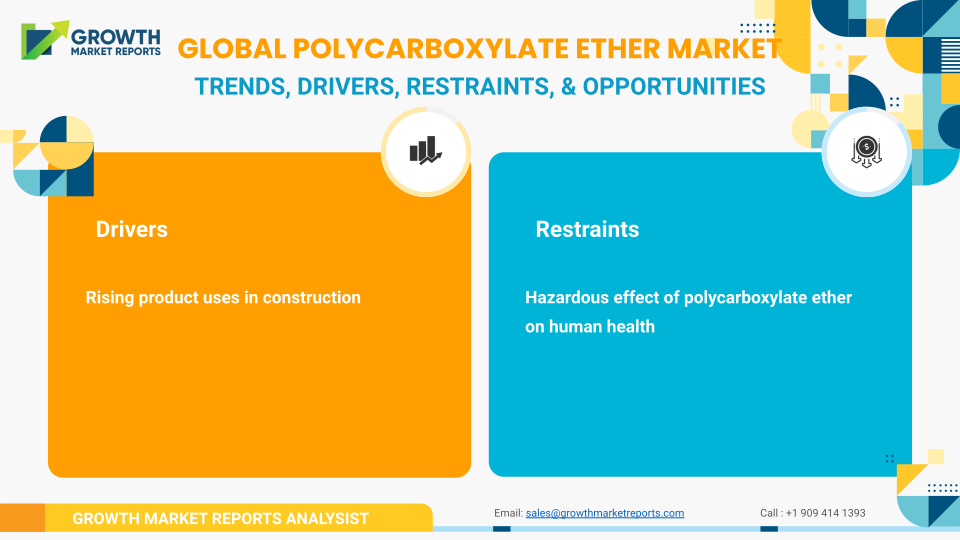
The polycarboxylate ether market presents significant opportunities for growth, particularly in the context of global infrastructure development and the shift towards sustainable construction practices. The ongoing urbanization in emerging economies and the increasing demand for high-performance, durable concrete are creating lucrative opportunities for manufacturers and suppliers of PCEs. Investments in smart cities, transport networks, and renewable energy infrastructure are expected to drive sustained demand for advanced concrete admixtures. Additionally, the growing awareness of environmental sustainability and the need to reduce carbon emissions in the construction sector are prompting the adoption of PCE-based admixtures, which enable lower cement usage and improved energy efficiency.

Technological innovation represents another major opportunity for the polycarboxylate ether market. Advances in polymer chemistry, molecular engineering, and digitalization are enabling the development of next-generation PCEs with enhanced performance characteristics. Manufacturers that invest in R&D and collaborate with research institutions and construction companies are well-positioned to capture market share by offering differentiated, value-added solutions. The trend towards customization and the development of region-specific PCE formulations also open up new avenues for growth, as manufacturers can address the unique requirements of different geographies and applications.

Despite the positive outlook, the polycarboxylate ether market faces certain threats and challenges that could restrain growth. One of the primary restrainers is the volatility in raw material prices, particularly petrochemical feedstocks used in PCE production. Fluctuations in crude oil prices and supply chain disruptions can impact production costs and profit margins for manufacturers. Additionally, the market is subject to regulatory scrutiny regarding the use of chemicals in construction materials, with increasing emphasis on environmental and health safety. Compliance with evolving regulations and standards may require additional investments in product development and certification, posing challenges for smaller players and new entrants.

Regional Outlook

The Asia Pacific region continues to dominate the global polycarboxylate ether market, accounting for nearly 48% of total market revenue in 2024, which translates to approximately USD 1.31 billion. The region's leadership is underpinned by rapid urbanization, large-scale infrastructure projects, and significant investments in residential and commercial construction, particularly in China, India, and Southeast Asian countries. The Asia Pacific market is projected to register the highest CAGR of 8.7% from 2025 to 2033, driven by government initiatives to modernize infrastructure and the increasing adoption of advanced construction materials. The presence of major PCE manufacturers and the expansion of local production capacities further support the region's growth prospects.

North America is the second-largest regional market, with a market size of approximately USD 670 million in 2024. The region benefits from a mature construction industry, stringent regulatory standards for building materials, and a strong focus on sustainability and green building practices. The demand for high-performance and self-compacting concrete is particularly high in the United States and Canada, where infrastructure renewal and commercial construction projects are key growth drivers. The North American market is expected to grow at a steady CAGR of 6.5% over the forecast period, supported by ongoing investments in smart cities, transportation networks, and energy infrastructure.

Europe holds a significant share of the polycarboxylate ether market, with a market value of around USD 530 million in 2024. The region is characterized by a strong emphasis on sustainable construction, energy efficiency, and the use of eco-friendly materials. The European Union's regulatory framework encourages the adoption of advanced admixtures such as PCEs to reduce the environmental impact of concrete production. Key markets in the region include Germany, France, the United Kingdom, and Italy, where infrastructure modernization and urban redevelopment projects are driving demand. Latin America and the Middle East & Africa collectively account for the remaining market share, with growing opportunities in infrastructure development and urbanization, particularly in Brazil, Mexico, the GCC countries, and South Africa.

Polycarboxylate Ether Market Statistics

Competitor Outlook

The global polycarboxylate ether market is highly competitive, with a mix of multinational corporations, regional players, and niche manufacturers vying for market share. The competitive landscape is shaped by factors such as product innovation, technological expertise, pricing strategies, and distribution networks. Leading companies are investing heavily in research and development to create differentiated PCE formulations that offer enhanced performance, sustainability, and compatibility with various cement types. Strategic collaborations with construction companies, concrete producers, and research institutions are common, as they enable market leaders to stay ahead of emerging trends and address evolving customer needs.

Product quality, technical support, and customer service are key differentiators in the polycarboxylate ether market. Manufacturers that offer comprehensive technical assistance, customized solutions, and reliable supply chains are better positioned to capture and retain customers in a competitive environment. The market is also witnessing a trend towards vertical integration, with some companies expanding their presence across the value chain by acquiring raw material suppliers, distribution partners, and application specialists. This approach enables them to ensure consistent product quality, optimize costs, and respond quickly to market demands.

Mergers and acquisitions are another prominent feature of the competitive landscape, as companies seek to expand their geographic reach, diversify their product portfolios, and strengthen their market positions. The entry of new players and the expansion of local manufacturers in emerging markets are intensifying competition, prompting established players to focus on innovation, sustainability, and operational efficiency. Regulatory compliance, environmental stewardship, and adherence to international quality standards are becoming increasingly important, as customers and authorities demand higher levels of safety and sustainability in construction materials.

Some of the major companies operating in the global polycarboxylate ether market include BASF SE, Sika AG, Arkema Group, Mapei S.p.A., GCP Applied Technologies, Fosroc International, Kao Corporation, Sobute New Materials, and Ha-Be Betonchemie GmbH & Co. KG. BASF SE is recognized for its extensive portfolio of construction chemicals and a strong focus on innovation and sustainability. Sika AG is a global leader in specialty chemicals for construction, offering a wide range of PCE-based admixtures tailored to various applications. Arkema Group and Mapei S.p.A. are known for their advanced polymer technologies and commitment to environmental responsibility. GCP Applied Technologies and Fosroc International have established themselves as key players through their global distribution networks and technical expertise. Kao Corporation and Sobute New Materials are prominent in the Asia Pacific region, leveraging their local presence and R&D capabilities to address regional market needs. Ha-Be Betonchemie GmbH & Co. KG is recognized for its customized admixture solutions and strong customer relationships in Europe. Collectively, these companies are shaping the future of the polycarboxylate ether market through continuous innovation, strategic partnerships, and a relentless focus on customer value.

Key Players

  • Sika AG
  • BASF SE
  • Arkema Group
  • GCP Applied Technologies Inc.
  • MAPEI S.p.A.
  • Kao Corporation
  • Sobute New Materials Co., Ltd.
  • Fosroc International Limited
  • Liaoning Kelong Fine Chemical Co., Ltd.
  • Shandong Wanshan Chemical Co., Ltd.
  • Huangteng Chemical
  • Euclid Chemical Company
  • Rhein-Chemotechnik GmbH
  • Enaspol a.s.
  • Takemoto Oil & Fat Co., Ltd.
  • Shijiazhuang Yucai Chemical Co., Ltd.
  • Hunan Yousuo Chemical Co., Ltd.
  • Hubei Aging Chemical Co., Ltd.
  • Tianjin Feilong Retarding Agent Co., Ltd.
  • MUHU (China) Construction Materials Co., Ltd.
Polycarboxylate Ether Market Overview

Segments

The Polycarboxylate Ether market has been segmented on the basis of

Product Type

  • Liquid Polycarboxylate Ether
  • Powder Polycarboxylate Ether

Application

  • Ready-Mix Concrete
  • Precast Concrete
  • High-Performance Concrete
  • Self-Compacting Concrete
  • Others

End-Use Industry

  • Residential
  • Commercial
  • Infrastructure
  • Industrial
  • Others

Competitive Landscape

Sika AG; Ruia Chemicals; Arkema S.A.; Rossari Biotech; Kashyap Industries; Fosroc International Limited; Sakshi Chem Sciences Private Ltd.; Mapei S.P.A.; BASF SE; and Chembond Chemicals Ltd. are some key players operating in the global polycarboxylate ether market.

Some of the major companies are actively involved in research and development programs to increase their product portfolio and expand their consumer base.

In December 2021, a British manufacturer of specialized construction chemicals Fosroc International Limited, launch a stock facility agency at Vishakhapatnam, India. The company is able to offer timely delivery in Andhra Pradesh and neighboring region.
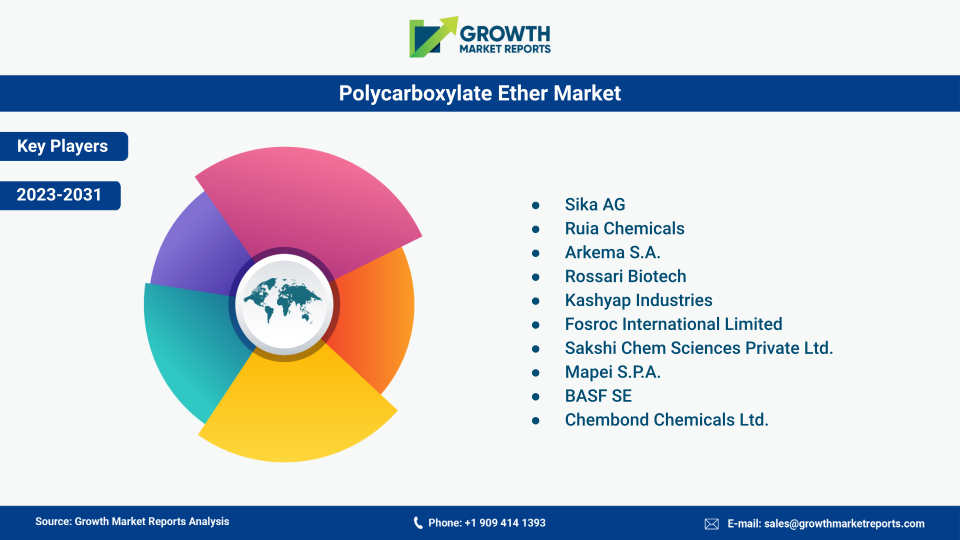

Polycarboxylate Ether Market Key Players

Frequently Asked Questions

Advances in polymer chemistry, molecular engineering, and digitalization are enabling the development of next-generation PCEs with enhanced performance, sustainability, and application-specific customization.

Major companies include BASF SE, Sika AG, Arkema Group, Mapei S.p.A., GCP Applied Technologies, Fosroc International, Kao Corporation, Sobute New Materials, and Ha-Be Betonchemie GmbH & Co. KG.

Opportunities include global infrastructure development, sustainable construction trends, and technological innovation. Threats involve raw material price volatility and regulatory challenges regarding chemical use and environmental safety.

The largest end-use industries are infrastructure, commercial, and residential construction, with additional demand from industrial projects and utilities.

PCE is widely used in ready-mix concrete, precast concrete, high-performance concrete, self-compacting concrete, and other specialized applications like shotcrete and grout.

The market is segmented into Liquid Polycarboxylate Ether and Powder Polycarboxylate Ether. Liquid PCE dominates due to its ease of use and superior dispersion, while powder PCE is gaining traction in regions with logistical challenges.

Asia Pacific leads the global PCE market, accounting for nearly 48% of total revenue in 2024, followed by North America and Europe.

Key growth drivers include rising demand for high-performance concrete admixtures, rapid urbanization, infrastructure investments, and the shift towards sustainable construction practices.

The polycarboxylate ether market is forecasted to grow at a CAGR of 7.8% from 2025 to 2033, reaching an estimated value of USD 5.41 billion by 2033.

As of 2024, the global polycarboxylate ether (PCE) market is valued at USD 2.74 billion, with strong growth expected in the coming years.

Table Of Content

Chapter 1 Executive Summary
Chapter 2 Assumptions and Acronyms Used
Chapter 3 Research Methodology
Chapter 4 Polycarboxylate Ether Market Overview
   4.1 Introduction
      4.1.1 Market Taxonomy
      4.1.2 Market Definition
      4.1.3 Macro-Economic Factors Impacting the Market Growth
   4.2 Polycarboxylate Ether Market Dynamics
      4.2.1 Market Drivers
      4.2.2 Market Restraints
      4.2.3 Market Opportunity
   4.3 Polycarboxylate Ether Market - Supply Chain Analysis
      4.3.1 List of Key Suppliers
      4.3.2 List of Key Distributors
      4.3.3 List of Key Consumers
   4.4 Key Forces Shaping the Polycarboxylate Ether Market
      4.4.1 Bargaining Power of Suppliers
      4.4.2 Bargaining Power of Buyers
      4.4.3 Threat of Substitution
      4.4.4 Threat of New Entrants
      4.4.5 Competitive Rivalry
   4.5 Global Polycarboxylate Ether Market Size & Forecast, 2023-2032
      4.5.1 Polycarboxylate Ether Market Size and Y-o-Y Growth
      4.5.2 Polycarboxylate Ether Market Absolute $ Opportunity

Chapter 5 Global Polycarboxylate Ether Market Analysis and Forecast By Product Type
   5.1 Introduction
      5.1.1 Key Market Trends & Growth Opportunities By Product Type
      5.1.2 Basis Point Share (BPS) Analysis By Product Type
      5.1.3 Absolute $ Opportunity Assessment By Product Type
   5.2 Polycarboxylate Ether Market Size Forecast By Product Type
      5.2.1 Liquid Polycarboxylate Ether
      5.2.2 Powder Polycarboxylate Ether
   5.3 Market Attractiveness Analysis By Product Type

Chapter 6 Global Polycarboxylate Ether Market Analysis and Forecast By Application
   6.1 Introduction
      6.1.1 Key Market Trends & Growth Opportunities By Application
      6.1.2 Basis Point Share (BPS) Analysis By Application
      6.1.3 Absolute $ Opportunity Assessment By Application
   6.2 Polycarboxylate Ether Market Size Forecast By Application
      6.2.1 Ready-Mix Concrete
      6.2.2 Precast Concrete
      6.2.3 High-Performance Concrete
      6.2.4 Self-Compacting Concrete
      6.2.5 Others
   6.3 Market Attractiveness Analysis By Application

Chapter 7 Global Polycarboxylate Ether Market Analysis and Forecast By End-Use Industry
   7.1 Introduction
      7.1.1 Key Market Trends & Growth Opportunities By End-Use Industry
      7.1.2 Basis Point Share (BPS) Analysis By End-Use Industry
      7.1.3 Absolute $ Opportunity Assessment By End-Use Industry
   7.2 Polycarboxylate Ether Market Size Forecast By End-Use Industry
      7.2.1 Residential
      7.2.2 Commercial
      7.2.3 Infrastructure
      7.2.4 Industrial
      7.2.5 Others
   7.3 Market Attractiveness Analysis By End-Use Industry

Chapter 8 Global Polycarboxylate Ether Market Analysis and Forecast by Region
   8.1 Introduction
      8.1.1 Key Market Trends & Growth Opportunities By Region
      8.1.2 Basis Point Share (BPS) Analysis By Region
      8.1.3 Absolute $ Opportunity Assessment By Region
   8.2 Polycarboxylate Ether Market Size Forecast By Region
      8.2.1 North America
      8.2.2 Europe
      8.2.3 Asia Pacific
      8.2.4 Latin America
      8.2.5 Middle East & Africa (MEA)
   8.3 Market Attractiveness Analysis By Region

Chapter 9 Coronavirus Disease (COVID-19) Impact 
   9.1 Introduction 
   9.2 Current & Future Impact Analysis 
   9.3 Economic Impact Analysis 
   9.4 Government Policies 
   9.5 Investment Scenario

Chapter 10 North America Polycarboxylate Ether Analysis and Forecast
   10.1 Introduction
   10.2 North America Polycarboxylate Ether Market Size Forecast by Country
      10.2.1 U.S.
      10.2.2 Canada
   10.3 Basis Point Share (BPS) Analysis by Country
   10.4 Absolute $ Opportunity Assessment by Country
   10.5 Market Attractiveness Analysis by Country
   10.6 North America Polycarboxylate Ether Market Size Forecast By Product Type
      10.6.1 Liquid Polycarboxylate Ether
      10.6.2 Powder Polycarboxylate Ether
   10.7 Basis Point Share (BPS) Analysis By Product Type 
   10.8 Absolute $ Opportunity Assessment By Product Type 
   10.9 Market Attractiveness Analysis By Product Type
   10.10 North America Polycarboxylate Ether Market Size Forecast By Application
      10.10.1 Ready-Mix Concrete
      10.10.2 Precast Concrete
      10.10.3 High-Performance Concrete
      10.10.4 Self-Compacting Concrete
      10.10.5 Others
   10.11 Basis Point Share (BPS) Analysis By Application 
   10.12 Absolute $ Opportunity Assessment By Application 
   10.13 Market Attractiveness Analysis By Application
   10.14 North America Polycarboxylate Ether Market Size Forecast By End-Use Industry
      10.14.1 Residential
      10.14.2 Commercial
      10.14.3 Infrastructure
      10.14.4 Industrial
      10.14.5 Others
   10.15 Basis Point Share (BPS) Analysis By End-Use Industry 
   10.16 Absolute $ Opportunity Assessment By End-Use Industry 
   10.17 Market Attractiveness Analysis By End-Use Industry

Chapter 11 Europe Polycarboxylate Ether Analysis and Forecast
   11.1 Introduction
   11.2 Europe Polycarboxylate Ether Market Size Forecast by Country
      11.2.1 Germany
      11.2.2 France
      11.2.3 Italy
      11.2.4 U.K.
      11.2.5 Spain
      11.2.6 Russia
      11.2.7 Rest of Europe
   11.3 Basis Point Share (BPS) Analysis by Country
   11.4 Absolute $ Opportunity Assessment by Country
   11.5 Market Attractiveness Analysis by Country
   11.6 Europe Polycarboxylate Ether Market Size Forecast By Product Type
      11.6.1 Liquid Polycarboxylate Ether
      11.6.2 Powder Polycarboxylate Ether
   11.7 Basis Point Share (BPS) Analysis By Product Type 
   11.8 Absolute $ Opportunity Assessment By Product Type 
   11.9 Market Attractiveness Analysis By Product Type
   11.10 Europe Polycarboxylate Ether Market Size Forecast By Application
      11.10.1 Ready-Mix Concrete
      11.10.2 Precast Concrete
      11.10.3 High-Performance Concrete
      11.10.4 Self-Compacting Concrete
      11.10.5 Others
   11.11 Basis Point Share (BPS) Analysis By Application 
   11.12 Absolute $ Opportunity Assessment By Application 
   11.13 Market Attractiveness Analysis By Application
   11.14 Europe Polycarboxylate Ether Market Size Forecast By End-Use Industry
      11.14.1 Residential
      11.14.2 Commercial
      11.14.3 Infrastructure
      11.14.4 Industrial
      11.14.5 Others
   11.15 Basis Point Share (BPS) Analysis By End-Use Industry 
   11.16 Absolute $ Opportunity Assessment By End-Use Industry 
   11.17 Market Attractiveness Analysis By End-Use Industry

Chapter 12 Asia Pacific Polycarboxylate Ether Analysis and Forecast
   12.1 Introduction
   12.2 Asia Pacific Polycarboxylate Ether Market Size Forecast by Country
      12.2.1 China
      12.2.2 Japan
      12.2.3 South Korea
      12.2.4 India
      12.2.5 Australia
      12.2.6 South East Asia (SEA)
      12.2.7 Rest of Asia Pacific (APAC)
   12.3 Basis Point Share (BPS) Analysis by Country
   12.4 Absolute $ Opportunity Assessment by Country
   12.5 Market Attractiveness Analysis by Country
   12.6 Asia Pacific Polycarboxylate Ether Market Size Forecast By Product Type
      12.6.1 Liquid Polycarboxylate Ether
      12.6.2 Powder Polycarboxylate Ether
   12.7 Basis Point Share (BPS) Analysis By Product Type 
   12.8 Absolute $ Opportunity Assessment By Product Type 
   12.9 Market Attractiveness Analysis By Product Type
   12.10 Asia Pacific Polycarboxylate Ether Market Size Forecast By Application
      12.10.1 Ready-Mix Concrete
      12.10.2 Precast Concrete
      12.10.3 High-Performance Concrete
      12.10.4 Self-Compacting Concrete
      12.10.5 Others
   12.11 Basis Point Share (BPS) Analysis By Application 
   12.12 Absolute $ Opportunity Assessment By Application 
   12.13 Market Attractiveness Analysis By Application
   12.14 Asia Pacific Polycarboxylate Ether Market Size Forecast By End-Use Industry
      12.14.1 Residential
      12.14.2 Commercial
      12.14.3 Infrastructure
      12.14.4 Industrial
      12.14.5 Others
   12.15 Basis Point Share (BPS) Analysis By End-Use Industry 
   12.16 Absolute $ Opportunity Assessment By End-Use Industry 
   12.17 Market Attractiveness Analysis By End-Use Industry

Chapter 13 Latin America Polycarboxylate Ether Analysis and Forecast
   13.1 Introduction
   13.2 Latin America Polycarboxylate Ether Market Size Forecast by Country
      13.2.1 Brazil
      13.2.2 Mexico
      13.2.3 Rest of Latin America (LATAM)
   13.3 Basis Point Share (BPS) Analysis by Country
   13.4 Absolute $ Opportunity Assessment by Country
   13.5 Market Attractiveness Analysis by Country
   13.6 Latin America Polycarboxylate Ether Market Size Forecast By Product Type
      13.6.1 Liquid Polycarboxylate Ether
      13.6.2 Powder Polycarboxylate Ether
   13.7 Basis Point Share (BPS) Analysis By Product Type 
   13.8 Absolute $ Opportunity Assessment By Product Type 
   13.9 Market Attractiveness Analysis By Product Type
   13.10 Latin America Polycarboxylate Ether Market Size Forecast By Application
      13.10.1 Ready-Mix Concrete
      13.10.2 Precast Concrete
      13.10.3 High-Performance Concrete
      13.10.4 Self-Compacting Concrete
      13.10.5 Others
   13.11 Basis Point Share (BPS) Analysis By Application 
   13.12 Absolute $ Opportunity Assessment By Application 
   13.13 Market Attractiveness Analysis By Application
   13.14 Latin America Polycarboxylate Ether Market Size Forecast By End-Use Industry
      13.14.1 Residential
      13.14.2 Commercial
      13.14.3 Infrastructure
      13.14.4 Industrial
      13.14.5 Others
   13.15 Basis Point Share (BPS) Analysis By End-Use Industry 
   13.16 Absolute $ Opportunity Assessment By End-Use Industry 
   13.17 Market Attractiveness Analysis By End-Use Industry

Chapter 14 Middle East & Africa (MEA) Polycarboxylate Ether Analysis and Forecast
   14.1 Introduction
   14.2 Middle East & Africa (MEA) Polycarboxylate Ether Market Size Forecast by Country
      14.2.1 Saudi Arabia
      14.2.2 South Africa
      14.2.3 UAE
      14.2.4 Rest of Middle East & Africa (MEA)
   14.3 Basis Point Share (BPS) Analysis by Country
   14.4 Absolute $ Opportunity Assessment by Country
   14.5 Market Attractiveness Analysis by Country
   14.6 Middle East & Africa (MEA) Polycarboxylate Ether Market Size Forecast By Product Type
      14.6.1 Liquid Polycarboxylate Ether
      14.6.2 Powder Polycarboxylate Ether
   14.7 Basis Point Share (BPS) Analysis By Product Type 
   14.8 Absolute $ Opportunity Assessment By Product Type 
   14.9 Market Attractiveness Analysis By Product Type
   14.10 Middle East & Africa (MEA) Polycarboxylate Ether Market Size Forecast By Application
      14.10.1 Ready-Mix Concrete
      14.10.2 Precast Concrete
      14.10.3 High-Performance Concrete
      14.10.4 Self-Compacting Concrete
      14.10.5 Others
   14.11 Basis Point Share (BPS) Analysis By Application 
   14.12 Absolute $ Opportunity Assessment By Application 
   14.13 Market Attractiveness Analysis By Application
   14.14 Middle East & Africa (MEA) Polycarboxylate Ether Market Size Forecast By End-Use Industry
      14.14.1 Residential
      14.14.2 Commercial
      14.14.3 Infrastructure
      14.14.4 Industrial
      14.14.5 Others
   14.15 Basis Point Share (BPS) Analysis By End-Use Industry 
   14.16 Absolute $ Opportunity Assessment By End-Use Industry 
   14.17 Market Attractiveness Analysis By End-Use Industry

Chapter 15 Competition Landscape 
   15.1 Polycarboxylate Ether Market: Competitive Dashboard
   15.2 Global Polycarboxylate Ether Market: Market Share Analysis, 2023
   15.3 Company Profiles (Details – Overview, Financials, Developments, Strategy) 
      15.3.1 Sika AG
BASF SE
Arkema Group
GCP Applied Technologies Inc.
MAPEI S.p.A.
Kao Corporation
Sobute New Materials Co., Ltd.
Fosroc International Limited
Liaoning Kelong Fine Chemical Co., Ltd.
Shandong Wanshan Chemical Co., Ltd.
Huangteng Chemical
Euclid Chemical Company
Rhein-Chemotechnik GmbH
Enaspol a.s.
Takemoto Oil & Fat Co., Ltd.
Shijiazhuang Yucai Chemical Co., Ltd.
Hunan Yousuo Chemical Co., Ltd.
Hubei Aging Chemical Co., Ltd.
Tianjin Feilong Retarding Agent Co., Ltd.
MUHU (China) Construction Materials Co., Ltd.

Methodology

Our Clients

Deloitte
General Electric
Pfizer
The John Holland Group
sinopec
Nestle SA
General Mills
Honda Motor Co. Ltd.