Global Carbon Fiber & Carbon Fiber Reinforced Plastic Market
Segments - By Raw Material Type (Polyacrylonitrile Carbon Fibers (PAN-Based CF), Pitch-Based Carbon Fiber, And Rayon-Based Carbon Fiber), By Resin Type (Thermosetting CFRP, Thermoplastic CFRP), By Application (Aerospace & Defense, Sports & Leisure, Wind Energy, Automotive, Pressure Vessels, Construction & Infrastructure, Chemical, Oil & Gas, And Others), By Sales Channel (Manufacturer, Distributor), and Region (North America, Latin America, Europe, Asia Pacific and Middle East & Africa) - Global Industry Analysis, Growth, Share, Size, Trends, and Forecast 2020 – 2027
Segments - By Raw Material Type (Polyacrylonitrile Carbon Fibers (PAN-Based CF), Pitch-Based Carbon Fiber, And Rayon-Based Carbon Fiber), By Resin Type (Thermosetting CFRP, Thermoplastic CFRP), By Application (Aerospace & Defense, Sports & Leisure, Wind Energy, Automotive, Pressure Vessels, Construction & Infrastructure, Chemical, Oil & Gas, And Others), By Sales Channel (Manufacturer, Distributor), and Region (North America, Latin America, Europe, Asia Pacific and Middle East & Africa) - Global Industry Analysis, Growth, Share, Size, Trends, and Forecast 2020 – 2027
Carbon Fiber and Carbon Fiber Reinforced Plastic Market Outlook:
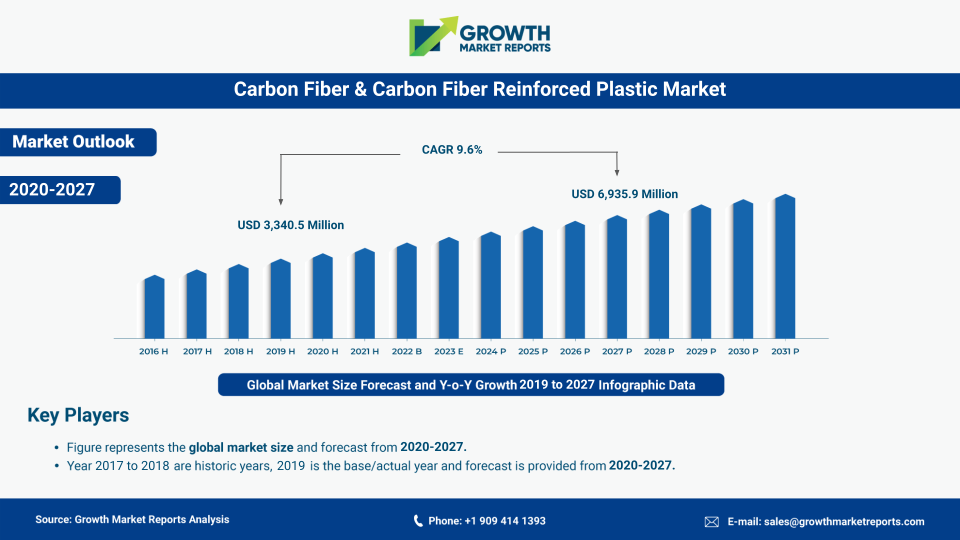
The global Carbon Fiber market size wasvalued at USD 3,340.5 Million in 2019 and is likely reach to USD 6,935.9 Million by 2027, expanding at a CAGR of 9.6% during the forecast period 2020-2027.
The global Carbon Fiber Reinforced Plastic Market is projected to reach 43,955.8 Million with 11.6% CAGR from 18,248.0 Million revenue in 2019. Carbon fiber (CF) is a polymer that consists of a long chain of carbon atoms bonded together.
These fibers are very strong, extremely stiff, and light in weight. A carbon fiber is thinner than a strand of human hair. The fiber becomes extremely strong when twisted together in the same manner as a yarn. Strands of fiber can be also woven together to produce cloth. Carbon fiber reinforced plastic (CFRP) is a composite material that uses carbon fibers, as the principal structural component.
This combination of reinforcing carbons and a polymer matrix leads to high-performance materials, which allows weight reduction by 50%, while steel decrease weight by 20%, as compared to aluminum.
Companies in industries such as automotive, construction, and aerospace are engaging in extensive research and development (R&D) activities to move from niche to high-volume applications. Carbon fiber reinforced plastic is sometimes also referred to as carbon fiber reinforced polymer.
CFRP materials are widely used in the manufacturing of top-end sports cars that require strong and light materials. Furthermore, high-end competition motorbikes and bicycles use CRPF frames, handlebars, and forks to keep the weight to a minimum.
Carbon Fiber and Carbon Fiber Reinforced PlasticMarket Dynamics
Market drivers
Superior mechanical and physical properties of CF materials such as lightweight, high tensile strength, and impact resistance make these materials ideal for making vehicles fuel-efficient and reliable. This, in turn, is increasing the demand for CF materials in various industries such as aerospace & defense, automotive, sports, and wind turbines.
The aerospace & defense industry has stringent performance product requirements for applications in commercial aircraft, satellites, helicopters, engines, and launchers. This, in turn, is increasing the demand for high-performance products in the aerospace and defense industry, which is fueling the demand for CRPF products.
Market Restraints
CFRP product manufacturing requires a long production cycle; therefore, fewer number of goods are produced in a particular period of time, thus restricting the use of CFRP products in applications where higher number of products are required in a short time period. The high cost of manufacturing composite materials is likely to hinder the growth of the market.
Carbon Fiber & Carbon Fiber Reinforced Plastic MarketSegmental Outlook
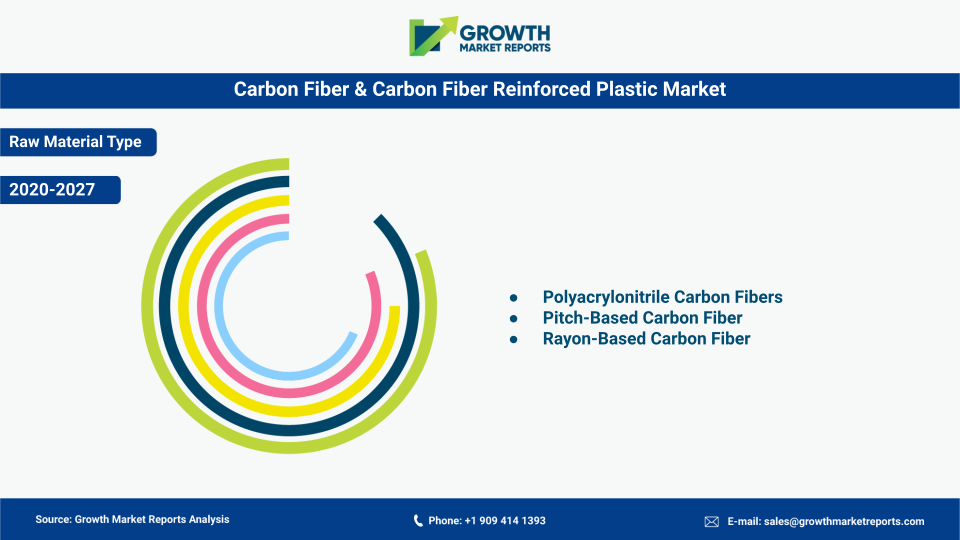
On the basis of raw materials, the market has been segmented into polyacrylonitrile carbon fibers (PAN-based CF), pitch-based carbon fiber, and rayon-based carbon fiber. The PAN-based Carbon Fibers dominates the market and is projected to expand at a CAGR of 9.3% during the forecast period.
Polyacrylonitrile (PAN) is extensively used in the production of CF owing to its excellent mechanical properties such as high tensile strength and temperature resistance. Moreover, PAN is less expensive than other raw materials.
Based on resin types, the market has been bifurcated into thermosetting CFRP and thermoplastic CFRP. Thermosetting CFRP is projected to constitute more than 79% share of market by 2026.
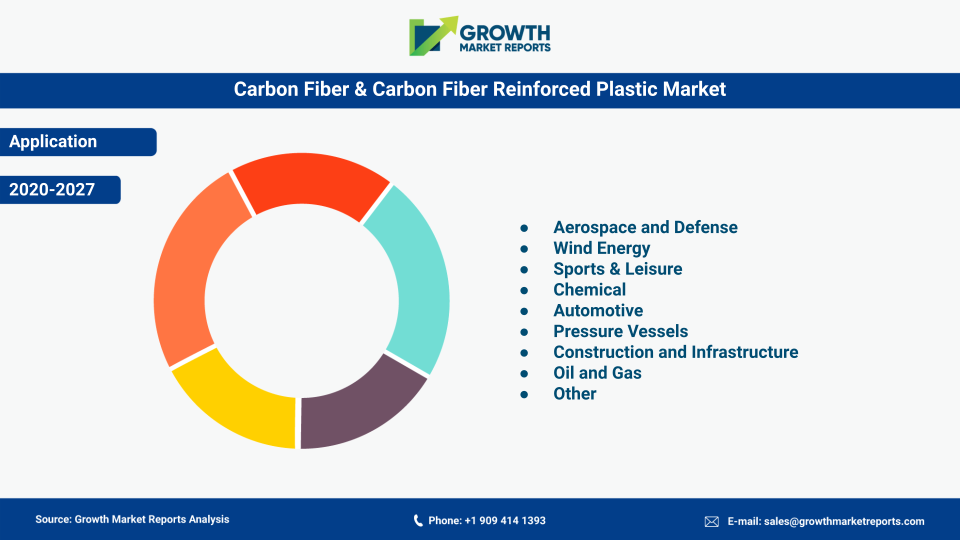
In terms of applications, the market has been classified as aerospace & defense, sports & leisure, wind energy, automotive, pressure vessels, construction & infrastructure, chemical, oil & gas, and others. In terms of volume and revenue, the aerospace & defense segment is anticipated to account for a key share of the market, during the forecast period.
The automotive segment is estimated to expand at a significant CAGR of 12.8% owing to the rising global demand for automobile sector. CFRP is light weight as compared to metals thus gives high mileage and, less cost and weight. CF is employed in the manufacture of part such as blade spar caps, root sections, blade shells, drive shafts, and towers.
On the basis of sales channels, the market has been bifurcated into manufacturers and distributors. Leading manufacturers of CF have increased their production capacity to cater to the increasing global demand. The CF market is highly concentrated.
Major manufacturers include Hexcel Corporation, SGL Carbon SE, Mitsubishi Chemical Carbon Fiber and Composites, Toho Tenax, and Toray Industries Inc. among others.
Distribution is the process of making a service or product available for the consumer or business users who demand them. Distributors usually have a business relationship with manufactures that produces product.
Carbon Fiber & Carbon Fiber Reinforced Plastic MarketRegional Outlook
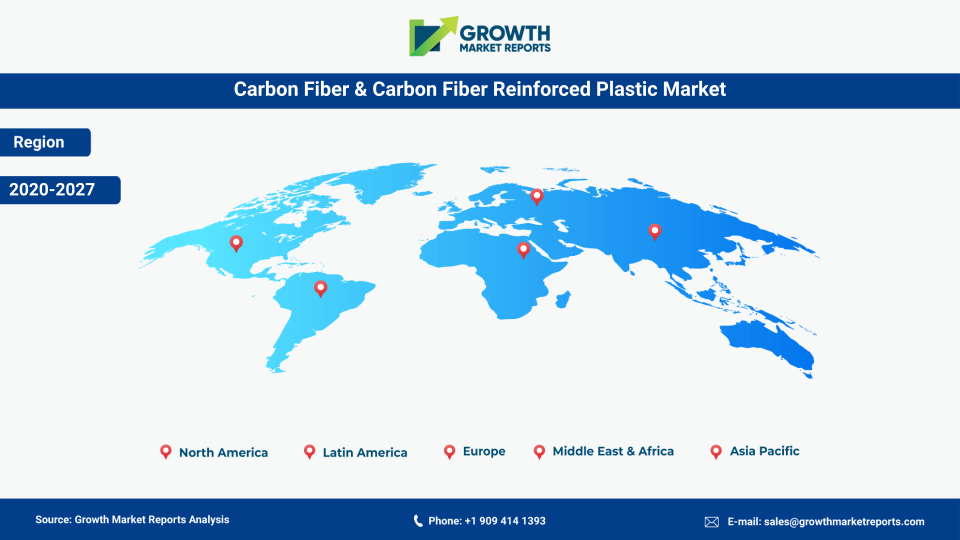
On the basis of regions, the global carbon fiber and carbon fiber reinforced polymer market share has been segmented into North America, Europe, Asia Pacific, Latin America, and Middle East & Africa (MEA).
North America is a promising region for the market. Growing research and development activities in the aerospace and defense sector in the US, is expected to boost the demand for CF and CFRP during the forecast period.
Key Benefits for Industry Participants & Stakeholders
In-depth Analysis of the Global Carbon Fiber & Carbon Fiber Reinforced Plastics Market
Historical, Current and Projected Market Size in terms of Value and Volume
Potential & Niche Segments and Regions Exhibiting Promising Growth Covered
Industry Drivers, Restraints and Opportunities Covered in the Study
Recent Industry Trends and Developments
Competitive Landscape & Strategies of Key Players
Neutral Perspective on Global Carbon Fiber & Carbon Fiber Reinforced Plastic Market Performance
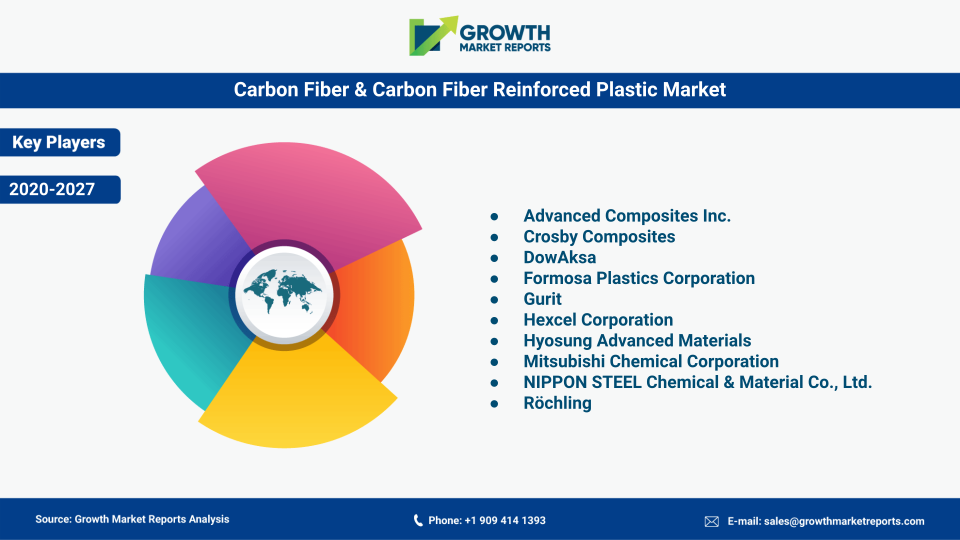
Key players in the market include TEIJIN LIMITED, Formosa Plastics Corporation, Hexcel Corporation, TORAY INDUSTRIES, INC., and others. They considered as key manufacturers of the market based on their different varieties of product availability, regional presence, better supply chain management system, and the increasing demand for the products.
The players are adopting key strategies such as acquisition, and geographical expansion where potential opportunity for the carbon fiber & carbon fiber reinforced plastic extraction is added in the company’s capacity.
For instance, On December 19, 2017, SGL Carbon completed the purchase of 50% shares of BENTELER Carbon Composites Beteiligungs-GmbH in the joint venture Benteler SGL GmbH & Co. KG, Paderborn. The transaction resulted in SGL Carbon being the sole owner of the company, thus strengthening its production capabilities for components produced from fiber-reinforced composites.
On December 3, 2019, Solvay and SGL Carbon entered into a joint development agreement (JDA) to commercialize composite materials based on large-tow intermediate modulus (IM) carbon fiber. This agreement has helped Solvay strengthen its hold in the aerospace industry.
Video Summary for Carbon Fiber & Carbon Fiber Reinforced Plastic Market
Chapter 1 Executive Summary Chapter 2 Assumptions and Acronyms Used Chapter 3 Research Methodology Chapter 4 Carbon Fiber & Carbon Fiber Reinforced Plastic Market Overview 4.1 Introduction 4.1.1 Market Taxonomy 4.1.2 Market Definition 4.1.3 Macro-Economic Factors Impacting the Market Growth 4.2 Carbon Fiber & Carbon Fiber Reinforced Plastic Market Dynamics 4.2.1 Market Drivers 4.2.2 Market Restraints 4.2.3 Market Opportunity 4.2.4 Market Trends 4.3 Carbon Fiber & Carbon Fiber Reinforced Plastic Market - Supply Chain Analysis 4.3.1 List of Key Suppliers 4.3.2 List of Key Distributors 4.3.3 List of Key Consumers 4.4 Key Forces Shaping the Carbon Fiber & Carbon Fiber Reinforced Plastic Market 4.4.1 Bargaining Power of Suppliers 4.4.2 Bargaining Power of Buyers 4.4.3 Threat of Substitution 4.4.4 Threat of New Entrants 4.4.5 Competitive Rivalry 4.5 Global Carbon Fiber & Carbon Fiber Reinforced Plastic Market Size & Forecast, 2017-2027 4.5.1 Carbon Fiber & Carbon Fiber Reinforced Plastic Market Size and Y-o-Y Growth 4.5.2 Carbon Fiber & Carbon Fiber Reinforced Plastic Market Absolute $ Opportunity Chapter 5 Global Carbon Fiber Market Analysis and Forecast By Raw Material Type 5.1 Introduction 5.1.1 Key Market Trends & Growth Opportunities By Raw Material Type 5.1.2 Basis Point Share (BPS) Analysis By Raw Material Type 5.1.3 Absolute $ Opportunity Assessment By Raw Material Type 5.2 Carbon Fiber Market Size & Volume Forecast By Raw Material Type 5.2.1 Polyacrylonitrile Carbon Fibers 5.2.2 Pitch-Based Carbon Fiber 5.2.3 Rayon-Based Carbon Fiber 5.3 Market Attractiveness Analysis By Raw Material Type Chapter 6 Global Carbon Fiber Reinforced Plastic Market Analysis and Forecast By Resin Type 6.1 Introduction 6.1.1 Key Market Trends & Growth Opportunities By Resin Type 6.1.2 Basis Point Share (BPS) Analysis By Resin Type 6.1.3 Absolute $ Opportunity Assessment By Resin Type 6.2 Carbon Fiber Reinforced Plastic Market Size & Volume Forecast By Resin Type 6.2.1 Thermosetting CFRP 6.2.2 Thermoplastic CFRP 6.3 Market Attractiveness Analysis By Resin Type Chapter 7 Global Carbon Fiber Reinforced Plastic Market Analysis and Forecast By Application 7.1 Introduction 7.1.1 Key Market Trends & Growth Opportunities By Application 7.1.2 Basis Point Share (BPS) Analysis By Application 7.1.3 Absolute $ Opportunity Assessment By Application 7.2 Carbon Fiber Reinforced Plastic Market Size & Volume Forecast By Application 7.2.1 Aerospace and Defense 7.2.2 Wind Energy 7.2.3 Sports & Leisure 7.2.4 Chemical 7.2.5 Automotive 7.2.6 Pressure Vessels 7.2.7 Construction and Infrastructure 7.2.8 Oil and Gas 7.2.9 Other 7.3 Market Attractiveness Analysis By Application Chapter 8 Global Carbon Fiber Reinforced Plastic Market Analysis and Forecast By Sales Channel 8.1 Introduction 8.1.1 Key Market Trends & Growth Opportunities By Sales Channel 8.1.2 Basis Point Share (BPS) Analysis By Sales Channel 8.1.3 Absolute $ Opportunity Assessment By Sales Channel 8.2 Carbon Fiber Reinforced Plastic Market Size & Volume Forecast By Sales Channel 8.2.1 Manufacturer 8.2.2 Distributor 8.3 Market Attractiveness Analysis By Sales Channel Chapter 9 Global Carbon Fiber & Carbon Fiber Reinforced Plastic Market Analysis and Forecast by Region 9.1 Introduction 9.1.1 Key Market Trends & Growth Opportunities by Region 9.1.2 Basis Point Share (BPS) Analysis by Region 9.1.3 Absolute $ Opportunity Assessment by Region 9.2 Carbon Fiber & Carbon Fiber Reinforced Plastic Market Size Forecast by Region 9.2.1 North America 9.2.2 Europe 9.2.3 Asia Pacific 9.2.4 Latin America 9.2.5 Middle East & Africa (MEA) 9.3 Market Attractiveness Analysis by Region Chapter 10 Coronavirus Disease (COVID-19) Impact 10.1 Introduction 10.2 Current & Future Impact Analysis 10.3 Economic Impact Analysis 10.4 Government Policies 10.5 Investment Scenario Chapter 11 North America Carbon Fiber & Carbon Fiber Reinforced Plastic Market Analysis and Forecast 11.1 Introduction 11.2 North America Carbon Fiber Reinforced Plastic Market Size Forecast by Country 11.2.1 U.S. 11.2.2 Canada 11.3 Basis Point Share (BPS) Analysis by Country 11.4 Absolute $ Opportunity Assessment by Country 11.5 Market Attractiveness Analysis by Country 11.6 North America Carbon Fiber Market Size & Volume Forecast By Raw Material Type 11.6.1 Polyacrylonitrile Carbon Fibers 11.6.2 Pitch-Based Carbon Fiber 11.6.3 Rayon-Based Carbon Fiber 11.7 Basis Point Share (BPS) Analysis By Raw Material Type 11.8 Absolute $ Opportunity Assessment By Raw Material Type 11.9 Market Attractiveness Analysis By Raw Material Type 11.10 North America Carbon Fiber Reinforced Plastic Market Size & Volume Forecast By Resin Type 11.10.1 Thermosetting CFRP 11.10.2 Thermoplastic CFRP 11.11 Basis Point Share (BPS) Analysis By Resin Type 11.12 Absolute $ Opportunity Assessment By Resin Type 11.13 Market Attractiveness Analysis By Resin Type 11.14 North America Carbon Fiber Reinforced Plastic Market Size & Volume Forecast By Application 11.14.1 Aerospace and Defense 11.14.2 Wind Energy 11.14.3 Sports & Leisure 11.14.4 Chemical 11.14.5 Automotive 11.14.6 Pressure Vessels 11.14.7 Construction and Infrastructure 11.14.8 Oil and Gas 11.14.9 Other 11.15 Basis Point Share (BPS) Analysis By Application 11.16 Absolute $ Opportunity Assessment By Application 11.17 Market Attractiveness Analysis By Application 11.18 North America Carbon Fiber Reinforced Plastic Market Size & Volume Forecast By Sales Channel 11.18.1 Manufacturer 11.18.2 Distributor 11.19 Basis Point Share (BPS) Analysis By Sales Channel 11.20 Absolute $ Opportunity Assessment By Sales Channel 11.21 Market Attractiveness Analysis By Sales Channel Chapter 12 Europe Carbon Fiber & Carbon Fiber Reinforced Plastic Market Analysis and Forecast 12.1 Introduction 12.2 Europe Carbon Fiber Reinforced Plastic Market Size Forecast by Country 12.2.1 Germany 12.2.2 France 12.2.3 Italy 12.2.4 U.K. 12.2.5 Spain 12.2.6 Russia 12.2.7 Rest of Europe 12.3 Basis Point Share (BPS) Analysis by Country 12.4 Absolute $ Opportunity Assessment by Country 12.5 Market Attractiveness Analysis by Country 12.6 Europe Carbon Fiber Market Size & Volume Forecast By Raw Material Type 12.6.1 Polyacrylonitrile Carbon Fibers 12.6.2 Pitch-Based Carbon Fiber 12.6.3 Rayon-Based Carbon Fiber 12.7 Basis Point Share (BPS) Analysis By Raw Material Type 12.8 Absolute $ Opportunity Assessment By Raw Material Type 12.9 Market Attractiveness Analysis By Raw Material Type 12.10 Europe Carbon Fiber Reinforced Plastic Market Size & Volume Forecast By Resin Type 12.10.1 Thermosetting CFRP 12.10.2 Thermoplastic CFRP 12.11 Basis Point Share (BPS) Analysis By Resin Type 12.12 Absolute $ Opportunity Assessment By Resin Type 12.13 Market Attractiveness Analysis By Resin Type 12.14 Europe Carbon Fiber Reinforced Plastic Market Size & Volume Forecast By Application 12.14.1 Aerospace and Defense 12.14.2 Wind Energy 12.14.3 Sports & Leisure 12.14.4 Chemical 12.14.5 Automotive 12.14.6 Pressure Vessels 12.14.7 Construction and Infrastructure 12.14.8 Oil and Gas 12.14.9 Other 12.15 Basis Point Share (BPS) Analysis By Application 12.16 Absolute $ Opportunity Assessment By Application 12.17 Market Attractiveness Analysis By Application 12.18 Europe Carbon Fiber Reinforced Plastic Market Size & Volume Forecast By Sales Channel 12.18.1 Manufacturer 12.18.2 Distributor 12.19 Basis Point Share (BPS) Analysis By Sales Channel 12.20 Absolute $ Opportunity Assessment By Sales Channel 12.21 Market Attractiveness Analysis By Sales Channel Chapter 13 Asia Pacific Carbon Fiber & Carbon Fiber Reinforced Plastic Market Analysis and Forecast 13.1 Introduction 13.2 Asia Pacific Carbon Fiber Reinforced Plastic Market Size Forecast by Country 13.2.1 China 13.2.2 Japan 13.2.3 South Korea 13.2.4 India 13.2.5 Australia 13.2.6 South East Asia (SEA) 13.2.7 Rest of Asia Pacific (APAC) 13.3 Basis Point Share (BPS) Analysis by Country 13.4 Absolute $ Opportunity Assessment by Country 13.5 Market Attractiveness Analysis by Country 13.6 Asia Pacific Carbon Fiber Reinforced Plastic Market Size & Volume Forecast By Raw Material Type 13.6.1 Polyacrylonitrile Carbon Fibers 13.6.2 Pitch-Based Carbon Fiber 13.6.3 Rayon-Based Carbon Fiber 13.7 Basis Point Share (BPS) Analysis By Raw Material Type 13.8 Absolute $ Opportunity Assessment By Raw Material Type 13.9 Market Attractiveness Analysis By Raw Material Type 13.10 Asia Pacific Carbon Fiber Reinforced Plastic Market Size & Volume Forecast By Resin Type 13.10.1 Thermosetting CFRP 13.10.2 Thermoplastic CFRP 13.11 Basis Point Share (BPS) Analysis By Resin Type 13.12 Absolute $ Opportunity Assessment By Resin Type 13.13 Market Attractiveness Analysis By Resin Type 13.14 Asia Pacific Carbon Fiber Reinforced Plastic Market Size & Volume Forecast By Application 13.14.1 Aerospace and Defense 13.14.2 Wind Energy 13.14.3 Sports & Leisure 13.14.4 Chemical 13.14.5 Automotive 13.14.6 Pressure Vessels 13.14.7 Construction and Infrastructure 13.14.8 Oil and Gas 13.14.9 Other 13.15 Basis Point Share (BPS) Analysis By Application 13.16 Absolute $ Opportunity Assessment By Application 13.17 Market Attractiveness Analysis By Application 13.18 Asia Pacific Carbon Fiber Reinforced Plastic Market Size & Volume Forecast By Sales Channel 13.18.1 Manufacturer 13.18.2 Distributor 13.19 Basis Point Share (BPS) Analysis By Sales Channel 13.20 Absolute $ Opportunity Assessment By Sales Channel 13.21 Market Attractiveness Analysis By Sales Channel Chapter 14 Latin America Carbon Fiber & Carbon Fiber Reinforced Plastic Market Analysis and Forecast 14.1 Introduction 14.2 Latin America Carbon Fiber Reinforced Plastic Market Size Forecast by Country 14.2.1 Brazil 14.2.2 Mexico 14.2.3 Rest of Latin America (LATAM) 14.3 Basis Point Share (BPS) Analysis by Country 14.4 Absolute $ Opportunity Assessment by Country 14.5 Market Attractiveness Analysis by Country 14.6 Latin America Carbon Fiber Market Size & Volume Forecast By Raw Material Type 14.6.1 Polyacrylonitrile Carbon Fibers 14.6.2 Pitch-Based Carbon Fiber 14.6.3 Rayon-Based Carbon Fiber 14.7 Basis Point Share (BPS) Analysis By Raw Material Type 14.8 Absolute $ Opportunity Assessment By Raw Material Type 14.9 Market Attractiveness Analysis By Raw Material Type 14.10 Latin America Carbon Fiber Reinforced Plastic Market Size & Volume Forecast By Resin Type 14.10.1 Thermosetting CFRP 14.10.2 Thermoplastic CFRP 14.11 Basis Point Share (BPS) Analysis By Resin Type 14.12 Absolute $ Opportunity Assessment By Resin Type 14.13 Market Attractiveness Analysis By Resin Type 14.14 Latin America Carbon Fiber Reinforced Plastic Market Size & Volume Forecast By Application 14.14.1 Aerospace and Defense 14.14.2 Wind Energy 14.14.3 Sports & Leisure 14.14.4 Chemical 14.14.5 Automotive 14.14.6 Pressure Vessels 14.14.7 Construction and Infrastructure 14.14.8 Oil and Gas 14.14.9 Other 14.15 Basis Point Share (BPS) Analysis By Application 14.16 Absolute $ Opportunity Assessment By Application 14.17 Market Attractiveness Analysis By Application 14.18 Latin America Carbon Fiber Reinforced Plastic Market Size & Volume Forecast By Sales Channel 14.18.1 Manufacturer 14.18.2 Distributor 14.19 Basis Point Share (BPS) Analysis By Sales Channel 14.20 Absolute $ Opportunity Assessment By Sales Channel 14.21 Market Attractiveness Analysis By Sales Channel Chapter 15 Middle East & Africa (MEA) Carbon Fiber & Carbon Fiber Reinforced Plastic Market Analysis and Forecast 15.1 Introduction 15.2 Middle East & Africa (MEA) Carbon Fiber Reinforced Plastic Market Size Forecast by Country 15.2.1 Saudi Arabia 15.2.2 South Africa 15.2.3 UAE 15.2.4 Rest of Middle East & Africa (MEA) 15.3 Basis Point Share (BPS) Analysis by Country 15.4 Absolute $ Opportunity Assessment by Country 15.5 Market Attractiveness Analysis by Country 15.6 Middle East & Africa (MEA) Carbon Fiber Market Size & Volume Forecast By Raw Material Type 15.6.1 Polyacrylonitrile Carbon Fibers 15.6.2 Pitch-Based Carbon Fiber 15.6.3 Rayon-Based Carbon Fiber 15.7 Basis Point Share (BPS) Analysis By Raw Material Type 15.8 Absolute $ Opportunity Assessment By Raw Material Type 15.9 Market Attractiveness Analysis By Raw Material Type 15.10 Middle East & Africa (MEA) Carbon Fiber Reinforced Plastic Market Size & Volume Forecast By Resin Type 15.10.1 Thermosetting CFRP 15.10.2 Thermoplastic CFRP 15.11 Basis Point Share (BPS) Analysis By Resin Type 15.12 Absolute $ Opportunity Assessment By Resin Type 15.13 Market Attractiveness Analysis By Resin Type 15.14 Middle East & Africa (MEA) Carbon Fiber Reinforced Plastic Market Size & Volume Forecast By Application 15.14.1 Aerospace and Defense 15.14.2 Wind Energy 15.14.3 Sports & Leisure 15.14.4 Chemical 15.14.5 Automotive 15.14.6 Pressure Vessels 15.14.7 Construction and Infrastructure 15.14.8 Oil and Gas 15.14.9 Other 15.15 Basis Point Share (BPS) Analysis By Application 15.16 Absolute $ Opportunity Assessment By Application 15.17 Market Attractiveness Analysis By Application 15.18 Middle East & Africa (MEA) Carbon Fiber Reinforced Plastic Market Size & Volume Forecast By Sales Channel 15.18.1 Manufacturer 15.18.2 Distributor 15.19 Basis Point Share (BPS) Analysis By Sales Channel 15.20 Absolute $ Opportunity Assessment By Sales Channel 15.21 Market Attractiveness Analysis By Sales Channel Chapter 16 Competition Landscape 16.1 Carbon Fiber & Carbon Fiber Reinforced Plastic Market: Competitive Dashboard 16.2 Global Carbon Fiber & Carbon Fiber Reinforced Plastic Market: Market Share Analysis, 2019 16.3 Company Profiles (Details – Overview, Financials, Developments, Strategy) 16.3.1 Advanced Composites Inc. 16.3.2 Crosby Composites 16.3.3 DowAksa 16.3.4 Formosa Plastics Corporation 16.3.5 Gurit 16.3.6 Hexcel Corporation 16.3.7 Hyosung Advanced Materials 16.3.8 Mitsubishi Chemical Corporation 16.3.9 NIPPON STEEL Chemical & Material Co., Ltd. 16.3.10 Röchling 16.3.11 SGL Carbon 16.3.12 Solvay 16.3.13 TEIJIN LIMITED 16.3.14 TORAY INDUSTRIES, INC. 16.3.15 Veplas d.d. 16.3.16 ZOLTEK
Ask for Research To Be Focused On Specific Regions or Segments
Receive Data As Per Your Format and Definition
Companies Profiled based on Your Requirements
Breaking Down Competitive Landscape as per Your Requirements
Any Level of Customization
Our Clients
Client Testinomials
We needed a highly accurate and precise report, which Growth Market Reports delivered promptly. The company compiled information from a wide array of reliable agencies and sourcess.It is extremely satisfactory to be working with you. Strategy Head of Major Tech Company
We were very pleased to contact Growth Market Reports as they tailored reports precisely as per our requirements. As we are dealing with the aerospace and defense industry, we need reports of high accuracy and substantial quality. Major Player in Defense Industry
Extremely delighted to have a well-crafted report on “Global Packaging Solutions Market Research Report” from your team. Thank you for providing me with all our requirements and for incorporating our suggestions. CMO of Leading Packaging Company from USA
I had a good experience working with Growth Market Reports as they were very open to all constructive changes in the report. I found that the report had its charm embedded with ample of data. Founder and Managing Partner of Major Korean Company
Our company has been working with Growth Market Reports for some years now and we are very happy with the quality of the reports provided by the company.I, on behalf of my organization, would like to thank you for offering professional reports. Global Consulting Firm
Yes, the report covers raw material type specific information such as polyacrylonitrile carbon fibers (PAN-based CF), pitch-based carbon fiber, and rayon-based carbon fiber.
According to this Growth Market Reports report, the market from Carbon Fiber & Carbon Fiber Reinforced Plastic market is likely to register a CAGR of 9.6% and 11.6% during forecast period 2020-2027, with an anticipated valuation of USD 3,340.5 Million and 18,248.0 Million by the end of the 2027.
In addition to market size (in USD Million) and Company Market Share (in % for base year 2019), other data such macro-economic factors, COVID-19 Impact on the Carbon Fiber & Carbon Fiber Reinforced Plastic is available in final report.
The market is driven by major factors such as increasing demand for carbon fiber (CF) and carbon fiber reinforced plastics (CFRP) products from aerospace & defense, wind energy, and automotive industries. CFRP products are replacing several metals in various automotive applications to reduce fuel consumption. This, in turn, is boosting market growth.
The market is expected to witness decrease in demand owing to the negative impact of COVID-19 pandemic on the Carbon Fiber & Carbon Fiber Reinforced Plastic market.
The base year considered for the global Carbon Fiber & Carbon Fiber Reinforced Plastic market report is 2019. The complete analysis period is 2017 to 2027, wherein, 2017 & 2018 are the historic years and the forecast is provided from 2020 to 2027.










 Request For Customization
 Enquiry Before Buying
 Speak With Analyst