Oil & Gas Downstream Market Research Report 2033

Oil & Gas Downstream Market Research Report 2033

Segments - by Product Type (Refined Petroleum Products, Petrochemicals, Lubricants, Others), by Application (Fuel, Chemical, Industrial, Others), by Process (Refining, Processing, Distribution, Marketing), by End-User (Transportation, Industrial, Residential & Commercial, Others)

https://growthmarketreports.com/Raksha
Author : Raksha Sharma
https://growthmarketreports.com/Vaibhav
Fact-checked by : V. Chandola
https://growthmarketreports.com/Shruti
Editor : Shruti Bhat

Upcoming | Report ID :EP-1554 | 4.9 Rating | 60 Reviews | 269 Pages | Format : Docx PDF

Report Description


Oil & Gas Downstream Market Outlook

As per our latest research, the global Oil & Gas Downstream market size is valued at USD 2.9 trillion in 2024 and is projected to reach USD 4.1 trillion by 2033, growing at a robust CAGR of 3.9% during the forecast period from 2025 to 2033. This growth is primarily driven by increasing global energy demand, significant investments in refining and petrochemical infrastructure, and the expanding consumption of refined petroleum products and petrochemicals across emerging economies. The downstream sector continues to evolve, adapting to stricter environmental regulations and shifting consumer preferences, which are catalyzing modernization and technological innovation throughout the market.

One of the primary growth factors propelling the Oil & Gas Downstream market is the surging demand for refined petroleum products, especially in developing regions such as Asia Pacific and the Middle East. Rapid urbanization, rising disposable incomes, and ongoing industrialization have led to higher consumption of transportation fuels, lubricants, and petrochemical derivatives. In particular, the automotive and aviation sectors are witnessing an uptick in fuel consumption, while the plastics and chemicals industries continue to rely heavily on petrochemical feedstocks. This sustained demand is encouraging refiners and downstream operators to expand capacity and invest in advanced refining technologies, ensuring efficient and environmentally compliant operations.

Another significant driver is the increasing focus on value addition within the downstream segment. Companies are not only concentrating on traditional refining but are also diversifying into high-margin petrochemicals and specialty products. The integration of refining and petrochemical complexes allows operators to maximize yield and profitability by converting crude oil into a wider range of end products. Furthermore, the adoption of digitalization, automation, and process optimization technologies is enhancing operational efficiency and reducing costs. These advancements are enabling downstream players to respond swiftly to market fluctuations, regulatory changes, and evolving consumer preferences, thereby solidifying their competitive positions.

Environmental regulations and sustainability trends are also shaping the future of the Oil & Gas Downstream market. Governments worldwide are implementing stringent emissions standards and encouraging the adoption of cleaner fuels and processes. This has led to significant investments in desulfurization units, renewable fuel production, and carbon capture technologies within refineries and petrochemical plants. Moreover, the growing emphasis on circular economy principles is driving the development of recycling and waste-to-energy projects, further diversifying the downstream portfolio. These initiatives not only help companies comply with regulatory mandates but also enhance their reputation and access to environmentally conscious markets.

Regionally, the Asia Pacific market stands out as the largest and fastest-growing segment, accounting for over 40% of the global downstream revenue in 2024. The region’s dominance is attributed to rapid economic development, expanding manufacturing bases, and increasing energy consumption in countries like China, India, and Southeast Asian nations. North America and Europe, while mature, continue to invest in technological upgrades and sustainability initiatives, maintaining their significance in the global landscape. Meanwhile, the Middle East is leveraging its abundant hydrocarbon resources to expand refining and petrochemical capacities, aiming to capture greater value within the supply chain and reduce reliance on crude exports.

Global Oil & Gas Downstream Industry Outlook

Product Type Analysis

The Product Type segment in the Oil & Gas Downstream market is broadly categorized into Refined Petroleum Products, Petrochemicals, Lubricants, and Others. Refined petroleum products, such as gasoline, diesel, jet fuel, and kerosene, constitute the largest share, driven by the ever-increasing demand for transportation and industrial fuels. The proliferation of vehicles, expansion of airline fleets, and ongoing infrastructure development have kept the demand for these products consistently high, especially in emerging economies. Refineries are continually upgrading their facilities to produce cleaner and more efficient fuels, adhering to evolving environmental standards. This segment’s growth is further supported by government policies promoting low-sulfur fuels and improved fuel quality, ensuring sustained market expansion.

Petrochemicals form the second-largest product type, with applications spanning plastics, fertilizers, synthetic fibers, and industrial chemicals. The surge in global plastics consumption, coupled with increased demand for specialty chemicals and advanced materials, is fueling investments in integrated refinery-petrochemical complexes. These facilities enable operators to optimize feedstock utilization and capture higher margins by producing a diverse array of petrochemical products. The shift towards lightweight and high-performance materials in automotive, construction, and electronics industries is also driving innovation and capacity expansion in this segment. Moreover, the adoption of naphtha and ethane cracking technologies is enabling the production of olefins and aromatics, meeting the needs of downstream manufacturing sectors.

Lubricants, though smaller in volume compared to fuels and petrochemicals, represent a crucial segment due to their indispensable role in machinery, automotive engines, and industrial equipment. The growing emphasis on high-performance and environmentally friendly lubricants is prompting manufacturers to develop advanced formulations with improved thermal stability and reduced emissions. The expansion of industrial and transportation sectors in developing regions is further boosting lubricant consumption. Additionally, the increasing penetration of synthetic and bio-based lubricants is opening new avenues for growth, as end-users seek products that enhance equipment efficiency and comply with sustainability goals.

The ‘Others’ category encompasses a range of specialty and by-products, including asphalt, waxes, and solvents. While these products constitute a smaller portion of the overall market, they are critical for niche applications in construction, packaging, and consumer goods. The rising demand for bitumen in road construction and infrastructure projects, especially in developing countries, is supporting the growth of this sub-segment. Furthermore, advancements in refining technologies are enabling the efficient recovery and utilization of these by-products, contributing to overall profitability and resource optimization within downstream operations.

Report Scope

Attributes Details
Report Title Oil & Gas Downstream Market Research Report 2033
By Product Type Refined Petroleum Products, Petrochemicals, Lubricants, Others
By Application Fuel, Chemical, Industrial, Others
By Process Refining, Processing, Distribution, Marketing
By End-User Transportation, Industrial, Residential & Commercial, Others
Regions Covered North America, Europe, APAC, Latin America, MEA
Base Year 2024
Historic Data 2018-2023
Forecast Period 2025-2033
Number of Pages 269
Number of Tables & Figures 257
Customization Available Yes, the report can be customized as per your need.

Application Analysis

The Application segment of the Oil & Gas Downstream market is segmented into Fuel, Chemical, Industrial, and Others, each playing a pivotal role in shaping market dynamics. The Fuel application dominates the market, accounting for the largest share due to the widespread use of gasoline, diesel, and jet fuel in transportation, power generation, and heating. The global increase in vehicle ownership, coupled with rising air travel and freight movement, continues to drive fuel consumption. Governments are also promoting cleaner fuel alternatives, such as ultra-low sulfur diesel and biofuels, which are prompting refiners to upgrade their processes and diversify their product offerings.

The Chemical application segment is closely linked with the petrochemical industry, as downstream operations supply essential feedstocks for the production of plastics, fertilizers, synthetic rubbers, and other chemicals. The robust growth of the global chemicals sector, particularly in Asia Pacific, is fueling demand for naphtha, ethylene, propylene, and other petrochemical intermediates. The integration of refining and chemical production is becoming increasingly prevalent, enabling operators to maximize value addition and respond to shifting market trends. This segment’s growth is further supported by the rising demand for specialty chemicals in industries such as automotive, electronics, and healthcare.

Industrial applications encompass the use of refined products and petrochemicals in manufacturing, power generation, and heavy industries. Lubricants, solvents, and process oils are vital for the smooth operation of machinery and equipment across diverse industrial sectors. The expansion of manufacturing activities, especially in emerging economies, is driving the consumption of these products. Additionally, the growing focus on energy efficiency and emissions reduction is prompting industries to adopt high-quality, low-emission fuels and lubricants, supporting the downstream market’s evolution towards sustainability.

The ‘Others’ application segment includes niche and emerging uses of downstream products, such as specialty waxes, bitumen for construction, and household fuels like LPG. The rising demand for bitumen in infrastructure projects, particularly in developing regions, is contributing to the growth of this sub-segment. Furthermore, the increasing adoption of LPG and other clean-burning fuels in residential and commercial settings is supported by government initiatives aimed at reducing indoor air pollution and enhancing energy access. These trends underscore the diverse and evolving nature of downstream applications, ensuring continued market expansion across multiple end-use sectors.

Process Analysis

The Process segment in the Oil & Gas Downstream market comprises Refining, Processing, Distribution, and Marketing, each representing a critical stage in the value chain. Refining is the cornerstone of the downstream sector, involving the conversion of crude oil into valuable products such as fuels, lubricants, and petrochemical feedstocks. The global refining capacity continues to expand, driven by investments in new refineries and the modernization of existing facilities. Technological advancements, such as hydrocracking, catalytic reforming, and desulfurization, are enhancing product yields and quality while ensuring compliance with stringent environmental standards. The adoption of digitalization and advanced process control systems is further improving operational efficiency and reducing costs.

Processing, which includes the transformation of intermediate products into petrochemicals and specialty chemicals, is gaining prominence as companies seek to capture higher margins and diversify their product portfolios. Integrated refinery-petrochemical complexes are becoming increasingly common, enabling operators to optimize feedstock utilization and respond to fluctuating market demands. The development of advanced cracking and polymerization technologies is supporting the production of high-value chemicals and materials, catering to the needs of downstream manufacturing industries. This trend is particularly evident in Asia Pacific and the Middle East, where large-scale integrated complexes are being established to meet growing regional and global demand.

Distribution is a vital aspect of the downstream value chain, encompassing the storage, transportation, and logistics of refined products and petrochemicals. Efficient distribution networks are essential for ensuring timely delivery to end-users across diverse geographies. The expansion of pipeline infrastructure, development of modern storage facilities, and adoption of digital supply chain solutions are enhancing the reliability and cost-effectiveness of product distribution. Moreover, the growing focus on safety, security, and environmental compliance is prompting companies to invest in advanced monitoring and control systems, minimizing risks and ensuring regulatory adherence.

Marketing represents the final stage in the downstream process, involving the promotion and sale of products to end-users. The competitive landscape in the marketing segment is characterized by the presence of both integrated oil majors and independent players, each striving to capture market share through differentiated product offerings, brand strength, and customer service excellence. The rise of digital marketing platforms and loyalty programs is enabling companies to engage directly with consumers, gather valuable market insights, and tailor their offerings to evolving preferences. Additionally, the growing emphasis on sustainability and corporate responsibility is shaping marketing strategies, as companies seek to align their brands with environmental and social values.

End-User Analysis

The End-User segment in the Oil & Gas Downstream market is segmented into Transportation, Industrial, Residential & Commercial, and Others, each contributing uniquely to market growth. The Transportation sector is the largest end-user, accounting for a significant share of global fuel consumption. The proliferation of automobiles, commercial vehicles, ships, and aircraft is driving demand for gasoline, diesel, jet fuel, and lubricants. Emerging economies, in particular, are witnessing rapid growth in vehicle ownership and air travel, supporting robust downstream product consumption. The transition towards cleaner fuels and the adoption of alternative energy vehicles are also influencing product development and market strategies within this segment.

The Industrial sector is another major end-user, relying on refined products and petrochemicals for manufacturing, power generation, and process applications. Lubricants, solvents, and specialty chemicals are essential for the efficient operation of machinery and equipment across diverse industries. The expansion of manufacturing bases, especially in Asia Pacific, is fueling demand for high-quality downstream products. Furthermore, the emphasis on sustainability and operational efficiency is prompting industries to adopt advanced fuels and lubricants that reduce emissions and enhance productivity.

Residential & Commercial end-users primarily consume products such as LPG, kerosene, and heating oils for cooking, heating, and lighting purposes. The increasing adoption of clean-burning fuels in households and commercial establishments is supported by government initiatives aimed at improving energy access and reducing indoor air pollution. The growth of urban populations and rising living standards in developing regions are further boosting demand for downstream products in this segment. Additionally, the expansion of modern retail and distribution networks is enhancing product availability and accessibility for residential and commercial customers.

The ‘Others’ category includes niche and emerging end-users, such as agriculture, construction, and small-scale industries. Bitumen for road construction, waxes for packaging, and specialty chemicals for agriculture are examples of downstream products serving these segments. The rising investment in infrastructure projects and the adoption of advanced materials in construction and agriculture are supporting the growth of this sub-segment. Moreover, the increasing focus on sustainability and resource efficiency is driving innovation in product formulations and applications, further expanding the downstream market’s reach.

Opportunities & Threats

The Oil & Gas Downstream market presents a multitude of opportunities for industry participants, driven by evolving energy consumption patterns and technological advancements. One of the most promising opportunities lies in the integration of refining and petrochemical operations, enabling companies to optimize feedstock utilization and maximize value addition. The development of large-scale integrated complexes, particularly in Asia Pacific and the Middle East, is allowing operators to respond effectively to fluctuating market demands and capture higher margins. Additionally, the adoption of digitalization, automation, and advanced analytics is enhancing operational efficiency, reducing costs, and enabling predictive maintenance, thereby improving profitability and competitiveness.

Another significant opportunity is the transition towards sustainability and cleaner energy solutions. Governments and consumers are increasingly prioritizing low-emission fuels, renewable feedstocks, and circular economy principles. This shift is prompting downstream operators to invest in renewable diesel, biofuels, and waste-to-energy projects, diversifying their product portfolios and reducing environmental impact. The development of advanced desulfurization and carbon capture technologies is also enabling refiners to comply with stringent emissions standards and access environmentally conscious markets. Furthermore, the growing demand for specialty chemicals and high-performance materials in industries such as automotive, electronics, and healthcare is creating new avenues for growth and innovation within the downstream sector.

Despite these opportunities, the Oil & Gas Downstream market faces several restraining factors, the most notable being regulatory uncertainty and volatility in crude oil prices. Stringent environmental regulations, particularly in North America and Europe, are increasing compliance costs and necessitating significant investments in process upgrades and emissions control technologies. Additionally, fluctuations in crude oil prices can impact refinery margins and profitability, making it challenging for operators to plan investments and manage operational costs effectively. The growing competition from alternative energy sources, such as electric vehicles and renewable power, also poses a long-term threat to traditional downstream products, necessitating continuous innovation and adaptation by industry participants.

Regional Outlook

The Asia Pacific region is the undisputed leader in the Oil & Gas Downstream market, accounting for over USD 1.16 trillion in 2024, which is more than 40% of the global market size. This dominance is driven by rapid economic growth, urbanization, and industrialization in countries such as China, India, and Indonesia. The region’s expanding middle class, rising vehicle ownership, and growing manufacturing base are fueling robust demand for refined petroleum products and petrochemicals. Investments in new refining and petrochemical complexes, coupled with government initiatives to promote cleaner fuels and energy security, are further strengthening Asia Pacific’s position as the largest and fastest-growing downstream market, with a projected CAGR of 4.5% from 2025 to 2033.

North America remains a key player in the downstream sector, with a market size of approximately USD 650 billion in 2024. The region benefits from advanced refining infrastructure, abundant feedstock availability, and a strong focus on technological innovation. The United States, in particular, is a major exporter of refined products and petrochemicals, leveraging its shale oil and gas resources to maintain a competitive edge. The emphasis on sustainability and emissions reduction is driving investments in renewable fuels, carbon capture, and process optimization technologies. While market growth is relatively moderate compared to Asia Pacific, North America continues to play a vital role in shaping global downstream trends and best practices.

Europe’s downstream market, valued at around USD 480 billion in 2024, is characterized by a mature and highly regulated landscape. The region’s focus on sustainability, energy efficiency, and emissions reduction is prompting refiners to invest in advanced process technologies and renewable fuel production. The transition towards a circular economy and the increasing adoption of electric vehicles are influencing demand patterns, leading to a gradual shift from traditional fuels to specialty chemicals and high-value products. Meanwhile, the Middle East & Africa and Latin America regions, with market sizes of USD 400 billion and USD 210 billion respectively, are leveraging their hydrocarbon resources to expand refining and petrochemical capacities, aiming to capture greater value within the supply chain and support economic diversification.

Oil & Gas Downstream Market Statistics

Competitor Outlook

The Oil & Gas Downstream market is characterized by intense competition and the presence of both integrated oil majors and specialized downstream players. The competitive landscape is shaped by factors such as refining capacity, technological innovation, product diversification, and geographic reach. Companies are increasingly focusing on operational efficiency, cost optimization, and sustainability to maintain their market positions and respond to evolving consumer preferences. Strategic partnerships, mergers and acquisitions, and investments in digitalization and process automation are common strategies employed by leading players to enhance their competitive advantage and capture emerging growth opportunities.

Integrated oil companies, such as ExxonMobil, Shell, BP, and Chevron, dominate the global downstream market, leveraging their extensive refining and petrochemical networks, robust supply chains, and strong brand recognition. These companies are investing heavily in upgrading their facilities, expanding their product portfolios, and adopting advanced technologies to meet stringent environmental standards and capitalize on new market trends. The integration of refining and petrochemical operations is enabling these players to optimize feedstock utilization, improve profitability, and respond swiftly to market fluctuations.

National oil companies (NOCs) in regions such as the Middle East, Asia Pacific, and Latin America are also playing an increasingly prominent role in the downstream sector. Companies like Saudi Aramco, Sinopec, and PetroChina are investing in large-scale refining and petrochemical complexes, aiming to capture greater value within the supply chain and support national economic development goals. These NOCs are leveraging their access to abundant hydrocarbon resources and government support to expand their downstream footprints and compete effectively on the global stage.

In addition to the major players, a number of independent refiners, specialty chemical producers, and regional distributors contribute to the diversity and dynamism of the downstream market. Companies such as Valero, Marathon Petroleum, and Reliance Industries are focusing on niche markets, product innovation, and customer-centric strategies to differentiate themselves and capture market share. The increasing emphasis on sustainability, digitalization, and customer engagement is shaping the competitive landscape, prompting both established and emerging players to adapt and innovate continuously.

Among the key companies in the global Oil & Gas Downstream market are ExxonMobil, Royal Dutch Shell, BP, Chevron, TotalEnergies, Saudi Aramco, Sinopec, PetroChina, Valero Energy, Marathon Petroleum, and Reliance Industries. ExxonMobil and Shell are renowned for their extensive refining and petrochemical networks, technological leadership, and commitment to sustainability. BP and Chevron are focusing on renewable fuels and emissions reduction, while TotalEnergies is investing in integrated energy solutions and circular economy initiatives. Saudi Aramco, Sinopec, and PetroChina are expanding their downstream capacities and integrating refining with petrochemical production to capture higher margins. Valero and Marathon Petroleum are leading independent refiners in North America, while Reliance Industries is a major player in Asia with a strong focus on innovation and customer engagement.

Key Players

  • ExxonMobil
  • Royal Dutch Shell
  • BP
  • Chevron Corporation
  • TotalEnergies
  • Saudi Aramco
  • PetroChina
  • Sinopec
  • Indian Oil Corporation
  • Phillips 66
  • Valero Energy
  • Marathon Petroleum Corporation
  • Eni S.p.A.
  • Repsol S.A.
  • Petrobras
  • Lukoil
  • Petróleos de Venezuela (PDVSA)
  • OMV Group
  • Hindustan Petroleum Corporation Limited (HPCL)
  • Kuwait Petroleum Corporation (KPC)
Oil & Gas Downstream Market Overview

Segments

The Oil & Gas Downstream market has been segmented on the basis of

Product Type

  • Refined Petroleum Products
  • Petrochemicals
  • Lubricants
  • Others

Application

  • Fuel
  • Chemical
  • Industrial
  • Others

Process

  • Refining
  • Processing
  • Distribution
  • Marketing

End-User

  • Transportation
  • Industrial
  • Residential & Commercial
  • Others

Competitive Landscape

Key players competing in the Argentina oil & gas downstream market include Pan American Energy SL, Raizen SA, Aximon Energy, Pampa Energia SA, and Yacimientos Petroliferos Fiscales SA.

Some of these players are engaged in several market strategies such as mergers, acquisitions, partnerships, collaborations, capacity expansion, and product launches to increase their market shares and to increase the production of oil & gas.
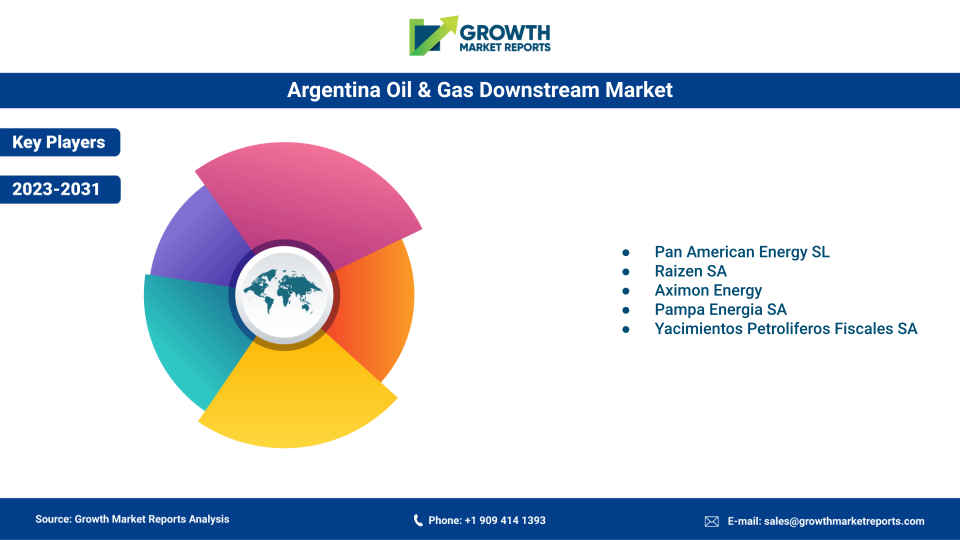

Argentina Oil & Gas Downstream Market Key Players

Frequently Asked Questions

Opportunities include integration of refining and petrochemical operations, investments in renewable fuels and circular economy initiatives, development of specialty chemicals, and adoption of advanced process technologies.

Digitalization, automation, and advanced analytics are enhancing operational efficiency, reducing costs, enabling predictive maintenance, and helping companies respond swiftly to market and regulatory changes.

Major challenges include regulatory uncertainty, volatility in crude oil prices, high compliance costs, and competition from alternative energy sources like electric vehicles and renewables.

Key players include ExxonMobil, Royal Dutch Shell, BP, Chevron, TotalEnergies, Saudi Aramco, Sinopec, PetroChina, Valero Energy, Marathon Petroleum, and Reliance Industries.

Downstream products are mainly used as fuels (gasoline, diesel, jet fuel), chemicals (plastics, fertilizers), industrial applications (lubricants, solvents), and in niche areas like construction and household fuels.

Stricter environmental regulations are prompting investments in cleaner fuels, desulfurization units, renewable fuel production, and carbon capture technologies, driving sustainability and compliance across the sector.

Major product types include Refined Petroleum Products (gasoline, diesel, jet fuel), Petrochemicals, Lubricants, and specialty by-products such as asphalt, waxes, and solvents.

The Asia Pacific region dominates the market, accounting for over 40% of global downstream revenue in 2024, driven by rapid economic development and increasing energy consumption in countries like China, India, and Southeast Asia.

Key growth drivers include increasing global energy demand, significant investments in refining and petrochemical infrastructure, expanding consumption of refined petroleum products in emerging economies, and modernization driven by stricter environmental regulations.

The global Oil & Gas Downstream market is projected to reach USD 4.1 trillion by 2033, growing from USD 2.9 trillion in 2024 at a CAGR of 3.9%.

Table Of Content

Chapter 1 Executive Summary
Chapter 2 Assumptions and Acronyms Used
Chapter 3 Research Methodology
Chapter 4 Oil & Gas Downstream Market Overview
   4.1 Introduction
      4.1.1 Market Taxonomy
      4.1.2 Market Definition
      4.1.3 Macro-Economic Factors Impacting the Market Growth
   4.2 Oil & Gas Downstream Market Dynamics
      4.2.1 Market Drivers
      4.2.2 Market Restraints
      4.2.3 Market Opportunity
   4.3 Oil & Gas Downstream Market - Supply Chain Analysis
      4.3.1 List of Key Suppliers
      4.3.2 List of Key Distributors
      4.3.3 List of Key Consumers
   4.4 Key Forces Shaping the Oil & Gas Downstream Market
      4.4.1 Bargaining Power of Suppliers
      4.4.2 Bargaining Power of Buyers
      4.4.3 Threat of Substitution
      4.4.4 Threat of New Entrants
      4.4.5 Competitive Rivalry
   4.5 Global Oil & Gas Downstream Market Size & Forecast, 2023-2032
      4.5.1 Oil & Gas Downstream Market Size and Y-o-Y Growth
      4.5.2 Oil & Gas Downstream Market Absolute $ Opportunity

Chapter 5 Global Oil & Gas Downstream Market Analysis and Forecast By Product Type
   5.1 Introduction
      5.1.1 Key Market Trends & Growth Opportunities By Product Type
      5.1.2 Basis Point Share (BPS) Analysis By Product Type
      5.1.3 Absolute $ Opportunity Assessment By Product Type
   5.2 Oil & Gas Downstream Market Size Forecast By Product Type
      5.2.1 Refined Petroleum Products
      5.2.2 Petrochemicals
      5.2.3 Lubricants
      5.2.4 Others
   5.3 Market Attractiveness Analysis By Product Type

Chapter 6 Global Oil & Gas Downstream Market Analysis and Forecast By Application
   6.1 Introduction
      6.1.1 Key Market Trends & Growth Opportunities By Application
      6.1.2 Basis Point Share (BPS) Analysis By Application
      6.1.3 Absolute $ Opportunity Assessment By Application
   6.2 Oil & Gas Downstream Market Size Forecast By Application
      6.2.1 Fuel
      6.2.2 Chemical
      6.2.3 Industrial
      6.2.4 Others
   6.3 Market Attractiveness Analysis By Application

Chapter 7 Global Oil & Gas Downstream Market Analysis and Forecast By Process
   7.1 Introduction
      7.1.1 Key Market Trends & Growth Opportunities By Process
      7.1.2 Basis Point Share (BPS) Analysis By Process
      7.1.3 Absolute $ Opportunity Assessment By Process
   7.2 Oil & Gas Downstream Market Size Forecast By Process
      7.2.1 Refining
      7.2.2 Processing
      7.2.3 Distribution
      7.2.4 Marketing
   7.3 Market Attractiveness Analysis By Process

Chapter 8 Global Oil & Gas Downstream Market Analysis and Forecast By End-User
   8.1 Introduction
      8.1.1 Key Market Trends & Growth Opportunities By End-User
      8.1.2 Basis Point Share (BPS) Analysis By End-User
      8.1.3 Absolute $ Opportunity Assessment By End-User
   8.2 Oil & Gas Downstream Market Size Forecast By End-User
      8.2.1 Transportation
      8.2.2 Industrial
      8.2.3 Residential & Commercial
      8.2.4 Others
   8.3 Market Attractiveness Analysis By End-User

Chapter 9 Global Oil & Gas Downstream Market Analysis and Forecast by Region
   9.1 Introduction
      9.1.1 Key Market Trends & Growth Opportunities By Region
      9.1.2 Basis Point Share (BPS) Analysis By Region
      9.1.3 Absolute $ Opportunity Assessment By Region
   9.2 Oil & Gas Downstream Market Size Forecast By Region
      9.2.1 North America
      9.2.2 Europe
      9.2.3 Asia Pacific
      9.2.4 Latin America
      9.2.5 Middle East & Africa (MEA)
   9.3 Market Attractiveness Analysis By Region

Chapter 10 Coronavirus Disease (COVID-19) Impact 
   10.1 Introduction 
   10.2 Current & Future Impact Analysis 
   10.3 Economic Impact Analysis 
   10.4 Government Policies 
   10.5 Investment Scenario

Chapter 11 North America Oil & Gas Downstream Analysis and Forecast
   11.1 Introduction
   11.2 North America Oil & Gas Downstream Market Size Forecast by Country
      11.2.1 U.S.
      11.2.2 Canada
   11.3 Basis Point Share (BPS) Analysis by Country
   11.4 Absolute $ Opportunity Assessment by Country
   11.5 Market Attractiveness Analysis by Country
   11.6 North America Oil & Gas Downstream Market Size Forecast By Product Type
      11.6.1 Refined Petroleum Products
      11.6.2 Petrochemicals
      11.6.3 Lubricants
      11.6.4 Others
   11.7 Basis Point Share (BPS) Analysis By Product Type 
   11.8 Absolute $ Opportunity Assessment By Product Type 
   11.9 Market Attractiveness Analysis By Product Type
   11.10 North America Oil & Gas Downstream Market Size Forecast By Application
      11.10.1 Fuel
      11.10.2 Chemical
      11.10.3 Industrial
      11.10.4 Others
   11.11 Basis Point Share (BPS) Analysis By Application 
   11.12 Absolute $ Opportunity Assessment By Application 
   11.13 Market Attractiveness Analysis By Application
   11.14 North America Oil & Gas Downstream Market Size Forecast By Process
      11.14.1 Refining
      11.14.2 Processing
      11.14.3 Distribution
      11.14.4 Marketing
   11.15 Basis Point Share (BPS) Analysis By Process 
   11.16 Absolute $ Opportunity Assessment By Process 
   11.17 Market Attractiveness Analysis By Process
   11.18 North America Oil & Gas Downstream Market Size Forecast By End-User
      11.18.1 Transportation
      11.18.2 Industrial
      11.18.3 Residential & Commercial
      11.18.4 Others
   11.19 Basis Point Share (BPS) Analysis By End-User 
   11.20 Absolute $ Opportunity Assessment By End-User 
   11.21 Market Attractiveness Analysis By End-User

Chapter 12 Europe Oil & Gas Downstream Analysis and Forecast
   12.1 Introduction
   12.2 Europe Oil & Gas Downstream Market Size Forecast by Country
      12.2.1 Germany
      12.2.2 France
      12.2.3 Italy
      12.2.4 U.K.
      12.2.5 Spain
      12.2.6 Russia
      12.2.7 Rest of Europe
   12.3 Basis Point Share (BPS) Analysis by Country
   12.4 Absolute $ Opportunity Assessment by Country
   12.5 Market Attractiveness Analysis by Country
   12.6 Europe Oil & Gas Downstream Market Size Forecast By Product Type
      12.6.1 Refined Petroleum Products
      12.6.2 Petrochemicals
      12.6.3 Lubricants
      12.6.4 Others
   12.7 Basis Point Share (BPS) Analysis By Product Type 
   12.8 Absolute $ Opportunity Assessment By Product Type 
   12.9 Market Attractiveness Analysis By Product Type
   12.10 Europe Oil & Gas Downstream Market Size Forecast By Application
      12.10.1 Fuel
      12.10.2 Chemical
      12.10.3 Industrial
      12.10.4 Others
   12.11 Basis Point Share (BPS) Analysis By Application 
   12.12 Absolute $ Opportunity Assessment By Application 
   12.13 Market Attractiveness Analysis By Application
   12.14 Europe Oil & Gas Downstream Market Size Forecast By Process
      12.14.1 Refining
      12.14.2 Processing
      12.14.3 Distribution
      12.14.4 Marketing
   12.15 Basis Point Share (BPS) Analysis By Process 
   12.16 Absolute $ Opportunity Assessment By Process 
   12.17 Market Attractiveness Analysis By Process
   12.18 Europe Oil & Gas Downstream Market Size Forecast By End-User
      12.18.1 Transportation
      12.18.2 Industrial
      12.18.3 Residential & Commercial
      12.18.4 Others
   12.19 Basis Point Share (BPS) Analysis By End-User 
   12.20 Absolute $ Opportunity Assessment By End-User 
   12.21 Market Attractiveness Analysis By End-User

Chapter 13 Asia Pacific Oil & Gas Downstream Analysis and Forecast
   13.1 Introduction
   13.2 Asia Pacific Oil & Gas Downstream Market Size Forecast by Country
      13.2.1 China
      13.2.2 Japan
      13.2.3 South Korea
      13.2.4 India
      13.2.5 Australia
      13.2.6 South East Asia (SEA)
      13.2.7 Rest of Asia Pacific (APAC)
   13.3 Basis Point Share (BPS) Analysis by Country
   13.4 Absolute $ Opportunity Assessment by Country
   13.5 Market Attractiveness Analysis by Country
   13.6 Asia Pacific Oil & Gas Downstream Market Size Forecast By Product Type
      13.6.1 Refined Petroleum Products
      13.6.2 Petrochemicals
      13.6.3 Lubricants
      13.6.4 Others
   13.7 Basis Point Share (BPS) Analysis By Product Type 
   13.8 Absolute $ Opportunity Assessment By Product Type 
   13.9 Market Attractiveness Analysis By Product Type
   13.10 Asia Pacific Oil & Gas Downstream Market Size Forecast By Application
      13.10.1 Fuel
      13.10.2 Chemical
      13.10.3 Industrial
      13.10.4 Others
   13.11 Basis Point Share (BPS) Analysis By Application 
   13.12 Absolute $ Opportunity Assessment By Application 
   13.13 Market Attractiveness Analysis By Application
   13.14 Asia Pacific Oil & Gas Downstream Market Size Forecast By Process
      13.14.1 Refining
      13.14.2 Processing
      13.14.3 Distribution
      13.14.4 Marketing
   13.15 Basis Point Share (BPS) Analysis By Process 
   13.16 Absolute $ Opportunity Assessment By Process 
   13.17 Market Attractiveness Analysis By Process
   13.18 Asia Pacific Oil & Gas Downstream Market Size Forecast By End-User
      13.18.1 Transportation
      13.18.2 Industrial
      13.18.3 Residential & Commercial
      13.18.4 Others
   13.19 Basis Point Share (BPS) Analysis By End-User 
   13.20 Absolute $ Opportunity Assessment By End-User 
   13.21 Market Attractiveness Analysis By End-User

Chapter 14 Latin America Oil & Gas Downstream Analysis and Forecast
   14.1 Introduction
   14.2 Latin America Oil & Gas Downstream Market Size Forecast by Country
      14.2.1 Brazil
      14.2.2 Mexico
      14.2.3 Rest of Latin America (LATAM)
   14.3 Basis Point Share (BPS) Analysis by Country
   14.4 Absolute $ Opportunity Assessment by Country
   14.5 Market Attractiveness Analysis by Country
   14.6 Latin America Oil & Gas Downstream Market Size Forecast By Product Type
      14.6.1 Refined Petroleum Products
      14.6.2 Petrochemicals
      14.6.3 Lubricants
      14.6.4 Others
   14.7 Basis Point Share (BPS) Analysis By Product Type 
   14.8 Absolute $ Opportunity Assessment By Product Type 
   14.9 Market Attractiveness Analysis By Product Type
   14.10 Latin America Oil & Gas Downstream Market Size Forecast By Application
      14.10.1 Fuel
      14.10.2 Chemical
      14.10.3 Industrial
      14.10.4 Others
   14.11 Basis Point Share (BPS) Analysis By Application 
   14.12 Absolute $ Opportunity Assessment By Application 
   14.13 Market Attractiveness Analysis By Application
   14.14 Latin America Oil & Gas Downstream Market Size Forecast By Process
      14.14.1 Refining
      14.14.2 Processing
      14.14.3 Distribution
      14.14.4 Marketing
   14.15 Basis Point Share (BPS) Analysis By Process 
   14.16 Absolute $ Opportunity Assessment By Process 
   14.17 Market Attractiveness Analysis By Process
   14.18 Latin America Oil & Gas Downstream Market Size Forecast By End-User
      14.18.1 Transportation
      14.18.2 Industrial
      14.18.3 Residential & Commercial
      14.18.4 Others
   14.19 Basis Point Share (BPS) Analysis By End-User 
   14.20 Absolute $ Opportunity Assessment By End-User 
   14.21 Market Attractiveness Analysis By End-User

Chapter 15 Middle East & Africa (MEA) Oil & Gas Downstream Analysis and Forecast
   15.1 Introduction
   15.2 Middle East & Africa (MEA) Oil & Gas Downstream Market Size Forecast by Country
      15.2.1 Saudi Arabia
      15.2.2 South Africa
      15.2.3 UAE
      15.2.4 Rest of Middle East & Africa (MEA)
   15.3 Basis Point Share (BPS) Analysis by Country
   15.4 Absolute $ Opportunity Assessment by Country
   15.5 Market Attractiveness Analysis by Country
   15.6 Middle East & Africa (MEA) Oil & Gas Downstream Market Size Forecast By Product Type
      15.6.1 Refined Petroleum Products
      15.6.2 Petrochemicals
      15.6.3 Lubricants
      15.6.4 Others
   15.7 Basis Point Share (BPS) Analysis By Product Type 
   15.8 Absolute $ Opportunity Assessment By Product Type 
   15.9 Market Attractiveness Analysis By Product Type
   15.10 Middle East & Africa (MEA) Oil & Gas Downstream Market Size Forecast By Application
      15.10.1 Fuel
      15.10.2 Chemical
      15.10.3 Industrial
      15.10.4 Others
   15.11 Basis Point Share (BPS) Analysis By Application 
   15.12 Absolute $ Opportunity Assessment By Application 
   15.13 Market Attractiveness Analysis By Application
   15.14 Middle East & Africa (MEA) Oil & Gas Downstream Market Size Forecast By Process
      15.14.1 Refining
      15.14.2 Processing
      15.14.3 Distribution
      15.14.4 Marketing
   15.15 Basis Point Share (BPS) Analysis By Process 
   15.16 Absolute $ Opportunity Assessment By Process 
   15.17 Market Attractiveness Analysis By Process
   15.18 Middle East & Africa (MEA) Oil & Gas Downstream Market Size Forecast By End-User
      15.18.1 Transportation
      15.18.2 Industrial
      15.18.3 Residential & Commercial
      15.18.4 Others
   15.19 Basis Point Share (BPS) Analysis By End-User 
   15.20 Absolute $ Opportunity Assessment By End-User 
   15.21 Market Attractiveness Analysis By End-User

Chapter 16 Competition Landscape 
   16.1 Oil & Gas Downstream Market: Competitive Dashboard
   16.2 Global Oil & Gas Downstream Market: Market Share Analysis, 2023
   16.3 Company Profiles (Details – Overview, Financials, Developments, Strategy) 
      16.3.1 ExxonMobil
Royal Dutch Shell
BP
Chevron Corporation
TotalEnergies
Saudi Aramco
PetroChina
Sinopec
Indian Oil Corporation
Phillips 66
Valero Energy
Marathon Petroleum Corporation
Eni S.p.A.
Repsol S.A.
Petrobras
Lukoil
Petróleos de Venezuela (PDVSA)
OMV Group
Hindustan Petroleum Corporation Limited (HPCL)
Kuwait Petroleum Corporation (KPC)

Methodology

Our Clients

Honda Motor Co. Ltd.
Dassault Aviation
Deloitte
General Mills
Pfizer
The John Holland Group
FedEx Logistics
Siemens Healthcare