Segments - by Service Type (Well Plugging & Abandonment, Platform Removal, Pipeline & Subsea Infrastructure Decommissioning, Environmental Site Remediation, Others), by Structure (Topside, Substructure, Subsea Infrastructure), by Depth (Shallow Water, Deepwater), by Removal Method (Leave in Place, Partial Removal, Complete Removal), by Application (Oil & Gas, Renewable Energy, Others)
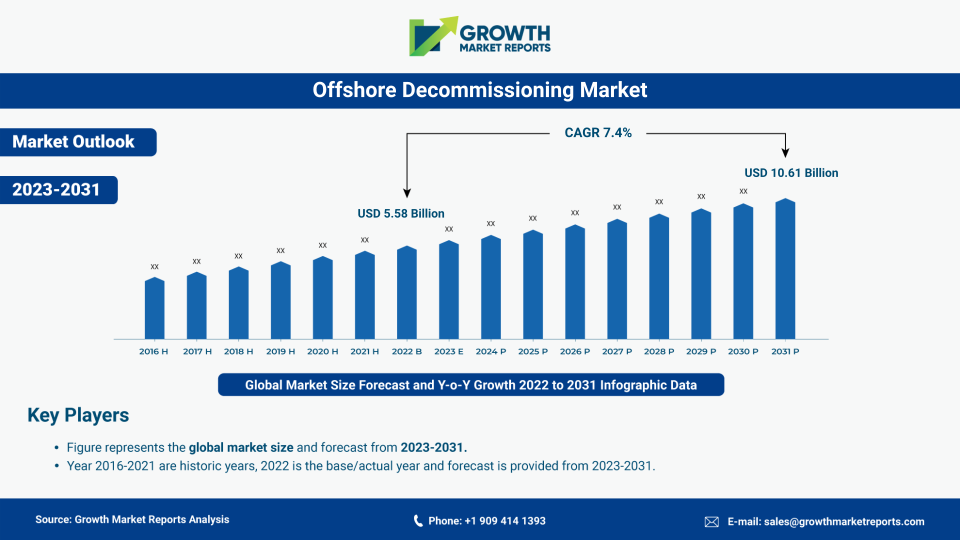
According to our latest research, the offshore decommissioning market size reached USD 7.82 billion in 2024 at a robust growth rate, with a recorded CAGR of 7.4% between 2025 and 2033. The market is projected to advance significantly, achieving a value of USD 14.91 billion by 2033. This growth is propelled by stringent environmental regulations, maturing offshore oil and gas assets, and increasing focus on sustainable marine ecosystems. The rapid expansion of the renewable energy sector, particularly offshore wind, is further accelerating demand for decommissioning services worldwide.
The primary growth factor for the offshore decommissioning market is the aging infrastructure of offshore oil and gas fields, especially in mature basins such as the North Sea, Gulf of Mexico, and parts of Southeast Asia. Many of these assets have exceeded their productive life and require safe and efficient decommissioning to comply with regulatory standards and minimize environmental impact. Governments and regulatory bodies are enforcing stricter guidelines on the abandonment of wells, removal of platforms, and remediation of subsea infrastructure, which is directly contributing to the rising demand for decommissioning services. Additionally, the increasing liability for operators to restore marine environments to pre-development conditions has led to a surge in investments and technological advancements in decommissioning operations.
Another significant driver is the growing emphasis on environmental sustainability and the circular economy. The decommissioning process is not only about dismantling aging infrastructure but also about recycling and reusing materials, reducing carbon footprints, and protecting marine biodiversity. Environmental site remediation, in particular, is gaining traction as stakeholders seek to ensure that decommissioned sites are free from contaminants and safe for future use. This trend is prompting oil and gas companies to partner with specialized service providers that offer integrated decommissioning solutions, encompassing everything from well plugging and abandonment to site restoration, thereby fostering innovation and efficiency throughout the value chain.
Technological advancements are also playing a pivotal role in shaping the offshore decommissioning market. The adoption of advanced robotics, remotely operated vehicles (ROVs), and artificial intelligence-driven project management tools has enhanced the safety, accuracy, and cost-effectiveness of decommissioning activities. These technologies enable precise cutting, lifting, and transportation of heavy structures in challenging offshore environments, reducing human risk and operational downtime. Furthermore, digital twin technology and predictive analytics are being leveraged to plan and execute decommissioning projects with greater precision, minimizing environmental disruption and optimizing resource allocation.
The offshore oil and gas industry plays a crucial role in driving the decommissioning market, as many offshore fields are reaching the end of their productive life. The complexity of decommissioning these assets requires specialized knowledge and technology to ensure safe and environmentally sound operations. The industry is also under pressure to minimize its environmental footprint, making the decommissioning process even more critical. As such, there is a growing emphasis on developing innovative solutions that not only address the technical challenges of decommissioning but also promote sustainability and environmental stewardship. The offshore oil and gas sector's commitment to these principles is essential for the continued growth and evolution of the decommissioning market.
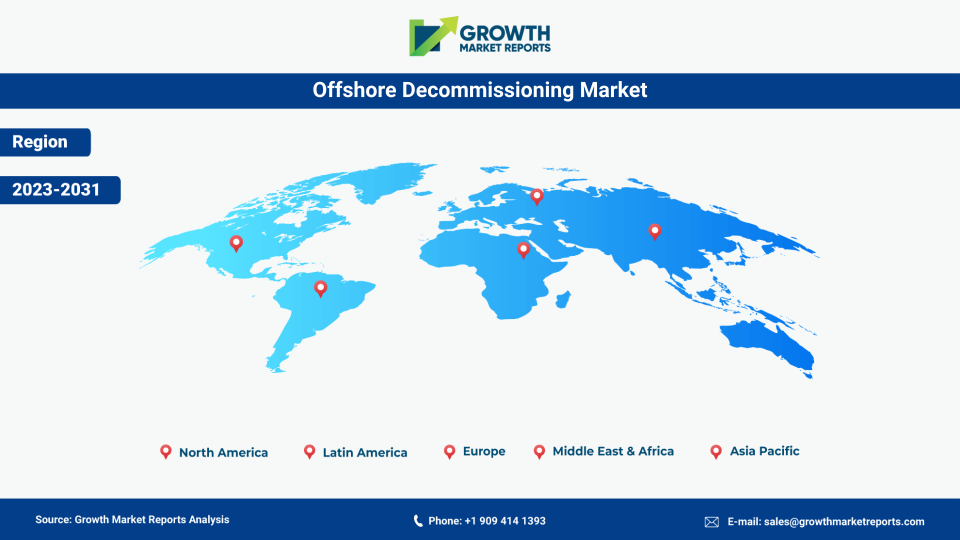
From a regional perspective, Europe continues to dominate the offshore decommissioning market, accounting for the largest share in 2024, largely due to extensive decommissioning activities in the North Sea. North America follows closely, driven by regulatory mandates and the decommissioning of aging Gulf of Mexico assets. The Asia Pacific region is witnessing increasing activity, particularly in Australia, Malaysia, and Indonesia, as governments tighten regulations and operators seek to retire uneconomic fields. The Middle East & Africa and Latin America are emerging markets, with growing awareness about environmental stewardship and a gradual shift toward decommissioning as assets mature. This regional diversity presents both opportunities and challenges for market participants, as they must navigate varying regulatory landscapes and operational complexities.
The offshore decommissioning market is segmented by service type into well plugging & abandonment, platform removal, pipeline & subsea infrastructure decommissioning, environmental site remediation, and others. Well plugging & abandonment is the largest and most critical service segment, accounting for a substantial portion of the overall market value. This process involves safely sealing wells to prevent leakage of hydrocarbons and other contaminants, a task that is heavily regulated and technically challenging. The complexity and cost associated with well plugging & abandonment are driving innovation in sealing materials, cementing techniques, and remote monitoring technologies. Service providers are increasingly offering turnkey solutions, integrating planning, execution, and regulatory compliance to streamline operations and reduce project timelines.
Platform removal is another significant segment, encompassing the dismantling, cutting, lifting, and transportation of topsides and substructures. The choice of removal method depends on factors such as platform size, water depth, and environmental considerations. As the number of decommissioned platforms rises, there is a growing demand for heavy-lift vessels, precision cutting equipment, and subsea robotics. Service providers are also focusing on minimizing the environmental impact of platform removal by recycling steel and other materials, as well as exploring partial removal options where feasible. The integration of digital project management tools is enhancing efficiency, safety, and cost control in platform removal operations.
Pipeline & subsea infrastructure decommissioning involves the safe disconnection, cleaning, and removal or abandonment of pipelines, risers, and associated equipment. This segment is gaining prominence as subsea infrastructure networks expand and mature. The technical challenges of subsea decommissioning, such as deepwater operations, hazardous material handling, and complex logistics, are driving demand for specialized equipment and skilled personnel. Innovations in remotely operated vehicles (ROVs), subsea cutting tools, and environmental monitoring are enabling safer and more efficient decommissioning of pipelines and subsea assets. Regulatory compliance and environmental stewardship remain top priorities, with service providers investing in advanced technologies to meet stringent standards.
Environmental site remediation is a rapidly growing service segment, reflecting the increasing focus on restoring decommissioned sites to their natural state. This involves the removal of contaminants, sediment management, habitat restoration, and long-term monitoring. Environmental site remediation is often mandated by regulators and is seen as a key component of responsible decommissioning. Service providers are leveraging advanced environmental assessment tools, bioremediation techniques, and data analytics to deliver effective and sustainable remediation solutions. The integration of environmental services with decommissioning operations is creating new opportunities for market participants and driving the adoption of best practices across the industry.
The "others" category includes a range of ancillary services such as project management, regulatory consulting, waste management, and transportation logistics. These services are essential for ensuring the smooth execution of decommissioning projects, particularly in complex offshore environments. As the market matures, there is a growing trend toward integrated service offerings, where providers bundle multiple services to deliver comprehensive decommissioning solutions. This approach not only enhances operational efficiency but also reduces costs and simplifies regulatory compliance for operators.
| Attributes | Details |
| Report Title | Offshore Decommissioning Market Research Report 2033 |
| By Service Type | Well Plugging & Abandonment, Platform Removal, Pipeline & Subsea Infrastructure Decommissioning, Environmental Site Remediation, Others |
| By Structure | Topside, Substructure, Subsea Infrastructure |
| By Depth | Shallow Water, Deepwater |
| By Removal Method | Leave in Place, Partial Removal, Complete Removal |
| By Application | Oil & Gas, Renewable Energy, Others |
| Regions Covered | North America, Europe, APAC, Latin America, MEA |
| Base Year | 2024 |
| Historic Data | 2018-2023 |
| Forecast Period | 2025-2033 |
| Number of Pages | 268 |
| Number of Tables & Figures | 328 |
| Customization Available | Yes, the report can be customized as per your need. |
The offshore decommissioning market is further segmented by structure type: topside, substructure, and subsea infrastructure. Topside decommissioning involves the removal and disposal of the upper part of the platform, which houses processing equipment, living quarters, and support systems. This is often the most visible and logistically complex part of the decommissioning process, requiring heavy-lift vessels, precise engineering, and rigorous safety protocols. The trend toward modular topside designs is facilitating easier and more cost-effective removal, while advances in lifting and transportation technologies are reducing project timelines and environmental impact. Service providers are investing in specialized assets and skilled personnel to meet the growing demand for efficient topside decommissioning.
Substructure decommissioning deals with the removal or abandonment of the supporting structures that anchor platforms to the seabed, such as jackets, gravity-based structures, and monopiles. This segment is technically challenging due to the size, weight, and underwater location of substructures. The choice between complete removal, partial removal, or leave-in-place options depends on regulatory requirements, environmental considerations, and cost implications. Innovations in underwater cutting, lifting, and disposal techniques are enabling safer and more efficient substructure decommissioning. Service providers are also exploring ways to repurpose substructures as artificial reefs, contributing to marine biodiversity and reducing disposal costs.
Subsea infrastructure decommissioning encompasses the disconnection, removal, or abandonment of pipelines, manifolds, risers, and other equipment located on or below the seabed. This segment is gaining importance as offshore developments move into deeper waters and more complex environments. The technical challenges of subsea decommissioning, such as deepwater operations, remote access, and hazardous material handling, are driving demand for advanced ROVs, subsea cutting tools, and environmental monitoring systems. Service providers are leveraging digital technologies and real-time data analytics to plan and execute subsea decommissioning projects with greater precision and safety.
The integration of structure-specific decommissioning services is becoming increasingly common, as operators seek to streamline project management and reduce costs. Service providers are offering bundled solutions that cover the entire value chain, from initial assessment and engineering to execution and site remediation. This approach enhances operational efficiency, reduces project risk, and ensures compliance with regulatory and environmental standards. As the market evolves, there is a growing emphasis on innovation, sustainability, and collaboration across the structure decommissioning value chain.
The structure segment is expected to witness significant growth over the forecast period, driven by the increasing number of aging offshore platforms and the need for safe, efficient, and environmentally responsible decommissioning solutions. The adoption of advanced technologies, modular designs, and integrated service offerings will be key to meeting the evolving needs of operators and regulators in the offshore decommissioning market.
Depth is a critical factor in offshore decommissioning, with the market segmented into shallow water and deepwater operations. Shallow water decommissioning dominates the market, accounting for the majority of projects and revenue. Shallow water assets are typically located in water depths of less than 400 meters and are easier to access, dismantle, and transport. The relative simplicity of shallow water operations, combined with the large number of aging platforms in regions such as the North Sea and Gulf of Mexico, is driving sustained demand for decommissioning services. Service providers are leveraging established technologies and best practices to deliver cost-effective and efficient solutions for shallow water projects.
Deepwater decommissioning, involving assets located in water depths greater than 400 meters, is a rapidly growing segment of the market. Deepwater projects are inherently more complex and costly, requiring specialized equipment, advanced engineering, and highly skilled personnel. The challenges of deepwater decommissioning include limited accessibility, harsh environmental conditions, and the need for remote operations. Innovations in ROVs, subsea cutting tools, and digital project management are enabling safer and more efficient deepwater decommissioning. As offshore developments move into deeper waters, particularly in regions such as West Africa, Brazil, and the Gulf of Mexico, the demand for deepwater decommissioning services is expected to rise significantly.
The depth of operation has a direct impact on the choice of decommissioning methods, technologies, and service providers. Shallow water projects tend to favor traditional methods and established contractors, while deepwater projects require cutting-edge technologies and specialized expertise. The increasing complexity and cost of deepwater decommissioning are driving collaboration between operators, service providers, and technology developers to develop innovative solutions and share best practices.
Regulatory requirements and environmental considerations also vary by depth, with deepwater projects subject to more stringent oversight and risk management protocols. Service providers are investing in research and development to address the unique challenges of deepwater decommissioning, including the development of new materials, remote monitoring systems, and advanced lifting technologies. The integration of digital tools and real-time data analytics is enhancing the safety, efficiency, and environmental performance of both shallow and deepwater decommissioning projects.
The depth segment is expected to witness continued growth and diversification over the forecast period, as operators seek to retire aging assets in both shallow and deepwater environments. The adoption of advanced technologies, collaborative approaches, and integrated service offerings will be key to meeting the evolving needs of the offshore decommissioning market across different water depths.
The offshore decommissioning market is segmented by removal method into leave in place, partial removal, and complete removal. Leave in place is an increasingly popular option, particularly for subsea infrastructure and certain platform substructures. This method involves leaving some or all components on the seabed, provided they do not pose a risk to navigation, the environment, or future development. Leave in place is often favored for its lower cost and reduced environmental impact, as it avoids the need for extensive lifting, transportation, and disposal. However, it requires rigorous environmental assessment and regulatory approval to ensure long-term safety and compliance.
Partial removal involves the removal of certain components, such as topsides or hazardous materials, while leaving other structures in place. This method strikes a balance between cost, environmental impact, and regulatory requirements. Partial removal is often used for large substructures or in cases where complete removal is technically challenging or environmentally disruptive. Service providers are leveraging advanced engineering and environmental assessment tools to determine the optimal removal strategy for each project, taking into account site-specific conditions, regulatory mandates, and stakeholder preferences.
Complete removal is the most comprehensive and costly removal method, involving the full dismantling, lifting, transportation, and disposal of all offshore infrastructure. This method is typically mandated in cases where structures pose a risk to navigation, the environment, or future development. Complete removal requires advanced heavy-lift vessels, precision cutting equipment, and specialized logistics. Service providers are investing in new technologies and operational best practices to enhance the safety, efficiency, and environmental performance of complete removal projects. The trend toward recycling and reusing materials is also driving innovation in dismantling and disposal techniques.
The choice of removal method is influenced by a range of factors, including regulatory requirements, environmental considerations, technical feasibility, and cost. Operators and service providers must work closely with regulators and stakeholders to develop site-specific decommissioning plans that balance safety, environmental protection, and economic efficiency. The growing emphasis on sustainability and the circular economy is driving demand for innovative removal methods that minimize waste, reduce carbon emissions, and support marine biodiversity.
As the offshore decommissioning market matures, there is a growing trend toward integrated removal solutions that combine multiple methods to deliver optimal outcomes. Service providers are developing flexible and adaptive approaches that can be tailored to the unique needs of each project, enhancing operational efficiency, reducing costs, and ensuring compliance with evolving regulatory and environmental standards.
The offshore decommissioning market is segmented by application into oil & gas, renewable energy, and others. Oil & gas remains the dominant application segment, accounting for the majority of decommissioning projects and market revenue. The aging of offshore oil and gas fields, particularly in mature regions such as the North Sea, Gulf of Mexico, and Southeast Asia, is driving sustained demand for decommissioning services. Operators are under increasing pressure to retire uneconomic assets, comply with stringent environmental regulations, and restore marine environments. The complexity and cost of oil & gas decommissioning are prompting operators to seek integrated, turnkey solutions that encompass well plugging & abandonment, platform removal, subsea infrastructure decommissioning, and site remediation.
Renewable energy, particularly offshore wind, is an emerging application segment in the offshore decommissioning market. As the first generation of offshore wind farms reaches the end of its operational life, there is a growing need for specialized decommissioning services. The decommissioning of offshore wind assets presents unique challenges, including the removal of large monopiles, cables, and turbines, as well as the restoration of seabed habitats. Service providers are leveraging their experience in oil & gas decommissioning to develop innovative solutions for the renewable energy sector, including modular designs, advanced lifting technologies, and environmentally sustainable practices.
The "others" category includes a range of applications such as marine research, defense, and telecommunications. These segments are relatively small but are expected to grow as offshore infrastructure expands and matures. The decommissioning of subsea cables, research platforms, and military installations presents unique technical, regulatory, and environmental challenges. Service providers are developing specialized solutions to address the specific needs of these applications, including advanced cutting, lifting, and disposal technologies.
The application segment is expected to witness significant diversification over the forecast period, as operators in both the oil & gas and renewable energy sectors seek to retire aging assets and comply with evolving regulatory and environmental standards. The growing emphasis on sustainability, circular economy principles, and stakeholder engagement is driving demand for integrated, innovative, and environmentally responsible decommissioning solutions across all application segments.
As the offshore decommissioning market evolves, service providers are increasingly offering application-specific solutions that address the unique challenges and opportunities of each sector. This approach enhances operational efficiency, reduces costs, and ensures compliance with regulatory and environmental requirements, positioning the market for sustained growth and innovation.
The offshore decommissioning market presents numerous opportunities for growth and innovation. One of the most significant opportunities lies in the development and deployment of advanced technologies, such as robotics, artificial intelligence, and digital twins, to enhance the safety, efficiency, and cost-effectiveness of decommissioning operations. These technologies enable precise planning, execution, and monitoring of decommissioning projects, reducing human risk and operational downtime. Service providers that invest in research and development, and adopt cutting-edge technologies, are well positioned to capitalize on the growing demand for integrated and innovative decommissioning solutions. Additionally, the increasing focus on environmental sustainability and the circular economy is creating new opportunities for service providers to develop sustainable decommissioning practices, such as recycling and reusing materials, habitat restoration, and carbon footprint reduction.
Another key opportunity is the expansion of the offshore decommissioning market into emerging regions, such as Asia Pacific, Middle East & Africa, and Latin America. As offshore oil and gas assets in these regions mature, and governments tighten regulatory requirements, the demand for decommissioning services is expected to rise significantly. Service providers that establish a strong regional presence, build local partnerships, and develop tailored solutions for these markets will be well positioned to capture new business and drive growth. The diversification of the market into new applications, such as renewable energy, marine research, and telecommunications, also presents significant opportunities for service providers to expand their offerings and enter new markets.
Despite the numerous opportunities, the offshore decommissioning market faces several restraining factors. The high cost and technical complexity of decommissioning projects, particularly in deepwater environments, can be a significant barrier to market entry and growth. Operators and service providers must navigate a complex regulatory landscape, manage environmental risks, and ensure the safety of personnel and assets. The lack of standardized regulations and best practices across regions can create uncertainty and increase project risk. Additionally, fluctuations in oil and gas prices can impact the timing and scale of decommissioning projects, as operators may delay or defer decommissioning activities in response to market conditions. Addressing these challenges will require ongoing investment in technology, collaboration between stakeholders, and the development of standardized regulations and best practices.
Europe remains the largest and most mature regional market for offshore decommissioning, accounting for approximately 38% of the global market value in 2024, or around USD 2.97 billion. The region's dominance is driven by extensive decommissioning activities in the North Sea, where a significant number of oil and gas platforms are reaching the end of their productive life. The United Kingdom and Norway are the leading markets, supported by well-established regulatory frameworks, advanced technological capabilities, and a strong focus on environmental sustainability. The European market is expected to maintain a steady CAGR of 6.8% through 2033, driven by ongoing investment in decommissioning projects and the emergence of new opportunities in the offshore wind sector.
North America is the second-largest regional market, with a market size of approximately USD 2.35 billion in 2024, accounting for 30% of the global market. The region's growth is fueled by the decommissioning of aging offshore oil and gas assets in the Gulf of Mexico, as well as increasing regulatory pressure to restore marine environments. The United States is the dominant market, supported by a robust regulatory framework, a large installed base of offshore infrastructure, and a strong ecosystem of service providers. The North American market is expected to grow at a CAGR of 7.2% through 2033, driven by continued investment in decommissioning projects and the adoption of advanced technologies.
The Asia Pacific region is an emerging market for offshore decommissioning, with a market size of approximately USD 1.17 billion in 2024, or 15% of the global market. The region's growth is driven by the maturing of offshore oil and gas fields in Australia, Malaysia, and Indonesia, as well as increasing regulatory scrutiny and environmental awareness. The Asia Pacific market is expected to grow at a CAGR of 8.1% through 2033, outpacing the global average and presenting significant opportunities for service providers. The Middle East & Africa and Latin America are smaller but rapidly growing markets, with a combined market size of USD 1.33 billion in 2024, or 17% of the global market. These regions are characterized by a growing installed base of offshore infrastructure, increasing regulatory focus on decommissioning, and rising demand for specialized service providers.
The offshore decommissioning market is characterized by intense competition, with a mix of global, regional, and niche service providers vying for market share. The competitive landscape is shaped by factors such as technological innovation, operational efficiency, regulatory compliance, and environmental stewardship. Leading companies are investing heavily in research and development to develop advanced decommissioning technologies, such as robotics, artificial intelligence, and digital twins, that enhance the safety, efficiency, and cost-effectiveness of decommissioning operations. The trend toward integrated service offerings is also driving consolidation in the market, as companies seek to expand their capabilities and deliver comprehensive solutions across the value chain.
Strategic partnerships, mergers, and acquisitions are common in the offshore decommissioning market, as companies seek to strengthen their market position, gain access to new technologies, and expand their geographic footprint. Service providers are increasingly collaborating with operators, regulators, and technology developers to develop innovative solutions, share best practices, and address the unique challenges of decommissioning projects. The growing emphasis on environmental sustainability and the circular economy is also prompting companies to develop new business models and value-added services, such as recycling and reusing materials, habitat restoration, and carbon footprint reduction.
The competitive landscape is further shaped by the entry of new players, particularly in emerging regions and application segments. These companies are leveraging their local knowledge, technical expertise, and cost advantages to capture market share and drive innovation. However, the high cost and technical complexity of decommissioning projects, particularly in deepwater environments, create significant barriers to entry and favor established players with a proven track record and robust operational capabilities. The development of standardized regulations and best practices is expected to level the playing field and create new opportunities for both established and emerging service providers.
Major companies operating in the offshore decommissioning market include Petrofac, TechnipFMC, Halliburton, Allseas Group, Subsea 7, Heerema Marine Contractors, Aker Solutions, Oceaneering International, and Wood Group. These companies are recognized for their technical expertise, operational excellence, and commitment to safety and environmental stewardship. Petrofac and TechnipFMC are leaders in integrated decommissioning solutions, offering a full suite of services from well plugging & abandonment to site remediation. Halliburton and Subsea 7 are known for their advanced technologies and project management capabilities, particularly in deepwater and complex offshore environments. Allseas Group and Heerema Marine Contractors specialize in heavy-lift and transportation services, leveraging their state-of-the-art vessels and engineering capabilities to deliver efficient and cost-effective platform removal solutions.
Aker Solutions and Oceaneering International are at the forefront of technological innovation, investing in robotics, digital twins, and environmental monitoring systems to enhance the safety, efficiency, and sustainability of decommissioning operations. Wood Group is recognized for its expertise in project management, regulatory compliance, and environmental services, supporting operators throughout the decommissioning lifecycle. These companies are continuously expanding their service offerings, geographic reach, and technological capabilities to maintain their competitive edge and capture new opportunities in the evolving offshore decommissioning market.
The competitive dynamics of the offshore decommissioning market are expected to intensify over the forecast period, as operators seek to retire aging assets, comply with evolving regulatory and environmental standards, and adopt innovative and sustainable decommissioning practices. Companies that invest in advanced technologies, integrated service offerings, and strategic partnerships will be well positioned to capitalize on the growing demand for offshore decommissioning services and drive long-term growth and profitability.
The Offshore Decommissioning market has been segmented on the basis of
Environmental sustainability is central to offshore decommissioning, with a focus on recycling materials, reducing carbon footprints, restoring habitats, and ensuring decommissioned sites are safe for future use. Regulatory bodies increasingly mandate environmental site remediation as part of the process.
Shallow water decommissioning is generally simpler and more cost-effective, while deepwater projects are more complex, require specialized equipment, and face harsher environmental conditions. Deepwater decommissioning is a growing segment due to the expansion of offshore developments.
Major players include Petrofac, TechnipFMC, Halliburton, Allseas Group, Subsea 7, Heerema Marine Contractors, Aker Solutions, Oceaneering International, Wood Group, Royal Dutch Shell, BP, ExxonMobil, Chevron, TotalEnergies, Equinor, ConocoPhillips, Petrobras, Saipem, Baker Hughes, and Schlumberger.
Challenges include high costs, technical complexity, regulatory uncertainty, and environmental risks. Opportunities lie in technological innovation, expansion into emerging regions, and the growing need for sustainable and integrated decommissioning solutions.
Technologies such as robotics, remotely operated vehicles (ROVs), artificial intelligence, digital twins, and advanced environmental monitoring are improving the safety, efficiency, and cost-effectiveness of decommissioning operations.
Removal methods include leave in place (leaving structures on the seabed if safe), partial removal (removing certain components), and complete removal (full dismantling and disposal). The choice depends on regulatory, environmental, and technical factors.
Key service types include well plugging & abandonment, platform removal, pipeline & subsea infrastructure decommissioning, environmental site remediation, and ancillary services like project management and regulatory consulting.
Europe leads the offshore decommissioning market, especially due to activities in the North Sea. North America follows, driven by the Gulf of Mexico, while Asia Pacific, Middle East & Africa, and Latin America are emerging markets with increasing decommissioning activity.
The offshore decommissioning market reached USD 7.82 billion in 2024 and is projected to grow at a CAGR of 7.4% from 2025 to 2033, reaching USD 14.91 billion by 2033. Growth is driven by aging infrastructure, stricter regulations, and the expansion of offshore renewable energy.
Offshore decommissioning refers to the process of safely retiring and dismantling offshore oil and gas platforms, subsea infrastructure, and renewable energy assets once they reach the end of their productive life. It is important to comply with environmental regulations, minimize ecological impact, and restore marine environments to pre-development conditions.