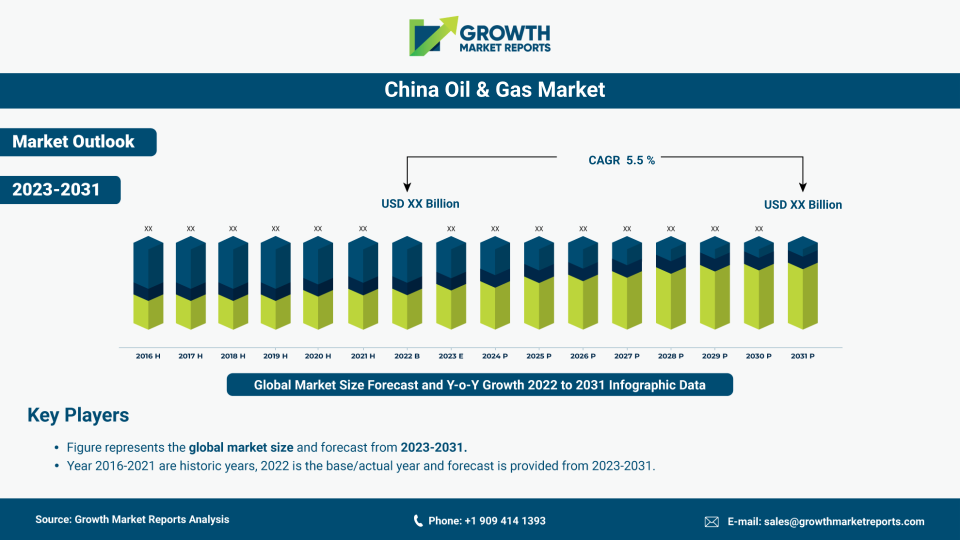
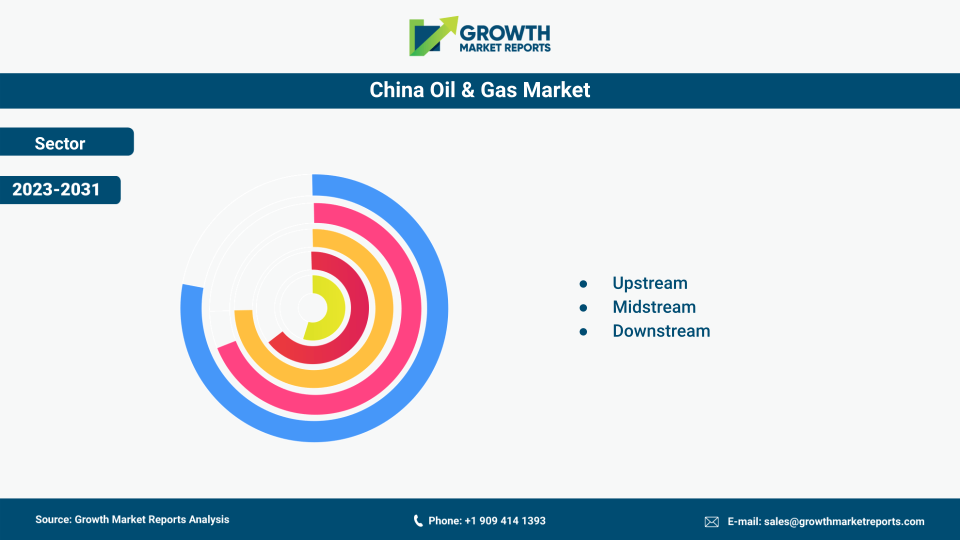
Oil & Gas Market Research Report 2033

Oil & Gas Market Research Report 2033

Segments - by Sector (Upstream, Midstream, Downstream), by Resource Type (Conventional, Unconventional), by Application (Onshore, Offshore), by Service (Exploration, Drilling, Production, Processing, Transportation, Storage, Refining, Distribution)

https://growthmarketreports.com/Raksha
Author : Raksha Sharma
https://growthmarketreports.com/Vaibhav
Fact-checked by : V. Chandola
https://growthmarketreports.com/Shruti
Editor : Shruti Bhat

Upcoming | Report ID :EP-1413 | 4.3 Rating | 63 Reviews | 293 Pages | Format : Docx PDF

Report Description


Oil & Gas Market Outlook

According to our latest research, the global oil & gas market size reached USD 7.3 trillion in 2024, reflecting the sectorÂ’s enduring significance in the global economy. The industry is projected to grow at a CAGR of 4.1% from 2025 to 2033, with the market forecasted to attain a value of USD 10.6 trillion by 2033. This steady growth is primarily driven by increasing energy demand, ongoing industrialization in emerging economies, and the evolution of extraction and processing technologies. The oil & gas market continues to be a cornerstone of global energy supply, with its outlook shaped by dynamic factors such as geopolitical developments, regulatory changes, and the transition towards cleaner energy sources.

One of the most prominent growth factors in the oil & gas market is the persistent rise in global energy demand, particularly from rapidly developing economies in Asia and Africa. As urbanization accelerates and populations expand, the need for reliable energy sources intensifies, placing oil and gas at the forefront of energy consumption. Additionally, the transportation sector, which remains heavily reliant on petroleum-based fuels, continues to drive demand. Despite the increasing adoption of renewable energy, the oil & gas sector remains indispensable, especially for industries where alternative energy sources are not yet viable at scale. This ongoing demand, coupled with strategic investments in infrastructure and technology, underpins the sectorÂ’s robust growth trajectory.

Technological advancements have played a pivotal role in enhancing the efficiency and productivity of the oil & gas industry. Innovations such as hydraulic fracturing, horizontal drilling, and advanced seismic imaging have unlocked previously inaccessible reserves, particularly in unconventional resource basins. These advancements have not only increased the recoverable resources but have also contributed to cost reductions and improved environmental management. The integration of digital technologies, including artificial intelligence and IoT, has further optimized operations, from exploration and drilling to refining and distribution. As companies continue to invest in R&D, the sector is poised to benefit from improved operational efficiencies and reduced environmental impact, fostering sustainable growth.

The oil & gas market is also influenced by evolving regulatory landscapes and environmental considerations. Governments worldwide are implementing stricter emissions standards and incentivizing the adoption of cleaner technologies. While this presents challenges, it also drives innovation within the sector, encouraging the development of low-carbon solutions such as carbon capture and storage (CCS) and the integration of hydrogen into existing infrastructure. Companies that proactively adapt to these regulatory changes are better positioned to capitalize on emerging opportunities, ensuring long-term competitiveness and market relevance. The interplay between regulation, sustainability, and technological innovation is shaping the future direction of the oil & gas industry.

Oil and Gas Consulting plays a crucial role in navigating the complexities of the oil and gas industry. As companies strive to optimize their operations and adapt to evolving market dynamics, consulting services provide invaluable insights and strategic guidance. These services encompass a wide range of expertise, from market analysis and risk management to technological innovation and regulatory compliance. By leveraging the knowledge and experience of industry experts, companies can enhance their decision-making processes, improve operational efficiency, and identify new growth opportunities. Consulting firms also assist in project management, helping organizations to streamline their operations and achieve their strategic objectives. In an industry characterized by rapid change and uncertainty, the role of oil and gas consulting is more important than ever, ensuring that companies remain competitive and resilient in the face of emerging challenges.

Regionally, the oil & gas market exhibits significant variation in growth patterns and investment priorities. The Middle East continues to dominate in terms of proven reserves and production capacity, while North America leads in unconventional resource development, particularly shale oil and gas. Asia Pacific is emerging as a major demand center, driven by robust economic growth and industrialization. Europe, meanwhile, is focusing on energy transition strategies, balancing the need for energy security with decarbonization goals. This regional diversity underscores the complex and interconnected nature of the global oil & gas market, with each region navigating unique challenges and opportunities.

Global  Oil & Gas  Industry Outlook

Sector Analysis

The oil & gas market is traditionally segmented into three primary sectors: upstream, midstream, and downstream. The upstream sector encompasses exploration and production activities, focusing on locating and extracting crude oil and natural gas from underground reserves. This segment is highly capital-intensive and technologically demanding, often requiring sophisticated equipment and expertise to access deepwater or unconventional resources. Recent years have seen a surge in exploration activities, particularly in North America and the Middle East, as companies seek to replenish reserves and capitalize on favorable market conditions. The upstream sectorÂ’s performance is closely tied to global oil prices, geopolitical stability, and advancements in extraction technology, all of which influence investment decisions and project viability.

The midstream sector serves as the critical link between upstream production and downstream processing. It involves the transportation, storage, and wholesale marketing of crude oil, natural gas, and refined products. Infrastructure such as pipelines, tankers, and storage facilities are central to this segment, ensuring the efficient and safe movement of hydrocarbons from production sites to refineries and end markets. The midstream sector has witnessed significant investment in recent years, particularly in expanding pipeline networks and enhancing storage capacity to accommodate fluctuations in supply and demand. Regulatory oversight, environmental considerations, and geopolitical factors play a significant role in shaping midstream operations, with companies increasingly adopting digital solutions to optimize logistics and ensure compliance.

The downstream sector encompasses refining, processing, distribution, and marketing of finished petroleum products. Refineries convert crude oil into a range of products, including gasoline, diesel, jet fuel, and petrochemicals, which are essential for transportation, manufacturing, and everyday life. The downstream segment is characterized by intense competition, margin pressures, and the need for continuous innovation to meet evolving consumer preferences and regulatory requirements. Companies are investing in advanced refining technologies to improve product yields, reduce emissions, and enhance operational efficiency. Additionally, the growing demand for petrochemicals, driven by the plastics and chemicals industries, is prompting downstream players to diversify their product portfolios and explore new market opportunities.

The interplay between upstream, midstream, and downstream activities is fundamental to the overall performance and resilience of the oil & gas market. Integrated oil companies, which operate across all three sectors, benefit from operational synergies and risk diversification, enabling them to navigate market volatility more effectively. Conversely, specialized firms focus on optimizing specific segments, leveraging expertise and innovation to gain competitive advantages. The sectoral dynamics are further influenced by external factors such as regulatory changes, technological advancements, and shifting consumer preferences, all of which necessitate strategic agility and continuous investment in capabilities and infrastructure.

Report Scope

Attributes Details
Report Title Oil & Gas Market Research Report 2033
By Sector Upstream, Midstream, Downstream
By Resource Type Conventional, Unconventional
By Application Onshore, Offshore
By Service Exploration, Drilling, Production, Processing, Transportation, Storage, Refining, Distribution
Regions Covered North America, Europe, APAC, Latin America, MEA
Base Year 2024
Historic Data 2018-2023
Forecast Period 2025-2033
Number of Pages 293
Number of Tables & Figures 269
Customization Available Yes, the report can be customized as per your need.

Resource Type Analysis

The oil & gas market is broadly categorized by resource type into conventional and unconventional resources. Conventional resources refer to oil and gas deposits that are easily accessible and extracted using traditional drilling methods. These resources, typically found in large reservoirs with high permeability, have historically dominated global production. Major conventional resource basins include the Middle East, Russia, and parts of North America. The extraction of conventional resources is generally more cost-effective and less technologically demanding, making them the preferred choice for many producers. However, the maturity of many conventional fields and declining production rates have prompted companies to seek new opportunities in unconventional resource development.

Unconventional resources, including shale oil, tight gas, coalbed methane, and oil sands, require advanced extraction techniques such as hydraulic fracturing and horizontal drilling. The development of these resources has transformed the global energy landscape, particularly in North America, where the shale revolution has significantly increased domestic oil and gas production. Unconventional resources are often found in low-permeability formations, necessitating intensive capital investment and technological innovation. Despite higher extraction costs and environmental concerns, unconventional resources have become increasingly attractive due to their vast potential and the ability to offset declining conventional production. The ongoing evolution of extraction technologies continues to enhance the commercial viability of unconventional resources, contributing to the sectorÂ’s overall growth.

The balance between conventional and unconventional resource development is influenced by a range of factors, including market prices, regulatory frameworks, and environmental considerations. High oil prices typically incentivize investment in unconventional projects, while periods of low prices may shift focus back to more cost-effective conventional operations. Environmental regulations, particularly those related to water use and emissions, play a critical role in shaping the pace and scale of unconventional resource development. Companies are increasingly adopting best practices and innovative technologies to minimize environmental impact and ensure regulatory compliance, thereby enhancing the sustainability of their operations.

Looking ahead, the integration of conventional and unconventional resource development will be essential to meeting global energy demand and ensuring long-term supply security. Companies that can effectively balance their portfolios, leveraging the strengths of both resource types, will be better positioned to navigate market volatility and capitalize on emerging opportunities. The ongoing convergence of technological innovation, regulatory adaptation, and market dynamics will shape the future trajectory of the oil & gas market, with resource type diversification emerging as a key strategic imperative.

Application Analysis

The oil & gas market can be segmented by application into onshore and offshore operations, each presenting unique challenges and opportunities. Onshore exploration and production activities account for the majority of global output, driven by lower costs, easier access, and established infrastructure. Key onshore regions include North America, the Middle East, and parts of Asia. Onshore projects typically benefit from shorter development timelines and lower operational risks, making them attractive to both established players and new entrants. The ongoing development of unconventional resources, particularly shale oil and gas, has further bolstered onshore activity, contributing to increased production and supply security.

Offshore operations, while more capital-intensive and technologically demanding, play a critical role in meeting global energy needs. Deepwater and ultra-deepwater projects, particularly in regions such as the Gulf of Mexico, Brazil, and West Africa, have emerged as major sources of new supply. Advances in subsea technology, floating production systems, and remote monitoring have enabled companies to access previously untapped reserves, driving significant investment in offshore exploration and development. Despite higher costs and operational complexities, offshore projects offer substantial production potential and are often less susceptible to geopolitical risks compared to some onshore regions.

The choice between onshore and offshore applications is influenced by a range of factors, including resource availability, market conditions, regulatory environments, and technological capabilities. Companies often pursue a balanced portfolio approach, leveraging the advantages of both application types to optimize production and manage risk. The ongoing evolution of drilling and completion technologies, coupled with digital innovation, is enhancing the efficiency and safety of both onshore and offshore operations, enabling companies to maximize resource recovery and reduce environmental impact.

Looking forward, the continued expansion of onshore and offshore activities will be essential to meeting growing energy demand and ensuring supply security. Companies that can effectively navigate the unique challenges associated with each application type, while leveraging technological innovation and operational best practices, will be well-positioned to capitalize on emerging opportunities and drive sustainable growth in the oil & gas market.

Service Analysis

The oil & gas market encompasses a wide range of services, including exploration, drilling, production, processing, transportation, storage, refining, and distribution. Exploration services involve the identification and assessment of hydrocarbon reserves, utilizing advanced seismic imaging, geological modeling, and data analytics to pinpoint prospective drilling locations. The success of exploration activities is critical to the long-term viability of the sector, as it underpins reserve replacement and future production growth. Companies are increasingly investing in cutting-edge technologies and collaborative partnerships to enhance exploration efficiency and reduce risk, ensuring a steady pipeline of new projects.

Drilling services represent a major component of the oil & gas value chain, encompassing the design, engineering, and execution of drilling operations. Advances in drilling technology, such as rotary steerable systems, measurement-while-drilling (MWD), and managed pressure drilling, have significantly improved well productivity and reduced non-productive time. The adoption of automation and digital monitoring systems is further enhancing drilling efficiency, safety, and cost-effectiveness. As drilling operations become increasingly complex, particularly in deepwater and unconventional plays, the demand for specialized services and expertise continues to grow.

Production and processing services focus on the extraction, separation, and treatment of oil and gas to ensure quality and safety standards are met. Enhanced oil recovery (EOR) techniques, such as water flooding, gas injection, and chemical treatments, are being deployed to maximize resource recovery and extend the productive life of mature fields. Processing facilities, including gas plants and separation units, play a vital role in removing impurities and preparing hydrocarbons for transportation and refining. The integration of digital technologies and real-time monitoring is optimizing production processes, reducing downtime, and improving overall asset performance.

Transportation, storage, refining, and distribution services are essential to ensuring the efficient movement of hydrocarbons from production sites to end users. Pipelines, tankers, and storage terminals form the backbone of the midstream segment, while refineries convert crude oil into a wide range of finished products. Distribution networks ensure timely delivery to consumers, supporting economic activity and energy security. Companies are investing in infrastructure upgrades, digitalization, and sustainability initiatives to enhance operational resilience and meet evolving regulatory requirements. The seamless integration of these services is critical to the overall efficiency and competitiveness of the oil & gas market.

Opportunities & Threats

The oil & gas market presents significant opportunities for growth and innovation, particularly in the areas of digital transformation and sustainability. The adoption of advanced analytics, artificial intelligence, and IoT technologies is enabling companies to optimize operations, improve safety, and reduce costs. Digital solutions are being deployed across the value chain, from exploration and drilling to refining and distribution, driving efficiency gains and enhancing decision-making capabilities. Additionally, the growing focus on sustainability and emissions reduction is fostering the development of low-carbon solutions, such as carbon capture and storage (CCS), hydrogen production, and renewable integration. Companies that proactively invest in digital and sustainable technologies are well-positioned to capitalize on emerging opportunities and drive long-term value creation.

Another significant opportunity lies in the expansion of unconventional resource development, particularly in regions with vast untapped reserves. Advances in extraction technology and operational best practices are unlocking new sources of supply, supporting energy security and economic growth. The ongoing transition to cleaner energy sources, including natural gas and hydrogen, presents additional opportunities for diversification and market expansion. Strategic partnerships, mergers and acquisitions, and cross-sector collaboration are enabling companies to access new markets, share expertise, and accelerate innovation. The ability to navigate market volatility, regulatory changes, and evolving consumer preferences will be critical to capturing these opportunities and sustaining competitive advantage.

Despite these opportunities, the oil & gas market faces significant threats and restrainers, including price volatility, regulatory uncertainty, and environmental concerns. Fluctuations in global oil prices, driven by supply-demand imbalances, geopolitical tensions, and macroeconomic factors, can impact project viability and investment decisions. Regulatory changes, particularly those related to emissions standards and environmental protection, may increase compliance costs and operational complexity. Environmental concerns, including the risk of spills, emissions, and habitat disruption, pose reputational and financial risks for companies operating in sensitive regions. Addressing these challenges will require ongoing investment in risk management, stakeholder engagement, and sustainable practices to ensure long-term resilience and market relevance.

Regional Outlook

The Asia Pacific region represents the largest and fastest-growing market for oil & gas, with a market size of approximately USD 2.7 trillion in 2024. Rapid economic growth, urbanization, and industrialization are driving robust energy demand, particularly in China, India, and Southeast Asia. The regionÂ’s dependence on imported oil and gas underscores the importance of supply security and diversification, prompting significant investment in upstream, midstream, and downstream infrastructure. Companies are also exploring opportunities in unconventional resource development and LNG imports to meet rising demand. The Asia Pacific oil & gas market is forecasted to grow at a CAGR of 5.2% through 2033, outpacing other regions and reinforcing its strategic importance in the global energy landscape.

North America remains a key player in the global oil & gas market, with a market size of USD 1.9 trillion in 2024. The regionÂ’s leadership in unconventional resource development, particularly shale oil and gas, has transformed its energy landscape and positioned it as a major exporter. The United States and Canada continue to invest in exploration, production, and infrastructure expansion, leveraging technological innovation and operational efficiency to maintain competitiveness. The region also faces challenges related to regulatory changes, environmental concerns, and market volatility, necessitating ongoing adaptation and strategic agility. North AmericaÂ’s oil & gas market is expected to grow steadily, supported by continued investment in technology and resource development.

The Middle East & Africa region, with a market size of USD 1.5 trillion in 2024, remains a dominant force in global oil & gas production, accounting for a significant share of proven reserves and export capacity. Countries such as Saudi Arabia, the United Arab Emirates, and Nigeria are investing in capacity expansion, diversification, and downstream integration to enhance value creation and economic resilience. The regionÂ’s strategic location, coupled with its abundant resources, ensures its continued relevance in the global energy market. However, the Middle East & Africa also faces challenges related to geopolitical instability, regulatory changes, and the need to balance economic growth with environmental sustainability. The regionÂ’s oil & gas market is projected to grow at a moderate pace, supported by ongoing investment and strategic partnerships.

 Oil & Gas  Market Statistics

Competitor Outlook

The oil & gas market is characterized by a highly competitive landscape, with a mix of integrated oil majors, national oil companies (NOCs), independent producers, and service providers vying for market share. Integrated oil companies, such as ExxonMobil, Shell, BP, and Chevron, operate across the entire value chain, leveraging operational synergies, scale, and technological expertise to maintain competitive advantage. These companies are investing heavily in digital transformation, sustainability initiatives, and portfolio diversification to adapt to evolving market dynamics and regulatory requirements. National oil companies, including Saudi Aramco, Gazprom, and PetroChina, play a pivotal role in shaping global supply, leveraging state support and resource access to drive production and investment.

Independent producers and service companies, such as ConocoPhillips, Schlumberger, and Halliburton, focus on specific segments of the value chain, offering specialized expertise, innovation, and operational flexibility. These companies are often at the forefront of technological advancement, driving efficiency gains and cost reductions across exploration, drilling, and production activities. The competitive landscape is further shaped by strategic partnerships, mergers and acquisitions, and cross-sector collaboration, enabling companies to access new markets, share expertise, and accelerate innovation. The ability to adapt to market volatility, regulatory changes, and evolving consumer preferences is critical to sustaining competitive advantage in this dynamic sector.

Major companies in the oil & gas market include ExxonMobil, Royal Dutch Shell, BP, Chevron, TotalEnergies, Saudi Aramco, Gazprom, PetroChina, ConocoPhillips, and Equinor. ExxonMobil is renowned for its integrated operations, technological innovation, and global presence, with a strong focus on digital transformation and sustainability. Royal Dutch Shell is a leader in LNG and downstream operations, leveraging a diversified portfolio and strategic partnerships to drive growth. BP is investing in renewable energy and low-carbon solutions, positioning itself as a key player in the energy transition. Chevron and TotalEnergies are expanding their upstream and downstream operations, focusing on operational efficiency and emissions reduction.

National oil companies such as Saudi Aramco and Gazprom dominate global production and reserves, leveraging state support and strategic investments to enhance capacity and market reach. PetroChina and Equinor are expanding their international presence, investing in upstream, midstream, and downstream projects to diversify their portfolios and capture new opportunities. Service companies like Schlumberger and Halliburton are driving technological innovation, offering advanced solutions for exploration, drilling, and production optimization. The competitive landscape is dynamic and evolving, with companies continuously adapting to market trends, regulatory changes, and technological advancements to maintain relevance and drive long-term growth in the global oil & gas market.

Key Players

  • Saudi Aramco
  • ExxonMobil
  • Shell
  • Chevron
  • BP
  • TotalEnergies
  • PetroChina
  • Gazprom
  • Rosneft
  • Kuwait Petroleum Corporation
  • Abu Dhabi National Oil Company (ADNOC)
  • Lukoil
  • Equinor
  • ConocoPhillips
  • Eni
  • Petrobras
  • QatarEnergy
  • Occidental Petroleum
  • Reliance Industries
  • Sinopec
 Oil & Gas  Market Overview

Segments

The Oil & Gas market has been segmented on the basis of

Sector

  • Upstream
  • Midstream
  • Downstream

Resource Type

  • Conventional
  • Unconventional

Application

  • Onshore
  • Offshore

Service

  • Exploration
  • Drilling
  • Production
  • Processing
  • Transportation
  • Storage
  • Refining
  • Distribution

Competitive Landscape

The major players of the market are China National Petroleum Corp., China Petroleum & Chemical Corporation (Sinopec), China National Offshore Oil Corporation (CNOOC), Exxon Mobil Corporation, Chevron Corporation, BP Plc, and Royal Dutch Shell Plc.

Companies are coping with changes in end-use demand patterns and supply composition. The rise in environmental concerns rising focus on impact-focused investing, and growing adoption of creative strategies have encouraged major industry players to engage in R&D activities to reduce the environment burden. Moreover, they are engaging in partnerships with government state bodies and local players to expand their market share.
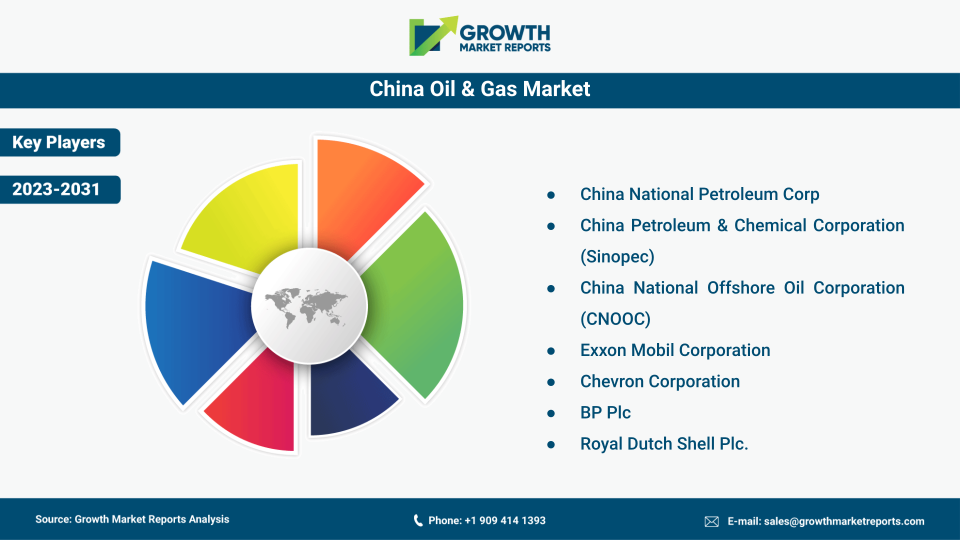

China Oil & Gas Market Keyplayers


Frequently Asked Questions

Companies are investing in low-carbon solutions like carbon capture and storage (CCS), hydrogen integration, advanced refining technologies, and digital transformation to reduce emissions and enhance sustainability.

Major challenges include price volatility, regulatory uncertainty, environmental concerns, stricter emissions standards, and the transition to cleaner energy sources.

Key companies include Saudi Aramco, ExxonMobil, Shell, Chevron, BP, TotalEnergies, PetroChina, Gazprom, Rosneft, ADNOC, Lukoil, Equinor, ConocoPhillips, Eni, Petrobras, QatarEnergy, Occidental Petroleum, Reliance Industries, and Sinopec.

Asia Pacific is the largest and fastest-growing market, followed by North America, which leads in unconventional resource development. The Middle East & Africa remain dominant in proven reserves and production.

Conventional resources are easily accessible and extracted using traditional methods, while unconventional resources (like shale oil, tight gas, and oil sands) require advanced techniques such as hydraulic fracturing and horizontal drilling.

The market is segmented into upstream (exploration and production), midstream (transportation and storage), and downstream (refining and distribution) sectors.

Technological innovations such as hydraulic fracturing, horizontal drilling, advanced seismic imaging, and digital solutions like AI and IoT are improving efficiency, unlocking new reserves, reducing costs, and minimizing environmental impact.

Key growth drivers include rising global energy demand, ongoing industrialization in emerging economies, technological advancements in extraction and processing, and continued reliance on petroleum-based fuels, especially in transportation.

The oil & gas market is expected to grow at a CAGR of 4.1% from 2025 to 2033, reaching a value of USD 10.6 trillion by 2033.

As of 2024, the global oil & gas market size reached USD 7.3 trillion, highlighting its continued importance in the global economy.

Table Of Content

Chapter 1 Executive Summary
Chapter 2 Assumptions and Acronyms Used
Chapter 3 Research Methodology
Chapter 4  Oil & Gas  Market Overview
   4.1 Introduction
      4.1.1 Market Taxonomy
      4.1.2 Market Definition
      4.1.3 Macro-Economic Factors Impacting the Market Growth
   4.2  Oil & Gas  Market Dynamics
      4.2.1 Market Drivers
      4.2.2 Market Restraints
      4.2.3 Market Opportunity
   4.3  Oil & Gas  Market - Supply Chain Analysis
      4.3.1 List of Key Suppliers
      4.3.2 List of Key Distributors
      4.3.3 List of Key Consumers
   4.4 Key Forces Shaping the  Oil & Gas  Market
      4.4.1 Bargaining Power of Suppliers
      4.4.2 Bargaining Power of Buyers
      4.4.3 Threat of Substitution
      4.4.4 Threat of New Entrants
      4.4.5 Competitive Rivalry
   4.5 Global  Oil & Gas  Market Size & Forecast, 2023-2032
      4.5.1  Oil & Gas  Market Size and Y-o-Y Growth
      4.5.2  Oil & Gas  Market Absolute $ Opportunity

Chapter 5 Global  Oil & Gas  Market Analysis and Forecast By Sector
   5.1 Introduction
      5.1.1 Key Market Trends & Growth Opportunities By Sector
      5.1.2 Basis Point Share (BPS) Analysis By Sector
      5.1.3 Absolute $ Opportunity Assessment By Sector
   5.2  Oil & Gas  Market Size Forecast By Sector
      5.2.1 Upstream
      5.2.2 Midstream
      5.2.3 Downstream
   5.3 Market Attractiveness Analysis By Sector

Chapter 6 Global  Oil & Gas  Market Analysis and Forecast By Resource Type
   6.1 Introduction
      6.1.1 Key Market Trends & Growth Opportunities By Resource Type
      6.1.2 Basis Point Share (BPS) Analysis By Resource Type
      6.1.3 Absolute $ Opportunity Assessment By Resource Type
   6.2  Oil & Gas  Market Size Forecast By Resource Type
      6.2.1 Conventional
      6.2.2 Unconventional
   6.3 Market Attractiveness Analysis By Resource Type

Chapter 7 Global  Oil & Gas  Market Analysis and Forecast By Application
   7.1 Introduction
      7.1.1 Key Market Trends & Growth Opportunities By Application
      7.1.2 Basis Point Share (BPS) Analysis By Application
      7.1.3 Absolute $ Opportunity Assessment By Application
   7.2  Oil & Gas  Market Size Forecast By Application
      7.2.1 Onshore
      7.2.2 Offshore
   7.3 Market Attractiveness Analysis By Application

Chapter 8 Global  Oil & Gas  Market Analysis and Forecast By Service
   8.1 Introduction
      8.1.1 Key Market Trends & Growth Opportunities By Service
      8.1.2 Basis Point Share (BPS) Analysis By Service
      8.1.3 Absolute $ Opportunity Assessment By Service
   8.2  Oil & Gas  Market Size Forecast By Service
      8.2.1 Exploration
      8.2.2 Drilling
      8.2.3 Production
      8.2.4 Processing
      8.2.5 Transportation
      8.2.6 Storage
      8.2.7 Refining
      8.2.8 Distribution
   8.3 Market Attractiveness Analysis By Service

Chapter 9 Global  Oil & Gas  Market Analysis and Forecast by Region
   9.1 Introduction
      9.1.1 Key Market Trends & Growth Opportunities By Region
      9.1.2 Basis Point Share (BPS) Analysis By Region
      9.1.3 Absolute $ Opportunity Assessment By Region
   9.2  Oil & Gas  Market Size Forecast By Region
      9.2.1 North America
      9.2.2 Europe
      9.2.3 Asia Pacific
      9.2.4 Latin America
      9.2.5 Middle East & Africa (MEA)
   9.3 Market Attractiveness Analysis By Region

Chapter 10 Coronavirus Disease (COVID-19) Impact 
   10.1 Introduction 
   10.2 Current & Future Impact Analysis 
   10.3 Economic Impact Analysis 
   10.4 Government Policies 
   10.5 Investment Scenario

Chapter 11 North America  Oil & Gas  Analysis and Forecast
   11.1 Introduction
   11.2 North America  Oil & Gas  Market Size Forecast by Country
      11.2.1 U.S.
      11.2.2 Canada
   11.3 Basis Point Share (BPS) Analysis by Country
   11.4 Absolute $ Opportunity Assessment by Country
   11.5 Market Attractiveness Analysis by Country
   11.6 North America  Oil & Gas  Market Size Forecast By Sector
      11.6.1 Upstream
      11.6.2 Midstream
      11.6.3 Downstream
   11.7 Basis Point Share (BPS) Analysis By Sector 
   11.8 Absolute $ Opportunity Assessment By Sector 
   11.9 Market Attractiveness Analysis By Sector
   11.10 North America  Oil & Gas  Market Size Forecast By Resource Type
      11.10.1 Conventional
      11.10.2 Unconventional
   11.11 Basis Point Share (BPS) Analysis By Resource Type 
   11.12 Absolute $ Opportunity Assessment By Resource Type 
   11.13 Market Attractiveness Analysis By Resource Type
   11.14 North America  Oil & Gas  Market Size Forecast By Application
      11.14.1 Onshore
      11.14.2 Offshore
   11.15 Basis Point Share (BPS) Analysis By Application 
   11.16 Absolute $ Opportunity Assessment By Application 
   11.17 Market Attractiveness Analysis By Application
   11.18 North America  Oil & Gas  Market Size Forecast By Service
      11.18.1 Exploration
      11.18.2 Drilling
      11.18.3 Production
      11.18.4 Processing
      11.18.5 Transportation
      11.18.6 Storage
      11.18.7 Refining
      11.18.8 Distribution
   11.19 Basis Point Share (BPS) Analysis By Service 
   11.20 Absolute $ Opportunity Assessment By Service 
   11.21 Market Attractiveness Analysis By Service

Chapter 12 Europe  Oil & Gas  Analysis and Forecast
   12.1 Introduction
   12.2 Europe  Oil & Gas  Market Size Forecast by Country
      12.2.1 Germany
      12.2.2 France
      12.2.3 Italy
      12.2.4 U.K.
      12.2.5 Spain
      12.2.6 Russia
      12.2.7 Rest of Europe
   12.3 Basis Point Share (BPS) Analysis by Country
   12.4 Absolute $ Opportunity Assessment by Country
   12.5 Market Attractiveness Analysis by Country
   12.6 Europe  Oil & Gas  Market Size Forecast By Sector
      12.6.1 Upstream
      12.6.2 Midstream
      12.6.3 Downstream
   12.7 Basis Point Share (BPS) Analysis By Sector 
   12.8 Absolute $ Opportunity Assessment By Sector 
   12.9 Market Attractiveness Analysis By Sector
   12.10 Europe  Oil & Gas  Market Size Forecast By Resource Type
      12.10.1 Conventional
      12.10.2 Unconventional
   12.11 Basis Point Share (BPS) Analysis By Resource Type 
   12.12 Absolute $ Opportunity Assessment By Resource Type 
   12.13 Market Attractiveness Analysis By Resource Type
   12.14 Europe  Oil & Gas  Market Size Forecast By Application
      12.14.1 Onshore
      12.14.2 Offshore
   12.15 Basis Point Share (BPS) Analysis By Application 
   12.16 Absolute $ Opportunity Assessment By Application 
   12.17 Market Attractiveness Analysis By Application
   12.18 Europe  Oil & Gas  Market Size Forecast By Service
      12.18.1 Exploration
      12.18.2 Drilling
      12.18.3 Production
      12.18.4 Processing
      12.18.5 Transportation
      12.18.6 Storage
      12.18.7 Refining
      12.18.8 Distribution
   12.19 Basis Point Share (BPS) Analysis By Service 
   12.20 Absolute $ Opportunity Assessment By Service 
   12.21 Market Attractiveness Analysis By Service

Chapter 13 Asia Pacific  Oil & Gas  Analysis and Forecast
   13.1 Introduction
   13.2 Asia Pacific  Oil & Gas  Market Size Forecast by Country
      13.2.1 China
      13.2.2 Japan
      13.2.3 South Korea
      13.2.4 India
      13.2.5 Australia
      13.2.6 South East Asia (SEA)
      13.2.7 Rest of Asia Pacific (APAC)
   13.3 Basis Point Share (BPS) Analysis by Country
   13.4 Absolute $ Opportunity Assessment by Country
   13.5 Market Attractiveness Analysis by Country
   13.6 Asia Pacific  Oil & Gas  Market Size Forecast By Sector
      13.6.1 Upstream
      13.6.2 Midstream
      13.6.3 Downstream
   13.7 Basis Point Share (BPS) Analysis By Sector 
   13.8 Absolute $ Opportunity Assessment By Sector 
   13.9 Market Attractiveness Analysis By Sector
   13.10 Asia Pacific  Oil & Gas  Market Size Forecast By Resource Type
      13.10.1 Conventional
      13.10.2 Unconventional
   13.11 Basis Point Share (BPS) Analysis By Resource Type 
   13.12 Absolute $ Opportunity Assessment By Resource Type 
   13.13 Market Attractiveness Analysis By Resource Type
   13.14 Asia Pacific  Oil & Gas  Market Size Forecast By Application
      13.14.1 Onshore
      13.14.2 Offshore
   13.15 Basis Point Share (BPS) Analysis By Application 
   13.16 Absolute $ Opportunity Assessment By Application 
   13.17 Market Attractiveness Analysis By Application
   13.18 Asia Pacific  Oil & Gas  Market Size Forecast By Service
      13.18.1 Exploration
      13.18.2 Drilling
      13.18.3 Production
      13.18.4 Processing
      13.18.5 Transportation
      13.18.6 Storage
      13.18.7 Refining
      13.18.8 Distribution
   13.19 Basis Point Share (BPS) Analysis By Service 
   13.20 Absolute $ Opportunity Assessment By Service 
   13.21 Market Attractiveness Analysis By Service

Chapter 14 Latin America  Oil & Gas  Analysis and Forecast
   14.1 Introduction
   14.2 Latin America  Oil & Gas  Market Size Forecast by Country
      14.2.1 Brazil
      14.2.2 Mexico
      14.2.3 Rest of Latin America (LATAM)
   14.3 Basis Point Share (BPS) Analysis by Country
   14.4 Absolute $ Opportunity Assessment by Country
   14.5 Market Attractiveness Analysis by Country
   14.6 Latin America  Oil & Gas  Market Size Forecast By Sector
      14.6.1 Upstream
      14.6.2 Midstream
      14.6.3 Downstream
   14.7 Basis Point Share (BPS) Analysis By Sector 
   14.8 Absolute $ Opportunity Assessment By Sector 
   14.9 Market Attractiveness Analysis By Sector
   14.10 Latin America  Oil & Gas  Market Size Forecast By Resource Type
      14.10.1 Conventional
      14.10.2 Unconventional
   14.11 Basis Point Share (BPS) Analysis By Resource Type 
   14.12 Absolute $ Opportunity Assessment By Resource Type 
   14.13 Market Attractiveness Analysis By Resource Type
   14.14 Latin America  Oil & Gas  Market Size Forecast By Application
      14.14.1 Onshore
      14.14.2 Offshore
   14.15 Basis Point Share (BPS) Analysis By Application 
   14.16 Absolute $ Opportunity Assessment By Application 
   14.17 Market Attractiveness Analysis By Application
   14.18 Latin America  Oil & Gas  Market Size Forecast By Service
      14.18.1 Exploration
      14.18.2 Drilling
      14.18.3 Production
      14.18.4 Processing
      14.18.5 Transportation
      14.18.6 Storage
      14.18.7 Refining
      14.18.8 Distribution
   14.19 Basis Point Share (BPS) Analysis By Service 
   14.20 Absolute $ Opportunity Assessment By Service 
   14.21 Market Attractiveness Analysis By Service

Chapter 15 Middle East & Africa (MEA)  Oil & Gas  Analysis and Forecast
   15.1 Introduction
   15.2 Middle East & Africa (MEA)  Oil & Gas  Market Size Forecast by Country
      15.2.1 Saudi Arabia
      15.2.2 South Africa
      15.2.3 UAE
      15.2.4 Rest of Middle East & Africa (MEA)
   15.3 Basis Point Share (BPS) Analysis by Country
   15.4 Absolute $ Opportunity Assessment by Country
   15.5 Market Attractiveness Analysis by Country
   15.6 Middle East & Africa (MEA)  Oil & Gas  Market Size Forecast By Sector
      15.6.1 Upstream
      15.6.2 Midstream
      15.6.3 Downstream
   15.7 Basis Point Share (BPS) Analysis By Sector 
   15.8 Absolute $ Opportunity Assessment By Sector 
   15.9 Market Attractiveness Analysis By Sector
   15.10 Middle East & Africa (MEA)  Oil & Gas  Market Size Forecast By Resource Type
      15.10.1 Conventional
      15.10.2 Unconventional
   15.11 Basis Point Share (BPS) Analysis By Resource Type 
   15.12 Absolute $ Opportunity Assessment By Resource Type 
   15.13 Market Attractiveness Analysis By Resource Type
   15.14 Middle East & Africa (MEA)  Oil & Gas  Market Size Forecast By Application
      15.14.1 Onshore
      15.14.2 Offshore
   15.15 Basis Point Share (BPS) Analysis By Application 
   15.16 Absolute $ Opportunity Assessment By Application 
   15.17 Market Attractiveness Analysis By Application
   15.18 Middle East & Africa (MEA)  Oil & Gas  Market Size Forecast By Service
      15.18.1 Exploration
      15.18.2 Drilling
      15.18.3 Production
      15.18.4 Processing
      15.18.5 Transportation
      15.18.6 Storage
      15.18.7 Refining
      15.18.8 Distribution
   15.19 Basis Point Share (BPS) Analysis By Service 
   15.20 Absolute $ Opportunity Assessment By Service 
   15.21 Market Attractiveness Analysis By Service

Chapter 16 Competition Landscape 
   16.1  Oil & Gas  Market: Competitive Dashboard
   16.2 Global  Oil & Gas  Market: Market Share Analysis, 2023
   16.3 Company Profiles (Details – Overview, Financials, Developments, Strategy) 
      16.3.1 Saudi Aramco
ExxonMobil
Shell
Chevron
BP
TotalEnergies
PetroChina
Gazprom
Rosneft
Kuwait Petroleum Corporation
Abu Dhabi National Oil Company (ADNOC)
Lukoil
Equinor
ConocoPhillips
Eni
Petrobras
QatarEnergy
Occidental Petroleum
Reliance Industries
Sinopec

Methodology

Our Clients

The John Holland Group
Dassault Aviation
Pfizer
Deloitte
Honda Motor Co. Ltd.
General Mills
FedEx Logistics
Nestle SA