Metro Ethernet Services Market Research Report 2033

Metro Ethernet Services Market Research Report 2033

Segments - by Service Type (E-Line, E-LAN, E-Tree, E-Access, Others), by Application (Residential, Commercial, Industrial, Others), by End-User (BFSI, Healthcare, IT & Telecom, Government, Retail, Education, Others), by Organization Size (Large Enterprises, Small and Medium Enterprises)

https://growthmarketreports.com/Raksha
Author : Raksha Sharma
https://growthmarketreports.com/Vaibhav
Fact-checked by : V. Chandola
https://growthmarketreports.com/Shruti
Editor : Shruti Bhat

Upcoming | Report ID :ICT-SE-493 | 4.6 Rating | 23 Reviews | 276 Pages | Format : Docx PDF

Report Description


Metro Ethernet Services Market Outlook

According to our latest research, the global Metro Ethernet Services market size in 2024 is valued at USD 68.5 billion, demonstrating robust expansion driven by escalating demand for high-speed, reliable, and scalable connectivity solutions across diverse sectors. The market is expected to grow at a CAGR of 10.2% during the forecast period, reaching approximately USD 164.6 billion by 2033. The accelerating adoption of cloud-based applications, digital transformation initiatives, and the proliferation of Internet of Things (IoT) devices are the primary growth factors fueling this marketÂ’s remarkable trajectory.

The growth of the Metro Ethernet Services market is predominantly propelled by the increasing need for high-bandwidth and low-latency connectivity among enterprises and service providers. As organizations embrace digital transformation, there is a mounting requirement for robust and agile network infrastructures that can support cloud computing, unified communications, and real-time data analytics. Metro Ethernet services, with their inherent scalability and flexibility, have emerged as the preferred choice for enterprises seeking to interconnect multiple locations within metropolitan areas. The rise of data-intensive applications, such as video conferencing, online collaboration tools, and big data analytics, further amplifies the demand for reliable and high-performance Metro Ethernet solutions.

Another critical growth driver for the Metro Ethernet Services market is the ongoing evolution of smart cities and the rapid expansion of IoT ecosystems. Governments and municipalities across the globe are investing heavily in smart infrastructure to enhance urban living, optimize resource management, and improve public safety. Metro Ethernet networks serve as the backbone for these smart city initiatives, enabling seamless connectivity for surveillance systems, traffic management, public Wi-Fi, and other IoT-enabled services. The increasing deployment of 5G networks also augments the need for robust Ethernet backhaul solutions, further strengthening the market outlook for Metro Ethernet services.

Moreover, the growing trend of remote and hybrid work environments has accelerated the adoption of Metro Ethernet services among businesses of all sizes. The COVID-19 pandemic underscored the importance of resilient and secure connectivity for maintaining business continuity and supporting distributed workforces. Enterprises are increasingly leveraging Metro Ethernet to establish secure connections between branch offices, data centers, and cloud platforms, ensuring uninterrupted access to critical applications and data. The flexibility to scale bandwidth on demand and the ability to support diverse applications make Metro Ethernet an indispensable component of modern enterprise networking strategies.

Ethernet Access Services play a pivotal role in the Metro Ethernet Services market by providing the necessary infrastructure for seamless connectivity. These services enable service providers to extend their Ethernet networks and deliver high-speed, reliable connections to end-users. By facilitating last-mile connectivity, Ethernet Access Services ensure that businesses and residential customers can access the full range of Metro Ethernet capabilities, including high-bandwidth and low-latency communication. This is particularly important in urban areas where demand for robust internet services is high. As the market continues to evolve, Ethernet Access Services are expected to become even more integral, supporting the growing needs of digital transformation and smart city initiatives.

From a regional perspective, North America and Asia Pacific currently dominate the Metro Ethernet Services market, accounting for a substantial share of global revenue. North AmericaÂ’s leadership is attributed to the presence of advanced IT infrastructure, widespread adoption of cloud services, and a large concentration of technology-driven enterprises. Meanwhile, Asia Pacific is witnessing the fastest growth, driven by rapid urbanization, increasing investments in digital infrastructure, and the proliferation of connected devices. Europe, Latin America, and the Middle East & Africa are also experiencing steady growth, fueled by digitalization initiatives and rising demand for high-speed connectivity in both urban and rural areas.

Global Metro Ethernet Services Industry Outlook

Service Type Analysis

The Service Type segment of the Metro Ethernet Services market is categorized into E-Line, E-LAN, E-Tree, E-Access, and Others. Among these, the E-Line service type holds the largest market share, owing to its simplicity, cost-effectiveness, and widespread adoption among enterprises seeking point-to-point connectivity. E-Line services are particularly favored by organizations requiring dedicated, high-speed connections between two locations, such as data centers, branch offices, or business partners. The growing need for secure and private data transmission, coupled with the increasing adoption of cloud-based services, has further bolstered the demand for E-Line solutions across various industries.

E-LAN services, which provide multipoint-to-multipoint connectivity, are gaining significant traction among businesses with complex network topologies and distributed operations. These services enable seamless communication between multiple locations within a metropolitan area, making them ideal for large enterprises, educational institutions, and government agencies. The flexibility to add or remove sites without disrupting the existing network architecture is a key advantage driving the adoption of E-LAN services. Additionally, the rising popularity of collaborative applications and unified communications platforms has increased the demand for robust and scalable E-LAN solutions.

E-Tree services, designed for point-to-multipoint connectivity, cater to organizations that require centralized management of distributed sites. This service type is particularly relevant for industries such as retail, banking, and public sector, where a central office needs to communicate with multiple branch locations. E-Tree services offer a cost-effective and efficient solution for managing dispersed operations, enabling secure and reliable connectivity between the central hub and remote sites. The growing emphasis on network security and compliance requirements has further accelerated the adoption of E-Tree services in regulated industries.

Carrier Ethernet has emerged as a cornerstone technology within the Metro Ethernet Services market, offering standardized, carrier-grade Ethernet solutions that meet the rigorous demands of modern enterprises. By providing scalable and reliable connectivity, Carrier Ethernet enables businesses to efficiently manage data traffic across metropolitan and wide area networks. This technology supports a wide range of applications, from cloud computing and data center interconnectivity to unified communications and IoT deployments. As organizations increasingly prioritize network performance and security, Carrier Ethernet is poised to play a critical role in enabling seamless digital experiences and supporting the next wave of technological innovation.

E-Access services are primarily targeted at service providers and carriers, enabling them to extend their Ethernet reach and deliver last-mile connectivity to end-users. These services facilitate seamless interconnection between different network domains, supporting the delivery of high-speed broadband and value-added services to residential and commercial customers. The increasing demand for high-speed internet access, driven by the proliferation of digital content and online services, has created lucrative opportunities for E-Access providers. The Others category, encompassing specialized and customized Ethernet solutions, continues to evolve in response to emerging use cases and industry-specific requirements.

Report Scope

Attributes Details
Report Title Metro Ethernet Services Market Research Report 2033
By Service Type E-Line, E-LAN, E-Tree, E-Access, Others
By Application Residential, Commercial, Industrial, Others
By End-User BFSI, Healthcare, IT & Telecom, Government, Retail, Education, Others
By Organization Size Large Enterprises, Small and Medium Enterprises
Regions Covered North America, Europe, APAC, Latin America, MEA
Base Year 2024
Historic Data 2018-2023
Forecast Period 2025-2033
Number of Pages 276
Number of Tables & Figures 260
Customization Available Yes, the report can be customized as per your need.

Application Analysis

The Application segment of the Metro Ethernet Services market encompasses Residential, Commercial, Industrial, and Others. The commercial application segment dominates the market, driven by the rapid digitalization of businesses and the growing reliance on cloud-based applications, unified communications, and data analytics. Enterprises across sectors such as finance, healthcare, retail, and IT are increasingly adopting Metro Ethernet services to support mission-critical operations, ensure business continuity, and enhance customer experiences. The ability to provide high-speed, reliable, and scalable connectivity makes Metro Ethernet an attractive option for commercial users seeking to stay competitive in the digital economy.

The industrial application segment is witnessing robust growth, fueled by the ongoing adoption of Industry 4.0 technologies and the proliferation of connected devices in manufacturing, logistics, and energy sectors. Metro Ethernet services play a pivotal role in enabling real-time monitoring, process automation, and predictive maintenance, thereby improving operational efficiency and reducing downtime. The need for secure and resilient connectivity to support industrial IoT applications, remote asset management, and data-driven decision-making is driving the demand for Metro Ethernet solutions in industrial environments.

Residential applications of Metro Ethernet services are gaining momentum, particularly in urban areas with high population density and increasing demand for high-speed internet access. The growing popularity of online streaming, gaming, remote education, and telemedicine has created a strong need for reliable broadband connectivity in residential settings. Metro Ethernet providers are leveraging fiber-optic networks to deliver gigabit-speed internet and value-added services to households, addressing the evolving needs of modern consumers. The Others segment, which includes applications such as public safety, transportation, and smart city initiatives, is also expanding as governments and municipalities invest in digital infrastructure to enhance urban living and public services.

The growing convergence of applications across segments is leading to the development of integrated Metro Ethernet solutions that cater to diverse user requirements. Service providers are increasingly offering customized packages and flexible service-level agreements (SLAs) to address the unique needs of different customer segments. The emphasis on quality of service (QoS), network security, and scalability is shaping the evolution of Metro Ethernet applications, driving innovation and differentiation in the market.

End-User Analysis

The End-User segment of the Metro Ethernet Services market is comprised of BFSI, Healthcare, IT & Telecom, Government, Retail, Education, and Others. The BFSI sector is a major contributor to market growth, as financial institutions require secure, high-speed, and reliable connectivity to support real-time transactions, data analytics, and regulatory compliance. Metro Ethernet services enable banks and financial service providers to interconnect branch offices, data centers, and trading platforms, ensuring seamless and secure data flow across the organization. The increasing adoption of digital banking, mobile payments, and fintech solutions is further driving the demand for Metro Ethernet in the BFSI sector.

The healthcare sector is rapidly embracing Metro Ethernet services to support electronic health records (EHRs), telemedicine, medical imaging, and remote patient monitoring. The need for high-bandwidth, low-latency connectivity to facilitate real-time data exchange between hospitals, clinics, and laboratories is a key driver for Metro Ethernet adoption in healthcare. The ongoing digital transformation of healthcare systems, coupled with stringent data privacy and security requirements, underscores the importance of robust and scalable network infrastructures.

IT & Telecom companies are at the forefront of Metro Ethernet adoption, leveraging these services to deliver high-speed broadband, cloud computing, and managed network solutions to enterprise and residential customers. The proliferation of data centers, the expansion of 5G networks, and the growing demand for OTT (over-the-top) services are creating new opportunities for Metro Ethernet providers in the IT & Telecom sector. Government agencies, on the other hand, are utilizing Metro Ethernet to support e-governance initiatives, public safety communications, and smart city projects, driving the need for secure and resilient connectivity solutions.

The retail and education sectors are also significant end-users of Metro Ethernet services. Retailers are leveraging high-speed connectivity to enable omnichannel experiences, support point-of-sale systems, and enhance supply chain visibility. Educational institutions are adopting Metro Ethernet to facilitate online learning, campus networking, and research collaborations. The Others category, which includes transportation, utilities, and public sector organizations, is expanding as the digitalization of critical infrastructure and public services accelerates.

Organization Size Analysis

The Organization Size segment of the Metro Ethernet Services market is divided into Large Enterprises and Small and Medium Enterprises (SMEs). Large enterprises account for the largest share of the market, driven by their complex network requirements, extensive geographic presence, and substantial IT budgets. These organizations require high-capacity, secure, and scalable connectivity solutions to support data-intensive applications, interconnect multiple locations, and ensure business continuity. Metro Ethernet services offer large enterprises the flexibility to scale bandwidth on demand, implement disaster recovery solutions, and support digital transformation initiatives.

Small and Medium Enterprises (SMEs) are increasingly recognizing the benefits of Metro Ethernet services, as they seek to enhance productivity, improve customer experiences, and compete with larger organizations. The growing adoption of cloud-based applications, remote work, and digital marketing strategies is driving the demand for high-speed, reliable connectivity among SMEs. Service providers are responding to this trend by offering cost-effective, scalable Metro Ethernet solutions tailored to the unique needs of smaller businesses. The ability to access enterprise-grade connectivity without significant upfront investments is a key factor driving Metro Ethernet adoption among SMEs.

The evolving needs of organizations of all sizes are prompting service providers to develop flexible pricing models, customizable service-level agreements, and value-added services. The focus on delivering superior customer experiences, ensuring network reliability, and providing proactive support is shaping the competitive landscape of the Metro Ethernet Services market. As organizations continue to embrace digital transformation, the demand for agile and scalable connectivity solutions is expected to grow across both large enterprises and SMEs.

The increasing convergence of enterprise and SME requirements is leading to the development of standardized Metro Ethernet offerings that cater to a wide range of use cases. Service providers are leveraging automation, artificial intelligence, and advanced analytics to optimize network performance, enhance security, and deliver differentiated services. The emphasis on operational efficiency, cost optimization, and innovation is driving the evolution of Metro Ethernet solutions for organizations of all sizes.

Opportunities & Threats

The Metro Ethernet Services market presents significant opportunities for growth, driven by the ongoing digital transformation of businesses, the proliferation of IoT devices, and the expansion of cloud-based applications. The increasing adoption of smart city initiatives, 5G networks, and Industry 4.0 technologies is creating new avenues for Metro Ethernet providers to deliver high-speed, reliable connectivity solutions. The emergence of edge computing and the growing demand for low-latency applications are further expanding the addressable market for Metro Ethernet services. Service providers that can offer differentiated, value-added solutions tailored to specific industry verticals and use cases are well-positioned to capitalize on these opportunities.

Another major opportunity lies in the untapped potential of emerging markets, where rapid urbanization, rising internet penetration, and increasing investments in digital infrastructure are driving demand for high-speed connectivity. Metro Ethernet providers can leverage partnerships with local governments, telecom operators, and technology vendors to expand their footprint in these regions. The development of innovative pricing models, flexible service offerings, and bundled solutions can help providers address the unique needs of diverse customer segments, including SMEs, residential users, and public sector organizations. The focus on sustainability, energy efficiency, and green networking is also creating new opportunities for Metro Ethernet providers to differentiate themselves in the market.

Despite the promising outlook, the Metro Ethernet Services market faces several challenges and restraints. Intense competition from alternative connectivity solutions, such as MPLS, SD-WAN, and wireless technologies, poses a threat to market growth. Price pressures, commoditization of services, and the need for continuous innovation are compelling providers to differentiate themselves through superior customer experiences, advanced security features, and value-added services. Regulatory complexities, data privacy concerns, and the need for substantial investments in network infrastructure are additional challenges that may hinder market expansion. Providers must navigate these threats by embracing innovation, enhancing operational efficiency, and fostering strategic partnerships.

Regional Outlook

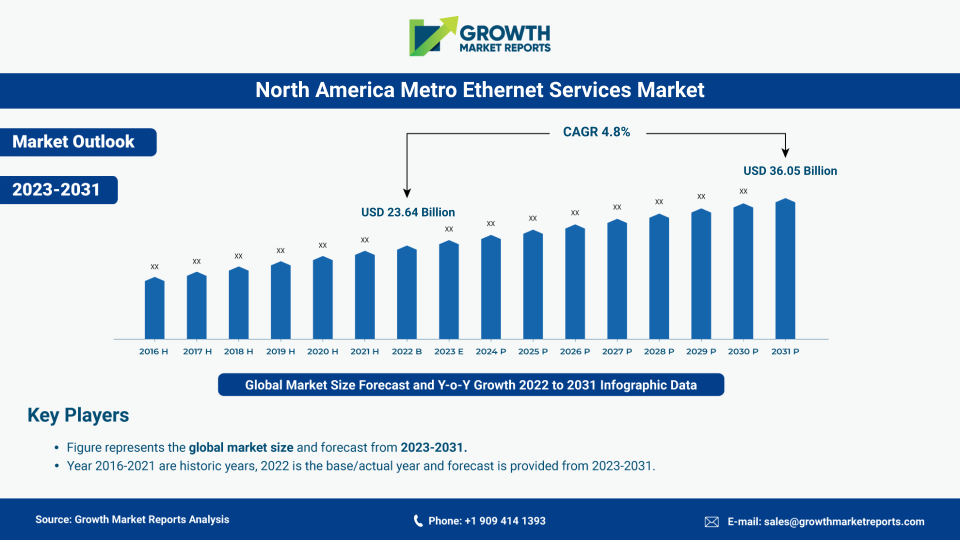
North America remains the largest regional market for Metro Ethernet Services, with a market size of USD 23.6 billion in 2024. The regionÂ’s dominance is attributed to the widespread adoption of advanced IT infrastructure, the presence of leading technology companies, and a strong emphasis on digital transformation across industries. The United States, in particular, accounts for the majority of regional revenue, driven by high demand from sectors such as BFSI, healthcare, and IT & Telecom. The increasing deployment of 5G networks, coupled with the proliferation of cloud-based applications and IoT devices, is further fueling the demand for Metro Ethernet services in North America. The region is projected to maintain a steady growth trajectory, with a CAGR of 8.7% through 2033.

Asia Pacific is the fastest-growing region in the Metro Ethernet Services market, with a market size of USD 19.4 billion in 2024. The regionÂ’s rapid growth is driven by factors such as urbanization, rising internet penetration, and increasing investments in digital infrastructure. Countries like China, India, Japan, and South Korea are at the forefront of Metro Ethernet adoption, supported by government initiatives to promote smart cities, digital economies, and broadband connectivity. The growing presence of multinational corporations, the expansion of data centers, and the proliferation of connected devices are creating new opportunities for Metro Ethernet providers in the region. Asia Pacific is expected to exhibit a CAGR of 12.8% during the forecast period, outpacing other regions in terms of market expansion.

Europe, Latin America, and the Middle East & Africa collectively account for the remaining share of the global Metro Ethernet Services market, with a combined market size of USD 25.5 billion in 2024. Europe is witnessing steady growth, driven by digitalization initiatives, the expansion of fiber-optic networks, and increasing demand for high-speed connectivity in both urban and rural areas. Latin America and the Middle East & Africa are emerging as promising markets, supported by government-led infrastructure projects and the growing adoption of digital services. The focus on bridging the digital divide, enhancing public services, and promoting economic development is expected to drive further growth in these regions.

Metro Ethernet Services Market Statistics

Competitor Outlook

The Metro Ethernet Services market is characterized by intense competition, with a diverse mix of global, regional, and local players vying for market share. The competitive landscape is shaped by factors such as service quality, network coverage, pricing strategies, and the ability to deliver value-added solutions. Leading service providers are investing heavily in network upgrades, fiber-optic deployments, and advanced technologies to enhance their service offerings and differentiate themselves from competitors. Strategic partnerships, mergers and acquisitions, and collaborations with technology vendors are common strategies adopted by market players to expand their footprint and strengthen their market position.

Innovation is a key differentiator in the Metro Ethernet Services market, with providers leveraging automation, artificial intelligence, and analytics to optimize network performance, enhance security, and deliver superior customer experiences. The ability to offer customized solutions, flexible service-level agreements, and proactive support is becoming increasingly important in retaining and attracting customers. Providers are also focusing on sustainability, energy efficiency, and green networking as part of their corporate social responsibility initiatives and to meet evolving customer expectations.

The market is witnessing the emergence of new entrants, particularly in emerging regions, who are leveraging disruptive technologies and innovative business models to challenge established players. These new entrants often focus on underserved markets, niche applications, or specialized customer segments, creating competitive pressure and driving further innovation in the industry. The ongoing convergence of telecom, IT, and cloud services is leading to the development of integrated solutions that cater to the evolving needs of businesses and consumers.

Major companies operating in the Metro Ethernet Services market include AT&T Inc., Verizon Communications Inc., CenturyLink (Lumen Technologies), Orange S.A., BT Group plc, Comcast Corporation, Colt Technology Services, Tata Communications, NTT Communications, and China Telecom. AT&T and Verizon are recognized for their extensive network coverage, advanced service offerings, and strong presence in the North American market. CenturyLink (Lumen Technologies) is known for its comprehensive portfolio of Ethernet solutions and focus on enterprise customers. Orange S.A. and BT Group plc have a significant presence in the European market, offering a wide range of Metro Ethernet services to businesses and public sector organizations.

Comcast Corporation and Colt Technology Services are leading providers of Metro Ethernet solutions for commercial and residential customers, leveraging their extensive fiber-optic networks and innovative service offerings. Tata Communications and NTT Communications are prominent players in the Asia Pacific region, supported by strong regional partnerships and investments in digital infrastructure. China Telecom is a major player in the Chinese market, benefiting from government-led digitalization initiatives and the rapid expansion of broadband connectivity. These companies are continuously innovating, expanding their service portfolios, and enhancing customer experiences to maintain their competitive edge in the dynamic Metro Ethernet Services market.

Key Players

  • AT&T
  • Verizon Communications
  • Comcast Business
  • CenturyLink (Lumen Technologies)
  • BT Group
  • Orange Business Services
  • NTT Communications
  • Tata Communications
  • Telefonica
  • Vodafone Group
  • Colt Technology Services
  • Cox Communications
  • Spectrum Enterprise (Charter Communications)
  • Windstream Enterprise
  • Zayo Group
  • China Telecom
  • China Unicom
  • SingTel
  • Telstra
  • Reliance Communications
Metro Ethernet Services Market Overview

Segments

The Metro Ethernet Services market has been segmented on the basis of

Service Type

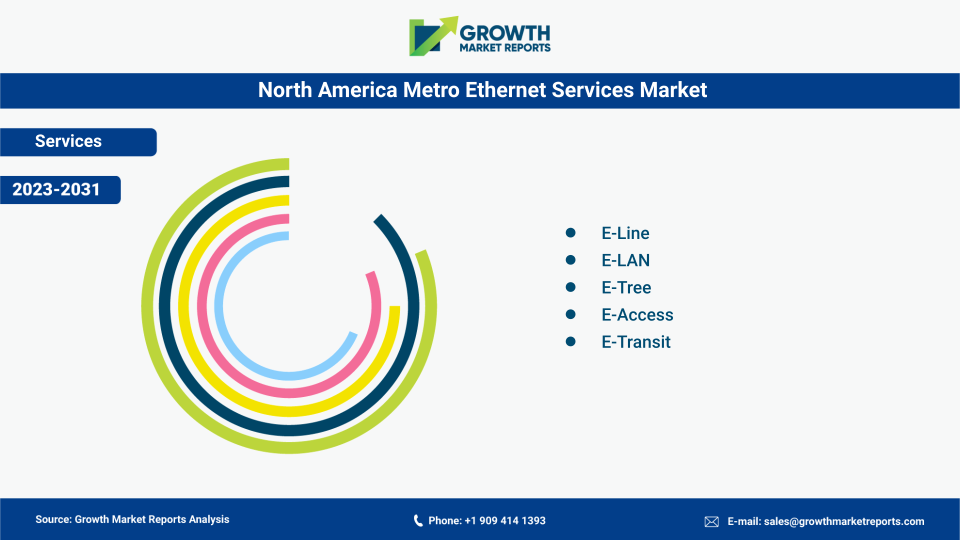
  • E-Line
  • E-LAN
  • E-Tree
  • E-Access
  • Others

Application

  • Residential
  • Commercial
  • Industrial
  • Others

End-User

  • BFSI
  • Healthcare
  • IT & Telecom
  • Government
  • Retail
  • Education
  • Others

Organization Size

  • Large Enterprises
  • Small and Medium Enterprises

Competitive Landscape

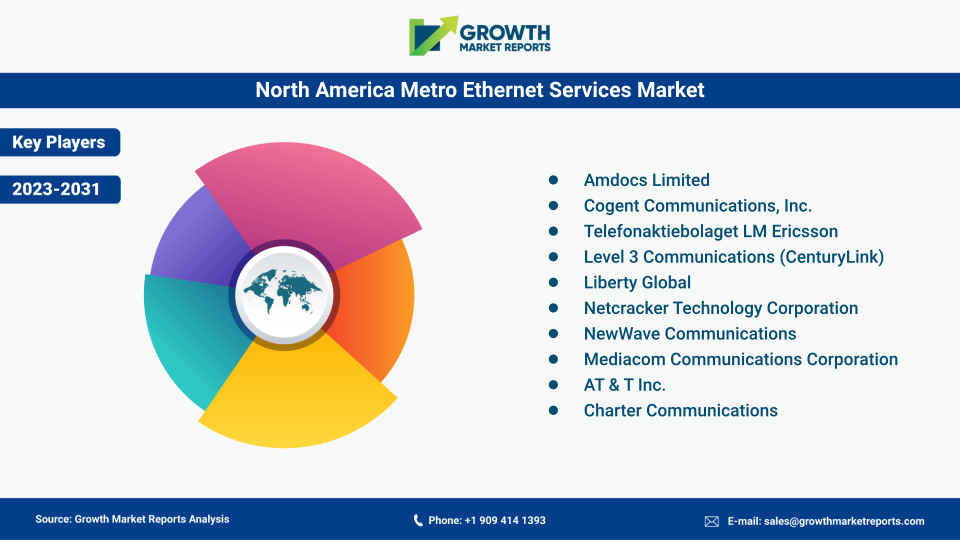
Some of the key players in the North America metro Ethernet services market include Amdocs Limited, Cogent Communications, Inc., Telefonaktiebolaget LM Ericsson, Level 3 Communications (CenturyLink), Liberty Global, Netcracker Technology Corporation, NewWave Communications, Mediacom Communications Corporation, AT & T Inc., and Charter Communications.

Industry participants are focusing on various business strategies such as product launch to provide top-notch devices to their customers and expand their consumer base across the region.

  • In December 2016, Amdocs, Inc. announced that NetLink Trust, a Singapore-based telecommunications infrastructure provider, has selected Amdocs as a provider of advanced business and operations support systems. The company claims that its solution allows acceleration of fiber connectivity and reduce maintenance and repair times and enhance the quality of its service.

North America Metro Ethernet Services Market Key Players

Frequently Asked Questions

Key players include AT&T, Verizon Communications, Comcast Business, CenturyLink (Lumen Technologies), BT Group, Orange Business Services, NTT Communications, Tata Communications, Telefonica, Vodafone Group, Colt Technology Services, and others.

Metro Ethernet Services provide secure, scalable, and reliable connectivity for businesses with distributed workforces, ensuring uninterrupted access to critical applications and data between branch offices, data centers, and cloud platforms.

Metro Ethernet networks serve as the backbone for smart city initiatives, enabling connectivity for surveillance, traffic management, public Wi-Fi, and IoT-enabled services, supporting seamless data flow and real-time applications.

Opportunities include digital transformation, IoT proliferation, smart city initiatives, and emerging markets. Threats involve competition from alternative technologies (like MPLS and SD-WAN), price pressures, regulatory challenges, and the need for continuous innovation.

North America and Asia Pacific are the leading regions. North America leads in market share due to advanced IT infrastructure, while Asia Pacific is the fastest-growing region driven by urbanization and digital infrastructure investments.

Major end-users include BFSI, healthcare, IT & telecom, government, retail, education, and others. BFSI and healthcare sectors are significant contributors due to their need for secure, high-speed, and reliable connectivity.

Metro Ethernet Services are used in residential, commercial, industrial, and other applications. Commercial applications dominate, supporting sectors like finance, healthcare, retail, and IT with high-speed, reliable connectivity.

The main service types are E-Line, E-LAN, E-Tree, E-Access, and Others, with E-Line holding the largest market share due to its simplicity and cost-effectiveness for point-to-point connectivity.

Key growth drivers include the rising demand for high-speed, reliable, and scalable connectivity, increased adoption of cloud-based applications, digital transformation initiatives, proliferation of IoT devices, and the expansion of smart city and 5G infrastructure.

The global Metro Ethernet Services market is valued at USD 68.5 billion in 2024 and is expected to grow at a CAGR of 10.2%, reaching approximately USD 164.6 billion by 2033.

Table Of Content

Chapter 1 Executive Summary
Chapter 2 Assumptions and Acronyms Used
Chapter 3 Research Methodology
Chapter 4 Metro Ethernet Services Market Overview
   4.1 Introduction
      4.1.1 Market Taxonomy
      4.1.2 Market Definition
      4.1.3 Macro-Economic Factors Impacting the Market Growth
   4.2 Metro Ethernet Services Market Dynamics
      4.2.1 Market Drivers
      4.2.2 Market Restraints
      4.2.3 Market Opportunity
   4.3 Metro Ethernet Services Market - Supply Chain Analysis
      4.3.1 List of Key Suppliers
      4.3.2 List of Key Distributors
      4.3.3 List of Key Consumers
   4.4 Key Forces Shaping the Metro Ethernet Services Market
      4.4.1 Bargaining Power of Suppliers
      4.4.2 Bargaining Power of Buyers
      4.4.3 Threat of Substitution
      4.4.4 Threat of New Entrants
      4.4.5 Competitive Rivalry
   4.5 Global Metro Ethernet Services Market Size & Forecast, 2023-2032
      4.5.1 Metro Ethernet Services Market Size and Y-o-Y Growth
      4.5.2 Metro Ethernet Services Market Absolute $ Opportunity

Chapter 5 Global Metro Ethernet Services Market Analysis and Forecast By Service Type
   5.1 Introduction
      5.1.1 Key Market Trends & Growth Opportunities By Service Type
      5.1.2 Basis Point Share (BPS) Analysis By Service Type
      5.1.3 Absolute $ Opportunity Assessment By Service Type
   5.2 Metro Ethernet Services Market Size Forecast By Service Type
      5.2.1 E-Line
      5.2.2 E-LAN
      5.2.3 E-Tree
      5.2.4 E-Access
      5.2.5 Others
   5.3 Market Attractiveness Analysis By Service Type

Chapter 6 Global Metro Ethernet Services Market Analysis and Forecast By Application
   6.1 Introduction
      6.1.1 Key Market Trends & Growth Opportunities By Application
      6.1.2 Basis Point Share (BPS) Analysis By Application
      6.1.3 Absolute $ Opportunity Assessment By Application
   6.2 Metro Ethernet Services Market Size Forecast By Application
      6.2.1 Residential
      6.2.2 Commercial
      6.2.3 Industrial
      6.2.4 Others
   6.3 Market Attractiveness Analysis By Application

Chapter 7 Global Metro Ethernet Services Market Analysis and Forecast By End-User
   7.1 Introduction
      7.1.1 Key Market Trends & Growth Opportunities By End-User
      7.1.2 Basis Point Share (BPS) Analysis By End-User
      7.1.3 Absolute $ Opportunity Assessment By End-User
   7.2 Metro Ethernet Services Market Size Forecast By End-User
      7.2.1 BFSI
      7.2.2 Healthcare
      7.2.3 IT & Telecom
      7.2.4 Government
      7.2.5 Retail
      7.2.6 Education
      7.2.7 Others
   7.3 Market Attractiveness Analysis By End-User

Chapter 8 Global Metro Ethernet Services Market Analysis and Forecast By Organization Size
   8.1 Introduction
      8.1.1 Key Market Trends & Growth Opportunities By Organization Size
      8.1.2 Basis Point Share (BPS) Analysis By Organization Size
      8.1.3 Absolute $ Opportunity Assessment By Organization Size
   8.2 Metro Ethernet Services Market Size Forecast By Organization Size
      8.2.1 Large Enterprises
      8.2.2 Small and Medium Enterprises
   8.3 Market Attractiveness Analysis By Organization Size

Chapter 9 Global Metro Ethernet Services Market Analysis and Forecast by Region
   9.1 Introduction
      9.1.1 Key Market Trends & Growth Opportunities By Region
      9.1.2 Basis Point Share (BPS) Analysis By Region
      9.1.3 Absolute $ Opportunity Assessment By Region
   9.2 Metro Ethernet Services Market Size Forecast By Region
      9.2.1 North America
      9.2.2 Europe
      9.2.3 Asia Pacific
      9.2.4 Latin America
      9.2.5 Middle East & Africa (MEA)
   9.3 Market Attractiveness Analysis By Region

Chapter 10 Coronavirus Disease (COVID-19) Impact 
   10.1 Introduction 
   10.2 Current & Future Impact Analysis 
   10.3 Economic Impact Analysis 
   10.4 Government Policies 
   10.5 Investment Scenario

Chapter 11 North America Metro Ethernet Services Analysis and Forecast
   11.1 Introduction
   11.2 North America Metro Ethernet Services Market Size Forecast by Country
      11.2.1 U.S.
      11.2.2 Canada
   11.3 Basis Point Share (BPS) Analysis by Country
   11.4 Absolute $ Opportunity Assessment by Country
   11.5 Market Attractiveness Analysis by Country
   11.6 North America Metro Ethernet Services Market Size Forecast By Service Type
      11.6.1 E-Line
      11.6.2 E-LAN
      11.6.3 E-Tree
      11.6.4 E-Access
      11.6.5 Others
   11.7 Basis Point Share (BPS) Analysis By Service Type 
   11.8 Absolute $ Opportunity Assessment By Service Type 
   11.9 Market Attractiveness Analysis By Service Type
   11.10 North America Metro Ethernet Services Market Size Forecast By Application
      11.10.1 Residential
      11.10.2 Commercial
      11.10.3 Industrial
      11.10.4 Others
   11.11 Basis Point Share (BPS) Analysis By Application 
   11.12 Absolute $ Opportunity Assessment By Application 
   11.13 Market Attractiveness Analysis By Application
   11.14 North America Metro Ethernet Services Market Size Forecast By End-User
      11.14.1 BFSI
      11.14.2 Healthcare
      11.14.3 IT & Telecom
      11.14.4 Government
      11.14.5 Retail
      11.14.6 Education
      11.14.7 Others
   11.15 Basis Point Share (BPS) Analysis By End-User 
   11.16 Absolute $ Opportunity Assessment By End-User 
   11.17 Market Attractiveness Analysis By End-User
   11.18 North America Metro Ethernet Services Market Size Forecast By Organization Size
      11.18.1 Large Enterprises
      11.18.2 Small and Medium Enterprises
   11.19 Basis Point Share (BPS) Analysis By Organization Size 
   11.20 Absolute $ Opportunity Assessment By Organization Size 
   11.21 Market Attractiveness Analysis By Organization Size

Chapter 12 Europe Metro Ethernet Services Analysis and Forecast
   12.1 Introduction
   12.2 Europe Metro Ethernet Services Market Size Forecast by Country
      12.2.1 Germany
      12.2.2 France
      12.2.3 Italy
      12.2.4 U.K.
      12.2.5 Spain
      12.2.6 Russia
      12.2.7 Rest of Europe
   12.3 Basis Point Share (BPS) Analysis by Country
   12.4 Absolute $ Opportunity Assessment by Country
   12.5 Market Attractiveness Analysis by Country
   12.6 Europe Metro Ethernet Services Market Size Forecast By Service Type
      12.6.1 E-Line
      12.6.2 E-LAN
      12.6.3 E-Tree
      12.6.4 E-Access
      12.6.5 Others
   12.7 Basis Point Share (BPS) Analysis By Service Type 
   12.8 Absolute $ Opportunity Assessment By Service Type 
   12.9 Market Attractiveness Analysis By Service Type
   12.10 Europe Metro Ethernet Services Market Size Forecast By Application
      12.10.1 Residential
      12.10.2 Commercial
      12.10.3 Industrial
      12.10.4 Others
   12.11 Basis Point Share (BPS) Analysis By Application 
   12.12 Absolute $ Opportunity Assessment By Application 
   12.13 Market Attractiveness Analysis By Application
   12.14 Europe Metro Ethernet Services Market Size Forecast By End-User
      12.14.1 BFSI
      12.14.2 Healthcare
      12.14.3 IT & Telecom
      12.14.4 Government
      12.14.5 Retail
      12.14.6 Education
      12.14.7 Others
   12.15 Basis Point Share (BPS) Analysis By End-User 
   12.16 Absolute $ Opportunity Assessment By End-User 
   12.17 Market Attractiveness Analysis By End-User
   12.18 Europe Metro Ethernet Services Market Size Forecast By Organization Size
      12.18.1 Large Enterprises
      12.18.2 Small and Medium Enterprises
   12.19 Basis Point Share (BPS) Analysis By Organization Size 
   12.20 Absolute $ Opportunity Assessment By Organization Size 
   12.21 Market Attractiveness Analysis By Organization Size

Chapter 13 Asia Pacific Metro Ethernet Services Analysis and Forecast
   13.1 Introduction
   13.2 Asia Pacific Metro Ethernet Services Market Size Forecast by Country
      13.2.1 China
      13.2.2 Japan
      13.2.3 South Korea
      13.2.4 India
      13.2.5 Australia
      13.2.6 South East Asia (SEA)
      13.2.7 Rest of Asia Pacific (APAC)
   13.3 Basis Point Share (BPS) Analysis by Country
   13.4 Absolute $ Opportunity Assessment by Country
   13.5 Market Attractiveness Analysis by Country
   13.6 Asia Pacific Metro Ethernet Services Market Size Forecast By Service Type
      13.6.1 E-Line
      13.6.2 E-LAN
      13.6.3 E-Tree
      13.6.4 E-Access
      13.6.5 Others
   13.7 Basis Point Share (BPS) Analysis By Service Type 
   13.8 Absolute $ Opportunity Assessment By Service Type 
   13.9 Market Attractiveness Analysis By Service Type
   13.10 Asia Pacific Metro Ethernet Services Market Size Forecast By Application
      13.10.1 Residential
      13.10.2 Commercial
      13.10.3 Industrial
      13.10.4 Others
   13.11 Basis Point Share (BPS) Analysis By Application 
   13.12 Absolute $ Opportunity Assessment By Application 
   13.13 Market Attractiveness Analysis By Application
   13.14 Asia Pacific Metro Ethernet Services Market Size Forecast By End-User
      13.14.1 BFSI
      13.14.2 Healthcare
      13.14.3 IT & Telecom
      13.14.4 Government
      13.14.5 Retail
      13.14.6 Education
      13.14.7 Others
   13.15 Basis Point Share (BPS) Analysis By End-User 
   13.16 Absolute $ Opportunity Assessment By End-User 
   13.17 Market Attractiveness Analysis By End-User
   13.18 Asia Pacific Metro Ethernet Services Market Size Forecast By Organization Size
      13.18.1 Large Enterprises
      13.18.2 Small and Medium Enterprises
   13.19 Basis Point Share (BPS) Analysis By Organization Size 
   13.20 Absolute $ Opportunity Assessment By Organization Size 
   13.21 Market Attractiveness Analysis By Organization Size

Chapter 14 Latin America Metro Ethernet Services Analysis and Forecast
   14.1 Introduction
   14.2 Latin America Metro Ethernet Services Market Size Forecast by Country
      14.2.1 Brazil
      14.2.2 Mexico
      14.2.3 Rest of Latin America (LATAM)
   14.3 Basis Point Share (BPS) Analysis by Country
   14.4 Absolute $ Opportunity Assessment by Country
   14.5 Market Attractiveness Analysis by Country
   14.6 Latin America Metro Ethernet Services Market Size Forecast By Service Type
      14.6.1 E-Line
      14.6.2 E-LAN
      14.6.3 E-Tree
      14.6.4 E-Access
      14.6.5 Others
   14.7 Basis Point Share (BPS) Analysis By Service Type 
   14.8 Absolute $ Opportunity Assessment By Service Type 
   14.9 Market Attractiveness Analysis By Service Type
   14.10 Latin America Metro Ethernet Services Market Size Forecast By Application
      14.10.1 Residential
      14.10.2 Commercial
      14.10.3 Industrial
      14.10.4 Others
   14.11 Basis Point Share (BPS) Analysis By Application 
   14.12 Absolute $ Opportunity Assessment By Application 
   14.13 Market Attractiveness Analysis By Application
   14.14 Latin America Metro Ethernet Services Market Size Forecast By End-User
      14.14.1 BFSI
      14.14.2 Healthcare
      14.14.3 IT & Telecom
      14.14.4 Government
      14.14.5 Retail
      14.14.6 Education
      14.14.7 Others
   14.15 Basis Point Share (BPS) Analysis By End-User 
   14.16 Absolute $ Opportunity Assessment By End-User 
   14.17 Market Attractiveness Analysis By End-User
   14.18 Latin America Metro Ethernet Services Market Size Forecast By Organization Size
      14.18.1 Large Enterprises
      14.18.2 Small and Medium Enterprises
   14.19 Basis Point Share (BPS) Analysis By Organization Size 
   14.20 Absolute $ Opportunity Assessment By Organization Size 
   14.21 Market Attractiveness Analysis By Organization Size

Chapter 15 Middle East & Africa (MEA) Metro Ethernet Services Analysis and Forecast
   15.1 Introduction
   15.2 Middle East & Africa (MEA) Metro Ethernet Services Market Size Forecast by Country
      15.2.1 Saudi Arabia
      15.2.2 South Africa
      15.2.3 UAE
      15.2.4 Rest of Middle East & Africa (MEA)
   15.3 Basis Point Share (BPS) Analysis by Country
   15.4 Absolute $ Opportunity Assessment by Country
   15.5 Market Attractiveness Analysis by Country
   15.6 Middle East & Africa (MEA) Metro Ethernet Services Market Size Forecast By Service Type
      15.6.1 E-Line
      15.6.2 E-LAN
      15.6.3 E-Tree
      15.6.4 E-Access
      15.6.5 Others
   15.7 Basis Point Share (BPS) Analysis By Service Type 
   15.8 Absolute $ Opportunity Assessment By Service Type 
   15.9 Market Attractiveness Analysis By Service Type
   15.10 Middle East & Africa (MEA) Metro Ethernet Services Market Size Forecast By Application
      15.10.1 Residential
      15.10.2 Commercial
      15.10.3 Industrial
      15.10.4 Others
   15.11 Basis Point Share (BPS) Analysis By Application 
   15.12 Absolute $ Opportunity Assessment By Application 
   15.13 Market Attractiveness Analysis By Application
   15.14 Middle East & Africa (MEA) Metro Ethernet Services Market Size Forecast By End-User
      15.14.1 BFSI
      15.14.2 Healthcare
      15.14.3 IT & Telecom
      15.14.4 Government
      15.14.5 Retail
      15.14.6 Education
      15.14.7 Others
   15.15 Basis Point Share (BPS) Analysis By End-User 
   15.16 Absolute $ Opportunity Assessment By End-User 
   15.17 Market Attractiveness Analysis By End-User
   15.18 Middle East & Africa (MEA) Metro Ethernet Services Market Size Forecast By Organization Size
      15.18.1 Large Enterprises
      15.18.2 Small and Medium Enterprises
   15.19 Basis Point Share (BPS) Analysis By Organization Size 
   15.20 Absolute $ Opportunity Assessment By Organization Size 
   15.21 Market Attractiveness Analysis By Organization Size

Chapter 16 Competition Landscape 
   16.1 Metro Ethernet Services Market: Competitive Dashboard
   16.2 Global Metro Ethernet Services Market: Market Share Analysis, 2023
   16.3 Company Profiles (Details – Overview, Financials, Developments, Strategy) 
      16.3.1 AT&T
Verizon Communications
Comcast Business
CenturyLink (Lumen Technologies)
BT Group
Orange Business Services
NTT Communications
Tata Communications
Telefonica
Vodafone Group
Colt Technology Services
Cox Communications
Spectrum Enterprise (Charter Communications)
Windstream Enterprise
Zayo Group
China Telecom
China Unicom
SingTel
Telstra
Reliance Communications

Methodology

Our Clients

Dassault Aviation
Microsoft
FedEx Logistics
General Mills
Nestle SA
The John Holland Group
Deloitte
Siemens Healthcare