Segments - by Solution (Mapping, Localization, Update & Maintenance, Others), by Level Of Automation (Level 2, Level 3, Level 4, Level 5), by Application (Passenger Vehicles, Commercial Vehicles, Others), by End-User (Automotive OEMs, Tier 1 Suppliers, Mobility as a Service Providers, Others)
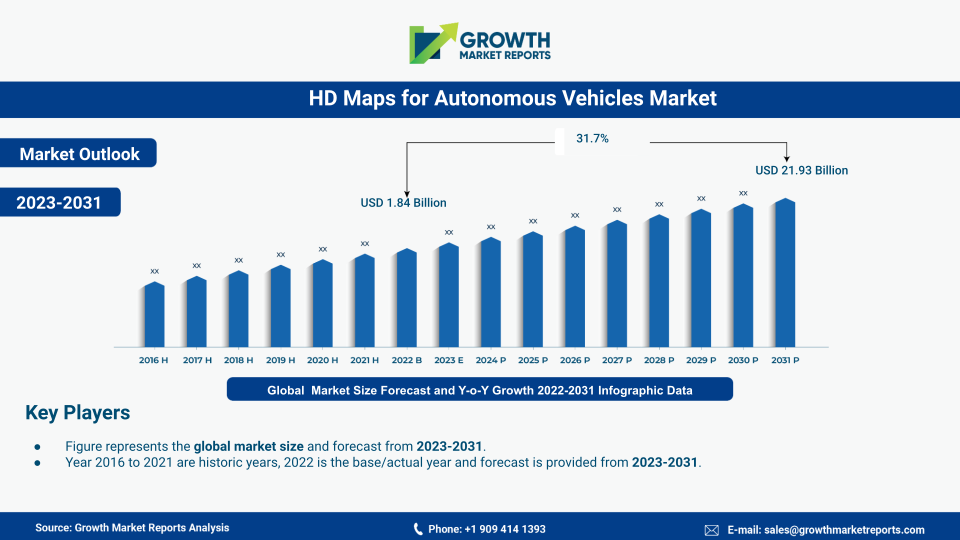
According to our latest research, the global market size for HD Maps for Autonomous Vehicles reached USD 3.1 billion in 2024, reflecting robust momentum in the adoption of advanced mapping technologies across the mobility sector. The market is demonstrating a strong growth trajectory, with a compound annual growth rate (CAGR) of 28.5% projected between 2025 and 2033. By 2033, the HD Maps for Autonomous Vehicles market size is forecasted to attain USD 24.7 billion, driven by the increasing deployment of autonomous and semi-autonomous vehicles, advancements in sensor technologies, and a rising emphasis on road safety and precision navigation.
One of the most significant growth factors propelling the HD Maps for Autonomous Vehicles market is the escalating integration of autonomous driving systems by automotive OEMs and mobility providers. As the automotive industry transitions from traditional vehicles to those enabled with advanced driver-assistance systems (ADAS) and full autonomy, the need for highly accurate, real-time, and continuously updated HD maps has become paramount. These maps provide centimeter-level precision, which is critical for lane-level navigation, object localization, and safe maneuvering in complex urban environments. Additionally, the proliferation of connected vehicle infrastructure and the rollout of 5G networks are further accelerating the demand for dynamic mapping solutions capable of supporting real-time data exchange and rapid updates.
Another crucial driver for market growth is the technological advancements in artificial intelligence, machine learning, and sensor fusion. The integration of these technologies enables HD maps to incorporate multi-source data from LiDAR, radar, cameras, and GPS, thereby enhancing the richness and accuracy of mapping content. Continuous innovations in data processing and cloud-based map management are making it feasible to scale HD map coverage across vast geographies while maintaining high levels of accuracy and reliability. Moreover, the emergence of crowdsourcing and vehicle-to-everything (V2X) communication is enabling more frequent and efficient map updates, ensuring that autonomous vehicles are always equipped with the latest environmental information.
The growing emphasis on regulatory compliance and safety standards is also fueling the adoption of HD maps in the autonomous vehicle ecosystem. Governments and regulatory bodies worldwide are mandating stricter safety requirements for self-driving vehicles, including the use of high-definition maps for enhanced situational awareness and compliance with local traffic rules. This regulatory push is compelling automakers and technology providers to invest heavily in HD map development and maintenance, thereby creating new growth opportunities for solution vendors. Furthermore, strategic collaborations among automotive OEMs, map providers, and tech companies are fostering innovation and accelerating the commercialization of autonomous driving technologies.
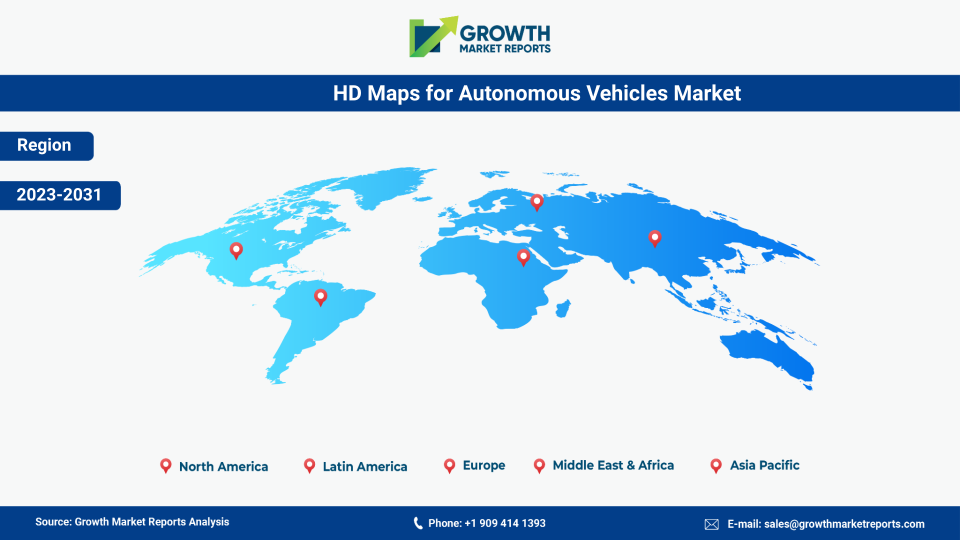
From a regional perspective, North America currently leads the HD Maps for Autonomous Vehicles market, accounting for the largest share due to the early adoption of autonomous driving technologies, a well-established automotive industry, and significant investments in smart infrastructure. Europe follows closely, driven by stringent regulatory frameworks and a strong focus on road safety and environmental sustainability. The Asia Pacific region is emerging as a high-growth market, supported by rapid urbanization, government initiatives for smart mobility, and the presence of leading automotive manufacturers in countries such as China, Japan, and South Korea. These regional dynamics underscore the global nature of the market and highlight the diverse opportunities and challenges faced by industry stakeholders.
The solution segment of the HD Maps for Autonomous Vehicles market encompasses mapping, localization, update & maintenance, and other specialized services, each playing a pivotal role in enabling autonomous navigation. Mapping solutions form the foundational layer, providing high-resolution, three-dimensional representations of road networks, traffic signs, lane markings, and environmental features. These maps are built using data collected from a variety of sensors, including LiDAR, cameras, and radar, and are processed using advanced algorithms to ensure centimeter-level precision. The growing complexity of urban environments and the need for detailed map content have driven significant investments in mapping technologies, with solution providers focusing on expanding coverage and enhancing the richness of map attributes.
Localization solutions are critical for enabling autonomous vehicles to determine their precise position within the mapped environment. Unlike traditional GPS-based navigation, which can be prone to errors in dense urban areas or under challenging weather conditions, HD map-based localization leverages a combination of sensor data and map features to achieve high accuracy. This capability is essential for lane-level positioning, obstacle avoidance, and safe navigation through intersections and complex road segments. The integration of AI and sensor fusion technologies has further improved the reliability and robustness of localization solutions, making them indispensable for Level 3 and above autonomous driving systems.
Update & maintenance solutions address the dynamic nature of road environments, where changes such as construction, new traffic signs, or temporary obstacles can significantly impact vehicle safety and performance. These solutions enable real-time or near-real-time updates to HD maps, ensuring that autonomous vehicles always have access to the most current information. Crowdsourced data from connected vehicles, V2X communication, and cloud-based map management platforms are increasingly being used to streamline the update process and reduce latency. The ability to rapidly detect and incorporate environmental changes is a key differentiator for HD map providers, as it directly impacts the reliability and safety of autonomous driving systems.
Other specialized solutions within this segment include map validation, quality assurance, and integration services, which are essential for ensuring the accuracy, consistency, and interoperability of HD maps across different vehicle platforms and geographic regions. As the market matures, solution providers are increasingly focusing on offering end-to-end mapping services that encompass data collection, processing, validation, and ongoing maintenance. This holistic approach not only enhances the value proposition for automotive OEMs and mobility providers but also enables seamless integration with other vehicle systems, such as ADAS and infotainment.
Overall, the solution segment is characterized by rapid innovation, intense competition, and a strong emphasis on scalability and reliability. Leading vendors are leveraging cloud computing, edge processing, and AI-driven analytics to deliver highly differentiated mapping solutions that meet the evolving needs of the autonomous vehicle ecosystem. The continued evolution of this segment will be instrumental in shaping the future of autonomous mobility and ensuring the safe and efficient operation of self-driving vehicles.
| Attributes | Details |
| Report Title | HD Maps for Autonomous Vehicles Market Research Report 2033 |
| By Solution | Mapping, Localization, Update & Maintenance, Others |
| By Level Of Automation | Level 2, Level 3, Level 4, Level 5 |
| By Application | Passenger Vehicles, Commercial Vehicles, Others |
| By End-User | Automotive OEMs, Tier 1 Suppliers, Mobility as a Service Providers, Others |
| Regions Covered | North America, Europe, APAC, Latin America, MEA |
| Countries Covered | North America (United States, Canada), Europe (Germany, France, Italy, United Kingdom, Spain, Russia, Rest of Europe), Asia Pacific (China, Japan, South Korea, India, Australia, South East Asia (SEA), Rest of Asia Pacific), Latin America (Mexico, Brazil, Rest of Latin America), Middle East & Africa (Saudi Arabia, South Africa, United Arab Emirates, Rest of Middle East & Africa) |
| Base Year | 2024 |
| Historic Data | 2018-2023 |
| Forecast Period | 2025-2033 |
| Number of Pages | 263 |
| Number of Tables & Figures | 296 |
| Customization Available | Yes, the report can be customized as per your need. |
The level of automation segment in the HD Maps for Autonomous Vehicles market is categorized into Level 2, Level 3, Level 4, and Level 5 automation, each representing a distinct stage in the evolution toward full autonomy. Level 2 automation encompasses vehicles equipped with partial automation features, such as adaptive cruise control and lane-keeping assistance, where the driver remains responsible for monitoring the environment. While the demand for HD maps at this level is relatively moderate, the growing adoption of advanced driver-assistance systems is prompting OEMs to incorporate basic HD mapping capabilities to enhance safety and navigation accuracy.
Level 3 automation marks a significant step forward, enabling conditional automation where the vehicle can handle certain driving tasks under specific conditions, with the driver required to intervene when prompted. At this level, the reliance on HD maps increases substantially, as vehicles must be able to interpret complex road scenarios, make real-time decisions, and navigate safely without continuous human oversight. The integration of high-precision mapping and localization solutions is therefore essential for supporting Level 3 autonomous driving, particularly in urban and highway environments with dense traffic and frequent changes.
Level 4 automation represents a higher degree of autonomy, where vehicles are capable of fully autonomous operation within predefined geofenced areas or specific use cases, such as urban mobility services or dedicated shuttle routes. HD maps play a critical role in enabling safe and efficient operation at this level, providing detailed information on road geometry, traffic rules, and dynamic obstacles. The ability to continuously update and maintain map data is particularly important for Level 4 vehicles, as they must be able to adapt to changes in the environment without human intervention. This has led to increased collaboration between automakers, map providers, and technology companies to develop robust mapping ecosystems that can support large-scale deployment of Level 4 autonomous vehicles.
Level 5 automation represents the pinnacle of autonomous driving, where vehicles are capable of operating without any human input under all conditions. The requirements for HD maps at this level are exceptionally stringent, as vehicles must be able to navigate any environment, including unstructured or unpredictable scenarios. This necessitates the use of ultra-high-resolution maps, real-time updates, and advanced AI-driven analytics to ensure maximum safety and reliability. While Level 5 automation is still in the experimental or pilot phase, ongoing advancements in mapping technologies and data processing are laying the groundwork for future commercialization.
The segmentation by level of automation highlights the varying requirements and challenges associated with each stage of autonomous vehicle development. As the industry progresses toward higher levels of autonomy, the demand for sophisticated HD mapping solutions is expected to surge, creating significant opportunities for solution providers and technology innovators. The evolution of this segment will be closely linked to advancements in sensor technology, AI, and regulatory frameworks, all of which will shape the future trajectory of the HD Maps for Autonomous Vehicles market.
The application segment of the HD Maps for Autonomous Vehicles market is broadly divided into passenger vehicles, commercial vehicles, and other specialized applications. Passenger vehicles represent the largest and fastest-growing segment, driven by the increasing adoption of advanced driver-assistance systems and the gradual introduction of autonomous features in consumer vehicles. Automotive OEMs are investing heavily in HD mapping technologies to enhance safety, improve navigation accuracy, and deliver superior driving experiences. The integration of HD maps with in-vehicle infotainment and navigation systems is also gaining traction, enabling personalized and context-aware services for end-users.
Commercial vehicles, including trucks, buses, and delivery vans, constitute a significant and rapidly expanding application area for HD maps. The logistics and transportation industry is increasingly leveraging autonomous and semi-autonomous vehicles to optimize fleet operations, reduce operational costs, and enhance safety. HD maps are essential for enabling precise route planning, real-time traffic management, and efficient navigation in complex urban and highway environments. The ability to support large-scale fleet deployments and ensure reliable operation under diverse conditions is a key differentiator for HD map providers targeting the commercial vehicle segment.
Other specialized applications of HD maps include mobility as a service (MaaS) platforms, ride-hailing services, and autonomous shuttles operating in controlled environments such as airports, campuses, or industrial sites. These use cases require tailored mapping solutions that can accommodate specific operational requirements, such as geofencing, dynamic routing, and integration with external data sources. The growing popularity of MaaS and shared mobility services is creating new opportunities for map providers to develop customized solutions that cater to the unique needs of different user groups and operational scenarios.
The application segment is characterized by diverse requirements and use cases, each demanding specific mapping features, update frequencies, and integration capabilities. Solution providers are increasingly adopting modular and scalable approaches to address the unique challenges associated with different vehicle types and operational environments. This includes offering flexible licensing models, cloud-based map management platforms, and API-driven integration frameworks that enable seamless deployment and interoperability across a wide range of applications.
As the adoption of autonomous driving technologies continues to accelerate across both passenger and commercial vehicle segments, the demand for high-quality, reliable, and up-to-date HD maps is expected to grow exponentially. The ability to deliver tailored mapping solutions that meet the evolving needs of diverse applications will be a key success factor for market participants, driving innovation and competition in the HD Maps for Autonomous Vehicles market.
The end-user segment of the HD Maps for Autonomous Vehicles market is segmented into automotive OEMs, Tier 1 suppliers, mobility as a service (MaaS) providers, and others, each representing a distinct set of requirements and value propositions. Automotive OEMs are the primary consumers of HD mapping solutions, as they seek to differentiate their vehicles through advanced autonomous driving capabilities and enhanced safety features. OEMs are forging strategic partnerships with map providers and technology companies to integrate high-precision mapping and localization solutions into their vehicle platforms, enabling seamless operation across diverse geographies and driving conditions.
Tier 1 suppliers, which include major automotive component manufacturers, play a critical role in the development and integration of HD mapping technologies. These suppliers are responsible for delivering key hardware and software components, such as sensors, ECUs, and middleware, that enable the collection, processing, and utilization of HD map data. Collaboration between Tier 1 suppliers and map providers is essential for ensuring compatibility, interoperability, and scalability of mapping solutions across different vehicle models and architectures. The growing complexity of autonomous driving systems is driving increased collaboration and innovation within this segment.
Mobility as a Service (MaaS) providers represent a rapidly growing end-user segment, as they leverage autonomous vehicles to deliver on-demand transportation services in urban and suburban environments. MaaS providers require highly dynamic and customizable mapping solutions that can support real-time routing, geofencing, and integration with external data sources such as traffic management systems and public transit networks. The ability to deliver seamless, safe, and efficient mobility experiences is a key differentiator for MaaS providers, making HD maps an essential component of their technology stack.
Other end-users of HD mapping solutions include government agencies, research institutions, and technology companies engaged in the development and testing of autonomous driving technologies. These stakeholders require access to high-quality map data for purposes such as infrastructure planning, regulatory compliance, and performance validation. The growing involvement of public and private sector entities in the autonomous vehicle ecosystem is creating new opportunities for map providers to expand their customer base and diversify their revenue streams.
The end-user segment is characterized by a diverse range of requirements, operational models, and value drivers. Solution providers must therefore adopt flexible and customer-centric approaches to address the unique needs of different end-user groups. This includes offering tailored mapping solutions, customizable licensing models, and dedicated support services to ensure successful deployment and ongoing operation. The ability to build strong partnerships and deliver differentiated value will be critical for success in the increasingly competitive HD Maps for Autonomous Vehicles market.
The HD Maps for Autonomous Vehicles market presents significant opportunities for growth and innovation, driven by the rapid evolution of autonomous driving technologies and the increasing demand for high-precision mapping solutions. One of the most promising opportunities lies in the integration of artificial intelligence and machine learning algorithms to enhance map accuracy, automate data processing, and enable real-time updates. The use of crowdsourced data from connected vehicles and V2X communication is enabling more frequent and efficient map updates, reducing latency and improving the reliability of autonomous driving systems. Additionally, the expansion of smart city initiatives and the deployment of intelligent transportation infrastructure are creating new opportunities for map providers to collaborate with public and private sector stakeholders and deliver value-added services.
Another major opportunity is the growing adoption of mobility as a service (MaaS) platforms and shared mobility solutions, which require dynamic and customizable mapping capabilities to support real-time routing, geofencing, and integration with external data sources. The emergence of new business models, such as map-as-a-service and subscription-based licensing, is enabling solution providers to tap into recurring revenue streams and expand their customer base. Furthermore, the increasing focus on safety, regulatory compliance, and environmental sustainability is driving demand for HD maps that support advanced driver-assistance systems and enable more efficient, eco-friendly transportation solutions.
Despite these opportunities, the market faces several challenges and restrainers that could impact growth and adoption. One of the primary restrainers is the high cost and complexity of developing, maintaining, and updating HD maps, particularly for large-scale, global deployments. The need for continuous data collection, processing, and validation requires significant investments in infrastructure, technology, and skilled personnel. Additionally, concerns related to data privacy, cybersecurity, and regulatory compliance pose challenges for solution providers, particularly in regions with stringent data protection laws. Addressing these challenges will require ongoing innovation, collaboration, and investment to ensure the long-term success and sustainability of the HD Maps for Autonomous Vehicles market.
The regional landscape of the HD Maps for Autonomous Vehicles market is characterized by significant variation in adoption rates, regulatory frameworks, and investment levels across different geographies. North America currently dominates the market, accounting for approximately 44% of global revenues, or around USD 1.36 billion in 2024. The region’s leadership is underpinned by early adoption of autonomous driving technologies, strong government support for smart infrastructure, and the presence of major automotive OEMs and technology companies. The United States, in particular, is a key hub for innovation and commercialization, with several pilot projects and large-scale deployments underway in cities such as San Francisco, Detroit, and Phoenix.
Europe is the second-largest market, representing about 28% of global revenues, or USD 870 million in 2024. The region benefits from a robust regulatory framework that emphasizes road safety, environmental sustainability, and the development of intelligent transportation systems. Countries such as Germany, the United Kingdom, and France are at the forefront of autonomous vehicle adoption, supported by significant investments in research and development, public-private partnerships, and pilot programs. The European market is expected to grow at a CAGR of 27.9% through 2033, driven by ongoing advancements in mapping technologies and the increasing integration of autonomous driving solutions in passenger and commercial vehicles.
The Asia Pacific region is emerging as a high-growth market, accounting for approximately 22% of global revenues, or USD 680 million in 2024. Rapid urbanization, government initiatives for smart mobility, and the presence of leading automotive manufacturers in countries such as China, Japan, and South Korea are fueling demand for HD mapping solutions. China, in particular, is investing heavily in autonomous vehicle infrastructure and has launched several large-scale pilot projects in major cities. The region is expected to exhibit the highest CAGR during the forecast period, driven by increasing adoption of autonomous driving technologies and expanding investments in digital infrastructure. Latin America and the Middle East & Africa currently account for a smaller share of the market but are expected to witness steady growth as regulatory frameworks evolve and investments in smart mobility increase.
The HD Maps for Autonomous Vehicles market is highly competitive, characterized by the presence of established technology giants, specialized mapping companies, and innovative startups. The competitive landscape is defined by rapid technological advancements, strategic partnerships, and a strong emphasis on scalability, reliability, and differentiation. Leading players are investing heavily in research and development to enhance map accuracy, automate data processing, and enable real-time updates. The integration of artificial intelligence, machine learning, and cloud computing is enabling solution providers to deliver highly differentiated offerings that meet the evolving needs of automotive OEMs, Tier 1 suppliers, and mobility service providers.
Strategic collaborations and partnerships are a key feature of the market, with automotive OEMs, map providers, and technology companies joining forces to accelerate the development and commercialization of autonomous driving solutions. These partnerships enable stakeholders to leverage complementary strengths, share data and resources, and reduce time-to-market for new products and services. Mergers and acquisitions are also shaping the competitive landscape, as larger players seek to expand their capabilities, enter new markets, and gain access to proprietary mapping technologies and intellectual property.
Innovation is a critical success factor in the HD Maps for Autonomous Vehicles market, with companies continuously seeking to develop new features, improve map coverage, and enhance integration with vehicle systems. The ability to deliver end-to-end mapping solutions, from data collection and processing to validation and ongoing maintenance, is increasingly seen as a key differentiator. Solution providers are also focusing on developing modular and scalable platforms that can support a wide range of applications, vehicle types, and geographies, enabling them to address the diverse needs of their customers and capture new growth opportunities.
Major companies operating in the HD Maps for Autonomous Vehicles market include HERE Technologies, TomTom NV, Google (Waymo), NVIDIA Corporation, Baidu, Civil Maps, Dynamic Map Platform Co., Ltd., and NavInfo. HERE Technologies is recognized as a global leader in digital mapping and location services, offering comprehensive HD mapping solutions for automotive and mobility applications. TomTom NV is another prominent player, known for its advanced mapping technologies and strategic partnerships with leading automakers. Google’s Waymo division is at the forefront of autonomous vehicle development, leveraging proprietary mapping and AI technologies to enable safe and efficient navigation. NVIDIA is a key technology provider, offering AI-driven mapping and localization solutions that are widely adopted across the automotive industry.
The HD Maps for Autonomous Vehicles market has been segmented on the basis of
Key players in the global HD maps for autonomous vehicles market includeTomTom International BV, The Sanborn Map Company, Inc., NVIDIA Corporation, NavmiiNavInfo Co., Ltd, Momenta, HERE, DEEPMAP, and CE Info Systems Pvt. Ltd. These players are engaged in strategies such as product approvals, product launches,acquisitions, collaborations, and partnership.
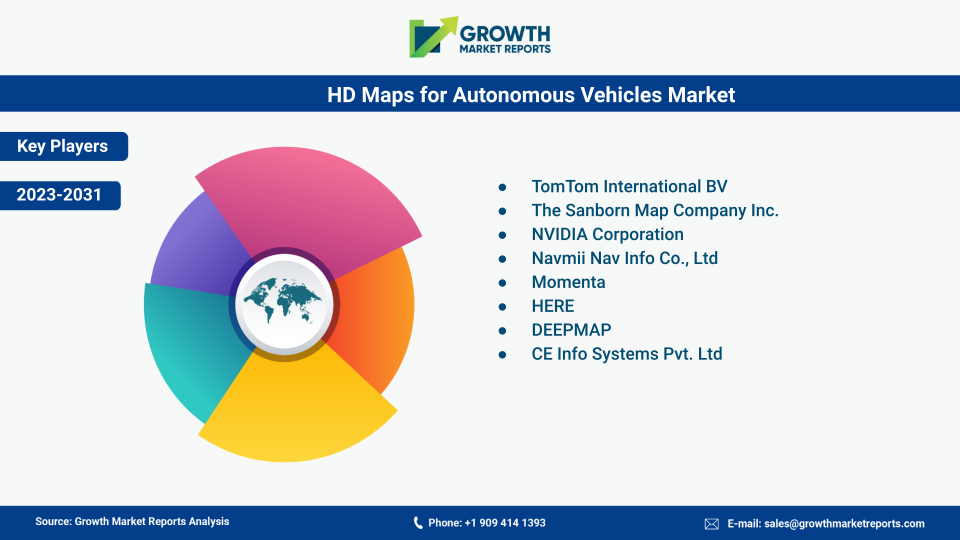
Major players include HERE Technologies, TomTom NV, Google (Waymo), NVIDIA Corporation, Baidu, Civil Maps, Dynamic Map Platform Co., Ltd., and NavInfo.
Opportunities include AI-driven map enhancements, crowdsourced data, and MaaS integration. Challenges involve high costs of map development and maintenance, data privacy, cybersecurity, and regulatory compliance.
Primary end-users include automotive OEMs, Tier 1 suppliers, Mobility as a Service (MaaS) providers, government agencies, and technology companies involved in autonomous vehicle development and deployment.
Higher levels of automation (Levels 3-5) require more advanced and frequently updated HD maps for safe and reliable operation, especially in complex or unpredictable environments.
The main solutions include mapping, localization, update & maintenance, and specialized services such as map validation and integration. These enable precise navigation, real-time updates, and interoperability across vehicle platforms.
North America currently leads the market, followed by Europe and the Asia Pacific region. North America benefits from early adoption and significant investments, while Asia Pacific is experiencing rapid growth due to urbanization and government initiatives.
HD maps provide centimeter-level precision for lane-level navigation, object localization, and safe maneuvering, enabling autonomous vehicles to interpret complex road scenarios and make real-time driving decisions.
Key growth drivers include the increasing adoption of autonomous and semi-autonomous vehicles, advancements in sensor and AI technologies, regulatory emphasis on road safety, and the expansion of connected vehicle infrastructure and 5G networks.
The HD Maps for Autonomous Vehicles market is projected to grow at a compound annual growth rate (CAGR) of 28.5% from 2025 to 2033, reaching USD 24.7 billion by 2033.
As of 2024, the global market size for HD Maps for Autonomous Vehicles is estimated at USD 3.1 billion, with strong growth expected in the coming years.