Soybean Seed Treatment Market Research Report 2033

Soybean Seed Treatment Market Research Report 2033

Segments - by Product Type (Chemical Seed Treatment, Biological Seed Treatment, Physical Seed Treatment), by Application (Insecticides, Fungicides, Bio-control, Others), by Formulation (Liquid, Powder, Granular), by Function (Seed Protection, Seed Enhancement), by Crop Type (Genetically Modified, Conventional)

https://growthmarketreports.com/Raksha
Author : Raksha Sharma
https://growthmarketreports.com/Vaibhav
Fact-checked by : V. Chandola
https://growthmarketreports.com/Shruti
Editor : Shruti Bhat

Upcoming | Report ID :MC-4042 | 4.7 Rating | 47 Reviews | 283 Pages | Format : Docx PDF

Report Description


Soybean Seed Treatment Market Outlook

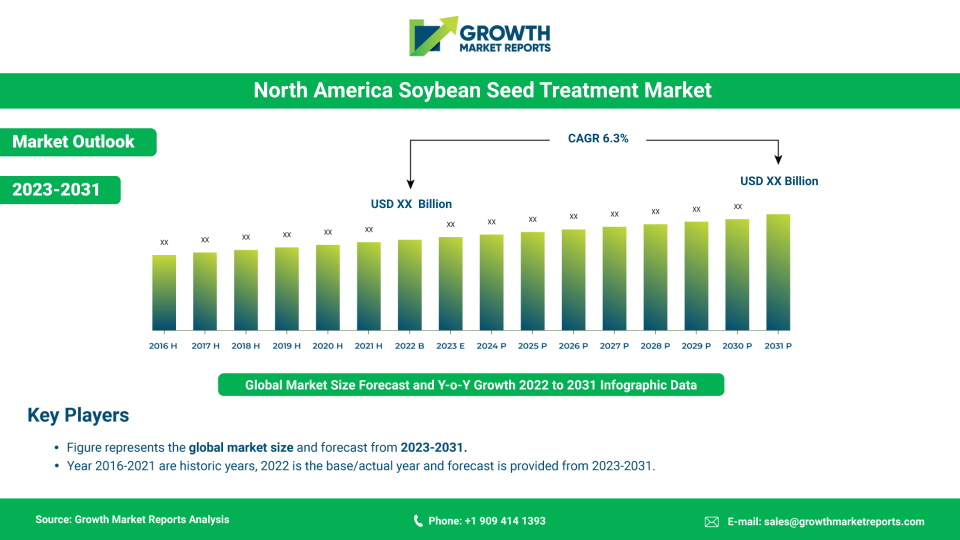
According to our latest research, the global soybean seed treatment market size in 2024 stands at USD 2.83 billion, with a robust compound annual growth rate (CAGR) of 8.2% projected over the forecast period. By 2033, the market is expected to reach approximately USD 5.56 billion, reflecting the increasing adoption of advanced seed treatment solutions. The primary growth factor driving this market is the rising demand for high-yielding and disease-resistant soybean crops, which is fueling the adoption of innovative seed treatment products across major agricultural economies.

The growth of the soybean seed treatment market is strongly influenced by the intensification of global agriculture and the need to optimize crop yields. Farmers are increasingly recognizing the benefits of seed treatment technologies, such as improved germination rates, enhanced resistance to pests and diseases, and reduced need for post-emergence chemical applications. This shift is particularly evident in countries with large-scale commercial soybean cultivation, where maximizing productivity and minimizing input costs are top priorities. As a result, there has been a surge in demand for both chemical and biological seed treatment products, as they offer a cost-effective and environmentally sustainable solution for protecting soybean seeds during the critical early stages of growth.

Another significant factor contributing to the expansion of the soybean seed treatment market is the growing prevalence of seed-borne and soil-borne diseases. With changes in climate patterns and increased incidence of pest infestations, farmers are seeking advanced seed treatment solutions that offer broad-spectrum protection. The development of multi-functional seed treatment formulations, which combine fungicides, insecticides, and bio-control agents, is gaining traction. These products not only safeguard seeds against multiple threats but also promote healthy seedling establishment, leading to higher yields and better crop quality. Moreover, regulatory support for sustainable agriculture and the reduction of pesticide residues in food products are further propelling the adoption of seed treatment technologies.

Technological advancements in seed treatment formulations and application techniques are also playing a pivotal role in market growth. Innovations such as polymer-based coatings, nano-formulations, and precision application equipment are enabling more efficient and uniform treatment of soybean seeds. These advancements are enhancing the efficacy and longevity of seed protection, reducing environmental impact, and ensuring compliance with stringent regulatory standards. The increasing investment by leading agrochemical companies in research and development is expected to yield new and improved seed treatment products, further accelerating market expansion in the coming years.

Chemical Seed Treatment plays a crucial role in the soybean seed treatment market by providing a reliable and effective means of protecting seeds from a wide range of pathogens and pests. These treatments are essential for ensuring the health and viability of soybean seeds during the critical early stages of growth. By applying chemical agents such as fungicides and insecticides, farmers can safeguard their crops against diseases and insect infestations, which can significantly impact yield and quality. The use of chemical seed treatments is particularly beneficial in regions with high disease pressure, where traditional pest control methods may be less effective. As the demand for high-yielding and disease-resistant soybean crops continues to rise, the role of chemical seed treatments in enhancing crop productivity and sustainability becomes increasingly important.

Regionally, North America dominates the soybean seed treatment market, owing to its large-scale commercial soybean farming and high adoption of advanced agricultural technologies. However, Asia Pacific is emerging as a lucrative market, driven by rapid expansion of soybean cultivation in countries like China, India, and Indonesia. The region is witnessing increased awareness among farmers regarding the benefits of seed treatment, coupled with government initiatives to promote sustainable agriculture. Europe and Latin America are also significant contributors, with a growing preference for biological seed treatment solutions and stringent regulations favoring environmentally friendly products. The Middle East & Africa, though smaller in market size, is expected to register steady growth as agricultural modernization gains momentum.

Global Soybean Seed Treatment Industry Outlook

Product Type Analysis

The soybean seed treatment market is segmented by product type into chemical seed treatment, biological seed treatment, and physical seed treatment. Chemical seed treatment remains the most widely adopted segment, accounting for a substantial share of the global market. This dominance is attributed to the proven efficacy of chemical agents in controlling a broad spectrum of seed-borne and soil-borne pathogens, as well as their ability to deliver consistent results under varying agronomic conditions. Chemical seed treatments typically include fungicides, insecticides, and nematicides, which collectively provide comprehensive protection during the vulnerable germination and early growth stages.

Biological seed treatment is rapidly gaining traction as an environmentally sustainable alternative to conventional chemical treatments. This segment encompasses products based on beneficial microorganisms, such as bacteria and fungi, which enhance plant health by promoting nutrient uptake, stimulating growth, and suppressing disease-causing organisms. The increasing regulatory scrutiny of chemical pesticides and rising consumer preference for organic and residue-free crops are major factors driving the adoption of biological seed treatments. Additionally, ongoing research and development efforts are resulting in more robust and commercially viable biological solutions, further expanding their market presence.

In the context of soybean cultivation, Chemical Seed Treatment remains a preferred choice for many farmers due to its proven efficacy in managing seed-borne and soil-borne diseases. These treatments are designed to provide comprehensive protection during the vulnerable germination and early growth stages, ensuring that soybean plants have the best possible start. By incorporating a range of active ingredients, such as fungicides and insecticides, chemical seed treatments offer a robust defense against a variety of threats, including fungal pathogens and insect pests. This approach not only helps to maximize yield potential but also reduces the need for additional chemical applications later in the growing season. As agricultural practices continue to evolve, the integration of chemical seed treatments into broader pest management strategies is likely to play a pivotal role in achieving sustainable crop production.

Physical seed treatment, though a smaller segment, is witnessing steady growth due to its non-chemical approach to seed protection. Techniques such as hot water treatment, irradiation, and mechanical scarification are employed to eliminate pathogens and improve seed vigor without the use of synthetic chemicals. These methods are particularly appealing in regions with strict regulations on pesticide use and in organic farming systems. While physical treatments may not offer the same spectrum of protection as chemical or biological products, they are valued for their safety and compatibility with integrated pest management (IPM) practices.

The competitive landscape within the product type segment is characterized by continuous innovation and strategic partnerships. Leading agrochemical companies are investing heavily in the development of next-generation seed treatment products that combine the strengths of chemical, biological, and physical approaches. This trend is expected to yield synergistic solutions that deliver enhanced efficacy, reduced environmental impact, and improved crop performance. Furthermore, collaborations with research institutions and agricultural extension services are facilitating the transfer of advanced seed treatment technologies to farmers, thereby accelerating market adoption.

Report Scope

Attributes Details
Report Title Soybean Seed Treatment Market Research Report 2033
By Product Type Chemical Seed Treatment, Biological Seed Treatment, Physical Seed Treatment
By Application Insecticides, Fungicides, Bio-control, Others
By Formulation Liquid, Powder, Granular
By Function Seed Protection, Seed Enhancement
By Crop Type Genetically Modified, Conventional
Regions Covered North America, Europe, APAC, Latin America, MEA
Base Year 2024
Historic Data 2018-2023
Forecast Period 2025-2033
Number of Pages 283
Number of Tables & Figures 369
Customization Available Yes, the report can be customized as per your need.

Application Analysis

The application segment of the soybean seed treatment market is categorized into insecticides, fungicides, bio-control, and others. Fungicides represent the largest application area, as fungal diseases pose a significant threat to soybean seed viability and early seedling development. Common pathogens such as Phytophthora, Fusarium, and Rhizoctonia can cause substantial yield losses if not effectively managed. Seed-applied fungicides provide targeted protection against these threats, minimizing the need for foliar sprays and reducing the risk of resistance development. The widespread use of fungicidal seed treatments is a key driver of market growth, especially in regions prone to high disease pressure.

Biological Seed Treatment is gaining momentum as a sustainable alternative to traditional chemical methods in the soybean seed treatment market. These treatments utilize beneficial microorganisms, such as bacteria and fungi, to enhance plant health and resilience. By promoting nutrient uptake and stimulating natural defense mechanisms, biological seed treatments help soybean plants to thrive in challenging growing conditions. This approach aligns with the increasing consumer demand for organic and residue-free crops, as well as the regulatory push towards reducing chemical pesticide use. As research and development efforts continue to yield more robust and commercially viable biological solutions, the adoption of these treatments is expected to grow. The integration of biological seed treatments into integrated pest management systems offers a promising pathway for achieving both high productivity and environmental sustainability in soybean cultivation.

Insecticidal seed treatments are also gaining importance, particularly in areas where early-season insect pests such as wireworms, seedcorn maggots, and bean leaf beetles are prevalent. These treatments offer a proactive approach to pest management, safeguarding seeds and seedlings from damage during the critical establishment phase. The use of systemic insecticides in seed treatment formulations ensures that the active ingredients are taken up by the plant, providing extended protection as the crop develops. This not only enhances crop vigor but also reduces the reliance on broad-spectrum foliar insecticides, contributing to more sustainable pest management practices.

Bio-control applications are expanding rapidly, reflecting the growing demand for environmentally friendly and residue-free crop protection solutions. Bio-control agents, including beneficial bacteria, fungi, and natural plant extracts, are applied to seeds to suppress harmful pathogens and promote plant health. These products are particularly well-suited for use in organic and integrated pest management systems, as they offer a low-risk alternative to synthetic chemicals. The increasing availability of bio-control seed treatments, coupled with supportive regulatory frameworks and farmer education initiatives, is expected to drive significant growth in this segment over the forecast period.

The "others" category encompasses a range of seed treatment applications, including nematicides, micronutrient coatings, and plant growth regulators. These products address specific agronomic challenges, such as nematode infestations, nutrient deficiencies, and suboptimal germination rates. The development of customized seed treatment solutions tailored to local conditions and crop requirements is emerging as a key trend in the market. Companies are leveraging advanced formulation technologies to deliver multi-functional seed treatments that combine disease, pest, and abiotic stress protection with growth enhancement, thereby maximizing the value proposition for farmers.

Formulation Analysis

Within the soybean seed treatment market, formulations are segmented into liquid, powder, and granular forms. Liquid formulations dominate the market due to their ease of application, superior coverage, and compatibility with modern seed treatment equipment. Liquid seed treatments ensure uniform coating of each seed, resulting in consistent protection and improved germination rates. This segment has benefited from technological advancements in formulation chemistry, which have led to the development of stable, easy-to-handle, and low-dust products. Additionally, liquid formulations are often preferred for their ability to combine multiple active ingredients, such as fungicides, insecticides, and micronutrients, into a single application.

Powder formulations, while less prevalent than liquids, continue to hold a significant share of the market, particularly in regions with limited access to advanced application technologies. Powdered seed treatments are valued for their cost-effectiveness, long shelf life, and suitability for small-scale and resource-constrained farmers. These products are typically applied using manual or semi-automated methods, making them accessible to a wide range of growers. However, challenges related to dust generation, uneven coverage, and compatibility with certain seed types have limited the growth of this segment in highly mechanized agricultural systems.

Granular formulations represent a niche but growing segment within the soybean seed treatment market. Granules offer distinct advantages in terms of ease of handling, reduced dust, and controlled release of active ingredients. They are particularly well-suited for use in automated seed treatment facilities and bulk seed processing operations. The development of innovative granular products that incorporate both chemical and biological agents is expected to drive further adoption, especially in regions with large-scale commercial soybean production. Granular formulations also align well with the trend toward precision agriculture, as they enable accurate dosing and targeted delivery of seed treatment agents.

The competitive dynamics within the formulation segment are shaped by ongoing innovation and the need to address evolving farmer preferences and regulatory requirements. Companies are investing in the development of new formulation technologies that enhance the stability, efficacy, and safety of seed treatment products. Emphasis is being placed on reducing dust emissions, improving seed flowability, and ensuring compatibility with a wide range of seed types and planting equipment. As the market continues to evolve, the ability to offer flexible and user-friendly formulation options will be a key differentiator for leading seed treatment providers.

Function Analysis

The function segment of the soybean seed treatment market is divided into seed protection and seed enhancement. Seed protection remains the primary function, as it addresses the critical need to defend seeds against a multitude of biotic stresses, including fungi, insects, and nematodes. Effective seed protection ensures that seeds remain viable and healthy during storage, handling, and the initial stages of germination. The widespread adoption of seed protection products is driven by the increasing prevalence of seed-borne diseases and the growing emphasis on crop security in the face of climate change and evolving pest pressures.

Seed enhancement is an emerging function that is gaining prominence as farmers seek to optimize crop performance beyond basic protection. Seed enhancement products include biostimulants, micronutrients, and growth regulators that improve seed vigor, accelerate germination, and promote robust early plant development. These products are particularly valuable in challenging growing conditions, such as drought-prone or nutrient-deficient soils, where maximizing seedling establishment is critical to achieving high yields. The integration of seed enhancement technologies into seed treatment programs is expected to drive significant market growth, as they offer tangible benefits in terms of crop productivity and resilience.

The convergence of seed protection and seed enhancement functionalities is a notable trend in the market, with companies developing multi-functional seed treatment products that deliver comprehensive benefits. These products combine disease and pest control with growth promotion, resulting in healthier plants and higher yields. The ability to deliver multiple benefits through a single seed treatment application is highly attractive to farmers, as it simplifies crop management and reduces input costs. This trend is expected to drive increased adoption of advanced seed treatment solutions, particularly in regions with high-value soybean production.

The function segment is also influenced by regulatory and sustainability considerations. Governments and industry bodies are encouraging the use of seed treatments that minimize environmental impact and support integrated pest management practices. This has led to the development of seed treatment products with improved safety profiles, reduced toxicity, and enhanced compatibility with biological control agents. As the market continues to evolve, the ability to deliver both protection and enhancement through innovative seed treatment technologies will be a key driver of competitive advantage.

Crop Type Analysis

Soybean seed treatment market segmentation by crop type includes genetically modified (GM) and conventional soybeans. Genetically modified soybeans account for a significant share of the market, particularly in countries like the United States, Brazil, and Argentina, where GM crops are widely cultivated. The adoption of GM soybean varieties, which are engineered for traits such as herbicide tolerance and pest resistance, has created new opportunities for seed treatment products that complement these traits and provide additional protection against emerging threats. Seed treatments tailored for GM soybeans often incorporate advanced chemistries and biological agents to address specific agronomic challenges and regulatory requirements.

Conventional soybeans, while representing a smaller share of the global market, continue to be an important segment, especially in regions with restrictions on GM crop cultivation or strong demand for non-GM and organic products. Seed treatment products for conventional soybeans focus on providing broad-spectrum protection against diseases and pests, as well as enhancing seedling vigor and yield potential. The increasing consumer preference for non-GM and organic soybeans is driving the development of seed treatment solutions that meet stringent residue and safety standards, further supporting the growth of this segment.

The choice between GM and conventional seed treatments is influenced by a range of factors, including regulatory frameworks, market access, and consumer preferences. In markets where GM crops are widely accepted, the focus is on maximizing the performance and profitability of high-yielding varieties through advanced seed treatment technologies. In contrast, markets with restrictions on GM crops emphasize the development and adoption of seed treatments that are compatible with conventional and organic farming systems. This dynamic is shaping the competitive landscape and driving innovation in seed treatment product development.

The crop type segment is also characterized by regional variations in adoption patterns and market growth. For example, North America and South America are leading markets for GM soybean seed treatments, while Europe and parts of Asia Pacific exhibit a stronger preference for conventional and biological seed treatment solutions. Companies operating in the global soybean seed treatment market must therefore tailor their product offerings and marketing strategies to address the unique needs and preferences of each crop type segment.

Opportunities & Threats

The soybean seed treatment market presents significant opportunities for growth, driven by the increasing adoption of integrated pest management (IPM) practices and the shift toward sustainable agriculture. As farmers seek to reduce their reliance on chemical pesticides and minimize environmental impact, there is growing demand for seed treatment products that offer effective protection while supporting soil health and biodiversity. The development of bio-based and multi-functional seed treatment solutions represents a major opportunity for companies to differentiate themselves and capture market share. Additionally, the expanding adoption of precision agriculture technologies is creating new avenues for innovation in seed treatment application and monitoring, enabling more targeted and efficient use of seed treatment products.

Emerging markets, particularly in Asia Pacific and Latin America, offer substantial growth potential for the soybean seed treatment industry. Rapid expansion of soybean cultivation, coupled with increasing awareness of the benefits of seed treatment, is driving demand for advanced seed protection and enhancement solutions in these regions. Government initiatives to promote agricultural modernization, improve farmer education, and support sustainable crop production are further supporting market growth. Companies that invest in local partnerships, research and development, and tailored product offerings are well-positioned to capitalize on these opportunities and establish a strong presence in high-growth markets.

Despite the positive outlook, the soybean seed treatment market faces certain restrainers that could impact growth. Regulatory challenges, particularly regarding the use of certain chemical active ingredients, pose a significant threat to market expansion. Stringent regulations on pesticide residues, environmental impact, and worker safety are leading to the phase-out of some widely used seed treatment chemicals, necessitating the development of alternative solutions. Additionally, the high cost of advanced seed treatment products and limited access to modern application technologies in some regions may hinder adoption among smallholder and resource-constrained farmers. Addressing these challenges will require ongoing innovation, investment in farmer education, and collaboration with regulatory authorities to ensure the continued growth and sustainability of the market.

Regional Outlook

North America remains the largest regional market for soybean seed treatment, with a market size of approximately USD 1.13 billion in 2024. The region's dominance is underpinned by extensive commercial soybean cultivation, high levels of mechanization, and widespread adoption of advanced agricultural technologies. The United States, in particular, is a major contributor to market growth, driven by strong demand for high-yielding, disease-resistant soybean varieties and the presence of leading agrochemical companies. North America's market is expected to grow at a steady CAGR of 7.9% through 2033, supported by ongoing innovation and increasing emphasis on sustainable farming practices.

Asia Pacific is emerging as a high-growth region, with a market size of USD 0.74 billion in 2024 and a projected CAGR of 9.5% over the forecast period. Rapid expansion of soybean cultivation in countries such as China, India, and Indonesia is fueling demand for seed treatment products that enhance crop productivity and resilience. Government initiatives to promote sustainable agriculture, coupled with increasing awareness among farmers about the benefits of seed treatment, are driving market growth in the region. Asia Pacific is expected to contribute significantly to global market expansion, with a growing focus on the development and adoption of biological and environmentally friendly seed treatment solutions.

Europe and Latin America are also important markets for soybean seed treatment, with market sizes of USD 0.56 billion and USD 0.32 billion respectively in 2024. Europe is characterized by stringent regulations on pesticide use and a strong preference for sustainable and organic farming practices, driving demand for biological and non-chemical seed treatment products. Latin America, led by Brazil and Argentina, is witnessing increased adoption of advanced seed treatment technologies to support large-scale commercial soybean production. The Middle East & Africa, though smaller in market size at USD 0.08 billion, is expected to register steady growth as agricultural modernization and investment in crop protection solutions increase across the region.

Soybean Seed Treatment Market Statistics

Competitor Outlook

The competitive landscape of the soybean seed treatment market is characterized by the presence of several global and regional players, each striving to expand their market share through innovation, strategic partnerships, and geographic expansion. Leading companies are investing heavily in research and development to create next-generation seed treatment products that offer enhanced efficacy, safety, and environmental sustainability. The market is witnessing increased collaboration between agrochemical companies, seed producers, and research institutions to accelerate the development and commercialization of new seed treatment technologies. Additionally, mergers and acquisitions are being pursued as a means to strengthen product portfolios, expand distribution networks, and gain access to new markets.

Innovation remains a key differentiator in the soybean seed treatment market, with companies focusing on the development of multi-functional products that combine chemical, biological, and physical modes of action. The shift toward sustainable agriculture is driving demand for bio-based and low-toxicity seed treatment solutions, prompting companies to invest in the discovery and commercialization of novel biological agents and natural extracts. Advanced formulation technologies, such as microencapsulation and controlled-release systems, are being leveraged to enhance product performance and reduce environmental impact. Companies are also prioritizing farmer education and support services to facilitate the adoption of new seed treatment products and application techniques.

The market is highly competitive, with leading players vying for market leadership through product differentiation, quality assurance, and customer-centric strategies. Companies are expanding their presence in high-growth regions through local partnerships, distribution agreements, and targeted marketing campaigns. The ability to offer tailored seed treatment solutions that address specific agronomic challenges and regulatory requirements is emerging as a critical success factor. As the market continues to evolve, companies that can combine technological innovation with a deep understanding of local market dynamics will be best positioned to capture growth opportunities and maintain a competitive edge.

Major companies operating in the global soybean seed treatment market include BASF SE, Syngenta AG, Bayer CropScience AG, Corteva Agriscience, FMC Corporation, UPL Limited, Nufarm Limited, and Valent U.S.A. LLC. BASF SE is renowned for its comprehensive portfolio of chemical and biological seed treatment products, supported by strong research and development capabilities. Syngenta AG and Bayer CropScience AG are leaders in the development of innovative seed-applied technologies and integrated crop protection solutions. Corteva Agriscience has a strong presence in both GM and conventional seed treatment segments, with a focus on sustainable and farmer-friendly products. FMC Corporation and UPL Limited are expanding their market reach through strategic acquisitions and partnerships, while Nufarm Limited and Valent U.S.A. LLC are recognized for their commitment to sustainable agriculture and the development of bio-based seed treatment solutions.

These companies are constantly enhancing their product offerings by introducing novel active ingredients, improving formulation technologies, and expanding their distribution networks. They are also investing in digital agriculture platforms and precision application technologies to support farmers in optimizing seed treatment practices and maximizing crop performance. As competition intensifies, the focus on sustainability, innovation, and customer engagement will continue to shape the future of the soybean seed treatment market, driving the development of new solutions that meet the evolving needs of farmers and the broader agricultural industry.

Key Players

  • Bayer CropScience
  • Syngenta AG
  • BASF SE
  • Corteva Agriscience
  • UPL Limited
  • Sumitomo Chemical Co., Ltd.
  • FMC Corporation
  • Nufarm Limited
  • Germains Seed Technology
  • Incotec Group BV
  • Adama Agricultural Solutions Ltd.
  • Valent U.S.A. LLC
  • Arysta LifeScience
  • Croda International Plc
  • BrettYoung Seeds Limited
  • Precision Laboratories, LLC
  • Advanced Biological Marketing Inc.
  • Plant Health Care plc
  • Monsanto Company
  • DuPont Pioneer
Soybean Seed Treatment Market Overview

Segments

The Soybean Seed Treatment market has been segmented on the basis of

Product Type

  • Chemical Seed Treatment
  • Biological Seed Treatment
  • Physical Seed Treatment

Application

  • Insecticides
  • Fungicides
  • Bio-control
  • Others

Formulation

  • Liquid
  • Powder
  • Granular

Function

  • Seed Protection
  • Seed Enhancement

Crop Type

  • Genetically Modified
  • Conventional

Competitive Landscape

Key players competing in the North America soyabean seed treatment market include BASE SE.; Syngenta.; Bayers Cropscience.; UPL Limited.; Adama. Some of these players are adopting various strategies, such as partnerships, acquisitions, and product launches to gain a larger share in the market. The soyabean seed market is fairly consolidated, with the top players controlling majority of market share.
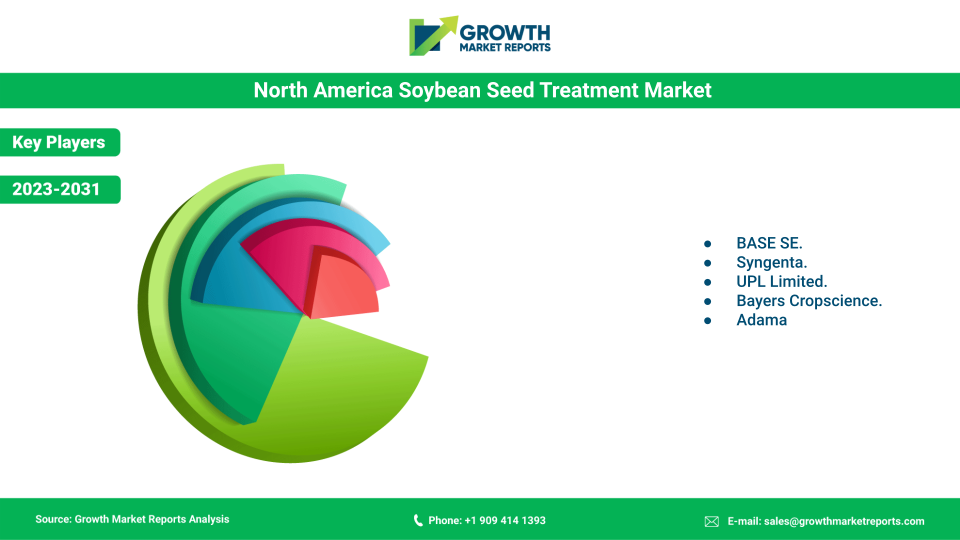

North America Soybean Seed Treatment Market Key Players

Frequently Asked Questions

Opportunities include the rise of sustainable and bio-based seed treatments, growth in emerging markets, and precision agriculture. Challenges involve regulatory restrictions on chemicals, high costs of advanced products, and limited technology access for smallholder farmers.

Key companies include BASF SE, Syngenta AG, Bayer CropScience AG, Corteva Agriscience, FMC Corporation, UPL Limited, Nufarm Limited, Valent U.S.A. LLC, and several others specializing in chemical, biological, and innovative seed treatment solutions.

Genetically modified soybeans account for a significant market share in regions like the US, Brazil, and Argentina, while conventional soybeans remain important in areas with GM restrictions or high demand for non-GM products. Both segments drive the need for tailored seed treatment solutions.

Seed protection focuses on defending seeds against pests, diseases, and environmental stresses, while seed enhancement involves products like biostimulants and micronutrients that improve seed vigor, germination, and early plant development.

Soybean seed treatments are available in liquid, powder, and granular formulations. Liquid formulations dominate due to ease of application and superior coverage, while powder and granular forms serve specific market needs.

Soybean seed treatments are primarily used as fungicides, insecticides, and bio-control agents. Fungicides are the largest application area, protecting seeds from fungal diseases, while insecticides and bio-control products address pest management and promote plant health.

The market is segmented into chemical seed treatment, biological seed treatment, and physical seed treatment. Chemical treatments remain the most widely adopted, but biological and physical treatments are gaining traction due to sustainability concerns.

North America dominates the market due to large-scale commercial soybean farming and advanced agricultural technologies, while Asia Pacific is emerging as a high-growth region driven by expanding soybean cultivation and government support for sustainable agriculture.

Key growth drivers include rising demand for high-yielding and disease-resistant soybean crops, increasing adoption of advanced seed treatment technologies, and the need to optimize crop yields and reduce input costs.

As of 2024, the global soybean seed treatment market is valued at USD 2.83 billion, with projections to reach approximately USD 5.56 billion by 2033.

Table Of Content

Chapter 1 Executive Summary
Chapter 2 Assumptions and Acronyms Used
Chapter 3 Research Methodology
Chapter 4 Soybean Seed Treatment Market Overview
   4.1 Introduction
      4.1.1 Market Taxonomy
      4.1.2 Market Definition
      4.1.3 Macro-Economic Factors Impacting the Market Growth
   4.2 Soybean Seed Treatment Market Dynamics
      4.2.1 Market Drivers
      4.2.2 Market Restraints
      4.2.3 Market Opportunity
   4.3 Soybean Seed Treatment Market - Supply Chain Analysis
      4.3.1 List of Key Suppliers
      4.3.2 List of Key Distributors
      4.3.3 List of Key Consumers
   4.4 Key Forces Shaping the Soybean Seed Treatment Market
      4.4.1 Bargaining Power of Suppliers
      4.4.2 Bargaining Power of Buyers
      4.4.3 Threat of Substitution
      4.4.4 Threat of New Entrants
      4.4.5 Competitive Rivalry
   4.5 Global Soybean Seed Treatment Market Size & Forecast, 2023-2032
      4.5.1 Soybean Seed Treatment Market Size and Y-o-Y Growth
      4.5.2 Soybean Seed Treatment Market Absolute $ Opportunity

Chapter 5 Global Soybean Seed Treatment Market Analysis and Forecast By Product Type
   5.1 Introduction
      5.1.1 Key Market Trends & Growth Opportunities By Product Type
      5.1.2 Basis Point Share (BPS) Analysis By Product Type
      5.1.3 Absolute $ Opportunity Assessment By Product Type
   5.2 Soybean Seed Treatment Market Size Forecast By Product Type
      5.2.1 Chemical Seed Treatment
      5.2.2 Biological Seed Treatment
      5.2.3 Physical Seed Treatment
   5.3 Market Attractiveness Analysis By Product Type

Chapter 6 Global Soybean Seed Treatment Market Analysis and Forecast By Application
   6.1 Introduction
      6.1.1 Key Market Trends & Growth Opportunities By Application
      6.1.2 Basis Point Share (BPS) Analysis By Application
      6.1.3 Absolute $ Opportunity Assessment By Application
   6.2 Soybean Seed Treatment Market Size Forecast By Application
      6.2.1 Insecticides
      6.2.2 Fungicides
      6.2.3 Bio-control
      6.2.4 Others
   6.3 Market Attractiveness Analysis By Application

Chapter 7 Global Soybean Seed Treatment Market Analysis and Forecast By Formulation
   7.1 Introduction
      7.1.1 Key Market Trends & Growth Opportunities By Formulation
      7.1.2 Basis Point Share (BPS) Analysis By Formulation
      7.1.3 Absolute $ Opportunity Assessment By Formulation
   7.2 Soybean Seed Treatment Market Size Forecast By Formulation
      7.2.1 Liquid
      7.2.2 Powder
      7.2.3 Granular
   7.3 Market Attractiveness Analysis By Formulation

Chapter 8 Global Soybean Seed Treatment Market Analysis and Forecast By Function
   8.1 Introduction
      8.1.1 Key Market Trends & Growth Opportunities By Function
      8.1.2 Basis Point Share (BPS) Analysis By Function
      8.1.3 Absolute $ Opportunity Assessment By Function
   8.2 Soybean Seed Treatment Market Size Forecast By Function
      8.2.1 Seed Protection
      8.2.2 Seed Enhancement
   8.3 Market Attractiveness Analysis By Function

Chapter 9 Global Soybean Seed Treatment Market Analysis and Forecast By Crop Type
   9.1 Introduction
      9.1.1 Key Market Trends & Growth Opportunities By Crop Type
      9.1.2 Basis Point Share (BPS) Analysis By Crop Type
      9.1.3 Absolute $ Opportunity Assessment By Crop Type
   9.2 Soybean Seed Treatment Market Size Forecast By Crop Type
      9.2.1 Genetically Modified
      9.2.2 Conventional
   9.3 Market Attractiveness Analysis By Crop Type

Chapter 10 Global Soybean Seed Treatment Market Analysis and Forecast by Region
   10.1 Introduction
      10.1.1 Key Market Trends & Growth Opportunities By Region
      10.1.2 Basis Point Share (BPS) Analysis By Region
      10.1.3 Absolute $ Opportunity Assessment By Region
   10.2 Soybean Seed Treatment Market Size Forecast By Region
      10.2.1 North America
      10.2.2 Europe
      10.2.3 Asia Pacific
      10.2.4 Latin America
      10.2.5 Middle East & Africa (MEA)
   10.3 Market Attractiveness Analysis By Region

Chapter 11 Coronavirus Disease (COVID-19) Impact 
   11.1 Introduction 
   11.2 Current & Future Impact Analysis 
   11.3 Economic Impact Analysis 
   11.4 Government Policies 
   11.5 Investment Scenario

Chapter 12 North America Soybean Seed Treatment Analysis and Forecast
   12.1 Introduction
   12.2 North America Soybean Seed Treatment Market Size Forecast by Country
      12.2.1 U.S.
      12.2.2 Canada
   12.3 Basis Point Share (BPS) Analysis by Country
   12.4 Absolute $ Opportunity Assessment by Country
   12.5 Market Attractiveness Analysis by Country
   12.6 North America Soybean Seed Treatment Market Size Forecast By Product Type
      12.6.1 Chemical Seed Treatment
      12.6.2 Biological Seed Treatment
      12.6.3 Physical Seed Treatment
   12.7 Basis Point Share (BPS) Analysis By Product Type 
   12.8 Absolute $ Opportunity Assessment By Product Type 
   12.9 Market Attractiveness Analysis By Product Type
   12.10 North America Soybean Seed Treatment Market Size Forecast By Application
      12.10.1 Insecticides
      12.10.2 Fungicides
      12.10.3 Bio-control
      12.10.4 Others
   12.11 Basis Point Share (BPS) Analysis By Application 
   12.12 Absolute $ Opportunity Assessment By Application 
   12.13 Market Attractiveness Analysis By Application
   12.14 North America Soybean Seed Treatment Market Size Forecast By Formulation
      12.14.1 Liquid
      12.14.2 Powder
      12.14.3 Granular
   12.15 Basis Point Share (BPS) Analysis By Formulation 
   12.16 Absolute $ Opportunity Assessment By Formulation 
   12.17 Market Attractiveness Analysis By Formulation
   12.18 North America Soybean Seed Treatment Market Size Forecast By Function
      12.18.1 Seed Protection
      12.18.2 Seed Enhancement
   12.19 Basis Point Share (BPS) Analysis By Function 
   12.20 Absolute $ Opportunity Assessment By Function 
   12.21 Market Attractiveness Analysis By Function
   12.22 North America Soybean Seed Treatment Market Size Forecast By Crop Type
      12.22.1 Genetically Modified
      12.22.2 Conventional
   12.23 Basis Point Share (BPS) Analysis By Crop Type 
   12.24 Absolute $ Opportunity Assessment By Crop Type 
   12.25 Market Attractiveness Analysis By Crop Type

Chapter 13 Europe Soybean Seed Treatment Analysis and Forecast
   13.1 Introduction
   13.2 Europe Soybean Seed Treatment Market Size Forecast by Country
      13.2.1 Germany
      13.2.2 France
      13.2.3 Italy
      13.2.4 U.K.
      13.2.5 Spain
      13.2.6 Russia
      13.2.7 Rest of Europe
   13.3 Basis Point Share (BPS) Analysis by Country
   13.4 Absolute $ Opportunity Assessment by Country
   13.5 Market Attractiveness Analysis by Country
   13.6 Europe Soybean Seed Treatment Market Size Forecast By Product Type
      13.6.1 Chemical Seed Treatment
      13.6.2 Biological Seed Treatment
      13.6.3 Physical Seed Treatment
   13.7 Basis Point Share (BPS) Analysis By Product Type 
   13.8 Absolute $ Opportunity Assessment By Product Type 
   13.9 Market Attractiveness Analysis By Product Type
   13.10 Europe Soybean Seed Treatment Market Size Forecast By Application
      13.10.1 Insecticides
      13.10.2 Fungicides
      13.10.3 Bio-control
      13.10.4 Others
   13.11 Basis Point Share (BPS) Analysis By Application 
   13.12 Absolute $ Opportunity Assessment By Application 
   13.13 Market Attractiveness Analysis By Application
   13.14 Europe Soybean Seed Treatment Market Size Forecast By Formulation
      13.14.1 Liquid
      13.14.2 Powder
      13.14.3 Granular
   13.15 Basis Point Share (BPS) Analysis By Formulation 
   13.16 Absolute $ Opportunity Assessment By Formulation 
   13.17 Market Attractiveness Analysis By Formulation
   13.18 Europe Soybean Seed Treatment Market Size Forecast By Function
      13.18.1 Seed Protection
      13.18.2 Seed Enhancement
   13.19 Basis Point Share (BPS) Analysis By Function 
   13.20 Absolute $ Opportunity Assessment By Function 
   13.21 Market Attractiveness Analysis By Function
   13.22 Europe Soybean Seed Treatment Market Size Forecast By Crop Type
      13.22.1 Genetically Modified
      13.22.2 Conventional
   13.23 Basis Point Share (BPS) Analysis By Crop Type 
   13.24 Absolute $ Opportunity Assessment By Crop Type 
   13.25 Market Attractiveness Analysis By Crop Type

Chapter 14 Asia Pacific Soybean Seed Treatment Analysis and Forecast
   14.1 Introduction
   14.2 Asia Pacific Soybean Seed Treatment Market Size Forecast by Country
      14.2.1 China
      14.2.2 Japan
      14.2.3 South Korea
      14.2.4 India
      14.2.5 Australia
      14.2.6 South East Asia (SEA)
      14.2.7 Rest of Asia Pacific (APAC)
   14.3 Basis Point Share (BPS) Analysis by Country
   14.4 Absolute $ Opportunity Assessment by Country
   14.5 Market Attractiveness Analysis by Country
   14.6 Asia Pacific Soybean Seed Treatment Market Size Forecast By Product Type
      14.6.1 Chemical Seed Treatment
      14.6.2 Biological Seed Treatment
      14.6.3 Physical Seed Treatment
   14.7 Basis Point Share (BPS) Analysis By Product Type 
   14.8 Absolute $ Opportunity Assessment By Product Type 
   14.9 Market Attractiveness Analysis By Product Type
   14.10 Asia Pacific Soybean Seed Treatment Market Size Forecast By Application
      14.10.1 Insecticides
      14.10.2 Fungicides
      14.10.3 Bio-control
      14.10.4 Others
   14.11 Basis Point Share (BPS) Analysis By Application 
   14.12 Absolute $ Opportunity Assessment By Application 
   14.13 Market Attractiveness Analysis By Application
   14.14 Asia Pacific Soybean Seed Treatment Market Size Forecast By Formulation
      14.14.1 Liquid
      14.14.2 Powder
      14.14.3 Granular
   14.15 Basis Point Share (BPS) Analysis By Formulation 
   14.16 Absolute $ Opportunity Assessment By Formulation 
   14.17 Market Attractiveness Analysis By Formulation
   14.18 Asia Pacific Soybean Seed Treatment Market Size Forecast By Function
      14.18.1 Seed Protection
      14.18.2 Seed Enhancement
   14.19 Basis Point Share (BPS) Analysis By Function 
   14.20 Absolute $ Opportunity Assessment By Function 
   14.21 Market Attractiveness Analysis By Function
   14.22 Asia Pacific Soybean Seed Treatment Market Size Forecast By Crop Type
      14.22.1 Genetically Modified
      14.22.2 Conventional
   14.23 Basis Point Share (BPS) Analysis By Crop Type 
   14.24 Absolute $ Opportunity Assessment By Crop Type 
   14.25 Market Attractiveness Analysis By Crop Type

Chapter 15 Latin America Soybean Seed Treatment Analysis and Forecast
   15.1 Introduction
   15.2 Latin America Soybean Seed Treatment Market Size Forecast by Country
      15.2.1 Brazil
      15.2.2 Mexico
      15.2.3 Rest of Latin America (LATAM)
   15.3 Basis Point Share (BPS) Analysis by Country
   15.4 Absolute $ Opportunity Assessment by Country
   15.5 Market Attractiveness Analysis by Country
   15.6 Latin America Soybean Seed Treatment Market Size Forecast By Product Type
      15.6.1 Chemical Seed Treatment
      15.6.2 Biological Seed Treatment
      15.6.3 Physical Seed Treatment
   15.7 Basis Point Share (BPS) Analysis By Product Type 
   15.8 Absolute $ Opportunity Assessment By Product Type 
   15.9 Market Attractiveness Analysis By Product Type
   15.10 Latin America Soybean Seed Treatment Market Size Forecast By Application
      15.10.1 Insecticides
      15.10.2 Fungicides
      15.10.3 Bio-control
      15.10.4 Others
   15.11 Basis Point Share (BPS) Analysis By Application 
   15.12 Absolute $ Opportunity Assessment By Application 
   15.13 Market Attractiveness Analysis By Application
   15.14 Latin America Soybean Seed Treatment Market Size Forecast By Formulation
      15.14.1 Liquid
      15.14.2 Powder
      15.14.3 Granular
   15.15 Basis Point Share (BPS) Analysis By Formulation 
   15.16 Absolute $ Opportunity Assessment By Formulation 
   15.17 Market Attractiveness Analysis By Formulation
   15.18 Latin America Soybean Seed Treatment Market Size Forecast By Function
      15.18.1 Seed Protection
      15.18.2 Seed Enhancement
   15.19 Basis Point Share (BPS) Analysis By Function 
   15.20 Absolute $ Opportunity Assessment By Function 
   15.21 Market Attractiveness Analysis By Function
   15.22 Latin America Soybean Seed Treatment Market Size Forecast By Crop Type
      15.22.1 Genetically Modified
      15.22.2 Conventional
   15.23 Basis Point Share (BPS) Analysis By Crop Type 
   15.24 Absolute $ Opportunity Assessment By Crop Type 
   15.25 Market Attractiveness Analysis By Crop Type

Chapter 16 Middle East & Africa (MEA) Soybean Seed Treatment Analysis and Forecast
   16.1 Introduction
   16.2 Middle East & Africa (MEA) Soybean Seed Treatment Market Size Forecast by Country
      16.2.1 Saudi Arabia
      16.2.2 South Africa
      16.2.3 UAE
      16.2.4 Rest of Middle East & Africa (MEA)
   16.3 Basis Point Share (BPS) Analysis by Country
   16.4 Absolute $ Opportunity Assessment by Country
   16.5 Market Attractiveness Analysis by Country
   16.6 Middle East & Africa (MEA) Soybean Seed Treatment Market Size Forecast By Product Type
      16.6.1 Chemical Seed Treatment
      16.6.2 Biological Seed Treatment
      16.6.3 Physical Seed Treatment
   16.7 Basis Point Share (BPS) Analysis By Product Type 
   16.8 Absolute $ Opportunity Assessment By Product Type 
   16.9 Market Attractiveness Analysis By Product Type
   16.10 Middle East & Africa (MEA) Soybean Seed Treatment Market Size Forecast By Application
      16.10.1 Insecticides
      16.10.2 Fungicides
      16.10.3 Bio-control
      16.10.4 Others
   16.11 Basis Point Share (BPS) Analysis By Application 
   16.12 Absolute $ Opportunity Assessment By Application 
   16.13 Market Attractiveness Analysis By Application
   16.14 Middle East & Africa (MEA) Soybean Seed Treatment Market Size Forecast By Formulation
      16.14.1 Liquid
      16.14.2 Powder
      16.14.3 Granular
   16.15 Basis Point Share (BPS) Analysis By Formulation 
   16.16 Absolute $ Opportunity Assessment By Formulation 
   16.17 Market Attractiveness Analysis By Formulation
   16.18 Middle East & Africa (MEA) Soybean Seed Treatment Market Size Forecast By Function
      16.18.1 Seed Protection
      16.18.2 Seed Enhancement
   16.19 Basis Point Share (BPS) Analysis By Function 
   16.20 Absolute $ Opportunity Assessment By Function 
   16.21 Market Attractiveness Analysis By Function
   16.22 Middle East & Africa (MEA) Soybean Seed Treatment Market Size Forecast By Crop Type
      16.22.1 Genetically Modified
      16.22.2 Conventional
   16.23 Basis Point Share (BPS) Analysis By Crop Type 
   16.24 Absolute $ Opportunity Assessment By Crop Type 
   16.25 Market Attractiveness Analysis By Crop Type

Chapter 17 Competition Landscape 
   17.1 Soybean Seed Treatment Market: Competitive Dashboard
   17.2 Global Soybean Seed Treatment Market: Market Share Analysis, 2023
   17.3 Company Profiles (Details – Overview, Financials, Developments, Strategy) 
      17.3.1 Bayer CropScience
Syngenta AG
BASF SE
Corteva Agriscience
UPL Limited
Sumitomo Chemical Co., Ltd.
FMC Corporation
Nufarm Limited
Germains Seed Technology
Incotec Group BV
Adama Agricultural Solutions Ltd.
Valent U.S.A. LLC
Arysta LifeScience
Croda International Plc
BrettYoung Seeds Limited
Precision Laboratories, LLC
Advanced Biological Marketing Inc.
Plant Health Care plc
Monsanto Company
DuPont Pioneer

Methodology

Our Clients

Siemens Healthcare
Microsoft
Deloitte
FedEx Logistics
Dassault Aviation
General Electric
Nestle SA
Pfizer