Underwater Robotics Market Research Report 2033

Underwater Robotics Market Research Report 2033

Segments - by Type (Remotely Operated Vehicles (ROVs), Autonomous Underwater Vehicles (AUVs), Hybrid Vehicles), by Application (Oil & Gas, Defense & Security, Scientific Research, Marine Exploration, Environmental Monitoring, Others), by Component (Hardware, Software, Services), by Depth (Shallow, Deep, Ultra-Deep)

https://growthmarketreports.com/Raksha
Author : Raksha Sharma
https://growthmarketreports.com/Vaibhav
Fact-checked by : V. Chandola
https://growthmarketreports.com/Shruti
Editor : Shruti Bhat

Upcoming | Report ID :ICT-SE-4001 | 4.8 Rating | 76 Reviews | 294 Pages | Format : Docx PDF

Report Description


Underwater Robotics Market Outlook

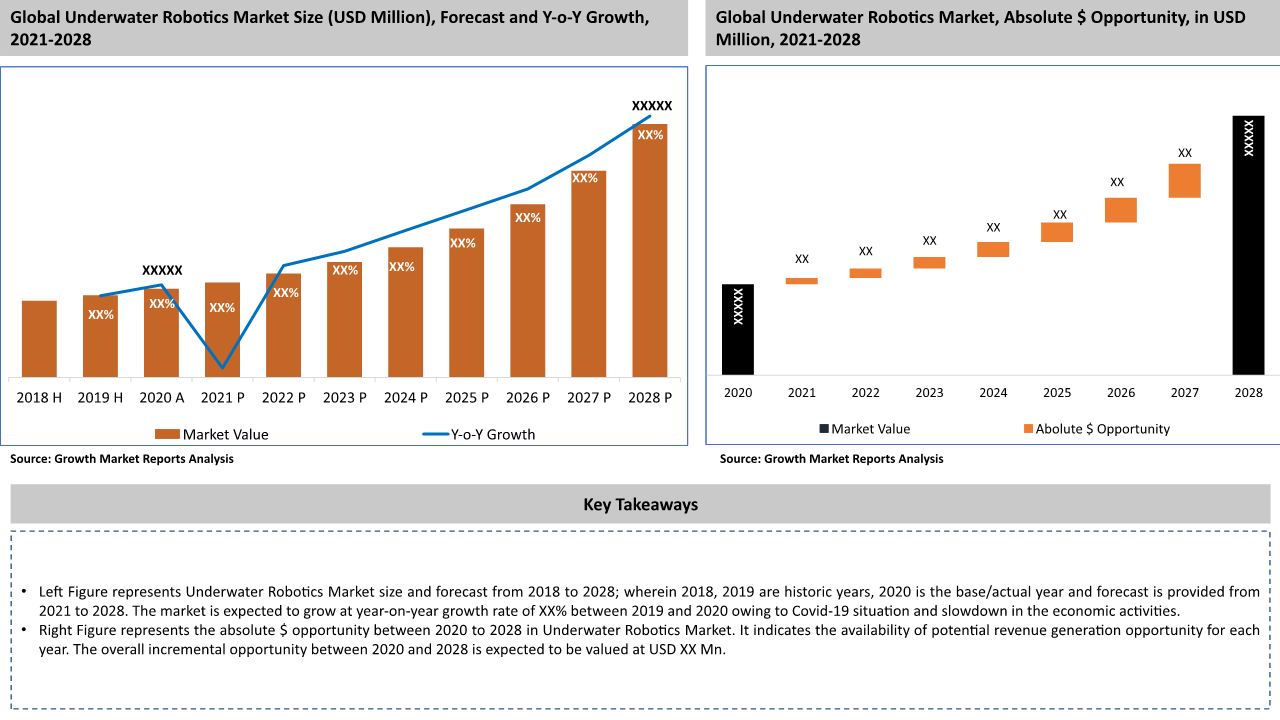
According to our latest research, the global underwater robotics market size reached USD 4.1 billion in 2024, exhibiting robust growth driven by advancements in marine technologies and expanding applications across multiple sectors. The market is projected to grow at a CAGR of 13.2% from 2025 to 2033, reaching a forecasted value of USD 12.1 billion by 2033. This strong upward trajectory is primarily fueled by increasing investments in ocean exploration, the oil and gas sector, and defense modernization programs worldwide.

One of the most significant growth factors for the underwater robotics market is the rapid technological evolution that is making underwater robots more capable, reliable, and cost-effective. The integration of artificial intelligence, machine learning, and advanced sensor technologies has enhanced the operational efficiency and autonomy of underwater robots. These advancements have enabled remotely operated vehicles (ROVs), autonomous underwater vehicles (AUVs), and hybrid vehicles to perform complex tasks in challenging and hazardous underwater environments. As a result, industries such as oil and gas, defense, and marine research are increasingly adopting underwater robotics to achieve greater safety, precision, and productivity in subsea operations. The growing need for deep-sea exploration and the rising demand for real-time data collection and monitoring are further propelling market expansion.

Another major driver is the intensifying focus on environmental monitoring and marine conservation. Governments and environmental organizations are leveraging underwater robotics for the assessment and preservation of marine ecosystems, detection of underwater pollutants, and monitoring of climate change impacts on oceanic environments. The ability of underwater robots to access hard-to-reach locations and operate for extended periods without human intervention has proven invaluable for scientific research and environmental monitoring. This trend is expected to gain further momentum as regulatory frameworks for marine protection become more stringent and as public awareness of ocean health continues to grow.

Additionally, the underwater robotics market is benefiting from increased defense spending and the modernization of naval fleets across both developed and emerging economies. Underwater robotics play a critical role in defense and security applications, including mine countermeasures, underwater surveillance, and anti-submarine warfare. The rising incidence of maritime threats and the need for enhanced border security are prompting governments to invest in advanced underwater robotic systems. Furthermore, the commercialization of underwater robotics in sectors such as offshore renewable energy, aquaculture, and underwater infrastructure inspection is opening new avenues for market growth, diversifying the application landscape beyond traditional industries.

From a regional perspective, North America currently leads the underwater robotics market, supported by substantial investments in marine technology, a strong presence of key industry players, and significant government funding for oceanographic research and defense projects. Europe follows closely, driven by robust demand from the oil and gas sector in the North Sea and increasing initiatives in marine conservation. The Asia Pacific region is emerging as a high-growth market, propelled by expanding maritime industries, rising defense budgets, and a growing focus on underwater resource exploration. Latin America and the Middle East & Africa are also witnessing steady adoption, particularly in offshore oil and gas exploration. This widespread regional growth underscores the global importance and potential of the underwater robotics market.

Global Underwater Robotics  Industry Outlook

Type Analysis

The underwater robotics market is segmented by type into Remotely Operated Vehicles (ROVs), Autonomous Underwater Vehicles (AUVs), and Hybrid Vehicles. Each type serves distinct operational requirements and is tailored to specific industry needs. ROVs dominate the market due to their versatility and reliability in performing complex underwater tasks while being controlled by human operators from the surface. They are widely used in oil and gas exploration, subsea construction, and salvage operations, where precise maneuvering and real-time control are essential. ROVs are valued for their ability to operate at significant depths and for extended durations, making them indispensable tools for deep-sea industries.

AUVs represent the fastest-growing segment within the underwater robotics market, thanks to their ability to operate autonomously without direct human intervention. These vehicles are equipped with advanced navigation systems, sensors, and onboard processing units, enabling them to conduct extensive surveys, mapping, and data collection missions. The demand for AUVs is particularly strong in scientific research, environmental monitoring, and defense applications, where large-scale, long-duration missions are required. AUVs are also being increasingly adopted in commercial sectors such as offshore wind farm inspection and pipeline monitoring, as their autonomy reduces operational costs and enhances safety.

Hybrid vehicles combine the advantages of both ROVs and AUVs, offering flexibility to switch between remotely operated and autonomous modes as needed. This capability makes hybrid vehicles suitable for missions that require both human oversight and extended autonomous operation. Although currently representing a smaller share of the market, hybrid vehicles are gaining traction in applications that demand high adaptability, such as complex subsea infrastructure inspection and multi-stage scientific expeditions. The continuous innovation in hybrid vehicle design and functionality is expected to drive their adoption in the coming years, particularly as mission requirements become more complex and diverse.

Overall, the segmentation by type reflects the evolving technological landscape of the underwater robotics market. While ROVs will continue to hold a significant market share due to their established utility in critical industries, the rapid advancement of AUV and hybrid technologies is set to reshape the competitive dynamics of the market. The ongoing integration of artificial intelligence, machine learning, and improved battery technologies is enhancing the capabilities of all three segments, enabling broader adoption and the development of new use cases across various sectors.

Report Scope

Attributes Details
Report Title Underwater Robotics Market Research Report 2033
By Type Remotely Operated Vehicles (ROVs), Autonomous Underwater Vehicles (AUVs), Hybrid Vehicles
By Application Oil & Gas, Defense & Security, Scientific Research, Marine Exploration, Environmental Monitoring, Others
By Component Hardware, Software, Services
By Depth Shallow, Deep, Ultra-Deep
Regions Covered North America, Europe, APAC, Latin America, MEA
Base Year 2024
Historic Data 2018-2023
Forecast Period 2025-2033
Number of Pages 294
Number of Tables & Figures 317
Customization Available Yes, the report can be customized as per your need.

Application Analysis

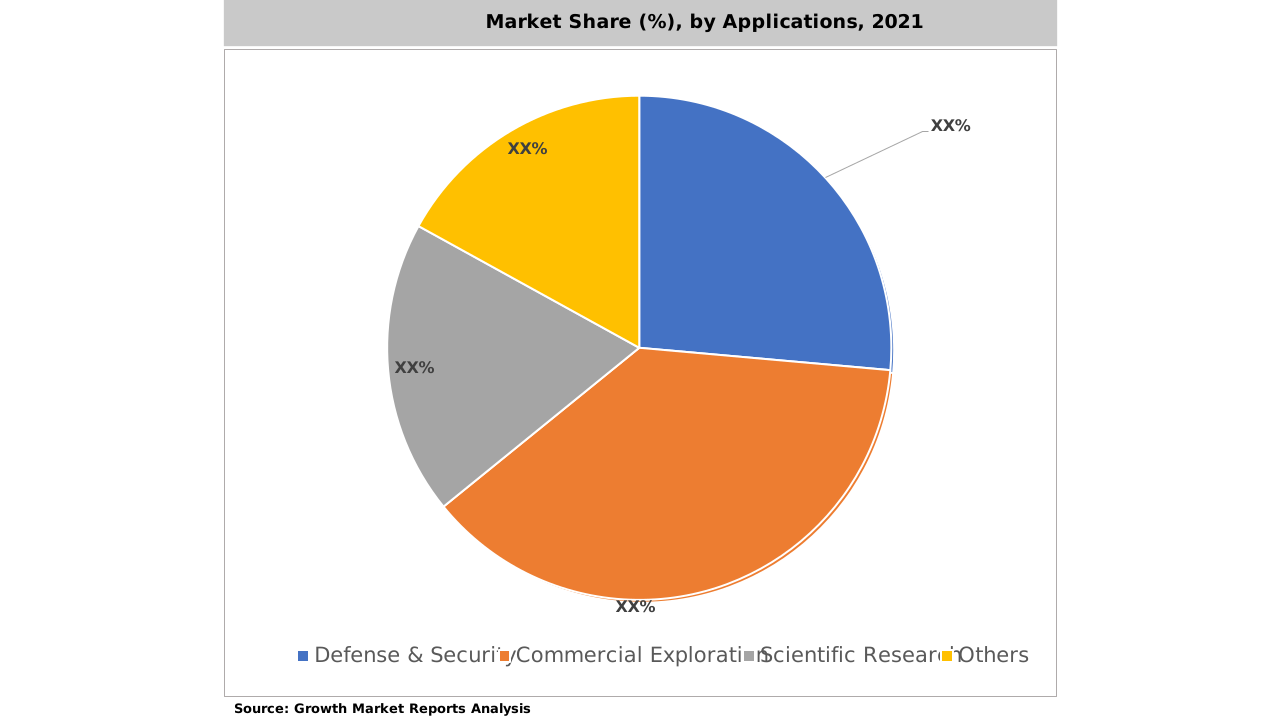
The underwater robotics market serves a diverse range of applications, including Oil & Gas, Defense & Security, Scientific Research, Marine Exploration, Environmental Monitoring, and others. The oil and gas sector remains the largest application area, leveraging underwater robotics for subsea inspection, maintenance, and repair of offshore platforms and pipelines. The ability of underwater robots to operate in hazardous environments and at great depths has significantly improved operational safety and efficiency in offshore energy production. As the industry expands into deeper and more challenging waters, the demand for advanced underwater robotics solutions continues to rise.

Defense and security applications constitute another major segment, as underwater robotics play a crucial role in maritime surveillance, mine detection, anti-submarine warfare, and port security. The increasing sophistication of underwater threats and the need for enhanced situational awareness are prompting defense agencies to invest heavily in state-of-the-art underwater robotic platforms. These systems provide critical capabilities for monitoring and protecting national waters, supporting both routine operations and emergency response scenarios. The integration of underwater robotics with unmanned surface and aerial systems is further enhancing the effectiveness of modern naval operations.

Scientific research and marine exploration are rapidly growing application areas, driven by the need to better understand ocean ecosystems, map the seafloor, and study marine biodiversity. Underwater robotics enable researchers to access previously unreachable locations, collect high-resolution data, and conduct long-term monitoring of oceanographic phenomena. The use of AUVs and ROVs in deep-sea exploration has led to numerous discoveries, including new species and geological formations, underscoring the critical role of underwater robotics in advancing marine science. These applications are expected to expand further as research institutions and environmental organizations increase their investment in ocean exploration.

Environmental monitoring is also emerging as a key application, as governments and non-governmental organizations seek to address issues such as marine pollution, climate change, and habitat degradation. Underwater robots are used to monitor water quality, track the movement of pollutants, and assess the health of coral reefs and other sensitive ecosystems. The ability to deploy these systems for extended periods and in challenging conditions makes them invaluable tools for environmental protection and sustainable resource management. Other applications, such as underwater archaeology, aquaculture, and underwater mining, are also contributing to the diversification and growth of the underwater robotics market.

Component Analysis

The underwater robotics market is segmented by component into hardware, software, and services, each playing a pivotal role in the overall value chain. Hardware represents the largest share of the market, encompassing the physical components such as chassis, propulsion systems, cameras, sensors, batteries, and communication modules. Continuous innovation in hardware design, including the development of lightweight materials, advanced propulsion mechanisms, and energy-efficient power systems, is enhancing the performance and durability of underwater robots. The demand for high-quality hardware is particularly strong in applications that require deep-sea operation and high reliability, such as oil and gas and defense.

Software is an increasingly important component, as it enables the automation, navigation, and data processing capabilities of underwater robots. Advances in artificial intelligence, machine learning, and real-time data analytics are transforming the way underwater robots operate, making them smarter, more autonomous, and capable of handling complex missions with minimal human intervention. Software platforms are being developed to support mission planning, vehicle control, data visualization, and integration with other marine systems. The growing sophistication of software solutions is enabling new applications and expanding the capabilities of existing underwater robotic systems.

Services form a critical part of the underwater robotics market, encompassing maintenance, repair, training, and operational support. As underwater robotic systems become more complex and widely adopted, the demand for specialized services is increasing. Service providers offer expertise in system integration, mission planning, data analysis, and regulatory compliance, helping end-users maximize the value of their underwater robotics investments. The rise of service-based business models, such as robotics-as-a-service (RaaS), is making underwater robotics more accessible to a broader range of customers, particularly small and medium-sized enterprises and research institutions.

The interplay between hardware, software, and services is driving innovation and value creation across the underwater robotics market. Manufacturers are increasingly focusing on developing integrated solutions that combine robust hardware platforms with advanced software and comprehensive service offerings. This holistic approach is enabling end-users to achieve greater operational efficiency, reduce costs, and address the unique challenges of underwater environments. As the market continues to evolve, the importance of seamless integration and lifecycle support is expected to grow, shaping the future direction of the underwater robotics industry.

Depth Analysis

The underwater robotics market is segmented by depth into shallow, deep, and ultra-deep categories, reflecting the varying operational environments and technical requirements of underwater missions. Shallow-water applications, typically involving depths up to 200 meters, are common in coastal monitoring, port security, and nearshore oil and gas operations. Underwater robots designed for shallow-water use prioritize maneuverability, ease of deployment, and cost-effectiveness. These systems are often used for routine inspections, environmental monitoring, and scientific studies in coastal areas, where accessibility and rapid response are critical.

Deep-water applications, covering depths from 200 to 3,000 meters, are prevalent in offshore oil and gas exploration, deep-sea research, and undersea infrastructure inspection. Underwater robots operating in deep-water environments must withstand high pressure, low temperatures, and limited visibility. Advanced engineering and robust materials are essential to ensure the reliability and safety of these systems. The demand for deep-water capable robots is driven by the expansion of offshore energy production into deeper waters and the growing need for scientific exploration of the deep ocean.

Ultra-deep-water applications, involving depths greater than 3,000 meters, represent the most challenging and technically demanding segment of the underwater robotics market. These missions require specialized vehicles equipped with reinforced hulls, advanced navigation systems, and high-capacity batteries to operate in extreme conditions. Ultra-deep-water robots are primarily used in scientific research, deep-sea mining, and the exploration of ocean trenches and hydrothermal vents. The ability to access the deepest parts of the ocean is opening new frontiers in marine science and resource extraction, driving innovation in ultra-deep-water robotics.

The segmentation by depth highlights the diverse operational requirements and technological challenges faced by the underwater robotics industry. Manufacturers are investing in research and development to create vehicles that can operate reliably across a wide range of depths, while end-users are seeking solutions that offer flexibility, durability, and advanced capabilities. The continuous push towards deeper and more complex underwater missions is expected to drive further advancements in underwater robotics technology, expanding the market's potential and enabling new applications across multiple sectors.

Opportunities & Threats

The underwater robotics market presents significant opportunities for growth and innovation, driven by the increasing adoption of advanced technologies and the expanding scope of applications. The integration of artificial intelligence, machine learning, and advanced sensor technologies is enabling underwater robots to perform more complex and autonomous missions, reducing operational costs and enhancing safety. The growing demand for real-time data collection and analysis in sectors such as oil and gas, defense, environmental monitoring, and scientific research is creating new opportunities for market expansion. Additionally, the rise of robotics-as-a-service (RaaS) models is making underwater robotics more accessible to a broader range of customers, including small and medium-sized enterprises and research institutions. This shift is expected to drive further adoption and innovation, as service providers develop customized solutions to meet the unique needs of different end-users.

Another major opportunity lies in the increasing focus on environmental monitoring and marine conservation. Governments, non-governmental organizations, and research institutions are investing in underwater robotics to monitor and protect marine ecosystems, assess the impacts of climate change, and support sustainable resource management. The ability of underwater robots to access hard-to-reach locations and operate for extended periods without human intervention makes them invaluable tools for environmental protection. The development of new applications, such as underwater archaeology, aquaculture, and underwater mining, is also contributing to the diversification and growth of the market. As regulatory frameworks for marine protection become more stringent and public awareness of ocean health increases, the demand for advanced underwater robotics solutions is expected to rise.

Despite the numerous opportunities, the underwater robotics market faces several challenges and restrainers. High initial costs and the complexity of underwater robotic systems can be significant barriers to adoption, particularly for small and medium-sized enterprises and organizations with limited budgets. The harsh and unpredictable nature of underwater environments poses technical challenges related to durability, reliability, and maintenance. Additionally, the lack of standardized regulations and interoperability between different systems can hinder market growth and limit the scalability of underwater robotics solutions. Addressing these challenges will require continued investment in research and development, as well as collaboration between industry stakeholders, regulatory bodies, and end-users to develop standardized protocols and best practices for underwater robotics deployment and operation.

Regional Outlook

North America holds the largest share of the global underwater robotics market, accounting for approximately USD 1.6 billion in 2024. The region's dominance is attributed to substantial investments in marine technology, a strong presence of leading industry players, and significant government funding for oceanographic research and defense projects. The United States, in particular, is a major contributor to market growth, with its advanced research institutions, robust defense sector, and thriving offshore oil and gas industry. Canada also plays a significant role, leveraging its extensive coastline and commitment to marine conservation to drive demand for underwater robotics solutions.

Europe follows closely, with a market size of nearly USD 1.2 billion in 2024. The region benefits from robust demand in the oil and gas sector, particularly in the North Sea, as well as strong initiatives in marine conservation and scientific research. Countries such as the United Kingdom, Norway, and Germany are at the forefront of underwater robotics innovation, supported by government funding, academic research, and collaboration with industry partners. The European market is expected to grow at a healthy CAGR of 12.5% through 2033, driven by ongoing investments in offshore energy production, environmental monitoring, and defense modernization.

The Asia Pacific region is emerging as a high-growth market, with a current value of USD 0.8 billion in 2024. Rapid industrialization, expanding maritime industries, and rising defense budgets are fueling demand for underwater robotics in countries such as China, Japan, South Korea, and Australia. The region's vast coastlines, growing focus on underwater resource exploration, and increasing investment in marine technology are creating new opportunities for market expansion. Latin America and the Middle East & Africa are also witnessing steady adoption, particularly in offshore oil and gas exploration and environmental monitoring. These regions are expected to play an increasingly important role in the global underwater robotics market as infrastructure development and technological adoption accelerate.

Underwater Robotics  Market Statistics

Competitor Outlook

The underwater robotics market is characterized by intense competition and a dynamic landscape, with numerous global and regional players vying for market share. Leading companies are focusing on innovation, strategic partnerships, and mergers and acquisitions to strengthen their market positions and expand their product portfolios. The competitive environment is shaped by rapid technological advancements, evolving customer requirements, and the need to address complex operational challenges in diverse underwater environments. Companies are investing heavily in research and development to create next-generation underwater robotic systems that offer enhanced performance, reliability, and autonomy.

Key players in the underwater robotics market are differentiating themselves through the development of integrated solutions that combine advanced hardware, sophisticated software, and comprehensive service offerings. These integrated solutions are designed to meet the unique needs of various industries, from oil and gas and defense to scientific research and environmental monitoring. The ability to provide end-to-end solutions, including system integration, training, and lifecycle support, is becoming increasingly important as customers seek to maximize the value of their underwater robotics investments. Collaboration with academic institutions, government agencies, and other industry stakeholders is also playing a critical role in driving innovation and expanding the application landscape.

The competitive landscape is further shaped by the emergence of new entrants and startups, particularly in the areas of artificial intelligence, machine learning, and advanced sensor technologies. These companies are bringing fresh perspectives and innovative solutions to the market, challenging established players and driving the pace of technological advancement. Strategic alliances, joint ventures, and partnerships are becoming more common as companies seek to leverage complementary strengths and accelerate the development and commercialization of new technologies. The increasing adoption of robotics-as-a-service (RaaS) models is also reshaping the competitive dynamics, enabling companies to reach new customer segments and expand their market presence.

Major companies operating in the underwater robotics market include Saab AB, Oceaneering International, Inc., Fugro, Teledyne Technologies Incorporated, Kongsberg Gruppen, Atlas Elektronik GmbH, Bluefin Robotics (a General Dynamics company), and Deep Trekker Inc.. Saab AB is renowned for its advanced AUV and ROV systems, catering to both defense and commercial markets. Oceaneering International, Inc. is a leader in providing ROV services for the oil and gas industry, with a strong focus on innovation and operational excellence. Fugro specializes in integrated marine solutions, leveraging its expertise in geotechnical, survey, and subsea services. Teledyne Technologies Incorporated is a key player in the development of advanced sensors, imaging systems, and autonomous underwater vehicles.

Kongsberg Gruppen is recognized for its cutting-edge underwater robotics technologies, serving both defense and commercial sectors with a wide range of AUVs and ROVs. Atlas Elektronik GmbH offers a comprehensive portfolio of underwater robotics solutions, with a focus on naval applications and underwater surveillance. Bluefin Robotics, a subsidiary of General Dynamics, is a pioneer in AUV development, providing solutions for defense, commercial, and research applications. Deep Trekker Inc. is known for its portable and rugged ROV systems, catering to industries such as aquaculture, infrastructure inspection, and environmental monitoring. These companies, along with a growing number of innovative startups and regional players, are shaping the future of the underwater robotics market through continuous innovation and a commitment to operational excellence.

Key Players

  • Saab AB
  • Oceaneering International, Inc.
  • Fugro N.V.
  • Teledyne Technologies Incorporated
  • Kongsberg Gruppen ASA
  • Atlas Elektronik GmbH
  • ECA Group
  • Bluefin Robotics (General Dynamics Mission Systems)
  • Deep Ocean Engineering, Inc.
  • Forum Energy Technologies, Inc.
  • Subsea 7 S.A.
  • Schilling Robotics (TechnipFMC)
  • Soil Machine Dynamics Ltd (SMD)
  • Hydroid, Inc. (Huntington Ingalls Industries)
  • VideoRay LLC
  • SeaRobotics Corporation
  • International Submarine Engineering Ltd. (ISE)
  • MarineNav Ltd.
  • Aquabotix Technology Corporation
  • Rovco Ltd.
Underwater Robotics  Market Overview

Segments

The Underwater Robotics market has been segmented on the basis of

Type

  • Remotely Operated Vehicles (ROVs)
  • Autonomous Underwater Vehicles (AUVs)
  • Hybrid Vehicles

Application

  • Oil & Gas
  • Defense & Security
  • Scientific Research
  • Marine Exploration
  • Environmental Monitoring
  • Others

Component

  • Hardware
  • Software
  • Services

Depth

  • Shallow
  • Deep
  • Ultra-Deep

Competitive Landscape

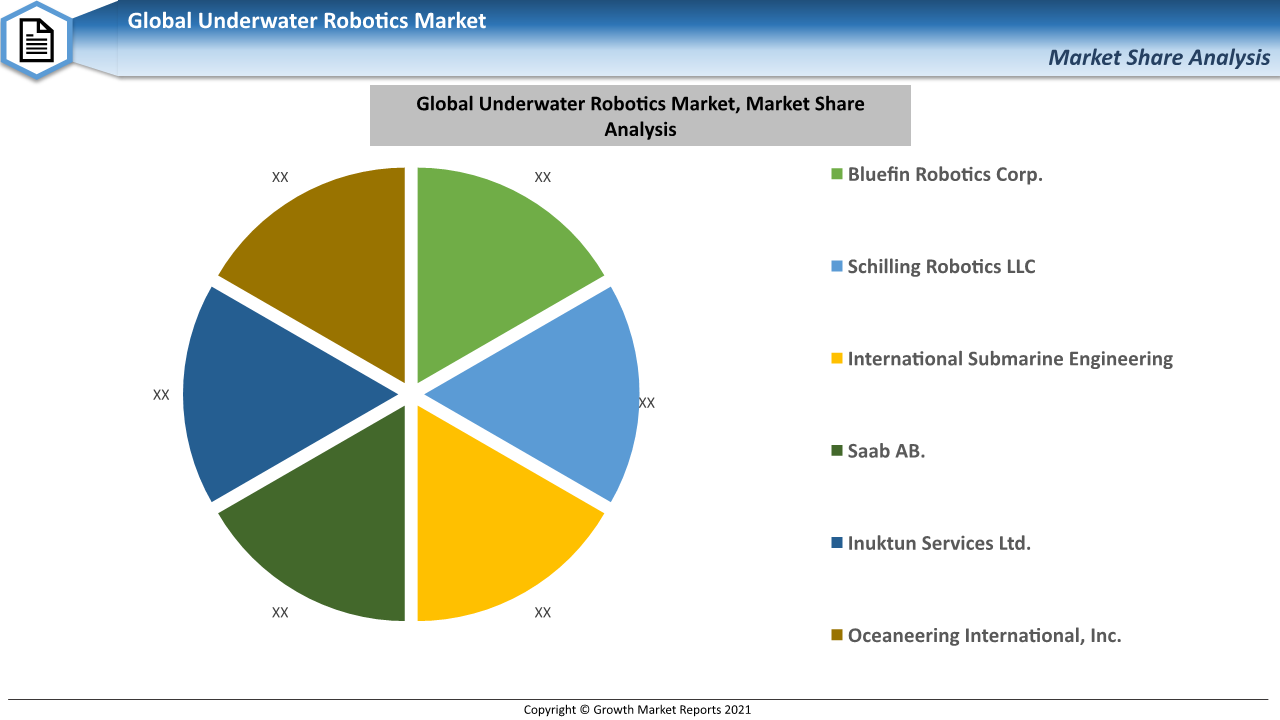
Key players competing in the global underwater robotics market are Bluefin Robotics Corp.; Schilling Robotics LLC; International Submarine Engineering; Saab AB; Inuktun Services Ltd.; and Oceaneering International, Inc. In October 2016, the Oceaneering International, Inc. reported its rapid growth of AUV operations in West Africa due to rising number of new customers as well as supported its existing ocean exploration services.

Underwater Robotics Market By Key Players

Frequently Asked Questions

Opportunities include increased adoption for environmental monitoring, marine conservation, underwater archaeology, aquaculture, and mining, as well as the rise of robotics-as-a-service (RaaS) business models.

Major companies include Saab AB, Oceaneering International, Fugro, Teledyne Technologies, Kongsberg Gruppen, Atlas Elektronik, Bluefin Robotics (General Dynamics), and Deep Trekker, among others.

The market is divided into shallow (up to 200m), deep (200–3,000m), and ultra-deep (over 3,000m) segments, each with specific technical requirements and applications.

The market is segmented by component into hardware (chassis, propulsion, sensors, etc.), software (AI, navigation, data analytics), and services (maintenance, training, integration, and robotics-as-a-service).

Major challenges include high initial costs, technical complexity, harsh underwater environments, and a lack of standardized regulations and interoperability between systems.

North America leads the market due to significant investments and government funding, followed by Europe with strong demand from the oil & gas sector. Asia Pacific is emerging as a high-growth region, while Latin America and the Middle East & Africa are seeing steady adoption.

AI, machine learning, and advanced sensor technologies are improving the autonomy, operational efficiency, and data processing capabilities of underwater robots, enabling them to perform complex tasks with minimal human intervention.

Key industries include oil & gas, defense & security, scientific research, marine exploration, and environmental monitoring. The oil and gas sector is the largest application area, while defense and scientific research are rapidly growing segments.

The market is segmented into Remotely Operated Vehicles (ROVs), Autonomous Underwater Vehicles (AUVs), and Hybrid Vehicles. ROVs are dominant due to their versatility, while AUVs are the fastest-growing segment, and hybrid vehicles offer both remote and autonomous capabilities.

The global underwater robotics market reached USD 4.1 billion in 2024 and is projected to grow at a CAGR of 13.2% from 2025 to 2033, reaching USD 12.1 billion by 2033.

Table Of Content

Chapter 1 Executive Summary
Chapter 2 Assumptions and Acronyms Used
Chapter 3 Research Methodology
Chapter 4 Underwater Robotics  Market Overview
   4.1 Introduction
      4.1.1 Market Taxonomy
      4.1.2 Market Definition
      4.1.3 Macro-Economic Factors Impacting the Market Growth
   4.2 Underwater Robotics  Market Dynamics
      4.2.1 Market Drivers
      4.2.2 Market Restraints
      4.2.3 Market Opportunity
   4.3 Underwater Robotics  Market - Supply Chain Analysis
      4.3.1 List of Key Suppliers
      4.3.2 List of Key Distributors
      4.3.3 List of Key Consumers
   4.4 Key Forces Shaping the Underwater Robotics  Market
      4.4.1 Bargaining Power of Suppliers
      4.4.2 Bargaining Power of Buyers
      4.4.3 Threat of Substitution
      4.4.4 Threat of New Entrants
      4.4.5 Competitive Rivalry
   4.5 Global Underwater Robotics  Market Size & Forecast, 2023-2032
      4.5.1 Underwater Robotics  Market Size and Y-o-Y Growth
      4.5.2 Underwater Robotics  Market Absolute $ Opportunity

Chapter 5 Global Underwater Robotics  Market Analysis and Forecast By Type
   5.1 Introduction
      5.1.1 Key Market Trends & Growth Opportunities By Type
      5.1.2 Basis Point Share (BPS) Analysis By Type
      5.1.3 Absolute $ Opportunity Assessment By Type
   5.2 Underwater Robotics  Market Size Forecast By Type
      5.2.1 Remotely Operated Vehicles (ROVs)
      5.2.2 Autonomous Underwater Vehicles (AUVs)
      5.2.3 Hybrid Vehicles
   5.3 Market Attractiveness Analysis By Type

Chapter 6 Global Underwater Robotics  Market Analysis and Forecast By Application
   6.1 Introduction
      6.1.1 Key Market Trends & Growth Opportunities By Application
      6.1.2 Basis Point Share (BPS) Analysis By Application
      6.1.3 Absolute $ Opportunity Assessment By Application
   6.2 Underwater Robotics  Market Size Forecast By Application
      6.2.1 Oil & Gas
      6.2.2 Defense & Security
      6.2.3 Scientific Research
      6.2.4 Marine Exploration
      6.2.5 Environmental Monitoring
      6.2.6 Others
   6.3 Market Attractiveness Analysis By Application

Chapter 7 Global Underwater Robotics  Market Analysis and Forecast By Component
   7.1 Introduction
      7.1.1 Key Market Trends & Growth Opportunities By Component
      7.1.2 Basis Point Share (BPS) Analysis By Component
      7.1.3 Absolute $ Opportunity Assessment By Component
   7.2 Underwater Robotics  Market Size Forecast By Component
      7.2.1 Hardware
      7.2.2 Software
      7.2.3 Services
   7.3 Market Attractiveness Analysis By Component

Chapter 8 Global Underwater Robotics  Market Analysis and Forecast By Depth
   8.1 Introduction
      8.1.1 Key Market Trends & Growth Opportunities By Depth
      8.1.2 Basis Point Share (BPS) Analysis By Depth
      8.1.3 Absolute $ Opportunity Assessment By Depth
   8.2 Underwater Robotics  Market Size Forecast By Depth
      8.2.1 Shallow
      8.2.2 Deep
      8.2.3 Ultra-Deep
   8.3 Market Attractiveness Analysis By Depth

Chapter 9 Global Underwater Robotics  Market Analysis and Forecast by Region
   9.1 Introduction
      9.1.1 Key Market Trends & Growth Opportunities By Region
      9.1.2 Basis Point Share (BPS) Analysis By Region
      9.1.3 Absolute $ Opportunity Assessment By Region
   9.2 Underwater Robotics  Market Size Forecast By Region
      9.2.1 North America
      9.2.2 Europe
      9.2.3 Asia Pacific
      9.2.4 Latin America
      9.2.5 Middle East & Africa (MEA)
   9.3 Market Attractiveness Analysis By Region

Chapter 10 Coronavirus Disease (COVID-19) Impact 
   10.1 Introduction 
   10.2 Current & Future Impact Analysis 
   10.3 Economic Impact Analysis 
   10.4 Government Policies 
   10.5 Investment Scenario

Chapter 11 North America Underwater Robotics  Analysis and Forecast
   11.1 Introduction
   11.2 North America Underwater Robotics  Market Size Forecast by Country
      11.2.1 U.S.
      11.2.2 Canada
   11.3 Basis Point Share (BPS) Analysis by Country
   11.4 Absolute $ Opportunity Assessment by Country
   11.5 Market Attractiveness Analysis by Country
   11.6 North America Underwater Robotics  Market Size Forecast By Type
      11.6.1 Remotely Operated Vehicles (ROVs)
      11.6.2 Autonomous Underwater Vehicles (AUVs)
      11.6.3 Hybrid Vehicles
   11.7 Basis Point Share (BPS) Analysis By Type 
   11.8 Absolute $ Opportunity Assessment By Type 
   11.9 Market Attractiveness Analysis By Type
   11.10 North America Underwater Robotics  Market Size Forecast By Application
      11.10.1 Oil & Gas
      11.10.2 Defense & Security
      11.10.3 Scientific Research
      11.10.4 Marine Exploration
      11.10.5 Environmental Monitoring
      11.10.6 Others
   11.11 Basis Point Share (BPS) Analysis By Application 
   11.12 Absolute $ Opportunity Assessment By Application 
   11.13 Market Attractiveness Analysis By Application
   11.14 North America Underwater Robotics  Market Size Forecast By Component
      11.14.1 Hardware
      11.14.2 Software
      11.14.3 Services
   11.15 Basis Point Share (BPS) Analysis By Component 
   11.16 Absolute $ Opportunity Assessment By Component 
   11.17 Market Attractiveness Analysis By Component
   11.18 North America Underwater Robotics  Market Size Forecast By Depth
      11.18.1 Shallow
      11.18.2 Deep
      11.18.3 Ultra-Deep
   11.19 Basis Point Share (BPS) Analysis By Depth 
   11.20 Absolute $ Opportunity Assessment By Depth 
   11.21 Market Attractiveness Analysis By Depth

Chapter 12 Europe Underwater Robotics  Analysis and Forecast
   12.1 Introduction
   12.2 Europe Underwater Robotics  Market Size Forecast by Country
      12.2.1 Germany
      12.2.2 France
      12.2.3 Italy
      12.2.4 U.K.
      12.2.5 Spain
      12.2.6 Russia
      12.2.7 Rest of Europe
   12.3 Basis Point Share (BPS) Analysis by Country
   12.4 Absolute $ Opportunity Assessment by Country
   12.5 Market Attractiveness Analysis by Country
   12.6 Europe Underwater Robotics  Market Size Forecast By Type
      12.6.1 Remotely Operated Vehicles (ROVs)
      12.6.2 Autonomous Underwater Vehicles (AUVs)
      12.6.3 Hybrid Vehicles
   12.7 Basis Point Share (BPS) Analysis By Type 
   12.8 Absolute $ Opportunity Assessment By Type 
   12.9 Market Attractiveness Analysis By Type
   12.10 Europe Underwater Robotics  Market Size Forecast By Application
      12.10.1 Oil & Gas
      12.10.2 Defense & Security
      12.10.3 Scientific Research
      12.10.4 Marine Exploration
      12.10.5 Environmental Monitoring
      12.10.6 Others
   12.11 Basis Point Share (BPS) Analysis By Application 
   12.12 Absolute $ Opportunity Assessment By Application 
   12.13 Market Attractiveness Analysis By Application
   12.14 Europe Underwater Robotics  Market Size Forecast By Component
      12.14.1 Hardware
      12.14.2 Software
      12.14.3 Services
   12.15 Basis Point Share (BPS) Analysis By Component 
   12.16 Absolute $ Opportunity Assessment By Component 
   12.17 Market Attractiveness Analysis By Component
   12.18 Europe Underwater Robotics  Market Size Forecast By Depth
      12.18.1 Shallow
      12.18.2 Deep
      12.18.3 Ultra-Deep
   12.19 Basis Point Share (BPS) Analysis By Depth 
   12.20 Absolute $ Opportunity Assessment By Depth 
   12.21 Market Attractiveness Analysis By Depth

Chapter 13 Asia Pacific Underwater Robotics  Analysis and Forecast
   13.1 Introduction
   13.2 Asia Pacific Underwater Robotics  Market Size Forecast by Country
      13.2.1 China
      13.2.2 Japan
      13.2.3 South Korea
      13.2.4 India
      13.2.5 Australia
      13.2.6 South East Asia (SEA)
      13.2.7 Rest of Asia Pacific (APAC)
   13.3 Basis Point Share (BPS) Analysis by Country
   13.4 Absolute $ Opportunity Assessment by Country
   13.5 Market Attractiveness Analysis by Country
   13.6 Asia Pacific Underwater Robotics  Market Size Forecast By Type
      13.6.1 Remotely Operated Vehicles (ROVs)
      13.6.2 Autonomous Underwater Vehicles (AUVs)
      13.6.3 Hybrid Vehicles
   13.7 Basis Point Share (BPS) Analysis By Type 
   13.8 Absolute $ Opportunity Assessment By Type 
   13.9 Market Attractiveness Analysis By Type
   13.10 Asia Pacific Underwater Robotics  Market Size Forecast By Application
      13.10.1 Oil & Gas
      13.10.2 Defense & Security
      13.10.3 Scientific Research
      13.10.4 Marine Exploration
      13.10.5 Environmental Monitoring
      13.10.6 Others
   13.11 Basis Point Share (BPS) Analysis By Application 
   13.12 Absolute $ Opportunity Assessment By Application 
   13.13 Market Attractiveness Analysis By Application
   13.14 Asia Pacific Underwater Robotics  Market Size Forecast By Component
      13.14.1 Hardware
      13.14.2 Software
      13.14.3 Services
   13.15 Basis Point Share (BPS) Analysis By Component 
   13.16 Absolute $ Opportunity Assessment By Component 
   13.17 Market Attractiveness Analysis By Component
   13.18 Asia Pacific Underwater Robotics  Market Size Forecast By Depth
      13.18.1 Shallow
      13.18.2 Deep
      13.18.3 Ultra-Deep
   13.19 Basis Point Share (BPS) Analysis By Depth 
   13.20 Absolute $ Opportunity Assessment By Depth 
   13.21 Market Attractiveness Analysis By Depth

Chapter 14 Latin America Underwater Robotics  Analysis and Forecast
   14.1 Introduction
   14.2 Latin America Underwater Robotics  Market Size Forecast by Country
      14.2.1 Brazil
      14.2.2 Mexico
      14.2.3 Rest of Latin America (LATAM)
   14.3 Basis Point Share (BPS) Analysis by Country
   14.4 Absolute $ Opportunity Assessment by Country
   14.5 Market Attractiveness Analysis by Country
   14.6 Latin America Underwater Robotics  Market Size Forecast By Type
      14.6.1 Remotely Operated Vehicles (ROVs)
      14.6.2 Autonomous Underwater Vehicles (AUVs)
      14.6.3 Hybrid Vehicles
   14.7 Basis Point Share (BPS) Analysis By Type 
   14.8 Absolute $ Opportunity Assessment By Type 
   14.9 Market Attractiveness Analysis By Type
   14.10 Latin America Underwater Robotics  Market Size Forecast By Application
      14.10.1 Oil & Gas
      14.10.2 Defense & Security
      14.10.3 Scientific Research
      14.10.4 Marine Exploration
      14.10.5 Environmental Monitoring
      14.10.6 Others
   14.11 Basis Point Share (BPS) Analysis By Application 
   14.12 Absolute $ Opportunity Assessment By Application 
   14.13 Market Attractiveness Analysis By Application
   14.14 Latin America Underwater Robotics  Market Size Forecast By Component
      14.14.1 Hardware
      14.14.2 Software
      14.14.3 Services
   14.15 Basis Point Share (BPS) Analysis By Component 
   14.16 Absolute $ Opportunity Assessment By Component 
   14.17 Market Attractiveness Analysis By Component
   14.18 Latin America Underwater Robotics  Market Size Forecast By Depth
      14.18.1 Shallow
      14.18.2 Deep
      14.18.3 Ultra-Deep
   14.19 Basis Point Share (BPS) Analysis By Depth 
   14.20 Absolute $ Opportunity Assessment By Depth 
   14.21 Market Attractiveness Analysis By Depth

Chapter 15 Middle East & Africa (MEA) Underwater Robotics  Analysis and Forecast
   15.1 Introduction
   15.2 Middle East & Africa (MEA) Underwater Robotics  Market Size Forecast by Country
      15.2.1 Saudi Arabia
      15.2.2 South Africa
      15.2.3 UAE
      15.2.4 Rest of Middle East & Africa (MEA)
   15.3 Basis Point Share (BPS) Analysis by Country
   15.4 Absolute $ Opportunity Assessment by Country
   15.5 Market Attractiveness Analysis by Country
   15.6 Middle East & Africa (MEA) Underwater Robotics  Market Size Forecast By Type
      15.6.1 Remotely Operated Vehicles (ROVs)
      15.6.2 Autonomous Underwater Vehicles (AUVs)
      15.6.3 Hybrid Vehicles
   15.7 Basis Point Share (BPS) Analysis By Type 
   15.8 Absolute $ Opportunity Assessment By Type 
   15.9 Market Attractiveness Analysis By Type
   15.10 Middle East & Africa (MEA) Underwater Robotics  Market Size Forecast By Application
      15.10.1 Oil & Gas
      15.10.2 Defense & Security
      15.10.3 Scientific Research
      15.10.4 Marine Exploration
      15.10.5 Environmental Monitoring
      15.10.6 Others
   15.11 Basis Point Share (BPS) Analysis By Application 
   15.12 Absolute $ Opportunity Assessment By Application 
   15.13 Market Attractiveness Analysis By Application
   15.14 Middle East & Africa (MEA) Underwater Robotics  Market Size Forecast By Component
      15.14.1 Hardware
      15.14.2 Software
      15.14.3 Services
   15.15 Basis Point Share (BPS) Analysis By Component 
   15.16 Absolute $ Opportunity Assessment By Component 
   15.17 Market Attractiveness Analysis By Component
   15.18 Middle East & Africa (MEA) Underwater Robotics  Market Size Forecast By Depth
      15.18.1 Shallow
      15.18.2 Deep
      15.18.3 Ultra-Deep
   15.19 Basis Point Share (BPS) Analysis By Depth 
   15.20 Absolute $ Opportunity Assessment By Depth 
   15.21 Market Attractiveness Analysis By Depth

Chapter 16 Competition Landscape 
   16.1 Underwater Robotics  Market: Competitive Dashboard
   16.2 Global Underwater Robotics  Market: Market Share Analysis, 2023
   16.3 Company Profiles (Details – Overview, Financials, Developments, Strategy) 
      16.3.1 Saab AB
Oceaneering International, Inc.
Fugro N.V.
Teledyne Technologies Incorporated
Kongsberg Gruppen ASA
Atlas Elektronik GmbH
ECA Group
Bluefin Robotics (General Dynamics Mission Systems)
Deep Ocean Engineering, Inc.
Forum Energy Technologies, Inc.
Subsea 7 S.A.
Schilling Robotics (TechnipFMC)
Soil Machine Dynamics Ltd (SMD)
Hydroid, Inc. (Huntington Ingalls Industries)
VideoRay LLC
SeaRobotics Corporation
International Submarine Engineering Ltd. (ISE)
MarineNav Ltd.
Aquabotix Technology Corporation
Rovco Ltd.

Methodology

Our Clients

FedEx Logistics
Nestle SA
Siemens Healthcare
General Electric
General Mills
The John Holland Group
sinopec
Deloitte