Oil field Equipment Rental Services Market Research Report 2033

Oil field Equipment Rental Services Market Research Report 2033

Segments - by Equipment Type (Drilling Equipment, Pressure & Flow Control Equipment, Fishing Equipment, Others), by Application (Onshore, Offshore), by End-User (Oil & Gas Companies, Drilling Contractors, Others)

https://growthmarketreports.com/Raksha
Author : Raksha Sharma
https://growthmarketreports.com/Vaibhav
Fact-checked by : V. Chandola
https://growthmarketreports.com/Shruti
Editor : Shruti Bhat

Upcoming | Report ID :EP-1189 | 5.0 Rating | 60 Reviews | 259 Pages | Format : Docx PDF

Report Description


Oil Field Equipment Rental Services Market Outlook

According to our latest research, the global oil field equipment rental services market size in 2024 stands at USD 21.7 billion, with a robust year-on-year growth trajectory. The market is expected to expand at a CAGR of 5.4% from 2025 to 2033, reaching a projected value of USD 34.7 billion by 2033. This impressive growth is primarily driven by the rising demand for energy, ongoing exploration and production activities, and the increasing preference among oil and gas operators for renting advanced equipment to optimize operational costs and flexibility. The oil field equipment rental services market is experiencing a dynamic transformation as industry players seek efficient solutions to meet fluctuating demand and technological advancements.

One of the primary growth factors for the oil field equipment rental services market is the ongoing surge in global energy consumption, which has prompted oil and gas companies to intensify exploration and drilling operations, both onshore and offshore. As mature oil fields decline, companies are compelled to explore new reserves, often in challenging environments that require specialized and high-cost equipment. Renting equipment allows these companies to access the latest technologies without incurring the high capital expenditure associated with ownership. This trend is particularly pronounced in emerging markets, where operators are focused on maximizing production efficiency and minimizing downtime, further fueling the demand for rental solutions.

Another significant driver is the increasing volatility in crude oil prices, which has made oil and gas companies more cautious about capital investments. By opting for equipment rental services, companies can better manage their cash flows and mitigate financial risks associated with asset ownership. The flexibility offered by rental agreements enables operators to scale their operations up or down based on market conditions, project timelines, and exploration success rates. This adaptability is crucial in an industry characterized by cyclical demand and frequent technological advancements, making rental services an attractive proposition for both established and emerging players in the oil and gas sector.

Technological innovation is also playing a pivotal role in shaping the oil field equipment rental services market. The adoption of advanced drilling technologies, digital monitoring systems, and automated pressure and flow control equipment has become essential in enhancing operational efficiency and safety. Rental service providers are investing heavily in upgrading their fleets with state-of-the-art equipment, offering clients access to cutting-edge solutions without the burden of maintenance and obsolescence. This trend is expected to accelerate as environmental regulations become more stringent, and as the industry shifts towards more sustainable and efficient extraction methods, further boosting the marketÂ’s growth potential.

Oilfield Services play a crucial role in the oil and gas industry by providing a range of specialized services that support exploration, drilling, and production activities. These services include well construction, drilling fluids management, and well testing, among others. As the industry faces increasing pressure to enhance efficiency and reduce costs, the demand for comprehensive oilfield services is on the rise. Companies offering these services are continuously innovating to provide advanced solutions that address the complex challenges of modern oil and gas operations. This trend is particularly evident in the adoption of digital technologies and automation, which are transforming traditional oilfield services into more integrated and efficient offerings.

From a regional perspective, North America continues to dominate the oil field equipment rental services market, driven by the extensive shale exploration activities in the United States and Canada. The regionÂ’s well-established oil and gas infrastructure, coupled with a large number of independent and major operators, ensures a steady demand for rental equipment. Meanwhile, the Middle East & Africa region is witnessing rapid growth due to increased investments in oil and gas projects and the expansion of exploration activities in untapped reserves. Asia Pacific is emerging as a significant market, propelled by the rising energy needs of countries like China and India. Europe and Latin America also contribute to the market, albeit at a slower pace, influenced by regulatory pressures and fluctuating investment trends.

Global Oil field Equipment Rental Services Industry Outlook

Equipment Type Analysis

The equipment type segment is a cornerstone of the oil field equipment rental services market, encompassing a diverse range of machinery and tools essential for exploration, drilling, and production activities. Drilling equipment constitutes the largest share within this segment, as it is fundamental to both onshore and offshore operations. The demand for advanced drilling rigs, drill pipes, and related accessories is consistently high, driven by the need to access deeper and more complex reservoirs. Rental service providers are continuously expanding their inventories to include high-performance drilling equipment that can withstand harsh environments and deliver superior operational efficiency. This focus on quality and reliability is crucial in minimizing downtime and ensuring the success of exploration projects.

Pressure and flow control equipment is another critical sub-segment, encompassing blowout preventers, valves, and chokes that are essential for maintaining safety and operational integrity during drilling and production. The increasing emphasis on safety regulations and environmental protection has elevated the importance of this equipment, prompting rental companies to invest in technologically advanced solutions that offer real-time monitoring and automated control features. These innovations not only enhance operational safety but also contribute to cost savings by reducing the risk of accidents and unplanned shutdowns. As regulatory frameworks become more stringent, the demand for rental pressure and flow control equipment is expected to grow steadily.

The fishing equipment sub-segment, which includes tools used to retrieve lost or stuck objects from wells, is gaining prominence as drilling operations become more complex and challenging. The ability to quickly and efficiently resolve downhole issues is vital in preventing costly delays and equipment damage. Rental service providers are expanding their offerings to include a comprehensive range of fishing tools, supported by expert technical teams that can provide on-site assistance. This value-added service is increasingly sought after by operators who prioritize operational continuity and risk mitigation in their exploration and production activities.

The others category within equipment type encompasses a wide array of auxiliary equipment, such as power generation units, mud pumps, and well control systems. These components, while not always in the spotlight, are essential for the smooth functioning of oil field operations. The trend towards integrated rental solutions, where companies can access a full suite of equipment tailored to their specific project requirements, is gaining traction. Rental providers are responding by offering bundled packages and flexible leasing terms, enabling clients to optimize their operational setups and reduce logistical complexities. This holistic approach is expected to drive further growth in the equipment type segment over the forecast period.

The significance of Oilfield Services extends beyond just operational support; they are integral to the strategic planning and execution of oil and gas projects. These services enable operators to optimize their resource allocation, improve safety standards, and enhance production efficiency. As exploration activities venture into more challenging environments, the expertise and technological capabilities provided by oilfield services become indispensable. Companies are increasingly relying on these services to navigate the complexities of regulatory compliance, environmental sustainability, and technological innovation. This reliance underscores the critical role of oilfield services in driving the industry's growth and adaptation to evolving market dynamics.

Report Scope

Attributes Details
Report Title Oil field Equipment Rental Services Market Research Report 2033
By Equipment Type Drilling Equipment, Pressure & Flow Control Equipment, Fishing Equipment, Others
By Application Onshore, Offshore
By End-User Oil & Gas Companies, Drilling Contractors, Others
Regions Covered North America, Europe, APAC, Latin America, MEA
Base Year 2024
Historic Data 2018-2023
Forecast Period 2025-2033
Number of Pages 259
Number of Tables & Figures 262
Customization Available Yes, the report can be customized as per your need.

Application Analysis

The application segment of the oil field equipment rental services market is broadly categorized into onshore and offshore operations, each presenting distinct challenges and opportunities. Onshore applications represent the larger share of the market, as land-based exploration and production activities are more prevalent and generally less capital-intensive compared to offshore projects. The demand for rental equipment in onshore fields is driven by the need for flexibility and cost efficiency, particularly among independent operators and smaller oil companies. Rental services enable these players to access advanced equipment without the financial burden of ownership, facilitating rapid project deployment and operational scalability.

Offshore applications, while representing a smaller portion of the overall market, are characterized by higher complexity and greater technical demands. The harsh and unpredictable conditions of offshore environments necessitate the use of specialized equipment that can withstand extreme pressures, corrosive elements, and remote operations. Rental service providers catering to offshore projects invest heavily in high-specification equipment and offer comprehensive support services, including maintenance, logistics, and technical training. The growth of deepwater and ultra-deepwater exploration, particularly in regions like the Gulf of Mexico and West Africa, is expected to drive increased demand for offshore rental solutions.

The evolving nature of oil and gas projects is also influencing application trends within the oil field equipment rental services market. As companies pursue unconventional resources, such as shale and tight oil, the requirements for specialized drilling and completion equipment are becoming more pronounced. Rental providers are adapting their offerings to cater to these emerging needs, ensuring that clients have access to the latest technologies and expertise required for successful project execution. This adaptability is a key differentiator in a competitive market, enabling rental companies to forge long-term partnerships with operators and contractors.

The integration of digital technologies into oil field operations is further shaping the application landscape. Real-time data monitoring, predictive maintenance, and remote operation capabilities are increasingly being incorporated into rental equipment, enhancing operational efficiency and reducing downtime. Rental service providers are leveraging these advancements to offer value-added services that go beyond equipment provision, positioning themselves as strategic partners in their clientsÂ’ exploration and production endeavors. This trend is expected to accelerate as the industry continues to embrace digital transformation and automation.

End-User Analysis

The end-user segment of the oil field equipment rental services market is primarily composed of oil and gas companies, drilling contractors, and other service providers. Oil and gas companies, including both national and international operators, represent the largest customer base for rental services. These organizations are under constant pressure to optimize operational efficiency, reduce costs, and maintain high safety standards. Renting equipment allows them to access the latest technologies and adapt to changing project requirements without the long-term financial commitments associated with equipment ownership. This approach is particularly beneficial for large-scale exploration and production projects that require significant capital investment and operational flexibility.

Drilling contractors form another key end-user group, often acting as intermediaries between oil companies and equipment rental providers. These contractors are responsible for executing drilling operations on behalf of their clients, and their success is heavily dependent on the availability and reliability of high-quality equipment. By partnering with rental service providers, drilling contractors can ensure that they have access to a diverse range of equipment tailored to the specific needs of each project. This collaboration enables them to deliver efficient and cost-effective drilling solutions, enhancing their competitive position in the market.

Other end-users, such as integrated oilfield service companies and specialized engineering firms, also contribute to the demand for oil field equipment rental services. These organizations often undertake complex projects that require a combination of technical expertise and specialized equipment. Rental services provide them with the flexibility to scale their operations and respond to dynamic project requirements, ensuring successful project delivery. The growing trend towards outsourcing non-core activities and focusing on core competencies is further driving the adoption of rental solutions among these end-user groups.

The evolving needs of end-users are prompting rental service providers to expand their offerings and enhance their value proposition. In addition to equipment provision, many providers now offer comprehensive support services, including maintenance, logistics, and technical training. This integrated approach is highly valued by end-users, as it enables them to focus on their core activities while benefiting from the expertise and support of their rental partners. As competition intensifies, the ability to deliver tailored solutions and exceptional customer service will be critical to success in the end-user segment.

Opportunities & Threats

The oil field equipment rental services market presents significant opportunities for growth, particularly in the context of rising global energy demand and the ongoing transition towards more efficient and sustainable extraction methods. The increasing adoption of digital technologies, such as real-time monitoring and predictive maintenance, is creating new avenues for value creation and differentiation. Rental service providers that invest in advanced equipment and digital solutions are well-positioned to capture a larger share of the market, as clients seek to enhance operational efficiency and reduce downtime. Additionally, the expansion of exploration and production activities into new and challenging environments, such as deepwater and unconventional reserves, is driving demand for specialized rental solutions. This trend is expected to accelerate as companies prioritize flexibility and cost optimization in their project planning and execution.

Another major opportunity lies in the growing preference for integrated service offerings, where rental providers offer a comprehensive suite of equipment and support services tailored to the specific needs of each project. This approach enables clients to streamline their operations, reduce logistical complexities, and benefit from the expertise of their rental partners. The increasing focus on sustainability and environmental compliance is also creating opportunities for rental service providers to differentiate themselves by offering eco-friendly and energy-efficient equipment. As regulatory frameworks become more stringent, the demand for rental solutions that meet or exceed environmental standards is expected to rise, providing a competitive advantage to providers that prioritize sustainability in their offerings.

Despite these opportunities, the oil field equipment rental services market faces several restraining factors that could impact its growth trajectory. One of the primary challenges is the volatility of crude oil prices, which can lead to fluctuations in exploration and production activities and, consequently, in the demand for rental equipment. Prolonged periods of low oil prices may prompt companies to delay or scale back projects, reducing the need for rental services. Additionally, the capital-intensive nature of the industry and the high cost of maintaining and upgrading rental fleets can put pressure on the profitability of service providers. To mitigate these risks, companies must focus on operational efficiency, strategic partnerships, and continuous innovation to remain competitive in a dynamic market environment.

Regional Outlook

North America remains the largest regional market for oil field equipment rental services, accounting for over USD 8.9 billion in 2024. The regionÂ’s dominance is underpinned by the extensive shale exploration and production activities in the United States, particularly in the Permian Basin, Eagle Ford, and Bakken formations. The presence of a large number of independent and major oil operators, coupled with a well-established oilfield services infrastructure, ensures a steady demand for rental equipment. Canada also contributes significantly to the regional market, driven by ongoing investments in oil sands and conventional oil projects. The North American market is expected to maintain a healthy growth rate, with a projected CAGR of 4.8% through 2033.

The Middle East & Africa region is witnessing rapid growth, with a market size of USD 5.6 billion in 2024. This growth is fueled by increased investments in oil and gas exploration, particularly in countries such as Saudi Arabia, the United Arab Emirates, and Nigeria. The regionÂ’s vast reserves and ongoing expansion of upstream activities are driving demand for advanced rental equipment and services. As national oil companies and international operators pursue ambitious production targets, the need for flexible and cost-effective rental solutions is becoming increasingly pronounced. The Middle East & Africa market is expected to register the fastest CAGR among all regions, reflecting the regionÂ’s strategic importance in the global energy landscape.

Asia Pacific is emerging as a significant market for oil field equipment rental services, with a market size of USD 4.2 billion in 2024. The regionÂ’s growth is driven by rising energy consumption in countries like China and India, as well as ongoing exploration activities in Southeast Asia and Australia. The increasing focus on domestic energy production and the development of unconventional resources are creating new opportunities for rental service providers. Europe and Latin America also contribute to the global market, with respective market sizes of USD 2.1 billion and USD 0.9 billion in 2024, influenced by regulatory trends and investment patterns. Overall, the regional outlook for the oil field equipment rental services market remains positive, with each region offering unique growth drivers and challenges.

Oil field Equipment Rental Services Market Statistics

Competitor Outlook

The oil field equipment rental services market is characterized by intense competition, with a diverse array of players ranging from global oilfield service giants to regional and specialized providers. The competitive landscape is shaped by factors such as technological innovation, service quality, fleet size, and the ability to offer integrated solutions that address the evolving needs of oil and gas operators. Leading companies are investing heavily in upgrading their equipment fleets, adopting digital technologies, and expanding their service portfolios to maintain a competitive edge. Strategic partnerships, mergers, and acquisitions are also common, as companies seek to strengthen their market positions and enhance their capabilities.

Innovation is a key differentiator in the oil field equipment rental services market, with companies striving to offer the latest technologies and value-added services to their clients. The integration of digital monitoring systems, predictive maintenance, and automation is enabling rental providers to deliver superior operational efficiency and reliability. Companies that can offer tailored solutions, responsive customer support, and comprehensive service packages are well-positioned to capture a larger share of the market. The ability to adapt to changing market conditions and client requirements is critical, as the industry continues to evolve in response to technological advancements and regulatory pressures.

The competitive landscape is also influenced by the geographic reach of service providers. Global players with extensive networks and a broad portfolio of equipment are able to serve multinational clients and participate in large-scale projects across multiple regions. At the same time, regional and specialized providers are leveraging their local expertise and customer relationships to carve out niche positions in specific markets. This diversity of players contributes to a dynamic and competitive environment, where innovation, service quality, and operational efficiency are paramount.

Some of the major companies operating in the oil field equipment rental services market include Schlumberger Limited, Halliburton Company, Baker Hughes Company, Weatherford International, and Superior Energy Services. These industry leaders are renowned for their extensive fleets, advanced technologies, and comprehensive service offerings. Schlumberger, for example, is a global leader in oilfield services, offering a wide range of equipment rental solutions supported by cutting-edge digital technologies. Halliburton and Baker Hughes are also prominent players, known for their innovation and commitment to operational excellence. Weatherford International and Superior Energy Services have established strong reputations for their expertise in specialized equipment and value-added services. In addition to these global giants, the market is home to numerous regional and specialized providers, such as Oil States International, Parker Drilling, and Precision Drilling Corporation, which offer tailored solutions and local expertise to meet the unique needs of their clients. Together, these companies are shaping the future of the oil field equipment rental services market, driving innovation, and delivering value to customers worldwide.

Key Players

  • Schlumberger Limited
  • Halliburton Company
  • Baker Hughes Company
  • Weatherford International plc
  • Superior Energy Services, Inc.
  • Patterson-UTI Energy, Inc.
  • Oil States International, Inc.
  • National Oilwell Varco, Inc.
  • Basic Energy Services, Inc.
  • Key Energy Services, LLC
  • Ensign Energy Services Inc.
  • Precision Drilling Corporation
  • Seadrill Limited
  • Transocean Ltd.
  • Noble Corporation plc
  • Parker Drilling Company
  • Helmerich & Payne, Inc.
  • John Energy Ltd.
  • AlMansoori Specialized Engineering
  • COSL (China Oilfield Services Limited)
Oil field Equipment Rental Services Market Overview

Segments

The Oil field Equipment Rental Services market has been segmented on the basis of

Equipment Type

  • Drilling Equipment
  • Pressure & Flow Control Equipment
  • Fishing Equipment
  • Others

Application

  • Onshore
  • Offshore

End-User

  • Oil & Gas Companies
  • Drilling Contractors
  • Others

Competitive Landscape

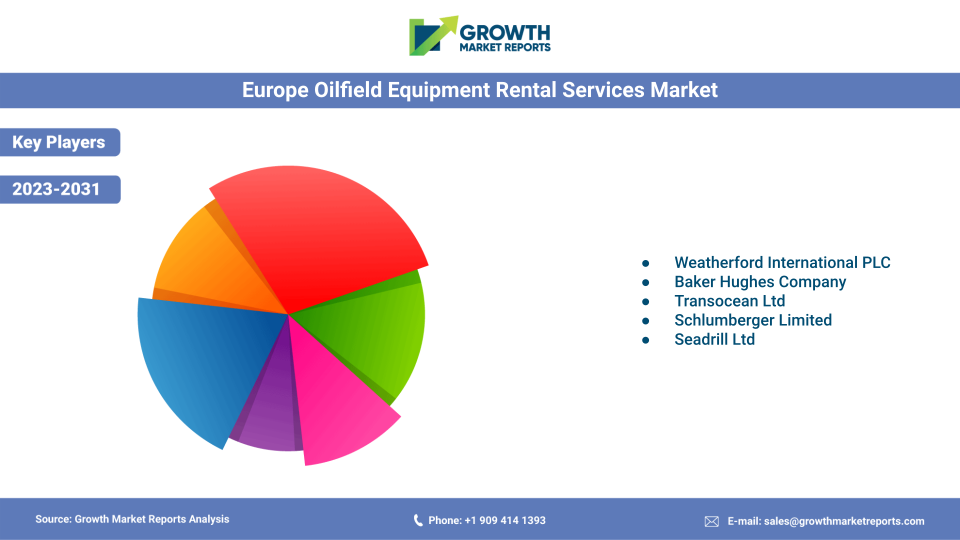
Key players competing in the Europe oilfield equipment rental services market include Weatherford International PLC, Baker Hughes Company, Transocean Ltd, Schlumberger Limited, and Seadrill Ltd.

Some of these players are using several business strategies including mergers, acquisitions, partnerships, collaborations, capacity expansion, and product launches to increase their market shares.

Europe Oilfield Equipment Rental Services Market Key Players

Frequently Asked Questions

Major players include Schlumberger Limited, Halliburton Company, Baker Hughes Company, Weatherford International, Superior Energy Services, Patterson-UTI Energy, Oil States International, National Oilwell Varco, and others.

Technological innovation, such as digital monitoring, predictive maintenance, and automation, is enhancing operational efficiency, safety, and value-added service offerings for rental clients.

Challenges include crude oil price volatility, capital-intensive nature of the industry, high costs of fleet maintenance and upgrades, and fluctuating demand linked to exploration and production cycles.

The primary end-users are oil and gas companies, drilling contractors, and other service providers such as integrated oilfield service companies and engineering firms.

Oil field equipment rental services are used in both onshore and offshore operations. Onshore applications dominate due to lower capital intensity, while offshore projects require specialized, high-specification equipment.

Renting equipment allows oil and gas companies to access the latest technologies without large capital investments, manage cash flow, scale operations flexibly, and reduce maintenance and obsolescence risks.

The most commonly rented equipment includes drilling equipment, pressure and flow control equipment, fishing equipment, and various auxiliary tools such as power generation units and mud pumps.

North America dominates the market due to extensive shale exploration in the US and Canada. The Middle East & Africa, Asia Pacific, Europe, and Latin America also contribute, with the Middle East & Africa expected to see the fastest growth.

Key growth drivers include rising global energy demand, increased exploration and production activities, technological advancements, and oil and gas companies' preference for renting equipment to optimize costs and flexibility.

As of 2024, the global oil field equipment rental services market is valued at USD 21.7 billion, with expectations to reach USD 34.7 billion by 2033.

Table Of Content

Chapter 1 Executive Summary
Chapter 2 Assumptions and Acronyms Used
Chapter 3 Research Methodology
Chapter 4 Oil field Equipment Rental Services Market Overview
   4.1 Introduction
      4.1.1 Market Taxonomy
      4.1.2 Market Definition
      4.1.3 Macro-Economic Factors Impacting the Market Growth
   4.2 Oil field Equipment Rental Services Market Dynamics
      4.2.1 Market Drivers
      4.2.2 Market Restraints
      4.2.3 Market Opportunity
   4.3 Oil field Equipment Rental Services Market - Supply Chain Analysis
      4.3.1 List of Key Suppliers
      4.3.2 List of Key Distributors
      4.3.3 List of Key Consumers
   4.4 Key Forces Shaping the Oil field Equipment Rental Services Market
      4.4.1 Bargaining Power of Suppliers
      4.4.2 Bargaining Power of Buyers
      4.4.3 Threat of Substitution
      4.4.4 Threat of New Entrants
      4.4.5 Competitive Rivalry
   4.5 Global Oil field Equipment Rental Services Market Size & Forecast, 2023-2032
      4.5.1 Oil field Equipment Rental Services Market Size and Y-o-Y Growth
      4.5.2 Oil field Equipment Rental Services Market Absolute $ Opportunity

Chapter 5 Global Oil field Equipment Rental Services Market Analysis and Forecast By Equipment Type
   5.1 Introduction
      5.1.1 Key Market Trends & Growth Opportunities By Equipment Type
      5.1.2 Basis Point Share (BPS) Analysis By Equipment Type
      5.1.3 Absolute $ Opportunity Assessment By Equipment Type
   5.2 Oil field Equipment Rental Services Market Size Forecast By Equipment Type
      5.2.1 Drilling Equipment
      5.2.2 Pressure & Flow Control Equipment
      5.2.3 Fishing Equipment
      5.2.4 Others
   5.3 Market Attractiveness Analysis By Equipment Type

Chapter 6 Global Oil field Equipment Rental Services Market Analysis and Forecast By Application
   6.1 Introduction
      6.1.1 Key Market Trends & Growth Opportunities By Application
      6.1.2 Basis Point Share (BPS) Analysis By Application
      6.1.3 Absolute $ Opportunity Assessment By Application
   6.2 Oil field Equipment Rental Services Market Size Forecast By Application
      6.2.1 Onshore
      6.2.2 Offshore
   6.3 Market Attractiveness Analysis By Application

Chapter 7 Global Oil field Equipment Rental Services Market Analysis and Forecast By End-User
   7.1 Introduction
      7.1.1 Key Market Trends & Growth Opportunities By End-User
      7.1.2 Basis Point Share (BPS) Analysis By End-User
      7.1.3 Absolute $ Opportunity Assessment By End-User
   7.2 Oil field Equipment Rental Services Market Size Forecast By End-User
      7.2.1 Oil & Gas Companies
      7.2.2 Drilling Contractors
      7.2.3 Others
   7.3 Market Attractiveness Analysis By End-User

Chapter 8 Global Oil field Equipment Rental Services Market Analysis and Forecast by Region
   8.1 Introduction
      8.1.1 Key Market Trends & Growth Opportunities By Region
      8.1.2 Basis Point Share (BPS) Analysis By Region
      8.1.3 Absolute $ Opportunity Assessment By Region
   8.2 Oil field Equipment Rental Services Market Size Forecast By Region
      8.2.1 North America
      8.2.2 Europe
      8.2.3 Asia Pacific
      8.2.4 Latin America
      8.2.5 Middle East & Africa (MEA)
   8.3 Market Attractiveness Analysis By Region

Chapter 9 Coronavirus Disease (COVID-19) Impact 
   9.1 Introduction 
   9.2 Current & Future Impact Analysis 
   9.3 Economic Impact Analysis 
   9.4 Government Policies 
   9.5 Investment Scenario

Chapter 10 North America Oil field Equipment Rental Services Analysis and Forecast
   10.1 Introduction
   10.2 North America Oil field Equipment Rental Services Market Size Forecast by Country
      10.2.1 U.S.
      10.2.2 Canada
   10.3 Basis Point Share (BPS) Analysis by Country
   10.4 Absolute $ Opportunity Assessment by Country
   10.5 Market Attractiveness Analysis by Country
   10.6 North America Oil field Equipment Rental Services Market Size Forecast By Equipment Type
      10.6.1 Drilling Equipment
      10.6.2 Pressure & Flow Control Equipment
      10.6.3 Fishing Equipment
      10.6.4 Others
   10.7 Basis Point Share (BPS) Analysis By Equipment Type 
   10.8 Absolute $ Opportunity Assessment By Equipment Type 
   10.9 Market Attractiveness Analysis By Equipment Type
   10.10 North America Oil field Equipment Rental Services Market Size Forecast By Application
      10.10.1 Onshore
      10.10.2 Offshore
   10.11 Basis Point Share (BPS) Analysis By Application 
   10.12 Absolute $ Opportunity Assessment By Application 
   10.13 Market Attractiveness Analysis By Application
   10.14 North America Oil field Equipment Rental Services Market Size Forecast By End-User
      10.14.1 Oil & Gas Companies
      10.14.2 Drilling Contractors
      10.14.3 Others
   10.15 Basis Point Share (BPS) Analysis By End-User 
   10.16 Absolute $ Opportunity Assessment By End-User 
   10.17 Market Attractiveness Analysis By End-User

Chapter 11 Europe Oil field Equipment Rental Services Analysis and Forecast
   11.1 Introduction
   11.2 Europe Oil field Equipment Rental Services Market Size Forecast by Country
      11.2.1 Germany
      11.2.2 France
      11.2.3 Italy
      11.2.4 U.K.
      11.2.5 Spain
      11.2.6 Russia
      11.2.7 Rest of Europe
   11.3 Basis Point Share (BPS) Analysis by Country
   11.4 Absolute $ Opportunity Assessment by Country
   11.5 Market Attractiveness Analysis by Country
   11.6 Europe Oil field Equipment Rental Services Market Size Forecast By Equipment Type
      11.6.1 Drilling Equipment
      11.6.2 Pressure & Flow Control Equipment
      11.6.3 Fishing Equipment
      11.6.4 Others
   11.7 Basis Point Share (BPS) Analysis By Equipment Type 
   11.8 Absolute $ Opportunity Assessment By Equipment Type 
   11.9 Market Attractiveness Analysis By Equipment Type
   11.10 Europe Oil field Equipment Rental Services Market Size Forecast By Application
      11.10.1 Onshore
      11.10.2 Offshore
   11.11 Basis Point Share (BPS) Analysis By Application 
   11.12 Absolute $ Opportunity Assessment By Application 
   11.13 Market Attractiveness Analysis By Application
   11.14 Europe Oil field Equipment Rental Services Market Size Forecast By End-User
      11.14.1 Oil & Gas Companies
      11.14.2 Drilling Contractors
      11.14.3 Others
   11.15 Basis Point Share (BPS) Analysis By End-User 
   11.16 Absolute $ Opportunity Assessment By End-User 
   11.17 Market Attractiveness Analysis By End-User

Chapter 12 Asia Pacific Oil field Equipment Rental Services Analysis and Forecast
   12.1 Introduction
   12.2 Asia Pacific Oil field Equipment Rental Services Market Size Forecast by Country
      12.2.1 China
      12.2.2 Japan
      12.2.3 South Korea
      12.2.4 India
      12.2.5 Australia
      12.2.6 South East Asia (SEA)
      12.2.7 Rest of Asia Pacific (APAC)
   12.3 Basis Point Share (BPS) Analysis by Country
   12.4 Absolute $ Opportunity Assessment by Country
   12.5 Market Attractiveness Analysis by Country
   12.6 Asia Pacific Oil field Equipment Rental Services Market Size Forecast By Equipment Type
      12.6.1 Drilling Equipment
      12.6.2 Pressure & Flow Control Equipment
      12.6.3 Fishing Equipment
      12.6.4 Others
   12.7 Basis Point Share (BPS) Analysis By Equipment Type 
   12.8 Absolute $ Opportunity Assessment By Equipment Type 
   12.9 Market Attractiveness Analysis By Equipment Type
   12.10 Asia Pacific Oil field Equipment Rental Services Market Size Forecast By Application
      12.10.1 Onshore
      12.10.2 Offshore
   12.11 Basis Point Share (BPS) Analysis By Application 
   12.12 Absolute $ Opportunity Assessment By Application 
   12.13 Market Attractiveness Analysis By Application
   12.14 Asia Pacific Oil field Equipment Rental Services Market Size Forecast By End-User
      12.14.1 Oil & Gas Companies
      12.14.2 Drilling Contractors
      12.14.3 Others
   12.15 Basis Point Share (BPS) Analysis By End-User 
   12.16 Absolute $ Opportunity Assessment By End-User 
   12.17 Market Attractiveness Analysis By End-User

Chapter 13 Latin America Oil field Equipment Rental Services Analysis and Forecast
   13.1 Introduction
   13.2 Latin America Oil field Equipment Rental Services Market Size Forecast by Country
      13.2.1 Brazil
      13.2.2 Mexico
      13.2.3 Rest of Latin America (LATAM)
   13.3 Basis Point Share (BPS) Analysis by Country
   13.4 Absolute $ Opportunity Assessment by Country
   13.5 Market Attractiveness Analysis by Country
   13.6 Latin America Oil field Equipment Rental Services Market Size Forecast By Equipment Type
      13.6.1 Drilling Equipment
      13.6.2 Pressure & Flow Control Equipment
      13.6.3 Fishing Equipment
      13.6.4 Others
   13.7 Basis Point Share (BPS) Analysis By Equipment Type 
   13.8 Absolute $ Opportunity Assessment By Equipment Type 
   13.9 Market Attractiveness Analysis By Equipment Type
   13.10 Latin America Oil field Equipment Rental Services Market Size Forecast By Application
      13.10.1 Onshore
      13.10.2 Offshore
   13.11 Basis Point Share (BPS) Analysis By Application 
   13.12 Absolute $ Opportunity Assessment By Application 
   13.13 Market Attractiveness Analysis By Application
   13.14 Latin America Oil field Equipment Rental Services Market Size Forecast By End-User
      13.14.1 Oil & Gas Companies
      13.14.2 Drilling Contractors
      13.14.3 Others
   13.15 Basis Point Share (BPS) Analysis By End-User 
   13.16 Absolute $ Opportunity Assessment By End-User 
   13.17 Market Attractiveness Analysis By End-User

Chapter 14 Middle East & Africa (MEA) Oil field Equipment Rental Services Analysis and Forecast
   14.1 Introduction
   14.2 Middle East & Africa (MEA) Oil field Equipment Rental Services Market Size Forecast by Country
      14.2.1 Saudi Arabia
      14.2.2 South Africa
      14.2.3 UAE
      14.2.4 Rest of Middle East & Africa (MEA)
   14.3 Basis Point Share (BPS) Analysis by Country
   14.4 Absolute $ Opportunity Assessment by Country
   14.5 Market Attractiveness Analysis by Country
   14.6 Middle East & Africa (MEA) Oil field Equipment Rental Services Market Size Forecast By Equipment Type
      14.6.1 Drilling Equipment
      14.6.2 Pressure & Flow Control Equipment
      14.6.3 Fishing Equipment
      14.6.4 Others
   14.7 Basis Point Share (BPS) Analysis By Equipment Type 
   14.8 Absolute $ Opportunity Assessment By Equipment Type 
   14.9 Market Attractiveness Analysis By Equipment Type
   14.10 Middle East & Africa (MEA) Oil field Equipment Rental Services Market Size Forecast By Application
      14.10.1 Onshore
      14.10.2 Offshore
   14.11 Basis Point Share (BPS) Analysis By Application 
   14.12 Absolute $ Opportunity Assessment By Application 
   14.13 Market Attractiveness Analysis By Application
   14.14 Middle East & Africa (MEA) Oil field Equipment Rental Services Market Size Forecast By End-User
      14.14.1 Oil & Gas Companies
      14.14.2 Drilling Contractors
      14.14.3 Others
   14.15 Basis Point Share (BPS) Analysis By End-User 
   14.16 Absolute $ Opportunity Assessment By End-User 
   14.17 Market Attractiveness Analysis By End-User

Chapter 15 Competition Landscape 
   15.1 Oil field Equipment Rental Services Market: Competitive Dashboard
   15.2 Global Oil field Equipment Rental Services Market: Market Share Analysis, 2023
   15.3 Company Profiles (Details – Overview, Financials, Developments, Strategy) 
      15.3.1 Schlumberger Limited
Halliburton Company
Baker Hughes Company
Weatherford International plc
Superior Energy Services, Inc.
Patterson-UTI Energy, Inc.
Oil States International, Inc.
National Oilwell Varco, Inc.
Basic Energy Services, Inc.
Key Energy Services, LLC
Ensign Energy Services Inc.
Precision Drilling Corporation
Seadrill Limited
Transocean Ltd.
Noble Corporation plc
Parker Drilling Company
Helmerich & Payne, Inc.
John Energy Ltd.
AlMansoori Specialized Engineering
COSL (China Oilfield Services Limited)

Methodology

Our Clients

sinopec
Honda Motor Co. Ltd.
Deloitte
The John Holland Group
Pfizer
Microsoft
General Electric
FedEx Logistics