Instrumentation Fittings Market Research Report 2033

Instrumentation Fittings Market Research Report 2033

Segments - by Product Type (Tube Fittings, Pipe Fittings, Flare Fittings, Compression Fittings, Others), by Material (Stainless Steel, Brass, Alloy, Others), by Application (Oil & Gas, Chemical, Power Generation, Food & Beverage, Pharmaceuticals, Others), by End-User (Industrial, Commercial, Others)

https://growthmarketreports.com/Raksha
Author : Raksha Sharma
https://growthmarketreports.com/Vaibhav
Fact-checked by : V. Chandola
https://growthmarketreports.com/Shruti
Editor : Shruti Bhat

Upcoming | Report ID :EP-650 | 4.1 Rating | 67 Reviews | 289 Pages | Format : Docx PDF

Report Description


Instrumentation Fittings Market Outlook

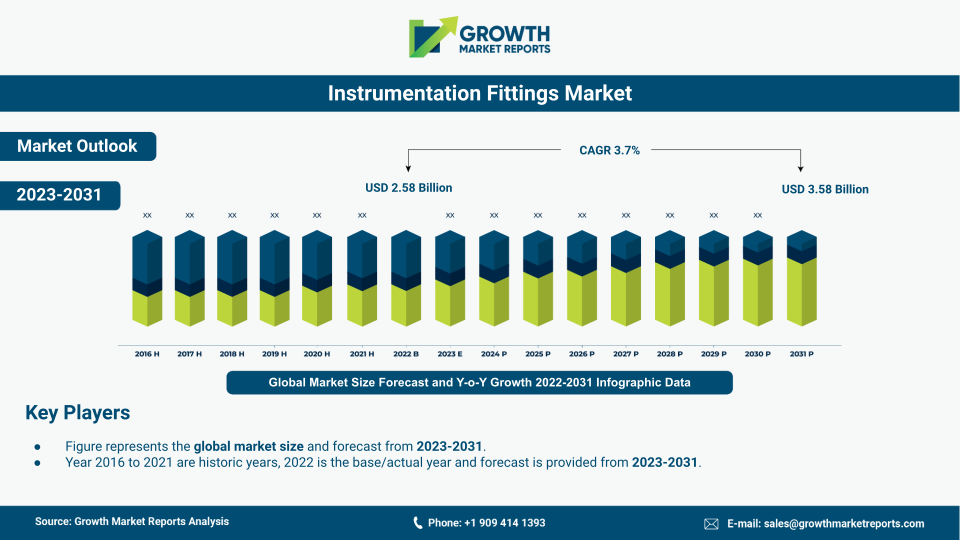
According to our latest research, the global instrumentation fittings market size reached USD 3.42 billion in 2024 and is anticipated to grow at a robust CAGR of 6.1% from 2025 to 2033. By the end of 2033, the market is forecasted to achieve a value of USD 5.80 billion. The primary growth factor driving this market is the increasing demand for precision fluid and gas control systems across industries such as oil & gas, chemicals, pharmaceuticals, and power generation, which require high-integrity and leak-proof connections for safety and efficiency.

The growth trajectory of the instrumentation fittings market is underpinned by the rapid expansion of industrial automation and process control systems across multiple sectors. As industries worldwide continue to embrace digital transformation and IoT-enabled monitoring, the need for reliable instrumentation fittings to ensure seamless and safe operation of automated systems has surged. The integration of smart sensors and advanced process instrumentation in manufacturing and processing facilities necessitates robust fittings that can withstand high pressure, temperature fluctuations, and corrosive environments. This trend is further amplified by the growing focus on operational efficiency, regulatory compliance, and the reduction of downtime, all of which are critical in sectors such as oil & gas, chemical processing, and power generation.

Another significant growth driver is the intensifying regulatory environment concerning workplace safety and environmental protection. Governments and industry bodies are enforcing stringent standards for leak prevention, emissions control, and process safety, particularly in hazardous industries. Instrumentation fittings play a pivotal role in meeting these regulatory requirements, as they are essential for creating secure and leak-proof connections in fluid and gas systems. The adoption of high-quality fittings made from advanced materials such as stainless steel and alloys is becoming increasingly common to ensure compliance with global safety norms. Additionally, the trend towards modular and scalable plant construction, especially in emerging economies, is fueling the demand for versatile and easy-to-install instrumentation fittings.

Technological advancements in material science and manufacturing processes are also propelling the instrumentation fittings market forward. The development of corrosion-resistant alloys, improved sealing technologies, and precision machining techniques has resulted in fittings that offer superior performance and longevity even in the most demanding applications. Manufacturers are investing in research and development to introduce innovative products that cater to the evolving needs of end-users, such as quick-connect fittings, zero-leakage designs, and fittings compatible with aggressive chemicals. These innovations not only enhance the reliability of instrumentation systems but also reduce maintenance costs and operational risks, thereby contributing to the overall market growth.

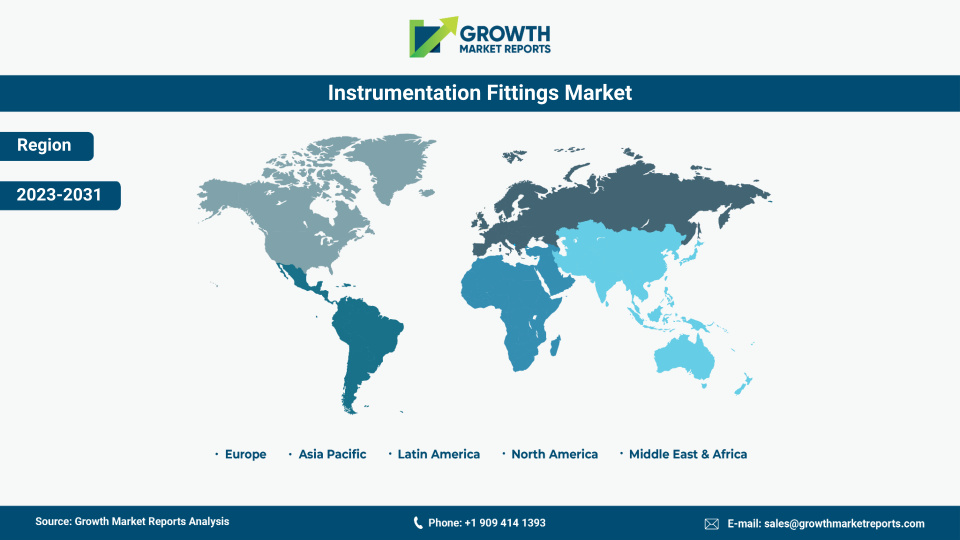
From a regional perspective, Asia Pacific continues to dominate the global instrumentation fittings market, accounting for the largest share in 2024. The region's leadership is driven by rapid industrialization, significant investments in infrastructure, and the expansion of key industries such as oil & gas, chemicals, and power generation in countries like China, India, and Southeast Asian nations. North America and Europe also represent substantial markets, supported by mature industrial sectors, stringent regulatory frameworks, and ongoing modernization of aging infrastructure. Meanwhile, the Middle East & Africa and Latin America are witnessing steady growth, propelled by increasing energy sector investments and the development of new industrial facilities.

Flare fittings are a critical component in the instrumentation fittings market, offering unique advantages in applications where quick assembly and disassembly are essential. These fittings are particularly valued in maintenance-intensive environments such as gas distribution systems and laboratory setups. The ability of flare fittings to create strong, leak-tight seals without the need for welding or soldering makes them an attractive choice for industries that prioritize operational flexibility and efficiency. As industries continue to evolve, the demand for flare fittings is expected to grow, driven by advancements in design such as double-flare and bubble-flare types, which enhance their applicability across a wider range of pressure and temperature conditions.

Global Instrumentation Fittings Industry Outlook

Product Type Analysis

The product type segment of the instrumentation fittings market is broadly categorized into tube fittings, pipe fittings, flare fittings, compression fittings, and others. Among these, tube fittings held the largest market share in 2024, owing to their extensive use in process instrumentation systems that demand high precision and leak-free performance. Tube fittings are vital in applications where accurate measurement and control of fluids and gases are required, such as in chemical processing, oil & gas, and power generation. The demand for tube fittings is further augmented by their ease of installation, versatility in handling different fluid types, and compatibility with various tubing materials, making them indispensable in both new installations and retrofit projects.

Pipe fittings represent another significant segment, driven by their widespread application in connecting and managing the flow of liquids and gases in industrial pipelines. The growth of the pipe fittings market is closely linked to the expansion of infrastructure projects and the modernization of existing facilities, especially in emerging economies. Pipe fittings are preferred for their robust construction, ability to handle high-pressure environments, and adaptability to large-diameter piping systems. The increasing adoption of automated and remotely monitored pipeline networks in oil & gas and water treatment sectors is also propelling the demand for advanced pipe fittings that offer enhanced durability and safety features.

Flare fittings are gaining traction in applications where quick assembly and disassembly are required, particularly in maintenance-intensive environments. These fittings are commonly used in gas distribution systems, laboratory setups, and instrumentation panels, where their ability to form strong, leak-tight seals without the need for welding or soldering is highly valued. The growing focus on operational flexibility and the need to minimize downtime during equipment servicing are key factors driving the adoption of flare fittings. Moreover, advancements in flare fitting designs, such as double-flare and bubble-flare types, are expanding their applicability across a wider range of pressure and temperature conditions.

Compression fittings continue to be a popular choice in the instrumentation fittings market due to their simplicity, reliability, and suitability for both metal and plastic tubing. These fittings are extensively used in applications where vibration resistance, ease of installation, and minimal maintenance are critical. The pharmaceutical, food & beverage, and water treatment industries, in particular, favor compression fittings for their hygienic design and ability to maintain system integrity under varying operational conditions. The introduction of advanced sealing materials and ergonomically designed compression nuts is further enhancing the performance and user-friendliness of these fittings.

The "others" category includes specialty fittings such as push-to-connect, quick-disconnect, and custom-designed fittings tailored to specific customer requirements. This segment is witnessing steady growth as end-users seek innovative solutions to address unique operational challenges, such as space constraints, aggressive media compatibility, and rapid system changes. Manufacturers are responding by offering a wider range of configurable and high-performance fittings, thereby catering to the diverse and evolving needs of the global market.

Report Scope

Attributes Details
Report Title Instrumentation Fittings Market Research Report 2033
By Product Type Tube Fittings, Pipe Fittings, Flare Fittings, Compression Fittings, Others
By Material Stainless Steel, Brass, Alloy, Others
By Application Oil & Gas, Chemical, Power Generation, Food & Beverage, Pharmaceuticals, Others
By End-User Industrial, Commercial, Others
Regions Covered North America, Europe, APAC, Latin America, MEA
Base Year 2024
Historic Data 2018-2023
Forecast Period 2025-2033
Number of Pages 289
Number of Tables & Figures 256
Customization Available Yes, the report can be customized as per your need.

Material Analysis

The material segment of the instrumentation fittings market is dominated by stainless steel, which accounted for the largest share in 2024. Stainless steel fittings are highly sought after for their exceptional corrosion resistance, mechanical strength, and ability to withstand extreme temperatures and pressures. These properties make stainless steel the material of choice for demanding applications in oil & gas, chemical processing, and power generation, where system reliability and safety are paramount. The increasing adoption of stainless steel fittings is also driven by their compliance with stringent industry standards and regulations, ensuring long-term performance and minimal maintenance requirements.

Brass fittings occupy a significant position in the market, particularly in applications where cost-effectiveness and moderate corrosion resistance are important. Brass is favored for its ease of machining, good sealing properties, and compatibility with a wide range of fluids and gases. The food & beverage, water treatment, and HVAC industries commonly utilize brass fittings due to their non-reactive nature and suitability for potable water systems. Recent advancements in lead-free brass formulations are further enhancing the market appeal of brass fittings, especially in regions with strict regulations on lead content in plumbing and fluid handling systems.

Alloy fittings, including those made from nickel, copper, and specialized alloys, are gaining prominence in applications that require superior resistance to aggressive chemicals, high temperatures, and mechanical stress. The chemical processing, pharmaceuticals, and marine industries are major consumers of alloy fittings, as these materials offer enhanced durability and performance in challenging environments. The ongoing development of new alloy compositions and surface treatments is expanding the application scope of alloy fittings, enabling them to meet the evolving demands of modern industrial processes.

The "others" material segment encompasses fittings made from plastics, composites, and specialty metals. Plastic fittings, in particular, are witnessing increased adoption in industries such as pharmaceuticals, biotechnology, and food processing, where chemical inertness, lightweight construction, and ease of cleaning are critical. Composite and specialty metal fittings are also being developed to address unique operational challenges, such as extreme temperature resistance and compatibility with ultra-pure media. The growing emphasis on sustainability and the use of recyclable materials is expected to further drive innovation in this segment.

Overall, the choice of material for instrumentation fittings is heavily influenced by factors such as application requirements, operating environment, regulatory compliance, and total cost of ownership. Manufacturers are continuously investing in research and development to introduce new materials and coatings that enhance the performance, safety, and longevity of their products, thereby supporting the sustained growth of the global market.

Application Analysis

The application landscape of the instrumentation fittings market is highly diversified, with oil & gas emerging as the dominant segment in 2024. The oil & gas industry relies extensively on instrumentation fittings for critical operations such as drilling, extraction, refining, and transportation of hydrocarbons. The need for leak-proof, high-pressure, and corrosion-resistant fittings is paramount in this sector, given the hazardous nature of the fluids and gases involved. The ongoing expansion of upstream and downstream infrastructure, coupled with the adoption of advanced process control and safety systems, is driving sustained demand for high-performance instrumentation fittings in the oil & gas sector.

The chemical industry represents another major application area, characterized by complex processes that involve aggressive chemicals, high temperatures, and stringent safety requirements. Instrumentation fittings play a vital role in ensuring the safe and efficient transfer, measurement, and control of fluids and gases within chemical plants. The increasing adoption of automation, digital monitoring, and smart process control systems is further boosting the demand for reliable and durable fittings that can withstand the rigors of chemical processing environments.

Power generation is a rapidly growing application segment, driven by the global transition towards cleaner and more efficient energy sources. Instrumentation fittings are essential components in both conventional and renewable power plants, where they are used in systems for steam generation, cooling, fuel handling, and emissions control. The modernization of aging power infrastructure and the construction of new facilities, particularly in emerging economies, are creating significant opportunities for instrumentation fittings manufacturers. The need for high-integrity connections in high-pressure and high-temperature environments is a key driver in this segment.

The food & beverage and pharmaceutical industries are also major consumers of instrumentation fittings, owing to their stringent requirements for hygiene, product purity, and process control. In these sectors, fittings must comply with rigorous industry standards and regulations to prevent contamination and ensure product safety. The growing trend towards automation, real-time monitoring, and the use of advanced materials in processing equipment is fueling demand for specialized fittings that offer superior cleanliness, chemical resistance, and ease of maintenance.

Other application areas, such as water treatment, HVAC, and laboratory systems, are witnessing steady growth as industries prioritize operational efficiency, environmental sustainability, and regulatory compliance. The increasing adoption of smart instrumentation and IoT-enabled monitoring solutions in these sectors is further driving the need for high-quality fittings that can support advanced data collection, leak detection, and system optimization.

End-User Analysis

The end-user segment of the instrumentation fittings market is predominantly led by the industrial sector, which accounted for the largest share in 2024. Industrial end-users encompass a wide range of industries, including oil & gas, chemicals, power generation, manufacturing, and water treatment, all of which require robust and reliable instrumentation fittings for critical process control and safety applications. The ongoing trends of industrial automation, process optimization, and regulatory compliance are driving continuous investment in high-performance fittings that can withstand demanding operational conditions and ensure system integrity.

Commercial end-users represent another important segment, encompassing sectors such as HVAC, building automation, food service, and laboratory equipment. The demand for instrumentation fittings in commercial applications is driven by the need for efficient fluid and gas management, energy savings, and compliance with safety and environmental standards. The increasing adoption of smart building technologies, energy-efficient HVAC systems, and automated laboratory setups is creating new opportunities for instrumentation fittings manufacturers to provide innovative solutions tailored to the unique needs of commercial customers.

The "others" category includes specialized end-users such as research institutions, educational facilities, and government laboratories, which require precision fittings for scientific experiments, pilot plants, and prototype development. These end-users often demand custom-designed fittings that offer exceptional performance, flexibility, and compatibility with advanced instrumentation systems. The growth of research and development activities in fields such as biotechnology, nanotechnology, and environmental science is contributing to the steady expansion of this segment.

Across all end-user segments, the emphasis on operational efficiency, safety, and sustainability is driving the adoption of advanced instrumentation fittings. Manufacturers are responding by offering a broader range of products, including modular fittings, quick-connect solutions, and fittings made from eco-friendly materials. The increasing focus on total cost of ownership, ease of maintenance, and system scalability is also influencing purchasing decisions, with end-users seeking fittings that deliver long-term value and reliability.

The evolving needs of end-users are prompting manufacturers to invest in product innovation, customization, and after-sales support, ensuring that their offerings remain aligned with the dynamic requirements of the global market. This customer-centric approach is expected to play a crucial role in sustaining the growth and competitiveness of the instrumentation fittings market in the coming years.

Opportunities & Threats

The instrumentation fittings market is poised for significant opportunities in the coming years, primarily driven by the rapid adoption of Industry 4.0 and smart manufacturing technologies. As industries continue to digitize and automate their operations, the demand for high-quality, precision-engineered fittings that can support real-time monitoring, predictive maintenance, and advanced process control is set to rise. The integration of IoT, artificial intelligence, and data analytics into industrial systems is creating new requirements for fittings that offer enhanced connectivity, compatibility with smart sensors, and seamless integration with digital platforms. Manufacturers that invest in developing innovative, technologically advanced products are well-positioned to capitalize on these emerging trends and capture new growth opportunities.

Another major opportunity lies in the expansion of infrastructure projects and industrial facilities in emerging economies, particularly in Asia Pacific, Latin America, and the Middle East & Africa. Governments and private sector players in these regions are investing heavily in energy, water, transportation, and manufacturing infrastructure to support economic growth and urbanization. This, in turn, is driving demand for reliable and cost-effective instrumentation fittings that can ensure the safe and efficient operation of complex process systems. The growing emphasis on sustainability, energy efficiency, and environmental protection is also creating opportunities for manufacturers to develop fittings made from eco-friendly materials, incorporate recyclable components, and offer solutions that help end-users reduce their environmental footprint.

Despite the positive outlook, the market faces certain restraints that could hinder its growth trajectory. One of the primary challenges is the volatility in raw material prices, particularly for stainless steel, brass, and specialty alloys, which can impact production costs and profit margins for manufacturers. Additionally, the presence of low-cost, substandard products in the market poses a threat to established players, as it can lead to increased competition and price pressure. Stringent regulatory requirements and the need for continuous product innovation to meet evolving industry standards also present challenges for manufacturers, requiring significant investments in research and development, quality assurance, and compliance management.

Regional Outlook

The Asia Pacific region dominated the global instrumentation fittings market in 2024, accounting for a market size of USD 1.28 billion. The region's leadership is attributed to rapid industrialization, significant investments in oil & gas, chemical processing, and power generation, and the expansion of manufacturing facilities in China, India, South Korea, and Southeast Asian countries. The ongoing development of infrastructure projects, coupled with the adoption of advanced automation and process control systems, is driving robust demand for instrumentation fittings across diverse industries. The Asia Pacific market is projected to exhibit the highest CAGR of 7.2% from 2025 to 2033, supported by favorable government policies, increasing foreign direct investment, and the growing focus on energy efficiency and environmental sustainability.

North America is the second-largest market for instrumentation fittings, with a market size of USD 0.92 billion in 2024. The region's mature industrial sector, stringent regulatory environment, and ongoing modernization of aging infrastructure are key factors supporting market growth. The United States and Canada are leading markets within the region, driven by significant investments in oil & gas exploration, chemical manufacturing, and power generation. The increasing adoption of digital technologies, IoT-enabled monitoring, and smart process control systems is further fueling demand for advanced instrumentation fittings that offer high performance, reliability, and compliance with industry standards.

Europe accounted for a market size of USD 0.78 billion in 2024, characterized by a strong emphasis on process safety, environmental protection, and technological innovation. The region's well-established chemical, pharmaceutical, and power generation industries are major consumers of high-quality instrumentation fittings. The ongoing transition towards renewable energy, the modernization of industrial facilities, and the adoption of advanced automation solutions are driving steady demand for instrumentation fittings in Europe. Meanwhile, Latin America and the Middle East & Africa collectively contributed USD 0.44 billion to the global market in 2024, with growth driven by investments in energy, water, and industrial infrastructure, as well as the expansion of oil & gas and petrochemical projects.

Instrumentation Fittings Market Statistics

Competitor Outlook

The global instrumentation fittings market is characterized by intense competition, with a mix of established multinational corporations and regional players vying for market share. The competitive landscape is shaped by factors such as product quality, technological innovation, pricing strategies, and customer service. Leading companies are continuously investing in research and development to introduce new products that offer enhanced performance, reliability, and ease of installation. The ability to provide customized solutions, comprehensive after-sales support, and compliance with international standards is also a key differentiator in this highly competitive market.

Strategic partnerships, mergers and acquisitions, and geographic expansion are common strategies adopted by major players to strengthen their market position and expand their global footprint. Companies are increasingly focusing on developing eco-friendly and sustainable products to align with the growing emphasis on environmental responsibility and regulatory compliance. The adoption of digital technologies, such as IoT-enabled fittings and smart monitoring solutions, is also gaining traction, as end-users seek to enhance operational efficiency and reduce maintenance costs.

The market is witnessing a trend towards consolidation, with larger players acquiring smaller, niche firms to broaden their product portfolios and gain access to new markets and technologies. At the same time, regional players are leveraging their local expertise and customer relationships to compete effectively with global giants. The competitive intensity is further heightened by the presence of low-cost manufacturers, particularly in Asia Pacific, who offer price-competitive products to cater to the needs of cost-sensitive customers.

Some of the major companies operating in the instrumentation fittings market include Swagelok Company, Parker Hannifin Corporation, Hy-Lok Corporation, DK-Lok Corporation, Ham-Let Group, and SSP Fittings Corp. Swagelok Company is renowned for its high-quality tube fittings, valves, and regulators, serving a wide range of industries globally. Parker Hannifin Corporation offers an extensive portfolio of instrumentation fittings and flow control solutions, with a strong focus on innovation and customer-centric product development. Hy-Lok Corporation and DK-Lok Corporation are recognized for their comprehensive range of fittings and valves, catering to the needs of the oil & gas, chemical, and power industries.

Ham-Let Group specializes in advanced instrumentation and process control products, with a strong presence in the global market. SSP Fittings Corp is known for its precision-engineered fittings and commitment to quality and reliability. These companies are continuously expanding their product offerings, investing in research and development, and exploring new market opportunities to maintain their competitive edge. The collective efforts of these leading players are driving innovation, setting industry benchmarks, and shaping the future of the global instrumentation fittings market.

Key Players

  • Swagelok
  • Parker Hannifin
  • Hy-Lok
  • Ham-Let Group
  • DK-Lok
  • Fujikin Incorporated
  • Eaton Corporation
  • FITOK Group
  • Hoke Inc.
  • Brennan Industries
  • AS-Schneider
  • Oliver Valves
  • Tylok International
  • Superlok (BMT Co., Ltd.)
  • S-Lok (Sunwoo Valve Co., Ltd.)
  • Hex Valve
  • Rotarex
  • Anderson Greenwood (Emerson)
  • SSP Fittings Corp.
  • Astec Valves & Fittings Pvt. Ltd.
Instrumentation Fittings Market Overview

Segments

The Instrumentation Fittings market has been segmented on the basis of

Product Type

  • Tube Fittings
  • Pipe Fittings
  • Flare Fittings
  • Compression Fittings
  • Others

Material

  • Stainless Steel
  • Brass
  • Alloy
  • Others

Application

  • Oil & Gas
  • Chemical
  • Power Generation
  • Food & Beverage
  • Pharmaceuticals
  • Others

End-User

  • Industrial
  • Commercial
  • Others

Competitive Landscape

The major players of the market are Allied International S.R.L, As-Schneider, Astec Valves & Fittings, BMT Superlok Asia Pte Ltd, Fujikin of America, Inc, Ham-Let Group, Hoke, Hy-Lok Usa, Parker Hannifin, Swagelok Company, Vesbo Asia Pte Ltd, World Wide Fittings Inc. Companies are engaging in mergers, acquisitions, and partnerships to expand their market share.
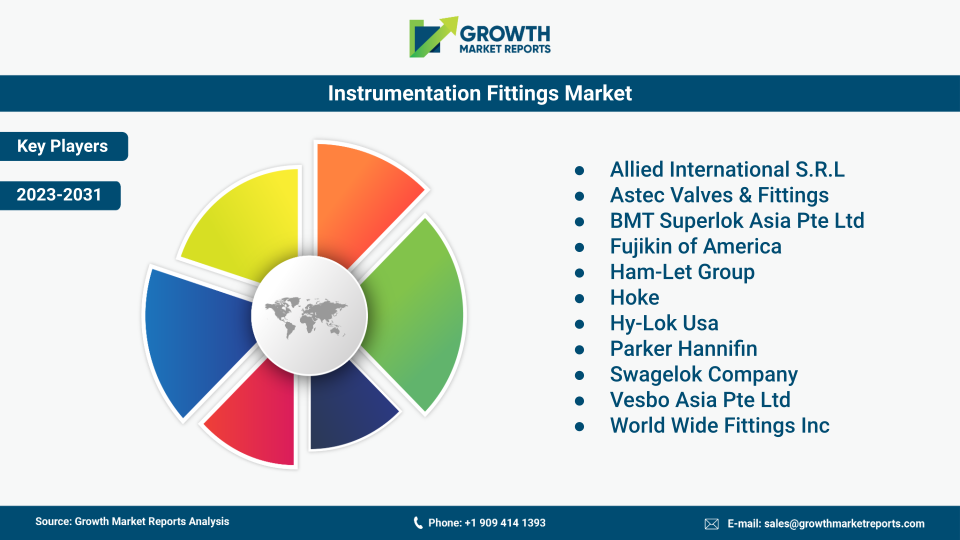
Instrumentation Fittings Market Key Players

Frequently Asked Questions

The adoption of Industry 4.0 and smart manufacturing is expected to increase demand for precision-engineered fittings that support real-time monitoring, predictive maintenance, and seamless integration with digital and IoT-enabled systems.

Instrumentation fittings are widely used in applications such as process control, fluid and gas transfer, measurement, and monitoring in industries like oil & gas, chemical processing, power generation, food & beverage, and pharmaceuticals.

Leading players include Swagelok Company, Parker Hannifin Corporation, Hy-Lok Corporation, DK-Lok Corporation, Ham-Let Group, SSP Fittings Corp., Fujikin Incorporated, Eaton Corporation, FITOK Group, and others.

Major challenges include volatility in raw material prices, competition from low-cost manufacturers, stringent regulatory requirements, and the need for continuous product innovation to meet evolving industry standards.

Asia Pacific dominates the market, accounting for the largest share in 2024, driven by rapid industrialization, infrastructure investments, and the expansion of industries such as oil & gas, chemicals, and power generation.

Key trends include the integration of IoT and smart sensors, development of corrosion-resistant alloys, improved sealing technologies, and the introduction of quick-connect and zero-leakage designs to enhance reliability and reduce maintenance.

Stainless steel is the most commonly used material due to its exceptional corrosion resistance, mechanical strength, and ability to withstand extreme temperatures and pressures, making it ideal for demanding industrial applications.

The main types of instrumentation fittings are tube fittings, pipe fittings, flare fittings, compression fittings, and specialty fittings such as push-to-connect and quick-disconnect fittings.

Key industries driving demand include oil & gas, chemicals, pharmaceuticals, power generation, food & beverage, and water treatment, all of which require high-integrity and leak-proof connections for safety and efficiency.

The global instrumentation fittings market reached USD 3.42 billion in 2024 and is expected to grow at a CAGR of 6.1% from 2025 to 2033, reaching USD 5.80 billion by 2033.

Table Of Content

Chapter 1 Executive Summary
Chapter 2 Assumptions and Acronyms Used
Chapter 3 Research Methodology
Chapter 4 Instrumentation Fittings Market Overview
   4.1 Introduction
      4.1.1 Market Taxonomy
      4.1.2 Market Definition
      4.1.3 Macro-Economic Factors Impacting the Market Growth
   4.2 Instrumentation Fittings Market Dynamics
      4.2.1 Market Drivers
      4.2.2 Market Restraints
      4.2.3 Market Opportunity
   4.3 Instrumentation Fittings Market - Supply Chain Analysis
      4.3.1 List of Key Suppliers
      4.3.2 List of Key Distributors
      4.3.3 List of Key Consumers
   4.4 Key Forces Shaping the Instrumentation Fittings Market
      4.4.1 Bargaining Power of Suppliers
      4.4.2 Bargaining Power of Buyers
      4.4.3 Threat of Substitution
      4.4.4 Threat of New Entrants
      4.4.5 Competitive Rivalry
   4.5 Global Instrumentation Fittings Market Size & Forecast, 2023-2032
      4.5.1 Instrumentation Fittings Market Size and Y-o-Y Growth
      4.5.2 Instrumentation Fittings Market Absolute $ Opportunity

Chapter 5 Global Instrumentation Fittings Market Analysis and Forecast By Product Type
   5.1 Introduction
      5.1.1 Key Market Trends & Growth Opportunities By Product Type
      5.1.2 Basis Point Share (BPS) Analysis By Product Type
      5.1.3 Absolute $ Opportunity Assessment By Product Type
   5.2 Instrumentation Fittings Market Size Forecast By Product Type
      5.2.1 Tube Fittings
      5.2.2 Pipe Fittings
      5.2.3 Flare Fittings
      5.2.4 Compression Fittings
      5.2.5 Others
   5.3 Market Attractiveness Analysis By Product Type

Chapter 6 Global Instrumentation Fittings Market Analysis and Forecast By Material
   6.1 Introduction
      6.1.1 Key Market Trends & Growth Opportunities By Material
      6.1.2 Basis Point Share (BPS) Analysis By Material
      6.1.3 Absolute $ Opportunity Assessment By Material
   6.2 Instrumentation Fittings Market Size Forecast By Material
      6.2.1 Stainless Steel
      6.2.2 Brass
      6.2.3 Alloy
      6.2.4 Others
   6.3 Market Attractiveness Analysis By Material

Chapter 7 Global Instrumentation Fittings Market Analysis and Forecast By Application
   7.1 Introduction
      7.1.1 Key Market Trends & Growth Opportunities By Application
      7.1.2 Basis Point Share (BPS) Analysis By Application
      7.1.3 Absolute $ Opportunity Assessment By Application
   7.2 Instrumentation Fittings Market Size Forecast By Application
      7.2.1 Oil & Gas
      7.2.2 Chemical
      7.2.3 Power Generation
      7.2.4 Food & Beverage
      7.2.5 Pharmaceuticals
      7.2.6 Others
   7.3 Market Attractiveness Analysis By Application

Chapter 8 Global Instrumentation Fittings Market Analysis and Forecast By End-User
   8.1 Introduction
      8.1.1 Key Market Trends & Growth Opportunities By End-User
      8.1.2 Basis Point Share (BPS) Analysis By End-User
      8.1.3 Absolute $ Opportunity Assessment By End-User
   8.2 Instrumentation Fittings Market Size Forecast By End-User
      8.2.1 Industrial
      8.2.2 Commercial
      8.2.3 Others
   8.3 Market Attractiveness Analysis By End-User

Chapter 9 Global Instrumentation Fittings Market Analysis and Forecast by Region
   9.1 Introduction
      9.1.1 Key Market Trends & Growth Opportunities By Region
      9.1.2 Basis Point Share (BPS) Analysis By Region
      9.1.3 Absolute $ Opportunity Assessment By Region
   9.2 Instrumentation Fittings Market Size Forecast By Region
      9.2.1 North America
      9.2.2 Europe
      9.2.3 Asia Pacific
      9.2.4 Latin America
      9.2.5 Middle East & Africa (MEA)
   9.3 Market Attractiveness Analysis By Region

Chapter 10 Coronavirus Disease (COVID-19) Impact 
   10.1 Introduction 
   10.2 Current & Future Impact Analysis 
   10.3 Economic Impact Analysis 
   10.4 Government Policies 
   10.5 Investment Scenario

Chapter 11 North America Instrumentation Fittings Analysis and Forecast
   11.1 Introduction
   11.2 North America Instrumentation Fittings Market Size Forecast by Country
      11.2.1 U.S.
      11.2.2 Canada
   11.3 Basis Point Share (BPS) Analysis by Country
   11.4 Absolute $ Opportunity Assessment by Country
   11.5 Market Attractiveness Analysis by Country
   11.6 North America Instrumentation Fittings Market Size Forecast By Product Type
      11.6.1 Tube Fittings
      11.6.2 Pipe Fittings
      11.6.3 Flare Fittings
      11.6.4 Compression Fittings
      11.6.5 Others
   11.7 Basis Point Share (BPS) Analysis By Product Type 
   11.8 Absolute $ Opportunity Assessment By Product Type 
   11.9 Market Attractiveness Analysis By Product Type
   11.10 North America Instrumentation Fittings Market Size Forecast By Material
      11.10.1 Stainless Steel
      11.10.2 Brass
      11.10.3 Alloy
      11.10.4 Others
   11.11 Basis Point Share (BPS) Analysis By Material 
   11.12 Absolute $ Opportunity Assessment By Material 
   11.13 Market Attractiveness Analysis By Material
   11.14 North America Instrumentation Fittings Market Size Forecast By Application
      11.14.1 Oil & Gas
      11.14.2 Chemical
      11.14.3 Power Generation
      11.14.4 Food & Beverage
      11.14.5 Pharmaceuticals
      11.14.6 Others
   11.15 Basis Point Share (BPS) Analysis By Application 
   11.16 Absolute $ Opportunity Assessment By Application 
   11.17 Market Attractiveness Analysis By Application
   11.18 North America Instrumentation Fittings Market Size Forecast By End-User
      11.18.1 Industrial
      11.18.2 Commercial
      11.18.3 Others
   11.19 Basis Point Share (BPS) Analysis By End-User 
   11.20 Absolute $ Opportunity Assessment By End-User 
   11.21 Market Attractiveness Analysis By End-User

Chapter 12 Europe Instrumentation Fittings Analysis and Forecast
   12.1 Introduction
   12.2 Europe Instrumentation Fittings Market Size Forecast by Country
      12.2.1 Germany
      12.2.2 France
      12.2.3 Italy
      12.2.4 U.K.
      12.2.5 Spain
      12.2.6 Russia
      12.2.7 Rest of Europe
   12.3 Basis Point Share (BPS) Analysis by Country
   12.4 Absolute $ Opportunity Assessment by Country
   12.5 Market Attractiveness Analysis by Country
   12.6 Europe Instrumentation Fittings Market Size Forecast By Product Type
      12.6.1 Tube Fittings
      12.6.2 Pipe Fittings
      12.6.3 Flare Fittings
      12.6.4 Compression Fittings
      12.6.5 Others
   12.7 Basis Point Share (BPS) Analysis By Product Type 
   12.8 Absolute $ Opportunity Assessment By Product Type 
   12.9 Market Attractiveness Analysis By Product Type
   12.10 Europe Instrumentation Fittings Market Size Forecast By Material
      12.10.1 Stainless Steel
      12.10.2 Brass
      12.10.3 Alloy
      12.10.4 Others
   12.11 Basis Point Share (BPS) Analysis By Material 
   12.12 Absolute $ Opportunity Assessment By Material 
   12.13 Market Attractiveness Analysis By Material
   12.14 Europe Instrumentation Fittings Market Size Forecast By Application
      12.14.1 Oil & Gas
      12.14.2 Chemical
      12.14.3 Power Generation
      12.14.4 Food & Beverage
      12.14.5 Pharmaceuticals
      12.14.6 Others
   12.15 Basis Point Share (BPS) Analysis By Application 
   12.16 Absolute $ Opportunity Assessment By Application 
   12.17 Market Attractiveness Analysis By Application
   12.18 Europe Instrumentation Fittings Market Size Forecast By End-User
      12.18.1 Industrial
      12.18.2 Commercial
      12.18.3 Others
   12.19 Basis Point Share (BPS) Analysis By End-User 
   12.20 Absolute $ Opportunity Assessment By End-User 
   12.21 Market Attractiveness Analysis By End-User

Chapter 13 Asia Pacific Instrumentation Fittings Analysis and Forecast
   13.1 Introduction
   13.2 Asia Pacific Instrumentation Fittings Market Size Forecast by Country
      13.2.1 China
      13.2.2 Japan
      13.2.3 South Korea
      13.2.4 India
      13.2.5 Australia
      13.2.6 South East Asia (SEA)
      13.2.7 Rest of Asia Pacific (APAC)
   13.3 Basis Point Share (BPS) Analysis by Country
   13.4 Absolute $ Opportunity Assessment by Country
   13.5 Market Attractiveness Analysis by Country
   13.6 Asia Pacific Instrumentation Fittings Market Size Forecast By Product Type
      13.6.1 Tube Fittings
      13.6.2 Pipe Fittings
      13.6.3 Flare Fittings
      13.6.4 Compression Fittings
      13.6.5 Others
   13.7 Basis Point Share (BPS) Analysis By Product Type 
   13.8 Absolute $ Opportunity Assessment By Product Type 
   13.9 Market Attractiveness Analysis By Product Type
   13.10 Asia Pacific Instrumentation Fittings Market Size Forecast By Material
      13.10.1 Stainless Steel
      13.10.2 Brass
      13.10.3 Alloy
      13.10.4 Others
   13.11 Basis Point Share (BPS) Analysis By Material 
   13.12 Absolute $ Opportunity Assessment By Material 
   13.13 Market Attractiveness Analysis By Material
   13.14 Asia Pacific Instrumentation Fittings Market Size Forecast By Application
      13.14.1 Oil & Gas
      13.14.2 Chemical
      13.14.3 Power Generation
      13.14.4 Food & Beverage
      13.14.5 Pharmaceuticals
      13.14.6 Others
   13.15 Basis Point Share (BPS) Analysis By Application 
   13.16 Absolute $ Opportunity Assessment By Application 
   13.17 Market Attractiveness Analysis By Application
   13.18 Asia Pacific Instrumentation Fittings Market Size Forecast By End-User
      13.18.1 Industrial
      13.18.2 Commercial
      13.18.3 Others
   13.19 Basis Point Share (BPS) Analysis By End-User 
   13.20 Absolute $ Opportunity Assessment By End-User 
   13.21 Market Attractiveness Analysis By End-User

Chapter 14 Latin America Instrumentation Fittings Analysis and Forecast
   14.1 Introduction
   14.2 Latin America Instrumentation Fittings Market Size Forecast by Country
      14.2.1 Brazil
      14.2.2 Mexico
      14.2.3 Rest of Latin America (LATAM)
   14.3 Basis Point Share (BPS) Analysis by Country
   14.4 Absolute $ Opportunity Assessment by Country
   14.5 Market Attractiveness Analysis by Country
   14.6 Latin America Instrumentation Fittings Market Size Forecast By Product Type
      14.6.1 Tube Fittings
      14.6.2 Pipe Fittings
      14.6.3 Flare Fittings
      14.6.4 Compression Fittings
      14.6.5 Others
   14.7 Basis Point Share (BPS) Analysis By Product Type 
   14.8 Absolute $ Opportunity Assessment By Product Type 
   14.9 Market Attractiveness Analysis By Product Type
   14.10 Latin America Instrumentation Fittings Market Size Forecast By Material
      14.10.1 Stainless Steel
      14.10.2 Brass
      14.10.3 Alloy
      14.10.4 Others
   14.11 Basis Point Share (BPS) Analysis By Material 
   14.12 Absolute $ Opportunity Assessment By Material 
   14.13 Market Attractiveness Analysis By Material
   14.14 Latin America Instrumentation Fittings Market Size Forecast By Application
      14.14.1 Oil & Gas
      14.14.2 Chemical
      14.14.3 Power Generation
      14.14.4 Food & Beverage
      14.14.5 Pharmaceuticals
      14.14.6 Others
   14.15 Basis Point Share (BPS) Analysis By Application 
   14.16 Absolute $ Opportunity Assessment By Application 
   14.17 Market Attractiveness Analysis By Application
   14.18 Latin America Instrumentation Fittings Market Size Forecast By End-User
      14.18.1 Industrial
      14.18.2 Commercial
      14.18.3 Others
   14.19 Basis Point Share (BPS) Analysis By End-User 
   14.20 Absolute $ Opportunity Assessment By End-User 
   14.21 Market Attractiveness Analysis By End-User

Chapter 15 Middle East & Africa (MEA) Instrumentation Fittings Analysis and Forecast
   15.1 Introduction
   15.2 Middle East & Africa (MEA) Instrumentation Fittings Market Size Forecast by Country
      15.2.1 Saudi Arabia
      15.2.2 South Africa
      15.2.3 UAE
      15.2.4 Rest of Middle East & Africa (MEA)
   15.3 Basis Point Share (BPS) Analysis by Country
   15.4 Absolute $ Opportunity Assessment by Country
   15.5 Market Attractiveness Analysis by Country
   15.6 Middle East & Africa (MEA) Instrumentation Fittings Market Size Forecast By Product Type
      15.6.1 Tube Fittings
      15.6.2 Pipe Fittings
      15.6.3 Flare Fittings
      15.6.4 Compression Fittings
      15.6.5 Others
   15.7 Basis Point Share (BPS) Analysis By Product Type 
   15.8 Absolute $ Opportunity Assessment By Product Type 
   15.9 Market Attractiveness Analysis By Product Type
   15.10 Middle East & Africa (MEA) Instrumentation Fittings Market Size Forecast By Material
      15.10.1 Stainless Steel
      15.10.2 Brass
      15.10.3 Alloy
      15.10.4 Others
   15.11 Basis Point Share (BPS) Analysis By Material 
   15.12 Absolute $ Opportunity Assessment By Material 
   15.13 Market Attractiveness Analysis By Material
   15.14 Middle East & Africa (MEA) Instrumentation Fittings Market Size Forecast By Application
      15.14.1 Oil & Gas
      15.14.2 Chemical
      15.14.3 Power Generation
      15.14.4 Food & Beverage
      15.14.5 Pharmaceuticals
      15.14.6 Others
   15.15 Basis Point Share (BPS) Analysis By Application 
   15.16 Absolute $ Opportunity Assessment By Application 
   15.17 Market Attractiveness Analysis By Application
   15.18 Middle East & Africa (MEA) Instrumentation Fittings Market Size Forecast By End-User
      15.18.1 Industrial
      15.18.2 Commercial
      15.18.3 Others
   15.19 Basis Point Share (BPS) Analysis By End-User 
   15.20 Absolute $ Opportunity Assessment By End-User 
   15.21 Market Attractiveness Analysis By End-User

Chapter 16 Competition Landscape 
   16.1 Instrumentation Fittings Market: Competitive Dashboard
   16.2 Global Instrumentation Fittings Market: Market Share Analysis, 2023
   16.3 Company Profiles (Details – Overview, Financials, Developments, Strategy) 
      16.3.1 Swagelok
Parker Hannifin
Hy-Lok
Ham-Let Group
DK-Lok
Fujikin Incorporated
Eaton Corporation
FITOK Group
Hoke Inc.
Brennan Industries
AS-Schneider
Oliver Valves
Tylok International
Superlok (BMT Co., Ltd.)
S-Lok (Sunwoo Valve Co., Ltd.)
Hex Valve
Rotarex
Anderson Greenwood (Emerson)
SSP Fittings Corp.
Astec Valves & Fittings Pvt. Ltd.

Methodology

Our Clients

FedEx Logistics
Nestle SA
sinopec
General Mills
Microsoft
Honda Motor Co. Ltd.
Pfizer
The John Holland Group