Segments - by Product Types (Primer, Basecoat, Filler, Topcoat, Others) by Resin Types (Acrylic, Alkyd, Polyurethane, Others) by Technology Used (Waterborne, Solvent borne, UV-cured), By Latin America - Latin America Industry Analysis, Growth, Share, Size, Trends, and Forecast 2020 – 2027
Segments - by Product Types (Primer, Basecoat, Filler, Topcoat, Others) by Resin Types (Acrylic, Alkyd, Polyurethane, Others) by Technology Used (Waterborne, Solvent borne, UV-cured), By Latin America - Latin America Industry Analysis, Growth, Share, Size, Trends, and Forecast 2020 – 2027
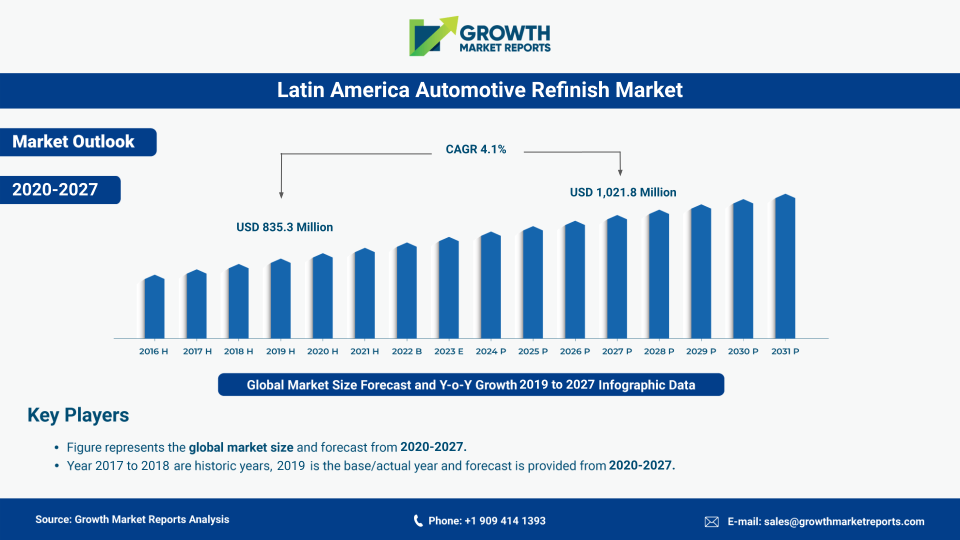
The Latin America Automotive Refinish market size was valued at USD 835.3 Million in 2019 and is projected to reach USD 1,021.8 Million by 2027, expanding at a CAGR of4.1% during the forecast period 2020-2027. The demand for automotive refinish is growing as the disposable income of people in Latin America is on the rise.
Moreover, automotive refinish coatings or paints are used to enhance the durability and appearance of a vehicle. These coatings are used for commercial and passenger vehicles, usually these coats are used on vehicles after coachwork or some mechanical repair work. Growing acceptance of automotive refinish for passenger and commercial vehicles is expected to crate lucrative opportunities for automotive refinish market during the forecast period.
Automotive Refinish Market Dynamics
Latin America is experiencing rapid urbanization in the last decade. This is encouraging people to migrate to the cities from the rural areas. Cities are seeing sudden growth in population and rise in the number of vehicles. Most cities in Latin America have colonial architecture with narrow roads. This is making the circulation of vehicles hard in today’s age.
Lack of proper planning of roads and increasing vehicles on the streets are fueling the number of collisions. Moreover, newly paved roads prompt drivers to speed their vehicles, which increases the risk of collision on crowded roads. Growing number of vehicle collisions is driving the automotive refinish market in Latin America. Furthermore, growing demand for refinishing of automotive is increasing disposable income across developing economies in Latin America.
Factors such as rapid growth in economy and rise in standard of living, are propelling the use of automotive refinishing. Furthermore, refinishing service and product providers are focusing on research & development activities to improve their offerings and the features of their products, thus driving the demand for these products. Hence, growing need for automotive refinishing products is anticipated to drive the market during the forecast period.
However, Paints and coatings used for the refinishing of vehicles are known to cause air pollution by emitting volatile organic compounds (VOCs). VOCs are organic, carbon-based compounds that easily vaporize or turn into gases. VOCs usually contain chlorine, bromine, nitrogen, and sulfur. These compounds can turn toxic when they come in contact with the environmental elements.
Moreover, heavy metals such as chromium, lead, and cadmium are released in the air while sanding and welding. Inhaling these metals can turn fatal over time. Governments and environmental associations in the region are taking strict actions and implementing rules to reduce and stop these emissions. This, in turn, is hampering the automotive refinish market.
Rapid urbanization in the region is increasing disposable income, thus boosting the inclination of people toward the customizing passenger vehicles in Latin America. Customization of passenger vehicles is fueling the demand for refinishing products and services.
Automotive Refinish Market Segment Insights
Product Types Segment Analysis
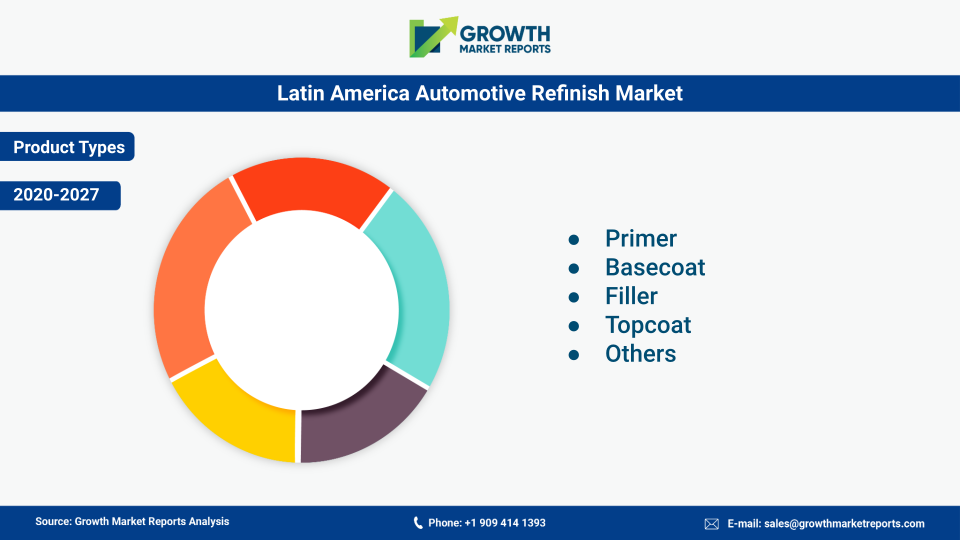
In terms of Product Type, the Latin America automotive refinish market is segmented as Primer, Basecoat, Fillers, Topcoat, others. The topcoat segment accounts for a major share of the market and is anticipated to expand at a considerable CAGR during the forecast period. The growth of the topcoat segment is due to the fact that these coats are used as final coats on body of vehicles. Topcoats seals the paint and protects it from external factors such as rain wind, snow and UV radiation. Basecoat segment is growing following the topcoat segment. This segment is growing as it is used to get smooth finish on the vehicles body before painting it.
Resin Types Segment Analysis
On basis of Resin Type, the Latin America automotive refinish market is categorized as Acrylic, Alkyd, Polyurethane, and others. The Polyurethane segment accounts for a major share of the market and is expected to increase at a substantial CAGR during the forecast period. Acrylic segment is growing after polyurethane segment, as acrylic based paints are widely used for smaller or quick fix jobs. Such jobs are more frequent than full body refinish jobs. Polyurethane segment is growing owing to its superior properties such as resistance to extreme temperatures and excellent performance in various environmental condition.
Technology Used Segment Analysis
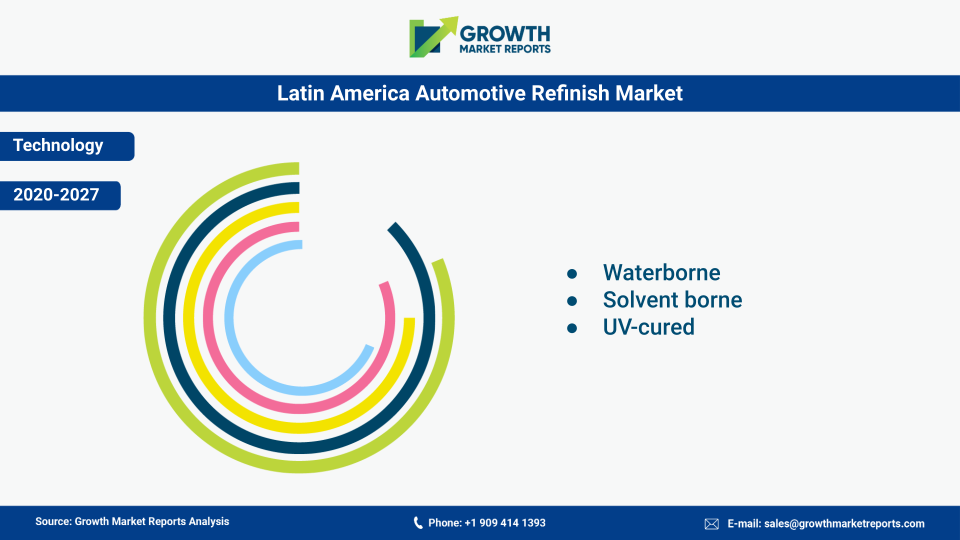
Based on technology used, the global Automotive Refinish market is classified as Waterborne, Solvent borne, and UV-cured. The waterborne segment accounts for a foremost share of the market and is projected to expand at a significant CAGR during the forecast period. UV cured technology is expected to grow in future as it provides, fast curing which reduces the time taken to refinish the vehicle. And these paints are resistant to water and other environmental factors. Solvent Borne segment is expected grow at slow pace compared to waterborne product due to stringent regulation on VOC emission level by governments of various countries.
Country Wise Analysis
By countries Latin America automotive refinish market is segmented as Brazil, Mexico, Argentina, Uruguay, Chile, Peru, Colombia, Ecuador, Costa Rica, Honduras, Guatemala, and Rest of Latin America.
Presence of leading players in Brazil who are producing and distributing automotive refinish products is also helping the automotive refinish market to grow in the country. Brazil ranks first in terms of automotive paints and coating production. Production of refinish products is growing rapidly in Brazil from last decade owing to it high demand. This is driving the automotive refinish market.
Urbanization in Mexico is growing at a significant pace. This has increased disposable income of people. Economically feasible conditions have raised expenditure on refinishing old and new vehicles. This is expected to drive the automotive refinish market in the country during forecast period. Mexico ranks second in terms automotive paints and coatings production in Latin America The automotive paints and coating industry is growing at a substantial speed in Mexico, which is resulting into growth of automotive refinish market
Key Benefits for Industry Participants & Stakeholders
In-depth Analysis of the Latin America automotive refinish market.
Historical, Current and Projected Market Size in terms of Value.
Potential & Niche Segments and Regions Exhibiting Promising Growth Covered
Industry Drivers, Restraints and Opportunities Covered in the Study
Recent Industry Trends and Developments
Competitive Landscape & Strategies of Key Players
Neutral Perspective on Latin America Automotive Refinish market Performance
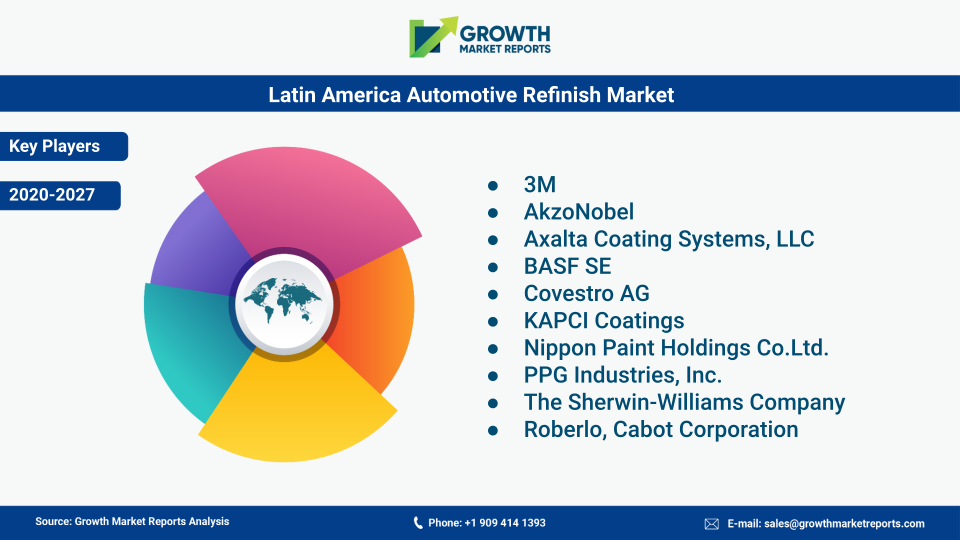
Key players in the market include 3M, AkzoNobel, Axalta Coating Systems, LLC, BASF SE, Covestro AG, KAPCI Coatings, Nippon Paint Holdings Co., Ltd., PPG Industries, Inc., The Sherwin-Williams Company, Roberlo, Cabot Corporation, Kansai Paint Co. Ltd, Mitsui Chemicals, NOROO Paint and Coatings, Sinteplast. These players are considered as key manufacturers of the market based on their different varieties of product availability, regional presence, better supply chain management system, and the increasing demand for the products. The players are adopting key strategies such as product development, geographical expansion, mergers and acquisition and many other strategies to increase their demand for automotive refinish.
Chapter 1 Executive Summary Chapter 2 Assumptions and Acronyms Used Chapter 3 Research Methodology Chapter 4 Automotive Refinish Market Overview 4.1 Introduction 4.1.1 Market Taxonomy 4.1.2 Market Definition 4.1.3 Macro-Economic Factors Impacting the Market Growth 4.2 Automotive Refinish Market Dynamics 4.2.1 Market Drivers 4.2.2 Market Restraints 4.2.3 Market Opportunity 4.3 Automotive Refinish Market - Supply Chain Analysis 4.3.1 List of Key Suppliers 4.3.2 List of Key Distributors 4.3.3 List of Key Consumers 4.4 Key Forces Shaping the Automotive Refinish Market 4.4.1 Bargaining Power of Suppliers 4.4.2 Bargaining Power of Buyers 4.4.3 Threat of Substitution 4.4.4 Threat of New Entrants 4.4.5 Competitive Rivalry 4.5 Latin America Automotive Refinish Market Size & Forecast, 2017-2027 4.5.1 Automotive Refinish Market Size and Y-o-Y Growth 4.5.2 Automotive Refinish Market Absolute $ Opportunity Chapter 5 Latin America Automotive Refinish Market Analysis and Forecast By Product Type 5.1 Introduction 5.1.1 Key Market Trends & Growth Opportunities By Product Type 5.1.2 Basis Point Share (BPS) Analysis By Product Type 5.1.3 Absolute $ Opportunity Assessment By Product Type 5.2 Automotive Refinish Market Size & Volume Forecast By Product Type 5.2.1 Primer 5.2.2 Basecoat 5.2.3 Filler 5.2.4 Topcoat 5.2.5 Others 5.3 Market Attractiveness Analysis By Product Type Chapter 6 Latin America Automotive Refinish Market Analysis and Forecast By Resin Type 6.1 Introduction 6.1.1 Key Market Trends & Growth Opportunities By Resin Type 6.1.2 Basis Point Share (BPS) Analysis By Resin Type 6.1.3 Absolute $ Opportunity Assessment By Resin Type 6.2 Automotive Refinish Market Size & Volume Forecast By Resin Type 6.2.1 Acrylic 6.2.2 Alkyd 6.2.3 Polyurethane 6.2.4 Others 6.3 Market Attractiveness Analysis By Resin Type Chapter 7 Latin America Automotive Refinish Market Analysis and Forecast By Technology Used 7.1 Introduction 7.1.1 Key Market Trends & Growth Opportunities By Technology Used 7.1.2 Basis Point Share (BPS) Analysis By Technology Used 7.1.3 Absolute $ Opportunity Assessment By Technology Used 7.2 Automotive Refinish Market Size & Volume Forecast By Technology Used 7.2.1 Waterborne 7.2.2 Solvent borne 7.2.3 UV-cured 7.3 Market Attractiveness Analysis By Technology Used Chapter 8 Coronavirus Disease (COVID-19) Impact 8.1 Introduction 8.2 Current & Future Impact Analysis 8.3 Economic Impact Analysis 8.4 Government Policies 8.5 Investment Scenario Chapter 9 Latin America Automotive Refinish Analysis and Forecast 9.1 Introduction 9.2 Latin America Automotive Refinish Market Size & Volume Forecast by Country 9.2.1 Brazil 9.2.1.1 By Product Type 9.2.1.2 By Resin Type 9.2.1.3 By Technology Used 9.2.2 Mexico 9.2.2.1 By Product Type 9.2.2.2 By Resin Type 9.2.2.3 By Technology Used 9.2.3 Argentina 9.2.3.1 By Product Type 9.2.3.2 By Resin Type 9.2.3.3 By Technology Used 9.2.4 Uruguay 9.2.4.1 By Product Type 9.2.4.2 By Resin Type 9.2.4.3 By Technology Used 9.2.5 Chile 9.2.5.1 By Product Type 9.2.5.2 By Resin Type 9.2.5.3 By Technology Used 9.2.6 Peru 9.2.6.1 By Product Type 9.2.6.2 By Resin Type 9.2.6.3 By Technology Used 9.2.7 Colombia 9.2.7.1 By Product Type 9.2.7.2 By Resin Type 9.2.7.3 By Technology Used 9.2.8 Ecuador 9.2.8.1 By Product Type 9.2.8.2 By Resin Type 9.2.8.3 By Technology Used 9.2.9 Costa Rica 9.2.9.1 By Product Type 9.2.9.2 By Resin Type 9.2.9.3 By Technology Used 9.2.10 Honduras 9.2.10.1 By Product Type 9.2.10.2 By Resin Type 9.2.10.3 By Technology Used 9.2.11 Guatemala 9.2.11.1 By Product Type 9.2.11.2 By Resin Type 9.2.11.3 By Technology Used 9.2.12 Rest of Latin America 9.2.12.1 By Product Type 9.2.12.2 By Resin Type 9.2.12.3 By Technology Used 9.3 Basis Point Share (BPS) Analysis by Country 9.4 Absolute $ Opportunity Assessment by Country 9.5 Market Attractiveness Analysis by Country 9.6 Latin America Automotive Refinish Market Size & Volume Forecast By Product Type 9.6.1 Primer 9.6.2 Basecoat 9.6.3 Filler 9.6.4 Topcoat 9.6.5 Others 9.7 Basis Point Share (BPS) Analysis By Product Type 9.8 Absolute $ Opportunity Assessment By Product Type 9.9 Market Attractiveness Analysis By Product Type 9.10 Latin America Automotive Refinish Market Size & Volume Forecast By Resin Type 9.10.1 Acrylic 9.10.2 Alkyd 9.10.3 Polyurethane 9.10.4 Others 9.11 Basis Point Share (BPS) Analysis By Resin Type 9.12 Absolute $ Opportunity Assessment By Resin Type 9.13 Market Attractiveness Analysis By Resin Type 9.14 Latin America Automotive Refinish Market Size & Volume Forecast By Technology Used 9.14.1 Waterborne 9.14.2 Solvent borne 9.14.3 UV-cured 9.15 Basis Point Share (BPS) Analysis By Technology Used 9.16 Absolute $ Opportunity Assessment By Technology Used 9.17 Market Attractiveness Analysis By Technology Used Chapter 10 Competition Landscape 10.1 Automotive Refinish Market: Competitive Dashboard 10.2 Latin America Automotive Refinish Market: Market Share Analysis, 2020 10.3 Company Profiles (Details – Overview, Financials, Developments, Strategy) 10.3.1 3M 10.3.2 AkzoNobel 10.3.3 Axalta Coating Systems, LLC 10.3.4 BASF SE 10.3.5 Covestro AG 10.3.6 KAPCI Coatings 10.3.7 Nippon Paint Holdings Co., Ltd. 10.3.8 PPG Industries, Inc. 10.3.9 The Sherwin-Williams Company 10.3.10 Roberlo 10.3.11 Cabot Corporation 10.3.12 Kansai Paint Co. Ltd 10.3.13 Mitsui Chemicals 10.3.14 NOROO Paint and Coatings 10.3.15 Sinteplast
Ask for Research To Be Focused On Specific Regions or Segments
Receive Data As Per Your Format and Definition
Companies Profiled based on Your Requirements
Breaking Down Competitive Landscape as per Your Requirements
Any Level of Customization
Our Clients
Client Testinomials
We needed a highly accurate and precise report, which Growth Market Reports delivered promptly. The company compiled information from a wide array of reliable agencies and sourcess.It is extremely satisfactory to be working with you. Strategy Head of Major Tech Company
We were very pleased to contact Growth Market Reports as they tailored reports precisely as per our requirements. As we are dealing with the aerospace and defense industry, we need reports of high accuracy and substantial quality. Major Player in Defense Industry
Extremely delighted to have a well-crafted report on “Global Packaging Solutions Market Research Report” from your team. Thank you for providing me with all our requirements and for incorporating our suggestions. CMO of Leading Packaging Company from USA
I had a good experience working with Growth Market Reports as they were very open to all constructive changes in the report. I found that the report had its charm embedded with ample of data. Founder and Managing Partner of Major Korean Company
Our company has been working with Growth Market Reports for some years now and we are very happy with the quality of the reports provided by the company.I, on behalf of my organization, would like to thank you for offering professional reports. Global Consulting Firm
According to this Growth Market Reports report, the market from Automotive Refinish market is likely to register a CAGR of 4.1% during forecast period 2020-2027, with an anticipated valuation of USD 1,021.8 million by the end of the 2027.
In addition to market size (in USD Million) and Company Market Share (in % for base year 2019), other data such Macro-economic factors, COVID-19 Impact on the automotive refinish market is available in final report.
The automotive refinish market is anticipated to grow significantly during forecast period due to rising number of vehicles on roads which is causing more vehicle crashes than before. Moreover, due to increasing population as well as rapid urbanization.
The market is expected to witness sluggish growth with slow increase in terms of demand during 2019-2020 owing to the negative impact of COVID-19 pandemic on the automotive refinish market.
The base year considered for the Latin America automotive refinish market report is 2019. The complete analysis period is 2017 to 2027, wherein, 2017 & 2018 are the historic years and the forecast is provided from 2020 to 2027.











 Request For Customization
 Enquiry Before Buying
 Speak With Analyst