Aerospace Industry Test Bench Market Trends, Industry | 2030
Global Aerospace Industry Test Bench Market
Segments - by Types (Hydraulic test benches, Mechanical test, benches, Fuel test benches, Iron bird), Applications (Aircraft, and Helicopter), End-users (Military, Civil), Sales Channels (OEM, Component manufacturer) and Regions (North America, Europe, Asia Pacific, Latin America and Middle East & Africa) - Global Industry Analysis, Growth, Share, Size, Trends, and Forecast 2020 – 2027
Segments - by Types (Hydraulic test benches, Mechanical test, benches, Fuel test benches, Iron bird), Applications (Aircraft, and Helicopter), End-users (Military, Civil), Sales Channels (OEM, Component manufacturer) and Regions (North America, Europe, Asia Pacific, Latin America and Middle East & Africa) - Global Industry Analysis, Growth, Share, Size, Trends, and Forecast 2020 – 2027
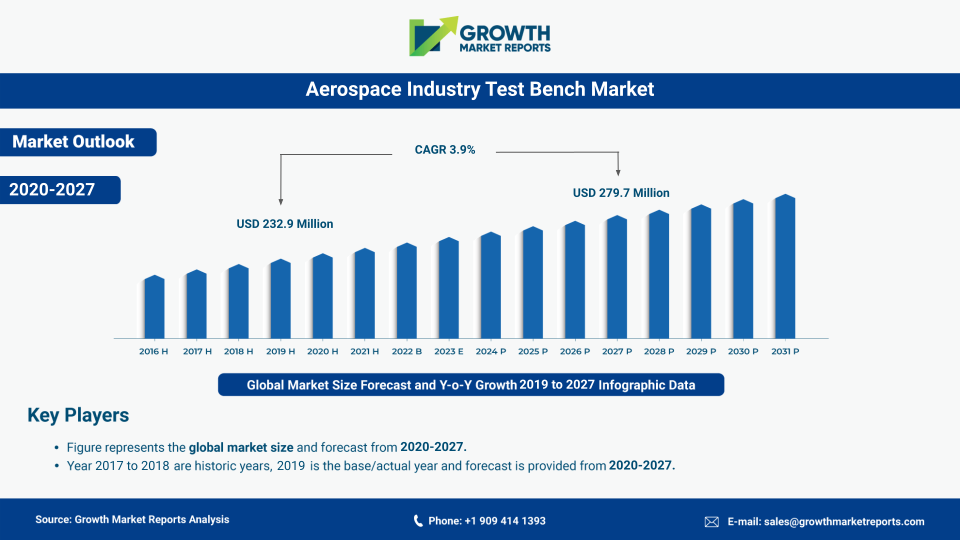
The Global Aerospace Industry Test Bench Market was valued at USD 232.9 Million in 2019 and is likely reach to USD 279.7 Million by 2027, expanding at a CAGR of 3.9% during the forecast period 2020-2027. A test bench is used to integrate various airborne system components and provide for ground maintenance by simulating an aircraft installation.
Different test bench are used for testing of engines, parts, and components of aircrafts and helicopters for civil and military applications. Companies are engaged in providing custom test benches to aircraft & helicopter manufacturers.
The various features associated with the aerospace industry test bench include, human machine interface (HMI), programmable logic controller (PLC), data acquisition system, graphic display, test sink area, specifications testing & environmental qualifications, instrument verification set, torque calibration, ease of maintenance, and reliability demonstration test.
Aerospace Industry Test BenchMarket Dynamics
The market is driven by factors such as increasing government spending on testing military aircrafts & helicopters and rising air traffic across the globe. Moreover, the intensification in avionics manufacturing and development activities has boosted the demand for test benches in the aerospace industry. The production of commercial aircraft is rising due to the increase in air traffic and international trade.
The air traffic across the globe is significantly increasing and had reached approximately 8.8 billion in 2018. Leading aircraft manufactures have increased the production rate of aircrafts by 40% due to the surge in the demand for commercial aircraft. The requirement for aircraft testing is significantly increasing with the rising air traffic across the globe.
An average commercial aircraft contains almost 450 structural forged parts and numerous engine parts. The regular testing and maintenance of these parts, using a test bench, is necessary in an aircraft. Thus, the increasing number of aircraft production across the world creates an intense need for the production of new test benches for the aerospace industry.
Continuous technological advancements in the aircraft/helicopter manufacturing have fueled the need for test benches. Key aircraft/helicopter manufacturing companies are engaged in R&D pertaining to the reduction of fuel consumption by aircraft/helicopter for a passenger per kilometer.
Moreover, flight safety and ecological impact (decrease in noise and environment pollution levels) of aviation transport is key factors considered while developing aircraft/helicopter.
In the near future, the development of aerodynamic layout of aircrafts is expected to be carried out in the frames of classical layout, with the use of novel materials, electronic & electromechanical devices, and super high bypass ratio engines.
Multiple standards for modern aircraft design are being tested by test bench. Theoretically, the lift-to-drag ratio for flying wing of an aircraft should be 40% higher than that of classical layout for the same wing aspect ratio.
Thus, the problems of balancing and controllability of flying wing (inevitably lead to losses) arises in modern aircrafts; therefore, the demand of new aircraft/helicopter specific test bench is expected to increase during the forecast period.
In the previous decades, independent maintenance, repair, and overhaul (MRO) companies consolidated the aerospace industry test bench market across the globe. However, increasing penetration of OEM in the aftermarket is expected to increase the prices of test benches in the near future, due to decreasing completion across the globe.
Emerging technologies such as predictive maintenance are increasing the prices of test benches.
OEM and aerospace manufacturers have started expanding into MRO (Maintenance, Repair, and Overhaul) and are asserting their control over the intellectual property (IP) behind engines, components, and airframes, which in turn, is boosting the prices of aircraft & helicopter testing benches.
Aerospace Industry Test Bench MarketSegmental Outlook
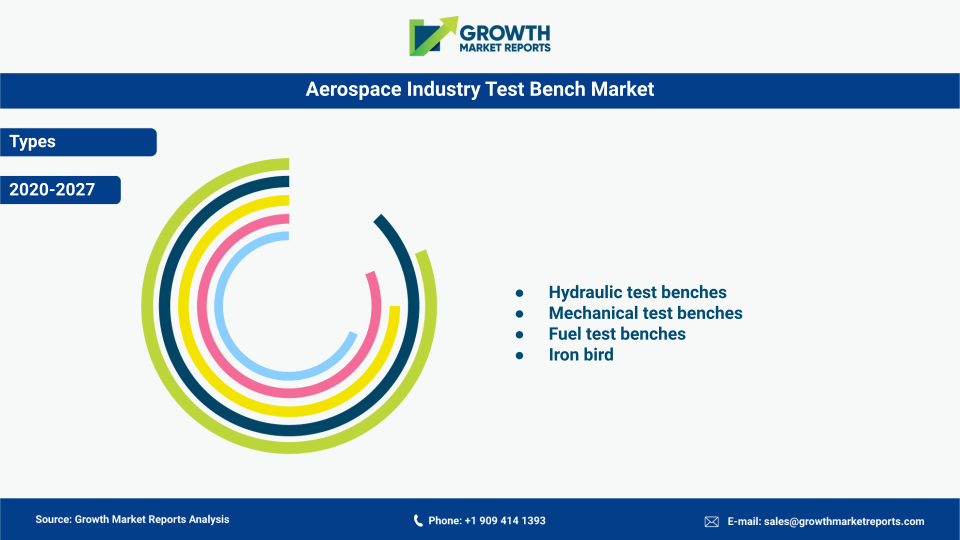
On the basis of type, the Global Aerospace Industry Test Bench Market is categorized as hydraulic test benches, mechanical test benches, fuel test system and iron bird.
The hydraulic test benches segment is expected to grow at a significant pace during the forecast period due to increasing application of hydraulics systems in aircrafts for moving & actuating aircraft/helicopter parts, landing gear, flaps, and brake applications.
Moreover, growing research and development pertaining to increasing testing of hydraulic systems and launch of innovative hydraulic systems in the aerospace industry is expected to create growth opportunities for the segment in the near future
The mechanical test benches segment holds a significant share of the global aerospace industry test bench market due to the high need for testing mechanical parts of aircrafts. Moreover, the significant number of aircraft maintenance services associated with the mechanical test benches propels the segment.
On the basis of applications segment, the market is categorized as aircraft and helicopter. The aircraft segment holds a significant share of the global aerospace industry test bench market. Higher use of aircrafts than helicopters due to high speed, more safety, and preference for long distance travelling fuels the aircraft segment.
Thus, the bench test associated with the aircrafts is in high demand as compared to that for aircraft. Moreover, the aircraft segment is projected to expand at a high CAGR during the forecast period due to increasing manufacturing of civil airplanes across the world.
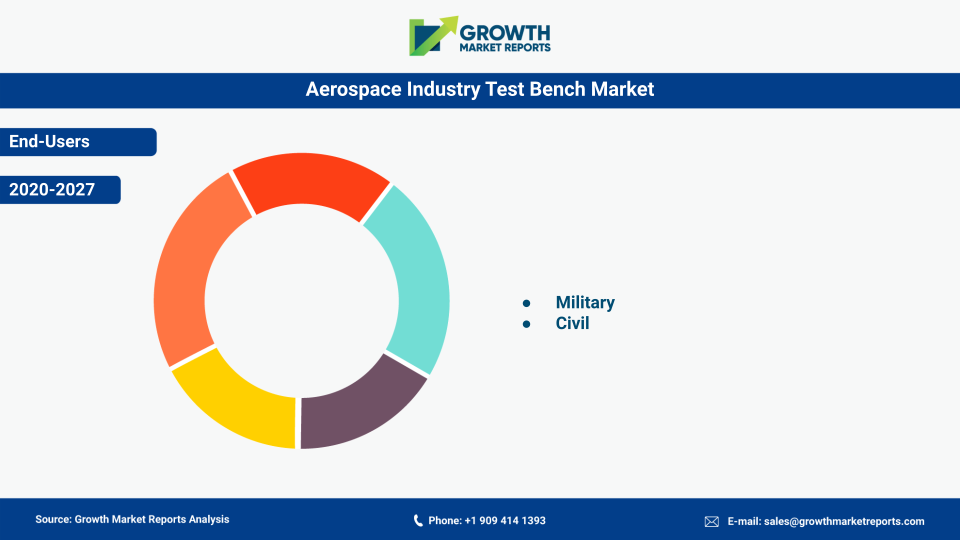
On the basis of End-users segment, the market is classified as military and civil. The civil segment is expected to hold the dominant share of the market due to the high need for the maintenance of civil airplanes on daily basis across the globe.
Moreover, rise in passenger air traffic has created the need for novel test benches across various airports in multiple countries across the globe; therefore, the demand for test benches for civil test benches has increased irrespective of the geographical regions.
The civil segment is expected to grow at a rapid pace during the forecast period due to the rapid growth of the civil aviation sector and increasing number of aircraft workshops across the world.
On the basis of sales channels, the market is categorized as OEM (aircraft and helicopters manufacturers) and aircraft & helicopters components manufacturers. Rising R&D spending and increasing partnership between aerospace companies and original component manufacturers (OCMs) are expected to create opportunities in the component manufacturer during the forecast period.
Definitions By Types Hydraulic test benches: Hydraulic test benches are used for servicing and testing hydraulic systems of all large- and mid-size body aircraft within the range of required test stand flow & pressure for the specific hydraulic test bench.
Hydraulic systems are used in the aerospace industry for controlling, monitoring, indication, power generation, and fluid storage/distribution in aircraft. Aircraft actuator hydraulics is built into the landing gear, aircraft flaps, and weapon systems.
Mechanical Test Bench: The mechanical test bench is a facility used to develop, characterize, and test mechanical components of aircrafts and helicopters and are used for testing of engine, wings, and other mechanical parts of aircraft.
Mechanical test bench is placed between the jet engine and the loading machine for testing purpose. The facility allows for the testing of the component and it offers the measurement of several physical variables associated to the functionality of the component.
Fuel Test Systems: Fuel test systems are conducted to test the transfer of fuel, in the correct sequence, from internal and external tanks to the collector tanks. The fuel test system test benches are repeated for alternative transfer modes such as following simulation of transfer valve failure.
Iron Bird: Iron bird test bench contain most of an aircraft's actual hardware components except for the structure. They are used to conduct aircraft subsystem tests such as hydraulic system evaluations. Hydraulic lines and hardware are sized and positioned in iron bird test bench, as they are in the actual aircraft.
Testing operations, through iron bird subsystems, are cycled through many hours of operational tests to ensure proper operation and endurance of the aircraft and helicopter.
Aerospace Industry Test Bench MarketRegional Outlook
In terms of regions, the global aerospace industry test bench market has been fragmented into Europe, North America, Latin America, Asia Pacific and Middle East & Africa. North America is a promising region for the market. Significant market share of North America is attributed to the presence of advanced technologies in the medical industry.
Moreover, easy availability of recourses supports the growth of key players and new entrance in the market in this region. Increasing number of Aerospace Industry Test Bench cases in Europe is driving the growth of the market in the region.
The market in Asia Pacific region is expected to grow at a significant rate during the forecast period due to increasing availability of Aerospace Industry Test Bench treatment technologies in the region. Moreover, increasing penetration of new companies, through mergers and acquisitions, fuels the market in the region.
Key Benefits for Industry Participants & Stakeholders
Industry drivers, restraints, and opportunities covered in the study
Neutral perspective on the global aerospace industry test Bench market performance
Recent industry trends and developments
Competitive landscape & strategies of key players
Potential & niche segments and regions exhibiting promising growth covered
Historical, current, and projected market size, in terms of value
In-depth analysis of the global Aerospace Industry Test Bench market
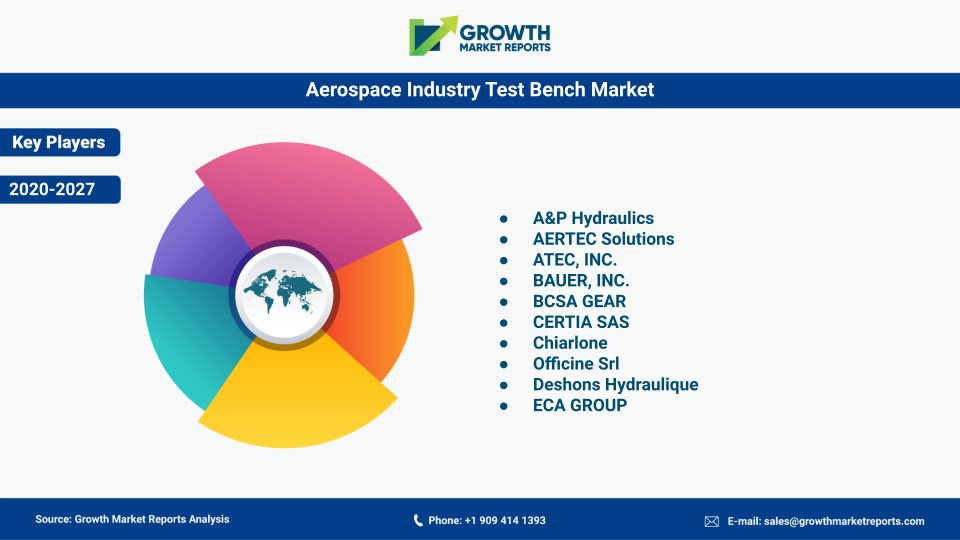
Key players in the market are A&P Hydraulics, AERTEC Solutions, ATEC, INC., BAUER, INC., BCSA GEAR, CERTIA SAS, Chiarlone, Officine Srl, Deshons Hydraulique, ECA GROUP, Elimco Aerospace, Haskel, HYCOM (Hydac), Hydraulics International, Inc., Maximator GmbH, Nidec Industrial Solutions, PINETTE P.E.I., REDVIKING, RENK Aktiengesellschaft, SECA, SEREME, Staley Co, Test Industry S.r.l., TEST-FUCHS, Titan, Inc. and TMH-TOOLS
These companies are considered as key players in global aerospace industry test bench market based on their revenue, research development (R&D) activities, regional presence, and supply chain management system.
Key players in the market are principally engaged in acquiring regional players to increase their sales and footprint across the globe.
Video Summary for Aerospace Industry Test Bench Market
Chapter 1 Executive Summary Chapter 2 Assumptions and Acronyms Used Chapter 3 Research Methodology Chapter 4 Aerospace Industry Test Bench Market Overview 4.1 Introduction 4.1.1 Market Taxonomy 4.1.2 Market Definition 4.1.3 Macro-Economic Factors Impacting the Market Growth 4.2 Aerospace Industry Test Bench Market Dynamics 4.2.1 Market Drivers 4.2.2 Market Restraints 4.2.3 Market Opportunity 4.3 Aerospace Industry Test Bench Market - Supply Chain Analysis 4.3.1 List of Key Suppliers 4.3.2 List of Key Distributors 4.3.3 List of Key Consumers 4.4 Key Forces Shaping the Aerospace Industry Test Bench Market 4.4.1 Bargaining Power of Suppliers 4.4.2 Bargaining Power of Buyers 4.4.3 Threat of Substitution 4.4.4 Threat of New Entrants 4.4.5 Competitive Rivalry 4.5 Global Aerospace Industry Test Bench Market Size & Forecast, 2017-2027 4.5.1 Aerospace Industry Test Bench Market Size and Y-o-Y Growth 4.5.2 Aerospace Industry Test Bench Market Absolute $ Opportunity 4.6 Global Aerospace Industry Test Bench Market: Impact Of Key Regulations 4.7 Helicopters & Aircraft Test Benches Market Analysis 4.8 Unmanned Helicopters Test Benches Market Overview 4.9 Comparative Analysis on Military vs Civil Aircraft Test Benches 4.10 Aviation Test Equipment Market Outlook Chapter 5 Global Aerospace Industry Test Bench Market Analysis and Forecast By Type 5.1 Introduction 5.1.1 Key Market Trends & Growth Opportunities By Type 5.1.2 Basis Point Share (BPS) Analysis By Type 5.1.3 Absolute $ Opportunity Assessment By Type 5.2 Aerospace Industry Test Bench Market Size Forecast By Type 5.2.1 Hydraulic Test Benches 5.2.2 Mechanical Test Benches 5.2.3 Fuel test benches 5.2.4 Iron bird 5.3 Market Attractiveness Analysis By Type Chapter 6 Global Aerospace Industry Test Bench Market Analysis and Forecast By Application 6.1 Introduction 6.1.1 Key Market Trends & Growth Opportunities By Application 6.1.2 Basis Point Share (BPS) Analysis By Application 6.1.3 Absolute $ Opportunity Assessment By Application 6.2 Aerospace Industry Test Bench Market Size Forecast By Application 6.2.1 Aircraft 6.2.2 Helicopter 6.3 Market Attractiveness Analysis By Application Chapter 7 Global Aerospace Industry Test Bench Market Analysis and Forecast By End-users 7.1 Introduction 7.1.1 Key Market Trends & Growth Opportunities By End-users 7.1.2 Basis Point Share (BPS) Analysis By End-users 7.1.3 Absolute $ Opportunity Assessment By End-users 7.2 Aerospace Industry Test Bench Market Size Forecast By End-users 7.2.1 Military 7.2.2 Civil 7.3 Market Attractiveness Analysis By End-users Chapter 8 Global Aerospace Industry Test Bench Market Analysis and Forecast By 8.1 Introduction 8.1.1 Key Market Trends & Growth Opportunities By 8.1.2 Basis Point Share (BPS) Analysis By 8.1.3 Absolute $ Opportunity Assessment By 8.2 Aerospace Industry Test Bench Market Size Forecast By 8.2.1 Sales Channel 8.3 Market Attractiveness Analysis By Chapter 9 Global Aerospace Industry Test Bench Market Analysis and Forecast by Region 9.1 Introduction 9.1.1 Key Market Trends & Growth Opportunities by Region 9.1.2 Basis Point Share (BPS) Analysis by Region 9.1.3 Absolute $ Opportunity Assessment by Region 9.2 Aerospace Industry Test Bench Market Size Forecast by Region 9.2.1 North America 9.2.2 Europe 9.2.3 Asia Pacific 9.2.4 Latin America 9.2.5 Middle East & Africa (MEA) 9.3 Market Attractiveness Analysis by Region Chapter 10 Coronavirus Disease (COVID-19) Impact 10.1 Introduction 10.2 Current & Future Impact Analysis 10.3 Economic Impact Analysis 10.4 Government Policies 10.5 Investment Scenario Chapter 11 North America Aerospace Industry Test Bench Analysis and Forecast 11.1 Introduction 11.2 North America Aerospace Industry Test Bench Market Size Forecast by Country 11.2.1 U.S. 11.2.2 Canada 11.3 Basis Point Share (BPS) Analysis by Country 11.4 Absolute $ Opportunity Assessment by Country 11.5 Market Attractiveness Analysis by Country 11.6 North America Aerospace Industry Test Bench Market Size Forecast By Type 11.6.1 Hydraulic Test Benches 11.6.2 Mechanical Test Benches 11.6.3 Fuel test benches 11.6.4 Iron bird 11.7 Basis Point Share (BPS) Analysis By Type 11.8 Absolute $ Opportunity Assessment By Type 11.9 Market Attractiveness Analysis By Type 11.10 North America Aerospace Industry Test Bench Market Size Forecast By Application 11.10.1 Aircraft 11.10.2 Helicopter 11.11 Basis Point Share (BPS) Analysis By Application 11.12 Absolute $ Opportunity Assessment By Application 11.13 Market Attractiveness Analysis By Application 11.14 North America Aerospace Industry Test Bench Market Size Forecast By End-users 11.14.1 Military 11.14.2 Civil 11.15 Basis Point Share (BPS) Analysis By End-users 11.16 Absolute $ Opportunity Assessment By End-users 11.17 Market Attractiveness Analysis By End-users 11.18 North America Aerospace Industry Test Bench Market Size Forecast By 11.18.1 Sales Channel 11.19 Basis Point Share (BPS) Analysis By 11.20 Absolute $ Opportunity Assessment By 11.21 Market Attractiveness Analysis By Chapter 12 Europe Aerospace Industry Test Bench Analysis and Forecast 12.1 Introduction 12.2 Europe Aerospace Industry Test Bench Market Size Forecast by Country 12.2.1 Germany 12.2.2 France 12.2.3 Italy 12.2.4 U.K. 12.2.5 Spain 12.2.6 Russia 12.2.7 Rest of Europe 12.3 Basis Point Share (BPS) Analysis by Country 12.4 Absolute $ Opportunity Assessment by Country 12.5 Market Attractiveness Analysis by Country 12.6 Europe Aerospace Industry Test Bench Market Size Forecast By Type 12.6.1 Hydraulic Test Benches 12.6.2 Mechanical Test Benches 12.6.3 Fuel test benches 12.6.4 Iron bird 12.7 Basis Point Share (BPS) Analysis By Type 12.8 Absolute $ Opportunity Assessment By Type 12.9 Market Attractiveness Analysis By Type 12.10 Europe Aerospace Industry Test Bench Market Size Forecast By Application 12.10.1 Aircraft 12.10.2 Helicopter 12.11 Basis Point Share (BPS) Analysis By Application 12.12 Absolute $ Opportunity Assessment By Application 12.13 Market Attractiveness Analysis By Application 12.14 Europe Aerospace Industry Test Bench Market Size Forecast By End-users 12.14.1 Military 12.14.2 Civil 12.15 Basis Point Share (BPS) Analysis By End-users 12.16 Absolute $ Opportunity Assessment By End-users 12.17 Market Attractiveness Analysis By End-users 12.18 Europe Aerospace Industry Test Bench Market Size Forecast By 12.18.1 Sales Channel 12.19 Basis Point Share (BPS) Analysis By 12.20 Absolute $ Opportunity Assessment By 12.21 Market Attractiveness Analysis By Chapter 13 Asia Pacific Aerospace Industry Test Bench Analysis and Forecast 13.1 Introduction 13.2 Asia Pacific Aerospace Industry Test Bench Market Size Forecast by Country 13.2.1 China 13.2.2 Japan 13.2.3 South Korea 13.2.4 India 13.2.5 Australia 13.2.6 South East Asia (SEA) 13.2.7 Rest of Asia Pacific (APAC) 13.3 Basis Point Share (BPS) Analysis by Country 13.4 Absolute $ Opportunity Assessment by Country 13.5 Market Attractiveness Analysis by Country 13.6 Asia Pacific Aerospace Industry Test Bench Market Size Forecast By Type 13.6.1 Hydraulic Test Benches 13.6.2 Mechanical Test Benches 13.6.3 Fuel test benches 13.6.4 Iron bird 13.7 Basis Point Share (BPS) Analysis By Type 13.8 Absolute $ Opportunity Assessment By Type 13.9 Market Attractiveness Analysis By Type 13.10 Asia Pacific Aerospace Industry Test Bench Market Size Forecast By Application 13.10.1 Aircraft 13.10.2 Helicopter 13.11 Basis Point Share (BPS) Analysis By Application 13.12 Absolute $ Opportunity Assessment By Application 13.13 Market Attractiveness Analysis By Application 13.14 Asia Pacific Aerospace Industry Test Bench Market Size Forecast By End-users 13.14.1 Military 13.14.2 Civil 13.15 Basis Point Share (BPS) Analysis By End-users 13.16 Absolute $ Opportunity Assessment By End-users 13.17 Market Attractiveness Analysis By End-users 13.18 Asia Pacific Aerospace Industry Test Bench Market Size Forecast By 13.18.1 Sales Channel 13.19 Basis Point Share (BPS) Analysis By 13.20 Absolute $ Opportunity Assessment By 13.21 Market Attractiveness Analysis By Chapter 14 Latin America Aerospace Industry Test Bench Analysis and Forecast 14.1 Introduction 14.2 Latin America Aerospace Industry Test Bench Market Size Forecast by Country 14.2.1 Brazil 14.2.2 Mexico 14.2.3 Rest of Latin America (LATAM) 14.3 Basis Point Share (BPS) Analysis by Country 14.4 Absolute $ Opportunity Assessment by Country 14.5 Market Attractiveness Analysis by Country 14.6 Latin America Aerospace Industry Test Bench Market Size Forecast By Type 14.6.1 Hydraulic Test Benches 14.6.2 Mechanical Test Benches 14.6.3 Fuel test benches 14.6.4 Iron bird 14.7 Basis Point Share (BPS) Analysis By Type 14.8 Absolute $ Opportunity Assessment By Type 14.9 Market Attractiveness Analysis By Type 14.10 Latin America Aerospace Industry Test Bench Market Size Forecast By Application 14.10.1 Aircraft 14.10.2 Helicopter 14.11 Basis Point Share (BPS) Analysis By Application 14.12 Absolute $ Opportunity Assessment By Application 14.13 Market Attractiveness Analysis By Application 14.14 Latin America Aerospace Industry Test Bench Market Size Forecast By End-users 14.14.1 Military 14.14.2 Civil 14.15 Basis Point Share (BPS) Analysis By End-users 14.16 Absolute $ Opportunity Assessment By End-users 14.17 Market Attractiveness Analysis By End-users 14.18 Latin America Aerospace Industry Test Bench Market Size Forecast By 14.18.1 Sales Channel 14.19 Basis Point Share (BPS) Analysis By 14.20 Absolute $ Opportunity Assessment By 14.21 Market Attractiveness Analysis By Chapter 15 Middle East & Africa (MEA) Aerospace Industry Test Bench Analysis and Forecast 15.1 Introduction 15.2 Middle East & Africa (MEA) Aerospace Industry Test Bench Market Size Forecast by Country 15.2.1 Saudi Arabia 15.2.2 South Africa 15.2.3 UAE 15.2.4 Rest of Middle East & Africa (MEA) 15.3 Basis Point Share (BPS) Analysis by Country 15.4 Absolute $ Opportunity Assessment by Country 15.5 Market Attractiveness Analysis by Country 15.6 Middle East & Africa (MEA) Aerospace Industry Test Bench Market Size Forecast By Type 15.6.1 Hydraulic Test Benches 15.6.2 Mechanical Test Benches 15.6.3 Fuel test benches 15.6.4 Iron bird 15.7 Basis Point Share (BPS) Analysis By Type 15.8 Absolute $ Opportunity Assessment By Type 15.9 Market Attractiveness Analysis By Type 15.10 Middle East & Africa (MEA) Aerospace Industry Test Bench Market Size Forecast By Application 15.10.1 Aircraft 15.10.2 Helicopter 15.11 Basis Point Share (BPS) Analysis By Application 15.12 Absolute $ Opportunity Assessment By Application 15.13 Market Attractiveness Analysis By Application 15.14 Middle East & Africa (MEA) Aerospace Industry Test Bench Market Size Forecast By End-users 15.14.1 Military 15.14.2 Civil 15.15 Basis Point Share (BPS) Analysis By End-users 15.16 Absolute $ Opportunity Assessment By End-users 15.17 Market Attractiveness Analysis By End-users 15.18 Middle East & Africa (MEA) Aerospace Industry Test Bench Market Size Forecast By 15.18.1 Sales Channel 15.19 Basis Point Share (BPS) Analysis By 15.20 Absolute $ Opportunity Assessment By 15.21 Market Attractiveness Analysis By Chapter 16 Competition Landscape 16.1 Aerospace Industry Test Bench Market: Competitive Dashboard 16.2 Global Aerospace Industry Test Bench Market: Market Share Analysis, 2019 16.3 Company Profiles (Details – Overview, Financials, Developments, Strategy) 16.3.1 A&P Hydraulics 16.3.2 AERTEC Solutions 16.3.3 ATEC, INC. 16.3.4 BAUER, INC 16.3.5 BCSA GEAR 16.3.6 CERTIA SAS 16.3.7 Chiarlone 16.3.8 Officine Srl 16.3.9 Deshons Hydraulique 16.3.10 ECA GROUP 16.3.11 Elimco Aerospace 16.3.12 Haskel 16.3.13 HYCOM (Hydac) 16.3.14 Maximator GmbH 16.3.15 Nidec Industrial Solutions 16.3.16 PINETTE P.E.I. 16.3.17 REDVIKING 16.3.18 RENK Aktiengesellschaft 16.3.19 SECA 16.3.20 SEREME 16.3.21 Staley Co. 16.3.22 Test Industry S.r.l. 16.3.23 TEST-FUCHS 16.3.24 Titan, Inc. 16.3.25 TMH-TOOLS
Ask for Research To Be Focused On Specific Regions or Segments
Receive Data As Per Your Format and Definition
Companies Profiled based on Your Requirements
Breaking Down Competitive Landscape as per Your Requirements
Any Level of Customization
Our Clients
Client Testinomials
We needed a highly accurate and precise report, which Growth Market Reports delivered promptly. The company compiled information from a wide array of reliable agencies and sourcess.It is extremely satisfactory to be working with you. Strategy Head of Major Tech Company
We were very pleased to contact Growth Market Reports as they tailored reports precisely as per our requirements. As we are dealing with the aerospace and defense industry, we need reports of high accuracy and substantial quality. Major Player in Defense Industry
Extremely delighted to have a well-crafted report on “Global Packaging Solutions Market Research Report” from your team. Thank you for providing me with all our requirements and for incorporating our suggestions. CMO of Leading Packaging Company from USA
I had a good experience working with Growth Market Reports as they were very open to all constructive changes in the report. I found that the report had its charm embedded with ample of data. Founder and Managing Partner of Major Korean Company
Our company has been working with Growth Market Reports for some years now and we are very happy with the quality of the reports provided by the company.I, on behalf of my organization, would like to thank you for offering professional reports. Global Consulting Firm
The base year considered for the global aerospace industry test bench market report is 2019. The complete analysis period is 2017 to 2027, wherein, 2017 and 2018 are the historic years, 2019 is the base year and the forecast is provided from 2020 to 2027.
The market is expected to witness a significant decline between 2019 and due to the adverse impact of COVID 19 pandemic on supply chain of medical industry.
Urbanization, the increasing government regulation pertaining to the aircraft testing, and increase in R&D expenditure by manufacturers for developing new aerospace industry test bench is expected to drive the market growth during forecast period.
Market size (in USD Million) and company market share (in % for base year 2019), other data such as COVID-19 impact on aerospace industry test bench market and regulatory outlook is available in the final report.
According to this Growth Market Reports report, the market from aerospace industry test bench is likely to register a CAGR of 3.9% during forecast period between 2020 and 2027, with an anticipated valuation of USD 279.7 million by the end of the 2027.












 Request For Customization
 Enquiry Before Buying
 Speak With Analyst