Segments - by Product Type (Passive Probes, Active Probes, Differential Probes, Current Probes, Others), by Application (Electronics & Electrical, Automotive, Aerospace & Defense, Telecommunications, Healthcare, Others), by End-User (Industrial, Research & Development, Education, Others), by Distribution Channel (Online, Offline)
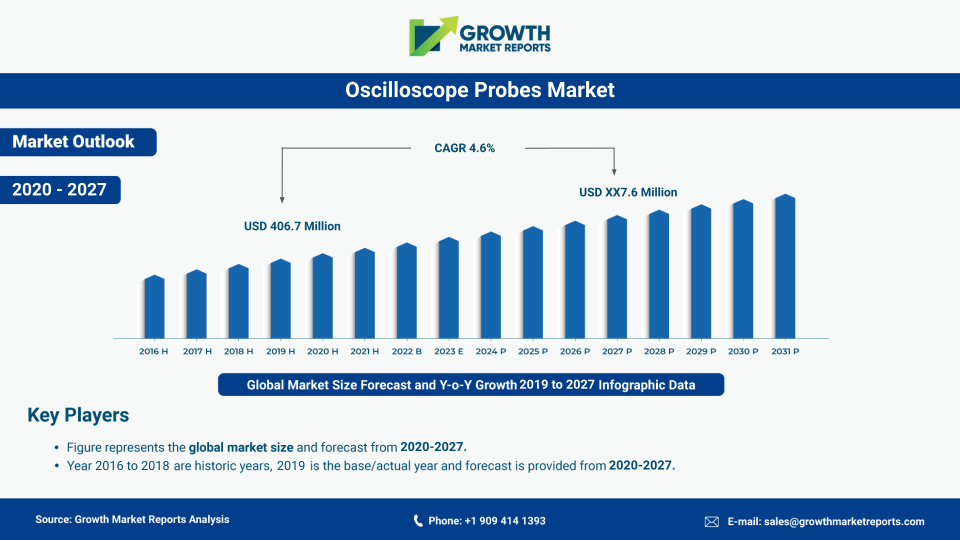
According to our latest research, the global oscilloscope probes market size reached USD 1.32 billion in 2024, supported by robust demand across electronics, automotive, and telecommunications sectors. The market is projected to grow at a CAGR of 6.1% during the forecast period, reaching approximately USD 2.25 billion by 2033. This growth is primarily driven by accelerating advancements in test and measurement technologies, increasing complexity in electronic devices, and the proliferation of high-speed digital communication systems globally. As per our comprehensive market analysis, the integration of advanced features in oscilloscopes and probes, coupled with rapid industrial automation, continues to bolster the oscilloscope probes market worldwide.
A key growth factor for the oscilloscope probes market is the ongoing evolution and miniaturization of electronic components, which has heightened the need for precise signal measurement and diagnostics. The trend towards more compact, high-performance electronic devices in consumer electronics, automotive electronics, and industrial automation has necessitated the use of sophisticated oscilloscope probes capable of handling higher frequencies and bandwidths. This demand is further accentuated by the rise in research and development activities within semiconductor manufacturing, where accurate signal integrity analysis is critical. The push toward Industry 4.0 and smart manufacturing environments has also contributed to increased adoption of advanced oscilloscopes and their associated probes, as companies seek to ensure the quality and reliability of their electronic systems.
Another significant driver is the rapid expansion of telecommunications infrastructure, particularly with the global rollout of 5G networks. The deployment of 5G and the increasing complexity of communication protocols have placed greater emphasis on high-bandwidth and low-noise measurement tools, directly benefiting the oscilloscope probes market. Telecommunications equipment manufacturers and service providers are investing heavily in sophisticated test equipment to validate the performance of new network components and ensure compliance with stringent standards. This, in turn, has led to a surge in demand for both active and differential probes that can accurately capture high-speed signals and transient events. The convergence of IoT, cloud computing, and edge devices further amplifies the need for reliable signal measurement solutions, driving sustained growth in this market segment.
The healthcare sectorÂ’s increasing reliance on electronic medical devices and diagnostic equipment has also spurred demand for oscilloscope probes. Medical device manufacturers require precise testing and validation of electronic circuits to ensure patient safety and regulatory compliance. Oscilloscope probes play a pivotal role in the development and maintenance of devices such as ECG machines, defibrillators, and imaging systems. Furthermore, the growing trend toward telemedicine and wearable health monitoring devices has expanded the application scope for oscilloscope probes. These factors, combined with stringent quality standards and the need for continuous innovation in medical electronics, are expected to further propel market growth in the coming years.
In the realm of oscilloscope probes, the introduction of Test Light Probes has marked a significant advancement. These probes are designed to enhance the precision and reliability of signal measurements, particularly in environments where light-based diagnostics are crucial. Test Light Probes offer unique advantages by utilizing optical technology to minimize electromagnetic interference, which is a common challenge in high-frequency applications. Their ability to provide accurate readings without direct electrical contact makes them ideal for sensitive electronic systems, such as those found in telecommunications and aerospace industries. As the demand for non-intrusive and highly accurate testing solutions grows, Test Light Probes are becoming an indispensable tool for engineers and technicians seeking to ensure the integrity and performance of complex electronic systems.
From a regional perspective, Asia Pacific continues to dominate the oscilloscope probes market, driven by its thriving electronics manufacturing industry, particularly in China, Japan, South Korea, and Taiwan. North America and Europe also represent significant markets, owing to strong investments in research and development, automotive innovation, and advancements in telecommunications infrastructure. Meanwhile, emerging economies in Latin America and the Middle East & Africa are witnessing gradual growth, supported by increasing industrialization and expansion of local manufacturing capabilities. The interplay of these regional dynamics, coupled with evolving end-user requirements, is shaping the competitive landscape and future growth trajectory of the global oscilloscope probes market.
The oscilloscope probes market, segmented by product type, encompasses passive probes, active probes, differential probes, current probes, and other specialized variants. Passive probes remain the most widely used due to their simplicity, cost-effectiveness, and suitability for a broad range of general-purpose measurements. These probes are favored in educational and basic industrial applications where bandwidth and signal fidelity requirements are moderate. Their robust design and ease of use make them a staple in electronics laboratories and production testing environments. However, as electronic systems become more complex and operate at higher frequencies, the limitations of passive probes in terms of bandwidth and signal loading have become more apparent, prompting a shift toward more advanced probe types.
Active probes are increasingly gaining traction, particularly in high-speed digital and RF applications. These probes incorporate active components such as FETs or amplifiers, enabling them to offer higher bandwidth, lower input capacitance, and minimal signal distortion compared to passive probes. As a result, they are essential for capturing fast transients and analyzing high-frequency signals in advanced electronics, telecommunications, and aerospace applications. The proliferation of high-speed serial data standards and the adoption of faster microprocessors have further elevated the demand for active probes. While they tend to be more expensive and require careful handling, their performance advantages make them indispensable in cutting-edge research and development settings.
Differential probes are witnessing robust growth, fueled by the increasing need to measure signals with respect to each other rather than ground, especially in environments with significant common-mode noise. These probes are critical in applications involving power electronics, automotive electronics, and digital communication systems, where accurate measurement of differential signals is paramount. Their ability to reject common-mode noise and provide high-fidelity signal capture makes them the preferred choice for engineers working on mixed-signal and high-voltage systems. As automotive and industrial sectors continue to adopt more sophisticated electronic control systems, the demand for differential probes is expected to rise steadily.
Current probes form another vital segment, enabling non-intrusive measurement of current waveforms in power electronics, automotive, and industrial applications. The transition toward electric vehicles, renewable energy systems, and smart grids has amplified the need for accurate current measurement solutions. Current probes, especially those capable of handling both AC and DC currents, are essential for diagnostics, maintenance, and quality assurance in power conversion and distribution systems. As energy efficiency and power management become central to various industries, the relevance of current probes in the oscilloscope probes market continues to grow. Specialized probes, such as high-voltage and optical probes, cater to niche applications, further diversifying the product landscape.
| Attributes | Details |
| Report Title | Oscilloscope Probes Market Research Report 2033 |
| By Product Type | Passive Probes, Active Probes, Differential Probes, Current Probes, Others |
| By Application | Electronics & Electrical, Automotive, Aerospace & Defense, Telecommunications, Healthcare, Others |
| By End-User | Industrial, Research & Development, Education, Others |
| By Distribution Channel | Online, Offline |
| Regions Covered | North America, Europe, APAC, Latin America, MEA |
| Base Year | 2024 |
| Historic Data | 2018-2023 |
| Forecast Period | 2025-2033 |
| Number of Pages | 267 |
| Number of Tables & Figures | 392 |
| Customization Available | Yes, the report can be customized as per your need. |
The oscilloscope probes market serves a diverse array of applications, including electronics & electrical, automotive, aerospace & defense, telecommunications, healthcare, and others. In the electronics & electrical sector, oscilloscope probes are indispensable for product development, quality assurance, and troubleshooting across consumer electronics, industrial automation, and semiconductor manufacturing. The relentless pace of innovation in this sector, coupled with the push for miniaturization and enhanced functionality, has necessitated the use of advanced measurement tools. As manufacturers strive to ensure the reliability and performance of increasingly complex electronic devices, the demand for high-precision oscilloscope probes continues to rise.
Within the automotive industry, the shift toward electric vehicles, autonomous driving technologies, and advanced driver-assistance systems (ADAS) has created new challenges for electronic testing and validation. Oscilloscope probes are critical for analyzing the performance of electronic control units (ECUs), in-vehicle networks, and power management systems. The need to capture high-speed data, analyze differential signals, and ensure electromagnetic compatibility (EMC) compliance has driven the adoption of specialized probes in automotive R&D and production environments. As vehicles become more connected and software-driven, the role of oscilloscope probes in ensuring safety, reliability, and regulatory compliance is becoming increasingly prominent.
The aerospace & defense sector relies heavily on oscilloscope probes for the development and maintenance of mission-critical electronic systems, including radar, avionics, and communication equipment. The stringent performance requirements and harsh operating environments in this sector demand probes with exceptional bandwidth, noise immunity, and signal fidelity. Aerospace engineers utilize a variety of probes, including differential and current probes, to validate the integrity of high-speed digital and analog signals. As defense budgets increase and governments invest in next-generation military technologies, the demand for advanced test and measurement solutions, including oscilloscope probes, is expected to remain strong.
In telecommunications, the ongoing expansion of high-speed networks and the deployment of 5G infrastructure have intensified the need for precise signal analysis and troubleshooting. Oscilloscope probes are essential for testing network equipment, base stations, and optical communication systems. The transition to higher frequency bands, increased data rates, and the integration of multiple communication protocols require probes with superior bandwidth and low noise characteristics. Telecommunications companies and equipment manufacturers are investing in state-of-the-art probing solutions to ensure network reliability, minimize downtime, and meet regulatory standards. The healthcare sector, on the other hand, utilizes oscilloscope probes for the development and maintenance of medical electronics, as previously discussed, with a growing emphasis on patient safety and compliance.
The oscilloscope probes market is segmented by end-user into industrial, research & development, education, and others, each contributing uniquely to market dynamics. The industrial segment represents a significant share, as manufacturers across electronics, automotive, and energy sectors rely on oscilloscope probes for process control, equipment maintenance, and quality assurance. The increasing automation of manufacturing processes and the adoption of smart factory concepts have heightened the need for real-time signal monitoring and diagnostics. Industrial end-users prioritize probes that offer durability, ease of integration, and compatibility with automated test systems, driving demand for robust and versatile probing solutions.
Research & development (R&D) is another major end-user segment, encompassing academic institutions, government laboratories, and corporate R&D centers. These users require high-performance probes capable of capturing complex waveforms and supporting advanced analysis features. As R&D activities in electronics, telecommunications, and materials science continue to expand, the need for precise and reliable measurement tools becomes increasingly critical. R&D professionals often demand probes with the highest bandwidth, lowest noise, and maximum flexibility to support a wide range of experimental setups. The continuous pursuit of innovation and the development of next-generation technologies ensure sustained demand from this segment.
The education segment, while smaller in comparison, plays a vital role in shaping the future workforce of the electronics and engineering industries. Universities, technical colleges, and vocational training centers utilize oscilloscope probes in laboratory courses and practical training sessions to teach students about signal analysis, circuit behavior, and electronic troubleshooting. The demand in this segment is largely driven by the need for affordable, easy-to-use, and durable probes that can withstand frequent handling by students. As educational institutions update their curricula to include emerging technologies such as IoT, robotics, and embedded systems, the relevance of oscilloscope probes in academic settings is expected to grow.
Other end-users, including service providers, repair centers, and independent consultants, contribute to the overall market demand by utilizing oscilloscope probes for equipment maintenance, diagnostics, and field service operations. These users often require portable, battery-operated probes that can be deployed in diverse environments. The increasing complexity of electronic systems in various industries has made regular maintenance and troubleshooting more challenging, underscoring the importance of reliable probing solutions. As the global workforce becomes more mobile and the need for on-site diagnostics increases, the demand for versatile and easy-to-use oscilloscope probes is likely to remain strong.
Oscilloscope probes are distributed through online and offline channels, each offering distinct advantages and challenges. The offline distribution channel, comprising authorized distributors, specialty electronics stores, and direct sales, has traditionally dominated the market. This channel is favored by industrial and institutional buyers who prioritize personalized service, technical support, and the ability to inspect products before purchase. Offline channels are particularly important for high-value, specialized probes that require customization or integration with existing test equipment. Distributors often provide value-added services such as calibration, training, and after-sales support, which are highly valued by professional users.
However, the online distribution channel has witnessed significant growth in recent years, driven by the increasing digitization of procurement processes and the convenience of e-commerce platforms. Online channels offer a wider selection of products, competitive pricing, and the ability to compare features and specifications across multiple brands. Small and medium-sized enterprises (SMEs), educational institutions, and individual users often prefer online purchasing due to its accessibility and ease of transaction. The COVID-19 pandemic further accelerated the shift toward online channels, as restrictions on physical movement and the need for contactless transactions became prevalent. Leading manufacturers and distributors have responded by enhancing their online presence and offering comprehensive digital catalogs, technical documentation, and virtual support.
Despite the advantages of online channels, certain challenges persist, such as concerns over product authenticity, lack of hands-on evaluation, and limited after-sales service. To address these issues, reputable manufacturers and distributors have implemented robust verification processes, extended warranties, and online customer support. Hybrid distribution models, which combine the strengths of both online and offline channels, are emerging as a preferred approach for many market participants. These models enable customers to research and select products online while benefiting from in-person support and service when needed.
The choice of distribution channel often depends on the complexity of the product, end-user requirements, and geographic location. In mature markets such as North America and Europe, offline channels continue to play a significant role, especially for high-end and customized probes. In contrast, emerging markets in Asia Pacific and Latin America are witnessing rapid growth in online sales, supported by expanding internet penetration and the proliferation of e-commerce platforms. As the oscilloscope probes market continues to evolve, manufacturers and distributors are expected to invest in omnichannel strategies to cater to the diverse needs of their global customer base.
The oscilloscope probes market presents several lucrative opportunities for growth and innovation. One of the most promising avenues lies in the development of probes with higher bandwidth, lower noise, and enhanced compatibility with next-generation oscilloscopes. As electronic systems continue to evolve, there is a growing need for probes that can accurately capture high-speed signals and support advanced analysis features such as real-time decoding, protocol analysis, and automated reporting. Manufacturers that invest in research and development to create innovative, user-friendly, and cost-effective probing solutions are well-positioned to capitalize on these trends. Additionally, the integration of IoT and wireless connectivity in probes is opening new possibilities for remote diagnostics, predictive maintenance, and cloud-based data analysis, further expanding the marketÂ’s potential.
Another significant opportunity lies in the expansion of the oscilloscope probes market into emerging economies. Rapid industrialization, increasing investments in electronics manufacturing, and the proliferation of educational institutions in regions such as Asia Pacific, Latin America, and the Middle East & Africa are creating new demand for test and measurement equipment. Governments and private sector players in these regions are prioritizing the development of local manufacturing capabilities, which in turn drives the need for high-quality oscilloscope probes. Strategic partnerships, localization of production, and targeted marketing efforts can help manufacturers tap into these high-growth markets and diversify their revenue streams. Furthermore, the trend toward sustainable and energy-efficient electronics presents opportunities for specialized probes designed for green technologies and renewable energy applications.
Despite these opportunities, the oscilloscope probes market faces certain challenges and restraining factors. One of the primary threats is the intense competition and price pressure in the market, particularly for standard and entry-level probes. The presence of numerous local and regional players offering low-cost alternatives can erode profit margins for established manufacturers. Additionally, the rapid pace of technological change requires continuous investment in R&D to keep up with evolving customer requirements and industry standards. Supply chain disruptions, fluctuations in raw material prices, and regulatory compliance issues can also pose significant challenges. Manufacturers must navigate these complexities by focusing on product differentiation, quality assurance, and customer service to maintain their competitive edge.
Regionally, the Asia Pacific region continues to lead the oscilloscope probes market, accounting for the largest share of global revenue in 2024, estimated at USD 520 million. This dominance is attributed to the presence of major electronics manufacturing hubs in China, Japan, South Korea, and Taiwan, which collectively drive substantial demand for test and measurement equipment. The regionÂ’s rapid industrialization, expanding automotive and telecommunications sectors, and increasing investments in research and development contribute to its robust market growth. The Asia Pacific market is projected to register a CAGR of 7.2% during the forecast period, outpacing other regions as local manufacturers and international players expand their operations to capitalize on emerging opportunities.
In North America, the oscilloscope probes market reached an estimated USD 350 million in 2024, supported by strong investments in R&D, advanced manufacturing, and the presence of leading technology companies. The United States, in particular, is a key contributor, with significant demand from the electronics, aerospace, defense, and healthcare sectors. The regionÂ’s focus on innovation, coupled with stringent regulatory standards and the need for high-performance test equipment, ensures steady market growth. North America is expected to maintain a healthy CAGR of 5.5% through 2033, with ongoing advancements in 5G, IoT, and autonomous vehicle technologies driving future demand for advanced oscilloscope probes.
Europe represents another important market, with a 2024 value of approximately USD 260 million. The region benefits from a strong industrial base, particularly in Germany, the United Kingdom, and France, as well as a focus on automotive innovation and renewable energy projects. European manufacturers and research institutions are at the forefront of developing next-generation electronic systems, creating sustained demand for high-precision measurement tools. The market in Europe is projected to grow at a moderate CAGR of 5.8% over the forecast period. Meanwhile, Latin America and the Middle East & Africa collectively accounted for around USD 190 million in 2024, with gradual growth expected as these regions continue to industrialize and invest in local manufacturing capabilities. Overall, the regional dynamics underscore the importance of tailored strategies to address the unique needs and growth drivers in each market.
The oscilloscope probes market is characterized by intense competition, with a mix of global giants and regional players vying for market share. Leading companies differentiate themselves through technological innovation, product quality, and comprehensive customer support. The competitive landscape is shaped by continuous advancements in probe design, bandwidth, and signal fidelity, as well as the integration of smart features and digital connectivity. As end-user requirements evolve, manufacturers are investing heavily in research and development to introduce new products that address emerging challenges in high-speed signal analysis, low-noise measurements, and multi-channel testing. Strategic partnerships, mergers and acquisitions, and expansion into emerging markets are common strategies employed by key players to strengthen their market position.
Major players in the oscilloscope probes market include Tektronix Inc., Keysight Technologies, Rohde & Schwarz, Teledyne LeCroy, and Yokogawa Electric Corporation. These companies have established strong brand recognition and a global distribution network, enabling them to serve a diverse customer base across multiple industries. They offer a wide range of probes, from entry-level passive models to advanced active and differential probes designed for specialized applications. Their commitment to quality, innovation, and customer service has helped them maintain a significant share of the global market. Additionally, these companies invest in continuous training and technical support to ensure that customers can maximize the value of their products.
In addition to the global leaders, several regional and niche players contribute to the competitive dynamics of the oscilloscope probes market. Companies such as Pico Technology, PMK Mess- und Kommunikationstechnik, and Fluke Corporation have carved out a niche by focusing on specific product segments, geographic markets, or application areas. These players often emphasize product customization, rapid delivery, and competitive pricing to attract customers in targeted segments. The presence of local manufacturers in emerging markets adds another layer of competition, as they can offer cost-effective solutions tailored to the needs of regional customers.
The competitive landscape is further influenced by ongoing technological trends, such as the integration of wireless connectivity, cloud-based data analysis, and the development of probes with enhanced safety features for high-voltage applications. Companies that can anticipate and respond to these trends are likely to gain a competitive advantage in the market. As the oscilloscope probes market continues to evolve, collaboration between manufacturers, research institutions, and end-users will be critical to driving innovation and addressing the complex challenges of modern electronic systems. The ability to provide comprehensive solutions, including hardware, software, and support services, will remain a key differentiator in this dynamic and rapidly growing market.
The Oscilloscope Probes market has been segmented on the basis of
Key players in the market include Fluke Corporation, Teledyne LeCroy, B&K Precision, Digilent Inc., Test Products International Inc., Amprobe, TEKTRONIX, INC. , Pico Technology, TESTEC Elektronik GmbH, Pintek, Electronics Co., Ltd., Rohde & Schwarz, Yokogawa Electric Corporation. These companies are considered as key manufacturers of oscilloscope probes based on their revenue, research & development (R&D) activities, regional presence, and supply chain management system.

Passive probes are cost-effective and suitable for general-purpose measurements. Active probes offer higher bandwidth and lower noise for high-speed digital and RF applications. Differential probes are ideal for measuring signals with respect to each other in noisy environments, such as power electronics and automotive systems.
Opportunities include developing probes with higher bandwidth, lower noise, and IoT integration, as well as expanding into emerging economies. Challenges include intense competition, price pressure, rapid technological changes, and supply chain disruptions.
Major players include Tektronix Inc., Keysight Technologies, Rohde & Schwarz, Teledyne LeCroy, Fluke Corporation, Yokogawa Electric Corporation, Pico Technology, National Instruments, and others.
Oscilloscope probes are distributed through both online and offline channels. Offline channels include authorized distributors and specialty stores, while online channels are growing rapidly due to e-commerce and digital procurement trends.
In healthcare, oscilloscope probes are used for testing and validation of electronic circuits in medical devices such as ECG machines, defibrillators, imaging systems, and wearable health monitoring devices.
Asia Pacific dominates the market, particularly China, Japan, South Korea, and Taiwan, followed by North America and Europe. Latin America and the Middle East & Africa are experiencing gradual growth due to industrialization.
The global rollout of 5G networks and increasing complexity in communication protocols are boosting demand for high-bandwidth, low-noise oscilloscope probes, especially active and differential probes capable of capturing high-speed signals.
The main types of oscilloscope probes are passive probes, active probes, differential probes, current probes, and specialized variants such as high-voltage and optical probes.
Key industries driving demand include electronics & electrical, automotive, telecommunications, aerospace & defense, and healthcare, due to increasing complexity in electronic devices and advancements in test and measurement technologies.
The global oscilloscope probes market reached USD 1.32 billion in 2024 and is projected to grow at a CAGR of 6.1%, reaching approximately USD 2.25 billion by 2033.