Concentrated Solar Power Market Report 2034

Concentrated Solar Power Market Report 2034

Segments - by Technology (Parabolic Trough, Solar Power Tower, Linear Fresnel, Dish/Engine Systems), by Component (Solar Field, Power Block, Thermal Energy Storage), by Application (Utilities, Enhanced Oil Recovery, Desalination, Others), by End-User (Residential, Commercial, Industrial)

https://growthmarketreports.com/Raksha
Author : Raksha Sharma
https://growthmarketreports.com/Vaibhav
Fact-checked by : V. Chandola
https://growthmarketreports.com/Shruti
Editor : Shruti Bhat

Last Updated : Jun, 2026 | Report ID :EP-4294 | 4.5 Rating | 26 Reviews | 255 Pages | Format : Docx PDF

Report Description

This report is updated with the latest market data and insights as of June 2026. Base year: 2025  |  Forecast period: 2026-2034


Concentrated Solar Power Market Outlook

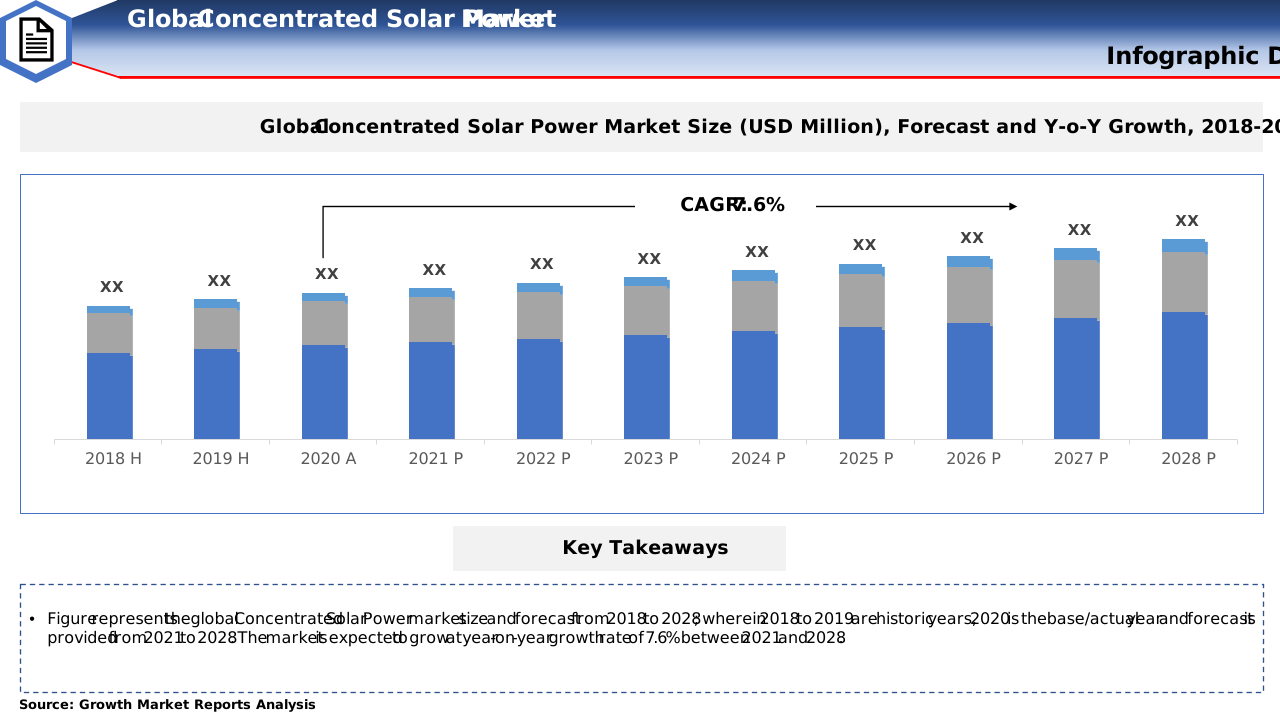
According to our latest research, the global concentrated solar power (CSP) market size reached USD 7.02 billion in 2025, demonstrating robust momentum in renewable energy adoption worldwide. The market is projected to expand at a CAGR of 9.2% from 2026 to 2034, reaching a forecasted value of USD 15.47 billion by 2034. This impressive growth trajectory is driven by increasing investments in sustainable energy infrastructure, growing governmental support for clean energy initiatives, and significant advancements in CSP technology. The CSP market is witnessing heightened interest from both public and private sectors, further accelerating its global adoption and technological innovation. For stakeholders exploring the financial dimensions of project development, the dynamics of CSP project financing are equally important to understand alongside technology trends.

Global Concentrated Solar Power Market Size Forecast 2025-2034, USD Billion

One of the primary growth factors propelling the concentrated solar power market is the rising demand for reliable and dispatchable renewable energy. Unlike traditional photovoltaic systems, CSP plants are equipped with thermal energy storage capabilities, allowing them to generate electricity even when sunlight is not available. This unique advantage is particularly valuable for grid stability and load balancing, making CSP an attractive option for regions with high solar irradiance and increasing energy needs. The integration of CSP into national grids is further supported by favorable government policies, feed-in tariffs, and incentives for renewable energy projects, especially in emerging economies. As energy security and carbon reduction targets become more stringent entering the late 2020s, the CSP market is expected to see sustained growth and strategic investments across all major geographies.

Technological advancements are another critical driver for the CSP market. Continuous innovation in CSP components such as solar fields, power blocks, and thermal energy storage systems has significantly enhanced plant efficiency and reduced levelized costs of electricity (LCOE). The emergence of hybrid systems that combine CSP with other renewable sources, such as concentrating photovoltaic and wind, further amplifies the value proposition of CSP technology. Additionally, advancements in materials science and automation have optimized the performance of parabolic troughs, solar towers, and linear Fresnel reflectors, making CSP plants more cost-effective and reliable. These technological breakthroughs are enabling the deployment of CSP projects at a larger scale and in more diverse geographic locations, thereby expanding the market's reach through 2034.

The global shift towards decarbonization and the increasing focus on environmental sustainability are providing a strong impetus for the CSP market. Many countries are setting ambitious renewable energy targets and implementing stringent emission regulations, prompting utilities and industrial players to invest in clean energy solutions. CSP not only helps reduce greenhouse gas emissions but also offers ancillary benefits such as water desalination and enhanced oil recovery, broadening its application spectrum. The adaptability of CSP technology to various end-user requirements, from residential and commercial to large-scale industrial applications, underscores its potential as a cornerstone of the future energy landscape. The broader solar thermal energy sector is also benefiting from many of the same policy tailwinds, creating synergistic growth across adjacent markets.

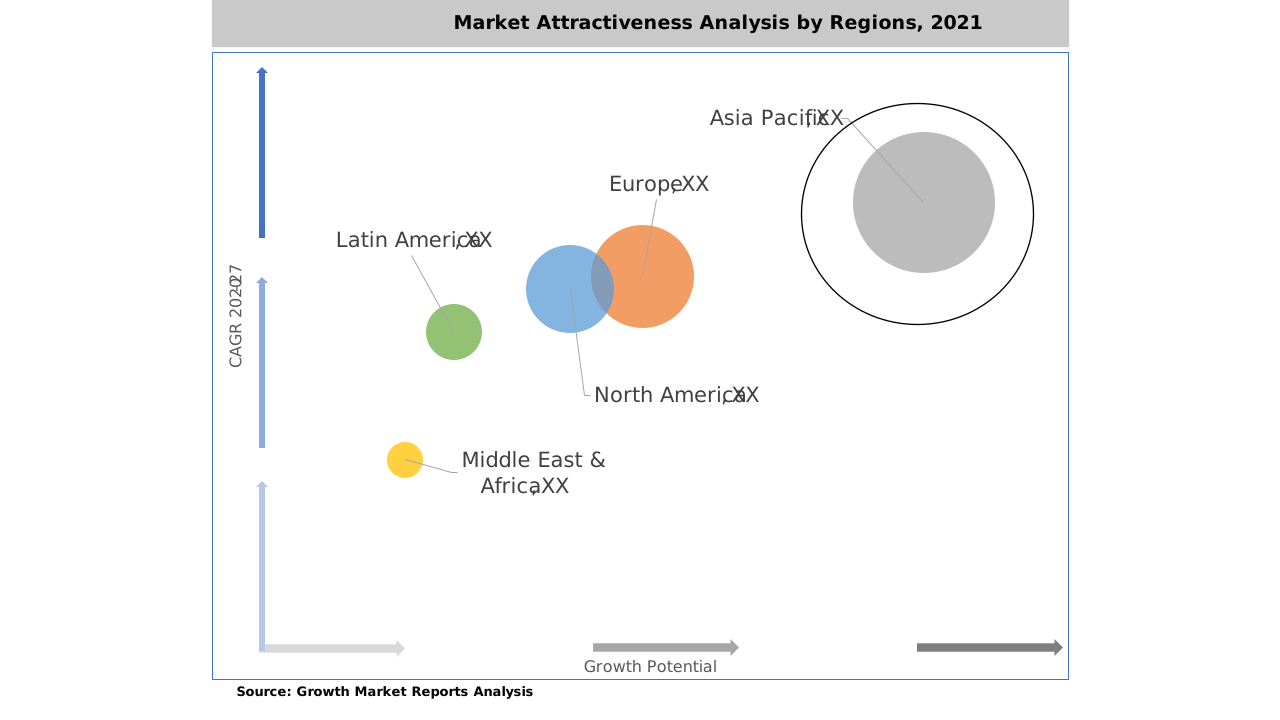
Regionally, the Asia Pacific market is emerging as a key growth engine for CSP, driven by substantial investments in solar infrastructure and supportive government policies in countries like China and India. Europe remains a leader in CSP adoption, leveraging its advanced technological capabilities and strong regulatory frameworks. North America is witnessing renewed interest in CSP, particularly for utility-scale projects in the southwestern United States. Meanwhile, the Middle East and Africa region is capitalizing on abundant solar resources and large-scale project development, positioning itself as a significant player in the global CSP market. Each region presents unique opportunities and challenges, shaping the competitive landscape and influencing market dynamics over the 2026-2034 forecast period.

Technology Analysis

The concentrated solar power market is segmented by technology into parabolic trough, solar power tower, linear Fresnel, and dish/engine systems, each offering distinct operational advantages and market opportunities. Parabolic trough technology dominates the market, accounting for approximately 42.5% of the 2025 market value due to its proven track record, scalability, and relatively lower capital costs. These systems utilize parabolic mirrors to concentrate sunlight onto a receiver tube, heating a fluid that generates steam to drive turbines. The widespread adoption of parabolic troughs is attributed to their high efficiency, ease of integration with thermal energy storage, and extensive deployment in countries such as Spain, the United States, and China. Continuous improvements in mirror materials, heat transfer fluids, and tracking mechanisms are further enhancing the performance of parabolic trough systems, solidifying their position in the market through the forecast horizon.

Concentrated Solar Power Market Share by Technology 2025

Solar power tower technology is gaining traction as a next-generation solution for utility-scale CSP projects, holding around 34.0% of the 2025 market and representing the fastest-growing segment. These systems employ a central receiver tower surrounded by a field of heliostats that track the sun and focus its energy onto the tower's receiver. The concentrated heat is used to generate high-temperature steam, which significantly improves thermal efficiency and power output. Solar power towers are particularly well-suited for integration with large-scale thermal energy storage, enabling round-the-clock electricity generation. Recent advancements in heliostat design, receiver materials, and molten salt storage have made solar power towers increasingly attractive for regions with high direct normal irradiance (DNI), such as the Middle East and North Africa. The scalability and high efficiency of this technology are expected to drive its adoption in mega solar projects worldwide through 2034.

Linear Fresnel reflector technology holds approximately 14.5% of the 2025 market and offers a cost-effective alternative to parabolic troughs and towers by using long rows of flat or slightly curved mirrors to focus sunlight onto a fixed receiver. This design simplifies construction, reduces land requirements, and lowers maintenance costs, making it an appealing choice for industrial and commercial applications. Linear Fresnel systems are particularly advantageous for process heat and steam generation, where moderate temperatures are sufficient. Although their conversion efficiency is generally lower than that of parabolic troughs and towers, ongoing research and development are addressing these limitations by improving optical design and receiver performance. As a result, linear Fresnel technology is carving out a niche in the global CSP market, especially in regions with limited land availability and moderate solar resources. Investors and developers curious about emerging optical concentration approaches may also find value in reviewing trends in the solar array concentrator segment, which shares several design principles with linear Fresnel systems.

The dish/engine systems segment accounts for roughly 9.0% of the 2025 market, notable for its modularity and high conversion efficiency at the unit level. These systems use parabolic dishes to concentrate sunlight onto a receiver attached to a Stirling engine or other heat engines. Dish/engine systems are ideal for decentralized power generation and off-grid applications, offering flexibility and scalability for remote or rural areas. Despite challenges related to cost and system complexity, advancements in dish materials, tracking systems, and engine efficiency are enhancing the commercial viability of this technology. As distributed energy solutions gain prominence in the late 2020s, dish/engine systems are expected to find growing application in niche markets and specialized industrial settings. Stakeholders evaluating the broader spectrum of concentrated solar solutions may also benefit from exploring developments in the solar PV multi-junction concentrator space, which is advancing in parallel with CSP dish technologies.

Report Scope

Attributes Details
Report Title Concentrated Solar Power Market Research Report 2034
By Technology Parabolic Trough, Solar Power Tower, Linear Fresnel, Dish/Engine Systems
By Component Solar Field, Power Block, Thermal Energy Storage
By Application Utilities, Enhanced Oil Recovery, Desalination, Others
By End-User Residential, Commercial, Industrial
Regions Covered North America, Europe, APAC, Latin America, MEA
Base Year 2025
Historic Data 2019-2024
Forecast Period 2026-2034
Number of Pages 255
Number of Tables & Figures 396
Customization Available Yes, the report can be customized as per your need.

Component Analysis

The concentrated solar power market is also segmented by component into solar field, power block, and thermal energy storage, each playing a critical role in the overall performance and efficiency of CSP plants. The solar field component, comprising mirrors, receivers, and tracking systems, is fundamental to capturing and concentrating solar energy. Innovations in mirror coatings, tracking algorithms, and receiver materials have significantly improved the solar field's efficiency and durability since 2019. Automated cleaning systems and real-time performance monitoring are further optimizing energy capture and reducing operational costs. The solar field segment is witnessing increased investment as developers seek to maximize energy yield and minimize land use, particularly in large-scale projects across sun-rich regions of the Middle East, Asia, and the American Southwest.

The power block component encompasses turbines, generators, and associated control systems responsible for converting thermal energy into electricity. Advances in turbine technology, including the use of superheated steam and high-efficiency generators, are enabling CSP plants to achieve higher output and lower emissions. Integration with combined-cycle systems and hybridization with other renewable sources are also enhancing the flexibility and reliability of CSP power blocks. As grid requirements become more stringent and demand for dispatchable power rises through the late 2020s, investment in advanced power block systems is expected to accelerate, driving further improvements in plant performance and cost-effectiveness.

Thermal energy storage (TES) is a transformative component of the CSP market, providing the ability to store excess thermal energy during periods of high solar irradiance and release it when needed. This capability enables CSP plants to deliver electricity on demand, addressing the intermittency challenges associated with other renewable sources. Molten salt storage is the most widely adopted TES technology, offering high energy density, long-duration storage, and cost-effectiveness. Ongoing research is focused on developing next-generation storage materials, such as phase change materials and advanced ceramics, to further enhance storage efficiency and reduce costs. The growing emphasis on grid stability and renewable integration is making TES an essential feature of new CSP projects commissioned from 2025 onward, driving innovation and market growth throughout the forecast period.

The interplay between these components is crucial for optimizing CSP plant performance and economics. Developers are increasingly adopting integrated design approaches that align solar field configuration, power block technology, and thermal energy storage capacity to specific site conditions and application requirements. This holistic approach is enabling the deployment of highly efficient, cost-competitive CSP plants that can compete with conventional power generation sources. As the market matures toward 2034, component manufacturers and project developers are collaborating to drive standardization, reduce costs, and accelerate the commercialization of advanced CSP technologies.

Application Analysis

The application landscape of the concentrated solar power market is diverse, with utilities, enhanced oil recovery, desalination, and other sectors leveraging CSP's unique capabilities. The utilities segment remains the largest application area, accounting for a significant share of global CSP capacity in 2025. Utility-scale CSP plants are being deployed to provide reliable, dispatchable power to national grids, particularly in regions with high solar resources and growing electricity demand. The ability to integrate thermal energy storage enables utilities to supply electricity during peak demand periods and support grid stability. Government mandates for renewable energy procurement and long-term power purchase agreements are further driving investment in utility-scale CSP projects, particularly in Europe, the Middle East, and North Africa.

Enhanced oil recovery (EOR) is an increasingly important application for CSP technology, particularly in oil-rich regions with abundant solar resources. CSP systems are used to generate high-temperature steam, which is injected into oil reservoirs to improve extraction efficiency. This application not only reduces the carbon footprint of oil production but also lowers operational costs by replacing conventional fossil fuel-based steam generation. The Middle East, with its vast oil fields and high solar irradiance, is at the forefront of CSP-based EOR deployment. As oil companies seek to meet sustainability targets and reduce emissions in line with 2025 climate commitments, the adoption of CSP for EOR is expected to grow, creating new opportunities for technology providers and project developers.

Desalination is another promising application for CSP, addressing the critical challenge of water scarcity in arid regions. CSP plants can provide the thermal energy required for multi-effect distillation (MED) and multi-stage flash (MSF) desalination processes, enabling the production of fresh water from seawater or brackish sources. The integration of CSP with desalination facilities offers a sustainable, low-carbon solution for water supply, particularly in the Middle East, North Africa, and parts of Asia. Technological advancements in hybrid CSP-desalination systems are improving efficiency and reducing costs, making this application increasingly viable for large-scale deployment. Related advances in concentrated solar ceramic furnace technology are also contributing to high-temperature industrial heat delivery, complementing CSP's desalination and process heat capabilities.

Beyond these core applications, CSP technology is finding use in a range of other sectors, including process heat for industrial operations, district heating, and remote power generation. The versatility of CSP systems, combined with their ability to deliver high-quality thermal energy and electricity, is driving adoption across diverse end-user segments. As awareness of CSP's benefits grows and new business models emerge through the 2026-2034 period, the application landscape is expected to expand, supporting the market's long-term growth and diversification.

End-User Analysis

The end-user segmentation of the concentrated solar power market encompasses residential, commercial, and industrial sectors, each with distinct energy requirements and adoption drivers. The industrial segment is the most prominent end-user, leveraging CSP technology for process heat, steam generation, and electricity supply. Industries such as chemicals, food processing, textiles, and mining require large amounts of high-temperature heat, making CSP an attractive alternative to conventional fossil fuel-based systems. The ability to integrate CSP with existing industrial processes and the potential for significant cost savings and emissions reductions are key factors driving adoption in this segment. As industrial decarbonization becomes a central priority in 2025 and beyond, CSP is expected to play an increasingly important role in supporting sustainable manufacturing and operations.

The commercial sector is also witnessing growing interest in CSP technology, particularly for applications such as district heating, cooling, and distributed power generation. Commercial buildings, hotels, hospitals, and educational institutions are exploring CSP solutions to reduce energy costs, enhance sustainability, and meet regulatory requirements. The modularity and scalability of CSP systems make them well-suited for commercial deployments, allowing users to tailor system size and configuration to specific energy needs. Incentives for green building certification and corporate sustainability initiatives are further driving adoption in this segment, particularly in regions with favorable solar resources and supportive policy frameworks.

The residential segment, while representing a smaller share of the CSP market, is beginning to gain traction in off-grid and remote areas where access to reliable electricity is limited. Small-scale CSP systems can provide both electricity and thermal energy for heating and hot water, improving living standards and supporting rural development. Advances in system design, cost reduction, and financing mechanisms are making residential CSP solutions more accessible and affordable. As energy access and rural electrification initiatives expand through the late 2020s, particularly in developing countries across Sub-Saharan Africa and South Asia, the residential segment is expected to contribute to the market's overall growth and social impact.

Across all end-user segments, the adoption of CSP technology is influenced by factors such as energy demand profiles, site-specific solar resources, regulatory frameworks, and economic considerations. Project developers and technology providers are increasingly offering customized solutions that address the unique needs of each end-user, from large-scale industrial plants to small off-grid communities. This customer-centric approach is fostering innovation, enhancing value propositions, and driving market penetration across diverse sectors and geographies through 2034.

Opportunities & Threats

The concentrated solar power market presents significant opportunities for growth and innovation, driven by the global transition to renewable energy and the need for dispatchable, low-carbon power solutions. One of the most promising opportunities lies in the integration of CSP with energy storage and hybrid renewable systems. By combining CSP with photovoltaic, wind, or biomass technologies, developers can create flexible, resilient power plants that maximize renewable energy utilization and enhance grid stability. The increasing demand for long-duration energy storage, particularly as intermittent renewables become a larger share of the energy mix through the early 2030s, is positioning CSP as a key enabler of the future energy landscape. Additionally, the expansion of CSP applications beyond power generation, such as water desalination and industrial process heat, is opening new markets and revenue streams for technology providers and project developers.

Another major opportunity is the deployment of CSP in emerging markets and sun-rich regions, where rapid population growth and industrialization are driving energy demand. Countries in the Middle East, Africa, and Asia Pacific are investing heavily in solar infrastructure, supported by favorable government policies, international financing, and strategic partnerships. The localization of CSP component manufacturing and the development of regional supply chains are further enhancing market competitiveness and reducing project costs. As technology costs continue to decline and project development expertise increases, CSP is expected to become an increasingly attractive option for both public and private sector stakeholders seeking to diversify their energy portfolios and achieve net-zero sustainability goals by mid-century.

Despite these opportunities, the CSP market faces certain restraints that could hinder its growth through the forecast period. High upfront capital costs remain a significant barrier, particularly for large-scale projects in developing countries with limited access to financing. The complexity of CSP plant design, construction, and operation requires specialized expertise and robust project management capabilities, which can pose challenges for new market entrants. Additionally, competition from rapidly falling photovoltaic and battery storage costs is exerting pressure on CSP project economics, necessitating continuous innovation and cost reduction efforts. Water consumption in arid deployment regions presents an environmental and operational constraint, accelerating the shift to dry-cooling solutions. Addressing these challenges will require coordinated action from industry stakeholders, policymakers, and financial institutions to unlock the full potential of CSP technology and ensure its long-term viability through 2034.

Regional Outlook

The regional distribution of the concentrated solar power market reflects varying levels of solar resource availability, policy support, and technological maturity. Asia Pacific is the leading regional market, accounting for approximately 28.5% of the global 2025 market value, equivalent to roughly USD 2.00 billion. China and India are driving regional growth, backed by ambitious renewable energy targets, substantial government investments, and a growing pipeline of utility-scale projects. The region's high solar irradiance, coupled with increasing energy demand and grid integration challenges, makes CSP a compelling solution for both power generation and industrial applications. Ongoing efforts to localize component manufacturing and develop regional supply chains are further enhancing the market's competitiveness in Asia Pacific and supporting long-term growth through 2034.

Concentrated Solar Power Market Regional Share 2025

Europe continues to be a global leader in CSP deployment, holding around 21.0% of the 2025 market, approximately USD 1.47 billion. Spain remains at the forefront, hosting some of the world's largest and most advanced CSP plants built over the past two decades. The region's strong regulatory frameworks, robust research and development ecosystems, and supportive policy environments have fostered innovation and accelerated project development. European utilities and industrial players are increasingly investing in hybrid CSP projects and cross-border electricity trading, leveraging CSP's dispatchability to support grid stability and renewable integration. The region is expected to maintain a steady growth trajectory through 2034, driven by ongoing decarbonization efforts and the expansion of CSP applications in process heat and water desalination.

The Middle East and Africa region is rapidly gaining prominence, accounting for approximately 19.5% of the 2025 global market, or roughly USD 1.37 billion. Countries such as the United Arab Emirates, Saudi Arabia, Morocco, and South Africa are investing heavily in large-scale CSP projects, leveraging exceptional solar resources and strong governmental support. The region's strategic focus on energy diversification, water desalination, and enhanced oil recovery is creating significant and expanding opportunities for CSP technology providers and project developers. North America holds approximately 17.5% of the 2025 market, or around USD 1.23 billion, with renewed interest in CSP particularly in the southwestern United States driven by high DNI levels and supportive long-term procurement frameworks. Latin America accounts for the remaining approximately 13.5% of the market, roughly USD 0.95 billion, with Chile, Brazil, and Mexico emerging as potential growth markets for CSP in mining, grid stabilization, and utility applications. Overall, regional dynamics are shaping the competitive landscape and influencing market growth trajectories across the globe through 2034.

Competitor Outlook

The concentrated solar power market is characterized by a dynamic and competitive landscape, with both established players and emerging entrants vying for market share. Leading companies are investing heavily in research and development to enhance system efficiency, reduce costs, and expand their product portfolios. Strategic partnerships, joint ventures, and mergers and acquisitions are common strategies employed to strengthen market positions and accelerate project development. The competitive environment is further intensified by the entry of new players from the broader renewable energy sector, bringing fresh perspectives and innovative solutions to the market. As the CSP market matures through the late 2020s and early 2030s, companies are focusing on building long-term relationships with utilities, industrial clients, and government agencies to secure project pipelines and drive sustainable growth.

Innovation is a key differentiator in the CSP market, with companies competing on the basis of technological leadership, project execution capabilities, and operational excellence. The development of advanced thermal energy storage systems, high-efficiency receivers, and next-generation heliostats is enabling market leaders to deliver superior performance and value to customers. Companies are also investing in digitalization and automation, leveraging data analytics and remote monitoring to optimize plant operations and reduce maintenance costs. The ability to offer turnkey solutions, from project design and financing to construction and operation, is becoming increasingly important as customers seek integrated, hassle-free project delivery through 2034.

In addition to technological innovation, market players are focusing on geographic expansion and localization strategies to tap into emerging markets and address region-specific requirements. Establishing local manufacturing facilities, training programs, and supply chain partnerships is helping companies reduce costs, enhance project delivery timelines, and build strong relationships with local stakeholders. The emphasis on sustainability, corporate social responsibility, and community engagement is also shaping the competitive landscape, as companies seek to differentiate themselves and build trust with customers and regulators alike.

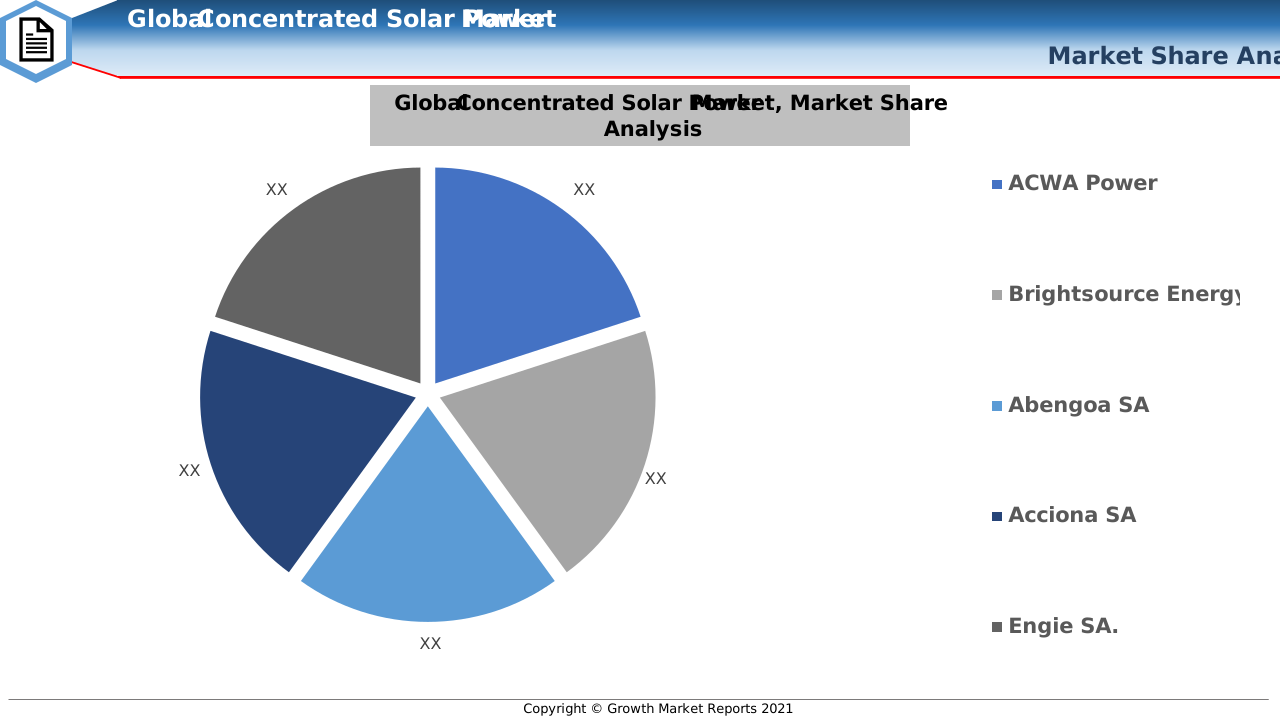
Major companies operating in the concentrated solar power market as of 2025 include ACWA Power, SENER Group, Abengoa Solar, Acciona Energia, Siemens Energy, and GE Vernova. ACWA Power is one of the world's most active developers and operators of large-scale CSP projects, with flagship assets in Saudi Arabia, Morocco, and South Africa. SENER Group is recognized globally for its engineering excellence in parabolic trough and solar tower technologies, with a strong project delivery record in Europe and Latin America. Acciona Energia operates a substantial fleet of CSP plants across Spain and is actively developing new capacity in emerging markets. Siemens Energy and GE Vernova are leveraging their expertise in power generation and automation to deliver advanced CSP solutions and support hybrid renewable integration. Abengoa Solar, despite financial restructuring, retains significant intellectual property and operational expertise in parabolic trough and tower technologies that continue to influence the competitive landscape through 2034.

Key Players

  • Abengoa Solar
  • BrightSource Energy
  • ACWA Power
  • SolarReserve
  • TSK Flagsol Engineering
  • SENER Group
  • Siemens Energy
  • Acciona Energia
  • ENGIE
  • GE Vernova
  • Aalborg CSP
  • Cobra Energia
  • Shouhang Hightech Energy Technology
  • Supcon Solar
  • Shanghai Electric
  • Enel Green Power
  • eSolar Inc.
  • Schott AG

Segments

The Concentrated Solar Power market has been segmented on the basis of

Technology

  • Parabolic Trough
  • Solar Power Tower
  • Linear Fresnel
  • Dish/Engine Systems

Component

  • Solar Field
  • Power Block
  • Thermal Energy Storage

Application

  • Utilities
  • Enhanced Oil Recovery
  • Desalination
  • Others

End-User

  • Residential
  • Commercial
  • Industrial

Frequently Asked Questions

Yes, CSP technology is highly adaptable across a wide spectrum of end-users and applications. For large industrial clients, CSP systems can be engineered to deliver high-temperature process heat or steam directly integrated into manufacturing workflows. Commercial users such as hotels, hospitals, and resorts can deploy modular CSP installations for combined heat and power. Utility customers benefit from turnkey CSP power plant solutions equipped with thermal energy storage calibrated to local grid and demand profiles. For remote and off-grid communities, smaller-scale dish/engine or linear Fresnel systems can provide affordable electricity and hot water. Project developers and technology providers in 2025 are increasingly offering modular, bankable, and site-specific CSP solutions to address this diverse demand landscape.

CSP technology is advancing rapidly across multiple fronts in 2025. Next-generation solar tower designs are achieving higher operating temperatures above 600 degrees Celsius using supercritical CO2 cycles, significantly improving thermal efficiency. Advanced heliostat designs with AI-driven tracking algorithms are reducing mirror field costs and improving optical accuracy. Research into new storage media, including phase change materials and advanced ceramics, is extending TES duration beyond 12 hours. Hybridization with photovoltaic systems and green hydrogen production is broadening CSP's value proposition and revenue streams. These innovations, combined with standardized EPC approaches and digital plant management platforms, are making CSP increasingly cost-competitive and adaptable to diverse market requirements.

Despite strong growth momentum, the CSP market faces several notable challenges in 2025. High upfront capital expenditure remains the most significant barrier, particularly for emerging-market projects with limited access to low-cost financing. Rapidly declining costs for utility-scale photovoltaic and battery storage create competitive pressure on CSP project economics, requiring continuous innovation and cost reduction across the CSP value chain. Complex plant design, construction timelines, and the need for specialized operational expertise can deter new entrants. Water consumption in arid regions, where CSP is most viable, also presents an environmental and logistical constraint, driving interest in dry-cooling solutions. Addressing these challenges is central to the long-term competitiveness of CSP.

The global CSP market features a mix of established energy conglomerates, specialized technology firms, and regional project developers. Leading players as of 2025 include ACWA Power, which dominates large-scale CSP deployment in the Middle East and North Africa; SENER Group, recognized for its engineering excellence in solar tower and parabolic trough projects; Abengoa Solar, a pioneer in European and Latin American CSP; and Acciona Energia, active across multiple continents. Other key participants include Siemens Energy, GE Vernova, ENGIE, Enel Green Power, Shanghai Electric, Supcon Solar, Aalborg CSP, and Schott AG, all contributing across technology development, EPC services, and plant operation.

CSP technology serves a broad range of applications beyond conventional electricity generation. The utilities segment is the dominant application, deploying CSP for grid-scale power supply with thermal storage for dispatchability. Enhanced oil recovery (EOR) is a growing application in the Middle East, where CSP-generated steam reduces the carbon footprint of oil extraction. Desalination is another significant use case, particularly in water-scarce regions of North Africa and the Arabian Peninsula. Additional applications include industrial process heat, district heating, and remote off-grid power generation. This expanding application spectrum is a key factor supporting the market's projected growth to USD 15.47 billion by 2034.

As of 2025, Asia Pacific leads the global CSP market with approximately 28.5% share, driven primarily by large-scale project investments in China and India, both of which have ambitious renewable energy targets. Europe holds around 21.0% share, led by Spain's extensive installed base and strong regulatory support for decarbonization. The Middle East and Africa account for roughly 19.5% of the market, capitalizing on exceptional solar irradiance and government-backed megaprojects in the UAE, Saudi Arabia, and Morocco. North America and Latin America hold 17.5% and 13.5% shares respectively, with growth driven by utility-scale developments in the U.S. Southwest and mining-sector applications in Chile.

Thermal energy storage (TES) is one of the most transformative advantages of CSP over other renewable energy technologies. By storing excess heat generated during peak solar hours, typically using molten salt as the storage medium, CSP plants can continue generating electricity well into the evening or during periods of cloud cover. This dispatchability makes CSP plants highly valuable for grid stability, peak demand management, and integration with intermittent renewables such as wind and photovoltaic. In 2025, TES-equipped CSP projects represent the majority of new capacity announcements globally, reflecting growing demand for reliable, round-the-clock clean power.

The four primary CSP technologies are parabolic trough, solar power tower, linear Fresnel reflectors, and dish/engine systems. Parabolic trough holds the largest share at approximately 42.5% of the 2025 market, owing to its proven commercial track record and scalability. Solar power tower is the fastest-growing segment at around 34.0% share, driven by its high thermal efficiency and compatibility with large-scale molten salt storage. Linear Fresnel accounts for roughly 14.5% of the market and is favored for industrial process heat. Dish/engine systems hold approximately 9.0% and are best suited for decentralized and off-grid applications.

According to our latest research, the global concentrated solar power market reached USD 7.02 billion in 2025. The market is projected to grow at a compound annual growth rate (CAGR) of 9.2% from 2026 to 2034, reaching an estimated value of USD 15.47 billion by 2034. This growth is driven by increasing investments in dispatchable renewable energy, expanding utility-scale project pipelines, and ongoing cost reductions in CSP technology components across key markets in Asia Pacific, the Middle East, and Europe.

Concentrated solar power (CSP) is a renewable energy technology that uses mirrors or lenses to concentrate sunlight onto a small area, generating high-temperature heat that drives a turbine to produce electricity. Unlike photovoltaic systems that convert sunlight directly into electricity, CSP systems produce thermal energy first, enabling integration with thermal energy storage (TES) for dispatchable, around-the-clock power generation. As of 2025, CSP is recognized as a cornerstone technology for reliable, low-carbon electricity supply in high solar irradiance regions globally.

Table Of Content

Chapter 1 Executive Summary
Chapter 2 Assumptions and Acronyms Used
Chapter 3 Research Methodology
Chapter 4 Concentrated Solar Power Market Overview
   4.1 Introduction
      4.1.1 Market Taxonomy
      4.1.2 Market Definition
      4.1.3 Macro-Economic Factors Impacting the Market Growth
   4.2 Concentrated Solar Power Market Dynamics
      4.2.1 Market Drivers
      4.2.2 Market Restraints
      4.2.3 Market Opportunity
   4.3 Concentrated Solar Power Market - Supply Chain Analysis
      4.3.1 List of Key Suppliers
      4.3.2 List of Key Distributors
      4.3.3 List of Key Consumers
   4.4 Key Forces Shaping the Concentrated Solar Power Market
      4.4.1 Bargaining Power of Suppliers
      4.4.2 Bargaining Power of Buyers
      4.4.3 Threat of Substitution
      4.4.4 Threat of New Entrants
      4.4.5 Competitive Rivalry
   4.5 Global Concentrated Solar Power Market Size & Forecast, 2023-2032
      4.5.1 Concentrated Solar Power Market Size and Y-o-Y Growth
      4.5.2 Concentrated Solar Power Market Absolute $ Opportunity

Chapter 5 Global Concentrated Solar Power Market Analysis and Forecast By Technology
   5.1 Introduction
      5.1.1 Key Market Trends & Growth Opportunities By Technology
      5.1.2 Basis Point Share (BPS) Analysis By Technology
      5.1.3 Absolute $ Opportunity Assessment By Technology
   5.2 Concentrated Solar Power Market Size Forecast By Technology
      5.2.1 Parabolic Trough
      5.2.2 Solar Power Tower
      5.2.3 Linear Fresnel
      5.2.4 Dish/Engine Systems
   5.3 Market Attractiveness Analysis By Technology

Chapter 6 Global Concentrated Solar Power Market Analysis and Forecast By Component
   6.1 Introduction
      6.1.1 Key Market Trends & Growth Opportunities By Component
      6.1.2 Basis Point Share (BPS) Analysis By Component
      6.1.3 Absolute $ Opportunity Assessment By Component
   6.2 Concentrated Solar Power Market Size Forecast By Component
      6.2.1 Solar Field
      6.2.2 Power Block
      6.2.3 Thermal Energy Storage
   6.3 Market Attractiveness Analysis By Component

Chapter 7 Global Concentrated Solar Power Market Analysis and Forecast By Application
   7.1 Introduction
      7.1.1 Key Market Trends & Growth Opportunities By Application
      7.1.2 Basis Point Share (BPS) Analysis By Application
      7.1.3 Absolute $ Opportunity Assessment By Application
   7.2 Concentrated Solar Power Market Size Forecast By Application
      7.2.1 Utilities
      7.2.2 Enhanced Oil Recovery
      7.2.3 Desalination
      7.2.4 Others
   7.3 Market Attractiveness Analysis By Application

Chapter 8 Global Concentrated Solar Power Market Analysis and Forecast By End-User
   8.1 Introduction
      8.1.1 Key Market Trends & Growth Opportunities By End-User
      8.1.2 Basis Point Share (BPS) Analysis By End-User
      8.1.3 Absolute $ Opportunity Assessment By End-User
   8.2 Concentrated Solar Power Market Size Forecast By End-User
      8.2.1 Residential
      8.2.2 Commercial
      8.2.3 Industrial
   8.3 Market Attractiveness Analysis By End-User

Chapter 9 Global Concentrated Solar Power Market Analysis and Forecast by Region
   9.1 Introduction
      9.1.1 Key Market Trends & Growth Opportunities By Region
      9.1.2 Basis Point Share (BPS) Analysis By Region
      9.1.3 Absolute $ Opportunity Assessment By Region
   9.2 Concentrated Solar Power Market Size Forecast By Region
      9.2.1 North America
      9.2.2 Europe
      9.2.3 Asia Pacific
      9.2.4 Latin America
      9.2.5 Middle East & Africa (MEA)
   9.3 Market Attractiveness Analysis By Region

Chapter 10 Coronavirus Disease (COVID-19) Impact 
   10.1 Introduction 
   10.2 Current & Future Impact Analysis 
   10.3 Economic Impact Analysis 
   10.4 Government Policies 
   10.5 Investment Scenario

Chapter 11 North America Concentrated Solar Power Analysis and Forecast
   11.1 Introduction
   11.2 North America Concentrated Solar Power Market Size Forecast by Country
      11.2.1 U.S.
      11.2.2 Canada
   11.3 Basis Point Share (BPS) Analysis by Country
   11.4 Absolute $ Opportunity Assessment by Country
   11.5 Market Attractiveness Analysis by Country
   11.6 North America Concentrated Solar Power Market Size Forecast By Technology
      11.6.1 Parabolic Trough
      11.6.2 Solar Power Tower
      11.6.3 Linear Fresnel
      11.6.4 Dish/Engine Systems
   11.7 Basis Point Share (BPS) Analysis By Technology 
   11.8 Absolute $ Opportunity Assessment By Technology 
   11.9 Market Attractiveness Analysis By Technology
   11.10 North America Concentrated Solar Power Market Size Forecast By Component
      11.10.1 Solar Field
      11.10.2 Power Block
      11.10.3 Thermal Energy Storage
   11.11 Basis Point Share (BPS) Analysis By Component 
   11.12 Absolute $ Opportunity Assessment By Component 
   11.13 Market Attractiveness Analysis By Component
   11.14 North America Concentrated Solar Power Market Size Forecast By Application
      11.14.1 Utilities
      11.14.2 Enhanced Oil Recovery
      11.14.3 Desalination
      11.14.4 Others
   11.15 Basis Point Share (BPS) Analysis By Application 
   11.16 Absolute $ Opportunity Assessment By Application 
   11.17 Market Attractiveness Analysis By Application
   11.18 North America Concentrated Solar Power Market Size Forecast By End-User
      11.18.1 Residential
      11.18.2 Commercial
      11.18.3 Industrial
   11.19 Basis Point Share (BPS) Analysis By End-User 
   11.20 Absolute $ Opportunity Assessment By End-User 
   11.21 Market Attractiveness Analysis By End-User

Chapter 12 Europe Concentrated Solar Power Analysis and Forecast
   12.1 Introduction
   12.2 Europe Concentrated Solar Power Market Size Forecast by Country
      12.2.1 Germany
      12.2.2 France
      12.2.3 Italy
      12.2.4 U.K.
      12.2.5 Spain
      12.2.6 Russia
      12.2.7 Rest of Europe
   12.3 Basis Point Share (BPS) Analysis by Country
   12.4 Absolute $ Opportunity Assessment by Country
   12.5 Market Attractiveness Analysis by Country
   12.6 Europe Concentrated Solar Power Market Size Forecast By Technology
      12.6.1 Parabolic Trough
      12.6.2 Solar Power Tower
      12.6.3 Linear Fresnel
      12.6.4 Dish/Engine Systems
   12.7 Basis Point Share (BPS) Analysis By Technology 
   12.8 Absolute $ Opportunity Assessment By Technology 
   12.9 Market Attractiveness Analysis By Technology
   12.10 Europe Concentrated Solar Power Market Size Forecast By Component
      12.10.1 Solar Field
      12.10.2 Power Block
      12.10.3 Thermal Energy Storage
   12.11 Basis Point Share (BPS) Analysis By Component 
   12.12 Absolute $ Opportunity Assessment By Component 
   12.13 Market Attractiveness Analysis By Component
   12.14 Europe Concentrated Solar Power Market Size Forecast By Application
      12.14.1 Utilities
      12.14.2 Enhanced Oil Recovery
      12.14.3 Desalination
      12.14.4 Others
   12.15 Basis Point Share (BPS) Analysis By Application 
   12.16 Absolute $ Opportunity Assessment By Application 
   12.17 Market Attractiveness Analysis By Application
   12.18 Europe Concentrated Solar Power Market Size Forecast By End-User
      12.18.1 Residential
      12.18.2 Commercial
      12.18.3 Industrial
   12.19 Basis Point Share (BPS) Analysis By End-User 
   12.20 Absolute $ Opportunity Assessment By End-User 
   12.21 Market Attractiveness Analysis By End-User

Chapter 13 Asia Pacific Concentrated Solar Power Analysis and Forecast
   13.1 Introduction
   13.2 Asia Pacific Concentrated Solar Power Market Size Forecast by Country
      13.2.1 China
      13.2.2 Japan
      13.2.3 South Korea
      13.2.4 India
      13.2.5 Australia
      13.2.6 South East Asia (SEA)
      13.2.7 Rest of Asia Pacific (APAC)
   13.3 Basis Point Share (BPS) Analysis by Country
   13.4 Absolute $ Opportunity Assessment by Country
   13.5 Market Attractiveness Analysis by Country
   13.6 Asia Pacific Concentrated Solar Power Market Size Forecast By Technology
      13.6.1 Parabolic Trough
      13.6.2 Solar Power Tower
      13.6.3 Linear Fresnel
      13.6.4 Dish/Engine Systems
   13.7 Basis Point Share (BPS) Analysis By Technology 
   13.8 Absolute $ Opportunity Assessment By Technology 
   13.9 Market Attractiveness Analysis By Technology
   13.10 Asia Pacific Concentrated Solar Power Market Size Forecast By Component
      13.10.1 Solar Field
      13.10.2 Power Block
      13.10.3 Thermal Energy Storage
   13.11 Basis Point Share (BPS) Analysis By Component 
   13.12 Absolute $ Opportunity Assessment By Component 
   13.13 Market Attractiveness Analysis By Component
   13.14 Asia Pacific Concentrated Solar Power Market Size Forecast By Application
      13.14.1 Utilities
      13.14.2 Enhanced Oil Recovery
      13.14.3 Desalination
      13.14.4 Others
   13.15 Basis Point Share (BPS) Analysis By Application 
   13.16 Absolute $ Opportunity Assessment By Application 
   13.17 Market Attractiveness Analysis By Application
   13.18 Asia Pacific Concentrated Solar Power Market Size Forecast By End-User
      13.18.1 Residential
      13.18.2 Commercial
      13.18.3 Industrial
   13.19 Basis Point Share (BPS) Analysis By End-User 
   13.20 Absolute $ Opportunity Assessment By End-User 
   13.21 Market Attractiveness Analysis By End-User

Chapter 14 Latin America Concentrated Solar Power Analysis and Forecast
   14.1 Introduction
   14.2 Latin America Concentrated Solar Power Market Size Forecast by Country
      14.2.1 Brazil
      14.2.2 Mexico
      14.2.3 Rest of Latin America (LATAM)
   14.3 Basis Point Share (BPS) Analysis by Country
   14.4 Absolute $ Opportunity Assessment by Country
   14.5 Market Attractiveness Analysis by Country
   14.6 Latin America Concentrated Solar Power Market Size Forecast By Technology
      14.6.1 Parabolic Trough
      14.6.2 Solar Power Tower
      14.6.3 Linear Fresnel
      14.6.4 Dish/Engine Systems
   14.7 Basis Point Share (BPS) Analysis By Technology 
   14.8 Absolute $ Opportunity Assessment By Technology 
   14.9 Market Attractiveness Analysis By Technology
   14.10 Latin America Concentrated Solar Power Market Size Forecast By Component
      14.10.1 Solar Field
      14.10.2 Power Block
      14.10.3 Thermal Energy Storage
   14.11 Basis Point Share (BPS) Analysis By Component 
   14.12 Absolute $ Opportunity Assessment By Component 
   14.13 Market Attractiveness Analysis By Component
   14.14 Latin America Concentrated Solar Power Market Size Forecast By Application
      14.14.1 Utilities
      14.14.2 Enhanced Oil Recovery
      14.14.3 Desalination
      14.14.4 Others
   14.15 Basis Point Share (BPS) Analysis By Application 
   14.16 Absolute $ Opportunity Assessment By Application 
   14.17 Market Attractiveness Analysis By Application
   14.18 Latin America Concentrated Solar Power Market Size Forecast By End-User
      14.18.1 Residential
      14.18.2 Commercial
      14.18.3 Industrial
   14.19 Basis Point Share (BPS) Analysis By End-User 
   14.20 Absolute $ Opportunity Assessment By End-User 
   14.21 Market Attractiveness Analysis By End-User

Chapter 15 Middle East & Africa (MEA) Concentrated Solar Power Analysis and Forecast
   15.1 Introduction
   15.2 Middle East & Africa (MEA) Concentrated Solar Power Market Size Forecast by Country
      15.2.1 Saudi Arabia
      15.2.2 South Africa
      15.2.3 UAE
      15.2.4 Rest of Middle East & Africa (MEA)
   15.3 Basis Point Share (BPS) Analysis by Country
   15.4 Absolute $ Opportunity Assessment by Country
   15.5 Market Attractiveness Analysis by Country
   15.6 Middle East & Africa (MEA) Concentrated Solar Power Market Size Forecast By Technology
      15.6.1 Parabolic Trough
      15.6.2 Solar Power Tower
      15.6.3 Linear Fresnel
      15.6.4 Dish/Engine Systems
   15.7 Basis Point Share (BPS) Analysis By Technology 
   15.8 Absolute $ Opportunity Assessment By Technology 
   15.9 Market Attractiveness Analysis By Technology
   15.10 Middle East & Africa (MEA) Concentrated Solar Power Market Size Forecast By Component
      15.10.1 Solar Field
      15.10.2 Power Block
      15.10.3 Thermal Energy Storage
   15.11 Basis Point Share (BPS) Analysis By Component 
   15.12 Absolute $ Opportunity Assessment By Component 
   15.13 Market Attractiveness Analysis By Component
   15.14 Middle East & Africa (MEA) Concentrated Solar Power Market Size Forecast By Application
      15.14.1 Utilities
      15.14.2 Enhanced Oil Recovery
      15.14.3 Desalination
      15.14.4 Others
   15.15 Basis Point Share (BPS) Analysis By Application 
   15.16 Absolute $ Opportunity Assessment By Application 
   15.17 Market Attractiveness Analysis By Application
   15.18 Middle East & Africa (MEA) Concentrated Solar Power Market Size Forecast By End-User
      15.18.1 Residential
      15.18.2 Commercial
      15.18.3 Industrial
   15.19 Basis Point Share (BPS) Analysis By End-User 
   15.20 Absolute $ Opportunity Assessment By End-User 
   15.21 Market Attractiveness Analysis By End-User

Chapter 16 Competition Landscape 
   16.1 Concentrated Solar Power Market: Competitive Dashboard
   16.2 Global Concentrated Solar Power Market: Market Share Analysis, 2023
   16.3 Company Profiles (Details – Overview, Financials, Developments, Strategy) 
      16.3.1 Abengoa Solar
      16.3.2 BrightSource Energy
      16.3.3 ACWA Power
      16.3.4 SENER Group
      16.3.5 Siemens Energy
      16.3.6 Acciona Energia
      16.3.7 ENGIE
      16.3.8 GE Vernova
      16.3.9 Aalborg CSP
      16.3.10 Cobra Energia
      16.3.11 Shouhang Hightech Energy Technology
      16.3.12 Supcon Solar
      16.3.13 Shanghai Electric
      16.3.14 Enel Green Power
      16.3.15 Schott AG
      16.3.16 SolarReserve
      16.3.17 TSK Flagsol Engineering
      16.3.18 eSolar Inc.

Methodology

Our Clients

General Electric
Pfizer
Honda Motor Co. Ltd.
The John Holland Group
sinopec
FedEx Logistics
General Mills
Deloitte