Segments - by Component (Solutions, Services), by Application (Emergency Communication, Surveillance and Security, Disaster Management, Critical Infrastructure Security, Others), by Deployment Mode (On-Premises, Cloud), by End-User (Law Enforcement Agencies, Firefighting Organizations, Emergency Medical Services, Homeland Security, Others)
This report is updated with the latest market data and insights as of June 2026. Base year: 2025 | Forecast period: 2026-2034
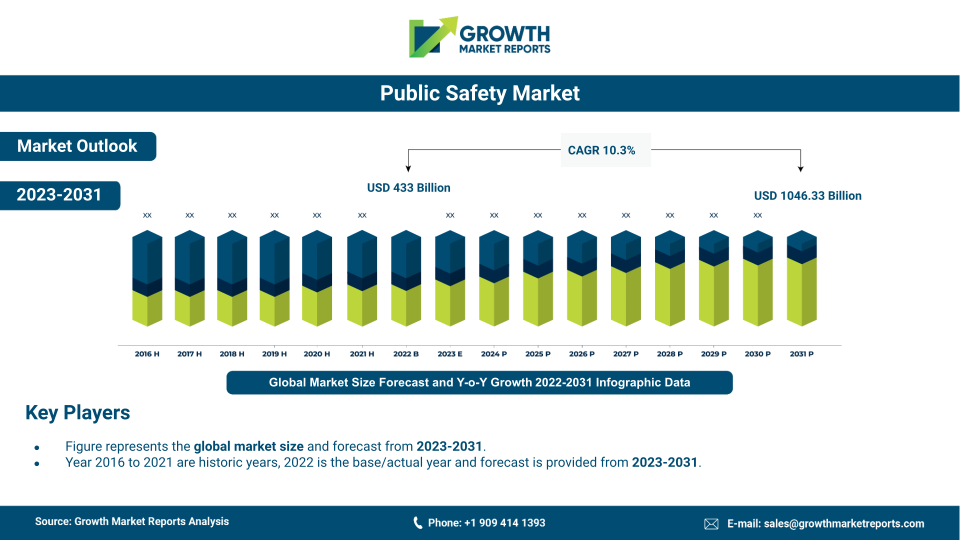
According to our latest research, the public safety market size globally reached USD 31.3 billion in 2025, reflecting robust expansion driven by increasing investments in advanced safety and security technologies. The market is expected to achieve a CAGR of 8.2% from 2026 to 2034, projecting a value of USD 63.4 billion by 2034. This impressive growth trajectory is fueled by heightened concerns over public safety, the proliferation of smart city initiatives, and the integration of digital transformation strategies by governments and agencies worldwide. The broader landscape of public safety and security solutions continues to attract significant capital as nations modernize their emergency response capabilities.
The primary growth driver for the public safety market is the rapid advancement and adoption of digital technologies such as artificial intelligence, IoT, and big data analytics. Governments and public agencies are increasingly leveraging these technologies to enhance situational awareness, streamline emergency response, and ensure the safety of citizens. The integration of real-time data analytics with emergency communication networks allows for faster, more informed decision-making during critical events. Furthermore, the growing threat of cyber and physical attacks on critical infrastructure is compelling authorities to invest in robust surveillance and security systems, further fueling market expansion.
Another significant factor propelling the public safety market is the global upsurge in natural disasters, terrorist activities, and large-scale public events that demand efficient disaster management and incident response. The frequency and severity of these events have underscored the need for comprehensive public safety solutions encompassing emergency communication, rapid mobilization of resources, and coordinated multi-agency responses. As a result, there is a marked increase in the deployment of advanced command and control systems, interoperable communication platforms, and geospatial intelligence tools, all contributing to the sustained growth of the market. Agencies seeking to modernize their data infrastructure are also exploring mission-critical data platforms designed specifically for high-stakes operational environments.
Moreover, the evolution of smart cities is acting as a catalyst for public safety market growth. Urbanization has intensified the complexity of managing safety in densely populated areas, prompting city authorities to embrace integrated surveillance, intelligent traffic management, and predictive policing solutions. These initiatives are not only enhancing real-time situational awareness but also enabling proactive prevention of incidents. The convergence of cloud computing, mobile technologies, and 5G connectivity is further enabling seamless collaboration among public safety agencies, thereby driving the adoption of next-generation public safety solutions across both developed and developing regions. The growing reliance on dedicated broadband networks for first responders is also accelerating this transition to connected, data-driven operations.
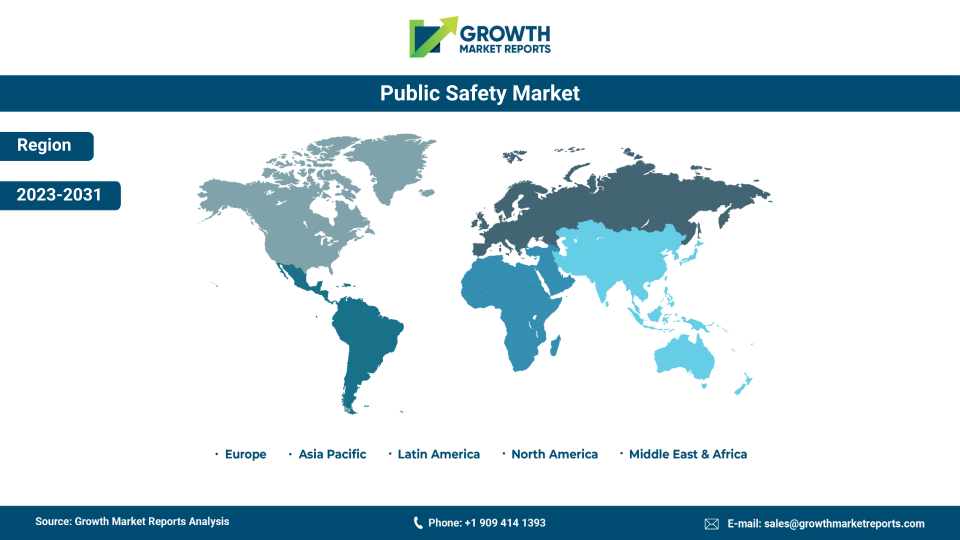
From a regional perspective, North America continues to dominate the public safety market, accounting for the largest share in 2025, closely followed by Europe and Asia Pacific. The United States, in particular, has seen substantial government investments in public safety infrastructure, emergency preparedness, and homeland security, which has set a benchmark for other regions. Asia Pacific is emerging as the fastest-growing market, propelled by rapid urbanization, increasing government spending on smart city projects, and rising awareness of public safety challenges. Meanwhile, the Middle East and Africa, as well as Latin America, are gradually enhancing their public safety frameworks, albeit at a more measured pace due to budgetary and infrastructural constraints.
The public safety market by component is broadly segmented into solutions and services, each playing a pivotal role in shaping the industry landscape. Solutions encompass a wide range of hardware and software offerings, including surveillance systems, emergency communication platforms, and incident management software. These solutions are designed to provide end-to-end visibility, streamline response procedures, and ensure a high level of preparedness against diverse threats. The increasing deployment of advanced surveillance cameras, biometric access controls, and AI-powered analytics is transforming how agencies monitor and respond to incidents, driving the solutions segment to approximately 62.5% of total market revenue in 2025.
Services are gaining traction as public safety agencies recognize the importance of ongoing support, maintenance, and training to maximize the utility of their technology investments. Managed services, consulting, and system integration are critical in ensuring the seamless operation of complex public safety infrastructures. As agencies transition towards digital platforms, the demand for specialized services such as cybersecurity, cloud migration, and data analytics is surging, reflecting a shift towards a more holistic approach to public safety management. These services also play a vital role in enabling agencies to adapt to evolving threats and regulatory requirements. The growing focus on community-level engagement is also driving demand, with agencies turning to citizen engagement platforms to improve transparency and public trust.
The interplay between solutions and services is increasingly evident as agencies seek integrated platforms that combine real-time monitoring, automated alerts, and cross-agency collaboration tools. Vendors are responding by offering comprehensive packages that bundle software, hardware, and professional services, providing end-users with a unified and scalable approach to public safety. This trend is particularly pronounced in regions with mature public safety infrastructures, where the focus is on upgrading legacy systems and ensuring interoperability across multiple agencies and jurisdictions.
Furthermore, the rise of cloud-based solutions is reshaping the component landscape, enabling agencies to deploy scalable, cost-effective, and easily upgradable platforms. Cloud adoption not only reduces the burden of on-premises infrastructure management but also enhances data sharing and collaboration among geographically dispersed teams. As a result, solution providers are increasingly offering cloud-native applications, while service providers are expanding their portfolios to include cloud integration and support services, driving further growth in both components. Geospatial capabilities are also becoming a standard feature across both segments, with GIS software tailored for public safety increasingly embedded into incident management and resource dispatch platforms.
| Attributes | Details |
| Report Title | Public Safety Market Research Report 2025-2034 |
| By Component | Solutions, Services |
| By Application | Emergency Communication, Surveillance and Security, Disaster Management, Critical Infrastructure Security, Others |
| By Deployment Mode | On-Premises, Cloud |
| By End-User | Law Enforcement Agencies, Firefighting Organizations, Emergency Medical Services, Homeland Security, Others |
| Regions Covered | North America, Europe, APAC, Latin America, MEA |
| Base Year | 2025 |
| Historic Data | 2019-2024 |
| Forecast Period | 2026-2034 |
| Number of Pages | 290 |
| Number of Tables & Figures | 307 |
| Customization Available | Yes, the report can be customized as per your need. |
The application landscape of the public safety market is diverse, encompassing critical areas such as emergency communication, surveillance and security, disaster management, critical infrastructure security, and other specialized use cases. Emergency communication systems are the backbone of effective incident response, facilitating real-time information exchange among first responders, government agencies, and the public. The adoption of next-generation 911 (NG911) solutions, mass notification systems, and interoperable radio networks is enhancing the speed and accuracy of emergency response, significantly reducing response times and improving outcomes during crises. As agencies look to deliver more responsive and transparent services, solutions addressing priority communications for public safety networks are gaining considerable traction in 2025.
Surveillance and security applications are witnessing substantial growth as cities and organizations invest in advanced video analytics, facial recognition, and sensor-based monitoring systems. These technologies are instrumental in preventing crime, managing large-scale public events, and safeguarding critical infrastructure. The integration of AI and machine learning is enabling predictive analytics, allowing agencies to identify potential threats before they escalate. This proactive approach is particularly valuable in urban environments, where the sheer volume of data generated by surveillance systems necessitates intelligent filtering and analysis.
Disaster management is another critical application area, driven by the increasing frequency and intensity of natural and man-made disasters. Public safety agencies are deploying sophisticated command and control centers, GIS-based resource tracking, and real-time situational awareness platforms to coordinate multi-agency responses and optimize resource allocation. These solutions are essential in minimizing the impact of disasters, ensuring rapid recovery, and safeguarding lives and property. The use of drones and unmanned vehicles for search and rescue operations is also gaining momentum, further expanding the scope of disaster management applications.
Critical infrastructure security remains a top priority for governments and private sector stakeholders alike. The protection of essential services such as power grids, water supply, transportation networks, and communication systems is paramount to national security and economic stability. Advanced intrusion detection systems, perimeter security solutions, and threat intelligence platforms are being deployed to mitigate risks and ensure the resilience of critical infrastructure. As cyber-physical threats become more sophisticated, the convergence of physical and cybersecurity solutions is emerging as a key trend in this application segment.
The public safety market is witnessing a significant shift in deployment preferences, with organizations increasingly weighing the benefits of on-premises versus cloud-based solutions. Traditionally, on-premises deployment has been favored by public safety agencies due to concerns over data sovereignty, security, and compliance with regulatory mandates. On-premises solutions offer agencies direct control over their infrastructure, enabling them to customize systems to their specific operational requirements and maintain stringent security protocols. This deployment mode remains prevalent among large agencies with substantial IT resources and complex legacy systems.
However, the cloud deployment mode is rapidly gaining traction, driven by the need for scalability, flexibility, and cost efficiency. Cloud-based public safety solutions enable agencies to quickly deploy new functionalities, scale resources in response to fluctuating demand, and reduce capital expenditure on hardware and maintenance. The adoption of cloud technologies is also facilitating cross-agency collaboration and data sharing, which are critical in managing large-scale emergencies and multi-jurisdictional incidents. As cloud security standards continue to improve through 2025 and beyond, more agencies are overcoming initial reservations and embracing cloud-based platforms.
Hybrid deployment models are also emerging as a viable option for agencies seeking to balance the benefits of both on-premises and cloud solutions. Hybrid architectures allow organizations to retain sensitive data and mission-critical applications on-premises while leveraging the agility and cost benefits of the cloud for less sensitive workloads. This approach is particularly attractive to agencies in regions with strict data protection regulations or limited cloud infrastructure maturity. Vendors are responding by offering flexible deployment options that cater to the unique needs of public safety organizations.
The transition to cloud and hybrid deployment modes is being supported by advancements in cloud security, data encryption, and regulatory compliance frameworks. Leading cloud service providers are investing heavily in certifications, disaster recovery capabilities, and secure access controls to address the concerns of public safety agencies. As a result, the deployment landscape is evolving rapidly, with cloud and hybrid solutions expected to capture an increasing share of the market over the forecast period through 2034.
The end-user segment of the public safety market is characterized by a diverse array of organizations, including law enforcement agencies, firefighting organizations, emergency medical services, homeland security, and other specialized entities. Law enforcement agencies represent the largest segment in 2025, driven by the need for advanced crime prevention, investigation, and response capabilities. These agencies are investing in technologies such as body-worn cameras, digital evidence management systems, and predictive analytics to enhance operational effectiveness and accountability. The adoption of automated threat response and AI-driven orchestration is also expanding, with SOAR capabilities increasingly applied to law enforcement workflows alongside broader SOAR deployments across the public safety sector.
Firefighting organizations are increasingly adopting public safety solutions to improve incident response, resource allocation, and firefighter safety. The integration of GIS-based dispatch systems, real-time location tracking, and mobile communication tools is enabling faster response times and better coordination during fire emergencies. Additionally, the use of drones and thermal imaging cameras is revolutionizing fire detection and rescue operations, allowing firefighters to assess hazardous situations remotely and deploy resources more effectively.
Emergency medical services (EMS) are leveraging public safety technologies to optimize patient care, streamline communication, and coordinate with other first responders. The adoption of electronic patient care reporting (ePCR) systems, telemedicine platforms, and automated dispatch solutions is enhancing the efficiency and effectiveness of EMS operations. These technologies enable paramedics to transmit critical patient data to hospitals in real time, ensuring timely and informed medical interventions.
Homeland security agencies play a crucial role in safeguarding national interests, protecting borders, and responding to large-scale emergencies. These agencies are at the forefront of adopting integrated command and control systems, advanced surveillance platforms, and cybersecurity solutions to counter evolving threats. The convergence of physical and digital security is particularly relevant for homeland security, as agencies seek to address both traditional and emerging risks in an increasingly interconnected world.
The public safety market is ripe with opportunities as governments and private sector stakeholders continue to prioritize security and resilience in the face of evolving threats. The proliferation of smart city initiatives presents a significant growth avenue, as urban centers invest in integrated surveillance, traffic management, and emergency response systems. The deployment of 5G networks and the Internet of Things (IoT) is enabling real-time data collection and analysis, paving the way for predictive policing, automated incident detection, and proactive risk mitigation. Additionally, the increasing adoption of cloud-based solutions is creating opportunities for vendors to offer scalable, cost-effective, and innovative public safety platforms tailored to the unique needs of different regions and end-users.
Another major opportunity lies in the growing demand for cross-agency collaboration and interoperability. Public safety agencies are recognizing the importance of seamless information sharing and coordinated response efforts, particularly in the context of large-scale emergencies and multi-jurisdictional incidents. The development of open standards, interoperable communication platforms, and integrated command and control systems is addressing longstanding challenges related to data silos and fragmented response mechanisms. Vendors that can deliver solutions facilitating real-time collaboration, situational awareness, and unified incident management are well-positioned to capitalize on this trend.
Despite the promising outlook, the market faces several restraining factors, most notably budgetary constraints and regulatory challenges. Many public safety agencies, particularly in developing regions, operate with limited financial resources, making it difficult to invest in advanced technologies and infrastructure upgrades. Additionally, stringent data privacy and security regulations can pose hurdles to the adoption of cloud-based and data-driven solutions. The complexity of integrating new technologies with legacy systems, coupled with the need for ongoing training and change management, further complicates the adoption process. Addressing these challenges will require a concerted effort from stakeholders across the public safety ecosystem.
North America continues to lead the public safety market, accounting for approximately USD 12.1 billion in 2025, driven by substantial investments in advanced technology, robust regulatory frameworks, and a strong focus on homeland security. The United States remains the largest market within the region, with significant federal and state-level funding allocated to public safety initiatives, emergency preparedness, and critical infrastructure protection. Canada is also making strides in modernizing its public safety infrastructure, particularly in areas such as emergency communication and disaster management. The region's mature technology ecosystem and proactive approach to public safety are expected to sustain its dominance over the forecast period through 2034.
Europe holds the second-largest share of the global public safety market, with a market size of approximately USD 8.1 billion in 2025. The region is characterized by a strong emphasis on cross-border collaboration, data protection, and integrated emergency response systems. Countries such as the United Kingdom, Germany, and France are at the forefront of adopting smart city solutions, AI-powered surveillance, and advanced disaster management platforms. The European Union's focus on interoperability and standardization is driving the adoption of unified communication and command systems across member states. The market in Europe is projected to grow at a CAGR of approximately 7.9% through 2034, reflecting ongoing investments in public safety modernization.
Asia Pacific is emerging as the fastest-growing region, with a market value of approximately USD 7.0 billion in 2025 and an anticipated CAGR of 10.1% over the forecast period. Rapid urbanization, increasing government spending on public safety, and the proliferation of smart city projects are key drivers of market growth in countries such as China, India, Japan, and Australia. The region is witnessing a surge in the adoption of cloud-based solutions, AI-driven analytics, and integrated surveillance systems. Meanwhile, the Middle East and Africa and Latin America collectively contributed approximately USD 4.1 billion to the global market in 2025, with gradual improvements expected as governments prioritize safety and security in response to emerging threats.
The competitive landscape of the public safety market is highly dynamic, characterized by the presence of global technology giants, specialized solution providers, and emerging startups. Major players are investing heavily in research and development to introduce innovative solutions that address the evolving needs of public safety agencies. The market is witnessing a wave of strategic partnerships, mergers, and acquisitions as companies seek to expand their product portfolios, enhance interoperability, and strengthen their market positions. The emphasis on integrated platforms that combine surveillance, communication, and incident management capabilities is driving competition among vendors to deliver comprehensive, end-to-end solutions.
Leading companies are differentiating themselves through the adoption of advanced technologies such as artificial intelligence, machine learning, cloud computing, and IoT. These technologies are enabling vendors to offer predictive analytics, automated threat detection, and real-time situational awareness, which are increasingly in demand among public safety agencies. The focus on user-friendly interfaces, mobile accessibility, and seamless integration with existing systems is also shaping product development strategies. Vendors are tailoring their offerings to cater to the specific requirements of different end-users, including law enforcement, firefighting, emergency medical services, and homeland security agencies.
The market is also witnessing the entry of niche players specializing in areas such as cybersecurity, drone-based surveillance, and AI-powered analytics. These companies are leveraging their expertise to address emerging challenges related to cyber-physical threats, data privacy, and interoperability. Strategic collaborations between technology providers and public safety agencies are fostering innovation and accelerating the deployment of next-generation solutions. As the market continues to evolve, the ability to adapt to changing regulatory requirements, deliver scalable and secure platforms, and provide ongoing support and training will be critical for sustained success through 2034.
Some of the major companies operating in the public safety market include Motorola Solutions, Hexagon AB, Honeywell International, Cisco Systems, IBM Corporation, Siemens AG, NEC Corporation, L3Harris Technologies, and Esri. Motorola Solutions is renowned for its comprehensive portfolio of mission-critical communication systems and command center software, serving law enforcement and emergency response agencies worldwide. Hexagon AB specializes in integrated public safety and security solutions, offering advanced incident management and geospatial intelligence platforms. Honeywell International is a leader in surveillance, access control, and building management solutions tailored for public safety applications.
Cisco Systems and IBM Corporation are at the forefront of delivering cloud-based communication, data analytics, and cybersecurity solutions for public safety agencies. Siemens AG and NEC Corporation provide cutting-edge surveillance, critical infrastructure protection, and integrated command and control systems. L3Harris Technologies is recognized for its expertise in mission-critical radio communication and emergency notification platforms, while Esri leads in geospatial analytics and mapping solutions for disaster management and resource allocation. Axon Enterprise has emerged as a key innovator in body-worn cameras and digital evidence management, while Tyler Technologies and CentralSquare Technologies are strengthening their positions in cloud-based public safety software for law enforcement and dispatch operations. These companies are continuously innovating to address the complex and evolving challenges faced by public safety organizations, ensuring the safety and security of communities worldwide.
The Public Safety market has been segmented on the basis of
The global public safety market features prominent players including Motorola Solutions, Honeywell International, Hexagon AB, NEC Corporation, Cisco Systems, General Dynamics, Siemens AG, IBM Corporation, Tyler Technologies, Zebra Technologies, Esri, L3Harris Technologies, Thales Group, Verint Systems, Axon Enterprise, CentralSquare Technologies, Indra Sistemas, and Alcatel-Lucent Enterprise. These companies are driving innovation through strategic partnerships, R&D investments, and the development of integrated platforms combining surveillance, communication, and incident management capabilities.
Key challenges include budget constraints in developing regions, the complexity of integrating new technologies with legacy systems, and stringent data privacy regulations that can slow the adoption of cloud and AI-driven solutions. Cybersecurity threats targeting public safety infrastructure are also a growing concern. On the opportunity side, the expansion of smart city initiatives, the rollout of 5G networks, and the increasing demand for interoperable cross-agency platforms present significant growth avenues. The development of open standards for public safety communication and the rising adoption of predictive analytics tools are further opening new market opportunities for solution providers through 2034.
The primary end-users are law enforcement agencies, firefighting organizations, emergency medical services, and homeland security agencies. Law enforcement represents the largest segment, investing in body-worn cameras, digital evidence management, and predictive analytics. Firefighting organizations are adopting GIS dispatch systems, real-time location tracking, and drone-based thermal imaging. Emergency medical services are deploying electronic patient care reporting and telemedicine platforms. Homeland security agencies are integrating advanced command and control systems, border security technologies, and cybersecurity solutions to address evolving national threats.
Cloud deployment is rapidly reshaping the public safety market by enabling agencies to adopt scalable, cost-effective, and continuously upgradable platforms without the overhead of on-premises infrastructure. By 2025, cloud adoption among public safety agencies has accelerated significantly, driven by improvements in cloud security standards, regulatory compliance frameworks, and the growing need for cross-agency data sharing. Hybrid deployment models are also gaining popularity, allowing agencies to retain sensitive data on-premises while leveraging cloud agility for non-critical workloads. Cloud-based platforms are expected to capture an increasing share of the market through 2034.
The primary application areas are emergency communication, surveillance and security, disaster management, critical infrastructure security, and other specialized use cases. Emergency communication, including next-generation 911 systems and mass notification platforms, forms the backbone of incident response. Surveillance and security applications leverage AI-powered video analytics and facial recognition to prevent crime and protect public spaces. Disaster management platforms coordinate multi-agency responses using GIS tools and real-time situational awareness. Critical infrastructure security protects essential services such as power grids, water systems, and transportation networks from both cyber and physical threats.
North America leads the global public safety market, holding approximately 38.5% of the market share in 2025, driven by substantial federal investments and a mature technology ecosystem. Europe holds the second-largest share at around 26.0%, supported by cross-border collaboration initiatives and smart city programs. Asia Pacific is the fastest-growing region, with a projected CAGR of 10.1% through 2034, fueled by rapid urbanization and government spending on public safety in China, India, Japan, and Australia. Latin America and the Middle East and Africa collectively account for approximately 13% of the market, with steady growth expected as governments modernize their safety frameworks.
The market is segmented into two primary components: solutions and services. Solutions, which account for approximately 62.5% of the market in 2025, include surveillance systems, emergency communication platforms, incident management software, and critical infrastructure protection tools. Services, representing roughly 37.5% of the market, encompass managed services, consulting, system integration, cybersecurity support, and cloud migration assistance. Both segments are growing as agencies seek end-to-end, integrated approaches to public safety management.
Artificial intelligence and machine learning are transforming threat detection and predictive analytics. IoT-connected sensors, body-worn cameras, and drones are enhancing situational awareness on the ground. 5G connectivity is enabling faster, more reliable communication among first responders. Cloud computing is facilitating scalable data storage and cross-agency collaboration. Geospatial intelligence and GIS-based platforms are improving resource allocation and disaster response. Together, these technologies are redefining how public safety agencies operate in 2025 and beyond.
Key drivers include rising incidences of natural disasters and terrorist threats, accelerating smart city development, growing adoption of 5G-enabled communication networks, and expanding government budgets for homeland security and emergency preparedness. The integration of AI, IoT, and big data analytics into public safety platforms is also a major catalyst, enabling real-time situational awareness and faster response times across law enforcement, firefighting, and emergency medical services.
The global public safety market reached USD 31.3 billion in 2025 and is projected to grow at a CAGR of 8.2% from 2026 to 2034, reaching approximately USD 63.4 billion by 2034. This growth is driven by increasing government investments in safety infrastructure, smart city deployments, and the rapid adoption of AI-powered emergency response systems.