Offshore High Voltage Substation Market Research Report 2033

Offshore High Voltage Substation Market Research Report 2033

Segments - by Component (Transformers, Switchgear, Busbars, Protection and Monitoring Systems, Others), by Installation Type (Fixed, Floating), by Voltage Level (Up to 220 kV, Above 220 kV), by Application (Offshore Wind Power, Oil & Gas Platforms, Others)

https://growthmarketreports.com/Raksha
Author : Raksha Sharma
https://growthmarketreports.com/Vaibhav
Fact-checked by : V. Chandola
https://growthmarketreports.com/Shruti
Editor : Shruti Bhat

Upcoming | Report ID :EP-5487 | 4.8 Rating | 23 Reviews | 274 Pages | Format : Docx PDF

Report Description


Offshore High Voltage Substation Market Outlook

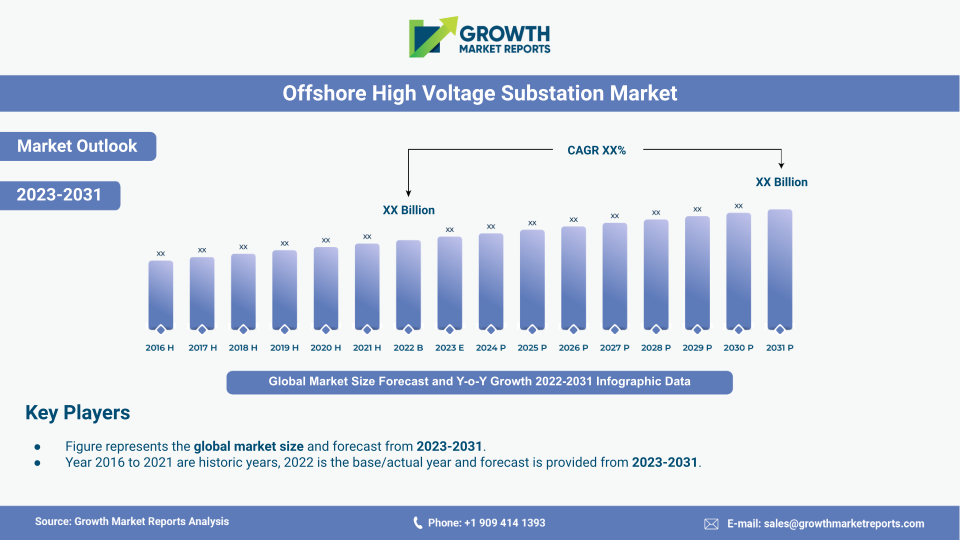
According to our latest research, the offshore high voltage substation market size reached USD 10.4 billion in 2024, and is expected to grow at a robust CAGR of 8.1% from 2025 to 2033. By the end of 2033, the market is forecasted to reach approximately USD 21.2 billion. This remarkable growth trajectory is primarily driven by the accelerating deployment of offshore wind farms, rising investments in renewable energy infrastructure, and the need for reliable, high-capacity offshore power transmission solutions.

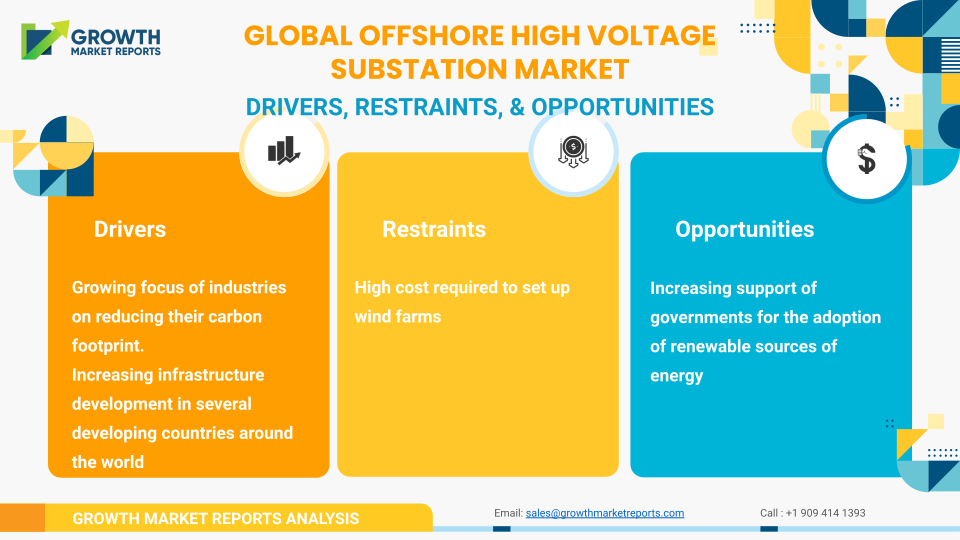
One of the primary growth factors for the offshore high voltage substation market is the rapid expansion of offshore wind energy projects worldwide. Governments and private investors are increasingly prioritizing renewable energy sources to meet ambitious decarbonization targets and reduce reliance on fossil fuels. Offshore wind power offers immense potential due to higher and more consistent wind speeds compared to onshore sites. However, transmitting this power efficiently to onshore grids requires advanced high voltage substations capable of handling large-scale electricity transmission. As a result, the demand for robust, technologically advanced offshore substations is surging, with new projects being announced in Europe, Asia Pacific, and North America. The integration of digital monitoring and protection systems further enhances substation performance, reliability, and operational safety, thus propelling market growth.

Another significant driver is the modernization and expansion of oil and gas platforms, which increasingly rely on offshore high voltage substations for safe and efficient power distribution. As oil and gas exploration moves into deeper waters and more remote locations, the need for reliable and scalable power infrastructure becomes paramount. Offshore substations are critical in supporting the electrification of oil and gas platforms, reducing operational emissions, and enabling integration with renewable energy sources such as offshore wind. The adoption of floating substation technology is also gaining traction, providing flexibility for deployment in challenging marine environments where fixed installations are not feasible. This technological evolution is opening new market opportunities and attracting investments from both traditional energy companies and new entrants focused on sustainable offshore operations.

The increasing focus on grid stability and the need to accommodate fluctuating renewable energy inputs are also driving the offshore high voltage substation market. As power grids become more complex with the integration of variable renewable energy sources, advanced substations equipped with real-time protection and monitoring systems are essential to maintain grid reliability. Utilities and transmission system operators are investing in high-capacity offshore substations to facilitate efficient load balancing, minimize transmission losses, and ensure seamless power delivery from offshore sources to onshore consumption centers. The trend toward digitalization, including the use of IoT sensors, predictive maintenance, and AI-based analytics, is further enhancing the value proposition of modern offshore substations and supporting long-term market growth.
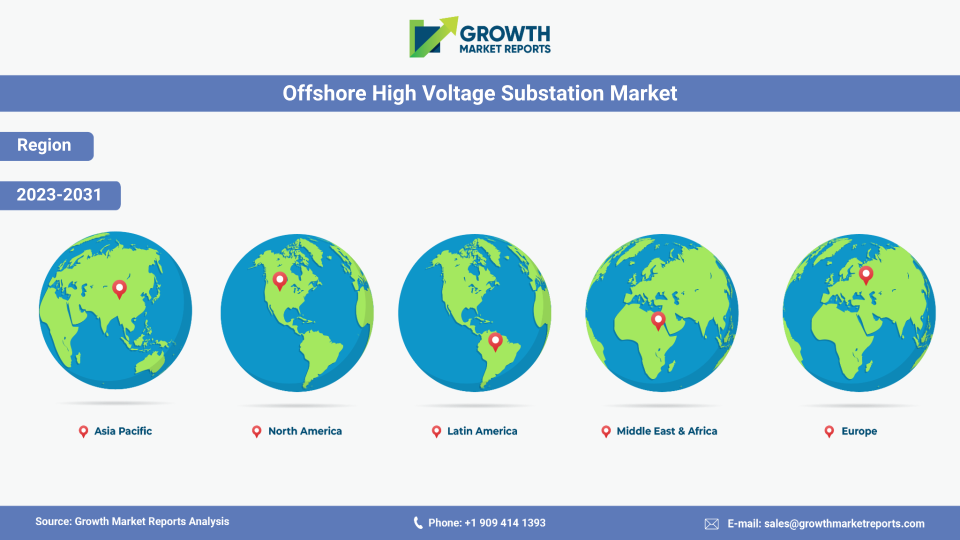
From a regional perspective, Europe currently dominates the offshore high voltage substation market, accounting for the largest share in 2024, followed closely by Asia Pacific. EuropeÂ’s leadership is attributed to its mature offshore wind sector, especially in countries such as the United Kingdom, Germany, and the Netherlands, which are investing heavily in next-generation wind farms and associated transmission infrastructure. Asia Pacific is emerging as the fastest-growing region, fueled by ambitious renewable energy targets in China, Taiwan, South Korea, and Japan. North America is also witnessing significant momentum, particularly in the United States, where new offshore wind projects along the Atlantic coast are driving demand for high voltage substations. The Middle East & Africa and Latin America are gradually entering the market, supported by government initiatives and international investments in offshore energy projects.

The Offshore Transformer Module plays a pivotal role in the efficient transmission of electricity generated by offshore wind farms to onshore grids. This innovative technology is designed to withstand the harsh marine environment, offering enhanced reliability and performance. As offshore wind projects expand into deeper waters, the demand for modular and scalable transformer solutions is increasing. These modules are engineered to handle high power densities and are equipped with advanced digital monitoring systems, ensuring seamless integration with existing grid infrastructure. The development of eco-friendly insulating materials and compact designs further enhances the sustainability and efficiency of Offshore Transformer Modules, making them an integral component of modern offshore substations.

Global Offshore High Voltage Substation Industry Outlook

Component Analysis

The offshore high voltage substation market is segmented by key components, including transformers, switchgear, busbars, protection and monitoring systems, and others. Among these, transformers represent a critical component, as they are responsible for stepping up the voltage generated by offshore wind turbines or oil and gas platforms to high transmission levels suitable for long-distance transport to onshore grids. The increasing deployment of high-capacity offshore wind farms is driving demand for advanced transformer technologies with enhanced efficiency, compact design, and robust corrosion resistance. Manufacturers are focusing on developing transformers that can withstand harsh marine environments, minimize energy losses, and support digital monitoring for predictive maintenance. The integration of eco-friendly insulating materials and the adoption of modular transformer designs are further elevating the market for this segment.

Switchgear is another vital component in offshore high voltage substations, providing essential functions such as circuit protection, isolation, and fault detection. The growing complexity of offshore power systems, combined with the need for high reliability and operational safety, is spurring innovation in switchgear technology. Modern offshore substations are increasingly equipped with gas-insulated switchgear (GIS), which offers a compact footprint, enhanced safety, and reduced maintenance compared to traditional air-insulated systems. The trend toward digital switchgear, featuring real-time diagnostics, remote monitoring, and automated control, is gaining traction as operators seek to optimize performance and minimize downtime. The switchgear segment is expected to witness steady growth, driven by ongoing investments in offshore wind and oil and gas infrastructure.

Busbars, which serve as the main electrical conductors within substations, are essential for distributing high-voltage electricity efficiently and safely. The demand for high-performance busbar systems is rising as offshore substations become larger and more complex, requiring reliable connections between multiple transformers, switchgear, and auxiliary equipment. Manufacturers are focusing on developing busbars with advanced materials and coatings to enhance conductivity, reduce energy losses, and withstand the corrosive effects of saltwater and extreme weather. The increasing adoption of modular and prefabricated busbar assemblies is also streamlining substation construction and maintenance, contributing to the overall growth of this component segment.

Protection and monitoring systems are indispensable for ensuring the safe and efficient operation of offshore high voltage substations. These systems encompass a wide range of technologies, including digital relays, fault detection devices, real-time condition monitoring, and cybersecurity solutions. As offshore substations become more digitally integrated, the importance of advanced protection and monitoring systems is growing. Operators are investing in solutions that enable predictive maintenance, rapid fault detection, and remote diagnostics, thereby minimizing unplanned outages and optimizing asset performance. The integration of IoT sensors and AI-driven analytics is further transforming this segment, enabling data-driven decision-making and enhancing the resilience of offshore power infrastructure.

Other components, such as auxiliary power systems, control panels, and communication networks, also play a crucial role in the functionality and reliability of offshore high voltage substations. As the industry moves toward more complex and interconnected offshore energy systems, the demand for integrated solutions that combine multiple components into seamless, interoperable platforms is increasing. This holistic approach not only improves operational efficiency but also reduces installation and maintenance costs, making it an attractive proposition for project developers and operators.

Report Scope

Attributes Details
Report Title Offshore High Voltage Substation Market Research Report 2033
By Component Transformers, Switchgear, Busbars, Protection and Monitoring Systems, Others
By Installation Type Fixed, Floating
By Voltage Level Up to 220 kV, Above 220 kV
By Application Offshore Wind Power, Oil & Gas Platforms, Others
Regions Covered North America, Europe, APAC, Latin America, MEA
Base Year 2024
Historic Data 2018-2023
Forecast Period 2025-2033
Number of Pages 274
Number of Tables & Figures 351
Customization Available Yes, the report can be customized as per your need.

Installation Type Analysis

The offshore high voltage substation market is segmented by installation type into fixed and floating substations. Fixed substations, which are installed on jacket or monopile foundations anchored to the seabed, have historically dominated the market. These installations are preferred for shallow to medium water depths and are widely used in established offshore wind farms across Europe and parts of Asia. Fixed substations offer proven reliability, robust structural integrity, and ease of integration with existing offshore infrastructure. However, their deployment is limited by water depth and seabed conditions, which restricts their applicability in deeper or more challenging marine environments. The ongoing expansion of offshore wind projects into deeper waters is prompting the industry to explore alternative installation types.

Floating offshore high voltage substations represent a transformative innovation in the market, offering unparalleled flexibility and scalability. Unlike fixed installations, floating substations are mounted on buoyant platforms, allowing them to be deployed in deepwater locations where traditional foundations are not feasible. This capability is particularly valuable as offshore wind projects move further from shore to harness stronger and more consistent wind resources. Floating substations also facilitate the electrification of remote oil and gas platforms, enabling operators to reduce emissions and improve operational efficiency. The development of floating substation technology is attracting significant investments from both established players and new entrants, driving rapid advancements in platform stability, mooring systems, and electrical integration.

The transition toward floating substations is supported by ongoing R&D efforts aimed at reducing costs, improving reliability, and standardizing design frameworks. Collaborative initiatives between equipment manufacturers, engineering firms, and project developers are accelerating the commercialization of floating substation solutions. As the technology matures, economies of scale and streamlined installation processes are expected to drive down costs, making floating substations increasingly competitive with fixed alternatives. The ability to relocate floating substations as project requirements evolve further enhances their appeal, providing project developers with greater operational flexibility and risk mitigation.

Despite the promising outlook for floating substations, fixed installations are expected to maintain a significant market share over the forecast period, particularly in regions with established offshore wind infrastructure and favorable seabed conditions. The continued deployment of large-scale offshore wind farms in shallow waters, coupled with the need for proven, reliable power transmission solutions, will sustain demand for fixed substations. However, the market share of floating installations is projected to grow rapidly, especially in Asia Pacific and North America, where deepwater projects are gaining traction. The coexistence of fixed and floating installation types will shape the future landscape of the offshore high voltage substation market, offering diverse solutions to meet the evolving needs of the offshore energy sector.

In summary, the installation type segment is characterized by a dynamic interplay between established fixed substation technologies and emerging floating solutions. The ongoing evolution of project requirements, technological advancements, and cost considerations will determine the relative adoption rates of each installation type, shaping the long-term growth trajectory of the offshore high voltage substation market.

Voltage Level Analysis

The offshore high voltage substation market is segmented by voltage level into up to 220 kV and above 220 kV categories. Substations with voltage ratings up to 220 kV are commonly used in small to medium-sized offshore wind farms and oil and gas platforms, where power transmission distances are relatively short and grid integration requirements are less complex. These substations offer a cost-effective solution for projects located close to shore or in regions with limited grid infrastructure. The up to 220 kV segment is characterized by standardized designs, streamlined installation processes, and lower maintenance requirements, making it an attractive option for early-stage or pilot offshore energy projects.

In contrast, substations with voltage ratings above 220 kV are gaining prominence in large-scale offshore wind farms and deepwater oil and gas projects, where high-capacity power transmission and long-distance grid integration are essential. The increasing deployment of gigawatt-scale offshore wind farms, particularly in Europe and Asia Pacific, is driving demand for high-voltage substations capable of efficiently transmitting large volumes of electricity to onshore grids. Above 220 kV substations offer several advantages, including reduced transmission losses, enhanced grid stability, and the ability to accommodate fluctuations in renewable energy generation. The integration of advanced insulation materials, compact designs, and digital monitoring systems further enhances the performance and reliability of high-voltage substations in challenging offshore environments.

The trend toward higher voltage levels is also supported by evolving grid codes and regulatory requirements, which mandate the adoption of advanced transmission technologies to ensure grid stability and resilience. Transmission system operators are increasingly specifying 275 kV, 400 kV, and even higher voltage substations for new offshore projects, particularly in regions with ambitious renewable energy targets and extensive offshore wind development pipelines. The ongoing expansion of interconnection projects, such as cross-border subsea power links, is further driving demand for high-voltage offshore substations capable of facilitating seamless electricity exchange between countries and regions.

Manufacturers and engineering firms are responding to this trend by investing in R&D to develop next-generation high-voltage equipment with enhanced efficiency, reliability, and environmental performance. The adoption of digital technologies, including real-time condition monitoring, predictive analytics, and remote diagnostics, is enabling operators to optimize the performance of high-voltage substations and minimize unplanned outages. The increasing focus on sustainability is also prompting the adoption of eco-friendly insulating materials and energy-efficient designs, further enhancing the value proposition of high-voltage offshore substations.

In summary, the voltage level segment of the offshore high voltage substation market is characterized by a clear shift toward higher voltage ratings, driven by the need to accommodate larger, more complex offshore energy projects and facilitate long-distance power transmission. The ongoing evolution of project requirements, regulatory frameworks, and technological advancements will continue to shape the demand for both up to 220 kV and above 220 kV substations, underpinning the long-term growth of the market.

Application Analysis

The offshore high voltage substation market is segmented by application into offshore wind power, oil and gas platforms, and others. Offshore wind power represents the largest and fastest-growing application segment, accounting for a significant share of the market in 2024. The global push toward decarbonization, coupled with ambitious renewable energy targets set by governments and international organizations, is driving unprecedented investments in offshore wind projects. High voltage substations are critical for efficiently transmitting the electricity generated by offshore wind turbines to onshore grids, ensuring grid stability, and minimizing transmission losses. The increasing scale of offshore wind farms, with projects exceeding 1 GW in capacity, is driving demand for advanced substation technologies capable of handling high power densities and integrating with digital monitoring systems.

Oil and gas platforms represent another important application of offshore high voltage substations. As the industry shifts toward electrification to reduce emissions and improve operational efficiency, the need for reliable, high-capacity power infrastructure is growing. Offshore substations enable the safe and efficient distribution of electricity to remote oil and gas platforms, supporting critical operations such as drilling, production, and processing. The adoption of floating substation technology is particularly relevant in this segment, as it enables electrification in deepwater locations where fixed installations are not feasible. The integration of renewable energy sources, such as offshore wind or solar, with oil and gas platforms is further enhancing the value proposition of offshore high voltage substations in this application.

The "others" segment includes a range of emerging applications, such as offshore hydrogen production, marine research facilities, and remote island electrification. The growing interest in green hydrogen as a clean energy carrier is driving investments in offshore electrolysis facilities, which require robust high voltage substations for power distribution and grid integration. Similarly, marine research stations and remote island communities are exploring the use of offshore substations to support sustainable energy supply and enhance resilience against grid disruptions. The diversification of applications is expanding the addressable market for offshore high voltage substations and attracting new stakeholders from adjacent industries.

The application segment is characterized by a dynamic interplay between established and emerging use cases, each with unique technical requirements and operational challenges. Project developers, utilities, and equipment manufacturers are collaborating to develop tailored substation solutions that meet the specific needs of each application, from large-scale wind farms to remote oil and gas platforms and innovative hydrogen production facilities. The ongoing evolution of project requirements, regulatory frameworks, and technological advancements will continue to drive demand for versatile, high-performance offshore high voltage substations across a broad spectrum of applications.

In summary, the application segment of the offshore high voltage substation market is dominated by offshore wind power, followed by oil and gas platforms and a diverse array of emerging use cases. The increasing scale and complexity of offshore energy projects, coupled with the need for reliable, efficient power transmission solutions, will underpin the long-term growth and diversification of this market segment.

Opportunities & Threats

The offshore high voltage substation market is poised for significant opportunities driven by the global transition to renewable energy and the rapid expansion of offshore wind power. The increasing number of large-scale offshore wind projects, particularly in Europe and Asia Pacific, is creating substantial demand for advanced substation technologies. Governments and utilities are investing heavily in grid infrastructure upgrades to accommodate the influx of renewable energy, opening new avenues for equipment manufacturers, engineering firms, and service providers. The emergence of floating substation technology is unlocking previously inaccessible deepwater sites, enabling the development of next-generation offshore wind farms and electrification of remote oil and gas platforms. The integration of digital monitoring and protection systems, IoT sensors, and AI-driven analytics is further enhancing the value proposition of modern offshore substations, creating opportunities for innovation and differentiation.

Another significant opportunity lies in the diversification of applications beyond traditional wind and oil and gas projects. The growing interest in offshore hydrogen production, marine research facilities, and remote island electrification is expanding the addressable market and attracting new stakeholders from adjacent industries. Collaborative initiatives between governments, research institutions, and private companies are driving R&D efforts to develop tailored substation solutions for these emerging applications. The increasing focus on sustainability, energy efficiency, and environmental performance is prompting the adoption of eco-friendly materials, modular designs, and energy-efficient technologies, further enhancing the competitiveness of offshore high voltage substations in a rapidly evolving energy landscape.

Despite the promising outlook, the offshore high voltage substation market faces several restraining factors that could hinder growth. The high capital costs associated with offshore substation construction, installation, and maintenance remain a significant barrier, particularly for early-stage or smaller projects. The complexity of marine environments, including harsh weather conditions, corrosive saltwater, and challenging seabed conditions, increases the risk of project delays, cost overruns, and operational disruptions. Regulatory uncertainty, permitting challenges, and evolving grid codes can also impact project timelines and investment decisions. Furthermore, the need for specialized engineering expertise and skilled labor poses challenges for market participants, especially in regions with limited experience in offshore energy development. Addressing these challenges will require ongoing collaboration between industry stakeholders, governments, and research institutions to develop cost-effective, reliable, and scalable offshore substation solutions.

Regional Outlook

Europe remains the dominant region in the offshore high voltage substation market, accounting for approximately 41% of the global market share in 2024, or around USD 4.3 billion. The regionÂ’s leadership is driven by its mature offshore wind sector, strong policy support, and extensive grid infrastructure. Countries such as the United Kingdom, Germany, the Netherlands, and Denmark are at the forefront of offshore wind development, with numerous large-scale projects in operation or under construction. The European UnionÂ’s ambitious renewable energy targets and cross-border interconnection initiatives are further accelerating investments in high voltage offshore substations. The region is also witnessing rapid adoption of floating substation technology, particularly in the North Sea and Baltic Sea, driven by the need to access deeper waters and optimize wind resource utilization.

Asia Pacific is emerging as the fastest-growing region in the offshore high voltage substation market, with a projected CAGR of 10.2% from 2025 to 2033. The region accounted for approximately USD 2.8 billion in 2024, representing 27% of the global market. China, Taiwan, South Korea, and Japan are leading the charge, supported by strong government policies, ambitious renewable energy targets, and substantial investments in offshore wind infrastructure. The rapid expansion of deepwater wind projects, coupled with the adoption of advanced substation technologies, is driving growth in this region. Asia Pacific is also witnessing increasing interest in floating substations, particularly in markets with challenging seabed conditions and high wind resource potential.

North America is gaining momentum in the offshore high voltage substation market, with the United States leading the way through new offshore wind projects along the Atlantic coast. The region accounted for approximately USD 1.6 billion in 2024, or 15% of the global market. The Biden administrationÂ’s commitment to expanding offshore wind capacity, combined with state-level initiatives and private sector investments, is driving demand for high voltage substations and associated transmission infrastructure. The region is also exploring the potential of floating substations to enable deepwater wind projects and electrify remote oil and gas platforms. Latin America and the Middle East & Africa are gradually entering the market, supported by government initiatives and international investments in offshore energy projects, though their combined market share remains below USD 1.7 billion in 2024.

Offshore High Voltage Substation Market Statistics

Competitor Outlook

The competitive landscape of the offshore high voltage substation market is characterized by the presence of several global and regional players, each vying for market share through innovation, strategic partnerships, and geographic expansion. Leading companies are investing heavily in R&D to develop advanced substation technologies that offer enhanced efficiency, reliability, and environmental performance. The market is witnessing increasing consolidation, with major players acquiring smaller firms and forming joint ventures to expand their product portfolios and strengthen their presence in key growth markets. The integration of digital monitoring, protection systems, and AI-driven analytics is emerging as a key differentiator, enabling companies to offer value-added solutions that optimize substation performance and reduce operational costs.

The market is also characterized by intense competition in the development and commercialization of floating offshore substation technologies. Companies are collaborating with engineering firms, project developers, and research institutions to accelerate the deployment of floating substations and standardize design frameworks. The ability to offer turnkey solutions, including design, engineering, procurement, installation, and maintenance services, is becoming increasingly important as project developers seek integrated offerings that minimize risk and streamline project execution. The growing complexity of offshore energy projects is prompting companies to invest in advanced project management capabilities, supply chain optimization, and workforce training to maintain a competitive edge.

In addition to established players, the market is witnessing the entry of new companies specializing in digital technologies, modular substation designs, and eco-friendly materials. These entrants are leveraging their expertise to develop innovative solutions that address emerging challenges such as grid integration, cybersecurity, and environmental sustainability. The increasing focus on sustainability and energy efficiency is prompting companies to adopt green manufacturing practices, develop recyclable materials, and minimize the environmental footprint of their products. The ability to demonstrate environmental leadership and compliance with evolving regulatory standards is becoming a key factor in winning contracts and securing long-term customer relationships.

Some of the major companies operating in the offshore high voltage substation market include Siemens Energy, ABB, General Electric (GE) Grid Solutions, Schneider Electric, Hitachi Energy, Mitsubishi Electric, and Aker Solutions. Siemens Energy is a global leader in offshore substation technology, offering a comprehensive portfolio of fixed and floating solutions for wind and oil and gas applications. ABB is renowned for its advanced transformer and switchgear technologies, with a strong focus on digitalization and sustainability. GE Grid Solutions provides turnkey substation solutions and has a strong presence in both Europe and North America. Schneider Electric is known for its innovative protection and monitoring systems, while Hitachi Energy and Mitsubishi Electric are expanding their offerings in high-voltage equipment and digital solutions. Aker Solutions specializes in engineering, procurement, and construction services for offshore substations, with a focus on modular and floating designs.

These companies are actively expanding their global footprint through strategic partnerships, joint ventures, and collaborations with utilities, project developers, and government agencies. They are also investing in workforce development, supply chain optimization, and digital transformation to enhance their competitiveness and capture new growth opportunities in the rapidly evolving offshore high voltage substation market. As the market continues to grow and diversify, the ability to offer innovative, reliable, and sustainable solutions will be critical to long-term success.

Key Players

  • Siemens Energy
  • ABB
  • General Electric (GE Grid Solutions)
  • Schneider Electric
  • Hitachi Energy
  • Aibel
  • HSM Offshore Energy
  • Keppel Offshore & Marine
  • STX Heavy Industries
  • Chiyoda Corporation
  • Iemants (Smulders Group)
  • ENGIE Fabricom
  • Petrofac
  • Sembcorp Marine
  • Larsen & Toubro (L&T)
  • Iv-Offshore & Energy
  • Burns & McDonnell
  • Nexans
  • Prysmian Group
  • McDermott International
Offshore High Voltage Substation Market Overview

Segments

The Offshore High Voltage Substation market has been segmented on the basis of

Component

  • Transformers
  • Switchgear
  • Busbars
  • Protection and Monitoring Systems
  • Others

Installation Type

  • Fixed
  • Floating

Voltage Level

  • Up to 220 kV
  • Above 220 kV

Application

  • Offshore Wind Power
  • Oil & Gas Platforms
  • Others

Competitive Landscape

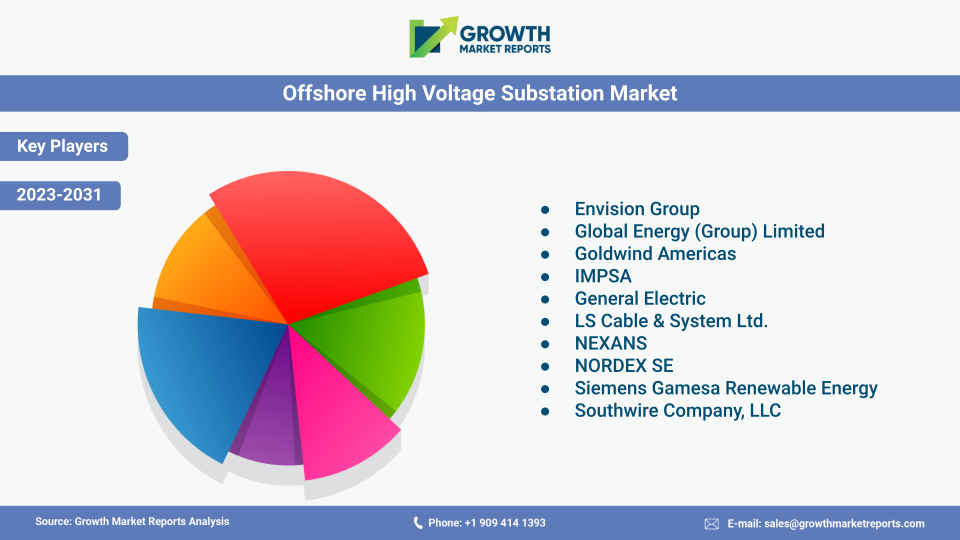
Key players competing in the global offshore high voltage substation market are Envision Group; Global Energy (Group) Limited; Goldwind Americas; IMPSA; General Electric; LS Cable & System Ltd.; NEXANS; NORDEX SE; Siemens Gamesa Renewable Energy; and Southwire Company, LLC.

These companies adopt several development strategies, including acquisitions, collaborations, product launches, mergers, partnerships, and production expansion to get an edge over the competitors. These companies are making significant investments in research & development, to create components that make the functioning of offshore stations efficient and productive.

For instance,

  • In June 2023, General Electric, one of the largest corporations in the world, announced that the delivery of Hafslund Eco, the latest Rotorpoles for water-cooled 3x 280 MW/300 MVA generators, for implementation at the Aurland 1 hydropower plant located in Norway. This is intended to help in maintaining the efficiency of generators for decades.

  • In April 2023, the North Fabrication division of the prominent market player, Global Energy Group (GEG), conducted its first steel cutting of the J-tube frames. This has been done for the Moray West Offshore Wind Farm (882MW) situated in the Port of Nigg in Scotland.

    Offshore High Voltage Substation Market Key Players

Frequently Asked Questions

Digitalization, including IoT sensors, predictive maintenance, and AI-based analytics, is enhancing substation performance, reliability, and operational safety, and is a key differentiator for market players.

Opportunities include the expansion of offshore wind projects, adoption of floating substation technology, and diversification into new applications. Challenges include high capital costs, complex marine environments, regulatory uncertainties, and the need for specialized expertise.

Major players include Siemens Energy, ABB, General Electric (GE Grid Solutions), Schneider Electric, Hitachi Energy, Mitsubishi Electric, and Aker Solutions, among others.

The main applications are offshore wind power, oil and gas platforms, and emerging uses such as offshore hydrogen production, marine research facilities, and remote island electrification.

Offshore high voltage substations are segmented by voltage level into up to 220 kV (used for small to medium projects) and above 220 kV (for large-scale and long-distance transmission projects).

Fixed substations are anchored to the seabed and are suitable for shallow to medium water depths, while floating substations are mounted on buoyant platforms, allowing deployment in deepwater locations and offering greater flexibility and scalability.

Major components include transformers, switchgear, busbars, protection and monitoring systems, and other auxiliary systems such as control panels and communication networks.

Europe is the dominant region, accounting for about 41% of the global market in 2024, followed by Asia Pacific, which is the fastest-growing region, and North America, which is witnessing significant momentum due to new offshore wind projects.

Key growth drivers include the rapid expansion of offshore wind energy projects, rising investments in renewable energy infrastructure, modernization of oil and gas platforms, and the need for reliable, high-capacity offshore power transmission solutions.

The offshore high voltage substation market reached USD 10.4 billion in 2024 and is expected to grow at a CAGR of 8.1% from 2025 to 2033, reaching approximately USD 21.2 billion by 2033.

Table Of Content

Chapter 1 Executive Summary
Chapter 2 Assumptions and Acronyms Used
Chapter 3 Research Methodology
Chapter 4 Offshore High Voltage Substation Market Overview
   4.1 Introduction
      4.1.1 Market Taxonomy
      4.1.2 Market Definition
      4.1.3 Macro-Economic Factors Impacting the Market Growth
   4.2 Offshore High Voltage Substation Market Dynamics
      4.2.1 Market Drivers
      4.2.2 Market Restraints
      4.2.3 Market Opportunity
   4.3 Offshore High Voltage Substation Market - Supply Chain Analysis
      4.3.1 List of Key Suppliers
      4.3.2 List of Key Distributors
      4.3.3 List of Key Consumers
   4.4 Key Forces Shaping the Offshore High Voltage Substation Market
      4.4.1 Bargaining Power of Suppliers
      4.4.2 Bargaining Power of Buyers
      4.4.3 Threat of Substitution
      4.4.4 Threat of New Entrants
      4.4.5 Competitive Rivalry
   4.5 Global Offshore High Voltage Substation Market Size & Forecast, 2023-2032
      4.5.1 Offshore High Voltage Substation Market Size and Y-o-Y Growth
      4.5.2 Offshore High Voltage Substation Market Absolute $ Opportunity

Chapter 5 Global Offshore High Voltage Substation Market Analysis and Forecast By Component
   5.1 Introduction
      5.1.1 Key Market Trends & Growth Opportunities By Component
      5.1.2 Basis Point Share (BPS) Analysis By Component
      5.1.3 Absolute $ Opportunity Assessment By Component
   5.2 Offshore High Voltage Substation Market Size Forecast By Component
      5.2.1 Transformers
      5.2.2 Switchgear
      5.2.3 Busbars
      5.2.4 Protection and Monitoring Systems
      5.2.5 Others
   5.3 Market Attractiveness Analysis By Component

Chapter 6 Global Offshore High Voltage Substation Market Analysis and Forecast By Installation Type
   6.1 Introduction
      6.1.1 Key Market Trends & Growth Opportunities By Installation Type
      6.1.2 Basis Point Share (BPS) Analysis By Installation Type
      6.1.3 Absolute $ Opportunity Assessment By Installation Type
   6.2 Offshore High Voltage Substation Market Size Forecast By Installation Type
      6.2.1 Fixed
      6.2.2 Floating
   6.3 Market Attractiveness Analysis By Installation Type

Chapter 7 Global Offshore High Voltage Substation Market Analysis and Forecast By Voltage Level
   7.1 Introduction
      7.1.1 Key Market Trends & Growth Opportunities By Voltage Level
      7.1.2 Basis Point Share (BPS) Analysis By Voltage Level
      7.1.3 Absolute $ Opportunity Assessment By Voltage Level
   7.2 Offshore High Voltage Substation Market Size Forecast By Voltage Level
      7.2.1 Up to 220 kV
      7.2.2 Above 220 kV
   7.3 Market Attractiveness Analysis By Voltage Level

Chapter 8 Global Offshore High Voltage Substation Market Analysis and Forecast By Application
   8.1 Introduction
      8.1.1 Key Market Trends & Growth Opportunities By Application
      8.1.2 Basis Point Share (BPS) Analysis By Application
      8.1.3 Absolute $ Opportunity Assessment By Application
   8.2 Offshore High Voltage Substation Market Size Forecast By Application
      8.2.1 Offshore Wind Power
      8.2.2 Oil & Gas Platforms
      8.2.3 Others
   8.3 Market Attractiveness Analysis By Application

Chapter 9 Global Offshore High Voltage Substation Market Analysis and Forecast by Region
   9.1 Introduction
      9.1.1 Key Market Trends & Growth Opportunities By Region
      9.1.2 Basis Point Share (BPS) Analysis By Region
      9.1.3 Absolute $ Opportunity Assessment By Region
   9.2 Offshore High Voltage Substation Market Size Forecast By Region
      9.2.1 North America
      9.2.2 Europe
      9.2.3 Asia Pacific
      9.2.4 Latin America
      9.2.5 Middle East & Africa (MEA)
   9.3 Market Attractiveness Analysis By Region

Chapter 10 Coronavirus Disease (COVID-19) Impact 
   10.1 Introduction 
   10.2 Current & Future Impact Analysis 
   10.3 Economic Impact Analysis 
   10.4 Government Policies 
   10.5 Investment Scenario

Chapter 11 North America Offshore High Voltage Substation Analysis and Forecast
   11.1 Introduction
   11.2 North America Offshore High Voltage Substation Market Size Forecast by Country
      11.2.1 U.S.
      11.2.2 Canada
   11.3 Basis Point Share (BPS) Analysis by Country
   11.4 Absolute $ Opportunity Assessment by Country
   11.5 Market Attractiveness Analysis by Country
   11.6 North America Offshore High Voltage Substation Market Size Forecast By Component
      11.6.1 Transformers
      11.6.2 Switchgear
      11.6.3 Busbars
      11.6.4 Protection and Monitoring Systems
      11.6.5 Others
   11.7 Basis Point Share (BPS) Analysis By Component 
   11.8 Absolute $ Opportunity Assessment By Component 
   11.9 Market Attractiveness Analysis By Component
   11.10 North America Offshore High Voltage Substation Market Size Forecast By Installation Type
      11.10.1 Fixed
      11.10.2 Floating
   11.11 Basis Point Share (BPS) Analysis By Installation Type 
   11.12 Absolute $ Opportunity Assessment By Installation Type 
   11.13 Market Attractiveness Analysis By Installation Type
   11.14 North America Offshore High Voltage Substation Market Size Forecast By Voltage Level
      11.14.1 Up to 220 kV
      11.14.2 Above 220 kV
   11.15 Basis Point Share (BPS) Analysis By Voltage Level 
   11.16 Absolute $ Opportunity Assessment By Voltage Level 
   11.17 Market Attractiveness Analysis By Voltage Level
   11.18 North America Offshore High Voltage Substation Market Size Forecast By Application
      11.18.1 Offshore Wind Power
      11.18.2 Oil & Gas Platforms
      11.18.3 Others
   11.19 Basis Point Share (BPS) Analysis By Application 
   11.20 Absolute $ Opportunity Assessment By Application 
   11.21 Market Attractiveness Analysis By Application

Chapter 12 Europe Offshore High Voltage Substation Analysis and Forecast
   12.1 Introduction
   12.2 Europe Offshore High Voltage Substation Market Size Forecast by Country
      12.2.1 Germany
      12.2.2 France
      12.2.3 Italy
      12.2.4 U.K.
      12.2.5 Spain
      12.2.6 Russia
      12.2.7 Rest of Europe
   12.3 Basis Point Share (BPS) Analysis by Country
   12.4 Absolute $ Opportunity Assessment by Country
   12.5 Market Attractiveness Analysis by Country
   12.6 Europe Offshore High Voltage Substation Market Size Forecast By Component
      12.6.1 Transformers
      12.6.2 Switchgear
      12.6.3 Busbars
      12.6.4 Protection and Monitoring Systems
      12.6.5 Others
   12.7 Basis Point Share (BPS) Analysis By Component 
   12.8 Absolute $ Opportunity Assessment By Component 
   12.9 Market Attractiveness Analysis By Component
   12.10 Europe Offshore High Voltage Substation Market Size Forecast By Installation Type
      12.10.1 Fixed
      12.10.2 Floating
   12.11 Basis Point Share (BPS) Analysis By Installation Type 
   12.12 Absolute $ Opportunity Assessment By Installation Type 
   12.13 Market Attractiveness Analysis By Installation Type
   12.14 Europe Offshore High Voltage Substation Market Size Forecast By Voltage Level
      12.14.1 Up to 220 kV
      12.14.2 Above 220 kV
   12.15 Basis Point Share (BPS) Analysis By Voltage Level 
   12.16 Absolute $ Opportunity Assessment By Voltage Level 
   12.17 Market Attractiveness Analysis By Voltage Level
   12.18 Europe Offshore High Voltage Substation Market Size Forecast By Application
      12.18.1 Offshore Wind Power
      12.18.2 Oil & Gas Platforms
      12.18.3 Others
   12.19 Basis Point Share (BPS) Analysis By Application 
   12.20 Absolute $ Opportunity Assessment By Application 
   12.21 Market Attractiveness Analysis By Application

Chapter 13 Asia Pacific Offshore High Voltage Substation Analysis and Forecast
   13.1 Introduction
   13.2 Asia Pacific Offshore High Voltage Substation Market Size Forecast by Country
      13.2.1 China
      13.2.2 Japan
      13.2.3 South Korea
      13.2.4 India
      13.2.5 Australia
      13.2.6 South East Asia (SEA)
      13.2.7 Rest of Asia Pacific (APAC)
   13.3 Basis Point Share (BPS) Analysis by Country
   13.4 Absolute $ Opportunity Assessment by Country
   13.5 Market Attractiveness Analysis by Country
   13.6 Asia Pacific Offshore High Voltage Substation Market Size Forecast By Component
      13.6.1 Transformers
      13.6.2 Switchgear
      13.6.3 Busbars
      13.6.4 Protection and Monitoring Systems
      13.6.5 Others
   13.7 Basis Point Share (BPS) Analysis By Component 
   13.8 Absolute $ Opportunity Assessment By Component 
   13.9 Market Attractiveness Analysis By Component
   13.10 Asia Pacific Offshore High Voltage Substation Market Size Forecast By Installation Type
      13.10.1 Fixed
      13.10.2 Floating
   13.11 Basis Point Share (BPS) Analysis By Installation Type 
   13.12 Absolute $ Opportunity Assessment By Installation Type 
   13.13 Market Attractiveness Analysis By Installation Type
   13.14 Asia Pacific Offshore High Voltage Substation Market Size Forecast By Voltage Level
      13.14.1 Up to 220 kV
      13.14.2 Above 220 kV
   13.15 Basis Point Share (BPS) Analysis By Voltage Level 
   13.16 Absolute $ Opportunity Assessment By Voltage Level 
   13.17 Market Attractiveness Analysis By Voltage Level
   13.18 Asia Pacific Offshore High Voltage Substation Market Size Forecast By Application
      13.18.1 Offshore Wind Power
      13.18.2 Oil & Gas Platforms
      13.18.3 Others
   13.19 Basis Point Share (BPS) Analysis By Application 
   13.20 Absolute $ Opportunity Assessment By Application 
   13.21 Market Attractiveness Analysis By Application

Chapter 14 Latin America Offshore High Voltage Substation Analysis and Forecast
   14.1 Introduction
   14.2 Latin America Offshore High Voltage Substation Market Size Forecast by Country
      14.2.1 Brazil
      14.2.2 Mexico
      14.2.3 Rest of Latin America (LATAM)
   14.3 Basis Point Share (BPS) Analysis by Country
   14.4 Absolute $ Opportunity Assessment by Country
   14.5 Market Attractiveness Analysis by Country
   14.6 Latin America Offshore High Voltage Substation Market Size Forecast By Component
      14.6.1 Transformers
      14.6.2 Switchgear
      14.6.3 Busbars
      14.6.4 Protection and Monitoring Systems
      14.6.5 Others
   14.7 Basis Point Share (BPS) Analysis By Component 
   14.8 Absolute $ Opportunity Assessment By Component 
   14.9 Market Attractiveness Analysis By Component
   14.10 Latin America Offshore High Voltage Substation Market Size Forecast By Installation Type
      14.10.1 Fixed
      14.10.2 Floating
   14.11 Basis Point Share (BPS) Analysis By Installation Type 
   14.12 Absolute $ Opportunity Assessment By Installation Type 
   14.13 Market Attractiveness Analysis By Installation Type
   14.14 Latin America Offshore High Voltage Substation Market Size Forecast By Voltage Level
      14.14.1 Up to 220 kV
      14.14.2 Above 220 kV
   14.15 Basis Point Share (BPS) Analysis By Voltage Level 
   14.16 Absolute $ Opportunity Assessment By Voltage Level 
   14.17 Market Attractiveness Analysis By Voltage Level
   14.18 Latin America Offshore High Voltage Substation Market Size Forecast By Application
      14.18.1 Offshore Wind Power
      14.18.2 Oil & Gas Platforms
      14.18.3 Others
   14.19 Basis Point Share (BPS) Analysis By Application 
   14.20 Absolute $ Opportunity Assessment By Application 
   14.21 Market Attractiveness Analysis By Application

Chapter 15 Middle East & Africa (MEA) Offshore High Voltage Substation Analysis and Forecast
   15.1 Introduction
   15.2 Middle East & Africa (MEA) Offshore High Voltage Substation Market Size Forecast by Country
      15.2.1 Saudi Arabia
      15.2.2 South Africa
      15.2.3 UAE
      15.2.4 Rest of Middle East & Africa (MEA)
   15.3 Basis Point Share (BPS) Analysis by Country
   15.4 Absolute $ Opportunity Assessment by Country
   15.5 Market Attractiveness Analysis by Country
   15.6 Middle East & Africa (MEA) Offshore High Voltage Substation Market Size Forecast By Component
      15.6.1 Transformers
      15.6.2 Switchgear
      15.6.3 Busbars
      15.6.4 Protection and Monitoring Systems
      15.6.5 Others
   15.7 Basis Point Share (BPS) Analysis By Component 
   15.8 Absolute $ Opportunity Assessment By Component 
   15.9 Market Attractiveness Analysis By Component
   15.10 Middle East & Africa (MEA) Offshore High Voltage Substation Market Size Forecast By Installation Type
      15.10.1 Fixed
      15.10.2 Floating
   15.11 Basis Point Share (BPS) Analysis By Installation Type 
   15.12 Absolute $ Opportunity Assessment By Installation Type 
   15.13 Market Attractiveness Analysis By Installation Type
   15.14 Middle East & Africa (MEA) Offshore High Voltage Substation Market Size Forecast By Voltage Level
      15.14.1 Up to 220 kV
      15.14.2 Above 220 kV
   15.15 Basis Point Share (BPS) Analysis By Voltage Level 
   15.16 Absolute $ Opportunity Assessment By Voltage Level 
   15.17 Market Attractiveness Analysis By Voltage Level
   15.18 Middle East & Africa (MEA) Offshore High Voltage Substation Market Size Forecast By Application
      15.18.1 Offshore Wind Power
      15.18.2 Oil & Gas Platforms
      15.18.3 Others
   15.19 Basis Point Share (BPS) Analysis By Application 
   15.20 Absolute $ Opportunity Assessment By Application 
   15.21 Market Attractiveness Analysis By Application

Chapter 16 Competition Landscape 
   16.1 Offshore High Voltage Substation Market: Competitive Dashboard
   16.2 Global Offshore High Voltage Substation Market: Market Share Analysis, 2023
   16.3 Company Profiles (Details – Overview, Financials, Developments, Strategy) 
      16.3.1 Siemens Energy
ABB
General Electric (GE Grid Solutions)
Schneider Electric
Hitachi Energy
Aibel
HSM Offshore Energy
Keppel Offshore & Marine
STX Heavy Industries
Chiyoda Corporation
Iemants (Smulders Group)
ENGIE Fabricom
Petrofac
Sembcorp Marine
Larsen & Toubro (L&T)
Iv-Offshore & Energy
Burns & McDonnell
Nexans
Prysmian Group
McDermott International

Methodology

Our Clients

Nestle SA
General Electric
Honda Motor Co. Ltd.
Deloitte
The John Holland Group
sinopec
Siemens Healthcare
Microsoft