Satellite Data Services Market Report 2034

Satellite Data Services Market Report 2034

Segments - by Service Type (Image Data, Data Analytics, Value-Added Services), by Application (Agriculture, Energy & Power, Defense & Intelligence, Engineering & Infrastructure, Environmental, Maritime, Insurance, Transportation & Logistics, Others), by End-User (Commercial, Government & Military)

https://growthmarketreports.com/Raksha
Author : Raksha Sharma
https://growthmarketreports.com/Vaibhav
Fact-checked by : V. Chandola
https://growthmarketreports.com/Shruti
Editor : Shruti Bhat

Last Updated : Jun, 2026 | Report ID :AD-437 | 4.5 Rating | 36 Reviews | 261 Pages | Format : Docx PDF

Report Description

This report is updated with the latest market data and insights as of June 2026. Base year: 2025  |  Forecast period: 2026-2034


Satellite Data Services Market Outlook

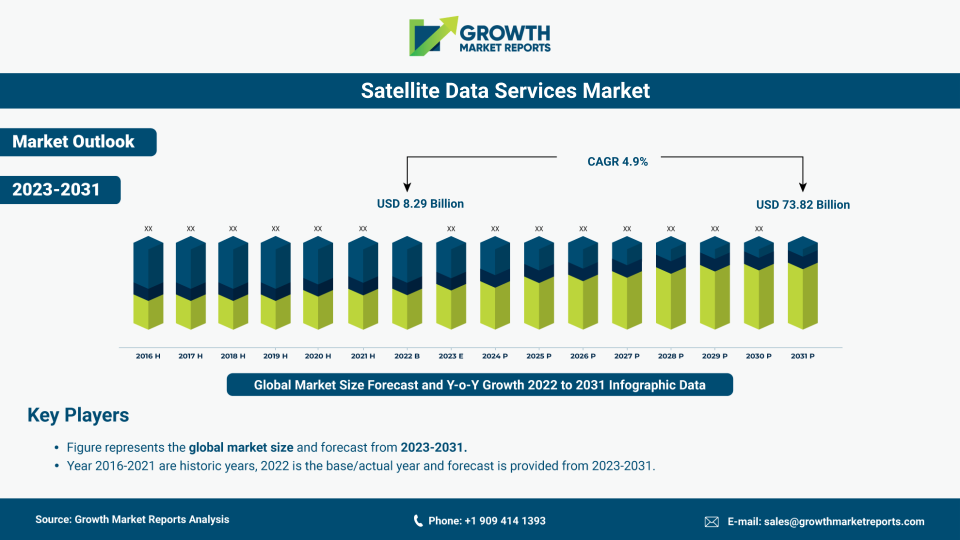
As per our latest research, the global satellite data services market size reached USD 10.3 billion in 2025, driven by increasing demand for real-time geospatial intelligence and advanced analytics across multiple industries. The market is poised for robust expansion, registering a CAGR of 19.6% from 2026 to 2034. By 2034, the satellite data services market is forecasted to attain a value of USD 51.8 billion, propelled by technological advancements, the proliferation of small satellite constellations, and growing integration of satellite data into commercial applications. This growth trajectory underscores the transformative impact of satellite data on decision-making processes and operational efficiency across global sectors. The convergence of satellite data delivery models with cloud-native architectures is further accelerating adoption among enterprise customers worldwide.

Global Satellite Data Services Market Size Forecast 2025-2034, USD Billion

One of the principal growth factors for the satellite data services market is the surge in demand for high-resolution imagery and geospatial analytics across sectors such as agriculture, energy, defense, and environmental monitoring. The rapid digitization of industries and the need for precise, real-time data to support critical operations have fueled investments in satellite data services. Additionally, the increasing frequency of natural disasters and the growing urgency of climate change monitoring have necessitated the use of satellite-based solutions for timely and accurate information. The integration of artificial intelligence and machine learning with satellite data analytics has further amplified the value proposition of these services, enabling predictive insights and automated anomaly detection for enhanced decision-making. Providers are also innovating in space weather data monitoring, helping utilities and aviation operators mitigate risks from solar and geomagnetic events.

Another significant driver is the expansion of small satellite constellations and the decreasing cost of satellite launches, which have democratized access to satellite data. The advent of low Earth orbit (LEO) satellites has revolutionized data acquisition, offering improved revisit rates and cost-effective solutions for commercial and governmental clients. The proliferation of private players and public-private partnerships has accelerated innovation in satellite data services, resulting in enhanced data quality, faster delivery times, and a wider range of value-added services. This democratization has opened new avenues for start-ups and small and medium enterprises, fostering a competitive environment that stimulates continuous technological advancement and market expansion.

The satellite data services market is also benefiting from increased government initiatives and policy support for space-based infrastructure and data utilization. Governments worldwide are investing in satellite programs to bolster national security, disaster management, and socio-economic development. These initiatives have led to greater collaboration between governmental agencies and private enterprises, promoting the adoption of satellite data for urban planning, resource management, and infrastructure development. Moreover, international efforts to standardize satellite data formats and improve interoperability are facilitating cross-border data sharing, thereby expanding the global reach and utility of satellite data services. Growing interest in satellite downlink infrastructure is further enabling faster, more reliable transmission of high-volume earth observation data to ground stations.

In the rapidly evolving landscape of satellite data services, Space Data Replay and Reprocessing Services are emerging as crucial components for enhancing data utility and accessibility. These services facilitate the retrieval and reprocessing of archived satellite data, enabling users to extract new insights and revisit past events with enhanced analytical capabilities. By leveraging advanced algorithms and cloud-based platforms, Space Data Replay and Reprocessing Services allow for the refinement of historical data, providing a more comprehensive understanding of temporal changes and trends. This capability is particularly valuable for sectors such as environmental monitoring and disaster management, where historical data can inform future strategies and improve response times.

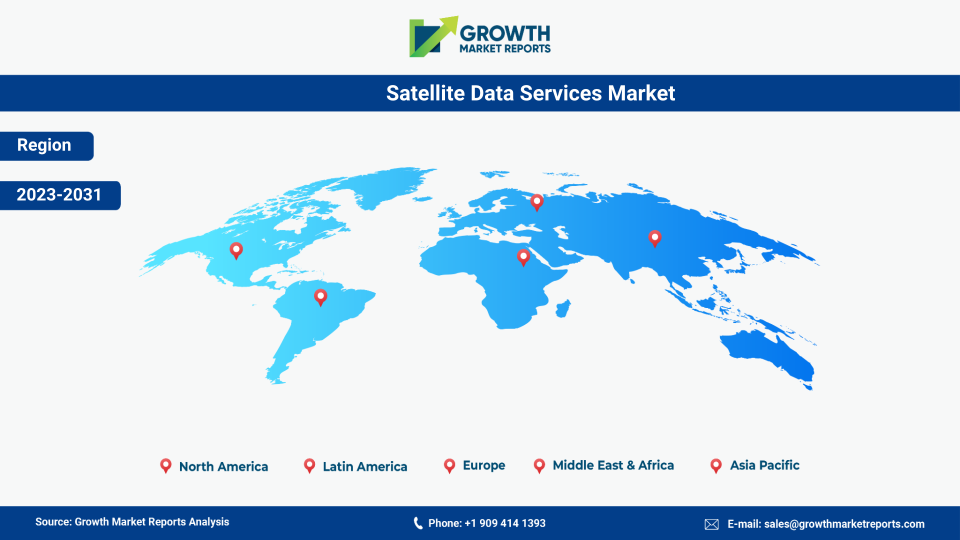
Regionally, North America remains the largest market for satellite data services, accounting for over 37.5% of global revenue in 2025, driven by the presence of leading satellite operators, advanced technological infrastructure, and substantial government funding. Europe follows with approximately 20.5% market share, supported by strong investments in space programs and a burgeoning commercial sector. The Asia Pacific region is witnessing the fastest growth, with a projected CAGR of approximately 22.0% during the forecast period, fueled by increasing adoption of satellite technologies in emerging economies such as China and India. Latin America and the Middle East and Africa are also experiencing steady growth, as governments and enterprises in these regions recognize the strategic value of satellite data for development and security.

Service Type Analysis

The satellite data services market is segmented by service type into image data, data analytics, and value-added services. Image data remains the largest segment with roughly 42.5% of 2025 market revenue, providing raw and processed satellite imagery that serves as the basis for further analysis and application. The demand for high-resolution, multispectral, and hyperspectral imagery continues to rise, particularly in industries such as agriculture, environmental monitoring, and defense. Organizations rely on image data to monitor crop health, assess land use changes, and support tactical operations. The proliferation of high-resolution satellites and advancements in imaging technologies, including synthetic aperture radar (SAR), have significantly improved the quality and accessibility of satellite imagery, making it an indispensable resource for a wide array of end-users.

Satellite Data Services Market Share by Service Type 2025

Data analytics is emerging as the fastest-growing service type within the satellite data services market, representing approximately 35.0% of revenue in 2025. This segment encompasses the processing, interpretation, and extraction of actionable insights from raw satellite data using advanced analytics tools, artificial intelligence, and machine learning algorithms. Data analytics services enable organizations to transform vast volumes of satellite imagery into meaningful intelligence for applications such as yield prediction, asset monitoring, and risk assessment. The integration of cloud computing and big data technologies has revolutionized the analytics segment, allowing for scalable, real-time processing and delivery of insights. As industries increasingly prioritize data-driven decision-making, the demand for sophisticated analytics solutions is expected to outpace that for raw image data alone. The growth of satellite-based surveillance analytics is a particularly strong contributor to this trend, with government and commercial users alike seeking automated monitoring capabilities.

Value-added services represent a critical growth area, accounting for around 22.5% of the 2025 market, offering tailored solutions that combine image data and analytics with domain-specific expertise. These services include custom mapping, change detection, anomaly identification, and integration with geographic information systems (GIS). Value-added services are particularly valuable in sectors such as insurance, transportation, and urban planning, where end-users require customized insights to address unique operational challenges. The ability to deliver end-to-end solutions that address specific business needs is a key differentiator for service providers, driving higher margins and fostering long-term client relationships.

The competitive landscape within the service type segment is characterized by a mix of established satellite operators, specialized analytics firms, and innovative start-ups. Companies are increasingly focusing on developing proprietary algorithms, enhancing automation, and expanding their value-added offerings to capture a larger share of the market. Strategic partnerships and collaborations are common, as firms seek to leverage complementary capabilities and broaden their service portfolios. As the market continues to evolve through 2034, the convergence of image data, analytics, and value-added services will be pivotal in unlocking new applications and driving sustained growth.

Report Scope

Attributes Details
Report Title Satellite Data Services Market Research Report 2034
By Service Type Image Data, Data Analytics, Value-Added Services
By Application Agriculture, Energy & Power, Defense & Intelligence, Engineering & Infrastructure, Environmental, Maritime, Insurance, Transportation & Logistics, Others
By End-User Commercial, Government & Military
Regions Covered North America, Europe, APAC, Latin America, MEA
Base Year 2025
Historic Data 2019-2024
Forecast Period 2026-2034
Number of Pages 261
Number of Tables & Figures 314
Customization Available Yes, the report can be customized as per your need.

Application Analysis

The application landscape of the satellite data services market is both diverse and dynamic, encompassing sectors such as agriculture, energy and power, defense and intelligence, engineering and infrastructure, environmental monitoring, maritime, insurance, transportation and logistics, and others. In agriculture, satellite data services are transforming precision farming by enabling farmers to monitor crop health, optimize irrigation, and predict yields with unprecedented accuracy. The integration of satellite imagery with IoT sensors and AI-driven analytics is empowering agribusinesses to make data-driven decisions that enhance productivity and sustainability. As global food demand rises and climate variability intensifies, the adoption of satellite data in agriculture is expected to accelerate significantly through 2034, driving meaningful market growth.

The energy and power sector is another major adopter of satellite data services, leveraging geospatial intelligence for asset monitoring, resource exploration, and infrastructure management. Satellite data is instrumental in identifying potential sites for renewable energy projects, monitoring transmission lines, and assessing environmental impacts. In the defense and intelligence domain, satellite data provides critical situational awareness, supporting surveillance, reconnaissance, and mission planning. Governments and military agencies rely on high-resolution imagery and advanced analytics to enhance national security and respond to emerging threats. The growing sophistication of satellite-based intelligence solutions is driving increased investment in this segment, which remains one of the highest-value application areas in the global market.

Applications in engineering and infrastructure and environmental monitoring are also gaining traction, as governments and private enterprises seek to optimize urban planning, monitor construction progress, and track environmental changes. Satellite data services enable the detection of land subsidence, assessment of natural disaster impacts, and monitoring of deforestation and water resources. In the maritime sector, satellite data supports vessel tracking, route optimization, and illegal fishing detection, enhancing safety and operational efficiency. The insurance industry is leveraging satellite data for risk assessment, claims validation, and disaster response, reducing fraud and improving customer service.

Transportation and logistics represent a rapidly growing application area, as companies utilize satellite data for fleet management, route planning, and supply chain optimization. Real-time tracking and geofencing capabilities are enabling logistics providers to enhance visibility, reduce costs, and improve delivery reliability. The ability to integrate satellite data with other digital platforms is creating new opportunities for innovation in this segment. As digital transformation accelerates across industries through 2034, the breadth and depth of satellite data applications will continue to expand, reinforcing the market's strong growth trajectory.

End-User Analysis

The satellite data services market is segmented by end-user into commercial and government and military sectors, each with distinct requirements and growth drivers. The commercial segment is witnessing rapid expansion, fueled by the increasing adoption of satellite data across industries such as agriculture, energy, insurance, and logistics. Businesses are leveraging satellite data to optimize operations, enhance decision-making, and gain a competitive edge. The proliferation of user-friendly platforms and APIs has lowered barriers to entry, enabling smaller enterprises and start-ups to access and utilize satellite data for diverse applications. The commercial segment's growth is further supported by the emergence of new business models, such as data-as-a-service and subscription-based offerings, which provide cost-effective and scalable solutions tailored to varying organizational needs.

The government and military segment remains a cornerstone of the satellite data services market, accounting for a significant share of global revenue in 2025. Governments and defense agencies rely on satellite data for national security, disaster management, urban planning, and environmental monitoring. The strategic importance of satellite-based intelligence has led to sustained investments in satellite infrastructure and data analytics capabilities. Public sector demand is characterized by a preference for high-resolution, secure, and mission-critical data, often delivered through long-term contracts and partnerships with leading service providers. The increasing frequency of natural disasters and elevated geopolitical tensions are reinforcing the role of government and military users as a primary growth driver for the market through 2034.

The interplay between commercial and government end-users is fostering innovation and collaboration in the satellite data services market. Public-private partnerships are becoming increasingly common, enabling the sharing of resources, expertise, and data to address complex societal challenges. Governments are also playing a pivotal role in supporting the commercial sector through funding, regulatory frameworks, and open data initiatives. This symbiotic relationship is accelerating the adoption of satellite data services and expanding the market's addressable base.

As the market matures, service providers are tailoring their offerings to meet the specific needs of different end-user segments. Customization, data security, and integration with existing workflows are key differentiators for providers seeking to capture a larger share of both commercial and government clients. The ability to deliver scalable, reliable, and high-value solutions will be critical in sustaining long-term growth and competitiveness in the satellite data services market through the 2026-2034 forecast window.

Opportunities & Threats

The satellite data services market is brimming with opportunities, particularly as technological advancements continue to lower the cost of satellite launches and enhance data quality. The rise of small satellite constellations and reusable launch vehicles is democratizing access to space, enabling a broader range of organizations to leverage satellite data for innovative applications. Emerging markets, such as smart cities, autonomous vehicles, and precision agriculture, present significant growth potential for satellite data services. The integration of satellite data with artificial intelligence, machine learning, and cloud computing is unlocking new possibilities for real-time analytics, predictive modeling, and automated decision-making. These technological trends are expected to drive the development of next-generation solutions that address complex challenges in areas such as climate change, disaster response, and resource management through 2034.

Another major opportunity lies in the increasing emphasis on sustainability and environmental stewardship. Governments, NGOs, and private enterprises are seeking advanced tools to monitor and mitigate the impacts of climate change, deforestation, and pollution. Satellite data services are uniquely positioned to provide comprehensive, timely, and actionable insights for environmental monitoring and conservation efforts. The ability to deliver high-frequency, global coverage is a key advantage that sets satellite data apart from traditional data sources. As regulatory requirements for environmental reporting and compliance become more stringent globally, the demand for satellite-based monitoring solutions is expected to surge, creating new revenue streams for service providers across the forecast period.

Despite these opportunities, the satellite data services market faces several restraints and challenges. Data privacy and security concerns are a significant barrier, particularly for government and defense applications. The risk of data breaches, cyberattacks, and unauthorized access to sensitive information necessitates robust security protocols and compliance with international standards. Additionally, the complexity of integrating satellite data with existing IT systems and workflows can hinder adoption, especially among organizations with limited technical expertise. Regulatory hurdles, such as export controls and licensing requirements, may also restrict market growth in certain regions. Addressing these challenges will require ongoing investment in cybersecurity, interoperability, and regulatory compliance to ensure the sustained expansion of the satellite data services market through 2034.

Regional Outlook

The North American satellite data services market dominated the global landscape in 2025, generating revenues of approximately USD 3.9 billion. The region's leadership is anchored by the presence of major satellite operators, advanced technological infrastructure, and robust government funding for space and defense initiatives. The United States, in particular, has been at the forefront of satellite data adoption, with active participation from both public agencies such as NASA and NOAA and private sector firms. The integration of satellite data into commercial applications, ranging from agriculture to logistics, continues to drive market growth in North America. Moreover, the region's strong ecosystem of start-ups and research institutions fosters continuous innovation and supports the development of next-generation solutions across the 2026-2034 forecast period.

Satellite Data Services Market Regional Share 2025

Europe accounted for around USD 2.1 billion in satellite data services revenue in 2025, with a projected CAGR of approximately 17.5% through 2034. The European market benefits from significant investments in space programs, a supportive policy environment, and a vibrant commercial sector. Initiatives such as the Copernicus program and the European Space Agency's partnerships with private firms have accelerated the adoption of satellite data across diverse sectors. European countries are leveraging satellite data for urban planning, climate monitoring, and disaster management, underscoring the region's commitment to sustainability and technological advancement. The growing integration of satellite data with digital platforms and IoT networks is expected to further enhance market growth in Europe through the forecast horizon.

The Asia Pacific region is emerging as the fastest-growing market for satellite data services, with revenues reaching approximately USD 2.9 billion in 2025 and a forecasted CAGR of approximately 22.0% through 2034. China, India, and Japan are leading the charge, driven by ambitious space programs, rapid industrialization, and increasing adoption of satellite technologies in agriculture, disaster management, and infrastructure development. The region's large and diverse population, coupled with the need for efficient resource management, is fueling demand for satellite data solutions. Government initiatives to promote space exploration and commercial satellite launches are creating a conducive environment for market growth. Latin America and the Middle East and Africa, while representing smaller shares of global revenue at roughly 7.5% and 6.5% respectively, are also recording steady expansion as governments and enterprises recognize the strategic value of satellite data for economic development and national security planning.

Competitor Outlook

The competitive landscape of the satellite data services market is characterized by a blend of established satellite operators, specialized analytics firms, and innovative technology start-ups. Leading companies are investing heavily in research and development to enhance data quality, improve analytics capabilities, and deliver value-added services tailored to specific industry needs. Strategic collaborations, mergers, and acquisitions are common, as firms seek to expand their service portfolios, enter new markets, and leverage complementary strengths. The ability to provide end-to-end solutions, from data acquisition to actionable insights, is a key differentiator in this highly competitive market. Companies are also focusing on developing user-friendly platforms and APIs to simplify data access and integration, thereby broadening their customer base.

Innovation is at the heart of the competitive strategy for major players in the satellite data services market. Firms are leveraging artificial intelligence, machine learning, and cloud computing to automate data processing, enhance predictive analytics, and deliver real-time insights. The integration of satellite data with other geospatial datasets and IoT networks is enabling the development of comprehensive solutions for complex challenges such as climate monitoring, disaster response, and supply chain optimization. As the market evolves toward 2034, the ability to deliver scalable, secure, and customizable solutions will be critical in capturing new opportunities and maintaining a competitive edge.

The market is witnessing the entry of new players, particularly in the small satellite and analytics segments, intensifying competition and driving down prices. Start-ups and SMEs are capitalizing on the democratization of satellite data, offering innovative solutions for niche applications and underserved markets. Public-private partnerships and government funding are providing additional impetus for innovation and market expansion. As competition intensifies, companies are increasingly focusing on customer-centric approaches, emphasizing reliability, data security, and responsive support to build long-term relationships and foster customer loyalty.

Some of the major companies operating in the satellite data services market include Maxar Technologies, Airbus Defence and Space, Planet Labs, BlackSky Global, Spire Global, Satellogic, ICEYE, Capella Space, and L3Harris Technologies. Maxar Technologies is renowned for its high-resolution imagery and advanced analytics capabilities, serving clients across defense, intelligence, and commercial sectors. Airbus Defence and Space offers a comprehensive suite of geospatial solutions, leveraging its extensive satellite constellation and expertise in value-added services. Planet Labs has pioneered the use of small satellites for daily Earth observation, providing high-frequency data for agriculture, environmental monitoring, and disaster response. BlackSky Global and Spire Global specialize in real-time analytics and maritime domain awareness, while Satellogic and ICEYE focus on delivering cost-effective, high-frequency imagery for a range of applications. GHGSat has carved out a specialized niche in greenhouse gas emissions monitoring from orbit, serving energy and industrial clients with precise methane and carbon dioxide measurements.

These companies are continuously expanding their service offerings through innovation, partnerships, and strategic acquisitions. Maxar Technologies has invested in AI-driven analytics and cloud-based delivery platforms to enhance its competitive position in the 2025 landscape. Planet Labs has formed alliances with leading agricultural and environmental organizations to broaden its customer base and drive adoption. Airbus Defence and Space is leveraging its global footprint and expertise in satellite manufacturing to deliver integrated solutions for government and commercial clients. Capella Space continues to advance its SAR imaging capabilities, providing high-resolution all-weather imagery that complements optical data services. The competitive landscape is expected to remain highly dynamic through 2034, with ongoing technological advancements and evolving customer needs shaping the future of the satellite data services market.

Key Players

  • Maxar Technologies
  • Planet Labs
  • Airbus Defence and Space
  • BlackSky Global
  • Spire Global
  • ICEYE
  • Satellogic
  • Capella Space
  • L3Harris Technologies
  • GHGSat
  • Orbital Insight
  • Descartes Labs
  • ImageSat International
  • European Space Imaging
  • Earth-i
  • SI Imaging Services
  • SpaceKnow

Segments

The Satellite Data Services market has been segmented on the basis of

Service Type

  • Image Data
  • Data Analytics
  • Value-Added Services

Application

  • Agriculture
  • Energy & Power
  • Defense & Intelligence
  • Engineering & Infrastructure
  • Environmental
  • Maritime
  • Insurance
  • Transportation & Logistics
  • Others

End-User

  • Commercial
  • Government & Military

Frequently Asked Questions

New entrants can capitalize on declining launch costs and the growing availability of commercial small satellite platforms to build differentiated data products for underserved verticals such as insurance risk modeling, supply chain transparency, and smart city management. The rising demand for near-real-time analytics, SAR data, and hyperspectral imaging presents niche opportunities for specialized providers. Partnerships with cloud platform providers and the adoption of data-as-a-service subscription models lower the barrier to customer acquisition, enabling start-ups to compete alongside established players.

Government and military users depend on satellite data services for national security surveillance, reconnaissance, border monitoring, disaster response, urban planning, and environmental compliance. Defense agencies use high-resolution SAR and optical imagery combined with AI analytics for mission planning and situational awareness. Civil government bodies leverage satellite data for infrastructure management, agricultural subsidy verification, deforestation tracking, and climate reporting. Long-term procurement contracts and classified programs ensure sustained government demand for premium, secure data services.

The leading companies operating in the satellite data services market as of 2025 include Maxar Technologies, Planet Labs, Airbus Defence and Space, BlackSky Global, Spire Global, ICEYE, Satellogic, Capella Space, L3Harris Technologies, GHGSat, Orbital Insight, Descartes Labs, ImageSat International, European Space Imaging, Earth-i, SI Imaging Services, and SpaceKnow. These firms compete across imagery, analytics, and value-added solution segments.

Key challenges include data privacy and cybersecurity risks, particularly for sensitive government and defense applications. The complexity of integrating satellite data with legacy IT systems and the high upfront costs of satellite infrastructure can slow adoption among smaller organizations. Regulatory constraints such as export controls, licensing requirements, and spectrum allocation disputes also pose barriers in certain regions. Additionally, signal latency and data volume management remain technical hurdles for near-real-time applications.

North America leads the global market with approximately 37.5% of revenue in 2025, underpinned by major satellite operators, strong government funding, and a mature commercial ecosystem. Asia Pacific is the fastest-growing region, forecast at a CAGR of around 22.0% through 2034, driven by large-scale space programs in China, India, and Japan. Europe holds roughly 20.5% of the market, supported by the Copernicus program and strong ESA partnerships with private industry.

The market is segmented into three core service types. Image data, which holds approximately 42.5% of the 2025 market, provides raw and processed satellite imagery in optical, multispectral, hyperspectral, and synthetic aperture radar (SAR) formats. Data analytics, accounting for around 35.0% of the market, encompasses AI-powered processing and insight extraction from raw imagery. Value-added services, representing roughly 22.5% of the market, include custom mapping, GIS integration, change detection, and domain-specific intelligence products.

Artificial intelligence is fundamentally transforming the satellite data services market by enabling automated image interpretation, anomaly detection, predictive analytics, and real-time change detection at scale. AI-driven platforms reduce the time required to derive actionable insights from raw satellite imagery from days to minutes. Machine learning models now support yield forecasting, maritime vessel tracking, infrastructure monitoring, and disaster response, significantly expanding the value proposition of satellite data services for both commercial and government clients.

The primary industries utilizing satellite data services in 2025 include defense and intelligence, agriculture, energy and power, engineering and infrastructure, environmental monitoring, maritime, insurance, and transportation and logistics. Defense and intelligence remain the single largest end-use sector, while agriculture and environmental monitoring are among the fastest-growing application areas due to the need for precision data and climate change tracking.

Key growth drivers include the rapid deployment of low Earth orbit (LEO) satellite constellations, declining launch costs, the integration of artificial intelligence and machine learning with geospatial analytics, and expanding demand from sectors such as agriculture, defense, energy, and environmental monitoring. Government investments in space infrastructure and the rise of public-private partnerships are also accelerating market adoption globally.

The global satellite data services market reached USD 10.3 billion in 2025 and is projected to grow at a CAGR of 19.6% from 2026 to 2034, reaching an estimated USD 51.8 billion by 2034. This robust expansion is driven by the proliferation of small satellite constellations, advances in AI-powered analytics, and surging demand for real-time geospatial intelligence across commercial and government sectors.

Table Of Content

Chapter 1 Executive Summary
Chapter 2 Assumptions and Acronyms Used
Chapter 3 Research Methodology
Chapter 4 Satellite Data Services Market Overview
   4.1 Introduction
      4.1.1 Market Taxonomy
      4.1.2 Market Definition
      4.1.3 Macro-Economic Factors Impacting the Market Growth
   4.2 Satellite Data Services Market Dynamics
      4.2.1 Market Drivers
      4.2.2 Market Restraints
      4.2.3 Market Opportunity
   4.3 Satellite Data Services Market - Supply Chain Analysis
      4.3.1 List of Key Suppliers
      4.3.2 List of Key Distributors
      4.3.3 List of Key Consumers
   4.4 Key Forces Shaping the Satellite Data Services Market
      4.4.1 Bargaining Power of Suppliers
      4.4.2 Bargaining Power of Buyers
      4.4.3 Threat of Substitution
      4.4.4 Threat of New Entrants
      4.4.5 Competitive Rivalry
   4.5 Global Satellite Data Services Market Size & Forecast, 2023-2032
      4.5.1 Satellite Data Services Market Size and Y-o-Y Growth
      4.5.2 Satellite Data Services Market Absolute $ Opportunity

Chapter 5 Global Satellite Data Services Market Analysis and Forecast By Service Type
   5.1 Introduction
      5.1.1 Key Market Trends & Growth Opportunities By Service Type
      5.1.2 Basis Point Share (BPS) Analysis By Service Type
      5.1.3 Absolute $ Opportunity Assessment By Service Type
   5.2 Satellite Data Services Market Size Forecast By Service Type
      5.2.1 Image Data
      5.2.2 Data Analytics
      5.2.3 Value-Added Services
   5.3 Market Attractiveness Analysis By Service Type

Chapter 6 Global Satellite Data Services Market Analysis and Forecast By Application
   6.1 Introduction
      6.1.1 Key Market Trends & Growth Opportunities By Application
      6.1.2 Basis Point Share (BPS) Analysis By Application
      6.1.3 Absolute $ Opportunity Assessment By Application
   6.2 Satellite Data Services Market Size Forecast By Application
      6.2.1 Agriculture
      6.2.2 Energy & Power
      6.2.3 Defense & Intelligence
      6.2.4 Engineering & Infrastructure
      6.2.5 Environmental
      6.2.6 Maritime
      6.2.7 Insurance
      6.2.8 Transportation & Logistics
      6.2.9 Others
   6.3 Market Attractiveness Analysis By Application

Chapter 7 Global Satellite Data Services Market Analysis and Forecast By End-User
   7.1 Introduction
      7.1.1 Key Market Trends & Growth Opportunities By End-User
      7.1.2 Basis Point Share (BPS) Analysis By End-User
      7.1.3 Absolute $ Opportunity Assessment By End-User
   7.2 Satellite Data Services Market Size Forecast By End-User
      7.2.1 Commercial
      7.2.2 Government & Military
   7.3 Market Attractiveness Analysis By End-User

Chapter 8 Global Satellite Data Services Market Analysis and Forecast by Region
   8.1 Introduction
      8.1.1 Key Market Trends & Growth Opportunities By Region
      8.1.2 Basis Point Share (BPS) Analysis By Region
      8.1.3 Absolute $ Opportunity Assessment By Region
   8.2 Satellite Data Services Market Size Forecast By Region
      8.2.1 North America
      8.2.2 Europe
      8.2.3 Asia Pacific
      8.2.4 Latin America
      8.2.5 Middle East & Africa (MEA)
   8.3 Market Attractiveness Analysis By Region

Chapter 9 Coronavirus Disease (COVID-19) Impact 
   9.1 Introduction 
   9.2 Current & Future Impact Analysis 
   9.3 Economic Impact Analysis 
   9.4 Government Policies 
   9.5 Investment Scenario

Chapter 10 North America Satellite Data Services Analysis and Forecast
   10.1 Introduction
   10.2 North America Satellite Data Services Market Size Forecast by Country
      10.2.1 U.S.
      10.2.2 Canada
   10.3 Basis Point Share (BPS) Analysis by Country
   10.4 Absolute $ Opportunity Assessment by Country
   10.5 Market Attractiveness Analysis by Country
   10.6 North America Satellite Data Services Market Size Forecast By Service Type
      10.6.1 Image Data
      10.6.2 Data Analytics
      10.6.3 Value-Added Services
   10.7 Basis Point Share (BPS) Analysis By Service Type 
   10.8 Absolute $ Opportunity Assessment By Service Type 
   10.9 Market Attractiveness Analysis By Service Type
   10.10 North America Satellite Data Services Market Size Forecast By Application
      10.10.1 Agriculture
      10.10.2 Energy & Power
      10.10.3 Defense & Intelligence
      10.10.4 Engineering & Infrastructure
      10.10.5 Environmental
      10.10.6 Maritime
      10.10.7 Insurance
      10.10.8 Transportation & Logistics
      10.10.9 Others
   10.11 Basis Point Share (BPS) Analysis By Application 
   10.12 Absolute $ Opportunity Assessment By Application 
   10.13 Market Attractiveness Analysis By Application
   10.14 North America Satellite Data Services Market Size Forecast By End-User
      10.14.1 Commercial
      10.14.2 Government & Military
   10.15 Basis Point Share (BPS) Analysis By End-User 
   10.16 Absolute $ Opportunity Assessment By End-User 
   10.17 Market Attractiveness Analysis By End-User

Chapter 11 Europe Satellite Data Services Analysis and Forecast
   11.1 Introduction
   11.2 Europe Satellite Data Services Market Size Forecast by Country
      11.2.1 Germany
      11.2.2 France
      11.2.3 Italy
      11.2.4 U.K.
      11.2.5 Spain
      11.2.6 Russia
      11.2.7 Rest of Europe
   11.3 Basis Point Share (BPS) Analysis by Country
   11.4 Absolute $ Opportunity Assessment by Country
   11.5 Market Attractiveness Analysis by Country
   11.6 Europe Satellite Data Services Market Size Forecast By Service Type
      11.6.1 Image Data
      11.6.2 Data Analytics
      11.6.3 Value-Added Services
   11.7 Basis Point Share (BPS) Analysis By Service Type 
   11.8 Absolute $ Opportunity Assessment By Service Type 
   11.9 Market Attractiveness Analysis By Service Type
   11.10 Europe Satellite Data Services Market Size Forecast By Application
      11.10.1 Agriculture
      11.10.2 Energy & Power
      11.10.3 Defense & Intelligence
      11.10.4 Engineering & Infrastructure
      11.10.5 Environmental
      11.10.6 Maritime
      11.10.7 Insurance
      11.10.8 Transportation & Logistics
      11.10.9 Others
   11.11 Basis Point Share (BPS) Analysis By Application 
   11.12 Absolute $ Opportunity Assessment By Application 
   11.13 Market Attractiveness Analysis By Application
   11.14 Europe Satellite Data Services Market Size Forecast By End-User
      11.14.1 Commercial
      11.14.2 Government & Military
   11.15 Basis Point Share (BPS) Analysis By End-User 
   11.16 Absolute $ Opportunity Assessment By End-User 
   11.17 Market Attractiveness Analysis By End-User

Chapter 12 Asia Pacific Satellite Data Services Analysis and Forecast
   12.1 Introduction
   12.2 Asia Pacific Satellite Data Services Market Size Forecast by Country
      12.2.1 China
      12.2.2 Japan
      12.2.3 South Korea
      12.2.4 India
      12.2.5 Australia
      12.2.6 South East Asia (SEA)
      12.2.7 Rest of Asia Pacific (APAC)
   12.3 Basis Point Share (BPS) Analysis by Country
   12.4 Absolute $ Opportunity Assessment by Country
   12.5 Market Attractiveness Analysis by Country
   12.6 Asia Pacific Satellite Data Services Market Size Forecast By Service Type
      12.6.1 Image Data
      12.6.2 Data Analytics
      12.6.3 Value-Added Services
   12.7 Basis Point Share (BPS) Analysis By Service Type 
   12.8 Absolute $ Opportunity Assessment By Service Type 
   12.9 Market Attractiveness Analysis By Service Type
   12.10 Asia Pacific Satellite Data Services Market Size Forecast By Application
      12.10.1 Agriculture
      12.10.2 Energy & Power
      12.10.3 Defense & Intelligence
      12.10.4 Engineering & Infrastructure
      12.10.5 Environmental
      12.10.6 Maritime
      12.10.7 Insurance
      12.10.8 Transportation & Logistics
      12.10.9 Others
   12.11 Basis Point Share (BPS) Analysis By Application 
   12.12 Absolute $ Opportunity Assessment By Application 
   12.13 Market Attractiveness Analysis By Application
   12.14 Asia Pacific Satellite Data Services Market Size Forecast By End-User
      12.14.1 Commercial
      12.14.2 Government & Military
   12.15 Basis Point Share (BPS) Analysis By End-User 
   12.16 Absolute $ Opportunity Assessment By End-User 
   12.17 Market Attractiveness Analysis By End-User

Chapter 13 Latin America Satellite Data Services Analysis and Forecast
   13.1 Introduction
   13.2 Latin America Satellite Data Services Market Size Forecast by Country
      13.2.1 Brazil
      13.2.2 Mexico
      13.2.3 Rest of Latin America (LATAM)
   13.3 Basis Point Share (BPS) Analysis by Country
   13.4 Absolute $ Opportunity Assessment by Country
   13.5 Market Attractiveness Analysis by Country
   13.6 Latin America Satellite Data Services Market Size Forecast By Service Type
      13.6.1 Image Data
      13.6.2 Data Analytics
      13.6.3 Value-Added Services
   13.7 Basis Point Share (BPS) Analysis By Service Type 
   13.8 Absolute $ Opportunity Assessment By Service Type 
   13.9 Market Attractiveness Analysis By Service Type
   13.10 Latin America Satellite Data Services Market Size Forecast By Application
      13.10.1 Agriculture
      13.10.2 Energy & Power
      13.10.3 Defense & Intelligence
      13.10.4 Engineering & Infrastructure
      13.10.5 Environmental
      13.10.6 Maritime
      13.10.7 Insurance
      13.10.8 Transportation & Logistics
      13.10.9 Others
   13.11 Basis Point Share (BPS) Analysis By Application 
   13.12 Absolute $ Opportunity Assessment By Application 
   13.13 Market Attractiveness Analysis By Application
   13.14 Latin America Satellite Data Services Market Size Forecast By End-User
      13.14.1 Commercial
      13.14.2 Government & Military
   13.15 Basis Point Share (BPS) Analysis By End-User 
   13.16 Absolute $ Opportunity Assessment By End-User 
   13.17 Market Attractiveness Analysis By End-User

Chapter 14 Middle East & Africa (MEA) Satellite Data Services Analysis and Forecast
   14.1 Introduction
   14.2 Middle East & Africa (MEA) Satellite Data Services Market Size Forecast by Country
      14.2.1 Saudi Arabia
      14.2.2 South Africa
      14.2.3 UAE
      14.2.4 Rest of Middle East & Africa (MEA)
   14.3 Basis Point Share (BPS) Analysis by Country
   14.4 Absolute $ Opportunity Assessment by Country
   14.5 Market Attractiveness Analysis by Country
   14.6 Middle East & Africa (MEA) Satellite Data Services Market Size Forecast By Service Type
      14.6.1 Image Data
      14.6.2 Data Analytics
      14.6.3 Value-Added Services
   14.7 Basis Point Share (BPS) Analysis By Service Type 
   14.8 Absolute $ Opportunity Assessment By Service Type 
   14.9 Market Attractiveness Analysis By Service Type
   14.10 Middle East & Africa (MEA) Satellite Data Services Market Size Forecast By Application
      14.10.1 Agriculture
      14.10.2 Energy & Power
      14.10.3 Defense & Intelligence
      14.10.4 Engineering & Infrastructure
      14.10.5 Environmental
      14.10.6 Maritime
      14.10.7 Insurance
      14.10.8 Transportation & Logistics
      14.10.9 Others
   14.11 Basis Point Share (BPS) Analysis By Application 
   14.12 Absolute $ Opportunity Assessment By Application 
   14.13 Market Attractiveness Analysis By Application
   14.14 Middle East & Africa (MEA) Satellite Data Services Market Size Forecast By End-User
      14.14.1 Commercial
      14.14.2 Government & Military
   14.15 Basis Point Share (BPS) Analysis By End-User 
   14.16 Absolute $ Opportunity Assessment By End-User 
   14.17 Market Attractiveness Analysis By End-User

Chapter 15 Competition Landscape 
   15.1 Satellite Data Services Market: Competitive Dashboard
   15.2 Global Satellite Data Services Market: Market Share Analysis, 2023
   15.3 Company Profiles (Details – Overview, Financials, Developments, Strategy) 
      15.3.1 Maxar Technologies
      15.3.2 Planet Labs
      15.3.3 Airbus Defence and Space
      15.3.4 BlackSky Global
      15.3.5 Spire Global
      15.3.6 ICEYE
      15.3.7 Satellogic
      15.3.8 Capella Space
      15.3.9 L3Harris Technologies
      15.3.10 GHGSat
      15.3.11 Orbital Insight
      15.3.12 Descartes Labs
      15.3.13 ImageSat International
      15.3.14 European Space Imaging
      15.3.15 Earth-i
      15.3.16 SI Imaging Services
      15.3.17 SpaceKnow

Methodology

Our Clients

Pfizer
Microsoft
Deloitte
General Electric
Dassault Aviation
sinopec
Siemens Healthcare
General Mills