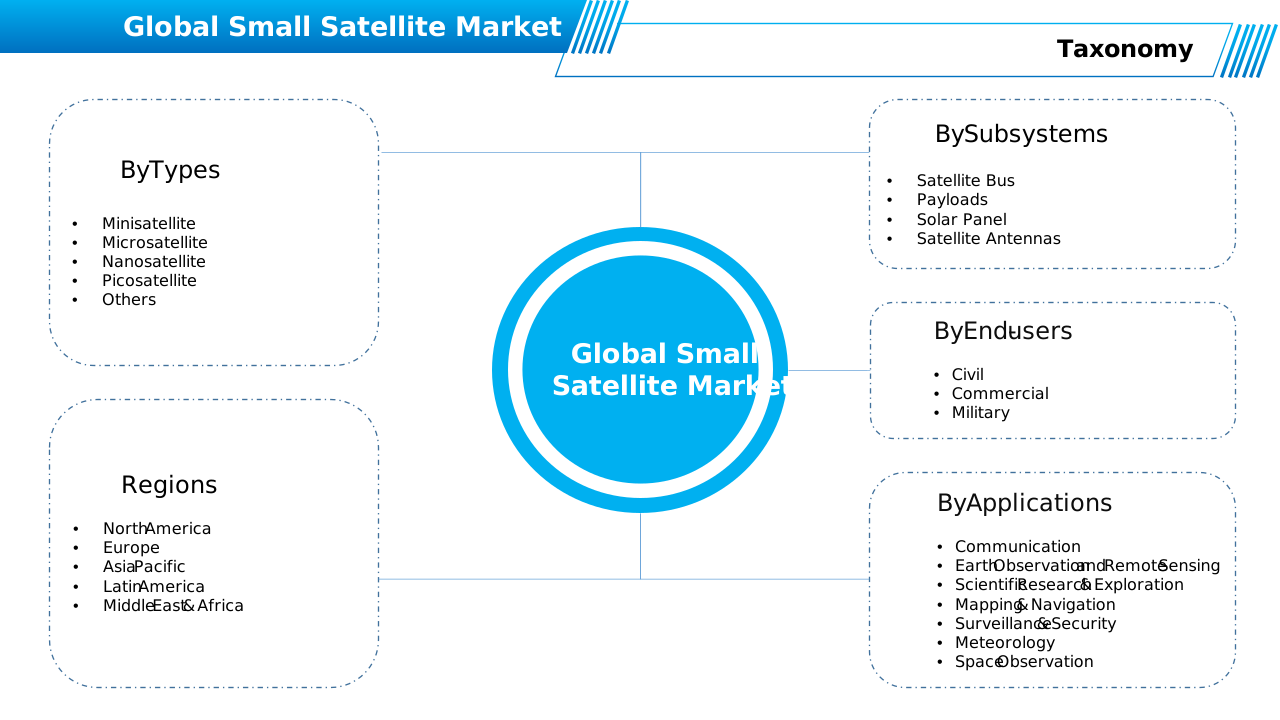
Segments - by Satellite Type (Mini Satellite, Micro Satellite, Nano Satellite, Pico Satellite, Femto Satellite), by Application (Earth Observation, Communication, Scientific Research, Technology Demonstration, Others), by End-User (Commercial, Government & Defense, Civil, Others), by Platform (CubeSat, Nanosat, Microsat, Minisat, Others)
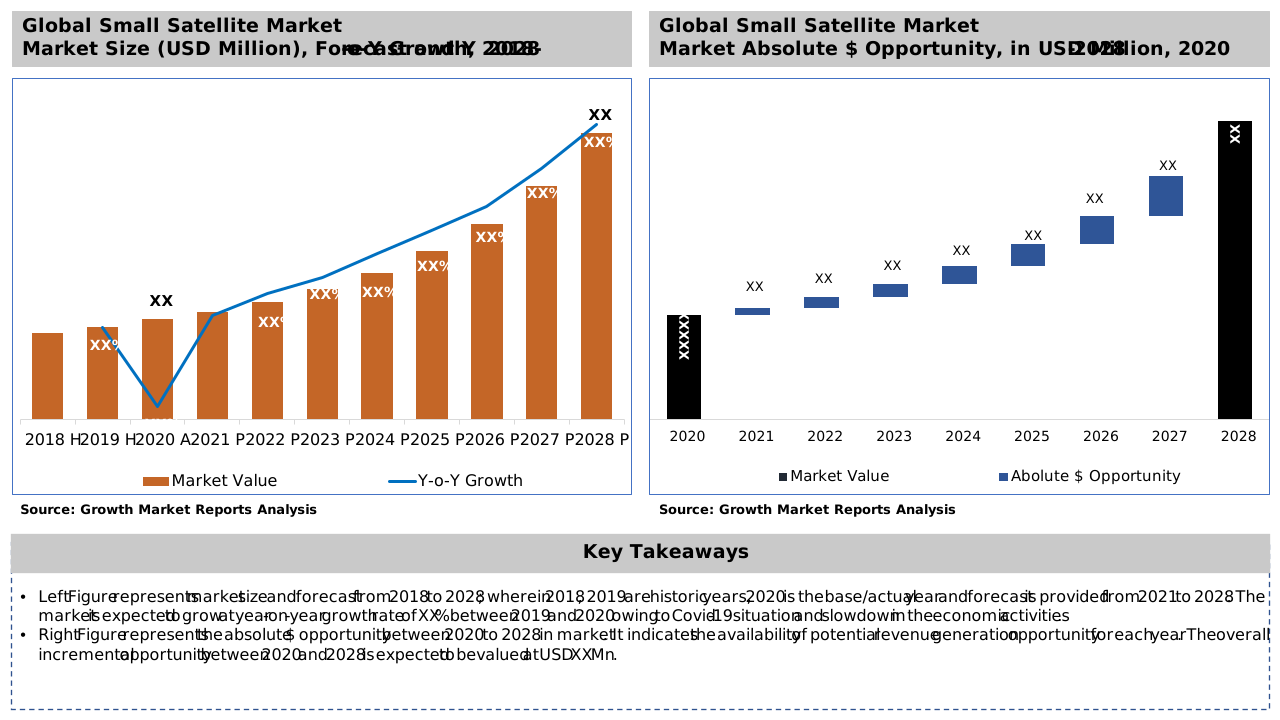
According to our latest research, the global small satellite market size reached USD 7.2 billion in 2024, with a robust compound annual growth rate (CAGR) of 17.8% recorded over the past few years. This strong momentum is expected to continue, propelling the market to a forecasted value of USD 38.7 billion by 2033. The primary growth driver for this market is the surging demand for cost-effective, agile, and technologically advanced satellite solutions across various sectors, including commercial, government, and defense applications. As per our latest research, the small satellite industry is witnessing unprecedented investments, technological advancements, and an evolving ecosystem that is reshaping the global space economy.
One of the most significant growth factors for the small satellite market is the rapid evolution in satellite miniaturization technologies. The development of compact, high-performance components such as sensors, propulsion systems, and communication payloads has enabled the deployment of smaller, lighter satellites with capabilities that previously required much larger spacecraft. This miniaturization has drastically reduced launch and manufacturing costs, making satellite technology more accessible to a broader range of organizations, from startups and universities to established aerospace companies and government agencies. The emergence of standardized platforms like CubeSats has further democratized access to space, fostering innovation and enabling frequent, low-cost missions for earth observation, scientific research, and technology demonstration.
Another crucial growth driver is the exponential increase in demand for earth observation and communication services. Small satellites are uniquely positioned to provide high-resolution imagery, real-time data, and global connectivity at a fraction of the cost of traditional large satellites. Industries such as agriculture, forestry, disaster management, and urban planning are leveraging small satellite data for monitoring, resource management, and decision-making. Furthermore, the rise of satellite-based internet services and the growing emphasis on bridging the digital divide in remote and underserved regions have spurred significant investments in small satellite constellations. Companies are deploying hundreds, even thousands, of small satellites to create resilient, scalable networks that can deliver broadband connectivity worldwide, further fueling market expansion.
The increasing role of government and defense agencies in fostering small satellite adoption is also a key growth catalyst. Governments worldwide are investing heavily in small satellite programs for surveillance, reconnaissance, and secure communications, recognizing the strategic and operational advantages these platforms offer. Initiatives aimed at national security, disaster response, and environmental monitoring are driving demand for rapid, flexible, and cost-effective satellite deployment. Additionally, public-private partnerships and supportive regulatory frameworks are encouraging the participation of private companies, startups, and academic institutions, resulting in a vibrant, collaborative ecosystem that accelerates technological development and market penetration.
From a regional perspective, North America remains the dominant force in the small satellite market, driven by a mature aerospace industry, substantial government investments, and the presence of leading commercial players. However, Asia Pacific is emerging as a significant growth engine, fueled by ambitious space programs in China, India, and Japan, as well as increasing private sector participation. Europe continues to demonstrate strong capabilities in satellite manufacturing and launch services, while Latin America and the Middle East & Africa are gradually increasing their footprint through targeted investments and regional collaborations. The interplay of these regional dynamics is shaping a highly competitive and innovative global market landscape.
The small satellite market is segmented by satellite type into mini satellites, micro satellites, nano satellites, pico satellites, and femto satellites, each playing a distinct role in the evolving space ecosystem. Mini satellites, typically weighing between 100 and 500 kilograms, are favored for missions requiring higher payload capacity, such as advanced earth observation, scientific research, and complex communication tasks. These satellites offer a balance between capability and cost, making them attractive for both governmental and commercial missions. Their ability to host sophisticated instruments and sensors enables high-resolution data collection, supporting applications in climate monitoring, disaster management, and defense surveillance. The demand for mini satellites is expected to remain strong, particularly as governments and large enterprises seek reliable, high-performance platforms for critical missions.
Micro satellites, with a mass range of 10 to 100 kilograms, represent a rapidly growing segment due to their versatility and cost-effectiveness. These satellites are commonly employed for earth observation, technology demonstration, and scientific experimentation. The reduced size and weight of micro satellites translate into lower launch costs and faster development cycles, making them ideal for organizations seeking to deploy agile, responsive missions. The proliferation of micro satellite constellations is enabling persistent, near-real-time coverage of the earth's surface, supporting applications such as agricultural monitoring, environmental assessment, and asset tracking. The increasing adoption of micro satellites by commercial operators, research institutions, and government agencies is expected to drive robust growth in this segment.
Nano satellites, typically weighing between 1 and 10 kilograms, have revolutionized access to space through their affordability and ease of deployment. The widespread adoption of standardized platforms like CubeSat has enabled a surge in nano satellite launches, with universities, startups, and research organizations leading the charge. These satellites are predominantly used for education, technology validation, and low-cost earth observation missions. The modularity and scalability of nano satellites make them ideal for building large constellations, enabling applications such as global IoT connectivity, space-based asset tracking, and rapid disaster response. The nano satellite segment is expected to witness the highest growth rate, driven by increasing investments in constellation-based services and the ongoing miniaturization of satellite components.
Pico satellites and femto satellites, weighing less than 1 kilogram and a few hundred grams respectively, represent the frontier of satellite miniaturization. While still in the early stages of commercial adoption, these ultra-small satellites are gaining traction for specific applications that require swarming, distributed sensing, or rapid technology demonstration. Advances in microelectronics, power systems, and propulsion technologies are enabling the development of increasingly capable pico and femto satellites, opening new possibilities for scientific research, space weather monitoring, and inter-satellite networking. As the technology matures and launch opportunities become more accessible, these segments are expected to contribute to the diversification and expansion of the small satellite market.
Overall, the segmentation by satellite type highlights the dynamic nature of the small satellite market, with each category addressing unique mission requirements and customer needs. The ongoing convergence of miniaturization, standardization, and cost reduction is accelerating the adoption of small satellites across diverse applications, driving sustained growth and innovation in the global market.
| Attributes | Details |
| Report Title | Small Satellite Market Research Report 2033 |
| By Satellite Type | Mini Satellite, Micro Satellite, Nano Satellite, Pico Satellite, Femto Satellite |
| By Application | Earth Observation, Communication, Scientific Research, Technology Demonstration, Others |
| By End-User | Commercial, Government & Defense, Civil, Others |
| By Platform | CubeSat, Nanosat, Microsat, Minisat, Others |
| Regions Covered | North America, Europe, APAC, Latin America, MEA |
| Countries Covered | North America (United States, Canada), Europe (Germany, France, Italy, United Kingdom, Spain, Russia, Rest of Europe), Asia Pacific (China, Japan, South Korea, India, Australia, South East Asia (SEA), Rest of Asia Pacific), Latin America (Mexico, Brazil, Rest of Latin America), Middle East & Africa (Saudi Arabia, South Africa, United Arab Emirates, Rest of Middle East & Africa) |
| Base Year | 2024 |
| Historic Data | 2018-2023 |
| Forecast Period | 2025-2033 |
| Number of Pages | 291 |
| Number of Tables & Figures | 277 |
| Customization Available | Yes, the report can be customized as per your need. |
The application landscape of the small satellite market is diverse, encompassing earth observation, communication, scientific research, technology demonstration, and other emerging uses. Earth observation remains the largest and most mature application segment, accounting for a significant share of small satellite deployments. These satellites provide high-resolution imagery, multispectral data, and environmental monitoring capabilities that support a wide range of industries, including agriculture, forestry, urban planning, and disaster management. The ability to deliver timely, accurate, and cost-effective data is driving the adoption of small satellites for earth observation, with new use cases emerging in climate monitoring, resource management, and infrastructure assessment. The proliferation of small satellite constellations is enabling persistent, global coverage, transforming how organizations access and utilize earth observation data.
Communication is another rapidly growing application, fueled by the increasing demand for global connectivity and the expansion of satellite-based internet services. Small satellites are being deployed in large constellations to provide broadband internet, IoT connectivity, and secure communications to remote and underserved regions. The flexibility, scalability, and cost advantages of small satellite networks are attracting significant investments from both established players and new entrants, driving innovation in satellite communication technologies. The deployment of low earth orbit (LEO) constellations is poised to revolutionize global communications, enabling high-speed, low-latency services that can compete with terrestrial networks. As digital transformation accelerates across industries, the communication segment is expected to be a key growth driver for the small satellite market.
Scientific research and technology demonstration represent important application areas for small satellites, providing a platform for testing new technologies, conducting experiments, and advancing space science. Universities, research institutions, and space agencies are leveraging small satellites to validate novel propulsion systems, sensors, and communication payloads in the space environment. These missions often serve as precursors to larger, more complex projects, enabling rapid iteration and risk reduction. The affordability and accessibility of small satellites are democratizing space science, enabling a broader range of organizations to participate in cutting-edge research and technology development. As the pace of innovation accelerates, the scientific research and technology demonstration segments are expected to play a pivotal role in shaping the future of the small satellite market.
Other emerging applications for small satellites include space situational awareness, on-orbit servicing, and inter-satellite networking. As the space environment becomes increasingly congested, the need for real-time monitoring, collision avoidance, and debris mitigation is driving the development of small satellite solutions for space traffic management. On-orbit servicing missions, such as refueling, repair, and deorbiting, are also gaining traction, with small satellites playing a key role in extending the operational life of larger spacecraft. The integration of advanced technologies such as artificial intelligence, machine learning, and autonomous operations is further expanding the application horizon for small satellites, unlocking new opportunities for innovation and market growth.
The application analysis underscores the versatility and transformative potential of small satellites across multiple domains. As new use cases continue to emerge and technology barriers are overcome, the application spectrum of small satellites is expected to broaden, driving sustained demand and shaping the evolution of the global market.
The small satellite market serves a diverse array of end-users, including commercial entities, government and defense organizations, civil agencies, and other specialized users. The commercial sector represents the largest and fastest-growing end-user segment, driven by the increasing adoption of small satellites for earth observation, communication, and remote sensing applications. Private companies are leveraging small satellites to deliver value-added services such as geospatial analytics, satellite-based internet, and asset tracking, tapping into new revenue streams and business models. The entry of non-traditional players, such as technology firms and startups, is fueling competition and innovation, further accelerating market growth. The commercial end-user segment is expected to maintain its dominance, supported by robust investment flows, expanding use cases, and the ongoing commercialization of space.
Government and defense agencies are major stakeholders in the small satellite market, utilizing these platforms for surveillance, reconnaissance, secure communications, and national security missions. The strategic advantages offered by small satellites, including rapid deployment, cost-effectiveness, and operational flexibility, are driving their adoption by military and intelligence agencies worldwide. Governments are also investing in small satellite programs for civil applications such as environmental monitoring, disaster response, and scientific research. The increasing emphasis on space-based capabilities for national security and public service is expected to sustain demand from the government and defense segment, with public-private partnerships playing a critical role in fostering innovation and market development.
Civil agencies, including research institutions, universities, and non-profit organizations, represent an important end-user group for small satellites. These entities are leveraging affordable satellite platforms to conduct scientific research, technology demonstration, and educational missions. The accessibility and flexibility of small satellites are enabling civil agencies to participate in space exploration, atmospheric studies, and earth observation, contributing to the advancement of science and technology. The growing interest in STEM education and hands-on learning experiences is driving the adoption of small satellites by academic institutions, fostering the next generation of space professionals and innovators. The civil end-user segment is expected to witness steady growth, supported by increasing funding, collaboration, and capacity-building initiatives.
Other end-users, such as international organizations, intergovernmental bodies, and specialized service providers, are also participating in the small satellite market. These entities are utilizing small satellites for a range of applications, including humanitarian aid, disaster relief, and global monitoring initiatives. The ability to deploy agile, responsive satellite missions is enabling these organizations to address complex challenges and deliver critical services in a timely manner. As the ecosystem matures and collaboration across sectors increases, the role of other end-users is expected to expand, contributing to the overall growth and diversification of the small satellite market.
The end-user analysis highlights the broad appeal and utility of small satellites across different sectors and mission profiles. The convergence of commercial, government, civil, and specialized demand is creating a vibrant, dynamic market environment that supports sustained innovation, investment, and growth in the global small satellite industry.
The small satellite market is characterized by a variety of platform types, including CubeSat, nanosat, microsat, minisat, and other specialized configurations. CubeSat platforms, based on standardized modular units (U), have become the de facto standard for small satellite missions, particularly in the nano and micro satellite categories. The CubeSat form factor offers significant advantages in terms of cost, scalability, and ease of integration, enabling rapid development and deployment of satellite missions. Universities, startups, and commercial operators are leveraging CubeSat platforms for a wide range of applications, from earth observation and scientific research to technology demonstration and IoT connectivity. The proliferation of CubeSat-based constellations is transforming the economics of space, driving down costs and democratizing access to satellite technology.
Nanosat platforms, encompassing satellites with a mass between 1 and 10 kilograms, are gaining traction for their versatility and adaptability. These platforms are often used for constellation-based missions, enabling persistent, global coverage for applications such as remote sensing, asset tracking, and environmental monitoring. The modular design and standardized interfaces of nanosat platforms facilitate rapid integration of diverse payloads, supporting a wide range of mission objectives. The ongoing miniaturization of satellite components and advances in power systems, propulsion, and communication technologies are enhancing the capabilities of nanosat platforms, positioning them as a key driver of market growth in the coming years.
Microsat platforms, typically weighing between 10 and 100 kilograms, offer a higher payload capacity and greater mission flexibility compared to smaller platforms. These satellites are often used for advanced earth observation, communication, and scientific research missions that require more sophisticated instruments and longer operational lifetimes. The ability to host multiple payloads and support complex mission architectures makes microsat platforms attractive to government agencies, commercial operators, and research institutions. The growing demand for high-resolution data, real-time communication, and advanced scientific experimentation is expected to drive sustained growth in the microsat platform segment.
Minisat platforms, with a mass range of 100 to 500 kilograms, bridge the gap between traditional large satellites and smaller platforms. These satellites are capable of supporting high-performance payloads and advanced mission profiles, including secure communications, surveillance, and climate monitoring. Minisat platforms are often selected for missions that require a balance between capability, cost, and deployment speed. The increasing emphasis on resilient, distributed satellite architectures is driving demand for minisat platforms, particularly in defense, government, and commercial applications. As technology advances and launch costs continue to decline, the minisat segment is expected to play a growing role in the global small satellite market.
Other platform types, including custom and hybrid configurations, are emerging to address specialized mission requirements and niche applications. These platforms leverage advances in modular design, propulsion, and autonomous operations to deliver tailored solutions for unique use cases, such as deep space exploration, on-orbit servicing, and inter-satellite networking. The ability to customize and adapt platform architectures is enabling organizations to address complex challenges and capture new market opportunities. As the small satellite ecosystem evolves, the diversity and sophistication of platform types are expected to increase, driving innovation and expanding the application horizon of small satellites.
The small satellite market presents abundant opportunities for stakeholders across the value chain, driven by technological advancements, expanding applications, and increasing investment flows. One of the most promising opportunities lies in the development and deployment of large-scale small satellite constellations for global connectivity and earth observation. The ability to provide real-time, high-resolution data and broadband internet services to remote and underserved regions is unlocking new business models and revenue streams, attracting significant interest from commercial operators, governments, and investors. The integration of advanced technologies such as artificial intelligence, machine learning, and edge computing is further enhancing the capabilities of small satellites, enabling autonomous operations, intelligent data processing, and on-orbit decision-making. These innovations are creating new opportunities for value-added services, data analytics, and application development, driving sustained growth in the small satellite market.
Another major opportunity is the increasing collaboration between public and private sector entities. Governments and space agencies are partnering with commercial companies, research institutions, and startups to accelerate the development and deployment of small satellite technologies. These collaborations are fostering innovation, reducing costs, and increasing access to space for a wider range of organizations. The emergence of dedicated small satellite launch services, rideshare missions, and deployable platforms is further lowering barriers to entry, enabling rapid, cost-effective access to space. As the ecosystem matures, opportunities for cross-sector collaboration, technology transfer, and capacity building are expected to expand, driving the growth and diversification of the global small satellite market.
Despite the numerous opportunities, the small satellite market faces several restraining factors and threats that could impact its growth trajectory. One of the primary challenges is the increasing congestion and risk of collision in low earth orbit (LEO), driven by the rapid proliferation of small satellite constellations. The accumulation of space debris and the potential for in-orbit collisions pose significant operational and regulatory risks, necessitating the development of robust space traffic management and debris mitigation strategies. Regulatory uncertainty, spectrum allocation challenges, and cybersecurity threats also represent potential barriers to market growth. Addressing these challenges will require coordinated action by industry stakeholders, governments, and international organizations to ensure the sustainable and secure development of the small satellite ecosystem.
North America continues to lead the global small satellite market, accounting for the largest share of revenue and satellite launches. In 2024, the region generated approximately USD 3.1 billion in market value, driven by the presence of leading aerospace companies, robust government investments, and a vibrant ecosystem of startups and research institutions. The United States, in particular, has established itself as a global hub for small satellite innovation, with major initiatives in earth observation, communication, and defense applications. The region's strong regulatory framework, access to capital, and advanced manufacturing capabilities are expected to sustain its leadership position, with a projected CAGR of 16.2% through 2033.
Asia Pacific is emerging as the fastest-growing region in the small satellite market, with a market size of USD 1.8 billion in 2024 and a projected CAGR of 20.7% through 2033. The region's growth is fueled by ambitious space programs in China, India, and Japan, as well as increasing private sector participation and investment. Governments in the region are prioritizing the development of indigenous satellite capabilities for national security, disaster management, and economic development. The expanding commercial space sector, coupled with supportive policies and international collaborations, is driving rapid adoption of small satellite technologies across diverse applications. As Asia Pacific continues to invest in infrastructure, talent, and technology, the region is poised to become a major driver of global market growth.
Europe remains a key player in the small satellite market, with a market value of USD 1.3 billion in 2024. The region is characterized by strong capabilities in satellite manufacturing, launch services, and research and development. The European Space Agency (ESA) and national space agencies are investing in small satellite programs for earth observation, climate monitoring, and scientific research. The presence of leading aerospace companies, research institutions, and a growing number of commercial operators is fostering innovation and competitiveness in the European market. Latin America and the Middle East & Africa, while smaller in market size, are gradually increasing their presence through targeted investments, regional collaborations, and capacity-building initiatives. These regions are focusing on leveraging small satellite technologies for socio-economic development, disaster response, and infrastructure monitoring, contributing to the global expansion and diversification of the small satellite market.
The competitive landscape of the small satellite market is characterized by a dynamic mix of established aerospace giants, innovative startups, and emerging players from diverse sectors. The market is highly fragmented, with companies competing on the basis of technological innovation, cost efficiency, mission reliability, and service differentiation. Leading players are investing heavily in research and development to enhance satellite performance, reduce costs, and expand their service offerings. Strategic partnerships, mergers and acquisitions, and vertical integration are common strategies employed by market participants to strengthen their market position and capture new growth opportunities. The increasing entry of non-traditional players, such as technology firms and venture-backed startups, is intensifying competition and driving rapid innovation across the value chain.
One of the defining features of the small satellite market is the emergence of dedicated launch service providers and satellite platform specialists. Companies are developing tailored solutions to address the unique requirements of small satellite missions, including rideshare launches, deployable platforms, and end-to-end mission management services. The proliferation of launch opportunities and the availability of standardized platforms are lowering barriers to entry, enabling a wider range of organizations to participate in the market. The competitive environment is further shaped by the presence of government and defense contractors, research institutions, and academic organizations, each contributing to the development and deployment of small satellite technologies.
Innovation is a key driver of competitive differentiation in the small satellite market. Companies are leveraging advances in miniaturization, modular design, propulsion systems, and autonomous operations to deliver increasingly capable and cost-effective satellite solutions. The integration of artificial intelligence, machine learning, and edge computing is enabling new applications and service models, such as real-time data analytics, autonomous mission planning, and on-orbit processing. The ability to rapidly iterate, adapt, and scale satellite missions is a critical success factor in the highly competitive and fast-evolving market landscape.
Major companies operating in the small satellite market include SpaceX, Planet Labs, Blue Canyon Technologies, GomSpace, Surrey Satellite Technology Limited (SSTL), Tyvak Nano-Satellite Systems, NanoAvionics, and Rocket Lab, among others. SpaceX, through its Starlink constellation, is a leading player in the satellite-based internet segment, deploying thousands of small satellites to provide global broadband connectivity. Planet Labs specializes in earth observation, operating one of the largest fleets of small satellites to deliver high-resolution imagery and geospatial analytics. Blue Canyon Technologies and GomSpace are recognized for their expertise in satellite platform development, offering turnkey solutions for a variety of applications. SSTL and Tyvak are pioneers in small satellite manufacturing and mission integration, supporting commercial, government, and research clients worldwide.
Rocket Lab is a leading provider of dedicated launch services for small satellites, offering frequent, cost-effective access to space through its Electron rocket. NanoAvionics is known for its modular satellite platforms and end-to-end mission services, catering to commercial, government, and academic customers. These companies, along with a growing number of innovative startups and established aerospace firms, are shaping the competitive dynamics of the global small satellite market. As the market continues to expand and evolve, the ability to innovate, collaborate, and deliver value-added services will be critical to sustaining competitive advantage and capturing new growth opportunities.
The Small Satellite market has been segmented on the basis of
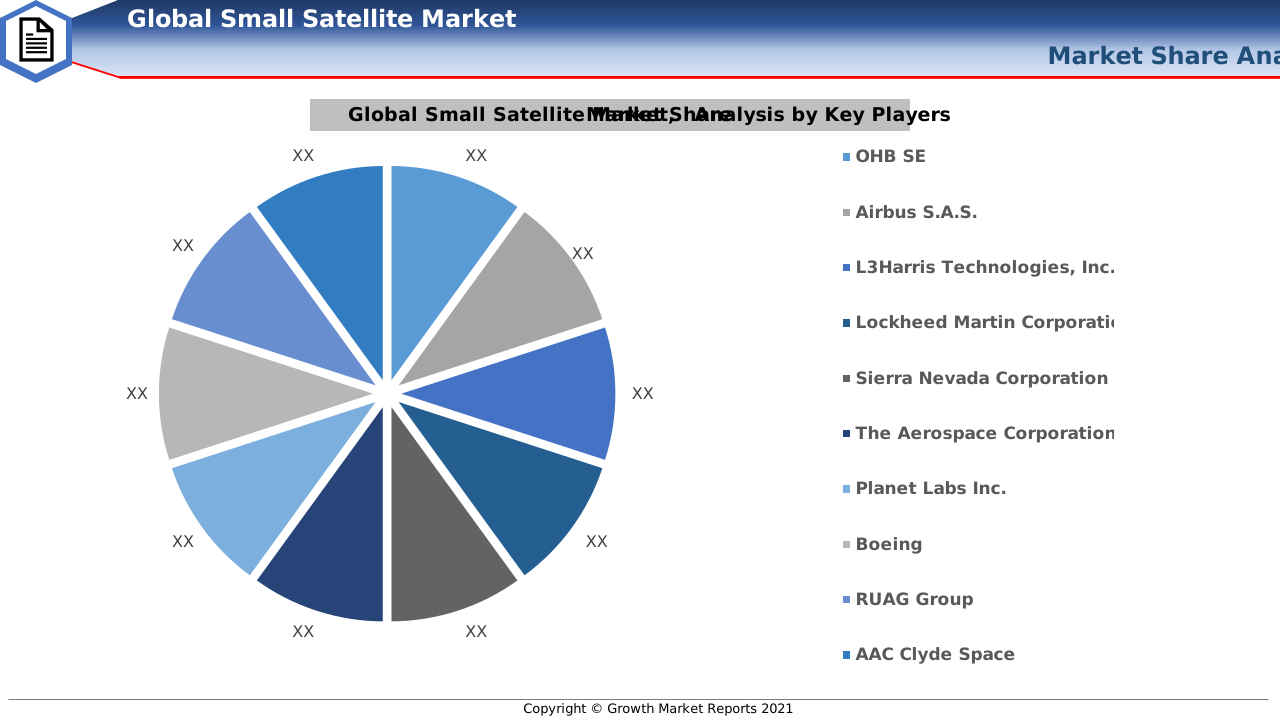
Key players in the global small satellite market include OHB SE, Airbus S.A.S., L3Harris Technologies, Inc., Lockheed Martin Corporation., Sierra Nevada Corporation, The Aerospace Corporation., Planet Labs Inc., Boeing, RUAG Group, and AAC Clyde Space.
Advancements in miniaturization, modular design, propulsion, and autonomous operations are enabling more capable, cost-effective, and scalable small satellite solutions, fostering innovation and new applications across industries.
Major players include SpaceX, Planet Labs, Blue Canyon Technologies, GomSpace, Surrey Satellite Technology Limited (SSTL), Tyvak Nano-Satellite Systems, NanoAvionics, and Rocket Lab.
Opportunities include the deployment of large satellite constellations, AI and edge computing integration, and public-private collaborations. Threats include orbital congestion, space debris, regulatory uncertainty, and cybersecurity risks.
Popular platforms include CubeSats, nanosats, microsats, minisats, and custom/hybrid configurations, with CubeSats being the most widely adopted due to their modularity and cost-effectiveness.
End-users include commercial companies, government and defense agencies, civil agencies (such as universities and research institutions), and specialized organizations like international bodies and NGOs.
Major applications include earth observation, communication (including satellite-based internet), scientific research, technology demonstration, space situational awareness, on-orbit servicing, and inter-satellite networking.
The market is segmented into mini satellites (100–500 kg), micro satellites (10–100 kg), nano satellites (1–10 kg), pico satellites (<1 kg), and femto satellites (a few hundred grams), each serving different mission profiles and user needs.
North America leads the market due to a mature aerospace sector and strong investments. Asia Pacific is the fastest-growing region, driven by space programs in China, India, and Japan. Europe also remains a significant player, while Latin America and the Middle East & Africa are gradually increasing their market presence.
Key growth drivers include advances in satellite miniaturization, rising demand for earth observation and communication services, increased government and defense investments, and expanding commercial applications.
As of 2024, the global small satellite market is valued at USD 7.2 billion and is projected to reach USD 38.7 billion by 2033, growing at a CAGR of 17.8%.