Wireline Logging Services Market Report 2034

Wireline Logging Services Market Report 2034

Segments - by Service Type (Open Hole, Cased Hole), by Application (Onshore, Offshore), by Hole Type (Vertical, Horizontal), by End-User (Oil & Gas, Mining, Water Exploration, Others)

https://growthmarketreports.com/Raksha
Author : Raksha Sharma
https://growthmarketreports.com/Vaibhav
Fact-checked by : V. Chandola
https://growthmarketreports.com/Shruti
Editor : Shruti Bhat

Last Updated : Jun, 2026 | Report ID :EP-2361 | 4.0 Rating | 83 Reviews | 281 Pages | Format : Docx PDF

Report Description

This report is updated with the latest market data and insights as of June 2026. Base year: 2025  |  Forecast period: 2026-2034


Wire line Logging Services Market Outlook

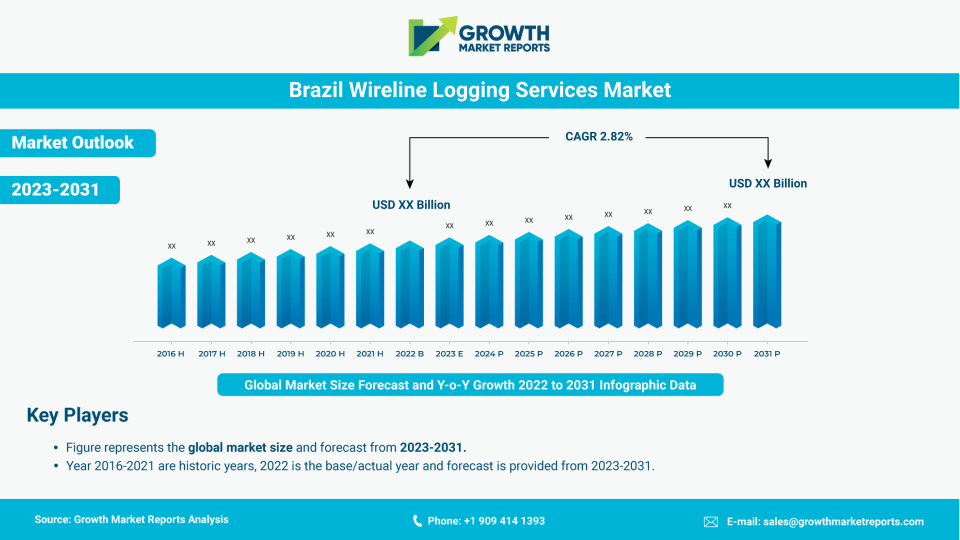
According to our latest research, the global Wireline Logging Services market size reached USD 9.3 billion in 2025, reflecting a robust industry driven by ongoing energy exploration and rapid technological advancements. The market is expected to grow at a CAGR of 7.2% from 2026 to 2034, reaching a projected value of USD 17.2 billion by 2034. This growth is primarily attributed to the increasing demand for efficient reservoir evaluation and the continued expansion of oil and gas exploration activities worldwide. As per our analysis, the rising focus on maximizing hydrocarbon recovery, coupled with the integration of digital technologies in well logging operations, is significantly shaping the competitive market landscape. For a broader view of subsurface evaluation services, our coverage of the wireline logging sector provides additional context on technology trends and investment flows.

Global Wire line Logging Services Market Size Forecast 2025-2034, USD Billion

One of the primary growth factors for the Wireline Logging Services market is the relentless global pursuit of hydrocarbon resources to meet the world's ever-growing energy needs. With mature oilfields requiring enhanced recovery techniques and new exploration frontiers being opened in deepwater and ultra-deepwater regions, the demand for advanced wireline logging solutions is surging in 2025. Operators are increasingly leveraging wireline logging services to obtain accurate subsurface data, which is crucial for making informed drilling and production decisions. The adoption of high-resolution imaging, formation evaluation, and real-time data transmission technologies has become standard practice, enabling oil and gas companies to optimize production and reduce operational risks. Furthermore, the integration of artificial intelligence and machine learning in data interpretation is enhancing the value proposition of wireline logging services, allowing for more precise reservoir characterization and improved well performance metrics.

Another significant driver for the Wireline Logging Services market is the ongoing shift toward unconventional resources, such as shale gas, tight oil, and coalbed methane. These resources present unique challenges that necessitate specialized logging techniques to evaluate complex formations accurately. As countries including the United States, China, and Argentina ramp up their unconventional exploration and production activities, the need for sophisticated wireline logging solutions is becoming increasingly pronounced. Additionally, environmental regulations and the growing emphasis on sustainable resource extraction are prompting companies to invest in advanced logging technologies that minimize environmental impact while maximizing data accuracy. This trend is fostering innovation in logging tool design, leading to the development of more compact, efficient, and environmentally responsible wireline logging systems suited to 2025 operational standards.

The market is further buoyed by the increasing adoption of digital oilfield initiatives, which aim to integrate real-time data acquisition, processing, and analysis across the entire exploration and production value chain. Well logging software platforms are playing a growing role in this digital transformation, enabling seamless data interpretation and reservoir modeling at scale. Wireline logging services play a pivotal role in digital oilfield strategies by providing high-quality subsurface data that feeds into advanced reservoir simulation platforms. As operators seek to enhance operational efficiency, reduce downtime, and improve decision-making, the demand for wireline logging services capable of delivering rapid, accurate, and actionable insights is on the rise. The convergence of cloud computing, the Internet of Things (IoT), and big data analytics is driving further innovation and adoption of wireline logging services across the 2026-2034 forecast period.

From a regional perspective, North America currently dominates the Wireline Logging Services market, driven by the high level of oil and gas exploration and production activities in the United States and Canada. The Asia Pacific region is emerging as a significant growth engine, fueled by increasing investments in offshore exploration in countries such as China, India, and Australia. Meanwhile, the Middle East and Africa region continues to be a key market, given its vast reserves and ongoing projects in both mature and greenfield fields. Europe and Latin America are also witnessing steady growth, supported by new exploration projects in the North Sea and pre-salt discoveries in Brazil, respectively. The interplay of these regional dynamics is expected to shape the global wireline logging services market over the 2026-2034 forecast period.

Service Type Analysis

The Service Type segment of the Wireline Logging Services market is bifurcated into open hole and cased hole logging services, each serving distinct roles in subsurface evaluation. Open hole logging services, which account for approximately 58.5% of total market revenue in 2025, are primarily utilized immediately after drilling and before the well is cased, offering a direct and comprehensive assessment of formation properties. These services are critical for determining porosity, permeability, fluid saturation, and lithology, which are essential parameters for reservoir evaluation and well completion decisions. The rising complexity of reservoir structures, especially in unconventional and deepwater fields, is driving increased demand for high-resolution open hole logging tools that can operate reliably under extreme downhole conditions. The integration of advanced sensors and imaging technologies has significantly improved the accuracy and depth of information provided by open hole logging, making it indispensable for modern exploration and production operations. Broader market dynamics in this area are well documented in our analysis of wire line services across the oilfield sector.

Wire line Logging Services Market Share by Service Type 2025

Cased hole logging services, on the other hand, are performed after the well has been cased and cemented, representing approximately 41.5% of market revenue in 2025. These services are crucial for evaluating cement bond integrity, monitoring production zones, and diagnosing well integrity issues over the life of the well. Cased hole logging is particularly important in mature fields where well intervention and workover operations are frequently required to maintain or enhance production. The increasing focus on maximizing recovery from existing wells, coupled with stringent regulatory requirements for well integrity, is fueling the growth of these services. Technological innovations such as pulsed neutron logging, production logging, and advanced cement evaluation tools are enhancing the capability of cased hole services to provide detailed and actionable insights into well performance and integrity throughout the asset lifecycle.

The market is witnessing a trend toward the integration of open hole and cased hole logging services to provide a holistic view of reservoir and wellbore conditions throughout the well lifecycle. Service providers are developing modular tool strings that can be easily configured for both open hole and cased hole operations, thereby improving operational efficiency and reducing costs for operators. Additionally, the adoption of digital and wireless telemetry systems is enabling real-time data transmission from both open and cased hole environments, allowing for faster and more informed decision-making. This convergence of technologies is expected to drive further growth in the service type segment, as operators seek comprehensive and flexible logging solutions to address increasingly complex subsurface challenges through 2034.

The competitive landscape within the service type segment is characterized by intense innovation and differentiation, as leading service providers invest heavily in research and development to introduce next-generation logging tools. The focus is on enhancing tool reliability, data accuracy, and operational safety, particularly for high-pressure, high-temperature (HPHT) environments. The adoption of artificial intelligence and machine learning algorithms for automated data interpretation is gaining significant traction in 2025, enabling faster turnaround times and reducing the reliance on specialist personnel. As the market evolves, the ability to deliver integrated, high-value logging services across both open and cased hole environments will be a key differentiator for service providers competing in the global arena.

Report Scope

Attributes Details
Report Title Wireline Logging Services Market Research Report 2034
By Service Type Open Hole, Cased Hole
By Application Onshore, Offshore
By Hole Type Vertical, Horizontal
By End-User Oil & Gas, Mining, Water Exploration, Others
Regions Covered North America, Europe, APAC, Latin America, MEA
Base Year 2025
Historic Data 2019-2024
Forecast Period 2026-2034
Number of Pages 281
Number of Tables & Figures 271
Customization Available Yes, the report can be customized as per your need.

Application Analysis

The Application segment of the Wireline Logging Services market is divided into onshore and offshore operations, each presenting unique challenges and opportunities. Onshore applications currently account for the largest share of the market in 2025, driven by the sheer volume of drilling and production activities in land-based oil and gas fields worldwide. Onshore wireline logging services are widely utilized for both exploration and development wells, providing critical data for reservoir evaluation, completion design, and production optimization. The relative accessibility of onshore fields allows for frequent logging operations, and the ongoing development of unconventional resources such as shale gas and tight oil is further boosting demand for advanced wireline logging solutions in this segment through the 2026-2034 forecast window.

Offshore applications, while representing a smaller share of the market compared to onshore, are experiencing rapid growth due to the increasing number of deepwater and ultra-deepwater exploration projects sanctioned globally from 2025 onward. Offshore wireline logging operations are inherently more complex and costly, requiring specialized tools capable of withstanding harsh downhole conditions, high pressures, and extreme temperatures. The need for accurate and reliable subsurface data is even more critical in offshore environments, where drilling and completion costs are significantly higher. As a result, operators are investing heavily in cutting-edge wireline logging technologies, including high-resolution imaging, formation testing, and real-time data transmission systems, to minimize operational risks and maximize hydrocarbon recovery from offshore fields.

The growing adoption of digital oilfield technologies is transforming both onshore and offshore wireline logging operations in 2025. Remote monitoring, automation, and real-time data analytics are becoming standard features in modern logging services, enabling operators to optimize well placement, reduce non-productive time, and enhance overall field development strategies. The integration of cloud-based data management platforms is also streamlining the storage, retrieval, and analysis of vast volumes of logging data, facilitating more effective collaboration between geoscientists, engineers, and decision-makers across geographically dispersed teams spanning multiple continents and time zones.

Environmental considerations and regulatory compliance are increasingly shaping the application of wireline logging services, particularly in offshore and environmentally sensitive onshore areas. Operators are under growing pressure to minimize environmental impact, reduce emissions, and ensure the integrity of well operations in accordance with 2025 regulatory frameworks. This is driving demand for logging tools and services that are not only highly accurate and reliable but also designed to operate with a minimal environmental footprint. Service providers are responding by developing compact, lightweight, and energy-efficient logging systems that can be deployed quickly and safely in challenging environments, further expanding the application scope of wireline logging services across all geographies.

Hole Type Analysis

The Hole Type segment of the Wireline Logging Services market is categorized into vertical and horizontal wells, each with distinct operational requirements and challenges. Vertical wells, which have traditionally dominated the oil and gas industry, continue to account for a significant share of wireline logging service demand in 2025. These wells are generally easier to log, as the vertical orientation allows for straightforward deployment and retrieval of logging tools. Vertical well logging provides essential data for reservoir characterization, formation evaluation, and well completion planning, and remains a staple in both conventional and unconventional resource development programs across all major producing regions.

However, the increasing prevalence of horizontal drilling, particularly in unconventional resource plays such as shale gas and tight oil, is reshaping the wireline logging services landscape considerably. Horizontal wells are drilled to maximize reservoir contact and improve hydrocarbon recovery, but they present unique challenges for wireline logging operations. The extended lateral sections and complex well trajectories require specialized conveyance systems, such as tractor-driven tools and coiled tubing, to deploy logging instruments effectively. The demand for high-resolution, multi-sensor logging tools capable of operating in horizontal wells is rising sharply in 2025, as operators seek to obtain detailed formation data along the entire length of the wellbore to optimize hydraulic fracture placement and production performance.

The integration of advanced technologies such as imaging tools, nuclear magnetic resonance (NMR) logging, and dipole sonic tools is enabling more comprehensive data acquisition in both vertical and horizontal wells. These technologies provide valuable insights into formation properties, fluid distribution, and reservoir heterogeneity, supporting more accurate reservoir modeling and production optimization. As the industry continues to shift toward horizontal drilling in pursuit of unconventional resources, the ability to deliver reliable and efficient wireline logging services in these challenging environments will be a key competitive advantage for service providers operating through the 2026-2034 forecast period.

Furthermore, the growing complexity of well architectures, including multi-lateral and extended-reach wells, is driving innovation in wireline logging tool design and deployment techniques. Service providers are investing in the development of flexible, modular, and remotely operated logging systems that can navigate complex well paths and deliver high-quality data in real time. This trend is expected to accelerate as operators continue to push the boundaries of drilling technology in search of new reserves and enhanced production from existing fields across North America, the Middle East, and emerging frontier basins worldwide.

End-User Analysis

The End-User segment of the Wireline Logging Services market encompasses a diverse range of industries, including oil and gas, mining, water exploration, and others. The oil and gas sector remains the dominant end-user in 2025, accounting for the majority of wireline logging service demand. Exploration and production companies rely heavily on wireline logging to acquire critical subsurface data for reservoir evaluation, drilling optimization, and production enhancement. The ongoing expansion of oil and gas exploration activities, particularly in challenging environments such as deepwater, ultra-deepwater, and unconventional resource plays, is driving sustained demand for advanced wireline logging solutions in this sector through 2034.

The mining industry is emerging as a significant end-user of wireline logging services, particularly for mineral exploration and ore body characterization. Wireline logging provides valuable geophysical and geochemical data that support resource estimation, mine planning, and operational efficiency. As global demand for critical minerals and metals continues to rise, driven in part by the energy transition and the proliferation of battery technologies, mining companies are increasingly adopting wireline logging technologies to improve exploration success rates and optimize resource extraction processes. The integration of advanced logging tools, such as spectral gamma-ray and resistivity sensors, is enabling more accurate and detailed assessment of mineral deposits globally.

Water exploration is another important application area for wireline logging services, particularly in regions facing water scarcity and increasing demand for groundwater resources across Africa, the Middle East, and parts of Asia. Wireline logging is used to evaluate aquifer properties, identify water-bearing zones, and assess well integrity in both municipal and industrial water supply projects. The growing emphasis on sustainable water management and the need for reliable groundwater data are driving the adoption of wireline logging technologies in this sector in 2025 and beyond. Service providers are responding by developing specialized logging tools and software tailored to the unique requirements of water exploration and integrated resource management.

Other end-users, such as geothermal energy developers and environmental monitoring agencies, are also contributing to the growth of the wireline logging services market. Geothermal projects require detailed subsurface data to assess reservoir properties and optimize well placement, while environmental monitoring relies on wireline logging to evaluate soil and groundwater contamination. The expanding application scope of wireline logging services across multiple industries is creating new growth opportunities for service providers and driving ongoing innovation in tool design, data interpretation capabilities, and service delivery models through the entire forecast horizon.

Opportunities & Threats

The Wireline Logging Services market presents a multitude of opportunities for growth and innovation, particularly as the energy sector continues to evolve in response to changing market dynamics and technological advancements in 2025. One of the most significant opportunities lies in the ongoing digital transformation of the oil and gas industry. The integration of advanced data analytics, artificial intelligence, and machine learning into wireline logging operations is enabling faster, more accurate, and more actionable insights for operators. This digitalization trend is expected to drive demand for next-generation logging tools and services that can seamlessly integrate with digital oilfield platforms, support remote operations, and deliver real-time data for enhanced decision-making. Service providers that invest in digital solutions and develop strong partnerships with technology companies will be well-positioned to capitalize on this opportunity and differentiate themselves in a competitive market through 2034.

Another major opportunity is the growing focus on sustainability and environmental stewardship across the energy and resource sectors. As regulatory requirements become more stringent and public scrutiny of environmental practices intensifies, operators are seeking wireline logging solutions that minimize environmental impact and support sustainable resource extraction. This includes the development of compact, lightweight, and energy-efficient logging tools, as well as the adoption of remote and automated operations to reduce the need for personnel on site. Additionally, the expansion of wireline logging services into emerging sectors such as geothermal energy, carbon capture and storage, and environmental monitoring presents new avenues for growth and diversification that align with global decarbonization goals. Service providers that can offer innovative, environmentally responsible solutions will be well-positioned to capture incremental market share and drive long-term growth.

Despite the numerous opportunities, the Wireline Logging Services market faces several restraining factors that could impact growth through the forecast period. One of the primary challenges is the cyclical nature of the oil and gas industry, which is highly sensitive to fluctuations in commodity prices and capital expenditure cycles. Periods of low oil prices can lead to reduced exploration and production activity, resulting in lower demand for wireline logging services. Additionally, the high cost of advanced logging tools and services, coupled with the increasing complexity of well architectures, can pose challenges for operators with limited budgets. Regulatory and environmental concerns, particularly in offshore and environmentally sensitive areas, can also increase operational risks and compliance costs for service providers. Companies must navigate these challenges by focusing on operational efficiency, cost optimization, and continuous innovation to maintain competitiveness and drive sustainable growth throughout the 2026-2034 forecast period.

Regional Outlook

The Wireline Logging Services market exhibits distinct regional dynamics, with North America leading the global market in terms of revenue and technological adoption. In 2025, North America accounts for approximately 36.5% of total market revenue, or roughly USD 3.4 billion, driven by the high level of oil and gas exploration and production activities in the United States and Canada. The region's leadership is underpinned by its advanced technological infrastructure, well-established oilfield service providers, and significant investments in unconventional resource development, particularly in the Permian Basin, Eagle Ford, and Bakken shale plays. The adoption of digital oilfield technologies and the integration of advanced wireline logging tools are further consolidating the region's market position as the 2026-2034 forecast cycle begins.

Wire line Logging Services Market Regional Share 2025

The Asia Pacific region is emerging as a key growth engine for the Wireline Logging Services market, with a market size of approximately USD 2.2 billion in 2025 and a projected CAGR of 8.5% through 2034. Countries such as China, India, and Australia are investing heavily in both onshore and offshore exploration projects to meet rising energy demand and reduce dependence on imported hydrocarbons. The region's vast untapped reserves, coupled with supportive government policies and increasing foreign investment, are driving demand for advanced wireline logging services. The adoption of digital technologies and the expansion of local service provider networks are also contributing to the region's rapid and sustained growth trajectory.

The Middle East and Africa region continues to be a major market for wireline logging services, accounting for approximately 20.0% of global revenue in 2025, equivalent to roughly USD 1.9 billion. The region's vast reserves, ongoing development of both mature and greenfield fields, and the presence of leading national oil companies are driving sustained demand for high-quality wireline logging solutions. Europe and Latin America collectively represent approximately 20.0% of the global market in 2025, supported by new exploration projects in the North Sea and pre-salt discoveries in Brazil. The interplay of these regional dynamics is expected to shape the global wireline logging services market over the 2026-2034 forecast period, with each region presenting unique opportunities and challenges for service providers across all segments.

Competitor Outlook

The Wireline Logging Services market is characterized by intense competition among a mix of global oilfield service giants and specialized regional providers. The competitive landscape is shaped by continuous technological innovation, strategic collaborations, and a strong focus on operational efficiency and customer service. Leading players in the market are investing heavily in research and development to introduce next-generation logging tools and services that offer enhanced data accuracy, reliability, and operational safety. The ability to deliver integrated, end-to-end solutions that encompass both open hole and cased hole logging, as well as advanced data analytics and interpretation services, is emerging as a key differentiator in the 2025 market environment.

Mergers, acquisitions, and strategic alliances are common strategies employed by major companies to expand their service portfolios, enter new markets, and strengthen their competitive positions. The trend toward digitalization and the adoption of cloud-based data management platforms are driving collaboration between wireline logging service providers and technology companies, enabling the development of innovative solutions that address the evolving needs of the industry. The competitive landscape is also characterized by a growing emphasis on sustainability and environmental responsibility, with leading players developing environmentally friendly logging tools and services to meet the demands of increasingly stringent regulatory frameworks applicable across all major producing regions in 2025.

Regional and niche service providers are also playing a significant role in the market, particularly in emerging regions such as Asia Pacific, Latin America, and the Middle East and Africa. These companies often offer specialized services tailored to the unique geological and operational challenges of their local markets. By leveraging their deep understanding of regional dynamics and maintaining close relationships with local operators, these providers are able to compete effectively with larger multinational players. The competitive landscape is further shaped by the entry of new players offering innovative technologies and business models, contributing to a dynamic and rapidly evolving market environment through 2034.

Some of the major companies operating in the Wireline Logging Services market include SLB (Schlumberger), Halliburton Company, Baker Hughes Company, Weatherford International plc, and Expro Group. SLB, as the largest oilfield service provider globally, offers a comprehensive portfolio of wireline logging services and is known for its technological leadership and global operational reach. Halliburton is renowned for its integrated service offerings and strong presence in both North America and international markets. Baker Hughes is recognized for its innovation in digital oilfield solutions and advanced logging technologies. Weatherford International has a strong focus on operational efficiency and customer-centric solutions, while Expro Group is known for its expertise in well intervention and production optimization services across multiple geographies.

These companies are continuously investing in the development of new technologies, including high-resolution imaging tools, real-time data transmission systems, and advanced data analytics platforms, to maintain their competitive edge in 2025 and beyond. Strategic partnerships with technology firms, research institutions, and national oil companies are also common, enabling the development of customized solutions that address the specific needs of different regions and end-users. As the market continues to evolve through 2034, the ability to innovate, adapt to changing customer requirements, and deliver high-value, integrated solutions will be critical for success in the highly competitive wireline logging services market across all service types and geographies.

Key Players

  • SLB (Schlumberger Limited)
  • Halliburton Company
  • Baker Hughes Company
  • Weatherford International plc
  • China Oilfield Services Limited (COSL)
  • Expro Group
  • Nabors Industries Ltd.
  • Archer Limited
  • Scientific Drilling International
  • TGT Diagnostics
  • Altus Intervention
  • Probe Technology Services
  • Casedhole Solutions
  • Hunting Energy Services
  • Paradigm Technology Services
  • Logan Industries International
  • Horizontal Technology Inc.
  • C&J Energy Services

Segments

The Wire line Logging Services market has been segmented on the basis of

Service Type

  • Open Hole
  • Cased Hole

Application

  • Onshore
  • Offshore

Hole Type

  • Vertical
  • Horizontal

End-User

  • Oil & Gas
  • Mining
  • Water Exploration
  • Others

Frequently Asked Questions

The wireline logging services market is responding to environmental and sustainability concerns through multiple avenues. Service providers are developing compact, lightweight, and energy-efficient logging tools that reduce the operational footprint. Automation and remote monitoring capabilities are minimizing the need for on-site personnel, lowering emissions associated with transportation and site activity. Leading companies are also expanding their service offerings into geothermal energy, carbon capture and storage evaluation, and environmental monitoring, aligning business growth with the global energy transition agenda and meeting increasingly strict regulatory requirements.

The global wireline logging services market is led by SLB (Schlumberger), Halliburton, and Baker Hughes, which together hold a significant combined market share due to their broad technology portfolios and global operational reach. Other notable players include Weatherford International, China Oilfield Services Limited (COSL), Expro Group, Nabors Industries, Archer Limited, TGT Diagnostics, Altus Intervention, and Scientific Drilling International. Regional and specialty providers such as Probe Technology Services, Casedhole Solutions, and Hunting Energy Services also contribute meaningfully to the competitive landscape.

Key challenges include the cyclical nature of oil and gas capital expenditure, which can sharply curtail logging demand during periods of low commodity prices. The high cost of advanced logging tools and services poses budget constraints for smaller operators. The growing complexity of well architectures, including extended-reach and multi-lateral wells, demands continuous tool innovation. Additionally, increasingly stringent environmental and safety regulations, particularly in offshore and ecologically sensitive regions, add compliance costs and operational complexity for service providers.

Beyond oil and gas, wireline logging services are widely used in the mining industry for mineral exploration and ore body characterization, and in water exploration for aquifer evaluation and groundwater management. Geothermal energy developers rely on logging to assess reservoir properties and optimize well placement. Environmental monitoring agencies use wireline logging to evaluate soil and groundwater contamination. These diverse applications are expanding the addressable market for wireline logging service providers significantly.

Digital oilfield technologies are profoundly transforming wireline logging services by enabling real-time data acquisition, remote monitoring, cloud-based data management, and AI-powered interpretation. These capabilities allow operators to make faster and more informed decisions regarding well placement, reservoir management, and production optimization. The convergence of the Internet of Things, big data analytics, and machine learning is reducing non-productive time and improving data accuracy, making digital integration a central competitive differentiator for leading service providers in 2025 and beyond.

North America leads the global market, accounting for approximately 36.5% of total revenue in 2025, driven by intense exploration and production activity in the Permian Basin, Eagle Ford, and Bakken shale plays. Asia Pacific is the fastest-growing region, with a projected CAGR of 8.5% from 2026 to 2034, supported by significant offshore investments in China, India, and Australia. The Middle East and Africa also represent a major share, underpinned by vast reserves and active national oil company programs.

Open hole logging is conducted immediately after drilling and before the well is cased, providing direct measurements of formation properties such as porosity, permeability, fluid saturation, and lithology. These measurements are critical for reservoir evaluation and completion design. Cased hole logging, by contrast, is performed after the wellbore has been cased and cemented. It focuses on evaluating cement bond integrity, monitoring production zones, and diagnosing well integrity issues over the productive life of the well. Both service types are essential across different phases of the well lifecycle.

The primary drivers include rising global energy demand, increased investment in deepwater and ultra-deepwater exploration, the rapid expansion of unconventional resource development in shale gas and tight oil plays, and the integration of artificial intelligence and real-time data analytics into logging operations. Government-led energy security initiatives in Asia Pacific and the Middle East are also providing strong impetus for market growth through 2034.

The wireline logging services market is projected to grow at a CAGR of 7.2% from 2026 to 2034, reaching an estimated value of approximately USD 17.2 billion by 2034. This growth trajectory is underpinned by expanding offshore exploration, rising adoption of horizontal drilling, and the continued shift toward data-driven reservoir management strategies.

According to our latest research, the global wireline logging services market reached USD 9.3 billion in 2025. This reflects robust and sustained demand driven by active energy exploration programs, ongoing unconventional resource development, and the accelerating integration of digital technologies across well logging operations worldwide.

Table Of Content

Chapter 1 Executive Summary
Chapter 2 Assumptions and Acronyms Used
Chapter 3 Research Methodology
Chapter 4 Wire line Logging Services Market Overview
   4.1 Introduction
      4.1.1 Market Taxonomy
      4.1.2 Market Definition
      4.1.3 Macro-Economic Factors Impacting the Market Growth
   4.2 Wire line Logging Services Market Dynamics
      4.2.1 Market Drivers
      4.2.2 Market Restraints
      4.2.3 Market Opportunity
   4.3 Wire line Logging Services Market - Supply Chain Analysis
      4.3.1 List of Key Suppliers
      4.3.2 List of Key Distributors
      4.3.3 List of Key Consumers
   4.4 Key Forces Shaping the Wire line Logging Services Market
      4.4.1 Bargaining Power of Suppliers
      4.4.2 Bargaining Power of Buyers
      4.4.3 Threat of Substitution
      4.4.4 Threat of New Entrants
      4.4.5 Competitive Rivalry
   4.5 Global Wire line Logging Services Market Size & Forecast, 2023-2032
      4.5.1 Wire line Logging Services Market Size and Y-o-Y Growth
      4.5.2 Wire line Logging Services Market Absolute $ Opportunity

Chapter 5 Global Wire line Logging Services Market Analysis and Forecast By Service Type
   5.1 Introduction
      5.1.1 Key Market Trends & Growth Opportunities By Service Type
      5.1.2 Basis Point Share (BPS) Analysis By Service Type
      5.1.3 Absolute $ Opportunity Assessment By Service Type
   5.2 Wire line Logging Services Market Size Forecast By Service Type
      5.2.1 Open Hole
      5.2.2 Cased Hole
   5.3 Market Attractiveness Analysis By Service Type

Chapter 6 Global Wire line Logging Services Market Analysis and Forecast By Application
   6.1 Introduction
      6.1.1 Key Market Trends & Growth Opportunities By Application
      6.1.2 Basis Point Share (BPS) Analysis By Application
      6.1.3 Absolute $ Opportunity Assessment By Application
   6.2 Wire line Logging Services Market Size Forecast By Application
      6.2.1 Onshore
      6.2.2 Offshore
   6.3 Market Attractiveness Analysis By Application

Chapter 7 Global Wire line Logging Services Market Analysis and Forecast By Hole Type
   7.1 Introduction
      7.1.1 Key Market Trends & Growth Opportunities By Hole Type
      7.1.2 Basis Point Share (BPS) Analysis By Hole Type
      7.1.3 Absolute $ Opportunity Assessment By Hole Type
   7.2 Wire line Logging Services Market Size Forecast By Hole Type
      7.2.1 Vertical
      7.2.2 Horizontal
   7.3 Market Attractiveness Analysis By Hole Type

Chapter 8 Global Wire line Logging Services Market Analysis and Forecast By End-User
   8.1 Introduction
      8.1.1 Key Market Trends & Growth Opportunities By End-User
      8.1.2 Basis Point Share (BPS) Analysis By End-User
      8.1.3 Absolute $ Opportunity Assessment By End-User
   8.2 Wire line Logging Services Market Size Forecast By End-User
      8.2.1 Oil & Gas
      8.2.2 Mining
      8.2.3 Water Exploration
      8.2.4 Others
   8.3 Market Attractiveness Analysis By End-User

Chapter 9 Global Wire line Logging Services Market Analysis and Forecast by Region
   9.1 Introduction
      9.1.1 Key Market Trends & Growth Opportunities By Region
      9.1.2 Basis Point Share (BPS) Analysis By Region
      9.1.3 Absolute $ Opportunity Assessment By Region
   9.2 Wire line Logging Services Market Size Forecast By Region
      9.2.1 North America
      9.2.2 Europe
      9.2.3 Asia Pacific
      9.2.4 Latin America
      9.2.5 Middle East & Africa (MEA)
   9.3 Market Attractiveness Analysis By Region

Chapter 10 Coronavirus Disease (COVID-19) Impact 
   10.1 Introduction 
   10.2 Current & Future Impact Analysis 
   10.3 Economic Impact Analysis 
   10.4 Government Policies 
   10.5 Investment Scenario

Chapter 11 North America Wire line Logging Services Analysis and Forecast
   11.1 Introduction
   11.2 North America Wire line Logging Services Market Size Forecast by Country
      11.2.1 U.S.
      11.2.2 Canada
   11.3 Basis Point Share (BPS) Analysis by Country
   11.4 Absolute $ Opportunity Assessment by Country
   11.5 Market Attractiveness Analysis by Country
   11.6 North America Wire line Logging Services Market Size Forecast By Service Type
      11.6.1 Open Hole
      11.6.2 Cased Hole
   11.7 Basis Point Share (BPS) Analysis By Service Type 
   11.8 Absolute $ Opportunity Assessment By Service Type 
   11.9 Market Attractiveness Analysis By Service Type
   11.10 North America Wire line Logging Services Market Size Forecast By Application
      11.10.1 Onshore
      11.10.2 Offshore
   11.11 Basis Point Share (BPS) Analysis By Application 
   11.12 Absolute $ Opportunity Assessment By Application 
   11.13 Market Attractiveness Analysis By Application
   11.14 North America Wire line Logging Services Market Size Forecast By Hole Type
      11.14.1 Vertical
      11.14.2 Horizontal
   11.15 Basis Point Share (BPS) Analysis By Hole Type 
   11.16 Absolute $ Opportunity Assessment By Hole Type 
   11.17 Market Attractiveness Analysis By Hole Type
   11.18 North America Wire line Logging Services Market Size Forecast By End-User
      11.18.1 Oil & Gas
      11.18.2 Mining
      11.18.3 Water Exploration
      11.18.4 Others
   11.19 Basis Point Share (BPS) Analysis By End-User 
   11.20 Absolute $ Opportunity Assessment By End-User 
   11.21 Market Attractiveness Analysis By End-User

Chapter 12 Europe Wire line Logging Services Analysis and Forecast
   12.1 Introduction
   12.2 Europe Wire line Logging Services Market Size Forecast by Country
      12.2.1 Germany
      12.2.2 France
      12.2.3 Italy
      12.2.4 U.K.
      12.2.5 Spain
      12.2.6 Russia
      12.2.7 Rest of Europe
   12.3 Basis Point Share (BPS) Analysis by Country
   12.4 Absolute $ Opportunity Assessment by Country
   12.5 Market Attractiveness Analysis by Country
   12.6 Europe Wire line Logging Services Market Size Forecast By Service Type
      12.6.1 Open Hole
      12.6.2 Cased Hole
   12.7 Basis Point Share (BPS) Analysis By Service Type 
   12.8 Absolute $ Opportunity Assessment By Service Type 
   12.9 Market Attractiveness Analysis By Service Type
   12.10 Europe Wire line Logging Services Market Size Forecast By Application
      12.10.1 Onshore
      12.10.2 Offshore
   12.11 Basis Point Share (BPS) Analysis By Application 
   12.12 Absolute $ Opportunity Assessment By Application 
   12.13 Market Attractiveness Analysis By Application
   12.14 Europe Wire line Logging Services Market Size Forecast By Hole Type
      12.14.1 Vertical
      12.14.2 Horizontal
   12.15 Basis Point Share (BPS) Analysis By Hole Type 
   12.16 Absolute $ Opportunity Assessment By Hole Type 
   12.17 Market Attractiveness Analysis By Hole Type
   12.18 Europe Wire line Logging Services Market Size Forecast By End-User
      12.18.1 Oil & Gas
      12.18.2 Mining
      12.18.3 Water Exploration
      12.18.4 Others
   12.19 Basis Point Share (BPS) Analysis By End-User 
   12.20 Absolute $ Opportunity Assessment By End-User 
   12.21 Market Attractiveness Analysis By End-User

Chapter 13 Asia Pacific Wire line Logging Services Analysis and Forecast
   13.1 Introduction
   13.2 Asia Pacific Wire line Logging Services Market Size Forecast by Country
      13.2.1 China
      13.2.2 Japan
      13.2.3 South Korea
      13.2.4 India
      13.2.5 Australia
      13.2.6 South East Asia (SEA)
      13.2.7 Rest of Asia Pacific (APAC)
   13.3 Basis Point Share (BPS) Analysis by Country
   13.4 Absolute $ Opportunity Assessment by Country
   13.5 Market Attractiveness Analysis by Country
   13.6 Asia Pacific Wire line Logging Services Market Size Forecast By Service Type
      13.6.1 Open Hole
      13.6.2 Cased Hole
   13.7 Basis Point Share (BPS) Analysis By Service Type 
   13.8 Absolute $ Opportunity Assessment By Service Type 
   13.9 Market Attractiveness Analysis By Service Type
   13.10 Asia Pacific Wire line Logging Services Market Size Forecast By Application
      13.10.1 Onshore
      13.10.2 Offshore
   13.11 Basis Point Share (BPS) Analysis By Application 
   13.12 Absolute $ Opportunity Assessment By Application 
   13.13 Market Attractiveness Analysis By Application
   13.14 Asia Pacific Wire line Logging Services Market Size Forecast By Hole Type
      13.14.1 Vertical
      13.14.2 Horizontal
   13.15 Basis Point Share (BPS) Analysis By Hole Type 
   13.16 Absolute $ Opportunity Assessment By Hole Type 
   13.17 Market Attractiveness Analysis By Hole Type
   13.18 Asia Pacific Wire line Logging Services Market Size Forecast By End-User
      13.18.1 Oil & Gas
      13.18.2 Mining
      13.18.3 Water Exploration
      13.18.4 Others
   13.19 Basis Point Share (BPS) Analysis By End-User 
   13.20 Absolute $ Opportunity Assessment By End-User 
   13.21 Market Attractiveness Analysis By End-User

Chapter 14 Latin America Wire line Logging Services Analysis and Forecast
   14.1 Introduction
   14.2 Latin America Wire line Logging Services Market Size Forecast by Country
      14.2.1 Brazil
      14.2.2 Mexico
      14.2.3 Rest of Latin America (LATAM)
   14.3 Basis Point Share (BPS) Analysis by Country
   14.4 Absolute $ Opportunity Assessment by Country
   14.5 Market Attractiveness Analysis by Country
   14.6 Latin America Wire line Logging Services Market Size Forecast By Service Type
      14.6.1 Open Hole
      14.6.2 Cased Hole
   14.7 Basis Point Share (BPS) Analysis By Service Type 
   14.8 Absolute $ Opportunity Assessment By Service Type 
   14.9 Market Attractiveness Analysis By Service Type
   14.10 Latin America Wire line Logging Services Market Size Forecast By Application
      14.10.1 Onshore
      14.10.2 Offshore
   14.11 Basis Point Share (BPS) Analysis By Application 
   14.12 Absolute $ Opportunity Assessment By Application 
   14.13 Market Attractiveness Analysis By Application
   14.14 Latin America Wire line Logging Services Market Size Forecast By Hole Type
      14.14.1 Vertical
      14.14.2 Horizontal
   14.15 Basis Point Share (BPS) Analysis By Hole Type 
   14.16 Absolute $ Opportunity Assessment By Hole Type 
   14.17 Market Attractiveness Analysis By Hole Type
   14.18 Latin America Wire line Logging Services Market Size Forecast By End-User
      14.18.1 Oil & Gas
      14.18.2 Mining
      14.18.3 Water Exploration
      14.18.4 Others
   14.19 Basis Point Share (BPS) Analysis By End-User 
   14.20 Absolute $ Opportunity Assessment By End-User 
   14.21 Market Attractiveness Analysis By End-User

Chapter 15 Middle East & Africa (MEA) Wire line Logging Services Analysis and Forecast
   15.1 Introduction
   15.2 Middle East & Africa (MEA) Wire line Logging Services Market Size Forecast by Country
      15.2.1 Saudi Arabia
      15.2.2 South Africa
      15.2.3 UAE
      15.2.4 Rest of Middle East & Africa (MEA)
   15.3 Basis Point Share (BPS) Analysis by Country
   15.4 Absolute $ Opportunity Assessment by Country
   15.5 Market Attractiveness Analysis by Country
   15.6 Middle East & Africa (MEA) Wire line Logging Services Market Size Forecast By Service Type
      15.6.1 Open Hole
      15.6.2 Cased Hole
   15.7 Basis Point Share (BPS) Analysis By Service Type 
   15.8 Absolute $ Opportunity Assessment By Service Type 
   15.9 Market Attractiveness Analysis By Service Type
   15.10 Middle East & Africa (MEA) Wire line Logging Services Market Size Forecast By Application
      15.10.1 Onshore
      15.10.2 Offshore
   15.11 Basis Point Share (BPS) Analysis By Application 
   15.12 Absolute $ Opportunity Assessment By Application 
   15.13 Market Attractiveness Analysis By Application
   15.14 Middle East & Africa (MEA) Wire line Logging Services Market Size Forecast By Hole Type
      15.14.1 Vertical
      15.14.2 Horizontal
   15.15 Basis Point Share (BPS) Analysis By Hole Type 
   15.16 Absolute $ Opportunity Assessment By Hole Type 
   15.17 Market Attractiveness Analysis By Hole Type
   15.18 Middle East & Africa (MEA) Wire line Logging Services Market Size Forecast By End-User
      15.18.1 Oil & Gas
      15.18.2 Mining
      15.18.3 Water Exploration
      15.18.4 Others
   15.19 Basis Point Share (BPS) Analysis By End-User 
   15.20 Absolute $ Opportunity Assessment By End-User 
   15.21 Market Attractiveness Analysis By End-User

Chapter 16 Competition Landscape 
   16.1 Wire line Logging Services Market: Competitive Dashboard
   16.2 Global Wire line Logging Services Market: Market Share Analysis, 2023
   16.3 Company Profiles (Details – Overview, Financials, Developments, Strategy) 
      16.3.1 SLB (Schlumberger Limited)
      16.3.2 Halliburton Company
      16.3.3 Baker Hughes Company
      16.3.4 Weatherford International plc
      16.3.5 China Oilfield Services Limited (COSL)
      16.3.6 Expro Group
      16.3.7 Nabors Industries Ltd.
      16.3.8 Archer Limited
      16.3.9 Scientific Drilling International
      16.3.10 TGT Diagnostics
      16.3.11 Altus Intervention
      16.3.12 Probe Technology Services
      16.3.13 Casedhole Solutions
      16.3.14 Hunting Energy Services
      16.3.15 Paradigm Technology Services
      16.3.16 Logan Industries International
      16.3.17 Horizontal Technology Inc.
      16.3.18 C&J Energy Services

Methodology

Our Clients

The John Holland Group
Siemens Healthcare
Pfizer
General Mills
General Electric
Honda Motor Co. Ltd.
Microsoft
Deloitte