
Solar-Powered Water Purifier Market Size, Share & Growth Analysis, 2026-2034
Solar-Powered Water Purifier Market Size, Share & Growth Analysis, 2026-2034
Segments - by Product Type (Portable Solar Water Purifiers, Stationary Solar Water Purifiers), by Technology (Ultraviolet Purification, Reverse Osmosis, Ultrafiltration, Activated Carbon, Others), by Application (Residential, Commercial, Industrial, Community), by Distribution Channel (Online Stores, Retail Stores, Direct Sales, Others)



Last Updated : Jun, 2026
| Report ID :EP-39621
| 4.0 Rating
| 73 Reviews
| 281 Pages
| Format :


Solar-Powered Water Purifier Market: Key Numbers
The Solar-Powered Water Purifier market was valued at USD 1.34 Billion in 2025 and is projected to reach USD 4.07 Billion by 2034, a CAGR of 13.2%.
| Market size (2025) | USD 1.34 Billion |
|---|---|
| Forecast (2034) | USD 4.07 Billion |
| CAGR (2026-2034) | 13.2% |
| Largest region | Asia Pacific (38% share) |
| Segments covered | Product Type, Technology, Application, Distribution Channel |
| Key companies | Eureka Forbes, Kent RO Systems, Trunz Water Systems, Helioz GmbH, Spectra Watermakers |
This report is updated with the latest market data and insights as of June 2026. Base year: 2025 | Forecast period: 2026-2034
Solar-Powered Water Purifier Market Size and Growth Outlook
Growth Market Reports finds that the global solar-powered water purifier market size reached USD 1.34 billion in 2025, demonstrating robust momentum in sustainable water purification solutions. The market is expected to expand at a CAGR of 13.2% from 2026 to 2034, reaching a forecasted value of USD 4.07 billion by 2034. This strong growth trajectory is propelled by increasing demand for clean drinking water, heightened awareness of renewable energy solutions, and the urgent need for decentralized water purification in remote and off-grid locations.

The surge in demand for solar-powered water purifiers is primarily attributed to the global water crisis, which has intensified the need for accessible, safe, and sustainable water purification technologies. As populations grow and urbanization accelerates, the strain on traditional water infrastructure becomes more pronounced, especially in developing regions. Solar-powered water purifiers offer a decentralized solution, leveraging abundant solar energy to deliver potable water without reliance on conventional power grids. This not only addresses the immediate need for clean water but also aligns with global sustainability goals, making these systems highly attractive for governments, NGOs, and private sector stakeholders alike.
Another significant growth driver is the technological advancement in purification methods and solar energy harnessing. Innovations such as compact, high-efficiency photovoltaic panels, integration of advanced filtration technologies like reverse osmosis and ultraviolet purification, and IoT-enabled monitoring systems have enhanced the reliability and effectiveness of solar-powered water purifiers. These innovations have reduced operational costs, increased purification capacity, and improved ease of use, thereby making the technology more accessible and appealing across various end-user segments. Furthermore, the declining cost of solar panels has made these systems more economically viable, accelerating adoption across both developed and developing markets. Solutions such as off-grid renewable water purification systems are gaining traction as complementary approaches to expanding clean water access in underserved areas.
Government initiatives and policy frameworks supporting renewable energy and clean water access also play a crucial role in market expansion. Many countries have introduced subsidies, grants, and favorable regulatory frameworks to promote the adoption of solar-powered solutions in rural and underserved communities. International organizations and NGOs have also ramped up their efforts to deploy solar-powered water purifiers in disaster-stricken and water-scarce regions. These collaborative efforts between public and private sectors are instrumental in driving market penetration, fostering innovation, and ensuring the scalability of solar-powered water purification systems worldwide.
The advent of smart portable water purifier technology is revolutionizing the way individuals access clean water, particularly in remote and off-grid locations. These devices are designed to be highly efficient and user-friendly, providing safe drinking water by harnessing solar energy. The integration of smart features, such as real-time monitoring and automated maintenance alerts, enhances the user experience and ensures optimal performance. This innovation is particularly beneficial for outdoor enthusiasts, travelers, and emergency response teams, offering a reliable solution in areas where traditional water infrastructure is lacking. As the demand for portable purification solutions grows, the market for smart portable water purifiers is set to expand, driven by advancements in technology and increasing consumer awareness of sustainable living practices.
Regionally, the Asia Pacific market leads in both adoption and innovation, with countries like India and China investing heavily in decentralized water purification infrastructure. North America and Europe are witnessing rapid uptake due to stringent environmental regulations and a strong emphasis on sustainability. Meanwhile, Latin America and the Middle East and Africa are emerging as high-potential markets, driven by acute water scarcity and increasing investments in renewable energy. The regional dynamics highlight a global consensus on the importance of sustainable water purification, with each region leveraging solar-powered solutions to address unique local challenges.
Solar-Powered Water Purifier Market by Product Type
The solar-powered water purifier market is segmented by product type into portable and stationary solar water purifiers, each catering to distinct use cases and consumer needs. Portable solar water purifiers have gained considerable traction among outdoor enthusiasts, travelers, and emergency response teams due to their compactness, lightweight design, and ease of transportation. These devices are particularly valuable in disaster relief scenarios and for communities in remote areas where conventional water purification infrastructure is lacking. Their ability to provide immediate access to safe drinking water, powered solely by sunlight, underscores their critical role in humanitarian and off-grid applications. Innovations in this space, including portable solar desalination devices, are further expanding the range of field-deployable purification solutions available to consumers and relief organizations.
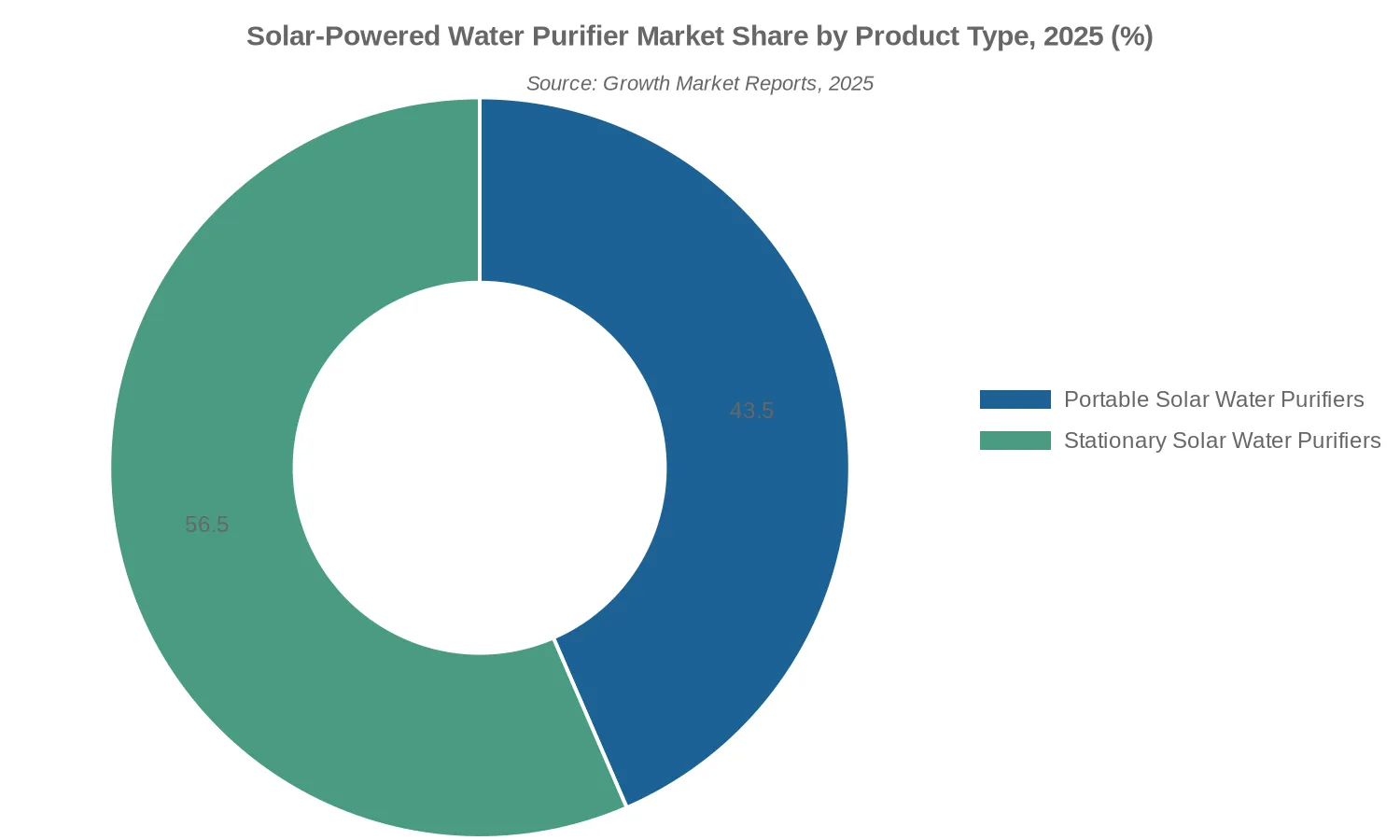
On the other hand, stationary solar water purifiers are designed for higher capacity and continuous operation, making them suitable for residential complexes, schools, healthcare facilities, and community water stations. These systems often incorporate advanced filtration technologies, larger photovoltaic arrays, and storage tanks to ensure consistent water supply. The scalability of stationary systems allows for customization based on the specific needs of a community or institution, making them a preferred choice for large-scale water purification projects. Their integration into municipal water systems and rural water supply schemes has been instrumental in addressing chronic water shortages in many regions. The growing commercial deployment of solar-powered reverse osmosis systems within the stationary segment is particularly noteworthy, as these configurations address high-salinity and heavy-metal contamination challenges in coastal and arid areas.
The demand for both portable and stationary solar water purifiers is further fueled by the increasing frequency of natural disasters and climate-induced disruptions to water supply. In such events, the resilience and autonomy provided by solar-powered purification systems are invaluable, enabling rapid deployment and reliable operation without dependence on external power sources. This has led to a surge in government and NGO procurement of both product types, particularly in disaster-prone regions and countries with vulnerable water infrastructure.
Market players are continuously innovating to bridge the gap between portability and capacity, introducing hybrid models that offer greater flexibility and efficiency. These advancements are expanding the addressable market for solar-powered water purifiers, enabling their use in a wider range of applications, from individual households to large-scale community projects. As consumer awareness grows and technological barriers continue to fall, both portable and stationary product segments are expected to witness sustained growth throughout the forecast period from 2026 to 2034.
In addition to purification, the concept of solar panel washing water recycling is gaining traction as a complementary solution to enhance the efficiency of solar-powered systems. This innovative approach involves the use of recycled water to clean solar panels, thereby maintaining their performance and prolonging their lifespan. By integrating water recycling systems with solar panel installations, users can ensure that their panels remain free of dust and debris, which can significantly reduce energy output. This not only optimizes the efficiency of solar-powered water purifiers but also contributes to water conservation efforts, making it an attractive option for eco-conscious consumers and businesses alike.
Solar-Powered Water Purifier Market Report Scope
| Attributes | Details |
| Report Title | Solar-Powered Water Purifier Market Research Report 2034 |
| By Product Type | Portable Solar Water Purifiers, Stationary Solar Water Purifiers |
| By Technology | Ultraviolet Purification, Reverse Osmosis, Ultrafiltration, Activated Carbon, Others |
| By Application | Residential, Commercial, Industrial, Community |
| By Distribution Channel | Online Stores, Retail Stores, Direct Sales, Others |
| Regions Covered | North America, Europe, APAC, Latin America, MEA |
| Base Year | 2025 |
| Historic Data | 2019-2024 |
| Forecast Period | 2026-2034 |
| Number of Pages | 281 |
| Number of Tables and Figures | 287 |
| Customization Available | Yes, the report can be customized as per your need. |
Solar-Powered Water Purifier Market by Technology
The technology segment of the solar-powered water purifier market encompasses a range of purification methods, including ultraviolet (UV) purification, reverse osmosis (RO), ultrafiltration, activated carbon filtration, and other emerging technologies. Each technology offers unique advantages in terms of contaminant removal, energy efficiency, and suitability for different water sources. UV purification is widely adopted for its effectiveness in neutralizing bacteria, viruses, and other pathogens, making it ideal for regions with high microbial contamination. Its integration with solar power ensures continuous operation even in off-grid settings, enhancing the reliability of water supply in rural and disaster-prone areas.
Reverse osmosis technology, known for its ability to remove dissolved salts, heavy metals, and chemical contaminants, is increasingly being integrated into solar-powered systems to address water quality challenges in both urban and rural settings. Although RO systems typically require higher energy input, advancements in energy-efficient membranes and solar-powered pumps have made their deployment more feasible and cost-effective. This has expanded the applicability of solar-powered RO purifiers in regions facing severe groundwater contamination and salinity issues, such as coastal areas and arid zones. Parallel advances in solar still water purification technology are offering lower-cost, low-maintenance alternatives for smallholder and subsistence-level users in these same environments.
Ultrafiltration and activated carbon technologies are also gaining prominence due to their ability to remove particulate matter, organic compounds, and chlorine, thereby improving the taste and safety of drinking water. These technologies are often used in combination with UV or RO systems to provide comprehensive multi-stage purification. The modular design of modern solar-powered purifiers allows for the integration of multiple technologies, enabling tailored solutions that address specific local water quality challenges. This versatility is a key factor driving the adoption of advanced purification technologies in the market.
Emerging technologies, such as nanofiltration, solar distillation, and IoT-enabled smart monitoring, are further enhancing the performance and user experience of solar-powered water purifiers. These innovations are focused on improving purification efficiency, reducing maintenance requirements, and enabling remote monitoring and control. Growing interest in solar-powered atmospheric water generation as a complementary sourcing technology is also reshaping how market participants think about end-to-end water production and purification. As research and development efforts intensify, the technology segment is expected to witness continuous evolution, with new solutions emerging to address the diverse and evolving needs of global water consumers through 2034.
Solar-Powered Water Purifier Market by Application
The application segment of the solar-powered water purifier market is categorized into residential, commercial, industrial, and community applications, each characterized by distinct demand drivers and usage patterns. The residential segment accounts for a significant share of the market, driven by rising consumer awareness of waterborne diseases, increasing adoption of sustainable home solutions, and the growing trend of off-grid living. Solar-powered water purifiers offer an attractive alternative to conventional electric systems, providing households with reliable access to safe drinking water while reducing energy costs and environmental impact.
In the commercial sector, solar-powered water purifiers are increasingly being adopted by hotels, restaurants, schools, hospitals, and offices seeking to demonstrate environmental responsibility and ensure the health and safety of their patrons and employees. These organizations are motivated by both regulatory requirements and corporate sustainability goals, leading to the installation of advanced purification systems that operate independently of the grid. The commercial segment is also witnessing the integration of solar-powered water purifiers into green building projects, further driving market growth.
The introduction of solar-powered water ATM and kiosk systems represents a significant advancement in providing decentralized water solutions to underserved communities. These kiosks are designed to operate independently of the grid, utilizing solar energy to power water purification processes and distribute clean water to surrounding areas. By offering a reliable and sustainable source of potable water, solar water ATM networks play a crucial role in improving public health and supporting local economies. They are particularly effective in rural and disaster-affected regions, where access to clean water is often limited. The deployment of these systems is supported by governments and NGOs, who recognize their potential to address water scarcity challenges and enhance community resilience.
The industrial application segment, while smaller in comparison, represents a high-growth opportunity, particularly in sectors such as food and beverage, pharmaceuticals, and manufacturing, where water quality is critical to operational processes. Solar-powered purification systems are increasingly being used for process water treatment, boiler feed water, and wastewater recycling, helping industries reduce their environmental footprint and comply with stringent water quality regulations. The scalability and flexibility of these systems make them suitable for a wide range of industrial applications, from small-scale workshops to large manufacturing plants.
Community-level applications are perhaps the most impactful, as they address the pressing need for clean water in remote, rural, and disaster-affected regions. Solar-powered community water stations and purification kiosks are being deployed by governments, NGOs, and international organizations to provide safe drinking water to large populations without access to centralized infrastructure. These initiatives are critical in achieving global water access targets and improving public health outcomes, particularly in low-income and underserved areas.
Solar-Powered Water Purifier Market by Distribution Channel
The distribution channel segment of the solar-powered water purifier market comprises online stores, retail stores, direct sales, and other emerging channels. Online stores have witnessed exponential growth in recent years, driven by the increasing penetration of e-commerce platforms, improved logistics, and the convenience of doorstep delivery. Consumers are increasingly turning to online channels to access a wide range of solar-powered water purifiers, compare features, and read user reviews, facilitating informed purchasing decisions. Manufacturers and distributors are also leveraging digital marketing strategies to enhance brand visibility and reach a broader customer base.
Retail stores continue to play a vital role, particularly in regions where internet penetration is limited or where consumers prefer to physically inspect products before purchase. Specialty stores, home improvement outlets, and electronics retailers offer a curated selection of solar-powered water purifiers, often accompanied by expert guidance and after-sales support. The in-store experience allows consumers to assess product quality, discuss their specific needs with knowledgeable staff, and access installation and maintenance services, contributing to higher customer satisfaction and loyalty.
Direct sales channels, including business-to-business (B2B) and institutional sales, are particularly important for large-scale projects and bulk procurement by governments, NGOs, and commercial enterprises. Manufacturers often collaborate directly with project developers, contractors, and funding agencies to design, deliver, and install customized solar-powered water purification systems tailored to the unique requirements of each project. This channel is characterized by longer sales cycles and higher transaction values, but it offers significant opportunities for market expansion, particularly in the community and industrial segments.
Other emerging distribution channels include partnerships with utility providers, integration into microgrid projects, and collaborations with local entrepreneurs in rural and remote areas. These innovative approaches are expanding market reach, improving last-mile delivery, and ensuring the sustainability of water purification initiatives. As the market continues to mature, the distribution landscape is expected to evolve, with omnichannel strategies becoming increasingly prevalent to meet the diverse needs of global consumers through 2034.
Solar-Powered Water Purifier Market Opportunities and Threats
The solar-powered water purifier market is brimming with opportunities, especially as the global focus intensifies on sustainability and universal access to clean water. One of the most significant opportunities lies in the untapped rural and off-grid markets of Asia, Africa, and Latin America, where hundreds of millions of people still lack access to safe drinking water. Governments, NGOs, and international development agencies are increasingly prioritizing decentralized, renewable-powered solutions to bridge this gap, creating vast potential for manufacturers and technology providers. Additionally, the increasing frequency of climate-induced disasters and humanitarian crises has heightened demand for portable, rapidly deployable water purification solutions, opening new avenues for innovation and growth.
Technological advancements represent another major opportunity for market players. The integration of IoT, AI-driven monitoring, and advanced filtration technologies is enabling the development of smarter, more efficient, and user-friendly solar-powered water purifiers. These innovations not only improve purification performance but also enhance system reliability, reduce maintenance requirements, and provide real-time data for users and service providers. As the cost of solar panels and advanced filtration components continues to decline, the market is poised for further democratization, with affordable solutions becoming accessible to a broader spectrum of consumers and communities. The expansion of solar-powered desalination for agricultural water supply also represents an adjacent growth path, as food security concerns drive parallel investment in renewable water infrastructure.
However, the market is not without its challenges. One of the primary restraining factors is the high initial capital investment required for the installation of solar-powered water purification systems, particularly for large-scale and industrial applications. While operational costs are generally lower compared to conventional systems, the upfront costs can be prohibitive for low-income households and small communities without access to financing or subsidies. Additionally, the intermittent nature of solar energy, coupled with the need for battery storage or backup systems in regions with limited sunlight, can affect system reliability and increase overall project costs. Addressing these challenges will require innovative financing models, continued technological advancement, and supportive policy frameworks to ensure the long-term sustainability and scalability of the market.
Solar-Powered Water Purifier Market Size by Region
The Asia Pacific region dominates the global solar-powered water purifier market, accounting for approximately 38% of the global market value in 2025, representing approximately USD 509 million. This leadership is driven by the region's large population, rapid urbanization, and acute water scarcity issues, particularly in countries like India, China, Bangladesh, and Indonesia. Governments in these countries are investing heavily in decentralized water purification infrastructure, supported by favorable policies, subsidies, and international funding. The Asia Pacific market is expected to maintain a strong growth trajectory, with a projected CAGR of 14.2% through 2034, as ongoing rural electrification and water access initiatives continue to fuel demand.

In North America, the market accounts for approximately 19.5% of global value in 2025, representing roughly USD 261 million, propelled by stringent environmental regulations, a strong emphasis on sustainability, and a well-established renewable energy sector. The region is characterized by high adoption rates of advanced purification technologies, integration with smart home systems, and a focus on disaster preparedness. The United States and Canada are leading markets, with significant investments in both residential and commercial solar-powered water purification solutions. North America's mature market structure and high consumer awareness are expected to drive steady growth, with a projected CAGR of 11.6% over the forecast period.
Europe holds a market share of approximately 14.5% in 2025, valued at around USD 194 million, supported by robust regulatory frameworks, strong environmental consciousness, and widespread adoption of green technologies. Countries such as Germany, the United Kingdom, and France are at the forefront of innovation, with a focus on integrating solar-powered water purifiers into smart city and sustainable building projects. Meanwhile, Latin America and the Middle East and Africa collectively account for approximately 28% of global value in 2025, driven by acute water scarcity, increasing investments in renewable energy, and growing support from international development agencies. These regions represent high-growth markets, with significant opportunities for market expansion as infrastructure development and policy support continue to improve through 2034.
Solar-Powered Water Purifier Market Competitive Landscape
The competitive landscape of the solar-powered water purifier market is characterized by a diverse mix of global conglomerates, regional players, and innovative startups. The market is highly dynamic, with companies competing on the basis of technology innovation, product quality, pricing, distribution reach, and after-sales service. Leading players are investing heavily in research and development to enhance purification efficiency, reduce system costs, and integrate smart monitoring features. Strategic partnerships with governments, NGOs, and international organizations are also common, enabling companies to participate in large-scale water access projects and expand their footprint in emerging markets.
Product differentiation is a key strategy, with companies offering a wide range of solutions tailored to specific customer segments and use cases. From compact, portable purifiers for outdoor and emergency use to large-scale, stationary systems for community and industrial applications, market leaders are focused on addressing the diverse needs of global consumers. The ability to customize solutions, provide reliable after-sales support, and offer flexible financing options is increasingly becoming a competitive advantage, particularly in price-sensitive and underserved markets.
The entry of new players and the proliferation of local manufacturers, particularly in Asia and Africa, are intensifying competition and driving down prices. While this is beneficial for market growth and consumer access, it also presents challenges related to product quality, standardization, and regulatory compliance. Established players are responding by strengthening their distribution networks, enhancing brand visibility, and investing in certification and quality assurance programs. Mergers, acquisitions, and joint ventures are also on the rise, as companies seek to consolidate their market positions and leverage synergies in technology and distribution.
Some of the major companies operating in the solar-powered water purifier market include Kent RO Systems, Eureka Forbes, Trunz Water Systems, Helioz GmbH, Spectra Watermakers, Aqua Sun International, Solvatten AB, Puralytics, Wateroam, and Renovagen Ltd.. Kent RO Systems is renowned for its extensive range of residential and commercial purification solutions, leveraging advanced RO and UV technologies. Trunz Water Systems specializes in portable and community-level solar water purification units, with a strong presence in humanitarian and disaster relief projects. Helioz GmbH is recognized for its innovative use of solar energy in water disinfection, offering solutions tailored to both developing and developed markets.
Solvatten AB and Puralytics are notable for their focus on photocatalytic and UV-LED purification approaches, targeting households and NGO distribution programs in water-stressed regions. Wateroam and Aqua Clara International serve humanitarian and community segments with lightweight, high-throughput filtration systems designed for rapid field deployment. Renovagen Ltd. brings portable solar rollout panel technology to off-grid water purification, enabling rapid power setup in emergency environments. These companies, along with a host of regional and emerging players, are shaping the future of the solar-powered water purifier market through relentless innovation, strategic collaboration, and a shared commitment to sustainable water access for all through 2034 and beyond.
Top Companies in the Solar-Powered Water Purifier Market
- Eureka Forbes
- Kent RO Systems
- Trunz Water Systems
- Helioz GmbH
- Spectra Watermakers
- Aqua Sun International
- Solvatten AB
- Puralytics
- Wateroam
- Renovagen Ltd.
- Aqua Clara International
- SunDwater
- Folia Water
- Clean Water Solutions
- Aquaer
Segments
The Solar-Powered Water Purifier market has been segmented on the basis of
Product Type
- Portable Solar Water Purifiers
- Stationary Solar Water Purifiers
Technology
- Ultraviolet Purification
- Reverse Osmosis
- Ultrafiltration
- Activated Carbon
- Others
Application
- Residential
- Commercial
- Industrial
- Community
Distribution Channel
- Online Stores
- Retail Stores
- Direct Sales
- Others
Frequently Asked Questions
Significant opportunities lie in the vast untapped rural and off-grid markets across Asia, Africa, and Latin America, where hundreds of millions still lack safe water access. Growing integration of IoT, AI-driven monitoring, and advanced nanofiltration technologies is creating smarter, more efficient products. Climate change-driven demand for rapid-deployment purification in disaster response, increasing corporate ESG commitments, and innovative microfinancing models for low-income communities all represent compelling growth avenues through 2034.
Leading companies include Kent RO Systems, Eureka Forbes, Trunz Water Systems, Helioz GmbH, Spectra Watermakers, Aqua Sun International, Solvatten AB, Puralytics, Wateroam, Renovagen Ltd., Aqua Clara International, SunDwater, Folia Water, Clean Water Solutions, and Aquaer. These players compete on technology innovation, product quality, pricing, distribution reach, and strategic partnerships with governments and international development organizations.
The principal challenges include high initial capital investment, especially for large-scale installations in low-income communities, the intermittent nature of solar energy requiring battery storage solutions, limited technical awareness and maintenance capabilities in remote areas, and product quality inconsistencies from the proliferation of low-cost local manufacturers. Financing access and regulatory harmonization across markets remain persistent barriers to broader adoption.
The primary channels include online stores, retail stores, direct sales, and emerging partnerships. Online stores are the fastest-growing channel, benefiting from e-commerce expansion and digital marketing. Retail stores remain important in regions with lower internet penetration, offering hands-on product evaluation and expert guidance. Direct sales channels handle large-scale B2B and institutional procurement by governments, NGOs, and commercial developers. Emerging channels include utility partnerships, microgrid integrations, and collaborations with rural entrepreneurs.
Solar-powered water purifiers serve residential, commercial, industrial, and community applications. Residential use is driven by waterborne disease awareness and off-grid living trends. Commercial adoption spans hotels, schools, hospitals, and offices with sustainability mandates. Industrial applications include process water and wastewater recycling in food, beverage, and pharmaceutical sectors. Community applications, such as solar water kiosks and purification stations, address clean water access for remote and underserved populations at scale.
Ultraviolet purification is widely adopted for effective pathogen elimination in off-grid settings. Reverse osmosis is increasingly integrated into solar-powered systems to remove dissolved salts, heavy metals, and chemical contaminants. Ultrafiltration and activated carbon filtration address particulate matter and organic compounds, and are frequently combined with UV or RO stages for comprehensive multi-stage treatment. Emerging technologies include nanofiltration, solar distillation, and IoT-enabled smart monitoring systems.
The market offers two primary product types. Portable solar water purifiers are compact, lightweight units designed for individual or small-group use in outdoor, emergency, and off-grid settings. Stationary solar water purifiers are larger, higher-capacity systems suited to residential complexes, schools, healthcare facilities, industrial sites, and community water stations, often incorporating storage tanks and advanced multi-stage filtration.
Asia Pacific leads the global market, accounting for approximately 38% of total market value in 2025, driven by large populations, acute water stress, and strong government investment in rural water infrastructure across India, China, Bangladesh, and Indonesia. North America and Europe follow, with strong regulatory support and high consumer sustainability awareness. Latin America and the Middle East & Africa are the fastest-emerging regions, supported by increasing renewable energy investment and international development funding.
Key growth drivers include escalating global water scarcity, rapid technological advancements in solar energy harvesting and filtration, declining photovoltaic panel costs, and supportive government policies promoting renewable energy and universal clean water access. Increasing climate-related disruptions to water infrastructure are also accelerating adoption of solar-powered purification systems worldwide.
The global solar-powered water purifier market reached USD 1.34 billion in 2025 and is projected to expand at a CAGR of 13.2% from 2026 to 2034, reaching approximately USD 4.07 billion by 2034. This robust growth reflects rising demand for sustainable, decentralized water purification across both developed and developing regions.
Table Of Content
Chapter 1 Executive SummaryChapter 2 Assumptions and Acronyms Used
Chapter 3 Research Methodology
Chapter 4 Solar-Powered Water Purifier Market Overview
4.1 Introduction
4.1.1 Market Taxonomy
4.1.2 Market Definition
4.1.3 Macro-Economic Factors Impacting the Market Growth
4.2 Solar-Powered Water Purifier Market Dynamics
4.2.1 Market Drivers
4.2.2 Market Restraints
4.2.3 Market Opportunity
4.3 Solar-Powered Water Purifier Market - Supply Chain Analysis
4.3.1 List of Key Suppliers
4.3.2 List of Key Distributors
4.3.3 List of Key Consumers
4.4 Key Forces Shaping the Solar-Powered Water Purifier Market
4.4.1 Bargaining Power of Suppliers
4.4.2 Bargaining Power of Buyers
4.4.3 Threat of Substitution
4.4.4 Threat of New Entrants
4.4.5 Competitive Rivalry
4.5 Global Solar-Powered Water Purifier Market Size & Forecast, 2023-2032
4.5.1 Solar-Powered Water Purifier Market Size and Y-o-Y Growth
4.5.2 Solar-Powered Water Purifier Market Absolute $ Opportunity
Chapter 5 Global Solar-Powered Water Purifier Market Analysis and Forecast By Product Type
5.1 Introduction
5.1.1 Key Market Trends & Growth Opportunities By Product Type
5.1.2 Basis Point Share (BPS) Analysis By Product Type
5.1.3 Absolute $ Opportunity Assessment By Product Type
5.2 Solar-Powered Water Purifier Market Size Forecast By Product Type
5.2.1 Portable Solar Water Purifiers
5.2.2 Stationary Solar Water Purifiers
5.3 Market Attractiveness Analysis By Product Type
Chapter 6 Global Solar-Powered Water Purifier Market Analysis and Forecast By Technology
6.1 Introduction
6.1.1 Key Market Trends & Growth Opportunities By Technology
6.1.2 Basis Point Share (BPS) Analysis By Technology
6.1.3 Absolute $ Opportunity Assessment By Technology
6.2 Solar-Powered Water Purifier Market Size Forecast By Technology
6.2.1 Ultraviolet Purification
6.2.2 Reverse Osmosis
6.2.3 Ultrafiltration
6.2.4 Activated Carbon
6.2.5 Others
6.3 Market Attractiveness Analysis By Technology
Chapter 7 Global Solar-Powered Water Purifier Market Analysis and Forecast By Application
7.1 Introduction
7.1.1 Key Market Trends & Growth Opportunities By Application
7.1.2 Basis Point Share (BPS) Analysis By Application
7.1.3 Absolute $ Opportunity Assessment By Application
7.2 Solar-Powered Water Purifier Market Size Forecast By Application
7.2.1 Residential
7.2.2 Commercial
7.2.3 Industrial
7.2.4 Community
7.3 Market Attractiveness Analysis By Application
Chapter 8 Global Solar-Powered Water Purifier Market Analysis and Forecast By Distribution Channel
8.1 Introduction
8.1.1 Key Market Trends & Growth Opportunities By Distribution Channel
8.1.2 Basis Point Share (BPS) Analysis By Distribution Channel
8.1.3 Absolute $ Opportunity Assessment By Distribution Channel
8.2 Solar-Powered Water Purifier Market Size Forecast By Distribution Channel
8.2.1 Online Stores
8.2.2 Retail Stores
8.2.3 Direct Sales
8.2.4 Others
8.3 Market Attractiveness Analysis By Distribution Channel
Chapter 9 Global Solar-Powered Water Purifier Market Analysis and Forecast by Region
9.1 Introduction
9.1.1 Key Market Trends & Growth Opportunities By Region
9.1.2 Basis Point Share (BPS) Analysis By Region
9.1.3 Absolute $ Opportunity Assessment By Region
9.2 Solar-Powered Water Purifier Market Size Forecast By Region
9.2.1 North America
9.2.2 Europe
9.2.3 Asia Pacific
9.2.4 Latin America
9.2.5 Middle East & Africa (MEA)
9.3 Market Attractiveness Analysis By Region
Chapter 10 Coronavirus Disease (COVID-19) Impact
10.1 Introduction
10.2 Current & Future Impact Analysis
10.3 Economic Impact Analysis
10.4 Government Policies
10.5 Investment Scenario
Chapter 11 North America Solar-Powered Water Purifier Analysis and Forecast
11.1 Introduction
11.2 North America Solar-Powered Water Purifier Market Size Forecast by Country
11.2.1 U.S.
11.2.2 Canada
11.3 Basis Point Share (BPS) Analysis by Country
11.4 Absolute $ Opportunity Assessment by Country
11.5 Market Attractiveness Analysis by Country
11.6 North America Solar-Powered Water Purifier Market Size Forecast By Product Type
11.6.1 Portable Solar Water Purifiers
11.6.2 Stationary Solar Water Purifiers
11.7 Basis Point Share (BPS) Analysis By Product Type
11.8 Absolute $ Opportunity Assessment By Product Type
11.9 Market Attractiveness Analysis By Product Type
11.10 North America Solar-Powered Water Purifier Market Size Forecast By Technology
11.10.1 Ultraviolet Purification
11.10.2 Reverse Osmosis
11.10.3 Ultrafiltration
11.10.4 Activated Carbon
11.10.5 Others
11.11 Basis Point Share (BPS) Analysis By Technology
11.12 Absolute $ Opportunity Assessment By Technology
11.13 Market Attractiveness Analysis By Technology
11.14 North America Solar-Powered Water Purifier Market Size Forecast By Application
11.14.1 Residential
11.14.2 Commercial
11.14.3 Industrial
11.14.4 Community
11.15 Basis Point Share (BPS) Analysis By Application
11.16 Absolute $ Opportunity Assessment By Application
11.17 Market Attractiveness Analysis By Application
11.18 North America Solar-Powered Water Purifier Market Size Forecast By Distribution Channel
11.18.1 Online Stores
11.18.2 Retail Stores
11.18.3 Direct Sales
11.18.4 Others
11.19 Basis Point Share (BPS) Analysis By Distribution Channel
11.20 Absolute $ Opportunity Assessment By Distribution Channel
11.21 Market Attractiveness Analysis By Distribution Channel
Chapter 12 Europe Solar-Powered Water Purifier Analysis and Forecast
12.1 Introduction
12.2 Europe Solar-Powered Water Purifier Market Size Forecast by Country
12.2.1 Germany
12.2.2 France
12.2.3 Italy
12.2.4 U.K.
12.2.5 Spain
12.2.6 Russia
12.2.7 Rest of Europe
12.3 Basis Point Share (BPS) Analysis by Country
12.4 Absolute $ Opportunity Assessment by Country
12.5 Market Attractiveness Analysis by Country
12.6 Europe Solar-Powered Water Purifier Market Size Forecast By Product Type
12.6.1 Portable Solar Water Purifiers
12.6.2 Stationary Solar Water Purifiers
12.7 Basis Point Share (BPS) Analysis By Product Type
12.8 Absolute $ Opportunity Assessment By Product Type
12.9 Market Attractiveness Analysis By Product Type
12.10 Europe Solar-Powered Water Purifier Market Size Forecast By Technology
12.10.1 Ultraviolet Purification
12.10.2 Reverse Osmosis
12.10.3 Ultrafiltration
12.10.4 Activated Carbon
12.10.5 Others
12.11 Basis Point Share (BPS) Analysis By Technology
12.12 Absolute $ Opportunity Assessment By Technology
12.13 Market Attractiveness Analysis By Technology
12.14 Europe Solar-Powered Water Purifier Market Size Forecast By Application
12.14.1 Residential
12.14.2 Commercial
12.14.3 Industrial
12.14.4 Community
12.15 Basis Point Share (BPS) Analysis By Application
12.16 Absolute $ Opportunity Assessment By Application
12.17 Market Attractiveness Analysis By Application
12.18 Europe Solar-Powered Water Purifier Market Size Forecast By Distribution Channel
12.18.1 Online Stores
12.18.2 Retail Stores
12.18.3 Direct Sales
12.18.4 Others
12.19 Basis Point Share (BPS) Analysis By Distribution Channel
12.20 Absolute $ Opportunity Assessment By Distribution Channel
12.21 Market Attractiveness Analysis By Distribution Channel
Chapter 13 Asia Pacific Solar-Powered Water Purifier Analysis and Forecast
13.1 Introduction
13.2 Asia Pacific Solar-Powered Water Purifier Market Size Forecast by Country
13.2.1 China
13.2.2 Japan
13.2.3 South Korea
13.2.4 India
13.2.5 Australia
13.2.6 South East Asia (SEA)
13.2.7 Rest of Asia Pacific (APAC)
13.3 Basis Point Share (BPS) Analysis by Country
13.4 Absolute $ Opportunity Assessment by Country
13.5 Market Attractiveness Analysis by Country
13.6 Asia Pacific Solar-Powered Water Purifier Market Size Forecast By Product Type
13.6.1 Portable Solar Water Purifiers
13.6.2 Stationary Solar Water Purifiers
13.7 Basis Point Share (BPS) Analysis By Product Type
13.8 Absolute $ Opportunity Assessment By Product Type
13.9 Market Attractiveness Analysis By Product Type
13.10 Asia Pacific Solar-Powered Water Purifier Market Size Forecast By Technology
13.10.1 Ultraviolet Purification
13.10.2 Reverse Osmosis
13.10.3 Ultrafiltration
13.10.4 Activated Carbon
13.10.5 Others
13.11 Basis Point Share (BPS) Analysis By Technology
13.12 Absolute $ Opportunity Assessment By Technology
13.13 Market Attractiveness Analysis By Technology
13.14 Asia Pacific Solar-Powered Water Purifier Market Size Forecast By Application
13.14.1 Residential
13.14.2 Commercial
13.14.3 Industrial
13.14.4 Community
13.15 Basis Point Share (BPS) Analysis By Application
13.16 Absolute $ Opportunity Assessment By Application
13.17 Market Attractiveness Analysis By Application
13.18 Asia Pacific Solar-Powered Water Purifier Market Size Forecast By Distribution Channel
13.18.1 Online Stores
13.18.2 Retail Stores
13.18.3 Direct Sales
13.18.4 Others
13.19 Basis Point Share (BPS) Analysis By Distribution Channel
13.20 Absolute $ Opportunity Assessment By Distribution Channel
13.21 Market Attractiveness Analysis By Distribution Channel
Chapter 14 Latin America Solar-Powered Water Purifier Analysis and Forecast
14.1 Introduction
14.2 Latin America Solar-Powered Water Purifier Market Size Forecast by Country
14.2.1 Brazil
14.2.2 Mexico
14.2.3 Rest of Latin America (LATAM)
14.3 Basis Point Share (BPS) Analysis by Country
14.4 Absolute $ Opportunity Assessment by Country
14.5 Market Attractiveness Analysis by Country
14.6 Latin America Solar-Powered Water Purifier Market Size Forecast By Product Type
14.6.1 Portable Solar Water Purifiers
14.6.2 Stationary Solar Water Purifiers
14.7 Basis Point Share (BPS) Analysis By Product Type
14.8 Absolute $ Opportunity Assessment By Product Type
14.9 Market Attractiveness Analysis By Product Type
14.10 Latin America Solar-Powered Water Purifier Market Size Forecast By Technology
14.10.1 Ultraviolet Purification
14.10.2 Reverse Osmosis
14.10.3 Ultrafiltration
14.10.4 Activated Carbon
14.10.5 Others
14.11 Basis Point Share (BPS) Analysis By Technology
14.12 Absolute $ Opportunity Assessment By Technology
14.13 Market Attractiveness Analysis By Technology
14.14 Latin America Solar-Powered Water Purifier Market Size Forecast By Application
14.14.1 Residential
14.14.2 Commercial
14.14.3 Industrial
14.14.4 Community
14.15 Basis Point Share (BPS) Analysis By Application
14.16 Absolute $ Opportunity Assessment By Application
14.17 Market Attractiveness Analysis By Application
14.18 Latin America Solar-Powered Water Purifier Market Size Forecast By Distribution Channel
14.18.1 Online Stores
14.18.2 Retail Stores
14.18.3 Direct Sales
14.18.4 Others
14.19 Basis Point Share (BPS) Analysis By Distribution Channel
14.20 Absolute $ Opportunity Assessment By Distribution Channel
14.21 Market Attractiveness Analysis By Distribution Channel
Chapter 15 Middle East & Africa (MEA) Solar-Powered Water Purifier Analysis and Forecast
15.1 Introduction
15.2 Middle East & Africa (MEA) Solar-Powered Water Purifier Market Size Forecast by Country
15.2.1 Saudi Arabia
15.2.2 South Africa
15.2.3 UAE
15.2.4 Rest of Middle East & Africa (MEA)
15.3 Basis Point Share (BPS) Analysis by Country
15.4 Absolute $ Opportunity Assessment by Country
15.5 Market Attractiveness Analysis by Country
15.6 Middle East & Africa (MEA) Solar-Powered Water Purifier Market Size Forecast By Product Type
15.6.1 Portable Solar Water Purifiers
15.6.2 Stationary Solar Water Purifiers
15.7 Basis Point Share (BPS) Analysis By Product Type
15.8 Absolute $ Opportunity Assessment By Product Type
15.9 Market Attractiveness Analysis By Product Type
15.10 Middle East & Africa (MEA) Solar-Powered Water Purifier Market Size Forecast By Technology
15.10.1 Ultraviolet Purification
15.10.2 Reverse Osmosis
15.10.3 Ultrafiltration
15.10.4 Activated Carbon
15.10.5 Others
15.11 Basis Point Share (BPS) Analysis By Technology
15.12 Absolute $ Opportunity Assessment By Technology
15.13 Market Attractiveness Analysis By Technology
15.14 Middle East & Africa (MEA) Solar-Powered Water Purifier Market Size Forecast By Application
15.14.1 Residential
15.14.2 Commercial
15.14.3 Industrial
15.14.4 Community
15.15 Basis Point Share (BPS) Analysis By Application
15.16 Absolute $ Opportunity Assessment By Application
15.17 Market Attractiveness Analysis By Application
15.18 Middle East & Africa (MEA) Solar-Powered Water Purifier Market Size Forecast By Distribution Channel
15.18.1 Online Stores
15.18.2 Retail Stores
15.18.3 Direct Sales
15.18.4 Others
15.19 Basis Point Share (BPS) Analysis By Distribution Channel
15.20 Absolute $ Opportunity Assessment By Distribution Channel
15.21 Market Attractiveness Analysis By Distribution Channel
Chapter 16 Competition Landscape
16.1 Solar-Powered Water Purifier Market: Competitive Dashboard
16.2 Global Solar-Powered Water Purifier Market: Market Share Analysis, 2023
16.3 Company Profiles (Details – Overview, Financials, Developments, Strategy)
16.3.1 Eureka Forbes
16.3.2 Kent RO Systems
16.3.3 Trunz Water Systems
16.3.4 Helioz GmbH
16.3.5 Spectra Watermakers
16.3.6 Aqua Sun International
16.3.7 Solvatten AB
16.3.8 Puralytics
16.3.9 Wateroam
16.3.10 Renovagen Ltd.
16.3.11 Aqua Clara International
16.3.12 SunDwater
16.3.13 Folia Water
16.3.14 Clean Water Solutions
16.3.15 Aquaer
Methodology


Related Reports
Some other reports from this category!


Our Clients





