Solar Control Window Films Market Market Research Report 2033

Solar Control Window Films Market Market Research Report 2033

Segments - by Product Type (Dyed, Metallized, Ceramic, Others), by Application (Residential, Commercial, Automotive, Others), by Distribution Channel (Offline, Online)

https://growthmarketreports.com/Raksha
Author : Raksha Sharma
https://growthmarketreports.com/Vaibhav
Fact-checked by : V. Chandola
https://growthmarketreports.com/Shruti
Editor : Shruti Bhat

Upcoming | Report ID :MC-755 | 4.9 Rating | 82 Reviews | 267 Pages | Format : Docx PDF

Report Description


Solar Control Window Films Market Outlook

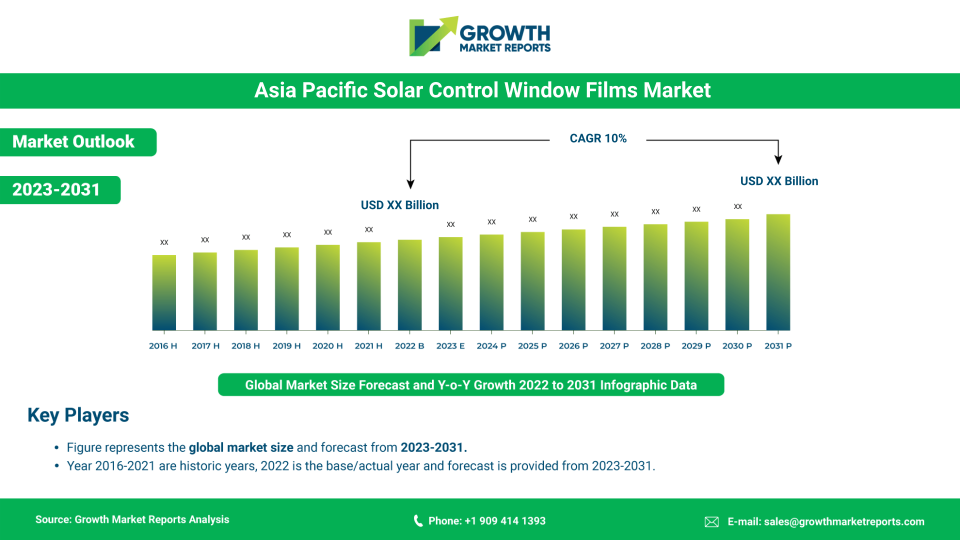
According to our latest research, the global solar control window films market size reached USD 1.98 billion in 2024, demonstrating robust growth momentum. The industry is projected to expand at a compound annual growth rate (CAGR) of 7.1% from 2025 to 2033. By the end of 2033, the market is forecasted to attain a value of USD 3.67 billion. This upward trajectory is predominantly driven by the escalating demand for energy-efficient solutions in residential, commercial, and automotive sectors, coupled with increasing awareness about UV protection and sustainability. As per the latest research, the market is witnessing significant investments in advanced materials and innovative technologies to enhance product performance and cater to evolving consumer preferences.

One of the primary growth drivers for the solar control window films market is the rising focus on energy conservation across multiple industries. Governments and regulatory bodies worldwide are emphasizing the reduction of carbon footprints and energy consumption, which is pushing both commercial and residential property owners to adopt solar control window films. These films significantly reduce heat gain, thereby lowering the need for air conditioning and consequently reducing energy bills. Additionally, the integration of green building codes and energy efficiency standards, particularly in developed economies, is further accelerating the adoption of these films. The growing trend of sustainable architecture and retrofitting existing buildings with energy-efficient solutions is expected to continue fueling the market’s growth.

Another notable factor propelling market expansion is the increasing awareness about health and safety benefits associated with solar control window films. These films offer substantial protection against harmful ultraviolet (UV) rays, which are known to cause skin cancer and other health issues. The ability of solar control window films to block up to 99% of UV rays not only protects occupants but also helps in preserving the interior furnishings and extending the lifespan of vehicles and buildings. The automotive sector, in particular, is witnessing heightened demand for these films, as consumers seek enhanced comfort, glare reduction, and protection from UV exposure. The dual benefits of improved energy efficiency and health protection are making solar control window films a preferred choice among end-users.

Technological advancements and product innovations are also playing a pivotal role in the growth of the solar control window films market. Manufacturers are investing in research and development to introduce films with superior optical clarity, durability, and multi-functional properties. The emergence of ceramic and nanotechnology-based films, which offer high heat rejection without compromising visibility, is gaining traction in both commercial and automotive applications. Furthermore, the expanding e-commerce sector and the availability of customizable solutions are making it easier for consumers to access and install these products. As the market becomes increasingly competitive, ongoing innovation and differentiation will be key to sustaining growth and capturing new opportunities.

From a regional perspective, Asia Pacific continues to dominate the solar control window films market, accounting for the largest share in 2024, followed by North America and Europe. The rapid urbanization, booming construction industry, and rising disposable incomes in countries such as China, India, and Southeast Asian nations are driving demand in this region. Meanwhile, North America and Europe are benefiting from stringent energy efficiency regulations and a strong focus on sustainable building practices. The Middle East & Africa and Latin America are also emerging as promising markets, supported by growing awareness and infrastructural developments. The regional outlook remains optimistic, with each geography presenting unique growth drivers and challenges.

Global Solar Control Window Films  Industry Outlook

Product Type Analysis

The product type segment of the solar control window films market is categorized into dyed, metallized, ceramic, and others. Dyed films, which utilize a layer of dye to absorb solar energy, are widely recognized for their cost-effectiveness and ease of installation. They are particularly popular in the residential and automotive sectors due to their ability to reduce glare and provide a subtle tint to windows. However, while dyed films offer aesthetic benefits and moderate heat reduction, their performance in terms of UV and infrared rejection is generally lower compared to advanced alternatives. The demand for dyed films remains steady, especially in price-sensitive markets, but the shift towards higher-performing films is becoming more pronounced as consumers seek long-term value and efficiency.

Metallized films, on the other hand, incorporate a thin layer of metal, such as aluminum or nickel, to reflect solar radiation and enhance heat rejection capabilities. These films are highly effective in reducing heat gain and improving energy efficiency, making them a preferred choice for commercial buildings and automotive applications in regions with intense sunlight. The reflective nature of metallized films also contributes to increased privacy and glare reduction. However, one of the challenges associated with metallized films is the potential for signal interference with electronic devices, which can be a concern in modern smart buildings and vehicles. Despite this limitation, metallized films continue to capture a significant share of the market due to their superior performance and durability.

Ceramic films represent the latest innovation in the solar control window films market, leveraging advanced nanotechnology to deliver exceptional heat rejection without the use of dyes or metals. These films are highly valued for their optical clarity, color stability, and ability to block both UV and infrared rays while maintaining natural light transmission. Ceramic films are non-conductive and do not interfere with electronic signals, making them ideal for contemporary buildings and vehicles equipped with advanced technologies. Although ceramic films are priced at a premium compared to dyed and metallized variants, their long-term benefits in terms of energy savings, comfort, and aesthetics are driving their adoption among discerning consumers and commercial enterprises.

The "others" category includes hybrid films and emerging technologies that combine multiple materials or incorporate smart functionalities such as switchable tint and self-healing properties. These innovative solutions are gaining traction in niche applications, such as high-security facilities, luxury vehicles, and smart homes. As the market continues to evolve, the demand for customized and multi-functional solar control window films is expected to rise, offering new avenues for growth and differentiation. Manufacturers are likely to focus on expanding their product portfolios and enhancing the performance characteristics of their offerings to meet the diverse needs of end-users across various segments.

Report Scope

Attributes Details
Report Title Solar Control Window Films Market Market Research Report 2033
By Product Type Dyed, Metallized, Ceramic, Others
By Application Residential, Commercial, Automotive, Others
By Distribution Channel Offline, Online
Regions Covered North America, Europe, APAC, Latin America, MEA
Base Year 2024
Historic Data 2018-2023
Forecast Period 2025-2033
Number of Pages 267
Number of Tables & Figures 302
Customization Available Yes, the report can be customized as per your need.

Application Analysis

The application segment of the solar control window films market encompasses residential, commercial, automotive, and others. The residential sector is witnessing a surge in demand for solar control window films, driven by growing awareness about energy conservation, UV protection, and indoor comfort. Homeowners are increasingly opting for these films to reduce cooling costs, enhance privacy, and protect furnishings from sun damage. The trend towards sustainable living and green homes is further accelerating the adoption of window films in the residential market. Additionally, retrofitting existing homes with solar control films is emerging as a cost-effective solution for improving energy efficiency without the need for extensive renovations.

The commercial segment, which includes office buildings, retail spaces, educational institutions, and healthcare facilities, represents a significant share of the solar control window films market. Commercial property owners and facility managers are prioritizing energy efficiency and occupant comfort to comply with regulatory standards and enhance the value of their assets. Solar control window films play a crucial role in reducing the operational costs of HVAC systems, minimizing glare on computer screens, and creating a more comfortable indoor environment. The adoption of these films is particularly high in regions with stringent building codes and energy performance requirements. As businesses continue to focus on sustainability and employee well-being, the commercial application of solar control window films is expected to expand further.

The automotive sector is another key application area, driven by the need for enhanced comfort, safety, and aesthetics. Solar control window films are widely used in passenger cars, commercial vehicles, and specialty vehicles to reduce heat buildup, block harmful UV rays, and improve driving visibility. The automotive industry is experiencing a growing trend towards factory-installed window films, as well as aftermarket installations, to meet consumer preferences for customized solutions. The increasing production of vehicles in emerging markets and the rising demand for premium and electric vehicles are contributing to the growth of this segment. Moreover, regulatory mandates regarding UV protection and energy efficiency in vehicles are expected to further boost the adoption of solar control window films in the automotive sector.

The "others" application category includes industrial facilities, public infrastructure, and specialized environments such as laboratories and data centers. These settings require advanced solar control solutions to maintain optimal indoor conditions, protect sensitive equipment, and ensure the safety and comfort of occupants. The versatility of solar control window films, combined with ongoing technological advancements, is enabling their use in a wide range of applications beyond traditional markets. As awareness of the benefits of these films continues to grow, new opportunities are emerging across diverse industry verticals.

Distribution Channel Analysis

The distribution channel segment of the solar control window films market is bifurcated into offline and online channels. Offline distribution, which includes specialty stores, automotive service centers, building material suppliers, and authorized dealers, remains the dominant channel for both residential and commercial customers. The offline channel offers the advantage of personalized consultation, professional installation services, and immediate product availability. Many consumers, particularly in emerging markets, prefer to purchase solar control window films through trusted local vendors who can provide expert advice and after-sales support. The strong presence of offline distributors and installers is a key factor contributing to the sustained growth of this channel.

However, the online distribution channel is rapidly gaining traction, driven by the increasing penetration of e-commerce platforms and digitalization of the retail sector. Online channels offer a wide range of product options, competitive pricing, and the convenience of doorstep delivery. Consumers can easily compare different brands, read customer reviews, and access detailed product specifications before making a purchase decision. The online channel is particularly popular among tech-savvy consumers and small businesses seeking cost-effective solutions for their window film needs. The rise of direct-to-consumer brands and online marketplaces is further expanding the reach of solar control window films to new customer segments.

Manufacturers and distributors are increasingly adopting omnichannel strategies to cater to the evolving preferences of customers. By integrating offline and online channels, companies can provide a seamless shopping experience, enhance brand visibility, and improve customer engagement. For example, many leading brands offer online product configurators, virtual consultations, and in-store pickup options to bridge the gap between digital and physical retail. This approach not only increases sales opportunities but also helps in building long-term customer loyalty. The growing emphasis on digital marketing and e-commerce is expected to reshape the distribution landscape of the solar control window films market in the coming years.

The COVID-19 pandemic has also accelerated the shift towards online distribution, as consumers and businesses increasingly rely on digital platforms for their purchasing needs. The adoption of contactless delivery and virtual installation guidance has become more prevalent, enabling customers to access solar control window films safely and conveniently. As the market continues to evolve, the online channel is anticipated to capture a larger share of the overall distribution mix, supported by ongoing investments in digital infrastructure and logistics.

Opportunities & Threats

The solar control window films market presents numerous opportunities for growth and innovation. One of the most promising opportunities lies in the increasing adoption of smart and multifunctional window films. The integration of advanced technologies such as switchable tint, self-cleaning surfaces, and energy-harvesting capabilities is creating new value propositions for both residential and commercial customers. Smart window films that can dynamically adjust their tint based on ambient light conditions are gaining popularity in high-end buildings and vehicles, offering enhanced comfort and energy savings. The ongoing development of eco-friendly and recyclable materials is also opening up new avenues for sustainable product offerings, aligning with global trends towards environmental responsibility.

Another significant opportunity is the expansion of the solar control window films market in emerging economies. Rapid urbanization, rising disposable incomes, and increasing construction activities in Asia Pacific, Latin America, and the Middle East & Africa are creating a fertile ground for market growth. The growing awareness of energy efficiency, coupled with supportive government policies and incentives, is encouraging the adoption of solar control window films in these regions. Manufacturers can capitalize on this trend by expanding their distribution networks, offering affordable solutions, and tailoring their products to meet the specific needs of local markets. Strategic partnerships with real estate developers, automotive manufacturers, and government agencies can further accelerate market penetration and drive long-term growth.

Despite these opportunities, the solar control window films market faces certain restraining factors. One of the primary challenges is the lack of awareness and technical expertise among end-users, particularly in developing regions. Many consumers are unfamiliar with the benefits and installation procedures of solar control window films, which can hinder market adoption. Additionally, the presence of low-quality and counterfeit products in the market poses a threat to brand reputation and customer satisfaction. The relatively high initial cost of advanced films, such as ceramic and smart films, may also deter price-sensitive customers. Addressing these challenges will require concerted efforts from industry stakeholders to invest in education, quality assurance, and customer support initiatives.

Regional Outlook

In terms of regional distribution, the Asia Pacific region leads the solar control window films market, accounting for approximately 43% of the global market value in 2024, which equates to around USD 0.85 billion. The robust growth in this region is fueled by rapid urbanization, a booming construction industry, and increasing automotive production. Countries such as China, India, Japan, and South Korea are witnessing heightened demand for energy-efficient and sustainable building solutions. The adoption of solar control window films is further supported by government initiatives promoting green buildings and energy conservation. The Asia Pacific market is expected to maintain a strong CAGR of 8.2% through 2033, outpacing other regions due to favorable economic and demographic trends.

North America holds the second-largest share in the solar control window films market, with a market value of approximately USD 0.58 billion in 2024. The region’s growth is underpinned by stringent energy efficiency regulations, a mature automotive industry, and a high level of consumer awareness regarding UV protection and indoor comfort. The United States and Canada are at the forefront of adopting advanced window film technologies, particularly in commercial and institutional buildings. The emphasis on sustainability and retrofitting existing structures with energy-saving solutions is driving continuous demand for solar control window films. North America is projected to exhibit steady growth, supported by ongoing investments in smart building technologies and renewable energy initiatives.

Europe represents another significant market, with a value of about USD 0.36 billion in 2024. The region benefits from well-established building codes, a strong focus on environmental sustainability, and a growing trend towards energy-efficient renovations. Countries such as Germany, the United Kingdom, France, and Italy are leading the adoption of solar control window films in both residential and commercial sectors. The European market is characterized by high product quality standards and a preference for innovative, eco-friendly solutions. Meanwhile, the Middle East & Africa and Latin America are emerging as promising markets, with a combined market value of USD 0.19 billion in 2024. These regions are witnessing increased investments in infrastructure development and rising awareness of the benefits of solar control window films, although market penetration remains relatively lower compared to more developed regions.

Solar Control Window Films  Market Statistics

Competitor Outlook

The solar control window films market is characterized by intense competition, with a mix of global giants and regional players vying for market share. The competitive landscape is shaped by ongoing innovation, strategic partnerships, mergers and acquisitions, and a strong focus on research and development. Leading companies are continuously investing in advanced materials, manufacturing processes, and product differentiation to stay ahead in the market. The emphasis on sustainability, durability, and performance is driving the development of next-generation window films that cater to the evolving needs of consumers and businesses. As the market matures, the ability to offer customized solutions and superior customer service will be key differentiators for industry participants.

Large multinational corporations dominate the upper echelons of the solar control window films market, leveraging their extensive distribution networks, brand reputation, and technological expertise. These companies are well-positioned to capitalize on emerging trends such as smart films, eco-friendly materials, and digital marketing. At the same time, regional and local players are carving out niche segments by offering cost-effective solutions, tailored products, and personalized services. The market is also witnessing the entry of new players, particularly in the online and direct-to-consumer segments, which is intensifying competition and driving innovation.

Strategic collaborations and alliances are becoming increasingly common as companies seek to expand their product portfolios, enter new markets, and enhance their technological capabilities. Partnerships with real estate developers, automotive manufacturers, and government agencies are enabling companies to tap into large-scale projects and secure long-term contracts. Mergers and acquisitions are also prevalent, as established players look to strengthen their market position and gain access to new technologies and distribution channels. The competitive dynamics of the market are expected to evolve further as the industry embraces digital transformation and sustainability initiatives.

Some of the major companies operating in the solar control window films market include 3M Company, Eastman Chemical Company, Saint-Gobain Performance Plastics, Avery Dennison Corporation, and Solar Gard (a subsidiary of Saint-Gobain). 3M Company is renowned for its innovative product offerings and extensive global presence, with a strong focus on research and development. Eastman Chemical Company, through its LLumar and SunTek brands, is a leading provider of high-performance window films for automotive, residential, and commercial applications. Saint-Gobain Performance Plastics and its Solar Gard division are recognized for their commitment to sustainability and advanced material science. Avery Dennison Corporation is known for its versatile product portfolio and strong distribution network.

Other notable players include Madico Inc., Hanita Coatings (acquired by Avery Dennison), Johnson Window Films, Garware Suncontrol, and Global Window Films. These companies are actively engaged in expanding their product lines, improving manufacturing efficiencies, and exploring new market opportunities. The competitive landscape is further enriched by a host of regional manufacturers and installers who cater to specific market needs and preferences. As the solar control window films market continues to evolve, collaboration, innovation, and customer-centric strategies will be critical for sustaining growth and achieving long-term success.

Key Players

  • 3M
  • Eastman Chemical Company
  • Saint-Gobain Performance Plastics
  • Avery Dennison Corporation
  • Johnson Window Films, Inc.
  • Madico, Inc.
  • Solar Gard (Saint-Gobain)
  • Hanita Coatings (Avery Dennison)
  • Garware Suncontrol
  • Reflectiv
  • Global Window Films
  • Huper Optik
  • Wintech
  • XPEL, Inc.
  • Armolan Window Films
  • Erickson International
  • KDX Window Film
  • Polytronix, Inc.
  • V-KOOL (Eastman Chemical Company)
  • LINTEC Corporation
Solar Control Window Films  Market Overview

Segments

The Solar Control Window Films Market market has been segmented on the basis of

Product Type

  • Dyed
  • Metallized
  • Ceramic
  • Others

Application

  • Residential
  • Commercial
  • Automotive
  • Others

Distribution Channel

  • Offline
  • Online

Competitive Landscape

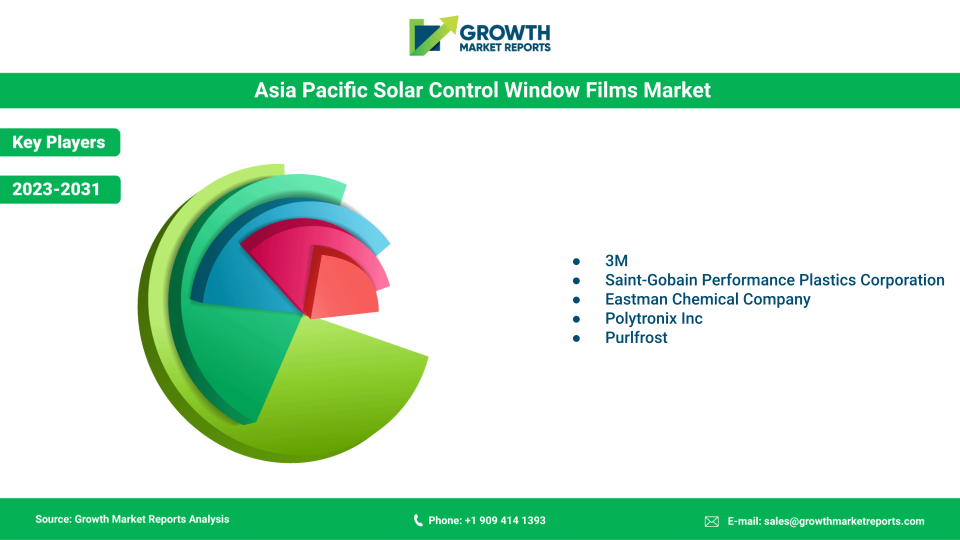
Key players operating in the Asia-Pacific Solar Control Window Films Market includes 3M, Saint-Gobain Performance Plastics Corporation, Eastman Chemical Company, Polytronix Inc, and Purlfrost.

Asia Pacific Solar Control Window Films Market Key Players 

Frequently Asked Questions

Trends include the adoption of smart and multifunctional films, eco-friendly materials, expansion in emerging economies, and increased focus on digital marketing and omnichannel distribution.

Major companies include 3M Company, Eastman Chemical Company, Saint-Gobain Performance Plastics, Avery Dennison Corporation, Solar Gard, Madico Inc., and others.

Offline channels like specialty stores and service centers remain dominant, but online channels are rapidly growing due to e-commerce and digitalization.

Ceramic films offer superior heat rejection, high optical clarity, color stability, and do not interfere with electronic signals, making them ideal for modern buildings and vehicles.

These films reduce heat gain through windows, lowering the need for air conditioning and thus reducing energy bills and carbon footprints.

Solar control window films are widely used in residential, commercial, and automotive sectors, as well as in industrial facilities and public infrastructure.

The main types are dyed, metallized, ceramic, and hybrid/other films. Each offers unique benefits in terms of heat rejection, UV protection, optical clarity, and price.

Asia Pacific holds the largest market share, followed by North America and Europe. Rapid urbanization, construction growth, and government initiatives in APAC are major contributors.

Key growth drivers include increasing demand for energy-efficient solutions, rising awareness about UV protection and sustainability, government regulations on energy conservation, and technological advancements in window film materials.

As of 2024, the global solar control window films market is valued at USD 1.98 billion and is expected to reach USD 3.67 billion by 2033.

Table Of Content

Chapter 1 Executive Summary
Chapter 2 Assumptions and Acronyms Used
Chapter 3 Research Methodology
Chapter 4 Solar Control Window Films  Market Overview
   4.1 Introduction
      4.1.1 Market Taxonomy
      4.1.2 Market Definition
      4.1.3 Macro-Economic Factors Impacting the Market Growth
   4.2 Solar Control Window Films  Market Dynamics
      4.2.1 Market Drivers
      4.2.2 Market Restraints
      4.2.3 Market Opportunity
   4.3 Solar Control Window Films  Market - Supply Chain Analysis
      4.3.1 List of Key Suppliers
      4.3.2 List of Key Distributors
      4.3.3 List of Key Consumers
   4.4 Key Forces Shaping the Solar Control Window Films  Market
      4.4.1 Bargaining Power of Suppliers
      4.4.2 Bargaining Power of Buyers
      4.4.3 Threat of Substitution
      4.4.4 Threat of New Entrants
      4.4.5 Competitive Rivalry
   4.5 Global Solar Control Window Films  Market Size & Forecast, 2023-2032
      4.5.1 Solar Control Window Films  Market Size and Y-o-Y Growth
      4.5.2 Solar Control Window Films  Market Absolute $ Opportunity

Chapter 5 Global Solar Control Window Films  Market Analysis and Forecast By Product Type
   5.1 Introduction
      5.1.1 Key Market Trends & Growth Opportunities By Product Type
      5.1.2 Basis Point Share (BPS) Analysis By Product Type
      5.1.3 Absolute $ Opportunity Assessment By Product Type
   5.2 Solar Control Window Films  Market Size Forecast By Product Type
      5.2.1 Dyed
      5.2.2 Metallized
      5.2.3 Ceramic
      5.2.4 Others
   5.3 Market Attractiveness Analysis By Product Type

Chapter 6 Global Solar Control Window Films  Market Analysis and Forecast By Application
   6.1 Introduction
      6.1.1 Key Market Trends & Growth Opportunities By Application
      6.1.2 Basis Point Share (BPS) Analysis By Application
      6.1.3 Absolute $ Opportunity Assessment By Application
   6.2 Solar Control Window Films  Market Size Forecast By Application
      6.2.1 Residential
      6.2.2 Commercial
      6.2.3 Automotive
      6.2.4 Others
   6.3 Market Attractiveness Analysis By Application

Chapter 7 Global Solar Control Window Films  Market Analysis and Forecast By Distribution Channel
   7.1 Introduction
      7.1.1 Key Market Trends & Growth Opportunities By Distribution Channel
      7.1.2 Basis Point Share (BPS) Analysis By Distribution Channel
      7.1.3 Absolute $ Opportunity Assessment By Distribution Channel
   7.2 Solar Control Window Films  Market Size Forecast By Distribution Channel
      7.2.1 Offline
      7.2.2 Online
   7.3 Market Attractiveness Analysis By Distribution Channel

Chapter 8 Global Solar Control Window Films  Market Analysis and Forecast by Region
   8.1 Introduction
      8.1.1 Key Market Trends & Growth Opportunities By Region
      8.1.2 Basis Point Share (BPS) Analysis By Region
      8.1.3 Absolute $ Opportunity Assessment By Region
   8.2 Solar Control Window Films  Market Size Forecast By Region
      8.2.1 North America
      8.2.2 Europe
      8.2.3 Asia Pacific
      8.2.4 Latin America
      8.2.5 Middle East & Africa (MEA)
   8.3 Market Attractiveness Analysis By Region

Chapter 9 Coronavirus Disease (COVID-19) Impact 
   9.1 Introduction 
   9.2 Current & Future Impact Analysis 
   9.3 Economic Impact Analysis 
   9.4 Government Policies 
   9.5 Investment Scenario

Chapter 10 North America Solar Control Window Films  Analysis and Forecast
   10.1 Introduction
   10.2 North America Solar Control Window Films  Market Size Forecast by Country
      10.2.1 U.S.
      10.2.2 Canada
   10.3 Basis Point Share (BPS) Analysis by Country
   10.4 Absolute $ Opportunity Assessment by Country
   10.5 Market Attractiveness Analysis by Country
   10.6 North America Solar Control Window Films  Market Size Forecast By Product Type
      10.6.1 Dyed
      10.6.2 Metallized
      10.6.3 Ceramic
      10.6.4 Others
   10.7 Basis Point Share (BPS) Analysis By Product Type 
   10.8 Absolute $ Opportunity Assessment By Product Type 
   10.9 Market Attractiveness Analysis By Product Type
   10.10 North America Solar Control Window Films  Market Size Forecast By Application
      10.10.1 Residential
      10.10.2 Commercial
      10.10.3 Automotive
      10.10.4 Others
   10.11 Basis Point Share (BPS) Analysis By Application 
   10.12 Absolute $ Opportunity Assessment By Application 
   10.13 Market Attractiveness Analysis By Application
   10.14 North America Solar Control Window Films  Market Size Forecast By Distribution Channel
      10.14.1 Offline
      10.14.2 Online
   10.15 Basis Point Share (BPS) Analysis By Distribution Channel 
   10.16 Absolute $ Opportunity Assessment By Distribution Channel 
   10.17 Market Attractiveness Analysis By Distribution Channel

Chapter 11 Europe Solar Control Window Films  Analysis and Forecast
   11.1 Introduction
   11.2 Europe Solar Control Window Films  Market Size Forecast by Country
      11.2.1 Germany
      11.2.2 France
      11.2.3 Italy
      11.2.4 U.K.
      11.2.5 Spain
      11.2.6 Russia
      11.2.7 Rest of Europe
   11.3 Basis Point Share (BPS) Analysis by Country
   11.4 Absolute $ Opportunity Assessment by Country
   11.5 Market Attractiveness Analysis by Country
   11.6 Europe Solar Control Window Films  Market Size Forecast By Product Type
      11.6.1 Dyed
      11.6.2 Metallized
      11.6.3 Ceramic
      11.6.4 Others
   11.7 Basis Point Share (BPS) Analysis By Product Type 
   11.8 Absolute $ Opportunity Assessment By Product Type 
   11.9 Market Attractiveness Analysis By Product Type
   11.10 Europe Solar Control Window Films  Market Size Forecast By Application
      11.10.1 Residential
      11.10.2 Commercial
      11.10.3 Automotive
      11.10.4 Others
   11.11 Basis Point Share (BPS) Analysis By Application 
   11.12 Absolute $ Opportunity Assessment By Application 
   11.13 Market Attractiveness Analysis By Application
   11.14 Europe Solar Control Window Films  Market Size Forecast By Distribution Channel
      11.14.1 Offline
      11.14.2 Online
   11.15 Basis Point Share (BPS) Analysis By Distribution Channel 
   11.16 Absolute $ Opportunity Assessment By Distribution Channel 
   11.17 Market Attractiveness Analysis By Distribution Channel

Chapter 12 Asia Pacific Solar Control Window Films  Analysis and Forecast
   12.1 Introduction
   12.2 Asia Pacific Solar Control Window Films  Market Size Forecast by Country
      12.2.1 China
      12.2.2 Japan
      12.2.3 South Korea
      12.2.4 India
      12.2.5 Australia
      12.2.6 South East Asia (SEA)
      12.2.7 Rest of Asia Pacific (APAC)
   12.3 Basis Point Share (BPS) Analysis by Country
   12.4 Absolute $ Opportunity Assessment by Country
   12.5 Market Attractiveness Analysis by Country
   12.6 Asia Pacific Solar Control Window Films  Market Size Forecast By Product Type
      12.6.1 Dyed
      12.6.2 Metallized
      12.6.3 Ceramic
      12.6.4 Others
   12.7 Basis Point Share (BPS) Analysis By Product Type 
   12.8 Absolute $ Opportunity Assessment By Product Type 
   12.9 Market Attractiveness Analysis By Product Type
   12.10 Asia Pacific Solar Control Window Films  Market Size Forecast By Application
      12.10.1 Residential
      12.10.2 Commercial
      12.10.3 Automotive
      12.10.4 Others
   12.11 Basis Point Share (BPS) Analysis By Application 
   12.12 Absolute $ Opportunity Assessment By Application 
   12.13 Market Attractiveness Analysis By Application
   12.14 Asia Pacific Solar Control Window Films  Market Size Forecast By Distribution Channel
      12.14.1 Offline
      12.14.2 Online
   12.15 Basis Point Share (BPS) Analysis By Distribution Channel 
   12.16 Absolute $ Opportunity Assessment By Distribution Channel 
   12.17 Market Attractiveness Analysis By Distribution Channel

Chapter 13 Latin America Solar Control Window Films  Analysis and Forecast
   13.1 Introduction
   13.2 Latin America Solar Control Window Films  Market Size Forecast by Country
      13.2.1 Brazil
      13.2.2 Mexico
      13.2.3 Rest of Latin America (LATAM)
   13.3 Basis Point Share (BPS) Analysis by Country
   13.4 Absolute $ Opportunity Assessment by Country
   13.5 Market Attractiveness Analysis by Country
   13.6 Latin America Solar Control Window Films  Market Size Forecast By Product Type
      13.6.1 Dyed
      13.6.2 Metallized
      13.6.3 Ceramic
      13.6.4 Others
   13.7 Basis Point Share (BPS) Analysis By Product Type 
   13.8 Absolute $ Opportunity Assessment By Product Type 
   13.9 Market Attractiveness Analysis By Product Type
   13.10 Latin America Solar Control Window Films  Market Size Forecast By Application
      13.10.1 Residential
      13.10.2 Commercial
      13.10.3 Automotive
      13.10.4 Others
   13.11 Basis Point Share (BPS) Analysis By Application 
   13.12 Absolute $ Opportunity Assessment By Application 
   13.13 Market Attractiveness Analysis By Application
   13.14 Latin America Solar Control Window Films  Market Size Forecast By Distribution Channel
      13.14.1 Offline
      13.14.2 Online
   13.15 Basis Point Share (BPS) Analysis By Distribution Channel 
   13.16 Absolute $ Opportunity Assessment By Distribution Channel 
   13.17 Market Attractiveness Analysis By Distribution Channel

Chapter 14 Middle East & Africa (MEA) Solar Control Window Films  Analysis and Forecast
   14.1 Introduction
   14.2 Middle East & Africa (MEA) Solar Control Window Films  Market Size Forecast by Country
      14.2.1 Saudi Arabia
      14.2.2 South Africa
      14.2.3 UAE
      14.2.4 Rest of Middle East & Africa (MEA)
   14.3 Basis Point Share (BPS) Analysis by Country
   14.4 Absolute $ Opportunity Assessment by Country
   14.5 Market Attractiveness Analysis by Country
   14.6 Middle East & Africa (MEA) Solar Control Window Films  Market Size Forecast By Product Type
      14.6.1 Dyed
      14.6.2 Metallized
      14.6.3 Ceramic
      14.6.4 Others
   14.7 Basis Point Share (BPS) Analysis By Product Type 
   14.8 Absolute $ Opportunity Assessment By Product Type 
   14.9 Market Attractiveness Analysis By Product Type
   14.10 Middle East & Africa (MEA) Solar Control Window Films  Market Size Forecast By Application
      14.10.1 Residential
      14.10.2 Commercial
      14.10.3 Automotive
      14.10.4 Others
   14.11 Basis Point Share (BPS) Analysis By Application 
   14.12 Absolute $ Opportunity Assessment By Application 
   14.13 Market Attractiveness Analysis By Application
   14.14 Middle East & Africa (MEA) Solar Control Window Films  Market Size Forecast By Distribution Channel
      14.14.1 Offline
      14.14.2 Online
   14.15 Basis Point Share (BPS) Analysis By Distribution Channel 
   14.16 Absolute $ Opportunity Assessment By Distribution Channel 
   14.17 Market Attractiveness Analysis By Distribution Channel

Chapter 15 Competition Landscape 
   15.1 Solar Control Window Films  Market: Competitive Dashboard
   15.2 Global Solar Control Window Films  Market: Market Share Analysis, 2023
   15.3 Company Profiles (Details – Overview, Financials, Developments, Strategy) 
      15.3.1 3M
Eastman Chemical Company
Saint-Gobain Performance Plastics
Avery Dennison Corporation
Johnson Window Films, Inc.
Madico, Inc.
Solar Gard (Saint-Gobain)
Hanita Coatings (Avery Dennison)
Garware Suncontrol
Reflectiv
Global Window Films
Huper Optik
Wintech
XPEL, Inc.
Armolan Window Films
Erickson International
KDX Window Film
Polytronix, Inc.
V-KOOL (Eastman Chemical Company)
LINTEC Corporation

Methodology

Our Clients

Honda Motor Co. Ltd.
General Mills
Nestle SA
The John Holland Group
Siemens Healthcare
General Electric
FedEx Logistics
Microsoft