Smart Transportation Market Report 2034

Smart Transportation Market Report 2034

Segments - by Solution (Traffic Management, Parking Management, Ticketing Management, Integrated Supervision, Others), by Transportation Mode (Roadways, Railways, Airways, Maritime), by Application (Urban, Inter-Urban, Rural), by Service (Cloud Services, Professional Services, Managed Services), by End-User (Government, Public, Private)

https://growthmarketreports.com/Raksha
Author : Raksha Sharma
https://growthmarketreports.com/Vaibhav
Fact-checked by : V. Chandola
https://growthmarketreports.com/Shruti
Editor : Shruti Bhat

Last Updated : Jun, 2026 | Report ID :AL-2752 | 4.1 Rating | 18 Reviews | 251 Pages | Format : Docx PDF

Report Description

This report is updated with the latest market data and insights as of June 2026. Base year: 2025  |  Forecast period: 2026-2034


Smart Transportation Market Outlook

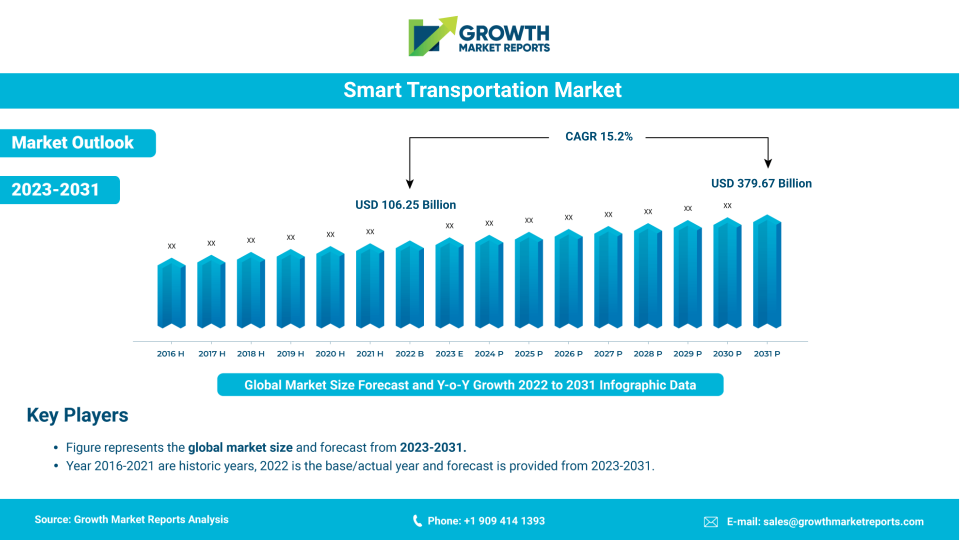
According to our latest research, the global smart transportation market size reached USD 136.2 billion in 2025, driven by rapid urbanization, increased government investments in intelligent mobility solutions, and the proliferation of connected infrastructure worldwide. The market is projected to expand at a robust CAGR of 12.1% from 2026 to 2034, with the market size forecasted to reach USD 381.5 billion by 2034. This sustained growth trajectory is primarily attributed to the growing need for efficient traffic management, the accelerating adoption of advanced data analytics, and the urgent demand for sustainable transportation systems across urban centers on every continent.

Global Smart Transportation Market Size Forecast 2025-2034, USD Billion

The smart transportation market is witnessing significant momentum due to the convergence of digital technologies and transportation infrastructure. The integration of IoT, AI, cloud computing, and big data analytics is revolutionizing how cities manage traffic flows, parking, ticketing, and multimodal transportation. Governments across the globe are increasingly prioritizing smart mobility initiatives to reduce congestion, enhance commuter safety, and minimize environmental impact. The emergence of intelligent transportation systems and the proliferation of connected vehicles are further propelling demand for advanced mobility solutions. The continuous evolution of these technologies is expected to unlock new efficiencies and create value chains that benefit both public and private stakeholders through 2034 and beyond.

A critical growth factor for the smart transportation market in 2025 is the rising emphasis on sustainability and environmental conservation. Urban areas are experiencing mounting pressure to reduce carbon emissions and improve air quality. Smart transportation solutions, such as AI-powered traffic management systems and eco-friendly public transit networks, play a pivotal role in achieving these objectives. The deployment of electric vehicles, adoption of real-time route optimization, and integration of renewable energy sources into transportation networks are gaining traction. These efforts not only contribute to environmental goals but also enhance the overall quality of urban life, making cities more livable and economically competitive.

Furthermore, the proliferation of mobile applications and digital payment systems has transformed the way commuters interact with transportation services. The adoption of contactless ticketing, ride-hailing apps, and mobility-as-a-service (MaaS) platforms is streamlining the commuter experience and promoting seamless intermodal journeys. This digital transformation is also enabling transportation authorities to gather valuable data insights, facilitating proactive maintenance, predictive analytics, and personalized services. Modern smart commuting platforms are becoming central to urban mobility strategies, enabling cities to deliver user-centric, data-driven transportation networks. As a result, the smart transportation market is becoming increasingly dynamic, with stakeholders leveraging innovative business models to capture new revenue streams and improve operational efficiency.

Regionally, Asia Pacific stands out as the fastest-growing market, driven by rapid urbanization, government-led smart city projects, and significant investments in digital infrastructure. North America and Europe continue to lead in terms of technology adoption, with established frameworks for intelligent transportation systems and a strong focus on sustainability. Meanwhile, emerging economies in Latin America and the Middle East & Africa are gradually embracing smart mobility solutions, supported by public-private partnerships and international collaborations. The diverse regional landscape presents both opportunities and challenges, necessitating tailored strategies to address unique mobility needs and regulatory environments across the 2026-2034 forecast period.

Solution Analysis

The smart transportation market is segmented by solution into traffic management, parking management, ticketing management, integrated supervision, and others. Among these, traffic management solutions hold the largest market share at approximately 34.5% in 2025, as cities worldwide grapple with increasing congestion and the need for efficient mobility. Advanced traffic management systems leverage real-time data from sensors, cameras, and connected vehicles to optimize signal timings, monitor traffic flows, and respond proactively to incidents. These solutions are instrumental in reducing travel times, minimizing fuel consumption, and enhancing road safety. The adoption of AI-driven analytics empowers authorities to predict congestion patterns and implement dynamic traffic control measures, making traffic management a cornerstone of smart transportation initiatives. Ongoing investments in transportation systems and analytics are further enhancing the capabilities of these platforms.

Smart Transportation Market Share by Solution 2025

Parking management solutions are gaining significant traction, particularly in densely populated urban areas where parking scarcity is a persistent challenge. Smart parking systems utilize IoT sensors, mobile apps, and automated payment platforms to provide real-time information on available parking spaces, streamline payment processes, and reduce time spent searching for parking. These solutions not only improve convenience for commuters but also contribute to reduced traffic congestion and lower emissions. As cities continue to prioritize efficient land use and sustainable mobility through 2034, the adoption of smart parking technologies is expected to accelerate, driving growth in this segment. The segment accounts for approximately 18.2% of the market in 2025.

Ticketing management has undergone a digital revolution, with the widespread adoption of contactless payment systems and mobile ticketing platforms, representing around 20.1% of the market in 2025. These solutions enable seamless fare collection, reduce operational costs, and enhance the passenger experience. Integrated ticketing systems that allow for multi-modal travel, covering buses, trains, metros, and even ride-sharing services, are becoming increasingly popular in metropolitan regions with complex transit networks. The integration of digital wallets and blockchain technology further enhances security and transparency in ticketing transactions, positioning this segment for sustained growth through the forecast period.

Integrated supervision solutions, which provide centralized monitoring and control over multiple transportation modes and infrastructure components, represent approximately 16.8% of the market in 2025 and are becoming essential for modern urban mobility. These systems enable authorities to oversee traffic, public transit, parking, and emergency response from a unified command center, improving coordination and decision-making. The growing complexity of urban transportation networks necessitates robust supervision capabilities to ensure resilience, safety, and service continuity. As cities invest in holistic mobility management strategies, the integrated supervision segment is poised for significant expansion over the 2026-2034 horizon.

Other solutions within the smart transportation market, including mobility-as-a-service platforms, real-time traveler information systems, and freight management solutions, collectively account for approximately 10.4% of the 2025 market. These innovative offerings address specific mobility challenges and cater to the evolving needs of commuters and logistics operators. The rise of transportation demand management solutions is particularly noteworthy, as cities use data-driven approaches to shift travel behavior, reduce peak-hour congestion, and promote greener mobility alternatives. The continuous development and integration of these solutions are expected to shape the future landscape of smart transportation, fostering greater efficiency, sustainability, and user satisfaction.

Report Scope

Attributes Details
Report Title Smart Transportation Market Research Report 2034
By Solution Traffic Management, Parking Management, Ticketing Management, Integrated Supervision, Others
By Transportation Mode Roadways, Railways, Airways, Maritime
By Application Urban, Inter-Urban, Rural
By Service Cloud Services, Professional Services, Managed Services
By End-User Government, Public, Private
Regions Covered North America, Europe, APAC, Latin America, MEA
Base Year 2025
Historic Data 2019-2024
Forecast Period 2026-2034
Number of Pages 251
Number of Tables & Figures 398
Customization Available Yes, the report can be customized as per your need.

Transportation Mode Analysis

The smart transportation market encompasses multiple transportation modes, including roadways, railways, airways, and maritime. Roadways represent the dominant mode, accounting for the largest share of the market, given the extensive use of road transport for both passenger and freight mobility. Smart roadway solutions focus on traffic management, connected vehicles, intelligent signaling, and real-time navigation. The widespread adoption of vehicle-to-everything (V2X) communication technologies, autonomous vehicle pilots, and adaptive traffic control systems is transforming roadways into dynamic, data-driven networks. These advancements are not only improving traffic flow but also enhancing safety and enabling the gradual transition toward connected and autonomous mobility ecosystems across major economies.

Railways are experiencing significant digital transformation in 2025, with the deployment of smart signaling systems, predictive maintenance platforms, and integrated ticketing solutions. Modern rail networks are leveraging IoT sensors, AI-powered analytics, and cloud-based platforms to optimize train schedules, monitor infrastructure health, and enhance passenger services. The increasing demand for high-speed rail and urban metro systems, particularly across Asia Pacific and Europe, is driving sustained investments in smart railway technologies. These innovations are pivotal in improving punctuality, reducing operational costs, and providing a seamless travel experience for commuters navigating complex urban transit environments.

In the airways segment, smart transportation solutions are focused on optimizing airport operations, enhancing passenger flow management, and improving air traffic control efficiency. The integration of biometric identification, automated check-in kiosks, and real-time baggage tracking systems is streamlining the passenger journey and reducing wait times at major hubs. Advanced analytics and AI-driven decision support systems are enabling airports to manage capacity, predict disruptions, and enhance safety protocols. As global air travel volume grows through 2034, the adoption of smart technologies in airports and air traffic management is accelerating, contributing to the overall growth of the smart transportation market.

The maritime segment, while relatively smaller compared to roadways and railways, is witnessing increased adoption of smart port solutions, vessel tracking technologies, and automated cargo handling systems. The use of IoT devices, blockchain, and digital twins is enhancing port efficiency, improving supply chain visibility, and reducing vessel turnaround times. As global trade volumes continue to rise, the need for intelligent maritime logistics and port management solutions is becoming more pronounced. The maritime segment is expected to register steady growth through 2034, supported by ongoing digitalization efforts and the expansion of international shipping corridors. Broader smart transportation security frameworks are also being applied to port and maritime environments to protect critical logistics infrastructure.

Overall, the integration of smart technologies across all transportation modes is fostering a more connected, efficient, and resilient mobility ecosystem. The convergence of road, rail, air, and maritime solutions is enabling seamless multimodal journeys, reducing operational silos, and supporting the development of future-ready transportation networks that cater to the diverse needs of urban and inter-urban populations through 2034 and beyond.

Application Analysis

The smart transportation market is further segmented by application into urban, inter-urban, and rural. Urban applications dominate the market, driven by the concentration of population, vehicles, and infrastructure in cities worldwide. Urban smart transportation solutions focus on alleviating congestion, improving public transit efficiency, and enhancing the overall commuter experience. The deployment of real-time traffic management systems, smart parking, and integrated ticketing is transforming urban mobility, making cities more sustainable and livable. The rise of smart city initiatives, coupled with government mandates to reduce emissions and promote green mobility, is fueling the adoption of advanced transportation technologies in metropolitan areas through the forecast period.

Inter-urban applications are gaining momentum as regional connectivity and long-distance travel become increasingly important to economic development. Smart transportation solutions for inter-urban corridors include high-speed rail, express bus systems, and intelligent highway management platforms. These initiatives aim to reduce travel times, enhance safety, and support economic growth by facilitating the efficient movement of people and goods between cities and regions. The rise of smart micro-transit systems is also bridging the gap between urban and inter-urban services, offering flexible, on-demand mobility options that complement traditional fixed-route networks. As countries invest in regional connectivity and cross-border mobility, the inter-urban segment is expected to witness robust growth from 2026 onward.

The rural application segment, while currently representing a smaller share of the market, is emerging as a key focus area for governments and transportation authorities seeking to promote inclusive mobility. Rural mobility challenges, such as limited public transit options and inadequate infrastructure, are being addressed through innovative solutions including demand-responsive transport, community ride-sharing, and digital ticketing platforms. The use of mobile apps and cloud-based services is enabling rural residents to access transportation services more conveniently and efficiently. As digital inclusion and rural development initiatives gain traction across emerging and developed economies alike, the adoption of smart transportation solutions in non-urban areas is expected to increase meaningfully through 2034.

Across all application segments, the emphasis on data-driven decision-making, real-time monitoring, and user-centric services is reshaping the transportation landscape. The ability to tailor solutions to the unique needs of urban, inter-urban, and rural environments is a critical success factor for market players. Complementary tools such as a transportation data platform are enabling authorities to harmonize data streams from diverse mobility sources, supporting smarter planning and resource allocation. By leveraging advanced technologies and adopting a holistic approach to mobility management, stakeholders can unlock new opportunities and drive sustainable growth across all application segments.

Service Analysis

The smart transportation market is segmented by service into cloud services, professional services, and managed services. Cloud services are at the forefront, enabling scalable, flexible, and cost-effective deployment of smart transportation solutions. The adoption of cloud-based platforms allows transportation authorities to collect, store, and analyze vast amounts of data in real time, supporting predictive analytics, dynamic routing, and integrated mobility management. Cloud services also facilitate seamless integration with third-party applications, enhancing interoperability and enabling the rapid rollout of new features and updates. As the demand for data-driven mobility grows through 2034, cloud services are expected to maintain their dominance in the overall service mix.

Professional services encompass consulting, system integration, training, and support, playing a vital role in the successful implementation of smart transportation projects. These services help organizations assess their mobility needs, design customized solutions, and ensure smooth deployment and long-term operation. The complexity of smart transportation systems, which often involve multiple stakeholders, cross-agency coordination, and legacy infrastructure, necessitates expert guidance and rigorous project management. Professional services providers are increasingly offering end-to-end solutions, from initial feasibility studies to post-implementation support, enabling clients to maximize the return on their technology investments.

Managed services are gaining popularity as transportation authorities and operators seek to outsource the ongoing management and maintenance of their smart mobility systems. Managed service providers offer 24/7 monitoring, proactive maintenance, cybersecurity management, and performance optimization, allowing clients to focus on core operations and strategic goals. The shift toward managed services is driven by the need for operational efficiency, cost predictability, and access to specialized expertise that may not be available in-house. As smart transportation networks become more complex and mission-critical through the 2026-2034 period, the demand for reliable managed services is expected to grow consistently, creating new opportunities for providers.

The interplay between cloud, professional, and managed services is shaping the future of the smart transportation market. Organizations are increasingly adopting hybrid service models that combine the scalability of cloud platforms with the expertise of professional and managed services providers. This integrated approach enables them to address evolving mobility challenges, respond to changing user expectations, and stay competitive in a rapidly advancing market. The continuous innovation in service delivery models is expected to drive sustained growth and create meaningful differentiation for market leaders through 2034.

End-User Analysis

The smart transportation market is segmented by end-user into government, public, and private sectors. Government agencies are the primary drivers of market growth, accounting for the largest share of investments in smart mobility infrastructure. Governments at the national, regional, and municipal levels are spearheading initiatives to modernize transportation networks, improve road safety, and promote sustainable urban development. Public sector projects often focus on large-scale deployments of traffic management, public transit systems, and integrated ticketing platforms. The availability of government funding, supportive policy frameworks, and evolving regulatory standards is critical to the continued success of smart transportation initiatives worldwide.

The public sector, including transit authorities, municipal corporations, and public utility operators, plays a key role in the implementation and day-to-day operation of smart transportation solutions. Public sector organizations are responsible for managing routine mobility services, maintaining infrastructure assets, and ensuring consistent service quality for citizens. The adoption of digital technologies enables them to enhance operational efficiency, reduce costs, and deliver measurably better services. Collaboration between public agencies and private technology providers is increasingly common in 2025, fostering innovation and accelerating the deployment of smart mobility solutions across urban and suburban environments.

The private sector is emerging as a significant and growing contributor to the smart transportation market, particularly in areas such as ride-hailing, mobility-as-a-service, and logistics optimization. Private companies are leveraging advanced analytics, AI, and IoT to develop innovative mobility solutions that cater to the evolving needs of both consumers and businesses. Strategic partnerships between private firms and public agencies are driving the integration of new technologies into traditional transportation systems. The private sector's agility, investment capacity, and customer-centric approach are expected to play a pivotal role in shaping the future of smart transportation through 2034.

The dynamic interplay between government, public, and private end-users is fostering a collaborative ecosystem that supports the development and scaling of smart transportation solutions. By aligning their objectives and leveraging complementary strengths, stakeholders across all three end-user categories can address complex mobility challenges, enhance service delivery, and create sustainable value for communities and economies worldwide over the coming decade.

Opportunities & Threats

The smart transportation market presents a multitude of opportunities for stakeholders across the value chain in the 2026-2034 period. One of the most significant opportunities lies in the integration of emerging technologies such as artificial intelligence, machine learning, and 5G connectivity into transportation infrastructure. These technologies enable real-time data processing, predictive analytics, and autonomous decision-making, unlocking new possibilities for traffic optimization, incident management, and personalized mobility services. The growing adoption of electric vehicles and the expansion of charging infrastructure present additional avenues for innovation and value creation. Companies that invest in R&D and form strategic alliances with technology providers are well-positioned to capitalize on these trends and sustain competitive advantage.

Another key opportunity is the expansion of smart transportation solutions into emerging markets, where rapid urbanization and infrastructure development are creating substantial demand for intelligent mobility systems. Governments in Asia Pacific, Latin America, and the Middle East & Africa are launching ambitious smart city projects and urban renewal programs, providing fertile ground for the deployment of advanced transportation technologies. The increasing focus on sustainability and environmental conservation is also driving the adoption of green mobility solutions, such as electric buses, bike-sharing programs, and integrated public transit networks. By tailoring their offerings to local needs and regulatory requirements, market players can tap into significant new revenue streams and establish strong positions in high-growth regions.

Despite the promising outlook, the smart transportation market faces several restraining factors. One of the primary challenges is the high initial cost of deploying smart mobility infrastructure, which can be a significant barrier for cash-strapped municipalities and developing economies. The complexity of integrating new technologies with legacy systems, coupled with concerns over data privacy and cybersecurity vulnerabilities, adds to implementation challenges. Regulatory uncertainties and the lack of standardized interoperability frameworks can also impede the broader adoption of smart transportation solutions. Addressing these challenges requires coordinated efforts from governments, industry players, and technology providers to develop scalable, secure, and cost-effective solutions that deliver tangible, measurable benefits to users and communities across diverse geographies.

Regional Outlook

The Asia Pacific region is the fastest-growing market for smart transportation, with a market size of USD 40.1 billion in 2025 and an anticipated CAGR of 14.8% through 2034. Rapid urbanization, population growth, and significant government investments in smart city initiatives are driving the adoption of intelligent mobility solutions across China, India, Japan, South Korea, and Southeast Asia. The region's focus on digital infrastructure, coupled with strong public-private partnerships, is fostering innovation and accelerating the deployment of advanced transportation technologies. Key programs such as China's smart highway networks, India's urban metro expansions, and Singapore's autonomous vehicle trials exemplify the region's commitment to transforming mobility and enhancing urban livability.

Smart Transportation Market Regional Share 2025

North America remains a leader in technology adoption, with a market size of USD 35.2 billion in 2025. The region benefits from well-established transportation infrastructure, a strong focus on sustainability, and a vibrant ecosystem of technology providers and mobility innovators. The United States and Canada are at the forefront of deploying smart traffic management, connected vehicle systems, and integrated transit networks. The accelerating adoption of electric vehicles and expansion of EV charging infrastructure are key additional growth drivers. As cities across North America continue to invest in digital mobility solutions and federal funding mechanisms support infrastructure modernization, the region is expected to maintain steady growth through the 2026-2034 forecast period.

Europe, with a market size of USD 31.5 billion in 2025, is characterized by its strong emphasis on sustainability, multimodal integration, and cross-border mobility harmonization. The European Union's Green Deal, digital single market strategy, and Sustainable and Smart Mobility Strategy are collectively driving the adoption of intelligent transportation systems across member states. Countries such as Germany, France, the Netherlands, and the United Kingdom are investing heavily in high-speed rail, smart ticketing, and urban mobility platforms. The region's collaborative regulatory approach, supported by harmonized standards and dedicated funding mechanisms, is enabling seamless integration of transportation networks. As Europe continues to prioritize green mobility and digitalization, it is well-positioned for sustained growth in the smart transportation market through 2034.

Competitor Outlook

The smart transportation market is highly competitive in 2025, with a diverse array of players spanning technology providers, system integrators, infrastructure developers, and mobility service operators. The competitive landscape is characterized by rapid technological innovation, strategic partnerships, and a strong emphasis on research and development. Leading companies are investing heavily in AI, IoT, and cloud computing to develop next-generation transportation solutions that address the evolving needs of cities, commuters, and logistics operators. The market is also witnessing increased consolidation, as larger players acquire niche technology firms to expand their capabilities and deepen their geographic presence.

Collaboration between public and private sector entities remains a defining feature of the smart transportation market in 2025. Governments and municipal authorities are increasingly partnering with technology providers and system integrators to design, deploy, and operate intelligent mobility solutions at scale. These partnerships enable the pooling of resources, sharing of expertise, and acceleration of project timelines. The growing importance of open data platforms and interoperability standards is fostering a more collaborative ecosystem that supports innovation, scalability, and long-term sustainability.

Start-ups and emerging players are making significant inroads into the market, leveraging agile business models and cutting-edge technologies to disrupt traditional transportation paradigms. These companies are introducing innovative solutions in areas such as ride-hailing, mobility-as-a-service, real-time traveler information, and freight optimization, challenging incumbents and driving market dynamism. The ability to rapidly adapt to changing user preferences and evolving regulatory requirements is a key differentiator for new entrants in the 2025 landscape.

Among the major companies operating in the smart transportation market are Siemens AG, IBM Corporation, Cisco Systems, Inc., Thales Group, Alstom SA, Cubic Corporation, Kapsch TrafficCom AG, Huawei Technologies Co., Ltd., Hitachi, Ltd., Indra Sistemas, Conduent Incorporated, Swarco AG, and SAP SE. Siemens AG is renowned for its comprehensive portfolio of intelligent traffic management and rail automation solutions, while IBM Corporation is a leader in AI-powered analytics and cloud-based mobility platforms. Cisco Systems, Inc. specializes in connected infrastructure and cybersecurity for transportation networks, and Thales Group offers advanced signaling and integrated supervision systems. Alstom SA and Hitachi, Ltd. are prominent players in smart rail solutions, while Cubic Corporation and Kapsch TrafficCom AG are recognized for their expertise in ticketing and electronic tolling systems. Conduent Incorporated and Swarco AG bring complementary strengths in transit management and urban traffic optimization, further enriching the competitive landscape.

These industry leaders are continuously expanding their product portfolios and geographic reach through strategic acquisitions, joint ventures, and sustained investments in R&D. Their ability to deliver end-to-end solutions, backed by robust technology platforms and deep global expertise, positions them as preferred partners for governments and transportation authorities worldwide. As the smart transportation market evolves through the 2026-2034 forecast period, the competitive landscape is expected to remain highly dynamic, with innovation, collaboration, and customer-centricity serving as the primary drivers of sustained success.

Key Players

  • Siemens AG
  • IBM Corporation
  • Cisco Systems, Inc.
  • Thales Group
  • Alstom SA
  • Kapsch TrafficCom AG
  • Cubic Corporation
  • Huawei Technologies Co., Ltd.
  • Hitachi, Ltd.
  • Indra Sistemas, S.A.
  • Iteris, Inc.
  • Denso Corporation
  • AT&T Inc.
  • SAP SE
  • Q-Free ASA
  • TransCore (Roper Technologies, Inc.)
  • TomTom NV
  • Conduent Incorporated
  • Yunex Traffic
  • Swarco AG

Segments

The Smart Transportation market has been segmented on the basis of

Solution

  • Traffic Management
  • Parking Management
  • Ticketing Management
  • Integrated Supervision
  • Others

Transportation Mode

  • Roadways
  • Railways
  • Airways
  • Maritime

Application

  • Urban
  • Inter-Urban
  • Rural

Service

  • Cloud Services
  • Professional Services
  • Managed Services

End-User

  • Government
  • Public
  • Private

Frequently Asked Questions

The market is segmented into urban, inter-urban, and rural applications. Urban applications dominate, driven by dense populations and smart city investments. Inter-urban solutions are gaining momentum as regional connectivity improves, and rural applications are emerging as governments push for broader digital inclusion and demand-responsive transit services.

Leading companies include Siemens AG, IBM Corporation, Cisco Systems, Thales Group, Alstom SA, Cubic Corporation, Kapsch TrafficCom AG, Huawei Technologies, Hitachi, Indra Sistemas, Conduent Incorporated, Swarco AG, and SAP SE, among others. These players compete on technology depth, geographic reach, and end-to-end solution capabilities.

Key opportunities include the integration of 5G and AI, expansion into emerging markets, growth of electric vehicle ecosystems, and the rise of MaaS platforms. Challenges include high upfront deployment costs, legacy system integration complexities, cybersecurity vulnerabilities, data privacy concerns, and inconsistent regulatory frameworks across regions.

End-users span government agencies, public sector organizations such as transit authorities and municipal corporations, and private sector companies including ride-hailing operators, logistics firms, and mobility-as-a-service providers. Government agencies currently represent the largest investment segment.

The market covers roadways, railways, airways, and maritime transport. Roadways hold the dominant share due to the extensive use of road networks for passenger and freight mobility, while railways and airways are rapidly adopting smart technologies for improved operations and passenger services.

Technologies such as AI, machine learning, 5G connectivity, IoT, cloud computing, and big data analytics are fundamentally reshaping smart transportation. These innovations enable real-time traffic optimization, predictive maintenance, autonomous vehicle integration, contactless fare collection, and seamless multimodal journey planning, all of which improve efficiency, safety, and the overall commuter experience.

The primary solutions include traffic management, parking management, ticketing management, integrated supervision, and other emerging platforms such as mobility-as-a-service and real-time traveler information systems. Traffic management commands the largest share at approximately 34.5% in 2025.

Asia Pacific leads global adoption with the highest growth rate, fueled by large-scale urbanization and government smart city programs in China, India, and Japan. North America and Europe also hold substantial shares due to mature digital infrastructure and sustainability-focused transportation policies.

The smart transportation market is projected to grow at a CAGR of 12.1% from 2026 to 2034, reaching approximately USD 381.5 billion by 2034, driven by technological advancements, smart city initiatives, and growing sustainability mandates.

The global smart transportation market reached USD 136.2 billion in 2025, supported by rapid urbanization, rising government investments in intelligent mobility, and the widespread adoption of IoT and AI-driven infrastructure.

Table Of Content

Chapter 1 Executive Summary
Chapter 2 Assumptions and Acronyms Used
Chapter 3 Research Methodology
Chapter 4 Smart Transportation Market Overview
   4.1 Introduction
      4.1.1 Market Taxonomy
      4.1.2 Market Definition
      4.1.3 Macro-Economic Factors Impacting the Market Growth
   4.2 Smart Transportation Market Dynamics
      4.2.1 Market Drivers
      4.2.2 Market Restraints
      4.2.3 Market Opportunity
   4.3 Smart Transportation Market - Supply Chain Analysis
      4.3.1 List of Key Suppliers
      4.3.2 List of Key Distributors
      4.3.3 List of Key Consumers
   4.4 Key Forces Shaping the Smart Transportation Market
      4.4.1 Bargaining Power of Suppliers
      4.4.2 Bargaining Power of Buyers
      4.4.3 Threat of Substitution
      4.4.4 Threat of New Entrants
      4.4.5 Competitive Rivalry
   4.5 Global Smart Transportation Market Size & Forecast, 2023-2032
      4.5.1 Smart Transportation Market Size and Y-o-Y Growth
      4.5.2 Smart Transportation Market Absolute $ Opportunity

Chapter 5 Global Smart Transportation Market Analysis and Forecast By Solution
   5.1 Introduction
      5.1.1 Key Market Trends & Growth Opportunities By Solution
      5.1.2 Basis Point Share (BPS) Analysis By Solution
      5.1.3 Absolute $ Opportunity Assessment By Solution
   5.2 Smart Transportation Market Size Forecast By Solution
      5.2.1 Traffic Management
      5.2.2 Parking Management
      5.2.3 Ticketing Management
      5.2.4 Integrated Supervision
      5.2.5 Others
   5.3 Market Attractiveness Analysis By Solution

Chapter 6 Global Smart Transportation Market Analysis and Forecast By Transportation Mode
   6.1 Introduction
      6.1.1 Key Market Trends & Growth Opportunities By Transportation Mode
      6.1.2 Basis Point Share (BPS) Analysis By Transportation Mode
      6.1.3 Absolute $ Opportunity Assessment By Transportation Mode
   6.2 Smart Transportation Market Size Forecast By Transportation Mode
      6.2.1 Roadways
      6.2.2 Railways
      6.2.3 Airways
      6.2.4 Maritime
   6.3 Market Attractiveness Analysis By Transportation Mode

Chapter 7 Global Smart Transportation Market Analysis and Forecast By Application
   7.1 Introduction
      7.1.1 Key Market Trends & Growth Opportunities By Application
      7.1.2 Basis Point Share (BPS) Analysis By Application
      7.1.3 Absolute $ Opportunity Assessment By Application
   7.2 Smart Transportation Market Size Forecast By Application
      7.2.1 Urban
      7.2.2 Inter-Urban
      7.2.3 Rural
   7.3 Market Attractiveness Analysis By Application

Chapter 8 Global Smart Transportation Market Analysis and Forecast By Service
   8.1 Introduction
      8.1.1 Key Market Trends & Growth Opportunities By Service
      8.1.2 Basis Point Share (BPS) Analysis By Service
      8.1.3 Absolute $ Opportunity Assessment By Service
   8.2 Smart Transportation Market Size Forecast By Service
      8.2.1 Cloud Services
      8.2.2 Professional Services
      8.2.3 Managed Services
   8.3 Market Attractiveness Analysis By Service

Chapter 9 Global Smart Transportation Market Analysis and Forecast By End-User
   9.1 Introduction
      9.1.1 Key Market Trends & Growth Opportunities By End-User
      9.1.2 Basis Point Share (BPS) Analysis By End-User
      9.1.3 Absolute $ Opportunity Assessment By End-User
   9.2 Smart Transportation Market Size Forecast By End-User
      9.2.1 Government
      9.2.2 Public
      9.2.3 Private
   9.3 Market Attractiveness Analysis By End-User

Chapter 10 Global Smart Transportation Market Analysis and Forecast by Region
   10.1 Introduction
      10.1.1 Key Market Trends & Growth Opportunities By Region
      10.1.2 Basis Point Share (BPS) Analysis By Region
      10.1.3 Absolute $ Opportunity Assessment By Region
   10.2 Smart Transportation Market Size Forecast By Region
      10.2.1 North America
      10.2.2 Europe
      10.2.3 Asia Pacific
      10.2.4 Latin America
      10.2.5 Middle East & Africa (MEA)
   10.3 Market Attractiveness Analysis By Region

Chapter 11 Coronavirus Disease (COVID-19) Impact 
   11.1 Introduction 
   11.2 Current & Future Impact Analysis 
   11.3 Economic Impact Analysis 
   11.4 Government Policies 
   11.5 Investment Scenario

Chapter 12 North America Smart Transportation Analysis and Forecast
   12.1 Introduction
   12.2 North America Smart Transportation Market Size Forecast by Country
      12.2.1 U.S.
      12.2.2 Canada
   12.3 Basis Point Share (BPS) Analysis by Country
   12.4 Absolute $ Opportunity Assessment by Country
   12.5 Market Attractiveness Analysis by Country
   12.6 North America Smart Transportation Market Size Forecast By Solution
      12.6.1 Traffic Management
      12.6.2 Parking Management
      12.6.3 Ticketing Management
      12.6.4 Integrated Supervision
      12.6.5 Others
   12.7 Basis Point Share (BPS) Analysis By Solution 
   12.8 Absolute $ Opportunity Assessment By Solution 
   12.9 Market Attractiveness Analysis By Solution
   12.10 North America Smart Transportation Market Size Forecast By Transportation Mode
      12.10.1 Roadways
      12.10.2 Railways
      12.10.3 Airways
      12.10.4 Maritime
   12.11 Basis Point Share (BPS) Analysis By Transportation Mode 
   12.12 Absolute $ Opportunity Assessment By Transportation Mode 
   12.13 Market Attractiveness Analysis By Transportation Mode
   12.14 North America Smart Transportation Market Size Forecast By Application
      12.14.1 Urban
      12.14.2 Inter-Urban
      12.14.3 Rural
   12.15 Basis Point Share (BPS) Analysis By Application 
   12.16 Absolute $ Opportunity Assessment By Application 
   12.17 Market Attractiveness Analysis By Application
   12.18 North America Smart Transportation Market Size Forecast By Service
      12.18.1 Cloud Services
      12.18.2 Professional Services
      12.18.3 Managed Services
   12.19 Basis Point Share (BPS) Analysis By Service 
   12.20 Absolute $ Opportunity Assessment By Service 
   12.21 Market Attractiveness Analysis By Service
   12.22 North America Smart Transportation Market Size Forecast By End-User
      12.22.1 Government
      12.22.2 Public
      12.22.3 Private
   12.23 Basis Point Share (BPS) Analysis By End-User 
   12.24 Absolute $ Opportunity Assessment By End-User 
   12.25 Market Attractiveness Analysis By End-User

Chapter 13 Europe Smart Transportation Analysis and Forecast
   13.1 Introduction
   13.2 Europe Smart Transportation Market Size Forecast by Country
      13.2.1 Germany
      13.2.2 France
      13.2.3 Italy
      13.2.4 U.K.
      13.2.5 Spain
      13.2.6 Russia
      13.2.7 Rest of Europe
   13.3 Basis Point Share (BPS) Analysis by Country
   13.4 Absolute $ Opportunity Assessment by Country
   13.5 Market Attractiveness Analysis by Country
   13.6 Europe Smart Transportation Market Size Forecast By Solution
      13.6.1 Traffic Management
      13.6.2 Parking Management
      13.6.3 Ticketing Management
      13.6.4 Integrated Supervision
      13.6.5 Others
   13.7 Basis Point Share (BPS) Analysis By Solution 
   13.8 Absolute $ Opportunity Assessment By Solution 
   13.9 Market Attractiveness Analysis By Solution
   13.10 Europe Smart Transportation Market Size Forecast By Transportation Mode
      13.10.1 Roadways
      13.10.2 Railways
      13.10.3 Airways
      13.10.4 Maritime
   13.11 Basis Point Share (BPS) Analysis By Transportation Mode 
   13.12 Absolute $ Opportunity Assessment By Transportation Mode 
   13.13 Market Attractiveness Analysis By Transportation Mode
   13.14 Europe Smart Transportation Market Size Forecast By Application
      13.14.1 Urban
      13.14.2 Inter-Urban
      13.14.3 Rural
   13.15 Basis Point Share (BPS) Analysis By Application 
   13.16 Absolute $ Opportunity Assessment By Application 
   13.17 Market Attractiveness Analysis By Application
   13.18 Europe Smart Transportation Market Size Forecast By Service
      13.18.1 Cloud Services
      13.18.2 Professional Services
      13.18.3 Managed Services
   13.19 Basis Point Share (BPS) Analysis By Service 
   13.20 Absolute $ Opportunity Assessment By Service 
   13.21 Market Attractiveness Analysis By Service
   13.22 Europe Smart Transportation Market Size Forecast By End-User
      13.22.1 Government
      13.22.2 Public
      13.22.3 Private
   13.23 Basis Point Share (BPS) Analysis By End-User 
   13.24 Absolute $ Opportunity Assessment By End-User 
   13.25 Market Attractiveness Analysis By End-User

Chapter 14 Asia Pacific Smart Transportation Analysis and Forecast
   14.1 Introduction
   14.2 Asia Pacific Smart Transportation Market Size Forecast by Country
      14.2.1 China
      14.2.2 Japan
      14.2.3 South Korea
      14.2.4 India
      14.2.5 Australia
      14.2.6 South East Asia (SEA)
      14.2.7 Rest of Asia Pacific (APAC)
   14.3 Basis Point Share (BPS) Analysis by Country
   14.4 Absolute $ Opportunity Assessment by Country
   14.5 Market Attractiveness Analysis by Country
   14.6 Asia Pacific Smart Transportation Market Size Forecast By Solution
      14.6.1 Traffic Management
      14.6.2 Parking Management
      14.6.3 Ticketing Management
      14.6.4 Integrated Supervision
      14.6.5 Others
   14.7 Basis Point Share (BPS) Analysis By Solution 
   14.8 Absolute $ Opportunity Assessment By Solution 
   14.9 Market Attractiveness Analysis By Solution
   14.10 Asia Pacific Smart Transportation Market Size Forecast By Transportation Mode
      14.10.1 Roadways
      14.10.2 Railways
      14.10.3 Airways
      14.10.4 Maritime
   14.11 Basis Point Share (BPS) Analysis By Transportation Mode 
   14.12 Absolute $ Opportunity Assessment By Transportation Mode 
   14.13 Market Attractiveness Analysis By Transportation Mode
   14.14 Asia Pacific Smart Transportation Market Size Forecast By Application
      14.14.1 Urban
      14.14.2 Inter-Urban
      14.14.3 Rural
   14.15 Basis Point Share (BPS) Analysis By Application 
   14.16 Absolute $ Opportunity Assessment By Application 
   14.17 Market Attractiveness Analysis By Application
   14.18 Asia Pacific Smart Transportation Market Size Forecast By Service
      14.18.1 Cloud Services
      14.18.2 Professional Services
      14.18.3 Managed Services
   14.19 Basis Point Share (BPS) Analysis By Service 
   14.20 Absolute $ Opportunity Assessment By Service 
   14.21 Market Attractiveness Analysis By Service
   14.22 Asia Pacific Smart Transportation Market Size Forecast By End-User
      14.22.1 Government
      14.22.2 Public
      14.22.3 Private
   14.23 Basis Point Share (BPS) Analysis By End-User 
   14.24 Absolute $ Opportunity Assessment By End-User 
   14.25 Market Attractiveness Analysis By End-User

Chapter 15 Latin America Smart Transportation Analysis and Forecast
   15.1 Introduction
   15.2 Latin America Smart Transportation Market Size Forecast by Country
      15.2.1 Brazil
      15.2.2 Mexico
      15.2.3 Rest of Latin America (LATAM)
   15.3 Basis Point Share (BPS) Analysis by Country
   15.4 Absolute $ Opportunity Assessment by Country
   15.5 Market Attractiveness Analysis by Country
   15.6 Latin America Smart Transportation Market Size Forecast By Solution
      15.6.1 Traffic Management
      15.6.2 Parking Management
      15.6.3 Ticketing Management
      15.6.4 Integrated Supervision
      15.6.5 Others
   15.7 Basis Point Share (BPS) Analysis By Solution 
   15.8 Absolute $ Opportunity Assessment By Solution 
   15.9 Market Attractiveness Analysis By Solution
   15.10 Latin America Smart Transportation Market Size Forecast By Transportation Mode
      15.10.1 Roadways
      15.10.2 Railways
      15.10.3 Airways
      15.10.4 Maritime
   15.11 Basis Point Share (BPS) Analysis By Transportation Mode 
   15.12 Absolute $ Opportunity Assessment By Transportation Mode 
   15.13 Market Attractiveness Analysis By Transportation Mode
   15.14 Latin America Smart Transportation Market Size Forecast By Application
      15.14.1 Urban
      15.14.2 Inter-Urban
      15.14.3 Rural
   15.15 Basis Point Share (BPS) Analysis By Application 
   15.16 Absolute $ Opportunity Assessment By Application 
   15.17 Market Attractiveness Analysis By Application
   15.18 Latin America Smart Transportation Market Size Forecast By Service
      15.18.1 Cloud Services
      15.18.2 Professional Services
      15.18.3 Managed Services
   15.19 Basis Point Share (BPS) Analysis By Service 
   15.20 Absolute $ Opportunity Assessment By Service 
   15.21 Market Attractiveness Analysis By Service
   15.22 Latin America Smart Transportation Market Size Forecast By End-User
      15.22.1 Government
      15.22.2 Public
      15.22.3 Private
   15.23 Basis Point Share (BPS) Analysis By End-User 
   15.24 Absolute $ Opportunity Assessment By End-User 
   15.25 Market Attractiveness Analysis By End-User

Chapter 16 Middle East & Africa (MEA) Smart Transportation Analysis and Forecast
   16.1 Introduction
   16.2 Middle East & Africa (MEA) Smart Transportation Market Size Forecast by Country
      16.2.1 Saudi Arabia
      16.2.2 South Africa
      16.2.3 UAE
      16.2.4 Rest of Middle East & Africa (MEA)
   16.3 Basis Point Share (BPS) Analysis by Country
   16.4 Absolute $ Opportunity Assessment by Country
   16.5 Market Attractiveness Analysis by Country
   16.6 Middle East & Africa (MEA) Smart Transportation Market Size Forecast By Solution
      16.6.1 Traffic Management
      16.6.2 Parking Management
      16.6.3 Ticketing Management
      16.6.4 Integrated Supervision
      16.6.5 Others
   16.7 Basis Point Share (BPS) Analysis By Solution 
   16.8 Absolute $ Opportunity Assessment By Solution 
   16.9 Market Attractiveness Analysis By Solution
   16.10 Middle East & Africa (MEA) Smart Transportation Market Size Forecast By Transportation Mode
      16.10.1 Roadways
      16.10.2 Railways
      16.10.3 Airways
      16.10.4 Maritime
   16.11 Basis Point Share (BPS) Analysis By Transportation Mode 
   16.12 Absolute $ Opportunity Assessment By Transportation Mode 
   16.13 Market Attractiveness Analysis By Transportation Mode
   16.14 Middle East & Africa (MEA) Smart Transportation Market Size Forecast By Application
      16.14.1 Urban
      16.14.2 Inter-Urban
      16.14.3 Rural
   16.15 Basis Point Share (BPS) Analysis By Application 
   16.16 Absolute $ Opportunity Assessment By Application 
   16.17 Market Attractiveness Analysis By Application
   16.18 Middle East & Africa (MEA) Smart Transportation Market Size Forecast By Service
      16.18.1 Cloud Services
      16.18.2 Professional Services
      16.18.3 Managed Services
   16.19 Basis Point Share (BPS) Analysis By Service 
   16.20 Absolute $ Opportunity Assessment By Service 
   16.21 Market Attractiveness Analysis By Service
   16.22 Middle East & Africa (MEA) Smart Transportation Market Size Forecast By End-User
      16.22.1 Government
      16.22.2 Public
      16.22.3 Private
   16.23 Basis Point Share (BPS) Analysis By End-User 
   16.24 Absolute $ Opportunity Assessment By End-User 
   16.25 Market Attractiveness Analysis By End-User

Chapter 17 Competition Landscape 
   17.1 Smart Transportation Market: Competitive Dashboard
   17.2 Global Smart Transportation Market: Market Share Analysis, 2023
   17.3 Company Profiles (Details – Overview, Financials, Developments, Strategy) 
      17.3.1 Siemens AG
      17.3.2 IBM Corporation
      17.3.3 Cisco Systems, Inc.
      17.3.4 Thales Group
      17.3.5 Alstom SA
      17.3.6 Kapsch TrafficCom AG
      17.3.7 Cubic Corporation
      17.3.8 Huawei Technologies Co., Ltd.
      17.3.9 Hitachi, Ltd.
      17.3.10 Indra Sistemas, S.A.
      17.3.11 Iteris, Inc.
      17.3.12 Denso Corporation
      17.3.13 AT&T Inc.
      17.3.14 SAP SE
      17.3.15 Q-Free ASA
      17.3.16 TransCore (Roper Technologies, Inc.)
      17.3.17 TomTom NV
      17.3.18 Conduent Incorporated
      17.3.19 Yunex Traffic (Siemens Spin-off)
      17.3.20 Swarco AG

Methodology

Our Clients

Siemens Healthcare
General Electric
Deloitte
Microsoft
Nestle SA
Dassault Aviation
FedEx Logistics
sinopec