Slag Handling Equipment Market Research Report 2033

Slag Handling Equipment Market Research Report 2033

Segments - by Product Type (Slag Pots, Slag Cars, Slag Skimmers, Slag Crushers, Others), by Application (Steel Mills, Foundries, Smelting Plants, Power Plants, Others), by Operation (Manual, Semi-Automatic, Automatic), by End-User (Metallurgical Industry, Construction, Mining, Energy, Others), by Distribution Channel (Direct Sales, Distributors, Online Sales, Others)

https://growthmarketreports.com/Raksha
Author : Raksha Sharma
https://growthmarketreports.com/Vaibhav
Fact-checked by : V. Chandola
https://growthmarketreports.com/Rucha
Editor : Rucha Phatak

Upcoming | Report ID :CM-910 | 4.2 Rating | 36 Reviews | 260 Pages | Format : Docx PDF

Report Description


Slag Handling Equipment Market Outlook

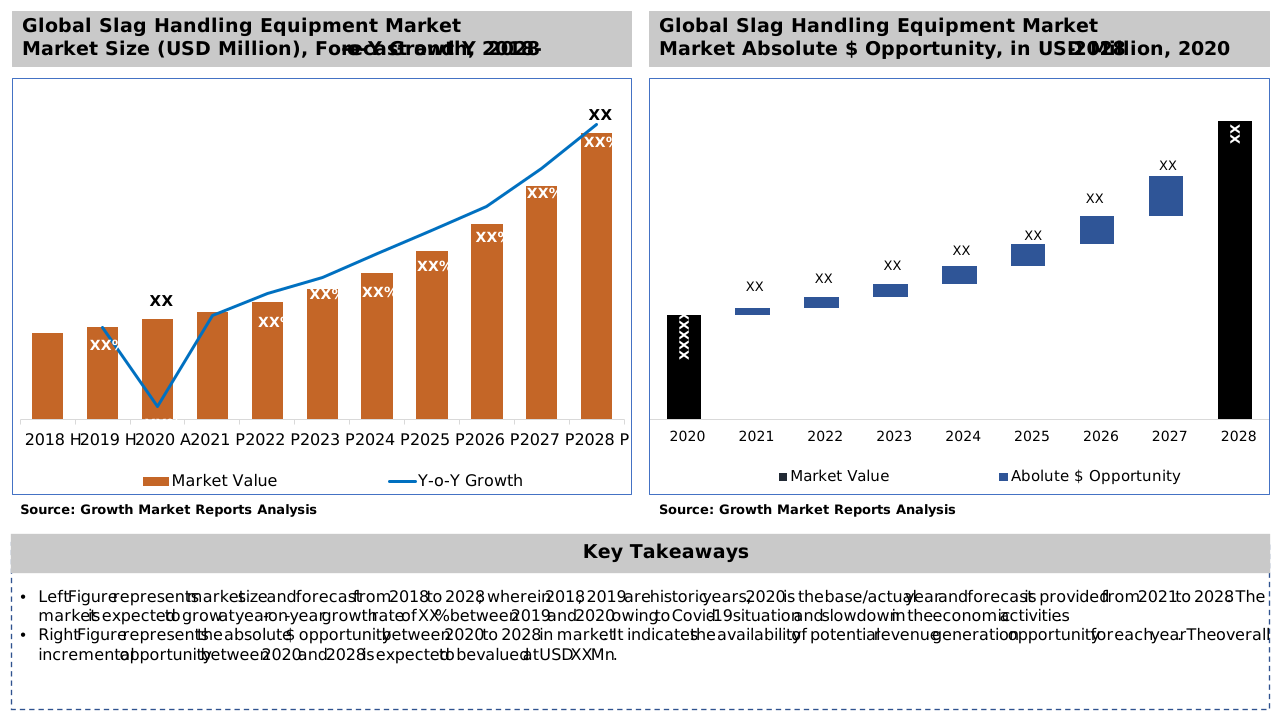
According to our latest research, the global slag handling equipment market size reached USD 1.81 billion in 2024, with a robust year-on-year growth supported by the ongoing expansion of the metallurgical and construction sectors. The market is projected to grow at a CAGR of 5.2% from 2025 to 2033, resulting in a forecasted market size of USD 2.85 billion by 2033. The primary growth factor driving this market is the increasing demand for efficient slag management solutions in steel mills and smelting plants, coupled with stringent environmental regulations mandating proper slag disposal and recycling.

A significant driver for the slag handling equipment market is the rapid industrialization and urbanization observed in emerging economies, particularly in the Asia Pacific region. As steel production and metal processing facilities expand to meet infrastructural demand, the generation of slag—a byproduct of smelting and refining—has also increased. This surge necessitates advanced slag handling solutions capable of not only managing large volumes but also improving operational efficiency and safety. The integration of automation and IoT technologies into slag handling equipment is further enhancing productivity, reducing labor costs, and minimizing human exposure to hazardous environments, thereby fueling market growth.

Environmental concerns and regulatory frameworks are also playing a pivotal role in shaping the slag handling equipment market. Governments worldwide are imposing stricter environmental standards to ensure the safe disposal and recycling of industrial byproducts such as slag. These regulations are encouraging steel mills, foundries, and power plants to invest in sophisticated slag handling systems that can facilitate the recovery of valuable metals from slag, reduce landfill waste, and lower carbon footprints. The emphasis on circular economy practices, wherein slag is repurposed for use in construction and road-building, is further boosting the adoption of advanced slag handling equipment.

Another key growth factor is the increasing adoption of energy-efficient and cost-effective slag handling solutions. Manufacturers are focusing on developing equipment with enhanced durability, reduced maintenance requirements, and improved operational flexibility to cater to diverse end-user needs. The rise of Industry 4.0 is also contributing to market expansion, as digital monitoring and predictive maintenance features are being integrated into slag handling systems to optimize performance and reduce downtime. These technological advancements are attracting investments from both established players and new entrants, intensifying competition and driving innovation across the market landscape.

Regionally, Asia Pacific dominates the slag handling equipment market, accounting for the largest share in 2024, followed by Europe and North America. The region’s dominance is attributed to the presence of major steel-producing countries such as China, India, and Japan, coupled with substantial investments in infrastructure development. North America and Europe are witnessing steady growth due to the modernization of existing metal processing facilities and a strong focus on sustainable waste management practices. Meanwhile, the Middle East & Africa and Latin America are emerging as promising markets, supported by the development of new metallurgical plants and increased mining activities.

Global Slag Handling Equipment Industry Outlook

Product Type Analysis

The slag handling equipment market by product type is segmented into slag pots, slag cars, slag skimmers, slag crushers, and others. Among these, slag pots hold a significant share, owing to their indispensable role in transporting molten slag from furnaces to designated cooling areas. The demand for high-capacity, thermally resistant slag pots is particularly high in steel mills and smelting plants, where operational efficiency and safety are paramount. Manufacturers are investing in advanced materials and design enhancements to improve the longevity and performance of slag pots, addressing the challenges posed by extreme temperatures and corrosive slag compositions.

Slag cars are another crucial product segment, especially in large-scale industrial setups where the efficient and safe transfer of slag is essential. These vehicles are engineered for durability and maneuverability, capable of operating in harsh environments and handling heavy loads. The integration of automation and remote-control features in slag cars is gaining traction, reducing the need for manual intervention and enhancing workplace safety. As steel production facilities scale up their operations, the demand for customized slag cars tailored to specific plant layouts and operational requirements is expected to rise.

Slag skimmers and slag crushers are witnessing increased adoption due to their role in improving slag processing efficiency and facilitating metal recovery. Skimmers are designed to remove floating slag from molten metal, ensuring product purity and reducing wastage. Crushers, on the other hand, are used to break down large slag pieces into manageable sizes for further processing or disposal. Technological advancements in these equipment types are focused on enhancing throughput, reducing maintenance downtime, and enabling integration with automated handling systems. These innovations are particularly beneficial for foundries and power plants aiming to optimize slag management and resource recovery.

The "Others" category includes ancillary equipment such as conveyors, cooling systems, and dust suppression solutions, all of which contribute to a comprehensive slag handling ecosystem. The growing emphasis on integrated slag management solutions is driving demand for such supporting equipment, as end-users seek to streamline operations and comply with environmental regulations. The trend toward modular and scalable slag handling systems is also evident, enabling facilities to adapt their equipment portfolios in line with changing production volumes and regulatory requirements.

Report Scope

Attributes Details
Report Title Slag Handling Equipment Market Research Report 2033
By Product Type Slag Pots, Slag Cars, Slag Skimmers, Slag Crushers, Others
By Application Steel Mills, Foundries, Smelting Plants, Power Plants, Others
By Operation Manual, Semi-Automatic, Automatic
By End-User Metallurgical Industry, Construction, Mining, Energy, Others
By Distribution Channel Direct Sales, Distributors, Online Sales, Others
Regions Covered North America, Europe, APAC, Latin America, MEA
Base Year 2024
Historic Data 2018-2023
Forecast Period 2025-2033
Number of Pages 260
Number of Tables & Figures 296
Customization Available Yes, the report can be customized as per your need.

Application Analysis

The application segment of the slag handling equipment market encompasses steel mills, foundries, smelting plants, power plants, and others. Steel mills represent the largest application area, accounting for a substantial portion of the market revenue. The sheer scale of slag generation in steel production necessitates robust handling solutions capable of managing continuous, high-volume operations. The adoption of advanced slag handling equipment in steel mills is driven by the need to enhance operational efficiency, ensure worker safety, and comply with stringent environmental standards related to slag disposal and recycling.

Foundries, which produce cast metal components for various industries, also contribute significantly to market demand. The diversity of slag types generated in foundries requires versatile handling solutions capable of accommodating different material characteristics and processing requirements. As foundries increasingly adopt automation and digital technologies to improve productivity, the integration of smart slag handling equipment is becoming more prevalent. These systems enable real-time monitoring and control of slag processing activities, reducing manual labor and minimizing the risk of equipment failure.

Smelting plants, involved in the extraction of metals from ores, generate large quantities of slag as a byproduct. Efficient slag handling is critical in these facilities to prevent production bottlenecks and ensure the safe disposal or recycling of slag. The market is witnessing a shift toward fully automated slag handling systems in smelting plants, driven by the need to enhance throughput, reduce operational costs, and minimize environmental impact. The recovery of valuable metals from smelting slag is also a key focus area, prompting investments in advanced crushers, skimmers, and separation technologies.

Power plants, particularly those utilizing coal or biomass, generate slag as a result of combustion processes. The management of boiler slag and bottom ash is essential to maintain plant efficiency and comply with environmental regulations. Slag handling equipment designed for power plants is characterized by high durability, resistance to abrasion, and the ability to operate in high-temperature environments. The trend toward cleaner energy sources and the implementation of emission control measures are driving the adoption of innovative slag handling solutions in this segment. Other application areas, including cement plants and waste-to-energy facilities, are also contributing to market growth as they seek to optimize byproduct management and resource recovery.

Operation Analysis

The slag handling equipment market is segmented by operation into manual, semi-automatic, and automatic systems. Manual slag handling equipment, while still prevalent in smaller facilities and regions with lower labor costs, is gradually being phased out in favor of more efficient and safer alternatives. The limitations of manual systems, including higher risk of workplace accidents, inconsistent performance, and increased labor expenses, are prompting end-users to explore automated solutions. However, in markets where capital expenditure is constrained, manual equipment remains a viable option, especially for low-volume or non-continuous operations.

Semi-automatic slag handling systems represent a transitional solution, combining elements of manual control with mechanized operations. These systems offer improved efficiency and safety compared to fully manual equipment, while maintaining a degree of operational flexibility. Semi-automatic systems are particularly popular in mid-sized foundries and smelting plants, where production volumes justify investment in mechanization but do not warrant full automation. The ability to retrofit existing manual equipment with semi-automatic features is also driving demand in this segment, enabling gradual modernization of slag handling processes.

Automatic slag handling systems are at the forefront of market innovation, leveraging advanced technologies such as robotics, IoT sensors, and AI-driven control algorithms. These systems deliver superior performance in terms of throughput, consistency, and safety, making them the preferred choice for large-scale steel mills, smelting plants, and power generation facilities. The adoption of automatic slag handling equipment is being accelerated by the need to reduce human exposure to hazardous environments, minimize downtime, and optimize resource utilization. The integration of predictive maintenance and remote monitoring capabilities is further enhancing the value proposition of automatic systems, enabling proactive identification of equipment issues and reducing the risk of unplanned outages.

The market is witnessing a trend toward hybrid slag handling solutions that combine the benefits of manual, semi-automatic, and automatic operations. These hybrid systems offer end-users the flexibility to tailor equipment functionality to specific process requirements and budget constraints. As technological advancements continue to drive down the cost of automation, the penetration of automatic and hybrid slag handling systems is expected to increase across all end-user segments, further propelling market growth.

End-User Analysis

The end-user landscape of the slag handling equipment market is diverse, encompassing the metallurgical industry, construction, mining, energy, and others. The metallurgical industry, which includes steel mills, foundries, and smelting plants, is the dominant end-user segment, accounting for the majority of market revenue. The high volume of slag generated in metallurgical processes, coupled with stringent quality and environmental requirements, drives the demand for advanced slag handling solutions. The ongoing modernization of metallurgical facilities, particularly in emerging markets, is further boosting investment in state-of-the-art equipment.

The construction sector represents a growing end-user segment, driven by the increasing use of processed slag as a sustainable alternative to traditional construction materials. Slag handling equipment is essential in processing and preparing slag for use in cement production, road construction, and building materials. As the construction industry embraces circular economy principles and seeks to reduce its environmental footprint, the demand for efficient slag management solutions is expected to rise. Equipment manufacturers are responding by developing systems tailored to the specific needs of construction material producers, including mobile crushers and screening units.

Mining operations generate slag as a byproduct of ore extraction and processing, necessitating effective handling and disposal solutions. The unique challenges faced by mining companies, such as remote locations and harsh operating environments, are driving demand for rugged, high-capacity slag handling equipment. The integration of automation and remote monitoring technologies is particularly valuable in mining applications, enabling efficient operation and maintenance of equipment in challenging conditions. The trend toward resource recovery and waste minimization in the mining sector is also contributing to market growth, as companies seek to extract valuable metals from slag and reduce environmental impact.

The energy sector, including coal-fired and biomass power plants, relies on slag handling equipment to manage boiler slag and ash byproducts. The transition to cleaner energy sources and the implementation of emission control technologies are influencing equipment design and selection in this segment. End-users are prioritizing solutions that offer high efficiency, low maintenance, and compliance with environmental regulations. Other end-user segments, such as waste-to-energy facilities and cement plants, are also adopting slag handling equipment to optimize byproduct management and support sustainability objectives.

Distribution Channel Analysis

The distribution channel segment of the slag handling equipment market includes direct sales, distributors, online sales, and others. Direct sales remain the most prevalent channel, particularly for large-scale industrial customers with complex equipment requirements. Manufacturers often maintain dedicated sales teams and technical support staff to engage directly with end-users, providing customized solutions and after-sales services. The direct sales model enables close collaboration between suppliers and customers, facilitating the development of equipment tailored to specific operational needs and ensuring timely delivery and installation.

Distributors play a vital role in expanding market reach, particularly in regions where manufacturers lack a direct presence. Distributors leverage their local market knowledge and established relationships with end-users to promote and sell slag handling equipment. They also provide value-added services such as installation, maintenance, and spare parts supply, enhancing the overall customer experience. The distributor channel is particularly important for small and mid-sized customers who may not have the resources to engage directly with manufacturers.

Online sales are emerging as a significant distribution channel, driven by the increasing digitization of industrial procurement processes. E-commerce platforms and manufacturer websites are providing end-users with convenient access to product information, pricing, and technical specifications, enabling informed purchasing decisions. The online channel is particularly attractive for standardized equipment and spare parts, where customization requirements are minimal. The COVID-19 pandemic has accelerated the adoption of online sales channels, as travel restrictions and supply chain disruptions prompted manufacturers and customers to embrace digital solutions.

Other distribution channels, such as system integrators and engineering, procurement, and construction (EPC) contractors, are also contributing to market growth. These channels are particularly relevant for turnkey projects and large-scale facility upgrades, where comprehensive solutions encompassing equipment supply, installation, and commissioning are required. The trend toward integrated slag management solutions is driving collaboration between equipment manufacturers, system integrators, and EPC contractors, enabling end-users to benefit from streamlined project execution and optimized system performance.

Opportunities & Threats

The slag handling equipment market is poised for significant opportunities driven by the global shift toward sustainable industrial practices and the circular economy. As industries increasingly recognize the value of slag as a resource rather than waste, there is a growing emphasis on efficient slag processing and metal recovery. This trend is opening up new revenue streams for equipment manufacturers, particularly in the development of advanced crushers, separators, and metal recovery systems. The integration of digital technologies and automation into slag handling equipment is another major opportunity, enabling real-time monitoring, predictive maintenance, and remote operation. These innovations not only enhance equipment performance and reliability but also reduce operational costs and improve safety, making them highly attractive to end-users across various industries.

Another significant opportunity lies in the expansion of slag handling equipment applications beyond traditional sectors such as steel mills and foundries. The use of processed slag in construction, road-building, and cement production is gaining traction, driven by the need for sustainable building materials and the reduction of landfill waste. Equipment manufacturers can capitalize on this trend by developing specialized solutions tailored to the needs of construction material producers and infrastructure projects. Furthermore, the increasing adoption of Industry 4.0 practices in industrial facilities is creating demand for smart, connected slag handling systems capable of seamless integration with existing plant automation and enterprise resource planning (ERP) systems. These developments are expected to drive market growth and foster innovation in equipment design and functionality.

Despite the promising growth prospects, the slag handling equipment market faces certain restrainers, most notably the high initial capital investment required for advanced equipment. Many small and mid-sized enterprises, particularly in developing regions, may find it challenging to justify the upfront costs associated with automation and digitalization. Additionally, the complexity of integrating new equipment with existing plant infrastructure can pose technical and operational challenges, potentially leading to delays and cost overruns. Economic uncertainties and fluctuations in raw material prices can also impact capital spending by end-users, affecting market growth in the short term. Addressing these restrainers will require manufacturers to offer flexible financing options, modular equipment designs, and comprehensive support services to facilitate adoption and maximize customer value.

Regional Outlook

Asia Pacific remains the dominant region in the global slag handling equipment market, accounting for approximately 48% of the total market value in 2024, or about USD 870 million. The region’s leadership is underpinned by the presence of major steel-producing countries such as China, India, and Japan, which collectively account for a significant share of global steel output and, consequently, slag generation. Rapid industrialization, urbanization, and infrastructural development are driving demand for efficient slag management solutions across the region. The adoption of advanced slag handling equipment is further supported by government initiatives promoting sustainable industrial practices and environmental protection, making Asia Pacific a key growth engine for the market.

Europe is the second-largest market, with a market size of around USD 420 million in 2024, driven by the modernization of existing metallurgical and power generation facilities. The region’s strong focus on sustainability, circular economy, and regulatory compliance is encouraging investments in state-of-the-art slag handling solutions. Countries such as Germany, Italy, and France are at the forefront of adopting innovative technologies, including automation and digitalization, to enhance operational efficiency and reduce environmental impact. The European market is expected to grow at a CAGR of 4.8% through 2033, fueled by ongoing investments in green technologies and resource recovery initiatives.

North America, with a market value of approximately USD 330 million in 2024, is characterized by a well-established industrial base and a strong emphasis on workplace safety and environmental stewardship. The United States and Canada are leading adopters of advanced slag handling equipment, particularly in steel mills, foundries, and power plants. The region is witnessing steady growth as industries upgrade their facilities to comply with evolving environmental regulations and embrace digital transformation. Meanwhile, Latin America and the Middle East & Africa are emerging as promising markets, supported by the development of new metallurgical plants, increased mining activities, and investments in power generation infrastructure. These regions collectively account for the remaining USD 190 million of the global market, with growth prospects driven by industrial expansion and the adoption of modern slag management practices.

Slag Handling Equipment Market Statistics

Competitor Outlook

The slag handling equipment market is highly competitive, with a mix of global giants and regional players vying for market share. The competitive landscape is characterized by continuous innovation, strategic partnerships, and a strong emphasis on customer-centric solutions. Leading companies are investing heavily in research and development to introduce advanced equipment with enhanced operational efficiency, durability, and automation capabilities. The focus on sustainability and resource recovery is prompting manufacturers to develop solutions that not only manage slag effectively but also facilitate the extraction of valuable metals and the repurposing of slag for construction and other applications. This innovation-driven approach is helping companies differentiate their offerings and maintain a competitive edge in a rapidly evolving market.

Strategic collaborations and partnerships are increasingly common in the slag handling equipment market, as companies seek to expand their geographic reach and enhance their product portfolios. Equipment manufacturers are partnering with system integrators, EPC contractors, and technology providers to deliver comprehensive slag management solutions tailored to the specific needs of end-users. These collaborations enable companies to leverage complementary expertise, streamline project execution, and provide end-to-end support throughout the equipment lifecycle. The trend toward integrated solutions is also driving mergers and acquisitions, as companies aim to strengthen their market position and capitalize on emerging opportunities in new application areas and regions.

Customer service and after-sales support are key differentiators in the slag handling equipment market, with leading players offering a range of services including equipment installation, maintenance, training, and spare parts supply. The ability to provide timely and effective support is critical to ensuring customer satisfaction and maintaining long-term relationships. Manufacturers are also leveraging digital technologies to enhance service delivery, offering remote monitoring, predictive maintenance, and real-time troubleshooting capabilities. These value-added services not only improve equipment uptime and performance but also create new revenue streams for suppliers.

Some of the major companies operating in the global slag handling equipment market include Paul Wurth S.A., Konecranes Plc, Tenova S.p.A., Metso Outotec Corporation, Uralmashplant JSC, TAKRAF GmbH, Shanghai Shenjia Heavy Industry Co., Ltd., and Nippon Conveyor Co., Ltd. Paul Wurth S.A. is renowned for its advanced slag handling systems for blast furnaces and steel plants, focusing on automation and environmental compliance. Konecranes Plc offers a comprehensive range of material handling solutions, including specialized slag handling cranes and transport systems designed for heavy industrial applications. Tenova S.p.A. and Metso Outotec Corporation are recognized for their innovative slag processing and metal recovery technologies, catering to the needs of steel mills, smelting plants, and power generation facilities worldwide.

Uralmashplant JSC and TAKRAF GmbH have a strong presence in the mining and metallurgical sectors, offering robust slag handling equipment capable of operating in challenging environments. Shanghai Shenjia Heavy Industry Co., Ltd. and Nippon Conveyor Co., Ltd. are prominent players in the Asia Pacific region, providing customized solutions for steel mills and construction material producers. These companies are distinguished by their focus on product quality, technological innovation, and customer support. As the market continues to evolve, leading players are expected to intensify their efforts in R&D, strategic partnerships, and geographic expansion to capitalize on emerging growth opportunities and address the evolving needs of end-users across diverse industries.

Key Players

  • Tenova S.p.A.
  • Paul Wurth S.A.
  • Metso Outotec Corporation
  • TAKRAF GmbH
  • Uralmashplant JSC
  • Magaldi Power S.p.A.
  • Loibl Förderanlagen GmbH
  • Taiyuan Heavy Industry Co., Ltd. (TYHI)
  • Konecranes Plc
  • Nippon Conveyor Co., Ltd.
  • Koenig & Bauer AG
  • Beijing Shougang International Engineering Technology Co., Ltd.
  • AMETEK Inc.
  • Atlas Copco AB
  • ThyssenKrupp AG
  • FLSmidth & Co. A/S
  • SABO S.A.
  • Schenck Process Holding GmbH
  • Caterpillar Inc.
  • Komatsu Ltd.
Slag Handling Equipment Market Overview

Segments

The Slag Handling Equipment market has been segmented on the basis of

Product Type

  • Slag Pots
  • Slag Cars
  • Slag Skimmers
  • Slag Crushers
  • Others

Application

  • Steel Mills
  • Foundries
  • Smelting Plants
  • Power Plants
  • Others

Operation

  • Manual
  • Semi-Automatic
  • Automatic

End-User

  • Metallurgical Industry
  • Construction
  • Mining
  • Energy
  • Others

Distribution Channel

  • Direct Sales
  • Distributors
  • Online Sales
  • Others

Competitive Landscape

Major players in the global slag handling equipment market includes American Crane and Equipment Corp, BHS SONTHOFEN, Dongqi Group, HORN & CO. GROUP, Stemm, Konecranes, Himalaya Steel Mill Services Private Limited, Paling Transporter, C&M Machinery, and N.M. Heilig B.V. Many of these companies have adopted research and development as a market strategy tool to enhance their market presence amid the rising global competition. The strategy is aimed to help provide better quality and new features of the products to customers.

Frequently Asked Questions

Slag handling equipment is distributed through direct sales, distributors, online sales, and system integrators/EPC contractors. Direct sales are common for large industrial buyers, while distributors and online channels help reach smaller customers and provide value-added services.

Key challenges include high initial capital investment for advanced equipment, integration complexities with existing plant infrastructure, economic uncertainties, and fluctuations in raw material prices. Small and mid-sized enterprises may face difficulties in adopting automation due to budget constraints.

Major companies in the slag handling equipment market include Paul Wurth S.A., Konecranes Plc, Tenova S.p.A., Metso Outotec Corporation, Uralmashplant JSC, TAKRAF GmbH, Shanghai Shenjia Heavy Industry Co., Ltd., and Nippon Conveyor Co., Ltd., among others.

Key trends include the adoption of energy-efficient and cost-effective solutions, integration of Industry 4.0 technologies, and the use of slag in construction and road-building. Opportunities exist in metal recovery from slag, expansion into new application areas, and development of smart, connected equipment.

Automation, IoT integration, and digital monitoring are transforming the slag handling equipment market by improving productivity, reducing labor costs, enhancing safety, and enabling predictive maintenance. Automated and semi-automatic systems are increasingly replacing manual equipment, especially in large-scale operations.

The primary end-users of slag handling equipment are the metallurgical industry (including steel mills, foundries, and smelting plants), construction, mining, and energy sectors. These industries generate large volumes of slag and require efficient handling solutions for operational efficiency and regulatory compliance.

The main types of slag handling equipment include slag pots, slag cars, slag skimmers, slag crushers, and ancillary equipment such as conveyors and cooling systems. Each type serves a specific function in the transportation, processing, or recycling of slag.

Asia Pacific dominates the slag handling equipment market, accounting for about 48% of the global market value in 2024, followed by Europe and North America. The dominance is due to major steel-producing countries like China, India, and Japan, as well as significant infrastructure investments.

The global slag handling equipment market reached USD 1.81 billion in 2024 and is projected to grow at a CAGR of 5.2% from 2025 to 2033, reaching approximately USD 2.85 billion by 2033. Growth is driven by expanding metallurgical and construction sectors, stricter environmental regulations, and technological advancements.

Slag handling equipment refers to specialized machinery used to manage, transport, process, and recycle slag—a byproduct generated during steelmaking, smelting, and power generation. Efficient slag handling is crucial for operational safety, environmental compliance, and the recovery of valuable metals from slag.

Table Of Content

Chapter 1 Executive Summary
Chapter 2 Assumptions and Acronyms Used
Chapter 3 Research Methodology
Chapter 4 Slag Handling Equipment Market Overview
   4.1 Introduction
      4.1.1 Market Taxonomy
      4.1.2 Market Definition
      4.1.3 Macro-Economic Factors Impacting the Market Growth
   4.2 Slag Handling Equipment Market Dynamics
      4.2.1 Market Drivers
      4.2.2 Market Restraints
      4.2.3 Market Opportunity
   4.3 Slag Handling Equipment Market - Supply Chain Analysis
      4.3.1 List of Key Suppliers
      4.3.2 List of Key Distributors
      4.3.3 List of Key Consumers
   4.4 Key Forces Shaping the Slag Handling Equipment Market
      4.4.1 Bargaining Power of Suppliers
      4.4.2 Bargaining Power of Buyers
      4.4.3 Threat of Substitution
      4.4.4 Threat of New Entrants
      4.4.5 Competitive Rivalry
   4.5 Global Slag Handling Equipment Market Size & Forecast, 2023-2032
      4.5.1 Slag Handling Equipment Market Size and Y-o-Y Growth
      4.5.2 Slag Handling Equipment Market Absolute $ Opportunity

Chapter 5 Global Slag Handling Equipment Market Analysis and Forecast By Product Type
   5.1 Introduction
      5.1.1 Key Market Trends & Growth Opportunities By Product Type
      5.1.2 Basis Point Share (BPS) Analysis By Product Type
      5.1.3 Absolute $ Opportunity Assessment By Product Type
   5.2 Slag Handling Equipment Market Size Forecast By Product Type
      5.2.1 Slag Pots
      5.2.2 Slag Cars
      5.2.3 Slag Skimmers
      5.2.4 Slag Crushers
      5.2.5 Others
   5.3 Market Attractiveness Analysis By Product Type

Chapter 6 Global Slag Handling Equipment Market Analysis and Forecast By Application
   6.1 Introduction
      6.1.1 Key Market Trends & Growth Opportunities By Application
      6.1.2 Basis Point Share (BPS) Analysis By Application
      6.1.3 Absolute $ Opportunity Assessment By Application
   6.2 Slag Handling Equipment Market Size Forecast By Application
      6.2.1 Steel Mills
      6.2.2 Foundries
      6.2.3 Smelting Plants
      6.2.4 Power Plants
      6.2.5 Others
   6.3 Market Attractiveness Analysis By Application

Chapter 7 Global Slag Handling Equipment Market Analysis and Forecast By Operation
   7.1 Introduction
      7.1.1 Key Market Trends & Growth Opportunities By Operation
      7.1.2 Basis Point Share (BPS) Analysis By Operation
      7.1.3 Absolute $ Opportunity Assessment By Operation
   7.2 Slag Handling Equipment Market Size Forecast By Operation
      7.2.1 Manual
      7.2.2 Semi-Automatic
      7.2.3 Automatic
   7.3 Market Attractiveness Analysis By Operation

Chapter 8 Global Slag Handling Equipment Market Analysis and Forecast By End-User
   8.1 Introduction
      8.1.1 Key Market Trends & Growth Opportunities By End-User
      8.1.2 Basis Point Share (BPS) Analysis By End-User
      8.1.3 Absolute $ Opportunity Assessment By End-User
   8.2 Slag Handling Equipment Market Size Forecast By End-User
      8.2.1 Metallurgical Industry
      8.2.2 Construction
      8.2.3 Mining
      8.2.4 Energy
      8.2.5 Others
   8.3 Market Attractiveness Analysis By End-User

Chapter 9 Global Slag Handling Equipment Market Analysis and Forecast By Distribution Channel
   9.1 Introduction
      9.1.1 Key Market Trends & Growth Opportunities By Distribution Channel
      9.1.2 Basis Point Share (BPS) Analysis By Distribution Channel
      9.1.3 Absolute $ Opportunity Assessment By Distribution Channel
   9.2 Slag Handling Equipment Market Size Forecast By Distribution Channel
      9.2.1 Direct Sales
      9.2.2 Distributors
      9.2.3 Online Sales
      9.2.4 Others
   9.3 Market Attractiveness Analysis By Distribution Channel

Chapter 10 Global Slag Handling Equipment Market Analysis and Forecast by Region
   10.1 Introduction
      10.1.1 Key Market Trends & Growth Opportunities By Region
      10.1.2 Basis Point Share (BPS) Analysis By Region
      10.1.3 Absolute $ Opportunity Assessment By Region
   10.2 Slag Handling Equipment Market Size Forecast By Region
      10.2.1 North America
      10.2.2 Europe
      10.2.3 Asia Pacific
      10.2.4 Latin America
      10.2.5 Middle East & Africa (MEA)
   10.3 Market Attractiveness Analysis By Region

Chapter 11 Coronavirus Disease (COVID-19) Impact 
   11.1 Introduction 
   11.2 Current & Future Impact Analysis 
   11.3 Economic Impact Analysis 
   11.4 Government Policies 
   11.5 Investment Scenario

Chapter 12 North America Slag Handling Equipment Analysis and Forecast
   12.1 Introduction
   12.2 North America Slag Handling Equipment Market Size Forecast by Country
      12.2.1 U.S.
      12.2.2 Canada
   12.3 Basis Point Share (BPS) Analysis by Country
   12.4 Absolute $ Opportunity Assessment by Country
   12.5 Market Attractiveness Analysis by Country
   12.6 North America Slag Handling Equipment Market Size Forecast By Product Type
      12.6.1 Slag Pots
      12.6.2 Slag Cars
      12.6.3 Slag Skimmers
      12.6.4 Slag Crushers
      12.6.5 Others
   12.7 Basis Point Share (BPS) Analysis By Product Type 
   12.8 Absolute $ Opportunity Assessment By Product Type 
   12.9 Market Attractiveness Analysis By Product Type
   12.10 North America Slag Handling Equipment Market Size Forecast By Application
      12.10.1 Steel Mills
      12.10.2 Foundries
      12.10.3 Smelting Plants
      12.10.4 Power Plants
      12.10.5 Others
   12.11 Basis Point Share (BPS) Analysis By Application 
   12.12 Absolute $ Opportunity Assessment By Application 
   12.13 Market Attractiveness Analysis By Application
   12.14 North America Slag Handling Equipment Market Size Forecast By Operation
      12.14.1 Manual
      12.14.2 Semi-Automatic
      12.14.3 Automatic
   12.15 Basis Point Share (BPS) Analysis By Operation 
   12.16 Absolute $ Opportunity Assessment By Operation 
   12.17 Market Attractiveness Analysis By Operation
   12.18 North America Slag Handling Equipment Market Size Forecast By End-User
      12.18.1 Metallurgical Industry
      12.18.2 Construction
      12.18.3 Mining
      12.18.4 Energy
      12.18.5 Others
   12.19 Basis Point Share (BPS) Analysis By End-User 
   12.20 Absolute $ Opportunity Assessment By End-User 
   12.21 Market Attractiveness Analysis By End-User
   12.22 North America Slag Handling Equipment Market Size Forecast By Distribution Channel
      12.22.1 Direct Sales
      12.22.2 Distributors
      12.22.3 Online Sales
      12.22.4 Others
   12.23 Basis Point Share (BPS) Analysis By Distribution Channel 
   12.24 Absolute $ Opportunity Assessment By Distribution Channel 
   12.25 Market Attractiveness Analysis By Distribution Channel

Chapter 13 Europe Slag Handling Equipment Analysis and Forecast
   13.1 Introduction
   13.2 Europe Slag Handling Equipment Market Size Forecast by Country
      13.2.1 Germany
      13.2.2 France
      13.2.3 Italy
      13.2.4 U.K.
      13.2.5 Spain
      13.2.6 Russia
      13.2.7 Rest of Europe
   13.3 Basis Point Share (BPS) Analysis by Country
   13.4 Absolute $ Opportunity Assessment by Country
   13.5 Market Attractiveness Analysis by Country
   13.6 Europe Slag Handling Equipment Market Size Forecast By Product Type
      13.6.1 Slag Pots
      13.6.2 Slag Cars
      13.6.3 Slag Skimmers
      13.6.4 Slag Crushers
      13.6.5 Others
   13.7 Basis Point Share (BPS) Analysis By Product Type 
   13.8 Absolute $ Opportunity Assessment By Product Type 
   13.9 Market Attractiveness Analysis By Product Type
   13.10 Europe Slag Handling Equipment Market Size Forecast By Application
      13.10.1 Steel Mills
      13.10.2 Foundries
      13.10.3 Smelting Plants
      13.10.4 Power Plants
      13.10.5 Others
   13.11 Basis Point Share (BPS) Analysis By Application 
   13.12 Absolute $ Opportunity Assessment By Application 
   13.13 Market Attractiveness Analysis By Application
   13.14 Europe Slag Handling Equipment Market Size Forecast By Operation
      13.14.1 Manual
      13.14.2 Semi-Automatic
      13.14.3 Automatic
   13.15 Basis Point Share (BPS) Analysis By Operation 
   13.16 Absolute $ Opportunity Assessment By Operation 
   13.17 Market Attractiveness Analysis By Operation
   13.18 Europe Slag Handling Equipment Market Size Forecast By End-User
      13.18.1 Metallurgical Industry
      13.18.2 Construction
      13.18.3 Mining
      13.18.4 Energy
      13.18.5 Others
   13.19 Basis Point Share (BPS) Analysis By End-User 
   13.20 Absolute $ Opportunity Assessment By End-User 
   13.21 Market Attractiveness Analysis By End-User
   13.22 Europe Slag Handling Equipment Market Size Forecast By Distribution Channel
      13.22.1 Direct Sales
      13.22.2 Distributors
      13.22.3 Online Sales
      13.22.4 Others
   13.23 Basis Point Share (BPS) Analysis By Distribution Channel 
   13.24 Absolute $ Opportunity Assessment By Distribution Channel 
   13.25 Market Attractiveness Analysis By Distribution Channel

Chapter 14 Asia Pacific Slag Handling Equipment Analysis and Forecast
   14.1 Introduction
   14.2 Asia Pacific Slag Handling Equipment Market Size Forecast by Country
      14.2.1 China
      14.2.2 Japan
      14.2.3 South Korea
      14.2.4 India
      14.2.5 Australia
      14.2.6 South East Asia (SEA)
      14.2.7 Rest of Asia Pacific (APAC)
   14.3 Basis Point Share (BPS) Analysis by Country
   14.4 Absolute $ Opportunity Assessment by Country
   14.5 Market Attractiveness Analysis by Country
   14.6 Asia Pacific Slag Handling Equipment Market Size Forecast By Product Type
      14.6.1 Slag Pots
      14.6.2 Slag Cars
      14.6.3 Slag Skimmers
      14.6.4 Slag Crushers
      14.6.5 Others
   14.7 Basis Point Share (BPS) Analysis By Product Type 
   14.8 Absolute $ Opportunity Assessment By Product Type 
   14.9 Market Attractiveness Analysis By Product Type
   14.10 Asia Pacific Slag Handling Equipment Market Size Forecast By Application
      14.10.1 Steel Mills
      14.10.2 Foundries
      14.10.3 Smelting Plants
      14.10.4 Power Plants
      14.10.5 Others
   14.11 Basis Point Share (BPS) Analysis By Application 
   14.12 Absolute $ Opportunity Assessment By Application 
   14.13 Market Attractiveness Analysis By Application
   14.14 Asia Pacific Slag Handling Equipment Market Size Forecast By Operation
      14.14.1 Manual
      14.14.2 Semi-Automatic
      14.14.3 Automatic
   14.15 Basis Point Share (BPS) Analysis By Operation 
   14.16 Absolute $ Opportunity Assessment By Operation 
   14.17 Market Attractiveness Analysis By Operation
   14.18 Asia Pacific Slag Handling Equipment Market Size Forecast By End-User
      14.18.1 Metallurgical Industry
      14.18.2 Construction
      14.18.3 Mining
      14.18.4 Energy
      14.18.5 Others
   14.19 Basis Point Share (BPS) Analysis By End-User 
   14.20 Absolute $ Opportunity Assessment By End-User 
   14.21 Market Attractiveness Analysis By End-User
   14.22 Asia Pacific Slag Handling Equipment Market Size Forecast By Distribution Channel
      14.22.1 Direct Sales
      14.22.2 Distributors
      14.22.3 Online Sales
      14.22.4 Others
   14.23 Basis Point Share (BPS) Analysis By Distribution Channel 
   14.24 Absolute $ Opportunity Assessment By Distribution Channel 
   14.25 Market Attractiveness Analysis By Distribution Channel

Chapter 15 Latin America Slag Handling Equipment Analysis and Forecast
   15.1 Introduction
   15.2 Latin America Slag Handling Equipment Market Size Forecast by Country
      15.2.1 Brazil
      15.2.2 Mexico
      15.2.3 Rest of Latin America (LATAM)
   15.3 Basis Point Share (BPS) Analysis by Country
   15.4 Absolute $ Opportunity Assessment by Country
   15.5 Market Attractiveness Analysis by Country
   15.6 Latin America Slag Handling Equipment Market Size Forecast By Product Type
      15.6.1 Slag Pots
      15.6.2 Slag Cars
      15.6.3 Slag Skimmers
      15.6.4 Slag Crushers
      15.6.5 Others
   15.7 Basis Point Share (BPS) Analysis By Product Type 
   15.8 Absolute $ Opportunity Assessment By Product Type 
   15.9 Market Attractiveness Analysis By Product Type
   15.10 Latin America Slag Handling Equipment Market Size Forecast By Application
      15.10.1 Steel Mills
      15.10.2 Foundries
      15.10.3 Smelting Plants
      15.10.4 Power Plants
      15.10.5 Others
   15.11 Basis Point Share (BPS) Analysis By Application 
   15.12 Absolute $ Opportunity Assessment By Application 
   15.13 Market Attractiveness Analysis By Application
   15.14 Latin America Slag Handling Equipment Market Size Forecast By Operation
      15.14.1 Manual
      15.14.2 Semi-Automatic
      15.14.3 Automatic
   15.15 Basis Point Share (BPS) Analysis By Operation 
   15.16 Absolute $ Opportunity Assessment By Operation 
   15.17 Market Attractiveness Analysis By Operation
   15.18 Latin America Slag Handling Equipment Market Size Forecast By End-User
      15.18.1 Metallurgical Industry
      15.18.2 Construction
      15.18.3 Mining
      15.18.4 Energy
      15.18.5 Others
   15.19 Basis Point Share (BPS) Analysis By End-User 
   15.20 Absolute $ Opportunity Assessment By End-User 
   15.21 Market Attractiveness Analysis By End-User
   15.22 Latin America Slag Handling Equipment Market Size Forecast By Distribution Channel
      15.22.1 Direct Sales
      15.22.2 Distributors
      15.22.3 Online Sales
      15.22.4 Others
   15.23 Basis Point Share (BPS) Analysis By Distribution Channel 
   15.24 Absolute $ Opportunity Assessment By Distribution Channel 
   15.25 Market Attractiveness Analysis By Distribution Channel

Chapter 16 Middle East & Africa (MEA) Slag Handling Equipment Analysis and Forecast
   16.1 Introduction
   16.2 Middle East & Africa (MEA) Slag Handling Equipment Market Size Forecast by Country
      16.2.1 Saudi Arabia
      16.2.2 South Africa
      16.2.3 UAE
      16.2.4 Rest of Middle East & Africa (MEA)
   16.3 Basis Point Share (BPS) Analysis by Country
   16.4 Absolute $ Opportunity Assessment by Country
   16.5 Market Attractiveness Analysis by Country
   16.6 Middle East & Africa (MEA) Slag Handling Equipment Market Size Forecast By Product Type
      16.6.1 Slag Pots
      16.6.2 Slag Cars
      16.6.3 Slag Skimmers
      16.6.4 Slag Crushers
      16.6.5 Others
   16.7 Basis Point Share (BPS) Analysis By Product Type 
   16.8 Absolute $ Opportunity Assessment By Product Type 
   16.9 Market Attractiveness Analysis By Product Type
   16.10 Middle East & Africa (MEA) Slag Handling Equipment Market Size Forecast By Application
      16.10.1 Steel Mills
      16.10.2 Foundries
      16.10.3 Smelting Plants
      16.10.4 Power Plants
      16.10.5 Others
   16.11 Basis Point Share (BPS) Analysis By Application 
   16.12 Absolute $ Opportunity Assessment By Application 
   16.13 Market Attractiveness Analysis By Application
   16.14 Middle East & Africa (MEA) Slag Handling Equipment Market Size Forecast By Operation
      16.14.1 Manual
      16.14.2 Semi-Automatic
      16.14.3 Automatic
   16.15 Basis Point Share (BPS) Analysis By Operation 
   16.16 Absolute $ Opportunity Assessment By Operation 
   16.17 Market Attractiveness Analysis By Operation
   16.18 Middle East & Africa (MEA) Slag Handling Equipment Market Size Forecast By End-User
      16.18.1 Metallurgical Industry
      16.18.2 Construction
      16.18.3 Mining
      16.18.4 Energy
      16.18.5 Others
   16.19 Basis Point Share (BPS) Analysis By End-User 
   16.20 Absolute $ Opportunity Assessment By End-User 
   16.21 Market Attractiveness Analysis By End-User
   16.22 Middle East & Africa (MEA) Slag Handling Equipment Market Size Forecast By Distribution Channel
      16.22.1 Direct Sales
      16.22.2 Distributors
      16.22.3 Online Sales
      16.22.4 Others
   16.23 Basis Point Share (BPS) Analysis By Distribution Channel 
   16.24 Absolute $ Opportunity Assessment By Distribution Channel 
   16.25 Market Attractiveness Analysis By Distribution Channel

Chapter 17 Competition Landscape 
   17.1 Slag Handling Equipment Market: Competitive Dashboard
   17.2 Global Slag Handling Equipment Market: Market Share Analysis, 2023
   17.3 Company Profiles (Details – Overview, Financials, Developments, Strategy) 
      17.3.1 Tenova S.p.A.
Paul Wurth S.A.
Metso Outotec Corporation
TAKRAF GmbH
Uralmashplant JSC
Magaldi Power S.p.A.
Loibl Förderanlagen GmbH
Taiyuan Heavy Industry Co., Ltd. (TYHI)
Konecranes Plc
Nippon Conveyor Co., Ltd.
Koenig & Bauer AG
Beijing Shougang International Engineering Technology Co., Ltd.
AMETEK Inc.
Atlas Copco AB
ThyssenKrupp AG
FLSmidth & Co. A/S
SABO S.A.
Schenck Process Holding GmbH
Caterpillar Inc.
Komatsu Ltd.

Methodology

Our Clients

General Electric
Microsoft
The John Holland Group
Nestle SA
FedEx Logistics
General Mills
Dassault Aviation
Deloitte