Sales Intelligence Market Research Report 2033

Sales Intelligence Market Research Report 2033

Segments - by Component (Software, Services), by Deployment Mode (Cloud, On-Premises), by Application (Lead Management, Data Management, Analytics & Reporting, Others), by Organization Size (Large Enterprises, Small and Medium Enterprises), by End-User (BFSI, IT & Telecom, Retail & E-commerce, Healthcare, Manufacturing, Others)

https://growthmarketreports.com/Raksha
Author : Raksha Sharma
https://growthmarketreports.com/Vaibhav
Fact-checked by : V. Chandola
https://growthmarketreports.com/Shruti
Editor : Shruti Bhat

Upcoming | Report ID :ICT-SE-2245 | 4.2 Rating | 90 Reviews | 283 Pages | Format : Docx PDF

Report Description


Sales Intelligence Market Outlook

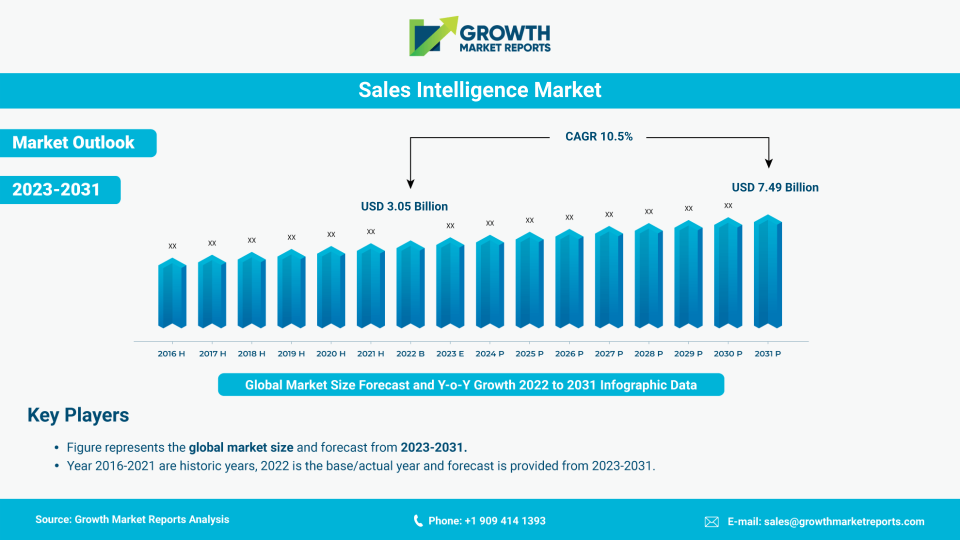
According to our latest research, the global sales intelligence market size reached USD 4.2 billion in 2024, reflecting robust adoption across industries. The market is expected to grow at a CAGR of 11.8% from 2025 to 2033, reaching a forecasted value of USD 11.8 billion by 2033. This impressive expansion is driven by the escalating demand for advanced data analytics and automation in sales processes, which enables organizations to optimize lead generation, improve customer engagement, and drive revenue growth.

A major growth factor for the sales intelligence market is the increasing emphasis on data-driven decision-making within sales organizations. Enterprises are leveraging sales intelligence platforms to gain actionable insights from vast volumes of customer and prospect data, including behavioral trends, purchase histories, and engagement patterns. This data-centric approach empowers sales teams to personalize outreach, prioritize high-value leads, and enhance conversion rates. As competition intensifies across industries, the ability to harness accurate, real-time intelligence has become a critical differentiator, prompting significant investments in sales intelligence solutions.

Another key driver is the integration of artificial intelligence (AI) and machine learning (ML) within sales intelligence platforms. AI-powered tools are transforming traditional sales processes by automating lead scoring, predictive analytics, and opportunity identification. These capabilities enable organizations to anticipate customer needs, forecast sales trends, and optimize resource allocation. The proliferation of cloud computing has further accelerated the adoption of AI-driven sales intelligence, making advanced analytics accessible to organizations of all sizes. As AI technologies continue to evolve, their role in enhancing the accuracy and efficiency of sales intelligence platforms is expected to expand, fueling further market growth.

The rapid digital transformation across verticals such as BFSI, IT & telecom, retail & e-commerce, and healthcare is also propelling the adoption of sales intelligence solutions. As customer journeys become increasingly complex and multi-channel, enterprises are seeking comprehensive platforms that can consolidate data from diverse sources, including CRM systems, social media, and web analytics. Sales intelligence tools enable seamless integration of these data streams, providing a unified view of prospects and customers. This holistic approach not only streamlines sales operations but also supports strategic decision-making, helping organizations respond swiftly to market dynamics and evolving customer expectations.

From a regional perspective, North America currently dominates the sales intelligence market, accounting for the largest share in 2024. This leadership can be attributed to the region's advanced technological infrastructure, high digital adoption rates, and the presence of numerous leading sales intelligence vendors. Europe and Asia Pacific are also witnessing substantial growth, driven by increasing investments in digital transformation and the rising adoption of cloud-based sales solutions. In particular, Asia Pacific is emerging as a high-growth region, supported by expanding SME sectors and rapid economic development. Latin America and the Middle East & Africa, while still nascent, are expected to register notable growth over the forecast period as organizations in these regions increasingly recognize the value of sales intelligence in driving business outcomes.

Global Sales Intelligence Industry Outlook

Component Analysis

The component segment of the sales intelligence market is primarily divided into software and services, each playing a pivotal role in the overall ecosystem. Software solutions dominate the market, accounting for the majority of the revenue share in 2024. These platforms offer a suite of functionalities, including data enrichment, lead scoring, predictive analytics, and CRM integration, which are essential for modern sales teams. The growing complexity of sales processes and the need for real-time, actionable insights have heightened the demand for sophisticated sales intelligence software. Vendors are continually innovating to offer more intuitive interfaces, seamless integrations, and advanced analytics capabilities, further driving software adoption across enterprises of all sizes.

On the other hand, services within the sales intelligence market are gaining traction as organizations seek expert guidance for solution implementation, customization, and ongoing support. Professional services, including consulting, training, and system integration, help businesses maximize the value of their sales intelligence investments. Managed services are also becoming increasingly popular, particularly among small and medium enterprises (SMEs) that may lack in-house expertise. These services ensure optimal platform performance, regular updates, and proactive issue resolution, enabling organizations to focus on core business activities while leveraging the full potential of their sales intelligence solutions.

The interplay between software and services is crucial in driving successful sales intelligence deployments. While software provides the foundational tools for data collection, analysis, and visualization, services ensure that these tools are effectively tailored to an organization’s unique requirements. This holistic approach supports the seamless integration of sales intelligence platforms with existing IT infrastructure, minimizes implementation risks, and accelerates time-to-value. As organizations increasingly prioritize agility and scalability, the demand for flexible, end-to-end sales intelligence solutions encompassing both software and services is expected to rise.

Looking ahead, the component landscape is likely to witness further innovation, particularly in the realm of AI-driven software and value-added services. Vendors are investing in the development of self-service analytics, natural language processing, and automated workflow capabilities to enhance user experiences and drive greater adoption. At the same time, the growing complexity of sales environments is expected to fuel demand for specialized consulting and managed services, creating new opportunities for service providers within the sales intelligence market.

Report Scope

Attributes Details
Report Title Sales Intelligence Market Research Report 2033
By Component Software, Services
By Deployment Mode Cloud, On-Premises
By Application Lead Management, Data Management, Analytics & Reporting, Others
By Organization Size Large Enterprises, Small and Medium Enterprises
By End-User BFSI, IT & Telecom, Retail & E-commerce, Healthcare, Manufacturing, Others
Regions Covered North America, Europe, APAC, Latin America, MEA
Base Year 2024
Historic Data 2018-2023
Forecast Period 2025-2033
Number of Pages 283
Number of Tables & Figures 320
Customization Available Yes, the report can be customized as per your need.

Deployment Mode Analysis

The deployment mode segment in the sales intelligence market is bifurcated into cloud and on-premises solutions, each offering distinct advantages and addressing specific business requirements. Cloud-based deployment has emerged as the preferred choice for a majority of organizations, capturing the largest market share in 2024. The scalability, flexibility, and cost-effectiveness of cloud solutions are key factors driving their widespread adoption. Cloud-based sales intelligence platforms enable organizations to access real-time data and analytics from anywhere, supporting remote and distributed sales teams. The subscription-based pricing models associated with cloud deployments also reduce upfront capital expenditures, making advanced sales intelligence accessible to businesses of all sizes, including SMEs.

On-premises deployment, while representing a smaller share of the market, remains relevant for organizations with stringent data security, compliance, or customization requirements. Industries such as BFSI and healthcare, which handle sensitive customer information, often prefer on-premises solutions to maintain greater control over data privacy and system configurations. These deployments typically involve higher initial investments and ongoing maintenance costs but offer enhanced security and integration capabilities. As regulatory requirements continue to evolve, particularly in regions with strict data protection laws, the demand for on-premises sales intelligence solutions is expected to persist among certain enterprise segments.

Hybrid deployment models are also gaining attention, combining the best of both cloud and on-premises approaches. Organizations adopting hybrid models can leverage the scalability and accessibility of the cloud for non-sensitive operations while retaining critical data and applications on-premises to ensure compliance and security. This flexibility is particularly valuable for multinational corporations operating in diverse regulatory environments. As sales intelligence vendors enhance their offerings to support hybrid deployments, organizations can achieve greater agility and resilience in their sales operations.

The ongoing shift towards digital transformation and remote work is expected to further accelerate the adoption of cloud-based sales intelligence solutions. Vendors are investing in robust cloud infrastructure, advanced security features, and seamless integration capabilities to address emerging customer needs. At the same time, the evolution of edge computing and private cloud environments may offer new avenues for organizations seeking to balance performance, security, and compliance in their sales intelligence deployments.

Application Analysis

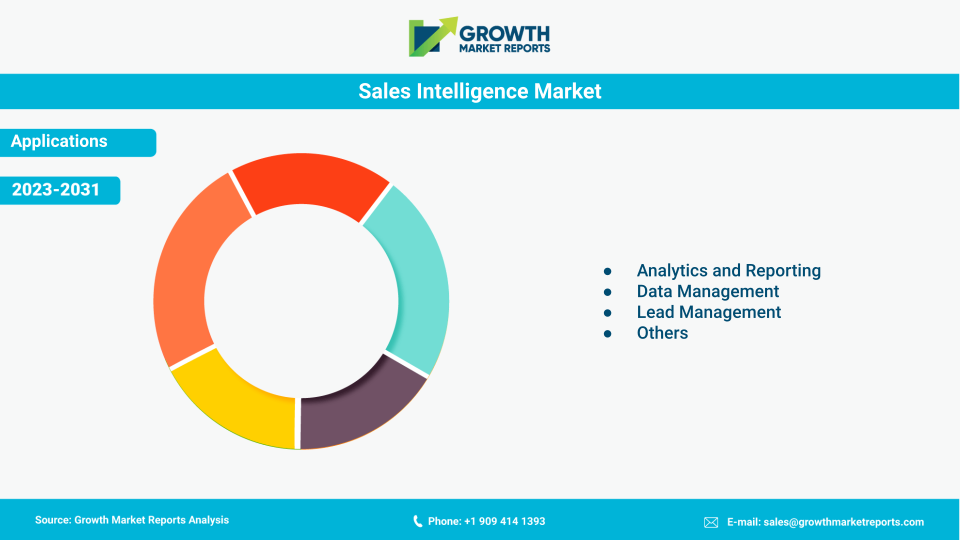
The application segment of the sales intelligence market encompasses a diverse range of use cases, including lead management, data management, analytics & reporting, and others, each contributing to the overall value proposition of sales intelligence platforms. Lead management is a primary application, enabling organizations to identify, prioritize, and nurture high-potential prospects. Advanced lead scoring algorithms, powered by AI and machine learning, help sales teams focus their efforts on the most promising opportunities, improving conversion rates and accelerating sales cycles. The ability to automate lead qualification and tracking also enhances productivity, allowing sales professionals to allocate more time to high-value activities.

Data management is another critical application area, addressing the challenges associated with collecting, cleansing, and enriching sales data from multiple sources. Sales intelligence platforms offer robust data integration and management capabilities, ensuring that organizations have access to accurate, up-to-date information on customers and prospects. This comprehensive data foundation supports personalized engagement strategies, targeted marketing campaigns, and informed decision-making. As data volumes continue to grow, the importance of effective data management in sales intelligence is expected to increase, driving demand for advanced data governance and quality assurance features.

Analytics and reporting functionalities are central to the value delivered by sales intelligence solutions. These capabilities enable organizations to analyze sales performance, forecast trends, and identify areas for improvement. Interactive dashboards, customizable reports, and real-time analytics empower sales leaders to monitor key metrics, track progress towards targets, and make data-driven decisions. The integration of predictive analytics and visualization tools further enhances the ability to uncover actionable insights, optimize sales strategies, and drive continuous improvement. As organizations seek to become more agile and responsive, the demand for advanced analytics and reporting capabilities within sales intelligence platforms is expected to rise.

Beyond these core applications, sales intelligence solutions are increasingly being leveraged for account management, competitive analysis, territory planning, and customer retention. The ability to integrate external data sources, such as social media and market intelligence, further extends the scope of sales intelligence platforms, enabling organizations to stay ahead of market trends and competitor activities. As the sales landscape continues to evolve, the application portfolio of sales intelligence solutions is expected to expand, offering new opportunities for innovation and value creation.

Organization Size Analysis

The organization size segment in the sales intelligence market distinguishes between large enterprises and small and medium enterprises (SMEs), each with unique adoption drivers and challenges. Large enterprises accounted for the majority of the market share in 2024, leveraging sales intelligence platforms to manage complex sales processes, large customer bases, and distributed sales teams. These organizations typically have the resources to invest in advanced, customizable solutions that integrate seamlessly with existing IT infrastructure. The ability to harness vast volumes of sales data, automate workflows, and generate predictive insights is particularly valuable for large enterprises seeking to drive revenue growth and maintain competitive advantage.

SMEs, while representing a smaller share of the market, are rapidly increasing their adoption of sales intelligence solutions. The democratization of cloud-based platforms and subscription-based pricing models has made advanced sales intelligence accessible to smaller organizations with limited budgets and IT resources. SMEs are leveraging these solutions to streamline lead generation, enhance customer engagement, and improve sales productivity. The ability to access real-time insights and automate routine tasks enables SMEs to compete more effectively with larger rivals, driving greater market penetration and business growth.

The distinct needs of large enterprises and SMEs are shaping the evolution of sales intelligence platforms. Vendors are developing scalable, flexible solutions that cater to the unique requirements of different organization sizes. For large enterprises, the focus is on advanced customization, integration, and analytics capabilities, while SMEs prioritize ease of use, affordability, and rapid deployment. The availability of industry-specific solutions and modular offerings further supports organizations in tailoring sales intelligence platforms to their specific needs and growth objectives.

As digital transformation accelerates across industries, the adoption of sales intelligence solutions is expected to increase among organizations of all sizes. The growing recognition of the value of data-driven sales strategies, coupled with ongoing innovation in platform features and pricing models, is likely to drive sustained growth in both the large enterprise and SME segments over the forecast period.

End-User Analysis

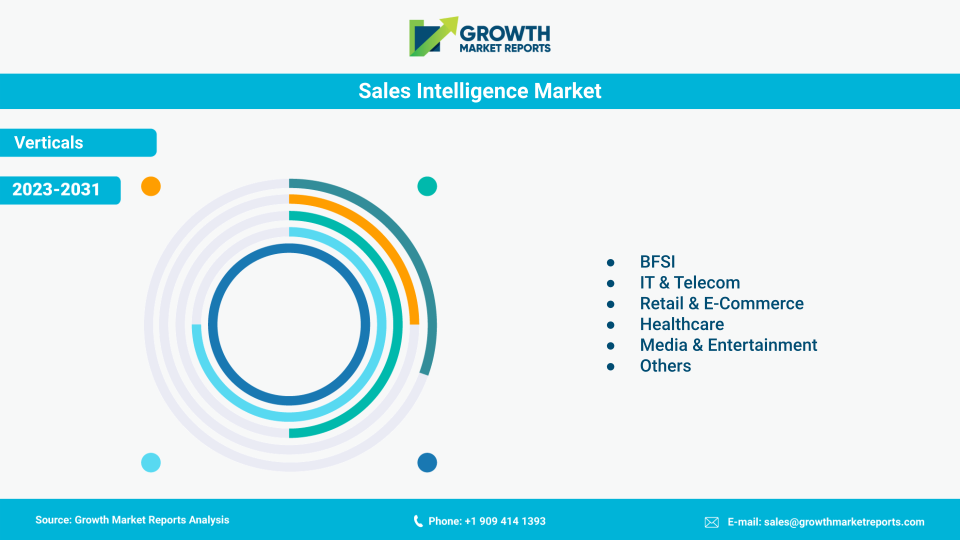
The end-user segment of the sales intelligence market comprises a diverse array of industries, including BFSI, IT & telecom, retail & e-commerce, healthcare, manufacturing, and others. The BFSI sector accounted for the largest share of the market in 2024, driven by the need to manage complex customer relationships, comply with regulatory requirements, and optimize sales processes. Sales intelligence platforms enable BFSI organizations to identify high-value clients, personalize product offerings, and enhance customer retention, contributing to improved financial performance and competitive differentiation.

The IT & telecom sector is another significant adopter of sales intelligence solutions, leveraging these platforms to manage extensive product portfolios, large customer bases, and intricate sales cycles. The ability to analyze customer behavior, track market trends, and forecast demand is particularly valuable in this fast-paced, innovation-driven industry. Sales intelligence tools also support account-based marketing, territory planning, and partner management, enabling IT & telecom companies to drive growth and maintain market leadership.

Retail & e-commerce organizations are increasingly investing in sales intelligence to enhance customer engagement, optimize pricing strategies, and drive cross-selling and upselling opportunities. The integration of sales intelligence with CRM and e-commerce platforms enables retailers to deliver personalized experiences, anticipate customer needs, and respond swiftly to market dynamics. As consumer expectations continue to evolve, the ability to leverage real-time data and predictive analytics is becoming a critical success factor for retail and e-commerce businesses.

Healthcare and manufacturing sectors are also recognizing the value of sales intelligence in improving sales effectiveness, managing complex supply chains, and navigating regulatory environments. In healthcare, sales intelligence platforms support targeted outreach, relationship management, and compliance tracking, while in manufacturing, they enable demand forecasting, channel management, and competitive analysis. As digital transformation accelerates across industries, the adoption of sales intelligence solutions is expected to expand, creating new opportunities for vendors and end-users alike.

Opportunities & Threats

The sales intelligence market presents significant opportunities for growth, driven by ongoing technological advancements and evolving business needs. The integration of artificial intelligence and machine learning into sales intelligence platforms is enabling organizations to unlock new levels of insight, automation, and personalization. As AI-powered tools become more sophisticated, they offer the potential to transform sales processes, from lead generation and qualification to customer engagement and retention. The emergence of self-service analytics, natural language processing, and predictive modeling is empowering sales teams to make smarter, faster decisions, driving improved outcomes and competitive advantage.

Another major opportunity lies in the increasing adoption of cloud-based sales intelligence solutions, particularly among small and medium enterprises. The scalability, flexibility, and affordability of cloud platforms are making advanced sales intelligence accessible to a broader range of organizations, supporting business growth and market expansion. Vendors that can offer robust, user-friendly, and secure cloud solutions are well-positioned to capture a growing share of the market. Additionally, the rising demand for industry-specific and modular sales intelligence offerings presents opportunities for vendors to differentiate their products and address unique customer needs.

Despite these opportunities, the sales intelligence market faces several restraining factors, chief among them being concerns around data privacy and security. As organizations increasingly rely on sales intelligence platforms to collect, store, and analyze sensitive customer information, the risk of data breaches and compliance violations grows. Stringent data protection regulations, such as GDPR and CCPA, require organizations to implement robust security measures and ensure transparency in data handling practices. Failure to address these concerns can undermine customer trust, expose organizations to legal liabilities, and hinder market growth. Vendors must prioritize data security and compliance in their product development and go-to-market strategies to mitigate these risks and sustain long-term success.

Regional Outlook

North America maintained its dominant position in the global sales intelligence market in 2024, accounting for approximately 42% of the total market share, which translates to around USD 1.76 billion. The region’s leadership is underpinned by advanced technological infrastructure, high digital adoption rates, and a strong presence of leading sales intelligence vendors. The United States, in particular, is a major contributor, with organizations across industries embracing sales intelligence solutions to drive business growth and maintain competitive edge. The region is also characterized by a high degree of innovation, with vendors continually introducing new features and capabilities to meet evolving customer needs.

Europe is the second-largest market for sales intelligence, capturing about 28% of the global share, or approximately USD 1.18 billion in 2024. The region is witnessing steady growth, driven by increasing investments in digital transformation, data analytics, and cloud computing. Countries such as the United Kingdom, Germany, and France are at the forefront of adoption, with organizations leveraging sales intelligence platforms to optimize sales operations, enhance customer engagement, and comply with stringent data protection regulations. The European market is expected to grow at a CAGR of 10.9% from 2025 to 2033, supported by ongoing innovation and regulatory developments.

Asia Pacific is emerging as a high-growth region in the sales intelligence market, accounting for around 20% of the global share, or USD 0.84 billion in 2024. The region’s rapid economic development, expanding SME sector, and increasing digitalization are key drivers of market growth. Countries such as China, India, Japan, and Australia are witnessing rising adoption of sales intelligence solutions, supported by government initiatives to promote digital transformation and innovation. The Asia Pacific market is expected to register the fastest CAGR over the forecast period, outpacing more mature markets as organizations seek to leverage data-driven sales strategies to capitalize on new business opportunities.

Sales Intelligence Market Statistics

Competitor Outlook

The global sales intelligence market is highly competitive, characterized by the presence of established technology giants, specialized vendors, and a growing number of innovative startups. The competitive landscape is shaped by continuous innovation, strategic partnerships, and mergers and acquisitions, as vendors seek to expand their product offerings, enhance capabilities, and increase market share. Leading players are investing heavily in research and development to integrate advanced technologies such as artificial intelligence, machine learning, and natural language processing into their platforms, enabling customers to derive greater value from their sales intelligence investments.

Customization, scalability, and integration capabilities are key differentiators in the market, with vendors focusing on delivering tailored solutions that address the unique needs of different industries, organization sizes, and deployment preferences. The shift towards cloud-based platforms has intensified competition, as vendors compete to offer robust, secure, and user-friendly solutions that can be rapidly deployed and scaled. At the same time, the growing importance of data privacy and compliance is prompting vendors to enhance security features and ensure adherence to global and regional regulations, further influencing purchasing decisions.

Strategic collaborations and ecosystem partnerships are also playing a crucial role in shaping the competitive landscape. Vendors are partnering with CRM providers, data aggregators, and analytics firms to offer integrated solutions that deliver end-to-end value across the sales cycle. These partnerships enable organizations to leverage best-in-class technologies, streamline workflows, and maximize the return on their sales intelligence investments. The emergence of industry-specific solutions and modular offerings is creating new opportunities for differentiation and market expansion, as vendors seek to address the evolving needs of diverse customer segments.

Some of the major companies operating in the sales intelligence market include LinkedIn Corporation (Microsoft), Dun & Bradstreet, Oracle Corporation, Salesforce, Inc., ZoomInfo Technologies Inc., InsideView Technologies (Demandbase), Clearbit, DiscoverOrg (now part of ZoomInfo), RelPro, and Cognism. LinkedIn, with its vast professional network and data analytics capabilities, offers powerful sales intelligence tools that enable organizations to identify and engage high-value prospects. Dun & Bradstreet is renowned for its comprehensive business data and analytics solutions, supporting lead generation, risk assessment, and market research. Oracle and Salesforce provide integrated sales intelligence platforms as part of their broader CRM and cloud offerings, delivering advanced analytics, automation, and reporting capabilities.

ZoomInfo Technologies has established itself as a leading provider of B2B sales intelligence, offering a robust platform that combines data enrichment, predictive analytics, and workflow automation. InsideView Technologies, now part of Demandbase, specializes in market intelligence and account-based marketing solutions, helping organizations identify growth opportunities and drive targeted outreach. Clearbit and Cognism are notable for their innovative approaches to data enrichment and sales prospecting, offering real-time insights and integrations with popular sales and marketing platforms. These companies, along with a host of emerging startups, are driving the evolution of the sales intelligence market, shaping its future trajectory through continuous innovation and customer-centric strategies.

Key Players

  • LinkedIn Corporation
  • Dun & Bradstreet
  • Oracle Corporation
  • Salesforce.com, Inc.
  • ZoomInfo Technologies Inc.
  • Clearbit
  • InsideView Technologies, Inc.
  • DiscoverOrg (now part of ZoomInfo)
  • HG Insights
  • Demandbase
  • UpLead
  • LeadGenius
  • RelPro, Inc.
  • Lusha
  • 6sense
  • EverString (now part of ZoomInfo)
  • Adapt.io
  • Cognism
  • Slintel (now part of 6sense)
  • Apollo.io
Sales Intelligence Market Overview

Segments

The Sales Intelligence market has been segmented on the basis of

Component

  • Software
  • Services

Deployment Mode

  • Cloud
  • On-Premises

Application

  • Lead Management
  • Data Management
  • Analytics & Reporting
  • Others

Organization Size

  • Large Enterprises
  • Small and Medium Enterprises

End-User

  • BFSI
  • IT & Telecom
  • Retail & E-commerce
  • Healthcare
  • Manufacturing
  • Others

Competitive Landscape

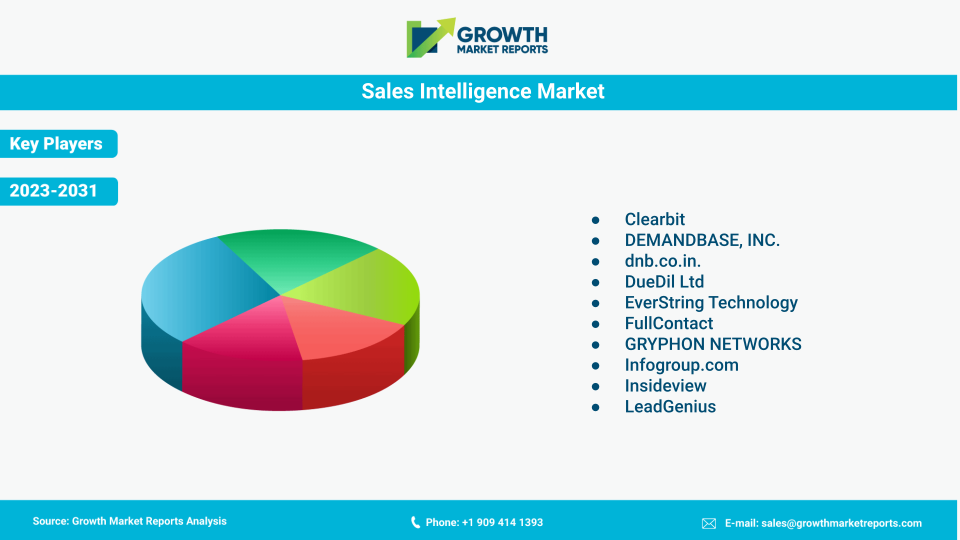
The key players in the global sales intelligence market are dnb.co.in.; Zoom Information, Inc.; Yesware, Inc.; Oracle; DEMANDBASE, INC.; Clearbit; LeadGenius; Infogroup.com; UpLead; Relationship Capital Partners Inc. and RelPro, Inc.; DueDil Ltd; EverString Technology; LinkedIn Corporation; RingLead, Inc.; GRYPHON NETWORKS; Insideview; List Partners LLC; FullContact; Zoho Corporation Pvt. Ltd..

These key players have adopted a series of market strategies including new product launching, entering into partnership, collaboration, and production expansion to enhance their market position and expand their consumer base.

Sales Intelligence Market Key Players

Frequently Asked Questions

Trends include the rise of AI-driven analytics, hybrid deployment models, self-service analytics, natural language processing, and increased focus on data security and compliance.

Large enterprises use advanced, customizable solutions for complex sales processes, while SMEs benefit from affordable, easy-to-use cloud-based platforms that improve sales productivity and competitiveness.

Opportunities include the integration of AI/ML, growth of cloud-based solutions, and demand for industry-specific offerings. Challenges involve data privacy and security concerns, and compliance with regulations such as GDPR and CCPA.

North America dominates the market, followed by Europe and Asia Pacific. North America accounted for about 42% of the market in 2024, with Europe at 28% and Asia Pacific emerging as a high-growth region.

Major companies include LinkedIn Corporation (Microsoft), Dun & Bradstreet, Oracle Corporation, Salesforce, ZoomInfo Technologies, InsideView Technologies (Demandbase), Clearbit, DiscoverOrg, RelPro, and Cognism.

Sales intelligence platforms are used for lead management, data management, analytics & reporting, account management, competitive analysis, territory planning, and customer retention.

Cloud-based solutions offer scalability, flexibility, and cost-effectiveness, making them popular among organizations of all sizes. On-premises solutions are preferred by industries with strict data security and compliance needs, such as BFSI and healthcare, offering enhanced control over data privacy.

Key industries adopting sales intelligence include BFSI, IT & telecom, retail & e-commerce, healthcare, and manufacturing, each leveraging these tools to optimize sales processes and enhance customer engagement.

Major growth drivers include the increasing emphasis on data-driven decision-making, integration of AI and machine learning, rapid digital transformation across industries, and the need for advanced data analytics and automation in sales processes.

The global sales intelligence market reached USD 4.2 billion in 2024 and is expected to grow at a CAGR of 11.8% from 2025 to 2033, reaching USD 11.8 billion by 2033.

Table Of Content

Chapter 1 Executive Summary
Chapter 2 Assumptions and Acronyms Used
Chapter 3 Research Methodology
Chapter 4 Sales Intelligence Market Overview
   4.1 Introduction
      4.1.1 Market Taxonomy
      4.1.2 Market Definition
      4.1.3 Macro-Economic Factors Impacting the Market Growth
   4.2 Sales Intelligence Market Dynamics
      4.2.1 Market Drivers
      4.2.2 Market Restraints
      4.2.3 Market Opportunity
   4.3 Sales Intelligence Market - Supply Chain Analysis
      4.3.1 List of Key Suppliers
      4.3.2 List of Key Distributors
      4.3.3 List of Key Consumers
   4.4 Key Forces Shaping the Sales Intelligence Market
      4.4.1 Bargaining Power of Suppliers
      4.4.2 Bargaining Power of Buyers
      4.4.3 Threat of Substitution
      4.4.4 Threat of New Entrants
      4.4.5 Competitive Rivalry
   4.5 Global Sales Intelligence Market Size & Forecast, 2023-2032
      4.5.1 Sales Intelligence Market Size and Y-o-Y Growth
      4.5.2 Sales Intelligence Market Absolute $ Opportunity

Chapter 5 Global Sales Intelligence Market Analysis and Forecast By Component
   5.1 Introduction
      5.1.1 Key Market Trends & Growth Opportunities By Component
      5.1.2 Basis Point Share (BPS) Analysis By Component
      5.1.3 Absolute $ Opportunity Assessment By Component
   5.2 Sales Intelligence Market Size Forecast By Component
      5.2.1 Software
      5.2.2 Services
   5.3 Market Attractiveness Analysis By Component

Chapter 6 Global Sales Intelligence Market Analysis and Forecast By Deployment Mode
   6.1 Introduction
      6.1.1 Key Market Trends & Growth Opportunities By Deployment Mode
      6.1.2 Basis Point Share (BPS) Analysis By Deployment Mode
      6.1.3 Absolute $ Opportunity Assessment By Deployment Mode
   6.2 Sales Intelligence Market Size Forecast By Deployment Mode
      6.2.1 Cloud
      6.2.2 On-Premises
   6.3 Market Attractiveness Analysis By Deployment Mode

Chapter 7 Global Sales Intelligence Market Analysis and Forecast By Application
   7.1 Introduction
      7.1.1 Key Market Trends & Growth Opportunities By Application
      7.1.2 Basis Point Share (BPS) Analysis By Application
      7.1.3 Absolute $ Opportunity Assessment By Application
   7.2 Sales Intelligence Market Size Forecast By Application
      7.2.1 Lead Management
      7.2.2 Data Management
      7.2.3 Analytics & Reporting
      7.2.4 Others
   7.3 Market Attractiveness Analysis By Application

Chapter 8 Global Sales Intelligence Market Analysis and Forecast By Organization Size
   8.1 Introduction
      8.1.1 Key Market Trends & Growth Opportunities By Organization Size
      8.1.2 Basis Point Share (BPS) Analysis By Organization Size
      8.1.3 Absolute $ Opportunity Assessment By Organization Size
   8.2 Sales Intelligence Market Size Forecast By Organization Size
      8.2.1 Large Enterprises
      8.2.2 Small and Medium Enterprises
   8.3 Market Attractiveness Analysis By Organization Size

Chapter 9 Global Sales Intelligence Market Analysis and Forecast By End-User
   9.1 Introduction
      9.1.1 Key Market Trends & Growth Opportunities By End-User
      9.1.2 Basis Point Share (BPS) Analysis By End-User
      9.1.3 Absolute $ Opportunity Assessment By End-User
   9.2 Sales Intelligence Market Size Forecast By End-User
      9.2.1 BFSI
      9.2.2 IT & Telecom
      9.2.3 Retail & E-commerce
      9.2.4 Healthcare
      9.2.5 Manufacturing
      9.2.6 Others
   9.3 Market Attractiveness Analysis By End-User

Chapter 10 Global Sales Intelligence Market Analysis and Forecast by Region
   10.1 Introduction
      10.1.1 Key Market Trends & Growth Opportunities By Region
      10.1.2 Basis Point Share (BPS) Analysis By Region
      10.1.3 Absolute $ Opportunity Assessment By Region
   10.2 Sales Intelligence Market Size Forecast By Region
      10.2.1 North America
      10.2.2 Europe
      10.2.3 Asia Pacific
      10.2.4 Latin America
      10.2.5 Middle East & Africa (MEA)
   10.3 Market Attractiveness Analysis By Region

Chapter 11 Coronavirus Disease (COVID-19) Impact 
   11.1 Introduction 
   11.2 Current & Future Impact Analysis 
   11.3 Economic Impact Analysis 
   11.4 Government Policies 
   11.5 Investment Scenario

Chapter 12 North America Sales Intelligence Analysis and Forecast
   12.1 Introduction
   12.2 North America Sales Intelligence Market Size Forecast by Country
      12.2.1 U.S.
      12.2.2 Canada
   12.3 Basis Point Share (BPS) Analysis by Country
   12.4 Absolute $ Opportunity Assessment by Country
   12.5 Market Attractiveness Analysis by Country
   12.6 North America Sales Intelligence Market Size Forecast By Component
      12.6.1 Software
      12.6.2 Services
   12.7 Basis Point Share (BPS) Analysis By Component 
   12.8 Absolute $ Opportunity Assessment By Component 
   12.9 Market Attractiveness Analysis By Component
   12.10 North America Sales Intelligence Market Size Forecast By Deployment Mode
      12.10.1 Cloud
      12.10.2 On-Premises
   12.11 Basis Point Share (BPS) Analysis By Deployment Mode 
   12.12 Absolute $ Opportunity Assessment By Deployment Mode 
   12.13 Market Attractiveness Analysis By Deployment Mode
   12.14 North America Sales Intelligence Market Size Forecast By Application
      12.14.1 Lead Management
      12.14.2 Data Management
      12.14.3 Analytics & Reporting
      12.14.4 Others
   12.15 Basis Point Share (BPS) Analysis By Application 
   12.16 Absolute $ Opportunity Assessment By Application 
   12.17 Market Attractiveness Analysis By Application
   12.18 North America Sales Intelligence Market Size Forecast By Organization Size
      12.18.1 Large Enterprises
      12.18.2 Small and Medium Enterprises
   12.19 Basis Point Share (BPS) Analysis By Organization Size 
   12.20 Absolute $ Opportunity Assessment By Organization Size 
   12.21 Market Attractiveness Analysis By Organization Size
   12.22 North America Sales Intelligence Market Size Forecast By End-User
      12.22.1 BFSI
      12.22.2 IT & Telecom
      12.22.3 Retail & E-commerce
      12.22.4 Healthcare
      12.22.5 Manufacturing
      12.22.6 Others
   12.23 Basis Point Share (BPS) Analysis By End-User 
   12.24 Absolute $ Opportunity Assessment By End-User 
   12.25 Market Attractiveness Analysis By End-User

Chapter 13 Europe Sales Intelligence Analysis and Forecast
   13.1 Introduction
   13.2 Europe Sales Intelligence Market Size Forecast by Country
      13.2.1 Germany
      13.2.2 France
      13.2.3 Italy
      13.2.4 U.K.
      13.2.5 Spain
      13.2.6 Russia
      13.2.7 Rest of Europe
   13.3 Basis Point Share (BPS) Analysis by Country
   13.4 Absolute $ Opportunity Assessment by Country
   13.5 Market Attractiveness Analysis by Country
   13.6 Europe Sales Intelligence Market Size Forecast By Component
      13.6.1 Software
      13.6.2 Services
   13.7 Basis Point Share (BPS) Analysis By Component 
   13.8 Absolute $ Opportunity Assessment By Component 
   13.9 Market Attractiveness Analysis By Component
   13.10 Europe Sales Intelligence Market Size Forecast By Deployment Mode
      13.10.1 Cloud
      13.10.2 On-Premises
   13.11 Basis Point Share (BPS) Analysis By Deployment Mode 
   13.12 Absolute $ Opportunity Assessment By Deployment Mode 
   13.13 Market Attractiveness Analysis By Deployment Mode
   13.14 Europe Sales Intelligence Market Size Forecast By Application
      13.14.1 Lead Management
      13.14.2 Data Management
      13.14.3 Analytics & Reporting
      13.14.4 Others
   13.15 Basis Point Share (BPS) Analysis By Application 
   13.16 Absolute $ Opportunity Assessment By Application 
   13.17 Market Attractiveness Analysis By Application
   13.18 Europe Sales Intelligence Market Size Forecast By Organization Size
      13.18.1 Large Enterprises
      13.18.2 Small and Medium Enterprises
   13.19 Basis Point Share (BPS) Analysis By Organization Size 
   13.20 Absolute $ Opportunity Assessment By Organization Size 
   13.21 Market Attractiveness Analysis By Organization Size
   13.22 Europe Sales Intelligence Market Size Forecast By End-User
      13.22.1 BFSI
      13.22.2 IT & Telecom
      13.22.3 Retail & E-commerce
      13.22.4 Healthcare
      13.22.5 Manufacturing
      13.22.6 Others
   13.23 Basis Point Share (BPS) Analysis By End-User 
   13.24 Absolute $ Opportunity Assessment By End-User 
   13.25 Market Attractiveness Analysis By End-User

Chapter 14 Asia Pacific Sales Intelligence Analysis and Forecast
   14.1 Introduction
   14.2 Asia Pacific Sales Intelligence Market Size Forecast by Country
      14.2.1 China
      14.2.2 Japan
      14.2.3 South Korea
      14.2.4 India
      14.2.5 Australia
      14.2.6 South East Asia (SEA)
      14.2.7 Rest of Asia Pacific (APAC)
   14.3 Basis Point Share (BPS) Analysis by Country
   14.4 Absolute $ Opportunity Assessment by Country
   14.5 Market Attractiveness Analysis by Country
   14.6 Asia Pacific Sales Intelligence Market Size Forecast By Component
      14.6.1 Software
      14.6.2 Services
   14.7 Basis Point Share (BPS) Analysis By Component 
   14.8 Absolute $ Opportunity Assessment By Component 
   14.9 Market Attractiveness Analysis By Component
   14.10 Asia Pacific Sales Intelligence Market Size Forecast By Deployment Mode
      14.10.1 Cloud
      14.10.2 On-Premises
   14.11 Basis Point Share (BPS) Analysis By Deployment Mode 
   14.12 Absolute $ Opportunity Assessment By Deployment Mode 
   14.13 Market Attractiveness Analysis By Deployment Mode
   14.14 Asia Pacific Sales Intelligence Market Size Forecast By Application
      14.14.1 Lead Management
      14.14.2 Data Management
      14.14.3 Analytics & Reporting
      14.14.4 Others
   14.15 Basis Point Share (BPS) Analysis By Application 
   14.16 Absolute $ Opportunity Assessment By Application 
   14.17 Market Attractiveness Analysis By Application
   14.18 Asia Pacific Sales Intelligence Market Size Forecast By Organization Size
      14.18.1 Large Enterprises
      14.18.2 Small and Medium Enterprises
   14.19 Basis Point Share (BPS) Analysis By Organization Size 
   14.20 Absolute $ Opportunity Assessment By Organization Size 
   14.21 Market Attractiveness Analysis By Organization Size
   14.22 Asia Pacific Sales Intelligence Market Size Forecast By End-User
      14.22.1 BFSI
      14.22.2 IT & Telecom
      14.22.3 Retail & E-commerce
      14.22.4 Healthcare
      14.22.5 Manufacturing
      14.22.6 Others
   14.23 Basis Point Share (BPS) Analysis By End-User 
   14.24 Absolute $ Opportunity Assessment By End-User 
   14.25 Market Attractiveness Analysis By End-User

Chapter 15 Latin America Sales Intelligence Analysis and Forecast
   15.1 Introduction
   15.2 Latin America Sales Intelligence Market Size Forecast by Country
      15.2.1 Brazil
      15.2.2 Mexico
      15.2.3 Rest of Latin America (LATAM)
   15.3 Basis Point Share (BPS) Analysis by Country
   15.4 Absolute $ Opportunity Assessment by Country
   15.5 Market Attractiveness Analysis by Country
   15.6 Latin America Sales Intelligence Market Size Forecast By Component
      15.6.1 Software
      15.6.2 Services
   15.7 Basis Point Share (BPS) Analysis By Component 
   15.8 Absolute $ Opportunity Assessment By Component 
   15.9 Market Attractiveness Analysis By Component
   15.10 Latin America Sales Intelligence Market Size Forecast By Deployment Mode
      15.10.1 Cloud
      15.10.2 On-Premises
   15.11 Basis Point Share (BPS) Analysis By Deployment Mode 
   15.12 Absolute $ Opportunity Assessment By Deployment Mode 
   15.13 Market Attractiveness Analysis By Deployment Mode
   15.14 Latin America Sales Intelligence Market Size Forecast By Application
      15.14.1 Lead Management
      15.14.2 Data Management
      15.14.3 Analytics & Reporting
      15.14.4 Others
   15.15 Basis Point Share (BPS) Analysis By Application 
   15.16 Absolute $ Opportunity Assessment By Application 
   15.17 Market Attractiveness Analysis By Application
   15.18 Latin America Sales Intelligence Market Size Forecast By Organization Size
      15.18.1 Large Enterprises
      15.18.2 Small and Medium Enterprises
   15.19 Basis Point Share (BPS) Analysis By Organization Size 
   15.20 Absolute $ Opportunity Assessment By Organization Size 
   15.21 Market Attractiveness Analysis By Organization Size
   15.22 Latin America Sales Intelligence Market Size Forecast By End-User
      15.22.1 BFSI
      15.22.2 IT & Telecom
      15.22.3 Retail & E-commerce
      15.22.4 Healthcare
      15.22.5 Manufacturing
      15.22.6 Others
   15.23 Basis Point Share (BPS) Analysis By End-User 
   15.24 Absolute $ Opportunity Assessment By End-User 
   15.25 Market Attractiveness Analysis By End-User

Chapter 16 Middle East & Africa (MEA) Sales Intelligence Analysis and Forecast
   16.1 Introduction
   16.2 Middle East & Africa (MEA) Sales Intelligence Market Size Forecast by Country
      16.2.1 Saudi Arabia
      16.2.2 South Africa
      16.2.3 UAE
      16.2.4 Rest of Middle East & Africa (MEA)
   16.3 Basis Point Share (BPS) Analysis by Country
   16.4 Absolute $ Opportunity Assessment by Country
   16.5 Market Attractiveness Analysis by Country
   16.6 Middle East & Africa (MEA) Sales Intelligence Market Size Forecast By Component
      16.6.1 Software
      16.6.2 Services
   16.7 Basis Point Share (BPS) Analysis By Component 
   16.8 Absolute $ Opportunity Assessment By Component 
   16.9 Market Attractiveness Analysis By Component
   16.10 Middle East & Africa (MEA) Sales Intelligence Market Size Forecast By Deployment Mode
      16.10.1 Cloud
      16.10.2 On-Premises
   16.11 Basis Point Share (BPS) Analysis By Deployment Mode 
   16.12 Absolute $ Opportunity Assessment By Deployment Mode 
   16.13 Market Attractiveness Analysis By Deployment Mode
   16.14 Middle East & Africa (MEA) Sales Intelligence Market Size Forecast By Application
      16.14.1 Lead Management
      16.14.2 Data Management
      16.14.3 Analytics & Reporting
      16.14.4 Others
   16.15 Basis Point Share (BPS) Analysis By Application 
   16.16 Absolute $ Opportunity Assessment By Application 
   16.17 Market Attractiveness Analysis By Application
   16.18 Middle East & Africa (MEA) Sales Intelligence Market Size Forecast By Organization Size
      16.18.1 Large Enterprises
      16.18.2 Small and Medium Enterprises
   16.19 Basis Point Share (BPS) Analysis By Organization Size 
   16.20 Absolute $ Opportunity Assessment By Organization Size 
   16.21 Market Attractiveness Analysis By Organization Size
   16.22 Middle East & Africa (MEA) Sales Intelligence Market Size Forecast By End-User
      16.22.1 BFSI
      16.22.2 IT & Telecom
      16.22.3 Retail & E-commerce
      16.22.4 Healthcare
      16.22.5 Manufacturing
      16.22.6 Others
   16.23 Basis Point Share (BPS) Analysis By End-User 
   16.24 Absolute $ Opportunity Assessment By End-User 
   16.25 Market Attractiveness Analysis By End-User

Chapter 17 Competition Landscape 
   17.1 Sales Intelligence Market: Competitive Dashboard
   17.2 Global Sales Intelligence Market: Market Share Analysis, 2023
   17.3 Company Profiles (Details â€“ Overview, Financials, Developments, Strategy) 
      17.3.1 LinkedIn Corporation
Dun & Bradstreet
Oracle Corporation
Salesforce.com, Inc.
ZoomInfo Technologies Inc.
Clearbit
InsideView Technologies, Inc.
DiscoverOrg (now part of ZoomInfo)
HG Insights
Demandbase
UpLead
LeadGenius
RelPro, Inc.
Lusha
6sense
EverString (now part of ZoomInfo)
Adapt.io
Cognism
Slintel (now part of 6sense)
Apollo.io

Methodology

Our Clients

Dassault Aviation
Honda Motor Co. Ltd.
FedEx Logistics
sinopec
Microsoft
General Electric
Pfizer
The John Holland Group