
Renewable Isopropanol Market Size, Share & Growth Analysis, 2026-2034
Renewable Isopropanol Market Size, Share & Growth Analysis, 2026-2034
Segments - by Feedstock (Biomass, Agricultural Waste, Industrial Waste, Others), by Production Process (Fermentation, Catalytic Hydrogenation, Others), by Application (Solvents, Pharmaceuticals, Cosmetics & Personal Care, Chemicals, Fuels & Additives, Others), by End-Use Industry (Pharmaceuticals, Chemicals, Personal Care, Food & Beverage, Others)



Last Updated : Jun, 2026
| Report ID :MC-39158
| 4.5 Rating
| 91 Reviews
| 291 Pages
| Format :


Renewable Isopropanol Market: Key Numbers
The Renewable Isopropanol market was valued at USD 707 Million in 2025 and is projected to reach USD 1579 Million by 2034, a CAGR of 9.3%.
| Market size (2025) | USD 707 Million |
|---|---|
| Forecast (2034) | USD 1579 Million |
| CAGR (2026-2034) | 9.3% |
| Segments covered | Feedstock, Production Process, Application, End-Use Industry |
| Key companies | Gevo, Inc., LanzaTech Inc., Clariant AG, INEOS Group Holdings S.A., Dow Inc. |
This report is updated with the latest market data and insights as of June 2026. Base year: 2025 | Forecast period: 2026-2034
Renewable Isopropanol Market Size and Growth Outlook
Across all regions, the renewable isopropanol market size reached USD 707 million in 2025, reflecting a robust surge in demand for sustainable solvents and chemicals worldwide. The market is experiencing strong growth momentum, with a compound annual growth rate (CAGR) of 9.3% projected from 2026 to 2034. By 2034, the market is forecasted to attain a value of USD 1,579 million, driven by increasing regulatory pressure to reduce carbon emissions, rising consumer awareness of green chemistry, and a decisive shift among industries toward eco-friendly alternatives. The renewable isopropanol market is benefiting from a convergence of technological innovations and supportive policy frameworks, establishing a solid foundation for continued expansion through the next decade.

A primary growth factor for the renewable isopropanol market is the intensifying global commitment to sustainability and environmental stewardship. Governments across North America, Europe, and Asia Pacific are implementing stringent regulations on volatile organic compounds (VOCs) and advocating for the replacement of fossil-based chemicals with renewable alternatives. This regulatory push is compelling manufacturers in pharmaceuticals, personal care, and chemicals to adopt renewable isopropanol as a key ingredient in their formulations. Additionally, multinational corporations are increasingly embedding sustainability into their procurement policies, further driving demand. The market is also benefiting from growing consumer preference for green products, which is prompting end-use industries to reformulate offerings with bio-based solvents and intermediates. The parallel growth of renewable isobutanol is reinforcing the broader bio-based solvents sector, as investment capital and regulatory tailwinds support multiple renewable alcohol chemistries simultaneously.
Technological advancements in feedstock processing and production are another vital contributor to the market's growth trajectory. Innovations in fermentation and catalytic hydrogenation have significantly improved the efficiency and yield of renewable isopropanol production, reducing overall costs and enhancing product quality. The development of advanced biocatalysts and genetically engineered microorganisms has enabled the conversion of a broader range of feedstocks, including lignocellulosic biomass and agricultural waste, into high-purity isopropanol. This technological progress has expanded the raw material base and lowered the carbon footprint of production. The integration of digital process control and real-time analytics is further optimizing supply chains, ensuring consistent quality and scalability. Novel pathways for isopropanol production from CO2 utilization are also attracting significant R&D investment in 2025, offering a route to near-zero carbon intensity products.
Another significant growth driver is the diversification of applications for renewable isopropanol across multiple industries. Its use as a solvent in pharmaceuticals, cosmetics, and personal care products is witnessing a rapid uptick, owing to its favorable safety profile and biodegradability. The chemical industry is leveraging renewable isopropanol as a building block for the synthesis of various derivatives, while the fuels and additives segment is exploring its potential as a sustainable alternative to conventional gasoline additives. The food and beverage industry is also showing increasing interest in renewable isopropanol for food-grade solvent applications. This broadening application base ensures a steady and resilient demand profile, mitigating risks associated with sector-specific downturns. The related expansion of bio-based acetone production, which shares feedstock and process infrastructure with renewable isopropanol, is creating synergistic growth across adjacent value chains.
The emergence of bio-based propanol solvents is creating a transformative impact on the renewable chemicals market. As industries increasingly pivot toward sustainable practices, bio-based propanol is gaining traction as an eco-friendly alternative to traditional solvents. Derived from renewable resources, this solvent not only reduces reliance on fossil fuels but also aligns with the growing consumer demand for green products. Its application spans pharmaceuticals, personal care, and industrial cleaning, where biodegradability and low toxicity are highly valued. The adoption of bio-based propanol solvent is further supported by advances in biotechnology, which have enhanced production efficiency and cost-effectiveness. As regulatory pressures to minimize environmental impact intensify, the role of bio-based solvents in promoting a circular economy is becoming more pronounced, offering promising growth opportunities for market participants.
From a regional perspective, North America and Europe are currently leading the renewable isopropanol market, supported by advanced infrastructure, favorable regulatory environments, and proactive industry initiatives. Asia Pacific is emerging as a high-growth region, propelled by rapid industrialization, increasing environmental awareness, and supportive government policies. Latin America and the Middle East and Africa are gradually catching up, fueled by growing investments in bio-based chemical production and a rising focus on sustainable development. The regional outlook for the renewable isopropanol market remains optimistic, with significant opportunities for growth and innovation across both developed and emerging markets.
Renewable Isopropanol Market by Feedstock
The feedstock segment of the renewable isopropanol market is critical, as it determines both the environmental impact and the economic viability of the final product. Biomass currently dominates the feedstock landscape, accounting for approximately 42.5% of the market in 2025. Biomass-derived isopropanol utilizes resources such as wood chips, crop residues, and dedicated energy crops, providing a renewable and abundant supply chain. This segment benefits from ongoing research into optimizing biomass conversion technologies, which are enhancing yields and reducing production costs. The use of lignocellulosic biomass, in particular, is gaining traction due to its non-competition with food resources and its potential for large-scale industrial applications. As governments and industry stakeholders seek to minimize reliance on fossil fuels, the biomass feedstock segment is expected to maintain its leadership position and drive further market growth through 2034.
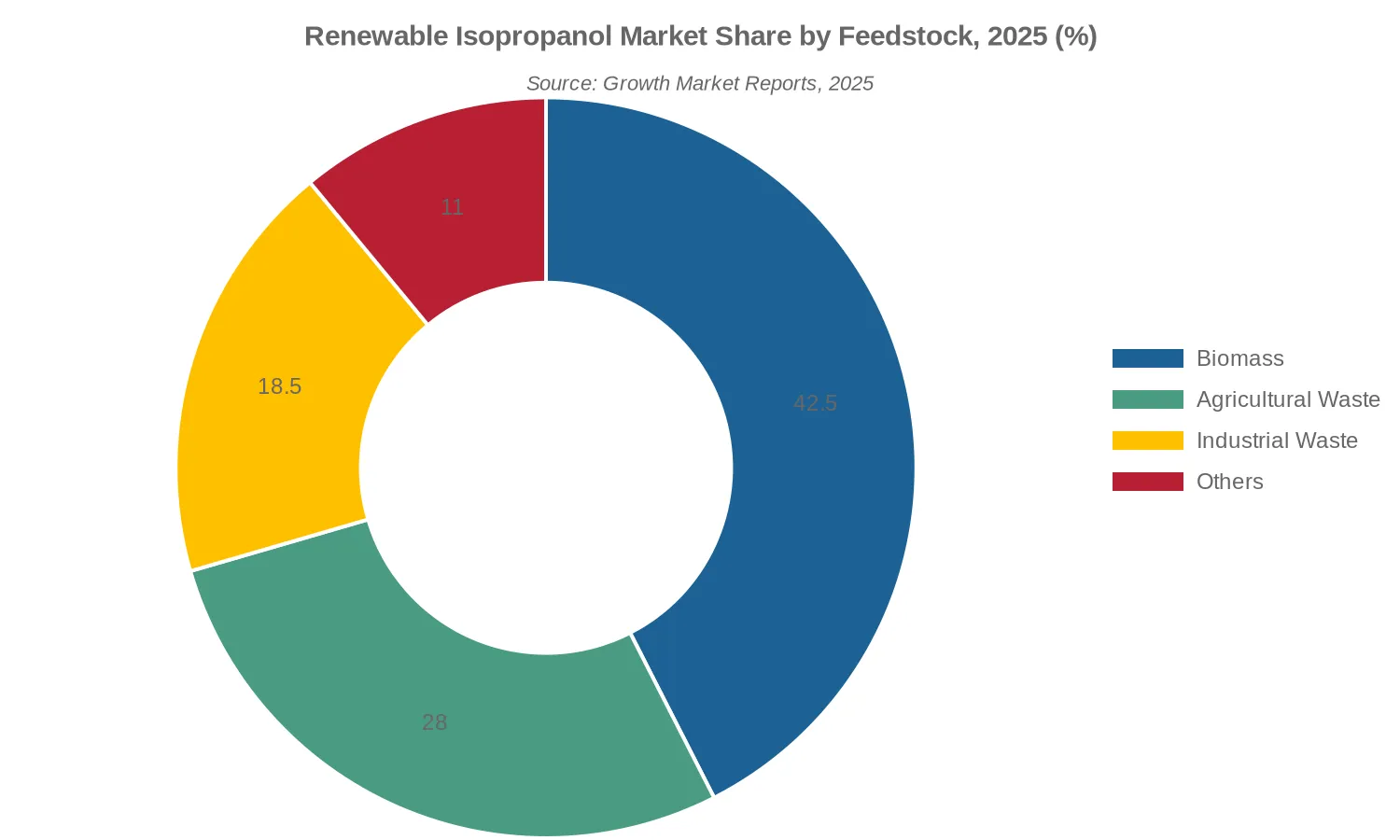
Agricultural waste is another promising feedstock segment, holding approximately 28.0% of the market in 2025, and offering both economic and environmental advantages. By utilizing crop residues, husks, corn stover, and sugarcane bagasse, renewable isopropanol producers can reduce waste disposal challenges while providing additional revenue streams for agricultural communities. The valorization of agricultural waste into high-value chemicals aligns with circular economy principles, reinforcing the sustainability credentials of renewable isopropanol. Technological advancements in pretreatment and fermentation processes are making it increasingly feasible to convert heterogeneous agricultural waste into high-purity isopropanol. As the agricultural sector seeks to enhance resource efficiency and minimize environmental impact, this feedstock segment is poised for significant expansion in the coming years.
Industrial waste as a feedstock, representing around 18.5% of the market in 2025, is gaining attention for its potential to close material loops within manufacturing processes. This segment involves the use of byproducts and residues from industrial operations, such as glycerol from biodiesel production and waste gases from fermentation industries. The integration of industrial waste streams into renewable isopropanol production reduces the environmental burden of waste disposal and improves the overall sustainability profile of the chemical sector. Challenges related to feedstock consistency and contamination must be addressed through advanced purification and processing technologies, and leading producers are actively investing in solutions to these technical barriers. As industries increasingly adopt circular economy models, the industrial waste feedstock segment is expected to witness steady growth.
Isopropyl alcohol (IPA) is a versatile compound with widespread applications in the renewable isopropanol market. Its role as a solvent, disinfectant, and chemical intermediate makes it indispensable in industries ranging from pharmaceuticals to personal care. The shift toward renewable isopropyl alcohol is driven by the need to reduce carbon footprints and enhance sustainability across supply chains. As a bio-based alternative, renewable IPA offers the dual benefits of maintaining performance standards while adhering to environmental regulations. The ongoing research into optimizing production processes and expanding feedstock sources is boosting the availability and affordability of renewable isopropyl alcohol. This transition is meeting regulatory demands while catering to rising consumer preference for eco-friendly products, positioning renewable IPA as a key component in the future of sustainable chemical manufacturing. The closely related market for renewable propylene oxide further illustrates how bio-based propylene chemistry is gaining industrial momentum across multiple derivative pathways.
Other feedstock sources, including municipal solid waste and algae, are being explored as part of ongoing research and development efforts. These feedstocks currently represent the remaining 11.0% of the market but offer significant long-term potential for expanding renewable isopropanol production capacity. Algae can be cultivated on non-arable land and possess high conversion efficiencies, making them an attractive option for future scale-up. Municipal solid waste utilization addresses urban waste management challenges and provides a pathway for integrating renewable chemical production into city infrastructures. As technological barriers are overcome and economies of scale are achieved, these alternative feedstock categories are likely to play a more prominent role in the renewable isopropanol market landscape by the latter part of the 2026-2034 forecast period.
Renewable Isopropanol Market Report Scope
| Attributes | Details |
| Report Title | Renewable Isopropanol Market Research Report 2034 |
| By Feedstock | Biomass, Agricultural Waste, Industrial Waste, Others |
| By Production Process | Fermentation, Catalytic Hydrogenation, Others |
| By Application | Solvents, Pharmaceuticals, Cosmetics & Personal Care, Chemicals, Fuels & Additives, Others |
| By End-Use Industry | Pharmaceuticals, Chemicals, Personal Care, Food & Beverage, Others |
| Regions Covered | North America, Europe, APAC, Latin America, MEA |
| Base Year | 2025 |
| Historic Data | 2019-2024 |
| Forecast Period | 2026-2034 |
| Number of Pages | 291 |
| Number of Tables & Figures | 285 |
| Customization Available | Yes, the report can be customized as per your need. |
Renewable Isopropanol Market by Production Process
The production process segment is a key determinant of the cost structure, scalability, and environmental performance of renewable isopropanol. Fermentation is currently the most widely adopted production process in 2025, leveraging the metabolic capabilities of engineered microorganisms to convert sugars and other feedstock components into isopropanol. Advances in microbial strain engineering and process optimization have significantly improved fermentation yields and reduced production times, making this process increasingly competitive with traditional petrochemical routes. Fermentation offers the advantage of flexibility in feedstock selection, enabling the use of various biomass and waste-derived substrates. Additionally, the mild operating conditions and lower energy requirements of fermentation contribute to its favorable sustainability profile, positioning it as a cornerstone technology in the renewable isopropanol market through the 2026-2034 forecast period.
Catalytic hydrogenation is another important production process, particularly for the conversion of biomass-derived intermediates such as acetone and bio-propylene into isopropanol. This process involves the use of specialized catalysts and hydrogen gas to facilitate the chemical transformation, offering high selectivity and efficiency. Recent advancements in catalyst design and reactor engineering have enhanced the performance of catalytic hydrogenation, enabling higher throughput and reduced operational costs. The ability to integrate catalytic hydrogenation with existing chemical manufacturing infrastructure makes it an attractive option for large-scale production. The availability of green hydrogen is an increasingly relevant enabler for this route, as electrolyzer capacity expands globally in 2025 and beyond. Ongoing research into green hydrogen production is expected to progressively reduce this constraint and support the continued growth of the catalytic hydrogenation segment.
Other production processes, including thermochemical and electrochemical conversion methods, are being explored as part of the industry's efforts to diversify production pathways. Thermochemical processes such as gasification and pyrolysis enable the conversion of complex feedstocks into syngas, which can subsequently be transformed into isopropanol via catalytic synthesis. These processes offer the advantage of processing a wide range of feedstock types, including municipal solid waste and lignocellulosic biomass. Electrochemical methods utilize renewable electricity to drive the conversion of carbon dioxide and water into isopropanol, presenting a novel approach to integrating clean energy with chemical manufacturing. While these alternative processes are still in the early stages of commercialization as of 2025, they hold significant potential for enhancing the flexibility and sustainability of renewable isopropanol production through the remainder of the forecast period.
The choice of production process has a direct impact on the environmental footprint, product purity, and scalability of renewable isopropanol. Companies are increasingly investing in hybrid and integrated process solutions that combine the strengths of multiple production methods. Coupling fermentation with catalytic upgrading steps, for example, can improve overall yields and enable the production of tailored isopropanol grades for specific applications. The integration of digital process control systems and real-time analytics is further enhancing process efficiency and product consistency. As the renewable isopropanol market matures through 2034, the adoption of advanced production technologies will be critical for maintaining cost competitiveness and meeting the evolving demands of end-use industries.
Renewable Isopropanol Market by Application
The application landscape for renewable isopropanol is broad and dynamic, with solvents representing the largest and most established segment in 2025. Renewable isopropanol is widely used as a solvent in the formulation of coatings, inks, adhesives, and cleaning agents, owing to its excellent solvency power, low toxicity, and biodegradability. The growing emphasis on sustainable and low-emission products is driving the replacement of fossil-based solvents with renewable alternatives in both industrial and consumer applications. Regulatory initiatives targeting VOC emissions and hazardous chemicals are further accelerating this transition. The solvent segment is expected to maintain its dominance over the 2026-2034 forecast period, supported by robust demand from the paints and coatings, electronics, and cleaning industries.
Pharmaceuticals constitute another major application segment, with renewable isopropanol being utilized as a solvent, disinfectant, and intermediate in the synthesis of active pharmaceutical ingredients (APIs). The pharmaceutical industry's stringent quality and safety requirements make renewable isopropanol an attractive option due to its high purity and traceability. The lessons of recent global health emergencies have underscored the importance of resilient and sustainable supply chains for critical chemicals, further boosting adoption of renewable isopropanol in pharmaceutical manufacturing. Additionally, the increasing focus on green chemistry and sustainable sourcing in the pharmaceutical sector is expected to drive continued growth in this application segment through 2034.
The cosmetics and personal care industry is rapidly embracing renewable isopropanol as a key ingredient in formulations such as hand sanitizers, perfumes, lotions, and hair care products. Consumers are increasingly seeking products with natural and eco-friendly ingredients, prompting manufacturers to reformulate offerings with bio-based solvents. Renewable isopropanol offers the dual benefits of safety and performance, meeting both regulatory and consumer expectations. The segment is witnessing strong growth, particularly in regions with advanced regulatory frameworks and high consumer awareness of sustainability. The ongoing trend toward clean beauty and natural personal care products is expected to further propel demand for renewable isopropanol in this segment.
The chemicals segment leverages renewable isopropanol as a building block for the synthesis of a wide range of derivatives, including isopropyl acetate, isopropylamine, and propylene glycol. These intermediates find applications in diverse industries such as agrochemicals, plastics, and specialty chemicals. The shift toward bio-based chemicals is driving chemical manufacturers to integrate renewable isopropanol into their production processes, enhancing the sustainability profile of their product portfolios. Additionally, the fuels and additives segment is exploring the use of renewable isopropanol as a component in gasoline blends and as an oxygenate to improve combustion efficiency and reduce emissions. While this segment is still emerging, it holds significant potential for future growth as the transportation sector transitions toward low-carbon fuels.
Other applications, including food processing and laboratory reagents, represent niche but growing segments for renewable isopropanol. In the food and beverage industry, renewable isopropanol is used as a food-grade solvent and extraction agent, benefiting from its safety and regulatory compliance. The laboratory and analytical sector values the high purity and consistency of renewable isopropanol for research and quality control applications. As new uses continue to emerge, the application landscape is expected to diversify further, providing additional growth opportunities for market participants through the 2026-2034 forecast window.
Renewable Isopropanol Market by End-Use Industry
The pharmaceuticals industry is a leading end-user of renewable isopropanol in 2025, driven by the sector's stringent quality standards and deepening commitment to sustainability. Renewable isopropanol is widely used as a solvent, disinfectant, and process intermediate in the manufacture of APIs, excipients, and finished dosage forms. The industry's focus on green chemistry and sustainable sourcing is prompting pharmaceutical companies to transition from petrochemical-based solvents to renewable alternatives. Regulatory agencies are also encouraging the adoption of bio-based chemicals to reduce environmental impact and enhance supply chain resilience. The growing demand for high-purity solvents and the increasing prevalence of chronic diseases are expected to sustain strong growth in this end-use segment through 2034.
The chemicals industry is another major consumer of renewable isopropanol, utilizing it as both a solvent and a precursor for the synthesis of various chemical intermediates. The trend toward sustainable chemistry is driving chemical manufacturers to incorporate renewable isopropanol into their processes, reducing their carbon footprint and enhancing the environmental performance of their products. The chemicals sector is also benefiting from the versatility of renewable isopropanol, which can be tailored to meet the specific requirements of different applications. As regulatory pressures mount and consumer preferences shift toward green products, the chemicals end-use segment is poised for continued expansion through the forecast period.
The personal care industry is experiencing rapid growth in the use of renewable isopropanol, fueled by rising consumer awareness of sustainability and the demand for natural ingredients. Renewable isopropanol is used in a variety of personal care products, including hand sanitizers, perfumes, and hair care formulations, where it provides effective solvency and quick-drying properties. The industry's focus on clean labeling and transparency is driving manufacturers to seek bio-based alternatives to traditional solvents. The personal care segment is expected to witness robust growth, particularly in developed markets where regulatory standards and consumer expectations are high.
The food and beverage industry is emerging as a promising end-use segment for renewable isopropanol, particularly in applications requiring food-grade solvents and extraction agents. The safety, traceability, and regulatory compliance of renewable isopropanol make it an attractive option for food processing and flavor extraction. As the food industry increasingly prioritizes sustainability and natural ingredients, the adoption of renewable isopropanol is expected to rise steadily through 2034. Other end-use industries, such as electronics, textiles, and agriculture, are also exploring the use of renewable isopropanol for specialized applications, contributing to the diversification and resilience of the market.
Renewable Isopropanol Market Opportunities and Threats
The renewable isopropanol market is brimming with opportunities, particularly in the context of the global transition toward a low-carbon economy. The increasing adoption of circular economy principles and the growing emphasis on resource efficiency are opening new avenues for the utilization of waste feedstocks and the integration of renewable chemicals into existing value chains. Technological innovations in feedstock processing, microbial engineering, and process optimization are enhancing the scalability and cost-effectiveness of renewable isopropanol production. The expanding application base across pharmaceuticals, personal care, chemicals, and fuels is providing a robust and diversified demand landscape. Strategic partnerships and collaborations among feedstock suppliers, technology providers, and end-users are expected to accelerate market development and foster innovation through the 2026-2034 forecast period.
Another significant opportunity lies in the alignment of renewable isopropanol production with global sustainability goals and regulatory initiatives. Governments and international organizations are increasingly mandating the use of bio-based chemicals and setting ambitious targets for carbon neutrality by mid-century. Companies that invest in renewable isopropanol production can benefit from regulatory incentives, green certifications, and enhanced brand reputation. The market is also witnessing growing interest from investors and venture capitalists, attracted by the potential for strong returns and positive environmental impact. As consumer awareness of sustainability issues continues to rise through the forecast period, the demand for products formulated with renewable isopropanol is expected to increase, creating new growth pathways for market participants.
Despite the favorable outlook, the renewable isopropanol market faces several restraining factors. The high initial capital investment required for the establishment of production facilities and the development of advanced technologies can pose a barrier to entry for new players. Feedstock availability and price volatility, particularly for agricultural and industrial waste streams, may impact production economics and supply chain stability. Additionally, competition from established petrochemical-based isopropanol producers, which benefit from mature infrastructure and low marginal costs, and the lack of standardized regulatory frameworks in some emerging regions may hinder market growth. Addressing these challenges will require coordinated efforts among industry stakeholders, policymakers, and researchers to ensure the long-term sustainability and competitiveness of the renewable isopropanol market.
Renewable Isopropanol Market Size by Region
North America currently leads the renewable isopropanol market, accounting for approximately 34.5% of the global market size in 2025, with a value of around USD 244 million. The region's dominance is attributed to a combination of advanced technological capabilities, supportive regulatory frameworks, and proactive industry initiatives. The United States, in particular, is home to several major renewable isopropanol producers and research institutions, driving innovation and commercialization efforts. The presence of a well-established bio-based chemicals industry and strong demand from end-use sectors such as pharmaceuticals, chemicals, and personal care further underpin the region's leadership position. As regulatory pressures on carbon emissions intensify and sustainability becomes a core business priority, North America is expected to maintain its prominent role in the renewable isopropanol market through 2034.

Europe follows closely, representing approximately 28.5% of the global market, with a market size of USD 201 million in 2025. The region's growth is driven by stringent environmental regulations, ambitious sustainability targets, and a strong focus on circular economy principles. European Union policies under the Green Deal and the Chemical Strategy for Sustainability are catalyzing investments in renewable isopropanol production and bio-based chemical manufacturing more broadly. Germany, France, and the Netherlands are leading markets within the region, supported by robust R&D activities and a high level of consumer awareness regarding green products. The European market is projected to grow at a CAGR of approximately 9.6% through 2034, slightly outpacing the global average and solidifying the region's position as a key hub for renewable chemical innovation.
The Asia Pacific region is emerging as a high-growth market, accounting for approximately 24.0% of the global market, with a value of USD 170 million in 2025. Rapid industrialization, increasing environmental awareness, and supportive government policies are driving the adoption of renewable isopropanol across the region. China, Japan, India, and South Korea are key contributors to market growth, with significant investments in bio-based chemical production and a rising focus on sustainable development. The Asia Pacific market is characterized by a large and diverse consumer base, growing demand for green products, and expanding industrial applications. As infrastructure and technological capabilities continue to improve, the region is expected to play an increasingly important role in the global renewable isopropanol market through 2034. Latin America and the Middle East and Africa, holding 7.5% and 5.5% respectively, represent the emerging frontier for renewable isopropanol investment, supported by feedstock abundance and developing regulatory momentum.
Renewable Isopropanol Market Competitive Landscape
The competitive landscape of the renewable isopropanol market in 2025 is characterized by a mix of established chemical companies, innovative technology developers, and sustainability-focused specialists. Market participants are investing heavily in research and development to enhance production efficiency, expand feedstock options, and develop new applications for renewable isopropanol. Strategic collaborations, joint ventures, and acquisitions are common strategies employed by leading players to strengthen their market position and accelerate the commercialization of advanced technologies. The market is also witnessing increased activity from venture capital firms and private equity investors, attracted by the sector's growth potential and alignment with global sustainability trends.
Innovation is a key differentiator in the renewable isopropanol market, with companies focusing on the development of proprietary production processes, advanced catalysts, and high-performance microbial strains. The ability to offer customized solutions and meet the specific requirements of different end-use industries is becoming increasingly important for gaining a competitive edge. Companies are also prioritizing sustainability and transparency in their operations, seeking third-party certifications and engaging in life cycle assessments to demonstrate the environmental benefits of their products. The integration of digital technologies, such as process automation and real-time monitoring, is further enhancing operational efficiency and product quality.
Market leaders are expanding their global footprint through the establishment of new production facilities, joint ventures, and strategic partnerships. North America and Europe remain key regions for innovation and commercialization, while Asia Pacific is emerging as a major growth market. Companies are also exploring opportunities in Latin America and the Middle East and Africa, where rising demand for sustainable chemicals and favorable policy environments are creating new growth prospects. The competitive landscape is expected to remain dynamic, with ongoing investments in technology development, capacity expansion, and market penetration through the 2026-2034 forecast period.
Some of the major companies operating in the renewable isopropanol market include DuPont de Nemours, Inc., Clariant AG, Gevo, Inc., LanzaTech Inc., and Braskem S.A.. DuPont is renowned for its extensive R&D capabilities and a broad portfolio of bio-based chemicals, while Clariant has established itself as a leader in sustainable chemical solutions with a focus on advanced feedstock processing. Gevo and LanzaTech are at the forefront of technological innovation, leveraging proprietary fermentation and gas fermentation technologies to produce renewable chemicals from diverse feedstocks. Braskem specializes in large-scale bio-based chemical production, particularly in Latin America, with a strong emphasis on sustainability and circular economy integration. These companies are actively collaborating with industry partners, research institutions, and government agencies to drive innovation, enhance production capacity, and expand their global reach.
In addition to these leading players, companies such as BASF SE, Dow Inc., Shell plc, TotalEnergies SE, and LG Chem Ltd. are integrating renewable isopropanol into their low-carbon chemicals strategies, leveraging their global manufacturing networks and established customer relationships. Sekab Biofuels and Chemicals AB contributes specialized expertise in lignocellulosic conversion from the Nordic region, while Zhejiang Xinhua Chemical Co., Ltd. and Mitsui Chemicals, Inc. are driving capacity growth in Asia Pacific. The influx of innovation from both large incumbents and emerging specialists is fostering a culture of competition and continuous improvement, driving the market toward greater efficiency, sustainability, and value creation through the 2026-2034 forecast window.
Top Companies in the Renewable Isopropanol Market
- Gevo, Inc.
- LanzaTech Inc.
- Clariant AG
- INEOS Group Holdings S.A.
- Dow Inc.
- BASF SE
- Shell plc
- ExxonMobil Corporation
- DuPont de Nemours, Inc.
- Mitsui Chemicals, Inc.
- Solvay S.A.
- Eastman Chemical Company
- Honeywell International Inc.
- Sekab Biofuels & Chemicals AB
- Zhejiang Xinhua Chemical Co., Ltd.
- Green Plains Inc.
- Sasol Limited
- Braskem S.A.
- TotalEnergies SE
- LG Chem Ltd.
Segments
The Renewable Isopropanol market has been segmented on the basis of
Feedstock
- Biomass
- Agricultural Waste
- Industrial Waste
- Others
Production Process
- Fermentation
- Catalytic Hydrogenation
- Others
Application
- Solvents
- Pharmaceuticals
- Cosmetics & Personal Care
- Chemicals
- Fuels & Additives
- Others
End-Use Industry
- Pharmaceuticals
- Chemicals
- Personal Care
- Food & Beverage
- Others
Frequently Asked Questions
The main challenges include the high capital expenditure required for commercial-scale bio-based production facilities, feedstock price volatility and supply inconsistency particularly for agricultural and industrial waste streams, and competition from well-established and lower-cost petrochemical IPA producers. Inconsistent regulatory frameworks across emerging markets also create market entry complexity. Key opportunities lie in the accelerating global adoption of circular economy models, expanding government incentives for bio-based chemicals, and the growing premium that pharmaceutical and personal care brands are willing to pay for certified sustainable ingredients. Technological advances in synthetic biology, green hydrogen availability for catalytic routes, and novel CO2-to-IPA pathways present further transformative opportunities through the 2026-2034 forecast window.
Leading companies in the 2025 renewable isopropanol market include Gevo, Inc. and LanzaTech Inc., both known for proprietary bio-based conversion technologies. Clariant AG is a key player in sustainable chemical solutions and advanced feedstock processing. BASF SE, Dow Inc., and DuPont de Nemours, Inc. bring large-scale production and broad application expertise. Shell plc and TotalEnergies SE are integrating renewable isopropanol into their low-carbon chemicals strategies. Braskem S.A. leads bio-based chemical production in Latin America, while Mitsui Chemicals, LG Chem, and Zhejiang Xinhua Chemical Co., Ltd. drive Asia Pacific capacity growth. Sekab Biofuels and Chemicals AB contributes Nordic expertise in lignocellulosic conversion.
North America holds the largest regional share at approximately 34.5% of the 2025 global market, valued at around USD 244 million, supported by advanced bio-based chemical infrastructure, federal bio-economy policies, and strong demand from pharmaceuticals and personal care. Europe accounts for roughly 28.5%, equivalent to about USD 201 million, propelled by EU Green Deal regulations, circular economy mandates, and ambitious carbon neutrality targets. Asia Pacific represents approximately 24.0% of the market, or about USD 170 million, with China, Japan, India, and South Korea driving rapid capacity expansion and rising sustainability-focused consumption. Latin America and Middle East and Africa hold 7.5% and 5.5% respectively, with growing investment momentum in bio-based chemical production.
The pharmaceuticals industry is the leading end-user in 2025, driven by stringent purity requirements, green chemistry adoption, and supply chain resilience initiatives. The chemicals industry follows closely, leveraging renewable isopropanol both as a solvent and as a synthetic intermediate across agrochemicals, specialty chemicals, and plastics production. The personal care industry is one of the fastest-growing end-user segments, fueled by clean beauty trends and regulatory preferences for bio-based ingredients. The food and beverage industry is an emerging growth segment, particularly for food-grade extraction and processing applications. Electronics, textiles, and agriculture are additional niche but growing end-use categories.
Solvents represent the largest application segment, driven by demand from coatings, inks, adhesives, and industrial and household cleaning products. Pharmaceuticals constitute the second largest segment, where renewable IPA serves as a high-purity solvent, disinfectant, and API synthesis intermediate. The cosmetics and personal care segment is a fast-growing application area, encompassing hand sanitizers, perfumes, and hair care formulations. The chemicals segment utilizes renewable isopropanol as a building block for isopropyl acetate, isopropylamine, and propylene glycol. The fuels and additives segment is gaining traction as a sustainable oxygenate and blending component. Food processing and laboratory reagent applications round out the diversified demand base.
Fermentation is the leading production process in 2025, using engineered microorganisms to convert sugars and biomass-derived substrates into isopropanol. It benefits from flexible feedstock compatibility and relatively low energy inputs. Catalytic hydrogenation, which converts bio-based acetone or propylene intermediates using specialized catalysts and green hydrogen, is the second major route, prized for its high selectivity and integration potential with existing chemical plants. Emerging processes include thermochemical conversion via gasification and pyrolysis, and electrochemical CO2 reduction routes, both of which are advancing toward pilot and early commercial scale as part of the broader low-carbon chemicals transition.
The dominant feedstock in 2025 is biomass, accounting for approximately 42.5% of the market, encompassing wood chips, crop residues, and dedicated energy crops. Agricultural waste, including corn stover, sugarcane bagasse, and cereal husks, represents around 28.0% of the feedstock share, valued for its circular economy credentials and low cost. Industrial waste, such as glycerol from biodiesel refining and off-gases from fermentation operations, holds roughly 18.5% of the market. Emerging feedstocks including algae, municipal solid waste, and carbon dioxide utilization pathways collectively account for approximately 11.0%, with strong growth potential anticipated through 2034.
The primary growth drivers include intensifying global regulatory pressure to reduce carbon emissions and volatile organic compound (VOC) outputs, rising corporate sustainability commitments across pharmaceuticals, chemicals, and personal care sectors, and rapid technological progress in fermentation and catalytic conversion. Additionally, growing consumer demand for green-labeled and bio-based products, expanding government incentive programs for bio-economy development, and the increasing commercial competitiveness of renewable feedstocks relative to petroleum-based alternatives are all fueling market expansion through the 2026-2034 forecast period.
According to our latest research, the global renewable isopropanol market reached USD 707 million in 2025. The market is forecast to grow at a compound annual growth rate (CAGR) of 9.3% from 2026 to 2034, reaching approximately USD 1,579 million by 2034. This robust expansion is underpinned by tightening environmental regulations, accelerating corporate sustainability mandates, and continuous improvements in bio-based production economics across North America, Europe, and Asia Pacific.
Renewable isopropanol is isopropanol (IPA) produced from bio-based feedstocks such as biomass, agricultural waste, or industrial waste, rather than from petroleum-derived propylene. It is chemically identical to conventional isopropanol in molecular structure and performance, but its production pathway significantly reduces net carbon dioxide emissions and fossil fuel consumption. As of 2025, advances in fermentation and catalytic hydrogenation have made renewable isopropanol a fully viable drop-in replacement for petrochemical IPA across most industrial, pharmaceutical, and consumer applications, offering supply chain sustainability benefits and alignment with corporate net-zero commitments.
Table Of Content
Chapter 1 Executive SummaryChapter 2 Assumptions and Acronyms Used
Chapter 3 Research Methodology
Chapter 4 Renewable Isopropanol Market Overview
4.1 Introduction
4.1.1 Market Taxonomy
4.1.2 Market Definition
4.1.3 Macro-Economic Factors Impacting the Market Growth
4.2 Renewable Isopropanol Market Dynamics
4.2.1 Market Drivers
4.2.2 Market Restraints
4.2.3 Market Opportunity
4.3 Renewable Isopropanol Market - Supply Chain Analysis
4.3.1 List of Key Suppliers
4.3.2 List of Key Distributors
4.3.3 List of Key Consumers
4.4 Key Forces Shaping the Renewable Isopropanol Market
4.4.1 Bargaining Power of Suppliers
4.4.2 Bargaining Power of Buyers
4.4.3 Threat of Substitution
4.4.4 Threat of New Entrants
4.4.5 Competitive Rivalry
4.5 Global Renewable Isopropanol Market Size & Forecast, 2023-2032
4.5.1 Renewable Isopropanol Market Size and Y-o-Y Growth
4.5.2 Renewable Isopropanol Market Absolute $ Opportunity
Chapter 5 Global Renewable Isopropanol Market Analysis and Forecast By Feedstock
5.1 Introduction
5.1.1 Key Market Trends & Growth Opportunities By Feedstock
5.1.2 Basis Point Share (BPS) Analysis By Feedstock
5.1.3 Absolute $ Opportunity Assessment By Feedstock
5.2 Renewable Isopropanol Market Size Forecast By Feedstock
5.2.1 Biomass
5.2.2 Agricultural Waste
5.2.3 Industrial Waste
5.2.4 Others
5.3 Market Attractiveness Analysis By Feedstock
Chapter 6 Global Renewable Isopropanol Market Analysis and Forecast By Production Process
6.1 Introduction
6.1.1 Key Market Trends & Growth Opportunities By Production Process
6.1.2 Basis Point Share (BPS) Analysis By Production Process
6.1.3 Absolute $ Opportunity Assessment By Production Process
6.2 Renewable Isopropanol Market Size Forecast By Production Process
6.2.1 Fermentation
6.2.2 Catalytic Hydrogenation
6.2.3 Others
6.3 Market Attractiveness Analysis By Production Process
Chapter 7 Global Renewable Isopropanol Market Analysis and Forecast By Application
7.1 Introduction
7.1.1 Key Market Trends & Growth Opportunities By Application
7.1.2 Basis Point Share (BPS) Analysis By Application
7.1.3 Absolute $ Opportunity Assessment By Application
7.2 Renewable Isopropanol Market Size Forecast By Application
7.2.1 Solvents
7.2.2 Pharmaceuticals
7.2.3 Cosmetics & Personal Care
7.2.4 Chemicals
7.2.5 Fuels & Additives
7.2.6 Others
7.3 Market Attractiveness Analysis By Application
Chapter 8 Global Renewable Isopropanol Market Analysis and Forecast By End-Use Industry
8.1 Introduction
8.1.1 Key Market Trends & Growth Opportunities By End-Use Industry
8.1.2 Basis Point Share (BPS) Analysis By End-Use Industry
8.1.3 Absolute $ Opportunity Assessment By End-Use Industry
8.2 Renewable Isopropanol Market Size Forecast By End-Use Industry
8.2.1 Pharmaceuticals
8.2.2 Chemicals
8.2.3 Personal Care
8.2.4 Food & Beverage
8.2.5 Others
8.3 Market Attractiveness Analysis By End-Use Industry
Chapter 9 Global Renewable Isopropanol Market Analysis and Forecast by Region
9.1 Introduction
9.1.1 Key Market Trends & Growth Opportunities By Region
9.1.2 Basis Point Share (BPS) Analysis By Region
9.1.3 Absolute $ Opportunity Assessment By Region
9.2 Renewable Isopropanol Market Size Forecast By Region
9.2.1 North America
9.2.2 Europe
9.2.3 Asia Pacific
9.2.4 Latin America
9.2.5 Middle East & Africa (MEA)
9.3 Market Attractiveness Analysis By Region
Chapter 10 Coronavirus Disease (COVID-19) Impact
10.1 Introduction
10.2 Current & Future Impact Analysis
10.3 Economic Impact Analysis
10.4 Government Policies
10.5 Investment Scenario
Chapter 11 North America Renewable Isopropanol Analysis and Forecast
11.1 Introduction
11.2 North America Renewable Isopropanol Market Size Forecast by Country
11.2.1 U.S.
11.2.2 Canada
11.3 Basis Point Share (BPS) Analysis by Country
11.4 Absolute $ Opportunity Assessment by Country
11.5 Market Attractiveness Analysis by Country
11.6 North America Renewable Isopropanol Market Size Forecast By Feedstock
11.6.1 Biomass
11.6.2 Agricultural Waste
11.6.3 Industrial Waste
11.6.4 Others
11.7 Basis Point Share (BPS) Analysis By Feedstock
11.8 Absolute $ Opportunity Assessment By Feedstock
11.9 Market Attractiveness Analysis By Feedstock
11.10 North America Renewable Isopropanol Market Size Forecast By Production Process
11.10.1 Fermentation
11.10.2 Catalytic Hydrogenation
11.10.3 Others
11.11 Basis Point Share (BPS) Analysis By Production Process
11.12 Absolute $ Opportunity Assessment By Production Process
11.13 Market Attractiveness Analysis By Production Process
11.14 North America Renewable Isopropanol Market Size Forecast By Application
11.14.1 Solvents
11.14.2 Pharmaceuticals
11.14.3 Cosmetics & Personal Care
11.14.4 Chemicals
11.14.5 Fuels & Additives
11.14.6 Others
11.15 Basis Point Share (BPS) Analysis By Application
11.16 Absolute $ Opportunity Assessment By Application
11.17 Market Attractiveness Analysis By Application
11.18 North America Renewable Isopropanol Market Size Forecast By End-Use Industry
11.18.1 Pharmaceuticals
11.18.2 Chemicals
11.18.3 Personal Care
11.18.4 Food & Beverage
11.18.5 Others
11.19 Basis Point Share (BPS) Analysis By End-Use Industry
11.20 Absolute $ Opportunity Assessment By End-Use Industry
11.21 Market Attractiveness Analysis By End-Use Industry
Chapter 12 Europe Renewable Isopropanol Analysis and Forecast
12.1 Introduction
12.2 Europe Renewable Isopropanol Market Size Forecast by Country
12.2.1 Germany
12.2.2 France
12.2.3 Italy
12.2.4 U.K.
12.2.5 Spain
12.2.6 Russia
12.2.7 Rest of Europe
12.3 Basis Point Share (BPS) Analysis by Country
12.4 Absolute $ Opportunity Assessment by Country
12.5 Market Attractiveness Analysis by Country
12.6 Europe Renewable Isopropanol Market Size Forecast By Feedstock
12.6.1 Biomass
12.6.2 Agricultural Waste
12.6.3 Industrial Waste
12.6.4 Others
12.7 Basis Point Share (BPS) Analysis By Feedstock
12.8 Absolute $ Opportunity Assessment By Feedstock
12.9 Market Attractiveness Analysis By Feedstock
12.10 Europe Renewable Isopropanol Market Size Forecast By Production Process
12.10.1 Fermentation
12.10.2 Catalytic Hydrogenation
12.10.3 Others
12.11 Basis Point Share (BPS) Analysis By Production Process
12.12 Absolute $ Opportunity Assessment By Production Process
12.13 Market Attractiveness Analysis By Production Process
12.14 Europe Renewable Isopropanol Market Size Forecast By Application
12.14.1 Solvents
12.14.2 Pharmaceuticals
12.14.3 Cosmetics & Personal Care
12.14.4 Chemicals
12.14.5 Fuels & Additives
12.14.6 Others
12.15 Basis Point Share (BPS) Analysis By Application
12.16 Absolute $ Opportunity Assessment By Application
12.17 Market Attractiveness Analysis By Application
12.18 Europe Renewable Isopropanol Market Size Forecast By End-Use Industry
12.18.1 Pharmaceuticals
12.18.2 Chemicals
12.18.3 Personal Care
12.18.4 Food & Beverage
12.18.5 Others
12.19 Basis Point Share (BPS) Analysis By End-Use Industry
12.20 Absolute $ Opportunity Assessment By End-Use Industry
12.21 Market Attractiveness Analysis By End-Use Industry
Chapter 13 Asia Pacific Renewable Isopropanol Analysis and Forecast
13.1 Introduction
13.2 Asia Pacific Renewable Isopropanol Market Size Forecast by Country
13.2.1 China
13.2.2 Japan
13.2.3 South Korea
13.2.4 India
13.2.5 Australia
13.2.6 South East Asia (SEA)
13.2.7 Rest of Asia Pacific (APAC)
13.3 Basis Point Share (BPS) Analysis by Country
13.4 Absolute $ Opportunity Assessment by Country
13.5 Market Attractiveness Analysis by Country
13.6 Asia Pacific Renewable Isopropanol Market Size Forecast By Feedstock
13.6.1 Biomass
13.6.2 Agricultural Waste
13.6.3 Industrial Waste
13.6.4 Others
13.7 Basis Point Share (BPS) Analysis By Feedstock
13.8 Absolute $ Opportunity Assessment By Feedstock
13.9 Market Attractiveness Analysis By Feedstock
13.10 Asia Pacific Renewable Isopropanol Market Size Forecast By Production Process
13.10.1 Fermentation
13.10.2 Catalytic Hydrogenation
13.10.3 Others
13.11 Basis Point Share (BPS) Analysis By Production Process
13.12 Absolute $ Opportunity Assessment By Production Process
13.13 Market Attractiveness Analysis By Production Process
13.14 Asia Pacific Renewable Isopropanol Market Size Forecast By Application
13.14.1 Solvents
13.14.2 Pharmaceuticals
13.14.3 Cosmetics & Personal Care
13.14.4 Chemicals
13.14.5 Fuels & Additives
13.14.6 Others
13.15 Basis Point Share (BPS) Analysis By Application
13.16 Absolute $ Opportunity Assessment By Application
13.17 Market Attractiveness Analysis By Application
13.18 Asia Pacific Renewable Isopropanol Market Size Forecast By End-Use Industry
13.18.1 Pharmaceuticals
13.18.2 Chemicals
13.18.3 Personal Care
13.18.4 Food & Beverage
13.18.5 Others
13.19 Basis Point Share (BPS) Analysis By End-Use Industry
13.20 Absolute $ Opportunity Assessment By End-Use Industry
13.21 Market Attractiveness Analysis By End-Use Industry
Chapter 14 Latin America Renewable Isopropanol Analysis and Forecast
14.1 Introduction
14.2 Latin America Renewable Isopropanol Market Size Forecast by Country
14.2.1 Brazil
14.2.2 Mexico
14.2.3 Rest of Latin America (LATAM)
14.3 Basis Point Share (BPS) Analysis by Country
14.4 Absolute $ Opportunity Assessment by Country
14.5 Market Attractiveness Analysis by Country
14.6 Latin America Renewable Isopropanol Market Size Forecast By Feedstock
14.6.1 Biomass
14.6.2 Agricultural Waste
14.6.3 Industrial Waste
14.6.4 Others
14.7 Basis Point Share (BPS) Analysis By Feedstock
14.8 Absolute $ Opportunity Assessment By Feedstock
14.9 Market Attractiveness Analysis By Feedstock
14.10 Latin America Renewable Isopropanol Market Size Forecast By Production Process
14.10.1 Fermentation
14.10.2 Catalytic Hydrogenation
14.10.3 Others
14.11 Basis Point Share (BPS) Analysis By Production Process
14.12 Absolute $ Opportunity Assessment By Production Process
14.13 Market Attractiveness Analysis By Production Process
14.14 Latin America Renewable Isopropanol Market Size Forecast By Application
14.14.1 Solvents
14.14.2 Pharmaceuticals
14.14.3 Cosmetics & Personal Care
14.14.4 Chemicals
14.14.5 Fuels & Additives
14.14.6 Others
14.15 Basis Point Share (BPS) Analysis By Application
14.16 Absolute $ Opportunity Assessment By Application
14.17 Market Attractiveness Analysis By Application
14.18 Latin America Renewable Isopropanol Market Size Forecast By End-Use Industry
14.18.1 Pharmaceuticals
14.18.2 Chemicals
14.18.3 Personal Care
14.18.4 Food & Beverage
14.18.5 Others
14.19 Basis Point Share (BPS) Analysis By End-Use Industry
14.20 Absolute $ Opportunity Assessment By End-Use Industry
14.21 Market Attractiveness Analysis By End-Use Industry
Chapter 15 Middle East & Africa (MEA) Renewable Isopropanol Analysis and Forecast
15.1 Introduction
15.2 Middle East & Africa (MEA) Renewable Isopropanol Market Size Forecast by Country
15.2.1 Saudi Arabia
15.2.2 South Africa
15.2.3 UAE
15.2.4 Rest of Middle East & Africa (MEA)
15.3 Basis Point Share (BPS) Analysis by Country
15.4 Absolute $ Opportunity Assessment by Country
15.5 Market Attractiveness Analysis by Country
15.6 Middle East & Africa (MEA) Renewable Isopropanol Market Size Forecast By Feedstock
15.6.1 Biomass
15.6.2 Agricultural Waste
15.6.3 Industrial Waste
15.6.4 Others
15.7 Basis Point Share (BPS) Analysis By Feedstock
15.8 Absolute $ Opportunity Assessment By Feedstock
15.9 Market Attractiveness Analysis By Feedstock
15.10 Middle East & Africa (MEA) Renewable Isopropanol Market Size Forecast By Production Process
15.10.1 Fermentation
15.10.2 Catalytic Hydrogenation
15.10.3 Others
15.11 Basis Point Share (BPS) Analysis By Production Process
15.12 Absolute $ Opportunity Assessment By Production Process
15.13 Market Attractiveness Analysis By Production Process
15.14 Middle East & Africa (MEA) Renewable Isopropanol Market Size Forecast By Application
15.14.1 Solvents
15.14.2 Pharmaceuticals
15.14.3 Cosmetics & Personal Care
15.14.4 Chemicals
15.14.5 Fuels & Additives
15.14.6 Others
15.15 Basis Point Share (BPS) Analysis By Application
15.16 Absolute $ Opportunity Assessment By Application
15.17 Market Attractiveness Analysis By Application
15.18 Middle East & Africa (MEA) Renewable Isopropanol Market Size Forecast By End-Use Industry
15.18.1 Pharmaceuticals
15.18.2 Chemicals
15.18.3 Personal Care
15.18.4 Food & Beverage
15.18.5 Others
15.19 Basis Point Share (BPS) Analysis By End-Use Industry
15.20 Absolute $ Opportunity Assessment By End-Use Industry
15.21 Market Attractiveness Analysis By End-Use Industry
Chapter 16 Competition Landscape
16.1 Renewable Isopropanol Market: Competitive Dashboard
16.2 Global Renewable Isopropanol Market: Market Share Analysis, 2023
16.3 Company Profiles (Details – Overview, Financials, Developments, Strategy)
16.3.1 Gevo, Inc.
16.3.2 LanzaTech Inc.
16.3.3 Clariant AG
16.3.4 INEOS Group Holdings S.A.
16.3.5 Dow Inc.
16.3.6 BASF SE
16.3.7 Shell plc
16.3.8 ExxonMobil Corporation
16.3.9 DuPont de Nemours, Inc.
16.3.10 Mitsui Chemicals, Inc.
16.3.11 Solvay S.A.
16.3.12 Eastman Chemical Company
16.3.13 Honeywell International Inc.
16.3.14 Sekab Biofuels & Chemicals AB
16.3.15 Zhejiang Xinhua Chemical Co., Ltd.
16.3.16 Green Plains Inc.
16.3.17 Sasol Limited
16.3.18 Braskem S.A.
16.3.19 TotalEnergies SE
16.3.20 LG Chem Ltd.
Methodology


Related Reports
Some other reports from this category!


Our Clients






