
Polymerizable Monomer Ink Market Size, Share & Growth Analysis, 2026-2034
Polymerizable Monomer Ink Market Size, Share & Growth Analysis, 2026-2034
Segments - by Product Type (Acrylate-Based, Methacrylate-Based, Epoxy-Based, Others), by Application (3D Printing, Inkjet Printing, Electronics, Packaging, Others), by End-Use Industry (Automotive, Healthcare, Electronics, Packaging, Others)



Last Updated : Jun, 2026
| Report ID :MC-26149
| 5.0 Rating
| 55 Reviews
| 296 Pages
| Format :


Polymerizable Monomer Ink Market: Key Numbers
The Polymerizable Monomer Ink market was valued at USD 1.46 Billion in 2025 and is projected to reach USD 3.19 Billion by 2034, a CAGR of 9.2%.
| Market size (2025) | USD 1.46 Billion |
|---|---|
| Forecast (2034) | USD 3.19 Billion |
| CAGR (2026-2034) | 9.2% |
| Largest region | Asia Pacific (40% share) |
| Segments covered | Product Type, Application, End-Use Industry |
| Key companies | Mitsubishi Chemical Corporation, DIC Corporation, Sun Chemical Corporation, BASF SE, Evonik Industries AG |
This report is updated with the latest market data and insights as of June 2026. Base year: 2025 | Forecast period: 2026-2034
Polymerizable Monomer Ink Market Size and Growth Outlook
The global Polymerizable Monomer Ink market size reached USD 1.46 billion in 2025, with robust expansion driven by surging demand across advanced manufacturing and digital printing sectors. The market is expected to grow at a CAGR of 9.2% from 2026 to 2034, projecting a significant increase to USD 3.19 billion by 2034. This growth trajectory is primarily fueled by escalating adoption in 3D printing, rapid technological advancements in ink formulations, and the increasing penetration of polymer-based inks in electronics and packaging industries. The market continues to benefit from the convergence of material science innovations and the rising need for high-performance, customizable printing solutions across diverse end-use industries. The broader landscape of industrial printing materials is also evolving rapidly, creating complementary tailwinds for polymerizable monomer ink demand.

The primary growth factor for the Polymerizable Monomer Ink market is the rapid evolution of additive manufacturing, particularly 3D printing, which has transformed prototyping and production methodologies across automotive, healthcare, and electronics sectors. As industries increasingly shift towards digital manufacturing, the demand for inks that offer superior polymerization, durability, and precision has surged. Innovations in acrylate-based and methacrylate-based monomer inks have enabled manufacturers to produce components with enhanced mechanical properties and chemical resistance, driving their adoption in high-value applications. Furthermore, the ability of these inks to enable rapid curing and layer-by-layer fabrication aligns with the growing need for faster production cycles and mass customization in modern manufacturing environments. The parallel expansion of the photopolymer resin segment reflects the same underlying technology shift driving monomer ink adoption across additive manufacturing platforms.
Another significant driver is the ongoing advancements in inkjet printing technologies and the expanding application scope of polymerizable monomer inks in electronics and packaging. Inkjet printing's transition from traditional graphics to functional materials has opened new avenues for printed electronics, flexible circuits, and high-resolution packaging. The formulation of specialized inks that can polymerize under UV or electron beam exposure has enabled the production of intricate electronic components and packaging with enhanced barrier properties and aesthetic appeal. This technological synergy is further amplified by the increasing demand for sustainable and low-VOC inks, as regulatory pressures and consumer preferences push industries toward greener alternatives. Companies developing next-generation inkjet ink formulations are simultaneously influencing polymerizable monomer ink chemistry, accelerating cross-segment innovation.
The market is also witnessing substantial growth due to rising investments in research and development activities aimed at enhancing the performance characteristics of polymerizable monomer inks. Companies are focusing on developing inks with improved adhesion, flexibility, and resistance to environmental factors to meet the stringent requirements of end-use industries such as healthcare, where biocompatibility and sterilizability are critical. The integration of smart materials and nanotechnology into ink formulations is further expanding the functional capabilities of these inks, enabling applications in wearable electronics, medical devices, and advanced packaging solutions. This continuous innovation cycle is expected to fuel the market's expansion over the forecast period, as industries seek to leverage new material properties for competitive advantage. Novel chemistries such as those explored in dual-cure epoxy-acrylic 3D ink development are indicative of the direction that advanced monomer ink formulation is heading in 2025 and beyond.
From a regional perspective, Asia Pacific remains the dominant market, propelled by rapid industrialization and technological advancements in countries such as China, Japan, and South Korea. The region's strong manufacturing base, coupled with significant investments in electronics and automotive sectors, has created a fertile ground for the adoption of advanced printing technologies and materials. North America and Europe are also significant contributors, driven by robust R&D activities, early adoption of 3D printing, and stringent environmental regulations that favor the use of polymerizable monomer inks. Meanwhile, emerging markets in Latin America and the Middle East and Africa are gradually catching up, supported by growing investments in industrial infrastructure and increasing awareness about advanced printing solutions.
Polymerizable Monomer Ink Market by Product Type
The Product Type segment of the Polymerizable Monomer Ink market includes acrylate-based, methacrylate-based, epoxy-based, and other specialized formulations. Acrylate-based inks dominate the market, capturing approximately 42.5% of global revenue in 2025, due to their exceptional polymerization speed, high reactivity, and versatile application profile. These inks are widely favored in both 3D and inkjet printing for their ability to deliver strong mechanical properties and resistance to environmental degradation. Their rapid curing under UV light makes them ideal for high-throughput manufacturing processes, catering to the evolving needs of the electronics, packaging, and automotive industries. As manufacturers seek inks that offer a balance of performance and cost-effectiveness, acrylate-based products continue to capture a significant share of the market.
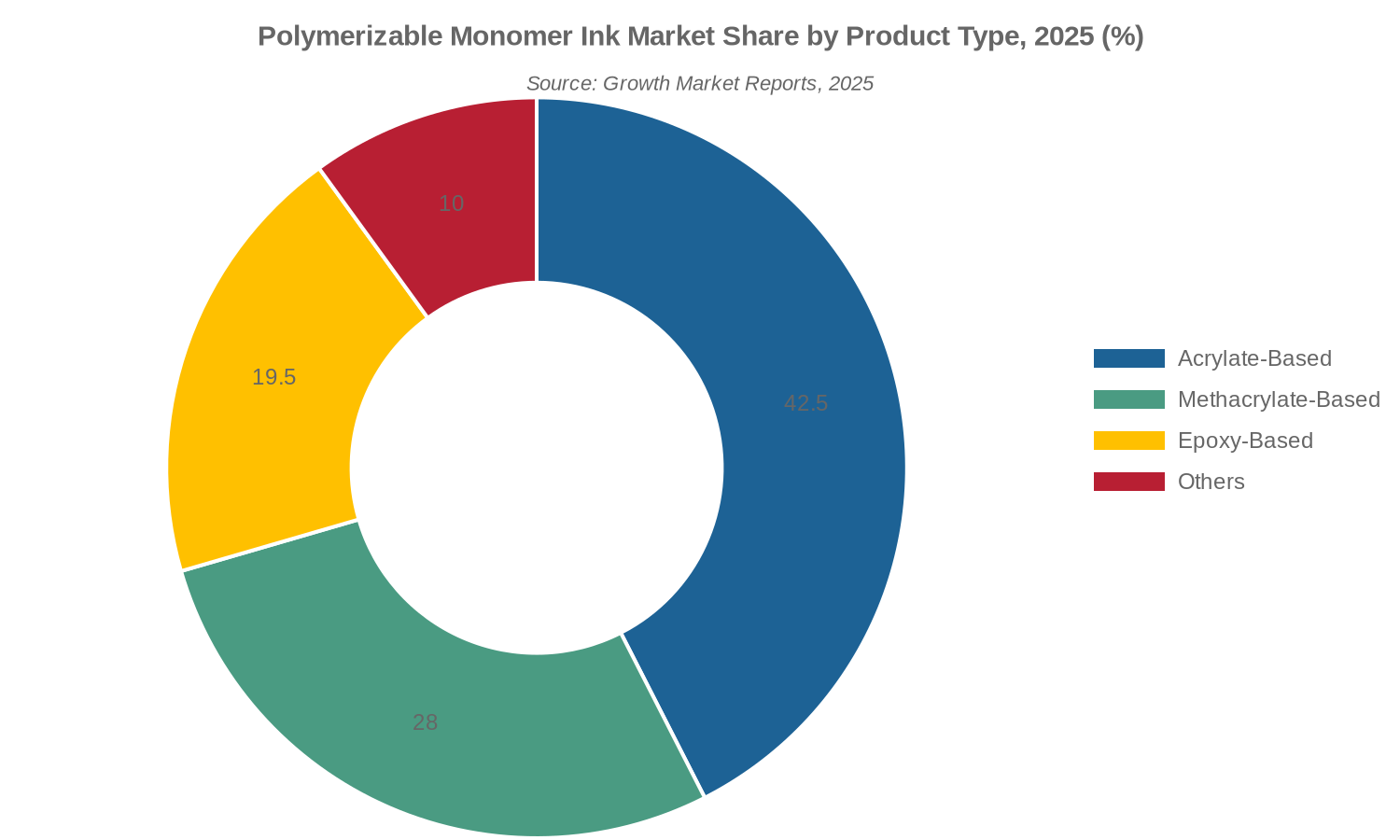
Methacrylate-based inks are gaining traction due to their superior flexibility, toughness, and suitability for applications requiring enhanced impact resistance, commanding around 28% of the market in 2025. These inks are particularly valuable in healthcare and automotive sectors, where components must withstand mechanical stress and dynamic environments. Methacrylate-based formulations also offer excellent adhesion to a variety of substrates, including plastics, metals, and glass, expanding their utility across multiple industrial domains. Ongoing research into bio-based methacrylates is expected to further boost the appeal of this product type, aligning with the market's shift towards sustainable and environmentally friendly materials. The analogous evolution occurring in the lens monomer segment illustrates how methacrylate chemistry is being refined for precision optical and biomedical use cases simultaneously.
Epoxy-based inks represent another key segment at approximately 19.5% market share in 2025, distinguished by their outstanding chemical and thermal stability. These inks are extensively used in electronics, especially for printed circuit boards and encapsulation of sensitive components, where resistance to solvents, heat, and moisture is paramount. Epoxy-based monomer inks offer the advantage of forming highly crosslinked networks upon curing, resulting in robust, durable coatings that protect electronic devices from harsh operating conditions. The growing miniaturization of electronic devices and the increasing complexity of circuit designs are expected to drive further innovation and adoption in this segment through 2034.
The "Others" category, comprising roughly 10% of the market, encompasses a range of emerging and niche monomer ink formulations, such as urethane-based and hybrid systems that combine the properties of multiple chemistries. These inks are being developed to address specific performance gaps, such as improved elasticity, enhanced optical clarity, or tailored surface functionalities for specialized applications. As end-use industries demand more customized solutions, the market is witnessing a proliferation of novel product types designed to meet unique performance criteria. This ongoing diversification is a testament to the dynamic nature of the Polymerizable Monomer Ink market and the relentless pursuit of innovation among leading manufacturers.
Polymerizable Monomer Ink Market Report Scope
| Attributes | Details |
| Report Title | Polymerizable Monomer Ink Market Research Report 2034 |
| By Product Type | Acrylate-Based, Methacrylate-Based, Epoxy-Based, Others |
| By Application | 3D Printing, Inkjet Printing, Electronics, Packaging, Others |
| By End-Use Industry | Automotive, Healthcare, Electronics, Packaging, Others |
| Regions Covered | North America, Europe, APAC, Latin America, MEA |
| Base Year | 2025 |
| Historic Data | 2019-2024 |
| Forecast Period | 2026-2034 |
| Number of Pages | 296 |
| Number of Tables & Figures | 369 |
| Customization Available | Yes, the report can be customized as per your need. |
Polymerizable Monomer Ink Market by Application
The Application segment of the Polymerizable Monomer Ink market is characterized by its widespread use in 3D printing, inkjet printing, electronics, packaging, and other specialized domains. 3D printing represents a rapidly expanding application area, leveraging the unique properties of polymerizable monomer inks to produce complex geometries with high precision and structural integrity. The ability to tailor ink formulations for specific end-use requirements, such as biocompatibility in medical implants or heat resistance in automotive components, has revolutionized the additive manufacturing landscape. As 3D printing technology becomes more accessible and cost-effective through 2025 and beyond, the demand for advanced monomer inks is expected to surge, further propelling market growth.
Inkjet printing remains a cornerstone application, benefiting from the ongoing transition from analog to digital printing across multiple industries. Polymerizable monomer inks enable high-resolution, fast-curing prints with vibrant colors and durable finishes, making them ideal for commercial printing, textile design, and decorative applications. The integration of functional materials, such as conductive or luminescent monomers, has expanded the scope of inkjet printing into areas such as printed electronics and smart packaging. As businesses seek to enhance product differentiation and reduce production lead times, the adoption of polymer-based inks in inkjet systems continues to gain momentum. Related chemistry advances, including those in water-based polyamide ink platforms, are informing next-generation monomer ink sustainability strategies.
In the electronics sector, polymerizable monomer inks are increasingly used for the fabrication of flexible circuits, sensors, and other printed electronic components. The compatibility of these inks with roll-to-roll and direct-write printing technologies enables the mass production of lightweight, flexible, and cost-effective electronic devices. The trend towards miniaturization and the integration of electronics into everyday objects through the Internet of Things are driving the development of inks with enhanced conductivity, dielectric properties, and environmental stability. As a result, the electronics application segment is poised for robust growth through 2034, supported by ongoing advancements in materials science and printing technology.
Packaging represents another vital application, where polymerizable monomer inks are used to create high-performance coatings, labels, and decorative elements that enhance product appeal and functionality. The shift towards sustainable packaging solutions has spurred the development of inks with low VOC emissions, recyclability, and compatibility with biodegradable substrates. Additionally, the demand for smart packaging, incorporating features such as QR codes, RFID tags, and tamper-evident seals, is driving the adoption of specialized monomer inks capable of supporting these functionalities. The packaging segment is expected to maintain steady growth through the forecast period, underpinned by evolving consumer preferences and stringent regulatory standards across key markets.
Polymerizable Monomer Ink Market by End-Use Industry
The End-Use Industry segment of the Polymerizable Monomer Ink market encompasses automotive, healthcare, electronics, packaging, and other industries, each with distinct requirements and growth dynamics. The automotive industry is a major consumer of advanced monomer inks, utilizing them for the production of lightweight components, interior trim, and functional coatings that enhance durability and aesthetics. As automotive manufacturers pursue greater fuel efficiency and electrification through 2025 and beyond, the need for materials that offer high performance, design flexibility, and compatibility with new manufacturing processes is driving the adoption of polymerizable monomer inks.
In the healthcare sector, these inks are critical for the fabrication of medical devices, dental prosthetics, and customized implants through 3D printing and inkjet technologies. The ability to produce patient-specific devices with precise geometries and tailored material properties has revolutionized medical manufacturing, enabling improved patient outcomes and reduced lead times. Stringent regulatory requirements for biocompatibility and sterilizability have spurred ongoing innovation in ink formulations, with a focus on developing materials that meet the highest standards of safety and performance expected by global regulatory bodies in 2025.
The electronics industry continues to be a key driver of demand for polymerizable monomer inks, leveraging their unique properties for the production of printed circuit boards, flexible displays, and wearable devices. As electronic devices become more compact and multifunctional, the need for inks that offer high conductivity, thermal management, and environmental resistance is intensifying. The rise of printed electronics and the proliferation of smart devices are expected to fuel sustained growth in this segment through 2034, supported by ongoing advancements in printing technology and material science. Emerging materials such as those used in ink-compatible quantum dot resin systems are converging with polymerizable monomer platforms to open entirely new functional application spaces.
Packaging remains a vital end-use industry, with polymerizable monomer inks enabling the creation of high-quality, functional packaging solutions that meet the demands of modern consumers and regulators. The shift towards sustainable packaging, coupled with the need for enhanced visual appeal and product protection, is driving the adoption of advanced ink formulations. Additionally, the integration of smart features such as anti-counterfeiting measures and interactive labels is expanding the role of polymerizable monomer inks in the packaging sector. Other industries, including textiles, construction, and consumer goods, are also exploring the potential of these inks for specialized applications, contributing to the market's overall growth and diversification through the 2026-2034 forecast horizon.
Polymerizable Monomer Ink Market Opportunities and Threats
The Polymerizable Monomer Ink market presents a wealth of opportunities, particularly in the realm of additive manufacturing and advanced electronics. The ongoing digital transformation across industries is creating a fertile environment for the adoption of high-performance inks that enable rapid prototyping, mass customization, and the integration of smart functionalities into products. Emerging applications in biomedical engineering, such as tissue scaffolding and drug delivery systems, offer significant growth potential for companies capable of developing biocompatible and functionalized ink formulations. Additionally, the increasing focus on sustainability is driving the development of eco-friendly inks that meet regulatory requirements and consumer expectations for greener products.
Another key opportunity lies in the expansion of the market into emerging economies, where rapid industrialization and infrastructure development are fueling demand for advanced manufacturing and printing solutions. Strategic partnerships between ink manufacturers, printer OEMs, and end-use industries can accelerate market penetration and foster innovation through collaborative R&D efforts. The integration of nanotechnology, smart materials, and digital printing platforms is expected to unlock new application areas and performance capabilities, further enhancing the value proposition of polymerizable monomer inks. Companies that invest in capacity expansion, product differentiation, and customer education are well-positioned to capitalize on these emerging opportunities and achieve sustainable growth through 2034.
Despite the promising outlook, the market faces certain restraining factors, most notably the high cost of advanced ink formulations and the complexity of regulatory compliance in sensitive industries such as healthcare and food packaging. The development and commercialization of new inks require substantial investments in R&D, testing, and certification, which can pose barriers to entry for smaller players. Additionally, the volatility of raw material prices, many of which are petrochemical-derived, and the need for specialized equipment and skilled personnel can impact the profitability and scalability of ink manufacturing operations. Addressing these challenges will require a concerted effort by industry stakeholders to optimize production processes, streamline regulatory pathways, and foster innovation through cross-sector collaboration throughout the forecast period.
Polymerizable Monomer Ink Market Size by Region
The Asia Pacific region leads the global Polymerizable Monomer Ink market, accounting for approximately USD 584 million in 2025, or about 40% of the global market size. The region's dominance is underpinned by its strong manufacturing base, particularly in China, Japan, and South Korea, where investments in electronics, automotive, and packaging industries are driving the adoption of advanced printing materials. The proliferation of 3D printing and inkjet technologies in industrial and commercial applications has further accelerated market growth, supported by favorable government policies and the presence of leading ink manufacturers. With a projected CAGR of 10.1% through 2034, Asia Pacific is expected to maintain its leadership position, fueled by ongoing industrialization and technological innovation.

North America is the second-largest regional market, valued at approximately USD 343 million in 2025, and is characterized by its early adoption of digital manufacturing technologies and a robust R&D ecosystem. The region's strong presence in the healthcare, electronics, and packaging sectors has created a steady demand for high-performance polymerizable monomer inks. Regulatory support for sustainable materials and the increasing penetration of 3D printing in automotive and aerospace applications are further contributing to market growth. The United States, in particular, is a major hub for innovation, with leading companies and research institutions driving advancements in ink formulations and printing technologies.
Europe follows closely, with a market size of around USD 299 million in 2025, supported by stringent environmental regulations, a focus on sustainability, and a well-established industrial base. The region's emphasis on green manufacturing and the circular economy has spurred the development and adoption of low-VOC and recyclable ink formulations. Key markets such as Germany, the United Kingdom, and France are at the forefront of technological innovation, particularly in automotive, healthcare, and electronics. Meanwhile, Latin America and the Middle East & Africa represent emerging markets, collectively accounting for about USD 220 million in 2025. These regions are experiencing gradual but accelerating growth, driven by investments in industrial infrastructure and increasing awareness of advanced printing solutions, with combined annual expansion expected to track above the global average through 2034.
Polymerizable Monomer Ink Market Competitive Landscape
The Polymerizable Monomer Ink market is characterized by a dynamic and competitive landscape, with a mix of global leaders, regional players, and innovative startups vying for market share. The market's growth is driven by continuous innovation in ink formulations, strategic collaborations, and expansion into emerging application areas. Leading companies are investing heavily in research and development to enhance the performance characteristics of their products, address evolving customer needs, and comply with increasingly stringent regulatory standards. The focus on sustainability, customization, and integration with advanced printing technologies is shaping the competitive strategies of key market participants in 2025.
Mergers and acquisitions, strategic partnerships, and joint ventures are common strategies employed by major players to strengthen their market position and expand their product portfolios. Companies are also leveraging digital platforms and direct-to-customer channels to enhance their market reach and improve customer engagement. The competitive landscape is further intensified by the entry of new players offering specialized or niche products tailored to specific end-use industries or application requirements. This has led to increased price competition, accelerated innovation cycles, and the need for continuous product differentiation to maintain margin and market share.
Intellectual property protection and regulatory compliance are critical factors influencing the competitive dynamics of the market. Companies with strong patent portfolios and proprietary technologies are better positioned to defend their market share and command premium pricing. Additionally, the ability to navigate complex regulatory environments, particularly in healthcare and food packaging, is a key differentiator for leading market participants. Customer support, technical expertise, and the ability to provide end-to-end solutions are also important factors that influence purchasing decisions and foster long-term customer relationships throughout the 2026-2034 forecast period.
Some of the major companies operating in the Polymerizable Monomer Ink market include Mitsubishi Chemical Corporation, Sun Chemical Corporation, DIC Corporation, BASF SE, Henkel AG & Co. KGaA, Evonik Industries AG, Toyo Ink SC Holdings Co., Ltd., Arkema Group (including Sartomer), Allnex Group, and IGM Resins B.V. These companies have established themselves as leaders through extensive R&D, broad product portfolios, and a strong global presence. BASF SE and Evonik Industries AG are renowned for their material science expertise and innovation in specialty chemicals. Sun Chemical and DIC Corporation are prominent in the printing inks sector, offering a wide range of polymerizable monomer inks for various applications. Henkel and Clariant AG are known for their focus on sustainability and advanced materials, while Toyo Ink and Allnex Group are recognized for their technical expertise and customer-centric solutions. IGM Resins B.V. has emerged as a specialist in photoinitiators and UV-curable systems, complementing the broader monomer ink ecosystem. Together, these companies drive the innovation and growth of the global Polymerizable Monomer Ink market, shaping its future trajectory through strategic investments and a relentless focus on customer needs through 2034.
Top Companies in the Polymerizable Monomer Ink Market
- Mitsubishi Chemical Corporation
- DIC Corporation
- Sun Chemical Corporation
- BASF SE
- Evonik Industries AG
- Arkema Group (including Sartomer)
- 3M Company
- DuPont de Nemours, Inc.
- Dow Inc.
- Allnex Group
- Agfa-Gevaert N.V.
- Flint Group
- Toyo Ink SC Holdings Co., Ltd.
- Huntsman Corporation
- Clariant AG
- Merck KGaA
- Henkel AG & Co. KGaA
- IGM Resins B.V.
Segments
The Polymerizable Monomer Ink market has been segmented on the basis of
Product Type
- Acrylate-Based
- Methacrylate-Based
- Epoxy-Based
- Others
Application
- 3D Printing
- Inkjet Printing
- Electronics
- Packaging
- Others
End-Use Industry
- Automotive
- Healthcare
- Electronics
- Packaging
- Others
Frequently Asked Questions
Innovation is reshaping the market across multiple fronts. The incorporation of quantum dot and nanomaterial additives is expanding functional performance in display and sensing applications. Advances in bio-based and renewable monomer chemistry are enabling greener formulations without sacrificing performance. Artificial intelligence-assisted formulation development is accelerating the discovery of optimized ink systems for specific substrate and curing combinations. The convergence of digital printing platforms with Industry 4.0 manufacturing environments is also creating demand for data-driven, application-specific ink solutions, positioning leading innovators for sustained competitive advantage through 2034.
The market features a competitive mix of global specialty chemical leaders and dedicated ink manufacturers. Major players include Mitsubishi Chemical Corporation, DIC Corporation, Sun Chemical Corporation, BASF SE, Evonik Industries AG, Arkema Group (including its Sartomer business), 3M Company, DuPont de Nemours, Dow Inc., Allnex Group, Agfa-Gevaert N.V., Flint Group, Toyo Ink SC Holdings, Huntsman Corporation, Clariant AG, Merck KGaA, Henkel AG and Co. KGaA, and IGM Resins B.V. These companies compete on the basis of formulation expertise, sustainability credentials, regulatory compliance capability, and depth of customer technical support.
Key trends in 2025 include the integration of nanotechnology and smart materials into ink formulations to enable multifunctional performance, the growing adoption of bio-based monomers aligned with circular economy principles, and the expansion of dual-cure and hybrid chemistries offering greater processing flexibility. Significant opportunities exist in biomedical applications such as tissue scaffolding and drug delivery, in sustainable packaging driven by regulatory mandates, and in emerging economies where industrialization is accelerating. Collaboration between ink formulators, printing equipment OEMs, and end-use industries is creating powerful innovation ecosystems.
Key challenges include the high cost of advanced ink formulations and the significant R&D expenditure required for regulatory certification, particularly in healthcare and food packaging. Volatility in petrochemical-derived raw material prices poses a persistent margin risk for manufacturers. Smaller market entrants face substantial barriers related to specialized production equipment and skilled personnel requirements. Additionally, navigating divergent global regulatory frameworks for VOC emissions, biocompatibility, and chemical safety remains complex and resource-intensive for companies operating across multiple regions.
Asia Pacific leads the global market with approximately 40% share in 2025, valued at around USD 584 million, driven by large-scale electronics and automotive manufacturing in China, Japan, and South Korea. North America is the second-largest region at roughly 23.5% share (approximately USD 343 million), supported by advanced R&D ecosystems and early adoption of 3D printing. Europe follows at about 20.5% share (approximately USD 299 million), bolstered by strict environmental regulations and innovation in automotive and healthcare manufacturing.
The electronics and packaging industries collectively represent the largest share of end-use demand in 2025, followed closely by automotive and healthcare. Electronics manufacturers rely on these inks for miniaturized, high-performance printed components. The packaging sector adopts them for sustainable, high-resolution, and smart packaging solutions. The automotive industry leverages them for lightweight parts and functional coatings, while healthcare utilizes biocompatible formulations for medical devices, dental prosthetics, and patient-specific implants produced via 3D printing.
The major applications are 3D printing, inkjet printing, electronics manufacturing, and packaging. Three-dimensional printing is the fastest-growing application, leveraging precise polymerization for complex geometries in medical, automotive, and industrial components. Inkjet printing underpins commercial graphics, textile design, and printed electronics. Electronics applications include flexible circuits, sensors, and PCB fabrication, while packaging uses these inks for high-performance coatings, smart labels, and tamper-evident features.
Acrylate-based inks hold the largest share of the market at roughly 42.5% in 2025, owing to their exceptional UV-curing speed, high reactivity, and versatile application profile across 3D printing and inkjet systems. Methacrylate-based inks account for around 28% of the market, valued for superior flexibility and impact resistance in healthcare and automotive applications. Epoxy-based inks hold approximately 19.5%, driven by demand in electronics for chemical and thermal stability. The remaining 10% comprises urethane-based, hybrid, and other emerging chemistries.
The primary growth drivers include the rapid expansion of additive manufacturing and 3D printing technologies, the ongoing shift from analog to digital printing in packaging and commercial graphics, and rising demand for functional inks in printed electronics and flexible circuits. Additional catalysts include tightening environmental regulations that favor low-VOC and UV-curable formulations, substantial R&D investment in nanotechnology-enhanced inks, and the proliferation of smart and connected devices under the Internet of Things paradigm.
The global Polymerizable Monomer Ink market reached USD 1.46 billion in 2025, the base year for this report. The market is projected to expand at a CAGR of 9.2% from 2026 to 2034, reaching approximately USD 3.19 billion by 2034. This growth is underpinned by accelerating adoption in 3D printing, inkjet printing, electronics fabrication, and sustainable packaging applications across all major geographies.
Table Of Content
Chapter 1 Executive SummaryChapter 2 Assumptions and Acronyms Used
Chapter 3 Research Methodology
Chapter 4 Polymerizable Monomer Ink Market Overview
4.1 Introduction
4.1.1 Market Taxonomy
4.1.2 Market Definition
4.1.3 Macro-Economic Factors Impacting the Market Growth
4.2 Polymerizable Monomer Ink Market Dynamics
4.2.1 Market Drivers
4.2.2 Market Restraints
4.2.3 Market Opportunity
4.3 Polymerizable Monomer Ink Market - Supply Chain Analysis
4.3.1 List of Key Suppliers
4.3.2 List of Key Distributors
4.3.3 List of Key Consumers
4.4 Key Forces Shaping the Polymerizable Monomer Ink Market
4.4.1 Bargaining Power of Suppliers
4.4.2 Bargaining Power of Buyers
4.4.3 Threat of Substitution
4.4.4 Threat of New Entrants
4.4.5 Competitive Rivalry
4.5 Global Polymerizable Monomer Ink Market Size & Forecast, 2023-2032
4.5.1 Polymerizable Monomer Ink Market Size and Y-o-Y Growth
4.5.2 Polymerizable Monomer Ink Market Absolute $ Opportunity
Chapter 5 Global Polymerizable Monomer Ink Market Analysis and Forecast By Product Type
5.1 Introduction
5.1.1 Key Market Trends & Growth Opportunities By Product Type
5.1.2 Basis Point Share (BPS) Analysis By Product Type
5.1.3 Absolute $ Opportunity Assessment By Product Type
5.2 Polymerizable Monomer Ink Market Size Forecast By Product Type
5.2.1 Acrylate-Based
5.2.2 Methacrylate-Based
5.2.3 Epoxy-Based
5.2.4 Others
5.3 Market Attractiveness Analysis By Product Type
Chapter 6 Global Polymerizable Monomer Ink Market Analysis and Forecast By Application
6.1 Introduction
6.1.1 Key Market Trends & Growth Opportunities By Application
6.1.2 Basis Point Share (BPS) Analysis By Application
6.1.3 Absolute $ Opportunity Assessment By Application
6.2 Polymerizable Monomer Ink Market Size Forecast By Application
6.2.1 3D Printing
6.2.2 Inkjet Printing
6.2.3 Electronics
6.2.4 Packaging
6.2.5 Others
6.3 Market Attractiveness Analysis By Application
Chapter 7 Global Polymerizable Monomer Ink Market Analysis and Forecast By End-Use Industry
7.1 Introduction
7.1.1 Key Market Trends & Growth Opportunities By End-Use Industry
7.1.2 Basis Point Share (BPS) Analysis By End-Use Industry
7.1.3 Absolute $ Opportunity Assessment By End-Use Industry
7.2 Polymerizable Monomer Ink Market Size Forecast By End-Use Industry
7.2.1 Automotive
7.2.2 Healthcare
7.2.3 Electronics
7.2.4 Packaging
7.2.5 Others
7.3 Market Attractiveness Analysis By End-Use Industry
Chapter 8 Global Polymerizable Monomer Ink Market Analysis and Forecast by Region
8.1 Introduction
8.1.1 Key Market Trends & Growth Opportunities By Region
8.1.2 Basis Point Share (BPS) Analysis By Region
8.1.3 Absolute $ Opportunity Assessment By Region
8.2 Polymerizable Monomer Ink Market Size Forecast By Region
8.2.1 North America
8.2.2 Europe
8.2.3 Asia Pacific
8.2.4 Latin America
8.2.5 Middle East & Africa (MEA)
8.3 Market Attractiveness Analysis By Region
Chapter 9 Coronavirus Disease (COVID-19) Impact
9.1 Introduction
9.2 Current & Future Impact Analysis
9.3 Economic Impact Analysis
9.4 Government Policies
9.5 Investment Scenario
Chapter 10 North America Polymerizable Monomer Ink Analysis and Forecast
10.1 Introduction
10.2 North America Polymerizable Monomer Ink Market Size Forecast by Country
10.2.1 U.S.
10.2.2 Canada
10.3 Basis Point Share (BPS) Analysis by Country
10.4 Absolute $ Opportunity Assessment by Country
10.5 Market Attractiveness Analysis by Country
10.6 North America Polymerizable Monomer Ink Market Size Forecast By Product Type
10.6.1 Acrylate-Based
10.6.2 Methacrylate-Based
10.6.3 Epoxy-Based
10.6.4 Others
10.7 Basis Point Share (BPS) Analysis By Product Type
10.8 Absolute $ Opportunity Assessment By Product Type
10.9 Market Attractiveness Analysis By Product Type
10.10 North America Polymerizable Monomer Ink Market Size Forecast By Application
10.10.1 3D Printing
10.10.2 Inkjet Printing
10.10.3 Electronics
10.10.4 Packaging
10.10.5 Others
10.11 Basis Point Share (BPS) Analysis By Application
10.12 Absolute $ Opportunity Assessment By Application
10.13 Market Attractiveness Analysis By Application
10.14 North America Polymerizable Monomer Ink Market Size Forecast By End-Use Industry
10.14.1 Automotive
10.14.2 Healthcare
10.14.3 Electronics
10.14.4 Packaging
10.14.5 Others
10.15 Basis Point Share (BPS) Analysis By End-Use Industry
10.16 Absolute $ Opportunity Assessment By End-Use Industry
10.17 Market Attractiveness Analysis By End-Use Industry
Chapter 11 Europe Polymerizable Monomer Ink Analysis and Forecast
11.1 Introduction
11.2 Europe Polymerizable Monomer Ink Market Size Forecast by Country
11.2.1 Germany
11.2.2 France
11.2.3 Italy
11.2.4 U.K.
11.2.5 Spain
11.2.6 Russia
11.2.7 Rest of Europe
11.3 Basis Point Share (BPS) Analysis by Country
11.4 Absolute $ Opportunity Assessment by Country
11.5 Market Attractiveness Analysis by Country
11.6 Europe Polymerizable Monomer Ink Market Size Forecast By Product Type
11.6.1 Acrylate-Based
11.6.2 Methacrylate-Based
11.6.3 Epoxy-Based
11.6.4 Others
11.7 Basis Point Share (BPS) Analysis By Product Type
11.8 Absolute $ Opportunity Assessment By Product Type
11.9 Market Attractiveness Analysis By Product Type
11.10 Europe Polymerizable Monomer Ink Market Size Forecast By Application
11.10.1 3D Printing
11.10.2 Inkjet Printing
11.10.3 Electronics
11.10.4 Packaging
11.10.5 Others
11.11 Basis Point Share (BPS) Analysis By Application
11.12 Absolute $ Opportunity Assessment By Application
11.13 Market Attractiveness Analysis By Application
11.14 Europe Polymerizable Monomer Ink Market Size Forecast By End-Use Industry
11.14.1 Automotive
11.14.2 Healthcare
11.14.3 Electronics
11.14.4 Packaging
11.14.5 Others
11.15 Basis Point Share (BPS) Analysis By End-Use Industry
11.16 Absolute $ Opportunity Assessment By End-Use Industry
11.17 Market Attractiveness Analysis By End-Use Industry
Chapter 12 Asia Pacific Polymerizable Monomer Ink Analysis and Forecast
12.1 Introduction
12.2 Asia Pacific Polymerizable Monomer Ink Market Size Forecast by Country
12.2.1 China
12.2.2 Japan
12.2.3 South Korea
12.2.4 India
12.2.5 Australia
12.2.6 South East Asia (SEA)
12.2.7 Rest of Asia Pacific (APAC)
12.3 Basis Point Share (BPS) Analysis by Country
12.4 Absolute $ Opportunity Assessment by Country
12.5 Market Attractiveness Analysis by Country
12.6 Asia Pacific Polymerizable Monomer Ink Market Size Forecast By Product Type
12.6.1 Acrylate-Based
12.6.2 Methacrylate-Based
12.6.3 Epoxy-Based
12.6.4 Others
12.7 Basis Point Share (BPS) Analysis By Product Type
12.8 Absolute $ Opportunity Assessment By Product Type
12.9 Market Attractiveness Analysis By Product Type
12.10 Asia Pacific Polymerizable Monomer Ink Market Size Forecast By Application
12.10.1 3D Printing
12.10.2 Inkjet Printing
12.10.3 Electronics
12.10.4 Packaging
12.10.5 Others
12.11 Basis Point Share (BPS) Analysis By Application
12.12 Absolute $ Opportunity Assessment By Application
12.13 Market Attractiveness Analysis By Application
12.14 Asia Pacific Polymerizable Monomer Ink Market Size Forecast By End-Use Industry
12.14.1 Automotive
12.14.2 Healthcare
12.14.3 Electronics
12.14.4 Packaging
12.14.5 Others
12.15 Basis Point Share (BPS) Analysis By End-Use Industry
12.16 Absolute $ Opportunity Assessment By End-Use Industry
12.17 Market Attractiveness Analysis By End-Use Industry
Chapter 13 Latin America Polymerizable Monomer Ink Analysis and Forecast
13.1 Introduction
13.2 Latin America Polymerizable Monomer Ink Market Size Forecast by Country
13.2.1 Brazil
13.2.2 Mexico
13.2.3 Rest of Latin America (LATAM)
13.3 Basis Point Share (BPS) Analysis by Country
13.4 Absolute $ Opportunity Assessment by Country
13.5 Market Attractiveness Analysis by Country
13.6 Latin America Polymerizable Monomer Ink Market Size Forecast By Product Type
13.6.1 Acrylate-Based
13.6.2 Methacrylate-Based
13.6.3 Epoxy-Based
13.6.4 Others
13.7 Basis Point Share (BPS) Analysis By Product Type
13.8 Absolute $ Opportunity Assessment By Product Type
13.9 Market Attractiveness Analysis By Product Type
13.10 Latin America Polymerizable Monomer Ink Market Size Forecast By Application
13.10.1 3D Printing
13.10.2 Inkjet Printing
13.10.3 Electronics
13.10.4 Packaging
13.10.5 Others
13.11 Basis Point Share (BPS) Analysis By Application
13.12 Absolute $ Opportunity Assessment By Application
13.13 Market Attractiveness Analysis By Application
13.14 Latin America Polymerizable Monomer Ink Market Size Forecast By End-Use Industry
13.14.1 Automotive
13.14.2 Healthcare
13.14.3 Electronics
13.14.4 Packaging
13.14.5 Others
13.15 Basis Point Share (BPS) Analysis By End-Use Industry
13.16 Absolute $ Opportunity Assessment By End-Use Industry
13.17 Market Attractiveness Analysis By End-Use Industry
Chapter 14 Middle East & Africa (MEA) Polymerizable Monomer Ink Analysis and Forecast
14.1 Introduction
14.2 Middle East & Africa (MEA) Polymerizable Monomer Ink Market Size Forecast by Country
14.2.1 Saudi Arabia
14.2.2 South Africa
14.2.3 UAE
14.2.4 Rest of Middle East & Africa (MEA)
14.3 Basis Point Share (BPS) Analysis by Country
14.4 Absolute $ Opportunity Assessment by Country
14.5 Market Attractiveness Analysis by Country
14.6 Middle East & Africa (MEA) Polymerizable Monomer Ink Market Size Forecast By Product Type
14.6.1 Acrylate-Based
14.6.2 Methacrylate-Based
14.6.3 Epoxy-Based
14.6.4 Others
14.7 Basis Point Share (BPS) Analysis By Product Type
14.8 Absolute $ Opportunity Assessment By Product Type
14.9 Market Attractiveness Analysis By Product Type
14.10 Middle East & Africa (MEA) Polymerizable Monomer Ink Market Size Forecast By Application
14.10.1 3D Printing
14.10.2 Inkjet Printing
14.10.3 Electronics
14.10.4 Packaging
14.10.5 Others
14.11 Basis Point Share (BPS) Analysis By Application
14.12 Absolute $ Opportunity Assessment By Application
14.13 Market Attractiveness Analysis By Application
14.14 Middle East & Africa (MEA) Polymerizable Monomer Ink Market Size Forecast By End-Use Industry
14.14.1 Automotive
14.14.2 Healthcare
14.14.3 Electronics
14.14.4 Packaging
14.14.5 Others
14.15 Basis Point Share (BPS) Analysis By End-Use Industry
14.16 Absolute $ Opportunity Assessment By End-Use Industry
14.17 Market Attractiveness Analysis By End-Use Industry
Chapter 15 Competition Landscape
15.1 Polymerizable Monomer Ink Market: Competitive Dashboard
15.2 Global Polymerizable Monomer Ink Market: Market Share Analysis, 2023
15.3 Company Profiles (Details – Overview, Financials, Developments, Strategy)
15.3.1 Mitsubishi Chemical Corporation
15.3.2 DIC Corporation
15.3.3 Sun Chemical Corporation
15.3.4 BASF SE
15.3.5 Evonik Industries AG
15.3.6 Arkema Group (including Sartomer)
15.3.7 3M Company
15.3.8 DuPont de Nemours, Inc.
15.3.9 Dow Inc.
15.3.10 Allnex Group
15.3.11 Agfa-Gevaert N.V.
15.3.12 Flint Group
15.3.13 Toyo Ink SC Holdings Co., Ltd.
15.3.14 Huntsman Corporation
15.3.15 Clariant AG
15.3.16 Merck KGaA
15.3.17 Henkel AG & Co. KGaA
15.3.18 IGM Resins B.V.
Methodology


Related Reports
Some other reports from this category!


Our Clients







