Patient Registry Software Market Research Report 2033

Patient Registry Software Market Research Report 2033

Segments - by Product Type (Standalone Software, Integrated Software), by Deployment Mode (On-Premises, Cloud-Based, Web-Based), by Database Type (Disease Registries, Health Service Registries, Product Registries, Others), by Functionality (Population Health Management, Patient Care Management, Health Information Exchange, Medical Research & Clinical Studies, Others), by End-User (Hospitals & Medical Practices, Pharmaceutical & Biotechnology Companies, Research Centers, Government Organizations, Others)

https://growthmarketreports.com/raksha
Author : Raksha Sharma
https://growthmarketreports.com/Vaibhav
Fact-checked by : V. Chandola
https://growthmarketreports.com/Shruti
Editor : Shruti Bhat

Upcoming | Report ID :HC-980 | 4.0 Rating | 7 Reviews | 288 Pages | Format : Docx PDF

Report Description


Patient Registry Software Market Outlook

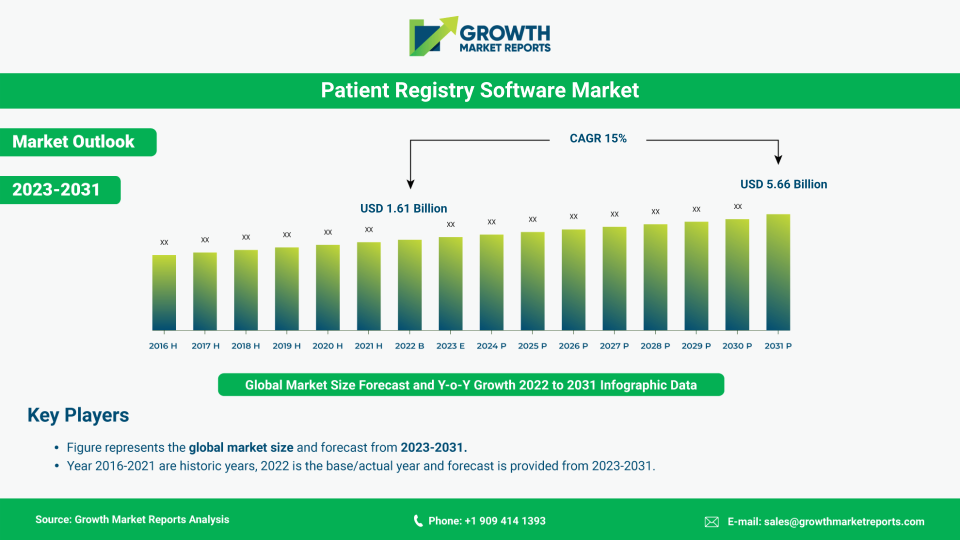
According to our latest research, the global patient registry software market size reached USD 1.92 billion in 2024, reflecting robust expansion amid digital transformation in healthcare. The market is projected to grow at a CAGR of 13.1% from 2025 to 2033, reaching a forecasted value of USD 5.41 billion by 2033. Growth is primarily fueled by the rising need for real-time patient data management, regulatory mandates for disease registries, and the integration of advanced analytics and artificial intelligence within healthcare settings.

A key growth driver for the patient registry software market is the escalating demand for comprehensive data collection and analysis to support evidence-based clinical decision-making. Healthcare providers are increasingly leveraging patient registry software to improve patient outcomes, streamline workflows, and facilitate population health management. The growing prevalence of chronic diseases such as diabetes, cardiovascular disorders, and cancer underscores the need for robust patient registries that can track patient journeys, monitor treatment efficacy, and enable proactive interventions. Additionally, the shift towards value-based care models and the need to demonstrate outcomes for reimbursement further amplify the adoption of these platforms.

Another significant factor propelling market growth is the evolving regulatory landscape. Governments and healthcare authorities across the globe are mandating the collection and reporting of patient data for disease surveillance, public health management, and clinical research. Initiatives such as the U.S. 21st Century Cures Act and the European General Data Protection Regulation (GDPR) have heightened the focus on data interoperability, security, and patient privacy, prompting healthcare organizations to invest in sophisticated registry solutions. These regulatory requirements not only ensure compliance but also foster greater transparency and accountability in patient care, driving the adoption of patient registry software across various healthcare settings.

Technological advancements are also shaping the trajectory of the patient registry software market. The integration of artificial intelligence, machine learning, and cloud computing has revolutionized the capabilities of registry platforms, enabling real-time analytics, predictive modeling, and seamless data exchange across disparate systems. The proliferation of cloud-based and web-based deployment models offers scalability, cost-efficiency, and remote accessibility, making advanced registry solutions more accessible to small and medium healthcare organizations. Furthermore, the rising trend of patient-centric care and personalized medicine relies heavily on robust data aggregation and analytics, further cementing the role of patient registry software as a critical enabler of next-generation healthcare delivery.

Rare Disease Registries play a crucial role in the patient registry software market, particularly as healthcare systems strive to address the unique challenges posed by rare diseases. These registries are designed to collect and manage comprehensive data on patients with rare conditions, facilitating research, diagnosis, and treatment development. By aggregating data from diverse sources, rare disease registries enable healthcare providers to identify patterns, track disease progression, and evaluate treatment outcomes. This is especially important given the limited patient populations and the need for specialized care pathways. The integration of rare disease registries with advanced analytics and artificial intelligence further enhances their utility, providing insights that can drive personalized medicine and improve patient outcomes. As awareness and advocacy for rare diseases continue to grow, the demand for robust registry solutions in this area is expected to increase, offering significant opportunities for innovation and market expansion.

From a regional perspective, North America dominates the global patient registry software market, accounting for the largest share in 2024, followed by Europe and Asia Pacific. The region's leadership is attributed to its advanced healthcare infrastructure, high adoption of electronic health records (EHRs), and extensive regulatory support for health IT initiatives. However, Asia Pacific is expected to witness the fastest growth during the forecast period, driven by increasing investments in healthcare digitization, expanding patient populations, and rising awareness regarding the benefits of registry software. Emerging markets in Latin America and the Middle East & Africa are also poised for steady growth, supported by government-led healthcare modernization programs and the rising burden of chronic diseases.

Global Patient Registry Software Industry Outlook

Product Type Analysis

The patient registry software market by product type is segmented into standalone software and integrated software. Standalone software solutions are designed to address specific registry needs, offering tailored functionalities for disease, product, or health service registries. These solutions are particularly favored by smaller healthcare providers or organizations with niche requirements, as they offer agility, ease of deployment, and lower upfront costs. However, their limited interoperability with other health IT systems can pose challenges in environments where data integration and exchange are critical. Despite this, standalone solutions continue to find traction in specialized research settings and among organizations seeking rapid deployment without extensive IT infrastructure overhaul.

Integrated patient registry software, on the other hand, is designed to seamlessly connect with existing electronic health records (EHRs), laboratory information systems, and other hospital information systems. This integration enables holistic patient data management, real-time analytics, and improved care coordination across the healthcare continuum. As healthcare organizations increasingly prioritize interoperability and data-driven decision-making, the demand for integrated solutions has surged. These platforms support a wide range of functionalities, from population health management to clinical research, and are often preferred by large hospitals, research centers, and government agencies seeking comprehensive, scalable registry capabilities.

The shift towards integrated solutions is further supported by the growing complexity of healthcare delivery and the need for unified patient records. Integrated registry software not only streamlines data collection and reporting but also enhances clinical workflows by reducing manual data entry and minimizing errors. The ability to aggregate data from multiple sources empowers healthcare providers to gain deeper insights into patient populations, track outcomes, and identify trends for targeted interventions. As a result, integrated software is expected to outpace standalone solutions in terms of adoption and market share over the forecast period.

Nevertheless, standalone software continues to play a vital role in the market, particularly in regions or segments where budget constraints or legacy systems limit the adoption of fully integrated platforms. Vendors are responding to these needs by offering modular solutions that can be customized and upgraded over time, bridging the gap between standalone and integrated functionalities. This hybrid approach enables organizations to start with basic registry capabilities and scale up as their needs evolve, ensuring flexibility and future-readiness in a rapidly changing healthcare landscape.

Model Registry systems are becoming increasingly important as healthcare organizations seek to standardize and optimize their data collection processes. These registries serve as frameworks for developing and implementing consistent data models across various healthcare settings, ensuring interoperability and data integrity. By adopting a model registry approach, healthcare providers can streamline data exchange, reduce redundancy, and enhance the accuracy of clinical and research data. This is particularly valuable in multi-site studies and collaborative research initiatives, where consistent data definitions and structures are critical for meaningful analysis. Model registries also support the integration of new data sources, such as wearable devices and patient-reported outcomes, into existing healthcare systems. As the healthcare industry continues to embrace digital transformation, the role of model registries in facilitating seamless data integration and analysis is expected to grow, driving demand for innovative registry solutions that support these capabilities.

Report Scope

Attributes Details
Report Title Patient Registry Software Market Research Report 2033
By Product Type Standalone Software, Integrated Software
By Deployment Mode On-Premises, Cloud-Based, Web-Based
By Database Type Disease Registries, Health Service Registries, Product Registries, Others
By Functionality Population Health Management, Patient Care Management, Health Information Exchange, Medical Research & Clinical Studies, Others
By End-User Hospitals & Medical Practices, Pharmaceutical & Biotechnology Companies, Research Centers, Government Organizations, Others
Regions Covered North America, Europe, APAC, Latin America, MEA
Base Year 2024
Historic Data 2018-2023
Forecast Period 2025-2033
Number of Pages 288
Number of Tables & Figures 399
Customization Available Yes, the report can be customized as per your need.

Deployment Mode Analysis

Deployment mode is a critical consideration for healthcare organizations investing in patient registry software, with options including on-premises, cloud-based, and web-based models. On-premises solutions are traditionally favored by large hospitals and government agencies that require stringent control over data security, privacy, and compliance. These deployments involve hosting software and data within the organization's own IT infrastructure, offering robust customization and integration capabilities. However, the high capital expenditure, ongoing maintenance requirements, and limited scalability have prompted many organizations to explore alternative deployment models.

Cloud-based patient registry software has gained significant momentum in recent years, driven by its scalability, cost-effectiveness, and ease of access. Cloud deployments eliminate the need for substantial upfront investments in hardware and IT resources, allowing healthcare providers to pay for services on a subscription basis. This model is particularly attractive to small and medium-sized enterprises (SMEs) and organizations operating in resource-constrained settings. Cloud-based solutions also facilitate remote access, real-time collaboration, and seamless software updates, ensuring that users always have access to the latest features and security enhancements. The growing adoption of telehealth and remote patient monitoring further underscores the relevance of cloud-based registry platforms.

Web-based deployment represents a hybrid approach, combining elements of both on-premises and cloud models. Web-based patient registry software enables users to access registry functionalities via a secure web browser, without the need for extensive local installations. This model supports interoperability, cross-platform compatibility, and rapid deployment, making it suitable for organizations seeking flexibility and ease of use. Web-based solutions are particularly valuable in multi-site healthcare networks, research collaborations, and public health initiatives that require centralized data collection and analysis across geographically dispersed locations.

The choice of deployment mode is often influenced by organizational size, regulatory requirements, IT infrastructure, and budget considerations. While on-premises solutions remain relevant in highly regulated or security-sensitive environments, the market is witnessing a clear shift towards cloud-based and web-based models. Vendors are responding by offering flexible deployment options, robust data encryption, and compliance with international standards such as HIPAA and GDPR. As digital transformation accelerates, the adoption of cloud and web-based patient registry software is expected to drive market growth, enabling healthcare organizations to harness the full potential of data-driven care delivery.

Database Type Analysis

The patient registry software market is further segmented by database type, including disease registries, health service registries, product registries, and others. Disease registries represent the largest segment, driven by the rising incidence of chronic and rare diseases and the need for longitudinal patient tracking. These registries collect and manage detailed information on patients diagnosed with specific conditions, enabling healthcare providers to monitor disease progression, evaluate treatment outcomes, and support clinical research. Disease registries play a pivotal role in public health surveillance, epidemiological studies, and the development of targeted therapies, making them indispensable in modern healthcare ecosystems.

Health service registries focus on tracking the utilization and outcomes of specific healthcare services, such as surgical procedures, diagnostic interventions, or preventive screenings. These registries enable healthcare organizations to assess the quality, safety, and efficiency of care delivery, identify best practices, and drive continuous improvement initiatives. Health service registries are increasingly integrated with quality improvement programs, accreditation processes, and value-based care models, reflecting the growing emphasis on accountability and patient-centered outcomes in healthcare.

Product registries are designed to monitor the safety, effectiveness, and real-world performance of medical devices, pharmaceuticals, and other healthcare products. These registries are essential for post-market surveillance, regulatory compliance, and risk management, providing manufacturers, regulators, and healthcare providers with critical data on product usage and adverse events. The expansion of global regulatory frameworks and the increasing complexity of medical products have heightened the importance of robust product registries, driving demand for specialized registry software solutions in the pharmaceutical and medical device industries.

Other database types encompass a wide range of registries, including patient satisfaction, lifestyle, and demographic registries, as well as registries focused on rare diseases, genetic disorders, and personalized medicine. The diversity of registry types reflects the evolving needs of healthcare stakeholders, from clinicians and researchers to policymakers and payers. Vendors are responding by offering configurable platforms that support multiple registry types, advanced analytics, and interoperability with external data sources. As healthcare continues to evolve towards a data-driven paradigm, the versatility and scalability of patient registry software will be key determinants of market success.

Functionality Analysis

Patient registry software platforms offer a broad spectrum of functionalities, with core areas including population health management, patient care management, health information exchange, medical research and clinical studies, and others. Population health management is a primary focus, enabling healthcare organizations to aggregate, analyze, and act on data from diverse patient populations. These functionalities support risk stratification, care coordination, and the identification of high-risk cohorts, empowering providers to implement targeted interventions and improve health outcomes. The integration of predictive analytics and machine learning further enhances the ability to forecast trends, allocate resources, and optimize care delivery at the population level.

Patient care management functionalities are designed to support individualized care planning, treatment monitoring, and patient engagement. Registry software enables clinicians to track patient progress, monitor adherence to treatment protocols, and identify gaps in care. These capabilities are particularly valuable in chronic disease management, where continuous monitoring and timely interventions are critical to preventing complications and reducing hospitalizations. Patient care management also extends to remote monitoring, telehealth, and patient-reported outcomes, reflecting the shift towards patient-centric and value-based care models.

Health information exchange (HIE) is another critical functionality, facilitating the secure sharing of patient data across healthcare organizations, providers, and care settings. HIE capabilities are essential for ensuring continuity of care, reducing duplication of tests and procedures, and supporting coordinated care pathways. Advanced registry platforms integrate with regional and national HIE networks, enabling real-time data exchange, interoperability, and compliance with regulatory standards. The growing emphasis on data liquidity and seamless information flow underscores the importance of HIE functionalities in modern patient registry software.

Medical research and clinical studies functionalities are increasingly embedded in patient registry software, supporting data collection, cohort identification, and outcomes analysis for clinical trials and observational studies. These capabilities accelerate research timelines, enhance data quality, and facilitate collaboration between academic institutions, research centers, and industry partners. Registries are also instrumental in post-market surveillance, pharmacovigilance, and real-world evidence generation, supporting the development of new therapies and the optimization of existing treatments. As the demand for high-quality clinical data continues to rise, registry software with advanced research functionalities will play a pivotal role in driving scientific and medical innovation.

End-User Analysis

The end-user landscape for patient registry software is diverse, encompassing hospitals and medical practices, pharmaceutical and biotechnology companies, research centers, government organizations, and others. Hospitals and medical practices represent the largest end-user segment, driven by the need to improve clinical outcomes, enhance care coordination, and comply with regulatory reporting requirements. These organizations leverage registry software to manage chronic disease populations, track quality metrics, and support accreditation and reimbursement processes. The integration of registry platforms with EHRs and other clinical systems further streamlines workflows and enhances data-driven decision-making within hospital settings.

Pharmaceutical and biotechnology companies are increasingly adopting patient registry software to support clinical trials, post-market surveillance, and real-world evidence generation. Registries enable these organizations to monitor drug and device performance, assess safety and efficacy, and comply with regulatory mandates for data collection and reporting. The growing focus on personalized medicine and targeted therapies has heightened the importance of comprehensive patient data, driving demand for advanced registry solutions in the life sciences sector. Collaboration between industry stakeholders and healthcare providers is also fostering the development of shared registries and data networks, accelerating research and innovation.

Research centers and academic institutions utilize patient registry software to support epidemiological studies, longitudinal research, and outcomes analysis. These organizations require flexible, configurable platforms that can accommodate diverse research protocols, data types, and analytical methodologies. Registry software enables researchers to recruit study participants, track cohorts over time, and generate high-quality data for publication and policy development. The integration of registry platforms with biobanks, genomics databases, and other research infrastructure further enhances the value of these solutions in advancing scientific knowledge and public health.

Government organizations play a critical role in driving the adoption of patient registry software, particularly in the context of public health surveillance, disease monitoring, and healthcare quality improvement. National and regional health authorities leverage registries to track disease outbreaks, monitor vaccination programs, and evaluate the impact of health policies. The implementation of large-scale, government-led registries requires robust, scalable software platforms capable of supporting millions of records, ensuring data security, and facilitating interoperability with other health information systems. As public health challenges continue to evolve, the role of government organizations as key end-users of patient registry software is expected to grow.

Opportunities & Threats

The patient registry software market presents significant opportunities for innovation and expansion, particularly as healthcare systems worldwide accelerate their digital transformation journeys. The integration of artificial intelligence and machine learning into registry platforms offers the potential for advanced predictive analytics, risk stratification, and personalized care recommendations. Vendors that invest in developing AI-powered solutions stand to gain a competitive edge by enabling healthcare organizations to move beyond retrospective data analysis towards real-time, actionable insights. Additionally, the proliferation of wearable devices, remote monitoring tools, and patient engagement apps is generating vast amounts of health data, creating new opportunities for registry software vendors to develop interoperable solutions that capture, integrate, and analyze data from multiple sources.

Another major opportunity lies in the expansion of registry software into emerging markets, where healthcare infrastructure is rapidly evolving, and the burden of chronic diseases is rising. Governments and international organizations are increasingly investing in health IT modernization, creating a fertile environment for the adoption of patient registry solutions. Vendors that offer scalable, cost-effective, and user-friendly platforms tailored to the needs of low- and middle-income countries can capitalize on untapped market potential. Strategic partnerships with local healthcare providers, government agencies, and non-governmental organizations can further accelerate market penetration and drive sustainable growth. Moreover, the growing emphasis on value-based care and outcome measurement globally is expected to drive demand for advanced registry functionalities that support quality improvement and reimbursement optimization.

Despite these opportunities, the patient registry software market faces several restraining factors, chief among them being concerns over data privacy and security. The sensitive nature of patient health information necessitates stringent safeguards against data breaches, unauthorized access, and cyber threats. Compliance with evolving regulatory frameworks such as HIPAA, GDPR, and other national data protection laws adds complexity and cost to software development and deployment. Healthcare organizations, particularly in regions with limited IT infrastructure or expertise, may be hesitant to adopt registry solutions due to perceived risks and the potential for regulatory non-compliance. Vendors must prioritize robust security features, regular software updates, and comprehensive user training to address these concerns and build trust among end-users.

Regional Outlook

North America remains the largest regional market for patient registry software, accounting for approximately USD 850 million of the global market size in 2024. The regionÂ’s dominance is attributed to its advanced healthcare infrastructure, widespread adoption of electronic health records, and strong regulatory support for health IT innovation. The United States, in particular, leads the market with a high concentration of hospitals, research centers, and life sciences companies leveraging registry software for clinical and research applications. Ongoing government initiatives, such as the Meaningful Use program and the 21st Century Cures Act, further drive adoption by incentivizing data interoperability, outcome measurement, and quality reporting.

Europe holds the second-largest share of the global patient registry software market, with a market size of approximately USD 520 million in 2024. The region benefits from robust public health systems, active disease surveillance initiatives, and a strong focus on data privacy and patient rights under the General Data Protection Regulation (GDPR). Countries such as Germany, the United Kingdom, and France are at the forefront of registry adoption, driven by government mandates, research collaborations, and the growing need for population health management. The European market is expected to grow at a steady pace, supported by ongoing investments in healthcare digitization and cross-border data sharing initiatives.

Asia Pacific is poised to be the fastest-growing regional market, with a projected CAGR of 16.5% from 2025 to 2033. The regionÂ’s market size reached approximately USD 320 million in 2024, with significant growth potential in China, India, Japan, and Australia. Rapid urbanization, expanding healthcare access, and rising chronic disease prevalence are driving demand for patient registry software across both public and private sectors. Government-led health IT modernization programs, combined with increasing investments from international organizations and private equity, are accelerating market development. The regionÂ’s large and diverse patient populations present unique opportunities for registry vendors to develop scalable, multilingual, and culturally tailored solutions.

Patient Registry Software Market Statistics

Competitor Outlook

The competitive landscape of the patient registry software market is characterized by a mix of established health IT vendors, specialized registry solution providers, and emerging technology firms. Market leaders are distinguished by their comprehensive product portfolios, robust integration capabilities, and strong customer support networks. These companies invest heavily in research and development to enhance platform functionalities, incorporate advanced analytics, and ensure compliance with evolving regulatory standards. Strategic partnerships, mergers and acquisitions, and geographic expansion are common strategies employed to strengthen market position and broaden customer reach.

Innovation is a key differentiator in the patient registry software market, with vendors competing on the basis of usability, interoperability, and scalability. Leading companies offer configurable platforms that support multiple registry types, seamless integration with EHRs and other health information systems, and advanced analytics for population health management and clinical research. The ability to deliver cloud-based and web-based solutions, along with robust data security features, is increasingly important as healthcare organizations prioritize flexibility and remote access. Customer-centric support, including training, customization, and ongoing technical assistance, also plays a crucial role in vendor selection and long-term customer retention.

The market is witnessing the entry of new players leveraging emerging technologies such as artificial intelligence, blockchain, and big data analytics to differentiate their offerings. These entrants are driving innovation by developing next-generation registry platforms that enable real-time data capture, predictive modeling, and personalized care recommendations. Collaboration with academic institutions, research organizations, and government agencies is fostering the development of open-source and consortium-based registry solutions, further expanding the competitive landscape. As the market matures, consolidation is expected, with larger players acquiring niche vendors to enhance their capabilities and expand their customer base.

Major companies operating in the patient registry software market include IBM Corporation, IQVIA Holdings Inc., Oracle Corporation, Phytel, Inc. (an IBM Company), Optum, Inc., Premier, Inc., FIGmd, Inc., Global Vision Technologies, Inc., Evado Clinical, and Liaison Technologies. IBM and Oracle are recognized for their robust, scalable solutions and strong integration with enterprise health IT systems. IQVIA leverages its expertise in clinical research and real-world evidence to offer specialized registry platforms for pharmaceutical and biotechnology clients. Optum and Premier provide comprehensive population health management solutions, with a focus on analytics and quality improvement. FIGmd and Global Vision Technologies are known for their configurable, user-friendly registry platforms tailored to the needs of medical societies, research organizations, and specialty providers. These companies are continuously investing in platform enhancements, strategic partnerships, and customer support to maintain their competitive edge in a rapidly evolving market.

Key Players

  • IBM Corporation
  • IQVIA Holdings Inc.
  • Optum Inc.
  • Pharmaceutical Product Development LLC (PPD)
  • Dacima Software Inc.
  • Medstreaming LLC
  • OpenText Corporation
  • Global Vision Technologies Inc.
  • Syneos Health Inc.
  • FIGmd Inc.
  • Liaison Technologies
  • Velos Inc.
  • Evado Pty. Ltd.
  • ImageTrend Inc.
  • Premier Inc.
  • McKesson Corporation
  • Oracle Corporation
  • RedCap Cloud (nPhase Inc.)
  • ArborMetrix Inc.
  • Culmination Bio (formerly ConcertAI)
Patient Registry Software Market Overview

Segments

The Patient Registry Software market has been segmented on the basis of

Product Type

  • Standalone Software
  • Integrated Software

Deployment Mode

  • On-Premises
  • Cloud-Based
  • Web-Based

Database Type

  • Disease Registries
  • Health Service Registries
  • Product Registries
  • Others

Functionality

  • Population Health Management
  • Patient Care Management
  • Health Information Exchange
  • Medical Research & Clinical Studies
  • Others

End-User

  • Hospitals & Medical Practices
  • Pharmaceutical & Biotechnology Companies
  • Research Centers
  • Government Organizations
  • Others

Competitive Landscape

The major players in the patient registry software market include IQVIA Inc., FIGmd Inc., Medstreaming, Open Text Corporation, Evado Clinical, LUMEDX, CEDARON, and IBM Corporation. Several companies are engaging in mergers, acquisitions, and partnerships to extend their market share. Moreover they are focusing on expanding their product portfolio to leverage their market position.

In July 2019, Pulse Infoframe partnered with Immunocore and introduced the first global patient registry for Uveal Melanoma. This is a joint effort from the companies and the academic institutions from U.S., Australia, and the U.K. In March 2019, Amplitude Clinical launched Amplitude software which is pre-loaded with the patient record, involving accurate case-mix adjustment in order to improve the diagnostic and treatment procedure.
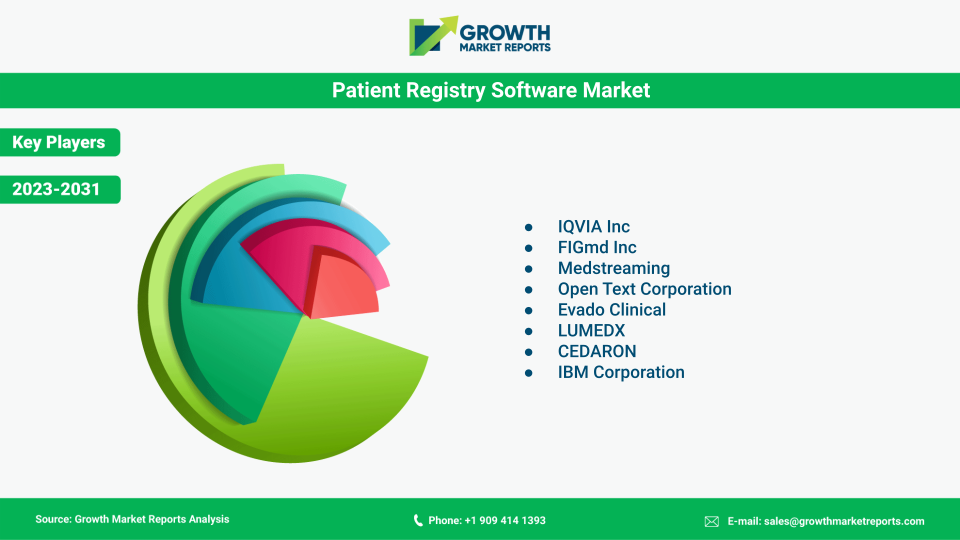

 Patient Registry Software Market Key Players

Frequently Asked Questions

Major players include IBM Corporation, IQVIA Holdings Inc., Oracle Corporation, Optum Inc., Premier Inc., FIGmd Inc., Global Vision Technologies Inc., Evado Clinical, Liaison Technologies, and others. These companies are recognized for their robust, scalable solutions and strong integration capabilities.

Core functionalities include population health management, patient care management, health information exchange, support for medical research and clinical studies, and advanced analytics for risk stratification and outcome measurement.

Major end-users include hospitals and medical practices, pharmaceutical and biotechnology companies, research centers, and government organizations. Each uses registry software for clinical management, research, regulatory compliance, and public health surveillance.

Patient registry software supports various database types, including disease registries, health service registries, product registries, and others such as patient satisfaction and demographic registries. Disease registries are the largest segment due to the need for tracking chronic and rare diseases.

North America leads the market due to advanced healthcare infrastructure and regulatory support, followed by Europe. Asia Pacific is expected to witness the fastest growth, driven by healthcare digitization, expanding patient populations, and increased investment in health IT.

Patient registry software can be deployed on-premises, cloud-based, or web-based. On-premises solutions offer control and customization but require higher investment. Cloud-based solutions provide scalability, cost-effectiveness, and remote access, while web-based models offer flexibility and rapid deployment via secure web browsers.

Standalone software addresses specific registry needs and is favored by smaller organizations for its agility and lower cost, but may lack interoperability. Integrated software connects seamlessly with EHRs and other health IT systems, enabling holistic data management and is preferred by larger hospitals and research centers for its scalability and comprehensive capabilities.

Key growth drivers include the rising need for real-time patient data management, regulatory mandates for disease registries, increasing prevalence of chronic diseases, integration of advanced analytics and AI, and the shift towards value-based care models.

The global patient registry software market reached USD 1.92 billion in 2024 and is projected to grow at a CAGR of 13.1% from 2025 to 2033, reaching an estimated value of USD 5.41 billion by 2033.

Patient registry software is a digital platform used to collect, manage, and analyze patient data for specific diseases, treatments, or healthcare services. It is crucial in healthcare for tracking patient outcomes, supporting clinical decision-making, improving population health management, and meeting regulatory requirements for data reporting and surveillance.

Table Of Content

Chapter 1 Executive Summary
Chapter 2 Assumptions and Acronyms Used
Chapter 3 Research Methodology
Chapter 4 Patient Registry Software Market Overview
   4.1 Introduction
      4.1.1 Market Taxonomy
      4.1.2 Market Definition
      4.1.3 Macro-Economic Factors Impacting the Market Growth
   4.2 Patient Registry Software Market Dynamics
      4.2.1 Market Drivers
      4.2.2 Market Restraints
      4.2.3 Market Opportunity
   4.3 Patient Registry Software Market - Supply Chain Analysis
      4.3.1 List of Key Suppliers
      4.3.2 List of Key Distributors
      4.3.3 List of Key Consumers
   4.4 Key Forces Shaping the Patient Registry Software Market
      4.4.1 Bargaining Power of Suppliers
      4.4.2 Bargaining Power of Buyers
      4.4.3 Threat of Substitution
      4.4.4 Threat of New Entrants
      4.4.5 Competitive Rivalry
   4.5 Global Patient Registry Software Market Size & Forecast, 2023-2032
      4.5.1 Patient Registry Software Market Size and Y-o-Y Growth
      4.5.2 Patient Registry Software Market Absolute $ Opportunity

Chapter 5 Global Patient Registry Software Market Analysis and Forecast By Product Type
   5.1 Introduction
      5.1.1 Key Market Trends & Growth Opportunities By Product Type
      5.1.2 Basis Point Share (BPS) Analysis By Product Type
      5.1.3 Absolute $ Opportunity Assessment By Product Type
   5.2 Patient Registry Software Market Size Forecast By Product Type
      5.2.1 Standalone Software
      5.2.2 Integrated Software
   5.3 Market Attractiveness Analysis By Product Type

Chapter 6 Global Patient Registry Software Market Analysis and Forecast By Deployment Mode
   6.1 Introduction
      6.1.1 Key Market Trends & Growth Opportunities By Deployment Mode
      6.1.2 Basis Point Share (BPS) Analysis By Deployment Mode
      6.1.3 Absolute $ Opportunity Assessment By Deployment Mode
   6.2 Patient Registry Software Market Size Forecast By Deployment Mode
      6.2.1 On-Premises
      6.2.2 Cloud-Based
      6.2.3 Web-Based
   6.3 Market Attractiveness Analysis By Deployment Mode

Chapter 7 Global Patient Registry Software Market Analysis and Forecast By Database Type
   7.1 Introduction
      7.1.1 Key Market Trends & Growth Opportunities By Database Type
      7.1.2 Basis Point Share (BPS) Analysis By Database Type
      7.1.3 Absolute $ Opportunity Assessment By Database Type
   7.2 Patient Registry Software Market Size Forecast By Database Type
      7.2.1 Disease Registries
      7.2.2 Health Service Registries
      7.2.3 Product Registries
      7.2.4 Others
   7.3 Market Attractiveness Analysis By Database Type

Chapter 8 Global Patient Registry Software Market Analysis and Forecast By Functionality
   8.1 Introduction
      8.1.1 Key Market Trends & Growth Opportunities By Functionality
      8.1.2 Basis Point Share (BPS) Analysis By Functionality
      8.1.3 Absolute $ Opportunity Assessment By Functionality
   8.2 Patient Registry Software Market Size Forecast By Functionality
      8.2.1 Population Health Management
      8.2.2 Patient Care Management
      8.2.3 Health Information Exchange
      8.2.4 Medical Research & Clinical Studies
      8.2.5 Others
   8.3 Market Attractiveness Analysis By Functionality

Chapter 9 Global Patient Registry Software Market Analysis and Forecast By End-User
   9.1 Introduction
      9.1.1 Key Market Trends & Growth Opportunities By End-User
      9.1.2 Basis Point Share (BPS) Analysis By End-User
      9.1.3 Absolute $ Opportunity Assessment By End-User
   9.2 Patient Registry Software Market Size Forecast By End-User
      9.2.1 Hospitals & Medical Practices
      9.2.2 Pharmaceutical & Biotechnology Companies
      9.2.3 Research Centers
      9.2.4 Government Organizations
      9.2.5 Others
   9.3 Market Attractiveness Analysis By End-User

Chapter 10 Global Patient Registry Software Market Analysis and Forecast by Region
   10.1 Introduction
      10.1.1 Key Market Trends & Growth Opportunities By Region
      10.1.2 Basis Point Share (BPS) Analysis By Region
      10.1.3 Absolute $ Opportunity Assessment By Region
   10.2 Patient Registry Software Market Size Forecast By Region
      10.2.1 North America
      10.2.2 Europe
      10.2.3 Asia Pacific
      10.2.4 Latin America
      10.2.5 Middle East & Africa (MEA)
   10.3 Market Attractiveness Analysis By Region

Chapter 11 Coronavirus Disease (COVID-19) Impact 
   11.1 Introduction 
   11.2 Current & Future Impact Analysis 
   11.3 Economic Impact Analysis 
   11.4 Government Policies 
   11.5 Investment Scenario

Chapter 12 North America Patient Registry Software Analysis and Forecast
   12.1 Introduction
   12.2 North America Patient Registry Software Market Size Forecast by Country
      12.2.1 U.S.
      12.2.2 Canada
   12.3 Basis Point Share (BPS) Analysis by Country
   12.4 Absolute $ Opportunity Assessment by Country
   12.5 Market Attractiveness Analysis by Country
   12.6 North America Patient Registry Software Market Size Forecast By Product Type
      12.6.1 Standalone Software
      12.6.2 Integrated Software
   12.7 Basis Point Share (BPS) Analysis By Product Type 
   12.8 Absolute $ Opportunity Assessment By Product Type 
   12.9 Market Attractiveness Analysis By Product Type
   12.10 North America Patient Registry Software Market Size Forecast By Deployment Mode
      12.10.1 On-Premises
      12.10.2 Cloud-Based
      12.10.3 Web-Based
   12.11 Basis Point Share (BPS) Analysis By Deployment Mode 
   12.12 Absolute $ Opportunity Assessment By Deployment Mode 
   12.13 Market Attractiveness Analysis By Deployment Mode
   12.14 North America Patient Registry Software Market Size Forecast By Database Type
      12.14.1 Disease Registries
      12.14.2 Health Service Registries
      12.14.3 Product Registries
      12.14.4 Others
   12.15 Basis Point Share (BPS) Analysis By Database Type 
   12.16 Absolute $ Opportunity Assessment By Database Type 
   12.17 Market Attractiveness Analysis By Database Type
   12.18 North America Patient Registry Software Market Size Forecast By Functionality
      12.18.1 Population Health Management
      12.18.2 Patient Care Management
      12.18.3 Health Information Exchange
      12.18.4 Medical Research & Clinical Studies
      12.18.5 Others
   12.19 Basis Point Share (BPS) Analysis By Functionality 
   12.20 Absolute $ Opportunity Assessment By Functionality 
   12.21 Market Attractiveness Analysis By Functionality
   12.22 North America Patient Registry Software Market Size Forecast By End-User
      12.22.1 Hospitals & Medical Practices
      12.22.2 Pharmaceutical & Biotechnology Companies
      12.22.3 Research Centers
      12.22.4 Government Organizations
      12.22.5 Others
   12.23 Basis Point Share (BPS) Analysis By End-User 
   12.24 Absolute $ Opportunity Assessment By End-User 
   12.25 Market Attractiveness Analysis By End-User

Chapter 13 Europe Patient Registry Software Analysis and Forecast
   13.1 Introduction
   13.2 Europe Patient Registry Software Market Size Forecast by Country
      13.2.1 Germany
      13.2.2 France
      13.2.3 Italy
      13.2.4 U.K.
      13.2.5 Spain
      13.2.6 Russia
      13.2.7 Rest of Europe
   13.3 Basis Point Share (BPS) Analysis by Country
   13.4 Absolute $ Opportunity Assessment by Country
   13.5 Market Attractiveness Analysis by Country
   13.6 Europe Patient Registry Software Market Size Forecast By Product Type
      13.6.1 Standalone Software
      13.6.2 Integrated Software
   13.7 Basis Point Share (BPS) Analysis By Product Type 
   13.8 Absolute $ Opportunity Assessment By Product Type 
   13.9 Market Attractiveness Analysis By Product Type
   13.10 Europe Patient Registry Software Market Size Forecast By Deployment Mode
      13.10.1 On-Premises
      13.10.2 Cloud-Based
      13.10.3 Web-Based
   13.11 Basis Point Share (BPS) Analysis By Deployment Mode 
   13.12 Absolute $ Opportunity Assessment By Deployment Mode 
   13.13 Market Attractiveness Analysis By Deployment Mode
   13.14 Europe Patient Registry Software Market Size Forecast By Database Type
      13.14.1 Disease Registries
      13.14.2 Health Service Registries
      13.14.3 Product Registries
      13.14.4 Others
   13.15 Basis Point Share (BPS) Analysis By Database Type 
   13.16 Absolute $ Opportunity Assessment By Database Type 
   13.17 Market Attractiveness Analysis By Database Type
   13.18 Europe Patient Registry Software Market Size Forecast By Functionality
      13.18.1 Population Health Management
      13.18.2 Patient Care Management
      13.18.3 Health Information Exchange
      13.18.4 Medical Research & Clinical Studies
      13.18.5 Others
   13.19 Basis Point Share (BPS) Analysis By Functionality 
   13.20 Absolute $ Opportunity Assessment By Functionality 
   13.21 Market Attractiveness Analysis By Functionality
   13.22 Europe Patient Registry Software Market Size Forecast By End-User
      13.22.1 Hospitals & Medical Practices
      13.22.2 Pharmaceutical & Biotechnology Companies
      13.22.3 Research Centers
      13.22.4 Government Organizations
      13.22.5 Others
   13.23 Basis Point Share (BPS) Analysis By End-User 
   13.24 Absolute $ Opportunity Assessment By End-User 
   13.25 Market Attractiveness Analysis By End-User

Chapter 14 Asia Pacific Patient Registry Software Analysis and Forecast
   14.1 Introduction
   14.2 Asia Pacific Patient Registry Software Market Size Forecast by Country
      14.2.1 China
      14.2.2 Japan
      14.2.3 South Korea
      14.2.4 India
      14.2.5 Australia
      14.2.6 South East Asia (SEA)
      14.2.7 Rest of Asia Pacific (APAC)
   14.3 Basis Point Share (BPS) Analysis by Country
   14.4 Absolute $ Opportunity Assessment by Country
   14.5 Market Attractiveness Analysis by Country
   14.6 Asia Pacific Patient Registry Software Market Size Forecast By Product Type
      14.6.1 Standalone Software
      14.6.2 Integrated Software
   14.7 Basis Point Share (BPS) Analysis By Product Type 
   14.8 Absolute $ Opportunity Assessment By Product Type 
   14.9 Market Attractiveness Analysis By Product Type
   14.10 Asia Pacific Patient Registry Software Market Size Forecast By Deployment Mode
      14.10.1 On-Premises
      14.10.2 Cloud-Based
      14.10.3 Web-Based
   14.11 Basis Point Share (BPS) Analysis By Deployment Mode 
   14.12 Absolute $ Opportunity Assessment By Deployment Mode 
   14.13 Market Attractiveness Analysis By Deployment Mode
   14.14 Asia Pacific Patient Registry Software Market Size Forecast By Database Type
      14.14.1 Disease Registries
      14.14.2 Health Service Registries
      14.14.3 Product Registries
      14.14.4 Others
   14.15 Basis Point Share (BPS) Analysis By Database Type 
   14.16 Absolute $ Opportunity Assessment By Database Type 
   14.17 Market Attractiveness Analysis By Database Type
   14.18 Asia Pacific Patient Registry Software Market Size Forecast By Functionality
      14.18.1 Population Health Management
      14.18.2 Patient Care Management
      14.18.3 Health Information Exchange
      14.18.4 Medical Research & Clinical Studies
      14.18.5 Others
   14.19 Basis Point Share (BPS) Analysis By Functionality 
   14.20 Absolute $ Opportunity Assessment By Functionality 
   14.21 Market Attractiveness Analysis By Functionality
   14.22 Asia Pacific Patient Registry Software Market Size Forecast By End-User
      14.22.1 Hospitals & Medical Practices
      14.22.2 Pharmaceutical & Biotechnology Companies
      14.22.3 Research Centers
      14.22.4 Government Organizations
      14.22.5 Others
   14.23 Basis Point Share (BPS) Analysis By End-User 
   14.24 Absolute $ Opportunity Assessment By End-User 
   14.25 Market Attractiveness Analysis By End-User

Chapter 15 Latin America Patient Registry Software Analysis and Forecast
   15.1 Introduction
   15.2 Latin America Patient Registry Software Market Size Forecast by Country
      15.2.1 Brazil
      15.2.2 Mexico
      15.2.3 Rest of Latin America (LATAM)
   15.3 Basis Point Share (BPS) Analysis by Country
   15.4 Absolute $ Opportunity Assessment by Country
   15.5 Market Attractiveness Analysis by Country
   15.6 Latin America Patient Registry Software Market Size Forecast By Product Type
      15.6.1 Standalone Software
      15.6.2 Integrated Software
   15.7 Basis Point Share (BPS) Analysis By Product Type 
   15.8 Absolute $ Opportunity Assessment By Product Type 
   15.9 Market Attractiveness Analysis By Product Type
   15.10 Latin America Patient Registry Software Market Size Forecast By Deployment Mode
      15.10.1 On-Premises
      15.10.2 Cloud-Based
      15.10.3 Web-Based
   15.11 Basis Point Share (BPS) Analysis By Deployment Mode 
   15.12 Absolute $ Opportunity Assessment By Deployment Mode 
   15.13 Market Attractiveness Analysis By Deployment Mode
   15.14 Latin America Patient Registry Software Market Size Forecast By Database Type
      15.14.1 Disease Registries
      15.14.2 Health Service Registries
      15.14.3 Product Registries
      15.14.4 Others
   15.15 Basis Point Share (BPS) Analysis By Database Type 
   15.16 Absolute $ Opportunity Assessment By Database Type 
   15.17 Market Attractiveness Analysis By Database Type
   15.18 Latin America Patient Registry Software Market Size Forecast By Functionality
      15.18.1 Population Health Management
      15.18.2 Patient Care Management
      15.18.3 Health Information Exchange
      15.18.4 Medical Research & Clinical Studies
      15.18.5 Others
   15.19 Basis Point Share (BPS) Analysis By Functionality 
   15.20 Absolute $ Opportunity Assessment By Functionality 
   15.21 Market Attractiveness Analysis By Functionality
   15.22 Latin America Patient Registry Software Market Size Forecast By End-User
      15.22.1 Hospitals & Medical Practices
      15.22.2 Pharmaceutical & Biotechnology Companies
      15.22.3 Research Centers
      15.22.4 Government Organizations
      15.22.5 Others
   15.23 Basis Point Share (BPS) Analysis By End-User 
   15.24 Absolute $ Opportunity Assessment By End-User 
   15.25 Market Attractiveness Analysis By End-User

Chapter 16 Middle East & Africa (MEA) Patient Registry Software Analysis and Forecast
   16.1 Introduction
   16.2 Middle East & Africa (MEA) Patient Registry Software Market Size Forecast by Country
      16.2.1 Saudi Arabia
      16.2.2 South Africa
      16.2.3 UAE
      16.2.4 Rest of Middle East & Africa (MEA)
   16.3 Basis Point Share (BPS) Analysis by Country
   16.4 Absolute $ Opportunity Assessment by Country
   16.5 Market Attractiveness Analysis by Country
   16.6 Middle East & Africa (MEA) Patient Registry Software Market Size Forecast By Product Type
      16.6.1 Standalone Software
      16.6.2 Integrated Software
   16.7 Basis Point Share (BPS) Analysis By Product Type 
   16.8 Absolute $ Opportunity Assessment By Product Type 
   16.9 Market Attractiveness Analysis By Product Type
   16.10 Middle East & Africa (MEA) Patient Registry Software Market Size Forecast By Deployment Mode
      16.10.1 On-Premises
      16.10.2 Cloud-Based
      16.10.3 Web-Based
   16.11 Basis Point Share (BPS) Analysis By Deployment Mode 
   16.12 Absolute $ Opportunity Assessment By Deployment Mode 
   16.13 Market Attractiveness Analysis By Deployment Mode
   16.14 Middle East & Africa (MEA) Patient Registry Software Market Size Forecast By Database Type
      16.14.1 Disease Registries
      16.14.2 Health Service Registries
      16.14.3 Product Registries
      16.14.4 Others
   16.15 Basis Point Share (BPS) Analysis By Database Type 
   16.16 Absolute $ Opportunity Assessment By Database Type 
   16.17 Market Attractiveness Analysis By Database Type
   16.18 Middle East & Africa (MEA) Patient Registry Software Market Size Forecast By Functionality
      16.18.1 Population Health Management
      16.18.2 Patient Care Management
      16.18.3 Health Information Exchange
      16.18.4 Medical Research & Clinical Studies
      16.18.5 Others
   16.19 Basis Point Share (BPS) Analysis By Functionality 
   16.20 Absolute $ Opportunity Assessment By Functionality 
   16.21 Market Attractiveness Analysis By Functionality
   16.22 Middle East & Africa (MEA) Patient Registry Software Market Size Forecast By End-User
      16.22.1 Hospitals & Medical Practices
      16.22.2 Pharmaceutical & Biotechnology Companies
      16.22.3 Research Centers
      16.22.4 Government Organizations
      16.22.5 Others
   16.23 Basis Point Share (BPS) Analysis By End-User 
   16.24 Absolute $ Opportunity Assessment By End-User 
   16.25 Market Attractiveness Analysis By End-User

Chapter 17 Competition Landscape 
   17.1 Patient Registry Software Market: Competitive Dashboard
   17.2 Global Patient Registry Software Market: Market Share Analysis, 2023
   17.3 Company Profiles (Details – Overview, Financials, Developments, Strategy) 
      17.3.1 IBM Corporation
IQVIA Holdings Inc.
Optum Inc.
Pharmaceutical Product Development LLC (PPD)
Dacima Software Inc.
Medstreaming LLC
OpenText Corporation
Global Vision Technologies Inc.
Syneos Health Inc.
FIGmd Inc.
Liaison Technologies
Velos Inc.
Evado Pty. Ltd.
ImageTrend Inc.
Premier Inc.
McKesson Corporation
Oracle Corporation
RedCap Cloud (nPhase Inc.)
ArborMetrix Inc.
Culmination Bio (formerly ConcertAI)

Methodology

Our Clients

Honda Motor Co. Ltd.
General Mills
The John Holland Group
Pfizer
Siemens Healthcare
sinopec
General Electric
Dassault Aviation