Next Generation Biometrics Market Report 2034

Next Generation Biometrics Market Report 2034

Segments - by Technology (Fingerprint Recognition, Face Recognition, Iris Recognition, Voice Recognition, Vein Recognition, Palm Print Recognition, Others), by Component (Hardware, Software, Services), by Authentication Type (Single-Factor Authentication, Multi-Factor Authentication), by Application (Access Control, Identity Verification, Payments, Surveillance, Others), by End-User (BFSI, Government, Healthcare, Retail, IT & Telecom, Travel & Immigration, Others)

https://growthmarketreports.com/Raksha
Author : Raksha Sharma
https://growthmarketreports.com/Vaibhav
Fact-checked by : V. Chandola
https://growthmarketreports.com/Shruti
Editor : Shruti Bhat

Last Updated : Jun, 2026 | Report ID :ICT-SE-1871 | 4.2 Rating | 97 Reviews | 258 Pages | Format : Docx PDF

Report Description

This report is updated with the latest market data and insights as of June 2026. Base year: 2025  |  Forecast period: 2026-2034


Next Generation Biometrics Market Outlook

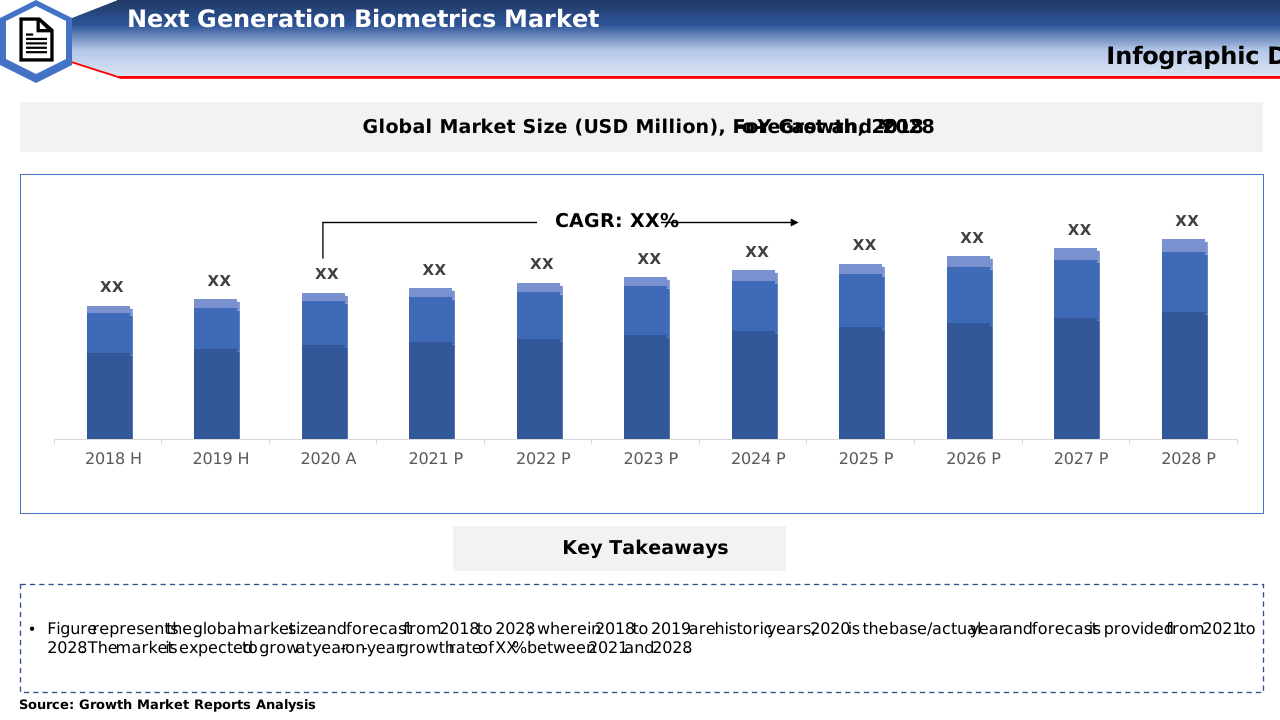
According to our latest research, the global next generation biometrics market size reached USD 31.4 billion in 2025 and is projected to expand to USD 99.2 billion by 2034, reflecting a robust CAGR of 13.6% during the forecast period of 2026 to 2034. This remarkable growth is propelled by the increasing adoption of biometric technologies across diverse industries for enhanced security, seamless identification, and fraud prevention. The surge in digital transformation initiatives, rising cybersecurity threats, and the growing demand for contactless authentication solutions are driving accelerated uptake of next generation biometrics globally. Organizations seeking to move beyond vulnerable password-based systems are turning to advanced biometric identification and verification platforms that deliver both precision and user convenience at scale.

Global Next Generation Biometrics Market Size Forecast 2025-2034, USD Billion

One of the primary growth factors fueling the next generation biometrics market is the rapid proliferation of digital services and the corresponding need for advanced security mechanisms. As organizations and governments worldwide digitize their operations, traditional authentication methods such as passwords and PINs are proving insufficient against sophisticated cyber threats. Next generation biometrics, including fingerprint, facial, iris, and voice recognition, offer a higher level of security by leveraging unique physiological and behavioral characteristics. This shift is further supported by regulatory mandates and compliance standards, especially in banking, financial services, and healthcare, where data privacy and secure access are paramount.

Another significant driver is the increasing adoption of mobile and IoT devices, which has expanded the scope and accessibility of biometric technologies. Modern smartphones, laptops, and wearable devices now commonly integrate biometric sensors, enabling users to unlock devices, authorize transactions, and access sensitive information with ease and security. The expansion of smartphone-embedded biometric solutions for banking, payments, and enterprise access is one of the fastest-growing sub-trends within the broader market. Furthermore, advancements in artificial intelligence and machine learning have enhanced the accuracy, speed, and reliability of biometric systems, making them more attractive for large-scale deployment across both public and private sectors.

The sustained global emphasis on contactless solutions, reinforced since the COVID-19 pandemic and now embedded in consumer and enterprise expectations by 2025, continues to accelerate the adoption of next generation biometrics. Organizations are prioritizing touchless authentication methods to minimize physical contact and improve hygiene standards. Facial and iris recognition technologies are being widely implemented in airports, healthcare facilities, and retail environments for access control and identity verification. This trend is expected to persist through 2034, with continued innovation in sensor technologies and algorithm development driving the evolution of touchless biometric authentication to meet emerging security and user experience requirements.

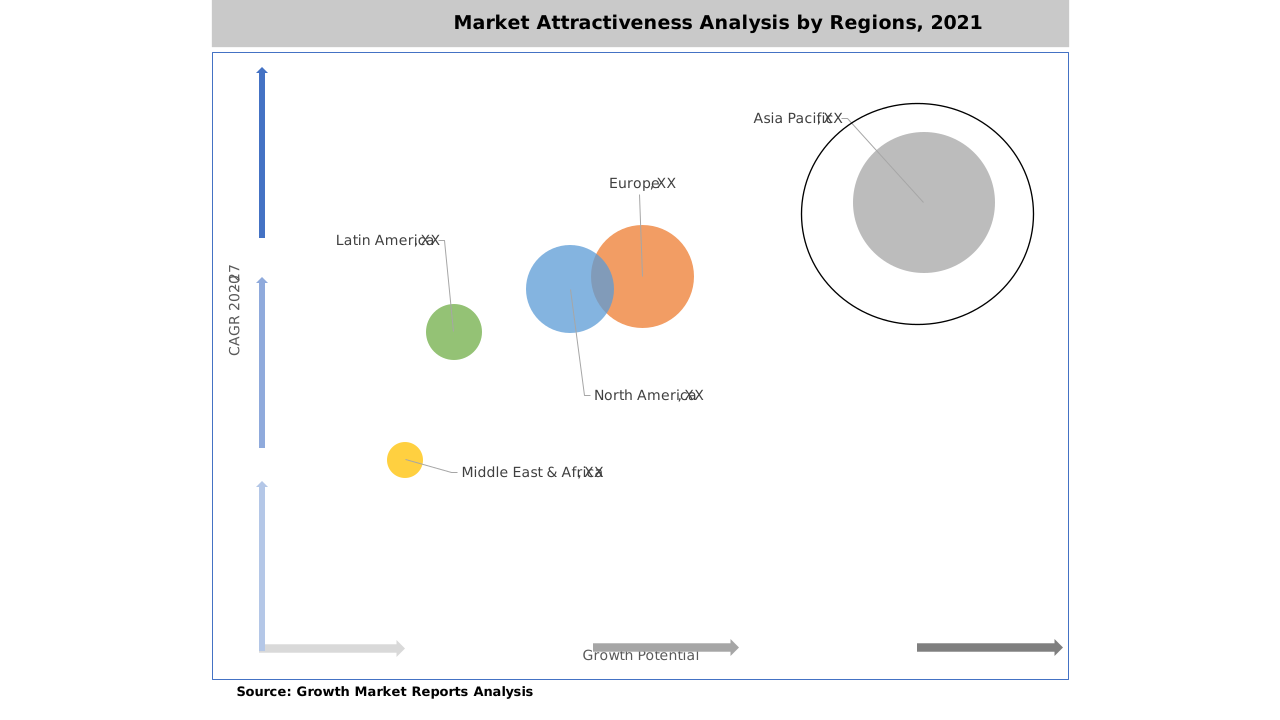
From a regional perspective, North America currently leads the next generation biometrics market, accounting for approximately 34.2% of global revenues in 2025. This dominance is attributed to the region's advanced technological infrastructure, high adoption rates in government and enterprise sectors, and the presence of major industry players. However, Asia Pacific is anticipated to exhibit the fastest growth over the forecast period, propelled by large-scale government initiatives, increasing investments in smart city projects, and the rapid expansion of digital economies in China, India, and Japan. Europe, Latin America, and the Middle East & Africa are also witnessing growing adoption, driven by regulatory compliance needs and demand for robust security frameworks across critical sectors.

Technology Analysis

The next generation biometrics market is segmented by technology into fingerprint recognition, face recognition, iris recognition, voice recognition, vein recognition, palm print recognition, and others. Fingerprint recognition continues to be the most widely adopted biometric technology, holding approximately 32.5% of the 2025 market, due to its proven reliability, cost-effectiveness, and ease of integration into various devices and systems. It is extensively used in smartphones, access control systems, and point-of-sale terminals. The technology is evolving rapidly with advanced under-display sensors and ultrasonic scanning that enhance accuracy even in challenging conditions. Integration of fingerprint recognition with multi-modal authentication systems is further strengthening its market position through the 2026-2034 forecast period.

Next Generation Biometrics Market Share by Technology 2025

Face recognition technology, commanding around 26.8% of the 2025 market, has witnessed significant advancements driven by improvements in computer vision, deep learning, and 3D imaging techniques. Its application spans diverse sectors including law enforcement, border control, retail, and banking, where it is used for surveillance, identity verification, and fraud prevention. The deepfake and synthetic media threat has spurred substantial R&D investment into liveness detection and anti-spoofing algorithms, making modern facial recognition systems considerably more robust than their predecessors. Concerns regarding privacy, data protection, and algorithmic bias remain key challenges that stakeholders are actively addressing through the development of more transparent and auditable systems.

Iris recognition is gaining traction as one of the most accurate and secure biometric modalities, accounting for approximately 14.2% of the 2025 market, owing to the uniqueness and stability of iris patterns across a lifetime. It is increasingly deployed in high-security environments such as government facilities, airports, and financial institutions. The technology's high resistance to spoofing and very low false acceptance rates make it suitable for applications requiring stringent security standards. Recent developments in mobile iris scanning and remote authentication are expanding use cases, while ongoing research focuses on improving user convenience and reducing hardware costs to broaden commercial viability.

Other technologies such as voice recognition, vein recognition, and palm print recognition are also experiencing growing adoption in specialized applications. Voice recognition, representing approximately 11.3% of the 2025 market, is particularly valuable for remote authentication in call centers and mobile banking environments. Vein and palm print recognition together account for around 12.5% of the market and are being explored for high-security access control in critical infrastructure and healthcare settings. The market is witnessing a decisive trend towards multi-modal biometrics, where multiple technologies are combined to enhance security, reduce error rates, and deliver a seamless user experience. This approach is gaining strong momentum as organizations seek to address the limitations of single-modal systems and adapt to the evolving threat landscape through 2034. The growth of advanced multi-modal authentication platforms is reshaping enterprise security architectures globally.

Report Scope

Attributes Details
Report Title Next Generation Biometrics Market Research Report 2034
By Technology Fingerprint Recognition, Face Recognition, Iris Recognition, Voice Recognition, Vein Recognition, Palm Print Recognition, Others
By Component Hardware, Software, Services
By Authentication Type Single-Factor Authentication, Multi-Factor Authentication
By Application Access Control, Identity Verification, Payments, Surveillance, Others
By End-User BFSI, Government, Healthcare, Retail, IT & Telecom, Travel & Immigration, Others
Regions Covered North America, Europe, APAC, Latin America, MEA
Base Year 2025
Historic Data 2019-2024
Forecast Period 2026-2034
Number of Pages 258
Number of Tables & Figures 378
Customization Available Yes, the report can be customized as per your need.

Component Analysis

The next generation biometrics market by component is categorized into hardware, software, and services. Hardware forms the foundation of biometric systems, encompassing sensors, scanners, cameras, and integrated devices that capture and process biometric data. The demand for advanced hardware is driven by the need for high-resolution imaging, faster processing speeds, and enhanced durability, especially in high-traffic environments like airports and government offices. Innovations in miniaturization and the integration of biometric sensors into consumer electronics are expanding the reach of biometric hardware, making it more accessible and affordable for a broader range of applications throughout the 2026-2034 period.

Software is a critical component underpinning the functionality and performance of biometric systems. It includes algorithms for feature extraction, matching, liveness detection, and data encryption. Rapid advancements in artificial intelligence and machine learning are enabling more accurate and reliable biometric matching, significantly reducing false positives and negatives. Software solutions are also playing a pivotal role in enabling interoperability across different biometric modalities and platforms, supporting seamless integration with existing IT infrastructure. The growing emphasis on privacy and data protection is driving the development of secure software architectures that comply with global regulations such as GDPR, CCPA, and emerging national biometric data laws enacted through 2025. The rise of cloud-native biometric data management platforms is enabling organizations to centralize, secure, and analyze biometric identities at enterprise scale.

Services in the next generation biometrics market encompass consulting, system integration, maintenance, and support. As organizations increasingly adopt biometric solutions, the demand for specialized services is rising, particularly for designing and implementing customized systems that meet specific security and operational requirements. Managed services are gaining strong popularity, allowing organizations to outsource the management and monitoring of biometric systems to expert providers. This reduces the burden on internal IT teams while ensuring continuous system optimization and compliance with evolving security standards. Training and education services are also essential, helping end-users understand the proper use and management of biometric technologies across complex multi-site deployments.

The interplay between hardware, software, and services is crucial for the successful deployment and operation of next generation biometric systems. Vendors are increasingly offering integrated solutions that combine state-of-the-art hardware with advanced software and comprehensive support services. This holistic approach ensures that organizations can leverage the full potential of biometrics to enhance security, streamline operations, and deliver superior user experiences. As the market matures through 2034, the focus is shifting towards scalable, interoperable, and future-proof solutions that can adapt to changing business needs and technological advancements.

Authentication Type Analysis

The next generation biometrics market is segmented by authentication type into single-factor authentication (SFA) and multi-factor authentication (MFA). Single-factor authentication relies on a single biometric modality, such as fingerprint or facial recognition, to verify an individual's identity. While SFA offers simplicity and convenience, it may be vulnerable to spoofing and other security threats, particularly in high-risk environments. Nevertheless, SFA remains widely used in consumer electronics, access control, and time-attendance systems due to its ease of use and cost-effectiveness.

Multi-factor authentication combines two or more authentication methods, such as a biometric factor paired with a password, smart card, or one-time passcode, to provide an additional layer of security. MFA is gaining strong traction across industries with stringent security requirements, including banking, healthcare, and government, where unauthorized access can have severe consequences. The integration of multiple biometric modalities, such as fingerprint combined with facial recognition, further enhances the robustness of MFA systems by reducing false positives and improving resistance to spoofing attempts. By 2025, MFA has become the de-facto standard for enterprise security deployments across regulated industries globally.

The adoption of MFA is being driven by the increasing sophistication of cyber-attacks and the need to comply with regulatory mandates that require strong authentication mechanisms. Organizations are recognizing the limitations of single-factor solutions and are investing in MFA to protect sensitive data, ensure regulatory compliance, and build customer trust. The growing use of cloud-based services and hybrid work arrangements has further underscored the importance of MFA, as traditional perimeter-based security models become less effective in distributed environments.

Technological advancements are making MFA more user-friendly and accessible, with innovations such as adaptive authentication, behavioral biometrics, and risk-based authentication enabling seamless and context-aware security. Vendors are focusing on developing MFA solutions that balance security with user convenience, minimizing friction while maintaining high assurance levels. As the threat landscape continues to evolve through 2034, the adoption of MFA is expected to accelerate further, becoming a universal practice for organizations seeking to safeguard their digital assets and maintain business continuity.

Application Analysis

The next generation biometrics market is segmented by application into access control, identity verification, payments, surveillance, and others. Access control remains one of the largest and most established application areas, with biometric systems widely deployed in offices, airports, government buildings, and critical infrastructure facilities. The ability of biometrics to provide secure and convenient access without the need for physical keys or cards is driving adoption in both physical and logical access control systems. The integration of biometrics with smart building solutions and IoT devices is further enhancing security and operational efficiency across commercial and public sector environments.

Identity verification is another key application, particularly in banking, healthcare, and travel, where accurate and reliable identification is essential. Biometric technologies are being used to verify identities during customer onboarding, transaction authorization, and border control, reducing the risk of identity theft, fraud, and unauthorized access. The adoption of biometrics for remote identity verification has surged significantly, driven by the growth of online services and the need for secure authentication in fully digital environments. This trend is expected to continue strongly as organizations seek to streamline processes and enhance customer experiences through the 2026-2034 forecast period.

The use of biometrics in payments is gaining compelling momentum, with financial institutions and payment service providers integrating biometric authentication into ATMs, mobile banking apps, and point-of-sale terminals. Biometric payments offer enhanced security and convenience, reducing reliance on passwords and PINs that are susceptible to theft and misuse. The growing popularity of contactless payment methods, coupled with regulatory initiatives to combat financial fraud, is expected to drive further adoption of biometric payment solutions. The growing intersection of biometrics and fintech is creating new opportunities for frictionless commerce in both developed and emerging markets.

Surveillance applications leverage biometric technologies for real-time monitoring, identification, and tracking of individuals in public and private spaces. Law enforcement agencies, transportation authorities, and retail organizations are deploying facial recognition and other biometric systems to enhance security, prevent crime, and improve operational efficiency. While surveillance applications offer significant benefits, they also raise important concerns regarding privacy, data protection, and ethical use, prompting the need for robust governance frameworks, independent audits, and transparent operational practices to maintain public trust.

End-User Analysis

The next generation biometrics market serves a diverse range of end-users, including BFSI, government, healthcare, retail, IT & telecom, travel & immigration, and others. The BFSI sector is a major adopter of biometric technologies, leveraging them for secure customer authentication, fraud prevention, and regulatory compliance. Banks and financial institutions are integrating biometrics into mobile banking, ATM access, and branch operations to enhance security and improve customer experiences. The rise of digital banking and fintech solutions is accelerating the adoption of next generation biometrics in the BFSI sector, with the trend expected to intensify through 2034 as open banking regulations expand globally.

Government agencies are at the forefront of biometric adoption, implementing large-scale identity management programs, border control systems, and law enforcement applications. National ID projects, e-passports, and digital voter registration initiatives are driving significant investments in biometric technologies, particularly in developing regions. By 2025, over 90 countries have deployed or are actively piloting biometric national ID systems, reflecting the technology's central role in modern governance. Governments are also leveraging biometrics for public safety, social welfare distribution, and secure access to e-government services.

The healthcare sector is increasingly adopting biometrics to enhance patient identification, secure access to medical records, and prevent medical fraud. Biometric systems are being deployed in hospitals, clinics, and pharmacies to ensure accurate patient matching, streamline workflows, and comply with data privacy regulations. The integration of biometrics with electronic health records and telemedicine platforms is expected to drive further adoption, as healthcare providers seek to improve patient safety and operational efficiency in an increasingly digital care environment.

Retail, IT & telecom, and travel & immigration are also key end-user segments, each with unique requirements and use cases. Retailers are using biometrics for customer authentication, loyalty program personalization, and loss prevention, while IT & telecom companies are integrating biometric authentication into devices and network access systems. The travel and immigration sector is leveraging biometrics for automated border control, passenger pre-clearance, and visa issuance, enhancing security while significantly reducing processing times. As the tangible benefits of biometrics become increasingly recognized, adoption is expected to grow broadly across all industries through the forecast period.

Opportunities & Threats

The next generation biometrics market presents significant opportunities for innovation and expansion, driven by the ongoing digital transformation across industries. The increasing demand for secure and convenient authentication solutions is creating new avenues for the development of advanced biometric technologies, including multi-modal systems, behavioral biometrics, and AI-powered analytics. The proliferation of IoT devices and the emergence of smart cities are opening up new application areas, from smart homes and connected vehicles to public safety and urban mobility solutions. Vendors and solution providers have the opportunity to differentiate themselves by offering scalable, interoperable, and user-centric solutions that address the evolving needs of organizations and consumers through 2034.

Another key opportunity lies in the integration of biometrics with emerging technologies such as blockchain, edge computing, and 5G networks. These technologies can enhance the security, scalability, and performance of biometric systems, enabling new use cases and business models. Blockchain can be used to ensure the integrity and privacy of biometric data through decentralized identity management, while edge computing enables real-time processing and decision-making at the point of capture, reducing latency and dependency on central servers. The adoption of biometrics in underserved markets and regions with limited access to traditional identification systems also represents a significant growth opportunity, as governments and organizations seek to improve financial inclusion and access to essential services.

Despite the numerous opportunities, the next generation biometrics market faces several restraining factors, the most prominent being concerns related to privacy, data protection, and ethical use. The collection, storage, and processing of biometric data raise significant privacy risks, particularly in the absence of robust governance frameworks and regulatory oversight. High-profile incidents of data breaches and algorithmic bias have heightened public scrutiny, potentially hindering adoption in certain regions and sectors. Addressing these concerns requires a multi-faceted approach, including the implementation of privacy-by-design principles, transparent data handling practices, independent third-party audits, and ongoing stakeholder engagement to build trust and confidence in biometric solutions across all deployment contexts.

Regional Outlook

North America remains the largest regional market for next generation biometrics, with a market size of USD 10.7 billion in 2025, representing approximately 34.2% of global revenues. The region's dominance is underpinned by its advanced technological infrastructure, high adoption rates in sectors such as BFSI, government, and healthcare, and the presence of leading industry players. The United States, in particular, is a major hub for innovation and investment in biometric technologies, with extensive deployments in law enforcement, border control, and financial services. The region is also characterized by a strong regulatory environment that increasingly supports the adoption of secure and privacy-compliant biometric solutions.

Next Generation Biometrics Market Regional Share 2025

Asia Pacific is emerging as the fastest-growing regional market, with a projected CAGR of 15.8% from 2026 to 2034. The region's market size reached USD 9.1 billion in 2025, driven by large-scale government initiatives, rapid urbanization, and the expansion of digital economies in China, India, and Japan. National ID programs, e-governance projects, and smart city developments are fueling demand for biometric technologies across public and private sectors. The region's vast population and rapidly increasing smartphone penetration are contributing to widespread adoption of biometrics for identity verification, payments, and access control. India's Aadhaar biometric identity program, now covering over 1.4 billion enrolled individuals, remains one of the most influential national biometric deployments globally as of 2025.

Europe, Latin America, and the Middle East & Africa are also witnessing steady growth in the adoption of next generation biometrics. Europe accounted for USD 6.8 billion of the global market in 2025, supported by stringent data protection regulations under GDPR, growing investments in public safety, and border security modernization programs. Latin America and the Middle East & Africa, with market sizes of USD 2.6 billion and USD 2.2 billion respectively in 2025, are leveraging biometrics to address challenges related to identity management, financial inclusion, and crime prevention. While these regions face unique challenges such as infrastructure limitations and regulatory uncertainties, they offer significant growth potential for vendors willing to invest in localized solutions, channel partnerships, and capacity-building initiatives over the 2026-2034 forecast period.

Competitor Outlook

The next generation biometrics market is characterized by intense competition, with a diverse mix of global technology giants, specialized biometric solution providers, and innovative startups. The competitive landscape is shaped by continuous innovation, strategic partnerships, and mergers and acquisitions aimed at expanding product portfolios and market reach. Leading companies are investing heavily in research and development to enhance the accuracy, speed, and scalability of their biometric solutions, as well as to address emerging challenges related to privacy, security, and user experience. The market is also witnessing the entry of new players offering disruptive AI-native technologies and platform business models, intensifying competition and driving value-based pricing across segments.

Key competitive strategies include product differentiation through proprietary AI algorithms, vertical integration across hardware and software stacks, and the development of end-to-end solutions that combine sensors, matching engines, and managed services. Companies are increasingly focusing on interoperability and open standards to facilitate seamless integration with existing IT infrastructure and third-party applications. The ability to offer scalable, customizable, and future-proof solutions is becoming a critical differentiator, as organizations seek to adapt to evolving security threats and regulatory requirements. Strategic collaborations with technology partners, system integrators, and industry consortia are also playing a vital role in driving innovation and expanding global market presence.

Intellectual property and proprietary technologies are important sources of competitive advantage. Leading vendors are building extensive patent portfolios and investing in advanced algorithms, sensor technologies, and privacy-enhancing data protection mechanisms. The ability to demonstrate compliance with global security and privacy standards, including ISO/IEC 30107 for liveness detection and FIDO2 biometric standards, is a key factor influencing customer purchasing decisions, particularly in regulated industries. As the market matures through 2034, the focus is shifting towards delivering holistic, outcome-oriented solutions that address the full spectrum of customer needs from initial deployment and integration to ongoing support, optimization, and regulatory adaptation.

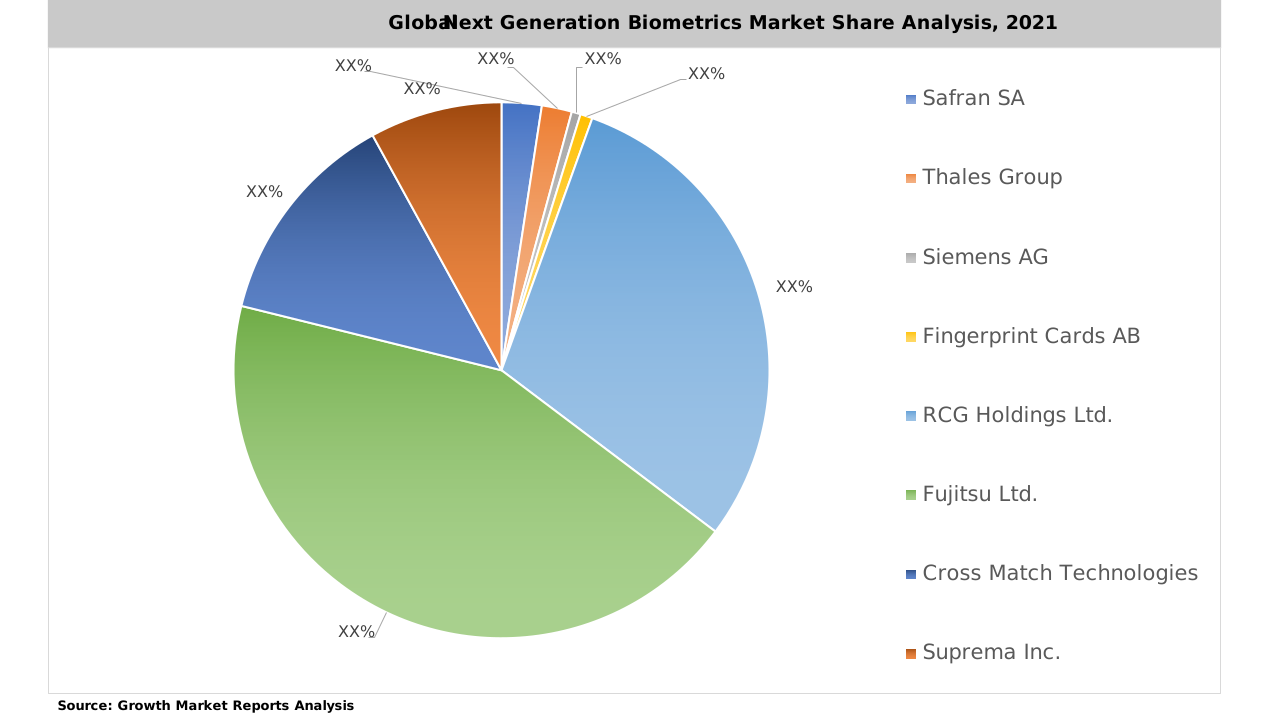
Major companies operating in the next generation biometrics market include NEC Corporation, Thales Group, IDEMIA Group, HID Global Corporation, Fujitsu Limited, Suprema Inc., Fingerprint Cards AB, Qualcomm Technologies Inc., Daon Inc., and Cognitec Systems GmbH. NEC Corporation is renowned for its advanced facial recognition and multi-modal biometric solutions, serving clients in government, transportation, and public safety globally. Thales Group and IDEMIA Group are leaders in secure identity and digital security, offering comprehensive portfolios of biometric technologies for banking, government, and enterprise applications. HID Global Corporation and Fujitsu Limited are recognized for their innovative fingerprint and palm vein recognition systems, while Suprema Inc. specializes in integrated biometric access control and time-attendance solutions. These companies are continuously expanding their global footprint through strategic partnerships, targeted acquisitions, and investments in emerging markets, positioning themselves to capitalize on the sustained demand for next generation biometrics worldwide through 2034.

Key Players

  • NEC Corporation
  • Fujitsu Limited
  • IDEMIA Group
  • Thales Group
  • Apple Inc.
  • Synaptics Incorporated
  • HID Global Corporation
  • Precise Biometrics AB
  • BIO-key International Inc.
  • Aware Inc.
  • Fingerprint Cards AB
  • Suprema Inc.
  • Iris ID Systems Inc.
  • ZKTeco Co. Ltd.
  • Qualcomm Technologies Inc.
  • Daon Inc.
  • M2SYS Technology
  • SecuGen Corporation
  • Cognitec Systems GmbH
  • Innovatrics

Segments

The Next Generation Biometrics market has been segmented on the basis of

Technology

  • Fingerprint Recognition
  • Face Recognition
  • Iris Recognition
  • Voice Recognition
  • Vein Recognition
  • Palm Print Recognition
  • Others

Component

  • Hardware
  • Software
  • Services

Authentication Type

  • Single-Factor Authentication
  • Multi-Factor Authentication

Application

  • Access Control
  • Identity Verification
  • Payments
  • Surveillance
  • Others

End-User

  • BFSI
  • Government
  • Healthcare
  • Retail
  • IT & Telecom
  • Travel & Immigration
  • Others

Frequently Asked Questions

Emerging trends include the convergence of biometrics with AI-driven behavioral analytics, the rise of passive and continuous authentication, and the integration of biometric systems with blockchain for decentralized identity management. Contactless and touchless modalities continue to evolve beyond the pandemic catalyst. Edge computing and 5G connectivity are enabling real-time biometric processing at scale. Significant opportunities exist in digital financial inclusion across underserved populations, the expansion of biometric-enabled smart city infrastructure, and the growing adoption of biometric e-commerce and digital onboarding platforms across Asia Pacific, Latin America, and the Middle East & Africa.

Leading companies in the global next generation biometrics market include NEC Corporation, IDEMIA Group, Thales Group, Fujitsu Limited, HID Global Corporation, Suprema Inc., Fingerprint Cards AB, Qualcomm Technologies Inc., Daon Inc., Cognitec Systems GmbH, Aware Inc., Iris ID Systems Inc., ZKTeco Co. Ltd., Synaptics Incorporated, Innovatrics, M2SYS Technology, SecuGen Corporation, BIO-key International Inc., Precise Biometrics AB, and Apple Inc. These players compete on the basis of algorithm accuracy, hardware innovation, vertical-specific solutions, and global compliance capabilities.

Key challenges include privacy and data protection concerns arising from the collection and storage of sensitive biometric data, the risk of large-scale data breaches exposing immutable identifiers, algorithmic bias affecting accuracy across demographic groups, and regulatory fragmentation across jurisdictions. Spoofing attacks using synthetic media and deepfakes present a growing technical threat. High initial deployment costs and integration complexity with legacy systems also act as barriers, particularly for small and mid-sized organizations in emerging markets.

Single-factor authentication (SFA) relies on one biometric modality, such as a fingerprint or face scan, to verify identity. It offers convenience and speed but can be more vulnerable to sophisticated spoofing. Multi-factor authentication (MFA) combines two or more verification methods, for example pairing a fingerprint with a PIN, smart card, or facial scan, to deliver stronger security assurance. MFA is the preferred standard in high-risk environments including banking, government, and healthcare, and its adoption is accelerating as cyber threats grow more advanced through the 2026-2034 forecast period.

Next generation biometric systems comprise three main components: hardware, software, and services. Hardware includes sensors, scanners, cameras, and embedded modules that capture biometric data. Software encompasses matching algorithms, liveness detection engines, AI models, and data encryption platforms. Services include consulting, system integration, managed services, maintenance, and training. Integrated end-to-end offerings combining all three components are increasingly preferred by enterprise and government buyers seeking scalable and future-proof deployments.

North America leads the global market with approximately 34.2% of 2025 revenues, supported by advanced infrastructure and strong government and enterprise deployments. Asia Pacific is the fastest-growing region, projected to register a CAGR exceeding 15.8% from 2026 to 2034, propelled by national ID programs, smart city initiatives, and digital economy expansion in China, India, and Japan. Europe holds around 21.5% share, driven by GDPR compliance and border security investments. Latin America and the Middle East & Africa together account for roughly 15.5% and represent significant emerging growth opportunities.

The primary applications are access control, identity verification, payments, and surveillance. Access control represents the largest application segment, deployed across airports, government buildings, offices, and critical infrastructure. Identity verification is critical in banking, healthcare, and travel sectors. Biometric payments are gaining fast adoption through ATMs, mobile banking, and point-of-sale terminals. Surveillance leverages facial and behavioral recognition for public safety and law enforcement purposes across urban and commercial environments.

Fingerprint recognition holds the largest share at approximately 32.5% of the 2025 market, owing to its proven reliability, cost-effectiveness, and ubiquitous integration in smartphones and access control systems. Face recognition follows with around 26.8% share, driven by contactless demand and deep learning advances. Iris recognition accounts for approximately 14.2%, valued for its high accuracy in secure environments. Voice recognition, vein recognition, and palm print recognition collectively make up the remaining share and are growing rapidly in niche and enterprise applications.

The primary drivers include the rapid proliferation of digital services demanding secure authentication, rising cybersecurity threats replacing password-based systems, growing regulatory mandates in banking and healthcare, the expansion of IoT and mobile devices integrating biometric sensors, and continued advancements in artificial intelligence and machine learning that improve biometric accuracy and speed. The post-pandemic emphasis on contactless solutions also remains a strong sustained catalyst through 2034.

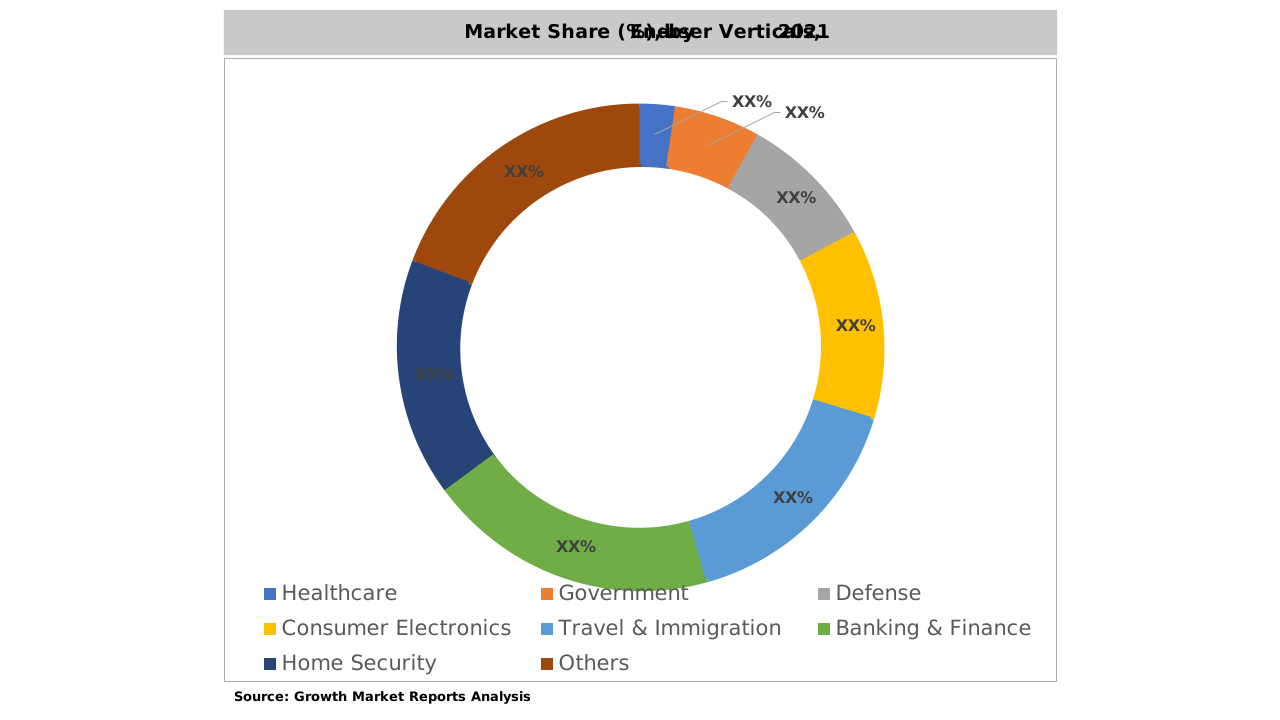
According to our latest research, the global next generation biometrics market size reached USD 31.4 billion in 2025 and is projected to expand to USD 99.2 billion by 2034, reflecting a robust CAGR of 13.6% during the forecast period of 2026 to 2034. This growth is driven by accelerating adoption of biometric technologies across government, BFSI, healthcare, and consumer electronics sectors worldwide.

Table Of Content

Chapter 1 Executive Summary
Chapter 2 Assumptions and Acronyms Used
Chapter 3 Research Methodology
Chapter 4 Next Generation Biometrics Market Overview
   4.1 Introduction
      4.1.1 Market Taxonomy
      4.1.2 Market Definition
      4.1.3 Macro-Economic Factors Impacting the Market Growth
   4.2 Next Generation Biometrics Market Dynamics
      4.2.1 Market Drivers
      4.2.2 Market Restraints
      4.2.3 Market Opportunity
   4.3 Next Generation Biometrics Market - Supply Chain Analysis
      4.3.1 List of Key Suppliers
      4.3.2 List of Key Distributors
      4.3.3 List of Key Consumers
   4.4 Key Forces Shaping the Next Generation Biometrics Market
      4.4.1 Bargaining Power of Suppliers
      4.4.2 Bargaining Power of Buyers
      4.4.3 Threat of Substitution
      4.4.4 Threat of New Entrants
      4.4.5 Competitive Rivalry
   4.5 Global Next Generation Biometrics Market Size & Forecast, 2023-2032
      4.5.1 Next Generation Biometrics Market Size and Y-o-Y Growth
      4.5.2 Next Generation Biometrics Market Absolute $ Opportunity

Chapter 5 Global Next Generation Biometrics Market Analysis and Forecast By Technology
   5.1 Introduction
      5.1.1 Key Market Trends & Growth Opportunities By Technology
      5.1.2 Basis Point Share (BPS) Analysis By Technology
      5.1.3 Absolute $ Opportunity Assessment By Technology
   5.2 Next Generation Biometrics Market Size Forecast By Technology
      5.2.1 Fingerprint Recognition
      5.2.2 Face Recognition
      5.2.3 Iris Recognition
      5.2.4 Voice Recognition
      5.2.5 Vein Recognition
      5.2.6 Palm Print Recognition
      5.2.7 Others
   5.3 Market Attractiveness Analysis By Technology

Chapter 6 Global Next Generation Biometrics Market Analysis and Forecast By Component
   6.1 Introduction
      6.1.1 Key Market Trends & Growth Opportunities By Component
      6.1.2 Basis Point Share (BPS) Analysis By Component
      6.1.3 Absolute $ Opportunity Assessment By Component
   6.2 Next Generation Biometrics Market Size Forecast By Component
      6.2.1 Hardware
      6.2.2 Software
      6.2.3 Services
   6.3 Market Attractiveness Analysis By Component

Chapter 7 Global Next Generation Biometrics Market Analysis and Forecast By Authentication Type
   7.1 Introduction
      7.1.1 Key Market Trends & Growth Opportunities By Authentication Type
      7.1.2 Basis Point Share (BPS) Analysis By Authentication Type
      7.1.3 Absolute $ Opportunity Assessment By Authentication Type
   7.2 Next Generation Biometrics Market Size Forecast By Authentication Type
      7.2.1 Single-Factor Authentication
      7.2.2 Multi-Factor Authentication
   7.3 Market Attractiveness Analysis By Authentication Type

Chapter 8 Global Next Generation Biometrics Market Analysis and Forecast By Application
   8.1 Introduction
      8.1.1 Key Market Trends & Growth Opportunities By Application
      8.1.2 Basis Point Share (BPS) Analysis By Application
      8.1.3 Absolute $ Opportunity Assessment By Application
   8.2 Next Generation Biometrics Market Size Forecast By Application
      8.2.1 Access Control
      8.2.2 Identity Verification
      8.2.3 Payments
      8.2.4 Surveillance
      8.2.5 Others
   8.3 Market Attractiveness Analysis By Application

Chapter 9 Global Next Generation Biometrics Market Analysis and Forecast By End-User
   9.1 Introduction
      9.1.1 Key Market Trends & Growth Opportunities By End-User
      9.1.2 Basis Point Share (BPS) Analysis By End-User
      9.1.3 Absolute $ Opportunity Assessment By End-User
   9.2 Next Generation Biometrics Market Size Forecast By End-User
      9.2.1 BFSI
      9.2.2 Government
      9.2.3 Healthcare
      9.2.4 Retail
      9.2.5 IT & Telecom
      9.2.6 Travel & Immigration
      9.2.7 Others
   9.3 Market Attractiveness Analysis By End-User

Chapter 10 Global Next Generation Biometrics Market Analysis and Forecast by Region
   10.1 Introduction
      10.1.1 Key Market Trends & Growth Opportunities By Region
      10.1.2 Basis Point Share (BPS) Analysis By Region
      10.1.3 Absolute $ Opportunity Assessment By Region
   10.2 Next Generation Biometrics Market Size Forecast By Region
      10.2.1 North America
      10.2.2 Europe
      10.2.3 Asia Pacific
      10.2.4 Latin America
      10.2.5 Middle East & Africa (MEA)
   10.3 Market Attractiveness Analysis By Region

Chapter 11 Coronavirus Disease (COVID-19) Impact 
   11.1 Introduction 
   11.2 Current & Future Impact Analysis 
   11.3 Economic Impact Analysis 
   11.4 Government Policies 
   11.5 Investment Scenario

Chapter 12 North America Next Generation Biometrics Analysis and Forecast
   12.1 Introduction
   12.2 North America Next Generation Biometrics Market Size Forecast by Country
      12.2.1 U.S.
      12.2.2 Canada
   12.3 Basis Point Share (BPS) Analysis by Country
   12.4 Absolute $ Opportunity Assessment by Country
   12.5 Market Attractiveness Analysis by Country
   12.6 North America Next Generation Biometrics Market Size Forecast By Technology
      12.6.1 Fingerprint Recognition
      12.6.2 Face Recognition
      12.6.3 Iris Recognition
      12.6.4 Voice Recognition
      12.6.5 Vein Recognition
      12.6.6 Palm Print Recognition
      12.6.7 Others
   12.7 Basis Point Share (BPS) Analysis By Technology 
   12.8 Absolute $ Opportunity Assessment By Technology 
   12.9 Market Attractiveness Analysis By Technology
   12.10 North America Next Generation Biometrics Market Size Forecast By Component
      12.10.1 Hardware
      12.10.2 Software
      12.10.3 Services
   12.11 Basis Point Share (BPS) Analysis By Component 
   12.12 Absolute $ Opportunity Assessment By Component 
   12.13 Market Attractiveness Analysis By Component
   12.14 North America Next Generation Biometrics Market Size Forecast By Authentication Type
      12.14.1 Single-Factor Authentication
      12.14.2 Multi-Factor Authentication
   12.15 Basis Point Share (BPS) Analysis By Authentication Type 
   12.16 Absolute $ Opportunity Assessment By Authentication Type 
   12.17 Market Attractiveness Analysis By Authentication Type
   12.18 North America Next Generation Biometrics Market Size Forecast By Application
      12.18.1 Access Control
      12.18.2 Identity Verification
      12.18.3 Payments
      12.18.4 Surveillance
      12.18.5 Others
   12.19 Basis Point Share (BPS) Analysis By Application 
   12.20 Absolute $ Opportunity Assessment By Application 
   12.21 Market Attractiveness Analysis By Application
   12.22 North America Next Generation Biometrics Market Size Forecast By End-User
      12.22.1 BFSI
      12.22.2 Government
      12.22.3 Healthcare
      12.22.4 Retail
      12.22.5 IT & Telecom
      12.22.6 Travel & Immigration
      12.22.7 Others
   12.23 Basis Point Share (BPS) Analysis By End-User 
   12.24 Absolute $ Opportunity Assessment By End-User 
   12.25 Market Attractiveness Analysis By End-User

Chapter 13 Europe Next Generation Biometrics Analysis and Forecast
   13.1 Introduction
   13.2 Europe Next Generation Biometrics Market Size Forecast by Country
      13.2.1 Germany
      13.2.2 France
      13.2.3 Italy
      13.2.4 U.K.
      13.2.5 Spain
      13.2.6 Russia
      13.2.7 Rest of Europe
   13.3 Basis Point Share (BPS) Analysis by Country
   13.4 Absolute $ Opportunity Assessment by Country
   13.5 Market Attractiveness Analysis by Country
   13.6 Europe Next Generation Biometrics Market Size Forecast By Technology
      13.6.1 Fingerprint Recognition
      13.6.2 Face Recognition
      13.6.3 Iris Recognition
      13.6.4 Voice Recognition
      13.6.5 Vein Recognition
      13.6.6 Palm Print Recognition
      13.6.7 Others
   13.7 Basis Point Share (BPS) Analysis By Technology 
   13.8 Absolute $ Opportunity Assessment By Technology 
   13.9 Market Attractiveness Analysis By Technology
   13.10 Europe Next Generation Biometrics Market Size Forecast By Component
      13.10.1 Hardware
      13.10.2 Software
      13.10.3 Services
   13.11 Basis Point Share (BPS) Analysis By Component 
   13.12 Absolute $ Opportunity Assessment By Component 
   13.13 Market Attractiveness Analysis By Component
   13.14 Europe Next Generation Biometrics Market Size Forecast By Authentication Type
      13.14.1 Single-Factor Authentication
      13.14.2 Multi-Factor Authentication
   13.15 Basis Point Share (BPS) Analysis By Authentication Type 
   13.16 Absolute $ Opportunity Assessment By Authentication Type 
   13.17 Market Attractiveness Analysis By Authentication Type
   13.18 Europe Next Generation Biometrics Market Size Forecast By Application
      13.18.1 Access Control
      13.18.2 Identity Verification
      13.18.3 Payments
      13.18.4 Surveillance
      13.18.5 Others
   13.19 Basis Point Share (BPS) Analysis By Application 
   13.20 Absolute $ Opportunity Assessment By Application 
   13.21 Market Attractiveness Analysis By Application
   13.22 Europe Next Generation Biometrics Market Size Forecast By End-User
      13.22.1 BFSI
      13.22.2 Government
      13.22.3 Healthcare
      13.22.4 Retail
      13.22.5 IT & Telecom
      13.22.6 Travel & Immigration
      13.22.7 Others
   13.23 Basis Point Share (BPS) Analysis By End-User 
   13.24 Absolute $ Opportunity Assessment By End-User 
   13.25 Market Attractiveness Analysis By End-User

Chapter 14 Asia Pacific Next Generation Biometrics Analysis and Forecast
   14.1 Introduction
   14.2 Asia Pacific Next Generation Biometrics Market Size Forecast by Country
      14.2.1 China
      14.2.2 Japan
      14.2.3 South Korea
      14.2.4 India
      14.2.5 Australia
      14.2.6 South East Asia (SEA)
      14.2.7 Rest of Asia Pacific (APAC)
   14.3 Basis Point Share (BPS) Analysis by Country
   14.4 Absolute $ Opportunity Assessment by Country
   14.5 Market Attractiveness Analysis by Country
   14.6 Asia Pacific Next Generation Biometrics Market Size Forecast By Technology
      14.6.1 Fingerprint Recognition
      14.6.2 Face Recognition
      14.6.3 Iris Recognition
      14.6.4 Voice Recognition
      14.6.5 Vein Recognition
      14.6.6 Palm Print Recognition
      14.6.7 Others
   14.7 Basis Point Share (BPS) Analysis By Technology 
   14.8 Absolute $ Opportunity Assessment By Technology 
   14.9 Market Attractiveness Analysis By Technology
   14.10 Asia Pacific Next Generation Biometrics Market Size Forecast By Component
      14.10.1 Hardware
      14.10.2 Software
      14.10.3 Services
   14.11 Basis Point Share (BPS) Analysis By Component 
   14.12 Absolute $ Opportunity Assessment By Component 
   14.13 Market Attractiveness Analysis By Component
   14.14 Asia Pacific Next Generation Biometrics Market Size Forecast By Authentication Type
      14.14.1 Single-Factor Authentication
      14.14.2 Multi-Factor Authentication
   14.15 Basis Point Share (BPS) Analysis By Authentication Type 
   14.16 Absolute $ Opportunity Assessment By Authentication Type 
   14.17 Market Attractiveness Analysis By Authentication Type
   14.18 Asia Pacific Next Generation Biometrics Market Size Forecast By Application
      14.18.1 Access Control
      14.18.2 Identity Verification
      14.18.3 Payments
      14.18.4 Surveillance
      14.18.5 Others
   14.19 Basis Point Share (BPS) Analysis By Application 
   14.20 Absolute $ Opportunity Assessment By Application 
   14.21 Market Attractiveness Analysis By Application
   14.22 Asia Pacific Next Generation Biometrics Market Size Forecast By End-User
      14.22.1 BFSI
      14.22.2 Government
      14.22.3 Healthcare
      14.22.4 Retail
      14.22.5 IT & Telecom
      14.22.6 Travel & Immigration
      14.22.7 Others
   14.23 Basis Point Share (BPS) Analysis By End-User 
   14.24 Absolute $ Opportunity Assessment By End-User 
   14.25 Market Attractiveness Analysis By End-User

Chapter 15 Latin America Next Generation Biometrics Analysis and Forecast
   15.1 Introduction
   15.2 Latin America Next Generation Biometrics Market Size Forecast by Country
      15.2.1 Brazil
      15.2.2 Mexico
      15.2.3 Rest of Latin America (LATAM)
   15.3 Basis Point Share (BPS) Analysis by Country
   15.4 Absolute $ Opportunity Assessment by Country
   15.5 Market Attractiveness Analysis by Country
   15.6 Latin America Next Generation Biometrics Market Size Forecast By Technology
      15.6.1 Fingerprint Recognition
      15.6.2 Face Recognition
      15.6.3 Iris Recognition
      15.6.4 Voice Recognition
      15.6.5 Vein Recognition
      15.6.6 Palm Print Recognition
      15.6.7 Others
   15.7 Basis Point Share (BPS) Analysis By Technology 
   15.8 Absolute $ Opportunity Assessment By Technology 
   15.9 Market Attractiveness Analysis By Technology
   15.10 Latin America Next Generation Biometrics Market Size Forecast By Component
      15.10.1 Hardware
      15.10.2 Software
      15.10.3 Services
   15.11 Basis Point Share (BPS) Analysis By Component 
   15.12 Absolute $ Opportunity Assessment By Component 
   15.13 Market Attractiveness Analysis By Component
   15.14 Latin America Next Generation Biometrics Market Size Forecast By Authentication Type
      15.14.1 Single-Factor Authentication
      15.14.2 Multi-Factor Authentication
   15.15 Basis Point Share (BPS) Analysis By Authentication Type 
   15.16 Absolute $ Opportunity Assessment By Authentication Type 
   15.17 Market Attractiveness Analysis By Authentication Type
   15.18 Latin America Next Generation Biometrics Market Size Forecast By Application
      15.18.1 Access Control
      15.18.2 Identity Verification
      15.18.3 Payments
      15.18.4 Surveillance
      15.18.5 Others
   15.19 Basis Point Share (BPS) Analysis By Application 
   15.20 Absolute $ Opportunity Assessment By Application 
   15.21 Market Attractiveness Analysis By Application
   15.22 Latin America Next Generation Biometrics Market Size Forecast By End-User
      15.22.1 BFSI
      15.22.2 Government
      15.22.3 Healthcare
      15.22.4 Retail
      15.22.5 IT & Telecom
      15.22.6 Travel & Immigration
      15.22.7 Others
   15.23 Basis Point Share (BPS) Analysis By End-User 
   15.24 Absolute $ Opportunity Assessment By End-User 
   15.25 Market Attractiveness Analysis By End-User

Chapter 16 Middle East & Africa (MEA) Next Generation Biometrics Analysis and Forecast
   16.1 Introduction
   16.2 Middle East & Africa (MEA) Next Generation Biometrics Market Size Forecast by Country
      16.2.1 Saudi Arabia
      16.2.2 South Africa
      16.2.3 UAE
      16.2.4 Rest of Middle East & Africa (MEA)
   16.3 Basis Point Share (BPS) Analysis by Country
   16.4 Absolute $ Opportunity Assessment by Country
   16.5 Market Attractiveness Analysis by Country
   16.6 Middle East & Africa (MEA) Next Generation Biometrics Market Size Forecast By Technology
      16.6.1 Fingerprint Recognition
      16.6.2 Face Recognition
      16.6.3 Iris Recognition
      16.6.4 Voice Recognition
      16.6.5 Vein Recognition
      16.6.6 Palm Print Recognition
      16.6.7 Others
   16.7 Basis Point Share (BPS) Analysis By Technology 
   16.8 Absolute $ Opportunity Assessment By Technology 
   16.9 Market Attractiveness Analysis By Technology
   16.10 Middle East & Africa (MEA) Next Generation Biometrics Market Size Forecast By Component
      16.10.1 Hardware
      16.10.2 Software
      16.10.3 Services
   16.11 Basis Point Share (BPS) Analysis By Component 
   16.12 Absolute $ Opportunity Assessment By Component 
   16.13 Market Attractiveness Analysis By Component
   16.14 Middle East & Africa (MEA) Next Generation Biometrics Market Size Forecast By Authentication Type
      16.14.1 Single-Factor Authentication
      16.14.2 Multi-Factor Authentication
   16.15 Basis Point Share (BPS) Analysis By Authentication Type 
   16.16 Absolute $ Opportunity Assessment By Authentication Type 
   16.17 Market Attractiveness Analysis By Authentication Type
   16.18 Middle East & Africa (MEA) Next Generation Biometrics Market Size Forecast By Application
      16.18.1 Access Control
      16.18.2 Identity Verification
      16.18.3 Payments
      16.18.4 Surveillance
      16.18.5 Others
   16.19 Basis Point Share (BPS) Analysis By Application 
   16.20 Absolute $ Opportunity Assessment By Application 
   16.21 Market Attractiveness Analysis By Application
   16.22 Middle East & Africa (MEA) Next Generation Biometrics Market Size Forecast By End-User
      16.22.1 BFSI
      16.22.2 Government
      16.22.3 Healthcare
      16.22.4 Retail
      16.22.5 IT & Telecom
      16.22.6 Travel & Immigration
      16.22.7 Others
   16.23 Basis Point Share (BPS) Analysis By End-User 
   16.24 Absolute $ Opportunity Assessment By End-User 
   16.25 Market Attractiveness Analysis By End-User

Chapter 17 Competition Landscape 
   17.1 Next Generation Biometrics Market: Competitive Dashboard
   17.2 Global Next Generation Biometrics Market: Market Share Analysis, 2023
   17.3 Company Profiles (Details – Overview, Financials, Developments, Strategy) 
      17.3.1 NEC Corporation
      17.3.2 Fujitsu Limited
      17.3.3 IDEMIA Group
      17.3.4 Thales Group
      17.3.5 Apple Inc.
      17.3.6 Synaptics Incorporated
      17.3.7 HID Global Corporation
      17.3.8 Precise Biometrics AB
      17.3.9 BIO-key International Inc.
      17.3.10 Aware Inc.
      17.3.11 Fingerprint Cards AB
      17.3.12 Suprema Inc.
      17.3.13 Iris ID Systems Inc.
      17.3.14 ZKTeco Co. Ltd.
      17.3.15 Qualcomm Technologies Inc.
      17.3.16 Daon Inc.
      17.3.17 M2SYS Technology
      17.3.18 SecuGen Corporation
      17.3.19 Cognitec Systems GmbH
      17.3.20 Innovatrics

Methodology

Our Clients

sinopec
Dassault Aviation
Deloitte
General Electric
Pfizer
Honda Motor Co. Ltd.
Microsoft
Nestle SA