Membrane Water & Wastewater Treatment Market 2034

Membrane Water & Wastewater Treatment Market 2034

Segments - by Technology (Reverse Osmosis, Ultrafiltration, Microfiltration, Nanofiltration, Others), by Application (Municipal, Industrial, Residential, Others), by Membrane Material (Polymeric, Ceramic, Others), by End-User (Food & Beverage, Pharmaceuticals, Power Generation, Chemicals & Petrochemicals, Others)

https://growthmarketreports.com/Raksha
Author : Raksha Sharma
https://growthmarketreports.com/Vaibhav
Fact-checked by : V. Chandola
https://growthmarketreports.com/Shruti
Editor : Shruti Bhat

Last Updated : Jun, 2026 | Report ID :EP-794 | 4.3 Rating | 100 Reviews | 269 Pages | Format : Docx PDF

Report Description

This report is updated with the latest market data and insights as of June 2026. Base year: 2025  |  Forecast period: 2026-2034


Membrane Water and Wastewater Treatment Market Outlook

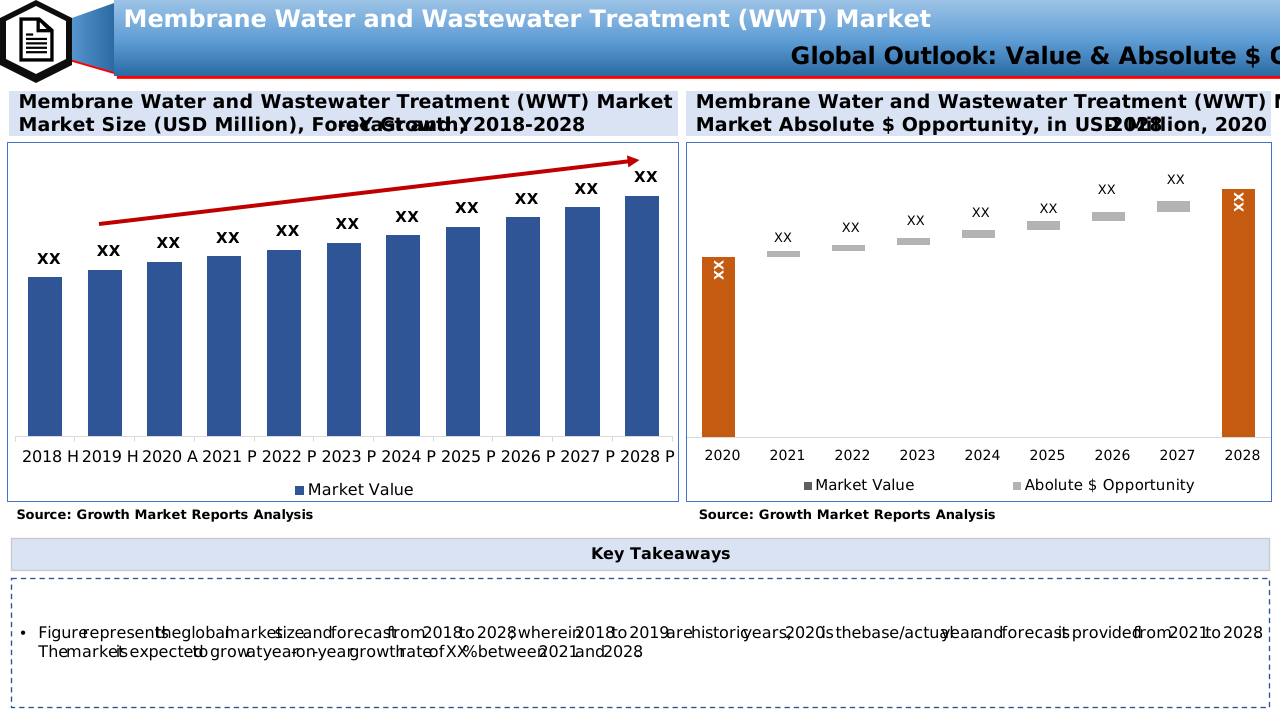
According to our latest research, the global membrane water and wastewater treatment market size reached USD 19.0 billion in 2025, driven by increasing demand for clean water and stringent environmental regulations worldwide. The market is exhibiting robust growth with a CAGR of 7.8% from 2026 to 2034. By the end of 2034, the market is forecasted to reach USD 36.9 billion, reflecting strong adoption across municipal, industrial, and residential sectors. This expansion is underpinned by rapid urbanization, water scarcity concerns, and technological advancements in membrane filtration processes that are reshaping how communities and industries manage water resources.

Global Membrane Water and Wastewater Treatment Market Size Forecast 2025-2034, USD Billion

One of the primary growth factors for the membrane water and wastewater treatment market is the escalating global water crisis, which has necessitated the adoption of advanced water purification technologies. As freshwater resources become increasingly scarce due to population growth, urbanization, and climate change, governments and industries are compelled to invest in efficient water treatment solutions. Membrane technologies such as reverse osmosis, ultrafiltration, and nanofiltration are gaining significant traction due to their ability to remove a wide range of contaminants, including bacteria, viruses, dissolved solids, and organic compounds. Additionally, the increasing prevalence of waterborne diseases and the need to comply with stringent water quality standards are further propelling market growth. The broader water and wastewater treatment equipment sector is also benefiting from parallel infrastructure investment cycles that create co-deployment opportunities for membrane systems.

Another crucial driver is the rapid industrialization witnessed in emerging economies, particularly in Asia Pacific and Latin America. Industries such as food and beverage, pharmaceuticals, and chemicals generate large volumes of wastewater containing hazardous pollutants. The adoption of membrane water and wastewater treatment systems allows these industries to achieve compliance with environmental regulations while reducing water consumption through recycling and reuse. Furthermore, advances in membrane material science, such as the development of more durable and fouling-resistant polymers and ceramics, are enhancing the efficiency and longevity of filtration systems, thereby reducing operational costs and increasing return on investment. Growing interest in industrial water treatment strategies such as zero liquid discharge is further accelerating membrane adoption across heavy-use sectors.

Government initiatives and investments in sustainable water infrastructure are playing a pivotal role in market expansion. Many countries have launched ambitious programs to upgrade and expand their municipal water and wastewater treatment facilities, often leveraging public-private partnerships. Financial incentives, grants, and stricter discharge norms are encouraging utilities and private players to adopt membrane-based technologies. Moreover, the growing awareness among residential users regarding the health benefits of purified water, coupled with the rising penetration of point-of-use and point-of-entry membrane filtration systems, is contributing to overall market growth. The integration of smart monitoring and automation in membrane systems is expected to further drive efficiency and adoption rates in the coming years.

From a regional perspective, Asia Pacific dominates the membrane water and wastewater treatment market, accounting for the largest revenue share in 2025. This dominance is attributed to the region's large population base, rapid urbanization, and increasing industrial output, especially in countries like China and India. North America and Europe also represent significant markets, driven by stringent environmental regulations and high awareness regarding water quality. Middle East & Africa, while currently a smaller market, is experiencing accelerated growth due to acute water scarcity and heavy investments in desalination projects. Latin America is also emerging as a key market, supported by infrastructure development and regulatory reforms. Overall, the global landscape is characterized by diverse growth trajectories, with each region presenting unique challenges and opportunities for stakeholders.

Technology Analysis

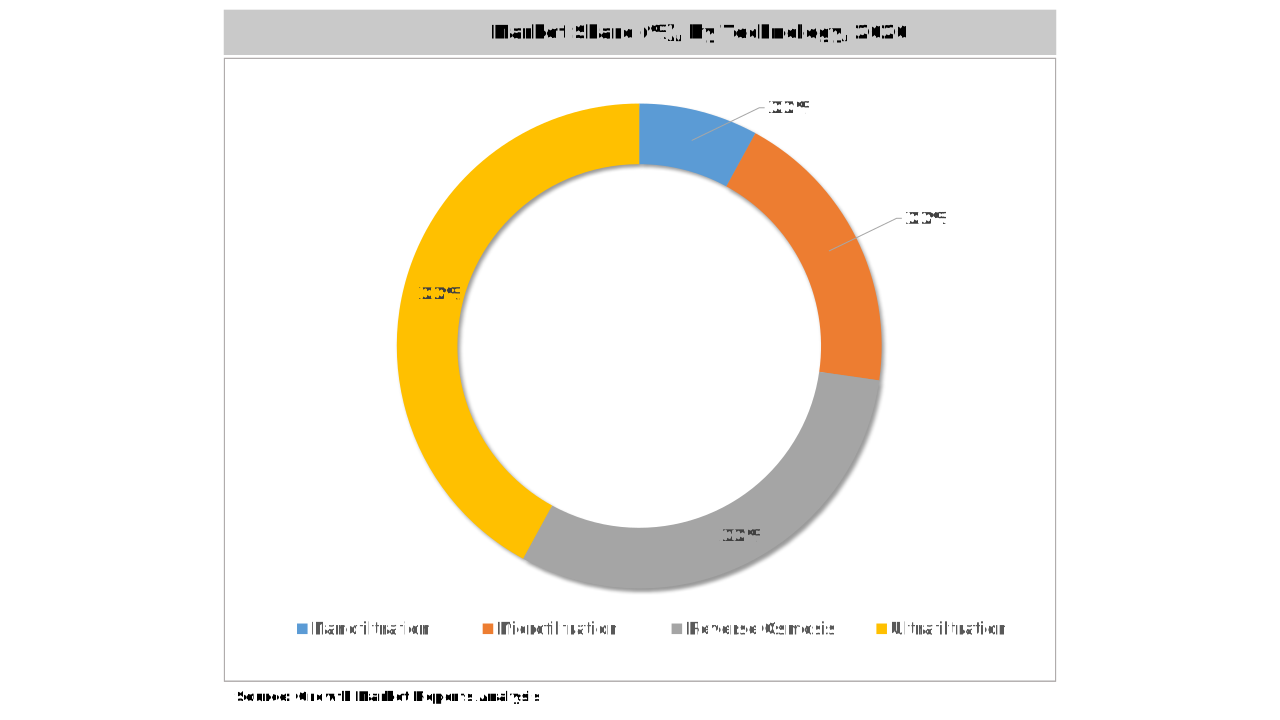
The membrane water and wastewater treatment market is segmented by technology into reverse osmosis, ultrafiltration, microfiltration, nanofiltration, and others. Reverse osmosis (RO) remains the most widely adopted technology, accounting for approximately 38.5% of the market in 2025. RO systems are highly effective in removing dissolved salts, heavy metals, and various organic and inorganic impurities from water, making them indispensable for both desalination and wastewater reclamation. The growing incidence of water scarcity, especially in arid regions and coastal cities, has led to increased investments in large-scale RO desalination plants. Technological advancements have improved the energy efficiency and recovery rates of RO systems, further driving their adoption across municipal and industrial sectors. Research into produced water membrane applications is also expanding the use case for high-performance RO modules in oil and gas settings.

Membrane Water and Wastewater Treatment Market Share by Technology 2025

Ultrafiltration (UF) is another critical segment, renowned for its ability to remove suspended solids, bacteria, and viruses while retaining essential minerals. UF membranes are increasingly being deployed as a pre-treatment step before reverse osmosis, enhancing the overall efficiency and lifespan of the filtration system. The food and beverage industry, in particular, has witnessed a surge in UF adoption for applications such as juice clarification, dairy processing, and beverage sterilization. The relatively low operating pressure and high throughput of UF systems make them attractive for both centralized and decentralized water treatment solutions.

Microfiltration (MF) technology is primarily utilized for the removal of larger particulates and microorganisms. MF membranes are widely used in municipal water treatment plants for the clarification of surface water and the removal of turbidity. The simplicity of operation and cost-effectiveness of MF systems have driven their adoption in small and medium-scale applications, including residential water purification and pre-treatment for industrial processes. Recent innovations in membrane fabrication have resulted in improved fouling resistance and higher flux rates, making MF an increasingly viable option for a broader range of applications.

Nanofiltration (NF) represents a rapidly growing segment, offering selective separation capabilities for divalent ions and organic molecules. NF membranes are particularly valuable in softening hard water, removing color and micropollutants, and recovering valuable byproducts from industrial effluents. The pharmaceutical and chemical industries are significant adopters of NF technology due to its ability to achieve high purity levels with lower energy consumption compared to RO. The ongoing research and development efforts aimed at enhancing membrane selectivity, permeability, and chemical resistance are expected to further accelerate the adoption of nanofiltration through 2034.

The "others" category includes emerging membrane technologies such as forward osmosis, membrane distillation, and hybrid systems. These technologies are gaining attention for their potential to address specific challenges, such as high salinity brines and industrial wastewater with complex compositions. The growing interest in membrane bioreactor solutions for oil and gas applications exemplifies how hybrid approaches are expanding into previously underserved end markets. While still in the early stages of commercialization, these innovative solutions are expected to play a crucial role in expanding the application scope of membrane water and wastewater treatment in the future.

Report Scope

Attributes Details
Report Title Membrane Water and Wastewater Treatment Market Research Report 2034
By Technology Reverse Osmosis, Ultrafiltration, Microfiltration, Nanofiltration, Others
By Application Municipal, Industrial, Residential, Others
By Membrane Material Polymeric, Ceramic, Others
By End-User Food & Beverage, Pharmaceuticals, Power Generation, Chemicals & Petrochemicals, Others
Regions Covered North America, Europe, APAC, Latin America, MEA
Base Year 2025
Historic Data 2019-2024
Forecast Period 2026-2034
Number of Pages 269
Number of Tables & Figures 362
Customization Available Yes, the report can be customized as per your need.

Application Analysis

The application landscape of the membrane water and wastewater treatment market is diverse, encompassing municipal, industrial, residential, and other sectors. The municipal segment holds the largest market share, driven by the urgent need to provide safe drinking water and manage wastewater in rapidly growing urban centers. Municipalities are increasingly turning to membrane technologies to upgrade aging water infrastructure, meet regulatory requirements, and ensure the sustainable management of water resources. The deployment of large-scale membrane bioreactors (MBRs) and advanced filtration systems is enabling cities to achieve higher treatment efficiencies and facilitate water reuse for non-potable applications such as irrigation and industrial cooling.

The industrial segment is witnessing robust growth, propelled by the rising demand for process water and the need to comply with stringent discharge norms. Industries such as food and beverage, pharmaceuticals, power generation, and chemicals generate significant volumes of complex wastewater, often containing hazardous contaminants. Membrane-based treatment solutions offer high removal efficiencies and operational flexibility, allowing industries to recycle and reuse water, minimize environmental impact, and reduce operational costs. The integration of zero liquid discharge (ZLD) systems, which rely heavily on membrane technologies, is becoming increasingly prevalent, particularly in water-stressed regions. Operators seeking flexible deployment options are also exploring mobile water treatment services to supplement fixed membrane infrastructure during peak demand or emergency situations.

The residential segment is also expanding, driven by growing awareness of waterborne diseases and concerns over the presence of microplastics, heavy metals, and emerging contaminants in tap water. Point-of-use (POU) and point-of-entry (POE) devices equipped with RO, UF, and NF membranes are gaining popularity in both urban and rural settings. Manufacturers are focusing on developing compact, user-friendly, and cost-effective solutions to cater to the diverse needs of residential consumers.

The "others" category includes specialized applications such as agricultural irrigation, aquaculture, and recreational water treatment. In agriculture, membrane systems are used to treat and recycle wastewater for irrigation, helping to conserve freshwater resources and reduce fertilizer runoff. Aquaculture operations leverage membrane technologies to maintain optimal water quality and prevent disease outbreaks. Recreational facilities, such as swimming pools and water parks, are also adopting advanced filtration systems to ensure the safety and hygiene of water used by patrons. These niche applications are expected to contribute to the overall growth of the market as awareness of water conservation and quality management continues to rise.

Overall, the diverse application spectrum of membrane water and wastewater treatment underscores the versatility and adaptability of these technologies. As water quality standards become increasingly stringent and the need for sustainable water management intensifies, the adoption of membrane solutions across all application segments is set to accelerate, driving market growth through 2034.

Membrane Material Analysis

The membrane water and wastewater treatment market is segmented by membrane material into polymeric, ceramic, and others. Polymeric membranes dominate the market, accounting for the majority of installations in 2025. These membranes are typically made from materials such as polyethersulfone (PES), polyvinylidene fluoride (PVDF), and polyamide, offering a favorable balance of performance, cost, and chemical resistance. Polymeric membranes are widely used in reverse osmosis, ultrafiltration, and nanofiltration systems across municipal, industrial, and residential applications. Ongoing advancements in polymer chemistry are enhancing the fouling resistance, permeability, and mechanical strength of these membranes, further solidifying their market position.

Ceramic membranes represent a growing segment, particularly in applications requiring high durability and resistance to extreme operating conditions. Made from materials such as alumina, zirconia, and titania, ceramic membranes exhibit superior thermal, chemical, and mechanical stability compared to their polymeric counterparts. This makes them ideal for treating aggressive industrial effluents, high-temperature process streams, and wastewater containing abrasive or corrosive substances. Although ceramic membranes typically entail higher upfront costs, their extended service life and lower maintenance requirements often result in a lower total cost of ownership over the long term. The increasing adoption of ceramic membranes in industries such as chemicals, petrochemicals, and power generation is expected to drive segment growth significantly through 2034.

The "others" category includes emerging membrane materials such as metallic, composite, and hybrid membranes. These materials are being developed to address specific challenges, such as enhanced selectivity, anti-fouling properties, and resistance to biofouling. Composite membranes, for instance, combine the advantages of different materials to achieve optimal performance in demanding applications. Research into graphene-based and nanostructured membranes is also gaining momentum, with the potential to revolutionize the water treatment landscape by offering unprecedented levels of filtration efficiency and energy savings.

Material selection plays a critical role in determining the performance, longevity, and cost-effectiveness of membrane water and wastewater treatment systems. Factors such as feed water composition, operating conditions, and target contaminants influence the choice of membrane material. Manufacturers are increasingly offering customized solutions tailored to the specific needs of end-users, leveraging advances in material science and process engineering to deliver superior outcomes.

As the demand for high-performance and sustainable water treatment solutions continues to grow, innovation in membrane materials will remain a key driver of market growth. The ongoing development and commercialization of advanced materials are expected to expand the application scope of membrane technologies, enabling the treatment of more challenging water sources and contributing to the global effort to address water scarcity and quality challenges.

End-User Analysis

The membrane water and wastewater treatment market serves a diverse range of end-users, including food & beverage, pharmaceuticals, power generation, chemicals & petrochemicals, and others. The food & beverage industry is a major adopter of membrane technologies, driven by the need to ensure product safety, comply with hygiene standards, and reduce water consumption. Membrane filtration is widely used for process water treatment, ingredient purification, and wastewater recycling in beverage bottling, dairy processing, and food manufacturing. The ability of membrane systems to remove pathogens, suspended solids, and unwanted flavors or odors while retaining essential nutrients makes them indispensable in this sector.

The pharmaceutical industry relies heavily on membrane water and wastewater treatment to achieve the ultra-pure water quality required for drug manufacturing, laboratory processes, and equipment sterilization. Membrane technologies such as reverse osmosis, ultrafiltration, and nanofiltration are used to remove endotoxins, bacteria, viruses, and dissolved contaminants from process water and effluents. Stringent regulatory requirements and the increasing complexity of pharmaceutical products are driving the adoption of advanced membrane solutions that offer high selectivity, reliability, and ease of validation.

The power generation sector represents another significant end-user, particularly in regions facing water scarcity and environmental constraints. Thermal and nuclear power plants require large volumes of high-purity water for boiler feed, cooling, and condensate polishing. Membrane systems are increasingly being deployed to treat and recycle cooling tower blowdown, flue gas desulfurization wastewater, and other process streams, helping power plants reduce their freshwater intake and comply with discharge regulations. The growing focus on sustainable power generation and water conservation is expected to fuel further adoption of membrane technologies in this sector.

The chemicals & petrochemicals industry generates complex and often hazardous effluents that require advanced treatment solutions. Membrane technologies offer the ability to selectively remove or recover valuable chemicals, reduce pollutant loads, and facilitate water reuse. The integration of membrane processes into existing treatment trains is enabling chemical manufacturers to achieve compliance with increasingly stringent environmental standards while optimizing resource utilization. The adoption of zero liquid discharge (ZLD) systems, which rely on membrane filtration for concentrate management, is gaining traction in this sector.

The "others" category includes end-users such as textiles, mining, pulp and paper, and electronics manufacturing. These industries face unique water treatment challenges, ranging from the removal of dyes and heavy metals to the management of highly variable wastewater streams. Membrane technologies are being tailored to meet the specific needs of these sectors, offering solutions that enhance operational efficiency, reduce environmental impact, and support sustainable growth. As industrial water management becomes a critical priority worldwide, the demand from diverse end-user segments will continue to drive innovation and market expansion through 2034.

Opportunities & Threats

The membrane water and wastewater treatment market presents a wealth of opportunities for stakeholders across the value chain. One of the most significant opportunities lies in the growing emphasis on water reuse and recycling, particularly in water-stressed regions and industries with high water consumption. The integration of advanced membrane technologies into existing water infrastructure enables municipalities and industries to maximize resource efficiency, reduce operational costs, and achieve sustainability goals. The increasing adoption of decentralized and modular membrane systems is also opening new avenues for market growth, particularly in rural and remote areas where centralized treatment facilities may be impractical. Furthermore, the ongoing development of smart and connected membrane systems, equipped with real-time monitoring and predictive maintenance capabilities, is enhancing operational efficiency and reducing downtime, delivering greater value to end-users.

Another major opportunity is the rising demand for advanced membrane materials and hybrid systems that offer improved performance, durability, and selectivity. The development of next-generation membranes with enhanced anti-fouling, anti-microbial, and self-cleaning properties is expected to address some of the key challenges associated with membrane operation, such as fouling and scaling. The increasing focus on the circular economy and resource recovery is also driving innovation in membrane processes, enabling the extraction of valuable byproducts from wastewater streams. As regulatory frameworks continue to evolve and environmental standards become more stringent, the demand for high-performance membrane solutions is set to rise, creating lucrative opportunities for technology providers, manufacturers, and service providers through the 2026-2034 forecast window.

Despite the promising outlook, the membrane water and wastewater treatment market faces several restraining factors. One of the primary challenges is the high capital and operational costs associated with advanced membrane systems, particularly in large-scale municipal and industrial applications. The need for regular membrane cleaning, replacement, and maintenance can add to the total cost of ownership, potentially limiting adoption in cost-sensitive markets. Additionally, issues such as membrane fouling, scaling, and chemical degradation can impact system performance and longevity, necessitating ongoing research and development to overcome these barriers. The lack of skilled personnel for system operation and maintenance, especially in developing regions, may also hinder market growth. Addressing these challenges will be critical for ensuring the widespread adoption and long-term sustainability of membrane technologies in water and wastewater treatment.

Regional Outlook

The Asia Pacific region leads the global membrane water and wastewater treatment market, accounting for approximately USD 7.3 billion in 2025. This dominance is driven by rapid urbanization, industrialization, and population growth in countries such as China, India, and Southeast Asian nations. Governments in the region are investing heavily in upgrading water infrastructure, expanding municipal water supply networks, and implementing stringent wastewater discharge regulations. The adoption of advanced membrane technologies is being supported by favorable policies, public-private partnerships, and increasing awareness of water conservation. The Asia Pacific market is projected to grow at a CAGR of 8.6% from 2026 to 2034, outpacing other regions due to its large addressable market and robust economic growth. Regional stakeholders seeking region-specific data can also reference insights on membrane water and wastewater treatment trends in North America for a comparative perspective.

Membrane Water and Wastewater Treatment Market Regional Share 2025

In North America, the membrane water and wastewater treatment market reached approximately USD 4.1 billion in 2025, driven by stringent environmental regulations, high water consumption in industrial sectors, and a strong focus on water quality and sustainability. The United States and Canada are at the forefront of technological innovation, with significant investments in research and development, pilot projects, and the deployment of advanced membrane systems. The region also benefits from a well-established regulatory framework, skilled workforce, and mature infrastructure, which facilitate the adoption of membrane technologies across municipal, industrial, and residential applications. The market is expected to maintain steady growth through 2034, supported by ongoing infrastructure upgrades and the increasing emphasis on water reuse and recycling.

Europe represents another significant market, with a size of approximately USD 3.8 billion in 2025. The region is characterized by strict water quality standards, ambitious environmental targets, and a high level of public awareness regarding water conservation. Countries such as Germany, France, and the United Kingdom are leading the adoption of membrane technologies in both municipal and industrial sectors. The European market is also witnessing growing interest in decentralized and modular treatment solutions, particularly in rural and remote areas. Middle East & Africa and Latin America are emerging markets, with a combined market size of approximately USD 3.8 billion in 2025. These regions are experiencing accelerated growth due to acute water scarcity, rising investments in desalination and water reuse projects, and increasing industrialization. The adoption of membrane technologies in these regions is supported by international funding, government initiatives, and the urgent need to address pressing water challenges across both urban and rural communities.

Competitor Outlook

The membrane water and wastewater treatment market is highly competitive, with a diverse array of global and regional players vying for market share. The competitive landscape is characterized by intense rivalry, continuous innovation, and a strong focus on research and development. Leading companies are investing heavily in the development of advanced membrane materials, energy-efficient systems, and integrated solutions that address the evolving needs of end-users. Strategic collaborations, mergers and acquisitions, and partnerships with technology providers and research institutions are common strategies employed by market leaders to strengthen their product portfolios and expand their geographic presence.

Innovation remains a key differentiator in the market, with companies striving to develop membranes with enhanced performance characteristics, such as higher permeability, selectivity, and resistance to fouling and chemical degradation. The integration of digital technologies, such as IoT-based monitoring and predictive analytics, is enabling companies to offer value-added services including remote monitoring, predictive maintenance, and performance optimization. These advancements are not only improving the operational efficiency of membrane systems but also enhancing customer satisfaction and loyalty.

The market is also witnessing a growing emphasis on sustainability, with companies focusing on the development of eco-friendly membrane materials, energy-efficient processes, and solutions that support water reuse and resource recovery. The adoption of circular economy principles and the pursuit of zero liquid discharge (ZLD) systems are driving demand for advanced membrane technologies that minimize environmental impact and maximize resource utilization. Companies are expanding their service offerings, including installation, maintenance, and technical support, to provide end-to-end solutions and strengthen customer relationships.

Some of the major companies operating in the membrane water and wastewater treatment market include SUEZ Water Technologies & Solutions, Veolia Water Technologies, DuPont Water Solutions, Pentair plc, Toray Industries, Hydranautics (Nitto Group), Koch Separation Solutions, Pall Corporation (Danaher Corporation), 3M Company, LG Chem, Mitsubishi Chemical Corporation, Asahi Kasei Corporation, Dow Inc., Xylem Inc., and Kurita Water Industries Ltd. SUEZ and Veolia are global leaders, offering comprehensive portfolios of membrane products and services for municipal, industrial, and residential applications. DuPont Water Solutions is renowned for its innovative membrane technologies and strong focus on sustainability. Toray Industries and Hydranautics are leading players in the development of advanced polymeric and composite membranes, while Koch Separation Solutions and Pall Corporation are recognized for their expertise in industrial water treatment.

These companies are continuously expanding their product portfolios through research and development, strategic acquisitions, and partnerships with local players. Veolia and SUEZ have announced collaborations to develop next-generation membranes with improved fouling resistance and energy efficiency. DuPont has invested in the development of novel nanostructured membranes for high-purity water applications. LG Chem is focusing on expanding its presence in the Asia Pacific region through partnerships and the establishment of local manufacturing facilities. Kurita Water Industries has deepened its integration of chemical treatment and membrane filtration into unified service packages targeting industrial clients in Japan and broader Southeast Asia. The competitive landscape is expected to remain dynamic, with ongoing innovation and strategic initiatives shaping the future of the membrane water and wastewater treatment market through 2034.

Key Players

  • SUEZ Water Technologies & Solutions
  • Veolia Water Technologies
  • Pentair plc
  • Toray Industries, Inc.
  • Koch Separation Solutions
  • Hydranautics (A Nitto Group Company)
  • DuPont Water Solutions
  • Pall Corporation (Danaher Corporation)
  • Mitsubishi Chemical Corporation
  • LG Chem Ltd.
  • Asahi Kasei Corporation
  • 3M Company
  • Parker Hannifin Corporation
  • Dow Inc.
  • Xylem Inc.
  • H2O Innovation Inc.
  • Evoqua Water Technologies (Xylem)
  • GEA Group AG
  • LANXESS AG
  • Kurita Water Industries Ltd.

Segments

The Membrane Water and Wastewater Treatment market has been segmented on the basis of

Technology

  • Reverse Osmosis
  • Ultrafiltration
  • Microfiltration
  • Nanofiltration
  • Others

Application

  • Municipal
  • Industrial
  • Residential
  • Others

Membrane Material

  • Polymeric
  • Ceramic
  • Others

End-User

  • Food & Beverage
  • Pharmaceuticals
  • Power Generation
  • Chemicals & Petrochemicals
  • Others

Frequently Asked Questions

The global membrane water and wastewater treatment market is forecast to reach approximately USD 36.9 billion by 2034, growing at a CAGR of 7.8% over the 2026-2034 forecast period. This growth will be propelled by expanding municipal infrastructure investment, rising industrial water reuse mandates, continued technological innovation, and the urgent global imperative to address water scarcity and quality challenges.

Advances in polymer chemistry and ceramic material science are yielding membranes with superior fouling resistance, higher flux rates, and longer service lives. The integration of IoT-based sensors, real-time monitoring platforms, and AI-driven predictive maintenance is reducing downtime and operational costs. Next-generation nanostructured and graphene-based membranes are under active development, promising unprecedented filtration efficiency. Energy recovery devices and improved module designs are also significantly lowering the energy footprint of large-scale RO installations.

Rapid industrialization, particularly in emerging economies, creates substantial demand for process water and generates complex wastewater streams containing hazardous pollutants. Industries such as food and beverage, pharmaceuticals, chemicals, and power generation are major adopters of membrane treatment systems to achieve regulatory compliance, reduce freshwater intake, and implement water recycling and zero liquid discharge strategies. As industrial output grows, demand for scalable and reliable membrane solutions continues to intensify.

Governments worldwide are launching large-scale water infrastructure programs, imposing stricter discharge standards, and offering financial incentives such as grants and subsidies to accelerate adoption of advanced treatment technologies. In Asia Pacific, national water security plans are channeling billions into membrane-based municipal systems. In Europe, the EU Water Framework Directive continues to push utilities toward high-efficiency solutions. In the Middle East, government-backed desalination expansion programs are a primary catalyst for RO adoption.

Asia Pacific leads the market with roughly 38.5% of global revenue in 2025, driven by China, India, and Southeast Asian nations investing heavily in water infrastructure. North America and Europe follow, accounting for approximately 21.5% and 20.0% respectively, supported by strict regulatory frameworks and mature industrial bases. Middle East & Africa and Latin America are the fastest-growing emerging markets.

Reverse osmosis holds the largest market share, approximately 38.5% in 2025, because it effectively removes dissolved salts, heavy metals, bacteria, viruses, and a broad spectrum of organic and inorganic contaminants. Its versatility across desalination, wastewater reclamation, and high-purity water production, combined with ongoing improvements in energy recovery and membrane durability, makes RO the preferred choice for both large-scale municipal plants and industrial facilities.

The primary technologies are reverse osmosis (RO), ultrafiltration (UF), microfiltration (MF), and nanofiltration (NF). Emerging approaches include forward osmosis, membrane distillation, and hybrid membrane systems. Each technology targets different contaminant sizes and types, allowing tailored solutions for desalination, industrial effluent treatment, municipal water supply, and residential purification.

Key growth drivers include escalating global water scarcity, increasingly stringent environmental and discharge regulations, rapid industrialization in Asia Pacific and Latin America, rising public awareness of waterborne disease risks, growing investment in municipal infrastructure upgrades, and advancements in membrane materials that improve fouling resistance, permeability, and overall system longevity.

The market is projected to grow at a CAGR of 7.8% from 2026 to 2034, reaching an estimated USD 36.9 billion by 2034. This steady expansion is supported by ongoing urbanization, industrial growth in emerging economies, and continuous technological improvements in membrane performance and energy efficiency.

The global membrane water and wastewater treatment market reached USD 19.0 billion in 2025, reflecting robust demand driven by water scarcity, tightening discharge regulations, and accelerating adoption of advanced filtration technologies across municipal, industrial, and residential sectors worldwide.

Table Of Content

Chapter 1 Executive Summary
Chapter 2 Assumptions and Acronyms Used
Chapter 3 Research Methodology
Chapter 4 Membrane Water and Wastewater Treatment Market Overview
   4.1 Introduction
      4.1.1 Market Taxonomy
      4.1.2 Market Definition
      4.1.3 Macro-Economic Factors Impacting the Market Growth
   4.2 Membrane Water and Wastewater Treatment Market Dynamics
      4.2.1 Market Drivers
      4.2.2 Market Restraints
      4.2.3 Market Opportunity
   4.3 Membrane Water and Wastewater Treatment Market - Supply Chain Analysis
      4.3.1 List of Key Suppliers
      4.3.2 List of Key Distributors
      4.3.3 List of Key Consumers
   4.4 Key Forces Shaping the Membrane Water and Wastewater Treatment Market
      4.4.1 Bargaining Power of Suppliers
      4.4.2 Bargaining Power of Buyers
      4.4.3 Threat of Substitution
      4.4.4 Threat of New Entrants
      4.4.5 Competitive Rivalry
   4.5 Global Membrane Water and Wastewater Treatment Market Size & Forecast, 2023-2032
      4.5.1 Membrane Water and Wastewater Treatment Market Size and Y-o-Y Growth
      4.5.2 Membrane Water and Wastewater Treatment Market Absolute $ Opportunity

Chapter 5 Global Membrane Water and Wastewater Treatment Market Analysis and Forecast By Technology
   5.1 Introduction
      5.1.1 Key Market Trends & Growth Opportunities By Technology
      5.1.2 Basis Point Share (BPS) Analysis By Technology
      5.1.3 Absolute $ Opportunity Assessment By Technology
   5.2 Membrane Water and Wastewater Treatment Market Size Forecast By Technology
      5.2.1 Reverse Osmosis
      5.2.2 Ultrafiltration
      5.2.3 Microfiltration
      5.2.4 Nanofiltration
      5.2.5 Others
   5.3 Market Attractiveness Analysis By Technology

Chapter 6 Global Membrane Water and Wastewater Treatment Market Analysis and Forecast By Application
   6.1 Introduction
      6.1.1 Key Market Trends & Growth Opportunities By Application
      6.1.2 Basis Point Share (BPS) Analysis By Application
      6.1.3 Absolute $ Opportunity Assessment By Application
   6.2 Membrane Water and Wastewater Treatment Market Size Forecast By Application
      6.2.1 Municipal
      6.2.2 Industrial
      6.2.3 Residential
      6.2.4 Others
   6.3 Market Attractiveness Analysis By Application

Chapter 7 Global Membrane Water and Wastewater Treatment Market Analysis and Forecast By Membrane Material
   7.1 Introduction
      7.1.1 Key Market Trends & Growth Opportunities By Membrane Material
      7.1.2 Basis Point Share (BPS) Analysis By Membrane Material
      7.1.3 Absolute $ Opportunity Assessment By Membrane Material
   7.2 Membrane Water and Wastewater Treatment Market Size Forecast By Membrane Material
      7.2.1 Polymeric
      7.2.2 Ceramic
      7.2.3 Others
   7.3 Market Attractiveness Analysis By Membrane Material

Chapter 8 Global Membrane Water and Wastewater Treatment Market Analysis and Forecast By End-User
   8.1 Introduction
      8.1.1 Key Market Trends & Growth Opportunities By End-User
      8.1.2 Basis Point Share (BPS) Analysis By End-User
      8.1.3 Absolute $ Opportunity Assessment By End-User
   8.2 Membrane Water and Wastewater Treatment Market Size Forecast By End-User
      8.2.1 Food & Beverage
      8.2.2 Pharmaceuticals
      8.2.3 Power Generation
      8.2.4 Chemicals & Petrochemicals
      8.2.5 Others
   8.3 Market Attractiveness Analysis By End-User

Chapter 9 Global Membrane Water and Wastewater Treatment Market Analysis and Forecast by Region
   9.1 Introduction
      9.1.1 Key Market Trends & Growth Opportunities By Region
      9.1.2 Basis Point Share (BPS) Analysis By Region
      9.1.3 Absolute $ Opportunity Assessment By Region
   9.2 Membrane Water and Wastewater Treatment Market Size Forecast By Region
      9.2.1 North America
      9.2.2 Europe
      9.2.3 Asia Pacific
      9.2.4 Latin America
      9.2.5 Middle East & Africa (MEA)
   9.3 Market Attractiveness Analysis By Region

Chapter 10 Coronavirus Disease (COVID-19) Impact 
   10.1 Introduction 
   10.2 Current & Future Impact Analysis 
   10.3 Economic Impact Analysis 
   10.4 Government Policies 
   10.5 Investment Scenario

Chapter 11 North America Membrane Water and Wastewater Treatment Analysis and Forecast
   11.1 Introduction
   11.2 North America Membrane Water and Wastewater Treatment Market Size Forecast by Country
      11.2.1 U.S.
      11.2.2 Canada
   11.3 Basis Point Share (BPS) Analysis by Country
   11.4 Absolute $ Opportunity Assessment by Country
   11.5 Market Attractiveness Analysis by Country
   11.6 North America Membrane Water and Wastewater Treatment Market Size Forecast By Technology
      11.6.1 Reverse Osmosis
      11.6.2 Ultrafiltration
      11.6.3 Microfiltration
      11.6.4 Nanofiltration
      11.6.5 Others
   11.7 Basis Point Share (BPS) Analysis By Technology 
   11.8 Absolute $ Opportunity Assessment By Technology 
   11.9 Market Attractiveness Analysis By Technology
   11.10 North America Membrane Water and Wastewater Treatment Market Size Forecast By Application
      11.10.1 Municipal
      11.10.2 Industrial
      11.10.3 Residential
      11.10.4 Others
   11.11 Basis Point Share (BPS) Analysis By Application 
   11.12 Absolute $ Opportunity Assessment By Application 
   11.13 Market Attractiveness Analysis By Application
   11.14 North America Membrane Water and Wastewater Treatment Market Size Forecast By Membrane Material
      11.14.1 Polymeric
      11.14.2 Ceramic
      11.14.3 Others
   11.15 Basis Point Share (BPS) Analysis By Membrane Material 
   11.16 Absolute $ Opportunity Assessment By Membrane Material 
   11.17 Market Attractiveness Analysis By Membrane Material
   11.18 North America Membrane Water and Wastewater Treatment Market Size Forecast By End-User
      11.18.1 Food & Beverage
      11.18.2 Pharmaceuticals
      11.18.3 Power Generation
      11.18.4 Chemicals & Petrochemicals
      11.18.5 Others
   11.19 Basis Point Share (BPS) Analysis By End-User 
   11.20 Absolute $ Opportunity Assessment By End-User 
   11.21 Market Attractiveness Analysis By End-User

Chapter 12 Europe Membrane Water and Wastewater Treatment Analysis and Forecast
   12.1 Introduction
   12.2 Europe Membrane Water and Wastewater Treatment Market Size Forecast by Country
      12.2.1 Germany
      12.2.2 France
      12.2.3 Italy
      12.2.4 U.K.
      12.2.5 Spain
      12.2.6 Russia
      12.2.7 Rest of Europe
   12.3 Basis Point Share (BPS) Analysis by Country
   12.4 Absolute $ Opportunity Assessment by Country
   12.5 Market Attractiveness Analysis by Country
   12.6 Europe Membrane Water and Wastewater Treatment Market Size Forecast By Technology
      12.6.1 Reverse Osmosis
      12.6.2 Ultrafiltration
      12.6.3 Microfiltration
      12.6.4 Nanofiltration
      12.6.5 Others
   12.7 Basis Point Share (BPS) Analysis By Technology 
   12.8 Absolute $ Opportunity Assessment By Technology 
   12.9 Market Attractiveness Analysis By Technology
   12.10 Europe Membrane Water and Wastewater Treatment Market Size Forecast By Application
      12.10.1 Municipal
      12.10.2 Industrial
      12.10.3 Residential
      12.10.4 Others
   12.11 Basis Point Share (BPS) Analysis By Application 
   12.12 Absolute $ Opportunity Assessment By Application 
   12.13 Market Attractiveness Analysis By Application
   12.14 Europe Membrane Water and Wastewater Treatment Market Size Forecast By Membrane Material
      12.14.1 Polymeric
      12.14.2 Ceramic
      12.14.3 Others
   12.15 Basis Point Share (BPS) Analysis By Membrane Material 
   12.16 Absolute $ Opportunity Assessment By Membrane Material 
   12.17 Market Attractiveness Analysis By Membrane Material
   12.18 Europe Membrane Water and Wastewater Treatment Market Size Forecast By End-User
      12.18.1 Food & Beverage
      12.18.2 Pharmaceuticals
      12.18.3 Power Generation
      12.18.4 Chemicals & Petrochemicals
      12.18.5 Others
   12.19 Basis Point Share (BPS) Analysis By End-User 
   12.20 Absolute $ Opportunity Assessment By End-User 
   12.21 Market Attractiveness Analysis By End-User

Chapter 13 Asia Pacific Membrane Water and Wastewater Treatment Analysis and Forecast
   13.1 Introduction
   13.2 Asia Pacific Membrane Water and Wastewater Treatment Market Size Forecast by Country
      13.2.1 China
      13.2.2 Japan
      13.2.3 South Korea
      13.2.4 India
      13.2.5 Australia
      13.2.6 South East Asia (SEA)
      13.2.7 Rest of Asia Pacific (APAC)
   13.3 Basis Point Share (BPS) Analysis by Country
   13.4 Absolute $ Opportunity Assessment by Country
   13.5 Market Attractiveness Analysis by Country
   13.6 Asia Pacific Membrane Water and Wastewater Treatment Market Size Forecast By Technology
      13.6.1 Reverse Osmosis
      13.6.2 Ultrafiltration
      13.6.3 Microfiltration
      13.6.4 Nanofiltration
      13.6.5 Others
   13.7 Basis Point Share (BPS) Analysis By Technology 
   13.8 Absolute $ Opportunity Assessment By Technology 
   13.9 Market Attractiveness Analysis By Technology
   13.10 Asia Pacific Membrane Water and Wastewater Treatment Market Size Forecast By Application
      13.10.1 Municipal
      13.10.2 Industrial
      13.10.3 Residential
      13.10.4 Others
   13.11 Basis Point Share (BPS) Analysis By Application 
   13.12 Absolute $ Opportunity Assessment By Application 
   13.13 Market Attractiveness Analysis By Application
   13.14 Asia Pacific Membrane Water and Wastewater Treatment Market Size Forecast By Membrane Material
      13.14.1 Polymeric
      13.14.2 Ceramic
      13.14.3 Others
   13.15 Basis Point Share (BPS) Analysis By Membrane Material 
   13.16 Absolute $ Opportunity Assessment By Membrane Material 
   13.17 Market Attractiveness Analysis By Membrane Material
   13.18 Asia Pacific Membrane Water and Wastewater Treatment Market Size Forecast By End-User
      13.18.1 Food & Beverage
      13.18.2 Pharmaceuticals
      13.18.3 Power Generation
      13.18.4 Chemicals & Petrochemicals
      13.18.5 Others
   13.19 Basis Point Share (BPS) Analysis By End-User 
   13.20 Absolute $ Opportunity Assessment By End-User 
   13.21 Market Attractiveness Analysis By End-User

Chapter 14 Latin America Membrane Water and Wastewater Treatment Analysis and Forecast
   14.1 Introduction
   14.2 Latin America Membrane Water and Wastewater Treatment Market Size Forecast by Country
      14.2.1 Brazil
      14.2.2 Mexico
      14.2.3 Rest of Latin America (LATAM)
   14.3 Basis Point Share (BPS) Analysis by Country
   14.4 Absolute $ Opportunity Assessment by Country
   14.5 Market Attractiveness Analysis by Country
   14.6 Latin America Membrane Water and Wastewater Treatment Market Size Forecast By Technology
      14.6.1 Reverse Osmosis
      14.6.2 Ultrafiltration
      14.6.3 Microfiltration
      14.6.4 Nanofiltration
      14.6.5 Others
   14.7 Basis Point Share (BPS) Analysis By Technology 
   14.8 Absolute $ Opportunity Assessment By Technology 
   14.9 Market Attractiveness Analysis By Technology
   14.10 Latin America Membrane Water and Wastewater Treatment Market Size Forecast By Application
      14.10.1 Municipal
      14.10.2 Industrial
      14.10.3 Residential
      14.10.4 Others
   14.11 Basis Point Share (BPS) Analysis By Application 
   14.12 Absolute $ Opportunity Assessment By Application 
   14.13 Market Attractiveness Analysis By Application
   14.14 Latin America Membrane Water and Wastewater Treatment Market Size Forecast By Membrane Material
      14.14.1 Polymeric
      14.14.2 Ceramic
      14.14.3 Others
   14.15 Basis Point Share (BPS) Analysis By Membrane Material 
   14.16 Absolute $ Opportunity Assessment By Membrane Material 
   14.17 Market Attractiveness Analysis By Membrane Material
   14.18 Latin America Membrane Water and Wastewater Treatment Market Size Forecast By End-User
      14.18.1 Food & Beverage
      14.18.2 Pharmaceuticals
      14.18.3 Power Generation
      14.18.4 Chemicals & Petrochemicals
      14.18.5 Others
   14.19 Basis Point Share (BPS) Analysis By End-User 
   14.20 Absolute $ Opportunity Assessment By End-User 
   14.21 Market Attractiveness Analysis By End-User

Chapter 15 Middle East & Africa (MEA) Membrane Water and Wastewater Treatment Analysis and Forecast
   15.1 Introduction
   15.2 Middle East & Africa (MEA) Membrane Water and Wastewater Treatment Market Size Forecast by Country
      15.2.1 Saudi Arabia
      15.2.2 South Africa
      15.2.3 UAE
      15.2.4 Rest of Middle East & Africa (MEA)
   15.3 Basis Point Share (BPS) Analysis by Country
   15.4 Absolute $ Opportunity Assessment by Country
   15.5 Market Attractiveness Analysis by Country
   15.6 Middle East & Africa (MEA) Membrane Water and Wastewater Treatment Market Size Forecast By Technology
      15.6.1 Reverse Osmosis
      15.6.2 Ultrafiltration
      15.6.3 Microfiltration
      15.6.4 Nanofiltration
      15.6.5 Others
   15.7 Basis Point Share (BPS) Analysis By Technology 
   15.8 Absolute $ Opportunity Assessment By Technology 
   15.9 Market Attractiveness Analysis By Technology
   15.10 Middle East & Africa (MEA) Membrane Water and Wastewater Treatment Market Size Forecast By Application
      15.10.1 Municipal
      15.10.2 Industrial
      15.10.3 Residential
      15.10.4 Others
   15.11 Basis Point Share (BPS) Analysis By Application 
   15.12 Absolute $ Opportunity Assessment By Application 
   15.13 Market Attractiveness Analysis By Application
   15.14 Middle East & Africa (MEA) Membrane Water and Wastewater Treatment Market Size Forecast By Membrane Material
      15.14.1 Polymeric
      15.14.2 Ceramic
      15.14.3 Others
   15.15 Basis Point Share (BPS) Analysis By Membrane Material 
   15.16 Absolute $ Opportunity Assessment By Membrane Material 
   15.17 Market Attractiveness Analysis By Membrane Material
   15.18 Middle East & Africa (MEA) Membrane Water and Wastewater Treatment Market Size Forecast By End-User
      15.18.1 Food & Beverage
      15.18.2 Pharmaceuticals
      15.18.3 Power Generation
      15.18.4 Chemicals & Petrochemicals
      15.18.5 Others
   15.19 Basis Point Share (BPS) Analysis By End-User 
   15.20 Absolute $ Opportunity Assessment By End-User 
   15.21 Market Attractiveness Analysis By End-User

Chapter 16 Competition Landscape 
   16.1 Membrane Water and Wastewater Treatment Market: Competitive Dashboard
   16.2 Global Membrane Water and Wastewater Treatment Market: Market Share Analysis, 2023
   16.3 Company Profiles (Details – Overview, Financials, Developments, Strategy) 
      16.3.1 SUEZ Water Technologies & Solutions
      16.3.2 Veolia Water Technologies
      16.3.3 Pentair plc
      16.3.4 Toray Industries, Inc.
      16.3.5 Koch Separation Solutions
      16.3.6 Hydranautics (A Nitto Group Company)
      16.3.7 DuPont Water Solutions
      16.3.8 Pall Corporation (Danaher Corporation)
      16.3.9 Mitsubishi Chemical Corporation
      16.3.10 LG Chem Ltd.
      16.3.11 Asahi Kasei Corporation
      16.3.12 3M Company
      16.3.13 Parker Hannifin Corporation
      16.3.14 Dow Inc.
      16.3.15 Xylem Inc.
      16.3.16 H2O Innovation Inc.
      16.3.17 Evoqua Water Technologies (Xylem)
      16.3.18 GEA Group AG
      16.3.19 LANXESS AG
      16.3.20 Kurita Water Industries Ltd.

Methodology

Our Clients

sinopec
Microsoft
General Electric
Siemens Healthcare
Deloitte
FedEx Logistics
General Mills
Pfizer