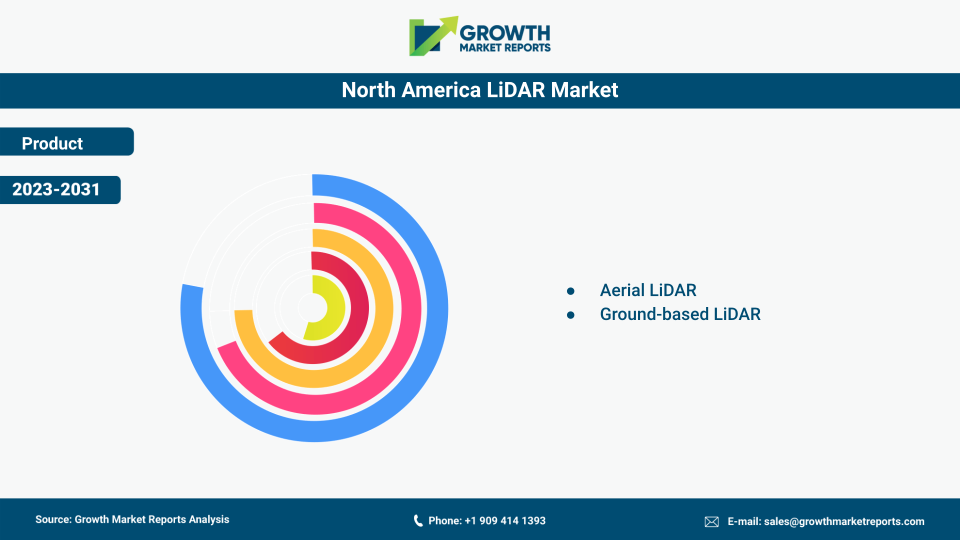
Segments - by Component (Laser Scanners, Navigation and Positioning Systems, Cameras, GPS/GNSS Receivers, Others), by Type (Terrestrial, Aerial, Mobile, Short-range), by Application (Automotive, Aerospace & Defense, Environmental, Mapping & Surveying, Agriculture, Mining, Others), by Installation (Ground-based, Airborne), by End-User (Government, Commercial, Industrial, Others)
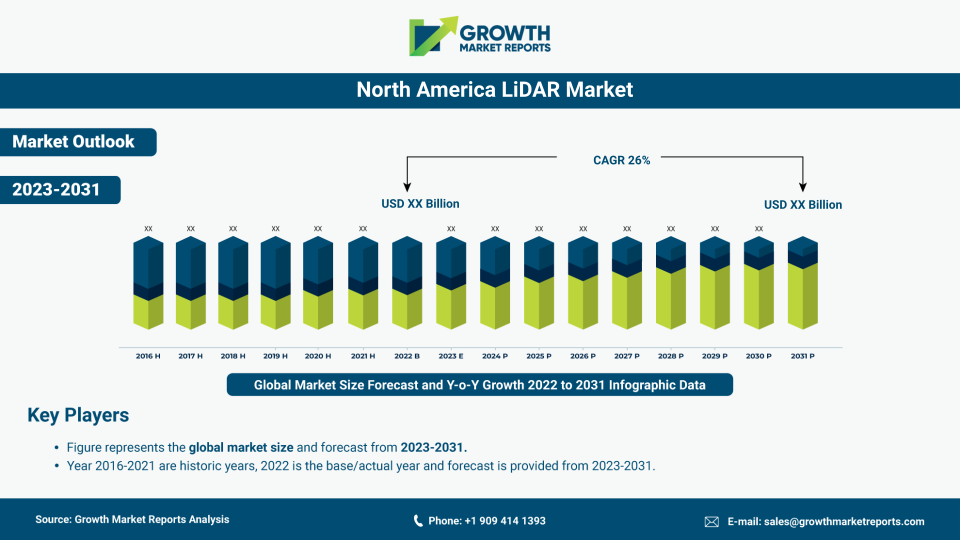
As per our latest research, the global LiDAR market size reached USD 2.5 billion in 2024, demonstrating robust momentum driven by surging adoption across diverse industries. The market is experiencing a compound annual growth rate (CAGR) of 19.4% and is forecasted to achieve a valuation of USD 11.7 billion by 2033. This remarkable growth trajectory is primarily fueled by the increasing integration of LiDAR technology in autonomous vehicles, advanced mapping applications, and infrastructure development, alongside expanding usage in environmental monitoring and smart city projects.
The LiDAR market is witnessing significant expansion due to the rapid advancements in sensor technologies and the growing demand for high-precision data collection across multiple sectors. The automotive industry, in particular, is a key growth driver, as LiDAR sensors are becoming an essential component of advanced driver-assistance systems (ADAS) and fully autonomous vehicles. The push for safer and more efficient transportation systems has compelled leading automotive OEMs and technology firms to ramp up investments in LiDAR-based solutions. Additionally, the declining cost of LiDAR hardware, coupled with improvements in miniaturization and durability, has made the technology increasingly accessible for a wider range of applications, further accelerating market growth.
Another critical factor propelling the LiDAR market is the rising need for precise geospatial data in infrastructure development, urban planning, and environmental monitoring. Governments and private organizations are leveraging LiDAR technology for large-scale mapping and surveying projects, such as flood modeling, forestry management, and coastline mapping. The ability of LiDAR to provide accurate three-dimensional representations of terrain and built environments is revolutionizing the way industries approach project planning and execution. Furthermore, the integration of LiDAR with complementary technologies such as artificial intelligence (AI), machine learning, and geographic information systems (GIS) is unlocking new possibilities in data analytics, enabling more informed decision-making and operational efficiency.
The proliferation of unmanned aerial vehicles (UAVs) and drones equipped with LiDAR sensors is another transformative trend shaping the market landscape. Aerial LiDAR is gaining traction in agriculture, mining, and environmental sectors for its ability to rapidly survey large and challenging terrains with high accuracy. This capability is particularly valuable for applications such as crop monitoring, disaster management, and resource exploration. As regulatory frameworks evolve to support the commercial use of drones, and as battery and payload technologies improve, the adoption of airborne LiDAR is expected to accelerate further, creating new opportunities for market participants.
From a regional perspective, North America leads the global LiDAR market in terms of revenue, driven by strong government support, a robust ecosystem of technology providers, and early adoption across automotive and defense sectors. Europe follows closely, benefiting from stringent regulatory standards and substantial investments in smart infrastructure projects. The Asia Pacific region is emerging as the fastest-growing market, fueled by rapid urbanization, expanding industrialization, and significant investments in transportation and environmental management. Latin America and the Middle East & Africa are gradually embracing LiDAR technology, primarily in mining, oil & gas, and infrastructure development, albeit at a slower pace compared to other regions.
The LiDAR market by component is segmented into laser scanners, navigation and positioning systems, cameras, GPS/GNSS receivers, and others. Laser scanners represent the core of LiDAR systems, providing the capability to emit laser pulses and measure the time it takes for them to return after hitting an object. Recent advancements in laser technology have led to the development of more compact, energy-efficient, and cost-effective laser scanners, which has significantly contributed to the proliferation of LiDAR applications across industries. The increasing demand for high-resolution and long-range scanning capabilities, especially in automotive and mapping sectors, is driving continuous innovation in this segment. Market players are focusing on enhancing the durability and performance of laser scanners to withstand harsh environmental conditions, further broadening their adoption in outdoor and industrial settings.
Navigation and positioning systems are another critical component of LiDAR solutions, ensuring accurate geospatial referencing of collected data. The integration of advanced inertial measurement units (IMUs) and real-time kinematic (RTK) positioning technologies has significantly improved the precision and reliability of LiDAR systems, particularly in dynamic environments such as moving vehicles or drones. This segment is experiencing robust growth as industries demand more sophisticated navigation solutions to support complex applications, such as autonomous driving and high-speed aerial mapping. The convergence of navigation systems with AI-powered analytics is further enhancing the value proposition of LiDAR by enabling real-time data processing and actionable insights.
Cameras are increasingly being incorporated into LiDAR systems to provide complementary visual information, enabling richer data fusion and improved object recognition capabilities. The synergy between LiDAR and high-resolution imaging is particularly valuable in applications such as autonomous vehicles, where accurate perception of the environment is critical for safe navigation. Innovations in camera technology, including higher frame rates and enhanced low-light performance, are expanding the scope of LiDAR applications, especially in challenging lighting conditions. This trend is expected to continue as market demand grows for integrated perception systems that combine the strengths of multiple sensor modalities.
GPS/GNSS receivers play a vital role in ensuring the spatial accuracy of LiDAR data, particularly in large-scale mapping and surveying projects. The adoption of multi-constellation and multi-frequency GNSS receivers has improved the robustness and reliability of positioning information, even in environments with limited satellite visibility. This is particularly important for applications in dense urban areas, forests, or under canopy cover, where traditional GPS signals may be obstructed. As the market for high-precision geospatial data expands, the demand for advanced GPS/GNSS receivers is expected to grow in tandem, supporting the broader adoption of LiDAR technology in diverse industries.
| Attributes | Details |
| Report Title | LiDAR Market Research Report 2033 |
| By Component | Laser Scanners, Navigation and Positioning Systems, Cameras, GPS/GNSS Receivers, Others |
| By Type | Terrestrial, Aerial, Mobile, Short-range |
| By Application | Automotive, Aerospace & Defense, Environmental, Mapping & Surveying, Agriculture, Mining, Others |
| By Installation | Ground-based, Airborne |
| By End-User | Government, Commercial, Industrial, Others |
| Regions Covered | North America, Europe, APAC, Latin America, MEA |
| Base Year | 2024 |
| Historic Data | 2018-2023 |
| Forecast Period | 2025-2033 |
| Number of Pages | 268 |
| Number of Tables & Figures | 399 |
| Customization Available | Yes, the report can be customized as per your need. |
The LiDAR market can be segmented by type into terrestrial, aerial, mobile, and short-range systems. Terrestrial LiDAR, also known as ground-based LiDAR, is widely used for applications such as topographical surveying, construction site monitoring, and infrastructure inspection. The ability of terrestrial LiDAR systems to deliver highly detailed three-dimensional models of buildings, bridges, and other structures has made them indispensable tools in civil engineering and urban planning. Recent advancements in portability and automation have further enhanced the appeal of terrestrial LiDAR, enabling faster data collection and processing with reduced labor requirements. As construction and infrastructure projects continue to grow in scale and complexity, the demand for terrestrial LiDAR solutions is expected to rise accordingly.
Aerial LiDAR, deployed from aircraft or drones, is gaining significant traction in sectors such as forestry, agriculture, and environmental management. The ability to rapidly survey vast and inaccessible areas with high spatial resolution makes aerial LiDAR a preferred choice for applications such as flood modeling, vegetation analysis, and coastline mapping. The integration of lightweight LiDAR sensors with unmanned aerial vehicles (UAVs) has democratized access to aerial mapping capabilities, enabling smaller organizations and research institutions to undertake projects that were previously cost-prohibitive. As regulatory frameworks evolve and drone technology advances, the adoption of aerial LiDAR is expected to accelerate, particularly in emerging markets with large tracts of unexplored land.
Mobile LiDAR systems, typically mounted on vehicles, are revolutionizing the way transportation infrastructure is mapped and maintained. These systems enable rapid and accurate collection of geospatial data along roadways, railways, and urban corridors, supporting applications such as asset management, route planning, and safety analysis. The automotive industry is a major adopter of mobile LiDAR, leveraging the technology for autonomous vehicle development, road condition monitoring, and traffic management. Ongoing improvements in sensor miniaturization, data processing speeds, and integration with other perception technologies are expanding the potential use cases for mobile LiDAR, driving strong growth in this segment.
Short-range LiDAR systems are designed for applications that require precise measurement over limited distances, such as industrial automation, robotics, and indoor mapping. The growing trend toward smart factories and warehouses is fueling demand for short-range LiDAR, which enables real-time object detection, collision avoidance, and process optimization. Innovations in solid-state and MEMS-based LiDAR technologies are making these systems more affordable and reliable, further accelerating their adoption in commercial and industrial settings. As industries continue to embrace automation and digital transformation, the market for short-range LiDAR is poised for sustained expansion.
The LiDAR market finds applications across a diverse array of industries, with automotive, aerospace & defense, environmental, mapping & surveying, agriculture, mining, and others driving demand. In the automotive sector, LiDAR is a cornerstone technology for the development of advanced driver-assistance systems (ADAS) and autonomous vehicles. The ability of LiDAR to provide accurate, real-time 3D mapping of the vehicle’s surroundings is critical for safe navigation and obstacle detection. Major automotive OEMs and technology startups are investing heavily in LiDAR R&D, aiming to enhance sensor range, resolution, and integration while reducing costs. As regulatory bodies in key markets move toward mandating advanced safety features, the adoption of LiDAR in vehicles is expected to surge.
In aerospace & defense, LiDAR technology is leveraged for applications such as terrain mapping, target identification, and surveillance. The precision and speed of LiDAR make it an invaluable tool for mission-critical operations, including search and rescue, reconnaissance, and border security. The increasing focus on modernizing defense infrastructure and enhancing situational awareness is driving demand for advanced LiDAR solutions in this sector. Furthermore, the integration of LiDAR with other sensing and communication technologies is enabling the development of multi-functional systems that can operate in complex and dynamic environments.
Environmental applications of LiDAR are gaining prominence as governments and organizations strive to address challenges related to climate change, natural resource management, and disaster mitigation. LiDAR is extensively used for forest inventory, flood modeling, coastal erosion monitoring, and habitat mapping. The technology’s ability to generate highly accurate elevation models and vegetation profiles supports data-driven decision-making in environmental conservation and land management. As the global focus on sustainability intensifies, the demand for LiDAR-based environmental monitoring solutions is expected to grow significantly.
Mapping & surveying remains a foundational application area for LiDAR, with the technology enabling rapid, high-precision data collection for infrastructure development, urban planning, and asset management. The integration of LiDAR with GIS and other geospatial technologies is streamlining workflows and enhancing the accuracy of mapping projects. In agriculture, LiDAR is being used to optimize crop management, monitor field topography, and assess soil health. The mining industry is leveraging LiDAR for resource exploration, pit mapping, and safety monitoring, benefiting from the technology’s ability to operate in challenging and hazardous environments.
The LiDAR market by installation can be broadly categorized into ground-based and airborne systems. Ground-based LiDAR, encompassing both stationary and mobile installations, is widely adopted for applications requiring detailed mapping of terrain, buildings, and infrastructure. The versatility of ground-based LiDAR systems makes them suitable for a wide range of use cases, from construction site monitoring to archaeological surveys. Recent advancements in automation and real-time data processing have enhanced the efficiency of ground-based LiDAR, enabling faster project turnaround times and reducing the need for manual intervention. The growing emphasis on digital twins and smart infrastructure is further driving demand for ground-based LiDAR solutions.
Airborne LiDAR systems, deployed from manned aircraft or UAVs, are essential for large-scale mapping, environmental monitoring, and disaster response. The ability to cover vast and inaccessible areas with high spatial and temporal resolution makes airborne LiDAR a preferred choice for government agencies, environmental organizations, and commercial mapping firms. The integration of lightweight LiDAR sensors with drones has democratized access to aerial mapping, enabling cost-effective data collection for a variety of applications. As drone technology continues to evolve, with improvements in battery life, payload capacity, and autonomous navigation, the adoption of airborne LiDAR is expected to accelerate, particularly in regions with challenging terrain.
The choice between ground-based and airborne LiDAR installation depends on factors such as project scale, required accuracy, and environmental conditions. In many cases, a combination of both installation types is employed to achieve comprehensive coverage and optimal results. The ongoing convergence of LiDAR with other sensing technologies, such as photogrammetry and hyperspectral imaging, is further expanding the capabilities of both ground-based and airborne systems, enabling more sophisticated data analysis and application development.
The LiDAR market serves a diverse range of end-users, including government, commercial, industrial, and others. Government agencies are among the largest adopters of LiDAR technology, leveraging it for applications such as infrastructure development, environmental monitoring, disaster management, and urban planning. The ability of LiDAR to provide accurate, up-to-date geospatial data supports data-driven decision-making and enhances the efficiency of public sector projects. Increasing government investments in smart city initiatives and sustainable development are expected to drive continued demand for LiDAR solutions in this segment.
Commercial end-users, including automotive manufacturers, real estate developers, and mapping service providers, are increasingly integrating LiDAR into their operations to gain a competitive edge. The automotive industry, in particular, is a major growth driver, with LiDAR playing a pivotal role in the development of autonomous vehicles and advanced safety systems. Real estate and construction firms are utilizing LiDAR for site surveying, building information modeling (BIM), and property management, benefiting from the technology’s ability to deliver accurate and detailed spatial data. The commercial segment is expected to witness robust growth as more industries recognize the value of LiDAR-enabled solutions.
Industrial end-users, such as mining, oil & gas, and agriculture companies, are adopting LiDAR to optimize operations, enhance safety, and improve resource management. In mining, LiDAR is used for pit mapping, volumetric analysis, and hazard detection, enabling more efficient and safer extraction processes. The oil & gas industry leverages LiDAR for pipeline inspection, terrain analysis, and infrastructure monitoring, benefiting from the technology’s ability to operate in hazardous or remote environments. In agriculture, LiDAR supports precision farming, crop monitoring, and land management, driving improvements in productivity and sustainability.
Other end-users, including research institutions, environmental organizations, and non-profit entities, are utilizing LiDAR for scientific research, conservation efforts, and educational purposes. The versatility and accuracy of LiDAR make it an invaluable tool for a wide range of applications, from archaeological surveys to wildlife habitat mapping. As awareness of the technology’s capabilities continues to grow, the adoption of LiDAR among non-traditional end-users is expected to increase, further expanding the market’s reach.
The LiDAR market presents a multitude of opportunities for growth and innovation, driven by the rapid adoption of autonomous vehicles, smart infrastructure, and environmental monitoring solutions. The ongoing digital transformation across industries is creating new use cases for LiDAR, from precision agriculture and asset management to disaster response and climate modeling. The convergence of LiDAR with emerging technologies such as artificial intelligence, machine learning, and cloud computing is unlocking new possibilities for real-time data processing, predictive analytics, and decision support. As industries continue to embrace automation and data-driven operations, the demand for high-resolution, accurate, and reliable LiDAR solutions is expected to grow exponentially.
Another significant opportunity lies in the democratization of LiDAR technology, driven by advancements in sensor miniaturization, cost reduction, and ease of integration. The proliferation of drones and mobile platforms equipped with LiDAR sensors is enabling organizations of all sizes to access high-quality geospatial data at a fraction of the cost and time required by traditional methods. This trend is particularly beneficial for small and medium enterprises (SMEs), research institutions, and non-profit organizations, which can now undertake projects that were previously beyond their reach. The expanding ecosystem of LiDAR solution providers, software developers, and system integrators is fostering innovation and competition, further accelerating market growth.
Despite the numerous opportunities, the LiDAR market faces several restraining factors that could impede its growth. One of the primary challenges is the high initial cost of LiDAR systems, particularly for high-end applications requiring advanced features and capabilities. While ongoing advancements are driving down costs, price sensitivity remains a concern, especially in price-competitive industries and emerging markets. Additionally, the complexity of LiDAR data processing and interpretation requires specialized skills and expertise, which can pose a barrier to adoption for organizations with limited technical resources. Regulatory uncertainties related to the use of drones and data privacy concerns may also impact the pace of market expansion in certain regions.
The LiDAR market exhibits distinct regional dynamics, with North America leading the global landscape. In 2024, North America accounted for approximately USD 1.1 billion of the total market, driven by strong government support, a mature technology ecosystem, and early adoption across automotive, defense, and infrastructure sectors. The United States, in particular, is a hotbed of innovation, with leading LiDAR manufacturers, research institutions, and technology firms driving advancements in sensor technology, data analytics, and system integration. Canada is also making significant strides, particularly in environmental monitoring and natural resource management, leveraging LiDAR for forest inventory, flood modeling, and land use planning.
Europe is the second-largest regional market, with revenues reaching USD 730 million in 2024. The region benefits from stringent regulatory standards, a strong focus on sustainability, and substantial investments in smart infrastructure and transportation projects. Countries such as Germany, the United Kingdom, and France are at the forefront of LiDAR adoption, particularly in automotive, environmental, and urban planning applications. The European market is expected to grow at a healthy CAGR of 18.6% through 2033, supported by ongoing digital transformation initiatives and the increasing integration of LiDAR with other geospatial technologies.
The Asia Pacific region is emerging as the fastest-growing market, with revenues of USD 500 million in 2024 and a projected CAGR of 22.1% over the forecast period. Rapid urbanization, expanding industrialization, and significant investments in transportation, infrastructure, and environmental management are driving demand for LiDAR solutions in countries such as China, Japan, South Korea, and India. The proliferation of smart city projects, coupled with government initiatives to promote digitalization and sustainability, is creating new opportunities for LiDAR adoption across the region. Latin America and the Middle East & Africa, although smaller in terms of market size, are gradually embracing LiDAR technology, particularly in mining, oil & gas, and infrastructure development, as awareness of its benefits continues to grow.
The LiDAR market is characterized by intense competition and rapid technological innovation, with a diverse array of players ranging from established industry giants to agile startups. The competitive landscape is shaped by ongoing advancements in sensor technology, data processing algorithms, and system integration capabilities. Leading companies are investing heavily in research and development to enhance the performance, reliability, and cost-effectiveness of their LiDAR solutions, aiming to capture a larger share of the expanding market. Strategic partnerships, mergers and acquisitions, and collaborations with automotive OEMs, drone manufacturers, and software developers are common strategies employed by market participants to strengthen their market position and accelerate innovation.
The market is witnessing a convergence of hardware and software capabilities, with companies increasingly offering integrated solutions that combine LiDAR sensors, navigation systems, cameras, and advanced analytics platforms. This approach enables end-users to streamline their operations, reduce integration complexity, and derive greater value from their LiDAR investments. The emergence of cloud-based LiDAR data processing and analytics services is further expanding the addressable market, enabling organizations to access powerful data analysis tools without the need for significant upfront investments in IT infrastructure. As the market continues to evolve, the ability to offer scalable, flexible, and user-friendly solutions will be a key differentiator for leading vendors.
Intellectual property and technological differentiation are critical factors shaping the competitive dynamics of the LiDAR market. Companies that can demonstrate superior performance in terms of range, resolution, reliability, and integration flexibility are well-positioned to capture high-value contracts in automotive, aerospace, and infrastructure sectors. The ongoing race to develop solid-state and MEMS-based LiDAR technologies is particularly intense, with the potential to significantly reduce costs and enable mass-market adoption in automotive and consumer electronics applications. The ability to address emerging use cases, such as indoor mapping, industrial automation, and smart city infrastructure, is also becoming increasingly important for market leaders.
Some of the major companies operating in the LiDAR market include Velodyne Lidar, Inc., Quanergy Systems, Inc., Innoviz Technologies, Luminar Technologies, RIEGL Laser Measurement Systems, Leica Geosystems (Hexagon AB), Trimble Inc., Teledyne Optech, FARO Technologies, and Ouster, Inc. Velodyne Lidar is renowned for its high-performance, scalable LiDAR solutions, catering primarily to the automotive and industrial automation sectors. Quanergy Systems focuses on developing solid-state LiDAR sensors for smart cities and security applications, while Innoviz Technologies is a key player in the automotive LiDAR space, supplying sensors for autonomous vehicles. Luminar Technologies stands out for its long-range, high-resolution LiDAR sensors, targeting the premium automotive market.
RIEGL and Leica Geosystems are leaders in the surveying and mapping segment, offering a wide range of airborne, terrestrial, and mobile LiDAR solutions for geospatial professionals. Trimble Inc. and Teledyne Optech are known for their comprehensive geospatial solutions, integrating LiDAR with GPS, imaging, and data analytics platforms. FARO Technologies specializes in 3D measurement and imaging solutions, serving industries such as construction, manufacturing, and forensics. Ouster, Inc. is a fast-growing player, leveraging digital LiDAR technology to deliver affordable, high-performance sensors for a variety of applications. These companies are continuously innovating to address evolving market demands and maintain their competitive edge in the dynamic LiDAR landscape.
The LiDAR market has been segmented on the basis of
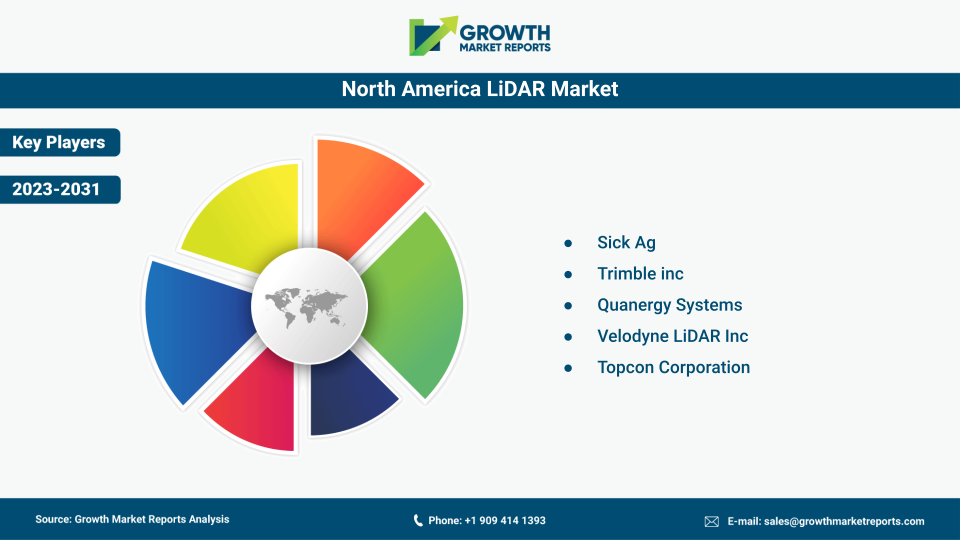
Key players competing in the North America LiDAR market are Sick Ag; Trimble Inc.; Quanergy Systems; Velodyne LiDAR Inc.; and Topcon Corporation.
Companies are engaging mergers, acquisitions, and partnerships to expand their market share. Moreover, they’re investing in R&D activities to leverage their market position.
Key challenges include the high initial cost of LiDAR systems, complexity in data processing, the need for specialized expertise, and regulatory uncertainties related to drone usage and data privacy.
Top companies in the LiDAR market include Velodyne Lidar, Quanergy Systems, Luminar Technologies, Ouster, Innoviz Technologies, Leica Geosystems, Teledyne Optech, RIEGL Laser Measurement Systems, Trimble Inc., and FARO Technologies.
Major trends include the integration of LiDAR with AI and GIS, the proliferation of drone-based LiDAR, sensor miniaturization, and cost reduction. Opportunities are emerging in autonomous vehicles, smart cities, precision agriculture, and environmental monitoring.
LiDAR is widely used for automotive safety, mapping & surveying, environmental monitoring, agriculture (crop and soil analysis), mining (resource exploration and safety), aerospace & defense (terrain mapping and surveillance), and smart infrastructure projects.
LiDAR systems typically consist of laser scanners, navigation and positioning systems (including IMUs and GPS/GNSS receivers), cameras, and other supporting components. Each plays a vital role in data accuracy and system performance.
North America leads the global LiDAR market, followed by Europe. The Asia Pacific region is the fastest-growing market, driven by rapid urbanization and infrastructure investments. Latin America and the Middle East & Africa are also gradually adopting LiDAR technology.
LiDAR sensors are critical for autonomous vehicles and advanced driver-assistance systems (ADAS), providing real-time 3D mapping and object detection to enhance vehicle safety and navigation.
The main types of LiDAR systems are terrestrial (ground-based), aerial (airborne), mobile (vehicle-mounted), and short-range systems, each suited for specific applications such as topographical surveying, environmental monitoring, and industrial automation.
Key industries fueling LiDAR market growth include automotive (especially for ADAS and autonomous vehicles), infrastructure development, environmental monitoring, smart cities, agriculture, mining, and aerospace & defense.
As of 2024, the global LiDAR market size is valued at USD 2.5 billion and is projected to reach USD 11.7 billion by 2033, growing at a CAGR of 19.4% due to rising adoption in industries such as automotive, mapping, and environmental monitoring.