Ion Milling System Market Research Report 2033

Ion Milling System Market Research Report 2033

Segments - by Product Type (Tabletop Ion Milling Systems, Floor-standing Ion Milling Systems), by Application (Semiconductor, Material Science, Life Sciences, Electronics, Others), by End-User (Academic & Research Institutes, Industrial, Others)

https://growthmarketreports.com/Raksha
Author : Raksha Sharma
https://growthmarketreports.com/Vaibhav
Fact-checked by : V. Chandola
https://growthmarketreports.com/Shruti
Editor : Shruti Bhat

Upcoming | Report ID :EP-4474 | 4.2 Rating | 34 Reviews | 265 Pages | Format : Docx PDF

Report Description


Ion Milling System Market Outlook

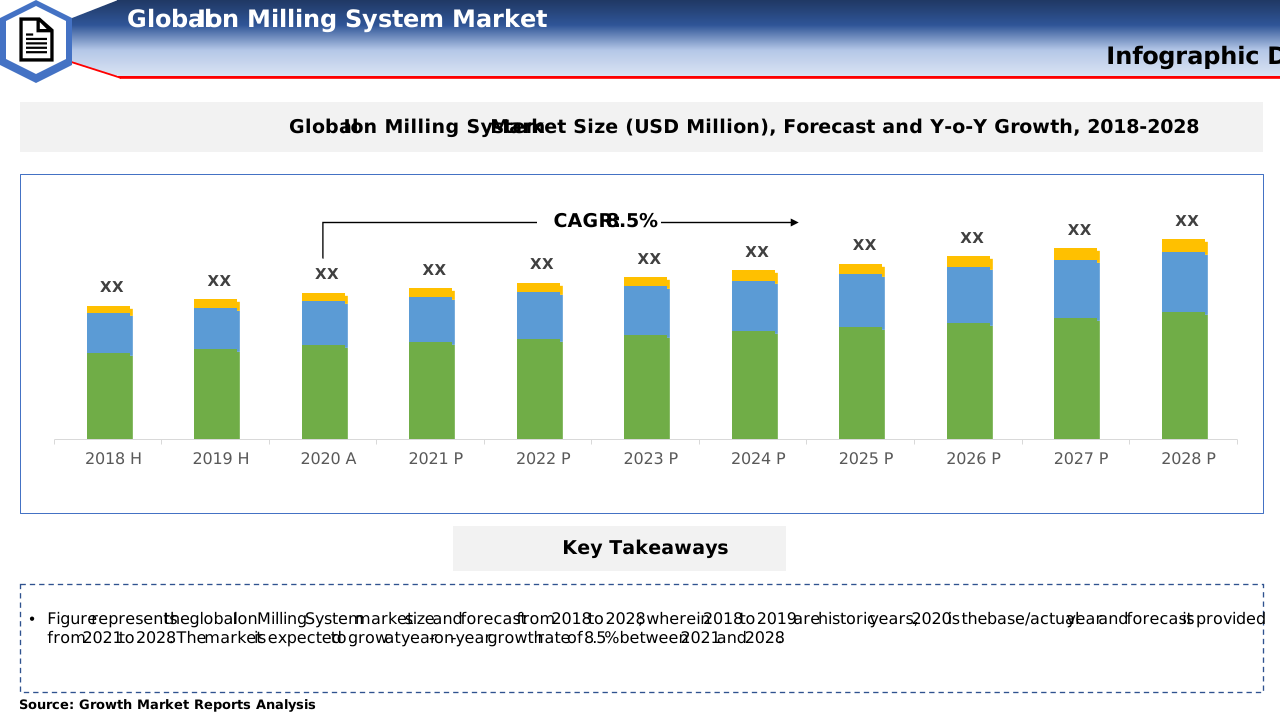
As per our latest research, the global Ion Milling System market size reached USD 1.12 billion in 2024, demonstrating robust growth propelled by advancements in materials science and semiconductor manufacturing. The market is expected to expand at a CAGR of 7.1% from 2025 to 2033, reaching a forecasted value of USD 2.08 billion by 2033. This growth is underpinned by increasing demand for precision sample preparation across diverse applications, including semiconductors, electronics, and life sciences, coupled with the continuous evolution of analytical instrumentation and nanotechnology.

The surge in semiconductor manufacturing and the relentless push for miniaturization in electronic devices are among the most significant growth factors fueling the Ion Milling System market. As device geometries shrink and complexity increases, manufacturers require highly precise and reliable sample preparation techniques to ensure accurate analysis and defect characterization. Ion milling systems are uniquely positioned to meet these needs, offering superior surface finish and minimal artifact introduction compared to traditional mechanical polishing methods. Additionally, the proliferation of advanced materials in sectors such as aerospace, automotive, and energy storage is driving the adoption of ion milling systems for material characterization, further expanding the addressable market.

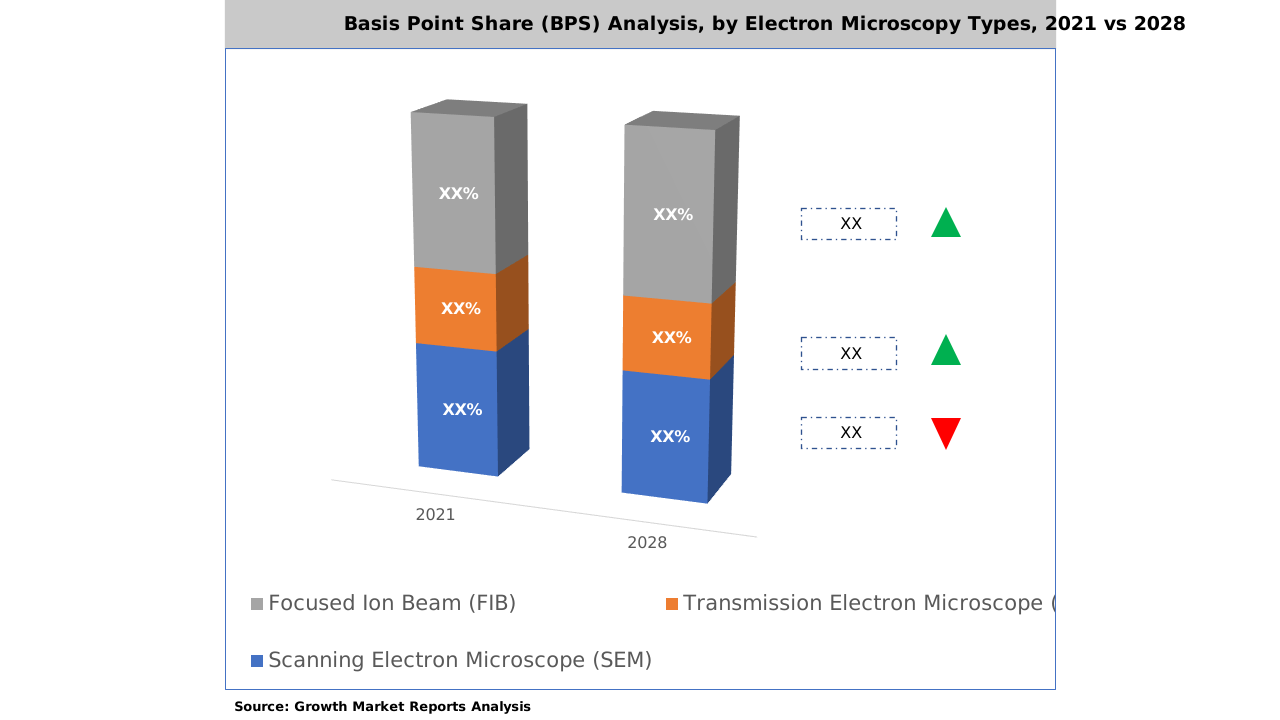
Another critical driver for the Ion Milling System market is the rapid development of analytical techniques such as scanning electron microscopy (SEM) and transmission electron microscopy (TEM). These techniques demand exceptionally prepared samples, and ion milling systems have become indispensable in research and industrial laboratories worldwide. The integration of automation and digital controls in modern ion milling systems has enhanced throughput, reproducibility, and ease of use, making them accessible to a broader range of end-users, including academic and research institutions. Furthermore, the growing focus on nanotechnology and the need for high-resolution imaging are prompting investments in advanced milling solutions, setting the stage for sustained market growth.

The increasing emphasis on quality control and failure analysis in the electronics and semiconductor industries is also driving the demand for ion milling systems. As manufacturers strive to maintain competitiveness and meet stringent international standards, the ability to perform accurate cross-sectional analysis and surface preparation is becoming a critical differentiator. Moreover, the expansion of research activities in life sciences and materials science is fostering collaborations between academia and industry, spurring the adoption of sophisticated ion milling systems. The development of environmentally friendly and energy-efficient milling solutions is further contributing to market expansion, aligning with global sustainability trends.

From a regional perspective, Asia Pacific continues to dominate the global Ion Milling System market, supported by the presence of major semiconductor manufacturing hubs in China, Japan, South Korea, and Taiwan. North America and Europe follow closely, driven by robust research infrastructure and technological innovation. Emerging economies in Latin America and the Middle East & Africa are gradually increasing their market share, propelled by investments in research and industrialization. This diverse regional landscape underscores the global relevance of ion milling systems across multiple sectors and applications.

Global Ion Milling System Industry Outlook

Product Type Analysis

The Ion Milling System market is segmented by product type into Tabletop Ion Milling Systems and Floor-standing Ion Milling Systems, each catering to distinct end-user requirements. Tabletop ion milling systems are gaining traction in academic and small-scale research environments due to their compact footprint, ease of installation, and cost-effectiveness. These systems are particularly suited for applications requiring moderate throughput and flexibility, making them popular in university laboratories and small research facilities. The integration of intuitive user interfaces and automation features has further enhanced their appeal, allowing users with varying levels of expertise to operate them efficiently. As research budgets tighten and space constraints become more pronounced, the demand for tabletop solutions is expected to witness steady growth.

Floor-standing ion milling systems, on the other hand, are designed to meet the rigorous demands of industrial and high-throughput research applications. These systems offer greater power, larger sample capacity, and advanced process control, making them ideal for semiconductor fabrication plants, electronics manufacturing, and materials science research centers. The ability to handle a wide range of sample sizes and materials, coupled with enhanced durability and reliability, positions floor-standing systems as the preferred choice for mission-critical applications. The ongoing trend toward automation and digitalization in manufacturing is driving investments in these high-performance systems, particularly in regions with a strong industrial base.

Technological advancements are blurring the lines between these two product categories, with manufacturers introducing hybrid systems that combine the portability of tabletop models with the power and functionality of floor-standing units. This convergence is enabling end-users to achieve greater operational flexibility without compromising on performance. Furthermore, the development of modular systems that can be upgraded or customized based on specific application needs is gaining momentum, offering a compelling value proposition to both research and industrial customers. The emphasis on user-friendly interfaces, remote monitoring, and integration with other analytical instruments is shaping the next generation of ion milling systems.

The competitive landscape in the product type segment is characterized by continuous innovation and a focus on addressing the evolving needs of end-users. Leading manufacturers are investing in research and development to enhance system performance, reduce operational costs, and improve environmental sustainability. The adoption of advanced materials and manufacturing techniques is enabling the production of more robust and reliable systems, further strengthening the market position of established players. As the demand for precision sample preparation continues to rise, the product type segment is expected to remain a key driver of growth in the global Ion Milling System market.

Report Scope

Attributes Details
Report Title Ion Milling System Market Research Report 2033
By Product Type Tabletop Ion Milling Systems, Floor-standing Ion Milling Systems
By Application Semiconductor, Material Science, Life Sciences, Electronics, Others
By End-User Academic & Research Institutes, Industrial, Others
Regions Covered North America, Europe, APAC, Latin America, MEA
Base Year 2024
Historic Data 2018-2023
Forecast Period 2025-2033
Number of Pages 265
Number of Tables & Figures 394
Customization Available Yes, the report can be customized as per your need.

Application Analysis

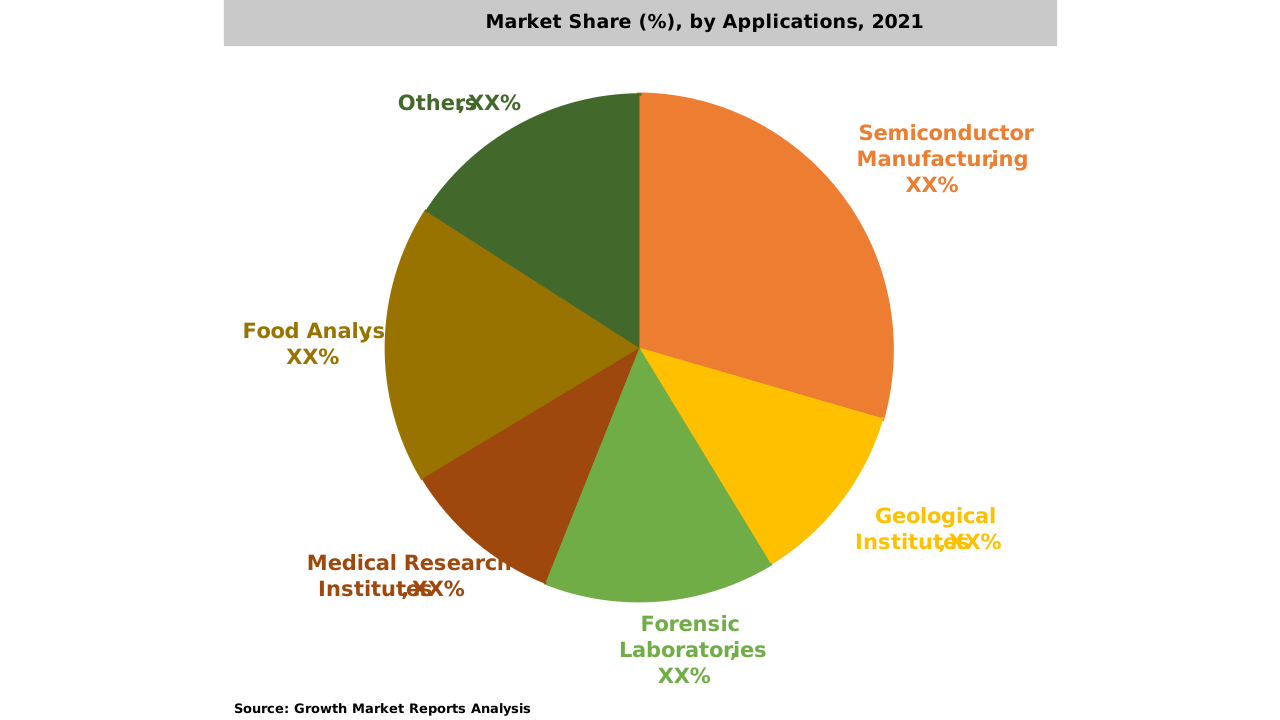
The Ion Milling System market is segmented by application into Semiconductor, Material Science, Life Sciences, Electronics, and Others, reflecting the diverse range of industries that rely on precision sample preparation. The semiconductor segment represents the largest share of the market, driven by the relentless demand for advanced chips and integrated circuits in consumer electronics, automotive, and telecommunications. Ion milling systems are essential for preparing cross-sections and thin samples for electron microscopy, enabling manufacturers to detect defects, analyze failure mechanisms, and optimize fabrication processes. The increasing complexity of semiconductor devices, coupled with the transition to smaller process nodes, is fueling investments in state-of-the-art milling solutions.

In material science, ion milling systems play a pivotal role in the characterization of metals, ceramics, polymers, and composites. Researchers rely on these systems to prepare high-quality samples for microstructural analysis, phase identification, and surface modification studies. The growing focus on advanced materials for aerospace, energy storage, and additive manufacturing is expanding the application scope of ion milling systems in this segment. Collaborative research initiatives between academia and industry are further accelerating the adoption of sophisticated milling technologies, driving innovation and knowledge transfer across disciplines.

The life sciences segment is witnessing increasing adoption of ion milling systems, particularly in the preparation of biological samples for high-resolution imaging. Techniques such as cryo-electron microscopy (cryo-EM) and serial block-face scanning electron microscopy (SBF-SEM) require meticulously prepared samples to achieve accurate structural and functional insights. Ion milling systems offer unparalleled precision and control, enabling researchers to study cellular and subcellular structures with unprecedented clarity. The expanding applications of nanotechnology and biomaterials in healthcare and biotechnology are expected to drive further growth in this segment.

Electronics manufacturing is another key application area for ion milling systems, encompassing the production of printed circuit boards (PCBs), sensors, and optoelectronic devices. The need for reliable failure analysis, quality control, and process optimization is prompting manufacturers to invest in advanced milling solutions. As the demand for miniaturized and multifunctional electronic components continues to rise, ion milling systems are becoming indispensable tools for ensuring product reliability and performance. The "Others" category, which includes applications in environmental science, geology, and forensics, is also experiencing steady growth, reflecting the versatility and adaptability of ion milling technology.

End-User Analysis

The Ion Milling System market is segmented by end-user into Academic & Research Institutes, Industrial, and Others, highlighting the broad spectrum of organizations that utilize these systems. Academic and research institutes represent a significant share of the market, driven by the increasing emphasis on interdisciplinary research and the need for advanced analytical tools. Universities and research centers are investing in ion milling systems to support a wide range of scientific investigations, from fundamental materials science to applied nanotechnology. The availability of government funding and collaborative research programs is further supporting market growth in this segment.

The industrial segment encompasses a diverse array of end-users, including semiconductor manufacturers, electronics producers, materials processing companies, and life sciences organizations. These entities rely on ion milling systems for quality control, process optimization, and failure analysis, ensuring the reliability and performance of their products. The growing complexity of industrial processes and the need for rapid, accurate analysis are driving demand for high-throughput and automated milling solutions. The integration of ion milling systems with other analytical instruments, such as electron microscopes and spectroscopy tools, is enabling seamless workflows and enhancing operational efficiency.

The "Others" category includes government laboratories, contract research organizations, and specialized service providers that offer sample preparation and analytical services to a wide range of clients. These entities play a crucial role in supporting research and development activities across multiple industries, providing access to advanced milling technologies and expertise. The increasing trend toward outsourcing of analytical and characterization services is expected to drive further growth in this segment, particularly in regions with limited access to state-of-the-art facilities.

Across all end-user segments, the emphasis on training, technical support, and after-sales service is becoming increasingly important. Manufacturers are responding by offering comprehensive support packages, including installation, maintenance, and user training, to ensure optimal system performance and customer satisfaction. The adoption of digital platforms for remote monitoring, troubleshooting, and software updates is also enhancing the user experience and reducing operational downtime. As the demand for precision sample preparation continues to rise, the end-user segment is expected to remain a key driver of growth in the global Ion Milling System market.

Opportunities & Threats

The Ion Milling System market presents significant opportunities for growth, particularly in emerging economies and new application areas. The rapid industrialization and expansion of research infrastructure in countries such as China, India, and Brazil are creating new demand for advanced analytical tools, including ion milling systems. The increasing focus on nanotechnology, advanced materials, and biotechnology is opening up new avenues for application, driving innovation and market expansion. Furthermore, the development of portable and user-friendly systems is enabling broader adoption across diverse end-user segments, from academic institutions to small and medium-sized enterprises.

Another key opportunity lies in the integration of ion milling systems with digital technologies, such as artificial intelligence (AI), machine learning, and the Internet of Things (IoT). These advancements are enabling real-time monitoring, predictive maintenance, and data-driven process optimization, enhancing system performance and reducing operational costs. The growing emphasis on sustainability and environmental responsibility is also driving the development of energy-efficient and eco-friendly milling solutions, aligning with global trends and regulatory requirements. Strategic partnerships and collaborations between manufacturers, research institutions, and end-users are expected to accelerate innovation and drive market growth in the coming years.

Despite these opportunities, the Ion Milling System market faces several challenges that could restrain growth. The high initial cost of advanced milling systems and the need for specialized training and technical expertise can be significant barriers to adoption, particularly for small and medium-sized organizations. Additionally, the availability of alternative sample preparation techniques, such as focused ion beam (FIB) systems and mechanical polishing, may limit market penetration in certain applications. Manufacturers must continue to innovate and differentiate their offerings to address these challenges and maintain a competitive edge in the global market.

Regional Outlook

The Asia Pacific region dominates the global Ion Milling System market, accounting for approximately 42% of the total market value in 2024, or around USD 470 million. This leadership position is driven by the presence of leading semiconductor manufacturing hubs in China, Japan, South Korea, and Taiwan, as well as strong investments in research and development across materials science, electronics, and life sciences. The region is expected to maintain a robust growth trajectory, with a projected CAGR of 8.2% through 2033, supported by ongoing industrialization, government initiatives, and the expansion of research infrastructure.

North America holds the second-largest share of the Ion Milling System market, valued at approximately USD 320 million in 2024. The region benefits from a well-established research ecosystem, a strong presence of leading technology companies, and significant investments in advanced manufacturing and nanotechnology. The United States, in particular, is at the forefront of innovation in semiconductor fabrication, materials science, and life sciences, driving demand for precision sample preparation solutions. The North American market is expected to experience steady growth, fueled by ongoing advancements in analytical instrumentation and the increasing adoption of digital technologies.

Europe represents a mature yet dynamic market for ion milling systems, with a total value of around USD 210 million in 2024. The region is characterized by a strong emphasis on research and development, supported by government funding and collaborative initiatives between academia and industry. Countries such as Germany, the United Kingdom, and France are leading adopters of advanced analytical tools, driving demand for high-performance milling systems. The European market is expected to grow at a moderate pace, with opportunities emerging in new application areas such as renewable energy, advanced materials, and biotechnology. Latin America and the Middle East & Africa, while currently representing smaller shares of the global market, are poised for growth as investments in research and industrialization increase.

Ion Milling System Market Statistics

Competitor Outlook

The competitive landscape of the Ion Milling System market is characterized by the presence of several established players, as well as emerging companies focused on innovation and technological advancement. Leading manufacturers are investing heavily in research and development to enhance system performance, improve user experience, and address evolving customer needs. The market is marked by intense competition, with companies differentiating themselves through product quality, technological innovation, after-sales support, and strategic partnerships. The emphasis on sustainability and energy efficiency is also shaping the competitive dynamics, as manufacturers strive to develop eco-friendly and cost-effective solutions.

Key players in the Ion Milling System market are increasingly focusing on expanding their product portfolios and geographic reach to capitalize on emerging opportunities. Strategic collaborations with research institutions, universities, and industrial partners are enabling companies to stay at the forefront of technological innovation and address niche application areas. The integration of digital technologies, such as AI and IoT, is enabling manufacturers to offer value-added services, including remote monitoring, predictive maintenance, and data analytics, enhancing customer satisfaction and loyalty. The ability to provide comprehensive training, technical support, and customization options is becoming a critical differentiator in this highly competitive market.

Some of the major companies operating in the Ion Milling System market include Hitachi High-Technologies Corporation, Leica Microsystems, Gatan Inc. (Ametek), JEOL Ltd., and Veeco Instruments Inc. These companies have established strong brand recognition and a global presence, supported by extensive distribution networks and customer service capabilities. Hitachi High-Technologies Corporation is renowned for its advanced ion milling solutions and commitment to innovation, while Leica Microsystems is recognized for its expertise in sample preparation and imaging technologies. Gatan Inc., a subsidiary of Ametek, is a leading provider of sample preparation solutions for electron microscopy, offering a comprehensive range of ion milling systems and accessories. JEOL Ltd. and Veeco Instruments Inc. are also prominent players, known for their high-quality products and strong focus on research and development.

In addition to these established players, several emerging companies and regional manufacturers are making significant inroads into the market by offering innovative and cost-effective solutions. These companies are leveraging advancements in materials science, automation, and digitalization to address the specific needs of local customers and niche application areas. The competitive landscape is expected to remain dynamic, with ongoing consolidation, partnerships, and new product launches shaping the future of the Ion Milling System market. As the demand for precision sample preparation continues to grow, companies that can deliver high-performance, reliable, and user-friendly systems will be well-positioned to capture market share and drive long-term growth.

Key Players

  • Hitachi High-Technologies Corporation
  • Veeco Instruments Inc.
  • Leica Microsystems (Danaher Corporation)
  • JEOL Ltd.
  • FEI Company (Thermo Fisher Scientific)
  • Carl Zeiss AG
  • Intlvac Thin Film
  • Scia Systems GmbH
  • Oxford Instruments plc
  • ULVAC Technologies, Inc.
  • Gatan, Inc.
  • AJA International, Inc.
  • Plasma-Therm
  • Technoorg Linda Co. Ltd.
  • Henniker Plasma
  • Raith GmbH
  • Kaufman & Robinson, Inc.
  • Seki Diamond Systems
  • Nano-Master, Inc.
  • South Bay Technology, Inc.
Ion Milling System Market Overview

Segments

The Ion Milling System market has been segmented on the basis of

Product Type

  • Tabletop Ion Milling Systems
  • Floor-standing Ion Milling Systems

Application

  • Semiconductor
  • Material Science
  • Life Sciences
  • Electronics
  • Others

End-User

  • Academic & Research Institutes
  • Industrial
  • Others

Competitive Landscape

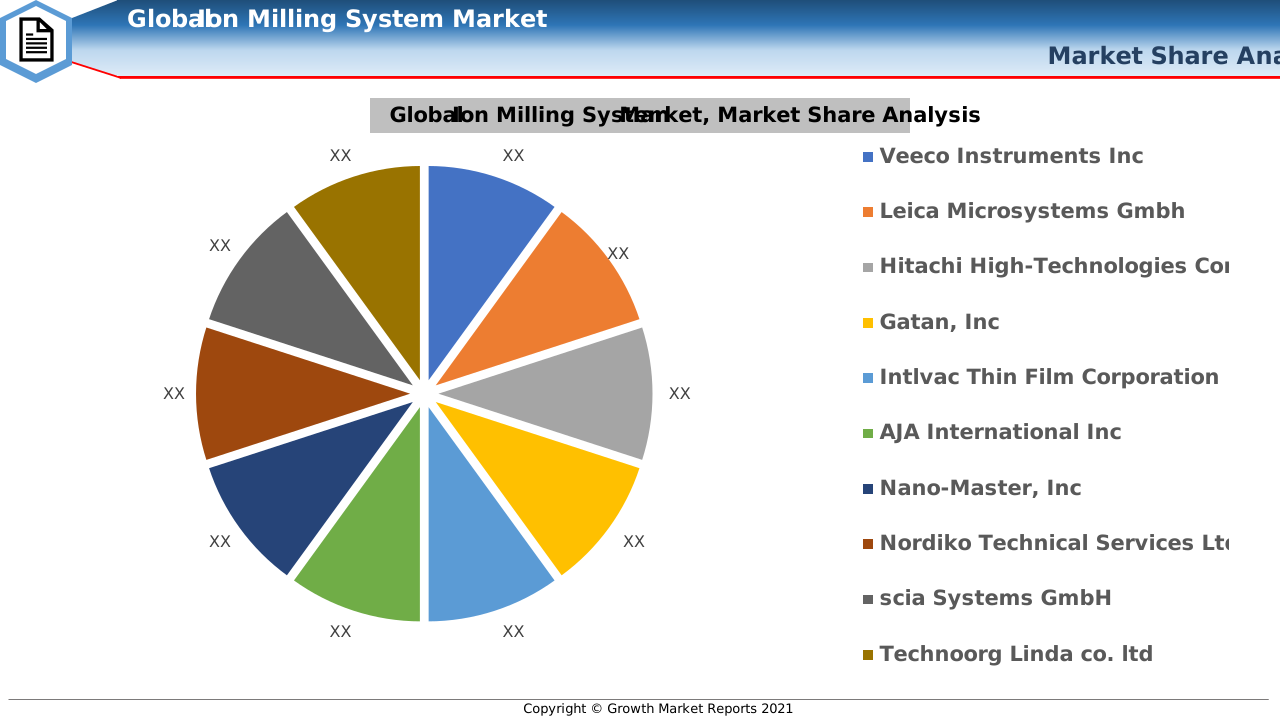
The players include Veeco Instruments Inc., Leica Microsystems Gmbh, Hitachi High-Technologies Corporation, Gatan, Inc., Intlvac Thin Film Corporation, AJA International Inc., Nano-Master, Inc., Nordiko Technical Services Ltd., scia Systems GmbH, and Technoorg Linda co. ltd. To develop and introduce new technologies into the market, these businesses are increasingly conducting product launches and innovations; agreements, contracts, and partnerships, and acquisitions.

Ion Milling System Market Share

Frequently Asked Questions

Yes, the Ion Milling System market research report offers customization options to address specific requirements regarding product type, application, end-user, and regional analysis.

Challenges include the high initial cost of advanced systems, need for specialized training, competition from alternative sample preparation methods like FIB and mechanical polishing, and the complexity of integrating new technologies.

Technological advancements such as automation, digital controls, integration with AI and IoT, and the development of energy-efficient and eco-friendly systems are enhancing performance, usability, and sustainability.

Major players include Hitachi High-Technologies Corporation, Veeco Instruments Inc., Leica Microsystems, JEOL Ltd., Gatan Inc. (Ametek), FEI Company (Thermo Fisher Scientific), and Carl Zeiss AG, among others.

Key growth drivers include the surge in semiconductor manufacturing, miniaturization of electronic devices, advancements in analytical techniques like SEM and TEM, and the increasing need for precise sample preparation.

Asia Pacific leads the market, accounting for about 42% of the global value in 2024, followed by North America and Europe. Emerging markets in Latin America and the Middle East & Africa are also experiencing growth.

The market is segmented into Tabletop Ion Milling Systems, which are compact and cost-effective for research and academic use, and Floor-standing Ion Milling Systems, which offer higher throughput and are ideal for industrial applications.

Ion milling systems are widely used in semiconductor manufacturing, electronics, life sciences, material science, aerospace, automotive, and energy storage industries for precision sample preparation and analysis.

The Ion Milling System market is expected to grow at a CAGR of 7.1% from 2025 to 2033, reaching an estimated value of USD 2.08 billion by 2033.

As of 2024, the global Ion Milling System market size reached USD 1.12 billion, with strong growth driven by advancements in materials science and semiconductor manufacturing.

Table Of Content

Chapter 1 Executive Summary
Chapter 2 Assumptions and Acronyms Used
Chapter 3 Research Methodology
Chapter 4 Ion Milling System Market Overview
   4.1 Introduction
      4.1.1 Market Taxonomy
      4.1.2 Market Definition
      4.1.3 Macro-Economic Factors Impacting the Market Growth
   4.2 Ion Milling System Market Dynamics
      4.2.1 Market Drivers
      4.2.2 Market Restraints
      4.2.3 Market Opportunity
   4.3 Ion Milling System Market - Supply Chain Analysis
      4.3.1 List of Key Suppliers
      4.3.2 List of Key Distributors
      4.3.3 List of Key Consumers
   4.4 Key Forces Shaping the Ion Milling System Market
      4.4.1 Bargaining Power of Suppliers
      4.4.2 Bargaining Power of Buyers
      4.4.3 Threat of Substitution
      4.4.4 Threat of New Entrants
      4.4.5 Competitive Rivalry
   4.5 Global Ion Milling System Market Size & Forecast, 2023-2032
      4.5.1 Ion Milling System Market Size and Y-o-Y Growth
      4.5.2 Ion Milling System Market Absolute $ Opportunity

Chapter 5 Global Ion Milling System Market Analysis and Forecast By Product Type
   5.1 Introduction
      5.1.1 Key Market Trends & Growth Opportunities By Product Type
      5.1.2 Basis Point Share (BPS) Analysis By Product Type
      5.1.3 Absolute $ Opportunity Assessment By Product Type
   5.2 Ion Milling System Market Size Forecast By Product Type
      5.2.1 Tabletop Ion Milling Systems
      5.2.2 Floor-standing Ion Milling Systems
   5.3 Market Attractiveness Analysis By Product Type

Chapter 6 Global Ion Milling System Market Analysis and Forecast By Application
   6.1 Introduction
      6.1.1 Key Market Trends & Growth Opportunities By Application
      6.1.2 Basis Point Share (BPS) Analysis By Application
      6.1.3 Absolute $ Opportunity Assessment By Application
   6.2 Ion Milling System Market Size Forecast By Application
      6.2.1 Semiconductor
      6.2.2 Material Science
      6.2.3 Life Sciences
      6.2.4 Electronics
      6.2.5 Others
   6.3 Market Attractiveness Analysis By Application

Chapter 7 Global Ion Milling System Market Analysis and Forecast By End-User
   7.1 Introduction
      7.1.1 Key Market Trends & Growth Opportunities By End-User
      7.1.2 Basis Point Share (BPS) Analysis By End-User
      7.1.3 Absolute $ Opportunity Assessment By End-User
   7.2 Ion Milling System Market Size Forecast By End-User
      7.2.1 Academic & Research Institutes
      7.2.2 Industrial
      7.2.3 Others
   7.3 Market Attractiveness Analysis By End-User

Chapter 8 Global Ion Milling System Market Analysis and Forecast by Region
   8.1 Introduction
      8.1.1 Key Market Trends & Growth Opportunities By Region
      8.1.2 Basis Point Share (BPS) Analysis By Region
      8.1.3 Absolute $ Opportunity Assessment By Region
   8.2 Ion Milling System Market Size Forecast By Region
      8.2.1 North America
      8.2.2 Europe
      8.2.3 Asia Pacific
      8.2.4 Latin America
      8.2.5 Middle East & Africa (MEA)
   8.3 Market Attractiveness Analysis By Region

Chapter 9 Coronavirus Disease (COVID-19) Impact 
   9.1 Introduction 
   9.2 Current & Future Impact Analysis 
   9.3 Economic Impact Analysis 
   9.4 Government Policies 
   9.5 Investment Scenario

Chapter 10 North America Ion Milling System Analysis and Forecast
   10.1 Introduction
   10.2 North America Ion Milling System Market Size Forecast by Country
      10.2.1 U.S.
      10.2.2 Canada
   10.3 Basis Point Share (BPS) Analysis by Country
   10.4 Absolute $ Opportunity Assessment by Country
   10.5 Market Attractiveness Analysis by Country
   10.6 North America Ion Milling System Market Size Forecast By Product Type
      10.6.1 Tabletop Ion Milling Systems
      10.6.2 Floor-standing Ion Milling Systems
   10.7 Basis Point Share (BPS) Analysis By Product Type 
   10.8 Absolute $ Opportunity Assessment By Product Type 
   10.9 Market Attractiveness Analysis By Product Type
   10.10 North America Ion Milling System Market Size Forecast By Application
      10.10.1 Semiconductor
      10.10.2 Material Science
      10.10.3 Life Sciences
      10.10.4 Electronics
      10.10.5 Others
   10.11 Basis Point Share (BPS) Analysis By Application 
   10.12 Absolute $ Opportunity Assessment By Application 
   10.13 Market Attractiveness Analysis By Application
   10.14 North America Ion Milling System Market Size Forecast By End-User
      10.14.1 Academic & Research Institutes
      10.14.2 Industrial
      10.14.3 Others
   10.15 Basis Point Share (BPS) Analysis By End-User 
   10.16 Absolute $ Opportunity Assessment By End-User 
   10.17 Market Attractiveness Analysis By End-User

Chapter 11 Europe Ion Milling System Analysis and Forecast
   11.1 Introduction
   11.2 Europe Ion Milling System Market Size Forecast by Country
      11.2.1 Germany
      11.2.2 France
      11.2.3 Italy
      11.2.4 U.K.
      11.2.5 Spain
      11.2.6 Russia
      11.2.7 Rest of Europe
   11.3 Basis Point Share (BPS) Analysis by Country
   11.4 Absolute $ Opportunity Assessment by Country
   11.5 Market Attractiveness Analysis by Country
   11.6 Europe Ion Milling System Market Size Forecast By Product Type
      11.6.1 Tabletop Ion Milling Systems
      11.6.2 Floor-standing Ion Milling Systems
   11.7 Basis Point Share (BPS) Analysis By Product Type 
   11.8 Absolute $ Opportunity Assessment By Product Type 
   11.9 Market Attractiveness Analysis By Product Type
   11.10 Europe Ion Milling System Market Size Forecast By Application
      11.10.1 Semiconductor
      11.10.2 Material Science
      11.10.3 Life Sciences
      11.10.4 Electronics
      11.10.5 Others
   11.11 Basis Point Share (BPS) Analysis By Application 
   11.12 Absolute $ Opportunity Assessment By Application 
   11.13 Market Attractiveness Analysis By Application
   11.14 Europe Ion Milling System Market Size Forecast By End-User
      11.14.1 Academic & Research Institutes
      11.14.2 Industrial
      11.14.3 Others
   11.15 Basis Point Share (BPS) Analysis By End-User 
   11.16 Absolute $ Opportunity Assessment By End-User 
   11.17 Market Attractiveness Analysis By End-User

Chapter 12 Asia Pacific Ion Milling System Analysis and Forecast
   12.1 Introduction
   12.2 Asia Pacific Ion Milling System Market Size Forecast by Country
      12.2.1 China
      12.2.2 Japan
      12.2.3 South Korea
      12.2.4 India
      12.2.5 Australia
      12.2.6 South East Asia (SEA)
      12.2.7 Rest of Asia Pacific (APAC)
   12.3 Basis Point Share (BPS) Analysis by Country
   12.4 Absolute $ Opportunity Assessment by Country
   12.5 Market Attractiveness Analysis by Country
   12.6 Asia Pacific Ion Milling System Market Size Forecast By Product Type
      12.6.1 Tabletop Ion Milling Systems
      12.6.2 Floor-standing Ion Milling Systems
   12.7 Basis Point Share (BPS) Analysis By Product Type 
   12.8 Absolute $ Opportunity Assessment By Product Type 
   12.9 Market Attractiveness Analysis By Product Type
   12.10 Asia Pacific Ion Milling System Market Size Forecast By Application
      12.10.1 Semiconductor
      12.10.2 Material Science
      12.10.3 Life Sciences
      12.10.4 Electronics
      12.10.5 Others
   12.11 Basis Point Share (BPS) Analysis By Application 
   12.12 Absolute $ Opportunity Assessment By Application 
   12.13 Market Attractiveness Analysis By Application
   12.14 Asia Pacific Ion Milling System Market Size Forecast By End-User
      12.14.1 Academic & Research Institutes
      12.14.2 Industrial
      12.14.3 Others
   12.15 Basis Point Share (BPS) Analysis By End-User 
   12.16 Absolute $ Opportunity Assessment By End-User 
   12.17 Market Attractiveness Analysis By End-User

Chapter 13 Latin America Ion Milling System Analysis and Forecast
   13.1 Introduction
   13.2 Latin America Ion Milling System Market Size Forecast by Country
      13.2.1 Brazil
      13.2.2 Mexico
      13.2.3 Rest of Latin America (LATAM)
   13.3 Basis Point Share (BPS) Analysis by Country
   13.4 Absolute $ Opportunity Assessment by Country
   13.5 Market Attractiveness Analysis by Country
   13.6 Latin America Ion Milling System Market Size Forecast By Product Type
      13.6.1 Tabletop Ion Milling Systems
      13.6.2 Floor-standing Ion Milling Systems
   13.7 Basis Point Share (BPS) Analysis By Product Type 
   13.8 Absolute $ Opportunity Assessment By Product Type 
   13.9 Market Attractiveness Analysis By Product Type
   13.10 Latin America Ion Milling System Market Size Forecast By Application
      13.10.1 Semiconductor
      13.10.2 Material Science
      13.10.3 Life Sciences
      13.10.4 Electronics
      13.10.5 Others
   13.11 Basis Point Share (BPS) Analysis By Application 
   13.12 Absolute $ Opportunity Assessment By Application 
   13.13 Market Attractiveness Analysis By Application
   13.14 Latin America Ion Milling System Market Size Forecast By End-User
      13.14.1 Academic & Research Institutes
      13.14.2 Industrial
      13.14.3 Others
   13.15 Basis Point Share (BPS) Analysis By End-User 
   13.16 Absolute $ Opportunity Assessment By End-User 
   13.17 Market Attractiveness Analysis By End-User

Chapter 14 Middle East & Africa (MEA) Ion Milling System Analysis and Forecast
   14.1 Introduction
   14.2 Middle East & Africa (MEA) Ion Milling System Market Size Forecast by Country
      14.2.1 Saudi Arabia
      14.2.2 South Africa
      14.2.3 UAE
      14.2.4 Rest of Middle East & Africa (MEA)
   14.3 Basis Point Share (BPS) Analysis by Country
   14.4 Absolute $ Opportunity Assessment by Country
   14.5 Market Attractiveness Analysis by Country
   14.6 Middle East & Africa (MEA) Ion Milling System Market Size Forecast By Product Type
      14.6.1 Tabletop Ion Milling Systems
      14.6.2 Floor-standing Ion Milling Systems
   14.7 Basis Point Share (BPS) Analysis By Product Type 
   14.8 Absolute $ Opportunity Assessment By Product Type 
   14.9 Market Attractiveness Analysis By Product Type
   14.10 Middle East & Africa (MEA) Ion Milling System Market Size Forecast By Application
      14.10.1 Semiconductor
      14.10.2 Material Science
      14.10.3 Life Sciences
      14.10.4 Electronics
      14.10.5 Others
   14.11 Basis Point Share (BPS) Analysis By Application 
   14.12 Absolute $ Opportunity Assessment By Application 
   14.13 Market Attractiveness Analysis By Application
   14.14 Middle East & Africa (MEA) Ion Milling System Market Size Forecast By End-User
      14.14.1 Academic & Research Institutes
      14.14.2 Industrial
      14.14.3 Others
   14.15 Basis Point Share (BPS) Analysis By End-User 
   14.16 Absolute $ Opportunity Assessment By End-User 
   14.17 Market Attractiveness Analysis By End-User

Chapter 15 Competition Landscape 
   15.1 Ion Milling System Market: Competitive Dashboard
   15.2 Global Ion Milling System Market: Market Share Analysis, 2023
   15.3 Company Profiles (Details – Overview, Financials, Developments, Strategy) 
      15.3.1 Hitachi High-Technologies Corporation
Veeco Instruments Inc.
Leica Microsystems (Danaher Corporation)
JEOL Ltd.
FEI Company (Thermo Fisher Scientific)
Carl Zeiss AG
Intlvac Thin Film
Scia Systems GmbH
Oxford Instruments plc
ULVAC Technologies, Inc.
Gatan, Inc.
AJA International, Inc.
Plasma-Therm
Technoorg Linda Co. Ltd.
Henniker Plasma
Raith GmbH
Kaufman & Robinson, Inc.
Seki Diamond Systems
Nano-Master, Inc.
South Bay Technology, Inc.

Methodology

Our Clients

Microsoft
The John Holland Group
Siemens Healthcare
Honda Motor Co. Ltd.
General Mills
Dassault Aviation
sinopec
FedEx Logistics