Segments - by Product Type (Fixed, Portable), by Technology (Infrared, Resistive, Capacitive, Electromagnetic, Others), by Screen Size (Up to 69 Inch, 70–90 Inch, Above 90 Inch), by End-User (Education, Corporate, Government, Others)
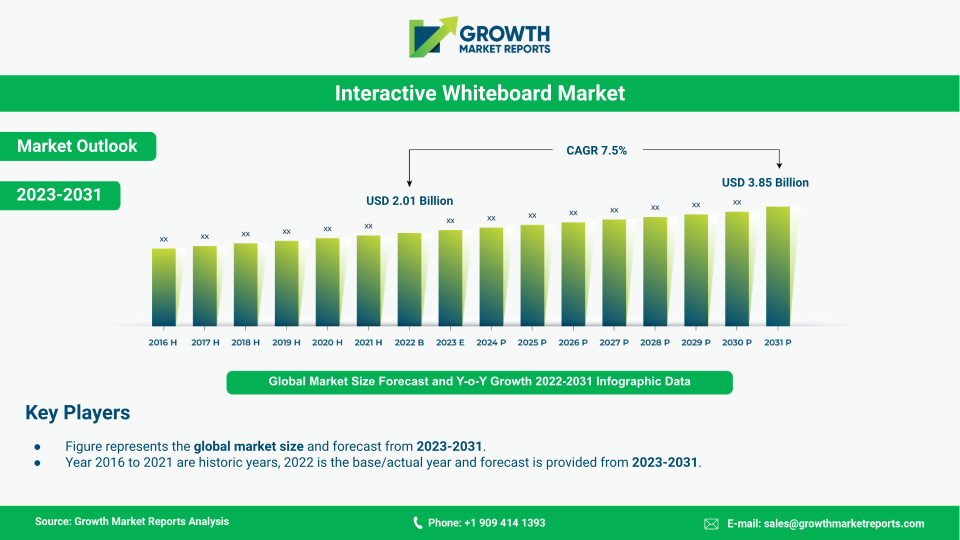
According to our latest research, the global interactive whiteboard market size reached USD 2.08 billion in 2024, with a robust year-on-year growth driven by the accelerating adoption of digital learning solutions and collaborative business environments. The market is projected to expand at a CAGR of 7.3% from 2025 to 2033, reaching an estimated USD 3.94 billion by 2033. This impressive growth trajectory is fueled by increasing investments in EdTech, rising demand for interactive and engaging presentation tools in corporate settings, and the ongoing digital transformation initiatives across educational and governmental institutions worldwide.
A significant growth factor for the interactive whiteboard market is the rapid digitalization of the education sector. Schools, colleges, and universities are increasingly integrating advanced technologies into their teaching methodologies to enhance learning outcomes and student engagement. Interactive whiteboards offer dynamic content delivery, real-time collaboration, and seamless integration with various educational software platforms, making them indispensable in modern classrooms. The global push toward blended and remote learning, particularly in the aftermath of the COVID-19 pandemic, has further accelerated the adoption of interactive whiteboards, as educators seek versatile tools that support both in-person and virtual instruction. Additionally, government initiatives aimed at upgrading educational infrastructure, especially in emerging economies, are providing a substantial boost to market growth.
Another key driver is the rising demand from the corporate sector, where interactive whiteboards are revolutionizing meeting rooms, boardrooms, and collaborative workspaces. Businesses are increasingly recognizing the value of interactive whiteboards in facilitating brainstorming sessions, data visualization, and project management. The ability to annotate, share, and save meeting notes in real time enhances productivity and fosters innovation. Moreover, the integration of interactive whiteboards with video conferencing systems and cloud-based platforms has become a strategic imperative for organizations aiming to support hybrid work models. As companies invest in digital transformation to remain competitive, the adoption of interactive whiteboards is expected to witness sustained momentum.
Technological advancements in display technologies and user interfaces are also propelling the interactive whiteboard market forward. Modern interactive whiteboards feature high-resolution touchscreens, multi-touch capabilities, and compatibility with a wide range of input devices, including styluses and mobile devices. Innovations such as gesture recognition, wireless connectivity, and AI-powered features are enhancing user experience and expanding the application scope of interactive whiteboards. These advancements are not only driving replacement demand in developed markets but also making interactive whiteboards more accessible and affordable for institutions in developing regions.
From a regional perspective, Asia Pacific is emerging as the fastest-growing market for interactive whiteboards, supported by substantial investments in educational technology and government-led digital literacy programs. North America remains the largest market, benefiting from early adoption and continuous innovation, while Europe is witnessing steady growth due to increasing corporate and government spending on digital infrastructure. Latin America and the Middle East & Africa are also showing promising growth potential, driven by efforts to modernize educational and corporate environments. Each region presents unique opportunities and challenges, influencing the overall dynamics of the global interactive whiteboard market.
The interactive whiteboard market is segmented by product type into fixed and portable interactive whiteboards, each addressing distinct user needs and deployment scenarios. Fixed interactive whiteboards, which are permanently installed in classrooms, boardrooms, or conference halls, continue to dominate the market due to their stability, large screen sizes, and suitability for high-traffic environments. These systems are favored in educational institutions and large enterprises where frequent, robust, and collaborative sessions are essential. The durability and integration capabilities of fixed whiteboards make them a long-term investment, especially in settings where space and infrastructure support permanent installations. As educational and corporate budgets allocate more resources to digital transformation, the demand for fixed interactive whiteboards is expected to remain strong.
On the other hand, portable interactive whiteboards are gaining traction among users who require flexibility and mobility. These devices are designed to be lightweight and easy to set up, making them ideal for small businesses, remote teams, and educational environments where space or budget constraints preclude permanent installations. Portable whiteboards are particularly popular in training sessions, workshops, and temporary project sites. Their plug-and-play functionality and wireless connectivity options enable seamless collaboration across different locations. The rising trend of hybrid work and learning models is further fueling the adoption of portable interactive whiteboards, as organizations and institutions seek tools that can adapt to changing needs and environments.
The competitive landscape for both fixed and portable interactive whiteboards is characterized by continuous innovation. Manufacturers are focusing on enhancing the user experience through features like multi-touch support, gesture recognition, and integration with popular collaboration platforms. In the fixed segment, advancements in display technology and interactive software are driving replacement demand, as users seek to upgrade older systems with more advanced capabilities. In the portable segment, battery life, connectivity, and ease of transportation are key differentiators. The convergence of hardware and software solutions is also evident, with vendors offering bundled packages that include interactive whiteboards, software licenses, and technical support to provide a comprehensive user experience.
Market trends indicate a growing preference for hybrid solutions that combine the strengths of both fixed and portable interactive whiteboards. For example, modular systems that can be easily disassembled and reinstalled in different locations are gaining popularity among organizations with multiple offices or campuses. Additionally, cloud-based management and remote troubleshooting capabilities are being integrated into both product types, enabling IT administrators to monitor and manage devices across distributed environments. As user expectations evolve, the ability to offer flexible, scalable, and user-friendly solutions will be a key success factor for manufacturers in the interactive whiteboard market.
| Attributes | Details |
| Report Title | Interactive Whiteboard Market Research Report 2033 |
| By Product Type | Fixed, Portable |
| By Technology | Infrared, Resistive, Capacitive, Electromagnetic, Others |
| By Screen Size | Up to 69 Inch, 70–90 Inch, Above 90 Inch |
| By End-User | Education, Corporate, Government, Others |
| Regions Covered | North America, Europe, APAC, Latin America, MEA |
| Countries Covered | North America (United States, Canada), Europe (Germany, France, Italy, United Kingdom, Spain, Russia, Rest of Europe), Asia Pacific (China, Japan, South Korea, India, Australia, South East Asia (SEA), Rest of Asia Pacific), Latin America (Mexico, Brazil, Rest of Latin America), Middle East & Africa (Saudi Arabia, South Africa, United Arab Emirates, Rest of Middle East & Africa) |
| Base Year | 2024 |
| Historic Data | 2018-2023 |
| Forecast Period | 2025-2033 |
| Number of Pages | 268 |
| Number of Tables & Figures | 272 |
| Customization Available | Yes, the report can be customized as per your need. |
The interactive whiteboard market is segmented by technology into infrared, resistive, capacitive, electromagnetic, and other emerging technologies. Infrared technology remains the most widely adopted due to its cost-effectiveness, durability, and compatibility with a variety of input devices. Infrared interactive whiteboards use an array of sensors to detect touch or stylus input, offering reliable performance in both educational and corporate settings. Their ability to support multi-touch functionality and large screen sizes makes them particularly suitable for collaborative environments. As price-sensitive markets in Asia Pacific and Latin America continue to expand, infrared technology is expected to maintain its dominant position.
Resistive and capacitive technologies offer distinct advantages in terms of touch accuracy and responsiveness. Resistive interactive whiteboards, which rely on pressure-sensitive layers, are valued for their affordability and resistance to accidental touches. They are commonly used in budget-conscious educational institutions and small businesses. Capacitive technology, on the other hand, provides superior touch sensitivity and supports advanced gestures, making it ideal for high-end corporate applications and premium educational environments. The growing demand for intuitive and natural user interfaces is driving the adoption of capacitive interactive whiteboards, particularly in developed markets where user experience is a key differentiator.
Electromagnetic technology is favored in applications that require precise handwriting recognition and stylus support. These interactive whiteboards use a grid of wires embedded in the screen to detect the position of a specialized pen, enabling detailed annotations and drawing. Electromagnetic systems are widely used in design studios, engineering classrooms, and other environments where precision is critical. While they tend to be more expensive than other technologies, their unique capabilities justify the investment for users with specialized needs. Manufacturers are continuously refining electromagnetic technology to enhance accuracy, reduce latency, and support a broader range of stylus types.
Emerging technologies, such as optical and ultrasonic interactive whiteboards, are also making inroads into the market. These solutions leverage advanced sensors and image processing algorithms to deliver touch and gesture recognition with minimal hardware requirements. Optical and ultrasonic whiteboards are particularly attractive for portable and retrofit applications, as they can be easily installed on existing surfaces. As the market evolves, the convergence of multiple technologies within a single device is becoming more common, enabling users to benefit from the strengths of each approach. The ongoing innovation in interactive whiteboard technology is expected to drive further market growth and diversification.
Screen size is a critical factor influencing the adoption and application of interactive whiteboards, with the market segmented into up to 69 inch, 70–90 inch, and above 90 inch categories. The up to 69 inch segment is particularly popular in small classrooms, meeting rooms, and training centers where space constraints and budget limitations are significant considerations. These compact interactive whiteboards offer sufficient surface area for most collaborative tasks while remaining affordable and easy to install. They are favored by small and medium-sized enterprises (SMEs) and educational institutions with limited resources, driving steady demand in this segment.
The 70–90 inch segment represents the largest share of the interactive whiteboard market, as it strikes a balance between screen real estate and installation flexibility. These mid-sized interactive whiteboards are widely used in standard classrooms, corporate boardrooms, and conference centers, where they facilitate group collaboration, interactive presentations, and multimedia content delivery. The ability to display detailed visuals and accommodate multiple users simultaneously makes 70–90 inch whiteboards the preferred choice for a broad range of applications. Manufacturers are focusing on enhancing the resolution, brightness, and touch response of these devices to meet the evolving expectations of users in both educational and corporate settings.
Above 90 inch interactive whiteboards cater to specialized environments that require large-scale collaboration and immersive experiences. These oversized whiteboards are commonly installed in lecture halls, auditoriums, and innovation labs, where they support interactive lectures, workshops, and design sessions. The demand for above 90 inch whiteboards is driven by institutions and organizations that prioritize high-impact visual communication and large-group engagement. While these systems represent a smaller share of the overall market, their high value and advanced features contribute significantly to revenue growth, particularly in developed regions with substantial investments in digital infrastructure.
Trends in screen size preferences are also influenced by advancements in display technology, such as ultra-high-definition (UHD) resolution, slim bezels, and energy-efficient backlighting. Users are increasingly seeking interactive whiteboards that offer superior image quality, wide viewing angles, and compatibility with various input sources. As prices for large-format displays continue to decline, the adoption of larger interactive whiteboards is expected to increase, particularly in sectors that require impactful visual communication. Manufacturers are responding by expanding their product portfolios to include a wider range of screen sizes and feature sets, ensuring that customers can find solutions tailored to their specific needs.
The interactive whiteboard market is segmented by end-user into education, corporate, government, and others, with each segment exhibiting distinct adoption patterns and growth drivers. The education sector remains the largest and most influential end-user, accounting for a significant share of global demand. Interactive whiteboards are transforming teaching and learning by enabling dynamic content delivery, real-time collaboration, and interactive assessments. Schools, colleges, and universities are leveraging these tools to foster student engagement, support diverse learning styles, and facilitate blended and remote instruction. The ongoing digital transformation of the education sector, coupled with government initiatives to modernize classrooms, is expected to sustain strong growth in this segment.
In the corporate sector, interactive whiteboards are becoming essential tools for enhancing productivity, creativity, and collaboration. Businesses are integrating interactive whiteboards into meeting rooms, huddle spaces, and training centers to facilitate brainstorming sessions, project management, and remote collaboration. The shift toward hybrid work models and the increasing reliance on digital communication platforms are driving demand for interactive whiteboards that support seamless integration with video conferencing systems and cloud-based collaboration tools. As organizations prioritize agility and innovation, the adoption of interactive whiteboards in the corporate sector is poised for continued expansion.
Government agencies and public sector organizations are also adopting interactive whiteboards to improve communication, training, and decision-making processes. Interactive whiteboards are being used in command centers, emergency response facilities, and policy planning sessions to visualize data, share information, and coordinate activities. The ability to display real-time information and facilitate collaborative problem-solving makes interactive whiteboards valuable assets in government settings. As public sector organizations invest in digital infrastructure and smart city initiatives, the demand for interactive whiteboards is expected to grow steadily.
Other end-users, including healthcare providers, non-profit organizations, and creative studios, are increasingly recognizing the value of interactive whiteboards for communication, training, and ideation. In healthcare, interactive whiteboards are used for patient education, medical training, and collaborative care planning. Creative professionals leverage these tools for design thinking, prototyping, and visual storytelling. The versatility and adaptability of interactive whiteboards are driving adoption across a diverse range of industries, contributing to the overall growth and diversification of the market.
The interactive whiteboard market presents a wealth of opportunities driven by ongoing digital transformation initiatives across education, corporate, and government sectors. The increasing integration of artificial intelligence, cloud computing, and advanced analytics into interactive whiteboards is opening new avenues for personalized learning, real-time collaboration, and data-driven decision-making. Educational institutions are exploring adaptive learning platforms that leverage interactive whiteboards to deliver customized content and track student progress. In the corporate sector, the convergence of interactive whiteboards with unified communication systems is enabling seamless collaboration across geographically dispersed teams. The growing emphasis on hybrid and remote work models is expected to drive further innovation and adoption, creating significant growth opportunities for manufacturers and solution providers.
Another major opportunity lies in the expansion of interactive whiteboard adoption in emerging markets, particularly in Asia Pacific, Latin America, and the Middle East & Africa. Governments in these regions are investing heavily in digital infrastructure and educational technology to enhance literacy rates, workforce skills, and economic competitiveness. The availability of affordable interactive whiteboard solutions, coupled with localized content and language support, is facilitating widespread adoption in schools, universities, and training centers. Manufacturers that can address the unique needs of these markets, such as low power consumption, rugged design, and multilingual support, are well-positioned to capitalize on the growing demand.
Despite the promising outlook, the interactive whiteboard market faces several restraining factors, with high initial costs and budget constraints being the most prominent. Many educational institutions and small businesses, particularly in developing regions, struggle to justify the upfront investment required for interactive whiteboard systems, especially when compared to traditional whiteboards or lower-cost digital alternatives. Additionally, the need for ongoing maintenance, technical support, and teacher training can further strain limited budgets. Market penetration may also be hindered by resistance to change, lack of digital literacy, and concerns about data privacy and security. Overcoming these challenges will require concerted efforts from manufacturers, policymakers, and educational leaders to demonstrate the long-term value and return on investment of interactive whiteboard solutions.
North America remains the largest market for interactive whiteboards, accounting for approximately USD 780 million in 2024. The region’s dominance is attributed to early adoption of EdTech solutions, high levels of digital literacy, and significant investments in educational and corporate infrastructure. The United States, in particular, leads the market with widespread deployment of interactive whiteboards in K-12 schools, higher education institutions, and Fortune 500 companies. The presence of leading technology providers and a robust ecosystem of software and content developers further strengthens North America’s position as a global innovation hub for interactive whiteboard solutions.
Asia Pacific is the fastest-growing region, with a projected CAGR of 9.1% through 2033. The market size for Asia Pacific reached USD 540 million in 2024, driven by rapid urbanization, expanding middle-class populations, and government-led digital literacy programs. Countries such as China, India, Japan, and South Korea are at the forefront of EdTech adoption, with large-scale investments in smart classrooms and digital learning platforms. The corporate sector in Asia Pacific is also embracing interactive whiteboards to support agile work environments and cross-border collaboration. As educational and business ecosystems continue to evolve, Asia Pacific is expected to play a pivotal role in shaping the future of the global interactive whiteboard market.
Europe holds a significant share of the interactive whiteboard market, with a market size of USD 480 million in 2024. The region benefits from strong government support for digital education, high levels of technology adoption, and a well-established network of research and innovation centers. The United Kingdom, Germany, and France are leading markets within Europe, with interactive whiteboards widely deployed in schools, universities, and corporate offices. Latin America and the Middle East & Africa collectively account for around USD 280 million in 2024, with growth driven by initiatives to modernize educational infrastructure and improve digital skills. While these regions face unique challenges related to affordability and connectivity, they offer substantial long-term growth potential as digital transformation accelerates.
The competitive landscape of the interactive whiteboard market is characterized by intense rivalry among global and regional players, each striving to differentiate their offerings through technological innovation, product quality, and customer support. Leading companies are investing heavily in research and development to enhance the performance, usability, and connectivity of their interactive whiteboard solutions. Strategic partnerships with software developers, educational institutions, and corporate clients are common, as vendors seek to deliver integrated solutions that address the evolving needs of end-users. The market is also witnessing a wave of mergers and acquisitions, as companies aim to expand their product portfolios, enter new markets, and strengthen their competitive positions.
Product innovation is a key focus area, with manufacturers introducing advanced features such as 4K resolution, multi-touch support, gesture recognition, and AI-powered analytics. The integration of interactive whiteboards with cloud-based collaboration platforms, learning management systems, and video conferencing tools is becoming increasingly important, as users demand seamless interoperability and remote access capabilities. Companies are also prioritizing user experience, offering intuitive interfaces, customizable settings, and robust technical support to ensure customer satisfaction. The ability to provide tailored solutions for specific industries, such as education, healthcare, and corporate, is emerging as a critical success factor in the competitive landscape.
Pricing strategies vary widely across the market, with premium brands targeting high-end customers through feature-rich, high-performance interactive whiteboards, while value-oriented players focus on affordability and ease of deployment. The growing demand for portable and modular solutions is opening new opportunities for niche players and startups, who can offer flexible, cost-effective alternatives to traditional fixed installations. As the market matures, competition is expected to intensify, with differentiation increasingly based on software capabilities, service quality, and ecosystem integration rather than hardware alone.
Major companies in the interactive whiteboard market include SMART Technologies, Promethean World, Hitachi, Panasonic, BenQ, ViewSonic, LG Electronics, Sharp Corporation, Samsung Electronics, and Ricoh. SMART Technologies is recognized for its pioneering role in the development of interactive whiteboard technology and its comprehensive suite of education-focused solutions. Promethean World is known for its innovative hardware and software offerings, catering to both educational and corporate clients. Hitachi and Panasonic leverage their expertise in display technology to deliver high-quality, reliable interactive whiteboards for diverse applications. BenQ, ViewSonic, and LG Electronics are expanding their market presence through a combination of product innovation, competitive pricing, and strong distribution networks. Sharp Corporation, Samsung Electronics, and Ricoh are leveraging their global reach and technological capabilities to offer integrated solutions that address the needs of modern classrooms and collaborative workspaces.
These leading players are continuously enhancing their product portfolios through the introduction of new models, software updates, and value-added services. They are also expanding their geographic footprint through partnerships, acquisitions, and investments in local sales and support infrastructure. As the interactive whiteboard market evolves, the ability to anticipate customer needs, deliver innovative solutions, and provide exceptional service will be crucial for sustained success and market leadership.
The Interactive Whiteboard market has been segmented on the basis of
Major players competing in the global interactive whiteboard market share include Microsoft Corporation, BenQ Corporation; Cisco Systems, Inc.; Boxlight Corporation; and Google Inc.
Some of these businesses are involved in adopting numerous market strategies such as merger, acquisition, collaboration, partnership, product launch, R&D activities, and capacity expansion to increase market share and global presence.
Recently, Boxlight Corp. announced the acquisition of EOSEDU, LLC. The former company aimed at expanding its operation in the education technology market through this acquisition deal.
Key players include SMART Technologies, Promethean World, Hitachi, Panasonic, BenQ, ViewSonic, LG Electronics, Sharp Corporation, Samsung Electronics, and Ricoh.
Challenges include high initial costs, budget constraints, need for ongoing maintenance and training, resistance to change, and concerns over data privacy and security.
Major end-users include educational institutions, corporate organizations, government agencies, and sectors like healthcare and creative industries.
Screen size segments include up to 69 inch, 70–90 inch, and above 90 inch. The 70–90 inch segment is most popular for classrooms and boardrooms, while larger sizes are used in auditoriums and innovation labs.
Interactive whiteboards utilize technologies such as infrared, resistive, capacitive, electromagnetic, and emerging options like optical and ultrasonic for touch and gesture recognition.
The market offers fixed interactive whiteboards, which are permanently installed, and portable interactive whiteboards, which provide flexibility and mobility for various environments.
North America is the largest market due to early adoption and innovation, while Asia Pacific is the fastest-growing region, supported by government-led digital literacy programs and investments in EdTech.
Key growth drivers include the digitalization of education, increased investments in EdTech, rising demand for collaborative tools in corporate settings, and government initiatives to upgrade educational infrastructure.
The interactive whiteboard market is expected to grow at a CAGR of 7.3% from 2025 to 2033, reaching approximately USD 3.94 billion by 2033.
As of 2024, the global interactive whiteboard market size reached USD 2.08 billion, with strong year-on-year growth driven by digital learning and collaborative business environments.