Industrial Control Systems Security Market Report 2034

Industrial Control Systems Security Market Report 2034

Segments - by Component (Solutions, Services), by Security Type (Network Security, Endpoint Security, Application Security, Database Security), by Deployment Mode (On-Premises, Cloud), by End-User Industry (Energy & Utilities, Manufacturing, Transportation, Oil & Gas, Chemicals, Food & Beverage, Others)

https://growthmarketreports.com/Raksha
Author : Raksha Sharma
https://growthmarketreports.com/Vaibhav
Fact-checked by : V. Chandola
https://growthmarketreports.com/Shruti
Editor : Shruti Bhat

Last Updated : Jun, 2026 | Report ID :ICT-SE-3055 | 4.9 Rating | 75 Reviews | 276 Pages | Format : Docx PDF

Report Description

This report is updated with the latest market data and insights as of June 2026. Base year: 2025  |  Forecast period: 2026-2034


Industrial Control Systems Security Market Outlook

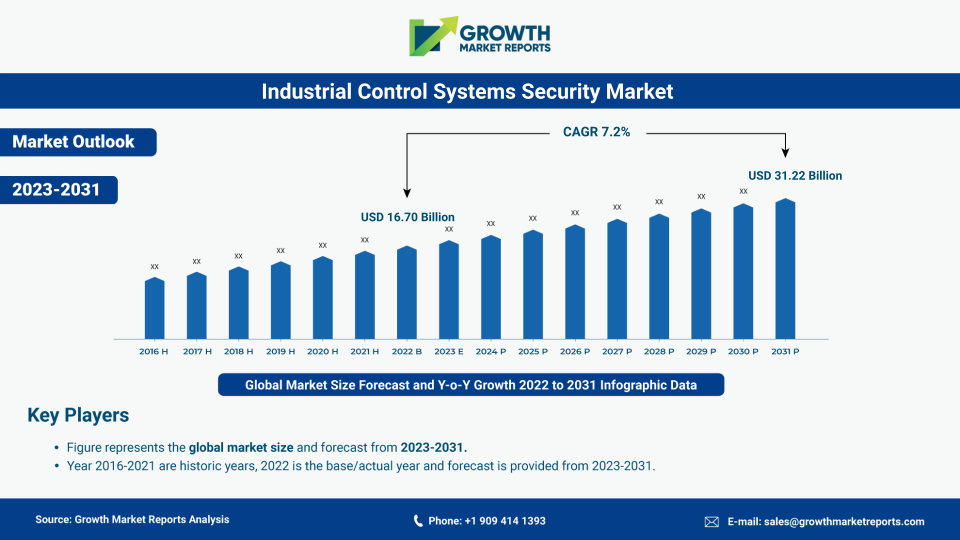
According to our latest research, the global industrial control systems security market size reached USD 23.4 billion in 2025, reflecting the rapidly accelerating demand for robust cybersecurity solutions across the industrial sector. The market is projected to grow at a CAGR of 8.1% from 2026 to 2034, reaching an estimated USD 47.8 billion by 2034. This strong growth trajectory is primarily driven by escalating cyber threats targeting critical infrastructure, the proliferation of connected industrial devices, and increasingly stringent regulatory mandates for operational security. As industries deepen their integration of digital technologies into operational frameworks, the need for comprehensive industrial automation and control system security solutions is becoming paramount to safeguard against evolving cyber risks.

Global Industrial Control Systems Security Market Size Forecast 2025-2034, USD Billion

One of the most significant growth factors for the industrial control systems security market is the increasing frequency and sophistication of cyberattacks targeting industrial environments. With the global maturation of Industry 4.0, industrial control systems (ICS) have become more interconnected and reliant on digital technologies, exposing them to a broader range of threats. High-profile incidents in 2023 and 2024, including ransomware campaigns against energy grids, water utilities, and advanced manufacturing plants, have underscored the critical need for robust ICS security measures. Organizations are prioritizing the deployment of advanced security solutions to protect their operational technology (OT) assets, prevent costly downtime, and ensure the physical safety of critical infrastructure. This heightened awareness and proactive investment culture is fueling sustained demand for ICS security across sectors worldwide.

Another key driver propelling the market is the rapidly evolving regulatory landscape. Governments and regulatory bodies across North America, Europe, and Asia Pacific are enacting stringent cybersecurity standards and compliance requirements for critical infrastructure. The European Union's updated NIS2 Directive, which took full effect in late 2024, significantly broadens the scope of mandatory cybersecurity obligations for industrial operators. In the United States, the Cybersecurity and Infrastructure Security Agency (CISA) has intensified its guidance for ICS operators, and sector-specific regulations continue to raise the compliance bar. These mandates compel organizations to adopt comprehensive security frameworks, conduct regular vulnerability assessments, and maintain continuous monitoring, directly accelerating the adoption of advanced ICS security technologies. The growing convergence of IT and OT environments is also prompting organizations to invest in integrated security strategies that address both domains holistically.

The rapid adoption of Industrial Internet of Things (IIoT) devices and smart automation is further amplifying the need for ICS security. As organizations embrace digital transformation to enhance operational efficiency, the number of connected devices and endpoints in industrial environments has surged to unprecedented levels. While these advancements offer significant productivity and cost benefits, they also introduce new vulnerabilities and expanded attack surfaces. Cybercriminals are actively exploiting these weak points to gain unauthorized access, disrupt operations, and exfiltrate sensitive data. To mitigate these risks, organizations are investing in next-generation security solutions that offer real-time threat detection, automated incident response, and secure remote access for distributed assets. Organizations looking to strengthen their workforce capabilities are also turning to specialized cybersecurity training for industrial control systems to close the critical skills gap that persists across the sector.

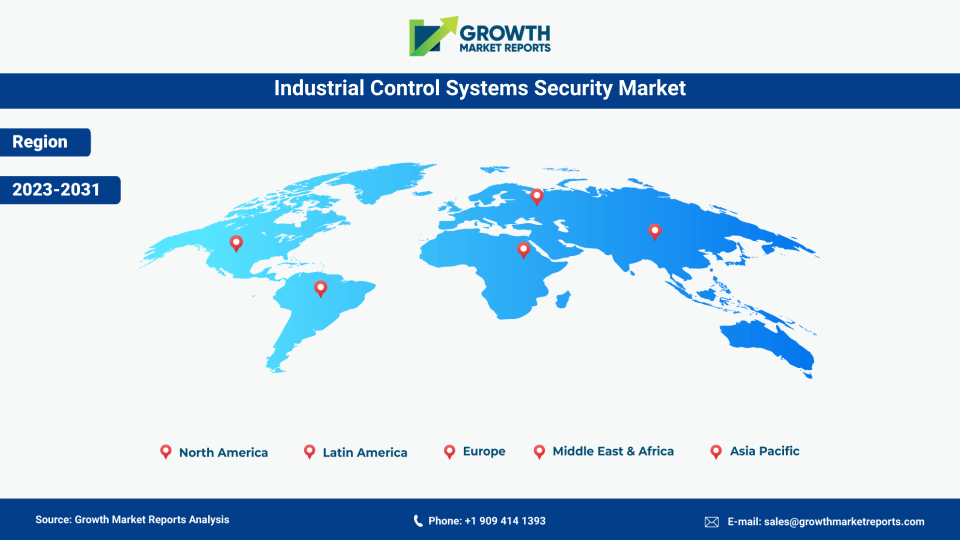
Regionally, North America continues to dominate the industrial control systems security market, accounting for approximately 37.5% of the global market share in 2025, equivalent to roughly USD 8.8 billion. This leadership position is driven by the presence of major industry players, high awareness of cybersecurity threats, and robust regulatory frameworks. Europe follows closely, driven by NIS2 compliance requirements and significant investments in critical infrastructure protection. The Asia Pacific region is the fastest-growing market, fueled by rapid industrialization, increasing automation adoption, and rising cyber threats targeting manufacturing and energy sectors. Latin America and the Middle East and Africa are also witnessing steady growth as governments and organizations prioritize the security of vital industrial assets. The global nature of cyber risks and the interconnectedness of industrial supply chains underscore the importance of a unified approach to ICS security across all regions.

Component Analysis

The industrial control systems security market is segmented by component into solutions and services, each playing a crucial role in safeguarding industrial environments. Solutions encompass a broad array of cybersecurity technologies, including firewalls, intrusion detection and prevention systems, antivirus software, security information and event management (SIEM) platforms, and identity and access management tools. These solutions form the backbone of any ICS security strategy, providing organizations with the capabilities needed to detect, prevent, and respond to cyber threats in real time. As industrial systems grow more complex and interconnected, the demand for advanced and integrated security solutions continues to rise, driving sustained innovation and investment in this segment. The solutions component accounted for approximately 62.5% of total market revenue in 2025.

Industrial Control Systems Security Market Share by Component 2025

The importance of robust SCADA security cannot be overstated in the realm of industrial control systems. SCADA systems are integral to the monitoring and control of industrial processes across energy, water, and manufacturing sectors, making them high-value targets for cyberattacks. Ensuring the security of these systems requires implementing rigorous access controls, encryption, network segmentation, and continuous monitoring to detect and respond to threats before they cause operational harm. As SCADA platforms become more interconnected with enterprise IT networks and cloud services, their attack surface expands considerably, and organizations are investing in advanced purpose-built solutions to maintain integrity and availability.

Services are equally critical in the industrial control systems security market, representing approximately 37.5% of total revenue in 2025. The services segment includes consulting, system integration, risk assessment, managed security services, and incident response. With the evolving threat landscape and an acute global shortage of OT-skilled cybersecurity professionals, organizations are increasingly seeking expert guidance to assess vulnerabilities, design resilient security architectures, and maintain regulatory compliance. Managed security services are gaining particular traction among organizations with limited in-house expertise, offering continuous monitoring, threat intelligence feeds, and rapid incident response capabilities that allow organizations to maintain security without diverting resources from core operations.

The interplay between solutions and services is becoming more pronounced as organizations recognize that a holistic ICS security posture requires both strong technology and expert human support. Solutions provide the technological foundation, while services ensure that these technologies are effectively deployed, tuned, maintained, and optimized over time. Many leading vendors are expanding their portfolios to include end-to-end offerings that combine hardware, software, and professional services under unified management platforms. This integrated approach is particularly valuable for organizations operating in highly regulated industries or managing complex, geographically distributed industrial environments. The broader landscape of industrial cyber-physical security is also gaining investor and operator attention, as the physical consequences of cyber intrusions in industrial settings become increasingly well understood.

Looking ahead through 2034, the services segment is expected to exhibit higher growth rates compared to solutions, driven by the increasing complexity of cyber threats, the rising adoption of managed detection and response (MDR) models, and the persistent global shortage of qualified OT cybersecurity professionals. Organizations are turning to external experts for ongoing support, advanced threat intelligence, and proactive incident management. As threat actors continue to evolve their tactics, including the use of AI-assisted attack tools, the demand for proactive and adaptive security services will remain strong, shaping the future direction of the industrial control systems security market.

Report Scope

Attributes Details
Report Title Industrial Control Systems Security Market Research Report 2034
By Component Solutions, Services
By Security Type Network Security, Endpoint Security, Application Security, Database Security
By Deployment Mode On-Premises, Cloud
By End-User Industry Energy & Utilities, Manufacturing, Transportation, Oil & Gas, Chemicals, Food & Beverage, Others
Regions Covered North America, Europe, APAC, Latin America, MEA
Base Year 2025
Historic Data 2019-2024
Forecast Period 2026-2034
Number of Pages 276
Number of Tables & Figures 256
Customization Available Yes, the report can be customized as per your need.

Security Type Analysis

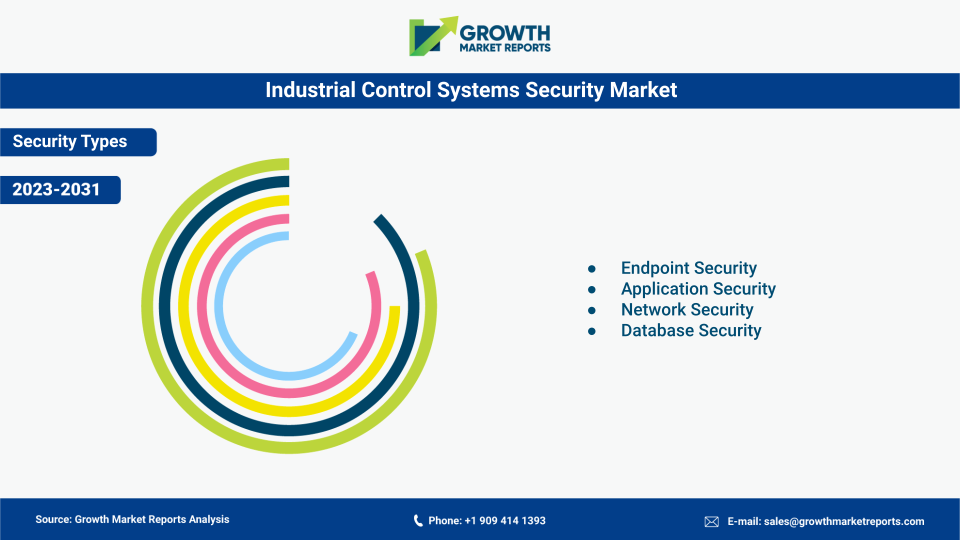
The industrial control systems security market is further segmented by security type, encompassing network security, endpoint security, application security, and database security. Network security remains the cornerstone of ICS protection in 2025, as industrial networks are consistently the primary target for cyberattacks. Solutions such as next-generation firewalls, virtual private networks (VPNs), network segmentation technologies, and encrypted communication protocols are widely deployed to prevent unauthorized access and contain potential breaches. The increasing adoption of remote access technologies, edge computing, and cloud-connected control systems is amplifying the need for robust network security measures, driving continuous innovation in this segment.

Endpoint security is gaining significant prominence as the number of connected devices in industrial environments continues to surge. Industrial endpoints, including programmable logic controllers (PLCs), human-machine interfaces (HMIs), remote terminal units (RTUs), and IIoT sensors, are frequent targets of malware, ransomware, and firmware exploitation. Endpoint protection solutions provide real-time threat detection, device authentication, application whitelisting, and secure firmware update mechanisms. As industrial organizations accelerate their IIoT and smart factory deployments, comprehensive endpoint security is becoming an indispensable layer in preventing lateral movement of threats across operational networks. The growing scope of cyber-physical systems security reflects the heightened recognition that endpoint compromises in OT settings can translate directly into physical operational consequences.

Application security is another vital dimension of ICS protection, focusing on securing the software applications that control and automate industrial processes. Vulnerabilities in industrial applications can be exploited to disrupt production, manipulate critical process parameters, or exfiltrate sensitive operational data. Application security solutions encompass static and dynamic code analysis, vulnerability scanning, secure software development lifecycle practices, and patch management. As organizations increasingly rely on commercial off-the-shelf and third-party applications to drive operational efficiency, ensuring the security of these applications throughout their lifecycle is essential to mitigating risk at the software layer.

Database security addresses the protection of critical data stored within industrial control systems and associated historian and data management platforms. Industrial databases often contain sensitive information related to production processes, intellectual property, process recipes, and operational performance metrics. Database security solutions include encryption at rest and in transit, granular access controls, and continuous activity monitoring to prevent unauthorized access and detect anomalous data access patterns. With the increasing value of industrial data, particularly as AI-driven analytics platforms become more prevalent, and the growing threat of data-exfiltration attacks, organizations are prioritizing database security as a core component of their comprehensive ICS security investment.

Deployment Mode Analysis

Deployment mode is a key strategic consideration in the industrial control systems security market, with organizations choosing between on-premises and cloud-based solutions based on their operational requirements, regulatory constraints, and risk tolerance. On-premises deployment has traditionally dominated industrial environments, offering maximum control over security infrastructure, direct integration with operational technology, and the ability to meet strict data sovereignty and compliance requirements. Many organizations in energy, utilities, and critical manufacturing continue to rely primarily on on-premises architectures, and this segment retains a commanding share of the market as of 2025.

However, cloud-based deployment is gaining strong momentum in 2025, driven by the need for scalability, operational flexibility, and cost efficiency. Cloud-based ICS security solutions offer centralized management consoles, access to continuously updated threat intelligence feeds, and rapid deployment across geographically distributed industrial assets. Organizations managing multiple production facilities or remote operational sites are leveraging cloud platforms to enforce consistent security policies, streamline incident response, and reduce the operational burden on on-site IT and OT teams. The cloud model also enables seamless integration with advanced analytics, machine learning, and security orchestration capabilities, significantly enhancing the overall effectiveness of ICS security programs.

The shift toward cloud-based deployment is being further accelerated by the maturing adoption of IIoT and edge computing technologies. Cloud security solutions enable organizations to monitor and protect assets in real time regardless of physical location, a capability that is particularly valuable in energy, utilities, and transportation sectors where remote sites and mobile assets are prevalent. Vendors offering cloud-native OT security platforms have seen accelerated customer acquisition since 2023, and this momentum is expected to continue through 2034 as cloud comfort levels rise among industrial operators. Understanding how ICS security intersects with broader control software considerations also drives organizations to evaluate purpose-built industrial control software platforms as part of their integrated security architecture planning.

Despite the numerous advantages of cloud deployment, some organizations remain cautious due to legitimate concerns about data privacy, connectivity resilience, and third-party risk exposure. Hybrid deployment models are emerging as the preferred architecture for many large industrial operators, enabling them to maintain on-premises control over the most sensitive OT assets while leveraging cloud-based platforms for centralized monitoring, analytics, and threat intelligence aggregation. This balanced approach allows organizations to modernize their security posture incrementally without compromising operational continuity or regulatory standing.

End-User Industry Analysis

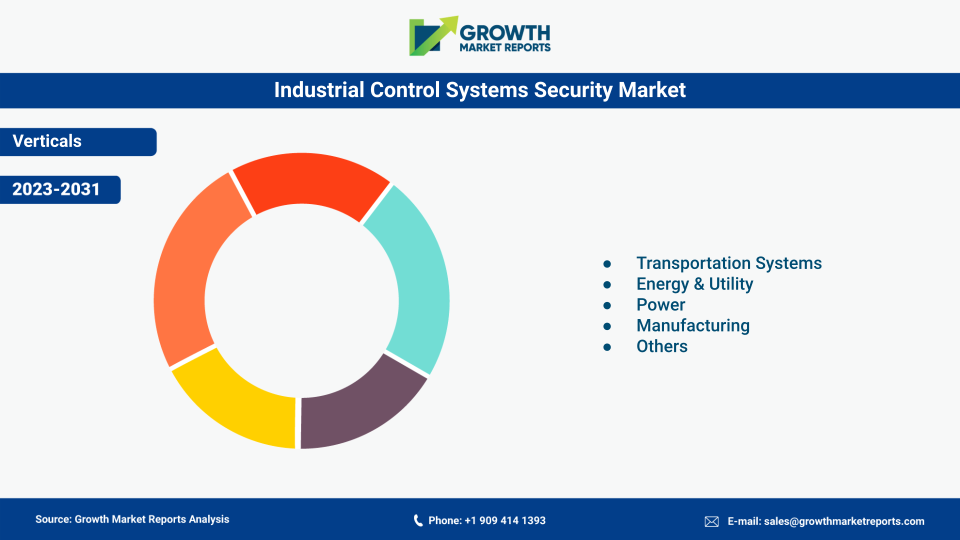
The industrial control systems security market serves a wide array of end-user industries, each presenting unique security requirements, threat profiles, and regulatory environments. The energy and utilities sector represents the largest end-user segment in 2025, accounting for a significant portion of overall ICS security spending. The critical importance of maintaining uninterrupted operations in power generation, electricity transmission, water distribution, and smart grid infrastructure makes this sector a high-value target for nation-state actors and ransomware groups alike. Regulatory frameworks such as NERC CIP in North America and sector-specific NIS2 guidelines in Europe are compelling energy operators to invest continuously in advanced threat detection, incident response, and compliance management capabilities.

The manufacturing industry is the second-largest end-user segment, as the sector continues its aggressive adoption of automation, robotics, collaborative robots (cobots), and IIoT technologies. Manufacturers face a growing and increasingly sophisticated threat landscape that includes ransomware campaigns designed to halt production lines, intellectual property theft targeting product designs and process formulas, and supply chain attacks exploiting third-party vendor access. Ensuring the security of connected production equipment, quality management systems, and enterprise resource planning (ERP) integrations is essential to maintaining operational continuity and protecting competitive assets. The strong emphasis on safety instrumented system cybersecurity within process manufacturing environments reflects the life-safety implications of inadequately secured control systems.

The transportation sector, encompassing railways, airports, seaports, and logistics providers, is also a significant and growing consumer of ICS security solutions in 2025. The sector's reliance on automated traffic management, signaling, navigation, and communication control systems creates substantial exposure to cyberattacks that can disrupt operations, compromise public safety, and damage critical national infrastructure. Transportation organizations are investing in multi-layered security architectures, continuous network monitoring, zero-trust access frameworks, and specialized incident response capabilities to address these risks.

Oil and gas, chemicals, and food and beverage represent additional important end-user segments. The oil and gas sector faces particularly complex challenges related to remote and offshore operations, aging legacy systems, and the high geopolitical value of targeted assets, making it a persistent focus for advanced persistent threat (APT) groups. Chemical manufacturers must guard against intrusions that could manipulate process parameters to create environmental hazards or safety incidents, adding a physical safety dimension to their cybersecurity calculus. The food and beverage industry, while historically less targeted, has seen a marked increase in cyber incidents since 2022 as digital transformation initiatives have expanded its connected attack surface. Across all verticals, the overarching trend through 2034 is growing recognition that ICS security is a board-level strategic priority, not merely a technical concern.

Opportunities & Threats

The industrial control systems security market presents substantial opportunities for growth and innovation through the forecast period to 2034. One of the most compelling opportunities lies in the deeper integration of artificial intelligence (AI) and machine learning (ML) into purpose-built OT security platforms. AI-driven behavioral analytics can dramatically improve threat detection accuracy, reduce false positives that cause alert fatigue, automate routine incident triage, and provide predictive intelligence about emerging attack patterns specific to industrial environments. As threat actors increasingly deploy AI-assisted attack tools, leveraging defensive AI capabilities will be essential to maintaining a security advantage. Vendors that invest meaningfully in AI-powered ICS security platforms are strongly positioned to capture premium market share through 2034.

The expansion of managed security services specifically designed for OT environments represents another major market opportunity. The persistent global shortage of professionals with combined OT operations knowledge and cybersecurity expertise means that many industrial organizations, particularly mid-market operators, cannot build and sustain effective in-house security operations centers. Specialized managed security service providers (MSSPs) with deep OT expertise can fill this gap by offering continuous monitoring, 24/7 threat response, and proactive vulnerability management tailored to industrial protocols and environments. The ongoing maturation of cloud-based delivery models is expanding the addressable market for these services to smaller operators that were previously unable to afford enterprise-grade security support.

Despite abundant opportunities, the market faces significant restraining factors. The prevalence of legacy systems and decades-old control platforms remains perhaps the most persistent structural challenge. Many industrial environments still operate PLCs, SCADA components, and distributed control systems (DCS) that were designed and installed before cybersecurity was a meaningful design consideration, often running unsupported operating systems and lacking patch management capabilities. Retrofitting security controls onto these systems without disrupting production requires specialized approaches and significant investment, creating a substantial barrier for many operators. Additionally, the air-gap myth, the belief that physical separation from corporate IT networks provides sufficient protection, continues to delay security investments in some sectors despite well-documented evidence that air gaps are routinely bridged by sophisticated attackers.

Regional Outlook

North America remains the largest regional market for industrial control systems security, accounting for approximately 37.5% of global market share in 2025, equivalent to around USD 8.8 billion. The region's sustained leadership is driven by a dense concentration of major technology vendors and critical infrastructure operators, mature and expanding regulatory requirements from CISA, NERC, and sector-specific agencies, and consistently high levels of cybersecurity investment across energy, manufacturing, and transportation sectors. The United States leads the regional market, with Canada also seeing accelerating investment in critical infrastructure protection. The frequency of high-profile ICS-targeted attacks in North America continues to motivate both private-sector spending and government-funded security initiatives.

Industrial Control Systems Security Market Regional Share 2025

Europe ranks as the second-largest market, with a regional market value of approximately USD 5.6 billion in 2025. The region is experiencing strengthened regulatory momentum following the full implementation of the NIS2 Directive in late 2024, which expands mandatory cybersecurity obligations to a broader range of industrial operators and introduces stricter incident reporting requirements. Germany, the United Kingdom, France, and the Netherlands are the primary contributors to European ICS security spending, reflecting their large industrial bases and advanced cybersecurity maturity levels. The European ICS security market is projected to grow at a CAGR of approximately 7.6% through 2034, supported by ongoing industrial digitalization programs and increasing awareness of nation-state cyber threats targeting European critical infrastructure.

The Asia Pacific region is the fastest-growing market for industrial control systems security, with a market size of approximately USD 5.3 billion in 2025 and a projected CAGR of 9.4% from 2026 to 2034. Rapid industrialization, aggressive expansion of smart manufacturing initiatives, and growing government investment in critical infrastructure cybersecurity are driving demand for advanced ICS security solutions in China, Japan, India, South Korea, and Australia. Regional governments are increasingly enacting cybersecurity legislation and publishing sector-specific ICS security guidelines, further accelerating market adoption. Latin America and the Middle East and Africa, while smaller in absolute market size at approximately 8.5% and 7.5% of global share respectively in 2025, are experiencing steady growth as industrial operators modernize their environments and recognize the strategic necessity of comprehensive OT cybersecurity programs.

Competitor Outlook

The industrial control systems security market in 2025 is highly competitive, featuring a diverse mix of industrial automation conglomerates, broad-based cybersecurity vendors, and specialized OT security pure-plays. The competitive landscape is defined by continuous product innovation, strategic mergers and acquisitions, and an intensifying focus on developing comprehensive security platforms that address the unique convergence of IT and OT environments. Leading vendors are investing heavily in research and development to integrate AI-driven analytics, cloud-native delivery architectures, and zero-trust security frameworks into their ICS security offerings, seeking to differentiate on both breadth of coverage and depth of OT-specific intelligence.

Mergers and acquisitions remain a defining feature of the competitive landscape, as established technology companies seek to acquire specialized OT security capabilities that would take years to build organically. The acquisitions of specialist OT security firms by larger platform vendors have accelerated since 2022, reshaping competitive dynamics and raising the technology baseline across the market. Strategic partnerships between ICS security vendors and industrial automation OEMs are also proliferating, creating integrated value propositions that combine secure-by-design hardware with continuously updated software security layers. New market entrants, particularly cloud-native security platform providers and AI-focused cybersecurity startups, are intensifying competition and accelerating the pace of innovation.

Customer expectations are evolving rapidly, with industrial operators increasingly demanding solutions that provide deep visibility into OT network traffic and asset behavior, seamless integration with existing industrial systems without operational disruption, and clear evidence of risk reduction rather than simply feature lists. Vendors that combine genuine OT protocol expertise, robust threat intelligence derived from real-world industrial attack data, and scalable delivery models are earning the strongest customer retention and expansion rates. The competitive advantage of purpose-built OT security vendors such as Dragos, Claroty, and Nozomi Networks over general-purpose IT security vendors has become more pronounced, though large platform vendors are closing the gap through continued R&D investment and acquisition activity.

Among the most prominent players in the industrial control systems security market are Honeywell International Inc., Siemens AG, ABB Ltd., Schneider Electric SE, Rockwell Automation Inc., Cisco Systems Inc., Fortinet Inc., Palo Alto Networks Inc., Check Point Software Technologies Ltd., Claroty Ltd., Dragos Inc., Nozomi Networks Inc., Trellix, Microsoft Corporation, Tenable Holdings Inc., and Armis Security Ltd. The industrial automation leaders, Honeywell, Siemens, ABB, Schneider Electric, and Rockwell Automation, leverage deep operational technology domain expertise and established customer relationships to deliver integrated security solutions alongside their core automation portfolios. Cisco and Fortinet bring strong network security foundations to the OT domain, while Palo Alto Networks and Check Point offer advanced threat prevention capabilities increasingly adapted for industrial protocol environments.

Specialized OT security vendors Dragos, Claroty, and Nozomi Networks have established strong reputations for purpose-built industrial threat detection, asset inventory, and vulnerability management platforms that offer deeper OT visibility than traditional IT security tools. Microsoft has significantly expanded its OT security presence through the integration of its Azure Defender for IoT platform with the broader Microsoft Sentinel SIEM ecosystem. Tenable and Armis bring complementary asset discovery and vulnerability management capabilities that are gaining adoption in industrial contexts. Collectively, these players are advancing the state of the art in ICS security through sustained innovation, strategic ecosystem partnerships, and a shared commitment to protecting the world's critical industrial infrastructure from increasingly sophisticated cyber threats through 2034.

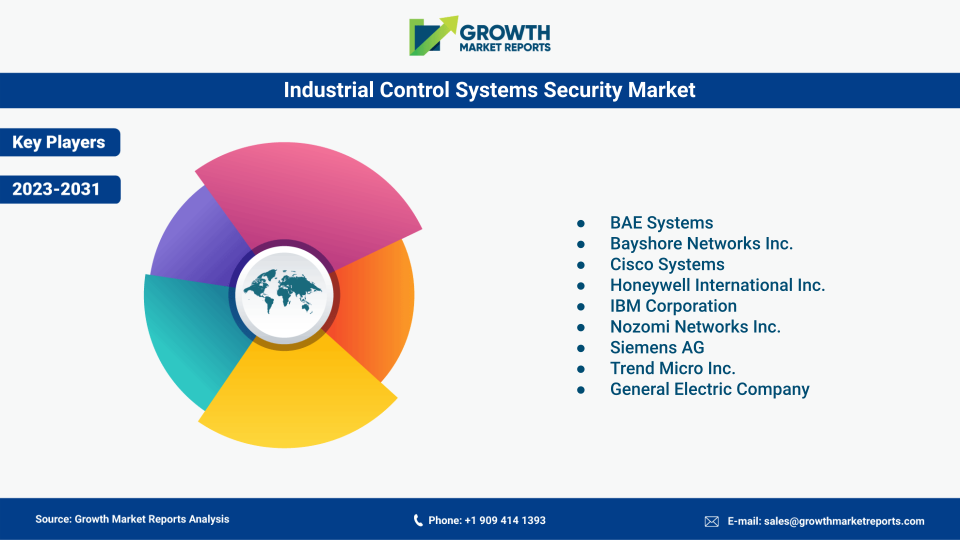
Key Players

  • Honeywell International Inc.
  • Siemens AG
  • ABB Ltd.
  • Schneider Electric SE
  • Rockwell Automation, Inc.
  • Cisco Systems, Inc.
  • Fortinet, Inc.
  • Palo Alto Networks, Inc.
  • Check Point Software Technologies Ltd.
  • Trend Micro Incorporated
  • Claroty Ltd.
  • Dragos, Inc.
  • Nozomi Networks Inc.
  • Belden Inc.
  • Trellix (formerly FireEye)
  • Microsoft Corporation
  • BAE Systems plc
  • Kaspersky Lab
  • Tenable Holdings, Inc.
  • Armis Security Ltd.

Segments

The Industrial Control Systems Security market has been segmented on the basis of

Component

  • Solutions
  • Services

Security Type

  • Network Security
  • Endpoint Security
  • Application Security
  • Database Security

Deployment Mode

  • On-Premises
  • Cloud

End-User Industry

  • Energy & Utilities
  • Manufacturing
  • Transportation
  • Oil & Gas
  • Chemicals
  • Food & Beverage
  • Others

Frequently Asked Questions

The market features a mix of industrial automation giants and specialized cybersecurity firms. Key players include Honeywell International Inc., Siemens AG, ABB Ltd., Schneider Electric SE, Rockwell Automation Inc., Cisco Systems Inc., Fortinet Inc., Palo Alto Networks Inc., Check Point Software Technologies Ltd., Claroty Ltd., Dragos Inc., Nozomi Networks Inc., Trellix, Microsoft Corporation, Tenable Holdings Inc., and Armis Security Ltd. Specialized OT security vendors such as Dragos and Claroty have gained significant traction since 2023, capturing growing market share by offering purpose-built industrial threat detection and response platforms.

AI and machine learning are fundamentally transforming ICS security as of 2025. AI-powered platforms enable real-time anomaly detection, predictive threat intelligence, and automated incident response, dramatically reducing mean time to detect and respond to intrusions in industrial environments. Generative AI tools are also being leveraged for threat simulation and security training. Leading vendors including Dragos, Claroty, and Nozomi Networks have integrated advanced AI capabilities into their OT security platforms, and the broader adoption of AI-driven security analytics is expected to be a primary market differentiator through 2034.

The primary challenges include the widespread presence of legacy systems that lack modern security features and are difficult to update without disrupting operations. The global shortage of OT-focused cybersecurity professionals remains acute as of 2025. Budget constraints, particularly among mid-sized industrial operators, limit the pace of security upgrades. Additionally, the growing complexity of hybrid IT/OT environments, the rapid proliferation of connected endpoints, and increasingly sophisticated nation-state threat actors create compounding challenges for organizations seeking to maintain resilient ICS security postures.

Energy and utilities represent the largest end-user segment, driven by the critical nature of power grids, water treatment facilities, and smart grid infrastructure. Manufacturing is the second-largest segment, facing growing threats from ransomware and supply chain attacks amid broad Industry 4.0 adoption. Transportation, oil and gas, chemicals, and food and beverage are also significant consumers. Across all verticals, the shared imperative is protecting operational technology from cyber disruptions that can cause safety risks, production losses, and regulatory penalties.

ICS security solutions are deployed in two primary modes: on-premises and cloud-based. On-premises deployment remains prevalent in critical infrastructure sectors due to data sovereignty and regulatory compliance requirements. However, cloud-based deployment is gaining strong momentum as of 2025, offering scalability, centralized management, and integration with AI-driven analytics. Hybrid deployment models are increasingly popular, allowing organizations to combine the control of on-premises infrastructure with the agility of cloud platforms across distributed industrial assets.

ICS security encompasses four main security types: network security, endpoint security, application security, and database security. Network security remains the dominant category, covering firewalls, VPNs, and network segmentation solutions. Endpoint security protects PLCs, HMIs, and sensors from malware and ransomware. Application security focuses on securing industrial software throughout its lifecycle, while database security safeguards sensitive operational and production data through encryption, access controls, and continuous monitoring.

The ICS security market is segmented into two primary components: solutions and services. Solutions, which account for approximately 62.5% of the market in 2025, include firewalls, intrusion detection and prevention systems, SIEM platforms, antivirus tools, and identity and access management technologies. Services, representing around 37.5% of the market, encompass consulting, managed security services, risk assessment, system integration, and incident response. The services segment is expected to grow faster through 2034 as organizations seek specialized external expertise.

North America holds the largest regional share at approximately 37.5% of the global market in 2025, valued at around USD 8.8 billion, driven by a mature regulatory environment and high cybersecurity awareness. Europe ranks second with roughly 24% share, supported by the NIS2 Directive and GDPR compliance demands. Asia Pacific is the fastest-growing region, projected to expand at a CAGR of 9.4% from 2026 to 2034, fueled by rapid industrialization in China, India, Japan, and South Korea.

Key growth drivers include the rising frequency and sophistication of cyberattacks on industrial environments, the accelerating convergence of IT and OT networks, rapid deployment of Industrial Internet of Things devices, and expanding government mandates for critical infrastructure protection. The global push toward Industry 4.0 and smart manufacturing is also amplifying the attack surface, compelling organizations to invest heavily in robust ICS security frameworks through 2034.

The global industrial control systems security market reached USD 23.4 billion in 2025 and is projected to grow at a CAGR of 8.1% from 2026 to 2034, reaching approximately USD 47.8 billion by 2034. This growth is driven by escalating cyber threats targeting critical infrastructure, expanding IIoT adoption, and increasingly stringent regulatory requirements across key industrial sectors worldwide.

Table Of Content

Chapter 1 Executive Summary
Chapter 2 Assumptions and Acronyms Used
Chapter 3 Research Methodology
Chapter 4 Industrial Control Systems Security Market Overview
   4.1 Introduction
      4.1.1 Market Taxonomy
      4.1.2 Market Definition
      4.1.3 Macro-Economic Factors Impacting the Market Growth
   4.2 Industrial Control Systems Security Market Dynamics
      4.2.1 Market Drivers
      4.2.2 Market Restraints
      4.2.3 Market Opportunity
   4.3 Industrial Control Systems Security Market - Supply Chain Analysis
      4.3.1 List of Key Suppliers
      4.3.2 List of Key Distributors
      4.3.3 List of Key Consumers
   4.4 Key Forces Shaping the Industrial Control Systems Security Market
      4.4.1 Bargaining Power of Suppliers
      4.4.2 Bargaining Power of Buyers
      4.4.3 Threat of Substitution
      4.4.4 Threat of New Entrants
      4.4.5 Competitive Rivalry
   4.5 Global Industrial Control Systems Security Market Size & Forecast, 2023-2032
      4.5.1 Industrial Control Systems Security Market Size and Y-o-Y Growth
      4.5.2 Industrial Control Systems Security Market Absolute $ Opportunity

Chapter 5 Global Industrial Control Systems Security Market Analysis and Forecast By Component
   5.1 Introduction
      5.1.1 Key Market Trends & Growth Opportunities By Component
      5.1.2 Basis Point Share (BPS) Analysis By Component
      5.1.3 Absolute $ Opportunity Assessment By Component
   5.2 Industrial Control Systems Security Market Size Forecast By Component
      5.2.1 Solutions
      5.2.2 Services
   5.3 Market Attractiveness Analysis By Component

Chapter 6 Global Industrial Control Systems Security Market Analysis and Forecast By Security Type
   6.1 Introduction
      6.1.1 Key Market Trends & Growth Opportunities By Security Type
      6.1.2 Basis Point Share (BPS) Analysis By Security Type
      6.1.3 Absolute $ Opportunity Assessment By Security Type
   6.2 Industrial Control Systems Security Market Size Forecast By Security Type
      6.2.1 Network Security
      6.2.2 Endpoint Security
      6.2.3 Application Security
      6.2.4 Database Security
   6.3 Market Attractiveness Analysis By Security Type

Chapter 7 Global Industrial Control Systems Security Market Analysis and Forecast By Deployment Mode
   7.1 Introduction
      7.1.1 Key Market Trends & Growth Opportunities By Deployment Mode
      7.1.2 Basis Point Share (BPS) Analysis By Deployment Mode
      7.1.3 Absolute $ Opportunity Assessment By Deployment Mode
   7.2 Industrial Control Systems Security Market Size Forecast By Deployment Mode
      7.2.1 On-Premises
      7.2.2 Cloud
   7.3 Market Attractiveness Analysis By Deployment Mode

Chapter 8 Global Industrial Control Systems Security Market Analysis and Forecast By End-User Industry
   8.1 Introduction
      8.1.1 Key Market Trends & Growth Opportunities By End-User Industry
      8.1.2 Basis Point Share (BPS) Analysis By End-User Industry
      8.1.3 Absolute $ Opportunity Assessment By End-User Industry
   8.2 Industrial Control Systems Security Market Size Forecast By End-User Industry
      8.2.1 Energy & Utilities
      8.2.2 Manufacturing
      8.2.3 Transportation
      8.2.4 Oil & Gas
      8.2.5 Chemicals
      8.2.6 Food & Beverage
      8.2.7 Others
   8.3 Market Attractiveness Analysis By End-User Industry

Chapter 9 Global Industrial Control Systems Security Market Analysis and Forecast by Region
   9.1 Introduction
      9.1.1 Key Market Trends & Growth Opportunities By Region
      9.1.2 Basis Point Share (BPS) Analysis By Region
      9.1.3 Absolute $ Opportunity Assessment By Region
   9.2 Industrial Control Systems Security Market Size Forecast By Region
      9.2.1 North America
      9.2.2 Europe
      9.2.3 Asia Pacific
      9.2.4 Latin America
      9.2.5 Middle East & Africa (MEA)
   9.3 Market Attractiveness Analysis By Region

Chapter 10 Coronavirus Disease (COVID-19) Impact 
   10.1 Introduction 
   10.2 Current & Future Impact Analysis 
   10.3 Economic Impact Analysis 
   10.4 Government Policies 
   10.5 Investment Scenario

Chapter 11 North America Industrial Control Systems Security Analysis and Forecast
   11.1 Introduction
   11.2 North America Industrial Control Systems Security Market Size Forecast by Country
      11.2.1 U.S.
      11.2.2 Canada
   11.3 Basis Point Share (BPS) Analysis by Country
   11.4 Absolute $ Opportunity Assessment by Country
   11.5 Market Attractiveness Analysis by Country
   11.6 North America Industrial Control Systems Security Market Size Forecast By Component
      11.6.1 Solutions
      11.6.2 Services
   11.7 Basis Point Share (BPS) Analysis By Component 
   11.8 Absolute $ Opportunity Assessment By Component 
   11.9 Market Attractiveness Analysis By Component
   11.10 North America Industrial Control Systems Security Market Size Forecast By Security Type
      11.10.1 Network Security
      11.10.2 Endpoint Security
      11.10.3 Application Security
      11.10.4 Database Security
   11.11 Basis Point Share (BPS) Analysis By Security Type 
   11.12 Absolute $ Opportunity Assessment By Security Type 
   11.13 Market Attractiveness Analysis By Security Type
   11.14 North America Industrial Control Systems Security Market Size Forecast By Deployment Mode
      11.14.1 On-Premises
      11.14.2 Cloud
   11.15 Basis Point Share (BPS) Analysis By Deployment Mode 
   11.16 Absolute $ Opportunity Assessment By Deployment Mode 
   11.17 Market Attractiveness Analysis By Deployment Mode
   11.18 North America Industrial Control Systems Security Market Size Forecast By End-User Industry
      11.18.1 Energy & Utilities
      11.18.2 Manufacturing
      11.18.3 Transportation
      11.18.4 Oil & Gas
      11.18.5 Chemicals
      11.18.6 Food & Beverage
      11.18.7 Others
   11.19 Basis Point Share (BPS) Analysis By End-User Industry 
   11.20 Absolute $ Opportunity Assessment By End-User Industry 
   11.21 Market Attractiveness Analysis By End-User Industry

Chapter 12 Europe Industrial Control Systems Security Analysis and Forecast
   12.1 Introduction
   12.2 Europe Industrial Control Systems Security Market Size Forecast by Country
      12.2.1 Germany
      12.2.2 France
      12.2.3 Italy
      12.2.4 U.K.
      12.2.5 Spain
      12.2.6 Russia
      12.2.7 Rest of Europe
   12.3 Basis Point Share (BPS) Analysis by Country
   12.4 Absolute $ Opportunity Assessment by Country
   12.5 Market Attractiveness Analysis by Country
   12.6 Europe Industrial Control Systems Security Market Size Forecast By Component
      12.6.1 Solutions
      12.6.2 Services
   12.7 Basis Point Share (BPS) Analysis By Component 
   12.8 Absolute $ Opportunity Assessment By Component 
   12.9 Market Attractiveness Analysis By Component
   12.10 Europe Industrial Control Systems Security Market Size Forecast By Security Type
      12.10.1 Network Security
      12.10.2 Endpoint Security
      12.10.3 Application Security
      12.10.4 Database Security
   12.11 Basis Point Share (BPS) Analysis By Security Type 
   12.12 Absolute $ Opportunity Assessment By Security Type 
   12.13 Market Attractiveness Analysis By Security Type
   12.14 Europe Industrial Control Systems Security Market Size Forecast By Deployment Mode
      12.14.1 On-Premises
      12.14.2 Cloud
   12.15 Basis Point Share (BPS) Analysis By Deployment Mode 
   12.16 Absolute $ Opportunity Assessment By Deployment Mode 
   12.17 Market Attractiveness Analysis By Deployment Mode
   12.18 Europe Industrial Control Systems Security Market Size Forecast By End-User Industry
      12.18.1 Energy & Utilities
      12.18.2 Manufacturing
      12.18.3 Transportation
      12.18.4 Oil & Gas
      12.18.5 Chemicals
      12.18.6 Food & Beverage
      12.18.7 Others
   12.19 Basis Point Share (BPS) Analysis By End-User Industry 
   12.20 Absolute $ Opportunity Assessment By End-User Industry 
   12.21 Market Attractiveness Analysis By End-User Industry

Chapter 13 Asia Pacific Industrial Control Systems Security Analysis and Forecast
   13.1 Introduction
   13.2 Asia Pacific Industrial Control Systems Security Market Size Forecast by Country
      13.2.1 China
      13.2.2 Japan
      13.2.3 South Korea
      13.2.4 India
      13.2.5 Australia
      13.2.6 South East Asia (SEA)
      13.2.7 Rest of Asia Pacific (APAC)
   13.3 Basis Point Share (BPS) Analysis by Country
   13.4 Absolute $ Opportunity Assessment by Country
   13.5 Market Attractiveness Analysis by Country
   13.6 Asia Pacific Industrial Control Systems Security Market Size Forecast By Component
      13.6.1 Solutions
      13.6.2 Services
   13.7 Basis Point Share (BPS) Analysis By Component 
   13.8 Absolute $ Opportunity Assessment By Component 
   13.9 Market Attractiveness Analysis By Component
   13.10 Asia Pacific Industrial Control Systems Security Market Size Forecast By Security Type
      13.10.1 Network Security
      13.10.2 Endpoint Security
      13.10.3 Application Security
      13.10.4 Database Security
   13.11 Basis Point Share (BPS) Analysis By Security Type 
   13.12 Absolute $ Opportunity Assessment By Security Type 
   13.13 Market Attractiveness Analysis By Security Type
   13.14 Asia Pacific Industrial Control Systems Security Market Size Forecast By Deployment Mode
      13.14.1 On-Premises
      13.14.2 Cloud
   13.15 Basis Point Share (BPS) Analysis By Deployment Mode 
   13.16 Absolute $ Opportunity Assessment By Deployment Mode 
   13.17 Market Attractiveness Analysis By Deployment Mode
   13.18 Asia Pacific Industrial Control Systems Security Market Size Forecast By End-User Industry
      13.18.1 Energy & Utilities
      13.18.2 Manufacturing
      13.18.3 Transportation
      13.18.4 Oil & Gas
      13.18.5 Chemicals
      13.18.6 Food & Beverage
      13.18.7 Others
   13.19 Basis Point Share (BPS) Analysis By End-User Industry 
   13.20 Absolute $ Opportunity Assessment By End-User Industry 
   13.21 Market Attractiveness Analysis By End-User Industry

Chapter 14 Latin America Industrial Control Systems Security Analysis and Forecast
   14.1 Introduction
   14.2 Latin America Industrial Control Systems Security Market Size Forecast by Country
      14.2.1 Brazil
      14.2.2 Mexico
      14.2.3 Rest of Latin America (LATAM)
   14.3 Basis Point Share (BPS) Analysis by Country
   14.4 Absolute $ Opportunity Assessment by Country
   14.5 Market Attractiveness Analysis by Country
   14.6 Latin America Industrial Control Systems Security Market Size Forecast By Component
      14.6.1 Solutions
      14.6.2 Services
   14.7 Basis Point Share (BPS) Analysis By Component 
   14.8 Absolute $ Opportunity Assessment By Component 
   14.9 Market Attractiveness Analysis By Component
   14.10 Latin America Industrial Control Systems Security Market Size Forecast By Security Type
      14.10.1 Network Security
      14.10.2 Endpoint Security
      14.10.3 Application Security
      14.10.4 Database Security
   14.11 Basis Point Share (BPS) Analysis By Security Type 
   14.12 Absolute $ Opportunity Assessment By Security Type 
   14.13 Market Attractiveness Analysis By Security Type
   14.14 Latin America Industrial Control Systems Security Market Size Forecast By Deployment Mode
      14.14.1 On-Premises
      14.14.2 Cloud
   14.15 Basis Point Share (BPS) Analysis By Deployment Mode 
   14.16 Absolute $ Opportunity Assessment By Deployment Mode 
   14.17 Market Attractiveness Analysis By Deployment Mode
   14.18 Latin America Industrial Control Systems Security Market Size Forecast By End-User Industry
      14.18.1 Energy & Utilities
      14.18.2 Manufacturing
      14.18.3 Transportation
      14.18.4 Oil & Gas
      14.18.5 Chemicals
      14.18.6 Food & Beverage
      14.18.7 Others
   14.19 Basis Point Share (BPS) Analysis By End-User Industry 
   14.20 Absolute $ Opportunity Assessment By End-User Industry 
   14.21 Market Attractiveness Analysis By End-User Industry

Chapter 15 Middle East & Africa (MEA) Industrial Control Systems Security Analysis and Forecast
   15.1 Introduction
   15.2 Middle East & Africa (MEA) Industrial Control Systems Security Market Size Forecast by Country
      15.2.1 Saudi Arabia
      15.2.2 South Africa
      15.2.3 UAE
      15.2.4 Rest of Middle East & Africa (MEA)
   15.3 Basis Point Share (BPS) Analysis by Country
   15.4 Absolute $ Opportunity Assessment by Country
   15.5 Market Attractiveness Analysis by Country
   15.6 Middle East & Africa (MEA) Industrial Control Systems Security Market Size Forecast By Component
      15.6.1 Solutions
      15.6.2 Services
   15.7 Basis Point Share (BPS) Analysis By Component 
   15.8 Absolute $ Opportunity Assessment By Component 
   15.9 Market Attractiveness Analysis By Component
   15.10 Middle East & Africa (MEA) Industrial Control Systems Security Market Size Forecast By Security Type
      15.10.1 Network Security
      15.10.2 Endpoint Security
      15.10.3 Application Security
      15.10.4 Database Security
   15.11 Basis Point Share (BPS) Analysis By Security Type 
   15.12 Absolute $ Opportunity Assessment By Security Type 
   15.13 Market Attractiveness Analysis By Security Type
   15.14 Middle East & Africa (MEA) Industrial Control Systems Security Market Size Forecast By Deployment Mode
      15.14.1 On-Premises
      15.14.2 Cloud
   15.15 Basis Point Share (BPS) Analysis By Deployment Mode 
   15.16 Absolute $ Opportunity Assessment By Deployment Mode 
   15.17 Market Attractiveness Analysis By Deployment Mode
   15.18 Middle East & Africa (MEA) Industrial Control Systems Security Market Size Forecast By End-User Industry
      15.18.1 Energy & Utilities
      15.18.2 Manufacturing
      15.18.3 Transportation
      15.18.4 Oil & Gas
      15.18.5 Chemicals
      15.18.6 Food & Beverage
      15.18.7 Others
   15.19 Basis Point Share (BPS) Analysis By End-User Industry 
   15.20 Absolute $ Opportunity Assessment By End-User Industry 
   15.21 Market Attractiveness Analysis By End-User Industry

Chapter 16 Competition Landscape 
   16.1 Industrial Control Systems Security Market: Competitive Dashboard
   16.2 Global Industrial Control Systems Security Market: Market Share Analysis, 2023
   16.3 Company Profiles (Details – Overview, Financials, Developments, Strategy) 
      16.3.1 Honeywell International Inc.
      16.3.2 Siemens AG
      16.3.3 ABB Ltd.
      16.3.4 Schneider Electric SE
      16.3.5 Rockwell Automation, Inc.
      16.3.6 Cisco Systems, Inc.
      16.3.7 Fortinet, Inc.
      16.3.8 Palo Alto Networks, Inc.
      16.3.9 Check Point Software Technologies Ltd.
      16.3.10 Trend Micro Incorporated
      16.3.11 Claroty Ltd.
      16.3.12 Dragos, Inc.
      16.3.13 Nozomi Networks Inc.
      16.3.14 Belden Inc.
      16.3.15 Trellix (formerly FireEye)
      16.3.16 Microsoft Corporation
      16.3.17 BAE Systems plc
      16.3.18 Kaspersky Lab
      16.3.19 Tenable Holdings, Inc.
      16.3.20 Armis Security Ltd.

Methodology

Our Clients

General Electric
sinopec
Honda Motor Co. Ltd.
Nestle SA
Siemens Healthcare
Deloitte
The John Holland Group
Microsoft