Hybrid Memory Cube Market Research Report 2033

Hybrid Memory Cube Market Research Report 2033

Segments - by Product Type (Hybrid Memory Cube Controllers, Hybrid Memory Cube Modules, Others), by Application (Consumer Electronics, High-Performance Computing, Networking & Data Centers, Industrial, Others), by End-User (IT & Telecommunication, Healthcare, Automotive, Defense & Military, Others)

https://growthmarketreports.com/Raksha
Author : Raksha Sharma
https://growthmarketreports.com/Vaibhav
Fact-checked by : V. Chandola
https://growthmarketreports.com/Shruti
Editor : Shruti Bhat

Upcoming | Report ID :ICT-SE-690 | 4.8 Rating | 55 Reviews | 275 Pages | Format : Docx PDF

Report Description


Hybrid Memory Cube Market Outlook

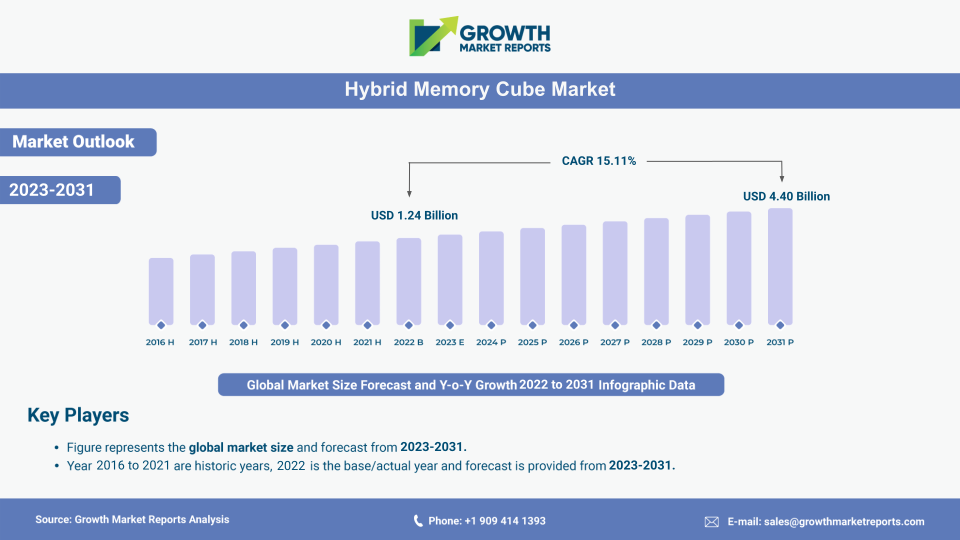
As per our latest research, the global Hybrid Memory Cube (HMC) market size was valued at USD 1.34 billion in 2024, demonstrating the increasing adoption of advanced memory solutions across multiple sectors. The market is experiencing robust momentum, driven by surging data traffic and the need for high-bandwidth, low-latency memory architecture. With a compound annual growth rate (CAGR) of 25.8% projected from 2025 to 2033, the market is forecasted to reach USD 11.06 billion by 2033. This significant growth trajectory is attributed to rising demand for high-performance computing, advancements in data center technologies, and the proliferation of artificial intelligence and machine learning workloads globally.

One of the primary growth drivers for the Hybrid Memory Cube market is the escalating need for high-speed data processing in sectors such as IT & telecommunications, high-performance computing, and data centers. As organizations increasingly rely on big data analytics, cloud computing, and artificial intelligence, the limitations of traditional DRAM memory become more apparent. HMC technology, with its unique 3D architecture and through-silicon via (TSV) interconnections, offers substantial improvements in bandwidth and energy efficiency over conventional memory solutions. This advantage is particularly critical for enterprise-grade applications where latency and throughput are paramount, fueling the adoption of HMC modules and controllers in next-generation computing systems.

Another significant factor propelling the growth of the Hybrid Memory Cube market is the rapid expansion of the consumer electronics segment. The proliferation of smart devices, gaming consoles, and augmented/virtual reality applications has placed unprecedented demands on memory performance. HMC’s ability to deliver high bandwidth at lower power consumption is highly attractive to manufacturers aiming to enhance device performance while maintaining energy efficiency. Furthermore, as 5G networks become mainstream, the need for advanced memory solutions to handle massive data transfers in real time is accelerating HMC deployment in networking and telecommunications infrastructure.

The increasing adoption of HMC in automotive, healthcare, and defense sectors is also contributing to market expansion. In automotive electronics, for instance, the integration of advanced driver-assistance systems (ADAS) and autonomous driving technologies requires memory solutions capable of processing vast amounts of sensor data with minimal latency. Similarly, in healthcare, the digitization of medical records and the rise of telemedicine are driving demand for high-performance memory to support imaging, diagnostics, and real-time data analysis. The defense and military sectors, which require robust and secure data processing capabilities, are also turning to HMC for mission-critical applications, further broadening the market’s scope.

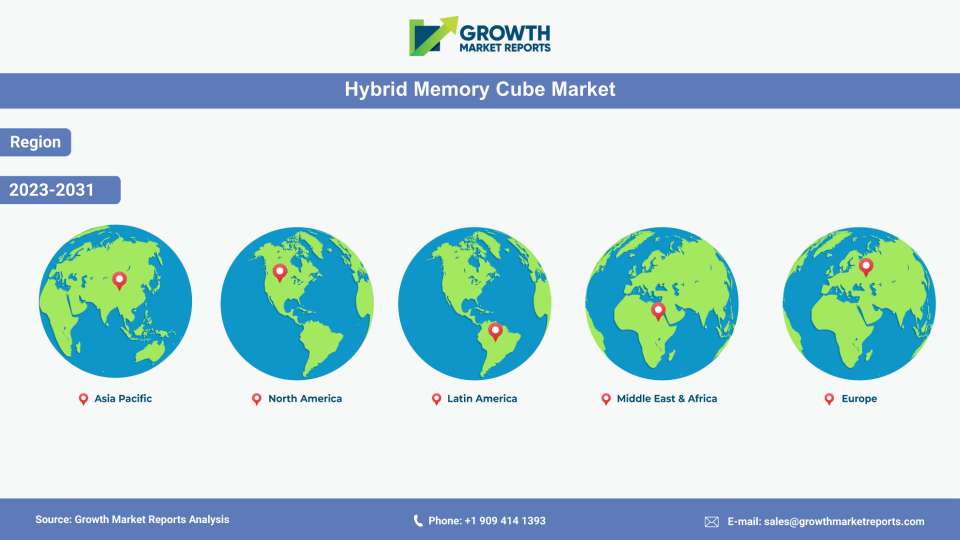
From a regional perspective, North America currently dominates the Hybrid Memory Cube market, owing to its advanced technological infrastructure, strong presence of leading semiconductor companies, and early adoption of high-performance computing solutions. However, Asia Pacific is emerging as the fastest-growing region, propelled by rapid industrialization, expanding data center networks, and increasing investments in AI and IoT technologies. Europe also holds a significant share, supported by advancements in automotive and industrial automation. The Middle East & Africa and Latin America are gradually catching up, driven by growing digital transformation initiatives and infrastructure development. This regional diversification is expected to intensify competition and foster innovation in the global HMC market.

Global Hybrid Memory Cube Industry Outlook

Hybrid Memory Cube Product Type Analysis

The Hybrid Memory Cube market is segmented by product type into Hybrid Memory Cube Controllers, Hybrid Memory Cube Modules, and Others. Among these, HMC modules represent the largest share, driven by their direct role in delivering high bandwidth and low latency in computing systems. HMC modules are being increasingly integrated into high-performance servers, data centers, and advanced computing platforms, where the demand for rapid data access is paramount. Their 3D architecture and TSV technology enable superior data transfer rates compared to traditional memory modules, making them the preferred choice for applications requiring intensive computational power. This segment is poised for sustained growth as more industries transition to data-driven operations.

Hybrid Memory Cube Controllers, on the other hand, play a critical role in bridging the communication between HMC modules and host systems. These controllers are essential for managing data flow, error correction, and ensuring seamless interoperability with existing hardware architectures. With the rising complexity of data center and enterprise computing environments, the demand for advanced HMC controllers is surging. Manufacturers are focusing on developing controllers that offer enhanced scalability, security features, and compatibility with emerging processor technologies. The evolution of controller technology will be pivotal in unlocking the full potential of HMC modules and expanding the addressable market.

The ‘Others’ category in the product type segment includes ancillary components and supporting technologies that complement the core HMC modules and controllers. This includes interposers, connectors, and custom-designed solutions tailored for specific industrial or military applications. As the adoption of HMC technology spreads across diverse verticals, the demand for specialized components is expected to rise. Companies operating in this niche are investing in R&D to create solutions that enhance the integration, reliability, and performance of HMC-based systems, thereby contributing to the overall growth of the market.

Technological advancements in semiconductor manufacturing are also influencing the product type landscape of the Hybrid Memory Cube market. The ongoing transition to smaller process nodes, improvements in TSV technology, and innovations in packaging are enabling the development of more compact, efficient, and cost-effective HMC products. These advancements are lowering the barriers to entry for new players and facilitating the adoption of HMC across a broader range of applications. As competition intensifies, product differentiation based on performance, power efficiency, and integration capabilities will become increasingly important for market success.

Report Scope

Attributes Details
Report Title Hybrid Memory Cube Market Research Report 2033
By Product Type Hybrid Memory Cube Controllers, Hybrid Memory Cube Modules, Others
By Application Consumer Electronics, High-Performance Computing, Networking & Data Centers, Industrial, Others
By End-User IT & Telecommunication, Healthcare, Automotive, Defense & Military, Others
Regions Covered North America, Europe, APAC, Latin America, MEA
Base Year 2024
Historic Data 2018-2023
Forecast Period 2025-2033
Number of Pages 275
Number of Tables & Figures 301
Customization Available Yes, the report can be customized as per your need.

Hybrid Memory Cube Application Analysis

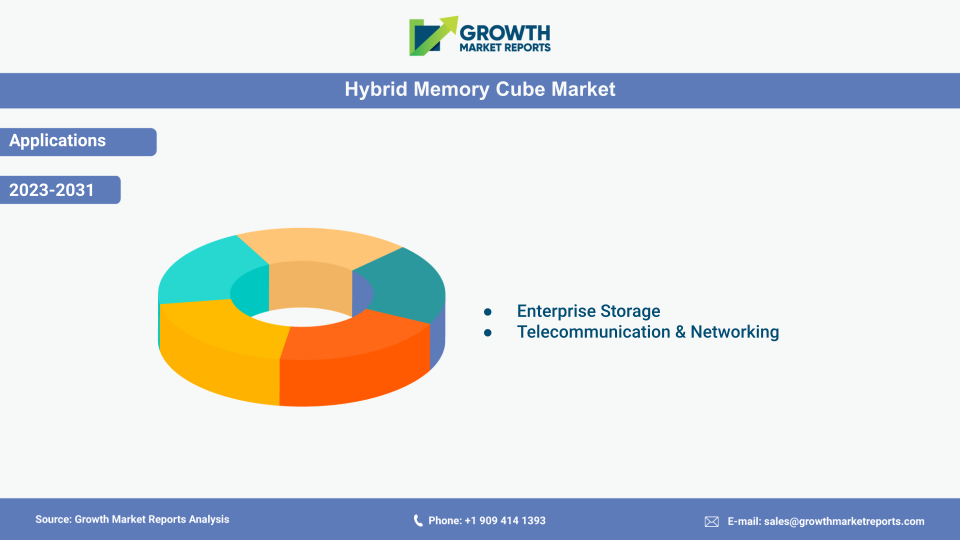
The application landscape of the Hybrid Memory Cube market is diverse, encompassing Consumer Electronics, High-Performance Computing, Networking & Data Centers, Industrial, and Others. High-Performance Computing (HPC) remains the dominant application segment, accounting for a significant portion of market revenue. The relentless growth of big data analytics, scientific simulations, and artificial intelligence workloads is driving the need for memory solutions that can deliver unparalleled speed and efficiency. HMC’s ability to support massive parallel processing and high data throughput makes it indispensable for HPC environments, where performance bottlenecks can have substantial operational and financial implications.

Networking & Data Centers is another key application segment witnessing rapid adoption of HMC technology. The exponential increase in global data traffic, fueled by cloud computing, video streaming, and IoT proliferation, is straining traditional memory infrastructures. HMC’s high bandwidth and low power consumption are critical for enhancing the performance and scalability of data center networks. Leading cloud service providers and enterprise data centers are integrating HMC modules to meet the growing demands of real-time data processing and storage, ensuring seamless user experiences and operational efficiency.

In the Consumer Electronics segment, HMC technology is gaining traction as manufacturers seek to differentiate their products through enhanced performance and energy efficiency. The rise of smart devices, gaming consoles, and immersive technologies such as virtual and augmented reality is creating new opportunities for HMC integration. By enabling faster data access and improved multitasking capabilities, HMC is helping manufacturers deliver next-generation user experiences. As consumer expectations for device performance continue to rise, the adoption of advanced memory solutions like HMC is set to accelerate.

The Industrial segment, which includes automation, robotics, and smart manufacturing, is also emerging as a significant application area for HMC. The transition to Industry 4.0 is driving the need for memory solutions that can support real-time data processing, predictive maintenance, and advanced analytics. HMC’s robustness, reliability, and scalability make it well-suited for industrial environments where downtime and latency can have critical consequences. As industrial automation becomes more sophisticated, the demand for high-performance memory solutions is expected to grow, further expanding the application scope of HMC technology.

Hybrid Memory Cube End-User Analysis

The Hybrid Memory Cube market caters to a wide array of end-users, including IT & Telecommunication, Healthcare, Automotive, Defense & Military, and Others. The IT & Telecommunication sector is the largest end-user, driven by the relentless growth of cloud computing, data centers, and enterprise IT infrastructure. Organizations in this sector are under constant pressure to deliver faster, more reliable services while managing escalating data volumes. HMC’s superior performance characteristics make it a natural fit for IT and telecom applications, where latency and bandwidth are critical success factors. As digital transformation accelerates, the reliance on high-performance memory solutions is expected to intensify.

Healthcare is another rapidly growing end-user segment for the Hybrid Memory Cube market. The digitization of healthcare records, the adoption of telemedicine, and the increasing use of AI-powered diagnostics are driving demand for memory solutions that can handle large volumes of sensitive data securely and efficiently. HMC’s high bandwidth and low latency are particularly valuable in medical imaging, real-time monitoring, and data analytics applications. As the healthcare sector continues to embrace digital technologies, the adoption of advanced memory solutions like HMC is set to rise significantly.

In the Automotive sector, the shift toward connected and autonomous vehicles is creating new opportunities for HMC technology. Modern vehicles are equipped with a multitude of sensors, cameras, and onboard computing systems that generate and process vast amounts of data in real time. HMC’s ability to deliver high-speed data access and low power consumption is critical for supporting advanced driver-assistance systems (ADAS), infotainment, and vehicle-to-everything (V2X) communications. As the automotive industry moves toward greater automation and connectivity, the demand for robust memory solutions will continue to grow.

The Defense & Military sector is also a significant end-user of HMC technology, driven by the need for secure, high-performance computing in mission-critical applications. Military systems, including surveillance, communications, and weapons platforms, require memory solutions that can operate reliably under extreme conditions. HMC’s ruggedness, scalability, and security features make it an attractive choice for defense applications. As military operations become more data-driven and technology-intensive, the adoption of advanced memory solutions like HMC is expected to increase, further diversifying the market’s end-user base.

Opportunities & Threats

The Hybrid Memory Cube market presents significant opportunities for growth, particularly in emerging applications such as artificial intelligence, machine learning, and edge computing. As organizations seek to harness the power of AI and big data analytics, the need for memory solutions that can deliver high bandwidth and low latency is becoming increasingly critical. HMC’s unique architecture positions it as a key enabler of next-generation computing platforms, opening up new revenue streams for manufacturers and solution providers. Furthermore, the ongoing expansion of 5G networks and the proliferation of IoT devices are expected to drive demand for advanced memory solutions, creating additional opportunities for market growth.

Another major opportunity lies in the integration of HMC technology with other emerging memory solutions, such as High Bandwidth Memory (HBM) and Non-Volatile Memory Express (NVMe). By combining the strengths of different memory architectures, manufacturers can develop hybrid solutions that offer superior performance, scalability, and energy efficiency. This trend is likely to spur innovation and collaboration across the semiconductor industry, leading to the development of new products and applications. Additionally, the increasing focus on sustainability and energy efficiency is expected to drive demand for HMC solutions, as organizations seek to reduce the environmental impact of their data center and computing operations.

Despite these opportunities, the Hybrid Memory Cube market faces several restraining factors that could hinder its growth. One of the primary challenges is the high cost of HMC technology compared to traditional memory solutions. The complexity of manufacturing HMC modules, coupled with the need for specialized controllers and supporting components, can result in higher upfront costs for end-users. This cost barrier may limit adoption, particularly among small and medium-sized enterprises with constrained budgets. Furthermore, the need for compatibility with existing hardware and software infrastructures can pose integration challenges, slowing down the pace of market penetration. Addressing these challenges will be critical for unlocking the full potential of the HMC market.

Regional Outlook

North America remains the largest regional market for Hybrid Memory Cube technology, accounting for approximately 42% of the global market share in 2024, with a market size of USD 563 million. The region’s dominance is underpinned by its advanced technological infrastructure, strong presence of leading semiconductor companies, and early adoption of high-performance computing solutions. The United States, in particular, is a key driver of market growth, supported by significant investments in data centers, cloud computing, and artificial intelligence. Canada and Mexico are also contributing to regional expansion, driven by growing digital transformation initiatives and increasing demand for advanced memory solutions.

Asia Pacific is the fastest-growing region in the Hybrid Memory Cube market, with a projected CAGR of 29.4% from 2025 to 2033. The region’s market size was USD 389 million in 2024, and it is expected to reach USD 3.87 billion by 2033. Rapid industrialization, expanding data center networks, and increasing investments in AI, IoT, and 5G technologies are propelling market growth in countries such as China, Japan, South Korea, and India. The presence of major electronics manufacturers and a robust semiconductor ecosystem further strengthen the region’s position as a key growth engine for the global HMC market. As regional governments prioritize digital infrastructure development, the adoption of advanced memory solutions is set to accelerate.

Europe holds a significant share of the Hybrid Memory Cube market, with a market size of USD 256 million in 2024. The region’s growth is driven by advancements in automotive, industrial automation, and healthcare sectors, where the demand for high-performance memory solutions is rising. Germany, France, and the United Kingdom are leading the adoption of HMC technology, supported by strong R&D capabilities and a focus on innovation. The Middle East & Africa and Latin America are emerging markets, with a combined market size of USD 132 million in 2024. These regions are gradually catching up, driven by increasing digital transformation initiatives and infrastructure development. As global connectivity improves and digital economies expand, regional diversification is expected to intensify competition and foster innovation in the HMC market.

Hybrid Memory Cube Market Statistics

Competitor Outlook

The Hybrid Memory Cube market is characterized by intense competition, with leading semiconductor companies vying for market share through innovation, strategic partnerships, and product differentiation. The competitive landscape is shaped by the presence of established players with extensive R&D capabilities, as well as emerging companies focused on niche applications and specialized solutions. Key competitive factors include product performance, energy efficiency, scalability, integration capabilities, and cost-effectiveness. Companies are investing heavily in research and development to enhance the performance of HMC modules and controllers, improve manufacturing processes, and develop new applications for HMC technology.

Strategic collaborations and partnerships are becoming increasingly common in the Hybrid Memory Cube market, as companies seek to leverage complementary strengths and accelerate the development of next-generation memory solutions. Alliances between semiconductor manufacturers, system integrators, and end-users are driving innovation and enabling the rapid commercialization of advanced HMC products. In addition, mergers and acquisitions are reshaping the competitive landscape, with larger players acquiring smaller companies to gain access to new technologies, intellectual property, and customer bases. This trend is expected to continue as the market matures and competition intensifies.

The entry of new players and the emergence of alternative memory technologies are also influencing the competitive dynamics of the Hybrid Memory Cube market. While established companies benefit from economies of scale and brand recognition, startups and smaller firms are driving innovation through agile development processes and a focus on specialized applications. The growing demand for customized HMC solutions tailored to specific industry requirements is creating opportunities for niche players to carve out a competitive advantage. However, the high capital requirements and technical complexity of HMC manufacturing present significant barriers to entry, limiting the pool of potential competitors.

Major companies operating in the Hybrid Memory Cube market include Micron Technology, Samsung Electronics, Intel Corporation, Xilinx (now part of AMD), and Open-Silicon (SiFive). Micron Technology is a pioneer in HMC development, offering a range of high-performance memory solutions for data centers, HPC, and enterprise applications. Samsung Electronics leverages its leadership in semiconductor manufacturing to deliver advanced HMC products with superior performance and energy efficiency. Intel Corporation is actively involved in the development of memory controllers and integration solutions that enhance the interoperability of HMC with existing computing architectures. Xilinx, now part of AMD, focuses on programmable logic devices and FPGA-based solutions that complement HMC technology in high-speed computing environments. Open-Silicon (SiFive) specializes in custom silicon solutions and has made significant contributions to the development of HMC-based products for specialized applications.

These companies are at the forefront of innovation, driving the evolution of the Hybrid Memory Cube market through ongoing investments in R&D, strategic partnerships, and a commitment to meeting the evolving needs of customers across diverse industries. As the market continues to grow and diversify, the competitive landscape is expected to become even more dynamic, with new entrants, technological breakthroughs, and shifting customer preferences shaping the future of the HMC industry.

Key Players

  • Micron Technology, Inc.
  • Intel Corporation
  • Samsung Electronics Co., Ltd.
  • SK Hynix Inc.
  • Xilinx, Inc.
  • Open-Silicon, Inc.
  • Mellanox Technologies Ltd.
  • IBM Corporation
  • Fujitsu Ltd.
  • Microsoft Corporation
  • Cisco Systems, Inc.
  • Advanced Micro Devices, Inc. (AMD)
  • NVIDIA Corporation
  • Rambus Inc.
  • Marvell Technology Group Ltd.
  • ARM Holdings plc
  • Cadence Design Systems, Inc.
  • Mentor Graphics Corporation
  • STMicroelectronics N.V.
  • Broadcom Inc.
Hybrid Memory Cube Market Overview

Segments

The Hybrid Memory Cube market has been segmented on the basis of

Product Type

  • Hybrid Memory Cube Controllers
  • Hybrid Memory Cube Modules
  • Others

Application

  • Consumer Electronics
  • High-Performance Computing
  • Networking & Data Centers
  • Industrial
  • Others

End-User

  • IT & Telecommunication
  • Healthcare
  • Automotive
  • Defense & Military
  • Others

Competitive Landscape

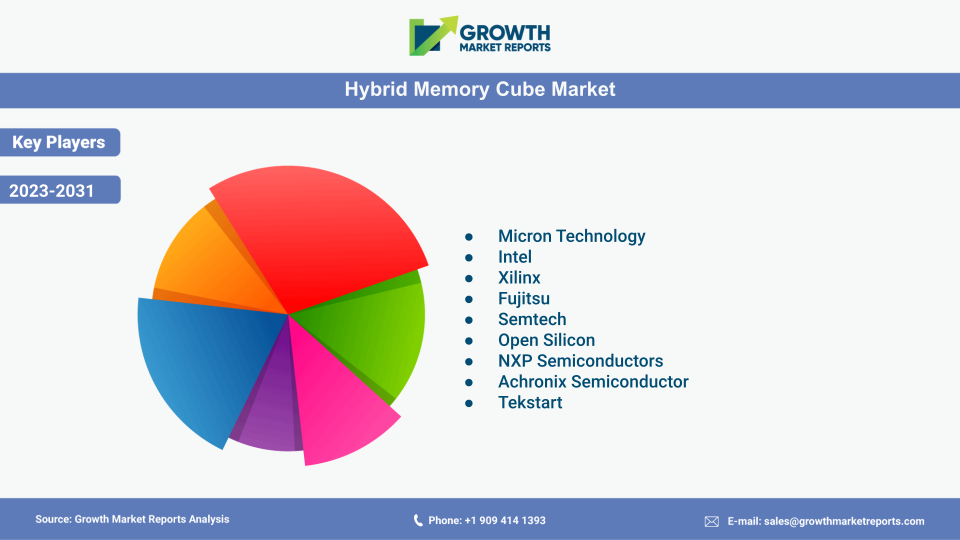
Key players competing in the hybrid memory cube market include Micron Technology, Intel, Xilinx, Fujitsu, Semtech, Open Silicon, NXP Semiconductors, Achronix Semiconductor and Tekstart. Some of these players are using several market strategies such as mergers, acquisitions, partnerships, collaborations, capacity expansion, and product launches to enhance their market shares. For instances,

September 2018 – A field trial conducted by Fujitsu for a memory expansion technology in India-based Sify Technologies Ltd's data center. This memory expansion trial stated that by applying this technology to a server, a system performance equivalent to that of 10 servers can be achieved. As a result, the system performance was improved up to 3.6 times.

Hybrid Memory Cube Market Key Players

Frequently Asked Questions

Yes, the Hybrid Memory Cube market research report can be customized according to specific requirements.

HMC offers significantly higher bandwidth and energy efficiency due to its 3D architecture and through-silicon via (TSV) technology, making it superior to conventional DRAM for high-performance and data-intensive applications.

Major companies include Micron Technology, Samsung Electronics, Intel Corporation, SK Hynix, Xilinx (AMD), Open-Silicon (SiFive), Mellanox Technologies, IBM, Fujitsu, Microsoft, Cisco, AMD, NVIDIA, Rambus, Marvell, ARM, Cadence, Mentor Graphics, STMicroelectronics, and Broadcom.

Opportunities include integration with AI, machine learning, edge computing, and emerging memory technologies. Challenges include higher costs compared to traditional memory and integration with existing hardware and software.

North America currently dominates the market, accounting for around 42% of the global share, followed by Asia Pacific (the fastest-growing region), Europe, Latin America, and the Middle East & Africa.

HMC technology is increasingly used in smart devices, gaming consoles, and AR/VR applications to deliver high bandwidth and low power consumption, enhancing device performance and user experience.

The market is segmented into Hybrid Memory Cube Controllers, Hybrid Memory Cube Modules, and Others (such as interposers, connectors, and custom solutions). HMC modules hold the largest market share.

Primary adopters include IT & telecommunications, high-performance computing, data centers, consumer electronics, automotive (especially ADAS and autonomous driving), healthcare, and defense & military sectors.

Key growth drivers include the rising demand for high-bandwidth, low-latency memory in high-performance computing, data centers, AI and machine learning workloads, the proliferation of smart devices, and the expansion of 5G networks.

The global Hybrid Memory Cube (HMC) market was valued at USD 1.34 billion in 2024 and is projected to reach USD 11.06 billion by 2033, growing at a CAGR of 25.8% from 2025 to 2033.

Table Of Content

Chapter 1 Executive Summary
Chapter 2 Assumptions and Acronyms Used
Chapter 3 Research Methodology
Chapter 4 Hybrid Memory Cube Market Overview
   4.1 Introduction
      4.1.1 Market Taxonomy
      4.1.2 Market Definition
      4.1.3 Macro-Economic Factors Impacting the Market Growth
   4.2 Hybrid Memory Cube Market Dynamics
      4.2.1 Market Drivers
      4.2.2 Market Restraints
      4.2.3 Market Opportunity
   4.3 Hybrid Memory Cube Market - Supply Chain Analysis
      4.3.1 List of Key Suppliers
      4.3.2 List of Key Distributors
      4.3.3 List of Key Consumers
   4.4 Key Forces Shaping the Hybrid Memory Cube Market
      4.4.1 Bargaining Power of Suppliers
      4.4.2 Bargaining Power of Buyers
      4.4.3 Threat of Substitution
      4.4.4 Threat of New Entrants
      4.4.5 Competitive Rivalry
   4.5 Global Hybrid Memory Cube Market Size & Forecast, 2023-2032
      4.5.1 Hybrid Memory Cube Market Size and Y-o-Y Growth
      4.5.2 Hybrid Memory Cube Market Absolute $ Opportunity

Chapter 5 Global Hybrid Memory Cube Market Analysis and Forecast By Product Type
   5.1 Introduction
      5.1.1 Key Market Trends & Growth Opportunities By Product Type
      5.1.2 Basis Point Share (BPS) Analysis By Product Type
      5.1.3 Absolute $ Opportunity Assessment By Product Type
   5.2 Hybrid Memory Cube Market Size Forecast By Product Type
      5.2.1 Hybrid Memory Cube Controllers
      5.2.2 Hybrid Memory Cube Modules
      5.2.3 Others
   5.3 Market Attractiveness Analysis By Product Type

Chapter 6 Global Hybrid Memory Cube Market Analysis and Forecast By Application
   6.1 Introduction
      6.1.1 Key Market Trends & Growth Opportunities By Application
      6.1.2 Basis Point Share (BPS) Analysis By Application
      6.1.3 Absolute $ Opportunity Assessment By Application
   6.2 Hybrid Memory Cube Market Size Forecast By Application
      6.2.1 Consumer Electronics
      6.2.2 High-Performance Computing
      6.2.3 Networking & Data Centers
      6.2.4 Industrial
      6.2.5 Others
   6.3 Market Attractiveness Analysis By Application

Chapter 7 Global Hybrid Memory Cube Market Analysis and Forecast By End-User
   7.1 Introduction
      7.1.1 Key Market Trends & Growth Opportunities By End-User
      7.1.2 Basis Point Share (BPS) Analysis By End-User
      7.1.3 Absolute $ Opportunity Assessment By End-User
   7.2 Hybrid Memory Cube Market Size Forecast By End-User
      7.2.1 IT & Telecommunication
      7.2.2 Healthcare
      7.2.3 Automotive
      7.2.4 Defense & Military
      7.2.5 Others
   7.3 Market Attractiveness Analysis By End-User

Chapter 8 Global Hybrid Memory Cube Market Analysis and Forecast by Region
   8.1 Introduction
      8.1.1 Key Market Trends & Growth Opportunities By Region
      8.1.2 Basis Point Share (BPS) Analysis By Region
      8.1.3 Absolute $ Opportunity Assessment By Region
   8.2 Hybrid Memory Cube Market Size Forecast By Region
      8.2.1 North America
      8.2.2 Europe
      8.2.3 Asia Pacific
      8.2.4 Latin America
      8.2.5 Middle East & Africa (MEA)
   8.3 Market Attractiveness Analysis By Region

Chapter 9 Coronavirus Disease (COVID-19) Impact 
   9.1 Introduction 
   9.2 Current & Future Impact Analysis 
   9.3 Economic Impact Analysis 
   9.4 Government Policies 
   9.5 Investment Scenario

Chapter 10 North America Hybrid Memory Cube Analysis and Forecast
   10.1 Introduction
   10.2 North America Hybrid Memory Cube Market Size Forecast by Country
      10.2.1 U.S.
      10.2.2 Canada
   10.3 Basis Point Share (BPS) Analysis by Country
   10.4 Absolute $ Opportunity Assessment by Country
   10.5 Market Attractiveness Analysis by Country
   10.6 North America Hybrid Memory Cube Market Size Forecast By Product Type
      10.6.1 Hybrid Memory Cube Controllers
      10.6.2 Hybrid Memory Cube Modules
      10.6.3 Others
   10.7 Basis Point Share (BPS) Analysis By Product Type 
   10.8 Absolute $ Opportunity Assessment By Product Type 
   10.9 Market Attractiveness Analysis By Product Type
   10.10 North America Hybrid Memory Cube Market Size Forecast By Application
      10.10.1 Consumer Electronics
      10.10.2 High-Performance Computing
      10.10.3 Networking & Data Centers
      10.10.4 Industrial
      10.10.5 Others
   10.11 Basis Point Share (BPS) Analysis By Application 
   10.12 Absolute $ Opportunity Assessment By Application 
   10.13 Market Attractiveness Analysis By Application
   10.14 North America Hybrid Memory Cube Market Size Forecast By End-User
      10.14.1 IT & Telecommunication
      10.14.2 Healthcare
      10.14.3 Automotive
      10.14.4 Defense & Military
      10.14.5 Others
   10.15 Basis Point Share (BPS) Analysis By End-User 
   10.16 Absolute $ Opportunity Assessment By End-User 
   10.17 Market Attractiveness Analysis By End-User

Chapter 11 Europe Hybrid Memory Cube Analysis and Forecast
   11.1 Introduction
   11.2 Europe Hybrid Memory Cube Market Size Forecast by Country
      11.2.1 Germany
      11.2.2 France
      11.2.3 Italy
      11.2.4 U.K.
      11.2.5 Spain
      11.2.6 Russia
      11.2.7 Rest of Europe
   11.3 Basis Point Share (BPS) Analysis by Country
   11.4 Absolute $ Opportunity Assessment by Country
   11.5 Market Attractiveness Analysis by Country
   11.6 Europe Hybrid Memory Cube Market Size Forecast By Product Type
      11.6.1 Hybrid Memory Cube Controllers
      11.6.2 Hybrid Memory Cube Modules
      11.6.3 Others
   11.7 Basis Point Share (BPS) Analysis By Product Type 
   11.8 Absolute $ Opportunity Assessment By Product Type 
   11.9 Market Attractiveness Analysis By Product Type
   11.10 Europe Hybrid Memory Cube Market Size Forecast By Application
      11.10.1 Consumer Electronics
      11.10.2 High-Performance Computing
      11.10.3 Networking & Data Centers
      11.10.4 Industrial
      11.10.5 Others
   11.11 Basis Point Share (BPS) Analysis By Application 
   11.12 Absolute $ Opportunity Assessment By Application 
   11.13 Market Attractiveness Analysis By Application
   11.14 Europe Hybrid Memory Cube Market Size Forecast By End-User
      11.14.1 IT & Telecommunication
      11.14.2 Healthcare
      11.14.3 Automotive
      11.14.4 Defense & Military
      11.14.5 Others
   11.15 Basis Point Share (BPS) Analysis By End-User 
   11.16 Absolute $ Opportunity Assessment By End-User 
   11.17 Market Attractiveness Analysis By End-User

Chapter 12 Asia Pacific Hybrid Memory Cube Analysis and Forecast
   12.1 Introduction
   12.2 Asia Pacific Hybrid Memory Cube Market Size Forecast by Country
      12.2.1 China
      12.2.2 Japan
      12.2.3 South Korea
      12.2.4 India
      12.2.5 Australia
      12.2.6 South East Asia (SEA)
      12.2.7 Rest of Asia Pacific (APAC)
   12.3 Basis Point Share (BPS) Analysis by Country
   12.4 Absolute $ Opportunity Assessment by Country
   12.5 Market Attractiveness Analysis by Country
   12.6 Asia Pacific Hybrid Memory Cube Market Size Forecast By Product Type
      12.6.1 Hybrid Memory Cube Controllers
      12.6.2 Hybrid Memory Cube Modules
      12.6.3 Others
   12.7 Basis Point Share (BPS) Analysis By Product Type 
   12.8 Absolute $ Opportunity Assessment By Product Type 
   12.9 Market Attractiveness Analysis By Product Type
   12.10 Asia Pacific Hybrid Memory Cube Market Size Forecast By Application
      12.10.1 Consumer Electronics
      12.10.2 High-Performance Computing
      12.10.3 Networking & Data Centers
      12.10.4 Industrial
      12.10.5 Others
   12.11 Basis Point Share (BPS) Analysis By Application 
   12.12 Absolute $ Opportunity Assessment By Application 
   12.13 Market Attractiveness Analysis By Application
   12.14 Asia Pacific Hybrid Memory Cube Market Size Forecast By End-User
      12.14.1 IT & Telecommunication
      12.14.2 Healthcare
      12.14.3 Automotive
      12.14.4 Defense & Military
      12.14.5 Others
   12.15 Basis Point Share (BPS) Analysis By End-User 
   12.16 Absolute $ Opportunity Assessment By End-User 
   12.17 Market Attractiveness Analysis By End-User

Chapter 13 Latin America Hybrid Memory Cube Analysis and Forecast
   13.1 Introduction
   13.2 Latin America Hybrid Memory Cube Market Size Forecast by Country
      13.2.1 Brazil
      13.2.2 Mexico
      13.2.3 Rest of Latin America (LATAM)
   13.3 Basis Point Share (BPS) Analysis by Country
   13.4 Absolute $ Opportunity Assessment by Country
   13.5 Market Attractiveness Analysis by Country
   13.6 Latin America Hybrid Memory Cube Market Size Forecast By Product Type
      13.6.1 Hybrid Memory Cube Controllers
      13.6.2 Hybrid Memory Cube Modules
      13.6.3 Others
   13.7 Basis Point Share (BPS) Analysis By Product Type 
   13.8 Absolute $ Opportunity Assessment By Product Type 
   13.9 Market Attractiveness Analysis By Product Type
   13.10 Latin America Hybrid Memory Cube Market Size Forecast By Application
      13.10.1 Consumer Electronics
      13.10.2 High-Performance Computing
      13.10.3 Networking & Data Centers
      13.10.4 Industrial
      13.10.5 Others
   13.11 Basis Point Share (BPS) Analysis By Application 
   13.12 Absolute $ Opportunity Assessment By Application 
   13.13 Market Attractiveness Analysis By Application
   13.14 Latin America Hybrid Memory Cube Market Size Forecast By End-User
      13.14.1 IT & Telecommunication
      13.14.2 Healthcare
      13.14.3 Automotive
      13.14.4 Defense & Military
      13.14.5 Others
   13.15 Basis Point Share (BPS) Analysis By End-User 
   13.16 Absolute $ Opportunity Assessment By End-User 
   13.17 Market Attractiveness Analysis By End-User

Chapter 14 Middle East & Africa (MEA) Hybrid Memory Cube Analysis and Forecast
   14.1 Introduction
   14.2 Middle East & Africa (MEA) Hybrid Memory Cube Market Size Forecast by Country
      14.2.1 Saudi Arabia
      14.2.2 South Africa
      14.2.3 UAE
      14.2.4 Rest of Middle East & Africa (MEA)
   14.3 Basis Point Share (BPS) Analysis by Country
   14.4 Absolute $ Opportunity Assessment by Country
   14.5 Market Attractiveness Analysis by Country
   14.6 Middle East & Africa (MEA) Hybrid Memory Cube Market Size Forecast By Product Type
      14.6.1 Hybrid Memory Cube Controllers
      14.6.2 Hybrid Memory Cube Modules
      14.6.3 Others
   14.7 Basis Point Share (BPS) Analysis By Product Type 
   14.8 Absolute $ Opportunity Assessment By Product Type 
   14.9 Market Attractiveness Analysis By Product Type
   14.10 Middle East & Africa (MEA) Hybrid Memory Cube Market Size Forecast By Application
      14.10.1 Consumer Electronics
      14.10.2 High-Performance Computing
      14.10.3 Networking & Data Centers
      14.10.4 Industrial
      14.10.5 Others
   14.11 Basis Point Share (BPS) Analysis By Application 
   14.12 Absolute $ Opportunity Assessment By Application 
   14.13 Market Attractiveness Analysis By Application
   14.14 Middle East & Africa (MEA) Hybrid Memory Cube Market Size Forecast By End-User
      14.14.1 IT & Telecommunication
      14.14.2 Healthcare
      14.14.3 Automotive
      14.14.4 Defense & Military
      14.14.5 Others
   14.15 Basis Point Share (BPS) Analysis By End-User 
   14.16 Absolute $ Opportunity Assessment By End-User 
   14.17 Market Attractiveness Analysis By End-User

Chapter 15 Competition Landscape 
   15.1 Hybrid Memory Cube Market: Competitive Dashboard
   15.2 Global Hybrid Memory Cube Market: Market Share Analysis, 2023
   15.3 Company Profiles (Details – Overview, Financials, Developments, Strategy) 
      15.3.1 Micron Technology, Inc.
Intel Corporation
Samsung Electronics Co., Ltd.
SK Hynix Inc.
Xilinx, Inc.
Open-Silicon, Inc.
Mellanox Technologies Ltd.
IBM Corporation
Fujitsu Ltd.
Microsoft Corporation
Cisco Systems, Inc.
Advanced Micro Devices, Inc. (AMD)
NVIDIA Corporation
Rambus Inc.
Marvell Technology Group Ltd.
ARM Holdings plc
Cadence Design Systems, Inc.
Mentor Graphics Corporation
STMicroelectronics N.V.
Broadcom Inc.

Methodology

Our Clients

General Electric
Honda Motor Co. Ltd.
FedEx Logistics
Siemens Healthcare
The John Holland Group
Deloitte
Nestle SA
Dassault Aviation