
Floating Nuclear Power Desalination Market Size, Share & Growth Analysis, 2026-2034
Floating Nuclear Power Desalination Market Size, Share & Growth Analysis, 2026-2034
Segments - by Reactor Type (Small Modular Reactors, Microreactors, Conventional Reactors), by Application (Seawater Desalination, Industrial Water Supply, Emergency Water Supply, Others), by Water Production Capacity (Up to 50, 000 m³/day, 50, 001–100, 000 m³/day, Above 100, 000 m³/day), by Deployment (Nearshore, Offshore), by End-User (Municipal, Industrial, Military, Others)



Last Updated : Jun, 2026
| Report ID :EP-41873
| 4.5 Rating
| 11 Reviews
| 276 Pages
| Format :


Floating Nuclear Power Desalination Market: Key Numbers
The Floating Nuclear Power Desalination market was valued at USD 2.4 Billion in 2025 and is projected to reach USD 7.7 Billion by 2034, a CAGR of 13.7%.
| Market size (2025) | USD 2.4 Billion |
|---|---|
| Forecast (2034) | USD 7.7 Billion |
| CAGR (2026-2034) | 13.7% |
| Largest region | Asia Pacific (41% share) |
| Segments covered | Reactor Type, Application, Water Production Capacity, Deployment, End-User |
| Key companies | Rosatom, China National Nuclear Corporation (CNNC), Korea Hydro and Nuclear Power (KHNP), GE Hitachi Nuclear Energy, Westinghouse Electric Company |
This report is updated with the latest market data and insights as of June 2026. Base year: 2025 | Forecast period: 2026-2034
Floating Nuclear Power Desalination Market Size and Growth Outlook
Growth Market Reports finds that the global floating nuclear power desalination market size reached USD 2.4 billion in 2025, driven by intensifying demand for sustainable water resources, low-carbon energy solutions, and resilient coastal infrastructure. The market is expected to grow at a robust CAGR of 13.7% from 2026 to 2034, with the market size projected to reach USD 7.7 billion by 2034. This impressive expansion is primarily propelled by the convergence of worsening water scarcity, accelerating advances in nuclear technology, and the rising need for decentralized, mobile water infrastructure in coastal and isolated regions. The parallel growth of the broader floating nuclear plant sector is also creating significant technology spillovers and shared investment momentum that benefits the desalination segment directly.

One of the most significant growth factors for the floating nuclear power desalination market is the escalating global water crisis, particularly in arid and densely populated coastal regions. As freshwater resources become increasingly strained due to climate change, population growth, and industrialization, governments and private stakeholders are urgently seeking innovative solutions to ensure water security. Floating nuclear desalination platforms offer a unique advantage by providing high-volume, reliable, and emission-free water production without competing for valuable land resources. Additionally, these platforms can be strategically relocated to areas experiencing acute water shortages, making them a flexible and adaptive solution in a rapidly changing world.
Technological advancements in nuclear reactor design, especially the development of small modular reactors (SMRs) and microreactors, have significantly enhanced the feasibility and safety of floating nuclear desalination plants. These next-generation reactors are characterized by their compactness, scalability, and inherently safe designs, which reduce the risk of accidents and facilitate deployment in maritime environments. The integration of advanced desalination technologies, such as reverse osmosis and multi-effect distillation, with nuclear power further improves efficiency and reduces operational costs. This synergy between nuclear and desalination technologies is attracting substantial investments from both public and private sectors, accelerating market adoption through 2034. Stakeholders comparing alternatives are also evaluating floating solar-powered desalination approaches, which are reinforcing the broader investment case for maritime water production platforms of all types.
Another critical driver is the increasing focus on energy diversification and decarbonization. Floating nuclear power desalination units support the global transition towards low-carbon energy sources by replacing fossil-fuel-powered desalination plants, which are widely criticized for their high greenhouse gas emissions. Furthermore, these floating units can be deployed near industrial clusters, ports, and military bases, providing a secure and uninterrupted supply of both water and energy. This dual functionality is especially valuable for island nations, remote coastal communities, and regions prone to natural disasters, where traditional infrastructure may be vulnerable or inadequate.
The emergence of Nuclear-Powered Hydrogen production is poised to further enhance the value proposition of floating nuclear power desalination by enabling platforms to simultaneously deliver desalinated water and clean hydrogen. Harnessing surplus nuclear-generated electricity for hydrogen electrolysis, these multi-output platforms address both water and clean energy challenges in a single deployable unit. This integration not only strengthens economic viability but also reinforces global decarbonization commitments by providing a low-carbon alternative to conventional hydrogen production. Investors and project developers are recognizing the compounding value of co-locating hydrogen production, power generation, and desalination on a single floating platform, and this recognition is expected to accelerate capital flows into the sector through the forecast period.
From a regional perspective, Asia Pacific is the dominant market for floating nuclear power desalination, fueled by rapid urbanization, chronic water shortages, and strong governmental support for nuclear innovation. Countries such as China, India, and South Korea are investing heavily in research, pilot projects, and commercial deployments. Meanwhile, the Middle East and Africa, with their arid climates and high desalination needs, are actively exploring floating nuclear solutions as a cornerstone of broader water security strategies. North America and Europe, while more cautious due to regulatory and public acceptance considerations, are witnessing growing interest in the technology for remote and emergency applications, with defense and disaster-response use cases drawing particular attention from policymakers.
Floating Nuclear Power Desalination Market by Reactor Type
The reactor type segment is a cornerstone of the floating nuclear power desalination market, encompassing small modular reactors (SMRs), microreactors, and conventional reactors. Small modular reactors dominate this segment, accounting for approximately 54.5% of the reactor type market share in 2025, owing to their compact size, modular construction, and enhanced passive safety features. SMRs are specifically engineered for scalability and ease of maritime deployment, making them ideal for integration onto floating platforms. Their comparatively lower capital investment requirements, relative to conventional reactors, allow for incremental capacity additions based on demand, which is particularly advantageous for regions with growing or fluctuating water needs. Passive cooling systems and reduced core inventory in modern SMR designs address longstanding public concerns about nuclear safety, further supporting rapid adoption in floating applications.
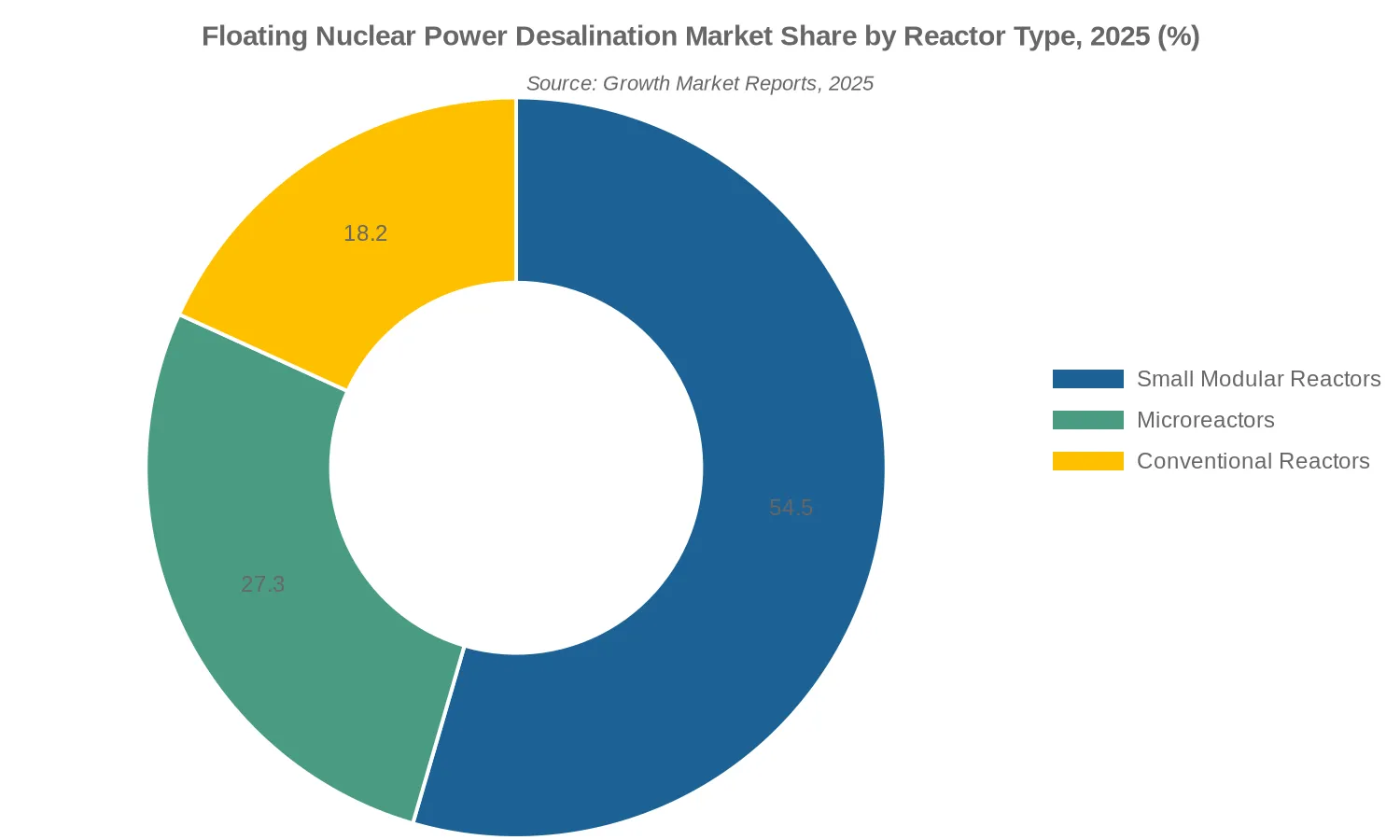
Microreactors hold approximately 27.3% of the reactor type segment in 2025 and are gaining momentum as a disruptive technology. Their ultra-compact design and ability to operate autonomously for extended periods make them well-suited for smaller-scale desalination projects, emergency deployments, and remote locations where rapid response is essential. Microreactors can be transported and commissioned quickly, offering a decisive advantage in disaster response and temporary water supply scenarios. Simplified systems and minimal staffing requirements reduce operational complexity and costs, making them attractive for both governmental and commercial operators. Companies exploring complementary portable water production systems, including those developing mobile water desalination infrastructure, are increasingly evaluating microreactor integration as a power source option that eliminates dependence on fossil fuels.
Conventional reactors retain roughly 18.2% of the reactor type segment in 2025 and remain relevant in scenarios requiring massive water output with substantial governmental backing and well-developed maritime support infrastructure. These reactors offer proven reliability and high thermal output, but their larger physical footprint, higher capital requirements, and more complex regulatory pathways limit their applicability in floating environments. Deployment is typically restricted to large-scale, long-term projects where sustained water production volumes justify the significant investment involved. Over the 2026-2034 forecast period, the segment balance is expected to shift further in favor of SMRs and microreactors, driven by their superior adaptability, improved economics, and accelerating regulatory acceptance.
The competitive landscape within the reactor type segment is characterized by intense innovation and collaboration among nuclear technology providers, maritime engineering firms, and desalination specialists. Strategic partnerships are being formed to combine expertise in reactor safety, marine vessel design, and water treatment processes. The drive for standardization and international regulatory harmonization is influencing the pace of commercialization, as stakeholders seek to streamline approval processes and demonstrate the safe, secure operation of floating nuclear desalination units at scale. As the market matures through 2034, SMRs and microreactors are firmly positioned as the preferred technology pathway, supported by superior adaptability, cost-effectiveness, and alignment with national decarbonization agendas.
Floating Nuclear Power Desalination Market Report Scope
| Attributes | Details |
| Report Title | Floating Nuclear Power Desalination Market Research Report 2034 |
| By Reactor Type | Small Modular Reactors, Microreactors, Conventional Reactors |
| By Application | Seawater Desalination, Industrial Water Supply, Emergency Water Supply, Others |
| By Water Production Capacity | Up to 50,000 m³/day, 50,001-100,000 m³/day, Above 100,000 m³/day |
| By Deployment | Nearshore, Offshore |
| By End-User | Municipal, Industrial, Military, Others |
| Regions Covered | North America, Europe, APAC, Latin America, MEA |
| Base Year | 2025 |
| Historic Data | 2019-2024 |
| Forecast Period | 2026-2034 |
| Number of Pages | 276 |
| Number of Tables & Figures | 290 |
| Customization Available | Yes, the report can be customized as per your need. |
Floating Nuclear Power Desalination Market by Application
The application segment of the floating nuclear power desalination market is broadly categorized into seawater desalination, industrial water supply, emergency water supply, and others. Seawater desalination represents the largest and most dynamic application, as coastal and island regions grapple with chronic water shortages exacerbated by climate change and population growth. Floating nuclear platforms provide a sustainable, high-capacity solution to convert seawater into potable water, supporting municipal water systems and reducing reliance on overexploited groundwater sources. The ability to relocate these units in response to shifting demand patterns or environmental emergencies adds a layer of resilience that traditional land-based desalination plants cannot match. This mobility advantage also draws comparisons with rapidly advancing deployable desalination hybrid systems, though floating nuclear platforms deliver vastly greater output capacity and operational endurance.
Industrial water supply is another critical application, particularly in sectors such as petrochemicals, mining, and power generation, where large volumes of process water are required on a continuous basis. Floating nuclear desalination plants can be stationed near industrial clusters or major ports, providing a dedicated and uninterrupted water supply that is independent of local freshwater resources. This capability is especially valuable in regions where industrial growth is constrained by water scarcity, enabling economic development while minimizing environmental impact. The integration of floating nuclear units with industrial operations also opens opportunities for cogeneration, where both electricity and desalinated water are produced simultaneously, significantly enhancing overall system efficiency and financial returns.
Emergency water supply is a fast-growing application area, driven by the increasing frequency of extreme weather events, natural disasters, humanitarian crises, and conflict situations. Floating nuclear desalination platforms can be rapidly deployed to disaster-stricken regions, providing immediate relief by supplying clean water to affected populations. Their mobility and energy self-sufficiency make them exceptionally well-suited for scenarios where traditional infrastructure has been damaged or destroyed. Governments and international aid organizations are increasingly recognizing the strategic value of these platforms in disaster preparedness planning, leading to pilot projects and feasibility assessments aimed at embedding floating nuclear desalination into national and international emergency response frameworks over the 2026-2034 period.
Other applications, including agricultural irrigation support and water provision for remote and island communities, are gaining traction as the technology matures and costs decline. The versatility of floating nuclear power desalination units enables them to address a wide range of water needs, from sustaining food production in drought-prone coastal regions to ensuring water security for isolated settlements beyond the reach of conventional grid-connected desalination infrastructure. As awareness of the technology's breadth of potential grows among policymakers, project developers, and international financiers, new use cases are expected to emerge continuously, further expanding the addressable market and stimulating design innovation through 2034.
Floating Nuclear Power Desalination Market by Water Production Capacity
The water production capacity segment is divided into up to 50,000 m³/day, 50,001-100,000 m³/day, and above 100,000 m³/day. Units with a capacity of up to 50,000 m³/day are primarily targeted at small to medium-sized municipalities, remote communities, military installations, and emergency response scenarios. These units offer a practical balance of mobility, scalability, and cost-effectiveness, making them suitable for a wide variety of deployment contexts. Their relatively compact footprint enables easier integration with existing port infrastructure and coastal logistics networks, while still delivering meaningful volumes of potable water to meet local demand. The growing interest in rapidly deployable platforms is also reflected in parallel advances in wave-powered desalination technology, which complements smaller-capacity floating nuclear units in hybrid coastal water security strategies.
The 50,001-100,000 m³/day capacity segment serves larger urban centers, industrial zones, and regions with moderate to high water demand. These units are designed to function as backbone suppliers for municipal water systems or as dedicated water providers for major industrial clusters. Increased output enables meaningful economies of scale, reducing the per-unit cost of desalinated water and enhancing the financial viability of floating nuclear desalination projects. The ability to configure multiple modular units in tandem adds operational flexibility, allowing operators to scale capacity in response to changing demand patterns or seasonal fluctuations without committing to an entirely new platform investment.
Above 100,000 m³/day capacity units represent the upper tier of the market, targeting mega-cities, large-scale industrial complexes, and regions facing severe, structural water scarcity. These high-capacity platforms require advanced engineering, robust structural integrity, and layered safety systems to ensure reliable continuous operation in demanding maritime environments. Deployment of such large-scale units is typically supported by substantial governmental or multinational financing, given the significant capital requirements and long-term operational commitments involved. However, their ability to deliver transformative quantities of potable water at scale positions them as a foundational element of national water security strategies in heavily water-stressed regions, particularly across the Middle East, South Asia, and North Africa through the forecast period.
The selection of water production capacity is shaped by local water demand projections, available maritime and port infrastructure, applicable regulatory requirements, and the financial parameters of each project. Operators must carefully evaluate the trade-offs between capacity, platform mobility, and total cost of ownership to identify the optimal configuration. As technological advancements in reactor miniaturization and desalination process efficiency continue to drive down unit economics, adoption is expected to accelerate across all three capacity segments, with modular and scalable solutions attracting the broadest interest from project developers and government procurers through 2034.
Floating Nuclear Power Desalination Market by Deployment
The deployment segment is categorized into nearshore and offshore installations, each presenting distinct operational advantages and logistical considerations. Nearshore deployments currently dominate the market, benefiting from proximity to established port infrastructure, straightforward access for routine maintenance and crew rotation, and reduced supply chain complexity. These installations can be efficiently connected to municipal water distribution grids or industrial facility intake systems, streamlining the delivery of desalinated water to end-users. Nearshore floating nuclear desalination units are particularly well-suited to densely populated coastal cities and industrial hubs where land availability is constrained and potable water demand is high and growing.
Offshore deployments, while less prevalent in 2025, are attracting growing interest due to their potential to serve remote islands, offshore hydrocarbon and mining operations, and coastal regions where near-coast land is environmentally protected or politically sensitive. Offshore units are engineered for extended autonomous operation, with enhanced structural integrity and redundant safety systems designed to withstand severe marine conditions, including extreme weather and seismic events. The logistical challenges associated with offshore deployment, including specialized vessel support, subsea mooring, and remote maintenance protocols, are progressively being addressed through advances in marine engineering and digital remote monitoring, gradually expanding the viable addressable market for offshore floating nuclear desalination.
The decision between nearshore and offshore deployment is governed by a combination of local regulatory frameworks, environmental sensitivity assessments, end-user proximity requirements, and the economic parameters of each project. Nearshore configurations are generally preferred for their lower operational overhead and easier infrastructure integration, while offshore configurations offer greater strategic flexibility and reduced visual and environmental impact on populated coastlines. Ongoing advances in maritime engineering, autonomous monitoring systems, and predictive maintenance analytics are steadily reducing the cost and complexity gap between the two deployment modes, expanding the commercially viable envelope for offshore projects through 2034.
Hybrid deployment models are also emerging, combining the logistical convenience of nearshore operations with the environmental and strategic benefits of offshore positioning. These models leverage modular platform architectures, dynamic positioning systems, and integrated supply chain frameworks to optimize performance across both nearshore and offshore contexts. The increasing emphasis on climate resilience, disaster preparedness, and environmental stewardship is expected to continue driving innovation in deployment engineering, enabling floating nuclear desalination units to address an expanding range of geographic and operational scenarios effectively through the forecast period.
Floating Nuclear Power Desalination Market by End-User
The end-user segment of the floating nuclear power desalination market includes municipal, industrial, military, and other stakeholders. Municipal end-users represent the largest share of demand, as city governments and water utilities across water-stressed coastal regions seek scalable, reliable, and low-carbon solutions to address chronic urban water deficits. Floating nuclear desalination platforms offer municipalities the ability to rapidly expand water supply capacity without requiring large land acquisitions or extensive onshore civil works, making them particularly attractive for densely populated coastal cities in Asia, the Middle East, and Latin America. The operational flexibility to relocate platforms in response to shifting population centers or environmental conditions adds further strategic value for municipal water managers.
Industrial end-users are increasingly incorporating floating nuclear desalination into their water security strategies, particularly in the petrochemical, mining, power generation, and heavy manufacturing sectors. Industries operating in water-constrained coastal or island environments face material operational risks from unreliable freshwater availability, and floating nuclear units provide a dedicated, high-reliability water source independent of increasingly stressed municipal supply systems. The cogeneration capability of nuclear platforms, producing both electricity and desalinated water simultaneously, offers additional economic and environmental advantages that align with corporate sustainability targets and operational efficiency imperatives. Comparisons with renewable-powered thermal desalination options reinforce the cost-competitiveness of nuclear alternatives for large-scale industrial baseload water demand.
Military end-users represent a specialized but strategically important and growing segment, driven by the need for secure, autonomous, and resilient water supplies at forward operating bases, naval installations, and expeditionary positions. Military operations frequently occur in regions with extremely limited freshwater access, making self-contained floating nuclear desalination platforms highly attractive for defense planners. The mobility, energy independence, and rapid deployment characteristics of these units align closely with military doctrines of operational flexibility and logistical self-sufficiency. National defense agencies in the United States, China, Russia, France, and South Korea are actively funding research and feasibility assessments to evaluate the integration of floating nuclear desalination into their strategic infrastructure portfolios.
Other end-users, including humanitarian organizations, disaster relief agencies, and isolated island communities beyond the reach of conventional water infrastructure, are also expanding their engagement with the technology. The capacity of floating nuclear platforms to deliver clean water in challenging and rapidly changing environments, combined with their inherent scalability and energy self-sufficiency, positions them as a uniquely powerful tool for addressing diverse and evolving water security challenges globally. As the market continues to mature and cost curves decline through 2034, end-user demand is expected to diversify further, stimulating ongoing innovation in platform configurations, service and financing models, and operational support frameworks.
Floating Nuclear Power Desalination Market Opportunities and Threats
The floating nuclear power desalination market presents substantial opportunities for stakeholders across the value chain. One of the most significant lies in the integration of advanced SMR and microreactor technologies with next-generation desalination processes to simultaneously address water scarcity and energy decarbonization. As governments worldwide accelerate their clean energy and water security commitments post-2025, floating nuclear desalination platforms stand uniquely positioned as multi-output infrastructure assets delivering potable water, baseload electricity, and in some configurations clean hydrogen. The growing commercialization of SMRs, coupled with continuous efficiency improvements in reverse osmosis and multi-effect distillation, is expected to drive meaningful cost reductions across the 2026-2034 forecast period, expanding the market's reach to new geographies and end-user categories that were previously economically unviable.
Another major opportunity lies in the formation of public-private partnerships and international cooperation frameworks for the co-development and financing of floating nuclear desalination projects. The convergence of development finance institutions, sovereign wealth funds, nuclear technology exporters, and multilateral climate finance mechanisms is creating a favorable environment for large-scale project investment. The establishment of internationally harmonized safety standards and licensing frameworks, currently being advanced through organizations such as the IAEA, will further reduce regulatory risk and accelerate commercialization timelines. The growing integration of digital twin technology, real-time remote monitoring, and AI-driven predictive maintenance is also creating new service and operational efficiency opportunities that enhance long-term project economics and investor confidence.
Despite these compelling opportunities, the market faces several material constraints. Regulatory complexity remains the most formidable barrier, as deploying nuclear reactors in maritime environments requires simultaneous compliance with nuclear safety regulations, maritime law, environmental protection requirements, and bilateral or multilateral political agreements, all of which vary substantially by region and jurisdiction. Public perception and community acceptance of nuclear technology at sea continue to require proactive and transparent communication, particularly in Europe and parts of North America where historical nuclear incidents retain cultural resonance. High upfront capital expenditures, complex specialized supply chains, and the scarcity of ports equipped to commission and service floating nuclear platforms also constrain near-term deployment velocity. Managing nuclear waste at sea, ensuring cybersecurity of remotely operated systems, and engineering platforms to withstand extreme climate events are additional technical and operational challenges that the industry must credibly address to sustain long-term investor and government confidence through the forecast period.
Floating Nuclear Power Desalination Market Size by Region
Asia Pacific leads the floating nuclear power desalination market, accounting for approximately 41% of global market share in 2025, with a market value of approximately USD 984 million. The region's dominance is sustained by rapid urbanization, persistent freshwater deficits, and deep governmental commitment to nuclear energy innovation. China and its state-owned nuclear enterprises are advancing multiple SMR-based floating platform programs for both domestic coastal deployment and international export. India and South Korea are simultaneously investing in research collaborations, technology pilot programs, and port infrastructure upgrades to support future commercial deployments. The region's favorable policy environment, substantial public investment commitments, and large addressable water demand base support a projected CAGR of 15.2% for Asia Pacific through 2034.

The Middle East and Africa region, representing approximately 17.5% of the 2025 global market at a value of roughly USD 420 million, is the second-most dynamic growth region, supported by a projected CAGR of approximately 13.5% through 2034. The region's structural dependence on energy-intensive desalination, combined with an urgent need to decarbonize water production, is driving active exploration of floating nuclear options across Saudi Arabia, the UAE, Egypt, and several North African nations. International partnerships between regional governments and technology providers from Russia, China, France, and South Korea are already yielding feasibility studies and early-stage project development agreements that are expected to translate into commercial deployments during the forecast period.
North America held a 2025 market value of approximately USD 389 million, representing roughly 16.2% of the global total, with growth led by U.S. Department of Defense interest in resilient water supply for remote and forward military installations, as well as Department of Energy-backed SMR commercialization programs. Canada is exploring floating nuclear desalination for remote northern and coastal communities. Europe, with a 2025 market share of approximately 13.3% and a value of around USD 319 million, is focused primarily on advanced research programs, with France, the UK, and Finland examining floating nuclear integration as part of their broader nuclear renaissance strategies. Latin America, representing 12.0% of the 2025 market at a value of approximately USD 288 million, is progressing through early-stage feasibility assessments in coastal Brazil, Chile, and several Caribbean island nations where energy and water insecurity coexist and where floating platforms represent a potentially transformative infrastructure solution through 2034.
Floating Nuclear Power Desalination Market Competitive Landscape
The competitive landscape of the floating nuclear power desalination market in 2025 is shaped by a combination of established state-backed nuclear corporations, advanced technology developers, and maritime engineering specialists. Leading companies are leveraging proprietary expertise in reactor design, marine vessel engineering, and integrated water treatment to develop differentiated solutions that address the unique operational and regulatory challenges of floating nuclear desalination. The competitive environment is intensifying as the market transitions from demonstration-phase projects toward early commercial deployments, driving increased investment in product standardization, supply chain development, and international regulatory engagement. Strategic alliances and joint ventures are proliferating, as no single company possesses the full spectrum of competencies required to independently bring floating nuclear desalination projects from concept to commercial operation.
Innovation is the primary competitive differentiator, with leading players accelerating development of next-generation SMR platforms, advanced passive safety systems, and hybrid desalination process trains optimized for maritime environments. Companies are simultaneously pursuing new project delivery models, including build-own-operate-transfer structures and long-term water purchase agreements, to reduce offtaker financial risk and stimulate demand from municipalities and industrial users that lack the balance sheet to finance platform acquisition directly. The emerging convergence of digital operations, AI-enhanced predictive maintenance, and satellite-enabled remote monitoring is also creating new competitive battlegrounds in platform operations and lifecycle management services.
Rosatom remains the undisputed global pioneer, with its Akademik Lomonosov floating nuclear power plant providing a proven operational reference point that no competitor currently matches. The company is actively marketing its RITM-200 SMR technology for next-generation floating desalination applications across Asia, the Middle East, and Latin America. China National Nuclear Corporation is advancing multiple domestic floating SMR programs with explicit desalination integration, targeting both the Chinese coastal market and export opportunities across Belt and Road partner nations. NuScale Power, BWX Technologies, Rolls-Royce SMR, and Holtec International are the leading North American and European SMR developers, each pursuing maritime application pathways with growing urgency as commercial SMR deployments approach reality. Korea Hydro and Nuclear Power is integrating floating desalination research with South Korea's established maritime construction industry strengths, while Mitsubishi Heavy Industries and Doosan Enerbility are contributing critical vessel design and reactor component manufacturing capabilities across Asian and global project supply chains. GE Hitachi Nuclear Energy, Westinghouse Electric Company, Siemens Energy, EDF Group, and Technip Energies round out the competitive field with global project delivery capabilities, digital operations platforms, and specialized engineering services that are essential to the successful execution of complex floating nuclear desalination projects through 2034.
Top Companies in the Floating Nuclear Power Desalination Market
- Rosatom
- China National Nuclear Corporation (CNNC)
- Korea Hydro and Nuclear Power (KHNP)
- GE Hitachi Nuclear Energy
- Westinghouse Electric Company
- BWX Technologies, Inc.
- Rolls-Royce SMR
- Mitsubishi Heavy Industries
- Holtec International
- NuScale Power
- EDF Group
- Siemens Energy
- Shanghai Electric Group
- X-energy
- OKBM Afrikantov
- Technip Energies
- Doosan Enerbility
- Toshiba Energy Systems and Solutions Corporation
Segments
The Floating Nuclear Power Desalination market has been segmented on the basis of
Reactor Type
- Small Modular Reactors
- Microreactors
- Conventional Reactors
Application
- Seawater Desalination
- Industrial Water Supply
- Emergency Water Supply
- Others
Water Production Capacity
- Up to 50
- 000 m³/day
- 50
- 001–100
- 000 m³/day
- Above 100
- 000 m³/day
Deployment
- Nearshore
- Offshore
End-User
- Municipal
- Industrial
- Military
- Others
Frequently Asked Questions
Yes. Floating nuclear desalination platforms are highly adaptable and can be configured across multiple dimensions to meet specific end-user requirements. Reactor type and capacity can be selected based on water demand, ranging from compact microreactors suitable for remote communities or emergency deployments to larger SMR configurations serving major urban or industrial users. Desalination technology, whether reverse osmosis, multi-effect distillation, or hybrid processes, can be matched to the salinity and quality of the source water. Platform hull design, mooring systems, and water distribution interfaces can be engineered for nearshore or offshore deployment environments. Cogeneration configurations allowing simultaneous electricity and water production can be incorporated, and platforms can be designed to satisfy military-grade security, civilian municipal standards, or industrial process specifications.
Floating nuclear desalination platforms offer several compelling advantages over conventional land-based facilities. They eliminate competition for scarce coastal land, which is particularly valuable in densely populated or environmentally sensitive areas. Their mobility enables redeployment to locations experiencing acute water demand or post-disaster recovery needs, providing a flexibility that fixed infrastructure cannot match. These platforms produce zero direct greenhouse gas emissions, supporting national and corporate decarbonization targets. They can operate independently of local power grids, providing resilient water and energy supply even during grid failures. Furthermore, modular construction enables incremental capacity additions aligned with demand growth, reducing financial risk compared to large single-investment land-based plants.
The market is led by a concentrated group of established nuclear and maritime engineering companies. Rosatom, the pioneer of commercial floating nuclear power with its Akademik Lomonosov platform, remains the global benchmark. China National Nuclear Corporation is aggressively developing SMR-based floating platforms for both domestic and export markets. GE Hitachi Nuclear Energy, Westinghouse Electric Company, BWX Technologies, Rolls-Royce SMR, Holtec International, and NuScale Power are leading SMR and microreactor development in North America and Europe. Mitsubishi Heavy Industries, Doosan Enerbility, Korea Hydro and Nuclear Power, and Shanghai Electric Group are significant Asian players. EDF Group, Siemens Energy, and Technip Energies contribute integrated engineering and project delivery expertise across regions.
The market faces several significant challenges. Regulatory complexity is among the most critical, as deploying nuclear reactors in maritime environments involves navigating layered international, national, and maritime safety frameworks that differ substantially across jurisdictions. Public perception and acceptance of nuclear technology at sea remains a barrier in many regions, requiring sustained stakeholder engagement and transparent safety communication. High upfront capital costs, complex supply chains for specialized marine nuclear components, and the limited availability of ports equipped to service floating nuclear platforms also constrain near-term growth. Additionally, cybersecurity, nuclear waste management at sea, and extreme weather resilience requirements add operational complexity that market participants must address through 2034.
Seawater desalination is the dominant application, serving coastal municipalities and island communities facing chronic freshwater shortages. Industrial water supply is the second major application, with petrochemical, mining, and power generation sectors deploying floating nuclear units near operational clusters to secure dedicated process water independent of local freshwater systems. Emergency water supply is a fast-growing application, leveraging the mobility of floating platforms for rapid deployment during natural disasters, humanitarian crises, and conflict scenarios. Other applications, including agricultural irrigation support and water provision for remote communities, are also expanding as awareness of the technology grows through the 2026-2034 forecast period.
Floating desalination platforms utilize three principal reactor categories. Small modular reactors dominate, holding roughly 54.5% of the reactor type segment in 2025, due to their compact modular design, passive safety systems, and scalability. Microreactors account for approximately 27.3% of the segment and are gaining traction for smaller-scale, emergency, and rapidly deployable applications where autonomy and minimal staffing are priorities. Conventional reactors retain about 18.2% of the segment, primarily in large-scale, long-term projects where maximum water output is required and robust maritime infrastructure exists. The balance is expected to shift further toward SMRs and microreactors through 2034 as technology matures and costs decline.
Asia Pacific leads global adoption, accounting for approximately 41% of the market in 2025, with a market value of roughly USD 984 million. China, India, and South Korea are the primary growth engines, supported by strong governmental nuclear programs and acute water demand pressures. The Middle East and Africa region, representing about 17.5% of the 2025 market, is the second-fastest growing area, driven by the arid climates of Saudi Arabia, the UAE, and Egypt. North America (16.2%) and Europe (13.3%) are advancing more cautiously, focusing on remote, emergency, and defense applications, while Latin America (12.0%) is emerging with early-stage feasibility projects in coastal and island communities.
The primary drivers of the floating nuclear power desalination market include worsening global water scarcity, rising demand for low-carbon energy sources, and rapid advances in compact nuclear reactor design. Climate change is intensifying freshwater stress in arid coastal regions, pushing governments to seek high-capacity, reliable desalination alternatives. Simultaneously, the development of inherently safe small modular reactors and microreactors has dramatically improved the safety profile and economic feasibility of nuclear-powered maritime platforms. Policy support for decarbonization, combined with growing recognition of the dual water-and-energy value of these platforms, is also attracting substantial public and private investment through 2034.
The global floating nuclear power desalination market is projected to grow at a compound annual growth rate of 13.7% from 2026 to 2034, reaching an estimated USD 7.7 billion by 2034. This robust expansion is driven by accelerating water scarcity challenges, decarbonization commitments, and continued advances in small modular reactor and microreactor technologies. Asia Pacific is expected to record the highest regional CAGR of approximately 15.2% over the forecast period, while the Middle East and Africa market is also anticipated to grow significantly due to persistent freshwater deficits and strong governmental investment in water security infrastructure.
The floating nuclear power desalination market encompasses mobile or moored maritime platforms that integrate nuclear reactors with desalination systems to produce potable water from seawater or brackish sources. As of 2025, these platforms primarily use small modular reactors and microreactors paired with reverse osmosis or multi-effect distillation technologies. They serve municipal, industrial, and military end-users in coastal, island, and remote regions where land-based infrastructure is unavailable or insufficient. The market was valued at USD 2.4 billion in 2025 and represents a rapidly maturing intersection of nuclear energy, maritime engineering, and water treatment technology.
Table Of Content
Chapter 1 Executive SummaryChapter 2 Assumptions and Acronyms Used
Chapter 3 Research Methodology
Chapter 4 Floating Nuclear Power Desalination Market Overview
4.1 Introduction
4.1.1 Market Taxonomy
4.1.2 Market Definition
4.1.3 Macro-Economic Factors Impacting the Market Growth
4.2 Floating Nuclear Power Desalination Market Dynamics
4.2.1 Market Drivers
4.2.2 Market Restraints
4.2.3 Market Opportunity
4.3 Floating Nuclear Power Desalination Market - Supply Chain Analysis
4.3.1 List of Key Suppliers
4.3.2 List of Key Distributors
4.3.3 List of Key Consumers
4.4 Key Forces Shaping the Floating Nuclear Power Desalination Market
4.4.1 Bargaining Power of Suppliers
4.4.2 Bargaining Power of Buyers
4.4.3 Threat of Substitution
4.4.4 Threat of New Entrants
4.4.5 Competitive Rivalry
4.5 Global Floating Nuclear Power Desalination Market Size & Forecast, 2023-2032
4.5.1 Floating Nuclear Power Desalination Market Size and Y-o-Y Growth
4.5.2 Floating Nuclear Power Desalination Market Absolute $ Opportunity
Chapter 5 Global Floating Nuclear Power Desalination Market Analysis and Forecast By Reactor Type
5.1 Introduction
5.1.1 Key Market Trends & Growth Opportunities By Reactor Type
5.1.2 Basis Point Share (BPS) Analysis By Reactor Type
5.1.3 Absolute $ Opportunity Assessment By Reactor Type
5.2 Floating Nuclear Power Desalination Market Size Forecast By Reactor Type
5.2.1 Small Modular Reactors
5.2.2 Microreactors
5.2.3 Conventional Reactors
5.3 Market Attractiveness Analysis By Reactor Type
Chapter 6 Global Floating Nuclear Power Desalination Market Analysis and Forecast By Application
6.1 Introduction
6.1.1 Key Market Trends & Growth Opportunities By Application
6.1.2 Basis Point Share (BPS) Analysis By Application
6.1.3 Absolute $ Opportunity Assessment By Application
6.2 Floating Nuclear Power Desalination Market Size Forecast By Application
6.2.1 Seawater Desalination
6.2.2 Industrial Water Supply
6.2.3 Emergency Water Supply
6.2.4 Others
6.3 Market Attractiveness Analysis By Application
Chapter 7 Global Floating Nuclear Power Desalination Market Analysis and Forecast By Water Production Capacity
7.1 Introduction
7.1.1 Key Market Trends & Growth Opportunities By Water Production Capacity
7.1.2 Basis Point Share (BPS) Analysis By Water Production Capacity
7.1.3 Absolute $ Opportunity Assessment By Water Production Capacity
7.2 Floating Nuclear Power Desalination Market Size Forecast By Water Production Capacity
7.2.1 Up to 50
7.2.2 000 m³/day
7.2.3 50
7.2.4 001–100
7.2.5 000 m³/day
7.2.6 Above 100
7.2.7 000 m³/day
7.3 Market Attractiveness Analysis By Water Production Capacity
Chapter 8 Global Floating Nuclear Power Desalination Market Analysis and Forecast By Deployment
8.1 Introduction
8.1.1 Key Market Trends & Growth Opportunities By Deployment
8.1.2 Basis Point Share (BPS) Analysis By Deployment
8.1.3 Absolute $ Opportunity Assessment By Deployment
8.2 Floating Nuclear Power Desalination Market Size Forecast By Deployment
8.2.1 Nearshore
8.2.2 Offshore
8.3 Market Attractiveness Analysis By Deployment
Chapter 9 Global Floating Nuclear Power Desalination Market Analysis and Forecast By End-User
9.1 Introduction
9.1.1 Key Market Trends & Growth Opportunities By End-User
9.1.2 Basis Point Share (BPS) Analysis By End-User
9.1.3 Absolute $ Opportunity Assessment By End-User
9.2 Floating Nuclear Power Desalination Market Size Forecast By End-User
9.2.1 Municipal
9.2.2 Industrial
9.2.3 Military
9.2.4 Others
9.3 Market Attractiveness Analysis By End-User
Chapter 10 Global Floating Nuclear Power Desalination Market Analysis and Forecast by Region
10.1 Introduction
10.1.1 Key Market Trends & Growth Opportunities By Region
10.1.2 Basis Point Share (BPS) Analysis By Region
10.1.3 Absolute $ Opportunity Assessment By Region
10.2 Floating Nuclear Power Desalination Market Size Forecast By Region
10.2.1 North America
10.2.2 Europe
10.2.3 Asia Pacific
10.2.4 Latin America
10.2.5 Middle East & Africa (MEA)
10.3 Market Attractiveness Analysis By Region
Chapter 11 Coronavirus Disease (COVID-19) Impact
11.1 Introduction
11.2 Current & Future Impact Analysis
11.3 Economic Impact Analysis
11.4 Government Policies
11.5 Investment Scenario
Chapter 12 North America Floating Nuclear Power Desalination Analysis and Forecast
12.1 Introduction
12.2 North America Floating Nuclear Power Desalination Market Size Forecast by Country
12.2.1 U.S.
12.2.2 Canada
12.3 Basis Point Share (BPS) Analysis by Country
12.4 Absolute $ Opportunity Assessment by Country
12.5 Market Attractiveness Analysis by Country
12.6 North America Floating Nuclear Power Desalination Market Size Forecast By Reactor Type
12.6.1 Small Modular Reactors
12.6.2 Microreactors
12.6.3 Conventional Reactors
12.7 Basis Point Share (BPS) Analysis By Reactor Type
12.8 Absolute $ Opportunity Assessment By Reactor Type
12.9 Market Attractiveness Analysis By Reactor Type
12.10 North America Floating Nuclear Power Desalination Market Size Forecast By Application
12.10.1 Seawater Desalination
12.10.2 Industrial Water Supply
12.10.3 Emergency Water Supply
12.10.4 Others
12.11 Basis Point Share (BPS) Analysis By Application
12.12 Absolute $ Opportunity Assessment By Application
12.13 Market Attractiveness Analysis By Application
12.14 North America Floating Nuclear Power Desalination Market Size Forecast By Water Production Capacity
12.14.1 Up to 50
12.14.2 000 m³/day
12.14.3 50
12.14.4 001–100
12.14.5 000 m³/day
12.14.6 Above 100
12.14.7 000 m³/day
12.15 Basis Point Share (BPS) Analysis By Water Production Capacity
12.16 Absolute $ Opportunity Assessment By Water Production Capacity
12.17 Market Attractiveness Analysis By Water Production Capacity
12.18 North America Floating Nuclear Power Desalination Market Size Forecast By Deployment
12.18.1 Nearshore
12.18.2 Offshore
12.19 Basis Point Share (BPS) Analysis By Deployment
12.20 Absolute $ Opportunity Assessment By Deployment
12.21 Market Attractiveness Analysis By Deployment
12.22 North America Floating Nuclear Power Desalination Market Size Forecast By End-User
12.22.1 Municipal
12.22.2 Industrial
12.22.3 Military
12.22.4 Others
12.23 Basis Point Share (BPS) Analysis By End-User
12.24 Absolute $ Opportunity Assessment By End-User
12.25 Market Attractiveness Analysis By End-User
Chapter 13 Europe Floating Nuclear Power Desalination Analysis and Forecast
13.1 Introduction
13.2 Europe Floating Nuclear Power Desalination Market Size Forecast by Country
13.2.1 Germany
13.2.2 France
13.2.3 Italy
13.2.4 U.K.
13.2.5 Spain
13.2.6 Russia
13.2.7 Rest of Europe
13.3 Basis Point Share (BPS) Analysis by Country
13.4 Absolute $ Opportunity Assessment by Country
13.5 Market Attractiveness Analysis by Country
13.6 Europe Floating Nuclear Power Desalination Market Size Forecast By Reactor Type
13.6.1 Small Modular Reactors
13.6.2 Microreactors
13.6.3 Conventional Reactors
13.7 Basis Point Share (BPS) Analysis By Reactor Type
13.8 Absolute $ Opportunity Assessment By Reactor Type
13.9 Market Attractiveness Analysis By Reactor Type
13.10 Europe Floating Nuclear Power Desalination Market Size Forecast By Application
13.10.1 Seawater Desalination
13.10.2 Industrial Water Supply
13.10.3 Emergency Water Supply
13.10.4 Others
13.11 Basis Point Share (BPS) Analysis By Application
13.12 Absolute $ Opportunity Assessment By Application
13.13 Market Attractiveness Analysis By Application
13.14 Europe Floating Nuclear Power Desalination Market Size Forecast By Water Production Capacity
13.14.1 Up to 50
13.14.2 000 m³/day
13.14.3 50
13.14.4 001–100
13.14.5 000 m³/day
13.14.6 Above 100
13.14.7 000 m³/day
13.15 Basis Point Share (BPS) Analysis By Water Production Capacity
13.16 Absolute $ Opportunity Assessment By Water Production Capacity
13.17 Market Attractiveness Analysis By Water Production Capacity
13.18 Europe Floating Nuclear Power Desalination Market Size Forecast By Deployment
13.18.1 Nearshore
13.18.2 Offshore
13.19 Basis Point Share (BPS) Analysis By Deployment
13.20 Absolute $ Opportunity Assessment By Deployment
13.21 Market Attractiveness Analysis By Deployment
13.22 Europe Floating Nuclear Power Desalination Market Size Forecast By End-User
13.22.1 Municipal
13.22.2 Industrial
13.22.3 Military
13.22.4 Others
13.23 Basis Point Share (BPS) Analysis By End-User
13.24 Absolute $ Opportunity Assessment By End-User
13.25 Market Attractiveness Analysis By End-User
Chapter 14 Asia Pacific Floating Nuclear Power Desalination Analysis and Forecast
14.1 Introduction
14.2 Asia Pacific Floating Nuclear Power Desalination Market Size Forecast by Country
14.2.1 China
14.2.2 Japan
14.2.3 South Korea
14.2.4 India
14.2.5 Australia
14.2.6 South East Asia (SEA)
14.2.7 Rest of Asia Pacific (APAC)
14.3 Basis Point Share (BPS) Analysis by Country
14.4 Absolute $ Opportunity Assessment by Country
14.5 Market Attractiveness Analysis by Country
14.6 Asia Pacific Floating Nuclear Power Desalination Market Size Forecast By Reactor Type
14.6.1 Small Modular Reactors
14.6.2 Microreactors
14.6.3 Conventional Reactors
14.7 Basis Point Share (BPS) Analysis By Reactor Type
14.8 Absolute $ Opportunity Assessment By Reactor Type
14.9 Market Attractiveness Analysis By Reactor Type
14.10 Asia Pacific Floating Nuclear Power Desalination Market Size Forecast By Application
14.10.1 Seawater Desalination
14.10.2 Industrial Water Supply
14.10.3 Emergency Water Supply
14.10.4 Others
14.11 Basis Point Share (BPS) Analysis By Application
14.12 Absolute $ Opportunity Assessment By Application
14.13 Market Attractiveness Analysis By Application
14.14 Asia Pacific Floating Nuclear Power Desalination Market Size Forecast By Water Production Capacity
14.14.1 Up to 50
14.14.2 000 m³/day
14.14.3 50
14.14.4 001–100
14.14.5 000 m³/day
14.14.6 Above 100
14.14.7 000 m³/day
14.15 Basis Point Share (BPS) Analysis By Water Production Capacity
14.16 Absolute $ Opportunity Assessment By Water Production Capacity
14.17 Market Attractiveness Analysis By Water Production Capacity
14.18 Asia Pacific Floating Nuclear Power Desalination Market Size Forecast By Deployment
14.18.1 Nearshore
14.18.2 Offshore
14.19 Basis Point Share (BPS) Analysis By Deployment
14.20 Absolute $ Opportunity Assessment By Deployment
14.21 Market Attractiveness Analysis By Deployment
14.22 Asia Pacific Floating Nuclear Power Desalination Market Size Forecast By End-User
14.22.1 Municipal
14.22.2 Industrial
14.22.3 Military
14.22.4 Others
14.23 Basis Point Share (BPS) Analysis By End-User
14.24 Absolute $ Opportunity Assessment By End-User
14.25 Market Attractiveness Analysis By End-User
Chapter 15 Latin America Floating Nuclear Power Desalination Analysis and Forecast
15.1 Introduction
15.2 Latin America Floating Nuclear Power Desalination Market Size Forecast by Country
15.2.1 Brazil
15.2.2 Mexico
15.2.3 Rest of Latin America (LATAM)
15.3 Basis Point Share (BPS) Analysis by Country
15.4 Absolute $ Opportunity Assessment by Country
15.5 Market Attractiveness Analysis by Country
15.6 Latin America Floating Nuclear Power Desalination Market Size Forecast By Reactor Type
15.6.1 Small Modular Reactors
15.6.2 Microreactors
15.6.3 Conventional Reactors
15.7 Basis Point Share (BPS) Analysis By Reactor Type
15.8 Absolute $ Opportunity Assessment By Reactor Type
15.9 Market Attractiveness Analysis By Reactor Type
15.10 Latin America Floating Nuclear Power Desalination Market Size Forecast By Application
15.10.1 Seawater Desalination
15.10.2 Industrial Water Supply
15.10.3 Emergency Water Supply
15.10.4 Others
15.11 Basis Point Share (BPS) Analysis By Application
15.12 Absolute $ Opportunity Assessment By Application
15.13 Market Attractiveness Analysis By Application
15.14 Latin America Floating Nuclear Power Desalination Market Size Forecast By Water Production Capacity
15.14.1 Up to 50
15.14.2 000 m³/day
15.14.3 50
15.14.4 001–100
15.14.5 000 m³/day
15.14.6 Above 100
15.14.7 000 m³/day
15.15 Basis Point Share (BPS) Analysis By Water Production Capacity
15.16 Absolute $ Opportunity Assessment By Water Production Capacity
15.17 Market Attractiveness Analysis By Water Production Capacity
15.18 Latin America Floating Nuclear Power Desalination Market Size Forecast By Deployment
15.18.1 Nearshore
15.18.2 Offshore
15.19 Basis Point Share (BPS) Analysis By Deployment
15.20 Absolute $ Opportunity Assessment By Deployment
15.21 Market Attractiveness Analysis By Deployment
15.22 Latin America Floating Nuclear Power Desalination Market Size Forecast By End-User
15.22.1 Municipal
15.22.2 Industrial
15.22.3 Military
15.22.4 Others
15.23 Basis Point Share (BPS) Analysis By End-User
15.24 Absolute $ Opportunity Assessment By End-User
15.25 Market Attractiveness Analysis By End-User
Chapter 16 Middle East & Africa (MEA) Floating Nuclear Power Desalination Analysis and Forecast
16.1 Introduction
16.2 Middle East & Africa (MEA) Floating Nuclear Power Desalination Market Size Forecast by Country
16.2.1 Saudi Arabia
16.2.2 South Africa
16.2.3 UAE
16.2.4 Rest of Middle East & Africa (MEA)
16.3 Basis Point Share (BPS) Analysis by Country
16.4 Absolute $ Opportunity Assessment by Country
16.5 Market Attractiveness Analysis by Country
16.6 Middle East & Africa (MEA) Floating Nuclear Power Desalination Market Size Forecast By Reactor Type
16.6.1 Small Modular Reactors
16.6.2 Microreactors
16.6.3 Conventional Reactors
16.7 Basis Point Share (BPS) Analysis By Reactor Type
16.8 Absolute $ Opportunity Assessment By Reactor Type
16.9 Market Attractiveness Analysis By Reactor Type
16.10 Middle East & Africa (MEA) Floating Nuclear Power Desalination Market Size Forecast By Application
16.10.1 Seawater Desalination
16.10.2 Industrial Water Supply
16.10.3 Emergency Water Supply
16.10.4 Others
16.11 Basis Point Share (BPS) Analysis By Application
16.12 Absolute $ Opportunity Assessment By Application
16.13 Market Attractiveness Analysis By Application
16.14 Middle East & Africa (MEA) Floating Nuclear Power Desalination Market Size Forecast By Water Production Capacity
16.14.1 Up to 50
16.14.2 000 m³/day
16.14.3 50
16.14.4 001–100
16.14.5 000 m³/day
16.14.6 Above 100
16.14.7 000 m³/day
16.15 Basis Point Share (BPS) Analysis By Water Production Capacity
16.16 Absolute $ Opportunity Assessment By Water Production Capacity
16.17 Market Attractiveness Analysis By Water Production Capacity
16.18 Middle East & Africa (MEA) Floating Nuclear Power Desalination Market Size Forecast By Deployment
16.18.1 Nearshore
16.18.2 Offshore
16.19 Basis Point Share (BPS) Analysis By Deployment
16.20 Absolute $ Opportunity Assessment By Deployment
16.21 Market Attractiveness Analysis By Deployment
16.22 Middle East & Africa (MEA) Floating Nuclear Power Desalination Market Size Forecast By End-User
16.22.1 Municipal
16.22.2 Industrial
16.22.3 Military
16.22.4 Others
16.23 Basis Point Share (BPS) Analysis By End-User
16.24 Absolute $ Opportunity Assessment By End-User
16.25 Market Attractiveness Analysis By End-User
Chapter 17 Competition Landscape
17.1 Floating Nuclear Power Desalination Market: Competitive Dashboard
17.2 Global Floating Nuclear Power Desalination Market: Market Share Analysis, 2023
17.3 Company Profiles (Details – Overview, Financials, Developments, Strategy)
17.3.1 Rosatom
17.3.2 China National Nuclear Corporation (CNNC)
17.3.3 Korea Hydro and Nuclear Power (KHNP)
17.3.4 GE Hitachi Nuclear Energy
17.3.5 Westinghouse Electric Company
17.3.6 BWX Technologies, Inc.
17.3.7 Rolls-Royce SMR
17.3.8 Mitsubishi Heavy Industries
17.3.9 Holtec International
17.3.10 NuScale Power
17.3.11 EDF Group
17.3.12 Siemens Energy
17.3.13 Shanghai Electric Group
17.3.14 X-energy
17.3.15 OKBM Afrikantov
17.3.16 Technip Energies
17.3.17 Doosan Enerbility
17.3.18 Toshiba Energy Systems and Solutions Corporation
Methodology


Related Reports
Some other reports from this category!


Our Clients




