
Drone-Mounted Façade Crack Scanner Market Size, Share & Growth Analysis, 2026-2034
Drone-Mounted Façade Crack Scanner Market Size, Share & Growth Analysis, 2026-2034
Segments - by Product Type (Fixed-Wing Drones, Rotary-Wing Drones, Hybrid Drones), by Technology (Infrared Imaging, Ultrasonic Testing, Visual Inspection, Laser Scanning, Others), by Application (Residential Buildings, Commercial Buildings, Industrial Structures, Bridges, Others), by End-User (Construction Companies, Facility Management, Government & Municipalities, Others)



Last Updated : Jun, 2026
| Report ID :CM-18637
| 4.0 Rating
| 49 Reviews
| 275 Pages
| Format :


Drone-Mounted Façade Crack Scanner Market: Key Numbers
The Drone-Mounted Façade Crack Scanner market was valued at USD 1.27 Billion in 2025 and is projected to reach USD 3.89 Billion by 2034, a CAGR of 13.2%.
| Market size (2025) | USD 1.27 Billion |
|---|---|
| Forecast (2034) | USD 3.89 Billion |
| CAGR (2026-2034) | 13.2% |
| Largest region | North America (USD 447 Million) |
| Segments covered | Product Type, Technology, Application, End-User |
| Key companies | DJI Enterprise, Parrot SA, Flyability, Terra Drone Corporation, Skydio |
This report is updated with the latest market data and insights as of June 2026. Base year: 2025 | Forecast period: 2026-2034
Drone-Mounted Façade Crack Scanner Market Size and Growth Outlook
The drone-mounted façade crack scanner market size reached USD 1.27 billion in 2025, supported by a robust adoption curve and rapid technological advancement. The market is exhibiting a strong growth trajectory with a CAGR of 13.2% from 2026 to 2034. By the end of 2034, the global market size is forecasted to reach USD 3.89 billion, driven by increasing demand for automated and precise infrastructure inspection solutions. This expansion is underpinned by the growing emphasis on building safety, aging infrastructure worldwide, and the integration of advanced multi-sensor technologies into commercial drone platforms. For a broader view of related aerial inspection trends, see our coverage of the building façade drone inspection market, which provides complementary context on technology adoption and end-user preferences.

A primary growth factor for the drone-mounted façade crack scanner market is the rising demand for non-destructive testing methods in the construction and maintenance sectors. As urbanization accelerates and the global building stock ages, there is heightened awareness of the risks associated with undetected structural defects, particularly façade cracks that can compromise safety and longevity. Drone-mounted scanners enable rapid, high-resolution, and comprehensive inspection of building exteriors, reducing both time and labor costs compared to traditional manual methods. The ability to access hard-to-reach or hazardous areas safely has further cemented the role of drones in modern structural health monitoring, making them indispensable tools for proactive maintenance strategies as of 2025.
Another significant driver propelling the market is the integration of advanced sensor technologies, including infrared imaging, ultrasonic testing, and laser scanning, into drone-mounted platforms. These technological advancements have dramatically improved the accuracy, reliability, and versatility of façade crack detection. The incorporation of artificial intelligence and machine learning algorithms allows for automated crack identification, classification, and reporting, streamlining the inspection process and minimizing human error. This convergence of technologies not only enhances the capabilities of drones but also broadens their applicability across various asset types, from residential and commercial buildings to critical infrastructure like bridges and industrial facilities. The parallel growth seen in drone-based bridge expansion joint inspection underscores the widening footprint of aerial non-destructive evaluation across civil infrastructure.
Regulatory support and the adoption of smart city initiatives globally are also fueling the expansion of the drone-mounted façade crack scanner market. Governments and municipalities are increasingly mandating regular building inspections and encouraging the use of advanced technologies to ensure public safety and compliance with evolving standards. The push towards digitalization in construction and facility management, coupled with the availability of funding for infrastructure modernization, has created fertile ground for the deployment of drone-based inspection solutions. This regulatory impetus, combined with the growing body of evidence demonstrating the cost-effectiveness and efficiency of drone-mounted scanners, is expected to sustain market growth through 2034.
Regionally, North America and Europe are leading the adoption of drone-mounted façade crack scanners due to stringent building codes, a high concentration of aging infrastructure, and early adoption of cutting-edge technologies. However, the Asia Pacific region is emerging as the fastest-growing market, propelled by rapid urbanization, large-scale infrastructure investments, and a burgeoning construction sector. Countries such as China, Japan, and India are witnessing increased deployment of drone inspection solutions as part of their efforts to enhance building safety and operational efficiency. Meanwhile, Latin America and the Middle East & Africa are gradually integrating these technologies, supported by infrastructure development programs and a growing focus on asset management.
Drone-Mounted Façade Crack Scanner Market by Product Type
The product type segment of the drone-mounted façade crack scanner market is broadly categorized into fixed-wing drones, rotary-wing drones, and hybrid drones. Fixed-wing drones are renowned for their long flight endurance and ability to cover expansive areas efficiently, making them suitable for inspecting large-scale industrial structures and bridges. Their aerodynamic design allows for extended operational ranges and higher altitudes, which is particularly beneficial for projects requiring comprehensive aerial surveys. However, fixed-wing drones often require more space for takeoff and landing, limiting their use in densely built urban environments where vertical takeoff and landing (VTOL) capabilities are preferred. The synergies between fixed-wing platforms and related surface inspection applications are explored in detail in the report on drone-based highway crack mapping.

Rotary-wing drones, including quadcopters and hexacopters, dominate the market with approximately 58.5% revenue share in 2025, due to their superior maneuverability, stability, and ability to hover in place. These features are indispensable for conducting detailed façade inspections in urban settings, where buildings are closely spaced and precise navigation is essential. Rotary-wing drones can easily access vertical surfaces, corners, and other challenging areas, making them the preferred choice for inspecting residential and commercial buildings. Their versatility and user-friendly operation have contributed significantly to their widespread adoption among construction companies and facility management service providers. Key players such as DJI Enterprise, Skydio, and Flyability continue to invest in advanced collision-avoidance and autonomous hover technologies to further expand rotary-wing drone capabilities in 2025 and beyond.
Hybrid drones, which combine the strengths of both fixed-wing and rotary-wing designs, are gaining traction in the market as they offer the best of both worlds. These drones can take off and land vertically like rotary-wing models while achieving the longer flight times and range of fixed-wing drones. This dual capability makes hybrid drones ideal for complex inspection scenarios where both extensive coverage and precise maneuverability are required. As technology continues to advance, hybrid drones are expected to capture a growing share of the market, particularly for large infrastructure projects and multi-structure inspection tasks. Companies such as Wingtra AG and senseFly (AgEagle Aerial Systems) are at the forefront of hybrid VTOL platform development tailored to infrastructure inspection use cases.
The selection of drone type is often dictated by the specific requirements of the inspection task, the nature of the structure, and the operational environment. For instance, fixed-wing drones are more suitable for linear assets such as bridges and highways, while rotary-wing drones excel in dense urban landscapes and high-rise buildings. Hybrid drones are increasingly being deployed for projects that demand both range and precision, reflecting the market's shift towards more versatile and adaptable inspection solutions. The ongoing evolution of drone technology, including improvements in battery energy density, payload capacity, and autonomous mission planning, is expected to further diversify product offerings and expand the application potential of each drone type through 2034.
Drone-Mounted Façade Crack Scanner Market Report Scope
| Attributes | Details |
| Report Title | Drone-Mounted Façade Crack Scanner Market Research Report 2034 |
| By Product Type | Fixed-Wing Drones, Rotary-Wing Drones, Hybrid Drones |
| By Technology | Infrared Imaging, Ultrasonic Testing, Visual Inspection, Laser Scanning, Others |
| By Application | Residential Buildings, Commercial Buildings, Industrial Structures, Bridges, Others |
| By End-User | Construction Companies, Facility Management, Government & Municipalities, Others |
| Regions Covered | North America, Europe, APAC, Latin America, MEA |
| Base Year | 2025 |
| Historic Data | 2019-2024 |
| Forecast Period | 2026-2034 |
| Number of Pages | 275 |
| Number of Tables & Figures | 311 |
| Customization Available | Yes, the report can be customized as per your need. |
Drone-Mounted Façade Crack Scanner Market by Technology
The technology segment of the drone-mounted façade crack scanner market encompasses infrared imaging, ultrasonic testing, visual inspection, laser scanning, and other advanced modalities. Infrared imaging has become a cornerstone in façade crack detection due to its ability to identify thermal anomalies associated with subsurface defects and moisture ingress. By capturing temperature differentials on building surfaces, infrared-equipped drones can detect cracks and delaminations that are invisible to the naked eye, enhancing the accuracy and comprehensiveness of inspections. Teledyne FLIR remains a dominant supplier of thermal imaging payloads for commercial drone platforms in 2025, and this technology is particularly valuable for early-stage defect identification and preventive maintenance planning. The growing sophistication of thermal analysis in aerial platforms is also driving demand in adjacent markets such as drone-enabled bridge thermography.
Ultrasonic testing, though less commonly deployed than visual or infrared methods, offers unique advantages for evaluating the depth and severity of cracks. By transmitting high-frequency sound waves through building materials, ultrasonic sensors mounted on drones can assess the internal condition of façades, providing critical information for structural health assessments. This non-invasive approach is especially beneficial for inspecting concrete and masonry structures, where surface cracks may indicate deeper issues. The integration of miniaturized ultrasonic transducers into drone-mounted contact and near-contact inspection systems is an active area of research and commercialization heading into the 2026-2034 forecast period.
Visual inspection remains the most widely used technology, leveraging high-resolution cameras and advanced image processing algorithms to detect and classify façade cracks. The advent of machine learning and artificial intelligence has significantly enhanced the efficiency and reliability of visual inspections, enabling drones to automatically identify, measure, and document defects in real time. This automation reduces the reliance on manual interpretation, accelerates reporting, and improves overall inspection consistency. Visual inspection technology continues to evolve rapidly in 2025, with advancements in camera resolution exceeding 100 megapixels, optical zoom, image stabilization, and edge-based AI inference driving further improvements in detection accuracy across diverse lighting and weather conditions.
Laser scanning, or LiDAR (Light Detection and Ranging), is gaining prominence in the market for its ability to generate precise 3D models of building exteriors. By emitting laser pulses and measuring their reflections, LiDAR-equipped drones capture detailed surface geometry, enabling the identification of minute cracks and deformations at sub-millimeter resolution. RIEGL Laser Measurement Systems is a leading supplier of high-accuracy LiDAR payloads adapted for drone integration, serving large-scale infrastructure inspection programs globally. The integration of multiple sensor modalities, combining visual, infrared, and laser scanning into a single drone platform, is a defining trend in 2025, offering comprehensive and multi-dimensional inspection capabilities that address a wide range of client needs across the building and civil infrastructure sectors.
Drone-Mounted Façade Crack Scanner Market by Application
The application segment of the drone-mounted façade crack scanner market spans residential buildings, commercial buildings, industrial structures, bridges, and other specialized assets. In the residential sector, the adoption of drone-mounted scanners is driven by the need for timely and cost-effective inspection of multi-story apartment complexes and high-rise condominiums. Homeowners' associations and property managers are increasingly leveraging drones to identify façade cracks and other defects, ensuring structural integrity and compliance with safety regulations. The ability to conduct regular, non-intrusive inspections without disrupting residents is a key operational advantage in this segment, particularly in cities with mandatory façade inspection ordinances.
Commercial buildings represent a significant share of the market, as office towers, shopping malls, and mixed-use developments require frequent façade inspections to maintain aesthetic appeal, occupant safety, and asset value. The use of drones enables facility managers to conduct comprehensive surveys quickly, minimizing downtime and operational disruptions. The integration of advanced technologies such as AI-powered defect detection and automated reporting streamlines the inspection process, allowing for faster decision-making and more efficient maintenance scheduling. The growing trend towards green building certifications and net-zero sustainability initiatives is also encouraging the adoption of drone-mounted inspection solutions in the commercial sector in 2025, as building owners seek to document and maintain envelope performance over time.
Industrial structures, including factories, warehouses, and power plants, present unique challenges for façade inspection due to their size, complexity, and operational hazards. Drone-mounted crack scanners are increasingly being used to monitor the condition of exterior walls, chimneys, cooling towers, and other critical components. These inspections help prevent costly unplanned downtime, extend asset service life, and ensure compliance with industry regulations. The ability to conduct inspections without exposing workers to hazardous environments is a compelling safety benefit, contributing to reduced liability and improved workforce protection. The crossover with pavement and surface inspection is addressed in our dedicated report on autonomous asphalt crack inspection drones, which shares many of the same sensor and AI platform dynamics.
Bridges and other infrastructure assets are also key application areas for drone-mounted façade crack scanners. The early detection of cracks and structural weaknesses is essential for preventing catastrophic failures and ensuring public safety. Drones equipped with advanced multi-sensor payloads can efficiently survey large spans and hard-to-access structural elements, providing detailed data for maintenance prioritization and risk assessment. Government agencies and transport authorities are increasingly incorporating drone-based inspections into their asset management programs through 2025 and beyond, reflecting growing recognition of the technology's value in extending infrastructure service life and building public confidence in safety outcomes.
Drone-Mounted Façade Crack Scanner Market by End-User
The end-user landscape of the drone-mounted façade crack scanner market is diverse, encompassing construction companies, facility management firms, government and municipalities, and other stakeholders. Construction companies are among the earliest adopters, leveraging drone-mounted scanners for both new builds and renovation projects. The ability to conduct rapid, accurate, and non-invasive inspections enhances quality control, reduces costly rework, and supports compliance with building codes. Drones are also deployed for progress monitoring, site surveillance, and as-built documentation, making them integral to modern construction workflows in 2025.
Facility management organizations are increasingly turning to drone-mounted façade crack scanners to optimize maintenance operations and extend the lifespan of building assets. By integrating drones into their inspection routines, facility managers can detect defects early, prioritize repairs, and allocate resources more efficiently. The automation of inspection and reporting processes reduces operational costs and improves service quality. Companies such as DroneDeploy and Terra Drone Corporation are providing cloud-based platforms that allow facility managers to track defect histories, generate compliance documentation, and benchmark asset condition across large property portfolios. As the facility management sector embraces digital transformation, drone-based solution adoption is expected to accelerate considerably through 2034.
Government agencies and municipalities play a pivotal role in driving market growth through regulatory mandates and infrastructure management programs. Many jurisdictions now require regular façade inspections for public buildings, schools, hospitals, and transportation assets, with drones emerging as the preferred solution for compliance and risk mitigation. The use of drone-mounted scanners enables authorities to conduct large-scale surveys quickly and cost-effectively, supporting proactive maintenance and public safety. Integration of inspection data into digital twin and asset management systems is enhancing transparency and long-term planning capability in public sector operations across North America, Europe, and Asia Pacific.
Other end-users, including insurance companies, engineering consultancies, and specialist inspection service providers, are also contributing to market expansion. Insurance providers are leveraging drone inspections to assess property conditions, process claims more accurately, and model risk exposure at portfolio scale. Engineering firms use drones for forensic analysis, structural assessments, and project documentation, while specialist companies such as Cyberhawk Innovations and SkySpecs have built entire business models around delivering drone-based inspection services to asset-intensive industries. The broadening of the end-user base reflects the versatility and growing acceptance of drone-mounted façade crack scanners across diverse industries and geographies.
Drone-Mounted Façade Crack Scanner Market Opportunities and Threats
The drone-mounted façade crack scanner market presents substantial opportunities for innovation and value creation heading into the 2026-2034 forecast period. One of the most promising areas is the deeper integration of generative AI and advanced computer vision into inspection workflows. By automating crack detection, classification, severity assessment, and predictive maintenance recommendations, AI-powered drones can deliver faster, more accurate results and significantly reduce the need for manual interpretation. This not only improves inspection efficiency but also enhances data-driven decision-making for maintenance budget allocation and capital planning. Additionally, the development of solid-state batteries, lightweight composite airframes, and miniaturized multi-sensor payloads is enabling longer flight times and more comprehensive data collection, opening new possibilities for large-scale and high-frequency inspection programs.
Another major opportunity lies in the expansion of inspection-as-a-service business models. As more organizations seek to outsource inspection tasks to specialized providers, there is growing demand for turnkey solutions combining drone hardware, software analytics, and regulatory reporting. This trend is particularly pronounced among small and medium-sized enterprises that lack resources to invest in dedicated drone fleets and trained personnel. The rise of cloud-based data platforms and remote collaboration tools further supports the scalability and accessibility of drone inspection services, facilitating market penetration in emerging economies and previously underserved sectors. The parallel opportunity landscape in road and pavement inspection is explored in our report on drone-based pavement inspection, which highlights the scalability of service-based delivery models in infrastructure monitoring.
Despite these opportunities, the market faces several restraining factors, chief among them being regulatory complexity and airspace restrictions. The operation of drones in urban environments is subject to strict regulations regarding flight permissions, privacy, electromagnetic interference, and safety, which can limit deployment flexibility and increase compliance costs. Variations in regulatory frameworks across countries and regions add complexity for multinational service providers and technology vendors. Furthermore, concerns about data security, equipment reliability in adverse weather, and the need for qualified drone pilots and data analysts remain barriers to widespread adoption, particularly in highly regulated or safety-critical industries. Addressing these challenges will require ongoing collaboration between industry stakeholders, civil aviation authorities, and standards bodies to establish clear, consistent, and pragmatic operational frameworks.
Drone-Mounted Façade Crack Scanner Market Size by Region
North America accounted for the largest share of the global drone-mounted façade crack scanner market in 2025, with a market value of approximately USD 447 million, representing around 35.2% of global revenue. This dominance is attributed to the region's advanced construction industry, stringent building safety regulations, and early adoption of cutting-edge inspection technologies. The United States, in particular, is a frontrunner in deploying drone-based inspection solutions for commercial buildings, bridges, and public infrastructure, supported by city-level façade inspection laws in New York, Chicago, and other major urban centers. The presence of leading technology providers such as Skydio, DroneDeploy, and SkySpecs, alongside a robust ecosystem of specialized inspection service companies, further strengthens North America's position in the global market.
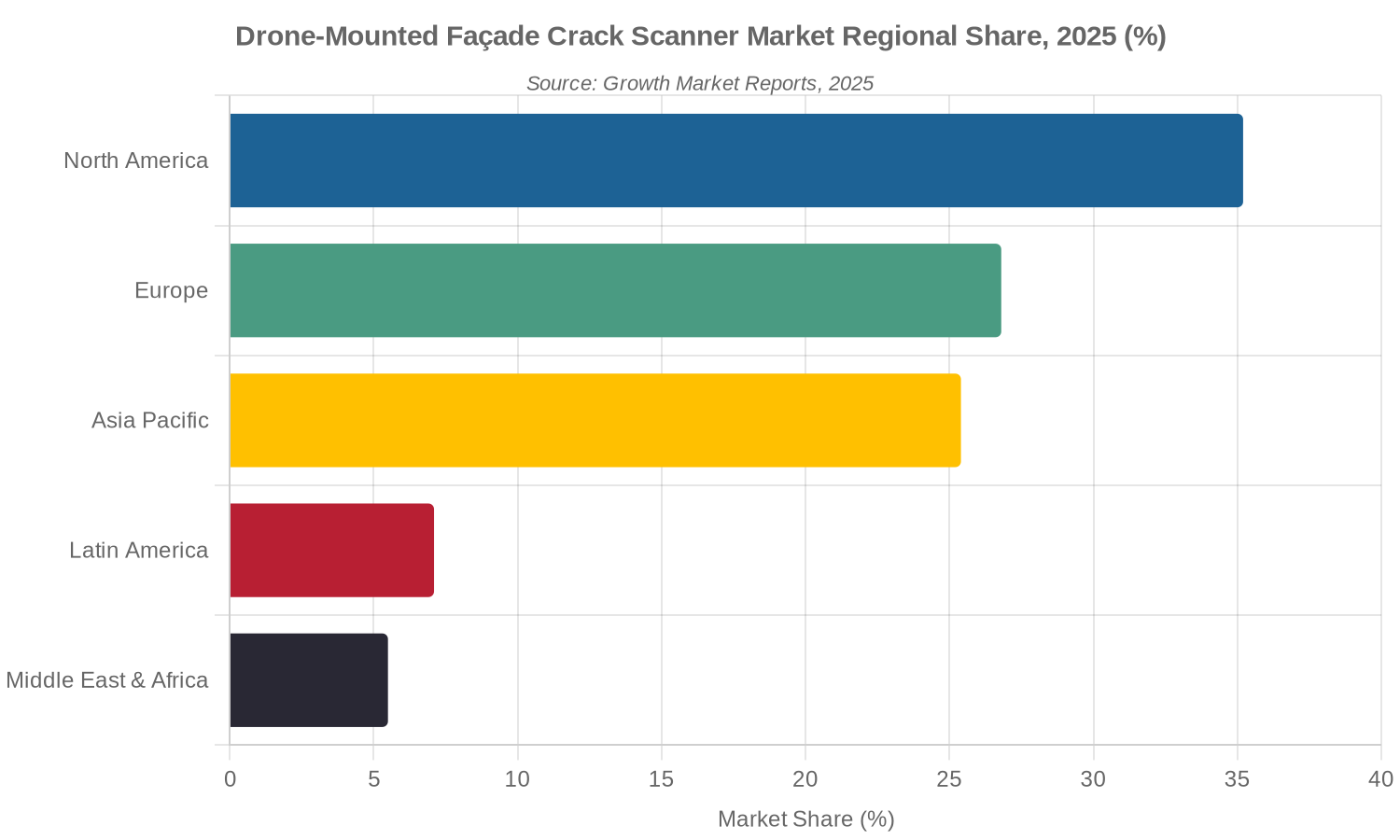
Europe held approximately 26.8% of global market revenue in 2025, equivalent to around USD 340 million. The region's focus on sustainability, building retrofitting, and heritage preservation has fueled the adoption of drone-mounted façade crack scanners. Countries such as Germany, the United Kingdom, France, and the Netherlands are at the forefront of integrating drones into building inspection protocols, supported by favorable regulatory environments, EU cohesion funding for smart city programs, and a well-developed ecosystem of engineering consultancy firms. The European market is projected to grow at a CAGR of approximately 12.8% through 2034, driven by ongoing investments in infrastructure modernization and digital construction technologies.
The Asia Pacific region is the fastest-growing market, with a 2025 value of approximately USD 323 million and a projected CAGR of 15.8% over the 2026-2034 forecast period. Rapid urbanization, large-scale government infrastructure programs, and the proliferation of high-rise residential and commercial buildings are key drivers in China, Japan, South Korea, and India. Local governments are increasingly mandating advanced inspection technologies to ensure building safety and seismic resilience, creating substantial growth opportunities for drone solution providers. Latin America contributed approximately USD 90 million in 2025, while the Middle East & Africa accounted for around USD 70 million, with both regions expected to witness steadily accelerating adoption as urban infrastructure investment and regulatory frameworks mature through 2034.
Drone-Mounted Façade Crack Scanner Market Competitive Landscape
The competitive landscape of the drone-mounted façade crack scanner market in 2025 is characterized by a mix of established technology providers, innovative startups, and specialized inspection service companies. Leading players are investing heavily in research and development to enhance drone platform capabilities, focusing on autonomous navigation, multi-sensor fusion, AI-powered analytics, and extended battery endurance. Strategic partnerships and collaborations with construction firms, facility management providers, and government agencies are common, enabling companies to expand their market reach and develop tailored solutions. The market has also seen a notable wave of mergers and acquisitions, as larger technology groups seek to consolidate positions and integrate complementary software and sensor capabilities.
Product differentiation is a key competitive strategy, with companies offering a range of drone models, sensor payloads, and software platforms to address diverse inspection requirements. Some firms specialize in turnkey solutions encompassing hardware, software, data analytics, and regulatory reporting, while others focus on providing modular components that can be integrated into existing operator workflows. The ability to deliver end-to-end solutions with cloud-based data management, automated defect reporting, and digital twin integration is emerging as a critical success factor in 2025. Customer support, pilot training programs, and after-sales service quality are also important differentiators, particularly for clients with limited in-house drone expertise.
Pricing strategies vary widely across the market, reflecting differences in product complexity, service scope, and target customer segments. While some providers compete aggressively on price to capture volume business from SMEs and emerging markets, others position themselves as premium solution providers emphasizing advanced capabilities, data security, and customization depth. The growing shift towards inspection-as-a-service is enabling companies to reach new customer segments and generate predictable recurring revenue streams, further intensifying competition and accelerating innovation in service delivery.
Major companies operating in the drone-mounted façade crack scanner market include DJI Enterprise, Flyability, Skydio, Terra Drone Corporation, Trimble Inc., Teledyne FLIR, Cyberhawk Innovations, Microdrones, Delair, senseFly (AgEagle Aerial Systems), RIEGL Laser Measurement Systems, DroneDeploy, SkySpecs, Wingtra AG, Percepto, and Apellix. DJI Enterprise leads the market in drone hardware volume with its broad portfolio of commercial platforms and imaging payloads. Flyability has carved a distinctive niche with its collision-tolerant Elios series, purpose-built for confined and complex structural environments. Skydio's AI-driven autonomous flight capabilities are redefining ease of use and repeatability for routine inspection programs. Trimble Inc. and Terra Drone Corporation offer integrated solutions combining drone hardware with sophisticated data analytics and asset management platforms, while Cyberhawk Innovations and SkySpecs have established strong reputations as pure-play drone inspection service providers serving critical infrastructure operators globally.
Top Companies in the Drone-Mounted Façade Crack Scanner Market
- DJI Enterprise
- Flyability
- Skydio
- Terra Drone Corporation
- Trimble Inc.
- Teledyne FLIR
- Cyberhawk Innovations
- Microdrones
- Delair
- senseFly (AgEagle Aerial Systems)
- RIEGL Laser Measurement Systems
- DroneDeploy
- SkySpecs
- Wingtra AG
- Percepto
- Apellix
- Parrot SA
- AeroVironment
Segments
The Drone-Mounted Façade Crack Scanner market has been segmented on the basis of
Product Type
- Fixed-Wing Drones
- Rotary-Wing Drones
- Hybrid Drones
Technology
- Infrared Imaging
- Ultrasonic Testing
- Visual Inspection
- Laser Scanning
- Others
Application
- Residential Buildings
- Commercial Buildings
- Industrial Structures
- Bridges
- Others
End-User
- Construction Companies
- Facility Management
- Government & Municipalities
- Others
Frequently Asked Questions
Yes. The report can be customized to meet specific research requirements. Customization options include additional country-level or city-level data, deeper segmentation by building height category or sensor payload type, competitive benchmarking of a tailored list of companies, and integration of proprietary pricing or demand data provided by the client. Please contact our research team to discuss your specific needs and obtain a customized scope and pricing proposal.
Leading companies as of 2025 include DJI Enterprise, Flyability, Skydio, Terra Drone Corporation, Trimble Inc., Teledyne FLIR, Cyberhawk Innovations, Microdrones, Delair, senseFly (an AgEagle company), RIEGL Laser Measurement Systems, DroneDeploy, SkySpecs, Wingtra AG, Percepto, and Apellix. These players compete on sensor integration capabilities, autonomous flight intelligence, software analytics, and the breadth of end-to-end service offerings.
3. What are the major opportunities and challenges in the drone-mounted façade crack scanner market?
Major opportunities include the integration of generative AI and advanced computer vision for fully automated defect classification, the expansion of inspection-as-a-service business models targeting SMEs, and growing demand from emerging markets investing heavily in urban infrastructure. Challenges include fragmented and evolving drone regulations across jurisdictions, airspace restrictions in dense urban corridors, data privacy concerns when operating near occupied buildings, high upfront equipment costs for smaller operators, and the need for skilled pilots and data analysts to maximize platform value.
Construction companies are among the earliest and most active end-users, deploying drones for quality assurance on new builds and façade renovation projects. Facility management firms represent a large and growing segment, integrating drones into routine maintenance programs to reduce costs and extend asset lifespans. Government agencies and municipalities are key drivers of regulatory-mandated inspection programs for public buildings, bridges, and transport infrastructure. Other end-users include insurance companies using drones for risk assessment and claims processing, engineering consultancies, and specialist inspection service providers.
Commercial buildings are the largest application segment, covering office towers, hotels, shopping centers, and mixed-use developments that require frequent exterior surveys to maintain safety and asset value. Residential high-rise complexes represent the second-largest segment, followed by industrial structures such as factories, power plants, and storage tanks. Bridges and other transportation infrastructure form a strategically important niche, where early crack detection is critical to preventing catastrophic failures and optimizing maintenance budgets.
North America leads the global market with approximately 35.2% revenue share in 2025, driven by strict building codes, a dense stock of aging high-rise structures, and strong early adoption of commercial drone technology. Europe holds about 26.8% share, supported by sustainability mandates and heritage building preservation programs. Asia Pacific accounts for roughly 25.4% and is the fastest-growing region, with a CAGR projected at 15.8% through 2034, fueled by rapid urbanization and large-scale government infrastructure programs in China, Japan, South Korea, and India.
Rotary-wing drones, including quadcopters and hexacopters, dominate the market with approximately 58.5% share in 2025 due to their hovering capability and maneuverability in dense urban environments. Fixed-wing drones account for roughly 22.5% of the market and are favored for large-area surveys of bridges and industrial facilities given their longer endurance. Hybrid (VTOL) drones hold around 19.0% and are gaining traction for complex projects that require both extended range and precise hover for close-up inspection of façade details.
The most widely adopted technologies include high-resolution visual inspection cameras, infrared (thermal) imaging for detecting subsurface defects and moisture ingress, LiDAR (laser scanning) for generating precise 3D models of building exteriors, and ultrasonic testing for assessing crack depth in concrete and masonry. Multi-sensor payloads that combine two or more of these modalities on a single drone platform are increasingly common, enabling richer diagnostic outputs and more comprehensive inspection reports in a single flight.
Key growth drivers include rising demand for non-destructive testing in construction and facility management, the proliferation of aging building stock in North America and Europe, accelerating urbanization in Asia Pacific, and the integration of artificial intelligence and machine learning into drone inspection platforms. Regulatory mandates requiring periodic building façade inspections in major cities such as New York, Singapore, and London are also creating consistent, recurring demand for drone-based solutions.
According to our latest research, the drone-mounted façade crack scanner market reached USD 1.27 billion in 2025 and is projected to expand at a CAGR of 13.2% from 2026 to 2034, reaching approximately USD 3.89 billion by the end of 2034. This growth is underpinned by accelerating infrastructure investment, stricter building safety regulations, and rapid advances in drone sensor technology across both developed and emerging markets.
Table Of Content
Chapter 1 Executive SummaryChapter 2 Assumptions and Acronyms Used
Chapter 3 Research Methodology
Chapter 4 Drone-Mounted Façade Crack Scanner Market Overview
4.1 Introduction
4.1.1 Market Taxonomy
4.1.2 Market Definition
4.1.3 Macro-Economic Factors Impacting the Market Growth
4.2 Drone-Mounted Façade Crack Scanner Market Dynamics
4.2.1 Market Drivers
4.2.2 Market Restraints
4.2.3 Market Opportunity
4.3 Drone-Mounted Façade Crack Scanner Market - Supply Chain Analysis
4.3.1 List of Key Suppliers
4.3.2 List of Key Distributors
4.3.3 List of Key Consumers
4.4 Key Forces Shaping the Drone-Mounted Façade Crack Scanner Market
4.4.1 Bargaining Power of Suppliers
4.4.2 Bargaining Power of Buyers
4.4.3 Threat of Substitution
4.4.4 Threat of New Entrants
4.4.5 Competitive Rivalry
4.5 Global Drone-Mounted Façade Crack Scanner Market Size & Forecast, 2023-2032
4.5.1 Drone-Mounted Façade Crack Scanner Market Size and Y-o-Y Growth
4.5.2 Drone-Mounted Façade Crack Scanner Market Absolute $ Opportunity
Chapter 5 Global Drone-Mounted Façade Crack Scanner Market Analysis and Forecast By Product Type
5.1 Introduction
5.1.1 Key Market Trends & Growth Opportunities By Product Type
5.1.2 Basis Point Share (BPS) Analysis By Product Type
5.1.3 Absolute $ Opportunity Assessment By Product Type
5.2 Drone-Mounted Façade Crack Scanner Market Size Forecast By Product Type
5.2.1 Fixed-Wing Drones
5.2.2 Rotary-Wing Drones
5.2.3 Hybrid Drones
5.3 Market Attractiveness Analysis By Product Type
Chapter 6 Global Drone-Mounted Façade Crack Scanner Market Analysis and Forecast By Technology
6.1 Introduction
6.1.1 Key Market Trends & Growth Opportunities By Technology
6.1.2 Basis Point Share (BPS) Analysis By Technology
6.1.3 Absolute $ Opportunity Assessment By Technology
6.2 Drone-Mounted Façade Crack Scanner Market Size Forecast By Technology
6.2.1 Infrared Imaging
6.2.2 Ultrasonic Testing
6.2.3 Visual Inspection
6.2.4 Laser Scanning
6.2.5 Others
6.3 Market Attractiveness Analysis By Technology
Chapter 7 Global Drone-Mounted Façade Crack Scanner Market Analysis and Forecast By Application
7.1 Introduction
7.1.1 Key Market Trends & Growth Opportunities By Application
7.1.2 Basis Point Share (BPS) Analysis By Application
7.1.3 Absolute $ Opportunity Assessment By Application
7.2 Drone-Mounted Façade Crack Scanner Market Size Forecast By Application
7.2.1 Residential Buildings
7.2.2 Commercial Buildings
7.2.3 Industrial Structures
7.2.4 Bridges
7.2.5 Others
7.3 Market Attractiveness Analysis By Application
Chapter 8 Global Drone-Mounted Façade Crack Scanner Market Analysis and Forecast By End-User
8.1 Introduction
8.1.1 Key Market Trends & Growth Opportunities By End-User
8.1.2 Basis Point Share (BPS) Analysis By End-User
8.1.3 Absolute $ Opportunity Assessment By End-User
8.2 Drone-Mounted Façade Crack Scanner Market Size Forecast By End-User
8.2.1 Construction Companies
8.2.2 Facility Management
8.2.3 Government & Municipalities
8.2.4 Others
8.3 Market Attractiveness Analysis By End-User
Chapter 9 Global Drone-Mounted Façade Crack Scanner Market Analysis and Forecast by Region
9.1 Introduction
9.1.1 Key Market Trends & Growth Opportunities By Region
9.1.2 Basis Point Share (BPS) Analysis By Region
9.1.3 Absolute $ Opportunity Assessment By Region
9.2 Drone-Mounted Façade Crack Scanner Market Size Forecast By Region
9.2.1 North America
9.2.2 Europe
9.2.3 Asia Pacific
9.2.4 Latin America
9.2.5 Middle East & Africa (MEA)
9.3 Market Attractiveness Analysis By Region
Chapter 10 Coronavirus Disease (COVID-19) Impact
10.1 Introduction
10.2 Current & Future Impact Analysis
10.3 Economic Impact Analysis
10.4 Government Policies
10.5 Investment Scenario
Chapter 11 North America Drone-Mounted Façade Crack Scanner Analysis and Forecast
11.1 Introduction
11.2 North America Drone-Mounted Façade Crack Scanner Market Size Forecast by Country
11.2.1 U.S.
11.2.2 Canada
11.3 Basis Point Share (BPS) Analysis by Country
11.4 Absolute $ Opportunity Assessment by Country
11.5 Market Attractiveness Analysis by Country
11.6 North America Drone-Mounted Façade Crack Scanner Market Size Forecast By Product Type
11.6.1 Fixed-Wing Drones
11.6.2 Rotary-Wing Drones
11.6.3 Hybrid Drones
11.7 Basis Point Share (BPS) Analysis By Product Type
11.8 Absolute $ Opportunity Assessment By Product Type
11.9 Market Attractiveness Analysis By Product Type
11.10 North America Drone-Mounted Façade Crack Scanner Market Size Forecast By Technology
11.10.1 Infrared Imaging
11.10.2 Ultrasonic Testing
11.10.3 Visual Inspection
11.10.4 Laser Scanning
11.10.5 Others
11.11 Basis Point Share (BPS) Analysis By Technology
11.12 Absolute $ Opportunity Assessment By Technology
11.13 Market Attractiveness Analysis By Technology
11.14 North America Drone-Mounted Façade Crack Scanner Market Size Forecast By Application
11.14.1 Residential Buildings
11.14.2 Commercial Buildings
11.14.3 Industrial Structures
11.14.4 Bridges
11.14.5 Others
11.15 Basis Point Share (BPS) Analysis By Application
11.16 Absolute $ Opportunity Assessment By Application
11.17 Market Attractiveness Analysis By Application
11.18 North America Drone-Mounted Façade Crack Scanner Market Size Forecast By End-User
11.18.1 Construction Companies
11.18.2 Facility Management
11.18.3 Government & Municipalities
11.18.4 Others
11.19 Basis Point Share (BPS) Analysis By End-User
11.20 Absolute $ Opportunity Assessment By End-User
11.21 Market Attractiveness Analysis By End-User
Chapter 12 Europe Drone-Mounted Façade Crack Scanner Analysis and Forecast
12.1 Introduction
12.2 Europe Drone-Mounted Façade Crack Scanner Market Size Forecast by Country
12.2.1 Germany
12.2.2 France
12.2.3 Italy
12.2.4 U.K.
12.2.5 Spain
12.2.6 Russia
12.2.7 Rest of Europe
12.3 Basis Point Share (BPS) Analysis by Country
12.4 Absolute $ Opportunity Assessment by Country
12.5 Market Attractiveness Analysis by Country
12.6 Europe Drone-Mounted Façade Crack Scanner Market Size Forecast By Product Type
12.6.1 Fixed-Wing Drones
12.6.2 Rotary-Wing Drones
12.6.3 Hybrid Drones
12.7 Basis Point Share (BPS) Analysis By Product Type
12.8 Absolute $ Opportunity Assessment By Product Type
12.9 Market Attractiveness Analysis By Product Type
12.10 Europe Drone-Mounted Façade Crack Scanner Market Size Forecast By Technology
12.10.1 Infrared Imaging
12.10.2 Ultrasonic Testing
12.10.3 Visual Inspection
12.10.4 Laser Scanning
12.10.5 Others
12.11 Basis Point Share (BPS) Analysis By Technology
12.12 Absolute $ Opportunity Assessment By Technology
12.13 Market Attractiveness Analysis By Technology
12.14 Europe Drone-Mounted Façade Crack Scanner Market Size Forecast By Application
12.14.1 Residential Buildings
12.14.2 Commercial Buildings
12.14.3 Industrial Structures
12.14.4 Bridges
12.14.5 Others
12.15 Basis Point Share (BPS) Analysis By Application
12.16 Absolute $ Opportunity Assessment By Application
12.17 Market Attractiveness Analysis By Application
12.18 Europe Drone-Mounted Façade Crack Scanner Market Size Forecast By End-User
12.18.1 Construction Companies
12.18.2 Facility Management
12.18.3 Government & Municipalities
12.18.4 Others
12.19 Basis Point Share (BPS) Analysis By End-User
12.20 Absolute $ Opportunity Assessment By End-User
12.21 Market Attractiveness Analysis By End-User
Chapter 13 Asia Pacific Drone-Mounted Façade Crack Scanner Analysis and Forecast
13.1 Introduction
13.2 Asia Pacific Drone-Mounted Façade Crack Scanner Market Size Forecast by Country
13.2.1 China
13.2.2 Japan
13.2.3 South Korea
13.2.4 India
13.2.5 Australia
13.2.6 South East Asia (SEA)
13.2.7 Rest of Asia Pacific (APAC)
13.3 Basis Point Share (BPS) Analysis by Country
13.4 Absolute $ Opportunity Assessment by Country
13.5 Market Attractiveness Analysis by Country
13.6 Asia Pacific Drone-Mounted Façade Crack Scanner Market Size Forecast By Product Type
13.6.1 Fixed-Wing Drones
13.6.2 Rotary-Wing Drones
13.6.3 Hybrid Drones
13.7 Basis Point Share (BPS) Analysis By Product Type
13.8 Absolute $ Opportunity Assessment By Product Type
13.9 Market Attractiveness Analysis By Product Type
13.10 Asia Pacific Drone-Mounted Façade Crack Scanner Market Size Forecast By Technology
13.10.1 Infrared Imaging
13.10.2 Ultrasonic Testing
13.10.3 Visual Inspection
13.10.4 Laser Scanning
13.10.5 Others
13.11 Basis Point Share (BPS) Analysis By Technology
13.12 Absolute $ Opportunity Assessment By Technology
13.13 Market Attractiveness Analysis By Technology
13.14 Asia Pacific Drone-Mounted Façade Crack Scanner Market Size Forecast By Application
13.14.1 Residential Buildings
13.14.2 Commercial Buildings
13.14.3 Industrial Structures
13.14.4 Bridges
13.14.5 Others
13.15 Basis Point Share (BPS) Analysis By Application
13.16 Absolute $ Opportunity Assessment By Application
13.17 Market Attractiveness Analysis By Application
13.18 Asia Pacific Drone-Mounted Façade Crack Scanner Market Size Forecast By End-User
13.18.1 Construction Companies
13.18.2 Facility Management
13.18.3 Government & Municipalities
13.18.4 Others
13.19 Basis Point Share (BPS) Analysis By End-User
13.20 Absolute $ Opportunity Assessment By End-User
13.21 Market Attractiveness Analysis By End-User
Chapter 14 Latin America Drone-Mounted Façade Crack Scanner Analysis and Forecast
14.1 Introduction
14.2 Latin America Drone-Mounted Façade Crack Scanner Market Size Forecast by Country
14.2.1 Brazil
14.2.2 Mexico
14.2.3 Rest of Latin America (LATAM)
14.3 Basis Point Share (BPS) Analysis by Country
14.4 Absolute $ Opportunity Assessment by Country
14.5 Market Attractiveness Analysis by Country
14.6 Latin America Drone-Mounted Façade Crack Scanner Market Size Forecast By Product Type
14.6.1 Fixed-Wing Drones
14.6.2 Rotary-Wing Drones
14.6.3 Hybrid Drones
14.7 Basis Point Share (BPS) Analysis By Product Type
14.8 Absolute $ Opportunity Assessment By Product Type
14.9 Market Attractiveness Analysis By Product Type
14.10 Latin America Drone-Mounted Façade Crack Scanner Market Size Forecast By Technology
14.10.1 Infrared Imaging
14.10.2 Ultrasonic Testing
14.10.3 Visual Inspection
14.10.4 Laser Scanning
14.10.5 Others
14.11 Basis Point Share (BPS) Analysis By Technology
14.12 Absolute $ Opportunity Assessment By Technology
14.13 Market Attractiveness Analysis By Technology
14.14 Latin America Drone-Mounted Façade Crack Scanner Market Size Forecast By Application
14.14.1 Residential Buildings
14.14.2 Commercial Buildings
14.14.3 Industrial Structures
14.14.4 Bridges
14.14.5 Others
14.15 Basis Point Share (BPS) Analysis By Application
14.16 Absolute $ Opportunity Assessment By Application
14.17 Market Attractiveness Analysis By Application
14.18 Latin America Drone-Mounted Façade Crack Scanner Market Size Forecast By End-User
14.18.1 Construction Companies
14.18.2 Facility Management
14.18.3 Government & Municipalities
14.18.4 Others
14.19 Basis Point Share (BPS) Analysis By End-User
14.20 Absolute $ Opportunity Assessment By End-User
14.21 Market Attractiveness Analysis By End-User
Chapter 15 Middle East & Africa (MEA) Drone-Mounted Façade Crack Scanner Analysis and Forecast
15.1 Introduction
15.2 Middle East & Africa (MEA) Drone-Mounted Façade Crack Scanner Market Size Forecast by Country
15.2.1 Saudi Arabia
15.2.2 South Africa
15.2.3 UAE
15.2.4 Rest of Middle East & Africa (MEA)
15.3 Basis Point Share (BPS) Analysis by Country
15.4 Absolute $ Opportunity Assessment by Country
15.5 Market Attractiveness Analysis by Country
15.6 Middle East & Africa (MEA) Drone-Mounted Façade Crack Scanner Market Size Forecast By Product Type
15.6.1 Fixed-Wing Drones
15.6.2 Rotary-Wing Drones
15.6.3 Hybrid Drones
15.7 Basis Point Share (BPS) Analysis By Product Type
15.8 Absolute $ Opportunity Assessment By Product Type
15.9 Market Attractiveness Analysis By Product Type
15.10 Middle East & Africa (MEA) Drone-Mounted Façade Crack Scanner Market Size Forecast By Technology
15.10.1 Infrared Imaging
15.10.2 Ultrasonic Testing
15.10.3 Visual Inspection
15.10.4 Laser Scanning
15.10.5 Others
15.11 Basis Point Share (BPS) Analysis By Technology
15.12 Absolute $ Opportunity Assessment By Technology
15.13 Market Attractiveness Analysis By Technology
15.14 Middle East & Africa (MEA) Drone-Mounted Façade Crack Scanner Market Size Forecast By Application
15.14.1 Residential Buildings
15.14.2 Commercial Buildings
15.14.3 Industrial Structures
15.14.4 Bridges
15.14.5 Others
15.15 Basis Point Share (BPS) Analysis By Application
15.16 Absolute $ Opportunity Assessment By Application
15.17 Market Attractiveness Analysis By Application
15.18 Middle East & Africa (MEA) Drone-Mounted Façade Crack Scanner Market Size Forecast By End-User
15.18.1 Construction Companies
15.18.2 Facility Management
15.18.3 Government & Municipalities
15.18.4 Others
15.19 Basis Point Share (BPS) Analysis By End-User
15.20 Absolute $ Opportunity Assessment By End-User
15.21 Market Attractiveness Analysis By End-User
Chapter 16 Competition Landscape
16.1 Drone-Mounted Façade Crack Scanner Market: Competitive Dashboard
16.2 Global Drone-Mounted Façade Crack Scanner Market: Market Share Analysis, 2023
16.3 Company Profiles (Details – Overview, Financials, Developments, Strategy)
16.3.1 DJI Enterprise
16.3.2 Parrot SA
16.3.3 Flyability
16.3.4 Terra Drone Corporation
16.3.5 Skydio
16.3.6 Trimble Inc.
16.3.7 Teledyne FLIR
16.3.8 RIEGL Laser Measurement Systems
16.3.9 Cyberhawk Innovations
16.3.10 Microdrones
16.3.11 Delair
16.3.12 senseFly (AgEagle Aerial Systems)
16.3.13 DroneDeploy
16.3.14 SkySpecs
16.3.15 AeroVironment
16.3.16 Wingtra AG
16.3.17 Percepto
16.3.18 Apellix
Methodology


Related Reports
Some other reports from this category!


Our Clients


