
Dental Sterilization Market Size, Share & Growth Analysis, 2026-2034
Dental Sterilization Market Size, Share & Growth Analysis, 2026-2034
Segments - by Product Type (Sterilization Equipment, Consumables and Accessories, Packaging Systems, Others), by Technology (Steam Sterilization, Dry Heat Sterilization, Chemical Vapor Sterilization, Others), by End User (Hospitals, Dental Clinics, Dental Laboratories, Others)



Last Updated : Jun, 2026
| Report ID :HC-5543
| 4.8 Rating
| 84 Reviews
| 289 Pages
| Format :


Dental Sterilization Market: Key Numbers
The Dental Sterilization market was valued at USD 2.05 Billion in 2025 and is projected to reach USD 3.77 Billion by 2034, a CAGR of 6.9%.
| Market size (2025) | USD 2.05 Billion |
|---|---|
| Forecast (2034) | USD 3.77 Billion |
| CAGR (2026-2034) | 6.9% |
| Largest region | North America (USD 789 Million) |
| Segments covered | Product Type, Technology, End User |
| Key companies | Getinge AB, Midmark Corporation, Tuttnauer, W&H Dentalwerk Bürmoos GmbH, SciCan Ltd. |
This report is updated with the latest market data and insights as of June 2026. Base year: 2025 | Forecast period: 2026-2034
Dental Sterilization Market Size and Growth Outlook
Worldwide, the dental sterilization market size stood at USD 2.05 billion in 2025, demonstrating robust momentum driven by heightened infection control standards and rising dental care demand worldwide. The market is expanding at a CAGR of 6.9% and is projected to reach USD 3.77 billion by 2034. This growth is primarily fueled by the increasing prevalence of dental diseases, stringent regulatory frameworks, and the accelerating adoption of advanced sterilization equipment across dental care facilities globally.
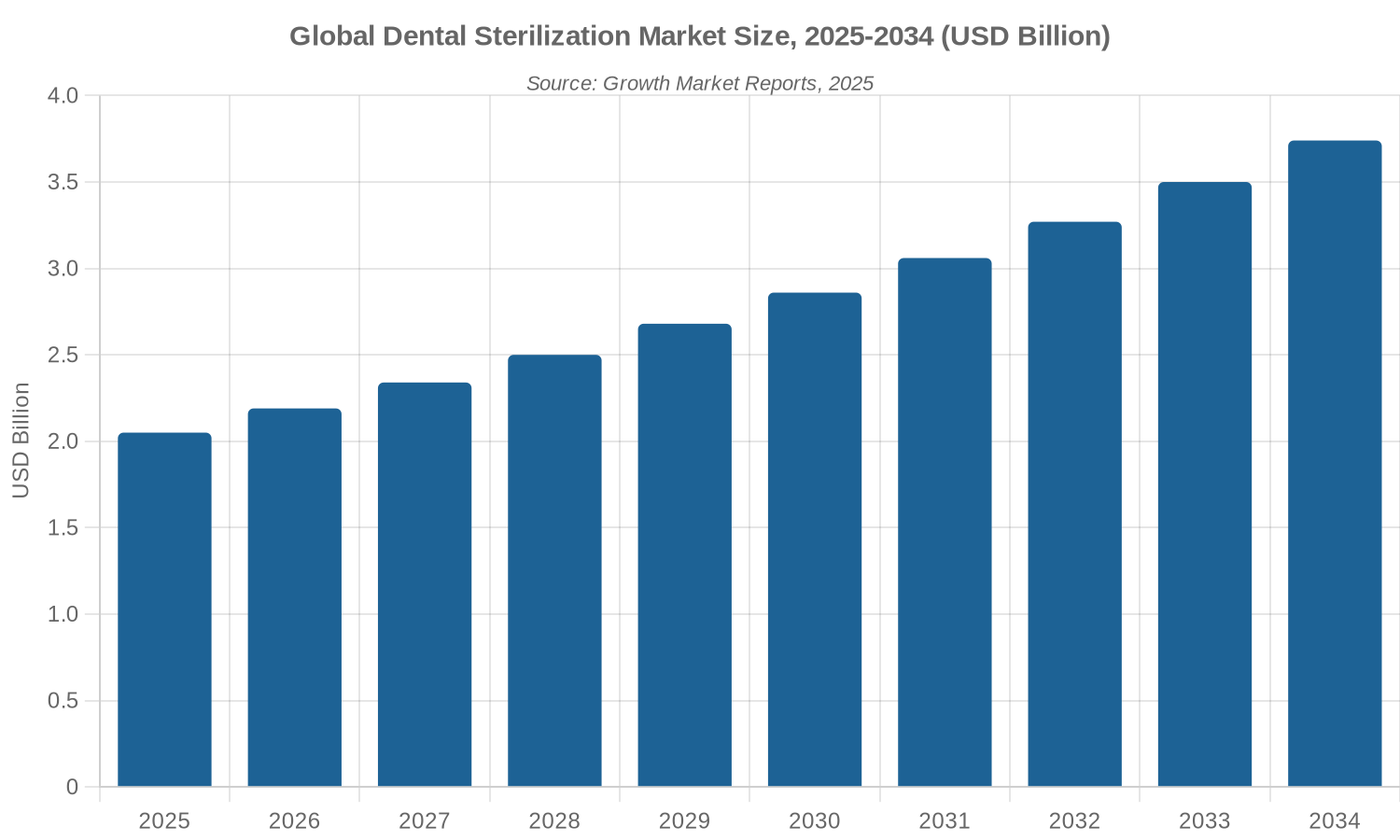
The dental sterilization market is experiencing significant growth due to escalating awareness of infection control protocols in the dental healthcare sector. Dental professionals are increasingly prioritizing the use of advanced sterilization products and consumables to ensure patient safety and comply with evolving regulatory guidelines. The rising incidence of dental caries, periodontal diseases, and other oral health conditions has led to a surge in dental procedures, thereby intensifying demand for effective sterilization solutions. Moreover, the growing trend toward minimally invasive dental treatments and the expansion of dental clinics in both developed and emerging economies are further propelling the market forward.
Technological advancements in sterilization methods represent another key driver of market expansion in 2025 and beyond. The integration of automation, digital monitoring, and IoT-enabled devices into sterilization equipment has significantly enhanced operational efficiency and reliability. These innovations allow for precise temperature and pressure control, real-time data tracking, and improved traceability, ensuring that instruments are thoroughly processed and safe for clinical use. The development of eco-friendly and energy-efficient sterilization technologies is also gaining traction, aligning with the global push toward sustainability in healthcare operations. The broader dental equipment sector is similarly benefiting from these technology-driven shifts.
The regulatory landscape plays a crucial role in shaping the growth trajectory of the dental sterilization market. Governments and health authorities across regions are implementing stringent guidelines and standards to minimize the risk of cross-contamination and healthcare-associated infections in dental settings. Compliance with standards such as the Centers for Disease Control and Prevention (CDC) guidelines and the Occupational Safety and Health Administration (OSHA) regulations is mandatory for dental practices in many jurisdictions, driving the adoption of certified sterilization products and validated solutions. Ongoing training and education programs for dental professionals on sterilization best practices are contributing to market expansion by fostering a culture of safety and regulatory compliance.
Regionally, North America continues to dominate the dental sterilization market, accounting for the largest revenue share in 2025, followed closely by Europe and the Asia Pacific. The presence of a well-established dental care infrastructure, high healthcare expenditure, and a strong emphasis on infection prevention are key factors supporting the market's leadership in these regions. Meanwhile, emerging markets in Asia Pacific and Latin America are witnessing rapid growth, supported by increasing investments in healthcare infrastructure, rising disposable incomes, and growing awareness of oral health and hygiene standards.
Dental Sterilization Market by Product Type
The dental sterilization market by product type is segmented into sterilization equipment, consumables and accessories, packaging systems, and others. Sterilization equipment forms the backbone of infection control in dental practices, encompassing autoclaves, ultrasonic cleaners, and washer-disinfectors. Demand for advanced sterilization equipment is being driven by the need for rapid, reliable, and efficient sterilization cycles that can handle high patient volumes without compromising on safety. Manufacturers are focusing on integrating smart technologies such as automated cycle tracking, intuitive user interfaces, and remote monitoring capabilities to enhance the user experience and ensure compliance with regulatory standards. The growing market for dental autoclave systems reflects the sector's continued preference for steam-based sterilization as the gold standard.

Consumables and accessories such as sterilization pouches, wraps, chemical indicators, and biological indicators are essential components of the dental sterilization workflow. These products provide critical validation of sterilization efficacy and help maintain the sterility of instruments from processing through to point of use. The consumables segment is experiencing steady growth, supported by the recurring nature of demand and the increasing adoption of single-use, disposable products to minimize the risk of cross-contamination. Innovations in packaging materials and indicator technologies are further driving market expansion in this segment. The use of instrument sterilization trays is also gaining wider adoption across dental clinics seeking organized and traceable instrument management.
Packaging systems play a vital role in maintaining the sterility of dental instruments during storage and transportation between sterilization and clinical use. The growing emphasis on infection prevention and regulatory compliance is prompting dental facilities to invest in high-quality packaging solutions that offer robust protection against microbial contamination. Advanced packaging systems are being developed with features such as tamper-evident seals, moisture barriers, and compatibility with various sterilization methods. The integration of RFID tags and barcodes for inventory management and traceability is also gaining traction in this segment, aligning with the broader digital transformation underway in dental practices.
The others category includes ancillary products such as cleaning solutions, lubricants, and maintenance kits that support the overall sterilization process. While this segment represents a smaller share of the market, it is nonetheless important for ensuring the optimal performance and longevity of sterilization equipment. The increasing focus on preventive maintenance and equipment care is driving demand for specialized cleaning and maintenance products tailored to the unique requirements of dental sterilization systems. The use of innovative solutions such as the hydrogen peroxide cold sterilizer for dental handpieces is gaining attention as practices seek effective low-temperature options for delicate instruments.
Dental Sterilization Market Report Scope
| Attributes | Details |
| Report Title | Dental Sterilization Market Research Report 2034 |
| By Product Type | Sterilization Equipment, Consumables and Accessories, Packaging Systems, Others |
| By Technology | Steam Sterilization, Dry Heat Sterilization, Chemical Vapor Sterilization, Others |
| By End User | Hospitals, Dental Clinics, Dental Laboratories, Others |
| Regions Covered | North America, Europe, APAC, Latin America, MEA |
| Base Year | 2025 |
| Historic Data | 2019-2024 |
| Forecast Period | 2026-2034 |
| Number of Pages | 289 |
| Number of Tables & Figures | 268 |
| Customization Available | Yes, the report can be customized as per your need. |
Dental Sterilization Market by Technology
The dental sterilization market is segmented by technology into steam sterilization, dry heat sterilization, chemical vapor sterilization, and others. Steam sterilization, commonly referred to as autoclaving, remains the most widely used method in dental practices due to its proven efficacy, speed, and cost-effectiveness. Autoclaves utilize pressurized steam to eliminate a broad spectrum of pathogens, including bacteria, viruses, and spores. Technological advancements in autoclave design, such as pre-programmed cycles, energy-saving features, and rapid cooling systems, are enhancing workflow efficiency and reducing turnaround times for instrument processing in 2025 and through the forecast period.
Dry heat sterilization is preferred for instruments that may be damaged by moisture, such as certain metal and sharp instruments. This technology employs high temperatures over defined periods to achieve sterilization, offering a reliable alternative to steam-based methods. Recent innovations in dry heat sterilizers include faster cycle times, improved temperature uniformity, and enhanced safety features, making them increasingly attractive to dental clinics seeking versatile sterilization solutions for their specific instrument portfolios.
Chemical vapor sterilization utilizes a mixture of chemicals, typically alcohol and formaldehyde, to generate sterilizing vapors at lower temperatures compared to steam or dry heat methods. This technology is particularly suitable for heat-sensitive instruments and offers the advantage of shorter cycle times and reduced instrument corrosion. However, the need for proper ventilation and careful handling of chemical agents presents certain operational challenges. Ongoing research and development efforts are focused on improving the safety, efficacy, and environmental sustainability of chemical vapor sterilization systems, and growing interest in terminal sterilization services reflects broader demand for validated low-temperature pathogen elimination.
The others category encompasses emerging and specialized sterilization technologies such as plasma-based, radiation, and ozone-based systems. These methods are gaining attention for their potential to offer rapid, residue-free sterilization with minimal impact on instrument integrity. While adoption remains limited by factors such as cost and regulatory approval pathways, advancements in these technologies are expected to expand their application in dental settings over the 2026-2034 forecast period. The growing demand for flexible and scalable sterilization solutions is likely to drive further innovation and market penetration in this segment.
Dental Sterilization Market by End User
The dental sterilization market is segmented by end user into hospitals, dental clinics, dental laboratories, and others. Hospitals represent a significant share of the market, driven by the high volume of dental procedures performed in these settings and the stringent infection control protocols mandated by healthcare authorities. Hospitals typically invest in advanced, large-capacity sterilization equipment and comprehensive consumable supplies to support their diverse dental departments. The integration of centralized sterilization units and automated workflow management systems is enhancing operational efficiency and regulatory compliance in hospital settings globally.
Dental clinics constitute the largest end-user segment, accounting for a substantial portion of market revenue in 2025. The proliferation of private dental practices and group clinics, coupled with increasing demand for cosmetic and restorative dental procedures, is fueling the adoption of state-of-the-art sterilization solutions. Dental clinics prioritize compact, user-friendly sterilization equipment that can be seamlessly integrated into daily clinical workflow. The shift toward digital record-keeping and instrument tracking is further driving demand for smart sterilization systems equipped with data management and automated reporting capabilities. Effective dental waterline disinfection is increasingly being adopted alongside instrument sterilization protocols to ensure comprehensive infection control within clinic environments.
Dental laboratories play a critical role in the fabrication of dental prosthetics, orthodontic appliances, and restorative materials. The need to ensure the sterility of laboratory instruments and materials is paramount to prevent cross-contamination and protect patient safety. Dental laboratories are investing in specialized sterilization equipment tailored to their unique requirements, such as high-capacity autoclaves, ultrasonic cleaners, and advanced packaging systems. The growing trend toward outsourcing dental laboratory services is also contributing to market growth in this segment, as outsourced laboratories must meet consistent quality and sterility standards demanded by their clinical partners.
The others category includes educational institutions, research centers, and mobile dental units that require reliable sterilization solutions to support their operations. While representing a smaller share of the overall market, these end users are nonetheless important contributors to total demand. The increasing focus on dental education and research, particularly in emerging markets across Asia Pacific and Latin America, is driving investments in modern sterilization infrastructure and structured training programs for students and early-career dental professionals.
Dental Sterilization Market Opportunities and Threats
One of the most significant opportunities in the dental sterilization market lies in the rapid adoption of digital and automated sterilization technologies. The integration of smart sensors, cloud-based monitoring, and real-time data analytics is transforming the way dental facilities manage infection control in 2025. These advancements not only enhance operational efficiency but also provide valuable insights into equipment performance, maintenance schedules, and compliance with evolving regulatory standards. The growing trend toward tele-dentistry and mobile dental clinics is further expanding the market for portable and versatile sterilization solutions, creating new avenues for product innovation and revenue growth through 2034.
Another major opportunity is the increasing focus on sustainability and eco-friendly practices in dental care. Manufacturers are actively developing energy-efficient sterilization equipment and biodegradable consumables to reduce the environmental footprint of dental sterilization processes. The adoption of green technologies and responsible waste management solutions is gaining traction among environmentally conscious dental professionals and healthcare organizations. Furthermore, the expansion of dental care services in emerging markets, supported by government public health initiatives and growing private investments, presents substantial growth potential for market participants seeking to establish or deepen their presence in these rapidly developing regions.
Despite the positive outlook, the dental sterilization market faces certain restraints that could moderate growth over the forecast period. The high initial capital cost of advanced sterilization equipment and the ongoing expenses associated with consumables and routine maintenance can pose financial challenges for small and independent dental practices. Additionally, the complexity of regulatory compliance across different national and regional frameworks, combined with the continuous need for staff training and competency verification, can create operational hurdles particularly in resource-constrained settings. Addressing these challenges through affordable product tiers, flexible financing options, and comprehensive digital training programs will be essential for market players seeking to expand their customer base and sustain long-term revenue growth.
Dental Sterilization Market Size by Region
North America remains the largest regional market for dental sterilization, with a market size of approximately USD 789 million in 2025. The region's dominance is attributed to its advanced dental healthcare infrastructure, high per capita healthcare expenditure, and a robust regulatory framework that mandates rigorous sterilization standards across dental practices. The United States accounts for a significant share of regional revenue, driven by widespread adoption of cutting-edge sterilization technologies and the presence of leading global market players. The emphasis on infection prevention and the increasing prevalence of dental diseases continue to reinforce market growth across North America.

Europe holds the second-largest share of the global dental sterilization market, with an estimated market value of approximately USD 543 million in 2025. The region benefits from a well-established dental care system, robust regulatory standards including EU Medical Device Regulation compliance requirements, and a high level of awareness regarding infection control. Countries such as Germany, France, and the United Kingdom are leading contributors to regional market revenue, supported by ongoing investments in healthcare infrastructure and the adoption of innovative sterilization solutions. The European market is expected to grow at a steady CAGR of approximately 6.4% through 2034, driven by increasing demand for dental services and continued expansion of dental clinics and specialized laboratories.
The Asia Pacific region is emerging as the fastest-growing market for dental sterilization, with an estimated market size of approximately USD 441 million in 2025. Rapid urbanization, rising disposable incomes, and growing awareness of oral health are driving the expansion of dental care services in countries such as China, India, Japan, and South Korea. Government initiatives to improve healthcare infrastructure and the increasing entry of international market players into these markets are further supporting regional growth. The Asia Pacific market is projected to register the highest CAGR among all regions over the 2026-2034 forecast period, reflecting significant untapped potential and accelerating investments in both public and private dental care facilities. Latin America and the Middle East & Africa, while smaller in absolute terms, are also showing promising growth trajectories supported by improving healthcare access and rising oral health awareness.
Dental Sterilization Market Competitive Landscape
The competitive landscape of the dental sterilization market in 2025 is characterized by the presence of several well-established global players alongside a growing cohort of regional manufacturers focused on technological innovation and competitive pricing. Leading companies are investing heavily in research and development to introduce advanced sterilization equipment and consumables that offer enhanced performance, user convenience, and regulatory compliance. Strategic collaborations, mergers and acquisitions, and geographic expansion remain common strategies employed by market players to strengthen their market position and broaden their product portfolios across diverse geographies.
Market leaders are also focusing on customer education and training programs to promote the adoption of best practices in dental sterilization and infection control. These initiatives are designed to build long-term relationships with dental professionals and institutions, foster brand loyalty, and drive repeat purchases of consumables and replacement parts. The increasing emphasis on sustainability and environmental responsibility is prompting companies to develop eco-friendly products and solutions, catering to the evolving expectations of environmentally conscious dental professionals and procurement decision-makers.
The market is witnessing intense competition in terms of pricing, product features, and quality of after-sales support. Companies are differentiating themselves by offering value-added services such as preventive equipment maintenance contracts, technical support, software upgrades, and customized solutions tailored to the specific needs of dental clinics, hospitals, and laboratories. The rise of e-commerce platforms and digital marketing is enabling market players to reach broader customer bases and enhance brand visibility, particularly among independent dental practices that may not have previously engaged with premium sterilization brands.
Some of the major companies operating in the dental sterilization market include Getinge AB, Midmark Corporation, Tuttnauer, W&H Dentalwerk Bürmoos GmbH, SciCan Ltd., Matachana Group, Dentsply Sirona, Steelco S.p.A., Mocom Srl, Coltene Holding AG, Hu-Friedy Mfg. Co. LLC, MELAG Medizintechnik GmbH & Co. KG, Miele Group, Belimed AG, Runyes Medical Instrument Co. Ltd., and Shinva Medical Instrument Co. Ltd. These companies are recognized for their extensive product portfolios, strong international distribution networks, and consistent commitment to innovation and quality assurance. Getinge AB and Midmark Corporation are known for their comprehensive sterilization equipment and consumables ranges, while Dentsply Sirona leads in integrated dental technology solutions. Tuttnauer and W&H Dentalwerk Bürmoos GmbH have established strong positions in the autoclave and handpiece care segments respectively, and regional players such as Runyes and Shinva are increasingly competitive in the high-growth Asia Pacific market. These key players continue to drive market growth through sustained product innovation, strategic partnerships, and a sharpened focus on customer-centric solutions through 2034.
Top Companies in the Dental Sterilization Market
- Getinge AB
- Midmark Corporation
- Tuttnauer
- W&H Dentalwerk Bürmoos GmbH
- SciCan Ltd.
- Matachana Group
- Dentsply Sirona
- Steelco S.p.A.
- Mocom Srl
- Coltene Holding AG
- Hu-Friedy Mfg. Co. LLC
- Miele Group
- Belimed AG
- Runyes Medical Instrument Co. Ltd.
- Shinva Medical Instrument Co. Ltd.
- Prestige Medical Limited
- A-dec Inc.
- Planmeca Group
- MELAG Medizintechnik GmbH & Co. KG
- NSK Ltd.
Segments
The Dental Sterilization market has been segmented on the basis of
Product Type
- Sterilization Equipment
- Consumables and Accessories
- Packaging Systems
- Others
Technology
- Steam Sterilization
- Dry Heat Sterilization
- Chemical Vapor Sterilization
- Others
End User
- Hospitals
- Dental Clinics
- Dental Laboratories
- Others
Frequently Asked Questions
Technology innovation is fundamentally reshaping the dental sterilization market. IoT-enabled autoclaves with cloud connectivity allow dental facilities to monitor sterilization cycles remotely, receive predictive maintenance alerts, and generate automated compliance reports. Artificial intelligence is being integrated into equipment diagnostics, reducing downtime and improving reliability. Advances in plasma-based and hydrogen peroxide cold sterilization are offering new options for heat-sensitive instruments, while biodegradable packaging materials and energy-efficient equipment designs are meeting the growing demand for sustainable dental infection control solutions through 2034.
Leading companies in the dental sterilization market include Getinge AB, Midmark Corporation, Tuttnauer, W&H Dentalwerk Bürmoos GmbH, SciCan Ltd., Matachana Group, Dentsply Sirona, Steelco S.p.A., Mocom Srl, Coltene Holding AG, Hu-Friedy Mfg. Co. LLC, MELAG Medizintechnik GmbH & Co. KG, Miele Group, Belimed AG, Runyes Medical Instrument Co. Ltd., and Shinva Medical Instrument Co. Ltd., among others.
The market faces challenges including the high capital cost of advanced sterilization equipment, ongoing expenditure on consumables and maintenance, and the complexity of navigating diverse regulatory requirements across different geographies. Smaller and independent dental practices may struggle with budget constraints, while a shortage of trained personnel to operate sophisticated sterilization systems remains a concern, particularly in low- and middle-income countries.
Major opportunities include the integration of smart, connected sterilization systems offering real-time monitoring and compliance tracking, the expansion of dental care infrastructure in high-growth emerging markets across Asia Pacific and Latin America, and the development of eco-friendly, energy-efficient sterilization products aligned with global sustainability goals. The rise of tele-dentistry and portable dental units is also opening new demand channels for compact, versatile sterilization solutions.
Dental clinics are the largest end-user segment, driven by the global proliferation of private practices and group clinics alongside growing cosmetic and restorative dentistry demand. Hospitals represent the second-largest segment, supported by high procedure volumes and centralized sterilization units. Dental laboratories and other end users, including educational institutions and mobile dental units, collectively contribute to sustained overall market demand through 2034.
Steam sterilization (autoclaving) remains the dominant technology, valued for its broad-spectrum efficacy, speed, and cost-effectiveness. Dry heat sterilization is preferred for moisture-sensitive metal instruments, while chemical vapor sterilization is used for heat-sensitive tools requiring lower processing temperatures. Emerging technologies such as plasma-based, radiation, and ozone-based systems are gaining gradual traction for specialized applications in the 2026-2034 period.
The dental sterilization market is segmented into sterilization equipment, consumables and accessories, packaging systems, and others. Sterilization equipment commands the largest share at around 42.5% in 2025, encompassing autoclaves, ultrasonic cleaners, and washer-disinfectors. Consumables and accessories represent approximately 34.0% of the market, while packaging systems account for about 16.5%, with the others category making up the remaining 7.0%.
North America holds the largest share of the global dental sterilization market, accounting for approximately 38.5% of revenue in 2025, supported by advanced dental infrastructure, high healthcare spending, and rigorous infection prevention standards. Europe is the second-largest region at around 26.5%, while Asia Pacific, at 21.5%, is the fastest-growing region, propelled by expanding healthcare investments, rapid urbanization, and growing oral health awareness in China, India, and Southeast Asia.
Key drivers include the rising global prevalence of dental caries and periodontal diseases, increasingly strict regulatory requirements from bodies such as the CDC and OSHA, and the rapid expansion of dental clinics in both developed and emerging economies. The integration of automation, IoT-enabled monitoring, and cloud-based data management into sterilization equipment is also accelerating adoption and boosting market growth through 2034.
According to our latest research, the global dental sterilization market was valued at USD 2.05 billion in 2025, the base year for this study. The market is projected to grow at a CAGR of 6.9% over the 2026-2034 forecast period, reaching approximately USD 3.77 billion by 2034, driven by rising dental procedure volumes and increasingly stringent infection control mandates worldwide.
Table Of Content
Chapter 1 Executive SummaryChapter 2 Assumptions and Acronyms Used
Chapter 3 Research Methodology
Chapter 4 Dental Sterilization Market Overview
4.1 Introduction
4.1.1 Market Taxonomy
4.1.2 Market Definition
4.1.3 Macro-Economic Factors Impacting the Market Growth
4.2 Dental Sterilization Market Dynamics
4.2.1 Market Drivers
4.2.2 Market Restraints
4.2.3 Market Opportunity
4.3 Dental Sterilization Market - Supply Chain Analysis
4.3.1 List of Key Suppliers
4.3.2 List of Key Distributors
4.3.3 List of Key Consumers
4.4 Key Forces Shaping the Dental Sterilization Market
4.4.1 Bargaining Power of Suppliers
4.4.2 Bargaining Power of Buyers
4.4.3 Threat of Substitution
4.4.4 Threat of New Entrants
4.4.5 Competitive Rivalry
4.5 Global Dental Sterilization Market Size & Forecast, 2023-2032
4.5.1 Dental Sterilization Market Size and Y-o-Y Growth
4.5.2 Dental Sterilization Market Absolute $ Opportunity
Chapter 5 Global Dental Sterilization Market Analysis and Forecast By Product Type
5.1 Introduction
5.1.1 Key Market Trends & Growth Opportunities By Product Type
5.1.2 Basis Point Share (BPS) Analysis By Product Type
5.1.3 Absolute $ Opportunity Assessment By Product Type
5.2 Dental Sterilization Market Size Forecast By Product Type
5.2.1 Sterilization Equipment
5.2.2 Consumables and Accessories
5.2.3 Packaging Systems
5.2.4 Others
5.3 Market Attractiveness Analysis By Product Type
Chapter 6 Global Dental Sterilization Market Analysis and Forecast By Technology
6.1 Introduction
6.1.1 Key Market Trends & Growth Opportunities By Technology
6.1.2 Basis Point Share (BPS) Analysis By Technology
6.1.3 Absolute $ Opportunity Assessment By Technology
6.2 Dental Sterilization Market Size Forecast By Technology
6.2.1 Steam Sterilization
6.2.2 Dry Heat Sterilization
6.2.3 Chemical Vapor Sterilization
6.2.4 Others
6.3 Market Attractiveness Analysis By Technology
Chapter 7 Global Dental Sterilization Market Analysis and Forecast By End User
7.1 Introduction
7.1.1 Key Market Trends & Growth Opportunities By End User
7.1.2 Basis Point Share (BPS) Analysis By End User
7.1.3 Absolute $ Opportunity Assessment By End User
7.2 Dental Sterilization Market Size Forecast By End User
7.2.1 Hospitals
7.2.2 Dental Clinics
7.2.3 Dental Laboratories
7.2.4 Others
7.3 Market Attractiveness Analysis By End User
Chapter 8 Global Dental Sterilization Market Analysis and Forecast by Region
8.1 Introduction
8.1.1 Key Market Trends & Growth Opportunities By Region
8.1.2 Basis Point Share (BPS) Analysis By Region
8.1.3 Absolute $ Opportunity Assessment By Region
8.2 Dental Sterilization Market Size Forecast By Region
8.2.1 North America
8.2.2 Europe
8.2.3 Asia Pacific
8.2.4 Latin America
8.2.5 Middle East & Africa (MEA)
8.3 Market Attractiveness Analysis By Region
Chapter 9 Coronavirus Disease (COVID-19) Impact
9.1 Introduction
9.2 Current & Future Impact Analysis
9.3 Economic Impact Analysis
9.4 Government Policies
9.5 Investment Scenario
Chapter 10 North America Dental Sterilization Analysis and Forecast
10.1 Introduction
10.2 North America Dental Sterilization Market Size Forecast by Country
10.2.1 U.S.
10.2.2 Canada
10.3 Basis Point Share (BPS) Analysis by Country
10.4 Absolute $ Opportunity Assessment by Country
10.5 Market Attractiveness Analysis by Country
10.6 North America Dental Sterilization Market Size Forecast By Product Type
10.6.1 Sterilization Equipment
10.6.2 Consumables and Accessories
10.6.3 Packaging Systems
10.6.4 Others
10.7 Basis Point Share (BPS) Analysis By Product Type
10.8 Absolute $ Opportunity Assessment By Product Type
10.9 Market Attractiveness Analysis By Product Type
10.10 North America Dental Sterilization Market Size Forecast By Technology
10.10.1 Steam Sterilization
10.10.2 Dry Heat Sterilization
10.10.3 Chemical Vapor Sterilization
10.10.4 Others
10.11 Basis Point Share (BPS) Analysis By Technology
10.12 Absolute $ Opportunity Assessment By Technology
10.13 Market Attractiveness Analysis By Technology
10.14 North America Dental Sterilization Market Size Forecast By End User
10.14.1 Hospitals
10.14.2 Dental Clinics
10.14.3 Dental Laboratories
10.14.4 Others
10.15 Basis Point Share (BPS) Analysis By End User
10.16 Absolute $ Opportunity Assessment By End User
10.17 Market Attractiveness Analysis By End User
Chapter 11 Europe Dental Sterilization Analysis and Forecast
11.1 Introduction
11.2 Europe Dental Sterilization Market Size Forecast by Country
11.2.1 Germany
11.2.2 France
11.2.3 Italy
11.2.4 U.K.
11.2.5 Spain
11.2.6 Russia
11.2.7 Rest of Europe
11.3 Basis Point Share (BPS) Analysis by Country
11.4 Absolute $ Opportunity Assessment by Country
11.5 Market Attractiveness Analysis by Country
11.6 Europe Dental Sterilization Market Size Forecast By Product Type
11.6.1 Sterilization Equipment
11.6.2 Consumables and Accessories
11.6.3 Packaging Systems
11.6.4 Others
11.7 Basis Point Share (BPS) Analysis By Product Type
11.8 Absolute $ Opportunity Assessment By Product Type
11.9 Market Attractiveness Analysis By Product Type
11.10 Europe Dental Sterilization Market Size Forecast By Technology
11.10.1 Steam Sterilization
11.10.2 Dry Heat Sterilization
11.10.3 Chemical Vapor Sterilization
11.10.4 Others
11.11 Basis Point Share (BPS) Analysis By Technology
11.12 Absolute $ Opportunity Assessment By Technology
11.13 Market Attractiveness Analysis By Technology
11.14 Europe Dental Sterilization Market Size Forecast By End User
11.14.1 Hospitals
11.14.2 Dental Clinics
11.14.3 Dental Laboratories
11.14.4 Others
11.15 Basis Point Share (BPS) Analysis By End User
11.16 Absolute $ Opportunity Assessment By End User
11.17 Market Attractiveness Analysis By End User
Chapter 12 Asia Pacific Dental Sterilization Analysis and Forecast
12.1 Introduction
12.2 Asia Pacific Dental Sterilization Market Size Forecast by Country
12.2.1 China
12.2.2 Japan
12.2.3 South Korea
12.2.4 India
12.2.5 Australia
12.2.6 South East Asia (SEA)
12.2.7 Rest of Asia Pacific (APAC)
12.3 Basis Point Share (BPS) Analysis by Country
12.4 Absolute $ Opportunity Assessment by Country
12.5 Market Attractiveness Analysis by Country
12.6 Asia Pacific Dental Sterilization Market Size Forecast By Product Type
12.6.1 Sterilization Equipment
12.6.2 Consumables and Accessories
12.6.3 Packaging Systems
12.6.4 Others
12.7 Basis Point Share (BPS) Analysis By Product Type
12.8 Absolute $ Opportunity Assessment By Product Type
12.9 Market Attractiveness Analysis By Product Type
12.10 Asia Pacific Dental Sterilization Market Size Forecast By Technology
12.10.1 Steam Sterilization
12.10.2 Dry Heat Sterilization
12.10.3 Chemical Vapor Sterilization
12.10.4 Others
12.11 Basis Point Share (BPS) Analysis By Technology
12.12 Absolute $ Opportunity Assessment By Technology
12.13 Market Attractiveness Analysis By Technology
12.14 Asia Pacific Dental Sterilization Market Size Forecast By End User
12.14.1 Hospitals
12.14.2 Dental Clinics
12.14.3 Dental Laboratories
12.14.4 Others
12.15 Basis Point Share (BPS) Analysis By End User
12.16 Absolute $ Opportunity Assessment By End User
12.17 Market Attractiveness Analysis By End User
Chapter 13 Latin America Dental Sterilization Analysis and Forecast
13.1 Introduction
13.2 Latin America Dental Sterilization Market Size Forecast by Country
13.2.1 Brazil
13.2.2 Mexico
13.2.3 Rest of Latin America (LATAM)
13.3 Basis Point Share (BPS) Analysis by Country
13.4 Absolute $ Opportunity Assessment by Country
13.5 Market Attractiveness Analysis by Country
13.6 Latin America Dental Sterilization Market Size Forecast By Product Type
13.6.1 Sterilization Equipment
13.6.2 Consumables and Accessories
13.6.3 Packaging Systems
13.6.4 Others
13.7 Basis Point Share (BPS) Analysis By Product Type
13.8 Absolute $ Opportunity Assessment By Product Type
13.9 Market Attractiveness Analysis By Product Type
13.10 Latin America Dental Sterilization Market Size Forecast By Technology
13.10.1 Steam Sterilization
13.10.2 Dry Heat Sterilization
13.10.3 Chemical Vapor Sterilization
13.10.4 Others
13.11 Basis Point Share (BPS) Analysis By Technology
13.12 Absolute $ Opportunity Assessment By Technology
13.13 Market Attractiveness Analysis By Technology
13.14 Latin America Dental Sterilization Market Size Forecast By End User
13.14.1 Hospitals
13.14.2 Dental Clinics
13.14.3 Dental Laboratories
13.14.4 Others
13.15 Basis Point Share (BPS) Analysis By End User
13.16 Absolute $ Opportunity Assessment By End User
13.17 Market Attractiveness Analysis By End User
Chapter 14 Middle East & Africa (MEA) Dental Sterilization Analysis and Forecast
14.1 Introduction
14.2 Middle East & Africa (MEA) Dental Sterilization Market Size Forecast by Country
14.2.1 Saudi Arabia
14.2.2 South Africa
14.2.3 UAE
14.2.4 Rest of Middle East & Africa (MEA)
14.3 Basis Point Share (BPS) Analysis by Country
14.4 Absolute $ Opportunity Assessment by Country
14.5 Market Attractiveness Analysis by Country
14.6 Middle East & Africa (MEA) Dental Sterilization Market Size Forecast By Product Type
14.6.1 Sterilization Equipment
14.6.2 Consumables and Accessories
14.6.3 Packaging Systems
14.6.4 Others
14.7 Basis Point Share (BPS) Analysis By Product Type
14.8 Absolute $ Opportunity Assessment By Product Type
14.9 Market Attractiveness Analysis By Product Type
14.10 Middle East & Africa (MEA) Dental Sterilization Market Size Forecast By Technology
14.10.1 Steam Sterilization
14.10.2 Dry Heat Sterilization
14.10.3 Chemical Vapor Sterilization
14.10.4 Others
14.11 Basis Point Share (BPS) Analysis By Technology
14.12 Absolute $ Opportunity Assessment By Technology
14.13 Market Attractiveness Analysis By Technology
14.14 Middle East & Africa (MEA) Dental Sterilization Market Size Forecast By End User
14.14.1 Hospitals
14.14.2 Dental Clinics
14.14.3 Dental Laboratories
14.14.4 Others
14.15 Basis Point Share (BPS) Analysis By End User
14.16 Absolute $ Opportunity Assessment By End User
14.17 Market Attractiveness Analysis By End User
Chapter 15 Competition Landscape
15.1 Dental Sterilization Market: Competitive Dashboard
15.2 Global Dental Sterilization Market: Market Share Analysis, 2023
15.3 Company Profiles (Details – Overview, Financials, Developments, Strategy)
15.3.1 Getinge AB
15.3.2 Midmark Corporation
15.3.3 Tuttnauer
15.3.4 W&H Dentalwerk Bürmoos GmbH
15.3.5 SciCan Ltd.
15.3.6 Matachana Group
15.3.7 Dentsply Sirona
15.3.8 Steelco S.p.A.
15.3.9 Mocom Srl
15.3.10 Coltene Holding AG
15.3.11 Hu-Friedy Mfg. Co. LLC
15.3.12 Miele Group
15.3.13 Belimed AG
15.3.14 Runyes Medical Instrument Co. Ltd.
15.3.15 Shinva Medical Instrument Co. Ltd.
15.3.16 Prestige Medical Limited
15.3.17 A-dec Inc.
15.3.18 Planmeca Group
15.3.19 MELAG Medizintechnik GmbH & Co. KG
15.3.20 NSK Ltd.
Methodology


Related Reports
Some other reports from this category!


Our Clients






