
Cordless Hole Cutter Market Size, Share & Growth Analysis, 2026-2034
Cordless Hole Cutter Market Size, Share & Growth Analysis, 2026-2034
Segments - by Product Type (Adjustable Cordless Hole Cutters, Fixed Size Cordless Hole Cutters), by Application (Construction, Electrical, Plumbing, HVAC, DIY, Others), by Blade Material (High-Speed Steel, Carbide, Diamond, Others), by Distribution Channel (Online Retail, Specialty Stores, Direct Sales, Others), by End-User (Professional, Residential, Industrial)



Last Updated : Jun, 2026
| Report ID :CM-22192
| 4.4 Rating
| 52 Reviews
| 298 Pages
| Format :


Cordless Hole Cutter Market: Key Numbers
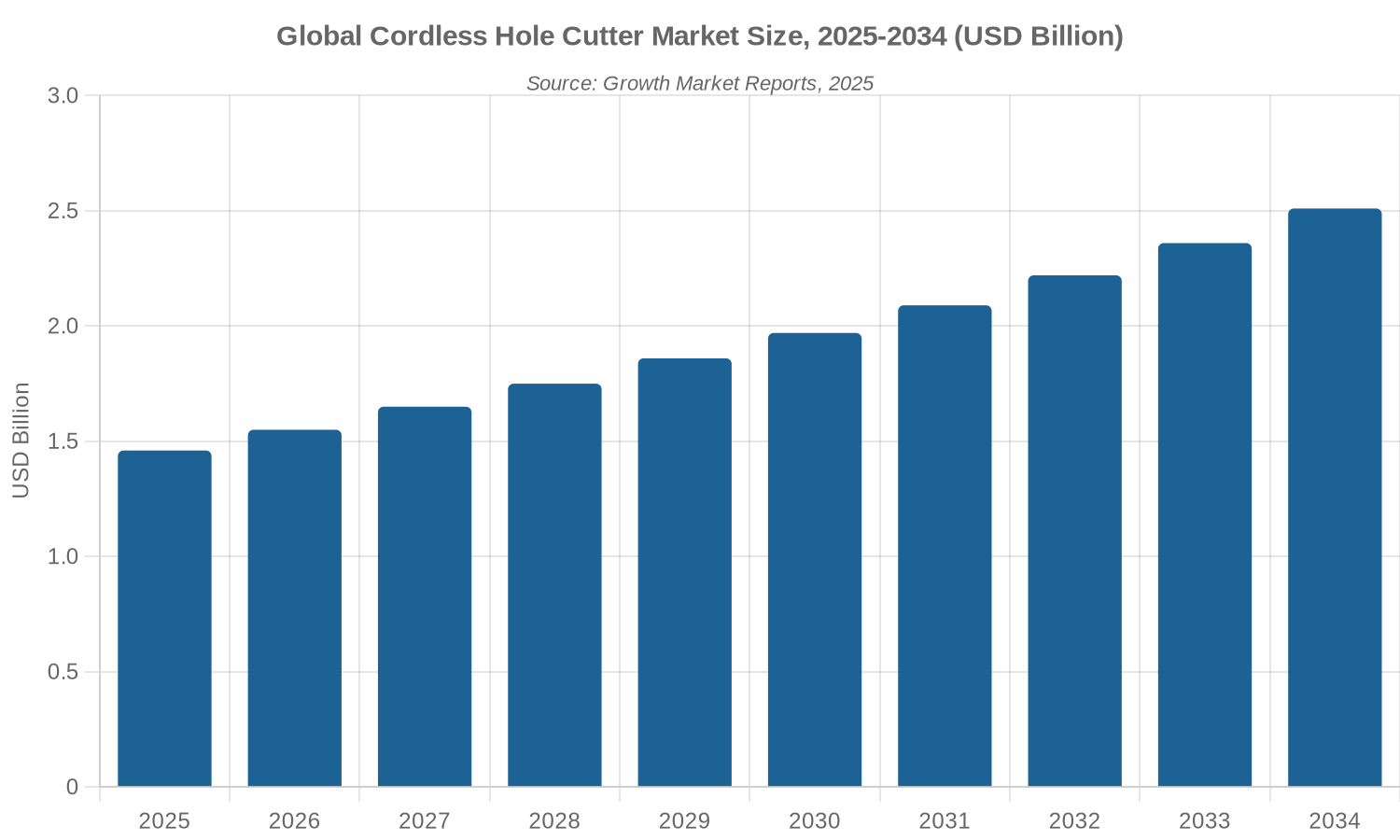
The Cordless Hole Cutter market was valued at USD 1.46 Billion in 2025 and is projected to reach USD 2.52 Billion by 2034, a CAGR of 6.2%.
| Market size (2025) | USD 1.46 Billion |
|---|---|
| Forecast (2034) | USD 2.52 Billion |
| CAGR (2026-2034) | 6.2% |
| Largest region | Asia Pacific (USD 485 Million) |
| Segments covered | Product Type, Application, Blade Material, Distribution Channel, End-User |
| Key companies | Makita Corporation, Milwaukee Tool (Techtronic Industries), DEWALT (Stanley Black & Decker), Bosch Power Tools, Hilti Corporation |
This report is updated with the latest market data and insights as of June 2026. Base year: 2025 | Forecast period: 2026-2034
Cordless Hole Cutter Market Size and Growth Outlook
Research by Growth Market Reports shows that the global cordless hole cutter market size stands at USD 1.46 billion in 2025, reflecting robust demand across construction, electrical, and DIY sectors. The market is experiencing healthy expansion, registering a CAGR of 6.2% from 2026 to 2034. By the end of 2034, the global cordless hole cutter market is forecasted to reach USD 2.52 billion. Growth is primarily fueled by the ongoing surge in infrastructure development, increasing adoption of portable power tools for enhanced mobility, and technological advancements in cutting blade materials and battery efficiency.
One of the principal growth drivers for the cordless hole cutter market is the rapid pace of urbanization and the consequent boom in construction activities worldwide. As cities expand and infrastructure projects multiply, the need for efficient, portable, and precise tools like cordless hole cutters has become paramount. These tools are invaluable for professionals in construction, electrical, plumbing, and HVAC applications, enabling them to work in confined or remote environments without the constraint of power cords. The increasing emphasis on time-efficient and labor-saving equipment further propels the adoption of cordless hole cutters, particularly in emerging economies where large-scale infrastructure investments are underway.
Technological innovation is another significant factor accelerating market growth. Modern cordless hole cutters are equipped with advanced battery technologies, such as lithium-ion cells, which offer longer runtimes and faster charging capabilities. Improvements in blade materials, including high-speed steel, carbide, and diamond, have enhanced the performance, durability, and versatility of these tools. Manufacturers are also integrating smart features like variable speed controls, ergonomic designs, and safety mechanisms, making cordless hole cutters more attractive to a wider array of end-users, from seasoned professionals to DIY enthusiasts. This technological evolution is fostering a surge in product replacement cycles and encouraging the entry of new players into the market.
The rising popularity of DIY culture, especially in developed regions, is contributing significantly to the growth of the cordless hole cutter market. Homeowners and hobbyists are increasingly investing in high-quality cordless power tools to undertake small-scale renovation, repair, and maintenance projects. The ease of use, portability, and reduced risk of accidents associated with cordless hole cutters make them a preferred choice for residential applications. Furthermore, the proliferation of online retail platforms has improved product accessibility, allowing consumers to compare features, prices, and reviews before making a purchase. This shift in consumer behavior is creating new opportunities for manufacturers and distributors to expand their reach and enhance customer engagement. The growing interest in complementary tools such as the cordless hand planer further reflects the broader consumer appetite for battery-powered tools that combine mobility with performance.
Regionally, the Asia Pacific market is emerging as a key growth engine, driven by rapid industrialization, urban sprawl, and government initiatives focused on infrastructure modernization. North America and Europe continue to exhibit steady demand, underpinned by a mature construction sector and high adoption rates of advanced power tools. Meanwhile, Latin America and the Middle East & Africa are witnessing gradual market penetration, supported by ongoing development projects and increasing awareness of cordless tool benefits. Each of these regions presents unique opportunities and challenges, shaping the competitive dynamics of the global cordless hole cutter market.
Cordless Hole Cutter Market by Product Type
The cordless hole cutter market by product type is broadly segmented into adjustable cordless hole cutters and fixed size cordless hole cutters. Adjustable cordless hole cutters are gaining significant traction owing to their versatility and ability to cater to a wide range of hole diameters with a single tool. This flexibility is particularly valued in professional settings where workers must adapt quickly to varying requirements on job sites. Adjustable models often feature robust design elements, such as quick-change mechanisms and reinforced blade assemblies, which not only enhance operational efficiency but also contribute to longer tool lifespans. The growing demand for multifunctional tools in both commercial and residential applications is expected to bolster the growth of this segment through 2034.

Fixed size cordless hole cutters, on the other hand, are preferred for applications that require consistent and repeatable hole diameters. These cutters are commonly used in industrial manufacturing, electrical installations, and plumbing where standardized hole sizes are crucial for quality and compliance. Fixed size models are typically lighter, more compact, and optimized for specific materials or tasks, making them ideal for repetitive work. Their simplicity and reliability appeal to users seeking straightforward solutions without the need for frequent adjustments. As a result, fixed size cordless hole cutters maintain a steady demand base across various end-user segments. Professionals who also rely on tools such as a hole saw for complementary cutting tasks frequently incorporate fixed size cordless models into their standard toolkit.
The competition between adjustable and fixed size cordless hole cutters is driving innovation in product design and functionality. Manufacturers are increasingly focusing on enhancing the durability, ease of use, and safety features of both product types. For instance, adjustable models are now incorporating tool-free adjustment systems and laser guides for improved accuracy, while fixed size cutters are being designed with advanced blade materials to extend cutting life and reduce maintenance. This ongoing evolution is expanding the addressable market and encouraging users to upgrade their toolkits with the latest offerings.
In terms of market share, adjustable cordless hole cutters currently lead with approximately 58.5% of the market in 2025, due to their adaptability and cost-effectiveness in dynamic work environments. Fixed size models continue to hold substantial value, representing around 41.5% of the market, particularly in specialized industrial and professional applications. The interplay between these two product types is expected to persist, with each segment catering to distinct user needs and preferences. As end-users become more discerning and demand higher performance standards, the product type segment will remain a focal point for innovation and competitive differentiation in the cordless hole cutter market.
The broader trend toward multi-task portable cutting solutions is also evident in adjacent product categories. Tools such as the cordless oscillating multi-tool are increasingly complementing cordless hole cutters on professional job sites, as contractors look to consolidate their battery platforms and reduce the number of tools they carry. This convergence is encouraging manufacturers to develop interoperable battery ecosystems, further strengthening brand loyalty and repeat purchase behavior across product lines.
Cordless Hole Cutter Market Report Scope
| Attributes | Details |
| Report Title | Cordless Hole Cutter Market Research Report 2034 |
| By Product Type | Adjustable Cordless Hole Cutters, Fixed Size Cordless Hole Cutters |
| By Application | Construction, Electrical, Plumbing, HVAC, DIY, Others |
| By Blade Material | High-Speed Steel, Carbide, Diamond, Others |
| By Distribution Channel | Online Retail, Specialty Stores, Direct Sales, Others |
| By End-User | Professional, Residential, Industrial |
| Regions Covered | North America, Europe, APAC, Latin America, MEA |
| Base Year | 2025 |
| Historic Data | 2019-2024 |
| Forecast Period | 2026-2034 |
| Number of Pages | 298 |
| Number of Tables & Figures | 311 |
| Customization Available | Yes, the report can be customized as per your need. |
Cordless Hole Cutter Market by Application
The application segment of the cordless hole cutter market encompasses construction, electrical, plumbing, HVAC, DIY, and others. The construction sector dominates this segment, accounting for the largest share due to the extensive use of hole cutters in tasks such as drilling through wood, metal, and composite materials for structural, wiring, and pipe installations. The ongoing global infrastructure boom, particularly in Asia Pacific and emerging markets, is fueling demand for high-performance cordless hole cutters that can withstand rigorous use on construction sites. The shift toward modular and prefabricated construction methods is increasing the need for precise and portable cutting tools, further propelling market growth in this segment through 2034.
The electrical and plumbing sectors are also significant contributors to the cordless hole cutter market. Electricians rely on these tools for creating access points in panels, walls, and ceilings to route cables and install fixtures, while plumbers use them to cut holes for pipes and fittings in various materials. The advent of smart homes and the proliferation of complex electrical and plumbing systems have heightened the need for reliable, cordless solutions that offer both power and maneuverability. HVAC professionals are increasingly adopting cordless hole cutters for ductwork installations and maintenance, as these tools enable them to work efficiently in tight or elevated spaces without the hassle of cords.
DIY and home improvement applications represent a fast-growing segment, driven by the rising trend of do-it-yourself projects and the increasing availability of user-friendly cordless hole cutters. Homeowners and hobbyists are investing in these tools for tasks ranging from furniture assembly to home renovation, attracted by their portability, safety features, and ease of operation. Manufacturers are responding to this trend by offering compact, lightweight models with intuitive controls and comprehensive safety instructions, making cordless hole cutters accessible to users of all skill levels. The DIY segment is expected to continue its upward trajectory through 2034 as more consumers embrace hands-on home improvement activities. Enthusiasts who invest in a cordless drill as their primary cutting and fastening tool frequently add a cordless hole cutter to their toolkit as their project scope expands.
Other applications, such as automotive, aerospace, and shipbuilding, are gradually adopting cordless hole cutters for specialized tasks that require precision and mobility. These industries demand tools that can deliver consistent performance in challenging environments, prompting manufacturers to develop ruggedized models with enhanced battery life and cutting capabilities. The diversification of application areas is expanding the market's reach and creating new opportunities for growth, as cordless hole cutters become indispensable in a variety of professional and industrial settings.
Cordless Hole Cutter Market by Blade Material
The blade material segment of the cordless hole cutter market includes high-speed steel, carbide, diamond, and others. High-speed steel (HSS) blades are widely used due to their affordability, versatility, and ability to cut through a range of materials such as wood, plastic, and soft metals. HSS blades are favored in general-purpose applications and are particularly popular among DIY users and professionals who require reliable performance at a reasonable cost. However, the limitations of HSS in terms of wear resistance and cutting speed have led to increased demand for more advanced blade materials in heavy-duty and industrial applications.
Carbide blades are gaining traction in the market owing to their superior hardness, durability, and ability to maintain sharpness over prolonged use. These blades are ideal for cutting tougher materials like stainless steel, hard plastics, and composites, making them a preferred choice for professionals in construction, plumbing, and electrical sectors. The higher initial investment in carbide blades is offset by their extended lifespan and reduced need for frequent replacements, resulting in lower total cost of ownership for end-users. As industries seek to improve productivity and minimize downtime, the adoption of carbide blade cordless hole cutters is expected to rise steadily through the forecast period.
Diamond blades represent the pinnacle of cutting performance for the most demanding applications, such as cutting through reinforced concrete, ceramic tiles, and other hard materials. These blades are engineered with industrial-grade diamond particles embedded in the cutting edge, offering unmatched precision, speed, and longevity. Although diamond blade cordless hole cutters command a premium price, their ability to deliver clean, accurate cuts in challenging conditions makes them indispensable in specialized sectors like construction, mining, and infrastructure maintenance. The growing focus on high-value projects and the need for precision tools are driving the adoption of diamond blade technologies in the cordless hole cutter market.
Other blade materials, including bi-metal and coated variants, cater to niche applications where specific performance characteristics are required. Manufacturers are continually experimenting with new alloys, coatings, and manufacturing techniques to enhance blade performance, reduce friction, and extend tool life. This ongoing innovation in blade materials is a key differentiator in the competitive landscape, enabling brands to offer tailored solutions that address the unique needs of various end-users. As material science advances, the blade material segment will remain a critical area of focus for product development and market expansion through 2034.
Cordless Hole Cutter Market by Distribution Channel
The distribution channel segment of the cordless hole cutter market is categorized into online retail, specialty stores, direct sales, and others. Online retail has emerged as the dominant channel as of 2025, driven by the increasing preference for e-commerce platforms that offer convenience, competitive pricing, and a wide selection of products. The growth of online marketplaces such as Amazon, Alibaba, and specialized tool retailers has made it easier for consumers and professionals to access the latest cordless hole cutters, compare features, and read user reviews before making a purchase. Continued investment by manufacturers in direct-to-consumer digital storefronts is further strengthening the online channel's growth trajectory through 2034.
Specialty stores continue to play a vital role in the distribution of cordless hole cutters, particularly for professional and industrial customers who value expert advice, product demonstrations, and after-sales support. These stores often stock a curated selection of high-quality tools from leading brands, providing customers with the opportunity to inspect products firsthand and receive personalized recommendations. The expertise and service offered by specialty stores are especially important for complex or high-value purchases, where buyers seek assurance regarding product performance and compatibility.
Direct sales channels, including manufacturer-owned outlets and business-to-business (B2B) sales teams, are increasingly being leveraged to target large-scale buyers such as construction firms, electrical contractors, and industrial enterprises. Direct sales enable manufacturers to build closer relationships with key customers, offer customized solutions, and provide comprehensive technical support. This channel is particularly effective for high-volume orders, specialized products, and long-term supply agreements, allowing manufacturers to better understand customer needs and respond with tailored offerings.
Other distribution channels, such as hardware stores, wholesalers, and rental outlets, also contribute to market reach by catering to local markets and offering flexible purchasing options. The diversity of distribution channels reflects the varied needs of end-users and the importance of accessibility in driving market growth. As competition intensifies, manufacturers and distributors are focusing on omni-channel strategies that integrate online and offline touchpoints, enhance customer experience, and streamline logistics to capture a larger share of the cordless hole cutter market.
Cordless Hole Cutter Market by End-User
The end-user segment of the cordless hole cutter market comprises professional, residential, and industrial users. Professional users, including contractors, electricians, plumbers, and HVAC technicians, represent the largest segment due to their frequent and intensive use of cordless hole cutters for a wide range of applications. These users prioritize performance, reliability, and durability, often opting for premium models with advanced features and robust construction. The growing complexity of modern construction and maintenance tasks is driving demand for high-quality cordless hole cutters that can deliver consistent results in challenging environments.
Residential users, encompassing homeowners and DIY enthusiasts, constitute a rapidly expanding segment fueled by the rising popularity of home improvement projects and the increasing availability of user-friendly cordless tools. Residential users value portability, safety, and ease of operation, seeking tools that enable them to undertake repairs, renovations, and creative projects with confidence. Manufacturers are responding to this trend by developing compact, lightweight models with intuitive controls and comprehensive safety features, making cordless hole cutters accessible to a broader audience. Accessory tools such as the cordless nail gun are frequently purchased alongside cordless hole cutters by residential users undertaking full-scale home renovation projects.
Industrial users, such as manufacturing plants, automotive workshops, and shipyards, require cordless hole cutters for specialized tasks that demand precision, power, and efficiency. These environments often involve cutting through tough materials and working in confined or hazardous spaces, necessitating tools that can withstand heavy use and deliver reliable performance. Industrial users are increasingly adopting cordless solutions to enhance mobility, reduce setup time, and improve workplace safety. The shift toward Industry 4.0 and smart manufacturing is further driving the adoption of advanced cordless hole cutters equipped with digital controls and connectivity features.
The diverse needs of professional, residential, and industrial end-users are shaping product development and marketing strategies in the cordless hole cutter market. Manufacturers are focusing on segment-specific innovations, such as ergonomic designs for professionals, safety enhancements for residential users, and ruggedized models for industrial applications. By addressing the unique requirements of each end-user segment, companies are positioning themselves to capture a larger share of the market and drive sustained growth through 2034.
Cordless Hole Cutter Market Opportunities and Threats
The cordless hole cutter market presents significant opportunities for growth, particularly through technological innovation and product diversification. The ongoing development of advanced battery technologies, such as solid-state and fast-charging lithium-ion cells, is enabling manufacturers to offer cordless hole cutters with longer runtimes, faster recharge cycles, and greater power output. These advancements are expanding the range of applications for cordless tools and attracting new user segments, including industrial and commercial customers. The integration of smart features like Bluetooth connectivity, digital displays, and automated safety mechanisms is creating new value propositions and differentiating brands in a competitive market.
Another major opportunity lies in the expansion of distribution networks and the adoption of omni-channel sales strategies. The rise of e-commerce and online retail platforms has made it easier for manufacturers to reach a global audience, while specialty stores and direct sales channels continue to provide valuable touchpoints for professional and industrial customers. By leveraging data analytics and customer insights, companies can tailor their marketing and product offerings to specific segments, enhance customer engagement, and drive higher conversion rates. The increasing emphasis on sustainability and eco-friendly manufacturing practices also presents opportunities for brands to differentiate themselves and appeal to environmentally conscious consumers in 2025 and beyond.
Despite the positive outlook, the cordless hole cutter market faces several restraining factors that could impede growth. One of the primary challenges is the high initial cost of advanced cordless hole cutters, particularly those equipped with premium blade materials and smart features. Price-sensitive customers, especially in emerging markets, may be reluctant to invest in high-end models, opting instead for traditional corded tools or lower-priced alternatives. Concerns about battery life, performance consistency over repeated charge cycles, and maintenance requirements can deter some users from making the switch to cordless solutions. Addressing these challenges will require ongoing innovation, cost optimization, and targeted marketing efforts to educate consumers about the long-term benefits and total cost of ownership associated with cordless hole cutters.
Cordless Hole Cutter Market Size by Region
The Asia Pacific region commands the largest share of the cordless hole cutter market, with a market size of approximately USD 485 million in 2025. This dominance is attributed to rapid industrialization, urban expansion, and significant investments in infrastructure development across China, India, Japan, and Southeast Asia. The region is witnessing a surge in construction activities, both residential and commercial, which is driving demand for advanced power tools, including cordless hole cutters. The proliferation of manufacturing hubs and the increasing adoption of modern construction techniques are further bolstering market growth. With a projected CAGR of 7.2% through 2034, Asia Pacific is poised to maintain its leadership position in the global market.

North America is another key region, accounting for approximately USD 391 million of the global market in 2025. The region benefits from a mature construction sector, high adoption rates of cordless power tools, and a strong DIY culture. The presence of leading manufacturers, a well-established distribution network, and a focus on technological innovation contribute to the steady growth of the market in the United States and Canada. North American consumers are increasingly seeking high-performance, feature-rich cordless hole cutters for professional and personal use, driving demand for premium products. The region is expected to experience moderate but consistent growth over the forecast period, supported by ongoing infrastructure upgrades and residential renovation projects.
Europe holds a significant share of the cordless hole cutter market, with a market size of approximately USD 323 million in 2025. The region is characterized by stringent safety and quality standards, which drive demand for reliable and certified power tools. The construction, electrical, and plumbing sectors are major contributors to market growth, while the rising popularity of DIY projects among homeowners is expanding the consumer base. The European market is also witnessing increased adoption of sustainable and energy-efficient tools, reflecting the region's strong commitment to environmental responsibility. Latin America and the Middle East & Africa collectively account for the remaining market share, with gradual growth anticipated as awareness of cordless tool benefits increases and infrastructure investments accelerate in these regions through 2034.
Cordless Hole Cutter Market Competitive Landscape
The cordless hole cutter market is highly competitive, with a diverse mix of global and regional players vying for market share. The competitive landscape is characterized by constant innovation, product differentiation, and strategic partnerships aimed at expanding distribution networks and enhancing brand visibility. Leading companies are investing heavily in research and development to introduce new features, improve battery performance, and develop advanced blade materials that cater to evolving customer needs in 2025 and beyond. The emphasis on quality, safety, and user experience is driving manufacturers to adopt stringent quality control measures and obtain relevant certifications to gain a competitive edge.
Market leaders are also focusing on expanding their global footprint through mergers and acquisitions, joint ventures, and collaborations with local distributors. These strategies enable companies to access new markets, diversify their product portfolios, and leverage synergies in manufacturing and supply chain operations. The rise of e-commerce and digital marketing has further intensified competition, as brands compete for online visibility and customer engagement. Price competition remains a key challenge, particularly in price-sensitive markets, prompting manufacturers to explore cost optimization measures and value-added services to retain customer loyalty.
In addition to established brands, the market is witnessing the entry of new players offering innovative products at competitive prices. These entrants are leveraging advancements in battery technology, material science, and digital integration to carve out a niche in the market. The growing demand for sustainable and eco-friendly products is encouraging manufacturers to adopt green manufacturing practices and develop recyclable or more durable components. As consumer preferences evolve, the ability to anticipate and respond to market trends will be crucial for sustained competitiveness in the cordless hole cutter market through 2034.
Some of the major companies operating in the cordless hole cutter market include Makita Corporation, Milwaukee Tool (a subsidiary of Techtronic Industries), Bosch Power Tools, DEWALT (a Stanley Black & Decker brand), Hilti Corporation, and HiKOKI (formerly Hitachi Koki). These companies are renowned for their commitment to quality, innovation, and customer satisfaction. Makita Corporation is recognized for its extensive range of cordless tools and continuous investment in battery technology. Milwaukee Tool is a pioneer in introducing smart features and digital connectivity in power tools, while Bosch Power Tools is known for its robust engineering and global distribution network.
DEWALT, a leading brand under Stanley Black & Decker, offers a comprehensive portfolio of cordless hole cutters designed for professional and industrial applications. The company is noted for its focus on ergonomic design, safety features, and product durability. Hilti Corporation specializes in high-performance tools for the construction and industrial sectors, with a strong emphasis on customer service and after-sales support. HiKOKI is expanding its presence in the cordless power tool market through innovative product launches and strategic partnerships. Other notable competitors include Metabo HPT, Ryobi, Festool GmbH, FEIN Power Tools, Ridgid, WORX, and Einhell Germany AG, all of which contribute to a dynamic and innovation-driven competitive environment. Collectively, these companies account for a significant share of the global market and continue to shape competitive dynamics through ongoing technological investment and strategic market expansion.
Top Companies in the Cordless Hole Cutter Market
- Makita Corporation
- Milwaukee Tool (Techtronic Industries)
- DEWALT (Stanley Black & Decker)
- Bosch Power Tools
- Hilti Corporation
- HiKOKI (formerly Hitachi Koki)
- Metabo HPT
- Ryobi (Techtronic Industries)
- Festool GmbH
- FEIN Power Tools
- Ridgid (Emerson Electric)
- WORX (Positec Tool Corporation)
- Einhell Germany AG
- Skil Power Tools
- Kobalt (Lowe's)
Segments
The Cordless Hole Cutter market has been segmented on the basis of
Product Type
- Adjustable Cordless Hole Cutters
- Fixed Size Cordless Hole Cutters
Application
- Construction
- Electrical
- Plumbing
- HVAC
- DIY
- Others
Blade Material
- High-Speed Steel
- Carbide
- Diamond
- Others
Distribution Channel
- Online Retail
- Specialty Stores
- Direct Sales
- Others
End-User
- Professional
- Residential
- Industrial
Frequently Asked Questions
Leading manufacturers as of 2025 include Makita Corporation, Milwaukee Tool, DEWALT (Stanley Black & Decker), Bosch Power Tools, Hilti Corporation, HiKOKI, Metabo HPT, Ryobi, Festool GmbH, FEIN Power Tools, Ridgid, WORX, and Einhell Germany AG. These companies compete on the basis of battery performance, blade material innovation, ergonomic design, smart connectivity, and global distribution reach.
Key opportunities include the development of next-generation battery technologies such as solid-state cells, integration of smart digital features including Bluetooth connectivity and automated safety controls, and expansion into high-growth emerging markets across Asia Pacific, Latin America, and Middle East & Africa. Challenges include the high initial cost of premium cordless models, concerns about battery performance consistency over time, and competitive pricing pressure from low-cost manufacturers, particularly in price-sensitive developing regions.
Professional users, including contractors, electricians, plumbers, and HVAC technicians, represent the largest end-user segment due to high-frequency, intensive tool use. The residential segment is expanding quickly, fueled by DIY home improvement trends. Industrial users in manufacturing, automotive, and shipbuilding sectors form a third distinct segment, prioritizing precision, power, and durability in demanding workplace environments.
Online retail is the dominant and fastest-growing distribution channel as of 2025, driven by the convenience of e-commerce platforms and competitive pricing. Specialty tool stores remain important for professional and industrial buyers who value hands-on product evaluation and expert guidance. Direct sales channels serve large commercial and institutional buyers through manufacturer representatives. Hardware stores, wholesalers, and equipment rental outlets round out the distribution landscape.
High-speed steel (HSS) blades remain widely adopted for general-purpose applications due to their affordability and versatility. Carbide blades are gaining market share for their superior hardness and durability when cutting tough materials such as stainless steel and composites. Diamond blades command a premium and are used in specialized, high-demand applications such as cutting reinforced concrete and ceramic tiles. Bi-metal and specialty-coated blades serve additional niche requirements.
Cordless hole cutters are widely used across construction, electrical installation, plumbing, HVAC, and DIY home improvement. The construction sector holds the largest application share due to extensive drilling needs across wood, metal, and composite materials. Electricians, plumbers, and HVAC technicians also rely heavily on these tools, while the DIY segment is among the fastest growing as homeowners increasingly invest in portable, user-friendly power tools.
The market is primarily segmented into adjustable cordless hole cutters and fixed size cordless hole cutters. Adjustable models, which account for approximately 58.5% of the market in 2025, are valued for their versatility across a wide range of hole diameters. Fixed size models, representing roughly 41.5%, are preferred for standardized, repetitive tasks in industrial, electrical, and plumbing applications where consistent hole dimensions are required.
Asia Pacific leads the global cordless hole cutter market with a share of approximately 33.2%, driven by large-scale infrastructure projects and rapid industrialization in China, India, Japan, and Southeast Asia. North America holds roughly 26.8% of global market share, supported by a mature construction industry and strong DIY culture. Europe accounts for around 22.1%, with Latin America and Middle East & Africa representing the remaining growth-stage markets.
Key growth drivers include rapid urbanization and global infrastructure investment, widespread adoption of lithium-ion battery technology enabling longer runtimes and faster charging, rising DIY culture in developed economies, and expanding construction activity in Asia Pacific and emerging markets. Advances in blade materials, ergonomic tool design, and smart connectivity features are also accelerating product replacement cycles and attracting new user segments.
The global cordless hole cutter market is valued at USD 1.46 billion in 2025, the base year of this report. The market is projected to grow at a CAGR of 6.2% during the forecast period from 2026 to 2034, reaching approximately USD 2.52 billion by the end of 2034. This expansion is supported by strong demand from construction, electrical, plumbing, and DIY sectors worldwide.
Table Of Content
Chapter 1 Executive SummaryChapter 2 Assumptions and Acronyms Used
Chapter 3 Research Methodology
Chapter 4 Cordless Hole Cutter Market Overview
4.1 Introduction
4.1.1 Market Taxonomy
4.1.2 Market Definition
4.1.3 Macro-Economic Factors Impacting the Market Growth
4.2 Cordless Hole Cutter Market Dynamics
4.2.1 Market Drivers
4.2.2 Market Restraints
4.2.3 Market Opportunity
4.3 Cordless Hole Cutter Market - Supply Chain Analysis
4.3.1 List of Key Suppliers
4.3.2 List of Key Distributors
4.3.3 List of Key Consumers
4.4 Key Forces Shaping the Cordless Hole Cutter Market
4.4.1 Bargaining Power of Suppliers
4.4.2 Bargaining Power of Buyers
4.4.3 Threat of Substitution
4.4.4 Threat of New Entrants
4.4.5 Competitive Rivalry
4.5 Global Cordless Hole Cutter Market Size & Forecast, 2023-2032
4.5.1 Cordless Hole Cutter Market Size and Y-o-Y Growth
4.5.2 Cordless Hole Cutter Market Absolute $ Opportunity
Chapter 5 Global Cordless Hole Cutter Market Analysis and Forecast By Product Type
5.1 Introduction
5.1.1 Key Market Trends & Growth Opportunities By Product Type
5.1.2 Basis Point Share (BPS) Analysis By Product Type
5.1.3 Absolute $ Opportunity Assessment By Product Type
5.2 Cordless Hole Cutter Market Size Forecast By Product Type
5.2.1 Adjustable Cordless Hole Cutters
5.2.2 Fixed Size Cordless Hole Cutters
5.3 Market Attractiveness Analysis By Product Type
Chapter 6 Global Cordless Hole Cutter Market Analysis and Forecast By Application
6.1 Introduction
6.1.1 Key Market Trends & Growth Opportunities By Application
6.1.2 Basis Point Share (BPS) Analysis By Application
6.1.3 Absolute $ Opportunity Assessment By Application
6.2 Cordless Hole Cutter Market Size Forecast By Application
6.2.1 Construction
6.2.2 Electrical
6.2.3 Plumbing
6.2.4 HVAC
6.2.5 DIY
6.2.6 Others
6.3 Market Attractiveness Analysis By Application
Chapter 7 Global Cordless Hole Cutter Market Analysis and Forecast By Blade Material
7.1 Introduction
7.1.1 Key Market Trends & Growth Opportunities By Blade Material
7.1.2 Basis Point Share (BPS) Analysis By Blade Material
7.1.3 Absolute $ Opportunity Assessment By Blade Material
7.2 Cordless Hole Cutter Market Size Forecast By Blade Material
7.2.1 High-Speed Steel
7.2.2 Carbide
7.2.3 Diamond
7.2.4 Others
7.3 Market Attractiveness Analysis By Blade Material
Chapter 8 Global Cordless Hole Cutter Market Analysis and Forecast By Distribution Channel
8.1 Introduction
8.1.1 Key Market Trends & Growth Opportunities By Distribution Channel
8.1.2 Basis Point Share (BPS) Analysis By Distribution Channel
8.1.3 Absolute $ Opportunity Assessment By Distribution Channel
8.2 Cordless Hole Cutter Market Size Forecast By Distribution Channel
8.2.1 Online Retail
8.2.2 Specialty Stores
8.2.3 Direct Sales
8.2.4 Others
8.3 Market Attractiveness Analysis By Distribution Channel
Chapter 9 Global Cordless Hole Cutter Market Analysis and Forecast By End-User
9.1 Introduction
9.1.1 Key Market Trends & Growth Opportunities By End-User
9.1.2 Basis Point Share (BPS) Analysis By End-User
9.1.3 Absolute $ Opportunity Assessment By End-User
9.2 Cordless Hole Cutter Market Size Forecast By End-User
9.2.1 Professional
9.2.2 Residential
9.2.3 Industrial
9.3 Market Attractiveness Analysis By End-User
Chapter 10 Global Cordless Hole Cutter Market Analysis and Forecast by Region
10.1 Introduction
10.1.1 Key Market Trends & Growth Opportunities By Region
10.1.2 Basis Point Share (BPS) Analysis By Region
10.1.3 Absolute $ Opportunity Assessment By Region
10.2 Cordless Hole Cutter Market Size Forecast By Region
10.2.1 North America
10.2.2 Europe
10.2.3 Asia Pacific
10.2.4 Latin America
10.2.5 Middle East & Africa (MEA)
10.3 Market Attractiveness Analysis By Region
Chapter 11 Coronavirus Disease (COVID-19) Impact
11.1 Introduction
11.2 Current & Future Impact Analysis
11.3 Economic Impact Analysis
11.4 Government Policies
11.5 Investment Scenario
Chapter 12 North America Cordless Hole Cutter Analysis and Forecast
12.1 Introduction
12.2 North America Cordless Hole Cutter Market Size Forecast by Country
12.2.1 U.S.
12.2.2 Canada
12.3 Basis Point Share (BPS) Analysis by Country
12.4 Absolute $ Opportunity Assessment by Country
12.5 Market Attractiveness Analysis by Country
12.6 North America Cordless Hole Cutter Market Size Forecast By Product Type
12.6.1 Adjustable Cordless Hole Cutters
12.6.2 Fixed Size Cordless Hole Cutters
12.7 Basis Point Share (BPS) Analysis By Product Type
12.8 Absolute $ Opportunity Assessment By Product Type
12.9 Market Attractiveness Analysis By Product Type
12.10 North America Cordless Hole Cutter Market Size Forecast By Application
12.10.1 Construction
12.10.2 Electrical
12.10.3 Plumbing
12.10.4 HVAC
12.10.5 DIY
12.10.6 Others
12.11 Basis Point Share (BPS) Analysis By Application
12.12 Absolute $ Opportunity Assessment By Application
12.13 Market Attractiveness Analysis By Application
12.14 North America Cordless Hole Cutter Market Size Forecast By Blade Material
12.14.1 High-Speed Steel
12.14.2 Carbide
12.14.3 Diamond
12.14.4 Others
12.15 Basis Point Share (BPS) Analysis By Blade Material
12.16 Absolute $ Opportunity Assessment By Blade Material
12.17 Market Attractiveness Analysis By Blade Material
12.18 North America Cordless Hole Cutter Market Size Forecast By Distribution Channel
12.18.1 Online Retail
12.18.2 Specialty Stores
12.18.3 Direct Sales
12.18.4 Others
12.19 Basis Point Share (BPS) Analysis By Distribution Channel
12.20 Absolute $ Opportunity Assessment By Distribution Channel
12.21 Market Attractiveness Analysis By Distribution Channel
12.22 North America Cordless Hole Cutter Market Size Forecast By End-User
12.22.1 Professional
12.22.2 Residential
12.22.3 Industrial
12.23 Basis Point Share (BPS) Analysis By End-User
12.24 Absolute $ Opportunity Assessment By End-User
12.25 Market Attractiveness Analysis By End-User
Chapter 13 Europe Cordless Hole Cutter Analysis and Forecast
13.1 Introduction
13.2 Europe Cordless Hole Cutter Market Size Forecast by Country
13.2.1 Germany
13.2.2 France
13.2.3 Italy
13.2.4 U.K.
13.2.5 Spain
13.2.6 Russia
13.2.7 Rest of Europe
13.3 Basis Point Share (BPS) Analysis by Country
13.4 Absolute $ Opportunity Assessment by Country
13.5 Market Attractiveness Analysis by Country
13.6 Europe Cordless Hole Cutter Market Size Forecast By Product Type
13.6.1 Adjustable Cordless Hole Cutters
13.6.2 Fixed Size Cordless Hole Cutters
13.7 Basis Point Share (BPS) Analysis By Product Type
13.8 Absolute $ Opportunity Assessment By Product Type
13.9 Market Attractiveness Analysis By Product Type
13.10 Europe Cordless Hole Cutter Market Size Forecast By Application
13.10.1 Construction
13.10.2 Electrical
13.10.3 Plumbing
13.10.4 HVAC
13.10.5 DIY
13.10.6 Others
13.11 Basis Point Share (BPS) Analysis By Application
13.12 Absolute $ Opportunity Assessment By Application
13.13 Market Attractiveness Analysis By Application
13.14 Europe Cordless Hole Cutter Market Size Forecast By Blade Material
13.14.1 High-Speed Steel
13.14.2 Carbide
13.14.3 Diamond
13.14.4 Others
13.15 Basis Point Share (BPS) Analysis By Blade Material
13.16 Absolute $ Opportunity Assessment By Blade Material
13.17 Market Attractiveness Analysis By Blade Material
13.18 Europe Cordless Hole Cutter Market Size Forecast By Distribution Channel
13.18.1 Online Retail
13.18.2 Specialty Stores
13.18.3 Direct Sales
13.18.4 Others
13.19 Basis Point Share (BPS) Analysis By Distribution Channel
13.20 Absolute $ Opportunity Assessment By Distribution Channel
13.21 Market Attractiveness Analysis By Distribution Channel
13.22 Europe Cordless Hole Cutter Market Size Forecast By End-User
13.22.1 Professional
13.22.2 Residential
13.22.3 Industrial
13.23 Basis Point Share (BPS) Analysis By End-User
13.24 Absolute $ Opportunity Assessment By End-User
13.25 Market Attractiveness Analysis By End-User
Chapter 14 Asia Pacific Cordless Hole Cutter Analysis and Forecast
14.1 Introduction
14.2 Asia Pacific Cordless Hole Cutter Market Size Forecast by Country
14.2.1 China
14.2.2 Japan
14.2.3 South Korea
14.2.4 India
14.2.5 Australia
14.2.6 South East Asia (SEA)
14.2.7 Rest of Asia Pacific (APAC)
14.3 Basis Point Share (BPS) Analysis by Country
14.4 Absolute $ Opportunity Assessment by Country
14.5 Market Attractiveness Analysis by Country
14.6 Asia Pacific Cordless Hole Cutter Market Size Forecast By Product Type
14.6.1 Adjustable Cordless Hole Cutters
14.6.2 Fixed Size Cordless Hole Cutters
14.7 Basis Point Share (BPS) Analysis By Product Type
14.8 Absolute $ Opportunity Assessment By Product Type
14.9 Market Attractiveness Analysis By Product Type
14.10 Asia Pacific Cordless Hole Cutter Market Size Forecast By Application
14.10.1 Construction
14.10.2 Electrical
14.10.3 Plumbing
14.10.4 HVAC
14.10.5 DIY
14.10.6 Others
14.11 Basis Point Share (BPS) Analysis By Application
14.12 Absolute $ Opportunity Assessment By Application
14.13 Market Attractiveness Analysis By Application
14.14 Asia Pacific Cordless Hole Cutter Market Size Forecast By Blade Material
14.14.1 High-Speed Steel
14.14.2 Carbide
14.14.3 Diamond
14.14.4 Others
14.15 Basis Point Share (BPS) Analysis By Blade Material
14.16 Absolute $ Opportunity Assessment By Blade Material
14.17 Market Attractiveness Analysis By Blade Material
14.18 Asia Pacific Cordless Hole Cutter Market Size Forecast By Distribution Channel
14.18.1 Online Retail
14.18.2 Specialty Stores
14.18.3 Direct Sales
14.18.4 Others
14.19 Basis Point Share (BPS) Analysis By Distribution Channel
14.20 Absolute $ Opportunity Assessment By Distribution Channel
14.21 Market Attractiveness Analysis By Distribution Channel
14.22 Asia Pacific Cordless Hole Cutter Market Size Forecast By End-User
14.22.1 Professional
14.22.2 Residential
14.22.3 Industrial
14.23 Basis Point Share (BPS) Analysis By End-User
14.24 Absolute $ Opportunity Assessment By End-User
14.25 Market Attractiveness Analysis By End-User
Chapter 15 Latin America Cordless Hole Cutter Analysis and Forecast
15.1 Introduction
15.2 Latin America Cordless Hole Cutter Market Size Forecast by Country
15.2.1 Brazil
15.2.2 Mexico
15.2.3 Rest of Latin America (LATAM)
15.3 Basis Point Share (BPS) Analysis by Country
15.4 Absolute $ Opportunity Assessment by Country
15.5 Market Attractiveness Analysis by Country
15.6 Latin America Cordless Hole Cutter Market Size Forecast By Product Type
15.6.1 Adjustable Cordless Hole Cutters
15.6.2 Fixed Size Cordless Hole Cutters
15.7 Basis Point Share (BPS) Analysis By Product Type
15.8 Absolute $ Opportunity Assessment By Product Type
15.9 Market Attractiveness Analysis By Product Type
15.10 Latin America Cordless Hole Cutter Market Size Forecast By Application
15.10.1 Construction
15.10.2 Electrical
15.10.3 Plumbing
15.10.4 HVAC
15.10.5 DIY
15.10.6 Others
15.11 Basis Point Share (BPS) Analysis By Application
15.12 Absolute $ Opportunity Assessment By Application
15.13 Market Attractiveness Analysis By Application
15.14 Latin America Cordless Hole Cutter Market Size Forecast By Blade Material
15.14.1 High-Speed Steel
15.14.2 Carbide
15.14.3 Diamond
15.14.4 Others
15.15 Basis Point Share (BPS) Analysis By Blade Material
15.16 Absolute $ Opportunity Assessment By Blade Material
15.17 Market Attractiveness Analysis By Blade Material
15.18 Latin America Cordless Hole Cutter Market Size Forecast By Distribution Channel
15.18.1 Online Retail
15.18.2 Specialty Stores
15.18.3 Direct Sales
15.18.4 Others
15.19 Basis Point Share (BPS) Analysis By Distribution Channel
15.20 Absolute $ Opportunity Assessment By Distribution Channel
15.21 Market Attractiveness Analysis By Distribution Channel
15.22 Latin America Cordless Hole Cutter Market Size Forecast By End-User
15.22.1 Professional
15.22.2 Residential
15.22.3 Industrial
15.23 Basis Point Share (BPS) Analysis By End-User
15.24 Absolute $ Opportunity Assessment By End-User
15.25 Market Attractiveness Analysis By End-User
Chapter 16 Middle East & Africa (MEA) Cordless Hole Cutter Analysis and Forecast
16.1 Introduction
16.2 Middle East & Africa (MEA) Cordless Hole Cutter Market Size Forecast by Country
16.2.1 Saudi Arabia
16.2.2 South Africa
16.2.3 UAE
16.2.4 Rest of Middle East & Africa (MEA)
16.3 Basis Point Share (BPS) Analysis by Country
16.4 Absolute $ Opportunity Assessment by Country
16.5 Market Attractiveness Analysis by Country
16.6 Middle East & Africa (MEA) Cordless Hole Cutter Market Size Forecast By Product Type
16.6.1 Adjustable Cordless Hole Cutters
16.6.2 Fixed Size Cordless Hole Cutters
16.7 Basis Point Share (BPS) Analysis By Product Type
16.8 Absolute $ Opportunity Assessment By Product Type
16.9 Market Attractiveness Analysis By Product Type
16.10 Middle East & Africa (MEA) Cordless Hole Cutter Market Size Forecast By Application
16.10.1 Construction
16.10.2 Electrical
16.10.3 Plumbing
16.10.4 HVAC
16.10.5 DIY
16.10.6 Others
16.11 Basis Point Share (BPS) Analysis By Application
16.12 Absolute $ Opportunity Assessment By Application
16.13 Market Attractiveness Analysis By Application
16.14 Middle East & Africa (MEA) Cordless Hole Cutter Market Size Forecast By Blade Material
16.14.1 High-Speed Steel
16.14.2 Carbide
16.14.3 Diamond
16.14.4 Others
16.15 Basis Point Share (BPS) Analysis By Blade Material
16.16 Absolute $ Opportunity Assessment By Blade Material
16.17 Market Attractiveness Analysis By Blade Material
16.18 Middle East & Africa (MEA) Cordless Hole Cutter Market Size Forecast By Distribution Channel
16.18.1 Online Retail
16.18.2 Specialty Stores
16.18.3 Direct Sales
16.18.4 Others
16.19 Basis Point Share (BPS) Analysis By Distribution Channel
16.20 Absolute $ Opportunity Assessment By Distribution Channel
16.21 Market Attractiveness Analysis By Distribution Channel
16.22 Middle East & Africa (MEA) Cordless Hole Cutter Market Size Forecast By End-User
16.22.1 Professional
16.22.2 Residential
16.22.3 Industrial
16.23 Basis Point Share (BPS) Analysis By End-User
16.24 Absolute $ Opportunity Assessment By End-User
16.25 Market Attractiveness Analysis By End-User
Chapter 17 Competition Landscape
17.1 Cordless Hole Cutter Market: Competitive Dashboard
17.2 Global Cordless Hole Cutter Market: Market Share Analysis, 2023
17.3 Company Profiles (Details – Overview, Financials, Developments, Strategy)
17.3.1 Makita Corporation
17.3.2 Milwaukee Tool (Techtronic Industries)
17.3.3 DEWALT (Stanley Black & Decker)
17.3.4 Bosch Power Tools
17.3.5 Hilti Corporation
17.3.6 HiKOKI (formerly Hitachi Koki)
17.3.7 Metabo HPT
17.3.8 Ryobi (Techtronic Industries)
17.3.9 Festool GmbH
17.3.10 FEIN Power Tools
17.3.11 Ridgid (Emerson Electric)
17.3.12 WORX (Positec Tool Corporation)
17.3.13 Einhell Germany AG
17.3.14 Skil Power Tools
17.3.15 Kobalt (Lowe's)
Methodology


Related Reports
Some other reports from this category!


Our Clients


