
Closed-Cell Spray Foam Market Size, Share & Growth Analysis, 2026-2034
Closed-Cell Spray Foam Market Size, Share & Growth Analysis, 2026-2034
Segments - by Product Type (Low-Density, Medium-Density, High-Density), by Application (Residential, Commercial, Industrial, Others), by End-Use Industry (Building & Construction, Automotive, Oil & Gas, Marine, Others), by Distribution Channel (Direct Sales, Distributors/Wholesalers, Online Retail)



Last Updated : Jun, 2026
| Report ID :MC-25574
| 4.3 Rating
| 94 Reviews
| 292 Pages
| Format :


Closed-Cell Spray Foam Market: Key Numbers
The Closed-Cell Spray Foam market was valued at USD 1.93 Billion in 2025 and is projected to reach USD 3.29 Billion by 2034, a CAGR of 6.1%.
| Market size (2025) | USD 1.93 Billion |
|---|---|
| Forecast (2034) | USD 3.29 Billion |
| CAGR (2026-2034) | 6.1% |
| Largest region | North America |
| Segments covered | Product Type, Application, End-Use Industry, Distribution Channel |
| Key companies | BASF SE, Huntsman Corporation, Covestro AG, Dow Inc., Johns Manville (Berkshire Hathaway) |
This report is updated with the latest market data and insights as of June 2026. Base year: 2025 | Forecast period: 2026-2034
Closed-Cell Spray Foam Market Size and Growth Outlook
Our analysis shows that the global closed-cell spray foam market size reached USD 1.93 billion in 2025, demonstrating robust growth driven by increasing demand for energy-efficient insulation solutions across various industries. The market is projected to expand at a CAGR of 6.1% from 2025 to 2034, reaching an estimated USD 3.29 billion by 2034. This positive trajectory is primarily attributed to the growing adoption of closed-cell spray foam in building and construction, automotive, and oil and gas sectors, as well as ongoing advancements in foam technology. The closed-cell spray foam market is poised for significant expansion, underpinned by stringent energy codes, heightened awareness of building sustainability, and rising investments in infrastructure worldwide.

One of the primary growth factors for the closed-cell spray foam market is the increasing focus on energy efficiency within the construction industry. Governments and regulatory bodies across the globe have implemented stringent building codes and energy performance standards, compelling builders and developers to adopt advanced insulation materials. Closed-cell spray foam, with its superior thermal resistance and moisture barrier properties, has become a preferred choice for both retrofitting existing structures and new construction projects. The material's ability to reduce energy consumption by minimizing air leakage and heat transfer aligns perfectly with global sustainability goals and carbon footprint reduction initiatives. Additionally, rising consumer awareness regarding the long-term cost savings associated with high-performance insulation is further propelling adoption, especially in regions experiencing extreme climatic conditions. The broader spray foam insulation segment is experiencing parallel momentum, reinforcing the overall market narrative for 2025 and beyond.
Technological advancements and product innovations have also played a pivotal role in driving the closed-cell spray foam market forward. Manufacturers are investing heavily in research and development to enhance performance characteristics, such as fire resistance, environmental friendliness, and reduced volatile organic compound (VOC) emissions. The introduction of eco-friendly blowing agents with low global warming potential (GWP) and bio-based raw materials has opened new avenues for growth, making closed-cell spray foam more attractive to environmentally conscious consumers and industries. Furthermore, advancements in application techniques, including improved spray equipment and faster curing formulations, have streamlined installation processes, reduced labor costs, and minimized downtime for end-users, thereby boosting market penetration across residential, commercial, and industrial segments. The emergence of polyurethane-based foam insulation technologies is closely linked to these innovations, with shared raw material supply chains and overlapping R&D pipelines.
Closed Cell Processing Systems are integral to the production of high-quality closed-cell spray foam. These systems ensure the precise mixing and application of foam components, which is crucial for achieving the desired insulation properties and structural integrity. By maintaining a controlled environment during the foam's expansion and curing process, these processing systems help minimize defects and ensure consistent product performance. This technology is particularly important in large-scale industrial applications where uniformity and reliability are paramount. As demand for closed-cell spray foam continues to grow through 2034, advancements in processing systems are expected to enhance production efficiency and product quality, further driving market expansion.
The diversification of closed-cell spray foam applications beyond traditional building insulation is another significant growth catalyst. Industries such as automotive, oil and gas, and marine are increasingly utilizing closed-cell spray foam for its lightweight, high-strength, and moisture-resistant properties. In the automotive sector the material is used for thermal and acoustic insulation, while in oil and gas it serves as a protective coating for pipelines and storage tanks. The marine industry leverages closed-cell spray foam for buoyancy and corrosion protection. This expanding scope of applications has broadened the market's addressable base, enabling manufacturers and distributors to tap into new revenue streams and mitigate risks associated with fluctuations in the construction sector. Growing interest in closed-cell foam for sound insulation in transportation and commercial construction further illustrates the material's cross-sector relevance.
From a regional perspective, North America continues to dominate the closed-cell spray foam market, accounting for approximately 37.8% of the global share in 2025, followed closely by Europe and Asia Pacific. The United States, in particular, benefits from a mature construction industry, high awareness of energy-efficient solutions, and supportive government policies. However, the Asia Pacific region is expected to witness the fastest growth during the forecast period, driven by rapid urbanization, infrastructure development, and rising disposable incomes. Emerging economies in Latin America and the Middle East and Africa are also gradually increasing their adoption of closed-cell spray foam, supported by growing investments in commercial and industrial projects. This regional diversification is expected to sustain market growth and enhance resilience against economic downturns in any single geography.
Closed-Cell Spray Foam Market by Product Type
The closed-cell spray foam market is segmented by product type into low-density, medium-density, and high-density foams. Each product type offers unique performance characteristics and caters to distinct application requirements, contributing to the overall growth and diversification of the market. Low-density closed-cell spray foams are primarily valued for their flexibility, ease of application, and relatively lower cost. These foams are commonly used in residential applications for wall cavities, attics, and crawl spaces, providing effective thermal insulation while maintaining breathability. Demand for low-density foams is particularly strong in regions with moderate climates, where insulation needs are less demanding but cost efficiency remains a priority. Manufacturers have responded by developing formulations that balance performance with affordability, expanding the market's reach among budget-conscious consumers and small-scale builders. Low-density foams accounted for approximately 31.2% of the global market in 2025.

Medium-density closed-cell spray foams occupy a middle ground in terms of performance and cost, offering a balanced combination of thermal insulation, structural reinforcement, and moisture resistance. Holding the largest share at roughly 42.5% in 2025, these foams are frequently utilized in both residential and commercial construction, where enhanced durability and energy efficiency are required. Medium-density foams are also favored for their ability to provide a continuous air and vapor barrier, making them suitable for use in high-humidity environments or areas prone to water intrusion. Their versatility has driven adoption across a wide range of applications, from exterior walls and roofs to below-grade insulation and cold storage facilities. As building codes become more stringent and the need for high-performance insulation grows, medium-density closed-cell spray foams are expected to gain further traction through 2034. The performance overlap with rigid closed-cell foam sheet products continues to influence product selection decisions in commercial construction.
High-density closed-cell spray foams represent the premium segment of the market at approximately 26.3% share in 2025, offering superior compressive strength, structural support, and resistance to water and chemicals. These foams are designed for demanding industrial and commercial applications, such as roofing, foundation insulation, and protective coatings for pipelines and storage tanks. The high-density segment is particularly important in regions prone to severe weather conditions, such as hurricanes or heavy rainfall, where robust insulation and structural reinforcement are critical. While high-density foams command a higher price point, their long-term performance benefits and ability to meet specialized requirements justify the investment for many end-users. Ongoing innovations in high-density foam formulations, including improved fire resistance and environmental sustainability, are expected to further enhance their market appeal through the forecast period.
The competitive landscape within the product type segment is characterized by continuous innovation and product differentiation. Leading manufacturers are investing in the development of advanced formulations that address specific customer needs, such as low-GWP blowing agents, improved adhesion properties, and faster curing times. These innovations not only enhance the performance and versatility of closed-cell spray foams but also align with evolving regulatory standards and environmental concerns. As a result, the market is witnessing a steady influx of new and improved products, enabling end-users to select the most suitable foam type for their specific applications and performance requirements. Comparisons with alternative cell structures covered in the microcellular foam market are increasingly informing material selection across high-performance industrial applications.
In summary, the segmentation of the closed-cell spray foam market by product type underscores the industry's commitment to meeting diverse customer needs and application challenges. Whether for cost-effective residential insulation, versatile commercial applications, or high-performance industrial uses, the availability of low-density, medium-density, and high-density foams ensures that the market remains dynamic and responsive to evolving trends and demands. This diversity not only drives market growth but also fosters innovation and competition among manufacturers, ultimately benefiting end-users with a wider array of high-quality insulation solutions.
Closed-Cell Spray Foam Market Report Scope
| Attributes | Details |
| Report Title | Closed-Cell Spray Foam Market Research Report 2034 |
| By Product Type | Low-Density, Medium-Density, High-Density |
| By Application | Residential, Commercial, Industrial, Others |
| By End-Use Industry | Building & Construction, Automotive, Oil & Gas, Marine, Others |
| By Distribution Channel | Direct Sales, Distributors/Wholesalers, Online Retail |
| Regions Covered | North America, Europe, APAC, Latin America, MEA |
| Base Year | 2025 |
| Historic Data | 2019-2024 |
| Forecast Period | 2026-2034 |
| Number of Pages | 292 |
| Number of Tables & Figures | 336 |
| Customization Available | Yes, the report can be customized as per your need. |
Closed-Cell Spray Foam Market by Application
The application segment of the closed-cell spray foam market encompasses residential, commercial, industrial, and other specialized uses, each contributing uniquely to the market's overall growth and direction. In the residential sector, closed-cell spray foam has gained significant traction due to its superior insulation properties, ability to reduce energy costs, and effectiveness in minimizing air infiltration. Homeowners and builders are increasingly opting for spray foam insulation in new constructions as well as retrofitting older homes to meet modern energy standards. The rising adoption of green building certifications, such as LEED and ENERGY STAR, further incentivizes the use of closed-cell spray foam, as it enables buildings to achieve higher energy efficiency ratings and environmental performance scores. By 2025, the residential segment represents a substantial and steadily growing share of global demand, supported by ongoing housing investment across North America, Europe, and Asia Pacific.
Commercial applications represent a substantial portion of the closed-cell spray foam market, driven by the demand for durable, long-lasting insulation solutions in office buildings, retail spaces, educational institutions, and healthcare facilities. Closed-cell spray foam's ability to provide continuous insulation, moisture control, and structural reinforcement makes it an ideal choice for commercial projects seeking to optimize energy performance and reduce operational costs. The increasing prevalence of net-zero energy buildings and sustainable construction practices in the commercial sector is expected to further boost demand, as developers and facility managers prioritize energy savings, occupant comfort, and indoor air quality over the 2026-2034 forecast period.
Industrial applications of closed-cell spray foam are diverse and encompass a wide range of end-uses, including manufacturing plants, warehouses, cold storage facilities, and processing units. In these settings, closed-cell spray foam is valued for its high compressive strength, resistance to chemicals and water, and ability to provide both thermal and acoustic insulation. Industrial users often require custom solutions tailored to specific operational challenges, such as extreme temperatures, exposure to corrosive substances, or stringent hygiene standards. The versatility and adaptability of closed-cell spray foam make it a preferred choice for industrial insulation, particularly in sectors where energy efficiency and asset protection are critical to operational success.
Beyond conventional applications, closed-cell spray foam is also finding its way into specialized uses, such as transportation, marine, and oil and gas industries. In the marine sector, for instance, closed-cell spray foam is utilized for flotation, buoyancy, and corrosion protection, while in oil and gas it serves as insulation and a protective coating for pipelines and storage tanks. These niche applications highlight the material's adaptability and the growing recognition of its value proposition across diverse industries. As new application areas continue to emerge through 2034, the closed-cell spray foam market is expected to benefit from expanded opportunities and increased market penetration.
The application segment's growth is further supported by ongoing education and awareness campaigns targeting architects, builders, contractors, and end-users. Industry associations and manufacturers are actively promoting the benefits of closed-cell spray foam through training programs, technical seminars, and certification courses, ensuring that stakeholders are equipped with the knowledge and skills required to maximize the material's performance and longevity. This emphasis on education is helping to overcome misconceptions and resistance to adoption, paving the way for broader acceptance and utilization across all application segments.
Closed-Cell Spray Foam Market by End-Use Industry
The closed-cell spray foam market's end-use industry segmentation provides a comprehensive view of the material's versatility and widespread adoption. The building and construction industry remains the dominant end-user, accounting for the majority of market demand in 2025. This sector relies heavily on closed-cell spray foam for its superior insulation, air sealing, and moisture barrier properties, which are essential for meeting increasingly stringent building codes and energy efficiency standards. Residential, commercial, and institutional buildings all benefit from enhanced thermal performance and reduced energy consumption, driving sustained demand from new construction as well as renovation projects.
The automotive industry represents a growing end-use segment for closed-cell spray foam, leveraging its lightweight, high-strength, and sound-dampening properties. Automakers are incorporating spray foam insulation into vehicle bodies, doors, and roofs to improve thermal comfort, reduce noise, and enhance structural integrity. The shift towards electric vehicles (EVs) has further amplified demand for advanced insulation materials, as manufacturers seek to optimize battery performance, minimize energy loss, and meet evolving safety standards. Closed-cell spray foam's ability to provide both thermal and acoustic insulation makes it an attractive solution for the automotive sector, particularly as consumer expectations for comfort and efficiency continue to rise through the forecast period.
In the oil and gas industry, closed-cell spray foam is utilized for a range of applications, including pipeline insulation, storage tank coatings, and offshore platform protection. The material's resistance to moisture, chemicals, and extreme temperatures makes it ideally suited for harsh operating environments, where asset protection and operational efficiency are paramount. Closed-cell spray foam's ability to prevent corrosion, reduce heat loss, and enhance safety has made it a preferred choice for oil and gas companies seeking to extend the lifespan of critical infrastructure and minimize maintenance costs. As the industry continues to invest in new projects and infrastructure upgrades through 2034, demand for closed-cell spray foam is expected to remain strong.
The marine industry also contributes to the closed-cell spray foam market, utilizing the material for flotation, buoyancy, and insulation in boats, ships, and offshore structures. Closed-cell spray foam's structure prevents water absorption, ensuring long-term durability and performance in marine environments. The material is also used for soundproofing and vibration dampening, enhancing comfort and safety for passengers and crew. As the global marine industry expands, driven by growth in commercial shipping, recreational boating, and offshore energy production, demand for closed-cell spray foam is expected to increase accordingly.
Other end-use industries, such as aerospace, electronics, and agriculture, are also exploring the benefits of closed-cell spray foam for specialized applications. In aerospace, the material is used for lightweight insulation and structural reinforcement, while in electronics it provides protection against moisture and temperature fluctuations. In agriculture, closed-cell spray foam is applied for insulation in storage facilities and animal housing. The expanding adoption across diverse end-use industries underscores the material's adaptability and the market's potential for continued growth and innovation through 2034.
Closed-Cell Spray Foam Market by Distribution Channel
The closed-cell spray foam market's distribution channel landscape is evolving rapidly, reflecting changes in buyer behavior, advancements in digital technology, and increased emphasis on customer service and support. Direct sales remain a key distribution channel, particularly for large-scale commercial and industrial projects where customized solutions, technical support, and project management are essential. Manufacturers and suppliers often work closely with contractors, architects, and end-users to provide tailored products, on-site training, and after-sales service, ensuring optimal performance and customer satisfaction. The direct sales channel is characterized by long-term relationships, repeat business, and a focus on quality and reliability.
Distributors and wholesalers play a crucial role in expanding the reach of closed-cell spray foam products, particularly in regions with fragmented markets or where manufacturers lack a direct presence. These intermediaries maintain extensive inventories, offer a wide range of complementary products, and provide value-added services such as logistics, financing, and technical support. By leveraging their local market knowledge and established networks, distributors and wholesalers help manufacturers penetrate new markets, reach smaller contractors and builders, and respond quickly to changing demand patterns. The distribution channel is highly competitive, with success often hinging on product availability, pricing, and customer service quality.
Online retail is an emerging distribution channel for closed-cell spray foam, driven by the increasing adoption of e-commerce platforms and digital procurement solutions. While online sales currently represent a small share of the market, their importance is expected to grow as more contractors and DIY enthusiasts turn to digital channels for product research, price comparison, and purchasing. Online retailers offer convenience, competitive pricing, and access to a broader range of products, making them an attractive option for small-scale projects and remote locations. Manufacturers are responding by enhancing their online presence, investing in digital marketing, and partnering with leading e-commerce platforms to capture this growing segment.
The distribution channel landscape is also being shaped by trends such as consolidation, strategic partnerships, and vertical integration. Large manufacturers are increasingly acquiring or partnering with distributors to strengthen their market position, improve supply chain efficiency, and enhance customer service. At the same time, distributors are expanding their product portfolios and service offerings to differentiate themselves and capture a larger share of the value chain. These dynamics are driving innovation and competition within the distribution channel segment, ultimately benefiting end-users with greater choice, improved service, and better access to high-quality closed-cell spray foam products.
In summary, the distribution channel segment of the closed-cell spray foam market is characterized by a mix of traditional and emerging channels, each playing a vital role in ensuring product availability, customer support, and market growth. As the market continues to evolve through 2034, manufacturers, distributors, and online retailers will need to adapt their strategies to meet changing customer expectations, leverage new technologies, and capitalize on emerging opportunities.
Closed-Cell Spray Foam Market Opportunities and Threats
The closed-cell spray foam market is poised for significant opportunities, driven by the global shift towards energy-efficient and sustainable building practices. Governments worldwide are implementing stricter regulations and incentives to promote green construction, creating a favorable environment for the adoption of advanced insulation materials. The growing emphasis on reducing greenhouse gas emissions and achieving net-zero energy buildings is expected to drive demand for high-performance insulation solutions, particularly in developed markets such as North America and Europe. Additionally, the increasing prevalence of retrofitting and renovation projects presents a substantial opportunity for market expansion, as building owners seek to upgrade existing structures to meet modern energy standards and improve occupant comfort over the 2026-2034 forecast window.
Another major opportunity lies in the ongoing innovation and development of eco-friendly closed-cell spray foam products. Manufacturers are investing in research and development to create formulations with lower global warming potential, reduced VOC emissions, and enhanced recyclability. The introduction of bio-based raw materials and next-generation blowing agents is expected to open new market segments and attract environmentally conscious consumers and industries. Furthermore, the expansion of closed-cell spray foam applications into non-traditional sectors, such as electric vehicle manufacturing, oil and gas, and marine, offers additional growth avenues. As these industries seek lightweight, durable, and high-performance insulation solutions, closed-cell spray foam is well-positioned to capture a larger share of the overall insulation market. Regulatory tailwinds also benefit adjacent categories such as low-expansion fire-rated foam, which shares similar end-use markets and approval pathways.
Despite these opportunities, the closed-cell spray foam market faces certain restraining factors that could hinder its growth trajectory. One of the primary challenges is the relatively high cost of closed-cell spray foam compared to traditional insulation materials such as fiberglass or mineral wool. The initial investment required for spray foam installation can be a barrier for price-sensitive customers, particularly in developing regions or for small-scale projects. Additionally, concerns regarding the environmental impact of certain chemical components and blowing agents used in foam production have led to increased scrutiny and regulatory oversight. Manufacturers must navigate these challenges by developing cost-effective, environmentally friendly products and educating customers about the long-term benefits and return on investment associated with closed-cell spray foam insulation. A shortage of trained applicators in certain markets also poses a constraint on faster adoption, particularly across high-growth regions in Asia Pacific and Latin America.
Closed-Cell Spray Foam Market Size by Region
North America remains the largest regional market for closed-cell spray foam, accounting for approximately 37.8% of the global market share in 2025, with a market value of around USD 730 million. The region's dominance is underpinned by a mature construction industry, high awareness of energy-efficient building practices, and supportive government policies promoting sustainable development. The United States, in particular, is a key driver of market growth, with widespread adoption of closed-cell spray foam in residential, commercial, and industrial applications. The presence of leading manufacturers, robust distribution networks, and ongoing investments in infrastructure further bolster the region's market position. North America is expected to maintain steady growth over the 2026-2034 forecast period, supported by continued innovation and regulatory support for high-performance insulation.
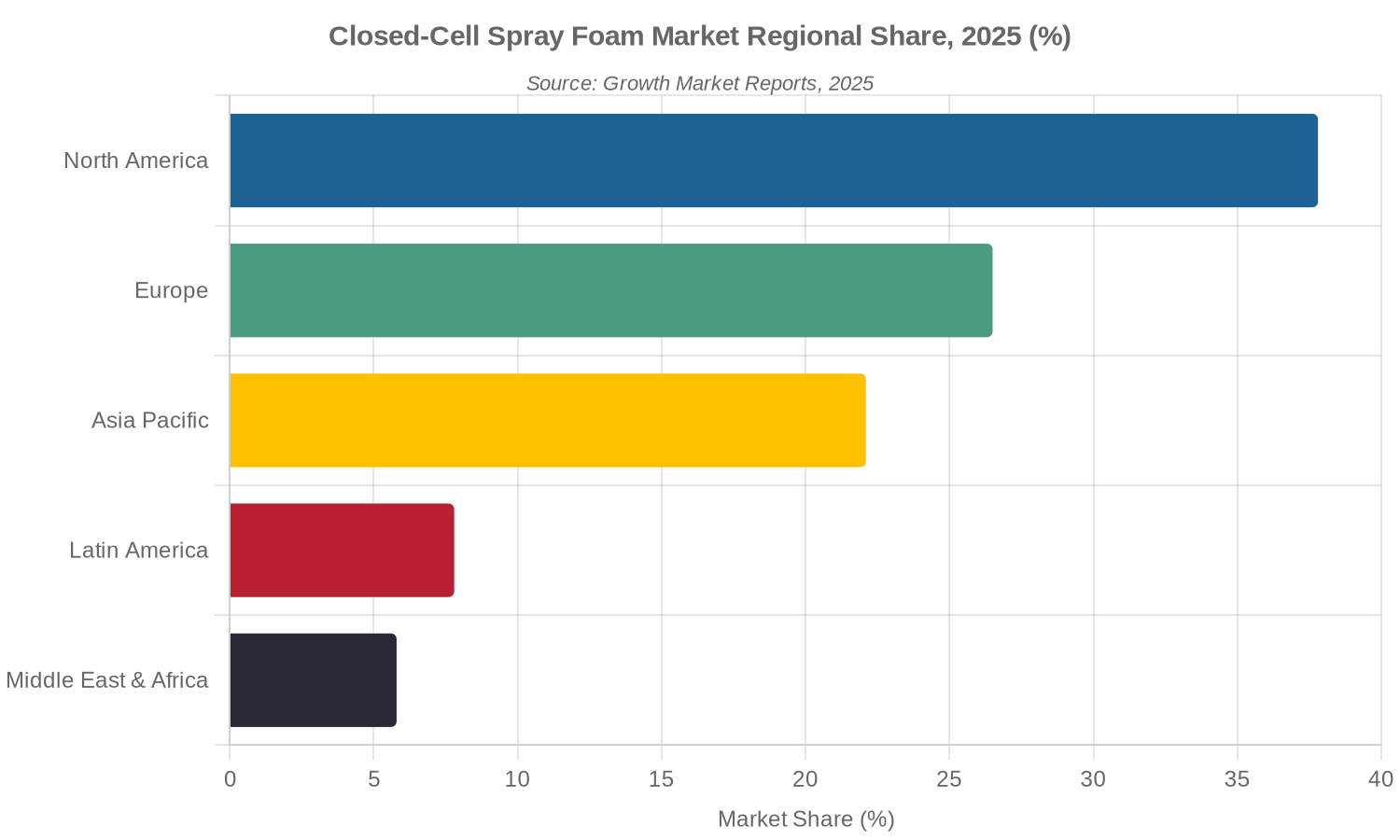
Europe is another significant market for closed-cell spray foam, representing about 26.5% of the global market with a value of approximately USD 511 million in 2025. The region benefits from stringent energy efficiency regulations, extensive retrofitting initiatives, and a strong focus on sustainable construction practices. Countries such as Germany, the United Kingdom, and France are at the forefront of closed-cell spray foam adoption, driven by ambitious climate targets and government incentives for green building technologies. The European market is characterized by a high level of product innovation, with manufacturers introducing advanced formulations to meet evolving regulatory requirements and customer preferences. The region is projected to grow at a CAGR of 5.8% through 2034, fueled by ongoing investments in energy-efficient infrastructure and building modernization programs aligned with the European Green Deal.
The Asia Pacific region is expected to witness the fastest growth in the closed-cell spray foam market, with a CAGR of 8.2% from 2025 to 2034. The market size in Asia Pacific reached approximately USD 427 million in 2025, accounting for roughly 22.1% of the global market. Rapid urbanization, population growth, and rising disposable incomes are driving demand for high-quality construction materials and energy-efficient building solutions across countries such as China, India, Japan, and South Korea. Government initiatives aimed at improving energy efficiency, reducing carbon emissions, and promoting sustainable urban development are further accelerating market growth. The increasing adoption of closed-cell spray foam in commercial and industrial projects, coupled with expanding distribution networks and rising awareness of its benefits, positions Asia Pacific as the primary growth engine for the global market through 2034. The complementary rise of expanded polyethylene closed-cell foam in the region reflects the broader momentum of advanced cellular insulation materials in Asia Pacific construction.
Latin America accounted for approximately 7.8% of the global closed-cell spray foam market in 2025, valued at roughly USD 150 million. The region is experiencing growing interest from commercial developers and industrial operators, particularly in Brazil, Mexico, and Colombia, where infrastructure expansion and urbanization are accelerating. The Middle East and Africa collectively held a 5.8% share, valued at around USD 112 million in 2025, with demand driven by large-scale commercial and industrial construction projects in the Gulf Cooperation Council (GCC) countries and growing awareness of energy-efficient insulation in North African markets. Both regions are projected to grow at above-average rates through 2034, supported by rising foreign direct investment, improving regulatory frameworks, and increasing adoption of international green building standards.
Closed-Cell Spray Foam Market Competitive Landscape
The closed-cell spray foam market is characterized by intense competition, with a mix of global giants, regional players, and specialized manufacturers vying for market share. The competitive landscape is shaped by continuous innovation, product differentiation, and a strong focus on customer service and technical support. Leading companies are investing heavily in research and development to enhance the performance, sustainability, and ease of application of their closed-cell spray foam products. This includes the development of low-GWP blowing agents, bio-based formulations, and advanced application equipment designed to improve efficiency and reduce installation costs. The ability to offer a comprehensive product portfolio, tailored solutions, and value-added services is a key differentiator in this highly competitive market as it evolves through 2034.
Strategic partnerships, mergers and acquisitions, and geographic expansion are common strategies employed by major players to strengthen their market position and expand their global footprint. Companies are increasingly seeking to establish a presence in high-growth regions such as Asia Pacific and Latin America, where rising construction activity and growing awareness of energy efficiency present significant opportunities. Collaboration with distributors, contractors, and industry associations is also critical for building brand recognition, educating end-users, and driving adoption of closed-cell spray foam solutions. The competitive landscape is further influenced by regulatory developments, with manufacturers racing to comply with evolving environmental standards and differentiate their products through sustainability certifications and green building endorsements.
The market is also witnessing the entry of new players, particularly in emerging markets, attracted by the growing demand for advanced insulation materials. These new entrants are leveraging local market knowledge, cost advantages, and innovative business models to capture market share and challenge established players. At the same time, established manufacturers are responding by investing in local production facilities, expanding their distribution networks, and enhancing their service offerings to maintain a competitive edge. The result is a dynamic and rapidly evolving market landscape, characterized by ongoing innovation, competitive pricing, and a relentless focus on customer needs.
Major companies operating in the closed-cell spray foam market include Huntsman Corporation, BASF SE, Covestro AG, Carlisle Companies Inc., Johns Manville (a Berkshire Hathaway company), Dow Inc., Owens Corning, Saint-Gobain S.A., Demilec (Huntsman Building Solutions), and Recticel Group. These companies are recognized for their extensive product portfolios, strong research and development capabilities, and global reach. Huntsman Corporation and BASF SE are at the forefront of developing environmentally friendly spray foam solutions, leveraging their expertise in chemical innovation and sustainability to meet tightening regulatory requirements. Carlisle Companies Inc. and Johns Manville are leading providers of insulation solutions for the building and construction industry, with a strong focus on quality, performance, and customer service.
Demilec (Huntsman Building Solutions) and Icynene-Lapolla have established themselves as prominent players in the North American market, known for their high-performance spray foam products and commitment to sustainability through the development of next-generation blowing agents. Dow Inc. and Covestro AG are also key players, offering a wide range of closed-cell spray foam solutions for diverse applications, including construction, automotive, and industrial sectors. Owens Corning and Saint-Gobain S.A. bring extensive distribution networks and strong brand equity to the market, while Recticel Group and Foam Supplies, Inc. serve specialized industrial and commercial niches. These companies are continuously investing in product development, strategic partnerships, and market expansion to capitalize on emerging opportunities and maintain their leadership positions in the global closed-cell spray foam market through 2034.
Top Companies in the Closed-Cell Spray Foam Market
- BASF SE
- Huntsman Corporation
- Covestro AG
- Dow Inc.
- Johns Manville (Berkshire Hathaway)
- Carlisle Companies Inc.
- Owens Corning
- Saint-Gobain S.A.
- Demilec (Huntsman Building Solutions)
- Icynene-Lapolla (Huntsman Building Solutions)
- CertainTeed Corporation (Saint-Gobain)
- Recticel Group
- Gaco Western (Firestone Building Products)
- Foam Supplies, Inc.
- Rhino Linings Corporation
- Isothane Ltd.
- Henry Company
- Premium Spray Products, Inc.
Segments
The Closed-Cell Spray Foam market has been segmented on the basis of
Product Type
- Low-Density
- Medium-Density
- High-Density
Application
- Residential
- Commercial
- Industrial
- Others
End-Use Industry
- Building & Construction
- Automotive
- Oil & Gas
- Marine
- Others
Distribution Channel
- Direct Sales
- Distributors/Wholesalers
- Online Retail
Frequently Asked Questions
Major opportunities include global green building incentives, expansion into electric vehicle insulation, growth of retrofitting programs, and development of bio-based and low-GWP formulations. Key challenges include the higher upfront cost versus conventional insulation, regulatory scrutiny of chemical blowing agents, and the need for skilled applicators to ensure proper installation and performance.
The three primary distribution channels are direct sales (especially for large commercial and industrial projects), distributors and wholesalers (serving regional and fragmented markets), and online retail (a fast-growing channel particularly for small contractors and DIY users).
Leading manufacturers include BASF SE, Huntsman Corporation, Covestro AG, Dow Inc., Johns Manville, Carlisle Companies Inc., Owens Corning, Saint-Gobain S.A., Demilec (Huntsman Building Solutions), Recticel Group, and Foam Supplies, Inc., among others.
Core applications include residential and commercial building insulation, industrial facility insulation, roofing systems, pipeline and storage tank coatings in oil and gas, marine flotation and buoyancy, and automotive thermal and acoustic insulation.
North America holds the largest share at approximately 37.8% in 2025, followed by Europe at 26.5% and Asia Pacific at 22.1%. Asia Pacific is the fastest-growing region, projected at a CAGR of 8.2% through 2034, driven by urbanization and infrastructure investment.
The market is segmented into low-density, medium-density, and high-density closed-cell spray foams. Medium-density leads with approximately 42.5% share in 2025, followed by low-density at 31.2% and high-density at 26.3%, each serving distinct performance and cost requirements.
Building and construction is the dominant end-use industry, accounting for the majority of 2025 demand. Automotive, oil and gas, and marine sectors are significant and growing users, leveraging closed-cell spray foam for thermal insulation, corrosion protection, buoyancy, and acoustic dampening.
Key growth drivers include increasingly stringent building energy codes, rising consumer and corporate focus on sustainability, growing retrofitting activity in mature markets, technological advances in low-GWP blowing agents, and the rapid expansion of construction and infrastructure in Asia Pacific and Latin America.
The closed-cell spray foam market is projected to grow at a CAGR of 6.1% from 2025 to 2034, reaching an estimated USD 3.29 billion by 2034, driven by tightening energy codes, sustainability mandates, and expanding application scope.
The global closed-cell spray foam market reached USD 1.93 billion in 2025, reflecting robust demand for energy-efficient insulation across residential, commercial, and industrial sectors worldwide.
Table Of Content
Chapter 1 Executive SummaryChapter 2 Assumptions and Acronyms Used
Chapter 3 Research Methodology
Chapter 4 Closed-Cell Spray Foam Market Overview
4.1 Introduction
4.1.1 Market Taxonomy
4.1.2 Market Definition
4.1.3 Macro-Economic Factors Impacting the Market Growth
4.2 Closed-Cell Spray Foam Market Dynamics
4.2.1 Market Drivers
4.2.2 Market Restraints
4.2.3 Market Opportunity
4.3 Closed-Cell Spray Foam Market - Supply Chain Analysis
4.3.1 List of Key Suppliers
4.3.2 List of Key Distributors
4.3.3 List of Key Consumers
4.4 Key Forces Shaping the Closed-Cell Spray Foam Market
4.4.1 Bargaining Power of Suppliers
4.4.2 Bargaining Power of Buyers
4.4.3 Threat of Substitution
4.4.4 Threat of New Entrants
4.4.5 Competitive Rivalry
4.5 Global Closed-Cell Spray Foam Market Size & Forecast, 2023-2032
4.5.1 Closed-Cell Spray Foam Market Size and Y-o-Y Growth
4.5.2 Closed-Cell Spray Foam Market Absolute $ Opportunity
Chapter 5 Global Closed-Cell Spray Foam Market Analysis and Forecast By Product Type
5.1 Introduction
5.1.1 Key Market Trends & Growth Opportunities By Product Type
5.1.2 Basis Point Share (BPS) Analysis By Product Type
5.1.3 Absolute $ Opportunity Assessment By Product Type
5.2 Closed-Cell Spray Foam Market Size Forecast By Product Type
5.2.1 Low-Density
5.2.2 Medium-Density
5.2.3 High-Density
5.3 Market Attractiveness Analysis By Product Type
Chapter 6 Global Closed-Cell Spray Foam Market Analysis and Forecast By Application
6.1 Introduction
6.1.1 Key Market Trends & Growth Opportunities By Application
6.1.2 Basis Point Share (BPS) Analysis By Application
6.1.3 Absolute $ Opportunity Assessment By Application
6.2 Closed-Cell Spray Foam Market Size Forecast By Application
6.2.1 Residential
6.2.2 Commercial
6.2.3 Industrial
6.2.4 Others
6.3 Market Attractiveness Analysis By Application
Chapter 7 Global Closed-Cell Spray Foam Market Analysis and Forecast By End-Use Industry
7.1 Introduction
7.1.1 Key Market Trends & Growth Opportunities By End-Use Industry
7.1.2 Basis Point Share (BPS) Analysis By End-Use Industry
7.1.3 Absolute $ Opportunity Assessment By End-Use Industry
7.2 Closed-Cell Spray Foam Market Size Forecast By End-Use Industry
7.2.1 Building & Construction
7.2.2 Automotive
7.2.3 Oil & Gas
7.2.4 Marine
7.2.5 Others
7.3 Market Attractiveness Analysis By End-Use Industry
Chapter 8 Global Closed-Cell Spray Foam Market Analysis and Forecast By Distribution Channel
8.1 Introduction
8.1.1 Key Market Trends & Growth Opportunities By Distribution Channel
8.1.2 Basis Point Share (BPS) Analysis By Distribution Channel
8.1.3 Absolute $ Opportunity Assessment By Distribution Channel
8.2 Closed-Cell Spray Foam Market Size Forecast By Distribution Channel
8.2.1 Direct Sales
8.2.2 Distributors/Wholesalers
8.2.3 Online Retail
8.3 Market Attractiveness Analysis By Distribution Channel
Chapter 9 Global Closed-Cell Spray Foam Market Analysis and Forecast by Region
9.1 Introduction
9.1.1 Key Market Trends & Growth Opportunities By Region
9.1.2 Basis Point Share (BPS) Analysis By Region
9.1.3 Absolute $ Opportunity Assessment By Region
9.2 Closed-Cell Spray Foam Market Size Forecast By Region
9.2.1 North America
9.2.2 Europe
9.2.3 Asia Pacific
9.2.4 Latin America
9.2.5 Middle East & Africa (MEA)
9.3 Market Attractiveness Analysis By Region
Chapter 10 Coronavirus Disease (COVID-19) Impact
10.1 Introduction
10.2 Current & Future Impact Analysis
10.3 Economic Impact Analysis
10.4 Government Policies
10.5 Investment Scenario
Chapter 11 North America Closed-Cell Spray Foam Analysis and Forecast
11.1 Introduction
11.2 North America Closed-Cell Spray Foam Market Size Forecast by Country
11.2.1 U.S.
11.2.2 Canada
11.3 Basis Point Share (BPS) Analysis by Country
11.4 Absolute $ Opportunity Assessment by Country
11.5 Market Attractiveness Analysis by Country
11.6 North America Closed-Cell Spray Foam Market Size Forecast By Product Type
11.6.1 Low-Density
11.6.2 Medium-Density
11.6.3 High-Density
11.7 Basis Point Share (BPS) Analysis By Product Type
11.8 Absolute $ Opportunity Assessment By Product Type
11.9 Market Attractiveness Analysis By Product Type
11.10 North America Closed-Cell Spray Foam Market Size Forecast By Application
11.10.1 Residential
11.10.2 Commercial
11.10.3 Industrial
11.10.4 Others
11.11 Basis Point Share (BPS) Analysis By Application
11.12 Absolute $ Opportunity Assessment By Application
11.13 Market Attractiveness Analysis By Application
11.14 North America Closed-Cell Spray Foam Market Size Forecast By End-Use Industry
11.14.1 Building & Construction
11.14.2 Automotive
11.14.3 Oil & Gas
11.14.4 Marine
11.14.5 Others
11.15 Basis Point Share (BPS) Analysis By End-Use Industry
11.16 Absolute $ Opportunity Assessment By End-Use Industry
11.17 Market Attractiveness Analysis By End-Use Industry
11.18 North America Closed-Cell Spray Foam Market Size Forecast By Distribution Channel
11.18.1 Direct Sales
11.18.2 Distributors/Wholesalers
11.18.3 Online Retail
11.19 Basis Point Share (BPS) Analysis By Distribution Channel
11.20 Absolute $ Opportunity Assessment By Distribution Channel
11.21 Market Attractiveness Analysis By Distribution Channel
Chapter 12 Europe Closed-Cell Spray Foam Analysis and Forecast
12.1 Introduction
12.2 Europe Closed-Cell Spray Foam Market Size Forecast by Country
12.2.1 Germany
12.2.2 France
12.2.3 Italy
12.2.4 U.K.
12.2.5 Spain
12.2.6 Russia
12.2.7 Rest of Europe
12.3 Basis Point Share (BPS) Analysis by Country
12.4 Absolute $ Opportunity Assessment by Country
12.5 Market Attractiveness Analysis by Country
12.6 Europe Closed-Cell Spray Foam Market Size Forecast By Product Type
12.6.1 Low-Density
12.6.2 Medium-Density
12.6.3 High-Density
12.7 Basis Point Share (BPS) Analysis By Product Type
12.8 Absolute $ Opportunity Assessment By Product Type
12.9 Market Attractiveness Analysis By Product Type
12.10 Europe Closed-Cell Spray Foam Market Size Forecast By Application
12.10.1 Residential
12.10.2 Commercial
12.10.3 Industrial
12.10.4 Others
12.11 Basis Point Share (BPS) Analysis By Application
12.12 Absolute $ Opportunity Assessment By Application
12.13 Market Attractiveness Analysis By Application
12.14 Europe Closed-Cell Spray Foam Market Size Forecast By End-Use Industry
12.14.1 Building & Construction
12.14.2 Automotive
12.14.3 Oil & Gas
12.14.4 Marine
12.14.5 Others
12.15 Basis Point Share (BPS) Analysis By End-Use Industry
12.16 Absolute $ Opportunity Assessment By End-Use Industry
12.17 Market Attractiveness Analysis By End-Use Industry
12.18 Europe Closed-Cell Spray Foam Market Size Forecast By Distribution Channel
12.18.1 Direct Sales
12.18.2 Distributors/Wholesalers
12.18.3 Online Retail
12.19 Basis Point Share (BPS) Analysis By Distribution Channel
12.20 Absolute $ Opportunity Assessment By Distribution Channel
12.21 Market Attractiveness Analysis By Distribution Channel
Chapter 13 Asia Pacific Closed-Cell Spray Foam Analysis and Forecast
13.1 Introduction
13.2 Asia Pacific Closed-Cell Spray Foam Market Size Forecast by Country
13.2.1 China
13.2.2 Japan
13.2.3 South Korea
13.2.4 India
13.2.5 Australia
13.2.6 South East Asia (SEA)
13.2.7 Rest of Asia Pacific (APAC)
13.3 Basis Point Share (BPS) Analysis by Country
13.4 Absolute $ Opportunity Assessment by Country
13.5 Market Attractiveness Analysis by Country
13.6 Asia Pacific Closed-Cell Spray Foam Market Size Forecast By Product Type
13.6.1 Low-Density
13.6.2 Medium-Density
13.6.3 High-Density
13.7 Basis Point Share (BPS) Analysis By Product Type
13.8 Absolute $ Opportunity Assessment By Product Type
13.9 Market Attractiveness Analysis By Product Type
13.10 Asia Pacific Closed-Cell Spray Foam Market Size Forecast By Application
13.10.1 Residential
13.10.2 Commercial
13.10.3 Industrial
13.10.4 Others
13.11 Basis Point Share (BPS) Analysis By Application
13.12 Absolute $ Opportunity Assessment By Application
13.13 Market Attractiveness Analysis By Application
13.14 Asia Pacific Closed-Cell Spray Foam Market Size Forecast By End-Use Industry
13.14.1 Building & Construction
13.14.2 Automotive
13.14.3 Oil & Gas
13.14.4 Marine
13.14.5 Others
13.15 Basis Point Share (BPS) Analysis By End-Use Industry
13.16 Absolute $ Opportunity Assessment By End-Use Industry
13.17 Market Attractiveness Analysis By End-Use Industry
13.18 Asia Pacific Closed-Cell Spray Foam Market Size Forecast By Distribution Channel
13.18.1 Direct Sales
13.18.2 Distributors/Wholesalers
13.18.3 Online Retail
13.19 Basis Point Share (BPS) Analysis By Distribution Channel
13.20 Absolute $ Opportunity Assessment By Distribution Channel
13.21 Market Attractiveness Analysis By Distribution Channel
Chapter 14 Latin America Closed-Cell Spray Foam Analysis and Forecast
14.1 Introduction
14.2 Latin America Closed-Cell Spray Foam Market Size Forecast by Country
14.2.1 Brazil
14.2.2 Mexico
14.2.3 Rest of Latin America (LATAM)
14.3 Basis Point Share (BPS) Analysis by Country
14.4 Absolute $ Opportunity Assessment by Country
14.5 Market Attractiveness Analysis by Country
14.6 Latin America Closed-Cell Spray Foam Market Size Forecast By Product Type
14.6.1 Low-Density
14.6.2 Medium-Density
14.6.3 High-Density
14.7 Basis Point Share (BPS) Analysis By Product Type
14.8 Absolute $ Opportunity Assessment By Product Type
14.9 Market Attractiveness Analysis By Product Type
14.10 Latin America Closed-Cell Spray Foam Market Size Forecast By Application
14.10.1 Residential
14.10.2 Commercial
14.10.3 Industrial
14.10.4 Others
14.11 Basis Point Share (BPS) Analysis By Application
14.12 Absolute $ Opportunity Assessment By Application
14.13 Market Attractiveness Analysis By Application
14.14 Latin America Closed-Cell Spray Foam Market Size Forecast By End-Use Industry
14.14.1 Building & Construction
14.14.2 Automotive
14.14.3 Oil & Gas
14.14.4 Marine
14.14.5 Others
14.15 Basis Point Share (BPS) Analysis By End-Use Industry
14.16 Absolute $ Opportunity Assessment By End-Use Industry
14.17 Market Attractiveness Analysis By End-Use Industry
14.18 Latin America Closed-Cell Spray Foam Market Size Forecast By Distribution Channel
14.18.1 Direct Sales
14.18.2 Distributors/Wholesalers
14.18.3 Online Retail
14.19 Basis Point Share (BPS) Analysis By Distribution Channel
14.20 Absolute $ Opportunity Assessment By Distribution Channel
14.21 Market Attractiveness Analysis By Distribution Channel
Chapter 15 Middle East & Africa (MEA) Closed-Cell Spray Foam Analysis and Forecast
15.1 Introduction
15.2 Middle East & Africa (MEA) Closed-Cell Spray Foam Market Size Forecast by Country
15.2.1 Saudi Arabia
15.2.2 South Africa
15.2.3 UAE
15.2.4 Rest of Middle East & Africa (MEA)
15.3 Basis Point Share (BPS) Analysis by Country
15.4 Absolute $ Opportunity Assessment by Country
15.5 Market Attractiveness Analysis by Country
15.6 Middle East & Africa (MEA) Closed-Cell Spray Foam Market Size Forecast By Product Type
15.6.1 Low-Density
15.6.2 Medium-Density
15.6.3 High-Density
15.7 Basis Point Share (BPS) Analysis By Product Type
15.8 Absolute $ Opportunity Assessment By Product Type
15.9 Market Attractiveness Analysis By Product Type
15.10 Middle East & Africa (MEA) Closed-Cell Spray Foam Market Size Forecast By Application
15.10.1 Residential
15.10.2 Commercial
15.10.3 Industrial
15.10.4 Others
15.11 Basis Point Share (BPS) Analysis By Application
15.12 Absolute $ Opportunity Assessment By Application
15.13 Market Attractiveness Analysis By Application
15.14 Middle East & Africa (MEA) Closed-Cell Spray Foam Market Size Forecast By End-Use Industry
15.14.1 Building & Construction
15.14.2 Automotive
15.14.3 Oil & Gas
15.14.4 Marine
15.14.5 Others
15.15 Basis Point Share (BPS) Analysis By End-Use Industry
15.16 Absolute $ Opportunity Assessment By End-Use Industry
15.17 Market Attractiveness Analysis By End-Use Industry
15.18 Middle East & Africa (MEA) Closed-Cell Spray Foam Market Size Forecast By Distribution Channel
15.18.1 Direct Sales
15.18.2 Distributors/Wholesalers
15.18.3 Online Retail
15.19 Basis Point Share (BPS) Analysis By Distribution Channel
15.20 Absolute $ Opportunity Assessment By Distribution Channel
15.21 Market Attractiveness Analysis By Distribution Channel
Chapter 16 Competition Landscape
16.1 Closed-Cell Spray Foam Market: Competitive Dashboard
16.2 Global Closed-Cell Spray Foam Market: Market Share Analysis, 2023
16.3 Company Profiles (Details – Overview, Financials, Developments, Strategy)
16.3.1 BASF SE
16.3.2 Huntsman Corporation
16.3.3 Covestro AG
16.3.4 Dow Inc.
16.3.5 Johns Manville (Berkshire Hathaway)
16.3.6 Carlisle Companies Inc.
16.3.7 Owens Corning
16.3.8 Saint-Gobain S.A.
16.3.9 Demilec (Huntsman Building Solutions)
16.3.10 Icynene-Lapolla (Huntsman Building Solutions)
16.3.11 CertainTeed Corporation (Saint-Gobain)
16.3.12 Recticel Group
16.3.13 Gaco Western (Firestone Building Products)
16.3.14 Foam Supplies, Inc.
16.3.15 Rhino Linings Corporation
16.3.16 Isothane Ltd.
16.3.17 Henry Company
16.3.18 Premium Spray Products, Inc.
Methodology


Related Reports
Some other reports from this category!


Our Clients




