
Bio-Based Glyoxal Market Size, Share & Growth Analysis, 2026-2034
Bio-Based Glyoxal Market Size, Share & Growth Analysis, 2026-2034
Segments - by Product Type (Natural Glyoxal, Synthetic Glyoxal), by Application (Textiles, Paper & Packaging, Leather, Cosmetics & Personal Care, Pharmaceuticals, Agriculture, Others), by End-Use Industry (Textile, Paper, Leather, Chemical, Food & Beverage, Others)



Last Updated : Jun, 2026
| Report ID :MC-26307
| 4.5 Rating
| 19 Reviews
| 298 Pages
| Format :


Bio-Based Glyoxal Market: Key Numbers
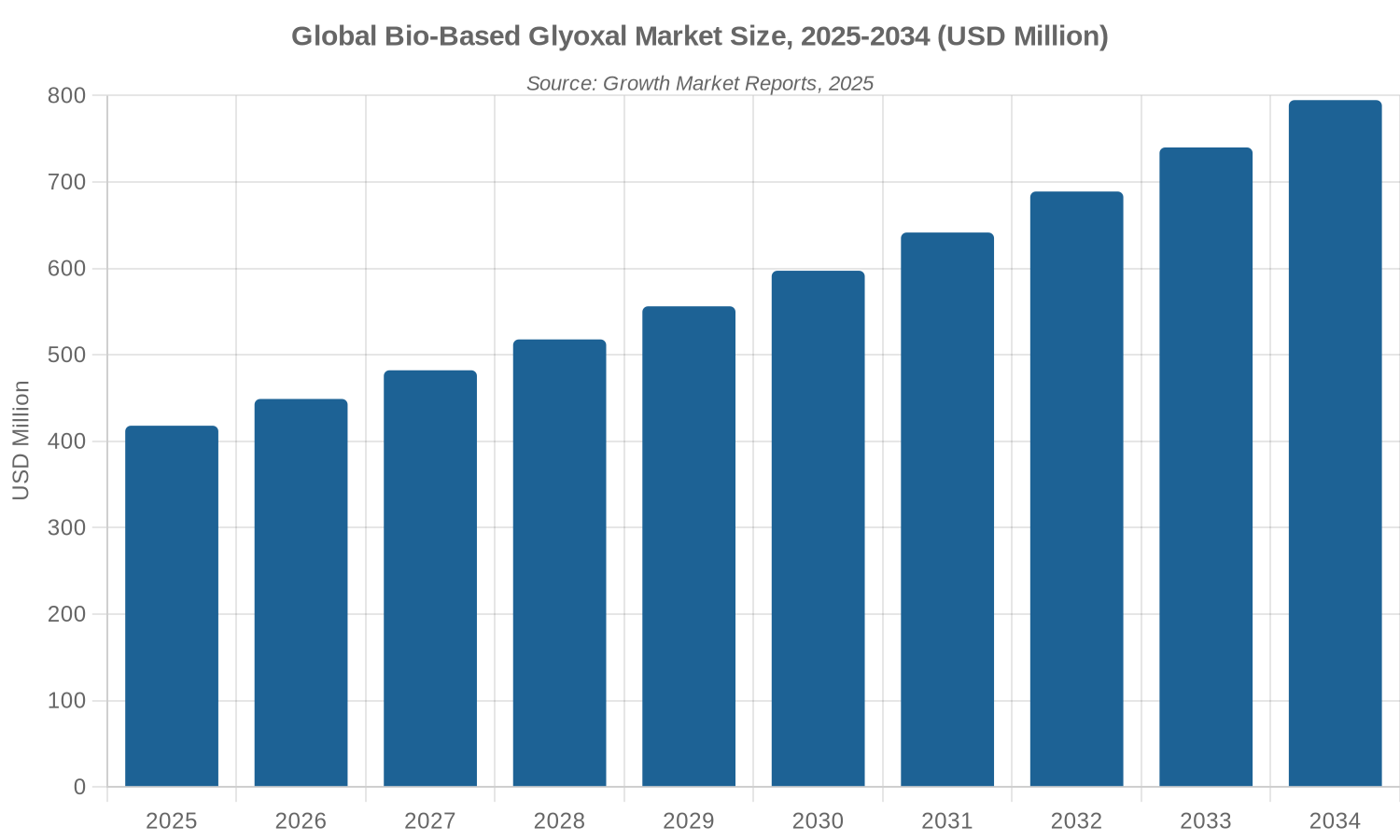
The Bio-Based Glyoxal market was valued at USD 418 Million in 2025 and is projected to reach USD 796 Million by 2034, a CAGR of 7.4%.
| Market size (2025) | USD 418 Million |
|---|---|
| Forecast (2034) | USD 796 Million |
| CAGR (2026-2034) | 7.4% |
| Largest region | Asia Pacific (42% share) |
| Segments covered | Product Type, Application, End-Use Industry |
| Key companies | BASF SE, Solvay S.A., Eastman Chemical Company, Merck KGaA, Huntsman Corporation |
This report is updated with the latest market data and insights as of June 2026. Base year: 2025 | Forecast period: 2026-2034
Bio-Based Glyoxal Market Size and Growth Outlook
Worldwide, the bio-based glyoxal market size reached USD 418 million in 2025, reflecting robust growth driven by increasing demand for sustainable chemicals across industries. The market is expected to exhibit a CAGR of 7.4% during the forecast period 2026-2034, reaching an estimated USD 796 million by 2034. The primary growth factor propelling the market is the accelerating shift towards eco-friendly alternatives in manufacturing processes, combined with tightening regulations on conventional petrochemical-derived substances. As per our 2025 analysis, the bio-based glyoxal market demonstrates significant potential for expansion, particularly as industries prioritize greener supply chains and sustainable product formulations aligned with net-zero commitments.
A key driver for the bio-based glyoxal market is the growing consumer and regulatory emphasis on sustainability. Governments worldwide are introducing stricter environmental norms and providing incentives for industries to adopt bio-based raw materials over petrochemical counterparts. This is especially evident in the textile, paper, and packaging sectors, where glyoxal serves as a crosslinking agent for improving fabric performance and paper wet strength. The use of bio-based glyoxal not only reduces carbon footprints but also aligns with circular economy models being adopted by major corporations globally. The increasing awareness of environmental and health hazards associated with synthetic chemicals is further accelerating the transition toward bio-based glyoxal, creating new opportunities for manufacturers and suppliers through the 2026-2034 period. Closely related specialty chemicals such as bio-based glyoxylic acid are also gaining attention as the green chemistry sector broadens its renewable building-block portfolio.
Another significant growth factor is the expanding application scope of bio-based glyoxal across various end-use industries. Beyond its established use in textiles and paper, bio-based glyoxal is gaining traction in cosmetics, personal care, and pharmaceuticals due to its non-toxic and biodegradable properties. The food and beverage industry is also exploring bio-based glyoxal for its potential as a preservative and processing aid, given the rising demand for natural additives. Moreover, advancements in fermentation and green chemistry are enhancing the efficiency and cost-effectiveness of bio-based glyoxal production, narrowing the price gap between bio-based and synthetic variants. These technological developments are making bio-based glyoxal more accessible to a broader range of industries and positioning it as a mainstream ingredient in sustainable formulations by 2034.
The bio-based glyoxal market is also benefiting from strategic collaborations and sustained investments in research and development. Leading chemical companies are partnering with biotechnology firms and academic institutions to optimize production processes and develop novel applications for glyoxal. This collaborative approach is fostering innovation and accelerating the commercialization of high-purity, bio-based glyoxal products. Additionally, the entry of new players, particularly in emerging markets across Asia Pacific and Latin America, is intensifying competition and driving market expansion. The increasing focus on product certification and eco-labeling further supports market growth, as consumers and businesses seek verified sustainable solutions aligned with 2025 sustainability targets and beyond.
Regionally, Asia Pacific holds a dominant position in the bio-based glyoxal market, accounting for the largest share in 2025. This is attributed to the presence of a robust textile and paper manufacturing base in China, India, and Japan, coupled with supportive government policies promoting green chemistry. Europe follows closely, driven by stringent environmental regulations such as REACH and the European Green Deal, alongside a strong emphasis on sustainable industrial practices. North America is also witnessing steady growth, fueled by technological advancements in biotechnology and rising consumer awareness of environmental issues. In contrast, the Middle East & Africa and Latin America are emerging as promising markets, supported by increasing industrialization and growing investments in sustainable chemical production. The regional dynamics indicate a broadening adoption of bio-based glyoxal, with each region contributing uniquely to the market's overall expansion through 2034.
In the realm of sustainable chemicals, Glutaraldehyde is emerging as a notable alternative, particularly in applications requiring biocidal properties. Known for its effectiveness as a disinfectant and sterilant, Glutaraldehyde is increasingly being considered in industries such as healthcare and water treatment. Its ability to act as a crosslinking agent, similar to glyoxal, makes it a valuable component in the production of polymers and resins. As industries continue to seek eco-friendly solutions, the compatibility of Glutaraldehyde with bio-based processes enhances its appeal. The ongoing research into its biodegradability and reduced environmental impact further positions Glutaraldehyde as a promising candidate in the transition towards greener chemical formulations, aligning with broader market trends visible in the bio-based glyoxal space.
Bio-Based Glyoxal Market by Product Type
The bio-based glyoxal market is segmented by product type into natural glyoxal and synthetic glyoxal. Natural glyoxal, derived from renewable sources such as plant biomass through processes like fermentation and green oxidation, is witnessing a surge in demand due to its superior environmental profile. Manufacturers are increasingly investing in high-purity natural glyoxal to cater to industries seeking to reduce their reliance on fossil-based chemicals. This segment commanded approximately 58.5% of total market share in 2025, favored by regulatory bodies and end-users alike as it aligns with global sustainability targets and offers a meaningfully lower carbon footprint. The adoption of natural glyoxal is also being driven by its compatibility with textiles, paper, and cosmetics applications, where safety and eco-friendliness are paramount considerations. The expanding market for renewable reactive monomers such as bio-based glycidyl methacrylate reflects the same broader industry momentum propelling natural glyoxal adoption.

Synthetic glyoxal, while still prevalent due to its established production processes and cost-effectiveness, is gradually facing intensifying competition from its natural counterpart. Synthetic glyoxal is typically produced from petrochemical feedstocks through oxidation of ethylene glycol or acetaldehyde. However, growing concerns surrounding the environmental impact and regulatory restrictions on petrochemicals are prompting manufacturers to explore bio-based alternatives. The synthetic segment retained approximately 41.5% of market share in 2025, remaining significant particularly in regions where raw material availability and cost constraints limit the faster adoption of natural glyoxal. Ongoing innovations in green chemistry are also enabling the production of synthetic glyoxal from bio-based intermediates, blurring the lines between the two segments and further supporting the overall market transition towards sustainability through 2034.
The market dynamics between natural and synthetic glyoxal are further influenced by end-user preferences and application-specific requirements. Industries such as cosmetics and pharmaceuticals are increasingly specifying natural glyoxal due to its non-toxic and hypoallergenic properties, which are critical for consumer safety and regulatory compliance. In contrast, sectors like paper and textiles that require large volumes and consistent quality may still rely partly on synthetic glyoxal when cost considerations are a primary concern. However, as economies of scale are achieved in natural glyoxal production and regulatory pressures continue to mount, a gradual but accelerating shift towards bio-based variants is anticipated across all major applications through the 2026-2034 forecast period.
The competitive landscape within the product type segment is characterized by a mix of established chemical giants and innovative start-ups. Leading players are investing in research and development to improve the yield and purity of natural glyoxal, while also exploring hybrid production methods that combine the advantages of both natural and synthetic processes. Strategic collaborations with agricultural producers and biotechnology firms are enabling the development of integrated supply chains for bio-based feedstocks. This approach enhances product traceability and supports the scalability of natural glyoxal production, positioning it as the preferred choice for environmentally conscious industries targeting sustainability benchmarks over the forecast period. The parallel development of other bio-based platform chemicals, including bio-based glycerol as a versatile renewable intermediate, reflects the broader strategic direction of the industry.
Bio-Based Glyoxal Market Report Scope
| Attributes | Details |
| Report Title | Bio-Based Glyoxal Market Research Report 2034 |
| By Product Type | Natural Glyoxal, Synthetic Glyoxal |
| By Application | Textiles, Paper & Packaging, Leather, Cosmetics & Personal Care, Pharmaceuticals, Agriculture, Others |
| By End-Use Industry | Textile, Paper, Leather, Chemical, Food & Beverage, Others |
| Regions Covered | North America, Europe, APAC, Latin America, MEA |
| Base Year | 2025 |
| Historic Data | 2019-2024 |
| Forecast Period | 2026-2034 |
| Number of Pages | 298 |
| Number of Tables & Figures | 325 |
| Customization Available | Yes, the report can be customized as per your need. |
Bio-Based Glyoxal Market by Application
The application segment of the bio-based glyoxal market is broad, encompassing textiles, paper and packaging, leather, cosmetics and personal care, pharmaceuticals, agriculture, and others. Among these, the textiles sector represents the largest application, accounting for a significant share of global consumption in 2025. Bio-based glyoxal is widely used as a crosslinking agent in textile finishing processes, imparting wrinkle resistance and enhanced durability to fabrics. The shift towards sustainable fashion and eco-friendly textile processing is driving demand for bio-based glyoxal, as brands and manufacturers seek to minimize the environmental impact of their operations. The paper and packaging industry is another major consumer, utilizing glyoxal to enhance the wet strength and printability of paper products, particularly as demand for recyclable and compostable packaging accelerates through 2034.
The leather industry is increasingly adopting bio-based glyoxal as a tanning and finishing agent, replacing traditional chemicals often associated with environmental pollution and health risks. The use of glyoxal in leather processing contributes to the production of high-quality, eco-friendly leather goods, catering to the growing demand for sustainable fashion accessories and footwear in premium market segments. In the cosmetics and personal care segment, bio-based glyoxal is valued for its non-toxic, hypoallergenic, and biodegradable properties. It is used in formulations for skin care, hair care, and personal hygiene products, aligning with the clean beauty movement and the rising consumer preference for natural and transparently sourced ingredients.
Pharmaceutical applications of bio-based glyoxal are gaining traction, particularly in drug formulation and preservation. The compound's antimicrobial properties make it suitable for use in topical medications and as a preservative in liquid pharmaceutical formulations. The agriculture sector is also exploring bio-based glyoxal as a biopesticide and soil conditioner, leveraging its low toxicity and environmental compatibility to address the growing demand for reduced-chemical farming. These emerging applications are expanding the market's reach and creating new avenues for growth, as industries seek safer, renewable replacements for hazardous conventional chemicals. The growth of allied bio-based specialty chemicals, such as bio-based ethylene oxide, signals the sustained investment momentum flowing into the broader renewable chemicals space that also benefits glyoxal producers.
The "others" category within the application segment includes niche uses such as adhesives, coatings, and specialty chemicals. These applications, while smaller in scale, contribute to the diversification of the bio-based glyoxal market and support its resilience against fluctuations in demand from major sectors. The versatility of bio-based glyoxal, coupled with ongoing research into novel applications, underscores its potential as a key ingredient in the global transition towards sustainable industrial processes. As regulatory frameworks evolve and consumer awareness continues to grow, the application landscape for bio-based glyoxal is expected to become increasingly dynamic and multifaceted through 2034.
Bio-Based Glyoxal Market by End-Use Industry
The bio-based glyoxal market is segmented by end-use industry into textile, paper, leather, chemical, food and beverage, and others. The textile industry stands out as the largest end-user in 2025, driven by the global push for sustainable fashion and eco-friendly textile processing practices. Leading textile manufacturers are increasingly incorporating bio-based glyoxal into their finishing processes to meet the demands of environmentally conscious consumers and comply with stringent industry and government standards. The adoption of bio-based glyoxal in textiles not only enhances fabric performance but also supports the industry's efforts to reduce water and chemical consumption, contributing to a more sustainable value chain over the 2026-2034 forecast period.
The paper industry is another significant end-user, utilizing bio-based glyoxal to improve the strength, printability, and durability of paper products. As the demand for sustainable packaging solutions rises in tandem with e-commerce growth and plastic reduction mandates, paper manufacturers are turning to bio-based glyoxal as a key additive in the production of recyclable and compostable packaging materials. The leather industry, while smaller in scale, is embracing bio-based glyoxal for its role in producing high-quality, eco-friendly leather goods that cater to the premium and sustainable fashion segments of the market.
The chemical industry represents a dynamic end-use segment in 2025, leveraging bio-based glyoxal as an intermediate in the synthesis of various specialty chemicals and polymers. The transition towards green chemistry and the development of bio-based polymers are creating new opportunities for glyoxal suppliers, as chemical manufacturers seek to diversify product portfolios and reduce reliance on petrochemical feedstocks. The food and beverage industry, though still in the relatively early stages of adoption, is exploring the use of bio-based glyoxal as a preservative and processing aid, driven by the growing demand for natural and clean-label ingredients among health-conscious consumers. Parallels can be drawn with the adoption trajectory seen in bio-based aromatic intermediates, where food and specialty chemical sectors have steadily embraced renewable sourcing.
The "others" category includes emerging end-use industries such as agriculture, cosmetics, and pharmaceuticals. These sectors are recognizing the benefits of bio-based glyoxal in enhancing product safety, efficacy, and environmental compatibility. The versatility of bio-based glyoxal across diverse end-use industries underscores its potential as a transformative ingredient in the global shift towards sustainable manufacturing. As technological advancements continue to improve the cost-effectiveness and scalability of bio-based glyoxal production, its adoption across end-use industries is expected to accelerate, driving long-term market growth through 2034.
Bio-Based Glyoxal Market Opportunities and Threats
The bio-based glyoxal market presents a range of lucrative opportunities for stakeholders across the value chain. One of the most significant opportunities lies in the development of advanced production technologies that enhance the yield, purity, and cost-effectiveness of bio-based glyoxal. Innovations in fermentation, green oxidation, and enzyme catalysis are enabling manufacturers to produce high-quality glyoxal from renewable feedstocks at increasingly competitive prices. These technological advancements reduce the environmental impact of glyoxal production while making bio-based variants more accessible to a wider range of industries. The growing demand for sustainable chemicals in emerging markets, coupled with supportive government policies and financial incentives, is creating new avenues for market expansion and investment through the 2026-2034 forecast window.
Another major opportunity is the diversification of application areas for bio-based glyoxal. As industries increasingly prioritize sustainability, there is significant potential for glyoxal to be used in new and emerging sectors such as bioplastics, green adhesives, and specialty coatings. The development of customized glyoxal formulations tailored to specific end-user requirements can further enhance market penetration and create value-added opportunities for manufacturers. Strategic partnerships and collaborations between chemical companies, biotechnology firms, and research institutions are also expected to drive innovation and accelerate the commercialization of novel glyoxal-based products. The integration of bio-based glyoxal into circular economy models and sustainable supply chains represents a compelling opportunity, particularly as the adjacent market for bio-based reactive chemical intermediates like epichlorohydrin demonstrates growing industry appetite for renewable crosslinking and functionalization agents.
Despite the promising growth prospects, the bio-based glyoxal market faces several restraining factors. One of the primary challenges is the relatively higher production cost of bio-based glyoxal compared to its synthetic counterpart in 2025. The availability and cost of renewable feedstocks, as well as the scalability of production processes, remain key concerns for manufacturers looking to serve high-volume industries. Additionally, the market is subject to fluctuations in raw material prices and supply chain disruptions, particularly in regions with limited access to agricultural resources. Regulatory uncertainties and the lack of fully standardized certification frameworks for bio-based chemicals can also pose barriers to market entry and broad adoption. Addressing these challenges will require continued investment in research and development, as well as collaborative efforts to establish robust supply chains and regulatory frameworks that support sustained growth of the bio-based glyoxal market through 2034.
Bio-Based Glyoxal Market Size by Region
The Asia Pacific region dominates the global bio-based glyoxal market, accounting for approximately 42% of total market revenue in 2025, which translates to around USD 175 million. This leadership is primarily attributed to the region's strong presence in textile, paper, and packaging industries, particularly in countries like China, India, and Japan. The implementation of stringent environmental regulations and government incentives for green manufacturing are further propelling the adoption of bio-based glyoxal in the region. Additionally, the growing awareness of sustainable practices among manufacturers and consumers is driving demand for eco-friendly chemicals. The Asia Pacific market is expected to maintain its growth momentum, with a projected CAGR of 7.9% through 2034, outpacing other major regions.

Europe is the second-largest market for bio-based glyoxal, with a market size of approximately USD 109 million in 2025, representing about 26% of the global market. The region's growth is fueled by stringent environmental regulations, including REACH and the European Green Deal, which encourage the use of bio-based and non-toxic chemicals in industrial processes. The presence of leading chemical manufacturers and a strong focus on research and development are also contributing to market expansion. In addition, the rising demand for sustainable packaging and personal care products is driving the adoption of bio-based glyoxal across Europe. The region is expected to witness steady growth over the 2026-2034 forecast period, supported by ongoing investments in green chemistry and sustainable manufacturing initiatives.
North America holds a significant share of the bio-based glyoxal market, with a market size of approximately USD 84 million in 2025, accounting for 20% of global revenue. The market in North America is driven by increasing consumer awareness of environmental issues, advancements in biotechnological production methods, and supportive government policies promoting sustainable chemicals. The United States and Canada are leading the adoption of bio-based glyoxal, particularly in the textiles, cosmetics, and food and beverage sectors. The Middle East & Africa and Latin America currently represent smaller but growing shares of the market, together accounting for the remaining 12% of global revenue in 2025, with Latin America at approximately 7% and Middle East & Africa at approximately 5%. Both regions are emerging as promising growth destinations due to rapid industrialization, growing investments in sustainable chemical production, and increasing adoption of green technologies, with significant expansion potential through 2034.
Bio-Based Glyoxal Market Competitive Landscape
The competitive landscape of the bio-based glyoxal market in 2025 is characterized by the presence of both established multinational chemical companies and innovative start-ups. The market is witnessing intensified competition as players strive to differentiate themselves through product innovation, sustainability initiatives, and strategic partnerships. Leading companies are investing heavily in research and development to enhance the efficiency and scalability of bio-based glyoxal production. These investments are aimed at improving product quality, reducing production costs, and expanding the application scope of glyoxal across various industries. The focus on sustainability and circular economy principles is also driving companies to develop integrated supply chains for renewable feedstocks, ensuring consistent quality and traceability of their products through the 2026-2034 period.
Strategic collaborations and mergers and acquisitions are prominent strategies adopted by key players to strengthen their market position and expand their global footprint. Companies are partnering with biotechnology firms, agricultural producers, and research institutions to leverage complementary expertise and accelerate the commercialization of advanced glyoxal products. These collaborations enable the development of customized glyoxal formulations tailored to specific end-user requirements, thereby enhancing market penetration and customer loyalty. In addition, companies are increasingly focusing on obtaining eco-certifications and sustainability labels to differentiate their products and appeal to environmentally conscious buyers across all major end-use industries.
The entry of new players, particularly in emerging markets across Asia Pacific and Latin America, is contributing to the dynamic nature of the bio-based glyoxal market. Start-ups and small-scale manufacturers are leveraging innovative production technologies and flexible business models to capture niche market segments and address unmet needs. The increasing availability of venture capital and government support for green chemistry initiatives is further encouraging entrepreneurship and innovation in the market. However, established players continue to dominate in terms of scale, distribution networks, and brand recognition, posing significant barriers to entry for new entrants without differentiated technology or feedstock advantages.
Major companies operating in the bio-based glyoxal market include BASF SE, Solvay S.A., Eastman Chemical Company, Merck KGaA, Huntsman Corporation, and Shandong Kunda Biotechnology Co. Ltd., among others. BASF SE is a leading player, leveraging its extensive research capabilities and global presence to offer high-quality bio-based glyoxal products across a wide range of applications. Solvay S.A. is recognized for its advanced production technologies and strategic collaborations with industry partners, enabling it to deliver customized glyoxal solutions for diverse end-use industries. Eastman Chemical Company is known for its commitment to sustainability and innovation, with a strong focus on developing bio-based chemicals meeting the evolving needs of customers. Merck KGaA and Huntsman Corporation are also prominent players, emphasizing product quality, regulatory compliance, and strong customer support networks. Haihang Industry Co. Ltd. and Taicang Guangze Chemical Co. Ltd. play important roles in the Asia Pacific supply chain, supporting regional demand growth. These companies are continuously investing in research and development, expanding their product portfolios, and exploring new market opportunities to maintain their competitive edge in the rapidly evolving bio-based glyoxal market through 2034.
Top Companies in the Bio-Based Glyoxal Market
- BASF SE
- Solvay S.A.
- Eastman Chemical Company
- Merck KGaA
- Huntsman Corporation
- Taicang Guangze Chemical Co., Ltd.
- Haihang Industry Co., Ltd.
- Shandong Kunda Biotechnology Co., Ltd.
- Jubilant Life Sciences Limited
- Zhonglan Industry Co., Ltd.
- Hubei Hongyuan Pharmaceutical Technology Co., Ltd.
- Nantong Xingchen Synthetic Material Co., Ltd.
- Airedale Chemical Company Limited
- Loba Chemie Pvt. Ltd.
- Tokyo Chemical Industry Co., Ltd. (TCI)
Segments
The Bio-Based Glyoxal market has been segmented on the basis of
Product Type
- Natural Glyoxal
- Synthetic Glyoxal
Application
- Textiles
- Paper & Packaging
- Leather
- Cosmetics & Personal Care
- Pharmaceuticals
- Agriculture
- Others
End-Use Industry
- Textile
- Paper
- Leather
- Chemical
- Food & Beverage
- Others
Frequently Asked Questions
Yes, the bio-based glyoxal market report can be fully customized to meet specific research and business requirements. Customization options include additional country-level or sub-regional analysis, deeper segmentation by application or end-use industry, competitive benchmarking of specific companies, supply chain analysis, and integration of proprietary data. Please contact our research team to discuss tailored options that align with your strategic objectives covering the 2025 base year and 2026-2034 forecast horizon.
Bio-based glyoxal contributes to sustainability by replacing petrochemical-derived glyoxal with a product sourced from renewable biomass, reducing greenhouse gas emissions across the production value chain. Its biodegradable properties minimize environmental persistence compared to synthetic alternatives. Companies integrating bio-based glyoxal into their operations can advance circular economy goals by sourcing feedstocks from agricultural byproducts, reducing hazardous chemical use, and enabling recyclable or compostable end products, particularly in paper packaging and eco-leather. These attributes support corporate ESG commitments and compliance with tightening regulations such as Europe's Green Deal through 2034.
Leading companies in the global bio-based glyoxal market include BASF SE, Solvay S.A., Eastman Chemical Company, Merck KGaA, Huntsman Corporation, Taicang Guangze Chemical Co. Ltd., Haihang Industry Co. Ltd., Shandong Kunda Biotechnology Co. Ltd., Jubilant Life Sciences Limited, and Zhonglan Industry Co. Ltd., among others. These players compete through product innovation, sustainability certifications, strategic partnerships, and geographic expansion to strengthen their positions through the 2026-2034 forecast period.
Key opportunities include the development of advanced production technologies such as enzyme catalysis and continuous fermentation that reduce costs, growing demand in emerging markets, and expanding applications in bioplastics, green adhesives, and specialty coatings. The integration of bio-based glyoxal into circular economy supply chains also presents significant upside. Challenges include higher production costs relative to synthetic glyoxal, feedstock price volatility, limited standardized bio-based certification frameworks, and supply chain scalability constraints, all of which stakeholders must address to sustain growth through 2034.
Bio-based glyoxal is applied across a broad range of industries. In textiles, it functions as a crosslinking agent for wrinkle-resistance finishing. In paper and packaging, it enhances wet strength and printability. The leather sector uses it as an eco-friendly tanning and finishing agent. In cosmetics and personal care, it is valued for its non-toxic and biodegradable properties. Pharmaceutical applications leverage its antimicrobial characteristics for drug formulation and preservation. Agriculture is an emerging application area, where glyoxal is explored as a biopesticide and soil conditioner.
Asia Pacific is the leading region, accounting for roughly 42% of global revenue in 2025, driven by large-scale textile and paper manufacturing in China, India, and Japan, along with supportive green chemistry policies. Europe holds approximately 26% of the market, propelled by REACH regulations and the European Green Deal. North America follows with around 20%, fueled by consumer awareness and biotechnology innovation. Latin America and the Middle East & Africa collectively account for the remaining 12%, representing high-growth emerging markets through 2034.
Natural glyoxal is derived from renewable bio-based feedstocks such as plant biomass through fermentation or enzymatic green oxidation, resulting in a lower carbon footprint and better alignment with sustainability standards. Synthetic glyoxal is conventionally produced via oxidation of petrochemical-derived ethylene glycol or acetaldehyde. While synthetic glyoxal has traditionally been more cost-effective and widely available, advances in bio-based production are narrowing the price gap, and natural glyoxal held approximately 58.5% of market share in 2025 due to growing regulatory and consumer preference for greener alternatives.
The textile industry is the largest consumer of bio-based glyoxal in 2025, utilizing it primarily as a crosslinking agent in fabric finishing. The paper and packaging sector ranks second, employing glyoxal to improve wet strength and printability of sustainable packaging materials. Leather processing, cosmetics and personal care, and pharmaceuticals are additional significant end-use segments, each contributing to overall demand growth through the forecast period ending 2034.
The primary growth drivers include tightening environmental regulations on petrochemical-derived chemicals, increasing corporate commitments to net-zero supply chains, and expanding consumer demand for naturally sourced ingredients. Technological advances in fermentation and green oxidation processes are also reducing the cost of bio-based glyoxal production, making it increasingly competitive with synthetic alternatives. Government incentives for green chemistry in major markets further accelerate adoption through 2034.
The global bio-based glyoxal market reached USD 418 million in 2025 and is projected to grow at a CAGR of 7.4% during the forecast period 2026-2034, reaching approximately USD 796 million by 2034. This growth is underpinned by rising demand for sustainable and bio-derived chemicals across textiles, paper, cosmetics, and pharmaceutical industries.
Table Of Content
Chapter 1 Executive SummaryChapter 2 Assumptions and Acronyms Used
Chapter 3 Research Methodology
Chapter 4 Bio-Based Glyoxal Market Overview
4.1 Introduction
4.1.1 Market Taxonomy
4.1.2 Market Definition
4.1.3 Macro-Economic Factors Impacting the Market Growth
4.2 Bio-Based Glyoxal Market Dynamics
4.2.1 Market Drivers
4.2.2 Market Restraints
4.2.3 Market Opportunity
4.3 Bio-Based Glyoxal Market - Supply Chain Analysis
4.3.1 List of Key Suppliers
4.3.2 List of Key Distributors
4.3.3 List of Key Consumers
4.4 Key Forces Shaping the Bio-Based Glyoxal Market
4.4.1 Bargaining Power of Suppliers
4.4.2 Bargaining Power of Buyers
4.4.3 Threat of Substitution
4.4.4 Threat of New Entrants
4.4.5 Competitive Rivalry
4.5 Global Bio-Based Glyoxal Market Size & Forecast, 2023-2032
4.5.1 Bio-Based Glyoxal Market Size and Y-o-Y Growth
4.5.2 Bio-Based Glyoxal Market Absolute $ Opportunity
Chapter 5 Global Bio-Based Glyoxal Market Analysis and Forecast By Product Type
5.1 Introduction
5.1.1 Key Market Trends & Growth Opportunities By Product Type
5.1.2 Basis Point Share (BPS) Analysis By Product Type
5.1.3 Absolute $ Opportunity Assessment By Product Type
5.2 Bio-Based Glyoxal Market Size Forecast By Product Type
5.2.1 Natural Glyoxal
5.2.2 Synthetic Glyoxal
5.3 Market Attractiveness Analysis By Product Type
Chapter 6 Global Bio-Based Glyoxal Market Analysis and Forecast By Application
6.1 Introduction
6.1.1 Key Market Trends & Growth Opportunities By Application
6.1.2 Basis Point Share (BPS) Analysis By Application
6.1.3 Absolute $ Opportunity Assessment By Application
6.2 Bio-Based Glyoxal Market Size Forecast By Application
6.2.1 Textiles
6.2.2 Paper & Packaging
6.2.3 Leather
6.2.4 Cosmetics & Personal Care
6.2.5 Pharmaceuticals
6.2.6 Agriculture
6.2.7 Others
6.3 Market Attractiveness Analysis By Application
Chapter 7 Global Bio-Based Glyoxal Market Analysis and Forecast By End-Use Industry
7.1 Introduction
7.1.1 Key Market Trends & Growth Opportunities By End-Use Industry
7.1.2 Basis Point Share (BPS) Analysis By End-Use Industry
7.1.3 Absolute $ Opportunity Assessment By End-Use Industry
7.2 Bio-Based Glyoxal Market Size Forecast By End-Use Industry
7.2.1 Textile
7.2.2 Paper
7.2.3 Leather
7.2.4 Chemical
7.2.5 Food & Beverage
7.2.6 Others
7.3 Market Attractiveness Analysis By End-Use Industry
Chapter 8 Global Bio-Based Glyoxal Market Analysis and Forecast by Region
8.1 Introduction
8.1.1 Key Market Trends & Growth Opportunities By Region
8.1.2 Basis Point Share (BPS) Analysis By Region
8.1.3 Absolute $ Opportunity Assessment By Region
8.2 Bio-Based Glyoxal Market Size Forecast By Region
8.2.1 North America
8.2.2 Europe
8.2.3 Asia Pacific
8.2.4 Latin America
8.2.5 Middle East & Africa (MEA)
8.3 Market Attractiveness Analysis By Region
Chapter 9 Coronavirus Disease (COVID-19) Impact
9.1 Introduction
9.2 Current & Future Impact Analysis
9.3 Economic Impact Analysis
9.4 Government Policies
9.5 Investment Scenario
Chapter 10 North America Bio-Based Glyoxal Analysis and Forecast
10.1 Introduction
10.2 North America Bio-Based Glyoxal Market Size Forecast by Country
10.2.1 U.S.
10.2.2 Canada
10.3 Basis Point Share (BPS) Analysis by Country
10.4 Absolute $ Opportunity Assessment by Country
10.5 Market Attractiveness Analysis by Country
10.6 North America Bio-Based Glyoxal Market Size Forecast By Product Type
10.6.1 Natural Glyoxal
10.6.2 Synthetic Glyoxal
10.7 Basis Point Share (BPS) Analysis By Product Type
10.8 Absolute $ Opportunity Assessment By Product Type
10.9 Market Attractiveness Analysis By Product Type
10.10 North America Bio-Based Glyoxal Market Size Forecast By Application
10.10.1 Textiles
10.10.2 Paper & Packaging
10.10.3 Leather
10.10.4 Cosmetics & Personal Care
10.10.5 Pharmaceuticals
10.10.6 Agriculture
10.10.7 Others
10.11 Basis Point Share (BPS) Analysis By Application
10.12 Absolute $ Opportunity Assessment By Application
10.13 Market Attractiveness Analysis By Application
10.14 North America Bio-Based Glyoxal Market Size Forecast By End-Use Industry
10.14.1 Textile
10.14.2 Paper
10.14.3 Leather
10.14.4 Chemical
10.14.5 Food & Beverage
10.14.6 Others
10.15 Basis Point Share (BPS) Analysis By End-Use Industry
10.16 Absolute $ Opportunity Assessment By End-Use Industry
10.17 Market Attractiveness Analysis By End-Use Industry
Chapter 11 Europe Bio-Based Glyoxal Analysis and Forecast
11.1 Introduction
11.2 Europe Bio-Based Glyoxal Market Size Forecast by Country
11.2.1 Germany
11.2.2 France
11.2.3 Italy
11.2.4 U.K.
11.2.5 Spain
11.2.6 Russia
11.2.7 Rest of Europe
11.3 Basis Point Share (BPS) Analysis by Country
11.4 Absolute $ Opportunity Assessment by Country
11.5 Market Attractiveness Analysis by Country
11.6 Europe Bio-Based Glyoxal Market Size Forecast By Product Type
11.6.1 Natural Glyoxal
11.6.2 Synthetic Glyoxal
11.7 Basis Point Share (BPS) Analysis By Product Type
11.8 Absolute $ Opportunity Assessment By Product Type
11.9 Market Attractiveness Analysis By Product Type
11.10 Europe Bio-Based Glyoxal Market Size Forecast By Application
11.10.1 Textiles
11.10.2 Paper & Packaging
11.10.3 Leather
11.10.4 Cosmetics & Personal Care
11.10.5 Pharmaceuticals
11.10.6 Agriculture
11.10.7 Others
11.11 Basis Point Share (BPS) Analysis By Application
11.12 Absolute $ Opportunity Assessment By Application
11.13 Market Attractiveness Analysis By Application
11.14 Europe Bio-Based Glyoxal Market Size Forecast By End-Use Industry
11.14.1 Textile
11.14.2 Paper
11.14.3 Leather
11.14.4 Chemical
11.14.5 Food & Beverage
11.14.6 Others
11.15 Basis Point Share (BPS) Analysis By End-Use Industry
11.16 Absolute $ Opportunity Assessment By End-Use Industry
11.17 Market Attractiveness Analysis By End-Use Industry
Chapter 12 Asia Pacific Bio-Based Glyoxal Analysis and Forecast
12.1 Introduction
12.2 Asia Pacific Bio-Based Glyoxal Market Size Forecast by Country
12.2.1 China
12.2.2 Japan
12.2.3 South Korea
12.2.4 India
12.2.5 Australia
12.2.6 South East Asia (SEA)
12.2.7 Rest of Asia Pacific (APAC)
12.3 Basis Point Share (BPS) Analysis by Country
12.4 Absolute $ Opportunity Assessment by Country
12.5 Market Attractiveness Analysis by Country
12.6 Asia Pacific Bio-Based Glyoxal Market Size Forecast By Product Type
12.6.1 Natural Glyoxal
12.6.2 Synthetic Glyoxal
12.7 Basis Point Share (BPS) Analysis By Product Type
12.8 Absolute $ Opportunity Assessment By Product Type
12.9 Market Attractiveness Analysis By Product Type
12.10 Asia Pacific Bio-Based Glyoxal Market Size Forecast By Application
12.10.1 Textiles
12.10.2 Paper & Packaging
12.10.3 Leather
12.10.4 Cosmetics & Personal Care
12.10.5 Pharmaceuticals
12.10.6 Agriculture
12.10.7 Others
12.11 Basis Point Share (BPS) Analysis By Application
12.12 Absolute $ Opportunity Assessment By Application
12.13 Market Attractiveness Analysis By Application
12.14 Asia Pacific Bio-Based Glyoxal Market Size Forecast By End-Use Industry
12.14.1 Textile
12.14.2 Paper
12.14.3 Leather
12.14.4 Chemical
12.14.5 Food & Beverage
12.14.6 Others
12.15 Basis Point Share (BPS) Analysis By End-Use Industry
12.16 Absolute $ Opportunity Assessment By End-Use Industry
12.17 Market Attractiveness Analysis By End-Use Industry
Chapter 13 Latin America Bio-Based Glyoxal Analysis and Forecast
13.1 Introduction
13.2 Latin America Bio-Based Glyoxal Market Size Forecast by Country
13.2.1 Brazil
13.2.2 Mexico
13.2.3 Rest of Latin America (LATAM)
13.3 Basis Point Share (BPS) Analysis by Country
13.4 Absolute $ Opportunity Assessment by Country
13.5 Market Attractiveness Analysis by Country
13.6 Latin America Bio-Based Glyoxal Market Size Forecast By Product Type
13.6.1 Natural Glyoxal
13.6.2 Synthetic Glyoxal
13.7 Basis Point Share (BPS) Analysis By Product Type
13.8 Absolute $ Opportunity Assessment By Product Type
13.9 Market Attractiveness Analysis By Product Type
13.10 Latin America Bio-Based Glyoxal Market Size Forecast By Application
13.10.1 Textiles
13.10.2 Paper & Packaging
13.10.3 Leather
13.10.4 Cosmetics & Personal Care
13.10.5 Pharmaceuticals
13.10.6 Agriculture
13.10.7 Others
13.11 Basis Point Share (BPS) Analysis By Application
13.12 Absolute $ Opportunity Assessment By Application
13.13 Market Attractiveness Analysis By Application
13.14 Latin America Bio-Based Glyoxal Market Size Forecast By End-Use Industry
13.14.1 Textile
13.14.2 Paper
13.14.3 Leather
13.14.4 Chemical
13.14.5 Food & Beverage
13.14.6 Others
13.15 Basis Point Share (BPS) Analysis By End-Use Industry
13.16 Absolute $ Opportunity Assessment By End-Use Industry
13.17 Market Attractiveness Analysis By End-Use Industry
Chapter 14 Middle East & Africa (MEA) Bio-Based Glyoxal Analysis and Forecast
14.1 Introduction
14.2 Middle East & Africa (MEA) Bio-Based Glyoxal Market Size Forecast by Country
14.2.1 Saudi Arabia
14.2.2 South Africa
14.2.3 UAE
14.2.4 Rest of Middle East & Africa (MEA)
14.3 Basis Point Share (BPS) Analysis by Country
14.4 Absolute $ Opportunity Assessment by Country
14.5 Market Attractiveness Analysis by Country
14.6 Middle East & Africa (MEA) Bio-Based Glyoxal Market Size Forecast By Product Type
14.6.1 Natural Glyoxal
14.6.2 Synthetic Glyoxal
14.7 Basis Point Share (BPS) Analysis By Product Type
14.8 Absolute $ Opportunity Assessment By Product Type
14.9 Market Attractiveness Analysis By Product Type
14.10 Middle East & Africa (MEA) Bio-Based Glyoxal Market Size Forecast By Application
14.10.1 Textiles
14.10.2 Paper & Packaging
14.10.3 Leather
14.10.4 Cosmetics & Personal Care
14.10.5 Pharmaceuticals
14.10.6 Agriculture
14.10.7 Others
14.11 Basis Point Share (BPS) Analysis By Application
14.12 Absolute $ Opportunity Assessment By Application
14.13 Market Attractiveness Analysis By Application
14.14 Middle East & Africa (MEA) Bio-Based Glyoxal Market Size Forecast By End-Use Industry
14.14.1 Textile
14.14.2 Paper
14.14.3 Leather
14.14.4 Chemical
14.14.5 Food & Beverage
14.14.6 Others
14.15 Basis Point Share (BPS) Analysis By End-Use Industry
14.16 Absolute $ Opportunity Assessment By End-Use Industry
14.17 Market Attractiveness Analysis By End-Use Industry
Chapter 15 Competition Landscape
15.1 Bio-Based Glyoxal Market: Competitive Dashboard
15.2 Global Bio-Based Glyoxal Market: Market Share Analysis, 2023
15.3 Company Profiles (Details – Overview, Financials, Developments, Strategy)
15.3.1 BASF SE
15.3.2 Solvay S.A.
15.3.3 Eastman Chemical Company
15.3.4 Merck KGaA
15.3.5 Huntsman Corporation
15.3.6 Taicang Guangze Chemical Co., Ltd.
15.3.7 Haihang Industry Co., Ltd.
15.3.8 Shandong Kunda Biotechnology Co., Ltd.
15.3.9 Jubilant Life Sciences Limited
15.3.10 Zhonglan Industry Co., Ltd.
15.3.11 Hubei Hongyuan Pharmaceutical Technology Co., Ltd.
15.3.12 Nantong Xingchen Synthetic Material Co., Ltd.
15.3.13 Airedale Chemical Company Limited
15.3.14 Loba Chemie Pvt. Ltd.
15.3.15 Tokyo Chemical Industry Co., Ltd. (TCI)
Methodology


Related Reports
Some other reports from this category!


Our Clients





