Anesthesia Devices Market Research Report 2033

Anesthesia Devices Market Research Report 2033

Segments - by Product Type (Anesthesia Machines, Anesthesia Monitors, Anesthesia Disposables & Accessories, Others), by Application (Hospitals, Ambulatory Surgical Centers, Clinics, Others), by End User (Hospitals, Clinics, Ambulatory Surgical Centers, Others)

https://growthmarketreports.com/raksha
Author : Raksha Sharma
https://growthmarketreports.com/Vaibhav
Fact-checked by : V. Chandola
https://growthmarketreports.com/Shruti
Editor : Shruti Bhat

Upcoming | Report ID :HC-1795 | 4.8 Rating | 97 Reviews | 293 Pages | Format : Docx PDF

Report Description


Anesthesia Devices Market Outlook

According to our latest research, the global anesthesia devices market size reached USD 14.2 billion in 2024, reflecting robust expansion driven by technological advancements and increasing surgical procedures worldwide. The market is projected to grow at a CAGR of 7.1% from 2025 to 2033, reaching a forecasted value of USD 26.4 billion by 2033. This growth is primarily fueled by the rising prevalence of chronic diseases necessitating surgical interventions, the ongoing development of minimally invasive surgeries, and the continuous evolution of anesthesia device technologies.

One of the primary growth drivers for the anesthesia devices market is the escalating number of surgical procedures performed globally. The rise in chronic diseases such as cardiovascular disorders, cancer, and respiratory ailments has significantly contributed to increased hospital admissions and surgical interventions. As healthcare systems strive to meet the demands of aging populations and the growing burden of chronic illnesses, the need for advanced anesthesia devices becomes more pronounced. Furthermore, the adoption of minimally invasive surgeries, which often require precise and sophisticated anesthesia management, is boosting demand for innovative anesthesia machines and monitors. This trend is expected to persist, as healthcare providers emphasize patient safety, operational efficiency, and improved surgical outcomes.

Technological advancements play a pivotal role in shaping the anesthesia devices market. The integration of artificial intelligence, advanced sensors, and real-time monitoring capabilities has transformed traditional anesthesia devices into intelligent systems that enhance patient safety and optimize anesthetic delivery. Modern anesthesia machines now offer features such as closed-loop feedback, automated drug delivery, and integrated patient monitoring, which significantly reduce the risk of complications and human error during surgical procedures. These innovations not only improve clinical outcomes but also streamline workflow efficiency for anesthesiologists and perioperative teams. As manufacturers continue to invest in research and development, the availability of next-generation anesthesia devices is expected to expand, further propelling market growth.

Additionally, the increasing focus on perioperative care and patient-centric healthcare models is driving the adoption of advanced anesthesia devices across various healthcare settings. Hospitals, ambulatory surgical centers, and specialty clinics are prioritizing the deployment of state-of-the-art anesthesia machines and monitors to ensure optimal patient management throughout the perioperative period. The growing awareness of the importance of precise anesthetic delivery, coupled with stringent regulatory requirements for patient safety, is compelling healthcare providers to upgrade their existing anesthesia equipment. Moreover, the expansion of healthcare infrastructure in emerging economies, supported by government initiatives and investments, is creating new avenues for market growth.

From a regional perspective, North America continues to dominate the anesthesia devices market, accounting for the largest share due to the presence of well-established healthcare infrastructure, high healthcare expenditure, and rapid adoption of cutting-edge medical technologies. Europe follows closely, driven by rising surgical volumes and favorable reimbursement policies. Meanwhile, the Asia Pacific region is experiencing the fastest growth, fueled by increasing healthcare investments, expanding medical tourism, and a large patient population requiring surgical care. As market dynamics evolve, regional players are focusing on strategic collaborations, product launches, and capacity expansion to strengthen their foothold in these lucrative markets.

Global Anesthesia Devices Industry Outlook

Product Type Analysis

The anesthesia devices market by product type is segmented into anesthesia machines, anesthesia monitors, anesthesia disposables & accessories, and others. Among these, anesthesia machines represent the cornerstone of modern anesthetic practice. These machines have undergone significant evolution over the past decade, transitioning from basic gas delivery systems to sophisticated, computer-controlled platforms. The integration of digital interfaces, automated ventilation controls, and real-time data analytics has greatly enhanced the precision and safety of anesthetic delivery. The demand for advanced anesthesia machines is particularly strong in tertiary care hospitals and surgical centers, where complex procedures necessitate highly reliable and customizable equipment. As surgical case volumes rise globally, especially in developing regions, the market for anesthesia machines is expected to maintain steady growth throughout the forecast period.

Anesthesia monitors constitute another critical segment, providing continuous assessment of vital parameters such as heart rate, blood pressure, oxygen saturation, and end-tidal CO2 during anesthesia administration. The growing emphasis on patient safety and regulatory compliance has led to widespread adoption of multi-parameter monitors that offer comprehensive, real-time insights into patient status. Technological advancements have enabled integration with electronic health records (EHR) and cloud-based platforms, allowing for seamless data management and remote monitoring. The increasing use of anesthesia monitors in both inpatient and outpatient settings is anticipated to drive segment growth, particularly as healthcare providers seek to minimize perioperative risks and improve clinical outcomes.

The anesthesia disposables & accessories segment encompasses a wide range of single-use products, including breathing circuits, face masks, endotracheal tubes, filters, and syringes. The growing awareness of infection control and the need to prevent cross-contamination in operating rooms have accelerated the adoption of disposable anesthesia accessories. The COVID-19 pandemic further underscored the importance of single-use devices in maintaining high standards of hygiene and patient safety. As a result, hospitals and ambulatory centers are increasingly allocating budget resources to procure high-quality disposables, contributing to robust market expansion in this segment. Moreover, regulatory bodies are enforcing stringent guidelines on sterilization and infection prevention, reinforcing the shift towards disposable anesthesia products.

Other product types in the anesthesia devices market include specialized equipment such as anesthesia information management systems (AIMS), vaporizers, and gas scavenging systems. These devices play a supportive role in optimizing anesthesia delivery, documentation, and environmental safety. The adoption of AIMS, in particular, is gaining traction among large healthcare institutions seeking to digitize perioperative workflows and enhance data-driven decision-making. As the scope of anesthesia practice expands to encompass broader aspects of perioperative care, the demand for ancillary anesthesia devices is expected to rise, contributing to the overall growth and diversification of the market.

Report Scope

Attributes Details
Report Title Anesthesia Devices Market Research Report 2033
By Product Type Anesthesia Machines, Anesthesia Monitors, Anesthesia Disposables & Accessories, Others
By Application Hospitals, Ambulatory Surgical Centers, Clinics, Others
By End User Hospitals, Clinics, Ambulatory Surgical Centers, Others
Regions Covered North America, Europe, APAC, Latin America, MEA
Base Year 2024
Historic Data 2018-2023
Forecast Period 2025-2033
Number of Pages 293
Number of Tables & Figures 293
Customization Available Yes, the report can be customized as per your need.

Application Analysis

The anesthesia devices market, when analyzed by application, is primarily segmented into hospitals, ambulatory surgical centers (ASCs), clinics, and others. Hospitals remain the largest end users of anesthesia devices, accounting for a significant share of global sales. The high volume of complex surgeries performed in hospital settings necessitates the use of advanced anesthesia machines and monitoring systems to ensure patient safety and optimal outcomes. Hospitals also benefit from substantial capital budgets, enabling them to invest in state-of-the-art equipment and regularly upgrade their anesthesia infrastructure. The trend towards consolidation of healthcare facilities and the emergence of large hospital networks further amplify the demand for standardized, interoperable anesthesia devices across multiple sites.

Ambulatory surgical centers represent a rapidly growing segment within the anesthesia devices market. The global shift towards outpatient surgeries, driven by advances in minimally invasive techniques and cost containment measures, has led to the proliferation of ASCs in both developed and emerging markets. These centers prioritize efficiency, patient throughput, and rapid recovery, necessitating the deployment of compact, portable, and user-friendly anesthesia devices. Manufacturers are responding to this demand by offering tailored solutions that combine high performance with ease of integration into fast-paced surgical environments. As governments and payers encourage the migration of elective procedures to outpatient settings, the market for anesthesia devices in ASCs is poised for sustained growth.

Clinics, including specialty clinics and day surgery centers, represent another important application area for anesthesia devices. These facilities typically handle a diverse range of procedures, from dental surgeries to cosmetic interventions, requiring versatile and scalable anesthesia solutions. The adoption of anesthesia monitors and compact machines in clinics is driven by the need for reliable, cost-effective equipment that can be easily maintained and operated by smaller clinical teams. The increasing prevalence of office-based surgeries and the growing trend towards decentralized healthcare delivery are expected to fuel demand for anesthesia devices tailored to the unique requirements of clinics.

The "others" category encompasses a variety of healthcare settings, including military hospitals, veterinary centers, and research institutions. While these applications represent a smaller share of the overall market, they contribute to the diversity and resilience of the anesthesia devices market. For instance, veterinary anesthesia devices are witnessing increased adoption as pet ownership rises and veterinary care standards improve globally. Similarly, research institutions and academic centers are investing in advanced anesthesia equipment to support clinical trials and experimental surgeries. This segment, though niche, is expected to experience steady growth as healthcare delivery models continue to evolve.

End User Analysis

The anesthesia devices market by end user closely mirrors the application segmentation, with hospitals, clinics, ambulatory surgical centers, and others constituting the primary categories. Hospitals dominate the end user landscape, driven by their central role in delivering both elective and emergency surgical care. Large hospitals and academic medical centers, in particular, are early adopters of next-generation anesthesia technologies, leveraging their resources to enhance patient safety and clinical efficiency. The need for continuous monitoring, automated drug delivery, and integration with hospital information systems underscores the demand for advanced anesthesia devices in hospital settings.

Clinics, including multispecialty and single-specialty centers, form a significant and expanding end user segment. The rise of outpatient care models and the increasing acceptance of office-based surgeries have accelerated the adoption of anesthesia devices in clinics. These facilities prioritize compact, cost-effective solutions that can be seamlessly integrated into smaller operating environments. The growing focus on patient comfort, rapid recovery, and streamlined workflows is driving clinics to invest in anesthesia monitors and portable machines that offer both reliability and ease of use.

Ambulatory surgical centers are emerging as key end users of anesthesia devices, reflecting the broader healthcare trend towards decentralization and cost optimization. ASCs require anesthesia equipment that is not only technologically advanced but also tailored to the unique demands of high-volume, short-duration procedures. Manufacturers are responding with solutions that emphasize portability, user-friendly interfaces, and low maintenance requirements. The expansion of ASCs in both urban and rural areas, coupled with favorable reimbursement policies, is expected to further stimulate demand for anesthesia devices in this segment.

The "others" end user category encompasses a diverse range of institutions, including military and field hospitals, veterinary clinics, and research laboratories. While these users represent a smaller proportion of total market revenue, they contribute to the overall growth and innovation within the anesthesia devices market. For example, military and field hospitals require rugged, portable anesthesia machines capable of operating in challenging environments, while research institutions demand highly specialized equipment for experimental applications. As healthcare delivery becomes increasingly diversified, the importance of catering to these specialized end users is expected to grow.

Opportunities & Threats

The anesthesia devices market presents numerous opportunities for growth and innovation over the coming decade. One of the most significant opportunities lies in the integration of digital health technologies and artificial intelligence into anesthesia devices. The development of smart anesthesia machines capable of real-time data analytics, predictive modeling, and automated decision support is poised to revolutionize perioperative care. These advancements not only enhance patient safety but also improve workflow efficiency for clinicians. Additionally, the expansion of healthcare infrastructure in emerging markets, supported by government investments and international collaborations, offers substantial growth potential. Manufacturers that can tailor their product offerings to meet the specific needs of these regions, such as affordability, portability, and ease of use, stand to gain a competitive edge.

Another major opportunity is the growing demand for minimally invasive and outpatient surgical procedures. As patient preferences shift towards shorter hospital stays and faster recovery times, the need for compact, user-friendly anesthesia devices is expected to rise. This trend is particularly pronounced in ambulatory surgical centers and specialty clinics, where efficiency and patient throughput are paramount. Furthermore, the increasing focus on infection control and patient safety is driving demand for single-use anesthesia disposables and accessories. Companies that can innovate in the areas of infection prevention, device sterilization, and eco-friendly disposables are well-positioned to capitalize on this evolving market landscape.

Despite these opportunities, the anesthesia devices market faces several restraining factors that could impede growth. One of the primary challenges is the high cost associated with advanced anesthesia machines and monitoring systems. The significant capital investment required for procurement, installation, and maintenance can be a barrier for smaller healthcare facilities and those in resource-constrained settings. Additionally, the complex regulatory landscape governing medical devices, including stringent approval processes and compliance requirements, can delay product launches and increase development costs. Market participants must navigate these challenges by offering flexible financing options, investing in regulatory expertise, and focusing on cost-effective product development to maintain competitiveness.

Regional Outlook

North America remains the largest regional market for anesthesia devices, accounting for approximately 39% of global revenue in 2024, equivalent to USD 5.5 billion. The region’s dominance is attributed to its advanced healthcare infrastructure, high surgical volumes, and rapid adoption of innovative medical technologies. The United States, in particular, leads the market due to its robust reimbursement framework, well-established hospital networks, and strong presence of leading medical device manufacturers. Canada also contributes significantly, with increasing investments in healthcare modernization and surgical care. North America is expected to maintain steady growth over the forecast period, supported by ongoing technological advancements and a strong focus on patient safety.

Europe holds the second-largest share of the anesthesia devices market, with total revenues reaching USD 3.7 billion in 2024. The region benefits from a well-developed healthcare system, favorable regulatory environment, and high awareness of perioperative care standards. Key markets such as Germany, the United Kingdom, and France are at the forefront of adopting advanced anesthesia technologies and implementing best practices in surgical care. The European market is projected to grow at a CAGR of 6.4% from 2025 to 2033, driven by rising surgical volumes, increasing healthcare expenditure, and supportive government initiatives aimed at improving healthcare outcomes.

The Asia Pacific region is witnessing the fastest growth in the anesthesia devices market, with revenues totaling USD 3.2 billion in 2024 and a projected CAGR of 9.1% through 2033. Rapid urbanization, expanding healthcare infrastructure, and a large patient population are key factors driving market expansion in countries such as China, India, and Japan. The region is also experiencing a surge in medical tourism, further boosting demand for advanced anesthesia devices. Latin America and the Middle East & Africa, while representing smaller shares of the global market, are expected to experience steady growth as healthcare access improves and investments in surgical care increase. Collectively, these regions are creating new opportunities for market participants to expand their footprint and capitalize on emerging demand.

Anesthesia Devices Market Statistics

Competitor Outlook

The global anesthesia devices market is highly competitive, characterized by the presence of several multinational corporations and a growing number of regional players. The competitive landscape is shaped by continuous innovation, strategic collaborations, and a strong emphasis on research and development. Leading companies are investing heavily in the development of next-generation anesthesia machines, monitors, and disposables, leveraging advanced technologies such as artificial intelligence, automation, and connectivity. These investments are aimed at differentiating product offerings, enhancing clinical outcomes, and meeting the evolving needs of healthcare providers. In addition to product innovation, market leaders are focusing on expanding their global distribution networks, strengthening after-sales support, and offering comprehensive training programs to drive customer loyalty.

Strategic mergers, acquisitions, and partnerships are common in the anesthesia devices market, as companies seek to broaden their product portfolios and enter new geographic markets. For instance, several leading manufacturers have acquired smaller firms specializing in niche anesthesia technologies or disposables, enabling them to offer integrated solutions across the perioperative care continuum. Collaborations with healthcare providers, academic institutions, and technology companies are also on the rise, fostering the development of customized anesthesia solutions and accelerating the adoption of digital health technologies. As the market continues to evolve, competitive dynamics are expected to intensify, with both established players and new entrants vying for market share.

Product quality, regulatory compliance, and customer service are critical differentiators in the anesthesia devices market. Companies that can consistently deliver reliable, high-performance anesthesia equipment while ensuring compliance with international standards are well-positioned to succeed. After-sales support, including maintenance, training, and technical assistance, is increasingly important as healthcare providers seek to maximize the lifespan and performance of their anesthesia devices. Market participants are also investing in digital platforms and remote monitoring solutions to enhance customer engagement and provide real-time support.

Some of the major companies operating in the anesthesia devices market include GE Healthcare, Drägerwerk AG & Co. KGaA, Medtronic plc, Koninklijke Philips N.V., Mindray Medical International Limited, Smiths Medical, B. Braun Melsungen AG, Fisher & Paykel Healthcare, and Nihon Kohden Corporation. GE Healthcare is recognized for its advanced anesthesia machines and integrated monitoring systems, while Drägerwerk is renowned for its expertise in respiratory care and perioperative solutions. Medtronic and Philips are leading innovators in patient monitoring and connectivity, offering comprehensive solutions that span the entire perioperative care pathway. Mindray and Smiths Medical are gaining traction with their cost-effective, user-friendly anesthesia devices tailored to emerging markets. B. Braun, Fisher & Paykel, and Nihon Kohden are also making significant contributions, particularly in the areas of disposable anesthesia products and specialized monitoring equipment. Collectively, these companies are driving innovation, improving clinical outcomes, and shaping the future of the global anesthesia devices market.

Key Players

  • Medtronic plc
  • GE Healthcare
  • Drägerwerk AG & Co. KGaA
  • Philips Healthcare
  • Fisher & Paykel Healthcare Limited
  • Smiths Medical (ICU Medical, Inc.)
  • B. Braun Melsungen AG
  • Mindray Medical International Limited
  • Masimo Corporation
  • Nihon Kohden Corporation
  • Ambu A/S
  • Teleflex Incorporated
  • Penlon Limited
  • OSI Systems, Inc. (Spacelabs Healthcare)
  • SunMed
  • Vyaire Medical, Inc.
  • Intersurgical Ltd.
  • Löwenstein Medical GmbH & Co. KG
  • Siare Engineering International Group S.r.l.
  • Heyer Medical AG
Anesthesia Devices Market Overview

Segments

The Anesthesia Devices market has been segmented on the basis of

Product Type

  • Anesthesia Machines
  • Anesthesia Monitors
  • Anesthesia Disposables & Accessories
  • Others

Application

  • Hospitals
  • Ambulatory Surgical Centers
  • Clinics
  • Others

End User

  • Hospitals
  • Clinics
  • Ambulatory Surgical Centers
  • Others

Competitive Landscape

Key players competing in the India anesthesia devices market include Terumo Corp.; Nihon Kohden Corp.; GE Healthcare Ltd.; Baxter International Inc.; Medion Healthcare Pvt. Ltd.; B. Braun Medical; Becton, Dickinson & Company; and Ontex Medical Devices manufacturing Pvt. Ltd.

Some of these players are using several market strategies such as product launches, partnerships, merger, capacity expansion, collaborations, and acquisitions to enhance their market shares and to generate revenue and raise their production line of the business in the coming years.
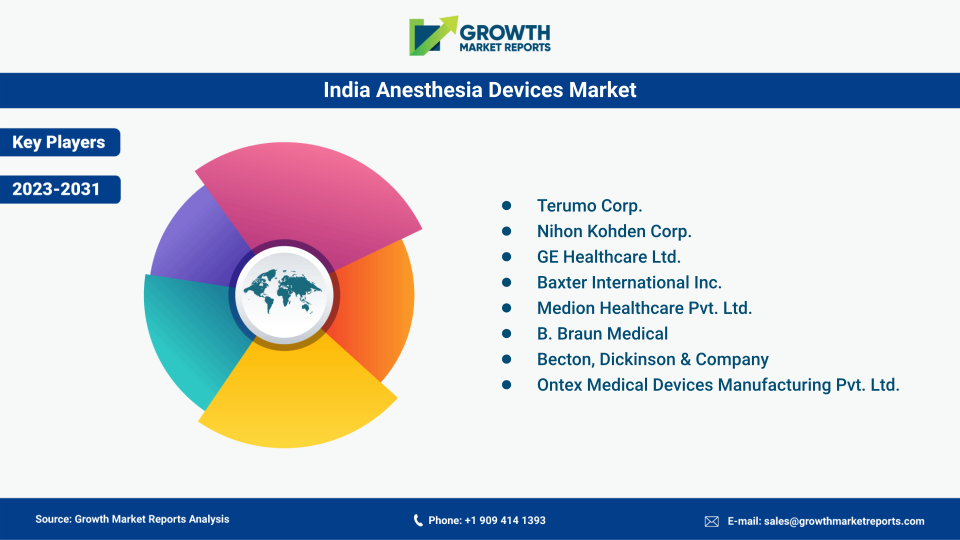

India Anesthesia Devices Market Key Players

Frequently Asked Questions

Key trends include the adoption of smart anesthesia machines, increased use of disposable products, focus on patient safety and perioperative care, and strategic collaborations among manufacturers to expand product offerings and global reach.

Major players include GE Healthcare, Drägerwerk AG & Co. KGaA, Medtronic plc, Philips Healthcare, Mindray Medical International Limited, Smiths Medical, B. Braun Melsungen AG, Fisher & Paykel Healthcare, and Nihon Kohden Corporation.

The pandemic increased awareness of infection control, accelerating the adoption of single-use anesthesia disposables and accessories to prevent cross-contamination in healthcare settings.

Opportunities include the integration of AI and digital health, demand for minimally invasive surgeries, and growth in emerging markets. Challenges include high costs of advanced devices and complex regulatory requirements.

Technological advancements such as artificial intelligence, advanced sensors, real-time monitoring, closed-loop feedback, and automated drug delivery are making anesthesia devices safer, more efficient, and easier to integrate with digital health systems.

Primary end users include hospitals, clinics, ambulatory surgical centers (ASCs), and other healthcare settings such as military hospitals, veterinary centers, and research institutions.

The main product types are anesthesia machines, anesthesia monitors, anesthesia disposables & accessories, and other specialized equipment like anesthesia information management systems (AIMS), vaporizers, and gas scavenging systems.

North America leads the anesthesia devices market due to advanced healthcare infrastructure and high surgical volumes, followed by Europe. The Asia Pacific region is experiencing the fastest growth, driven by expanding healthcare infrastructure and medical tourism.

Key growth drivers include the rising number of surgical procedures, increasing prevalence of chronic diseases, advancements in minimally invasive surgeries, and continuous technological innovation in anesthesia devices.

The global anesthesia devices market reached USD 14.2 billion in 2024 and is projected to grow at a CAGR of 7.1% from 2025 to 2033, reaching USD 26.4 billion by 2033.

Table Of Content

Chapter 1 Executive Summary
Chapter 2 Assumptions and Acronyms Used
Chapter 3 Research Methodology
Chapter 4 Anesthesia Devices Market Overview
   4.1 Introduction
      4.1.1 Market Taxonomy
      4.1.2 Market Definition
      4.1.3 Macro-Economic Factors Impacting the Market Growth
   4.2 Anesthesia Devices Market Dynamics
      4.2.1 Market Drivers
      4.2.2 Market Restraints
      4.2.3 Market Opportunity
   4.3 Anesthesia Devices Market - Supply Chain Analysis
      4.3.1 List of Key Suppliers
      4.3.2 List of Key Distributors
      4.3.3 List of Key Consumers
   4.4 Key Forces Shaping the Anesthesia Devices Market
      4.4.1 Bargaining Power of Suppliers
      4.4.2 Bargaining Power of Buyers
      4.4.3 Threat of Substitution
      4.4.4 Threat of New Entrants
      4.4.5 Competitive Rivalry
   4.5 Global Anesthesia Devices Market Size & Forecast, 2023-2032
      4.5.1 Anesthesia Devices Market Size and Y-o-Y Growth
      4.5.2 Anesthesia Devices Market Absolute $ Opportunity

Chapter 5 Global Anesthesia Devices Market Analysis and Forecast By Product Type
   5.1 Introduction
      5.1.1 Key Market Trends & Growth Opportunities By Product Type
      5.1.2 Basis Point Share (BPS) Analysis By Product Type
      5.1.3 Absolute $ Opportunity Assessment By Product Type
   5.2 Anesthesia Devices Market Size Forecast By Product Type
      5.2.1 Anesthesia Machines
      5.2.2 Anesthesia Monitors
      5.2.3 Anesthesia Disposables & Accessories
      5.2.4 Others
   5.3 Market Attractiveness Analysis By Product Type

Chapter 6 Global Anesthesia Devices Market Analysis and Forecast By Application
   6.1 Introduction
      6.1.1 Key Market Trends & Growth Opportunities By Application
      6.1.2 Basis Point Share (BPS) Analysis By Application
      6.1.3 Absolute $ Opportunity Assessment By Application
   6.2 Anesthesia Devices Market Size Forecast By Application
      6.2.1 Hospitals
      6.2.2 Ambulatory Surgical Centers
      6.2.3 Clinics
      6.2.4 Others
   6.3 Market Attractiveness Analysis By Application

Chapter 7 Global Anesthesia Devices Market Analysis and Forecast By End User
   7.1 Introduction
      7.1.1 Key Market Trends & Growth Opportunities By End User
      7.1.2 Basis Point Share (BPS) Analysis By End User
      7.1.3 Absolute $ Opportunity Assessment By End User
   7.2 Anesthesia Devices Market Size Forecast By End User
      7.2.1 Hospitals
      7.2.2 Clinics
      7.2.3 Ambulatory Surgical Centers
      7.2.4 Others
   7.3 Market Attractiveness Analysis By End User

Chapter 8 Global Anesthesia Devices Market Analysis and Forecast by Region
   8.1 Introduction
      8.1.1 Key Market Trends & Growth Opportunities By Region
      8.1.2 Basis Point Share (BPS) Analysis By Region
      8.1.3 Absolute $ Opportunity Assessment By Region
   8.2 Anesthesia Devices Market Size Forecast By Region
      8.2.1 North America
      8.2.2 Europe
      8.2.3 Asia Pacific
      8.2.4 Latin America
      8.2.5 Middle East & Africa (MEA)
   8.3 Market Attractiveness Analysis By Region

Chapter 9 Coronavirus Disease (COVID-19) Impact 
   9.1 Introduction 
   9.2 Current & Future Impact Analysis 
   9.3 Economic Impact Analysis 
   9.4 Government Policies 
   9.5 Investment Scenario

Chapter 10 North America Anesthesia Devices Analysis and Forecast
   10.1 Introduction
   10.2 North America Anesthesia Devices Market Size Forecast by Country
      10.2.1 U.S.
      10.2.2 Canada
   10.3 Basis Point Share (BPS) Analysis by Country
   10.4 Absolute $ Opportunity Assessment by Country
   10.5 Market Attractiveness Analysis by Country
   10.6 North America Anesthesia Devices Market Size Forecast By Product Type
      10.6.1 Anesthesia Machines
      10.6.2 Anesthesia Monitors
      10.6.3 Anesthesia Disposables & Accessories
      10.6.4 Others
   10.7 Basis Point Share (BPS) Analysis By Product Type 
   10.8 Absolute $ Opportunity Assessment By Product Type 
   10.9 Market Attractiveness Analysis By Product Type
   10.10 North America Anesthesia Devices Market Size Forecast By Application
      10.10.1 Hospitals
      10.10.2 Ambulatory Surgical Centers
      10.10.3 Clinics
      10.10.4 Others
   10.11 Basis Point Share (BPS) Analysis By Application 
   10.12 Absolute $ Opportunity Assessment By Application 
   10.13 Market Attractiveness Analysis By Application
   10.14 North America Anesthesia Devices Market Size Forecast By End User
      10.14.1 Hospitals
      10.14.2 Clinics
      10.14.3 Ambulatory Surgical Centers
      10.14.4 Others
   10.15 Basis Point Share (BPS) Analysis By End User 
   10.16 Absolute $ Opportunity Assessment By End User 
   10.17 Market Attractiveness Analysis By End User

Chapter 11 Europe Anesthesia Devices Analysis and Forecast
   11.1 Introduction
   11.2 Europe Anesthesia Devices Market Size Forecast by Country
      11.2.1 Germany
      11.2.2 France
      11.2.3 Italy
      11.2.4 U.K.
      11.2.5 Spain
      11.2.6 Russia
      11.2.7 Rest of Europe
   11.3 Basis Point Share (BPS) Analysis by Country
   11.4 Absolute $ Opportunity Assessment by Country
   11.5 Market Attractiveness Analysis by Country
   11.6 Europe Anesthesia Devices Market Size Forecast By Product Type
      11.6.1 Anesthesia Machines
      11.6.2 Anesthesia Monitors
      11.6.3 Anesthesia Disposables & Accessories
      11.6.4 Others
   11.7 Basis Point Share (BPS) Analysis By Product Type 
   11.8 Absolute $ Opportunity Assessment By Product Type 
   11.9 Market Attractiveness Analysis By Product Type
   11.10 Europe Anesthesia Devices Market Size Forecast By Application
      11.10.1 Hospitals
      11.10.2 Ambulatory Surgical Centers
      11.10.3 Clinics
      11.10.4 Others
   11.11 Basis Point Share (BPS) Analysis By Application 
   11.12 Absolute $ Opportunity Assessment By Application 
   11.13 Market Attractiveness Analysis By Application
   11.14 Europe Anesthesia Devices Market Size Forecast By End User
      11.14.1 Hospitals
      11.14.2 Clinics
      11.14.3 Ambulatory Surgical Centers
      11.14.4 Others
   11.15 Basis Point Share (BPS) Analysis By End User 
   11.16 Absolute $ Opportunity Assessment By End User 
   11.17 Market Attractiveness Analysis By End User

Chapter 12 Asia Pacific Anesthesia Devices Analysis and Forecast
   12.1 Introduction
   12.2 Asia Pacific Anesthesia Devices Market Size Forecast by Country
      12.2.1 China
      12.2.2 Japan
      12.2.3 South Korea
      12.2.4 India
      12.2.5 Australia
      12.2.6 South East Asia (SEA)
      12.2.7 Rest of Asia Pacific (APAC)
   12.3 Basis Point Share (BPS) Analysis by Country
   12.4 Absolute $ Opportunity Assessment by Country
   12.5 Market Attractiveness Analysis by Country
   12.6 Asia Pacific Anesthesia Devices Market Size Forecast By Product Type
      12.6.1 Anesthesia Machines
      12.6.2 Anesthesia Monitors
      12.6.3 Anesthesia Disposables & Accessories
      12.6.4 Others
   12.7 Basis Point Share (BPS) Analysis By Product Type 
   12.8 Absolute $ Opportunity Assessment By Product Type 
   12.9 Market Attractiveness Analysis By Product Type
   12.10 Asia Pacific Anesthesia Devices Market Size Forecast By Application
      12.10.1 Hospitals
      12.10.2 Ambulatory Surgical Centers
      12.10.3 Clinics
      12.10.4 Others
   12.11 Basis Point Share (BPS) Analysis By Application 
   12.12 Absolute $ Opportunity Assessment By Application 
   12.13 Market Attractiveness Analysis By Application
   12.14 Asia Pacific Anesthesia Devices Market Size Forecast By End User
      12.14.1 Hospitals
      12.14.2 Clinics
      12.14.3 Ambulatory Surgical Centers
      12.14.4 Others
   12.15 Basis Point Share (BPS) Analysis By End User 
   12.16 Absolute $ Opportunity Assessment By End User 
   12.17 Market Attractiveness Analysis By End User

Chapter 13 Latin America Anesthesia Devices Analysis and Forecast
   13.1 Introduction
   13.2 Latin America Anesthesia Devices Market Size Forecast by Country
      13.2.1 Brazil
      13.2.2 Mexico
      13.2.3 Rest of Latin America (LATAM)
   13.3 Basis Point Share (BPS) Analysis by Country
   13.4 Absolute $ Opportunity Assessment by Country
   13.5 Market Attractiveness Analysis by Country
   13.6 Latin America Anesthesia Devices Market Size Forecast By Product Type
      13.6.1 Anesthesia Machines
      13.6.2 Anesthesia Monitors
      13.6.3 Anesthesia Disposables & Accessories
      13.6.4 Others
   13.7 Basis Point Share (BPS) Analysis By Product Type 
   13.8 Absolute $ Opportunity Assessment By Product Type 
   13.9 Market Attractiveness Analysis By Product Type
   13.10 Latin America Anesthesia Devices Market Size Forecast By Application
      13.10.1 Hospitals
      13.10.2 Ambulatory Surgical Centers
      13.10.3 Clinics
      13.10.4 Others
   13.11 Basis Point Share (BPS) Analysis By Application 
   13.12 Absolute $ Opportunity Assessment By Application 
   13.13 Market Attractiveness Analysis By Application
   13.14 Latin America Anesthesia Devices Market Size Forecast By End User
      13.14.1 Hospitals
      13.14.2 Clinics
      13.14.3 Ambulatory Surgical Centers
      13.14.4 Others
   13.15 Basis Point Share (BPS) Analysis By End User 
   13.16 Absolute $ Opportunity Assessment By End User 
   13.17 Market Attractiveness Analysis By End User

Chapter 14 Middle East & Africa (MEA) Anesthesia Devices Analysis and Forecast
   14.1 Introduction
   14.2 Middle East & Africa (MEA) Anesthesia Devices Market Size Forecast by Country
      14.2.1 Saudi Arabia
      14.2.2 South Africa
      14.2.3 UAE
      14.2.4 Rest of Middle East & Africa (MEA)
   14.3 Basis Point Share (BPS) Analysis by Country
   14.4 Absolute $ Opportunity Assessment by Country
   14.5 Market Attractiveness Analysis by Country
   14.6 Middle East & Africa (MEA) Anesthesia Devices Market Size Forecast By Product Type
      14.6.1 Anesthesia Machines
      14.6.2 Anesthesia Monitors
      14.6.3 Anesthesia Disposables & Accessories
      14.6.4 Others
   14.7 Basis Point Share (BPS) Analysis By Product Type 
   14.8 Absolute $ Opportunity Assessment By Product Type 
   14.9 Market Attractiveness Analysis By Product Type
   14.10 Middle East & Africa (MEA) Anesthesia Devices Market Size Forecast By Application
      14.10.1 Hospitals
      14.10.2 Ambulatory Surgical Centers
      14.10.3 Clinics
      14.10.4 Others
   14.11 Basis Point Share (BPS) Analysis By Application 
   14.12 Absolute $ Opportunity Assessment By Application 
   14.13 Market Attractiveness Analysis By Application
   14.14 Middle East & Africa (MEA) Anesthesia Devices Market Size Forecast By End User
      14.14.1 Hospitals
      14.14.2 Clinics
      14.14.3 Ambulatory Surgical Centers
      14.14.4 Others
   14.15 Basis Point Share (BPS) Analysis By End User 
   14.16 Absolute $ Opportunity Assessment By End User 
   14.17 Market Attractiveness Analysis By End User

Chapter 15 Competition Landscape 
   15.1 Anesthesia Devices Market: Competitive Dashboard
   15.2 Global Anesthesia Devices Market: Market Share Analysis, 2023
   15.3 Company Profiles (Details – Overview, Financials, Developments, Strategy) 
      15.3.1 Medtronic plc
GE Healthcare
Drägerwerk AG & Co. KGaA
Philips Healthcare
Fisher & Paykel Healthcare Limited
Smiths Medical (ICU Medical, Inc.)
B. Braun Melsungen AG
Mindray Medical International Limited
Masimo Corporation
Nihon Kohden Corporation
Ambu A/S
Teleflex Incorporated
Penlon Limited
OSI Systems, Inc. (Spacelabs Healthcare)
SunMed
Vyaire Medical, Inc.
Intersurgical Ltd.
Löwenstein Medical GmbH & Co. KG
Siare Engineering International Group S.r.l.
Heyer Medical AG

Methodology

Our Clients

FedEx Logistics
Honda Motor Co. Ltd.
Nestle SA
sinopec
General Mills
General Electric
Microsoft
Dassault Aviation