
AI Security Code Scanning Market Size, Share & Growth Analysis, 2026-2034
AI Security Code Scanning Market Size, Share & Growth Analysis, 2026-2034
Segments - by Component (Software, Services), by Deployment Mode (On-Premises, Cloud), by Application (Web Applications, Mobile Applications, Cloud-based Applications, Embedded Systems, Others), by Organization Size (Small and Medium Enterprises, Large Enterprises), by End-User (BFSI, Healthcare, IT and Telecommunications, Government, Retail, Manufacturing, Others)



Last Updated : Jun, 2026
| Report ID :ICT-SE-60841
| 4.1 Rating
| 44 Reviews
| 283 Pages
| Format :


AI Security Code Scanning Market: Key Numbers
The AI Security Code Scanning market was valued at USD 1.65 Billion in 2025 and is projected to reach USD 7.84 Billion by 2034, a CAGR of 19.7%.
| Market size (2025) | USD 1.65 Billion |
|---|---|
| Forecast (2034) | USD 7.84 Billion |
| CAGR (2026-2034) | 19.7% |
| Largest region | North America |
| Segments covered | Component, Deployment Mode, Application, Organization Size, End-User |
| Key companies | Microsoft, Google, IBM, Checkmarx, Synopsys |
This report is updated with the latest market data and insights as of June 2026. Base year: 2025 | Forecast period: 2026-2034
AI Security Code Scanning Market Size and Growth Outlook
The AI Security Code Scanning market size reached USD 1.65 billion in 2025, reflecting robust adoption across industries driven by the escalating need for proactive security measures in software development. The market is poised to expand at a remarkable CAGR of 19.7% during the forecast period, projecting a value of USD 7.84 billion by 2034. This surge is primarily attributed to the increasing sophistication of cyber threats, the rapid pace of digital transformation, and the growing regulatory focus on secure coding practices. Broader trends in AI-driven cybersecurity are reinforcing investment momentum, as organizations recognize that intelligent automation is now essential to maintaining defensible software supply chains.

One of the fundamental growth drivers for the AI Security Code Scanning market is the escalating complexity and frequency of cyberattacks targeting software vulnerabilities. As organizations accelerate digital transformation and software-driven operations in 2025 and beyond, the attack surface has widened substantially, making security an integral component of the software development lifecycle. AI-powered code scanning tools offer a proactive approach to identifying and mitigating vulnerabilities early in the development process, significantly reducing the risk of breaches and compliance failures. The integration of machine learning, large language models, and advanced analytics enables these solutions to detect both known and unknown security flaws with high accuracy, empowering development teams to deliver secure applications faster and more efficiently than ever before.
Another significant growth factor is the increasing demand for automation in application security testing. Traditional manual code reviews and static analysis methods are often time-consuming, error-prone, and insufficient to keep pace with the agile and DevOps methodologies adopted by modern enterprises. AI-driven code scanning platforms automate the detection of vulnerabilities, streamline remediation workflows, and provide contextual insights to developers, thereby enhancing productivity and reducing time-to-market. The ability of these solutions to continuously learn from new threat patterns and adapt to evolving codebases ensures that security remains a dynamic and integral part of the software development process. This shift toward automated, AI-enhanced security testing is being further accelerated by the persistent shortage of skilled cybersecurity professionals and the growing pressure to comply with stringent data protection regulations. The parallel rise of AI-powered vulnerability detection capabilities is reshaping how development teams approach risk from the first line of code.
Regulatory compliance and industry standards are also playing a pivotal role in propelling the AI Security Code Scanning market through 2034. With governments and regulatory bodies around the world mandating secure coding practices and regular vulnerability assessments, organizations are increasingly investing in advanced code scanning solutions to meet compliance requirements. Frameworks such as GDPR, HIPAA, PCI DSS, the U.S. Executive Order on Cybersecurity, and various national cybersecurity directives require organizations to demonstrate due diligence in securing their software assets. AI-powered code scanning tools not only facilitate compliance by providing comprehensive vulnerability reports and audit trails but also help organizations avoid costly penalties and reputational damage associated with data breaches. The convergence of regulatory pressure and the need for robust security postures is expected to sustain strong market growth over the coming years.
From a regional perspective, North America currently leads the global AI Security Code Scanning market, driven by the presence of major technology vendors, high cybersecurity awareness, and significant investments in software innovation. However, the Asia Pacific region is anticipated to witness the highest growth rate during the forecast period, fueled by rapid digitalization, increasing cyber threats, and expanding regulatory mandates across emerging economies such as China, India, and Southeast Asia. Europe also represents a substantial market share, supported by strict data protection regulations and a strong focus on secure software development practices. The Middle East & Africa and Latin America are gradually catching up, as organizations in these regions recognize the importance of proactive security measures in safeguarding digital assets and maintaining business continuity.
AI Security Code Scanning Market by Component
The AI Security Code Scanning market by component is segmented into Software and Services. The software segment dominates the market, accounting for approximately 64.5% of revenue in 2025, as organizations increasingly deploy AI-driven code scanning platforms to automate vulnerability detection and remediation. These software solutions are designed to integrate seamlessly with existing development environments, providing real-time feedback to developers and ensuring that security is embedded throughout the software development lifecycle. The growing adoption of DevSecOps practices and the need for continuous security validation are further driving demand for advanced software tools that leverage artificial intelligence to identify both known and emerging threats in codebases. Solutions that extend into infrastructure-as-code security scanning are increasingly bundled with core AI scanning platforms, broadening the value proposition for enterprise buyers.

The services segment, while representing approximately 35.5% of market share, is experiencing robust growth as organizations seek expert guidance in implementing and optimizing AI-powered code scanning solutions. Service providers offer a range of offerings including consulting, integration, training, and managed security services, to help enterprises maximize the value of their investments. As the threat landscape evolves and new vulnerabilities emerge, the need for specialized expertise in configuring, updating, and fine-tuning AI security solutions becomes increasingly critical. Managed services, in particular, are gaining traction among small and medium enterprises that lack in-house security resources and require ongoing support to maintain effective security postures through 2034.
Customization and scalability are key differentiators in the software segment, with vendors offering modular solutions that can be tailored to the unique needs of different industries and development environments. Advanced features such as real-time analytics, machine learning-based anomaly detection, natural language-driven remediation guidance, and deep integration with CI/CD pipelines are becoming standard, enabling organizations to detect vulnerabilities at every stage of the development process. The ability to scale these solutions across large, distributed development teams and complex application portfolios is a major factor driving adoption among large enterprises and technology-driven organizations.
In the services segment, the focus is increasingly on value-added offerings such as risk assessment, compliance management, and incident response planning. Service providers are leveraging their expertise to help organizations develop comprehensive security strategies, align with evolving regulatory requirements, and respond effectively to emerging threats. The growing demand for end-to-end security solutions is prompting vendors to expand their service portfolios and form strategic partnerships with technology providers, further enhancing the overall value proposition of AI security code scanning offerings.
AI Security Code Scanning Market Report Scope
| Attributes | Details |
| Report Title | AI Security Code Scanning Market Research Report 2034 |
| By Component | Software, Services |
| By Deployment Mode | On-Premises, Cloud |
| By Application | Web Applications, Mobile Applications, Cloud-based Applications, Embedded Systems, Others |
| By Organization Size | Small and Medium Enterprises, Large Enterprises |
| By End-User | BFSI, Healthcare, IT and Telecommunications, Government, Retail, Manufacturing, Others |
| Regions Covered | North America, Europe, APAC, Latin America, MEA |
| Countries Covered | North America (United States, Canada), Europe (Germany, France, Italy, United Kingdom, Spain, Russia, Rest of Europe), Asia Pacific (China, Japan, South Korea, India, Australia, South East Asia (SEA), Rest of Asia Pacific), Latin America (Mexico, Brazil, Rest of Latin America), Middle East & Africa (Saudi Arabia, South Africa, United Arab Emirates, Rest of Middle East & Africa) |
| Base Year | 2025 |
| Historic Data | 2019-2024 |
| Forecast Period | 2026-2034 |
| Number of Pages | 283 |
| Number of Tables & Figures | 259 |
| Customization Available | Yes, the report can be customized as per your need. |
AI Security Code Scanning Market by Deployment Mode
Deployment mode is a critical consideration for organizations adopting AI Security Code Scanning solutions, with the market segmented into On-Premises and Cloud deployments. The cloud segment is witnessing the fastest growth, driven by the increasing adoption of cloud-native development practices and the need for scalable, flexible security solutions that can be rapidly deployed and updated. Cloud-based code scanning platforms offer several advantages, including lower upfront costs, seamless integration with cloud-based development tools, and the ability to leverage AI-driven threat intelligence from a global network of users. As organizations migrate their workloads to the cloud and embrace agile development methodologies through 2025 and beyond, the demand for cloud-native security solutions is expected to continue rising steadily.
On-premises deployment, while representing a smaller share of the market, remains important for organizations with stringent data privacy requirements, regulatory constraints, or legacy infrastructure. Industries such as banking, healthcare, and government often prefer on-premises solutions to maintain full control over sensitive code and security data. These deployments typically involve higher upfront investments and ongoing maintenance costs, but offer greater customization and integration with existing security frameworks. As regulatory scrutiny intensifies and data sovereignty becomes a top priority in 2025, the on-premises segment is expected to maintain steady demand among risk-averse organizations globally.
Hybrid deployment models are also gaining significant traction, as organizations seek to balance the benefits of cloud scalability with the control and security of on-premises infrastructure. Vendors are responding by offering flexible deployment options that allow customers to choose the best fit for their operational and compliance needs. The ability to seamlessly transition between deployment modes as business requirements evolve is becoming a key selling point for leading AI security code scanning providers competing in this dynamic market.
Security, performance, and ease of integration are top considerations for organizations evaluating deployment options in 2025. Cloud-based solutions are increasingly incorporating advanced encryption, multi-factor authentication, zero-trust architecture support, and compliance certifications to address concerns around data privacy and regulatory compliance. On-premises solutions are focusing on enhanced customization, integration with legacy systems, and support for complex development environments. As the market matures through 2034, the distinction between cloud and on-premises deployments is expected to blur further, with hybrid and multi-cloud strategies becoming the predominant norm.
AI Security Code Scanning Market by Application
The application landscape for AI Security Code Scanning is diverse, encompassing Web Applications, Mobile Applications, Cloud-based Applications, Embedded Systems, and others. Web applications constitute the largest segment, reflecting the ubiquitous nature of web-based services and the high frequency of attacks targeting web application vulnerabilities. Organizations are prioritizing the security of web applications as they serve as primary customer touchpoints and gateways to sensitive data. AI-powered code scanning tools are instrumental in identifying vulnerabilities such as SQL injection, cross-site scripting, and authentication flaws, enabling organizations to safeguard their web assets and maintain customer trust through continuous monitoring.
Mobile applications represent a rapidly growing segment, driven by the proliferation of smartphones and the increasing reliance on mobile apps for business and personal use. The unique security challenges associated with mobile platforms, including fragmented operating systems, frequent updates, and diverse device configurations, necessitate advanced code scanning solutions capable of detecting platform-specific vulnerabilities. AI-driven tools can analyze mobile application code for security flaws, privacy risks, and compliance issues, helping developers deliver secure and reliable apps to end-users. The growing use of AI-based scanning technology across device types is further elevating the standard for mobile security validation in 2025.
Cloud-based applications are also experiencing significant demand for AI security code scanning solutions, as organizations shift their workloads to public, private, and hybrid cloud environments. The dynamic and distributed nature of cloud applications introduces new security challenges including misconfigurations, insecure APIs, and data exposure risks. AI-powered code scanning platforms offer real-time monitoring, automated vulnerability detection, and integration with cloud-native development tools, enabling organizations to secure their cloud applications at scale and maintain compliance with industry standards throughout the 2026-2034 forecast period.
Embedded systems, which include IoT devices, industrial control systems, and connected products, present unique security challenges due to resource constraints, long lifecycles, and limited update capabilities. The growing adoption of AI security code scanning in embedded systems is driven by the need to prevent attacks on critical infrastructure, protect intellectual property, and ensure the safety and reliability of connected devices. AI-based solutions can analyze firmware and embedded software for vulnerabilities, backdoors, and insecure configurations, helping manufacturers and operators address security risks proactively before products reach deployment. This segment is expected to see accelerated investment through 2034 as the attack surface for connected devices continues to expand.
AI Security Code Scanning Market by Organization Size
The AI Security Code Scanning market is segmented by organization size into Small and Medium Enterprises (SMEs) and Large Enterprises. Large enterprises currently account for the largest share of the market in 2025, driven by their extensive software development operations, complex application portfolios, and heightened exposure to cyber threats. These organizations are investing heavily in advanced AI-powered code scanning solutions to automate security testing, reduce manual effort, and ensure compliance with stringent regulatory requirements. The ability to scale security operations across distributed development teams and integrate with enterprise-grade DevSecOps pipelines is a key factor driving adoption among large enterprises and technology-driven organizations worldwide.
Small and medium enterprises are emerging as a high-growth segment, as they increasingly recognize the importance of proactive security measures in safeguarding their digital assets. While SMEs often face resource constraints and limited cybersecurity expertise, the availability of cost-effective, cloud-based AI code scanning solutions is lowering the barriers to adoption significantly. Vendors are tailoring their offerings to meet the unique needs of SMEs, providing simplified deployment, automated workflows, and pay-as-you-go pricing models that align with tighter budgets. As cyber threats become more sophisticated and regulatory pressures intensify through 2034, SMEs are expected to invest more aggressively in advanced security solutions to protect their operations and maintain customer trust.
The differing needs and challenges of SMEs and large enterprises are shaping the evolution of AI security code scanning solutions across the forecast period. Large enterprises prioritize scalability, integration, and advanced analytics, seeking solutions that can support complex, multi-cloud environments and provide actionable insights for continuous improvement. SMEs, on the other hand, value ease of use, affordability, and rapid deployment, favoring solutions that require minimal configuration and maintenance. Vendors are responding by offering modular, customizable platforms that can be tailored to the specific requirements of organizations of all sizes and maturity levels.
The increasing availability of managed security services is further bridging the gap between SMEs and large enterprises, enabling organizations with limited in-house resources to access expert support and maintain effective security postures. As digital transformation accelerates across industries through 2034, the demand for scalable, AI-driven code scanning solutions is expected to grow across organizations of all sizes, driving sustained innovation and competition throughout the market. Advances in AI-assisted security testing methodologies are also helping smaller organizations adopt offensive security insights to harden their codebases more cost-effectively.
AI Security Code Scanning Market by End-User
The AI Security Code Scanning market serves a wide range of end-users, including BFSI, Healthcare, IT and Telecommunications, Government, Retail, Manufacturing, and others. The BFSI sector leads the market in 2025, driven by the critical importance of data security, regulatory compliance, and the need to protect sensitive financial information. Banks, insurance companies, and financial institutions are leveraging AI-powered code scanning tools to identify and remediate vulnerabilities in their applications, ensuring the integrity and confidentiality of customer data. The growing adoption of digital banking, mobile payments, and fintech solutions is further increasing the demand for advanced security measures across the BFSI sector globally.
Healthcare is another major end-user segment, as organizations in this sector face stringent data protection regulations such as HIPAA and GDPR, as well as the growing threat of ransomware and data breaches targeting patient records and clinical systems. AI security code scanning solutions help healthcare providers, payers, and technology vendors secure their applications, protect patient data, and maintain compliance with industry standards. The increasing adoption of electronic health records, telemedicine, and connected medical devices is creating new security challenges that drive the need for proactive and automated security testing solutions through 2034.
The IT and telecommunications sector is experiencing strong demand for AI security code scanning, as organizations in this industry are at the forefront of software innovation and digital transformation. The rapid pace of development, frequent software releases, and the need to secure complex, distributed systems make AI-powered code scanning an essential component of the security strategy for IT and telecom companies. These organizations are leveraging advanced analytics, machine learning, and automation to detect and remediate vulnerabilities in real-time, ensuring the security and reliability of their services at scale. Emerging capabilities in AI-driven container inspection are increasingly integrated with code scanning workflows to extend protection into runtime environments.
Government agencies and public sector organizations are also significant end-users of AI security code scanning solutions in 2025, driven by the need to protect critical infrastructure, sensitive data, and public services from increasingly sophisticated cyber threats. Regulatory mandates, budget modernization initiatives, and the increasing sophistication of nation-state attacks are prompting governments to invest in advanced security technologies that can automate vulnerability detection and ensure compliance with security standards. The retail and manufacturing sectors are steadily increasing their adoption of AI security code scanning, as e-commerce growth, supply chain digitization, and the rise of connected products create new security challenges and commercial opportunities through the 2026-2034 period.
AI Security Code Scanning Market Opportunities and Threats
The AI Security Code Scanning market presents significant opportunities for innovation and growth, driven by the rapid evolution of the threat landscape and the increasing adoption of digital technologies across industries in 2025. The integration of generative AI and large language models with code scanning tools is enabling organizations to detect and remediate vulnerabilities with unprecedented speed and contextual accuracy, reducing the risk of breaches and compliance failures. The growing adoption of DevSecOps practices, cloud-native development, and agile methodologies is creating new opportunities for vendors to deliver scalable, automated security solutions that can keep pace with the demands of modern software development. As organizations continue to prioritize security and compliance through 2034, the demand for advanced AI-powered code scanning tools is expected to grow, creating new opportunities for technology providers, service vendors, and managed security service providers across all major regions.
Another major opportunity lies in the expansion of the market into emerging regions and industries. As digital transformation accelerates in Asia Pacific, Latin America, and the Middle East & Africa, organizations in these regions are increasingly recognizing the importance of proactive security measures in safeguarding their digital assets. The availability of cloud-based, pay-as-you-go AI security code scanning solutions is lowering the barriers to adoption for small and medium enterprises, enabling them to access advanced security technologies without significant upfront investment. Vendors that can offer localized support, regulatory compliance expertise, and industry-specific solutions are well-positioned to capitalize on the growing demand for AI security code scanning in these emerging markets through the end of the forecast period.
Despite the significant opportunities, the AI Security Code Scanning market faces several restraining factors, including the complexity of integrating AI-powered solutions with existing development environments, the persistent shortage of skilled cybersecurity professionals, and ongoing concerns around data privacy and cross-border regulatory compliance. Organizations may face challenges in customizing and scaling AI security solutions to meet their unique needs, particularly in industries with legacy systems or strict regulatory requirements. The rapid pace of technology evolution and the emergence of new threat vectors, including AI-generated malicious code, also require continuous investment in research and development that may pose challenges for smaller vendors and new entrants. Addressing these challenges will be critical to sustaining long-term growth and unlocking the full potential of AI security code scanning solutions through 2034.
AI Security Code Scanning Market Size by Region
North America remains the dominant region in the AI Security Code Scanning market, accounting for approximately 40.5% of global revenue in 2025. The region's leadership is driven by the presence of major technology vendors, high cybersecurity awareness, and significant investments in software innovation and digital transformation. The United States, in particular, is a major contributor, with organizations across BFSI, healthcare, and IT sectors prioritizing the adoption of AI-powered code scanning solutions to address the growing threat of cyberattacks and comply with stringent regulatory requirements including the updated U.S. Cybersecurity Executive Order provisions. The region's mature technology ecosystem, strong focus on research and development, and robust venture capital activity are expected to sustain its leadership position over the 2026-2034 forecast period.
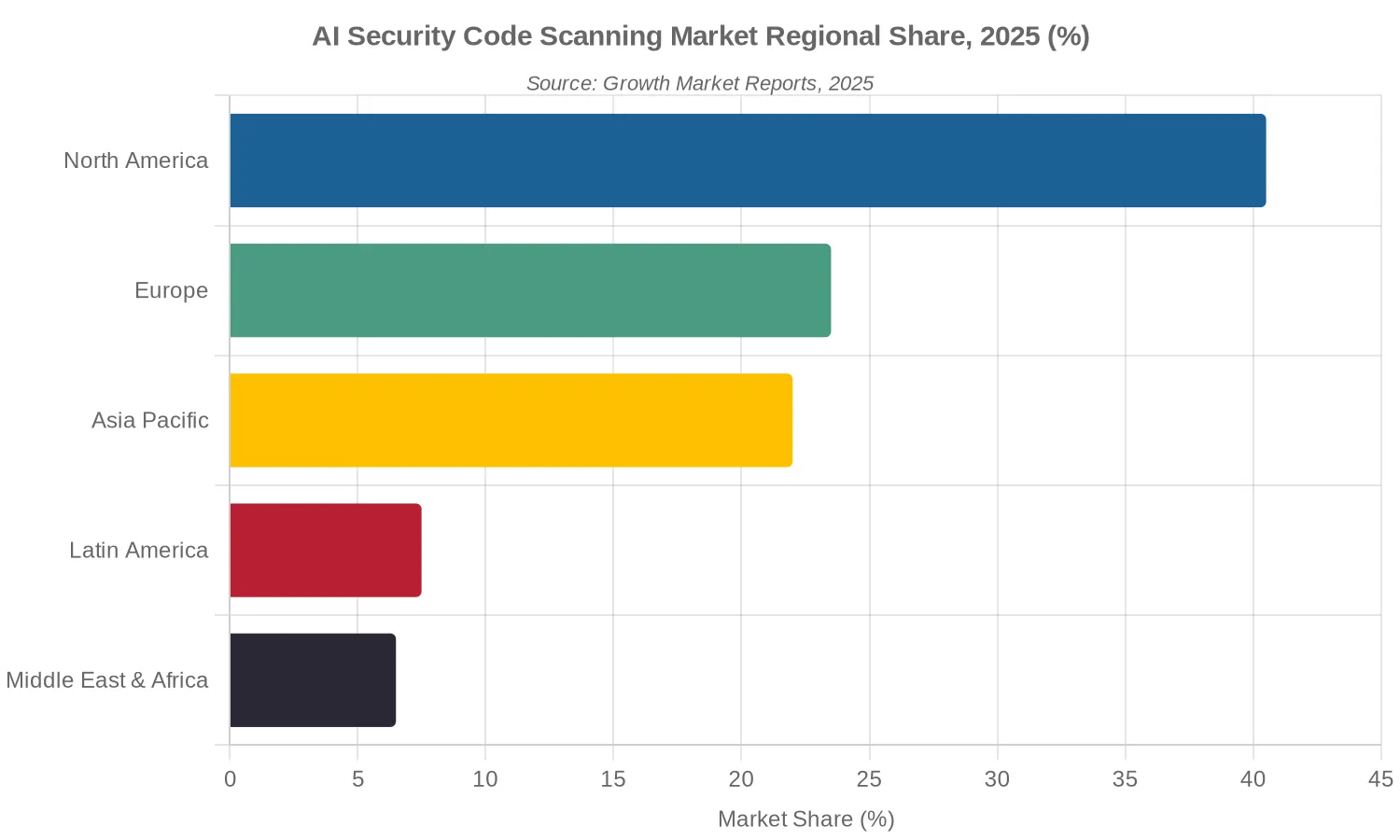
The Asia Pacific region is poised for the highest growth, with a projected CAGR of 23.1% from 2026 to 2034. The market in Asia Pacific is being driven by rapid digitalization, increasing cyber threats, and expanding regulatory mandates across emerging economies such as China, India, Japan, and Southeast Asia. Organizations in the region are investing in advanced security solutions to protect their digital assets, comply with data protection regulations, and maintain business continuity in an increasingly connected environment. The growing adoption of cloud computing, mobile applications, and IoT devices is creating new security challenges and opportunities, driving demand for scalable, AI-driven code scanning solutions. By 2034, Asia Pacific is expected to account for over 28% of the global market, reflecting its growing importance in the global cybersecurity landscape.
Europe represents a significant share of the AI Security Code Scanning market in 2025, supported by strict data protection regulations such as GDPR, the EU Cyber Resilience Act, and a strong focus on secure software development practices across member states. The region's mature regulatory environment, high cybersecurity awareness, and growing adoption of digital technologies are driving demand for advanced code scanning solutions across BFSI, healthcare, and government sectors. The Middle East & Africa and Latin America are gradually increasing their adoption of AI security code scanning solutions, as organizations in these regions recognize the importance of proactive security measures in safeguarding digital assets and maintaining business continuity. Together, these two regions are expected to account for approximately 14% of the global market by 2034, reflecting steady growth and increasing awareness of the benefits of AI-powered security solutions across developing economies.
AI Security Code Scanning Market Competitive Landscape
The competitive landscape of the AI Security Code Scanning market in 2025 is characterized by intense innovation, strategic partnerships, and a strong focus on research and development. Leading technology vendors are investing heavily in the development of advanced AI-powered code scanning solutions that can detect and remediate vulnerabilities with high accuracy and efficiency, incorporating capabilities such as generative AI-assisted remediation and real-time supply chain risk monitoring. The market is witnessing a wave of mergers and acquisitions, as established players seek to expand their product portfolios, enhance their technological capabilities, and strengthen their market positions. Startups and niche vendors are also entering the market, offering specialized solutions tailored to the unique needs of different industries and deployment environments.
Product differentiation and customer-centric innovation are key strategies employed by market leaders to gain a competitive edge through the 2026-2034 forecast period. Vendors are focusing on delivering solutions that offer seamless integration with existing development tools, support for multiple programming languages and frameworks, and advanced analytics capabilities powered by machine learning. The ability to provide real-time vulnerability detection, automated remediation workflows, and comprehensive compliance reporting is becoming increasingly important, as organizations seek to embed security into every stage of the software development lifecycle. Strategic partnerships with cloud service providers, system integrators, and managed security service providers are enabling vendors to expand their reach and deliver end-to-end security solutions to a broader customer base globally.
Pricing models and service offerings are also evolving to meet the diverse needs of organizations of all sizes in 2025. Vendors are offering flexible subscription-based pricing, pay-as-you-go models, and value-added services such as consulting, training, and managed security services. The ability to deliver scalable, customizable solutions that can be tailored to the specific requirements of different industries and deployment environments is a key factor driving customer loyalty and market growth. As the market matures through 2034, competition is expected to intensify, with vendors vying for market share through continuous innovation, strategic partnerships, and a strong focus on customer success metrics and outcome-based service models.
Major companies operating in the AI Security Code Scanning market include Checkmarx, Synopsys, Veracode, SonarSource, OpenText (Fortify), GitHub (Microsoft), Snyk, and Mend (WhiteSource). These companies are recognized for their comprehensive product portfolios, strong customer relationships, and global presence. Checkmarx and Synopsys are known for their advanced static application security testing (SAST) solutions, leveraging AI and machine learning to deliver real-time vulnerability detection and remediation guidance. Veracode and SonarSource offer cloud-based platforms that integrate seamlessly with CI/CD pipelines, enabling organizations to automate security testing and maintain continuous compliance. OpenText Fortify provides a suite of application security solutions tailored to the needs of large enterprises and regulated industries across North America and Europe.
GitHub, a subsidiary of Microsoft, has rapidly expanded its presence in the market through the integration of AI-powered code scanning tools, including Copilot Autofix, directly into its widely adopted development platform. Snyk and Mend are recognized for their focus on open-source security and software composition analysis, providing solutions that help organizations identify and remediate vulnerabilities in third-party libraries and dependencies. Palo Alto Networks, CrowdStrike, and SentinelOne are extending their cloud security platforms to encompass code-level scanning capabilities, reflecting the convergence of endpoint, cloud, and application security. These companies are continuously enhancing their offerings through strategic acquisitions, partnerships, and investments in research and development. As the market continues to evolve through 2034, collaboration between technology vendors, service providers, and end-users will be critical to driving innovation, improving security outcomes, and sustaining long-term growth in the AI Security Code Scanning market.
Top Companies in the AI Security Code Scanning Market
- Microsoft
- IBM
- Checkmarx
- Synopsys
- Veracode
- GitHub
- Snyk
- Fortinet
- Palo Alto Networks
- Rapid7
- Mend (WhiteSource)
- OpenText (Fortify)
- Trend Micro
- CrowdStrike
- SentinelOne
- Qualys
- Aqua Security
- SonarSource
- Datadog
Segments
The AI Security Code Scanning market has been segmented on the basis of
Component
- Software
- Services
Deployment Mode
- On-Premises
- Cloud
Application
- Web Applications
- Mobile Applications
- Cloud-based Applications
- Embedded Systems
- Others
Organization Size
- Small and Medium Enterprises
- Large Enterprises
End-User
- BFSI
- Healthcare
- IT and Telecommunications
- Government
- Retail
- Manufacturing
- Others
Frequently Asked Questions
Leading players in 2025 include Microsoft, Google, IBM, Checkmarx, Synopsys, Veracode, GitHub, Snyk, Fortinet, Palo Alto Networks, Rapid7, Mend (formerly WhiteSource), OpenText (Fortify), Trend Micro, CrowdStrike, SentinelOne, Qualys, Aqua Security, SonarSource, and Datadog. These companies compete on AI capability depth, integration breadth, compliance support, and managed service offerings.
Significant opportunities include the expansion of AI-native scanning platforms that leverage large language models for contextual vulnerability detection, growth in emerging markets across Asia Pacific and Latin America, and the deepening integration of scanning tools within DevSecOps workflows. Challenges include the complexity of integrating AI scanning into legacy development environments, persistent shortages of cybersecurity talent, evolving regulatory landscapes across jurisdictions, and the need for continuous model updates to address novel attack vectors and zero-day vulnerabilities.
BFSI leads end-user adoption due to high data sensitivity, digital banking growth, and rigorous regulatory requirements. Healthcare follows closely, driven by HIPAA compliance needs and the proliferation of connected medical devices and telehealth platforms. IT and Telecommunications organizations are major adopters given their software-intensive operations. Government agencies are investing heavily to protect critical infrastructure. Retail and Manufacturing are growing segments as e-commerce expansion and Industry 4.0 initiatives create new security challenges.
Large enterprises currently account for the majority of market revenue in 2025, driven by extensive software development operations, complex multi-cloud portfolios, and strict compliance obligations. Small and medium enterprises are the fastest-growing adopter segment, benefiting from cloud-based subscription models, simplified deployment, and pay-as-you-go pricing that reduce barriers to entry. Managed service options are further enabling SMEs to access enterprise-grade security capabilities without large in-house teams.
Web applications represent the largest segment given the high volume of web-facing services and frequent targeting by attackers exploiting vulnerabilities such as SQL injection and cross-site scripting. Mobile applications are growing rapidly as smartphone adoption expands. Cloud-based applications face unique risks including API insecurity and misconfigurations, driving dedicated scanning demand. Embedded systems and IoT firmware are an emerging area, particularly in industrial and healthcare contexts where long device lifecycles make early vulnerability detection critical.
AI Security Code Scanning solutions are available in On-Premises and Cloud deployment modes. Cloud-based deployments are growing fastest due to lower upfront costs, elastic scalability, and seamless integration with modern cloud-native development pipelines. On-premises deployments remain preferred by organizations in regulated industries such as banking, healthcare, and government, where data sovereignty and strict access controls are mandatory. Hybrid models combining both modes are increasingly common.
The market is segmented into Software and Services. Software dominates with roughly 64.5% of market revenue in 2025, encompassing AI-driven static and dynamic analysis platforms, vulnerability management tools, and CI/CD-integrated scanning engines. The Services segment, representing approximately 35.5%, includes consulting, implementation, training, and managed security services that help organizations deploy and optimize scanning solutions effectively.
North America leads the global market with approximately 40.5% revenue share in 2025, anchored by mature technology ecosystems and high cybersecurity investment in the United States and Canada. Asia Pacific is the fastest-growing region, expected to record a CAGR exceeding 23% from 2026 to 2034, driven by rapid digitalization in China, India, Japan, and Southeast Asia. Europe holds a substantial share supported by stringent GDPR enforcement and broad adoption of secure development frameworks.
Key growth drivers include the increasing frequency and complexity of software vulnerabilities, the rapid shift to cloud-native and agile development, widespread adoption of DevSecOps practices, and tightening compliance mandates such as GDPR, HIPAA, and PCI DSS. The shortage of skilled cybersecurity professionals is also pushing organizations toward automated, AI-powered scanning tools that reduce manual effort and accelerate secure software delivery.
The AI Security Code Scanning market reached USD 1.65 billion in 2025 and is projected to grow at a CAGR of 19.7% from 2026 to 2034, reaching approximately USD 7.84 billion by 2034. This growth is driven by rising cyberattack sophistication, accelerating DevSecOps adoption, and expanding regulatory requirements for secure software development globally.
Table Of Content
Chapter 1 Executive SummaryChapter 2 Assumptions and Acronyms Used
Chapter 3 Research Methodology
Chapter 4 AI Security Code Scanning Market Overview
4.1 Introduction
4.1.1 Market Taxonomy
4.1.2 Market Definition
4.1.3 Macro-Economic Factors Impacting the Market Growth
4.2 AI Security Code Scanning Market Dynamics
4.2.1 Market Drivers
4.2.2 Market Restraints
4.2.3 Market Opportunity
4.3 AI Security Code Scanning Market - Supply Chain Analysis
4.3.1 List of Key Suppliers
4.3.2 List of Key Distributors
4.3.3 List of Key Consumers
4.4 Key Forces Shaping the AI Security Code Scanning Market
4.4.1 Bargaining Power of Suppliers
4.4.2 Bargaining Power of Buyers
4.4.3 Threat of Substitution
4.4.4 Threat of New Entrants
4.4.5 Competitive Rivalry
4.5 Global AI Security Code Scanning Market Size & Forecast, 2023-2032
4.5.1 AI Security Code Scanning Market Size and Y-o-Y Growth
4.5.2 AI Security Code Scanning Market Absolute $ Opportunity
Chapter 5 Global AI Security Code Scanning Market Analysis and Forecast By Component
5.1 Introduction
5.1.1 Key Market Trends & Growth Opportunities By Component
5.1.2 Basis Point Share (BPS) Analysis By Component
5.1.3 Absolute $ Opportunity Assessment By Component
5.2 AI Security Code Scanning Market Size Forecast By Component
5.2.1 Software
5.2.2 Services
5.3 Market Attractiveness Analysis By Component
Chapter 6 Global AI Security Code Scanning Market Analysis and Forecast By Deployment Mode
6.1 Introduction
6.1.1 Key Market Trends & Growth Opportunities By Deployment Mode
6.1.2 Basis Point Share (BPS) Analysis By Deployment Mode
6.1.3 Absolute $ Opportunity Assessment By Deployment Mode
6.2 AI Security Code Scanning Market Size Forecast By Deployment Mode
6.2.1 On-Premises
6.2.2 Cloud
6.3 Market Attractiveness Analysis By Deployment Mode
Chapter 7 Global AI Security Code Scanning Market Analysis and Forecast By Application
7.1 Introduction
7.1.1 Key Market Trends & Growth Opportunities By Application
7.1.2 Basis Point Share (BPS) Analysis By Application
7.1.3 Absolute $ Opportunity Assessment By Application
7.2 AI Security Code Scanning Market Size Forecast By Application
7.2.1 Web Applications
7.2.2 Mobile Applications
7.2.3 Cloud-based Applications
7.2.4 Embedded Systems
7.2.5 Others
7.3 Market Attractiveness Analysis By Application
Chapter 8 Global AI Security Code Scanning Market Analysis and Forecast By Organization Size
8.1 Introduction
8.1.1 Key Market Trends & Growth Opportunities By Organization Size
8.1.2 Basis Point Share (BPS) Analysis By Organization Size
8.1.3 Absolute $ Opportunity Assessment By Organization Size
8.2 AI Security Code Scanning Market Size Forecast By Organization Size
8.2.1 Small and Medium Enterprises
8.2.2 Large Enterprises
8.3 Market Attractiveness Analysis By Organization Size
Chapter 9 Global AI Security Code Scanning Market Analysis and Forecast By End-User
9.1 Introduction
9.1.1 Key Market Trends & Growth Opportunities By End-User
9.1.2 Basis Point Share (BPS) Analysis By End-User
9.1.3 Absolute $ Opportunity Assessment By End-User
9.2 AI Security Code Scanning Market Size Forecast By End-User
9.2.1 BFSI
9.2.2 Healthcare
9.2.3 IT and Telecommunications
9.2.4 Government
9.2.5 Retail
9.2.6 Manufacturing
9.2.7 Others
9.3 Market Attractiveness Analysis By End-User
Chapter 10 Global AI Security Code Scanning Market Analysis and Forecast by Region
10.1 Introduction
10.1.1 Key Market Trends & Growth Opportunities By Region
10.1.2 Basis Point Share (BPS) Analysis By Region
10.1.3 Absolute $ Opportunity Assessment By Region
10.2 AI Security Code Scanning Market Size Forecast By Region
10.2.1 North America
10.2.2 Europe
10.2.3 Asia Pacific
10.2.4 Latin America
10.2.5 Middle East & Africa (MEA)
10.3 Market Attractiveness Analysis By Region
Chapter 11 Coronavirus Disease (COVID-19) Impact
11.1 Introduction
11.2 Current & Future Impact Analysis
11.3 Economic Impact Analysis
11.4 Government Policies
11.5 Investment Scenario
Chapter 12 North America AI Security Code Scanning Analysis and Forecast
12.1 Introduction
12.2 North America AI Security Code Scanning Market Size Forecast by Country
12.2.1 U.S.
12.2.2 Canada
12.3 Basis Point Share (BPS) Analysis by Country
12.4 Absolute $ Opportunity Assessment by Country
12.5 Market Attractiveness Analysis by Country
12.6 North America AI Security Code Scanning Market Size Forecast By Component
12.6.1 Software
12.6.2 Services
12.7 Basis Point Share (BPS) Analysis By Component
12.8 Absolute $ Opportunity Assessment By Component
12.9 Market Attractiveness Analysis By Component
12.10 North America AI Security Code Scanning Market Size Forecast By Deployment Mode
12.10.1 On-Premises
12.10.2 Cloud
12.11 Basis Point Share (BPS) Analysis By Deployment Mode
12.12 Absolute $ Opportunity Assessment By Deployment Mode
12.13 Market Attractiveness Analysis By Deployment Mode
12.14 North America AI Security Code Scanning Market Size Forecast By Application
12.14.1 Web Applications
12.14.2 Mobile Applications
12.14.3 Cloud-based Applications
12.14.4 Embedded Systems
12.14.5 Others
12.15 Basis Point Share (BPS) Analysis By Application
12.16 Absolute $ Opportunity Assessment By Application
12.17 Market Attractiveness Analysis By Application
12.18 North America AI Security Code Scanning Market Size Forecast By Organization Size
12.18.1 Small and Medium Enterprises
12.18.2 Large Enterprises
12.19 Basis Point Share (BPS) Analysis By Organization Size
12.20 Absolute $ Opportunity Assessment By Organization Size
12.21 Market Attractiveness Analysis By Organization Size
12.22 North America AI Security Code Scanning Market Size Forecast By End-User
12.22.1 BFSI
12.22.2 Healthcare
12.22.3 IT and Telecommunications
12.22.4 Government
12.22.5 Retail
12.22.6 Manufacturing
12.22.7 Others
12.23 Basis Point Share (BPS) Analysis By End-User
12.24 Absolute $ Opportunity Assessment By End-User
12.25 Market Attractiveness Analysis By End-User
Chapter 13 Europe AI Security Code Scanning Analysis and Forecast
13.1 Introduction
13.2 Europe AI Security Code Scanning Market Size Forecast by Country
13.2.1 Germany
13.2.2 France
13.2.3 Italy
13.2.4 U.K.
13.2.5 Spain
13.2.6 Russia
13.2.7 Rest of Europe
13.3 Basis Point Share (BPS) Analysis by Country
13.4 Absolute $ Opportunity Assessment by Country
13.5 Market Attractiveness Analysis by Country
13.6 Europe AI Security Code Scanning Market Size Forecast By Component
13.6.1 Software
13.6.2 Services
13.7 Basis Point Share (BPS) Analysis By Component
13.8 Absolute $ Opportunity Assessment By Component
13.9 Market Attractiveness Analysis By Component
13.10 Europe AI Security Code Scanning Market Size Forecast By Deployment Mode
13.10.1 On-Premises
13.10.2 Cloud
13.11 Basis Point Share (BPS) Analysis By Deployment Mode
13.12 Absolute $ Opportunity Assessment By Deployment Mode
13.13 Market Attractiveness Analysis By Deployment Mode
13.14 Europe AI Security Code Scanning Market Size Forecast By Application
13.14.1 Web Applications
13.14.2 Mobile Applications
13.14.3 Cloud-based Applications
13.14.4 Embedded Systems
13.14.5 Others
13.15 Basis Point Share (BPS) Analysis By Application
13.16 Absolute $ Opportunity Assessment By Application
13.17 Market Attractiveness Analysis By Application
13.18 Europe AI Security Code Scanning Market Size Forecast By Organization Size
13.18.1 Small and Medium Enterprises
13.18.2 Large Enterprises
13.19 Basis Point Share (BPS) Analysis By Organization Size
13.20 Absolute $ Opportunity Assessment By Organization Size
13.21 Market Attractiveness Analysis By Organization Size
13.22 Europe AI Security Code Scanning Market Size Forecast By End-User
13.22.1 BFSI
13.22.2 Healthcare
13.22.3 IT and Telecommunications
13.22.4 Government
13.22.5 Retail
13.22.6 Manufacturing
13.22.7 Others
13.23 Basis Point Share (BPS) Analysis By End-User
13.24 Absolute $ Opportunity Assessment By End-User
13.25 Market Attractiveness Analysis By End-User
Chapter 14 Asia Pacific AI Security Code Scanning Analysis and Forecast
14.1 Introduction
14.2 Asia Pacific AI Security Code Scanning Market Size Forecast by Country
14.2.1 China
14.2.2 Japan
14.2.3 South Korea
14.2.4 India
14.2.5 Australia
14.2.6 South East Asia (SEA)
14.2.7 Rest of Asia Pacific (APAC)
14.3 Basis Point Share (BPS) Analysis by Country
14.4 Absolute $ Opportunity Assessment by Country
14.5 Market Attractiveness Analysis by Country
14.6 Asia Pacific AI Security Code Scanning Market Size Forecast By Component
14.6.1 Software
14.6.2 Services
14.7 Basis Point Share (BPS) Analysis By Component
14.8 Absolute $ Opportunity Assessment By Component
14.9 Market Attractiveness Analysis By Component
14.10 Asia Pacific AI Security Code Scanning Market Size Forecast By Deployment Mode
14.10.1 On-Premises
14.10.2 Cloud
14.11 Basis Point Share (BPS) Analysis By Deployment Mode
14.12 Absolute $ Opportunity Assessment By Deployment Mode
14.13 Market Attractiveness Analysis By Deployment Mode
14.14 Asia Pacific AI Security Code Scanning Market Size Forecast By Application
14.14.1 Web Applications
14.14.2 Mobile Applications
14.14.3 Cloud-based Applications
14.14.4 Embedded Systems
14.14.5 Others
14.15 Basis Point Share (BPS) Analysis By Application
14.16 Absolute $ Opportunity Assessment By Application
14.17 Market Attractiveness Analysis By Application
14.18 Asia Pacific AI Security Code Scanning Market Size Forecast By Organization Size
14.18.1 Small and Medium Enterprises
14.18.2 Large Enterprises
14.19 Basis Point Share (BPS) Analysis By Organization Size
14.20 Absolute $ Opportunity Assessment By Organization Size
14.21 Market Attractiveness Analysis By Organization Size
14.22 Asia Pacific AI Security Code Scanning Market Size Forecast By End-User
14.22.1 BFSI
14.22.2 Healthcare
14.22.3 IT and Telecommunications
14.22.4 Government
14.22.5 Retail
14.22.6 Manufacturing
14.22.7 Others
14.23 Basis Point Share (BPS) Analysis By End-User
14.24 Absolute $ Opportunity Assessment By End-User
14.25 Market Attractiveness Analysis By End-User
Chapter 15 Latin America AI Security Code Scanning Analysis and Forecast
15.1 Introduction
15.2 Latin America AI Security Code Scanning Market Size Forecast by Country
15.2.1 Brazil
15.2.2 Mexico
15.2.3 Rest of Latin America (LATAM)
15.3 Basis Point Share (BPS) Analysis by Country
15.4 Absolute $ Opportunity Assessment by Country
15.5 Market Attractiveness Analysis by Country
15.6 Latin America AI Security Code Scanning Market Size Forecast By Component
15.6.1 Software
15.6.2 Services
15.7 Basis Point Share (BPS) Analysis By Component
15.8 Absolute $ Opportunity Assessment By Component
15.9 Market Attractiveness Analysis By Component
15.10 Latin America AI Security Code Scanning Market Size Forecast By Deployment Mode
15.10.1 On-Premises
15.10.2 Cloud
15.11 Basis Point Share (BPS) Analysis By Deployment Mode
15.12 Absolute $ Opportunity Assessment By Deployment Mode
15.13 Market Attractiveness Analysis By Deployment Mode
15.14 Latin America AI Security Code Scanning Market Size Forecast By Application
15.14.1 Web Applications
15.14.2 Mobile Applications
15.14.3 Cloud-based Applications
15.14.4 Embedded Systems
15.14.5 Others
15.15 Basis Point Share (BPS) Analysis By Application
15.16 Absolute $ Opportunity Assessment By Application
15.17 Market Attractiveness Analysis By Application
15.18 Latin America AI Security Code Scanning Market Size Forecast By Organization Size
15.18.1 Small and Medium Enterprises
15.18.2 Large Enterprises
15.19 Basis Point Share (BPS) Analysis By Organization Size
15.20 Absolute $ Opportunity Assessment By Organization Size
15.21 Market Attractiveness Analysis By Organization Size
15.22 Latin America AI Security Code Scanning Market Size Forecast By End-User
15.22.1 BFSI
15.22.2 Healthcare
15.22.3 IT and Telecommunications
15.22.4 Government
15.22.5 Retail
15.22.6 Manufacturing
15.22.7 Others
15.23 Basis Point Share (BPS) Analysis By End-User
15.24 Absolute $ Opportunity Assessment By End-User
15.25 Market Attractiveness Analysis By End-User
Chapter 16 Middle East & Africa (MEA) AI Security Code Scanning Analysis and Forecast
16.1 Introduction
16.2 Middle East & Africa (MEA) AI Security Code Scanning Market Size Forecast by Country
16.2.1 Saudi Arabia
16.2.2 South Africa
16.2.3 UAE
16.2.4 Rest of Middle East & Africa (MEA)
16.3 Basis Point Share (BPS) Analysis by Country
16.4 Absolute $ Opportunity Assessment by Country
16.5 Market Attractiveness Analysis by Country
16.6 Middle East & Africa (MEA) AI Security Code Scanning Market Size Forecast By Component
16.6.1 Software
16.6.2 Services
16.7 Basis Point Share (BPS) Analysis By Component
16.8 Absolute $ Opportunity Assessment By Component
16.9 Market Attractiveness Analysis By Component
16.10 Middle East & Africa (MEA) AI Security Code Scanning Market Size Forecast By Deployment Mode
16.10.1 On-Premises
16.10.2 Cloud
16.11 Basis Point Share (BPS) Analysis By Deployment Mode
16.12 Absolute $ Opportunity Assessment By Deployment Mode
16.13 Market Attractiveness Analysis By Deployment Mode
16.14 Middle East & Africa (MEA) AI Security Code Scanning Market Size Forecast By Application
16.14.1 Web Applications
16.14.2 Mobile Applications
16.14.3 Cloud-based Applications
16.14.4 Embedded Systems
16.14.5 Others
16.15 Basis Point Share (BPS) Analysis By Application
16.16 Absolute $ Opportunity Assessment By Application
16.17 Market Attractiveness Analysis By Application
16.18 Middle East & Africa (MEA) AI Security Code Scanning Market Size Forecast By Organization Size
16.18.1 Small and Medium Enterprises
16.18.2 Large Enterprises
16.19 Basis Point Share (BPS) Analysis By Organization Size
16.20 Absolute $ Opportunity Assessment By Organization Size
16.21 Market Attractiveness Analysis By Organization Size
16.22 Middle East & Africa (MEA) AI Security Code Scanning Market Size Forecast By End-User
16.22.1 BFSI
16.22.2 Healthcare
16.22.3 IT and Telecommunications
16.22.4 Government
16.22.5 Retail
16.22.6 Manufacturing
16.22.7 Others
16.23 Basis Point Share (BPS) Analysis By End-User
16.24 Absolute $ Opportunity Assessment By End-User
16.25 Market Attractiveness Analysis By End-User
Chapter 17 Competition Landscape
17.1 AI Security Code Scanning Market: Competitive Dashboard
17.2 Global AI Security Code Scanning Market: Market Share Analysis, 2023
17.3 Company Profiles (Details – Overview, Financials, Developments, Strategy)
17.3.1 Microsoft
17.3.2 Google
17.3.3 IBM
17.3.4 Checkmarx
17.3.5 Synopsys
17.3.6 Veracode
17.3.7 GitHub
17.3.8 Snyk
17.3.9 Fortinet
17.3.10 Palo Alto Networks
17.3.11 Rapid7
17.3.12 Mend (WhiteSource)
17.3.13 OpenText (Fortify)
17.3.14 Trend Micro
17.3.15 CrowdStrike
17.3.16 SentinelOne
17.3.17 Qualys
17.3.18 Aqua Security
17.3.19 SonarSource
17.3.20 Datadog
Methodology


Related Reports
Some other reports from this category!


Our Clients




