
 Author Raksha Sharma
 Fact-checked by V. Chandola
 Editor Shruti Bhat
Market Overview
The market in brief: size, growth, who leads and what is changing.
The global AI integration platform market was worth USD 4.65 billion in 2025 and is set to reach USD 27.43 billion by 2034, a CAGR of 21.8%. The main driver is the move of AI agents into production, where every agent needs governed access to CRM, ERP and data systems; Salesforce's Agentforce ARR reached USD 800 million in fiscal 2026, up 169%[1]. North America holds 45% of revenue, while Asia Pacific grows fastest at 24.8% a year. AI-enabled iPaaS is the largest platform type at 45%.
- Salesforce is the largest single vendor after closing its Informatica acquisition on November 18, 2025, combining MuleSoft and Informatica in a line that earned USD 6,232 million of subscription and support revenue in fiscal 2026[1][2].
- Agents are already running at scale on integration platforms: more than 75,000 AI agents built on Boomi were deployed in production by February 2026[3].
- The Model Context Protocol has become the shared connection standard, with more than 10,000 MCP servers published by December 2025 and the protocol placed under the Linux Foundation's new Agentic AI Foundation[4].
- Integration is the gating factor for agent projects: in a Tray.ai survey of more than 1,000 enterprise technology leaders, 42% said they need eight or more data sources to deploy agents successfully[5].
- Adoption headroom is large: 20.0% of EU enterprises with 10 or more employees used AI in 2025, up from 13.5% a year earlier, and 37% of US firms with at least 250 employees reported AI use[6][7].
- Consolidation is reshaping the supplier base, with IBM completing its USD 11 billion enterprise value acquisition of Confluent in March 2026 to add real-time data streaming to webMethods[8][9].
- IBM completed its acquisition of Confluent, agreed in December 2025 at an enterprise value of USD 11 billion, adding data streaming to webMethods.
- Salesforce reported Agentforce ARR of USD 800 million, up 169%, across 29,000 deals in its fiscal 2026 results.
- Boomi said more than 75,000 AI agents built on its platform were deployed in production.

What is AI integration platform?
An AI integration platform is the software layer that lets AI models and AI agents read from and act on enterprise systems. It covers the AI-attributable share of integration platform as a service (iPaaS) subscriptions, agent orchestration and builder platforms that are tied to integration, API management and MCP or AI gateways that broker agent traffic, and data integration pipelines built to feed AI. Google describes the Model Context Protocol as a common standard to connect AI models with data and tools[16], and IBM states plainly that there is no AI without integration[17]. The market value excludes foundation model and LLM API fees, cloud compute, standalone robotic process automation, consulting and systems integration services, and the share of classic integration licences that serves no AI workload. Services spend, including AI systems integration projects, sits outside this perimeter even though it is often bought alongside the platform.

How AI integration platform works, step by step
- Connect: prebuilt connectors, APIs and MCP servers expose CRM, ERP, data lakes and SaaS apps; Zapier alone reaches more than 9,000 apps[18].
- Orchestrate: an agent builder or workflow engine decides which tool to call, chaining deterministic steps, serverless functions and AI reasoning in one flow[19].
- Govern: a gateway registers, authenticates and observes agent traffic over MCP and Agent-to-Agent protocols, as MuleSoft Agent Fabric does[20].
- Feed data: data integration and streaming pipelines keep the context agents rely on current and trusted[10][8].
- Monitor and bill: vendors charge per subscription tier, per execution or per invocation, as AgentCore Gateway does per 1,000 API calls[12][21].
AI Integration Platform Market Size and Outlook
How big the market is, how fast it grows and the forces behind it.
We size the market on two independent routes and set the 2025 base between them. The bottom-up route starts from the leaders' disclosed integration revenue. Salesforce reported USD 6,232 million of Agentforce Integration and Agentforce Analytics revenue in fiscal 2026, up from USD 5,775 million[1]; we take half of that line, USD 3,116 million, as MuleSoft integration. Informatica's Cloud Subscription ARR was USD 968.6 million[10], SnapLogic passed USD 100 million of ARR[11], and Boomi's more than 30,000 customers[3] at an average subscription of USD 15,000 give USD 450 million. That named subtotal of USD 4,635 million is about 40% of integration platform software revenue, a pool of USD 11,590 million. SnapLogic ties more than 20% of new and expansion sales to AI[11], which we treat as a floor; with agent modules on top we set the AI-attributable share at 35%, or USD 4,056 million, and add AI-native connectivity billed outside the suites, such as AWS AgentCore Gateway[12], to reach USD 4,543 million.
The top-down route uses official adoption data. The EU has 53,000 large and 246,000 medium enterprises[13], of which 55.03% and 30.36% used AI in 2025[14]. That gives 29,166 large firms at USD 25,000 a year (USD 729 million) and 74,686 medium firms at USD 4,000 a year (USD 299 million); a self-serve tier for small firms lifts the EU total to USD 1,151 million. Europe accounted for USD 10,017 million of Salesforce's USD 41,525 million fiscal 2026 revenue across its three regions, a 24.1% weight[1], so the global market is USD 4,777 million. The two routes bracket our base of USD 4.65 billion. Growth of 21.8% blends fast AI layers, including Informatica Cloud ARR up 29.5%[10] and n8n's 10x revenue growth in 2025[15], with the mature integration base, where Salesforce's line grew 7.9%[1]. The market adds USD 22.78 billion between 2025 and 2034.

Year-by-year values for 2023-2034 by segment, region and country are in the Excel dataset. Get sample data
Drivers, restraints and opportunities
Demand is set by how quickly enterprises push AI agents from pilots into production, because each production agent needs secure, governed access to several systems of record. Supply is consolidating around a few large suites while open protocols lower switching costs, and self-serve tools keep entry prices low for small firms.

Growth drivers (4)
| Growth drivers | Why it matters | Impact |
|---|---|---|
| Agents moving into production | Salesforce closed 29,000 Agentforce deals with ARR of USD 800 million, and Boomi customers run more than 75,000 agents in production, each of which needs connections to enterprise data.[1][3] | High |
| Integration is the precondition for agent success | Nearly 90% of enterprises surveyed by Tray.ai consider integration with CRM, ERP and data lake systems essential for AI agent success.[5] | High |
| Broad builder base on vendor suites | More than 230,000 organizations, including 90% of the Fortune 500, had used Copilot Studio to build agents and automations by May 2025, widening the pool that needs connectors.[22] | Medium |
| Fast-rising enterprise AI adoption | EU enterprise AI use rose from 13.5% to 20.0% in one year, and 55.03% of large EU firms used AI in 2025.[6][14] | Medium |
Restraints (4)
| Restraints | Why it matters | Impact |
|---|---|---|
| Failed AI and automation projects | Boomi states that 70% to 95% of organizations fail to realize the expected benefits of AI and automation projects, which slows repeat purchasing.[23] | High |
| Thin small-business base | Fewer than 20% of US firms with four or fewer employees use AI, so the long tail adds volume slowly.[7] | Medium |
| Overall adoption still low | About 18% of US firms had adopted AI at year-end 2025, which caps near-term spend outside large enterprises.[24] | Medium |
| Data sprawl raises project cost | 42% of enterprise technology leaders say agents need eight or more data sources, lengthening integration work before value appears.[5] | Low |
Opportunities (4)
| Opportunities | Why it matters |
|---|---|
| Agent governance gateways | Gateways for MCP and A2A traffic, such as MuleSoft's Flex Gateway, open a control-plane revenue line on top of classic API management.[20] |
| Managed MCP from hyperscalers | Google's fully managed remote MCP servers turn its API estate into an agent connectivity layer billed with cloud consumption.[16] |
| Data streaming for agent context | IBM's Confluent deal brings more than 6,500 streaming clients into reach of an integration and AI portfolio.[8] |
| Prepackaged agents | Workato's Genies and SAP's 40 Joule Agents show vendors selling ready agents that pull integration volume with them.[19][25] |
Key trends (4)
| Key trends | Why it matters |
|---|---|
| MCP as the common connection standard | The Linux Foundation placed MCP in its Agentic AI Foundation, and more than 10,000 MCP servers had been published by December 2025.[4] |
| iPaaS vendors rebrand as agentic platforms | SnapLogic calls itself the Agentic Integration Company and Workato positions Enterprise MCP as the foundation of its platform.[11][19] |
| Suite consolidation | Salesforce completed the Informatica acquisition and IBM completed the Confluent acquisition, folding data management into integration suites.[2][8] |
| Open protocols in ERP suites | SAP added agent building with A2A and MCP support in Joule Studio, and Oracle Integration began agentic capabilities with Agent Tools.[26][27] |
AI Integration Platform Market Segments
Two-level segmentation. The leading segment and fastest growth are shown; the full values are in the report.
AI Integration Platform Market by Platform Type
Vendors split their product lines into iPaaS, API management, MCP and agent building; Jitterbit sells iPaaS, EDI, API Manager, MCP and App Builder as separate products[28], and Workato sells Agent Studio as a distinct product[19]. We follow those lines and keep each dimension mutually exclusive.
AI-Enabled iPaaS led with 45% of 2025 revenue, while Agent Orchestration and Builder Platforms is the fastest-growing segment at a 26.5% CAGR through 2034.

| Platform Type | Sub-segments covered | Share 2025 | CAGR 2026-2034 |
|---|---|---|---|
| AI-Enabled iPaaS Largest | Enterprise iPaaS, Self-Serve Workflow Automation | 45% | 18% |
| Agent Orchestration and Builder Platforms Fastest growing | Vendor-Neutral Agent Builders, Suite-Embedded Agent Studios | In report | 26.5% |
| API Management and MCP Gateways | AI and MCP Gateways, API Management for AI Traffic | In report | In report |
| AI Data Integration and Pipelines | Covered in the report | In report | In report |
AI-Enabled iPaaS
The largest platform type at 45% of 2025 revenue. It covers enterprise suites such as Boomi, which serves more than 30,000 customers[3], and self-serve automation tools such as Tray iPaaS for integration, automation and MCP[29].
Agent Orchestration and Builder Platforms
API Management and MCP Gateways
AI Integration Platform Market by Deployment Mode
Buyers choose between multi-tenant cloud, hybrid runtimes that keep data on premises, and self-hosted editions. Vendors publish these options directly, from IBM's hybrid runtime[17] to n8n's self-hosted Community Edition[21], so the split follows how contracts are written.
By deployment mode, Cloud holds 68% of 2025 revenue and also grows fastest, at a 23.3% CAGR to 2034.

| Deployment Mode | Sub-segments covered | Share 2025 | CAGR 2026-2034 |
|---|---|---|---|
| Cloud Largest | Multi-Tenant SaaS, Hyperscaler-Managed Services | 68% | 23.3% |
| Hybrid | Covered in the report | In report | In report |
| On-Premises and Self-Hosted | Covered in the report | In report | In report |
Cloud
Hybrid
Hybrid deployments suit regulated firms that keep systems of record on premises. IBM webMethods Hybrid Integration manages integration patterns across on-premises and multicloud environments[17], and connects to more than 3.1 million trading partners[17].
On-Premises and Self-Hosted
The smallest and slowest mode, used where data must never leave the firm, such as defence, public sector and some banking workloads. n8n's self-hosted Community Edition[21] shows how open editions serve this need, often at low licence cost, which limits revenue per user even as usage grows.
AI Integration Platform Market by Organization Size
Spend tracks AI adoption by firm size, which Eurostat publishes for small, medium and large enterprises[14]. Vendor pricing follows the same split, with self-serve plans for small teams and contracts above USD 1 million a year for large ones[11].
Large Enterprises accounts for 66% of 2025 revenue. The fastest growth comes from Small and Medium Enterprises, at a 24.1% CAGR through 2034.

| Organization Size | Sub-segments covered | Share 2025 | CAGR 2026-2034 |
|---|---|---|---|
| Large Enterprises Largest | Covered in the report | 66% | 20.4% |
| Small and Medium Enterprises Fastest growing | Medium Enterprises, Small Enterprises | In report | 24.1% |
Large Enterprises
Small and Medium Enterprises
SMEs grow faster, at 24.1% a year, as self-serve plans lower entry costs. n8n's Business plan targets companies with fewer than 100 employees[21], and 30.36% of medium EU firms used AI in 2025[14]. Medium firms carry most SME spend, while small firms buy monthly plans such as Zapier Professional[18].
AI Integration Platform Market by End-Use Industry
Industry demand reflects both AI adoption rates and spend per firm. Eurostat shows information and communication and professional services far ahead in AI use[14], while banks and insurers spend more per firm on governed integration.
BFSI led with 21% of 2025 revenue, while Healthcare and Life Sciences is the fastest-growing segment at a 23.5% CAGR through 2034.

| End-Use Industry | Sub-segments covered | Share 2025 | CAGR 2026-2034 |
|---|---|---|---|
| BFSI Largest | Banking, Insurance, Capital Markets | 21% | 20.5% |
| IT and Telecom | Covered in the report | In report | In report |
| Retail and E-commerce | Covered in the report | In report | In report |
| Manufacturing | Covered in the report | In report | In report |
| Healthcare and Life Sciences Fastest growing | Covered in the report | In report | 23.5% |
| Government and Public Sector | Covered in the report | In report | In report |
| Others | Covered in the report | In report | In report |
BFSI
BFSI is the largest industry at 21% of revenue. Banks and insurers run many systems of record and strict audit rules, which favours governed gateways and hybrid runtimes such as IBM webMethods[17].
IT and Telecom
The sector with the highest AI use: 62.52% of EU information and communication enterprises used AI in 2025[14]. Software and telecom firms are early buyers of MCP gateways and agent builders.
Retail and E-commerce
Retailers connect commerce, order and service systems to agents. Celigo's platform spans predictable workflows to fully agentic ones[30], a fit for commerce operations teams running many SaaS apps.
Manufacturing
Manufacturers integrate ERP, supply chain and B2B partner flows. IBM's Sterling B2B Integration VAN links webMethods users to more than 3.1 million trading partners[17], the kind of partner network agents now read from.
Healthcare and Life Sciences
The fastest-growing industry at 23.5% a year, from a low base of AI use. Most sectors outside information and professional services were below 25% AI use in the EU in 2025[14], leaving room to catch up.
Government and Public Sector
Others
Covers professional services, education, energy, logistics and media. Professional, scientific and technical firms had 40.43% AI use in the EU in 2025[14], making them the strongest group within this row.
AI Integration Platform Market by Region
Where the revenue is today and where growth is fastest.
Regional demand follows enterprise software spend and AI adoption. Salesforce's fiscal 2026 revenue split of USD 27,193 million in the Americas, USD 10,017 million in Europe and USD 4,315 million in Asia Pacific[1] anchors the weights, adjusted for adoption data from the US Census Bureau and Eurostat[7][6].

| Region | Countries covered | Share 2025 | CAGR 2026-2034 |
|---|---|---|---|
| North America | United States, Canada, rest of region | 45% | 19.8% |
| Europe | Germany, United Kingdom, France, Nordics, Netherlands, Rest of Europe, rest of region | 27% | In report |
| Asia Pacific Fastest growing | Japan, China, India, Australia, South Korea, Rest of Asia Pacific, rest of region | 21% | 24.8% |
| Latin America | Brazil, Mexico, Rest of Latin America, rest of region | 4% | In report |
| Middle East & Africa | United Arab Emirates, Saudi Arabia, South Africa, Rest of Middle East & Africa, rest of region | 3% | In report |
North America
North America holds 45% of the market and grows at 19.8% a year. Most leading vendors are headquartered in the United States, and 37% of US firms with at least 250 employees reported using AI in the December 2025 to May 2026 survey window[7]. Overall US adoption is lower, at about 18% of firms at year-end 2025[24], so growth comes from mid-sized firms catching up with large ones. Salesforce's Americas revenue grew 9% in constant currency in Q4 fiscal 2026[1].
Europe
Europe accounts for 27% of revenue and grows at 22.3% a year. AI use among EU enterprises with 10 or more employees rose from 13.5% to 20.0% between 2024 and 2025[6], one of the fastest adoption shifts in any region. Salesforce's European revenue grew 13% in constant currency in Q4 fiscal 2026[1]. Germany hosts SAP, whose Joule Studio added A2A and MCP support[26], and Berlin-based n8n[31].
Asia Pacific
Asia Pacific holds 21% of revenue and is the fastest-growing region at 24.8% a year. Salesforce's Asia Pacific revenue of USD 4,315 million grew 13% in constant currency in Q4 fiscal 2026[1], matching Europe. Hyperscaler services, local cloud platforms and ERP suites carry a larger share of demand here than in the West, and Japan, China, India and Australia lead spend. Managed MCP servers from cloud providers[16] reduce the build effort for firms with thin integration teams.
Latin America
Latin America holds 4% of revenue and grows at 21.8% a year, in line with the global market. Brazil and Mexico account for most spend, led by banks, retailers and telecom operators that already run cloud CRM and ERP. Self-serve plans priced from USD 9 to USD 69 a month[32][18] lower the entry cost for mid-sized firms in the region, where budgets for enterprise suites are tighter.
Middle East & Africa
Middle East & Africa holds 3% of revenue and grows at 22.7% a year. The United Arab Emirates and Saudi Arabia lead through national digital government and banking programs, with South Africa the main market in Africa. Buyers here favour hyperscaler-managed services billed on consumption, such as AgentCore Gateway[12], and hybrid runtimes that keep regulated data in country[17]. Banks, telecom operators and government entities are the first large buyers of agent connectivity in the region.
AI Integration Platform Companies
Who competes, how concentrated the market is and how the leaders compare.
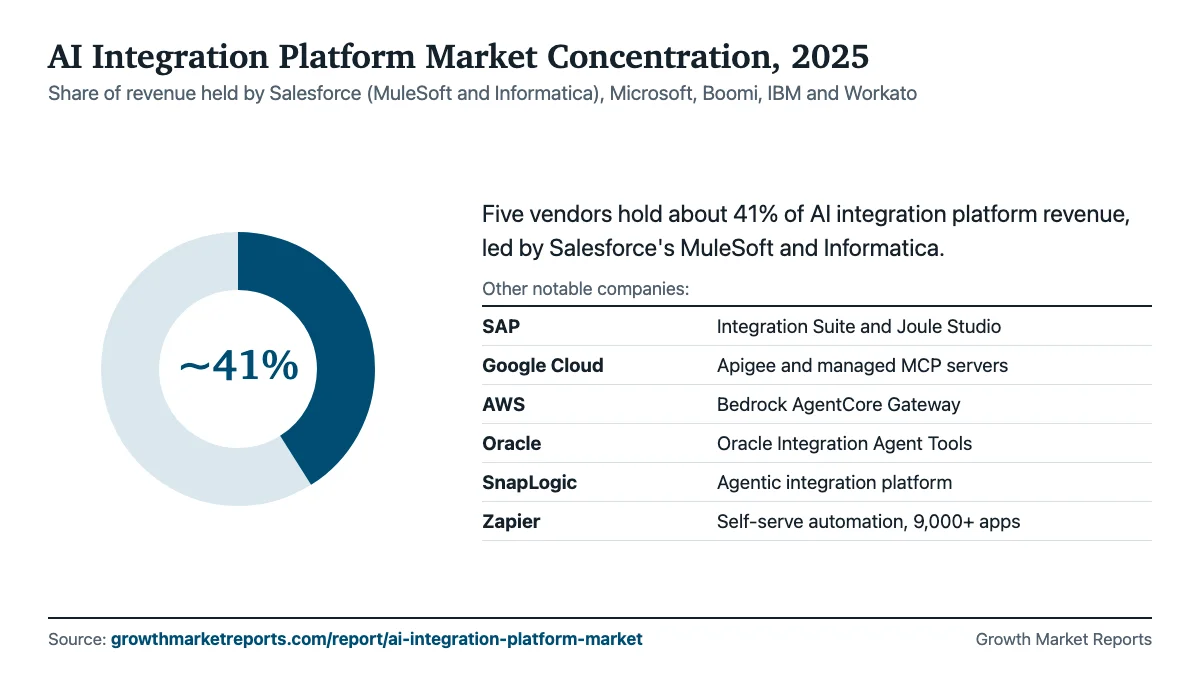
The market is moderately concentrated: Salesforce, Microsoft, Boomi, IBM and Workato hold about 41% of revenue. Salesforce's integration line is the largest single block[1], hyperscalers sell agent connectivity inside their clouds[22][12], and a long tail of self-serve tools such as Zapier, Make and n8n competes on price and app coverage[18][32][15].
Leading companies
| Company | HQ | Ownership | Scale or latest result | Strongest in |
|---|---|---|---|---|
| Salesforce, Inc. | San Francisco, United States | Listed (NYSE: CRM) | USD 6,232 million integration and analytics revenue, fiscal 2026 | Enterprise iPaaS, agent governance, AI data management |
| Microsoft Corporation | Redmond, United States | Listed (NASDAQ: MSFT) | 230,000+ organizations built on Copilot Studio | Agent builders, Azure integration services |
| Boomi, LP | Conshohocken, United States | Private | 30,000+ customers; 75,000+ agents in production | Enterprise iPaaS and agent lifecycle management |
| IBM | Armonk, United States | Listed (NYSE: IBM) | Closed Confluent buy at USD 11 billion enterprise value | Hybrid integration, B2B networks, data streaming |
| Workato, Inc. | Mountain View, United States | Private | Enterprise MCP, Agent Studio and Genies | Enterprise automation and agent orchestration |
| SAP SE | Walldorf, Germany | Listed (XETRA: SAP) | 400 Business AI use cases, 40 Joule Agents | ERP-centric integration and agents |
| Google LLC | Mountain View, United States | Subsidiary of Alphabet Inc. | Managed remote MCP servers, December 2025 | API management and MCP on Google Cloud |
| Amazon Web Services, Inc. | Seattle, United States | Subsidiary of Amazon.com, Inc. | AgentCore Gateway at USD 0.005 per 1,000 invocations | Consumption-billed agent gateways |
| Oracle Corporation | Austin, United States | Listed (NYSE: ORCL) | Agent Tools in Oracle Integration | Oracle application integration |
| SnapLogic, Inc. | San Mateo, United States | Private | USD 100 million+ ARR | Agentic integration for large enterprises |
| Zapier, Inc. | San Francisco, United States | Private | 9,000+ connected apps | Self-serve automation and MCP |
| Celigo, Inc. | San Mateo, United States | Private | Workflows from predictable to fully agentic | Mid-market iPaaS for commerce and finance |
| Jitterbit, Inc. | Alameda, United States | Private | Harmony with accountable AI agents | Low-code iPaaS, EDI and API management |
| Tray.ai | San Francisco, United States | Private | Merlin Agent Builder and Tray iPaaS | Agent building on an iPaaS core |
| n8n GmbH | Berlin, Germany | Private | 10x revenue growth in 2025 | Developer-led, self-hostable agent workflows |
Company market shares for 2025 and a competitive benchmarking matrix are in the full report. Get free sample
MuleSoft vs Boomi vs Workato vs Microsoft
The four platforms most often shortlisted for enterprise agent integration differ in where they sit in the stack and how they charge.
| Criteria | MuleSoft (Salesforce) | Boomi | Workato | Microsoft |
|---|---|---|---|---|
| Best for | API-led integration in Salesforce estates | Broad iPaaS across many SaaS apps | Business-led automation at scale | Firms standardized on Azure and Microsoft 365 |
| Agent layer | Agent Fabric to register and govern any agent | Agentstudio for agent lifecycle | Agent Studio and Genies | Azure AI Foundry Agent Service and Copilot Studio |
| Protocol support | Flex Gateway for MCP and A2A | MCP-ready agent tooling | Workato Enterprise MCP | MCP and Agent-to-Agent |
| Data layer | Informatica cloud data management | Boomi Data Integration | Connectors and data pipelines | Azure data services |
| Buying model | Enterprise subscription | Enterprise subscription | Enterprise subscription | Cloud consumption plus licences |
Company profiles
Salesforce, Inc.
Salesforce owns MuleSoft and, since November 2025, Informatica, and reports both under Agentforce Integration and Agentforce Analytics. It sells API management, integration and agent governance on one platform.
- Agentforce Integration and Agentforce Analytics revenue reached USD 6,232 million in fiscal 2026, up from USD 5,775 million.[1]
- Launched MuleSoft Agent Fabric in September 2025 to register, orchestrate, govern and observe agents built on any platform.[20]
- Completed the Informatica acquisition on November 18, 2025; Informatica served more than 5,000 customers in nearly 100 countries.[2][33]
Microsoft Corporation
Microsoft reaches the market through Azure integration services, Azure AI Foundry Agent Service and Copilot Studio, bundling agent connectivity into its cloud and productivity estate.
Boomi, LP
Boomi is the largest independent iPaaS vendor by customer count and has repositioned its platform around agent lifecycle management.
IBM
IBM combines webMethods integration, Sterling B2B networks and, since March 2026, Confluent data streaming for hybrid estates.
- Announced webMethods Hybrid Integration at Think 2025, generally available on 16 June 2025.[17]
- Completed the acquisition of Confluent on March 17, 2026, agreed on December 8, 2025 at USD 31 per share, an enterprise value of USD 11 billion.[9][8]
- Sterling B2B Integration VAN connects webMethods users with more than 3.1 million trading partners.[17]
Workato, Inc.
SnapLogic, Inc.
n8n GmbH
Berlin-based n8n sells developer-led workflow automation with AI agents, in the cloud or self-hosted.
Recent AI Integration Platform Market Developments
Launches, deals, capacity moves and policy changes, newest first, each linked to its source.
- IBM completed its acquisition of Confluent, agreed in December 2025 at an enterprise value of USD 11 billion, adding data streaming to webMethods.[9][8]
- Salesforce reported Agentforce ARR of USD 800 million, up 169%, across 29,000 deals in its fiscal 2026 results.[1]
- Boomi said more than 75,000 AI agents built on its platform were deployed in production.[3]
- Workato positioned Workato Enterprise MCP as the foundation of its platform for production AI agents.[19]
- Google Cloud released fully managed remote MCP servers for Google and Google Cloud services.[16]
- The Linux Foundation formed the Agentic AI Foundation with Model Context Protocol, goose and AGENTS.md as founding projects.[4]
- Oracle Integration began its agentic AI capabilities with Agent Tools.[27]
- IBM agreed to acquire Confluent for USD 31 per share, an enterprise value of USD 11 billion.[8]
- Salesforce completed its acquisition of Informatica, agreed in May 2025 at USD 25 in cash per share.[2][33]
- SAP added agent building in Joule Studio with A2A and MCP support at SAP TechEd.[26]
- n8n announced its Series C, reporting 6x user growth and 10x revenue growth in 2025.[15]
- Salesforce launched MuleSoft Agent Fabric to register, orchestrate, govern and observe AI agents built on any platform.[20]
- Workato launched prepackaged AI agents called Genies at World of Workato 2025.[19]
- SnapLogic passed USD 100 million in ARR, with more than 20% of new and expansion sales tied to AI.[11]
- Microsoft made Azure AI Foundry Agent Service generally available with MCP and Agent-to-Agent support.[22]
- Boomi made Agentstudio, its agent lifecycle management product, generally available at Boomi World.[23]
- Jitterbit added accountable AI agents and a layered AI architecture to its Harmony low-code integration platform.[28]
AI Integration Platform Pricing: Plans, Executions and Invocations
Self-serve plans start under USD 20 a month; enterprise contracts run past USD 1 million a year.
Pricing follows three models: monthly self-serve tiers, execution-based plans for growing teams, and consumption billing for hyperscaler gateways. Enterprise suites sell annual subscriptions negotiated by connector count and volume, and published list prices cover only the self-serve end.
| Pricing model | Typical level | Notes |
|---|---|---|
| Make entry paid plan | USD 9 a month for 5,000 credits | Lowest-cost entry, 350+ AI apps connected[32] |
| Zapier Professional | From USD 19.99 a month | Single-user automation[18] |
| Zapier Team | From USD 69 a month | Shared AI-powered systems for teams[18] |
| n8n cloud Starter | EUR 20 a month billed annually, 2,500 executions | Agents, MCP and AI nodes included[21] |
| n8n Business | EUR 667 a month billed annually, 40,000 executions | For companies under 100 employees[21] |
| AWS AgentCore Gateway | USD 0.005 per 1,000 API invocations; USD 0.025 per 1,000 search invocations | Pure consumption billing[12] |
| Enterprise iPaaS contract | Above USD 1 million a year for the largest accounts | SnapLogic has 21+ such customers[11] |
A worked example shows the spread. A small team on Zapier Team pays USD 828 a year, and an n8n Business customer running 40,000 executions a month pays EUR 8,004 a year[18][21]. An agent making 10 million gateway calls a month on AgentCore Gateway pays about USD 50 a month in gateway fees[12], before model and compute costs, which sit outside this market. Large enterprises standardizing on one suite move into seven-figure annual contracts[11].
Get the Full AI Integration Platform Report
What the report adds beyond this page, and how to get it.
Choose your license
- Single UserUSD 4,200
- Multi UserUSD 5,500
- Corporate UserUSD 6,600
- Excel Data PackUSD 2,599
Delivered as a PDF by email within 24 to 48 hours of payment. Pay by card, PayPal or wire transfer. Ask before buying or request a discount.
See the data before you buy
The free sample includes the table of contents, methodology and selected segment and country tables.
Get free sampleResearch Methodology and Sources
How the numbers were built and where every cited fact comes from.
The analysis combines primary research, through interviews with integration architects, platform product leaders and enterprise IT buyers, with secondary research in company filings, annual reports and releases, vendor price lists, and official statistics from Eurostat, the US Census Bureau and the Federal Reserve. Vendor revenue comes from filings such as Salesforce's fiscal 2026 results[1], and adoption from official surveys[14][7].

How the market size was built
- Defined the perimeter as AI-attributable integration platform software revenue, excluding model fees, compute and services.
- Bottom-up: Salesforce USD 3,116 million, Informatica USD 968.6 million, SnapLogic USD 100 million and Boomi USD 450 million sum to USD 4,635 million, grossed up to a USD 11,590 million pool; 35% AI share plus AI-native connectivity gives USD 4,543 million.
- Top-down: 29,166 AI-using large and 74,686 medium EU firms at USD 25,000 and USD 4,000 a year, plus a small-firm tier, give USD 1,151 million in the EU, divided by Europe's 24.1% weight for USD 4,777 million globally.
- Set the 2025 base at USD 4.65 billion between the two routes and the CAGR at 21.8% from vendor growth rates and adoption trends.
- Split regions from Salesforce's regional revenue and official adoption data, and segments from vendor product lines and Eurostat size and sector data.
- Profiled 15 companies from their own filings, releases and websites, and checked every figure against the source quote.
Sources (33)
- Salesforce, Inc. (SEC Form 8-K, Exhibit 99.1), "Salesforce Q4 and fiscal 2026 results", 2026-02-25
- Salesforce, "Salesforce Completes Acquisition of Informatica", 2025-11-18
- Boomi, "Boomi's Market Momentum Accelerates as Enterprises Standardize on Its AI Activation Platform", 2026-02-04
- The Linux Foundation, "Linux Foundation Announces the Formation of the Agentic AI Foundation", 2025-12-09
- Tray.ai, "Tray.ai launches Merlin Agent Builder", 2025-03-17
- Eurostat, "20% of EU enterprises use AI technologies", 2025-12-11
- U.S. Census Bureau, "Large Firms With at Least 20 Employees Biggest AI Users", 2026-05-26
- IBM Newsroom, "IBM to Acquire Confluent to Create Smart Data Platform for Enterprise Generative AI", 2025-12-08
- IBM (SEC filing), "IBM Form 10-Q for the quarter ended March 31, 2026", 2026-04-28
- Informatica Inc. (SEC Form 8-K, Exhibit 99.1), "Informatica Reports Third Quarter 2025 Financial Results", 2025-11-05
- SnapLogic (press release), "SnapLogic Achieves Record Quarter and Year; Founder and CEO Gaurav Dhillon Retires", 2025-08-13
- Amazon Web Services, "Amazon Bedrock AgentCore Pricing", 2026-10-06
- Eurostat, "Large businesses make up only 0.2% of EU enterprises", 2024-12-05
- Eurostat, "Use of artificial intelligence in enterprises (Statistics Explained)", 2025-12-11
- n8n blog, "n8n Series C announcement", 2025-10-09
- Google Cloud, "Announcing Model Context Protocol (MCP) support for Google services", 2025-12-11
- IBM, "IBM webMethods Hybrid Integration: Integration for the agentic AI era", 2025-05-06
- Zapier, "Plans & Pricing", 2026-10-06
- Workato, "2025 Product Highlights", 2026-01-15
- Salesforce, "Salesforce Launches MuleSoft Agent Fabric to Orchestrate and Govern Any AI Agent Across the Agentic Enterprise", 2025-09-25
- n8n, "n8n Plans and Pricing", 2026-10-06
- Microsoft, "Microsoft Build 2025: The age of AI agents and building the open agentic web", 2025-05-19
- Boomi, "Boomi Advances AI-Driven Automation with Major Announcements at Boomi World 2025", 2025-05-14
- Board of Governors of the Federal Reserve System, "Monitoring AI Adoption in the U.S. Economy (FEDS Notes)", 2026-04-03
- SAP News Center, "Business AI Innovation Unveiled at SAP TechEd", 2025-11-17
- SAP News Center, "New Agentic Capabilities on SAP BTP Supercharge Developers for What's Next", 2025-11-05
- Oracle (Oracle Integration blog), "Oracle Integration Powering AI Agents with connected apps, data and automation", 2025-12-09
- Jitterbit, "Jitterbit Unveils Layered AI Architecture, Adds Accountable AI Agents to AI-Infused Low-Code Harmony Platform", 2025-05-06
- Tray.ai, "Tray.ai Merlin Agent Builder release", 2025-06-24
- Celigo, "Celigo press release, November 2025", 2025-11-11
- n8n, "n8n Press", 2026-10-06
- Make (a Celonis company), "Pricing & Subscription Packages", 2026-10-06
- Informatica Inc. (SEC Form 8-K, Exhibit 99.1), "Salesforce signs definitive agreement to acquire Informatica", 2025-05-27
Report scope
| Market value, base year 2025 | USD 4.65 billion |
|---|---|
| Forecast value 2034 | USD 27.43 billion |
| CAGR 2026-2034 | 21.8% |
| Historical data | 2023-2024 |
| Forecast period | 2026-2034 |
| Units | USD million |
| Segments | Platform Type, Deployment Mode, Organization Size, End-Use Industry (two levels) |
| Regions | North America, Europe, Asia Pacific, Latin America, Middle East & Africa |
| Countries | United States, Canada, Germany, United Kingdom, France, Nordics, Netherlands, Rest of Europe, Japan, China, India, Australia, South Korea, Rest of Asia Pacific, Brazil, Mexico, Rest of Latin America, United Arab Emirates, Saudi Arabia, South Africa, Rest of Middle East & Africa |
| Companies profiled | Salesforce, Inc., Microsoft Corporation, Boomi, LP, IBM, Workato, Inc., SAP SE, Google LLC, Amazon Web Services, Inc., Oracle Corporation, SnapLogic, Inc. and others |
| Delivery | PDF report and Excel dataset |
Table of contents (18 chapters)
- Executive Summary
- Research Methodology and Sources
- Market Definition and Scope
- Market Dynamics: Drivers, Restraints, Opportunities, Trends
- Market Size and Forecast, 2023-2034
- Market by Platform Type (AI-Enabled iPaaS, Agent Orchestration and Builder Platforms, API Management and MCP Gateways, AI Data Integration and Pipelines)
- Market by Deployment Mode (Cloud, Hybrid, On-Premises and Self-Hosted)
- Market by Organization Size (Large Enterprises, Small and Medium Enterprises)
- Market by End-Use Industry (BFSI, IT and Telecom, Retail and E-commerce, Manufacturing, Healthcare and Life Sciences, Government and Public Sector, Others)
- North America (United States, Canada)
- Europe (Germany, United Kingdom, France, Nordics, Netherlands, Rest of Europe)
- Asia Pacific (Japan, China, India, Australia, South Korea, Rest of Asia Pacific)
- Latin America (Brazil, Mexico, Rest of Latin America)
- Middle East & Africa (United Arab Emirates, Saudi Arabia, South Africa, Rest of Middle East & Africa)
- Competitive Landscape and Market Concentration
- Pricing Benchmarks
- Company Profiles
- Recent Developments
Cite this report
Growth Market Reports. (2026). AI Integration Platform Market Size, Share and Forecast 2025 to 2034. Updated 7 October 2026. https://growthmarketreports.com/report/ai-integration-platform-market
Charts on this page are licensed under CC BY 4.0: you may reuse them in articles and presentations with credit to Growth Market Reports and a link to this page.
Frequently Asked Questions
Short answers to the questions buyers ask most.
How large is the AI integration platform market?
The market was worth USD 4.65 billion in 2025 and is set to reach USD 27.43 billion by 2034, growing at a CAGR of 21.8%. The figure covers platform software only, not services or model fees.
How big is the AI integration services market compared with the platform market?
AI integration and systems integration services, the consulting and implementation work bought around these platforms, sit outside our USD 4.65 billion figure. We count only software subscriptions and consumption fees, so services spend adds to, rather than overlaps with, this market.
Is AI a separate segment of the systems integration market?
Systems integration firms do report AI work as a growing practice, but their revenue is labour and project fees. This report treats AI systems integration services as adjacent and sizes the software that those integrators deploy, such as MuleSoft, Boomi and Workato.
What is the difference between an AI integration platform and a classic iPaaS?
A classic iPaaS moves data between applications on fixed rules. An AI integration platform adds agent builders, MCP and agent gateways and AI data pipelines, so agents can discover tools and act on enterprise systems under governance, as MuleSoft Agent Fabric does.
How does the Model Context Protocol change integration buying?
MCP gives agents one standard way to call tools and data. More than 10,000 MCP servers were published by December 2025, so buyers now ask vendors for MCP gateways and governance rather than custom connectors for each model.
Which companies lead the AI integration platform market?
Salesforce (MuleSoft and Informatica), Microsoft, Boomi, IBM and Workato hold about 41% of revenue. SAP, Google, AWS, Oracle, SnapLogic, Zapier, Celigo, Jitterbit, Tray.ai and n8n are the other main suppliers.
What does an AI integration platform cost?
Self-serve plans start at USD 9 a month on Make and USD 19.99 a month on Zapier, n8n Business costs EUR 667 a month, and the largest enterprise contracts run above USD 1 million a year. Hyperscaler gateways charge per invocation.
Should enterprises buy agent connectivity from a hyperscaler or an independent vendor?
Hyperscaler gateways such as AgentCore Gateway suit firms whose agents and data already sit in one cloud and want consumption billing. Independent vendors such as Boomi, Workato or SnapLogic suit multi-cloud estates with many SaaS applications that need one governance layer.
Which region grows fastest?
Asia Pacific grows fastest at 24.8% a year, from 21% of 2025 revenue, while North America remains the largest region with 45%. Europe grows at 22.3% on fast AI adoption among EU enterprises.
Why do so many AI agent projects stall before production?
Agents need access to many systems: 42% of enterprise technology leaders say they need eight or more data sources. Boomi states that 70% to 95% of organizations miss the expected benefits of AI and automation projects, often because integration and governance come late.
More Artificial Intelligence (AI) reports
Recently updated research in the same category.
- AI-Powered Micro-Learning Platform Market 2034
- AI Training Dataset Market
- Engineering Change Impact Analysis AI Market 2034
- Carbon Offset Quality Verification AI Market 2034
- Multi-Physics Simulation Surrogate AI Market 2025
- Secure Multi-Party Computation for AI Market 2034
- Clinical Trial Patient Recruitment AI Market 2034
- Product Lifecycle Carbon Analytics AI Market 2025-2034
- Deep Learning Vision Inference Engines Market 2025-2034
- Model Validation for Transportation AI Market 2034
- Synthetic Data for Traffic AI Training Market 2034
- AI in Oil and Gas Market
- AI Content Moderation for Live Streams Market 2034
- End-to-End Autonomous Driving Software Market 2034
- First Contact Resolution Prediction AI Market 2034
- Price Intelligence AI Market