Segments - by Product Type (Balloon, Airship, Hybrid), by Payload (Surveillance Radar, Communication Relay, Navigation Systems, Electro-Optics, Others), by Application (Military, Homeland Security, Commercial, Research, Others), by Propulsion System (Powered, Unpowered)
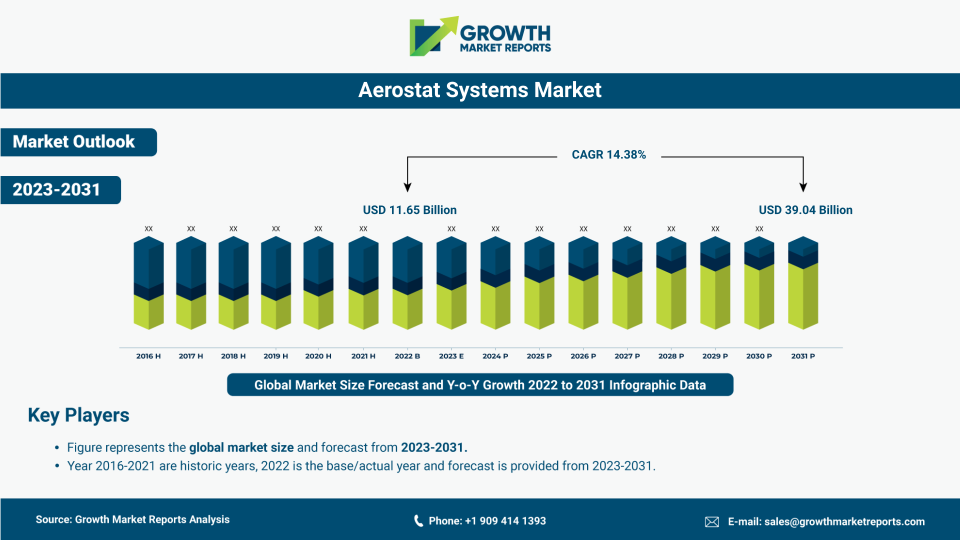
According to our latest research, the global aerostat systems market size in 2024 stands at USD 13.2 billion, reflecting robust demand across both defense and commercial sectors. The market is projected to expand at a CAGR of 13.7% from 2025 to 2033, reaching a forecasted value of USD 41.5 billion by 2033. This significant growth is primarily driven by the increasing adoption of aerostat systems for surveillance, intelligence gathering, and communication purposes, as well as advancements in payload technologies and the rising need for persistent aerial monitoring across various industries and governmental agencies.
The growth trajectory of the aerostat systems market is propelled by several pivotal factors. One of the most prominent drivers is the escalating demand for cost-effective, long-endurance surveillance platforms in military and homeland security applications. Aerostat systems offer a unique advantage with their ability to remain airborne for extended periods, providing continuous monitoring and intelligence gathering capabilities that are critical for border security, battlefield awareness, and disaster management. Moreover, the enhanced payload capacities and integration of advanced sensors, such as electro-optics and surveillance radar, enable these systems to deliver high-resolution imagery and real-time data, further amplifying their utility in modern defense strategies. The relatively lower operational costs compared to traditional aircraft and unmanned aerial vehicles (UAVs) also make aerostats an attractive solution for governments and security agencies worldwide.
Another key growth factor is the expanding range of commercial and research applications for aerostat systems. Beyond defense, these platforms are increasingly being utilized in telecommunications for establishing temporary communication networks in remote or disaster-affected areas. Their ability to carry communication relay payloads at high altitudes enables rapid deployment of broadband and cellular networks where terrestrial infrastructure is lacking or compromised. Furthermore, aerostat systems are finding applications in environmental monitoring, atmospheric research, and scientific data collection. Their stable, high-altitude positioning allows for extended observation of weather patterns, pollution levels, and wildlife, supporting a diverse array of research initiatives. The versatility and adaptability of aerostat platforms are thus broadening their market appeal across multiple sectors.
Technological advancements represent another critical catalyst for the aerostat systems market. Innovations in materials science have led to the development of lighter, more durable envelopes and hulls, enhancing the operational efficiency and lifespan of aerostat platforms. The integration of hybrid propulsion systems and automated navigation technologies further augments their maneuverability and reliability. Additionally, advancements in miniaturized payloads and sensor technologies allow for greater mission flexibility and improved performance, even in challenging weather conditions. These technological strides are not only improving the capabilities of existing aerostat systems but are also paving the way for new applications and deployment scenarios, thereby sustaining market momentum.
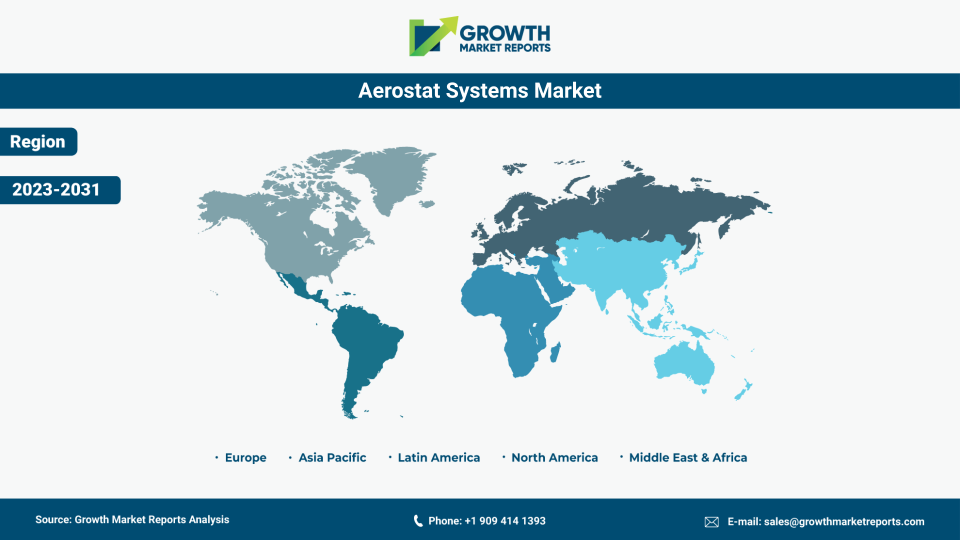
From a regional perspective, North America currently dominates the aerostat systems market, accounting for the largest share in 2024, driven by substantial investments in defense modernization and border surveillance initiatives. The region benefits from the presence of leading market players, robust R&D infrastructure, and ongoing government contracts aimed at enhancing homeland security. Asia Pacific, on the other hand, is emerging as the fastest-growing region, fueled by rising defense budgets, increasing security concerns, and expanding commercial applications, particularly in China and India. Europe also presents significant growth opportunities, supported by cross-border surveillance programs and technological collaborations. The Middle East & Africa and Latin America are witnessing gradual adoption, primarily in the context of military operations and infrastructure protection, albeit at a comparatively slower pace.
The product type segment of the aerostat systems market is broadly categorized into balloons, airships, and hybrid aerostats, each serving distinct operational requirements and offering unique advantages. Balloons, often tethered and filled with lighter-than-air gases, represent the most widely deployed aerostat type, particularly in surveillance and communication roles. Their simplicity, cost-effectiveness, and ease of deployment make them a preferred choice for both military and commercial applications. Balloons can be rapidly launched and positioned at various altitudes, providing persistent coverage over large areas. The ability to carry diverse payloads, such as radar and electro-optical sensors, further enhances their versatility. However, their operational range is typically limited by tether length and environmental conditions, necessitating careful site selection and weather monitoring.
Airships, which are powered and capable of controlled flight, offer greater maneuverability and payload capacity compared to traditional balloons. These platforms are increasingly being adopted for missions that require mobility, extended coverage, and the ability to relocate rapidly. Airships are equipped with propulsion systems and advanced navigation technologies, enabling them to operate independently of ground tethers and adapt to changing mission requirements. Their large internal volume allows for the integration of heavier and more sophisticated payloads, making them suitable for complex surveillance, communication, and research operations. The ability to loiter over specific areas for prolonged periods further amplifies their value in strategic intelligence gathering and disaster response.
Hybrid aerostats, which combine features of both balloons and airships, are gaining traction as a versatile solution for a wide range of applications. These platforms leverage the buoyancy of lighter-than-air gases for lift, while incorporating aerodynamic surfaces and propulsion systems for enhanced stability and maneuverability. Hybrid aerostats can operate at higher altitudes and withstand more challenging weather conditions compared to traditional balloons, while also offering greater payload flexibility. Their design enables longer mission durations and improved operational efficiency, making them ideal for persistent surveillance, communication relay, and scientific research missions. The growing adoption of hybrid aerostats is expected to drive significant innovation and expansion within the product type segment.
The competitive landscape within the product type segment is characterized by continuous innovation and the introduction of next-generation aerostat platforms. Leading manufacturers are investing in the development of modular designs, advanced materials, and integrated propulsion systems to enhance the performance and reliability of their offerings. Collaborative efforts between defense agencies, research institutions, and commercial enterprises are further accelerating the evolution of aerostat technologies. As end-users seek solutions that balance cost, capability, and operational flexibility, the product type segment is poised for sustained growth and diversification over the forecast period.
| Attributes | Details |
| Report Title | Aerostat Systems Market Research Report 2033 |
| By Product Type | Balloon, Airship, Hybrid |
| By Payload | Surveillance Radar, Communication Relay, Navigation Systems, Electro-Optics, Others |
| By Application | Military, Homeland Security, Commercial, Research, Others |
| By Propulsion System | Powered, Unpowered |
| Regions Covered | North America, Europe, APAC, Latin America, MEA |
| Countries Covered | North America (United States, Canada), Europe (Germany, France, Italy, United Kingdom, Spain, Russia, Rest of Europe), Asia Pacific (China, Japan, South Korea, India, Australia, South East Asia (SEA), Rest of Asia Pacific), Latin America (Mexico, Brazil, Rest of Latin America), Middle East & Africa (Saudi Arabia, South Africa, United Arab Emirates, Rest of Middle East & Africa) |
| Base Year | 2024 |
| Historic Data | 2018-2023 |
| Forecast Period | 2025-2033 |
| Number of Pages | 272 |
| Number of Tables & Figures | 399 |
| Customization Available | Yes, the report can be customized as per your need. |
The payload segment is a critical determinant of aerostat system performance and market value, encompassing a diverse array of technologies such as surveillance radar, communication relay, navigation systems, electro-optics, and other specialized sensors. Surveillance radar remains the most prominent payload category, driven by its essential role in border security, battlefield monitoring, and maritime surveillance. Modern radar payloads offer high-resolution imaging, wide-area coverage, and real-time data transmission, enabling rapid detection and response to potential threats. The integration of advanced signal processing algorithms and automated target recognition further enhances the effectiveness of aerostat-borne radar systems, making them indispensable assets for military and homeland security agencies.
Communication relay payloads are witnessing increasing adoption, particularly in scenarios where terrestrial or satellite infrastructure is unavailable or compromised. Aerostat systems equipped with communication relays can establish temporary or supplementary networks for voice, data, and video transmission, supporting emergency response, disaster recovery, and remote area connectivity. The ability to deploy these systems rapidly and maintain persistent coverage over wide geographic areas is a key advantage, especially in the aftermath of natural disasters or during large-scale public events. The growing reliance on mobile and broadband communication services is expected to further drive demand for aerostat-based relay solutions across both government and commercial sectors.
Navigation systems represent another vital payload category, enabling precise positioning, tracking, and guidance for aerostat platforms and their associated missions. Advanced navigation payloads leverage GPS, inertial measurement units, and sensor fusion technologies to ensure accurate flight control and mission execution, even in challenging environments. The integration of autonomous navigation capabilities is also enhancing the operational flexibility and safety of aerostat systems, reducing the need for constant human intervention and enabling more complex mission profiles. As the scope of aerostat deployments expands, the demand for reliable and sophisticated navigation solutions is expected to rise accordingly.
Electro-optical payloads, including high-definition cameras, infrared sensors, and multispectral imagers, are gaining prominence due to their ability to capture detailed visual and thermal imagery for surveillance, reconnaissance, and environmental monitoring. These payloads enable real-time video streaming, target identification, and situational awareness, supporting a wide range of defense, security, and research applications. The ongoing miniaturization of electro-optical components and improvements in image processing algorithms are further enhancing the performance and affordability of these payloads. Other specialized payloads, such as chemical and biological sensors, weather instruments, and scientific data collectors, are also being integrated into aerostat platforms to support niche applications and research initiatives.
The application segment of the aerostat systems market is distinguished by its extensive reach across military, homeland security, commercial, research, and other domains. Military applications account for the largest share of the market, underpinned by the critical need for persistent surveillance, intelligence gathering, and force protection. Aerostat systems provide armed forces with a cost-effective means of monitoring borders, detecting intrusions, and supporting tactical operations in real time. Their ability to remain airborne for extended periods and carry advanced sensor payloads makes them invaluable for situational awareness and threat detection. Defense agencies worldwide are increasingly integrating aerostat platforms into their surveillance and reconnaissance architectures, driving sustained demand within this segment.
Homeland security applications are also witnessing significant growth, driven by the escalating threat of terrorism, cross-border smuggling, and illegal migration. Aerostat systems are being deployed by law enforcement and border security agencies to monitor critical infrastructure, secure public events, and enhance coastal surveillance. Their rapid deployment capability and persistent coverage make them well-suited for emergency response and crisis management scenarios. The integration of advanced communication and imaging payloads further enhances their utility in homeland security operations, enabling real-time information sharing and coordinated response efforts.
In the commercial sector, aerostat systems are finding increasing utility in telecommunications, broadcasting, and infrastructure monitoring. Telecom operators are leveraging aerostat platforms to establish temporary communication networks in remote or underserved areas, as well as to support disaster recovery operations. The ability to deploy high-altitude communication relays quickly and cost-effectively is a major advantage, particularly in regions with limited terrestrial infrastructure. Additionally, aerostat systems are being used for environmental monitoring, wildlife tracking, and agricultural surveillance, supporting a diverse array of commercial and research applications.
Research applications represent a growing segment within the aerostat systems market, driven by the need for high-altitude platforms capable of supporting scientific experiments, atmospheric studies, and environmental monitoring. Aerostat platforms offer stable, long-duration observation capabilities, enabling researchers to collect data on weather patterns, air quality, and ecological dynamics over extended periods. The integration of specialized sensors and data collection instruments is expanding the scope of aerostat-based research initiatives, fostering innovation and collaboration across academic, governmental, and private sector entities.
The propulsion system segment of the aerostat systems market is divided into powered and unpowered platforms, each offering distinct operational characteristics and advantages. Powered aerostat systems, which incorporate engines or electric motors for propulsion, offer enhanced maneuverability, altitude control, and mission flexibility. These systems are capable of relocating rapidly, adjusting their position in response to changing mission requirements, and maintaining stable flight in variable wind conditions. Powered aerostats are particularly well-suited for applications that demand mobility, extended coverage, and the ability to respond dynamically to evolving operational scenarios. The integration of advanced propulsion technologies, such as hybrid-electric systems, is further improving the efficiency, endurance, and environmental sustainability of powered aerostat platforms.
Unpowered aerostat systems, on the other hand, rely solely on buoyancy provided by lighter-than-air gases to remain aloft, with their position typically maintained by ground-based tethers. These platforms are renowned for their simplicity, cost-effectiveness, and ease of deployment, making them a popular choice for persistent surveillance, communication, and research applications. Unpowered aerostats can remain airborne for weeks or even months at a time, providing continuous coverage over designated areas with minimal operational intervention. Their low maintenance requirements and reduced logistical footprint make them an attractive solution for both military and commercial end-users seeking long-endurance monitoring capabilities.
The choice between powered and unpowered aerostat systems is largely dictated by the specific requirements of the intended application, including mission duration, geographic coverage, payload capacity, and environmental conditions. Powered systems offer greater versatility and adaptability, enabling rapid redeployment and dynamic mission execution. Unpowered systems, in contrast, excel in scenarios where persistent, stationary coverage is required and operational simplicity is a priority. The ongoing evolution of propulsion technologies and the development of hybrid solutions are blurring the lines between these categories, enabling the creation of platforms that combine the best attributes of both powered and unpowered aerostats.
Market trends within the propulsion system segment are shaped by the increasing emphasis on operational efficiency, environmental sustainability, and mission flexibility. Manufacturers are investing in the development of lightweight materials, energy-efficient propulsion systems, and autonomous flight control technologies to enhance the performance and reliability of their offerings. The integration of renewable energy sources, such as solar panels, is also being explored as a means of extending mission endurance and reducing the environmental impact of aerostat operations. As end-users seek solutions that balance cost, capability, and sustainability, the propulsion system segment is expected to witness continued innovation and growth over the forecast period.
The aerostat systems market presents a wealth of opportunities, particularly as advancements in payload technology and data analytics unlock new applications across defense, commercial, and research sectors. One of the most promising opportunities lies in the integration of artificial intelligence and machine learning algorithms with aerostat-borne sensors, enabling automated target detection, anomaly identification, and predictive analytics. These capabilities can significantly enhance the effectiveness of surveillance, reconnaissance, and environmental monitoring missions, providing end-users with actionable insights in real time. Furthermore, the growing demand for persistent, wide-area coverage in urban security, critical infrastructure protection, and emergency response is expected to drive increased adoption of aerostat systems by municipal authorities, private enterprises, and non-governmental organizations.
Another major opportunity is the expansion of aerostat applications in telecommunications and broadcasting. As the global demand for high-speed internet and mobile connectivity continues to rise, particularly in remote and underserved regions, aerostat platforms offer a cost-effective and rapidly deployable solution for establishing temporary or supplementary communication networks. The ability to position communication relays at high altitudes enables coverage over vast geographic areas, supporting disaster recovery, event management, and rural connectivity initiatives. Additionally, the use of aerostat systems for scientific research, environmental monitoring, and agricultural surveillance is expected to grow as technological advancements make these platforms more accessible and affordable for academic and commercial users alike.
Despite these opportunities, the aerostat systems market faces several restraining factors and threats that could impede growth. Chief among these is the vulnerability of aerostat platforms to adverse weather conditions, such as high winds, lightning, and extreme temperatures, which can limit their operational availability and increase maintenance requirements. Furthermore, regulatory challenges related to airspace management, safety standards, and payload restrictions can pose significant barriers to market entry and expansion, particularly in densely populated or strategically sensitive regions. The risk of damage or interference from hostile actors, including cyberattacks and physical sabotage, also represents a persistent threat, necessitating ongoing investment in security measures and risk mitigation strategies.
North America remains the leading regional market for aerostat systems, capturing a substantial share of the global market value in 2024 with approximately USD 5.8 billion. The region's dominance is underpinned by robust investments in defense modernization, border surveillance, and homeland security initiatives, particularly in the United States. The presence of major market players, advanced R&D infrastructure, and a supportive regulatory environment further contribute to the region's leadership position. Ongoing government contracts and procurement programs are driving continuous innovation and deployment of next-generation aerostat platforms, ensuring sustained market growth over the forecast period.
Asia Pacific is emerging as the fastest-growing region in the aerostat systems market, with a projected CAGR of 16.2% from 2025 to 2033. The region is expected to reach a market value of USD 9.6 billion by 2033, driven by rising defense budgets, expanding security concerns, and increasing adoption of aerostat systems for commercial and research applications. China and India are at the forefront of regional growth, leveraging aerostat platforms for border surveillance, disaster management, and infrastructure monitoring. The rapid pace of urbanization, infrastructure development, and technological innovation is creating new opportunities for market expansion across Southeast Asia, Japan, and South Korea as well.
Europe holds a significant share of the global aerostat systems market, accounting for approximately USD 3.2 billion in 2024. The region benefits from strong cross-border surveillance programs, collaborative research initiatives, and ongoing investments in defense and security infrastructure. Countries such as the United Kingdom, France, and Germany are leading adopters of aerostat systems, utilizing these platforms for military operations, border security, and environmental monitoring. The Middle East & Africa and Latin America represent smaller but steadily growing markets, with combined market values of USD 2.1 billion in 2024, primarily driven by military modernization efforts and infrastructure protection initiatives. As regional security challenges evolve and technological capabilities advance, these markets are expected to witness gradual but sustained growth over the forecast period.
The competitive landscape of the aerostat systems market is characterized by the presence of several prominent global and regional players, each striving to capture market share through technological innovation, strategic partnerships, and targeted product development. Leading companies are investing heavily in research and development to enhance the performance, reliability, and versatility of their aerostat platforms. The focus is on integrating advanced payloads, improving propulsion systems, and leveraging artificial intelligence and automation to deliver next-generation solutions that meet the evolving needs of defense, security, and commercial end-users. The market is also witnessing increased collaboration between manufacturers, government agencies, and research institutions, fostering a dynamic ecosystem of innovation and knowledge exchange.
Competitive strategies in the aerostat systems market are shaped by the need to balance cost, capability, and operational flexibility. Major players are differentiating themselves through the development of modular, scalable platforms that can be customized to meet specific mission requirements. The emphasis on interoperability, ease of deployment, and rapid response capability is driving the adoption of standardized architectures and open systems, enabling seamless integration with existing surveillance, communication, and command-and-control networks. Additionally, companies are exploring new business models, such as leasing and service-based offerings, to expand their customer base and generate recurring revenue streams.
The market is also witnessing the entry of new players, particularly in the commercial and research segments, as technological barriers to entry decrease and demand for specialized applications grows. Startups and small-to-medium enterprises are leveraging niche expertise and agile development processes to introduce innovative solutions and disrupt traditional market dynamics. The competitive environment is further intensified by the ongoing consolidation of the industry, with mergers, acquisitions, and strategic alliances reshaping the landscape and driving the emergence of integrated, end-to-end solution providers.
Some of the major companies operating in the global aerostat systems market include Lockheed Martin Corporation, TCOM L.P., Raytheon Technologies Corporation, Raven Industries Inc., ILC Dover LP, RT Aerostats Systems, Aeroscraft Corporation, and Israel Aerospace Industries (IAI). Lockheed Martin is renowned for its advanced defense-focused aerostat platforms, supporting military and homeland security missions worldwide. TCOM L.P. is a leading provider of tethered aerostat solutions, with a strong presence in border surveillance and persistent monitoring applications. Raytheon Technologies and Raven Industries are recognized for their innovative payload integration and system-level expertise, while ILC Dover and RT Aerostats Systems specialize in the design and manufacture of high-performance envelopes and hulls. Aeroscraft Corporation and IAI are notable for their development of hybrid and powered aerostat platforms, catering to both defense and commercial markets.
These companies are continuously expanding their product portfolios, investing in next-generation technologies, and pursuing strategic partnerships to strengthen their market position. The focus on customer-centric innovation, operational excellence, and global reach is expected to drive sustained competitive advantage and market leadership over the forecast period. As the aerostat systems market continues to evolve, the ability to anticipate and respond to emerging threats, regulatory changes, and technological advancements will be critical for long-term success.
The Aerostat Systems market has been segmented on the basis of
Key players competing in the aerostat systems market include Aerostar International, Inc., ILC Dover LP, Israel Aerospace Industries Ltd., Lindstrand Technologies Ltd., Lockheed Martin Corporation., RosAeroSystems, International Ltd., RT Aerostat Systems Inc., TCOM L.P., Worldwide Aeros Corporation, Raytheon Company, and Rafael Advanced Defense Systems Ltd.
Innovations in materials, hybrid propulsion, miniaturized sensors, and AI-driven analytics are enhancing aerostat performance, reliability, and expanding their range of applications across defense, commercial, and research sectors.
Major players include Lockheed Martin Corporation, TCOM L.P., Raytheon Technologies Corporation, Raven Industries Inc., ILC Dover LP, RT Aerostats Systems, Aeroscraft Corporation, and Israel Aerospace Industries (IAI).
Challenges include vulnerability to adverse weather, regulatory hurdles related to airspace and payload restrictions, and security risks such as cyberattacks or sabotage.
Aerostat systems offer lower operational costs, longer endurance for persistent monitoring, the ability to carry diverse payloads, and rapid deployment, making them ideal for continuous surveillance and communication in various environments.
Common payloads include surveillance radar, communication relays, navigation systems, electro-optical sensors (cameras, infrared), and specialized scientific or environmental sensors.
Aerostat systems are used in military surveillance, homeland security, telecommunications, broadcasting, environmental monitoring, disaster management, and scientific research.
The main types are balloons (tethered), airships (powered and maneuverable), and hybrid aerostats (combining features of both balloons and airships for enhanced stability and flexibility).
North America currently leads the market due to strong defense investments, while Asia Pacific is the fastest-growing region, driven by rising defense budgets and commercial adoption, especially in China and India. Europe also holds a significant share, with the Middle East & Africa and Latin America showing gradual growth.
Key growth drivers include increasing demand for cost-effective, long-endurance surveillance platforms in defense and homeland security, advancements in payload and sensor technologies, and expanding applications in telecommunications, environmental monitoring, and research.
As of 2024, the global aerostat systems market is valued at USD 13.2 billion and is expected to grow at a CAGR of 13.7% from 2025 to 2033, reaching USD 41.5 billion by 2033.