
Adaptogen Peanut Butter Market Size, Share & Growth Analysis, 2026-2034
Adaptogen Peanut Butter Market Size, Share & Growth Analysis, 2026-2034
Segments - by Product Type (Organic, Conventional), by Adaptogen Type (Ashwagandha, Reishi, Maca, Rhodiola, Others), by Application (Nutritional Supplements, Functional Food, Sports Nutrition, Others), by Distribution Channel (Online Stores, Supermarkets/Hypermarkets, Specialty Stores, Others)



Last Updated : Jun, 2026
| Report ID :FB-46474
| 4.3 Rating
| 96 Reviews
| 263 Pages
| Format :


Adaptogen Peanut Butter Market: Key Numbers
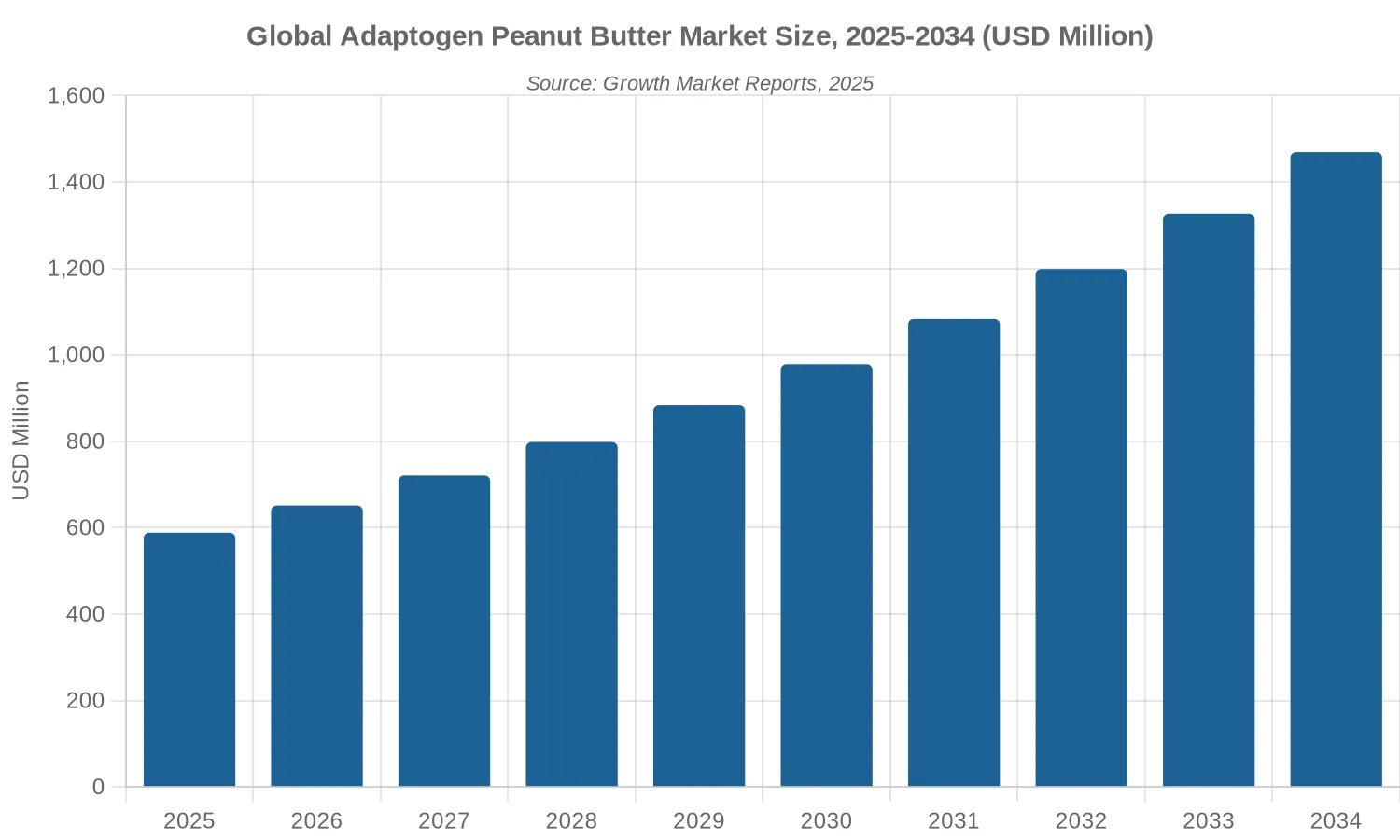
The Adaptogen Peanut Butter market was valued at USD 588.4 Million in 2025 and is projected to reach USD 1478.6 Million by 2034, a CAGR of 10.7%.
| Market size (2025) | USD 588.4 Million |
|---|---|
| Forecast (2034) | USD 1478.6 Million |
| CAGR (2026-2034) | 10.7% |
| Largest region | North America |
| Segments covered | Product Type, Adaptogen Type, Application, Distribution Channel |
| Key companies | NuttZo, Wild Friends Foods, Justin's, Once Again Nut Butter, Georgia Grinders |
This report is updated with the latest market data and insights as of June 2026. Base year: 2025 | Forecast period: 2026-2034
Adaptogen Peanut Butter Market Size and Growth Outlook
The adaptogen peanut butter market size reached USD 588.4 million in 2025, establishing a strong base for our current forecast cycle. The market is anticipated to expand at a CAGR of 10.7% from 2026 to 2034, culminating in a projected value of USD 1,478.6 million by 2034. This significant growth trajectory is being driven by a rising consumer focus on holistic wellness and the integration of functional ingredients into daily diets, with adaptogen peanut butter emerging as a preferred option for health-conscious individuals seeking both superior nutrition and natural stress management in a single, convenient product.
One of the primary growth factors for the adaptogen peanut butter market is the increasing consumer awareness regarding the health benefits of adaptogens. Adaptogens such as ashwagandha, reishi, maca, and rhodiola are renowned for their ability to help the body resist physical, chemical, and biological stressors. As consumers in 2025 become more educated about the potential of these natural substances to support mental clarity, sustained energy, and immune function, demand for functional foods incorporating adaptogens has surged dramatically. The peanut butter category, already a staple in many households due to its protein content and versatility, is experiencing a renaissance as manufacturers innovate by fortifying products with adaptogenic herbs and mushrooms, appealing to a broader demographic seeking both taste and measurable wellness benefits. The broader category of adaptogenic snacks is expanding in parallel, reinforcing consumer familiarity with adaptogens across multiple food formats.
Another significant driver is the evolving landscape of dietary preferences and the rapid adoption of plant-based diets. The shift towards veganism and vegetarianism, particularly among millennials and Gen Z, has created fertile ground for growth in the adaptogen peanut butter market. Peanut butter is naturally plant-based and, when combined with adaptogens, offers a potent blend of protein, healthy fats, and stress-relieving compounds. This aligns well with consumers who are not only looking for clean-label products but also desire added functional benefits from their everyday foods. The proliferation of specialty health food stores and e-commerce platforms has made it easier than ever for consumers to access a diverse range of adaptogen-infused peanut butters, further fueling market expansion across geographies.
The market is also benefiting from aggressive marketing strategies and continuous product innovations by leading manufacturers. Companies are investing heavily in research and development to introduce unique flavor combinations, new adaptogen blends, and convenient packaging formats. These efforts are supported by collaborations with nutritionists, social media influencers, and wellness experts who educate consumers about the synergistic benefits of adaptogens paired with peanut butter. Additionally, the increased prevalence of stress-related disorders and chronic lifestyle diseases has made adaptogen peanut butter an attractive option for preventive health management, driving repeat purchases and fostering strong brand loyalty in a competitive market. Consumers exploring complementary products are also discovering options such as adaptogen yogurt, reflecting the wider integration of adaptogens into everyday eating occasions.
Regionally, North America continues to dominate the adaptogen peanut butter market, owing to high consumer awareness, a strong culture of health and wellness, and the presence of established brands with extensive distribution networks. However, Asia Pacific is rapidly emerging as the fastest-growing region due to rising disposable incomes, rapid urbanization, and the growing acceptance of Western dietary habits. Europe and Latin America are also witnessing steady growth, driven by increasing demand for organic and functional food products. The Middle East and Africa, while still a nascent market, presents significant potential as health and wellness trends permeate urban centers. Collectively, these regional dynamics underscore the global appeal and robust growth prospects of adaptogen peanut butter as a functional food staple for the decade ahead.
The introduction of Boron-Enhanced Nut Butter into the broader nut butter market is reshaping how consumers perceive functional foods. Boron, a trace mineral known for its potential benefits in bone health, cognitive function, and hormonal balance, is being integrated into nut butters to offer an additional layer of nutritional support. This innovation aligns perfectly with the growing consumer interest in nutrient-dense foods that provide multiple health benefits in a single serving. By incorporating boron into nut butters, manufacturers are enhancing the nutritional profile while catering to a demographic that prioritizes holistic health and wellness, further expanding the addressable market for fortified nut butters broadly.
Adaptogen Peanut Butter Market by Product Type
The product type segment of the adaptogen peanut butter market is primarily divided into organic and conventional categories. The organic segment is witnessing accelerated growth in 2025, propelled by the rising consumer inclination towards clean-label and pesticide-free products. Organic adaptogen peanut butter is perceived as a premium offering, attracting health-conscious individuals willing to pay above-average prices for products free from synthetic additives and genetically modified organisms. This trend is especially prominent in developed markets such as North America and Europe, where regulatory frameworks and consumer awareness around organic certification are well-established. Companies in this segment are leveraging organic certifications as a key brand differentiator, further driving demand and expanding market share, with organic variants accounting for approximately 54.5% of total 2025 market revenue.

Conversely, the conventional adaptogen peanut butter segment continues to capture a significant portion of the market due to its affordability and widespread availability. While organic products are gaining traction, price-sensitive consumers in emerging markets often opt for conventional variants that offer similar functional benefits at a more accessible price point. Manufacturers are responding to this demand by ensuring that their conventional products maintain rigorous quality standards and incorporate effective, well-studied adaptogen blends. The ability to scale production and maintain cost efficiency is a key competitive strength of this segment, enabling brands to penetrate mass-market retail channels such as supermarkets and hypermarkets at scale.
The competitive dynamics between organic and conventional adaptogen peanut butter are further shaped by evolving consumer perceptions and shifting purchasing behaviors in 2025. As consumers become more attuned to the potential health risks associated with synthetic additives and pesticides, there is a gradual but steady shift towards organic alternatives. However, the conventional segment retains strong appeal among consumers who prioritize taste, texture, and value over organic certification status. This duality in consumer preferences is prompting manufacturers to diversify their product portfolios, offering both organic and conventional variants to cater to the broadest possible audience across income levels and geographies.
Innovations in product formulation and packaging are also shaping the competitive landscape within the product type segment. Organic brands are increasingly experimenting with sustainable, compostable packaging solutions and transparent ingredient labeling to reinforce their commitment to environmental stewardship. Conventional brands, on the other hand, are focusing on value-added features such as fortified nutrition profiles and unique flavor combinations to enhance their market positioning. The broader trend of functional food enrichment is also influencing adjacent categories. For instance, the rise of Prebiotic Nut Butters illustrates how manufacturers are layering additional functional benefits into nut butter formats to satisfy increasingly sophisticated consumer health demands, a trend that directly parallels the trajectory of the adaptogen peanut butter segment.
Adaptogen Peanut Butter Market Report Scope
| Attributes | Details |
| Report Title | Adaptogen Peanut Butter Market Research Report 2034 |
| By Product Type | Organic, Conventional |
| By Adaptogen Type | Ashwagandha, Reishi, Maca, Rhodiola, Others |
| By Application | Nutritional Supplements, Functional Food, Sports Nutrition, Others |
| By Distribution Channel | Online Stores, Supermarkets/Hypermarkets, Specialty Stores, Others |
| Regions Covered | North America, Europe, APAC, Latin America, MEA |
| Base Year | 2025 |
| Historic Data | 2019-2024 |
| Forecast Period | 2026-2034 |
| Number of Pages | 263 |
| Number of Tables & Figures | 375 |
| Customization Available | Yes, the report can be customized as per your need. |
Adaptogen Peanut Butter Market by Adaptogen Type
The adaptogen type segment in the adaptogen peanut butter market encompasses ashwagandha, reishi, maca, rhodiola, and other adaptogenic ingredients. Ashwagandha, a traditional Ayurvedic herb, leads this segment in 2025 due to its well-documented benefits in stress reduction, cognitive enhancement, and immune support. Its widespread consumer recognition and robust scientific validation have made it the preferred choice among manufacturers seeking to capitalize on demand for natural stress relief. Ashwagandha-infused peanut butter products are particularly popular among urban professionals and fitness enthusiasts who seek convenient, food-based ways to incorporate adaptogens into their daily routines without relying on separate supplements.
Reishi mushrooms are another prominent adaptogen, valued highly for their immune-boosting and anti-inflammatory properties. The inclusion of reishi in peanut butter formulations is gaining significant traction in 2025, especially among consumers interested in holistic wellness and preventive healthcare. The earthy, umami flavor profile of reishi complements the rich, nutty taste of peanut butter, creating a distinctive product that appeals to adventurous eaters and health-focused consumers alike. Brands are leveraging the growing body of peer-reviewed research supporting reishi's health benefits to position their products confidently as premium functional foods in the competitive wellness marketplace. Consumers who enjoy reishi-infused products are also exploring related options such as adaptogen brownies, indicating strong cross-category demand for mushroom and herb enriched treats.
Maca, a Peruvian root known for its energy-enhancing and hormone-balancing effects, is also finding significant favor in the adaptogen peanut butter market. Maca-infused peanut butter is marketed as an ideal snack for athletes, busy professionals, and individuals seeking a natural, sustained energy boost without reliance on artificial stimulants or high-caffeine products. The popularity of maca is further bolstered by its adaptogenic properties and its natural compatibility with plant-based and vegan diets. As consumer interest in Andean superfoods grows globally, maca-based adaptogen peanut butter is poised for substantial growth, particularly in markets with a strong fitness and performance culture such as North America and Western Europe.
Rhodiola, prized for its ability to combat fatigue and sharpen mental performance under pressure, is gradually gaining traction in the adaptogen peanut butter category. Although less mainstream than ashwagandha or reishi at present, rhodiola's unique and well-researched benefits are attracting a niche but rapidly growing segment of consumers seeking targeted stress relief and cognitive support in a food-based format. The "others" category, which includes emerging adaptogens such as holy basil, schisandra, lion's mane, and cordyceps, represents a vibrant frontier for innovation as manufacturers experiment with novel combinations to differentiate their product offerings and cater to the evolving preferences of the most informed and engaged consumers in the wellness space.
Adaptogen Peanut Butter Market by Application
The application segment of the adaptogen peanut butter market is segmented into nutritional supplements, functional food, sports nutrition, and others. Nutritional supplements represent a significant share of the market in 2025, driven by the increasing consumer focus on preventive health and proactive wellness management. Adaptogen peanut butter is gaining strong popularity as a convenient, food-based supplement that delivers both macronutrients and adaptogenic compounds in a single satisfying serving. This application is particularly appealing to consumers who prefer food-based supplements over pills or capsules, aligning perfectly with the broader and accelerating trend of treating food as medicine in everyday dietary choices.
Functional food applications are a key growth area, with adaptogen peanut butter being incorporated into a wide variety of dietary patterns and daily meal occasions. As consumers seek to optimize their diets for both taste and measurable health benefits, functional foods that offer targeted support for stress management, sustained energy, and immune resilience are in high and growing demand. Adaptogen peanut butter is being positioned as a highly versatile ingredient for smoothies, breakfast bowls, energy bars, and snacks, appealing to a wide demographic range from busy urban professionals to health-focused families. Its natural compatibility with adjacent trending categories, including adaptogen muesli and functional breakfast formats, is broadening its usage occasions considerably.
The sports nutrition segment is experiencing robust growth as athletes and active individuals increasingly recognize the tangible value of adaptogens in supporting physical performance, stamina, and post-exercise recovery. Adaptogen peanut butter provides a highly balanced source of plant-based protein, healthy fats, and adaptogenic compounds, making it an ideal pre-workout or post-workout snack that fuels both body and mind. Brands are capitalizing on this trend by developing specialized formulations tailored to the needs of sports enthusiasts, including high-protein, low-sugar, and stimulant-free variants that complement structured training programs. The growing intersection of adaptogens and sports performance science is expected to drive continued innovation and market expansion throughout the forecast period. Athletes searching for comprehensive functional nutrition are also turning to complementary products such as adaptogenic protein powder, further validating the category's sports nutrition credentials.
Other applications, including use in meal replacements, specialty therapeutic diets, and clinical nutrition programs, are also emerging as important growth vectors for the market. As the scientific evidence supporting the health benefits of adaptogens continues to accumulate and strengthen, manufacturers are exploring new ways to integrate these ingredients into diverse product formats and eating occasions. The intrinsic adaptability of peanut butter as a versatile carrier for adaptogens enhances its appeal across multiple application areas, ensuring sustained consumer demand and strong market relevance well into the 2034 forecast horizon.
Adaptogen Peanut Butter Market by Distribution Channel
The distribution channel segment for adaptogen peanut butter is categorized into online stores, supermarkets/hypermarkets, specialty stores, and others. Online stores have firmly emerged as a dominant channel in 2025, accelerated by the global shift towards e-commerce and the maturation of digital retail ecosystems. The convenience of online shopping, coupled with the ability to access a comprehensive variety of brands and product variants with detailed ingredient transparency, has made e-commerce platforms the preferred discovery and purchase channel for many wellness-focused consumers. Brands are leveraging targeted digital marketing, social media influencer partnerships, subscription models, and direct-to-consumer strategies to build brand loyalty and drive sustained sales growth through online channels.
Supermarkets and hypermarkets continue to play a crucial and indispensable role in the distribution of adaptogen peanut butter, particularly in urban and suburban areas where physical retail remains the primary shopping channel for daily essentials. These retail outlets offer consumers the opportunity to discover new products, compare different brands side by side, and benefit from in-store promotional offers and sampling events. The visibility and accessibility provided by large-format grocery retail are essential for driving initial trial and repeat purchases, particularly among mainstream consumers who may be newly exploring adaptogen products for the first time. Strategic placement in dedicated health and wellness aisles further enhances product visibility and deepens consumer engagement at point of sale.
Specialty stores, including dedicated health food stores, organic markets, and natural food co-operatives, remain key distribution channels for premium and niche adaptogen peanut butter products in 2025. These curated retail environments cater to a discerning clientele actively seeking high-quality, certified organic, and functional food options. Specialty retailers typically offer a carefully curated selection of adaptogen peanut butters, supported by knowledgeable staff who can provide personalized education about the benefits and differences between adaptogen varieties. This expert shopping experience is a meaningful differentiator for specialty stores, enabling them to command premium price points and cultivate deep, enduring brand loyalty among their core customer base.
Other distribution channels, including gyms, yoga studios, corporate wellness programs, and airport convenience stores, are also contributing meaningfully to overall market growth in 2025. These channels offer valuable opportunities for impulse trial purchases and highly targeted marketing to specific consumer segments, particularly athletes, health professionals, and frequent travelers seeking functional, portable nutrition options. The ongoing diversification of distribution channels is enabling brands to reach progressively broader audiences and adapt fluidly to rapidly changing consumer shopping behaviors, ensuring sustained revenue growth and deepening market penetration across all major regions through the 2026-2034 forecast period.
Adaptogen Peanut Butter Market Opportunities and Threats
The adaptogen peanut butter market presents significant and expanding opportunities for innovation and strategic growth. One of the most promising opportunities lies in product diversification and the development of precisely targeted adaptogen blends tailored to specific consumer health needs and life stages. As scientific research continues to uncover the unique and synergistic benefits of different adaptogens, manufacturers can create specialized formulations for stress relief, cognitive performance, immune defense, hormonal balance, and physical energy. This approach increases product differentiation meaningfully and allows brands to speak directly to the evolving preferences of well-informed, health-conscious consumers who are making increasingly sophisticated purchasing decisions in the functional food space.
Another key opportunity is strategic expansion into high-growth emerging markets, particularly in Asia Pacific and Latin America, where rising household incomes, rapid urbanization, and the growing adoption of functional food concepts are driving demand for premium, health-oriented products. Partnerships with established local distributors, investment in culturally resonant marketing campaigns, and thoughtful adaptation of product formulations to suit regional taste preferences can help brands build strong and durable footholds in these high-potential markets. The increasing penetration of mobile e-commerce and digital platforms further enables brands to reach entirely new consumer segments, gather real-time consumer insights, and build genuine direct relationships with customers, significantly enhancing long-term growth prospects.
Despite these compelling opportunities, the market faces certain important restraints and threats that require proactive management. One of the primary challenges is the relatively high cost of premium adaptogenic ingredients and the complexities involved in ensuring consistent product quality, bioavailability, and efficacy at commercial scale. Sourcing certified organic or wild-harvested adaptogens can be expensive and subject to agricultural supply chain disruptions caused by climate variability or geopolitical factors. Additionally, regulatory uncertainties and varying national standards for adaptogen health claims and product labeling across different regions may create meaningful compliance challenges for manufacturers operating internationally. Sustained investment in consumer education, transparent ingredient sourcing communication, and proactive collaboration with regulatory authorities will be essential for building the broad consumer trust required to support continued market expansion through 2034.
Adaptogen Peanut Butter Market Size by Region
In 2025, North America dominates the adaptogen peanut butter market with a market size of USD 242.6 million, accounting for approximately 41.2% of global revenue. The region's leadership is firmly rooted in high consumer awareness of functional nutrition, a deeply embedded culture of health and wellness, and the presence of established brands with extensive, mature distribution networks. The United States is at the forefront of product innovation and wellness marketing, with brands leveraging influencer partnerships, podcast sponsorships, and sophisticated digital platforms to drive strong consumer engagement. Canada is also witnessing steady and sustained growth, supported by robust demand for certified organic and functional food products across urban markets.

Asia Pacific is firmly established as the fastest-growing region in the adaptogen peanut butter market in 2025, with a projected CAGR of 14.2% over the 2026-2034 forecast period. The region's 2025 market size reached USD 128.3 million, driven by rising disposable incomes, accelerating urbanization, and the growing integration of Western dietary habits and wellness culture into daily life. Countries such as China, India, Australia, and Japan are experiencing particularly rapid growth in the health and functional food sector, creating substantial opportunities for both local entrepreneurs and international brands. The explosive growth of mobile e-commerce platforms and the proliferation of specialty health food retail formats are further accelerating market penetration across the region.
Europe and Latin America are also witnessing steady and sustained growth in 2025, with market sizes of USD 114.2 million and USD 62.4 million respectively. In Europe, the demand for organic and functional foods is being reinforced by stringent regulatory standards, a well-developed specialty retail infrastructure, and a sophisticated consumer base with strong environmental and health consciousness. Germany, the United Kingdom, and France are key national markets, with consumers demonstrating a marked preference for clean-label, transparently sourced, and sustainably packaged products. Latin America's growth is fueled by increasing health consciousness among urban middle-class consumers and the rapid adoption of functional food trends, with Brazil and Mexico leading regional expansion. The Middle East and Africa region, with a 2025 market size of USD 41.2 million, presents significant untapped potential as health and wellness trends increasingly permeate major urban centers across the Gulf, South Africa, and key North African markets. These diverse regional dynamics collectively highlight the truly global appeal and broad-based growth opportunities within the adaptogen peanut butter market through 2034.
Adaptogen Peanut Butter Market Competitive Landscape
The competitive landscape of the adaptogen peanut butter market in 2025 is characterized by a dynamic mix of established natural food companies, innovative direct-to-consumer startups, and niche premium health food brands. The market is moderately fragmented, with leading players competing primarily on the basis of product quality, adaptogen sourcing transparency, formulation innovation, brand storytelling, and omnichannel distribution reach. Established brands benefit from strong consumer recognition, extensive and diversified distribution networks, and the financial capacity to invest in research and development for continuously evolving product formulations. Startups and niche specialty brands, conversely, are driving meaningful innovation by introducing novel adaptogen combinations, sustainable packaging solutions, and radically transparent sourcing practices that resonate deeply with the most health-conscious and values-driven consumer segments.
Product differentiation remains a paramount competitive strategy, with companies actively focusing on the development of new flavor profiles, targeted functional benefit claims, and distinctive value-added product features. Collaborations with registered dietitians, integrative medicine practitioners, wellness influencers, and sports performance coaches are increasingly common, as brands work to build scientific credibility and consumer trust in their adaptogen peanut butter products. Digital marketing, social commerce, and direct-to-consumer subscription models are playing a pivotal role in shaping brand visibility and deepening consumer engagement, particularly among younger millennial and Gen Z demographics who actively seek out and research functional foods online before purchasing.
The market is also witnessing a steady wave of strategic mergers, targeted acquisitions, and carefully structured partnerships as larger companies seek to expand their functional food portfolios, enter high-growth emerging markets, and leverage synergies in premium ingredient sourcing and distribution logistics. Investment in supply chain sustainability and ethical sourcing of adaptogenic ingredients is becoming a genuine competitive differentiator, particularly in the premium and organic segments. Companies are also prioritizing comprehensive label transparency and third-party quality certifications such as USDA Organic, NSF Certified for Sport, and Non-GMO Project Verified to build credibility with skeptical consumers and meet evolving regulatory standards across multiple jurisdictions.
Major companies operating in the adaptogen peanut butter market include NuttZo, Wild Friends Foods, Justin's, Once Again Nut Butter, and Georgia Grinders. NuttZo is recognized for its innovative multi-nut and multi-adaptogen formulations, leveraging premium ingredient sourcing and a compelling mission-driven brand narrative. Wild Friends Foods has built a strong following through its commitment to organic ingredients, colorful branding, and accessible retail distribution. Justin's, one of the most widely distributed premium nut butter brands in North America, has expanded its product line to incorporate functional ingredients targeting the wellness-focused consumer. Once Again Nut Butter emphasizes certified organic, fair-trade sourcing and employee ownership, appealing strongly to ethically minded shoppers. Georgia Grinders is known for its small-batch artisanal approach and commitment to clean, minimal ingredient lists that prioritize quality and transparency above all else. These companies, alongside dynamic emerging brands such as Yumbutter, Big Spoon Roasters, Fix & Fogg, and SuperFat, are setting industry benchmarks for product quality, functional innovation, and authentic consumer engagement in this rapidly evolving market.
In summary, the adaptogen peanut butter market is poised for substantial and sustained growth through the 2026-2034 forecast period, driven by accelerating consumer demand for functional foods that deliver measurable wellness benefits alongside great taste. As competition intensifies and consumer expectations for ingredient transparency, sustainability, and personalized nutrition continue to rise, companies that consistently prioritize quality, honest communication, and adaptive innovation will be best positioned to capture market share and build enduring brand equity in this dynamic and high-potential industry.
Top Companies in the Adaptogen Peanut Butter Market
- NuttZo
- Wild Friends Foods
- Justin's
- Once Again Nut Butter
- Georgia Grinders
- Yumbutter
- Big Spoon Roasters
- Spread The Love
- Fix & Fogg
- SuperFat
- JEM Organics
- Crazy Richard's
- Barney Butter
- Earth Balance
- Naked Nutrition
Segments
The Adaptogen Peanut Butter market has been segmented on the basis of
Product Type
- Organic
- Conventional
Adaptogen Type
- Ashwagandha
- Reishi
- Maca
- Rhodiola
- Others
Application
- Nutritional Supplements
- Functional Food
- Sports Nutrition
- Others
Distribution Channel
- Online Stores
- Supermarkets/Hypermarkets
- Specialty Stores
- Others
Frequently Asked Questions
In 2025, the adaptogen peanut butter market is shaped by several major trends and opportunities. Leading trends include the rise of personalized nutrition and targeted adaptogen blends for specific health goals, the growing popularity of organic and clean-label products, and the integration of novel adaptogens such as lion's mane and cordyceps. Key opportunities lie in expanding into high-growth Asia Pacific and Latin American markets, developing innovative product formats for sports nutrition, and leveraging e-commerce for direct consumer engagement. Related categories such as adaptogenic snacks and adaptogen-infused beverages are also creating cross-category growth momentum.
The adaptogen peanut butter market in 2025 features a mix of established natural food brands and innovative specialty companies. Key players include NuttZo, Wild Friends Foods, Justin's, Once Again Nut Butter, Georgia Grinders, Yumbutter, Big Spoon Roasters, Spread The Love, Fix & Fogg, SuperFat, JEM Organics, Crazy Richard's, Barney Butter, Earth Balance, and Naked Nutrition. These companies compete on product quality, adaptogen sourcing transparency, organic certification, flavor innovation, and digital marketing, with increasing investment in direct-to-consumer channels and sustainability initiatives.
In 2025, adaptogen peanut butter is available through a variety of distribution channels. Online stores, including brand websites and e-commerce platforms, are the most convenient and fastest-growing channel, offering the widest product selection and direct-to-consumer access. Specialty health food stores and organic markets carry premium and niche offerings alongside expert staff guidance. Supermarkets and hypermarkets provide mainstream accessibility for everyday shoppers. Additional channels include gyms, wellness centers, and convenience stores, which cater to on-the-go consumers and athletes seeking quick functional snack options.
In 2025, adaptogen peanut butter serves several key application segments. Functional food is the largest application, with the product used as a versatile ingredient in smoothies, breakfast bowls, snacks, and meal preparation. Nutritional supplements represent a growing application as consumers seek food-based alternatives to traditional pill or capsule supplements. Sports nutrition is a rapidly expanding segment, with athletes and active individuals using adaptogen peanut butter as a pre- or post-workout snack for protein delivery and physical recovery support. Other applications include meal replacements, specialty diets, and therapeutic nutrition.
As of 2025, ashwagandha is the most widely used adaptogen in peanut butter formulations, owing to its extensive scientific validation and broad consumer recognition for stress relief and cognitive support. Reishi mushroom ranks second, valued for its immune-boosting and anti-inflammatory properties. Maca is popular for its energy-enhancing and hormone-balancing effects, particularly in sports nutrition applications. Rhodiola is gaining traction for its fatigue-combating and mental performance benefits. Emerging adaptogens such as holy basil, schisandra, lion's mane, and cordyceps are also entering the market, driven by innovation from specialty brands.
The adaptogen peanut butter market in 2025 is primarily segmented into organic and conventional product types. Organic adaptogen peanut butter holds the larger share at approximately 54.5% of the market, driven by consumer preference for clean-label, pesticide-free, and non-GMO products, particularly in North America and Europe. Conventional adaptogen peanut butter accounts for the remaining 45.5%, appealing to price-sensitive consumers in emerging markets and those who prioritize taste and accessibility over organic certification.
As of 2025, North America leads the global adaptogen peanut butter market, accounting for approximately 41.2% of total revenue, driven by high consumer health awareness, strong brand presence, and well-developed distribution infrastructure. Asia Pacific is the fastest-growing region, projected to expand at a CAGR of 14.2% through 2034, fueled by rising disposable incomes, urbanization, and growing adoption of functional foods. Europe holds a significant share at 19.4%, while Latin America and the Middle East & Africa are emerging markets with increasing growth momentum.
According to our latest research, the global adaptogen peanut butter market reached USD 588.4 million in 2025, establishing the base year for our current forecast period. The market is projected to grow at a compound annual growth rate of 10.7% from 2026 to 2034, reaching approximately USD 1,478.6 million by 2034. This robust growth is driven by rising consumer demand for functional foods, increasing awareness of adaptogen benefits, and rapid expansion into emerging markets across Asia Pacific and Latin America.
Adaptogen peanut butter offers a wide range of health benefits in 2025. Beyond the foundational nutritional value of peanut butter, including plant-based protein, healthy monounsaturated fats, and fiber, the inclusion of adaptogens provides targeted support for stress reduction, cognitive clarity, immune function, hormonal balance, and physical endurance. Ashwagandha helps manage cortisol levels, reishi supports immune health, maca enhances energy and hormonal balance, and rhodiola combats fatigue and improves mental performance, making the combined product a multifunctional wellness food.
Adaptogen peanut butter is a functional food product that combines traditional peanut butter with one or more adaptogenic herbs or mushrooms, such as ashwagandha, reishi, maca, or rhodiola. As of 2025, it is formulated to deliver the nutritional benefits of peanut butter, including protein and healthy fats, alongside the stress-relieving, energy-supporting, and immune-modulating properties of adaptogens, making it a popular choice among health-conscious consumers seeking convenient wellness solutions.
Table Of Content
Chapter 1 Executive SummaryChapter 2 Assumptions and Acronyms Used
Chapter 3 Research Methodology
Chapter 4 Adaptogen Peanut Butter Market Overview
4.1 Introduction
4.1.1 Market Taxonomy
4.1.2 Market Definition
4.1.3 Macro-Economic Factors Impacting the Market Growth
4.2 Adaptogen Peanut Butter Market Dynamics
4.2.1 Market Drivers
4.2.2 Market Restraints
4.2.3 Market Opportunity
4.3 Adaptogen Peanut Butter Market - Supply Chain Analysis
4.3.1 List of Key Suppliers
4.3.2 List of Key Distributors
4.3.3 List of Key Consumers
4.4 Key Forces Shaping the Adaptogen Peanut Butter Market
4.4.1 Bargaining Power of Suppliers
4.4.2 Bargaining Power of Buyers
4.4.3 Threat of Substitution
4.4.4 Threat of New Entrants
4.4.5 Competitive Rivalry
4.5 Global Adaptogen Peanut Butter Market Size & Forecast, 2023-2032
4.5.1 Adaptogen Peanut Butter Market Size and Y-o-Y Growth
4.5.2 Adaptogen Peanut Butter Market Absolute $ Opportunity
Chapter 5 Global Adaptogen Peanut Butter Market Analysis and Forecast By Product Type
5.1 Introduction
5.1.1 Key Market Trends & Growth Opportunities By Product Type
5.1.2 Basis Point Share (BPS) Analysis By Product Type
5.1.3 Absolute $ Opportunity Assessment By Product Type
5.2 Adaptogen Peanut Butter Market Size Forecast By Product Type
5.2.1 Organic
5.2.2 Conventional
5.3 Market Attractiveness Analysis By Product Type
Chapter 6 Global Adaptogen Peanut Butter Market Analysis and Forecast By Adaptogen Type
6.1 Introduction
6.1.1 Key Market Trends & Growth Opportunities By Adaptogen Type
6.1.2 Basis Point Share (BPS) Analysis By Adaptogen Type
6.1.3 Absolute $ Opportunity Assessment By Adaptogen Type
6.2 Adaptogen Peanut Butter Market Size Forecast By Adaptogen Type
6.2.1 Ashwagandha
6.2.2 Reishi
6.2.3 Maca
6.2.4 Rhodiola
6.2.5 Others
6.3 Market Attractiveness Analysis By Adaptogen Type
Chapter 7 Global Adaptogen Peanut Butter Market Analysis and Forecast By Application
7.1 Introduction
7.1.1 Key Market Trends & Growth Opportunities By Application
7.1.2 Basis Point Share (BPS) Analysis By Application
7.1.3 Absolute $ Opportunity Assessment By Application
7.2 Adaptogen Peanut Butter Market Size Forecast By Application
7.2.1 Nutritional Supplements
7.2.2 Functional Food
7.2.3 Sports Nutrition
7.2.4 Others
7.3 Market Attractiveness Analysis By Application
Chapter 8 Global Adaptogen Peanut Butter Market Analysis and Forecast By Distribution Channel
8.1 Introduction
8.1.1 Key Market Trends & Growth Opportunities By Distribution Channel
8.1.2 Basis Point Share (BPS) Analysis By Distribution Channel
8.1.3 Absolute $ Opportunity Assessment By Distribution Channel
8.2 Adaptogen Peanut Butter Market Size Forecast By Distribution Channel
8.2.1 Online Stores
8.2.2 Supermarkets/Hypermarkets
8.2.3 Specialty Stores
8.2.4 Others
8.3 Market Attractiveness Analysis By Distribution Channel
Chapter 9 Global Adaptogen Peanut Butter Market Analysis and Forecast by Region
9.1 Introduction
9.1.1 Key Market Trends & Growth Opportunities By Region
9.1.2 Basis Point Share (BPS) Analysis By Region
9.1.3 Absolute $ Opportunity Assessment By Region
9.2 Adaptogen Peanut Butter Market Size Forecast By Region
9.2.1 North America
9.2.2 Europe
9.2.3 Asia Pacific
9.2.4 Latin America
9.2.5 Middle East & Africa (MEA)
9.3 Market Attractiveness Analysis By Region
Chapter 10 Coronavirus Disease (COVID-19) Impact
10.1 Introduction
10.2 Current & Future Impact Analysis
10.3 Economic Impact Analysis
10.4 Government Policies
10.5 Investment Scenario
Chapter 11 North America Adaptogen Peanut Butter Analysis and Forecast
11.1 Introduction
11.2 North America Adaptogen Peanut Butter Market Size Forecast by Country
11.2.1 U.S.
11.2.2 Canada
11.3 Basis Point Share (BPS) Analysis by Country
11.4 Absolute $ Opportunity Assessment by Country
11.5 Market Attractiveness Analysis by Country
11.6 North America Adaptogen Peanut Butter Market Size Forecast By Product Type
11.6.1 Organic
11.6.2 Conventional
11.7 Basis Point Share (BPS) Analysis By Product Type
11.8 Absolute $ Opportunity Assessment By Product Type
11.9 Market Attractiveness Analysis By Product Type
11.10 North America Adaptogen Peanut Butter Market Size Forecast By Adaptogen Type
11.10.1 Ashwagandha
11.10.2 Reishi
11.10.3 Maca
11.10.4 Rhodiola
11.10.5 Others
11.11 Basis Point Share (BPS) Analysis By Adaptogen Type
11.12 Absolute $ Opportunity Assessment By Adaptogen Type
11.13 Market Attractiveness Analysis By Adaptogen Type
11.14 North America Adaptogen Peanut Butter Market Size Forecast By Application
11.14.1 Nutritional Supplements
11.14.2 Functional Food
11.14.3 Sports Nutrition
11.14.4 Others
11.15 Basis Point Share (BPS) Analysis By Application
11.16 Absolute $ Opportunity Assessment By Application
11.17 Market Attractiveness Analysis By Application
11.18 North America Adaptogen Peanut Butter Market Size Forecast By Distribution Channel
11.18.1 Online Stores
11.18.2 Supermarkets/Hypermarkets
11.18.3 Specialty Stores
11.18.4 Others
11.19 Basis Point Share (BPS) Analysis By Distribution Channel
11.20 Absolute $ Opportunity Assessment By Distribution Channel
11.21 Market Attractiveness Analysis By Distribution Channel
Chapter 12 Europe Adaptogen Peanut Butter Analysis and Forecast
12.1 Introduction
12.2 Europe Adaptogen Peanut Butter Market Size Forecast by Country
12.2.1 Germany
12.2.2 France
12.2.3 Italy
12.2.4 U.K.
12.2.5 Spain
12.2.6 Russia
12.2.7 Rest of Europe
12.3 Basis Point Share (BPS) Analysis by Country
12.4 Absolute $ Opportunity Assessment by Country
12.5 Market Attractiveness Analysis by Country
12.6 Europe Adaptogen Peanut Butter Market Size Forecast By Product Type
12.6.1 Organic
12.6.2 Conventional
12.7 Basis Point Share (BPS) Analysis By Product Type
12.8 Absolute $ Opportunity Assessment By Product Type
12.9 Market Attractiveness Analysis By Product Type
12.10 Europe Adaptogen Peanut Butter Market Size Forecast By Adaptogen Type
12.10.1 Ashwagandha
12.10.2 Reishi
12.10.3 Maca
12.10.4 Rhodiola
12.10.5 Others
12.11 Basis Point Share (BPS) Analysis By Adaptogen Type
12.12 Absolute $ Opportunity Assessment By Adaptogen Type
12.13 Market Attractiveness Analysis By Adaptogen Type
12.14 Europe Adaptogen Peanut Butter Market Size Forecast By Application
12.14.1 Nutritional Supplements
12.14.2 Functional Food
12.14.3 Sports Nutrition
12.14.4 Others
12.15 Basis Point Share (BPS) Analysis By Application
12.16 Absolute $ Opportunity Assessment By Application
12.17 Market Attractiveness Analysis By Application
12.18 Europe Adaptogen Peanut Butter Market Size Forecast By Distribution Channel
12.18.1 Online Stores
12.18.2 Supermarkets/Hypermarkets
12.18.3 Specialty Stores
12.18.4 Others
12.19 Basis Point Share (BPS) Analysis By Distribution Channel
12.20 Absolute $ Opportunity Assessment By Distribution Channel
12.21 Market Attractiveness Analysis By Distribution Channel
Chapter 13 Asia Pacific Adaptogen Peanut Butter Analysis and Forecast
13.1 Introduction
13.2 Asia Pacific Adaptogen Peanut Butter Market Size Forecast by Country
13.2.1 China
13.2.2 Japan
13.2.3 South Korea
13.2.4 India
13.2.5 Australia
13.2.6 South East Asia (SEA)
13.2.7 Rest of Asia Pacific (APAC)
13.3 Basis Point Share (BPS) Analysis by Country
13.4 Absolute $ Opportunity Assessment by Country
13.5 Market Attractiveness Analysis by Country
13.6 Asia Pacific Adaptogen Peanut Butter Market Size Forecast By Product Type
13.6.1 Organic
13.6.2 Conventional
13.7 Basis Point Share (BPS) Analysis By Product Type
13.8 Absolute $ Opportunity Assessment By Product Type
13.9 Market Attractiveness Analysis By Product Type
13.10 Asia Pacific Adaptogen Peanut Butter Market Size Forecast By Adaptogen Type
13.10.1 Ashwagandha
13.10.2 Reishi
13.10.3 Maca
13.10.4 Rhodiola
13.10.5 Others
13.11 Basis Point Share (BPS) Analysis By Adaptogen Type
13.12 Absolute $ Opportunity Assessment By Adaptogen Type
13.13 Market Attractiveness Analysis By Adaptogen Type
13.14 Asia Pacific Adaptogen Peanut Butter Market Size Forecast By Application
13.14.1 Nutritional Supplements
13.14.2 Functional Food
13.14.3 Sports Nutrition
13.14.4 Others
13.15 Basis Point Share (BPS) Analysis By Application
13.16 Absolute $ Opportunity Assessment By Application
13.17 Market Attractiveness Analysis By Application
13.18 Asia Pacific Adaptogen Peanut Butter Market Size Forecast By Distribution Channel
13.18.1 Online Stores
13.18.2 Supermarkets/Hypermarkets
13.18.3 Specialty Stores
13.18.4 Others
13.19 Basis Point Share (BPS) Analysis By Distribution Channel
13.20 Absolute $ Opportunity Assessment By Distribution Channel
13.21 Market Attractiveness Analysis By Distribution Channel
Chapter 14 Latin America Adaptogen Peanut Butter Analysis and Forecast
14.1 Introduction
14.2 Latin America Adaptogen Peanut Butter Market Size Forecast by Country
14.2.1 Brazil
14.2.2 Mexico
14.2.3 Rest of Latin America (LATAM)
14.3 Basis Point Share (BPS) Analysis by Country
14.4 Absolute $ Opportunity Assessment by Country
14.5 Market Attractiveness Analysis by Country
14.6 Latin America Adaptogen Peanut Butter Market Size Forecast By Product Type
14.6.1 Organic
14.6.2 Conventional
14.7 Basis Point Share (BPS) Analysis By Product Type
14.8 Absolute $ Opportunity Assessment By Product Type
14.9 Market Attractiveness Analysis By Product Type
14.10 Latin America Adaptogen Peanut Butter Market Size Forecast By Adaptogen Type
14.10.1 Ashwagandha
14.10.2 Reishi
14.10.3 Maca
14.10.4 Rhodiola
14.10.5 Others
14.11 Basis Point Share (BPS) Analysis By Adaptogen Type
14.12 Absolute $ Opportunity Assessment By Adaptogen Type
14.13 Market Attractiveness Analysis By Adaptogen Type
14.14 Latin America Adaptogen Peanut Butter Market Size Forecast By Application
14.14.1 Nutritional Supplements
14.14.2 Functional Food
14.14.3 Sports Nutrition
14.14.4 Others
14.15 Basis Point Share (BPS) Analysis By Application
14.16 Absolute $ Opportunity Assessment By Application
14.17 Market Attractiveness Analysis By Application
14.18 Latin America Adaptogen Peanut Butter Market Size Forecast By Distribution Channel
14.18.1 Online Stores
14.18.2 Supermarkets/Hypermarkets
14.18.3 Specialty Stores
14.18.4 Others
14.19 Basis Point Share (BPS) Analysis By Distribution Channel
14.20 Absolute $ Opportunity Assessment By Distribution Channel
14.21 Market Attractiveness Analysis By Distribution Channel
Chapter 15 Middle East & Africa (MEA) Adaptogen Peanut Butter Analysis and Forecast
15.1 Introduction
15.2 Middle East & Africa (MEA) Adaptogen Peanut Butter Market Size Forecast by Country
15.2.1 Saudi Arabia
15.2.2 South Africa
15.2.3 UAE
15.2.4 Rest of Middle East & Africa (MEA)
15.3 Basis Point Share (BPS) Analysis by Country
15.4 Absolute $ Opportunity Assessment by Country
15.5 Market Attractiveness Analysis by Country
15.6 Middle East & Africa (MEA) Adaptogen Peanut Butter Market Size Forecast By Product Type
15.6.1 Organic
15.6.2 Conventional
15.7 Basis Point Share (BPS) Analysis By Product Type
15.8 Absolute $ Opportunity Assessment By Product Type
15.9 Market Attractiveness Analysis By Product Type
15.10 Middle East & Africa (MEA) Adaptogen Peanut Butter Market Size Forecast By Adaptogen Type
15.10.1 Ashwagandha
15.10.2 Reishi
15.10.3 Maca
15.10.4 Rhodiola
15.10.5 Others
15.11 Basis Point Share (BPS) Analysis By Adaptogen Type
15.12 Absolute $ Opportunity Assessment By Adaptogen Type
15.13 Market Attractiveness Analysis By Adaptogen Type
15.14 Middle East & Africa (MEA) Adaptogen Peanut Butter Market Size Forecast By Application
15.14.1 Nutritional Supplements
15.14.2 Functional Food
15.14.3 Sports Nutrition
15.14.4 Others
15.15 Basis Point Share (BPS) Analysis By Application
15.16 Absolute $ Opportunity Assessment By Application
15.17 Market Attractiveness Analysis By Application
15.18 Middle East & Africa (MEA) Adaptogen Peanut Butter Market Size Forecast By Distribution Channel
15.18.1 Online Stores
15.18.2 Supermarkets/Hypermarkets
15.18.3 Specialty Stores
15.18.4 Others
15.19 Basis Point Share (BPS) Analysis By Distribution Channel
15.20 Absolute $ Opportunity Assessment By Distribution Channel
15.21 Market Attractiveness Analysis By Distribution Channel
Chapter 16 Competition Landscape
16.1 Adaptogen Peanut Butter Market: Competitive Dashboard
16.2 Global Adaptogen Peanut Butter Market: Market Share Analysis, 2023
16.3 Company Profiles (Details – Overview, Financials, Developments, Strategy)
16.3.1 NuttZo
16.3.2 Wild Friends Foods
16.3.3 Justin's
16.3.4 Once Again Nut Butter
16.3.5 Georgia Grinders
16.3.6 Yumbutter
16.3.7 Big Spoon Roasters
16.3.8 Spread The Love
16.3.9 Fix & Fogg
16.3.10 SuperFat
16.3.11 JEM Organics
16.3.12 Crazy Richard's
16.3.13 Barney Butter
16.3.14 Earth Balance
16.3.15 Naked Nutrition
Methodology


Related Reports
Some other reports from this category!


Our Clients



